Navy commander loses carrier job over anti-gay videos

A Commander of the USS Enterprise aircraft carrier was permanently relieved of command for producing and broadcasting a series of lewd anti-gay videos to his crew according to the Virginian-Pilot:

Adm. John C. Harvey announced today that he has permanently relieved Capt. Owen Honors as commanding officer of the aircraft carrier Enterprise for showing “exceptionally poor judgment” in producing and broadcasting a series of raunchy videos to his crew in 2006 and 2007.

The paper reports that:

The offending videos became public this weekend, proving an embarrassment to the Pentagon.

The videos, released by The Virginian-Pilot and PilotOnline.com on Saturday and Monday, feature Honors using gay slurs, pantomiming masturbation and staging suggestive shower scenes. They were played on the shipwide television system during weekly movie nights when Honors was executive officer, or second in command, of the Enterprise. Honors has since become commander of the ship.

Over the weekend, the Navy at first downplayed the videos as “humorous skits,” then called them “not acceptable” and said they were under investigation.

The videos’ existence was not news to Navy higher-ups. In a statement to The Virginian-Pilot on Friday, the Navy said its leadership had put a stop to videos with “inappropriate content” on the Enterprise about four years ago.

Solidarity Actions to Protest US Military Expansion in Takae (Okinawa)

U.S. military helicopters buzzed the peace encampment near the Yambaru forest  in Takae, at the northern end of Okinawa. Construction of the jungle warfare training area has begun.  This is another site of community resistance to U.S. military base expansion in Okinawa, but it has gotten far less media attention than Futenma and Henoko.  Groups in Japan are mobilizing to protest the U.S. expansion of training in the rainforest of Yambaru.   They requested international groups to send messages of solidarity:

Email your message/request to: no.base.okinawa@gmail.com

Please include in your email the following information:

*** Name (for an individual) or name of your organization
*** Your message/request (length is up to you)

Both Japanese and English messages will be accepted.

Deadline: January 8 (Sat.), 2011 (Remember that Japan is a day ahead of Hawai’i)

>><<

Reposting from Satoko Norimatsu of Peace Philosophy Centre:

Sunday, January 02, 2011

Please Join Action for Takae at US Embassy!

高江ヘリパッド工事強行とテント損壊事件についてアメリカ大使館への抗議と申し入れへの呼びかけ

★ See a YouTube video of the Okinawan media reports on the December 23 incident of a US helicopter hovering above the Takae protest tent, which caused damage to the tent and some items in the tent.

(日本語ではこちらをご覧ください。)
Please Join Us in Our Action for Preserving the Pristine Yanbaru Forest and People of Takae, Okinawa!

We invite you to join us in our protest at the U.S. Embassy in Tokyo over the restart of the U.S. helipads construction in Takae, Higashi Village of Okinawa, and the destruction of the sit-in tent by a U.S. helicopter, either by sending us your message/request to the US Embassy by email by January 8, or physically joining our action on January 10 in Tokyo (see instruction at the bottom).

The Yambaru Forest is a habitat for endangered species such as Yambaru Kuina (Okinawan Rail) and Noguchi Gera (Okinawan Woodpecker). It is known internationally as a region rich in biodiversity. Takae, situated in Yambaru, is a small village of about 160 residents, including many who moved here for its pristine nature.

However, the U.S. Marine Corps has been using the Yambaru Forest for combat training. In 1957, th US military started using the area as “Northern Training Area” (Jungle Warfare Training Center), and currently there are 15 U.S. helicopter takeoff and landing zones (helipads) in Higashi Village. Residents of Takae have constantly suffered from the noise and the risk of helicopter crashes. To make matters worse, the Japanese and US governments decided to build 6 new helipads, surrounding the residential neighborhood of Takae.

Construction of new helipads will not only further endanger the livelihood and lives themselves of Takae residents, but also further destroy the precious environment with its wealth of species, forest and rivers. New military facilities also pave the way to the possibility of a new war. Residents of Takae have protested against the helipads construction for the above reasons. In 2006, we passed a resolution against the new helipads, and demanded of the relevant authorities that they review the construction plan. Takae residents and their supporters from across Japan and from around the world have continued to sit-in, monitoring the site and trying to persuade the government against the construction.

The Japanese and US governments, however, have not listened to the voices of opposition by the residents, and have not provided sincere explanation or proper opportunities for public hearing. The Japanese government even decided, all of a sudden, to prosecute some of the local protesters for obstructing traffic.

Just before dawn on December 22, 2010, at 6:30 AM, some 100 members of the Okinawa Defense Bureau, ignoring the ongoing court proceedings, barged into the site without warning to restart the helipad construction. On the next night, December 23rd, a US helicopter hovered only 15 meters above the sit-in tent, causing the tent to blow down. Such military exercise over a public road threatens the safety of local residents. The Japanese and US governments are harming the people of Takae by forcing through the construction work without sufficient explanation or consent by local residents. Such an approach by the two governments is unacceptable.

Residents of the Henoko district in Nago City, where the Japanese and US governments plan to build a replacement base for MCAS Futenma, have also been sitting-in for over 2,400 days, in order to preserve their life and the beautiful ocean. We urge you also to say “NO” to the new base plan in Henoko.

Following our protest to the Ministry of Defense on December 22 and the December 26 demonstration in Shinjuku, “Save Takae/Okinawa – an urgent appeal and demonstration against construction of helipads,” we will go to the US Embassy in Tokyo and the Japanese Ministry of Defense on January 10 (Mon.), 2011, to protest. We would like to collect as many requests/demands as possible and deliver them to the US government. We accept both individual and organizational messages. Just one sentence message, such as “We do not need US helipads in the pristine forest” will suffice, or a longer message is welcome too. The Takae and Henoko issues are not just about war and military bases, but they are also about environmental preservation, biological diversity, and an alternative, “slow-life” lifestyle. Please express your message in your own words. Please follow the below instruction and send your message by January 8, 2011.

With our voices and with our actions, let us stop the helipad construction in Takae, and the base construction in Henoko. Let us bring a peaceful and fulfilling life to Takae and Henoko!

(The original document in Japanese is at: http://takae.ti-da.net/e3296164.html. Translated by Norimatsu Satoko and Gavan McCormack)

★Email your message/request to: no.base.okinawa@gmail.com

Please include in your email the following information:

*** Name (for an individual) or name of your organization
*** Your message/request (length is up to you)

Both Japanese and English messages will be accepted.

Deadline: January 8 (Sat.), 2011

If you can physically join our action at the US Embassy, please meet us in front of Toranomon JT building, at 3 PM on January 10, 2011. (Take Exit 3 of Subway Ginza Line “Toranomon” station. Walk four minutes straight on Sotobori Street, towards Tameike Sanno). We particularly appreciate participation of people from US!

Address: Toranomon JT Building, 2-1, 2 chome, Toranomon, Minato-ku, Tokyo – see MAP here. Address in Japanese: 2011年1月10日(月・休)15時 虎ノ門JTビル前集合(地下鉄銀座線「虎ノ門駅」3番出口より、外堀通りを溜池山王方面へ直進、徒歩4分)

Organizer: Okinawa o fuminijiruna (Do not trample on Okinawa!) Urgent Action Committee; Yuntaku Takae; Okinawa One-tsubo Anti-war Landowners Association Kanto Bloc (URLs below)

呼びかけ:沖縄を踏みにじるな!緊急アクション実行委員会(新宿ど真ん中デモ)

http://d.hatena.ne.jp/hansentoteikounofesta09/

ゆんたく高江 http://helipad-verybad.org/

沖縄・一坪反戦地主会 関東ブロック http://www.jca.apc.org/HHK/

★There will be another action on the same day at the Ministry of Defense. We will meet in front of the MoD at 6:30 PM. The organizer of this action is “Committee for Not Allowing Base Construction in Henoko.” See Map of MoD here: http://www.mod.go.jp/e/access/index.html
In Japaneese, 1月10日18時半 防衛省前集合
主催:辺野古への基地建設を許さない実行委員会ttp://www.jca.apc.org/HHK/NoNewBases/NNBJ.html

★For the background information in English about the Takae issue, go to:

Voices of Takae (English version)
http://nohelipadtakae.org/files/VOT-english2010Oct14.pdf

Postcard…from Takae, by Jon Mitchell

http://www.fpif.org/articles/postcard_fromtakae

Navy Awards Two Contracts to Build New Combat Ships

The New York Times reports that Lockheed Martin and Austal USA got nice Christmas gifts from the Navy:

The Navy on Wednesday awarded two companies contracts that could be worth a total of more than $7 billion to build 20 of its new littoral combat ships, splitting the purchase to obtain the vessels more quickly.

Navy officials said that if it exercises all of its options under the contracts, Lockheed Martin would assemble 10 of the coastal warships for $3.62 billion over six years and Austal USA, a unit of an Australian company, would build 10 for $3.52 billion.

The littoral combat ship (LCS) is the U.S. Navy’s response to China’s fast shallow-water naval vessels.   This new ship design highlights the changing nature of naval warfare and the geopolitical importance of the Asia Pacific region.

Austal USA also built the two Hawaii Superferry ships, which were prototypes for the Joint High Speed Vessel (JHSV), a major contract that Austal USA recently won from the US Navy.  Activists opposed to the Hawaii Superferry pointed out that the ferry was just a front for these larger military plans.  At the time, these theories were ridiculed by the media and politicians.  But it seem now that the activists were right. And Austal is laughing all the way to the bank.

Two articles with analysis of the tensions in Korean peninsula

Mahalo to Marta Duenas of West Coast Famoksaiyan for posting the following articles about the tensions in the Korean Peninsula on her listserve.   Another blog for Famoksaiyan is here.  I am just reposting what she sent in her email as it captures my sentiments.  Mahalo to Satoko Norimatsu and her Peace Philosophy Centre blog, to Gavan McCormack and the Japan Focus website and Christine Ahn and Foreign Policy In Focus for keeping us informed about critical issues in the Asia Pacific region.  Please support these important groups.

>><<

From: Martha Duenas
Date: Tue, Dec 28, 2010 at 5:19 PM
Subject: [famoksaiyanfriends] Gavin McCormack on Korean Tensions / Christine Ahn on Resolving the Face-Off in Korea
To: Famoksaiyan Friends <famoksaiyanfriends@lists.riseup.net>

Peace Philosophy Centre: http://peacephilosophy.blogspot.com/

Satoko Norimatsu of Peace Philosophy Center has posted valuable information & analysis on the Asia-Pacific region, US military presence and government compliance in creating the volatile tensions that threaten the true and genuine security of the people in this region. Jeju Island is under assault at this very moment with threats of SWAT team force and arrest for protecting their land and seas from US military expansion. The communities, the people in these regions desire the peaceful way of life we have all known in the past to secure the future for our children.

War and all that exists for war makes money. War builds economies. But war kills. War destroys. War is not hope. We cannot want war.

Please visit the links at the bottom of this article for more information on the work of Gavin McCormack and Satoko Norimatsu.

Monday, December 27, 2010
Gavin McCormack on Korean Tensions
Gavin McCormack’s talk at the Foreign Correspondents Club of Japan (FCCJ) Professional Luncheon on December 15, 2010

How the shadows have fallen over East Asia in the space of these past few years. Just three years ago, North and South Korean leaders met and signed an agreement to cooperate and work out a path to peaceful unification of their divided peninsula, and specifically to turn the contested West Sea area into a zone of peace and cooperation; two years ago Barack Obama came to office in the United States promising a better world, progress toward nuclear disarmament, an end to war, dialogue with all “enemies;” just over one year ago, Hatoyama Yukio became Prime Minister of Japan, promising change, the vision of an East Asian Community, equi-distant diplomacy with China and the United States, and transformation of the South China Sea into a “Sea of Fraternité” (Yuai no umi) (and Ozawa Ichiro led his famous friendship mission of 600 to Beijing, derided by Richard Armitage as the Japanese People’s Liberation Army descending on China).
Now, as 2010 moves towards its end, massive military exercises (war games) take place around the Korean peninsula and in the Sea of Japan. Are they defensive? Are they provocative? Are we heading towards war?The governments that came to power in Korea in 2008 and in US and Japan in 2009 turned away from peaceful change. LMB scrapped the cooperation agreement negotiated by his predecessor; Obama continued, and intensified the two wars he inherited (while engaging in pressures and threats, rather than negotiations, that suggested the possibility of a third and even a fourth, in Iran and North Korea); and Japan moves simultaneously towards participation in collective war-rehearsing exercises that are almost certainly unconstitutional, presses for construction of a new base for the Marines in Henoko, and to reinforce the SDF military presence on the outlying islands.

The downward spiral accelerated through this year,, which has been punctuated by three major events: Cheonan in March, Senkaku in September, and Yeonpyeong in November.

CLICK HERE FOR THE COMPLETE TEXT OF GAVIN McCORMACK’S TALK
~ ~ ~ ~ ~ ~ ~ ~ ~ ~ ~ ~ ~ ~ ~ ~ ~ ~ ~ ~ ~ ~ ~ ~ ~ ~ ~ ~ ~ ~ ~ ~ ~ ~ ~ ~ ~ ~ ~ ~ ~ ~ ~ ~
McCormack, Takesada & Wada, Analysis on Korean Tension
See HERE for program information on the FCCJ website
CLICK HERE TO VISIT THE ASIA-PACIFIC JOURNAL: JAPAN FOCUS

~ ~ ~ ~ ~ ~ ~ ~ ~ ~ ~ ~ ~ ~ ~ ~ ~ ~ ~ ~ ~ ~ ~ ~ ~ ~ ~ ~ ~ ~ ~ ~ ~

Foreign Policy in Focus

Resolving the Face-Off in Korea

By Christine Ahn, December 22, 2010

On Monday, the Korean peninsula averted a cataclysmic showdown that could have escalated into full-blown war. The United Nations Security Council wasn’t able to conclude a statement that would defuse tensions, with countries lining up along Cold War divisions.

Seconds before I appeared on Al-Jazeera International Sunday night, the producer informed me that South Korea, despite pleas from both Russia and China to cancel the live fire artillery drills, had in fact started the exercises. Having been to North Korea several times, and knowing how their worldview centers on the right to defend their sovereignty, I feared the worst.

But by the time I returned home, the South Korean military drills were over. It lasted 94 minutes. North Korea, which had promised to retaliate with even more force than the November 23 shelling of Yeonpyeong island, decided that the South’s aggression was “not worth reacting” to. According to the North’s Korean Central News Agency, “The world should properly know who is the true champion of peace and who is the real provocateur of a war.”

Peace Parlay

Without a doubt, New Mexico Governor Bill Richardson’s trip to Pyongyang was crucial to cooling the tensions. Richardson has experience dealing with Pyongyang. In 1996 he went to secure the release of an American civilian who had illegally crossed the Yalu River into North Korea. But as the former energy secretary in the Clinton administration and governor of the state that houses the Los Alamos National Lab, Richardson knows energy, especially policy governing nuclear energy. At the eleventh hour, Richardson was able to secure a deal with Pyongyang in which they agreed to allow UN inspectors to monitor its nuclear program and an offer to sell 12,000 plutonium fuel rods to South Korea. North Korean officials are also considering Richardson’s recommendation to establish a hotline between North Korea and South Korea as well as a tri-lateral commission consisting of North Korea, South Korea, and the United States to address military disputes.

In addition to Richardson’s swift diplomacy, several other factors may have played a role in de-escalating the crisis. One, according to independent journalist Tim Shorrock, may have been the strong caution expressed in a December 16 press conference by U.S. General James Cartwright, the number two ranking officer at the Joint Chiefs of Staff. Cartwright explained that North Korea, in response to South Korea’s live artillery drill, could react and fire back on the islands, which “would start potentially a chain reaction of firing and counter-firing. What you don’t want to have happen out of that is for the escalation to be—for us to lose control of the escalation.” According to an email from Shorrock, Cartwright “seemed to be saying very diplomatically that South Korea should back off.”

An important Bloomberg story about the Northern Limit Line (NLL), which received very little play in the media, is key to understanding the root cause of the current crisis over the disputed waters in the West Sea. This area has been the site of multiple deadly naval clashes, which occurred in 1999, 2002, 2009, last March and November. The cycle of violence nearly ended on October 4, 2007 when then-South Korean President Roh Moo-hyun and North Korean leader Kim Jong-Il pledged to hold talks to “discuss ways of designating a joint fishing area in the West Sea to avoid accidental clashes and turning it into a peace area.” According to Henry Em, Associate Professor of East Asian Studies at New York University, “The 2007 agreement was thrown out as part of the new government’s strategy of getting tough with North Korea… [which] has been met with North Korea’s get-tough policy toward South Korea, with tragic and dangerous consequences.”

A Disputed Boundary

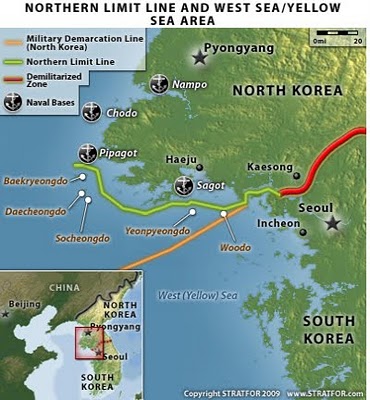
North Korea felt justified in retaliating against the South Korean shelling on November 23 because the nearly 4,000 shots the South Korean military fired within a four-hour period emanated from waters Pyongyang considers to be North Korean territory. Although Yeonpyeong Island, and four other nearby islands, were designated as South Korean under the 1953 armistice agreement, the waters surrounding them were not. In 1953, to restrain then-South Korean leader Syngman Rhee from continuing to attack the North, the United States unilaterally drew the NLL, which follows the coast of North Korea approximately 3 miles off-shore.

Not only is the NLL illegitimate because North Korea never agreed to it, international maritime convention considers 12 miles to be the boundary of any country’s waters. Yeonpyeong Island, from which South Korea conducted live artillery drills on November 23 and earlier this week, lies within 12 nautical miles of North Korea’s coastline. North Korea’s insistence that the South was conducting live artillery drills within its territorial boundaries is therefore not without basis.

But it’s not just the North Koreans who think the NLL isn’t legal. On December 17, two Bloomberg reporters discovered secret telegrams sent by former secretary of state Henry Kissinger in 1975 stating that the Northern Limit Line is “clearly contrary to international law.” The confidential February 1975 telegram from Kissinger reads, “As we have noted before (Ref B) Northern Patrol Limit Line does not have international legal status. NPLL was unilaterally established and not accepted by NK. Furthermore, insofar as it purports unilaterally to divide international waters, it is clearly contrary to international law and USG law of the sea position. Armistice provides two sides must respect each other’s “contiguous waters”, which negotiating history indicates would mean as maximum 12 miles.”

The Bloomberg reporters also quote a December 19, 1973 cable to Washington from Ambassador Francis Underhill who wrote, “The ROK and the U.S. might appear in the eyes of a significant number of other countries to be in the wrong” if an incident occurred in disputed areas. According to Mark J. Valencia, a maritime lawyer with the National Bureau of Asian Research, “If it ever went to arbitration, the decision would likely move the line further south.”

According to The New York Times, “Park In-kook, the South Korean ambassador, noted that the line had been established in 1953 and that North Korea had accepted it under a 1992 agreement, diplomats said.” Park may be referring to the North-South Joint Agreement on Reconciliation, Nonaggression, and Cooperation and Exchange, which did not specifically mention the Northern Limit Line, and in fact neither side has implemented it.  The clearest expression of agreement between North and South Korea addressing the disputed West Sea waters was set forth by North and South Korean leaders in their 2007 summit meeting.  In that meeting both sides agreed to establish a “peace zone” in the West Sea. Unfortunately, as soon as President Lee Myung Bak took office in 2008, he backed away from the agreements made in the 2000 and 2007 North – South summit meetings in favor of a more hard-line approach to the North.

Resolving the Stalemate

Since it’s unlikely that Lee Myung Bak will revive the 2007 agreement between North and South Korea, veteran Korea expert Selig Harrison proposed a solution in a New York Times op-ed last week: “The solution could be quite straightforward: the United States should redraw the disputed sea boundary, called the Northern Limit Line, moving it slightly to the south.” It’s that easy. And Harrison asserts that this is possible because “President Obama has the authority to redraw the line” as the United States is still the head of the United Nations Command for Korea. After consulting with Seoul and Pyongyang, the United States should get to work to not only redraw the line but also seriously move toward peace talks. This could be the first priority of the trilateral commission, if it were established.

As I remained fixed to my computer watching for developments and following twitter feeds over the weekend, I couldn’t help but feel both anxious and enraged. This ongoing game of brinkmanship played by our world leaders could have had horrific consequences. As I watched footage of elderly Koreans forced out of their homes and into bunkers, I imagined how traumatic it must have been, especially for the survivors of the Korean War.

Tragically, Koreans on the peninsula and in the diaspora must not only live with the painful memories of the Korean War, which claimed millions of lives and separated millions of families. We must also live with the hard truth that the Korean War is still not over 60 years later and the country remains divided. And all for what purpose and whose objectives? Certainly not for the security of the lives of ordinary Koreans, north and south.

Christine Ahn is a columnist with Foreign Policy In Focus, a policy analyst with the Korea Policy Institute, and a member of the National Campaign to End the Korean War.

http://www.fpif.org/articles/resolving_the_face-off_in_korea?utm_source=feedburner&utm_medium=feed&utm_campaign=Feed%3A+FPIF+%28Foreign+Policy+In+Focus+%28All+News%29%29&utm_content=FeedBurner

Community resists military expansion on Jeju Island

Thanks to Bruce Gagnon for posting these updates on the critical situation in Jeju island, Korea, where villagers are resisting the construction of a new military base.

Mon 12/27/2010 12:54 PM

RESISTANCE BEGINS ON JEJU ISLAND

I got these photos from a Jeju Island media outlet….you can see more of them if you click here

I’ve not yet heard from Sung-Hee Choi yet, she might have been arrested for all I know.

It is obvious that the Navy has pushed through with their cement trucks and will now begin to pour concrete over the sea life that lives among the rocks along the coastline of the Gangjeong village.

All of this in order to build a Navy base that is needed as the U.S. Navy builds more ships and deploys them in the region. Maine’s Sen. Olympia Snowe (Republican) has said over and over again to the media in our state that more Navy ships are needed to “protect” against China’s expanding power. There can be now doubt that this base has nothing to do with North Korea. It is all about projecting power toward China in order to block their ability to import oil on ships along the waterway between Jeju Island and mainland China. The Chinese import 80% of their oil via this sea route and if the U.S. can successfully “choke off” their ability to transport oil then the U.S., who can’t compete with China’s growing economy, would be able to still hold the “keys” to their economic engine.

It is hardball politics that the U.S. is playing here in this expensive and dangerous game. The people on Jeju Island, sadly enough, are just pawns in the way of imperial designs.
Bruce K. Gagnon
Coordinator
Global Network Against Weapons & Nuclear Power in Space
PO Box 652
Brunswick, ME 04011
(207) 443-9502
globalnet@mindspring.com
www.space4peace.org
http://space4peace.blogspot.com/ (blog)

Mon 12/27/2010 4:34 AM

NAVY MAKES MOVE TODAY ON JEJU ISLAND

As I write this the people of the Gangjeong village on Jeju Island in South Korea are in the midst of the fight of their lives. It is today that they face down the Navy and the plans to destroy their sacred coastline for the Navy base where U.S. Aegis destroyers (built here in Bath, Maine) will be ported.

As I write this they might be sitting in the road trying to block the construction machinery from beginning work. They might be getting arrested in large numbers. They are so isolated and few around the world know anything of their struggle to save the rocks, the water, the coral, the fish and their way of life.

On Christmas day a Catholic mass was held for the villagers along the rocky coastline by the Bishop of Jeju Island. Below is the latest report we got from Global Network board member Sung-Hee Choi who has been at the village for the last couple of weeks standing with the people and helping to spread word about their fight to others in Korea and around the world:

In the Joongduk coast – the planned naval base area – snowflakes fell onto the beautiful coast rocks and sea, as well, displaying a mysterious view as the sea horizon became clouded. It was a terrible feeling to think that the most beautiful rocks and sea in the Jeju Island might be covered with concrete if the naval base construction is enforced.

At 3:00 pm, there was a peace mass, called, ‘the Christmas missal to save life and peace of the Jeju Island,’ lead by Fr. Kang Woo-Il, Chairman of the Catholic Bishops’ Conference of Korea & the Bishop of the Catholic Jeju district, along with many fathers and nuns in the Jeju island. The event was hosted by the Special Committee for the Island of Peace, Catholic Jeju district. About 400~500 followers and Gangjeong villagers gathered and represented their will to save the Jeju island of Peace from the naval base construction.

Bishop Kang Woo-Il led the mass and said, “Military base cannot save peace and life”
and that he “would be together with the lonely and oppressed Gangjeong villagers.”

The least we can do is to let others know about this terrible moment so that the valiant struggle of the Gangjeong villagers is not done without the world knowing about it. Please pass on word about this and also call the South Korean embassy in your country and protest the construction of the Navy base for U.S. warships on Jeju Island.

As you can see in the small yellow signs being held by the people in the crowd that read “No War” the villagers understand that construction of this Navy base, so close to China’s coastline, is a wildly provocative move in the U.S. military strategy to surround China. It will only bring more conflict to their part of the world.

Bruce K. Gagnon
Coordinator
Global Network Against Weapons & Nuclear Power in Space
PO Box 652
Brunswick, ME 04011
(207) 443-9502
globalnet@mindspring.com
www.space4peace.org
http://space4peace.blogspot.com/ (blog)

Harriet Hanako Hanzawa/Kondo’s Instructions for War

Source: http://hawaiinewsdaily.com/2010/12/harriet-hanako-hanzawakondo%E2%80%99s-instructions-for-war/

Harriet Hanako Hanzawa/Kondo’s Instructions for War

1:53 pm

By Dwight Kondo

by Dwight Kondo

Puna, Hawaiian Kingdom

1338-121610

My mother’s instruction, as my father and she waited with me at Honolulu International Airport, was simple though incongruent with sending a son to War. As the other soldiers began to line up to board, she broke her silence and seemed to search with teary eyes for a message that would protect and bring me home safely from Vietnam. I had volunteered to go.

She then became momentarily stern. Seriousness veiled her fears and she gave me her orders in a tone she might have used when I was leaving home as a child to visit and stay with a significant aunt. I was her first and only to go to War.

Mother’s instructions, as I think back now, were profound. Perhaps, if more mothers had given the same instructions to soldier/sons over the last 10,000 years, things would not be as they are today.

Breaking the silence she turned abruptly to me as other soldiers began shuffling past. This was her transmission:

DON’T KILL ANYONE.

DON’T GET KILLED.

And finally, spoken as a wizen Nisei daughter of the War years with the US Fleet in Pearl Harbor:

And…DON’T DO ANYTHING DIRTY!

I realized when I arrived ‘In Country’ and looked around a bit, Mother meant for me to stay out of the brothels so common to War. During her War, her family lived on School Street less than a thousand feet mauka up Nu’uanu Stream from the brothels of Smith and Pauahi Streets in Chinatown and infamous Hotel Street. Mother told me that the girls who served there, especially the Japanese ones, pitifully, were referred to as Kamikazis

When I got my ‘boonies hat’ I took it to the seamstress at Long Binh and had her embroider a title from Three Dog Night: MAMA TOLD ME NOT TO COME.

I never realized its double meaning.

My father, that night mostly quiet, stepped forward, shook my hand and advised me to take care of myself and said, “Good Luck”. I boarded the chartered United Airlines jet full of soldiers. I wondered, as no doubt all the others on board, how many of us would be coming home in a year. There seemed no friendships starting here and, aside from the kindness of the older stewardesses, it was a quiet and introspective flight. Bewildered. In less than a day, the doors of the jet opened up to the blast of the tropical heat of Ton Son Nhut Airport, Saigon. We had each come alone to Vietnam to experience the mystery of War. In some 364 days, we each had to go back home alone, if at all.

Legend has it that in War, the seriously wounded or dying cry out to their mothers. I can only imagine that ultimately, the sins and horror of War most deeply offends any mother. More than any other, She has brought forth our lives and patiently taught the toddlers to walk. And when these babies march off to War, I bet she worries most if she will ever hear those footsteps again.

Deep down, more than our warrior machismo dares admit, we know this. If and when we are ever afraid of dying, we know it is She that will be hurt the most.

Mother recently related a conversation she had in the Hawaii Kai Long’s Drugs. While talking to a man in US Army uniform, she related to him that her son had gone to Vietnam. When he asked how I had fared, she said I was unscathed. Then she added that I never really came home, either. The older soldier said, maybe to comfort her to know that as a Mother of a soldier, most of us never do. I believe I would say the same thing, too, if it were me explaining War gently to a Mother.

My mother’s instruction for me in War was Mercy. I am so grateful that I could heed her instructions. When I see her now I know when she reviews Life, if there is such a place, she will not be ashamed of what her child did in times of War. That the child she bore did not become one of the monsters that have too long humiliated us all. That she, as a Mother, had done her duty.

ATSDR Late with Vieques Report

Source:  http://www.elnuevodia.com/retrasadoelinformedeatsdr-831633.html

ATSDR Late with Vieques Report

Concern within the scientific Community

by José A. Delgado jdelgado@elnuevodia.com

WASHINGTON – The confidentiality with which the Federal Agency for Toxic Substances and Disease Registry (ATSDR) has handled the report that would officially discard conclusions made a decade ago that minimized health damages caused by military maneuvers on Vieques provokes concern within the
scientific community.

“They were supposed to act with diligence, speed and transparency, but we’ve seen none of these things”, said biologist, Arturo Massol, professor at the University of Puerto Rico/Mayaguez and one of the scientists who participated in a forum in November of 2009 in Atlanta, in which the head of
ATSDR made initial commitment to discard conclusions based upon previous studies.

After a preliminary declaration in November, 2009, to announce the agency’s decision to discard previous conclusions that rejected a causal relationship between Navy actions and negative effects in health of Viequenses, the next step was to put out the draft report last May.

The plan was to submit the report to public comment in May, 2010 for later review by the Federal Health Department. Then, public hearings were to take place in Vieques during the summer.

More than six months have passed and the report has circulated only amongst a small group, without any public discussion.

“They didn’t fulfill their promises”, recognized Puerto Rico’s Resident Commissioner in Washington, Pedro Pierluisi, who asked ATSDR interim director, Henry Falk, for a second meeting to clear up the situation.

Falk asked for time to prepare the meeting, according to Pierluisi.

Massol sustained that he knows at least one UPR/Mayaguez professor invited to comment on the draft report. “ They’ve circulated a document but have not discussed it with the participants in the November, 2009 Atlanda forum”, Massol added.

In conversation last week, Pierluisi suggested he had a copy of the report, but if this is true, he has also kept it confidential.

It also said it would recommend ‘biological monitoring’ on Vieques and a collaborative agreement with the PR Health Department to carry out an exhaustive health study on the island municipality.

It is rumored that new ATSDR recommendations might be included in the report by the White House Inter Agency Group on Puerto Rico that should come out this month. “I don’t know that’s the plan, but Vieques will be part of the White House report”, Pierluisi indicated

In November, 2009, after Puerto Rican scientists like Massol, Carmen Ortiz Roque and Carmen Colón de Jorge confronted ATSDR researches with their own studies, the federal agency announced it was discarding ‘some’ of the conclusions about contamination on Vieques.

It is also feared that the Federal Government looks to soften ATSDR policy change, since a law suit continues involving 7000 Viequenses related to adverse health effects from military exercises on Vieques.

Last week the Viequenses, through their lawyer, John Arthur Eaves, Jr., appealed the decision by San Juan federal judge, Daniel Dominguez, who dismissed Viequenses claims that the federal government make reparations for health damages.

In the past, Pierluisi has stated that “logic and common sense tells me that high levels of cancer and other chronic illnesses (on Vieques) must be related to the military practices”.

“Access Denied”: Air Force blocks access to sites that post Wikileaks secrets

According to the New York Times, the Air Force is blocking access to websites that post secret documents leaked by Wikileaks.  Here’s an excerpt:

WASHINGTON — The Air Force is barring its personnel from using work computers to view the Web sites of The New York Times and more than 25 other news organizations and blogs that have posted secret cables obtained by WikiLeaks, Air Force officials said Tuesday.

When Air Force personnel on the service’s computer network try to view the Web sites of The Times, the British newspaper The Guardian, the German magazine Der Spiegel, the Spanish newspaper El País and the French newspaper Le Monde, as well as other sites that posted full confidential cables, the screen says “Access Denied: Internet usage is logged and monitored,” according to an Air Force official whose access was blocked and who shared the screen warning with The Times. Violators are warned that they face punishment if they try to view classified material from unauthorized Web sites.

READ THE FULL ARTICLE

Wikileaks reveals the secret soft underbelly of American Empire

The Honolulu Star Advertiser reported:

WASHINGTON >> In a disclosure of some of the most sensitive information revealed yet by WikiLeaks, the website has released a secret cable listing sites worldwide that the U.S. considers critical to its national security.

The locations cited in the diplomatic cable from U.S. Secretary of State Hillary Rodham Clinton range from undersea communications lines to suppliers of food, medicine and manufacturing materials.

READ THE FULL ARTICLE HERE

The leaked cable lists sites that would make a secret map of the soft underbelly of the American Empire.  Here is the Wikileaks document:

INFO  LOG-00   MFA-00   EEB-00   AF-00    AGRE-00  AIT-00   AMAD-00 AOP-00   AEX-00   AS-00    A-00     ACQ-00   CIAE-00  CIP-00 COME-00  CCOE-00  CPR-00   INL-00   DNI-00   DIM-00   DODE-00 DOEE-00  WHA-00   PERC-00  DS-00    EAP-00   DHSE-00  EUR-00 FBIE-00  VCI-00   FSI-00   OBO-00   TEDE-00  INR-00   IO-00 CAC-00   MED-07   MFLO-00  MMP-00   MOFM-00  MOF-00   M-00 CDC-00   VCIE-00  NEA-00   DCP-00   NRC-00   NSAE-00  ISN-00 OES-00   OIG-00   NIMA-00  PM-00    P-00     ISNE-00  DOHS-00 FMPC-00  IRM-00   SSO-00   SS-00    MR-00    TRSE-00  CBP-00 EPAE-00  SCRS-00  PMB-00   DSCC-00  PRM-00   DRL-00   G-00 ALM-00   SCA-00   SAS-00   FA-00    PMA-00   SWCI-00    /007R

P 182318Z FEB 09

FM SECSTATE WASHDC

TO PAGE 02        STATE   015113  182333Z

ALL DIPLOMATIC POSTS COLLECTIVE PRIORITY

AMEMBASSY TRIPOLI PRIORITY

S E C R E T STATE 015113

NOFORN, NOT FOR INTERNET DISTRIBUTION

E.O. 12958: DECL: 1/29/2019

TAG PTER, PGOV, ASEC, EFIN, ENRG, KCIP

SUBJECT: REQUEST FOR INFORMATION:CRITICAL FOREIGN DEPENDENCIES (CRITICAL INFRASTRUCTURE AND KEY RESOURCES LOCATED ABROAD)

REF: STATE 6461  PLEASE PASS TO RSO, POLOFF, ECON, and MANAGEMENT (GSO and IT).  Classified by S/CT DAS, Susan F. Burk, Reason: 1/4 (B), (D), (E), and (G)

¶1. (U//FOUO) This is an action request; see Para. 13.

¶2. (U//FOUO) Under the direction of the Department of Homeland Security (DHS), the National Infrastructure Protection Plan (NIPP) was written to provide the unifying structure for the integration of critical infrastructure and key resources (CI/KR) protection into a single national program. The overarching goal of the NIPP is to build a safer, more secure, and more resilient America by enhancing protection of the nation’s CI/KR to prevent, deter, neutralize or mitigate the effects of deliberate efforts by terrorists to destroy, incapacitate or exploit them; and to strengthen national preparedness, timely response, and rapid recovery in the event of an attack, natural disaster or other emergency.

¶3. (U//FOUO) In addition to a list of critical domestic CI/KR, the NIPP requires compilation and annual update of a comprehensive inventory of CI/KR that are located outside U.S. borders and whose loss could critically impact the public health, economic security, and/or national and homeland security of the United States. DHS in collaboration with State developed the Critical Foreign Dependencies Initiative (CFDI)to identify these critical U.S. foreign dependencies — foreign CI/KR that may affect systems within the U.S. directly or indirectly. State is coordinating with DHS to develop the 2009 inventory, and the action request in Para. 13 represents the initial step in this process.

¶4. (U//FOUO) The NIPP does not define CI/KR. Homeland Security Presidential Directive 7 (HSPD 7) references definitions in two separate statutes. In the USA Patriot Act of 2001 (42 U.S.C. 5195(e)) “critical infrastructure” is defined as systems and assets, whether physical or virtual, so vital to the United States the incapacitation or destruction of such systems and assets would have a debilitating impact on security, national economic security, national public health or safety, or any combination of those matters. In the Homeland Security Act of 2002 (6 U.S.C. 101(9)) “key resources” are defined as publicly or privately controlled resources essential to the minimal operations of the economy and government.

¶5. (U//FOUO) The NIPP identifies 18 CI/KR sectors: agriculture and food; defense industrial base; energy; healthcare and public health; national monuments and icons; banking and finance; drinking water and water treatment systems; chemical; commercial facilities; dams; emergency services; commercial nuclear reactors, materials, and waste; information technology; communications; postal and shipping; transportation and systems; government facilities; and critical manufacturing. Obviously some of these sectors are more likely to have international components than other sectors.

¶6. (U//FOUO) Department is surveying posts for their input on critical infrastructure and key resources within their host country which, if destroyed, disrupted or exploited, would likely have an immediate and deleterious effect on the United States. We expect posts, after consultation among all sections and agencies, will in many instances immediately recognize whether such CI/KR exist in their host country. Posts are not/not being asked to consult with host governments with respect to this request.

¶7. (U//FOUO) Building upon the initial survey completed in 2008, Department requests each post reassess and update information about infrastructure and resources in each host country whose loss could immediately affect the public health, economic security, and/or national and homeland security of the United States. This reassessment may include suggestions from posts for removing, modifying, or adding CI/KR to the list developed in 2008 (see the list of CI/KR identified in 2008 in Para. 15 below).

¶8. (U//FOUO) The following three categories should be considered when determining whether critical foreign dependencies exist in the host country: 1) direct physical linkages (e.g., pipelines, undersea telecommunications cables, and assets located in close enough proximity to the U.S. border their destruction could cause cross-border consequences, such as damage to dams and chemical facilities); 2) sole or predominantly foreign/host-country sourced goods and services (e.g., minerals or chemicals critical to U.S. industry, a critical finished product manufactured in one or only a small number of countries, or a telecom hub whose destruction might seriously disrupt global communications); and 3) critical supply chain nodes (e.g., the Strait of Hormuz and Panama Canal, as well as any ports or shipping lanes in the host-country critical to the functioning of the global supply chain).

¶9. (U//FOUO) Although they are important issues, Department is not/not seeking information at this time on second-order effects (e.g., public morale and confidence, and interdependency effects that might cascade from a disruption).

¶10. (U//FOUO) Posts do not need to report government facilities overseas managed by State or war fighting facilities managed by other departments or agencies.

¶11. (U//FOUO) The following general information should be addressed when nominating elements for inclusion, removal, or modification:  — (U//FOUO) Name and physical location of the asset, system, or supply chain node.  — (U//FOUO) Post’s rationale for including, modifying, or removing an asset, system, or supply chain node.  — (U//FOUO) Any information Post has regarding conditions in country causing Post to believe the CI/KR is an active target or especially vulnerable due to natural circumstances.  — (U//FOUO) Any information Post has regarding CIP activities in country and who/what agency is responsible for those activities.

¶12. (U//FOUO) Questions can be directed to Sharri R. Clark in S/CT: ClarkSR@state.sgov.gov; ClarkSR@state.gov; 202-647-1514. Alternatively, questions can be directed to S. Gail Robertson in S/CT: RobertsonSG2@state.sgov.gov; RobertsonSG@state.gov, 202-647-3769.

¶13. (U//FOUO) ACTION REQUEST: Posts are requested to report by March 20, 2009 on CI/KR in their host country meeting the criteria outlined above and a brief explanation of why posts believes the asset meets the criteria. Due to the potential sensitivity of assets identified, posts are asked to consider the necessity of classifying their responses appropriately. Please note the list in its entirety is classified S/NF. If post determines there are no such CI/KR in its host country, a negative report is requested. Please send replies to the attention of Sharri R. Clark in S/CT and use the subject line “CI/KR Response for S/CT”.

¶14. (U//FOUO) Posts’ assistance with providing input to the first list created in 2008 was invaluable, and Department appreciates Posts’ continuing cooperation.

¶15. (S//NF) Following is the 2008 Critical Foreign Dependencies Initiative (CFDI) list (CI/KR organized by region):  [BEGIN TEXT OF LIST]

AFRICA Congo (Kinshasa): Cobalt (Mine and Plant)  Gabon: Manganese – Battery grade, natural; battery grade, synthetic; chemical grade; ferro; metallurgical grade  Guinea: Bauxite (Mine)  South Africa: BAE Land System OMC, Benoni, South Africa Brown David Gear Industries LTD, Benoni, South Africa Bushveld Complex (chromite mine) Ferrochromium Manganese – Battery grade, natural; battery grade, synthetic; chemical grade; ferro; metallurgical grade Palladium Mine and Plant Platinum Mines Rhodium    EAST ASIA AND THE PACIFIC  Australia: Southern Cross undersea cable landing, Brookvale, Australia Southern Cross undersea cable landing, Sydney, Australia Manganese – Battery grade, natural; battery grade, synthetic; chemical grade; ferro; metallurgical grade Nickel Mines Maybe Faulding Mulgrave Victoria, Australia: Manufacturing facility for Midazolam injection. Mayne Pharma (fill/finish), Melbourne, Australia:  Sole suppliers of Crotalid Polyvalent Antivenin (CroFab).  China: C2C Cable Network undersea cable landing, Chom Hom Kok, Hong Kong C2C Cable Network undersea cable landing Shanghai, China China-US undersea cable landing, Chongming, China China-US undersea cable landing Shantou, China EAC undersea cable landing Tseung Kwan O, Hong Kong FLAG/REACH North Asia Loop undersea cable landing Tong Fuk, Hong Kong Hydroelectric Dam Turbines and Generators Fluorspar (Mine) Germanium Mine Graphite Mine Rare Earth Minerals/Elements Tin Mine and Plant Tungsten – Mine and Plant Polypropylene Filter Material for N-95 Masks Shanghai Port Guangzhou Port Hong Kong Port Ningbo Port Tianjin Port  Fiji: Southern Cross undersea cable landing, Suva, Fiji  Indonesia: Tin Mine and Plant Straits of Malacca  Japan: C2C Cable Network undersea cable landing, Chikura, Japan C2C Cable Network undersea cable landing, Shima, Japan China-US undersea cable, Okinawa, Japan EAC undersea cable landing Ajigaura, Japan EAC undersea cable landing Shima, Japan FLAG/REACH North Asia Loop undersea cable landing Wada, Japan FLAG/REACH North Asia Loop undersea cable landing Wada, Japan Japan-US undersea cable landing, Maruyama, Japan Japan-US undersea cable landing Kitaibaraki, Japan KJCN undersea cable landing Fukuoka, Japan KJCN undersea cable landing Kita-Kyushu, Japan Pacific Crossing-1 (PC-1) undersea cable landing Ajigaura, Japan Pacific Crossing-1 (PC-1) undersea cable landing Shima, Japan Tyco Transpacific undersea cable landing, Toyohashi, Japan Tyco Transpacific undersea cable landing Emi, Japan Hitachi, Hydroelectric Dam Turbines and Generators Port of Chiba Port of Kobe Port of Nagoya Port of Yokohama Iodine Mine Metal Fabrication Machines Titanium Metal (Processed) Biken, Kanonji City, Japan Hitachi Electrical Power Generators and Components Large AC Generators above 40 MVA  Malaysia: Straits of Malacca  New Zealand: Southern Cross undersea cable landing, Whenuapai, New Zealand Southern Cross undersea cable landing, Takapuna, New Zealand  Philippines: C2C Cable Network undersea cable landing, Batangas, Philippines EAC undersea cable landing Cavite, Philippines  Republic of Korea: C2C Cable Network undersea cable landing, Pusan, Republic of Korea. EAC undersea cable landing Shindu-Ri, Republic of Korea FLAG/REACH North Asia Loop undersea cable landing Pusan, Republic of Korea KJCN undersea cable landing Pusan, Republic of Korea Hitachi Large Electric Power Transformers 230 – 500 kV Busan Port  Singapore: C2C Cable Network undersea cable landing, Changi, Singapore EAC undersea cable landing Changi North, Singapore Port of Singapore Straits of Malacca  Taiwan: C2C Cable Network undersea cable landing, Fangshan, Taiwan C2C Cable Network undersea cable landing, Tanshui, Taiwan China-US undersea cable landing Fangshan, Taiwan EAC undersea cable landing Pa Li, Taiwan FLAG/REACH North Asia Loop undersea cable landing Toucheng, Taiwan Kaohsiung Port    EUROPE AND EURASIA  Europe (Unspecified): Metal Fabrication Machines: Small number of Turkish companies (Durma, Baykal, Ermaksan)  Austria: Baxter AG, Vienna, Austria: Immune Globulin Intravenous (IGIV) Octapharma Pharmazeutika, Vienna, Austria: Immune Globulin Intravenous (IGIV)  Azerbaijan: Sangachal Terminal Baku-Tbilisi-Ceyhan Pipeline  Belarus: Druzhba Oil Pipeline  Belgium: Germanium Mine Baxter SA, Lessines, Belgium: Immune Globulin Intravenous (IGIV) Glaxo Smith Kline, Rixensart, Belgium: Acellular Pertussis Vaccine Component GlaxoSmithKline Biologicals SA, Wavre, Belgium: Acellular Pertussis Vaccine Component Port of Antwerp  Denmark: TAT-14 undersea cable landing, Blaabjerg, Denmark Bavarian Nordic (BN), Hejreskovvej, Kvistgard, Denmark: Smallpox Vaccine Novo Nordisk Pharmaceuticals, Inc. Bagsvaerd, Denmark: Numerous formulations of insulin Novo Nordisk Insulin Manufacturer: Global insulin supplies Statens Serum Institut, Copenhagen, Denmark:  DTaP (including D and T components) pediatric version  France: APOLLO undersea cable, Lannion, France FA-1 undersea cable, Plerin, France TAT-14 undersea cable landing St. Valery, France Sanofi-Aventis Insulin Manufacturer: Global insulin supplies Foot and Mouth Disease Vaccine finishing Alstrom, Hydroelectric Dam Turbines and Generators Alstrom Electrical Power Generators and Components EMD Pharms Semoy, France: Cyanokit Injection GlaxoSmithKline, Inc. Evreux, France: Influenza neurominidase inhibitor RELENZA (Zanamivir) Diagast, Cedex, France: Olympus (impacts blood typing ability) Genzyme Polyclonals SAS (bulk), Lyon, France: Thymoglobulin Sanofi Pasteur SA, Lyon, France: Rabies virus vaccine  Georgia: Baku-Tbilisi-Ceyhan Pipeline  Germany: TAT-14 undersea cable landing, Nodren, Germany. Atlantic Crossing-1 (AC-1) undersea cable landing Sylt, Germany BASF Ludwigshafen: World’s largest integrated chemical complex Siemens Erlangen: Essentially irreplaceable production of key chemicals Siemens, GE, Hydroelectric Dam Turbines and Generators Draeger Safety AG & Co., Luebeck, Germany: Critical to gas detection capability Junghans Fienwerktechnik Schramberg, Germany: Critical to the production of mortars TDW-Gasellschaft Wirksysteme, Schroebenhausen, Germany: Critical to the production of the Patriot Advanced Capability Lethality Enhancement Assembly Siemens, Large Electric Power Transformers 230 – 500 kV Siemens, GE Electrical Power Generators and Components Druzhba Oil Pipeline Sanofi Aventis Frankfurt am Main, Germany: Lantus Injection (insulin) Heyl Chemish-pharmazeutische Fabrik GmbH: Radiogardase (Prussian blue) Hameln Pharmaceuticals, Hameln, Germany: Pentetate Calcium Trisodium (Ca DTPA) and Pentetate Zinc Trisodium (Zn DTPA) for contamination with plutonium, americium, and curium IDT Biologika GmbH, Dessau Rossiau, Germany: BN Small Pox Vaccine. Biotest AG, Dreiech, Germany: Supplier for TANGO (impacts automated blood typing ability) CSL Behring GmbH, Marburg, Germany: Antihemophilic factor/von Willebrand factor Novartis Vaccines and Diagnostics GmbH, Marburg, Germany: Rabies virus vaccine Vetter Pharma Fertigung GmbH & Co KG, Ravensburg, Germany (filling): Rho(D) IGIV Port of Hamburg  Ireland: Hibernia Atlantic undersea cable landing, Dublin Ireland Genzyme Ireland Ltd. (filling), Waterford, Ireland: Thymoglobulin  Italy: Glaxo Smith Kline SpA (fill/finish), Parma, Italy: Digibind (used to treat snake bites) Trans-Med gas pipeline  Netherlands: Atlantic Crossing-1 (AC-1) undersea cable landing Beverwijk, Netherlands TAT-14 undersea cable landing, Katwijk, Netherlands Rotterdam Port  Norway: Cobalt Nickel Mine  Poland: Druzhba Oil Pipeline  Russia: Novorossiysk Export Terminal Primorsk Export Terminal. Nadym Gas Pipeline Junction: The most critical gas facility in the world Uranium Nickel Mine: Used in certain types of stainless steel and superalloys Palladium Mine and Plant Rhodium  Spain: Strait of Gibraltar Instituto Grifols, SA, Barcelona, Spain: Immune Globulin Intravenous (IGIV) Maghreb-Europe (GME) gas pipeline, Algeria  Sweden: Recip AB Sweden: Thyrosafe (potassium iodine)  Switzerland: Hoffman-LaRoche, Inc. Basel, Switzerland: Tamiflu (oseltamivir) Berna Biotech, Berne, Switzerland: Typhoid vaccine CSL Behring AG, Berne, Switzerland: Immune Globulin Intravenous (IGIV)  Turkey: Metal Fabrication Machines: Small number of Turkish companies (Durma, Baykal, Ermaksan) Bosporus Strait Baku-Tbilisi-Ceyhan Pipeline  Ukraine: Manganese – Battery grade, natural; battery grade, synthetic; chemical grade; ferro; metallurgical grade  United Kingdom: Goonhilly Teleport, Goonhilly Downs, United Kingdom Madley Teleport, Stone Street, Madley, United Kingdom Martelsham Teleport, Ipswich, United Kingdom APOLLO undersea cable landing Bude, Cornwall Station, United Kingdom Atlantic Crossing-1 (AC-1) undersea cable landing Whitesands Bay FA-1 undersea cable landing Skewjack, Cornwall Station Hibernia Atlantic undersea cable landing, Southport, United Kingdom TAT-14 undersea cable landing Bude, Cornwall Station, United Kingdom Tyco Transatlantic undersea cable landing, Highbridge, United Kingdom Tyco Transatlantic undersea cable landing, Pottington, United Kingdom. Yellow/Atlantic Crossing-2  (AC-2)  undersea cable landing  Bude, United Kingdom Foot and Mouth Disease Vaccine finishing BAE Systems (Operations) Ltd., Presont, Lancashire, United Kingdom: Critical to the F-35 Joint Strike Fighter BAE Systems Operations Ltd., Southway, Plymouth Devon, United Kingdom: Critical to extended range guided munitions BAE Systems RO Defense, Chorley, United Kingdom: Critical to the Joint Standoff Weapon (JSOW) AGM-154C (Unitary Variant) MacTaggart Scott, Loanhead, Edinburgh, Lothian, Scotland, United Kingdom: Critical to the Ship Submersible Nuclear (SSN)    NEAR/MIDDLE EAST  Djibouti: Bab al-Mendeb: Shipping lane is a critical supply chain node  Egypt: ‘Ayn Sukhnah-SuMEd Receiving Import Terminal ‘Sidi Kurayr-SuMed Offloading Export Terminal Suez Canal  Iran: Strait of Hormuz Khark (Kharg) Island Sea Island Export Terminal Khark Island T-Jetty  Iraq: Al-Basrah Oil Terminal  Israel: Rafael Ordnance Systems Division, Haifa, Israel: Critical to Sensor Fused Weapons (SFW), Wind Corrected Munitions Dispensers (WCMD), Tail Kits, and batteries  Kuwait: Mina’ al Ahmadi Export Terminal  Morocco: Strait of Gibraltar Maghreb-Europe (GME) gas pipeline, Morocco  Oman: Strait of Hormuz  Qatar: Ras Laffan Industrial Center: By 2012 Qatar will be the largest source of imported LNG to U.S.  Saudi Arabia: Abqaiq Processing Center: Largest crude oil processing and stabilization plant in the world Al Ju’aymah Export Terminal: Part of the Ras Tanura complex As Saffaniyah Processing Center Qatif Pipeline Junction Ras at Tanaqib Processing Center Ras Tanura Export Terminal Shaybah Central Gas-oil Separation Plant  Tunisia: Trans-Med Gas Pipeline  United Arab Emirates (UAE): Das Island Export Terminal Jabal Zannah Export Terminal Strait of Hormuz  Yemen: Bab al-Mendeb: Shipping lane is a critical supply chain node  SOUTH AND CENTRAL ASIA  Kazakhstan: Ferrochromium Khromtau Complex, Kempersai, (Chromite Mine)  India: Orissa (chromite mines) and Karnataka (chromite mines) Generamedix Gujurat, India: Chemotherapy agents, including florouracil and methotrexate    WESTERN HEMISPHERE  Argentina: Foot and Mouth Disease Vaccine finishing  Bermuda: GlobeNet (formerly Bermuda US-1 (BUS-1) undersea cable landing Devonshire, Bermuda  Brazil: Americas-II undersea cable landing Fortaleza, Brazil GlobeNet undersea cable landing Fortaleza, Brazil GlobeNet undersea cable landing Rio de Janeiro, Brazil Iron Ore from Rio Tinto Mine Manganese – Battery grade, natural; battery grade, synthetic; chemical grade; ferro; metallurgical grade Niobium (Columbium), Araxa, Minas Gerais State (mine) Ouvidor and Catalao I, Goias State: Niobium  Chile: Iodine Mine  Canada: Hibernia Atlantic undersea cable landing Halifax , Nova Scotia, Canada James Bay Power Project, Quebec: monumental hydroelectric power development Mica Dam, British Columbia: Failure would impact the Columbia River Basin. Hydro Quebec, Quebec: Critical irreplaceable source of power to portions of Northeast U. S. Robert Moses/Robert H. Saunders Power, Ontario: Part of the St. Lawrence Power Project, between Barnhart Island, New York, and Cornwall, Ontario Seven Mile Dam, British Columbia: Concrete gravity dam between two other hydropower dams along the Pend d’Oreille River Pickering Nuclear Power Plant, Ontario, Canada Chalk River Nuclear Facility, Ontario: Largest supplier of medical radioisotopes in the world Hydrofluoric Acid Production Facility, Allied Signal, Amherstburg, Ontario Enbridge Pipeline Alliance Pipeline: Natural gas transmission from Canada Maritime and Northeast Pipeline: Natural gas transmission from Canada Transcanada Gas: Natural gas transmission from Canada Alexandria Bay POE, Ontario: Northern border crossing Ambassador Bridge POE, Ontario: Northern border crossing Blaine POE, British Columbia: Northern border crossing Blaine Washington Rail Crossing, British Columbia Blue Water Bridge POE, Ontario: Northern border crossing Champlain POE, Quebec: Northern border crossing CPR Tunnel Rail Crossing, Ontario (Michigan Central Rail Crossing) International Bridge Rail Crossing, Ontario International Railway Bridge Rail Crossing Lewiston-Queenstown POE, Ontario: Northern border crossing Peace Bridge POE, Ontario: Northern border crossing Pembina POE, Manitoba: Northern border crossing North Portal Rail Crossing, Saskatchewan St. Claire Tunnel Rail Crossing, Ontario Waneta Dam, British Columbia: Earthfill/concrete hydropower dam Darlington Nuclear Power Plant, Ontario, Canada. E-ONE Moli Energy, Maple Ridge, Canada: Critical to production of various military application electronics General Dynamics Land Systems – Canada, London Ontario, Canada: Critical to the production of the Stryker/USMC LAV Vehicle Integration Raytheon Systems Canada Ltd. ELCAN Optical Technologies Division, Midland, Ontario, Canada: Critical to the production of the AGM-130 Missile Thales Optronique Canada, Inc., Montreal, Quebec: Critical optical systems for ground combat vehicles Germanium Mine Graphite Mine Iron Ore Mine Nickel Mine Niobec Mine, Quebec, Canada:  Niobium Cangene, Winnipeg, Manitoba: Plasma Sanofi Pasteur Ltd., Toronto, Canada: Polio virus vaccine GlaxoSmithKile Biologicals, North America, Quebec, Canada: Pre-pandemic influenza vaccines  French Guiana: Americas-II undersea cable landing Cayenne, French Guiana  Martinique: Americas-II undersea cable landing Le Lamentin, Martinique  Mexico: FLAG/REACH North Asia Loop undersea cable landing Tijuana, Mexico Pan-American Crossing (PAC) undersea cable landing Mazatlan, Mexico Amistad International Dam: On the Rio Grande near Del Rio, Texas and Ciudad Acuna, Coahuila, Mexico Anzalduas Dam: Diversion dam south of Mission, Texas, operated jointly by the U.S. and Mexico for flood control Falcon International Dam: Upstream of Roma, Texas and Miguel Aleman, Tamaulipas, Mexico Retamal Dam: Diversion dam south of Weslaco, Texas, operated jointly by the U.S. and Mexico for flood control GE Hydroelectric Dam Turbines and Generators: Main source for a large portion of larger components Bridge of the Americas: Southern border crossing Brownsville POE: Southern border crossing Calexico East POE: Southern border crossing Columbia Solidarity Bridge: Southern border crossing Kansas City Southern de Mexico (KCSM) Rail Line, (Mexico) Nogales POE: Southern border crossing Laredo Rail Crossing Eagle Pass Rail Crossing Otay Mesa Crossing: Southern border crossing Pharr International Bridge: Southern border crossing World Trade Bridge: Southern border crossing Ysleta Zaragosa Bridge: Southern border crossing Hydrofluoric Acid Production Facility Graphite Mine GE Electrical Power Generators and Components General Electric, Large Electric Power Transformers 230 – 500 kV  Netherlands Antilles: Americas-II undersea cable landing Willemstad, Netherlands Antilles.  Panama: FLAG/REACH North Asia Loop undersea cable landing Fort Amador, Panama Panama Canal  Peru: Tin Mine and Plant  Trinidad and Tobago: Americas-II undersea cable landing Port of Spain Atlantic LNG: Provides 70% of U.S. natural gas import needs  Venezuela: Americas-II undersea cable landing Camuri, Venezuela GlobeNet undersea cable landing, Punta Gorda, Venezuela GlobeNet undersea cable landing Catia La Mar, Venezuela GlobeNet undersea cable landing Manonga, Venezuela  [END TEXT OF LIST]

¶16. (U//FOUO) Minimize considered. CLINTON

South Korea admits to firing the first shot

In his Organizing Notes blog, Bruce Gagnon writes:

South Korea has admitted it was the first to fire the shots in this incident. However it says the firing was part of a military drill, not directed at North Korea.

The U.S. and South Korean forces have been holding aggressive military war games directed at North Korea virtually every month since July. It was only a matter of time before this happened as the South Koreans, led by their right-wing President Lee (dressed in his bomber jacket like George W. Bush liked to do), has been spurred on by the Americans to incite greater tensions in the Korean peninsula.

This particular war game, called the Hoguk Exercise, involved 70,000 South Korean armed forces troops, 600 tracked vehicles, 90 helicopters, 50 warships, and 500 aircraft. The U.S. military is contributing the 31st Marine Expeditionary Unit and 7th Air Force to the land and air training exercises, respectively. Pyongyang regards the exercises as training for an attack on North Korea, citing the fact that it is a large-scale joint South Korea-U.S. exercise encompassing naval fleets, air forces, and land exercises.

Gagnon also writes:

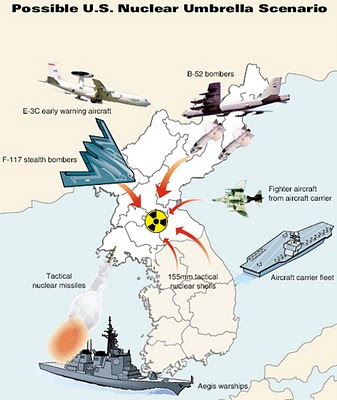
Another key factor to be considered are the recent comments from South Korea’s Defense Minister Kim that called for the U.S. to “redeploy” nuclear weapons on the Korean Peninsula. This kind of dangerous talk had to anger and frighten North Korea.

The maps posted on the blog help to explain the complicated and dangerous situation in the West Sea.  The United Nations declared a Northern Limit Line which extends very close to North Korean territory and far beyond the line that North Korea claims as its maritime border.  The second map shows possible U.S. nuclear attack scenarios.   All of this predictably sets the North Koreans on edge.

korea line

koea