Cental Asia Pipeline Plan Begins to Emerge

Today Bruce Gagnon proposed the following theory about the real motives for a massive new Marine base in a remote part of Afghanistan – construction of an oil pipeline.

>><<

CENTRAL ASIA PIPELINE PLAN BEGINS TO EMERGE
GR2010031400159

pipeline

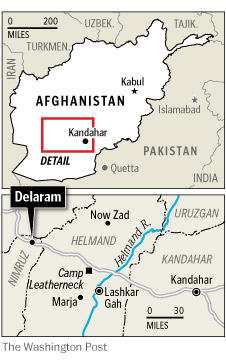
The Washington Post today introduces us this morning to a controversy over Afghanistan war strategy. The Post reports that operations in Delaram (in the southwest) are “far from a strategic priority for senior officers at the international military headquarters in Kabul. One calls Delaram, a day’s drive from the nearest city, ‘the end of the Earth.’ Another deems the area ‘unrelated to our core mission’ of defeating the Taliban by protecting Afghans in their cities and towns.”

Why then are the Marines fighting in this part of the country?

The Post continues, “The Marines are constructing a vast base on the outskirts of town that will have two airstrips, an advanced combat hospital, a post office, a large convenience store and rows of housing trailers stretching as far as the eye can see. By this summer, more than 3,000 Marines — one-tenth of the additional troops authorized by President Obama in December — will be based here.”

Again the Post adds, “They [some officials] question whether a large operation that began last month to flush the Taliban out of Marja, a poor farming community in central Helmand, is the best use of Marine resources. Although it has unfolded with fewer than expected casualties and helped to generate a perception of momentum in the U.S.-led military campaign, the mission probably will tie up two Marine battalions and hundreds of Afghan security forces until the summer.”

And finally the Post reports, “Brig. Gen. Lawrence D. Nicholson, the top Marine commander in Afghanistan now wants Marine units to push through miles of uninhabited desert to establish control of a crossing point for insurgents, drugs and weapons on the border with Pakistan. And he wants to use the new base in Delaram to mount more operations in Nimruz, a part of far southwestern Afghanistan deemed so unimportant that it is one of the only provinces where there is no U.S. or NATO reconstruction team.”

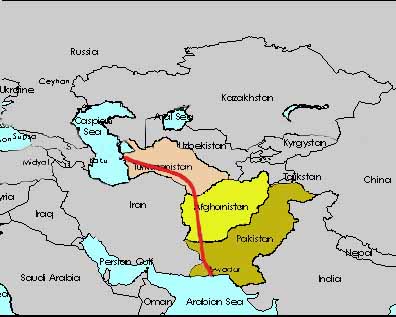
When you check the maps above a clearer picture emerges. The bottom map is the proposed pipeline route to move Caspian Sea oil through Turkmenistan into Afghanistan and then finally through Pakistan to ports along the Arabian Sea where U.S. and British tankers would gorge themselves with the black gold.

The whole reason the U.S. is in Afghanistan and Pakistan today is to deny those pipelines from being routed through Russia, China, or Iran.

Then look at the top map where the U.S. Marines are operating inside Afghanistan and causing some controversy within the military. They are building big bases in desolate southwestern Afghanistan and wanting to extend control in that region near the border of Pakistan – all of which are areas that must “be controlled” if pipelines are to be successfully built and maintained.

It seems quite obvious to me what is going on. I’d like to hear what you think.

Bruce K. Gagnon
Coordinator
Global Network Against Weapons & Nuclear Power in Space
PO Box 652
Brunswick, ME 04011
(207) 443-9502
globalnet@mindspring.com
www.space4peace.org
http://space4peace.blogspot.com/  (blog)

+++

http://www.washingtonpost.com/wp-dyn/content/article/2010/03/13/AR2010031302464.html?hpid=topnews&sid=ST2010031302945

At Afghan outpost, Marines gone rogue or leading the fight against counterinsurgency?

By Rajiv Chandrasekaran
Washington Post Staff Writer
Sunday, March 14, 2010; A01

DELARAM, AFGHANISTAN — Home to a dozen truck stops and a few hundred family farms bounded by miles of foreboding desert, this hamlet in southwestern Afghanistan is far from a strategic priority for senior officers at the international military headquarters in Kabul. One calls Delaram, a day’s drive from the nearest city, “the end of the Earth.” Another deems the area “unrelated to our core mission” of defeating the Taliban by protecting Afghans in their cities and towns.

U.S. Marine commanders have a different view of the dusty, desolate landscape that surrounds Delaram. They see controlling this corner of remote Nimruz province as essential to promoting economic development and defending the more populated parts of southern Afghanistan.

The Marines are constructing a vast base on the outskirts of town that will have two airstrips, an advanced combat hospital, a post office, a large convenience store and rows of housing trailers stretching as far as the eye can see. By this summer, more than 3,000 Marines — one-tenth of the additional troops authorized by President Obama in December — will be based here.

With Obama’s July 2011 deadline to begin reducing U.S. forces looming over the horizon, the Marines have opted to wage the war in their own way.

“If we’re going to succeed here, we have to experiment and take risks,” said Brig. Gen. Lawrence D. Nicholson, the top Marine commander in Afghanistan. “Just doing what everyone else is doing isn’t going to cut it.”

The Marines are pushing into previously ignored Taliban enclaves. They have set up a first-of-its-kind school to train police officers. They have brought in a Muslim chaplain to pray with local mullahs and deployed teams of female Marines to reach out to Afghan women.

The Marine approach — creative, aggressive and, at times, unorthodox — has won many admirers within the military. The Marine emphasis on patrolling by foot and interacting with the population, which has helped to turn former insurgent strongholds along the Helmand River valley into reasonably stable communities with thriving bazaars and functioning schools, is hailed as a model of how U.S. forces should implement counterinsurgency strategy.

But the Marines’ methods, and their insistence that they be given a degree of autonomy not afforded to U.S. Army units, also have riled many up the chain of command in Kabul and Washington, prompting some to refer to their area of operations in the south as “Marineistan.” They regard the expansion in Delaram and beyond as contrary to the population-centric approach embraced by Gen. Stanley A. McChrystal, the U.S. and NATO commander in Afghanistan, and they are seeking to impose more control over the Marines.

The U.S. ambassador in Kabul, Karl W. Eikenberry, recently noted that the international security force in Afghanistan feels as if it comprises 42 nations instead of 41 because the Marines act so independently from other U.S. forces.

“We have better operational coherence with virtually all of our NATO allies than we have with the U.S. Marine Corps,” said a senior Obama administration official involved in Afghanistan policy.

Some senior officials at the White House, at the Pentagon and in McChrystal’s headquarters would rather have many of the 20,000 Marines who will be in Afghanistan by summer deploy around Kandahar, the country’s second-largest city, to assist in a U.S. campaign to wrest the area from Taliban control instead of concentrating in neighboring Helmand province and points west. According to an analysis conducted by the National Security Council, fewer than 1 percent of the country’s population lives in the Marine area of operations.

They question whether a large operation that began last month to flush the Taliban out of Marja, a poor farming community in central Helmand, is the best use of Marine resources. Although it has unfolded with fewer than expected casualties and helped to generate a perception of momentum in the U.S.-led military campaign, the mission probably will tie up two Marine battalions and hundreds of Afghan security forces until the summer.

“What the hell are we doing?” the senior official said. “Why aren’t all 20,000 Marines in the population belts around Kandahar city right now? It’s [Taliban leader] Mullah Omar’s capital. If you want to stuff it to Mullah Omar, you make progress in Kandahar. If you want to communicate to the Taliban that there’s no way they’re returning, you show progress in Kandahar.”

Marines support Marines

Until earlier this month, McChrystal lacked operational control over the Marines, which would have allowed him to move them to other parts of the country. That power rested with a three-star Marine general at the U.S. Central Command. He and other senior Marine commanders insisted that Marines in Afghanistan have a contiguous area of operations — effectively precluding them from being split up and sent to Kandahar — because they think it is essential the Marines are supported by Marine helicopters and logistics units, which are based in Helmand, instead of relying on the Army.

After concern about the arrangement reached the White House, Gen. David H. Petraeus, who heads the Central Command, issued an order in early March giving McChrystal operational control of Marine forces in Afghanistan, according to senior defense officials. But the new authority vested in McChrystal — the product of extensive negotiations among military lawyers — still requires Central Command approval for any plan to disaggregate infantry units from air and logistics support, which will limit his ability to move them, the defense officials said.

“At the end of the day, not a lot has changed,” said a Marine general, who spoke on the condition of anonymity, as did several other senior officers and officials, to address sensitive command issues. “There’s still a caveat that prevents us from being cherry-picked.”

The Marine demand to be supported by their own aviators and logisticians has roots in the World War II battles for Guadalcanal and Tarawa. Marines landing on the Pacific islands did not receive the support they had expected from Navy ships and aircraft. Since then, Marine commanders have insisted on deploying with their own aviation and supply units. They did so in Vietnam, and in Iraq.

Despite the need to travel with an entourage, the Marines are willing to move fast. The commandant of the Corps, Gen. James T. Conway, offered to provide one-third of the forces Obama authorized in December, and to get them there quickly. Some arrived within weeks. By contrast, many of the Army units that comprise the new troop surge have yet to leave the United States.

“The Marines are a double-edged sword for McChrystal,” one senior defense official said. “He got them fast, but he only gets to use them in one place.”

Marine commanders note that they did not choose to go to Helmand — they were asked to go there by McChrystal’s predecessor, Gen. David D. McKiernan, because British forces in the area were unable to contain the intensifying insurgency. But once they arrived, they became determined to show they could rescue the place, in much the same way they helped to turn around Anbar province in Iraq.

They also became believers in Helmand’s strategic importance. “You cannot fix Kandahar without fixing Helmand,” Nicholson said. “The insurgency there draws support from the insurgency here.”

‘Mullahpalooza tour’

The Marine concentration in one part of the country — as opposed to Army units, which are spread across Afghanistan — has yielded a pride of place. As it did in Anbar, the Corps is sending some of its most talented young officers to Helmand.

The result has been a degree of experimentation and innovation unseen in most other parts of the country. Although they account for half of the Afghan population, women had been avoided by military forces, particularly in the conservative south, because it is regarded as taboo for women to interact with males with whom they are not related. In an effort to reach out to them, the Marines have established “female engagement teams.”

Made up principally of female Marines who came to Afghanistan to work in support jobs, the teams accompany combat patrols and seek to sit down with women in villages. Working with female translators, team members answer questions, dispense medical assistance and identify reconstruction needs.

Master Sgt. Julia Watson said the effort has had one major unexpected consequence. “Men have really opened up after they see us helping their wives and sisters,” she said.

The Marines have sought to jump into another void by establishing their own police academy at Camp Leatherneck in Helmand instead of waiting for the U.S. military’s national training program to provide recruits. The Marines also are seeking to do something that the military has not been able to do on a national scale: reduce police corruption by accepting only recruits vouched for by tribal elders.

“This is a shame culture,” said Terry Walker, a retired Marine drill instructor who helps run the academy. “If they know they are accountable to their elders, they will be less likely to misbehave.”

Then there’s what Marines call the “mullahpalooza tour.” Although most U.S. military units have avoided direct engagement with religious leaders in Afghanistan, Nicholson has brought over Lt. Cmdr. Abuhena Saifulislam, one of only two imams in the U.S. Navy, to spend a month meeting — and praying with — local mullahs, reasoning that the failure to interact with them made it easier for them to be swayed by the Taliban.

At his first session with religious leaders in Helmand, the participants initially thought the clean-shaven Saifulislam was an impostor. Then he led the group in noontime prayers. By the end, everyone wanted to take a picture with him.

“The mullahs of Afghanistan are the core of society,” he said. “Bypassing them is counterproductive.”

Reviving a ghost town

In December, columns of Marine armored vehicles punched into the city of Now Zad in northern Helmand. Once the second-largest town in the province, it had been almost completely emptied of its residents over the past four years as insurgents mined the roads and buildings with hundreds of homemade bombs. Successive units of British and U.S. troops had been largely confined to a Fort Apache-like base in the town. Every time they ventured out, they’d be shot at or bombed.

To Nicholson and his commanders, reclaiming the town, which the Marines accomplished within a few weeks, has been a crucial step in demonstrating to Helmand residents that U.S. forces are committed to getting rid of the Taliban. To other military officials in Afghanistan, however, the mission seemed contrary to McChrystal’s counterinsurgency strategy.

“If our focus is supposed to be protecting the population, why are we focusing on a ghost town?” said a senior officer at the NATO regional headquarters in Kandahar.

Nicholson notes that Helmand’s governor supported the operation, as did many local tribal leaders. Hundreds of residents have returned in recent weeks, and at least 65 shops have reopened, according to Marine officers stationed in Now Zad.

“Protecting the population means allowing people to return to their homes,” he said. “We’ve taken a grim, tough place, a place where there was no hope, and we’ve given it a future.”

Nicholson now wants Marine units to push through miles of uninhabited desert to establish control of a crossing point for insurgents, drugs and weapons on the border with Pakistan. And he wants to use the new base in Delaram to mount more operations in Nimruz, a part of far southwestern Afghanistan deemed so unimportant that it is one of the only provinces where there is no U.S. or NATO reconstruction team.

“This is a place where the enemy are moving in numbers,” he said, referring to increased Taliban activity along a newly built highway that bisects the province. “We need to clean it up.”

Nicholson contends that if his forces were kept only in key population centers in Helmand, insurgents would come right up to the gates of towns.

Other U.S. and NATO military officials say that what the Marines want to do makes sense only if there were not a greater demand for troops elsewhere. Because the Marines cannot easily be moved to Kandahar, U.S. and British military and diplomatic officials have begun discussions to expand the Marine footprint into more populous parts of Helmand with greater insurgent activity where British forces have been outmatched. That shift could occur as soon as this summer, when a Marine-run NATO regional headquarters is established in Helmand.

Until then, however, Marine commanders want to keep moving.

“The clock is ticking,” Nicholson told members of an intelligence battalion that recently arrived in Afghanistan. “The drawdown will begin next year. We still have a lot to do — and we don’t have a lot of time to do it.”

Clarify Futenma’s military role

http://search.japantimes.co.jp/cgi-bin/rc20100314a1.html

Sunday, Mar. 14, 2010

READERS IN COUNCIL

Clarify Futenma’s military role

By TONY DAVIES

Tokyo

The March 7 article “Emotionalized debate blurs valuable functions of Futenma,” by Dan Melton and Robert D. Eldridge [see below], characterized my statement that the U.S. Marine Corp Air Station at Futenma, Okinawa, “has not been operational since the termination of the Vietnam War” (from the Feb. 14 letter “Air base mystifies, not the alliance”) as an example of the “wild” statements surrounding the Futenma controversy.

I am happy to concede that my statement could be construed as incomplete — though it is clear enough from context, one would think. By “operational,” I meant that no U.S. Marines have been dispatched from Futenma into Asian theaters of war for the past 35 years. The statement was worded on the premise that, given the present realities within Okinawa, the air station needs to fulfill its primary function of enabling, resisting or deterring attack, to justify a replacement on Okinawan soil.

I had suggested that scenarios from which the base acts as a deterrent do not exist. Melton and Eldridge counter by claiming that the base deters North Korea. This is nonsense. North Korean leader Kim Jong Il is deterred by missiles, not marines. They further reject my assertion that “the base would not be a factor” in a war against North Korea.

Let me simply say that whatever role marines based in Okinawa could play after the “shock and awe” could just as easily be played by marines based elsewhere.

Melton and Eldridge point out the role that Futenma plays in disaster relief. Granted. But again, why Okinawa and not elsewhere? It is no longer enough for the United States to justify the retention of its air station on Okinawa simply because it is an agreeable locale.

Specific scenarios need to be forwarded that explain how these marines can play a role that cannot be played by marines based on Guam, Hawaii or the U.S. mainland. The people of Okinawa — and others — are clearly not prepared to accept anything less.

+++

http://search.japantimes.co.jp/cgi-bin/eo20100307a2.html

Sunday, March 7, 2010

Emotionalized debate blurs valuable functions of Futenma

By DAN MELTON and ROBERT D. ELDRIDGE

Special to The Japan Times

CAMP BUTLER, Okinawa Pref. — In recent months, the issue of the relocation of Marine Corps Air Station (MCAS) Futenma has gotten a great deal of attention in the news — so much so that it has almost overshadowed the significance of this year being the 50th anniversary of the revision of the U.S.-Japan Treaty of Mutual Cooperation and Security.

This is unfortunate because the U.S.-Japan alliance is an essential international public good that has served not only the mutual interests of Japan and the United States but those of the entire Asia-Pacific region for the past 60 years since the original security treaty of 1952.

It is also unfortunate because the discussion of Futenma’s relocation often takes place without a proper or correct understanding of the role, functions and capabilities of this important air station. Wild statements are made, such as in a recent letter to The Japan Times in which the reader wrote that the air station “has not been operational since the termination of the Vietnam War.” As a result, impractical solutions are put forth that blur and emotionalize the debate further.

We should point out that, fortunately, many people have tried over the years to be better informed about Futenma and continue to do so. For example, Futenma receives on average more than 25 official visits per year, including most recently that by Chief Cabinet Secretary Hirofumi Hirano as well as late last month by a delegation of the Upper House’s Foreign Affairs and Defense Committee. This number does not include the tens of thousands of local Okinawan and mainland Japanese who visit Futenma for work and various other reasons, including the annual Flightline Fair.

Futenma is primarily a rotary-wing operating base and, as such, must be collocated with the 1st Marine Air Wing-supported major subordinate commands of III Marine Expeditionary Force (MEF). Futenma does this with its 2,740-meter runway, from which fixed wing also regularly operate, and its staff of approximately 2,000 men and women, 151 of whom are local Okinawans or from mainland Japan.

Its first mission is to fulfill the Western Pacific Operational Support Airlift requirements in support of III MEF and U.S. Marine Corps Bases Japan. Second, Futenma functions as a U.N. Command (Rear) Airfield. Third, the air station provides, maintains and operates all living, working and recreational facilities and services for personnel living or working on Futenma.

Finally, it provides, maintains and operates all airfield facilities and services for the safe and efficient operational support of both 1st Marine Air Wing and transient aircraft. An additional mission is to provide a diversionary airfield for civilian aircraft that experience mechanical or other difficulties.

The bottom line is that Futenma does indeed perform numerous vital roles, not only for the U.S. Marine Corps, but also for other U.S. services and the U.N. Command. Each of these missions contributes directly or indirectly to the defense of Japan and peace and stability in the Asia-Pacific region.

The letter cited above also speculates about a situation on the Korean Peninsula: “A war on the Korean Peninsula would be quick. The North would be rapidly annihilated. The base would not be a factor.”

First, we should emphasize that we believe our robust presence of forward- deployed marines and the support facilities here in Japan, such as MCAS Futenma, contribute significantly to the deterrence necessary to prevent North Korea (and other countries) from miscalculating, and provide the U.S. and Japanese governments with the might behind the diplomacy.

In the event that deterrence failed and the Korean War was restarted by the North, it would probably not be a quick one as the reader suggests. In addition to the actual conflict and the preparations beforehand, the humanitarian crisis following the start of hostilities would have to be taken into consideration as well as preventing the proliferation of weapons of mass destruction.

Not only do U.S. Marines operating from Futenma provide significant contributions to deterrence and defense of Japan and peace and prosperity in the Asia-Pacific region, but they are also actively involved in humanitarian assistance missions and Theater Security Cooperation designed to build transparency and trust in this region.

Importantly, there have been hundreds of thousands of lives saved in the region by the marines, such as during the 12 significant humanitarian assistance operations carried out in the past five years alone, including the 2004 tsunami in the Indian Ocean and the disastrous tropical cyclones in Bangladesh (2007) and Burma (2008) in which units from III MEF stationed on Okinawa either directly led or significantly contributed to response efforts.

The U.S. Marines, being the only truly rapidly deployable ground troops in Northeast Asia, are always called on to be the first responders — the 911 force — to any crisis and continue to represent, along with the U.S. Navy, Air Force and Army service components of U.S. Forces Japan and U.S. Pacific Command, the American commitment to the region. Futenma makes this all possible.

In response to Japanese requests, the U.S. government agreed twice, first in 1996 and then again in 2006, to conditionally relocate the functions of MCAS Futenma to the less-populated northern part of Okinawa Prefecture as long as capabilities were maintained.

We await the May decision of the new government of Japan to reaffirm these previous agreements not because “scenarios do not exist for [Futenma’s] future use,” as the above-cited letter suggested, but very much because they do, and because Futenma’s daily role is vital to today’s missions as well.

Dan Melton, colonel USMC, is a former marine attache at the U.S. Embassy Tokyo with more than 20 years in the Asia-Pacific region. He currently serves as the assistant chief of staff, U.S. Marine Corps Bases Japan. Robert D. Eldridge, Ph.D., a 21-year resident of Japan, is a former associate professor of U.S.-Japan relations and Okinawan history at Osaka University. The views expressed here do not necessarily reflect those of the U.S. government.

New Earmark Rules Have Lobbyists Scrambling

Here is more from the New York Times on the proposed ban on earmarks to for-profit corporations.  In the article Daniel Inouye touts the development of the Predator killer drone as an example of a ‘successful’ earmark:

As one example, supporters pointed to the earmarking of tens of millions of dollars in the 1990s to General Atomics and other military contractors for early development of what became the Predator program, the unmanned drones now used frequently in airstrikes in Afghanistan. Senator Daniel K. Inouye, the Hawaii Democrat who leads the Senate Appropriations Committee, said that if the House ban on commercial earmarks had been in effect then, “we would not have the Predator today.”

Explain that to the Afghan and Pakistani civilians killed in drone attacks.

>><<

http://www.nytimes.com/2010/03/12/us/politics/12lobby.html

New Earmark Rules Have Lobbyists Scrambling

By ERIC LICHTBLAU

Published: March 11, 2010

WASHINGTON — Jolted by a sudden tightening of the rules, lobbyists and military contractors who have long relied on lucrative earmarks from Congress were scrambling Thursday to find new ways to keep the federal money flowing.

“The playing field has changed dramatically,” said Michael H. Herson, a lobbyist in Washington whose firm, American Defense International, represents numerous defense industry contractors who have already put in their requests this year for earmark money.

Those clients, who along with hundreds of other businesses got $1.7 billion last year through the controversial practice of awarding earmarks, will now be barred from receiving money under a new policy adopted Wednesday by Democrats on the House Appropriations Committee.

House Republicans, seeking to outdo the Democrats in ethics reform, went even further Thursday by agreeing to swear off all earmarks, for both nonprofit and commercial organizations, for the next year.

“This is the best day we’ve had in a while,” said Representative Jeff Flake, an Arizona Republican who has been a fierce opponent of earmarks — no-bid contracts directed by lawmakers — but had found little support among Republican colleagues before this week. “In terms of us getting this moratorium, the stars were aligned. What the Democrats did certainly motivated the Republicans.”

Senate leaders, however, have not rushed to follow the House, a situation that would set up a clash when the two chambers try to reconcile their spending bills.

No one was willing to predict on Thursday how that confrontation might play out. Meanwhile, defense contractors and the “K Street” lobbyists in Washington who often represent them were planning new ways of packaging their financing requests — and trying to keep the revenue coming in.

Some firms talked of partnering with hospitals, universities and other nonprofit organizations in seeking federal money, an idea that Congressional officials said might not be allowed under the new rules. Others said they planned to become more aggressive about applying directly to the Pentagon and other federal departments and agencies, and not Congress, for grant money. Still others are warning their clients to diversify their financing sources and become less reliant on Washington.

“For firms that have made their living on getting earmarks for their clients, this is a sea change,” said Joseph M. Donovan, managing partner at Nelson Mullins Public Strategies Group, a Boston lobbying firm that represents about 50 private and public clients. “It fundamentally changes their business model.”

Mr. Donovan said his company had anticipated a sharp cutback in earmarks because of the political mood in Washington and began taking steps to help clients navigate the new landscape. That includes hiring an in-house writer to help them apply for federal grants directly from executive branch agencies instead of Congress.

Because that grant money is usually awarded based on competitive bids, he said it would be harder for smaller companies with promising research-and-development ideas. Contractors will have to be “more strategic” in their thinking, he said, “because I don’t want to be in the position of telling them that things are being done through a wink and nod and you’re just going to get a million dollars.”

In the Senate, some lawmakers have defended earmarks as a necessary tool for Congress to exercise the power of the purse and influence federal spending. Supporters say that for every “Bridge to Nowhere,” the Alaska earmark project that became infamous five years ago, there are worthy projects that get less attention.

As one example, supporters pointed to the earmarking of tens of millions of dollars in the 1990s to General Atomics and other military contractors for early development of what became the Predator program, the unmanned drones now used frequently in airstrikes in Afghanistan. Senator Daniel K. Inouye, the Hawaii Democrat who leads the Senate Appropriations Committee, said that if the House ban on commercial earmarks had been in effect then, “we would not have the Predator today.”

Limiting earmarks to nonprofit recipients is not necessarily a cure-all. For example, Representative John P. Murtha, the Pennsylvania Democrat famous for his earmarking largess, set up the Concurrent Technologies Corporation in his district in the 1980s as a nonprofit research center for metalworking, and he helped guide more than $1 billion in defense earmarks to it before he died last month.

Executives at Concurrent contributed frequently to Mr. Murtha’s campaigns. The group has come under scrutiny by F.B.I. investigators looking into pay-to-play allegations against the now-defunct lobbying firm P.M.A., which represented Concurrent and other clients that got earmarks.

Whether earmark money will dry up complete

China’s ‘pearls’ spook Indian observers

http://www.guardianweekly.co.uk/?page=editorial&id=1490&catID=17

China’s ‘pearls’ spook Indian observers

Viewpoint

Thursday March 4th 2010

Le Monde’s Bruno Philip reports on how strategic Chinese construction projects are encircling India, raising fears that new facilities could be used by China for military purposes should a regional conflict erupt

China is weaving a web of trade and maritime agreements around its old rival India, encircling the country with strategically placed construction projects and schemes to enlarge port facilities. In the days of the Bush administration, US analysts hatched a theory that has since become accepted wisdom: China is putting together a “string of pearls” in India’s home waters.

“The ‘string’ is part of an indirect strategy, which … aims to trap India in a spider’s web, reducing its options in the event of crisis,” said Jean-Pierre Cabestan, professor of political science at Hong Kong Baptist University.

Beijing claims it is pursuing exclusively commercial goals, but the Indian Ocean is China’s main route for importing energy supplies, increasing the likelihood that these facilities could be used for military purposes should a regional conflict erupt, observers say.

The project giving India most cause for concern is a Chinese-funded port being built at Gwadar on the coast of Pakistan’s Baluchistan province.

In Burma, another Chinese ally, Beijing is involved in the construction of ports at Sittwe, Mergui and Dawei. China is also extremely active in Sri Lanka, where it is busy developing the port of Hambantota. China Eximbank is funding 85% of the work on port facilities, worth an estimated $1bn. Beijing also helped fund part of the war effort against the Tamil separatist movement quelled last year.

In Bangladesh China is contributing to the modernisation of the deep-water port at Chittagong, slated to become a major container hub.

The last pearl on the string, Nepal, is a landlocked country but one that occupies a strategic position for Beijing. Since the unrest in Lhasa, the capital of neighbouring Tibet, in 2008, the Nepalese have come under pressure from China to tighten Tibetan border controls and suppress demonstrations by Buddhist monks in Kathmandu.

Last month the Nepalese prime minister, Madhav Kumar Nepal, led a visit to Beijing that, according to the Chinese media, resulted in an agreement on Sino-Nepali border security.

But an editorial published last month on the Chinese Global Times website sought to reassure. “Worry about China competing for dominance of the Indian Ocean runs deep inside India,” it explained. “Such worries are unnecessary. China watches closely over the Indian Ocean because oil imported from the Middle East and Africa has to go through it.”

So is the military threat posed by an increasingly tight string of pearls exaggerated? “The ports could serve as logistical bases should China’s navy need to evacuate its nationals from an emergency somewhere in Africa or the Middle East. But things could be much more complicated if there was a war on,” Cabestan said

Leaders in House Block Earmarks to Corporations

The House votes to block earmarks to for-profit corporations.  Senator Inouye, chair of the Senate Appropriations Committee criticized the ban.   The Project Kai e’e / UARC scandal at the University of Hawai’i and the Pacific Missile Range stems from earmarks abuses.   Leaving earmarks in place for nonprofits is also problematic because some of the same companies that are reaping benefits of defense earmarks have established nonprofits to receive certain federal monies, such as the special 8A contracts for native owned companies.  The nonprofits in these cases are not the same as tax-exempt, charitable organizations serving the public good.  They are simply nonprofit corporations that function to funnel federal contracts.

>><<

http://www.nytimes.com/2010/03/11/us/politics/11earmark.html?pagewanted=all

Leaders in House Block Earmarks to Corporations

By ERIC LICHTBLAU

Published: March 10, 2010

WASHINGTON — House Democratic leaders on Wednesday banned budget earmarks to private industry, ending a practice that has steered billions of dollars in no-bid contracts to companies and set off corruption scandals.

The ban is the most forceful step yet in a three-year effort in Congress to curb abuses in the use of earmarks, which allow individual lawmakers to award financing for pet projects to groups and businesses, many of them campaign donors.

But House Republicans, in a quick round of political one-upmanship, tried to outmaneuver Democrats by calling for a ban on earmarks across the board, not just to for-profit companies. Republicans, who expect an intra-party vote on the issue Thursday, called earmarks “a s

Organizing Against Empire: Where Left and Right Meet … Amicably

http://www.counterpunch.org/buhle03012010.html

March 1, 2010

Organizing Against Empire

Where Left and Right Meet … Amicably

By PAUL BUHLE

Over a conference table at a Washington hotel on March 20, a couple dozen antiwar activists and intellectuals, yours truly included, met to hash out the beginnings of a most unusual movement. We wanted to end American war and American Empire, against the evident bipartisan determination to keep both of them going.

There never was such a boundary-crossing event before, at least not in my 50 year political lifetime or any historical incident that I can recall.

Not quite true. The Populists, arguably the one literal grassroots movement that most nearly overturned the two party system in a handful of states, brought together a kind of cultural conservatism, bathed in scorn of city life, and political radicalism. The antiwar movement of the 1910s made Republican German- and Scandinavian-Americans of the northern Midwest and Great Plains states turns to the Farmer-Labor movement, under a variety of names, and again, in the middle 1930s, to join campus antiwar activists in resisting the militarization of American culture. Even as Pearl Harbor drew close, Norman Thomas stood on platforms with outspoken conservatives urging some other solution than US entry with the inevitable counterparts of conscription, loss of civil liberties, etc. They were wrong about the war but, at least after Truman came to power, right after all about the doleful consequences of mobilization for war. The big state, with its military-industrial part not at all benign, was here to stay.

Even these past sagas, now relegated to a kind of pre-history, seem very different from the little gathering of magazine editors, journalists, youth activists against war. We live in a time so strange that several nineteen year olds joined us, devotees of maverick Texas congressman Ron Paul, had been at the conservative CPAC convention the day before, on their feet cheering Paul’s call for an end to US occupations overseas while neocon elders sat in their chairs, glowering. A time so strange that these kids sat a few seats away from Jon Berger, the SDSer on hand, reminding me of my own SDS days and the historic moment when isolationists joined us against the Vietnam War. The shared sentiment never became a real movement forty years ago, but this time it might.

The editors of The Nation, American Conservative, Reason, The Progressive Review (on line), Black Agenda Report (on radio) and the Veterans for Peace Newsletter were all very much were on the scene, although perhaps not so prominent as notables Ralph Nader or William Greider. The event-coordinator, Kevin Zeese, is director of Voters for Peace but perhaps better remembered as a longtime, prominent figure urging an end to the drug war.

The premise was simple, if difficult to grasp entirely at first: the crisis of empire has generated a wave of distrust, make a sense ofr outrage simultaneous among erstwhile Leftwing enthusiasts of Obama (this writer included) and Rightwingers who get labeled “Isolationist” but cannot be pinned down precisely on issues beyond their opposition to US interventions, occupations and military bases abroad. Well, it does sound simple. Perhaps the real problem has been a lack of trust among varied opponents of war, a combination of the usual Lesser Evil voting and a growing, parallel if not mutual sense of political despair.

There proved ample room for agreement as well as disagreement, summed up for me in one exchange. I proposed a return to the late 19th century title, “American Anti-Imperialist League,” set up by Boston Brahmins to oppose the bloody war on the Philippines. A conservative sitting improbably to my left complained that the phrase “anti-imperialist” brought visions to his reader of Jane Fonda, whereas “opposition to empire” would give them a proper perspective. (I was loath to mention what recovered past visions of Jane Fonda might do to, or for, me.) In other words, the invasions of Iraq and Afghanistan made us both rage and weep, while the remembrance of the 1960s made him rage and me weep … with nostalgia.

We had, however, the same goal: bring the troops home now. And we had better learn to work on that together, somehow or other, if we didn’t want rightwingers gulled by Sarah Palin and leftwingers waiting, waiting and waiting hopelessly for Obama to do the right thing globally.

It’s easy for either side to project nuttiness in the other. Speaking only for myself, I have a useful yardstick for these particular conservatives’ favorite politician: I ask myself whether Ron Paul is crazier than my evangelical relatives. The answer is personally satisfying, even when Paul goes off on a tangent about abolishing the Fed (well, not a bad idea) or something about immigration that I do not like at all.

Veteran peace mobilizers, like Sam Smith, Mike McPherson of Veterans for Peace, and young peace mobilizers, like the SDS activist Jon Berger from the University of Maryland, offered some of the most useful, i.e., practical reflections and questions of the day. How would a multiracial coalition of antiwar conservatives and radicals operate? And how would they overcome what remains a crucial distinction between distaste and disillusion toward a president whose election seemed so promising (alternatively: threatening, at least frustrating) but whose global military strategy was and is dead certain to remain both catastrophically expensive and just plain awful?

There aren’t any easy answers, but the route toward them must lie in a better understanding, and that, at least, seems to have been achieved.

At the end of this day, the presence of the van den Heuvel-style mover-shakers on various points of the spectrum might well have been the most impressive fact in evidence. It wasn’t, because their affable expressions mirrored something deeper, the ground changing beneath all our feet.

Somehow, the delayed crash of Cold War Liberalism may finally have happened, as it could not happen under either Clinton (the male one) or Bush. It is awfully hard to see what lays on the other side, but as aging Pan African giant CLR James wrote after reading The Gulag Archipelago : “at least we know.” The bipartisan military-industrial empire has hit the skids and may be in ruins the day after tomorrow, so to speak. At any rate, their Demo-Republican credibility is gone. Now the rest of us had better speak up and begin organizing alternatives.

Paul Buhle, founder-editor of the SDS journal Radical America in the 1960s, is a historian of the American Left and in recent years, an editor of nonfiction comic books, including The Beats: a Graphic History.

March 4 militancy led by women

Mahalo to Katy Rose for this link:

>><<

http://weknowwhatsup.blogspot.com/2010/03/m4-militancy-led-by-women.html

Monday, March 8, 2010

M4: Militancy led by women

March 4th Movement: Militancy led by women
http://www.youtube.com/watch?v=Kls5uAmYMek exellent video!

I just watched the video of the UC Davis. (Spoiler) the film shows students led by a woman activist marching down the I-80. She is watched by a crowd of people discussing the consequences of walking onto the freeway. Without judgment she told people that we should not be “alarmist” but recognize we are going into a situation of conflict. In front arm and arm with bicycles protecting her and her comrades they marched slowing to the one line flank of police. They gently but forcefully continued to march- the crowd of hundreds- some chanting in the back and those in front with silent resolve. The faces of the police were shielded by their riot helmets- still no one threw anything at the police. They were all united in their method to push back. With the woman- in front and arms link through the bike spokes they pushed and pushed and stood their ground not moving back and inch. They broke the police line with the might of their numbers. Without succumbing to the fear of violence the students of UC Davis marched onto the 1-80 freeway.

Still they were not left alone. The police (this time in black clad) came with a two line flank with pellet guns. The students continued their resolve only they did not have bicycles in front of them. Men, women, activists with only clothes as protection continued to march toward the police. The police came back with a vengeance. They began to spray pellet bullets at the students. The ricochet from the ground created a dust of smoke. The activists bodies were sprayed with pellets. The police let fly first the feet then the legs and then the torso. Still crowd slowly pressed forward. As you watch the video another person- a woman joins the ranks in arms to press onto the freeway. Unarmed or protected the students retreated from that front. If only momentarily.

First of all the acts of bravery captured on tape at UC Davis should be hailed by our movement. Even still there are countless other acts across the country and our fists go up to you and your comrades. Women have contributed to the militancy, dynamism, complexity and creativity of the movement. This is in part because women of color in particular have been admitted into college in higher levels than our male counterparts while male admission into colleges has dropped at higher rates. We have had more access to higher education in recent years which contributes to the diversity and leadership of women in the Public Education Defense Movement.

Women also are represented in higher percentages as K-12 teachers and support staff ( T.A. yard supervisors, janitors etc). The consequences of that are more women are involved in the movement and taking leadership roles.

It is incredible to see how situations are different in terms of female leadership. In my experience as an activists organizing mainly with women I have seen women be reluctant to join the movement. But when women join they do not quit easily and they are willing to challenge not only the problems put in front of them but all the obstacles which keep us from moving. At UCLA it was a woman who jumped over the police barricades and threw open the door of Covel Commons. It was women who organized the siege after the Regents voted for the increase and a majority of women who sat around the parking lots and refused to let the Regents go without a fight.

http://www.youtube.com/watch?v=2yYpjYDd7Og

Now that March 4th has passed women will most likely continue to play a leading role in organizing for Free Education for All People. We will speak up and will not shut up! The movement must still address the needs more so of working women and be more inclusive.

We need to offer child care at our meetings.

Spanish translation for Spanish speaking only people

Try to have meetings after 5pm and on the weekends

Welcome younger people’s voices in the movement

Listen and respect women’s suggestions in meetings. It is my experience that women’s suggestions tend to be attacked with more ease and less tact by both genders.

Welcome and encourage women speakers at rallies

Recognize essential auxiliary tasks which women tend to take the lead on (banner/poster making, chant sheets, handing out literature, meeting facilitation/ chair) encourage men to take on these tasks and women to take on others.

Women will continue to play a leading role in this movement. Women throughout the world stated they wanted a world run by ourselves. Students, workers and community to run education. We can not stop there. The capitalist system will continue to try to divide us and use sexism to encourage male egoism in our meetings and movement. This will hurt all of us. The system attempts to discourage female involvement because we tend to have children, work and go to school. Our movement needs to continue to accommodate the needs of women and encourage more involvement of all people.

Happy International Women’s Day! Thanks to all the women militants for standing up for our rights and the male comrades for supporting us! The March Forth Movement has begun a new era of activism and strength and women led the way.

South Korea: Nationwide Protests Against US-ROK War Games

Mahalo to Sung Hee Choi for these reports on peace/anti-war/anti-militarism demonstrations across Korea in response to provocative U.S.-Republic of Korea joint military exercises.

>><<

http://nobasestorieskorea.blogspot.com/2010/03/key-resolve-us-sk-annual-war-exercise.html

Monday, March 8, 2010

Key Resolve, US-SK Annual War Exercise Starts in the Korean Peninsula on March 8 and Nationwide Protests against it, as Well

* Image source: Solidarity for Peace And Reunification of Korea (SPARK)
‘Let’s stop the war and blossom the flowers’
TANGO, CFC, Sungnam
(reference source: Koh Sung-Jin
image source: Cho Sung-Bong, Tongil News, March 8, 2010
)

The civil society organizations including Solidarity for Peace And Reunification of Korea,
Korean Confederation of Trade Unions, Korea Alliance of Progressive Movements and Pan-Korean Alliance for Reunification (PKAR), South Korean branch, by starting with the press interview on March 8, in front of Theater, Air, Navy, Ground Operation (TANGO), Combined Forces Command, in Chungye Mt. Sungnam, South of Seoul, announced that, “By coming 18, we, through ‘the simultaneous anti-war & peace joint actions’ centered in the main USFK bases and cities nationwide, including Seoul, will urge to sop the invasive war exercise, and will spread our will for the realization of peace that has been longtime wished for.”

image source: Cho Sung-Bong, Tongil News, March 8, 2010
“Let’s stop the war and blossom the flowers”

Pyeongtaek
( reference/image source: Pyeongteak Peace Center)

About 30 activists from various organizations in Pyeongteak have gathered in front of Songtan branch, Pyeongteak City Hall on March 8, to denounce the Key Resolve exercise and to urge the stop of the additional runway in the Songtan USFK. The Pyeongtaek activists pointing out that the construction for additional runway in the Songtan USFK, which is planned to be completed by 2011, is for the realization of the strategic flexibility in the Korean peninsula, appealed to Pyeongtaek citizens to stop the construction. [The activists also pointed out that the planned return of the war time operation right from the USFK to ROK military has also been conditioned under the strategic flexibility]. The participants decided that they would make the issue of runway by the coming local election on June 2.

Click the image for larger view

“Stop the Key Resolve/ Foal Eagle War exercise and
the 2nd Runway Construction in the Songtan USFK Base!”


-Leaflet distributed to the citizens in Pyeongteak on March 8-

The leaflet was made by Gyunggi-do branch, Korean Alliance for Progressive Movement, Gyunggi-do headquarter of Korean Confederation of Trade Unions and the Pyeongtaek Area Democratic Organizations’ Council.


Incheon
( reference/image source:
Incheon branch, Solidarity for Peace And Reunification of Korea)

The Incheon activists, having the protest in front of Incheon City Hall criticized that the Key Resolve
that has been with the advanced weapons, was not for the defense exercise but for the attack against North Korea, and was the illegal war exercise, a violation of constitution that pursed the peaceful unification.

They also said that, if the United States and South Korea truly want the dialogue with North Korea,
both authorities of them should stop the Key Resolve war exercise, as they had stopped the Team Spirit military training in 1994 for the talk with North Korea. Saying that the western sea in front of Incheon is always in tension including the military clash, they denounced the war exercise that threatened the peace and heightened tension in the Korean peninsula.
Finally activists appealed to the citizens to abolish the US-SK war alliance with anti-war peace actions.

Chungnam-do (province)
Image source: SPARK
In front of Chungnam Province Hall (original source: Ohmynews)

Kunsan
Image source: Solidarity for Peace And Reunification of Korea (SPARK)
In front of Kunsan AFB (original source: Newsis)


Busan
Image source: Solidarity for Peace And Reunification of Korea (SPARK)
In front of the United States Consulate (original source: Voice of People)

A Military Coup in Iraq?

http://www.truthout.org/a-military-coup-iraq57374

A Military Coup in Iraq?

Thursday 04 March 2010

by: Raed Jarrar, t r u t h o u t | Report

Twenty million eligible voters are invited to participate in this weekend’s parliamentary election in Iraq. The election, scheduled for Sunday March 7, will take place amid an wave of increased violence and political tension in Iraq. But even with the possibilities of a total political meltdown, or even a military coup, the US should not delay or cancel its withdrawal plans.

Unlike in the United States, where Americans vote for both the executive and legislative branches, Iraqis only vote for their Parliament. The Parliament, also known as the Council of Representatives, then establishes both chambers of the executive branch: the Presidential Council and the Cabinet. This weekend’s election is seen as critical for Iraq’s future because it will determine Iraq’s legislators, president and prime minister for the next five years.

The election will feature around 6,200 candidates, representing over 600 political parties, competing for the Parliament’s 325 seats. However, most parties are not running as individual parties, but rather as allied groups of parties in political “coalitions.” Thus, there are only a few dozen competing coalitions from which voters can choose in each of Iraq’s 18 provinces. According to Iraqi laws, the coalition with the highest votes receives the power to determine the prime minister and form the government.

Recent polls from Iraq suggest that there are only three coalitions that are likely to win the top spot: the State of Law Coalition led by the current Prime Minister Nouri al-Maliki; the Iraqi National Alliance led by al-Hakim and the Sadrists; and the al-Iraqiya Coalition led by secular nationalists from the opposition, including former Prime Minister Iyad Allawi, Vice President Tariq al-Hashimi and Dr. Saleh al-Mutlaq, who was recently banned from the elections. Mr. al-Mutlaq, along with another 510 political candidates, were banned last month by the infamous de-Baathification commission led by the one and only Ahmed al-Chalabi, despite the fact that his commission was disbanded a few years ago and never replaced in accordance to the new laws.

Banning Dr. al-Mutlaq has already damaged some of the election’s legitimacy, and it was perceived by many Iraqis as another instance of political persecution of opposition leaders. Prime Minister al-Maliki went ahead with the political banning despite many attempts by the Obama administration and the United Nations to broker a deal that would allow for an open and inclusive election. The bans have also exposed the weakness of the Iraqi judicial system. The Iraqi Supreme Court ruled that the bans ought to be canceled or postponed until after the elections, only to be overruled by a stubborn prime minister who ended up having his way despite the upper court’s decision.

But even with Dr. al-Mutlaq out of the race, many political observers believe that with Prime Minister al-Maliki breaking ranks with al-Hakim and the Sadrists, the door is open for the al-Iraqiya coalition to win the election. With al-Maliki running in a different coalition, the ruling parties will be splitting the votes of their constituencies. However, this is only true if the election is fair and free, which will not necessarily be the case. The Iraqi Independent High Electoral Commission (IHEC) is fully controlled by members of the current five ruling parties. Thus, many Iraqis, especially from opposition parties, don’t believe the IHEC is fair and balanced.

What adds complication to the already tense situation is that only a few hundred international monitors are participating in these elections, and many of them have not been there long enough to monitor the preparations and set-up process. For example, most US organizations that have sent international monitors to Iraq’s past elections are not sending any at this time -some of them due to a lack of funds, others because of the lack of interest and security concerns. Last month, 28 US Congress members, including the chairman of the Foreign Affairs Committee and two chairmen of his subcommittees, sent a letter to President Obama asking him to pay more attention to the Iraqi elections. The letter urged Obama to “allocate emergency funds for US NGOs and encourage them to go to Iraq to observe the election,” but the White House does not seem to have considered that appeal.

In addition to the absence of international monitors and lack of IHEC credibility, rumors about the impending theft of elections have been creating an atmosphere where the slightest claim of fraud might lead to Iranian-style post-election unrest. Last week, the Shiite religious clergy in Najaf announced their concern over reports about special types of ink that “disappear in 24 hours” that might be used in some electoral centers, asking voters to take their own pens. Dozens of different rumors, even stranger than the magic ink one, have been adding to the Iraqi public’s suspicions and skepticism. This week, Iraqi newspaper Azzaman claimed on its front page that the electoral process abroad has been infiltrated by the ruling parties, and that all data entry clerks have been assigned by them in the last few days. Such claims will affect the perception of 1.4 million eligible Iraqi voters living in 16 countries outside Iraq.

Unfortunately, Iraq’s problems are far more complicated than these threats to the electoral process. Even if this election proves to be inclusive, fair and transparent, there are other threats to a peaceful transition of power to the upcoming democratically elected government. The Iraqi armed forces continue to be infiltrated by militias and controlled by the current ruling parties. After the disbanding of the Iraqi Army in 2003 by Paul Bremer, the US ruler of Iraq at the time, Bremer issued Order 91 to integrate nine militias totaling about 100,000 men or more into the Iraqi armed forces. It sounded like a good idea at first.

However, the ruling parties kept control over their armed men even after they became members of Iraq’s new Army, national police and national guards. For example, the Islamic Supreme Council of Iraq (ISCI), formerly an Iranian government agency created during the Iraq-Iran war, incorporated its Badr brigades into the armed forces, but kept its original hierarchy and chain of command. So did the two ruling Kurdish Parties, the PUK and KDP. In many cases, the ruling parties control entire brigades in the Iraqi Army or national police to this day. This situation has caused many Iraqi leaders, including Prime Minister Nouri al-Maliki, to worry about the loyalty of the transformed militiamen.

There is a high probability that Iraq will face a political meltdown after these elections. There is also the possibility, if al-Iraqiya wins the elections, that ISCI and other ruling parties backed by the Iranian government might stage a military coup. Most Iraqis would agree that the upcoming months will most probably bear a lot of bad news.

However, for the US, this should not affect withdrawal plans. There are two approaching deadlines for the US withdrawal from Iraq: President Obama’s plan to withdraw all combat forces and end combat operations by August 31 of this year and the US-Iraq bilateral security agreement’s deadline for all troops to withdraw by December 31, 2011. Both these deadlines are time-based, as opposed to the Bush-era’s condition-based benchmarks.

Last month, the Pentagon submitted its first official request to approve “contingency plans” to delay the combat forces withdrawal this year in case conditions on the ground deteriorate. The plan has caused a wave of panic in Iraq, and even concern in the US that President Obama might be breaking his promises.

Going back to a condition-based withdrawal plan would not only further diminish US credibility worldwide, but it would also lead to more deterioration and destruction in Iraq. Linking the US withdrawal to conditions on the ground creates an equation by which further deterioration in Iraq will automatically lead to prolonging the US military presence. Some groups, like the Iraqi ruling parties, want the US occupation to continue because they have been benefiting from it. Some regional players, including the Iranian government, do not want an independent and strong Iraq to re-emerge. And other groups, including al-Qaeda, would gladly see the US stuck in the current quagmire, and would love to see the US continue to lose blood, treasure and reputation in Iraq. Linking the withdrawal to conditions on the ground would be an open invitation to those who want to ensure an endless war.

The situation in Iraq is horrible, and it will most likely deteriorate further this year, but that should not be used as an excuse to delay or cancel the US withdrawal from the country. Prolonging the occupation will not fix what the occupation has broken, and extending the US military intervention will not help protect Iraq from other interventions. The only way we can help Iraq and Iraqis is to first withdraw from the country, and then do our best to help them help themselves – without interfering in their domestic issues.

Military suicides exceeded combat deaths in January

http://swampland.blogs.time.com/2010/03/01/military-suicides/

Military Suicides

Posted by Joe Klein

Monday, March 1, 2010 at 11:52 am

During the month of January, more soldiers committed suicide (24) than were killed by enemy fire in Afghanistan and Iraq combined (16). This is unusual, but–amazingly–not unique. In fact, the problem of military suicides is growing much worse, as Army Chief of Staff George Casey said yesterday in Hawaii.

Casey claimed to be mystified by the suicide rates:

“The fact of the matter is, we just don’t know” why suicides have increased, Army Chief of Staff Gen. George W. Casey Jr. said Friday. “It’s been very frustrating to me with the effort that we made over the last year, and we did not stem the tide.”

Which I’m sure is a matter of discretion being the better part of valor.

Undoubtedly, the soldiers are suffering the effects of repeatedly being deployed and redeployed into a war zone that–in Iraq, at least–is only peripherally related to our national interests. The rationale for the U.S. troop presence in Afghanistan, though certainly more plausible, is becoming less comprehensible as the years pass.

At an exceedingly iffy moment for our country–a moment when the people seem to have lost faith in the government (a staggering 56% believe the federal government is a threat to their rights, according to CNN), a moment when deficits are piling up–it is a good thing that we’re finally leaving Iraq. And President Obama’s rationale for setting a time limit for the Afghan surge certainly makes more sense every day.

I hope our effort in Afghanistan succeeds–but not if it crushes our Army. I hope Iraq limps toward democracy–but there is no way that a democratic Iraq can be worth the losses that we, and the Iraqi people, have already sustained. The debacle inflicted upon our military by the Bush Administration’s feckless lack of attention in Afghanistan and its historic neocolonial foolishness in Iraq remains a staggering indictment of that benighted Administration. It should not be forgotten.

Read more: http://swampland.blogs.time.com/2010/03/01/military-suicides/#ixzz0gzsfk2sR