U.S. – Japan disagree about bases in Okinawa

There are interesting developments in Japan over the fate of U.S. military bases in Okinawa.  The new Democratic Party of Japan (DPJ) has made moves to revise the mutual security alliance and change plans to relocate a U.S. Marine base within Okinawa.  Okinawans have strongly opposed the new base in the Henoko area.   The new Japanese government also wants to end its logistical support for the U.S. wars in the middle east.

>><<

U.S. pressures Japan on military package

Washington concerned as new leaders in Tokyo look to redefine alliance

By John Pomfret and Blaine Harden

Washington Post Staff Writer

Thursday, October 22, 2009

http://www.washingtonpost.com/wp-dyn/content/article/2009/10/21/AR2009102100746.html?nav=rss_nation/special

Worried about a new direction in Japan’s foreign policy, the Obama administration warned the Tokyo government Wednesday of serious consequences if it reneges on a military realignment plan formulated to deal with a rising China.

The comments from Defense Secretary Robert M. Gates underscored increasing concern among U.S. officials as Japan moves to redefine its alliance with the United States and its place in Asia. In August, the opposition Democratic Party of Japan (DPJ) won an overwhelming victory in elections, ending more than 50 years of one-party rule.

For a U.S. administration burdened with challenges in Pakistan, Afghanistan, Iraq, Iran, North Korea and China, troubles with its closest ally in Asia constitute a new complication.

A senior State Department official said the United States had “grown comfortable” thinking about Japan as a constant in U.S. relations in Asia. It no longer is, he said, adding that “the hardest thing right now is not China, it’s Japan.”

The official, who spoke on the condition of anonymity because of the sensitivity of the issue, said the new ruling party lacks experience in government and came to power wanting politicians to be in charge, not the bureaucrats who traditionally ran the country from behind the scenes. Added to that is a deep malaise in a society that has been politically and economically adrift for two decades.

In the past week, officials from the DPJ have announced that Japan would withdraw from an eight-year-old mission in the Indian Ocean to refuel warships supporting U.S.-led coalition forces in Afghanistan. They have also pledged to reopen negotiations over a $26 billion military package that involves relocating a U.S. Marine Corps helicopter base in Japan and moving 8,000 U.S. Marines from Japan to Guam. After more than a decade of talks, the United States and Japan agreed on the deal in 2006.

The atmospherics of the relationship have also morphed, with Japanese politicians now publicly contradicting U.S. officials.

U.S. discomfort was on display Wednesday in Tokyo as Gates pressured the government, after meetings with Prime Minister Yukio Hatoyama, to keep its commitment to the military agreement.

“It is time to move on,” Gates said, warning that if Japan pulls apart the troop “realignment road map,” it would be “immensely complicated and counterproductive.”

In a relationship in which protocol can be imbued with significance, Gates let his schedule do the talking, declining invitations to dine with Defense Ministry officials and to attend a welcome ceremony at the ministry.

Hatoyama said Gates’s presence in Japan “doesn’t mean we have to decide everything.”

For decades, the alliance with the United States was a cornerstone of Japanese policy, but it was also a crutch. The ruling Liberal Democratic Party (LDP) outsourced many foreign policy decisions to Washington. The base realignment plan, for example, was worked out as a way to confront China’s expanding military by building up Guam as a counterweight to Beijing’s growing navy and by improving missile defense capabilities to offset China and North Korea’s increasingly formidable rocket forces.

The DPJ rode to power pledging to be more assertive in its relations with the United States and has seemed less committed to a robust military response to China’s rise. On the campaign trail, Hatoyama vowed to reexamine what he called “secret” agreements between the LDP and the United States over the storage or transshipment of nuclear weapons in Japan — a sensitive topic in the only country that has endured nuclear attacks.

He also pushed the idea of an East Asian Community, a sort of Asian version of the European Union, with China at its core.

Soon after the election, U.S. officials dismissed concerns that change was afoot, saying campaign rhetoric was to blame. Although most of those officials still say the alliance is strong, there is worry the DPJ is committed to transforming Japan’s foreign policy — but exactly how is unclear.

DPJ politicians have accused U.S. officials of not taking them seriously. Said Tadashi Inuzuka, a DPJ member of the upper house of Japan’s parliament, the Diet: “They should realize that we are the governing party now.”

Kent Calder, the director of the Edwin O. Reischauer Center for East Asian Studies at Johns Hopkins University and a longtime U.S. diplomat in Japan, said that if Hatoyama succeeds in delaying a decision on the military package until next year, U.S. officials fear it could unravel.

Other Asian nations have privately reacted with alarm to Hatoyama’s call for the creation of the East Asian Community because they worry that the United States would be shut out.

“I think the U.S. has to be part of the Asia-Pacific and the overall architecture of cooperation within the Asia-Pacific,” Singapore’s prime minister, Lee Hsien Loong, said on a trip to Japan this month.

The theatrics of Japan’s relationship with Washington are new as well. Take, for instance, the dust-up last month between Japan’s ambassador to the United States, Ichiro Fujisaki, and Pentagon spokesman Geoff Morrell.

On Sept. 9, Morrell demanded that Japan continue its refueling operation in the Indian Ocean. The next day, Fujisaki responded that such a decision was “up to Japan” and then said that Japan and the United States were “not on such terms where we talk through spokespeople.” The Hatoyama government has said that it will not extend the refueling mission when it expires in January.

Then, at a seminar in Washington on Oct. 14, Kuniko Tanioka, a DPJ member in the upper house, went head-to-head with Kevin Maher, director of the State Department’s Office of Japan Affairs, over the Futenma Air Station deal. Maher said the deal concerning the Marine Corps base had been completed. Tanioka said the negotiations lacked transparency.

Maher noted that a senior DPJ official had agreed that the deal must go through, at which point Tanioka snapped back, “I’m smarter than he is.”

“I have never seen this in 30 years,” Calder said. “I haven’t heard Japanese talking back to American diplomats that often, especially not publicly. The Americans usually say, ‘We have a deal,’ and the Japanese respond, ‘Ah soo desu ka,’ — we have a deal — and it’s over. This is new.”

Harden reported from Tokyo.
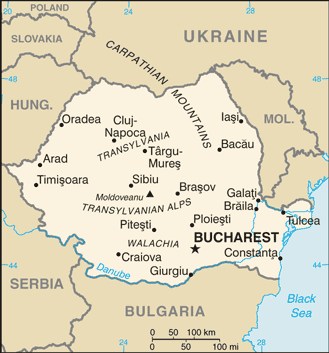
US Announces Military Base in Romania to Become “Permanent”

http://news.antiwar.com/2009/10/23/us-announces-military-base-in-romania-to-become-permanent/

US Announces Military Base in Romania to Become “Permanent”

Enduring US Presence at Site Used in Iraq Invasion, CIA Renditions

by Jason Ditz, October 23, 2009

In an announcement today which likely surprised no one, the US army announced that the military base just northwest of the Black Sea Port City of Constanta, Romania will become a “permanent” base for the American military.

The announcement of a permanent American presence in the former Warsaw Pact and current NATO member nation will likely underscore a growing US presence in Eastern Europe.
The base was notably used in early 2003 as a stopping off point for thousands of American soldiers en route to launching the invasion of Iraq. Romania contributed several hundred troops to the invasion.

The base was also used as a stopping off point for multiple CIA rendition flights and was rumored to have been one of the secret “black ops” sites the CIA used for detention and interrogation of captives.

New Pacific Air Force Commander awaits F-22s

The F-22 program was one of the expensive and wasteful projects that the Pentagon and the Obama administration wanted scrapped.   So why are these planes still coming to Hawai’i?  According to a leading analyst of defense spending, Senator Inouye has employed legislative tricks to “breath life back into the F-22”.  In 2007, twelve F-22s left Hawai’i on their first foreign deployment to Japan, but had the turn back because of a navigation system malfunction.   There have been serious problems with the F-15s, which the F-22s are supposed to replace.  In February 2008, an F-15 crashed into the sea off O’ahu.  “The $43.7 million plane sank in 2,500 feet of water.”

>><<

http://www.starbulletin.com/news/hawaiinews/20091021_Pilot_begins_training_while_Raptors_awaited.html

Pilot begins training while Raptors awaited

By Gregg K. Kakesako

POSTED: 01:30 a.m. HST, Oct 21, 2009

The Hawaii Air National Guard has sent the first of its 22 pilots to be trained at a Florida base to fly the highly sophisticated, single-seat F-22 Raptor jet fighter.

Gen. Gary North, the Pacific Air Forces four-star commander, told reporters yesterday that Hickam Air Force base will receive two of its 20 $137 million Raptors from Langley Air Force Base by early summer.

He said the Hawaii Air National Guard’s Lt. Col. Christopher “Frenchy” Faurot, who has been flying with the Guard since 1991, is now at flight school at Tyndall Air Force Base in Panama City, Fla.

Faurot is the Hawaii Air Guard F-22 integration project officer and was one of four fighter pilots who scrambled to protect island skies following the terrorist attacks on Sept. 11, 2001.

In February last year, Faurot was forced to eject from his F-15 jet fighter when both of the rudders failed during a training mission 60 miles south of Oahu. The $43.7 million plane sank in 2,500 feet of water.

The Raptors will be flown by a hybrid squadron made up of 22 pilots from the Hawaii Air Guard’s 199th Fighter Squadron and 10 from the active Air Force’s 531st Fighter Squadron.

North said that $145 million will be spent to upgrade Hickam’s Air National Guard facilities and should be operational by the end of 2013.

The 62-foot Raptor, which will replace the F-15 Eagles that the Hawaii Air Guard has flown since 1987, can fly at 1.5 times the speed of sound and can lock onto an enemy fighter 40 miles away and take it out with a missile before the other aircraft’s pilot realizes he has been targeted. Faurot said the Raptor’s speed and stealth capabilities give his pilots “the first look, first shot, first kill” advantage.

North said that shortly after assuming command of 45,000 airmen and civilians on Aug. 19, he made a point to visit his bases in Guam, Japan, South Korea and Alaska.

“My goal was to get out as quickly as I could to see the wing commanders and other commanders,” said North, pointing out that his command covers an area extending from the West Coast to the Indian Ocean and from the Arctic to the Antarctic.

North said the Air Force has maintained “a continued presence on Guam” because it is “a great facility for training” and to execute long-range training missions to Australia and South Korea. Since 2000 the Air Force has steadily increased the number jet fighters and bombers and stockpiles of munitions and jet fuel on Guam, 3,800 miles west of Hawaii.

Before coming to Hickam, North, a 33-year veteran, led the air campaigns in Iraq and Afghanistan for 3 1/2 years as commander of the 9th Air Force and U.S. Air Forces Central Command at Shaw Air Force Base in South Carolina. From July 2004 to January 2006, North, a command jet fighter pilot with 4,500 flight hours and 83 combat missions, was director of operations at U.S. Pacific Command.

U.S. Pacific Air Forces

It is one of two Air Force Major Commands out of the continental U.S.; the other is in Europe.

» Personnel: 45,000 civilian and military

» Area of responsibility: 100 million square miles

» Facilities: Nine in Hawaii, Alaska, Japan, Guam and South Korea

» Aircraft: 300

» Major units: 3rd Wing at Elmendorf Air Force Base in Alaska; 8th Fighter Wing in Kunsan, South Korea; 15th Airlift Wing at Hickam Air Force Base; 18th Wing at Kadena Air Base in Okinawa; 51st Fighter Wing in Osan, South Korea; 354th Fighter Wing at Eielson Air Force Base in Alaska; 35th Fighter Wing in Misawa, Japan; 374th Airlift Wing at Yokota Air Base, Japan; and 36th Wing at Andersen Air Force Base, Guam

Source: U.S. Air Force

Inouye backs expanding the U.S. war in Afghanistan

People need to remember this when Senator Inouye tries to paint his record as anti-war.

>><<

Posted on: Wednesday, October 14, 2009

Hawaii’s Sen. Inouye sides with McChrystal on Afghanistan

By JOHN YAUKEY

Advertiser Washington Bureau

WASHINGTON — U.S. Sen. Daniel K. Inouye, just back from Afghanistan and Pakistan, said yesterday that he backs the strategy there advocated by the top U.S. ground commander, but is awaiting “specific recommendations” from the military and White House before concluding for himself the number of troops needed for the job.

Inouye met with U.S. Army General Stanley McChrystal, who has indicated that he will ask for as many as 40,000 more troops in Afghanistan to broaden a counterinsurgency strategy focused on protecting Afghan civilians.

So far, McChrystal’s approach has received a lukewarm reception at the White House, which is in the throes of a full-scale strategy review of the war in Afghanistan and the role of neighboring Pakistan.

“At this time, I believe Gen. McChrystal’s assessment of the current situation and his conclusions, including his assessment that coalition forces must have more daily contact with the people of Afghanistan, is correct and is what is needed if we are to achieve security and stability in Afghanistan,” Inouye said in a statement.

“I had the opportunity to discuss with Gen. McChrystal his assessment and the report he made to the White House. His focus on the population is a correct one. You can spend all the money in the world, but if the people aren’t with you then you’re out of business.”

Senator has clout

Inouye met with U.S. troops — some from Hawai’i — as well as with U.S., Afghan and Pakistani commanders, intelligence officials, and the presidents of both countries.

“Despite the many challenges they face, the morale of our troops remains high and their fierce dedication to the mission was truly inspiring,” said Inouye, who won a Medal of Honor for his service in World War II’s European theater.

Hawai’i’s senior senator made his trip as violence in the eight-year war in Afghanistan has been escalating and U.S. casualties have been climbing.

Attacks of all types — roadside bombs, ambushes, sniper fire, rocket-propelled grenades and other weapons — have reached record levels, according to Pentagon data.

Meanwhile, public support for the war has been dropping.

Inouye heads the powerful Appropriations Committee and its defense subcommittee, which together have significant control over the purse strings of the military and potentially the course of the war in Afghanistan.

“As the chairman of the Appropriations Committee, I cannot and will not close my mind to the knowledge that for each 1,000 troops (added) it will be an additional $1 billion of taxpayer support,” Inouye said. “I need not remind anyone that this is a time of global financial crisis.”

Opposing views

For the past several weeks, President Obama and his national security team have been meeting behind closed doors to reassess the strategy in Afghanistan.

Secretary of State Hillary Clinton and Defense Secretary Robert Gates have both said recently that the United States is committed to a regional strategy aimed at building long-standing relations with Afghanistan and Pakistan.

But they have not been specific about how that might affect U.S. troop levels in the region.

Obama is already in the process of adding 21,000 more troops to Afghanistan, which would bring the total number of U.S. forces there to roughly 68,000 by year’s end.

McChrystal’s 40,000 — if he gets them — would come on top of that.

But there is resistance to McChrystal.

Vice President Joseph Biden believes that the mission in Afghanistan and Pakistan should be scaled back to a counterterrorism strategy aimed more at al-Qaida than the Taliban.

Some influential lawmakers advocate training Afghan forces as quickly as possible so American troops can start moving back out of the combat zones.

Obama apparently is not close yet to a final decision on the way forward.

“I still think we’re probably several weeks away,” White House spokesman Robert Gibbs said at a briefing late last week. “But I think the president feels like the discussions are going well.”

Will the new bases in Panama be U.S. or Panamanian bases? It makes no difference.

According to the blog post below, the Panamanian government quickly clarified that the new planned navy bases were Panamanian bases, not U.S. bases.  But this makes no difference.  The base in Manta, Ecuador was also an Ecuadorian base, but the U.S. had agreements to utilize the base.  This is consistent with the new basing strategy of the U.S. which includes leased bases on foreign soil.  The U.S. presence is still a violation of sovereignty and a provocative presence.

>><<

http://www.panama-guide.com/article.php/20090929125340415

Flap Over New Navy Bases in Panama Continues

Tuesday, September 29 2009 @ 12:53 PM EDT

Contributed by: Don Winner

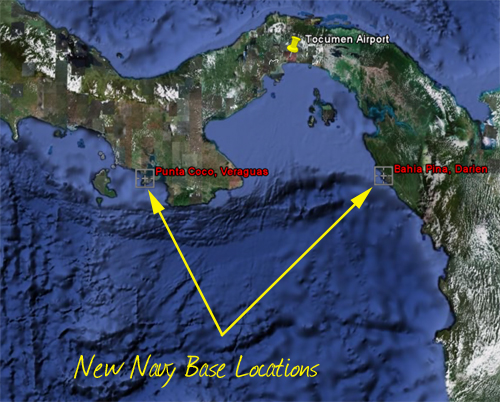
By DON WINNER for Panama-Guide.com – Panama’s Minister of Government and Justice Jose Raul Mulino further clarified their plans to install new new naval bases along Panama’s Pacific coast in order to improve their capability to combat drug trafficking at sea. They will build new facilities at Bahía Piña in the Darién province near the border with Colombia, and in Punta Coca in the province of Veraguas. (See annotated photo map below.) These bases will be used as launching points to search for vessels carrying drugs from South America towards Mexico and markets in the United States. Mulino said Panama will install these bases “to continue our commitment to the security of our territory. These bases will be clearly Panamanian which will be used by the different security institutions such as the National Border Service, the National Police, and the Naval Air Service.” There was a minor flap yesterday when the news wires picked up the idea that these bases would be built and used by the United States, which is not the case. Panama’s Vice President Juan Carlos Varela clarified yesterday that these will be Panamanian bases, built by Panama and operated by Panamanians. The US Navy and Coast Guard assist Panama in patrolling these waters of the Pacific ocean to detect and interdict drug trafficking vessels, as they have been doing for decades. However the specter of any kind of US military presence in Panama causes instantaneous reactions here and the lunatic fringe took the opportunity to spew. With one glance at the image below you can appreciate the positioning of these new bases, strategically placed to help extend the reach of the available surface forces out into the waters of the Pacific.

panama 20090929125340415_1

Panama agrees to host two U.S. naval bases

http://en.rian.ru/world/20090928/156270170.html

Panama agrees to host two U.S. naval bases

02:0328/09/2009

MEXICO, September 27 (RIA Novosti) – Panama will sign before October 2009 a treaty with the United States on the opening of two U.S. naval bases on its territory, a senior Panamanian government official said on Sunday.

According to Panama’s La Prensa newspaper, a preliminary agreement was reached between Panamanian President Ricardo Martinelli and U.S. Secretary of State Hillary Clinton during recent talks in New York.

“The U.S. and Panama will sign before October 30 an agreement on the deployment of two naval bases on the pacific coast of our country to fight international drug-trafficking,” said Minister of Government and Justice Jose Raul Mulino.

“One of the bases will be located in Bahia Pina…450 kilometers [280 miles] east of the capital, Panama City, and another one – in Punta Coca about 350 km [217 miles] west of the capital,” Mulino added.

The U.S. government will also allocate additional $7 million to Panama this year for the fight against organized crime and illicit drug trade.

According to Panamanian intelligence, there are over 2,000 hideouts on the Pacific coast of Panama, which international drug cartels use as transshipment bases for narcotics shipped from South America to the United States.

All U.S. bases in Panama were closed and U.S. military forces left the country at the end of 1999 in accordance with the Panama Canal treaties.

Inouye ‘supports troops’ by raiding their training budget

Sen. Inouye wrote an Op Ed piece on defending the Stryker Brigade in Hawai’i for the Honolulu Advertiser on  12/17/06.  He wrote:

I have and will continue to do everything I can to support our troops. This issue on the Stryker brigade should not be a referendum on the Iraq war…

Today, less than 1 percent of Americans are willing to make the sacrifice to wear our nation’s uniform. They deserve our support.

They deserve the best equipment and the best training we can provide to prepare them for battle.

Why then did he drastically cut the Operations and Maintenance (O&B) budget that pays for training, maintenance and repairs? Defense budget analyst and former congressional aide Winslow Wheeler wrote in the Huffington Post:

And what did the Senate Appropriations Committee do to better support our troops in the new 2010 DOD Appropriations bill? They cut the already-skinny O&M account by over $3 billion. The Defense Subcommittee Chairman, Senator Daniel Inouye (D-HI), with the full support of his Republican counterpart, Thad Cochran (R-MS), cut Obama’s request for basic O&M by $2.4 billion and for wartime O&M by another $655 million.

Is there some trick here? Did they refund the support of our troops somewhere else?

No, Inouye and Cochran have higher priorities. According to their own committee report, they wedged 778 earmarks (pork) costing $2.6 billion into their bill. That didn’t count some of their major goodies: one extra DDG-51 destroyer to be built in Cochran’s Mississippi but unrequested by the Navy ($1.7 billion) plus $2.5 billion for 10 unneeded, unrequested C-17 cargo aircraft pushed through by a gaggle of senators with parochial interests. To pay for this $6.8 billion mountain of lard without raising the total DOD budget, Inouye and Cochran picked the pockets of selected accounts in the bill. (Inouye calls them “reallocations.”) More than $3 billion of those “reallocations” came from the already-bare O&M cupboard.

All that raiding and juggling of accounts is hard work for busy senators but, as TaxPayers for Common Sense points out, it pays off in the form of campaign contributions. (See “Inouye, Cochran Benefit from Earmark Recipients” at the TCS website at http://www.taxpayer.net/.)

The lesson? Don’t believe all the rhetoric about supporting the troops.  If politicians really supported the troops, they would take decisive measures to end the wars and reverse the military expansion that threatens and antagonizes other people and countries around the world.

Gun dealer indicted for tax fraud

From the Pacific Business News:  “According to the indictment, Ong, 51, failed to report income he earned from selling firearms to federal, state, county and military agencies as well as the public.”

>><<

http://pacific.bizjournals.com/pacific/stories/2009/10/05/daily40.html

Wednesday, October 7, 2009

Feds indict Honolulu gun dealer on tax charges

Pacific Business News (Honolulu)

A federal grand jury has indicted a Hawaii firearms dealer on tax crimes, charging him with setting up phony businesses to hide the money he made from selling weapons.

Arthur Lee Ong, who owns Magnum Firearms in Honolulu, is charged with defrauding the federal government and six counts of tax evasion from 2000 to 2005, the U.S. District Attorney’s office in Hawaii said Wednesday.

According to the indictment, Ong, 51, failed to report income he earned from selling firearms to federal, state, county and military agencies as well as the public.

He created multiple businesses, falsified tax returns to hide his income, and evaded more than $300,000 in taxes during the five-year period, according to the indictment.

Ong, 51, will be arraigned on Oct. 14.

Magnum Firearms, at 940 Queen St., describes itself as one of Hawaii’s leading firearms dealers. In addition to its Kakaako showroom, it has a shooting range and is an NRA-certified training facility that provides mandatory firearms safety courses.

Inouye earmarks under attack

Source: http://www.honoluluadvertiser.com/article/20091004/NEWS21/910040367/Hawaii+s+Sen.+Inouye+defends+earmarks+for+his+home+state

Posted on: Sunday, October 4, 2009

Hawaii’s Sen. Inouye defends earmarks for his home state

Appropriations chairman criticized for steering millions toward Hawaii

By John Yaukey
Advertiser Washington Bureau

WASHINGTON – Seniority has its privileges.

But it comes with burdens as well.

Sen. Daniel Inouye, new chairman of the Senate Appropriations Committee, can attest to that as he shepherds through federal spending bills that are boons for Hawai’i but that deficit hawks have been attacking amid fierce debates over federal spending and spiking deficits.

That was especially evident in the last week during debate over a $636 billion military spending bill flush with money for Hawai’i.

In the defense bill alone, Inouye has 31 earmarks worth $178 million, and four earmarks worth $28.5 million in concert with other members, according to Washington-based Taxpayers for Common Sense, a nonpartisan watchdog group.

Earmarks refer to funding for pet projects that lawmakers insert in spending bills, often at the behest of lobbyists working for corporations, universities and other clients. Critics say the projects amount to no-bid contracts.

As the defense bill was debated, Inouye faced attacks from budget hawks, some of whom say defense earmarks draw funds from troops in combat.

But in a recent interview, Inouye was unrepentant about his prowess as a bacon-getter for Hawai’i – and about the constitutional power of Congress to spend money.

“This is the legislative branch doing its job,” the taciturn eight-term senator said in his characteristic baritone. “If this spending is not necessary, then it shouldn’t be appropriated.”

Inouye is doing much of that appropriating now as Congress’ 12 annual spending bills move toward passage.

Overall, Congress is on its way to spending $75 billion, or 7 percent, more in 2010 than it did in 2009, according to an analysis by Congressional Quarterly.

Hawai’i consistently ranks among the top 10 states in federal spending per capita, according to the U.S. Census Bureau’s Consolidated Federal Funds Report.

Earmark proponents argue that their budget inserts often provide funding to organizations that do good work but otherwise wouldn’t get federal money.

Many are small businesses, Inouye pointed out.

“You think they would be able to compete with GE?” he said. “No way.”

Earmarking is bipartisan, with tradition dictating that the majority party gets about 60 percent, according to breakdowns by the Center for Responsive Politics.

Inouye’s Republican counterpart on the Appropriations Committee, Mississippi’s Thad Cochran, has sponsored 13 earmarks worth $50 million on his own, co-sponsoring another 35 worth $166 million.

Not surprisingly, almost all of Inouye’s defense earmarks are for programs in Hawai’i.

And some are whoppers, according to Taxpayers for Common Sense. It found that 18 provisions, totaling more than $68 million, are for interests that have donated more than $300,000 to Inouye’s campaign since 2007.

Inouye, who is up for re-election in 2010, can take credit for three of the five largest defense earmarks in the 2010 budget:

  • $24.5 million for the Hawai’i Federal Health Care Network.
  • $20 million for the Maui Space Surveillance System, a program that has received earmarks from Inouye for years.
  • $25 million for the National World War II Museum at the University of New Orleans.

A cursory scan of other spending bills reinforces how well Hawai’i looks to fare across the federal spending spectrum in fiscal 2010:

  • $329 million for military construction, which is separate from the core defense budget.
  • $60 million for transportation, housing and urban development projects.
  • $24 million for the East-West Center think tank, which Inouye helped create.

Even for an appropriations chairman, this is a noteworthy performance.

“He’s at the top of the heap,” said Laura Peterson of the Center for Responsive Politics.

Inouye’s reach as the Senate’s top banker was apparent early in his appropriations chairmanship, which began with Barack Obama’s election to the White House.

In March, when lawmakers took up a $410 billion stopgap spending measure, second-term Rep. Mazie Hirono, D-Hawai’i, led the 435-member House with more than $138 million in earmarks. That was in large part because they were sponsored by Inouye.

In fourth place was Rep. Neil Abercrombie, D-Hawai’i, with $111.4 million.

But this is not what the White House wanted.

Obama campaigned to slash earmarks to the 1994 level of $7.8 billion. Still, Congress is on track to spend more than double the president’s limit.

In this year’s spending bills, all but four Republicans and three Democrats in the Senate have accepted earmarks for their states, according to the Center for Responsive Politics.

But the opponents have been vocal.

As the defense bill was debated, Inouye and Arizona’s budget hawk, GOP Sen. John McCain, clashed over, among other things, $2.5 billion for 10 new C-17 cargo planes.

The Pentagon has said it doesn’t need them, but Inouye supported the expenditure, arguing that shutting down the production line of such a versatile plane would be unwise.

McCain contended that it would draw money needed for basic military operations.

“This legislation should be vetoed in its present form,” McCain said.

Obama agrees.

“Every dollar wasted in our defense budget is a dollar we can’t spend to care for our troops, protect America or prepare for the future,” he said in an August speech to veterans in Arizona, citing some of the weapons Inouye supports.

As the second-longest-serving active senator, Inouye knows the power of Capitol Hill and the limits of even the most popular president.

“Any president can hope, dream, wish and cajole,” said Dave Levinthal, spokesman for the Center for Responsive Politics. “But in the end, he doesn’t run the Congress, and Congress will do what it wants.”

m1143757104

U.S. seeks two Navy bases in Panama, after Panama kicked out the bases years ago

Puerto Rican scholar and activist Deborah Santana just sent me news of U.S. plans to establish two Navy bases in Panama. The article is in Spanish, but I took an excerpt from Deborah’s email summarizing the article:

This news just got reported in the Mexican daily La Jornada. Unfortunately I don’t have time to translate it into English, but I think it’s important enough to alert people immediately. No doubt more news and information, including in English, will be forthcoming.

Briefly, the conservative new govt of Panama President Ricardo Martinelli will allow the US Navy to establish two new bases, both on the Pacific and one of which borders Colombia. This after the US closed 14 bases in Panamá (including the School of the Americas, which was moved to Georgia) and restored the canal zone to Panamanian sovereignty.

During the 1990’s the Panamanian government rejected a US proposal to establish a “Multilateral Antidrug Center” established by the US (another euphemism for a base). Panama is part of the US “Mérida Plan” which along with Colombia and México is supposed to be waging a collective war against drugs and terrorism.

>><<

http://www.jornada.unam.mx/2009/09/28/index.php?section=mundo&article=029n2mun

EEUU instalará bases navales en Darién y Punta Coca, Panamá

El acuerdo se firmará antes del 30 de octubre”, dice un ministro de Gobierno

La Jornada

Estados Unidos establecerá bases navales en Bahía Piña, en la provincia de Darién, limítrofe con Colombia, y Punta Coca, al sur de la provincia occidental de Veraguas, ambas en el litoral de Panamá, en el Pacífico, informó el ministro panameño de Gobierno y Justicia, José Raúl Mulino.

En declaraciones al diario local La Prensa, Mulino, quien integró la comitiva del presidente de la república, Ricardo Martinelli, a Estados Unidos, en el 64 período de sesiones de la Asamblea General de Naciones Unidas (ONU), indicó que el tratado que regirá el uso de estas bases se firmará antes del 30 de octubre.

Previamente al anuncio oficial, fue celebrada una reunión entre la secretaria de Estado de Estados Unidos, Hilary Clinton, y Martinelli, para abordar temas de cooperación conjunta.
De acuerdo con Mulino, un acuerdo bilateral autorizará la instalación de estaciones navales en territorio panameño, para el combate al narcotráfico y la protección en áreas costeras.
Los Tratados Torrijos-Carter, de 1977, garantizaron el desmantelamiento progresivo en este país de unas 14 bases y sitios de defensa, y aseguraron las recuperación soberana de la vía interoceánica y la denominada Zona del Canal de Panamá el primero de enero de 2000.

Bajo el gobierno nacionalista del desparecido general Omar Torrijos, Panamá obligó a Estados Unidos a cerrar la Escuela de las Américas, un centro de enseñanza de torturas y guerra sucia en la que se graduaron los antiguos dictadores de América Latina.

La decisión del gobierno del conservador Martinelli sugiere un retorno a la presencia militar estadunidense en suelos y mares panameños.

En el gobierno del ex presidente Ernesto Pérez Balladares (1994-1999), fue rechazado un proyecto para establecer en este país un Centro Multilteral Antidrogas, dirigido por Estados Unidos.
Panamá forma parte del Plan Mérida, el cual fue promovido por Washington, en contra de las organizaciones dedicadas al trasiego de drogas y armas, e integra una alianza política con México y Colombia para enfrentar el terrorismo.

Colombia anunció el julio pasado que Estados Unidos podrá utilizar siete bases militares en su territorio, lo que fue rechazado categóricamente por los países de la región, en especial Venezuela, que comparte frontera con territorio colombiano.