Navy training expansion in Puget Sound meets resistance

2/4/2009

Navy training expansion draws criticism

By Justin Burnett
Examiner Staff Writer

Photo: Howard Garrett
Ruffles, the oldest known male orca in the world, swims past Fort Casey Lighthouse in October 2008. The U.S. Navy recently released its plans to increase operations in its Northwest Training Range Complex and the news has many people wondering what the impact will be to marine wildlife and the environment.

Justin Burnett / The Whidbey Examiner
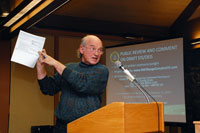
Clinton resident John Hurd speaks at a public hearing in Oak Harbor concerning the U.S. Navys plans to expand activities at the Northwest Training Range Complex.

Public comment
Mail comments about the plan by Feb. 11 to Naval Facilities Engineering Command Northwest, Attn: Kimberly Kler, 1101 Tautog Circle, Silverdale WA 98315-1101, or submit comments online at www.nwtrangecomplexeis.com.

As many as 150 orcas are known to inhabit the waters of Puget Sound and the coast of Washington at various times of the year.

Among them is Ruffles. He belongs to a small family group called J-pod. At 57, he is the oldest known male orca in the world, according to Howard Garrett, president of Orca Network, a Whidbey Island based nonprofit group dedicated to raising awareness about whales in the Northwest.

Ruffles’s exact age has been confirmed through photographic evidence. The characteristic ruffled back edge of his dorsal fin not only makes him easy to identify but also earned him his name.

He is usually spotted traveling on the outskirts of the pod. It may be that he is a loner or it may be that his position serves some special function within the group. It’s one of the many mysteries about orcas that scientists have yet to discover, Garrett said.

The U.S. Navy recently released its plan to expand its training operations in Puget Sound and off the coasts of Washington and Oregon. With everything from missile and sonar testing to dumping depleted uranium included in the proposal, some environmentalists are concerned that Ruffles and J-pod may have given up the last of their secrets.

Strategic defense

The Navy’s plan is to expand operations in its Northwest Training Range Complex, an area encompassing about 122,400 nautical miles of air, surface and subsurface space, which has been in operation since World War II.

The main purpose is to prepare for the wars of tomorrow, said Cmdr. Matt Miller, the executive officer at the Whidbey Island Naval Air Station, at a public hearing on the plan last week in Oak Harbor.

“Realistic training insures U.S. Navy personnel maintain the highest level of readiness in capability and is the single greatest asset the military has in preparing and protecting American service men and women to defend the nation,” he said.

The Navy has spent the past year preparing an environmental impact statement, or EIS, which is a requirement of the National Environment Policy Act. According to the document, which contains more than 1,000 pages, current training exercises in the complex include everything from anti-air, anti-surface, and anti-submarine warfare to explosive ordnance disposal.

Besides a no-action option, the EIS outlines two main alternatives. The first calls for an increase in current training activities as well as testing new equipment such as new aircraft, guided missile submarines and unmanned aerial systems.

Alternative 2, the Navy’s preferred option, includes all the changes outlined in alternative one but proposes increasing current training levels even more and enhancing the range by using new air and sea surface targets, and developing an underwater training minefield.

According to the EIS, Alternative 2 would allow the Navy to increase the number of missiles it fires by 470 percent, from 10 per year to 57 per year. The number of bombs dropped per year would increase 33 percent, from 108 to 144, and the number of shells fired would increase 106 percent, from 25,856 to 53,343.

That includes 20 mm cannon shells made from depleted uranium. Alternative 2 also would roughly double the number of sorties flown per year, from 2,499 to 4,998.

While most of these exercises would take place in coastal waters, some explosives testing is currently allowed within Puget Sound. Under Alternative 2, such activities would continue to be allowed.

Impact debated

Despite the Navy’s proposals, the EIS concludes there will be no significant effect on marine life from any of the offered alternatives.

The claim has drawn significant skepticism from a number of local residents. Of the 30 people who attended the public hearing in Oak Harbor, not a single person voiced support for the Navy’s plans. Instead, one attendee after another said the study’s conclusions are hard to swallow – literally.

“How much depleted uranium do you want to eat in your fish?” asked Zimmer Morris, a South Whidbey teacher.

While the study acknowledges that some species listed under the Endangered Species Act – certain salmonid species, leatherback turtles, migratory mammals and birds – could be affected, it would not be enough to have lasting effects.

The EIS is also proposing mitigation measures to help reduce potential impacts. With marine mammals, such as whales, the plan is to use passive sonar and keep at least three “well-trained” lookouts on duty 24 hours a day. When the animals are present, and they come within 200 yards, certain training exercises would be halted until the animals move out of the area.

But several people at the hearing expressed their doubt about the effectiveness of the mitigation measures. The Orca Network’s Garrett, for example, said he has been involved in observing and researching whales since 1981 and is aware of the difficulties of listening for “faint acoustic signals” that would indicate the presence of orcas.

“Recognition is highly problematic – even for experienced personnel,” Garrett said.

Another common concern among speakers was a feeling of being blindsided by the Navy’s plans. Although the EIS has been in the works for more than a year, Clinton resident Jerry Hurd said he didn’t learn about the proposal until January, shortly after the public comment period started Dec. 29. The comment period closes Feb. 11.

He also complained that he found it difficult to submit comments on the plan. The document was available at the Oak Harbor library, but not at any of the other Island libraries. And he said the Navy’s Web site, where the plan could be viewed online, wasn’t working for several days during the comment period.

“I think it would be appropriate there be an extension” of the public comment period, he said.

People from environmental organizations such as Whidbey Environmental Action Network, Whidbey Audubon Society and People for Puget Sound reported they also hadn’t learned about the plan until January.

“We just found out about this,” said Mike Sato, spokesman for People for Puget Sound.

Garrett said he also is hoping for an extension to the public comment period. Washington residents need more time to comment on the proposal, and a delay could improve the chance that the Navy’s plan will be noticed by Obama administration officials in Washington D.C., he said.

“The more time we can buy, the better,” he said.

Source: http://www.whidbeyexaminer.com/main.asp?SectionID=1&SubSectionID=1&ArticleID=2186&TM=66263.9

Kyrgyz government seeks to close U.S. military base

The U.S. may lose a key military base in Central Asia as the Obama Administration prepares to “surge” in Afghanistan.  According to a report by the AP, the government of Kyrgyzstan introduced legislation to close the U.S. military bas at Manas:

Kyrgyzstan’s government submitted a draft bill to parliament Wednesday that would close a U.S. base that is key to the American military campaign in Afghanistan.

Russia opposes the base at its doorstep.   The U.S. Embassy said that it did not receive formal notification of this closure.  The U.S. is seeking to maintain the base despite the Kyrgz government’s bid to close the base.

The report also cited opposition to the base as one of the reasons for the closure:

The Kyrgyz government also cited growing popular discontent with the U.S. military presence among its motivations for the closure. It also criticized U.S. obstruction of the investigation into the fatal shooting in December 2006 of a Kyrgyz truck driver by a U.S. serviceman during a security check at the entrance to the air base.

Activists in Vincenza, Italy occupy the site of a proposed U.S. military base

=================================
2009/1/31 Stephanie Westbrook <steph@webfabbrica.com>
Hi all,

This morning around 10am the movement opposing the new U.S. base in Vicenza entered and occupied the site. The police were caught completely off guard and the activists were able to cut the fence and gates and occupy the area. Once the police arrived, they were planning to forcibly remove the protesters. However, the protesters are occupying an area that was the airport Dal Molin, which is technically under control of the Italian civilian aviation authority, ENAC, who has said the protest is legitimate. So far the police have backed off. Tonight there will be a public assembly followed by a dinner and concert. Monday, Feb 2, had been announced by the movement as the start of a week of initiatives to protest the demolition work that is being carried out in preparation for the construction of the base, but it looks like the activists got off to an early start!

See below a “rough” translation of an article.

There is a short video on La 7: http://tinyurl.com/c7nqq6

You can also follow updates in Italian on the No Dal Molin and And Global Project sites:
http://www.nodalmolin.it/
http://www.globalproject.info/art-18748.html

For background, see the dossier in English:
http://www.peaceandjustice.it/vicenza

Stephanie

(Original in Italian – http://tinyurl.com/bfsdan)

Blitz in Vicenza: Site of the New US Base Occupied

About two hundred activists of the “No Dal Molin” movement entered the area of the Vicenza airport where a few days ago the construction of the new U.S. military base Camp Ederle 2 began.

The blitz was announced by the members of the movement themselves.

The police are on the site – including the Questore of Vicenza – and are
overseeing the peaceful occupation of the area.

To enter the area the protesters cut a piece of the fence. The Questore Sarlo is trying to start negotiations with the demonstrators. There are also members of the Disobbedienti who arrived from Padova and other cities of the Veneto region.

The situation for the moment is calm. The demonstrators displayed banners and posters against the U.S. military, and with the spray paint wrote “Vicenza City of Peace” and “You demolish, we build peace”. The protesters have not reached the area from the inside of Dal Molin, protected by a fence, which is being developed by the company in charge of demolishing the existing structures.

Some of the coop workers of CMC of Ravenna that were working on the site were taken away as a precaution. A fact that the ‘No Dal Molin’ have already declared as a victory.

Twenty demonstrators were on the roofs, while outside began assembling a tent. “This – said the Committee – is the response by those opposed to the project to the announcement of the imminent start of construction. On October 5, through the popular consultation, the participants decided in a vote by a large majority that the land must be devoted to civilian uses, therefore seeking to implement the project means trampling democracy.”

For the protesters, the project to double the U.S. base is “illegitimate and illegal, because the proponents have refused to accept that a detailed environmental impact assessment be made of the site, a useful tool in protecting the health and the area.” The occupation, the say, will continue indefinitely.

‘Tragedy Assistance’ or Ending the Tragedy?

Near the end of this article it mentions the suicide of Air Force Staff Sgt. Brandon Stagner, who suffered from PTSD and was about to redeploy to on his fourth tour to Iraq. Very sad.  I didn’t know Brandon, but I know some of his family.  His father Ishmael Stagner is a respected kupuna in the Hawaiian community, and his sister Carmael worked with LGBTQ youth at the AFSC Hawai’i office.  This young man was another human sacrifice for bloodthirsty gods of war and empire.

>><<

Group brings together grieving military families

A support group holds its first-ever event in Hawaii

Wearing the buttons with photos of fallen loved one, bereaved military families gathered yesterday in the first-ever Hawaii seminar for the Tragedy Assistance Program for Survivors, or TAPS.

The program helps families of U.S. military service members who have died in the service of the country.

Yesterday, children wrote about lost loved ones in letters that were tied to balloons and released into the sky above Waikiki.

Bonnie Carroll, founder of the 15-year-old nationwide program, said she hopes to make grief seminars in Hawaii an annual event. Darcie Sims, national director of training, said Hawaii’s aloha spirit is conducive to the TAPS mission.

“There’s a natural warmth and openness here we sometimes don’t see on the mainland,” Sims said. “They’re very open to helping, and they’ve been so welcoming to us.”

– Gene Park

FULL STORY >>

By Gene Park

POSTED: 01:30 a.m. HST, Jan 25, 2009

After Army Spc. Toby Olsen’s death in Iraq, his mother, Elisabeth Olsen, struggled to heal. Two years later she wants to help others who have also suffered the loss of a loved one in the military.

Olsen said she got help dealing with her grief from the Tragedy Assistance Program for Survivors, or TAPS, a private organization created to help families of military service members who have died in the service of their country.

Olsen’s son, a Mililani High School graduate, died on Jan. 20, 2007, after an explosion hit his vehicle in Iraq.

She said TAPS is able to bring together people who are going through similar experiences.

“When you don’t have to say a word because you know you’re looking into the eyes of another mother, there’s a connection,” she said. “It’s a family you never wanted to join.”

Olsen said she discovered TAPS when attending the national remembrance ceremony for fallen troops in Washington, D.C.

Yesterday the group held its first grief seminar in Hawaii.

More than 50 people attended. Some were local families, like Olsen. Others came from the mainland, like Victor, N.Y., resident Andrea Ralyea.

Ralyea said her 3-year-old son started asking about his uncle, Army Sgt. Jonathan Lootens, who died in a suicide bomb attack in Kirkuk, Iraq, on Oct. 16, 2006.

“I didn’t know how to answer those questions,” Ralyea said.

She got in touch with TAPS and attended a survivor seminar in Philadelphia. She came to the Hawaii seminar because Lootens was stationed at Schofield Barracks.

“I almost expect him to be here, but it’s nice to be able to be here and be where he was,” she said. “I find great comfort in it.”

Children and teenagers also spoke with counselors, who said that many of them never were able to vocalize their feelings before yesterday. The children wrote their feelings in letters which were tied to balloons and released outside the Hilton Hawaiian Village, where the seminar was held.

Hawaii is a great environment for TAPS, said Darcie Sims, TAPS national director of training. Sims has been with the group since 1995, one year after its inception.

“There’s a natural warmth and openness here we sometimes don’t see on the mainland,” Sims said. “They’re very open to helping, and they’ve been so welcoming to us.”

Sims said TAPS was borne out of necessity because self-help books and programs on grieving military families did not exist. Sims lost a brother during the Vietnam War, and her father to a nuclear weapons accident.

“Families did back then what they still do today, put one foot in front of the other,” Sims said. “We are literally a family organization, reaching out. When the checks have stopped, when the papers have been filed, this family is there.”

Olsen said she has volunteered to be a local point of contact for the organization, and hopes to make TAPS seminars a regular event for Hawaii.

TAPS has a telephone hot line manned at all hours, if family members need someone to talk to.

It is a valuable resource for newly grieving parents Ishmael and Carmen Stagner of Kaneohe.

Their son, Air Force Staff Sgt. Brandon K. Stagner, committed suicide in November while stationed in Alaska, but before going on his fourth tour of duty in Iraq. His parents said he suffered from post-traumatic stress disorder.

“We all think we’re John Wayne … but the fact of the matter is that it’s just a shell,” Ishmael Stagner said. “But maybe the heroes are also the ones who live and have to go on.”

After Army Spc. Toby Olsen’s death in Iraq, his mother, Elisabeth Olsen, struggled to heal. Two years later she wants to help others who have also suffered the loss of a loved one in the military.

Olsen said she got help dealing with her grief from the Tragedy Assistance Program for Survivors, or TAPS, a private organization created to help families of military service members who have died in the service of their country.

Olsen’s son, a Mililani High School graduate, died on Jan. 20, 2007, after an explosion hit his vehicle in Iraq.

She said TAPS is able to bring together people who are going through similar experiences.

“When you don’t have to say a word because you know you’re looking into the eyes of another mother, there’s a connection,” she said. “It’s a family you never wanted to join.”

Olsen said she discovered TAPS when attending the national remembrance ceremony for fallen troops in Washington, D.C.

Yesterday the group held its first grief seminar in Hawaii.

More than 50 people attended. Some were local families, like Olsen. Others came from the mainland, like Victor, N.Y., resident Andrea Ralyea.

Ralyea said her 3-year-old son started asking about his uncle, Army Sgt. Jonathan Lootens, who died in a suicide bomb attack in Kirkuk, Iraq, on Oct. 16, 2006.

“I didn’t know how to answer those questions,” Ralyea said.

She got in touch with TAPS and attended a survivor seminar in Philadelphia. She came to the Hawaii seminar because Lootens was stationed at Schofield Barracks.

“I almost expect him to be here, but it’s nice to be able to be here and be where he was,” she said. “I find great comfort in it.”

Children and teenagers also spoke with counselors, who said that many of them never were able to vocalize their feelings before yesterday. The children wrote their feelings in letters which were tied to balloons and released outside the Hilton Hawaiian Village, where the seminar was held.

Hawaii is a great environment for TAPS, said Darcie Sims, TAPS national director of training. Sims has been with the group since 1995, one year after its inception.

“There’s a natural warmth and openness here we sometimes don’t see on the mainland,” Sims said. “They’re very open to helping, and they’ve been so welcoming to us.”

Sims said TAPS was borne out of necessity because self-help books and programs on grieving military families did not exist. Sims lost a brother during the Vietnam War, and her father to a nuclear weapons accident.

“Families did back then what they still do today, put one foot in front of the other,” Sims said. “We are literally a family organization, reaching out. When the checks have stopped, when the papers have been filed, this family is there.”

Olsen said she has volunteered to be a local point of contact for the organization, and hopes to make TAPS seminars a regular event for Hawaii.

TAPS has a telephone hot line manned at all hours, if family members need someone to talk to.

It is a valuable resource for newly grieving parents Ishmael and Carmen Stagner of Kaneohe.

Their son, Air Force Staff Sgt. Brandon K. Stagner, committed suicide in November while stationed in Alaska, but before going on his fourth tour of duty in Iraq. His parents said he suffered from post-traumatic stress disorder.

“We all think we’re John Wayne … but the fact of the matter is that it’s just a shell,” Ishmael Stagner said. “But maybe the heroes are also the ones who live and have to go on.”

Source: http://www.starbulletin.com/news/20090125_Group_brings_together_grieving_military_families.html?page=1&c=y

Katharine Moon: Military Prostitution and the U.S. Military in Asia

Japan Focus

Military Prostitution and the U.S. Military in Asia

Katharine H.S. Moon

Where there are soldiers, there are women who exist for them. This is practically a cliché. History is filled with examples of women as war booty and “camp followers,” their bodies being used for service labor of various kinds, including sex. Contrary to common assumptions in the West, prostitution is not “part of Asian culture.” Just about every culture under the sun has some version of it during times of war and times of peace.

In some ways, military prostitution (prostitution catering to, and sometimes organized by, the military) has been so commonplace that people rarely stop to think about how and why it is created, sustained, and incorporated into military life and warfare. Academic interest and analysis of this issue gained momentum only in the last twenty years and still remains scant and sporadic. Even as interest in women and gender as categories of analysis has increased in many academic disciplines, there is still a question of intellectual “legitimacy,” that is, whether prostitutes, prostitution, and sex work warrant “serious” scholarly attention and resources, especially for students of international politics. After all, it is a highly “personal” and therefore “subjective” matter and prone toward the proverbial “he said/she said” contestation. To boot, many have turned the feminist emphasis on women and agency on its head by glibly claiming that most military prostitutes sought out the work and life of their own free will and therefore are exercising their agency. In this view, it is primarily about women’s personal decisions and responsibility to face the consequences; governments and other institutions of society need not be held accountable.

For decades, key leaders of Asian women’s movements such as Takazato Suzuyo of Okinawa and Matsui Yayori, the well-known Japanese journalist and feminist activist, Aida Santos and women’s organizations like GABRIELA of the Philippines have argued to the contrary. They documented and insisted that U.S. military prostitution in Okinawa/Japan, South Korea, and the Philippines involve a complex “system” of central and local government policies, political repression, economic inequalities and oppression of the underclass, police corruption, debt bondage of women by bar owners, in addition to pervasive sexist norms and attitudes in both the U.S. military and the respective Asian society. In the 1970s and 1980s, when Asian feminists raised these connections, they tended to fault patriarchal and sexist values together with power inequalities emanating from them and the economic and political disparities among nations.

Such individuals and organizations also emphasized the compromised sovereignty of their own governments in relationship with the more powerful U.S. government and military, resulting in the compromised rights and dignity of the Korean, Okinawan, Filipina and other women who “serviced” American military (male) personnel. Aida Santos, a long-time activist opposing U.S. military bases in the Philippines (and later the Visiting Forces Agreement) wrote in the early 1990s that in the Philippines, “[r]acism and sexism are now seen as a fulcrum in the issue of national sovereignty.”[1] Such activists made the case that the personal is indeed political and international. [2] “Olongapo Rose,” a 1988 documentary film by the British Broadcasting Corporation about U.S. military prostitution in the Philippines graphically depicts the various political, economic, cultural, and racial “systems” at work.

Even under authoritarian rule in the 1970s, Filipinas did not hesitate to speak up and campaign nationally and internationally against the Philippines authorities and the U.S. military for abetting and condoning the physical, sexual, and economic exploitation and violence against women who worked in the R&R industry along Olongapo and Subic Bay, where U.S. forces had been stationed until the early 1990s. But in Korea, even progressive activists of the 1970s and 1980s, who fought against military dictatorship, labor repression, and the violation of human rights overlooked military prostitution as a political issue. For one, they had their plates full, challenging the Park Chung Hee and Chun Doo Hwan regimes. Second, as much as some activists criticized the dominant role of the United States in the alliance relationship, others were loath to attack a fundamental institution that safeguarded Korean security. Of course, the legal system was stacked against them. With the National Security Law squarely in place, critics of the U.S. military or the alliance could be thrown into prison, tortured, or killed. Third, military prostitutes were so beneath the political radar screen of most progressives because the women themselves were viewed as “dirty,” lowest of the low, and “tainted” because they slept with foreign soldiers. A highly puritanical and moralistic sense of ethnonationalism among most Koreans had exiled Korean military prostitutes from the larger Korean society and political arena. It is common knowledge among military prostitutes and their advocates that the formers’ family often disowned them upon learning of their “shameful” lives.

But in 1988, Yu Boknim, a Korean democracy activist, and Faye Moon, an American missionary and social activist became mavericks even among progressive dissidents by paying attention to the plight of the Korean gijichon (camptown) women. Together with the assistance of a handful of student activists and the financial support of some Protestant churches, they established Durebang (My Sister’s Place) in 1988 as a counseling center, shelter, and later bakery (to generate income for older women who had left the sex business and younger women who wanted to get out). But despite their efforts to raise awareness of the relationship between the presence of U.S. bases and the growth of this underclass of women and their Amerasian children, most of Korean society continued to ignore the women and their needs. Rather, Yu and Moon found increasing solidarity with their activist counterparts from the Philippines, Okinawa/Japan, and the United States as women began to organize around issues of sexual violence and slavery, militarism, and human rights in the Asia-Pacific.

Currently, military prostitution in Korea has been transformed in line with global economic and migration trends. Foreign nationals, primarily from the Philippines and the former Soviet Union, have become the majority of sex-providers and “entertainers” for the U.S. troops. Young Korean women, with better education and economic and social opportunities than their mothers or grandmothers, are not available for such work. And they are not as easily duped by traffickers. In a more complex, globalized and multicultural sex industry environment, however, political and legal accountability for various problems and conflicts that both the prostitutes and the servicemen encounter become even more difficult to understand and more difficult for activists to target effectively. Nevertheless, on a day-to-day basis, hardworking advocacy organizations on behalf of the women, such as Saewoomtuh, continue to offer shelter, counseling, and health and legal assistance to the best of their ability.


So, if military prostitution around U.S. bases in Asia has been an institution found wherever US forces are stationed since the mid-20th century-including, in addition to Japan, Okinawa, South Korea and the Philippines, Thailand, Taiwan, the Pacific Islands and many others–and individual activists and concerned organizations have labored to raise political and societal awareness of this issue, why has it reached the pages of the New York Times-through the Korean case-only in 2009? The answer lies in a gradual evolution of international and domestic developments that has created some opening for the issue of military prostitution in Korea to become more public.

For starters, the concept of “women’s human rights” and the practice of generating norms and codifying laws have become popularized and prioritized only since the 1990s. Feminist activism on such matters has been around longer, but the “mainstreaming” of women’s human rights is relatively new, with emphasis on the urgency of addressing violence against women, human trafficking, and gender-based economic inequalities.

In East Asia, various regional networks and cooperation among women’s organizations have facilitated the exchange of information about military and civilian forms of prostitution and a wider audience than was available in each national community. The “comfort women” movement, which demanded official apologies, historical accountability, and compensation from the Japanese government for the sexual violence committed against Korean and other women by Japanese troops during the Pacific War, helped shed light on political abuses long regarded as “private” mishaps. Moreover, the social movement around former Japanese “comfort women” had overshadowed advocacy efforts on behalf of the U.S. military prostitutes. The survivors of Japanese sex slavery were older than the survivors of military prostitution, making the claims of the former more urgent. But more than that, activists in the Korean comfort women movement and many of the survivors themselves generally shunned even a remote association with U.S. military prostitutes because the latter were deemed to have freely and willingly sold their bodies. [3] The comfort women movement gained international legitimacy and stature partly because the former victims were viewed as innocents who had been forcibly violated. Nevertheless, the surviving comfort women have faced continuing skepticism about their innocence and purity from the Japanese right.

But with the comfort women issue having achieved some gains since the Korean movement for redress took off in the early 1990s-Japanese apology, albeit wishy-washy under former Prime Minister Abe Shinzo,[4] private compensation from Japan, support by the United Nations apparatus and numerous NGOs, and most recently, the passage of the nonbinding U.S. House Resolution 121 that called upon the Japanese government to apologize for its sexual enslavement of women during World War II-there is a bit more political space that former military prostitutes might share. It should be noted that the women who desire to seek apology and compensation from the Korean government and the U.S. military are themselves elderly, ill, frail, and without much time left to their lives. They now feel their own urgency to get their life stories out and to claim recognition and redress for their sacrifices.

Additionally, individual incidents of violence against women in U.S. military camptowns, which have been common through the decades of the U.S. presence in Asia, have gained broader attention in these societies since the 1990s. In Korea, the egregious murder of Yun Geumi by a U.S. serviceman in October, 1992 [5] was not unique in terms of the degree of abuse and brutality. But it catalyzed local camptown consciousness about the disproportionate burdens that the villages and towns housing U.S. bases in Korea have borne for decades. And it became a call to action for a small group of Korean progressives to organize on behalf of Korean civilians living and working near the bases. The National Campaign for Eradication of Crimes by U.S. Troops in Korea, which eventually became the leading organization that scrutinizes and documents-and when necessary, mobilizes around-the actions of U.S. commands and the conduct of U.S. troops as they affect Korean civilians, was born in the aftermath of Yun’s murder.[6] But for the most part, Yun’s death remained a localized and politically contained issue in the early-mid-1990s.

In Japan, the highly publicized gang rape of a twelve-year-old Okinawan girl in 1995 by three U.S. Marines galvanized political activism and brought wider attention to military-related violence against women. Unlike the rape of the girl, Yun’s murder did not itself spark a national debate about the presence and prerogatives of the U.S. forces or a crisis in the alliance relationship. On one evel, the murder of a prostitute did not elicit as much public sympathy and ire as the rape of a school girl, which triggered action toward an Okinawan referendum on the bases and the establishment of the joint Japan-U.S. Special Action Committee on Okinawa “to reduce the burden on the people of Okinawa and thereby strengthen the Japan-US alliance.”[7] For Koreans, the timing was not conducive to focusing on violence against camptown women because both Seoul and Washington were hip-deep in the first nuclear crisis concerning North Korea. Hammering out the Agreed Framework of 1994 was the major preoccupation of the United States regarding the Korean peninsula. In 1993-94, the Korean government itself had little interest and leverage to seek justice for a dead prostitute; it was fixated on not being left out of the negotiation process between Pyongyang and Washington. On another level, Korean civil society organizations were still in the process of forming and learning how to shape and adapt to the new political parameters that were being created in the aftermath of formal democratization in 1988. Making local politics and violence against women matter to the larger public and government after four decades to the contrary was new and challenging.

Okinawans, on the other hand, benefited from opportune timing. For one, a delegation of women representing peace and women’s human rights groups had just returned from the 1995 UN Conference on Women in Beijing. They responded immediately upon learning of the rape by establishing organizations and mobilizing existing networks that were to become key players in regional and international activism addressing U.S. bases, violence against women, anti-militarism, and human rights for the next decade. The fact that Okinawa enjoyed a governor, Ota Masahide, who was bent on asserting new powers of local
autonomy and challenging the central government’s hegemony over Okinawa’s land usage, economic and security arrangements was also instrumental. By contrast, Korea in 1992-93 had just begun to explore the process of decentralizing government, and at the time of the murder of Yun, autonomous local governments did not exist, and local residents’ identity as a legitimate and effective political community was inchoate. Today, however, local administrative autonomy and residents’ sense of empowerment and entitlement are quite robust. Social movements and opposition parties can and do make claims on the
central government and criticize U.S. bases and U.S.-South Korean relations without fearing the repression that had prevailed for most of the history of the Korean republic.[8]

Internal factors within the United States also provide a context in which the older generation of Korean women who worked and lived as sex providers to the U.S. forces can claim official apology and compensation. Since the early-mid 1990s, international trafficking of human beings for sexual labor and other forms of abuse has been an official part of the U.S. policy agenda. The Clinton administration was particularly active in this regard, with the Department of State under Madeleine Albright playing a leading role. Furthermore, in 2000, the U.S. Congress passed the Victims of Trafficking and Violence Protection Act, which established new protections for women in the domestic sex industry who were willing to cooperate with law enforcement authorities to convict traffickers. The law also put the world on notice that the U.S. seeks to be a leader in preventing and combating human trafficking and mandated the State Department to issue annual status reports of various countries’ efforts to fight trafficking.

Moreover, some members of the U.S. media have focused attention on the issue, Nicholas Kristof of the New York Times being the most prominent in recent years. But earlier in 2002, a FOX TV team had travelled to Korea to document the U.S. military’s involvement in the Korean sex industry and in international trafficking of women. This created a big stir in Washington, prompting members of Congress to write to the then Secretary of Defense Donald Rumsfeld to investigate the situation in Korea and other overseas bases. The R&R/sex industry that long had been an integral part of the landscape and the person-to-person interactions between Americans and Koreans became exposed to the larger world and highly newsworthy.

The Pentagon indeed took congressional and media scrutiny seriously and mandated inspector generals to investigate and report on any connection between trafficking and the U.S. military. And in response, commands in Korea cracked down on servicemen and bars suspected of using trafficked women as “hostesses” and entertainers by putting them off limits for periods of time. The U.S. commands also waged public awareness campaigns through radio and periodic education sessions to warn its troops that it does not condone soldiers’ association with prostitution and trafficking. The newspaper for the 2nd Infantry Division, Indianhead, quoted Capt. Kent Bennett, 2nd Inf. Div. Preventive Medicine Officer that “‘[p] rostitution and trafficking are demeaning acts toward women,'” and that by participating, “a Soldier is contributing to the enslavement of women and girls from all over the world.”[9] The article also stated that the U.S. Department of Defense is pushing to change the Uniform Code of Military Justice so that “Soldiers who are found convicted of soliciting prostitution may be dishonorably discharged.” These developments in the U.S. government and military reflect a new sensitivity and responsiveness to public scrutiny and pressures around military prostitution, but it is unclear to what extent institutional changes are systematically planned and enforced and whether the individual conduct of servicemen changes in the long run. These developments also point to a new vulnerability on the part of the U.S. military establishment. They can no longer avoid public oversight over a practice that soldiers and sailors took for granted as part of their “R&R” entitlement for a very long time. But U.S. military policy and behavioral changes that take place now and in the future would come too late for the women who had “serviced” American men in the past.

The domestic and international developments I describe above do matter in terms of whether issues like prostitution, trafficking, violence against women can find a political venue and audience. However, only the individuals who have experienced trafficking, prostitution, and violence can educate us about these conditions as lived realities. And it takes courage to come forward. The elderly women featured in the New York Times have decided that their time has come.

See “Ex-Prostitutes Say South Korea and U.S. Enabled Sex Trade Near Bases” by Choe Sang-Hun

Katharine H.S. Moon is Professor of Political Science at Wellesley College and the author of Sex Among Allies: Military Prostitution in U.S.-Korea Relations, Columbia University Press, 1997.

She wrote this article for The Asia-Pacific Journal: Japan Focus. Posted on January 17, 2009.

Recommended Citation: Katharine H.S. Moon, “Military Prostitution and the U.S. Military in Asia,” The Asia-Pacific Journal, Vol. 3-6-09, January 17, 2009.

See Choe Sang-hun, “Ex-Prostitutes Say South Korea and U.S. Enabled Sex Trade Near Bases,” The New York Times, January 7, 2009.

Notes:

[1] Aida Santos, “Gathering the Dust: The Bases Issue in the Philippines,” in Let the Good Times Roll, eds. Saundra Sturdevant and Brenda Stolzfus (New York: New Press, 1992) p. 40.

[2] Cynthia Enloe, Bananas, Beaches, and Bases: Making Feminist Sense of International Politics (Berkeley, CA: University of California Press, 2001).

[3] See Katharine H.S. Moon, “South Korean Movements against Militarized Sexual Labor,” in Asian Survey (34:2), 1999.

[4] Norimitsu Onishi, “Abe only partly successful in defusing ‘comfort women’ issue,” International Herald Tribune, April 29, 2007. Access date: May 2, 2007.

[5]Yun Geumi’s body was found “naked, bloody, and covered with bruises and contusions-with laundry detergent sprinkled over the crime site. In addition, a coke bottle was embedded in Yun’s uterus and the trunk of an umbrella driven 27cm into her rectum.” From Rainbow Center, Flushing, NY, News Letter # 3, January, 1994, p. 8.

[6] For more detailed discussion, see Katharine H.S. Moon, “Resurrecting Prostitutes and Overturning Treaties: Gender Politics in the South Korean ‘Anti-American’ Movement,” Journal of Asian Studies 66:1 (2007).

[7] Japanese Ministry of Foreign Affairs, “SACO Final Report,” December 2, 1996.

[8] For a comparative analysis of decentralization and its relationship to the U.S. military in Japan, Korea, and the Philippines, Katharine H.S. Moon, “Challenging U.S. Hegemony: Asian Nationalism and Anti-Americanism in East Asia,” in The United States and East Asia: Old Issues and New Thinking, G. John Ikenberry and Chung-in Moon, eds., (Lanham, MD: Rowman & Littlefield, 2007).

[9] Indianhead, October 4, 2004. (Access date: 11 January, 2009).

Amphibious Assault Vehicle Sinking off Waimanalo

Here are several archived news stories about the Marine Corps Amphibious Assault vehicle that sank off Waimanalo. The original URLs and videos are no longer available for two of the stories:

http://archives.starbulletin.com/content/20090114_Newswatch
POSTED: Tuesday, January 13, 2009

Marines look into vehicle’s sinking

The Marines are investigating what caused a $2 million amphibious vehicle to sink about 160 yards off Bellows Beach during a training exercise on Monday.

No one was injured during the incident, which occurred at 6:30 p.m.

Maj. Alan Crouch, a Marine spokesman, said the tracked vehicle was carrying three Marines at the time. It was one of seven vehicles taking part in the exercise.

A release from the Marine Corps Base Hawaii said a combat assault company’s assault amphibian platoon was conducting scheduled water operations when it encountered a swell about 1,200 yards offshore.

The 46,000-pound AAV or assault amphibian vehicle began taking on water and lost power while attempting to reach the shore, the statement said.

The three Marines onboard were safely evacuated to another assault vehicle participating in the exercise.

As a safety precaution an oil spill containment boom was placed around the area where the vehicle sank in 15 feet of water.

Navy salvage divers were to return to the area today to determine how to raise the sunken vehicle. Marine Corps officials hope to refloat the vehicle and send it the Barstow Marine Corps Logistical Base in California for repairs.

The 131/2-foot-long vehicles, capable of carrying 25 passengers and a crew of three, are used by Marines to move from ship to shore. It has a maximum speed of 45 mph on land and 8 mph in the water.

>><<

From KHON:

Salvaging an Assault Amphibian Vehicle

By Ron Mizutani

Story Updated: Jan 14, 2009 at 6:22 PM HST

A diving and salvage unit from Marine Corps Base Hawaii returned to Bellows Wednesday to recover an Assault Amphibian Vehicle that sank Monday night. But is there more to the story than what’s being shared by the military?

Sources told KHON2 diesel fuel leaked from the A-A-V but those in charge of the salvage project say that’s not true.

As divers prepped salvage equipment at Bellows, beach goers watched with interest and questions.

“There’s an offshore reef which is about probably 300 yards out and I always wondered whether there was a puka that they came through that was set aside for them to come through or whether they were just hoping that they wouldn’t hit it when they came in,” said Tom Holowach of Kailua.

Monday night, marines did the latter. The incident happened about 6:30 during water operations — similar to these exercises in 2002. According to military officials, a wave hit the AAV about 12-hundred yards offshore causing it to strike the reef. The vehicle started taking on water and lost power while attempting to reach the shoreline. It sank less than 175 yards from shore. All three marines escaped injury.

“So they pulled another vehicle along side it, moved all the personnel and gear to the other vehicle and attempted to hook up to tow but the vehicle was under water,” said Commander Christopher Kim of Marine Corps Base Hawaii.

“No fuel is emitting from the vehicle and we have been diving on it through out yesterday and today and continue to monitor and she’s pretty much intact,” said Gordon Olayvar of the Federal Conservation Law Enforcement.

But sources close to the investigation say an unknown amount of diesel leaked from the vehicle. Environmental watchdog Carroll Cox received a similar tip.

“I received a call saying there is diesel fuel being emitted — didn’t tell me the volume of the quantity,” said Cox.

“Obviously one of the things of concern for us is fuel making sure that the fuel is contained,” said Olayvar.

Cox says residents should not be satisfied.

“No we should not be,” said Cox. “The concern I have is a boom is placed here and if you look at it the way its configured — that’s not going to serve any purpose — it should be completed contained. I don’t believe that the military has been as transparent in this situation as they should be.”

Crews expect to recover the A-A-V Wednesday night. The state will then determine if there’s been any reef impact.

>><<
Marines Attempt to Re-Float Amphibious Vehicle
Written by KGMB9 News – news@kgmb9.com
January 15, 2009 06:39 PM

A complicated recovery project is going on in Waimanalo.

A team of marines is trying to re-float a 28-ton amphibious assault vehicle from a reef off Bellows Beach.

That’s where it sank on Monday, after a wave knocked it over.

Wednesday, crews tried to float the tank and tow it to shore.

But they had to go back Thursday and had better luck.

It took a few hours to get it off the sea floor.

The Marines are towing it in right now.

Capitalism’s Demise? interview with Immanuel Wallerstein

Capitalism’s Demise?

Immanuel Wallerstein interviewed by Jae-Jung Suh
2009/01/12

The financial crisis sweeping the world has led many to reconsider the neoliberal premises of the U.S. government. Jae-Jung Suh sits down with sociologist and world systems theorist Immanuel Wallerstein to consider the paradigm shift in global thinking on economic policy and the future of capitalism.

Crisis? What Crisis?

Suh: These days, everybody is talking about a crisis. But everyone has a different definition of crisis. Some talk about a financial crisis, others about a more general economic crisis, including production. Still others talk about a crisis of neoliberalism, a crisis of American hegemony, and, of course, some talk about a crisis of capitalism. I would like to start by asking how you define the current crisis.

Wallerstein: First, I think the word crisis is used very loosely. As most people use it, it simply means a situation in which some curve is going down that had been going up. And they call that a crisis. I don’t use the term that way. But, in fact, I think we are in a crisis and a crisis is a very rare thing.

We have to separate a number of elements here. If you take the world since 1945, we had a situation for about 25 years in which the United States was the unquestioned hegemonic power in the world system and it was also true that it was a period of enormous economic expansion. It was, in fact, the single biggest economic expansion in the history of the world economy. The French like to call it the “Thirty Glorious Years.”

Kondratieff Cycles

Both came to an end roughly at about the same time, circa 1970, although it’s very hard to date these things. I think U.S. hegemony has been in decline ever since that time. I analyze these things in terms of what are called Kondratieff (Kondratiev) phases, and we entered a Kondratieff B phase at about that time. The world economy has been in relative stagnation for 30 years. Typical characteristics of a stagnation include the fact that what were largely monopolized industries that have earned enormous profits no longer do so because others have entered the markets efficiently at that point, and so the profit levels of the most profitable industries basically collapse.

There are two things that can be done about that. One is to move the industries to areas of historically lower wages. Why you don’t do that earlier is that doing so involves a loss — a loss in transaction costs. I have this crisis of profits. Korea develops as so many other countries develop. They take up the less profitable industries and become the locus of them.

The second thing that happens when you have a Kondratieff B phase is that people who want to make a lot of money shift to the financial sphere; basically, speculation through debt mechanisms of various kinds. I see this from the point of view of the powerful economic players circa the 1970s, the United States, Western Europe and Japan. I call it exporting unemployment. Since there is a relative amount of unemployment in the world system as a result of the decline of industrial production, the question is: Who is going to suffer? So each tries to export the unemployment to the other. And my analysis is that in the 1970s Europe did well, and in the 1980s Japan did well, and in the beginning of the 1990s the United States did well. Basically, by various mechanisms — I don’t want to go into the details of the analysis of how they did it — but financial speculation always leads to a bust. It’s been doing that for 500 years, why should it stop now? It comes at the end of a Kondratieff B phase. Here we are. So what the people are calling a financial crisis is simply the bust. This recent business of Bernard Madoff and his incredible Ponzi scheme is just the most perfect example of the impossibility of continuing to make profits off financial speculation. At some point, it goes. If you want to call it a financial crisis, be my guest. That’s not important.

Suh: What is particularly interesting about the current phase of the Kondratieff cycle, to use your preferred term, is that the world economy is reaching the bottom of the cycle just as U.S. hegemony is being questioned more seriously than before. It has been declining for some time, perhaps for about 30 years since its defeat in Vietnam. Various U.S. administrations have tried to reverse the process by various means. Some tried human rights diplomacy or some version of liberal measures. Others attempted more realist policies by expanding military capability or turning to high-tech military power such as “Star Wars.” None were able to reverse the process, but everyone sought to find the most efficient way to manage the world with less power. What happened in recent years is that George W. Bush came along with the neocons who thought they were going to reverse this by policy of militarism and unilateralism. But instead of reversing the process and restoring U.S. hegemony, they accelerated the process of decline.

Financial Crisis/Geopolitical Crisis

Wallerstein: Here we are, about to be 2009, and we are in a multi-polar situation, which is irreversible from the point of view of the United States and a very complicated messy one. And we are in a so-called financial collapse. We are in a depression. I think that all this pussy-footing about language is nonsense. We are in a depression. There will be serious deflation. The deflation, conceivably might take the form of runaway inflation but that’s just another form of deflation, as far as I’m concerned. We might not come out of that for four or five years.

It takes awhile. Now all of that is what I think of as normal occurrences within the framework of the capitalist-run system. That’s how it operates. That’s how it always has operated. There’s nothing new in the decline of hegemony. There’s nothing new in the Kondratieff B phase and so forth. That’s normal.

Suh: The long economic stagnation, combined with the decline of hegemony, may just be part of a normal operation of the historic world system. But how is the capitalist world economy itself doing? Is it possible that the whole system is in such deep trouble this time that it may find it impossible to get out of the current trouble? In other words, the capitalist world system has had several crises before and succeeded in getting out of them. The current trouble is a definite downturn. But is it another turn in the normal cycle? Or is there anything that makes this time different from previous periods of trouble?

Wallerstein: That’s the other question, which is crisis. There is a crisis of the capitalist system, that is to say we have the conjuncture of normal downturn processes. What I think of as the fundamental crisis of the system is such that I don’t think the system will be here 20 or 30 years from now. It will have disappeared and been completely replaced by some other kind of world system. The explanation of that I have given a number of times in a number of my writings in the last 30 years is that there are three basic costs of capital which are personnel costs, input costs and taxation costs. Every capitalist has to pay for these three things, which have been rising steadily as a percentage of the price at which you can sell products. They have gotten to a point where they’re too large and the amount of surplus value that you can obtain from production has gotten so squeezed that it isn’t worth it to sensible capitalists. The risks are too great and profits too small. They are looking for alternatives. Other people are looking for other alternatives. For this I use a Prigogine kind of analyses where the system has deviated so far from equilibrium that it cannot be restored to any kind of equilibrium, even temporarily. Therefore, we are in a chaotic situation. Therefore, there is a bifurcation. Therefore, there is a fundamental conflict between which of the two possible alternative outcomes the system will take, inherently unpredictable but very much the issue. We can have a system better than capitalism or we can have a system that is worse than capitalism. The only thing we can’t have is a capitalist system. Now, I have given you a short version of the whole argument.

Suh: So, even if the world system as a whole has been on the decline, has been in the B phase, there were also many “dangerous moments,” let’s say, so as not to use the word “crisis,” in the early 1970s, 1980s and 1990s. And each time there were pundits who forecast the end of the system or the end of the capitalist world. But each time the world system found a way out of the difficulties. In the 70s, for example, the capitalist world economy found a way to survive the oil crisis. It found a way out of the difficulties of the 80s and 90s also. From a longer term perspective, the capitalist world economy managed to get out of more serious troubles like the Great Depression or earlier ones in the 19th century. So what is that makes this time different?

Longue Durée Perspective

Wallerstein: You see, this time is a tricky phrase. You’re assuming a collapse is a matter of a year or even a decade, whereas a collapse of a system takes 50, 70, 80 years. That’s the first thing to be said. The second thing to be said is that all of what you’re pointing at are exactly the mechanisms by which you exported unemployment. Basically, the OPEC oil crisis was a mechanism which was very much supported by the United States. Indeed, one could even argue that it was instigated by the United States. We have to remember that the two key governments that pushed for the 1973 oil rise were Saudi Arabia and Iran, then under the Shah of Iran, the most pro-American government in the whole of OPEC. The major consequence of that oil rise and price rise, the first one, was in fact to shift money to the oil-producing countries, which was immediately placed in U.S. banks. It was harder for Europe and for Japan to deal with this than it was for the United States. At which point, I don’t know if you are aware of this, but there were people from the banks, who in the 70s, went on missions to countries all around the world and spoke to the finance ministers and said: “Wouldn’t you like to have a loan, because, after all, you have balance of payment problems that give you political difficulties and we’re very happy to give you a loan. And that will solve your balance of payment problems in the meantime.” Of course, you make some money on the loan. But quite aside from anything else, you create this indebtedness which bursts because loans always have to be paid back.

Chronic US Debt

There was the so-called debt crisis, which is often dated at ’82 because of Mexico. I date it at ’80 because, I think, Poland started it. And if you analyze the Polish situation, it was a loan problem of the same kind, and they tried to handle it same way by squeezing the workers who rebelled and so forth. As a result of that, all of these countries got into trouble. So we had to find some other loans. The eighties was the period of the junk bonds. You’re getting this mechanism by which companies are buying up other companies and creating junk bonds and making loads of money. Of course, when that explodes, you have to look for new mechanisms.

The new mechanism is the U.S. government and the U.S. consumer. That is the ’90s and 2000s. That is to say, we get the U.S. government under Bush becoming indebted. You get the consumer becoming highly indebted, which then gives way to a symbiotic relationship with China and a number of other countries, including Korea, who invest their money in treasury bonds. That creates this incredible situation where the U.S. is totally dependent on the loans, but loans have to be repaid at some point. We’re at that point right now. Countries like China — of course, not only China, it’s just the one most talked about, it’s true of Norway, it’s true of Qatar — are in this delicate situation where on the one hand they want to sustain the United States so they continue to buy their products and on the other hand the money that they’ve invested is losing value all the time because it’s in dollars. And the dollar is going down. So, it’s two curves that cross. You’ve got to lose more one way or the other.

Basically, they’re moving slowly out of the dollar and the dollar is collapsing. And that adds more to the collapse of U.S. hegemony because the last two pillars of U.S. hegemony in the first decade of the 21st century have been the dollar, which is now kaput as far as I can tell, and the military is useless.

It’s useless because you have all this magnificent machinery, 10 times more than I don’t know who else and so forth: all these planes, all these bombs and everything that is up to date, but you don‘t have soldiers. Iraq and Afghanistan and everywhere else have proved you’ve got to send in soldiers. You don’t have soldiers because politically it’s impossible in the United States. The last time we used actual American soldiers we got a rebellion called the Vietnam crisis. So, we don’t use soldiers, we use mercenaries. So you buy the services of the poor: blacks, Latinos and rural white youth. That’s what makes up the U.S. Army and Marine Corps. They’re being a little bit overused at the moment, so even they don’t find it good enough to re-enlist. Then there’s the National Guard and those are more middle class types. They never expected to be spending years and years in Iraq, so they don’t re-enlist. So, we have no soldiers. Basically, the U.S. has no soldiers it can send anywhere. All the talk about North Korea, all the talk about Iraq, all the talk about Somalia is nonsense. There are no soldiers and you can’t just bomb them. It doesn’t work. So, we don’t have armed power, suddenly everybody realizes this and everybody is saying we’re not afraid of you because you don’t have any power. You don’t have military power. You’re spending your money on a big machine, but it doesn’t work. You can’t win a war with it. Now that people have suddenly really realized that, the U.S. has nothing to play with.

There it is. It’s got a big financial crisis, the U.S., worst of all, I suppose. The dollar is just one currency among several and one power among others. From the U.S. point of view, we are in a bad situation, which is why we elected Obama. But he’s not going to do any magic. The most he can do is a little bit of social democracy within the United States, which is very nice and I’m all for it. It reduces the pain, but he cannot restore U.S. hegemony in the world and he cannot get us out of the world depression by some magic policy of his own. He doesn’t have that power, but nobody else does. There we are. This is why it’s a chaotic situation that fluctuates wildly. Nobody knows where to put their money. Literally nobody knows where to put their money. It may go up and it may go down. It changes almost daily. It is truly a chaotic situation and it will continue to be that for some time. So, it’s a very unpleasant situation in terms of an ordinary life. A very dangerous one on the individual level and, I suppose, on a collective level. I have a friend who said despite Mumbai, he is going off to India on this trip. I said, “OK.” It is dangerous, every place is dangerous now. What is a non-dangerous place? It used to be that those nice hotels were the non-dangerous places.

Suh: Now, they’re the targets.

Wallerstein: They’re the targets. There’s no way. I mean, so-called terrorists have all the advantage when they can pick the place. There’s no way to defend everything. There’s just no way. You can choose a limited number of places and put up enormous concrete barriers. That’s what the U.S. has done in Baghdad with the green zone. So, you can be relatively safe, but it’s not perfectly safe. People do manage to get even in there. It’s just one unit, if you’re outside that unit then. . .

Suh: What’s different about this time, you suggest, is that we are entering not only a particularly turbulent Kondratieff B phase but we have also entered the terminal crisis of the world economy. If we have been in this terminal stage for some time, what does the current economic crisis do? What does it mean?

A Terminal Crisis of Capitalism?

Wallerstein: It means that the normal mechanisms of getting out of it won’t work any longer. We’ve had this kind of depression before; one in ’29. We’ve had many such depressions: 1873-96 was our Kondratieff B phase, 1873-96 was like this period. There have been many over the last four, five hundred years. The way you get out of it, there are standard modes of getting out of it. The modes of getting out of it aren’t working this time because it’s too hard. The standard modes of getting out of it; one of them is you create a new, productive leading industry, which you monopolize and get high profits and protect it very well, and so forth. You do a little bit of redistribution so that there are markets for these things. So, we’ve gotten out of it before, but it’s not going to be so easy this time. That is to say, there may be an upturn. It’s not impossible that there will be a relative upturn five years from now. It accentuates the problem because the upturn itself is raising the three basic curves, making them higher and higher and higher. There was an analysis done in the physical sciences a long time ago, which showed if a curve moves up towards an asymptote and gets to about 70, 80 percent of the way, at that point what happens is it begins to shake enormously. That’s the analogy. We’re at the 70, 80 percent point on these three essential curves and it is shaking enormously. There are great fluctuations and is very unstable; that is why we talk about being chaotic. But it can’t move up another 10 percent because it’s just too near. We haven’t had that problem before because when the curve was way down here at 20 percent, it worked very well. And you go from 30 to 40 percent, it worked very well. When you get all the way up there, there’s nowhere to go. That’s what the concept of asymptote is. I want to analyze this in terms of percentages of possible sales prices. The whole point is you can’t just expand the amount of money which you demand indefinitely for selling because people don’t want to buy at a certain point, because it’s just too much. And they don‘t.

Does the Obama Administration Offer an Alternative?

Suh: How would you then characterize the Obama administration? It is at least conceivable, theoretically, that he would try to address the three problems that you argue are at the core of the current crisis of the capitalist system: the rising wage cost, the rising input cost and taxation. One of the main reasons for high wage costs in the U.S. is the incredibly expensive health care cost, which significantly increased over the past few decades as the health care industry rode the high tide of neoliberalism. Neoliberalism has reached a point where the unrestrained market is starting to hurt the economy. So Obama is trying to bring in some kind of universal health care, which can potentially contribute to reducing wage costs overall. Also, his ambitious domestic expenditure programs can be seen as an effort to rein in the rising input cost by investing in infrastructure and new technologies. A state-led drive to invest in “green technologies” may be designed not only to reduce environmental externalities that add to the rising input cost, but also to create a new industry that generates a higher profit rate at a lower input cost. The problem of taxation will be evaded by deficit spending. So Obama seems to be trying not only to cure the excesses of neoliberalism but also to address the deeper problems of the world capitalist economy. The question is how successful he can be in accomplishing these goals.

Wallerstein: I don’t think he can attack any of those because I don’t think he has much power on the world scene. It isn’t that the U.S. is a non-entity, but it’s in a situation in which there are eight or ten foci of power and the U.S. options are limited. Look at the meeting of the Rio Group in Brazil. Here we have the first meeting in 200 years, 200 years, of all the Latin American and Caribbean countries, in which the U.S., Canada and the European powers were not invited. Every single head of state came, with two exceptions. Who were the two exceptions? Columbia and Peru — two, currently, mostly pro-American countries. But also, they didn’t boycott it. They sent a number two or number three. Even Mexico came. Of course, Raul Castro was there, who was the hero of this meeting. They took very strong positions and the U.S. was absolutely out in the cold.

Latin American and East Asian Challenges to US Hegemony

Now the U.S. has a plan and there’s another structure called the Summit of the Americas. And that’s met a couple of times and that gets all the heads of state of the Western Hemisphere, except for Cuba. They’re supposed to meet in April in Trinidad and Tobago. I wonder how many heads of state are actually going to show up.

But what Brazilian President Lula da Silva did was he undercut that meeting completely by this other meeting. This was absolutely inconceivable five years ago. Then what’s Obama going to do? He can’t change that. He can’t change the fact that the European Union hailed his victory and said in a unanimously passed resolution “we want to renew our friendship with the United States, but this time not as junior partners.” The picture is very clear. It’s very clear.

Just a couple days ago you had a China, Japan, South Korea meeting asserting what I’ve been arguing for sometime would come, which is a kind of political collaboration of some kind among these three countries — none of which the U.S. wants and none of which Obama can change. He can bless it. He can talk a much more palatable language to the rest of the world, but that doesn’t make the U.S. the leader. He’s still thinking that the U.S. is the leader. He has to be disabused of this idea. Nobody wants the U.S. as the leader; people want the U.S. as a possible collaborator on many things that have to be done like climate change, but not as a leader. I think his hands are tied there in terms of the world economy. What he can do is what everybody else can do, which is use the state machinery at home to do social democratic things to keep from having an uprising nationally.

Everybody is worried about that in the United States, in China, in South Africa, in Germany. Everybody is worried that they’re going to have something like what happened recently in Greece — a spontaneous uprising of angry people. That’s very hard for governments to deal with. When people are a little bit angry, which is what is basically happening now, they get even angrier. All the governments are trying to appease them. OK, fine. That’s what he can do. He will do things domestically. He will spend money on building bridges, which gives jobs. He will try to get a new health program through that will cover people. All good things, but they’re national things, they’re local things. They’re the same kind of good things that other leaders are trying to do in their countries. If he recognizes his limitations, he could be a great success. If he doesn’t recognize his limitations, he could be dragged into something.

I just wrote a piece on Pakistan; I called it “Pakistan: Obama’s Nightmare.” There ain’t nothing he can do about Pakistan. We’ve done enough damage already and if he tries to do any more… but he’s been very reckless. Part of his business of getting elected is to show “I’m a tough guy, too.” So he made statements about Afghanistan, which he can’t carry through on. He made statements about Pakistan he can’t carry through on. He made statements on Israel-Palestine he can’t carry through on. He should stop making statements. He should start, how shall I say, lowering the rhetoric. There’ll be all sorts of people who tell him that’s not what he should do, but I’m telling him that is what he should do.

Suh: We are now witnessing a very different world. The dollar, which has served as the world’s currency since the Bretton Woods system and survived the 1970s crisis, is significantly weak. It is facing the challenges of other currencies, particularly the Euro and the Japanese yen, that are vying to become the next global currency. The financial crisis fundamentally shook faith in the dollar, and some even suggest that it has already collapsed as the world currency. On the other hand, the U.S. maintains unchallenged military power and spends a disproportionate amount on keeping up its military dominance. Washington spends on its military as much as the rest of the world combined. And yet, U.S. military power, however technically sophisticated it may be, has proven to be rather ineffective, even useless, in theaters like Iraq and Afghanistan. All in all, the two main pillars of U.S. hegemony have been shaken to the core. How do these changes affect the geopolitical cleavages?

Regional Alternaives

Wallerstein: Ah, well, yes. That’s a reasonable question. As I see it now, there are maybe eight or ten foci of geopolitical power in the world. And that’s too many. All of them will start trying to make deals with each other and see what kind of arrangements are optimal because with 10, none of them have enough power. So, we’re in for a juggling period. People will try out possibilities and see what they can do. For example, I see the Shanghai Cooperation Organization as one possible combination, but Russia is not sure how it feels about it, India is not sure how it feels about it, and maybe even China is not sure how it feels about it. OK, maybe Russia and China both are playing footsie with Brazil and Latin America to see if they can arrange things. The United States can play that game too. We are in a period of, how shall I say, without clarity. I have long argued that the likely combination, I argued this as early as the article I wrote in 1980, is an East Asian combo with the United States, Europe with Russia, with India not sure where it wants to go.

Suh: One of the cleavages you talked about in your writing is the divide between the Davos Forum and the World Social Forum. Of course, these are not cleavages in geographical terms.

Wallerstein: That’s right. It’s a political cleavage.

Suh: Political cleavages and cleavages in terms of differing political visions.

Davos and Porto Alegre: the shape of the future?

Wallerstein: This has to do with the real crisis. If, as I say, we’re in a period of bifurcation, which means two possible solutions, then Davos represents one possible solution and Porto Alegre the other possible solution, with total uncertainty as to who will win out, but obviously, very different visions. The important thing, which I insist on, is that the people in Davos not try to restore capitalism. They’re trying to find an alternative, that is, how shall I say, which maintains the principles, the inequality, hierarchy, and so forth. We can have another system other than capitalism that does that. The Porto Alegre thrust is for a relatively democratic, relatively egalitarian system. Neither side has a clear image in its own mind what kind of structure this would require. Neither side is totally unified. That is to say, I see the Davos camp split between those who have a slightly longer range vision and those who are only worried about the next three years, and they go in different directions. Porto Alegre is totally unsure of what kind of system this other world that they’re talking about would be. And they are particularly unsure of what kind of strategy they would use to get there. Basically, the next five or 10 years, there’s something going on in the camp of Davos; I call it “the spirit of Davos,” although I don’t mean literally “Davos.” There’s something going on in the camp of “the spirit of Porto Alegre.” At this point I don’t know how it’s going to come out. That is, who is going to have the clearer strategy and what it is, and so forth. So in that sense, we’re in a period of great uncertainty as to what will happen. And that may determine, if one side or the other has a better strategy or clear vision that may win out.

Suh: You’ve suggested that we’re in the terminal stages of the world capitalist economy. Then, those who talk about how to save the current financial crisis or how to institute an oversight mechanism for financial transactions across the border are, in a way, trying to hold on to a system that’s dying out. They are trying to lengthen the life of the dying system with some kind of life support. Their debate is about what the best life support system is, for example whether a bailout of $5 billion or $10 billion is more efficient. But the real competition is about a new historical world system that will eventually replace the current world capitalist economy. Here you have two camps envisioning different worlds, competing to articulate their visions, and struggling to chart new possibilities. One of them wants to create a world system that would more or less replicate the current uneven distribution of power and production in a different way. This world could be based on a developmental role and regulative function of the state and an oversight management role of international institutions that will help to more effectively address the systemic problems of today’s world. The other camp, however, envisions a different world that is more democratic and egalitarian. This is a collection of divergent ideas and visions, but there seems to be a growing convergence on the importance of empowering the local in a way that frees it from the commodification of life. There are many experiments that seek to find a way to free the people and nature from the chains of commodification, and yet free them from the tyranny of parochialism by networking local communities in a mutually reinforcing and mutually nourishing way.

Wallerstein: Well, you know, that’s what people are debating. They’re debating very much what an egalitarian world means. For example, one of the things that is under much debate in the world left for the last 200 years has been Jacobinism. Therefore, it has been basically not only for a state oriented policy but for a homogenizing outcome, like everybody should be the same. We should transform people into the same kind of person. That’s what they’ve been trying to do. That’s what the French Revolution was trying to do. That’s what the Russian Revolution was trying to do. That’s what the Chinese Revolution was trying to do. Now, that Jacobin vision has been called into severe question. There are people who say, I don’t know, we want to allow the flourishing of multiple cultures. Exactly what does that mean?

I’ve argued what makes sense is a two-pronged strategy. On the one hand, always struggle for the lesser evil in the very, very short run because people live in the very short run and they don’t want to postpone to 10 years from now or 20 years from now what needs to be done today. And there’s always a lesser evil. You have to, at the same time, keep your eye on the larger ball of the new kind of world you want to construct, and that’s a matter of constant discussion, negotiation, integration of visions.

Suh: Thank you so much.
———–
Immanuel Wallerstein is a sociologist known for his work as a historical social scientist and world-systems analyst. He is currently a senior research scholar with Yale’s Sociology department. He received the Career of Distinguished Scholarship Award from the American Sociological Association in 2003. He is the author of the three volume series The Modern World-System, his most well-known work, and Historical Capitalism (Verso 1995); The Decline of American Power: The U.S. in a Chaotic World (New Press 2003) and European Universalism: The Rhetoric of Power (New Press 2006).
———–
Jae-Jung Suh is a professor of International Relations at Johns Hopkins and an expert on the international relations of the Korean Peninsula. He is the author of Power, Interest and Identity in Military Alliances.
————
The Hankyoreh is publishing a series of interviews with foreign scholars examining issues of economic growth and social welfare, international trade and monetary order, the environment and social development, income distribution, and production and consumption.

This interview appeared at The Hankyoreh on January 8, 2009.

This slightly edited version of the interview, one of a series of reports on the economic crisis in the Asia Pacific, is published at Japan Focus on January 8, 2009.

Recommended Citation: Immanuel Wallerstein and Jae-Jung Suh, “Capitalism’s Demise?” The Asia-Pacific Journal, 2-1-09, January 8, 2009.

Source:  http://peacemaking.kr/english/news/print.php?papercode=ENGLISH&newsno=1352

Military travelers increase despite tourism downturn

Friday, January 2, 2009 | Modified: Monday, January 5, 2009, 12:00am

Vacationers stay home but military visitors keep coming to Hawaii

Pacific Business News (Honolulu) – by Chad Blair Pacific Business News
Joseph Yip, a U.S. Army warrant officer, checked into the Hale Koa Hotel on Monday, two days before New Year’s Eve.

He was not here for rest and recuperation.

A marine deck officer who captains large, ocean-going landing craft, Yip was in Hawaii on his third temporary duty assignment – known as TDY – in three years.

“With my specific job, we bounce in between Virginia and Hawaii a lot,” said Yip, who is stationed at Fort Eustis, Va., home of the Army’s Transportation Corps. “We do deployment to Korea, Japan, Guam, the Philippines, the Mediterranean – even South America. I think I may be going to Kuwait in July. You never know until you are in the air.”

Yip is representative of one of the very few Hawaii visitor market segments that grew in 2008, and one that has the potential to grow further.

While the number of people who traveled to the Islands last year to get married or honeymoon, to attend a convention or corporate meeting, to visit friends and relatives or to go to school, all declined – some by double digits – those coming for government or military work jumped 16 percent through November, compared to the same period in 2007.

That meant an increase of more than 13,000 visitors, bumping the total number of airline passengers checking off the “government or military business” box on state agriculture forms to about 100,000.

The increase last year reverses a 10.7 percent decline in 2007.

There are several reasons cited by military and government officials, some factual and some anecdotal.

Leading the list is the Rim of the Pacific exercises that brought 20 U.S. Navy ships, 13 foreign ships, two Coast Guard vessels, three U.S. submarines, three foreign submarines, more than 150 U.S. and foreign aircraft, 18 other U.S. Navy and Marine Corps units and 11 foreign units to Oahu from late June through July.

“RIMPAC is held during even-numbered years and the number of military personnel participating can fluctuate between 20,000 and 30,000 – a ton of people,” said Jon Yoshishige, spokesman for the U.S. Pacific Fleet. “What’s not counted are the friends and families who meet the ships and aircraft here and make a little vacation. It helps that the exercises are usually held around the Fourth of July weekend or Memorial Day.”

Unlike most military personnel, those friends and family usually fly commercial and stay in hotels.

At the military-owned Hale Koa, where guests are usually an equal number of active and retired military, official government business was steady in 2008, compared to a slight decrease in leisure travel.

“You certainly had an uptick with RIMPAC, and that may be the reason why you saw more of these visitors,” said Jeff Breslau, a spokesman for the U.S. Pacific Command. “But I am not sure if it was an anomaly or a trend.”

Still, the last time RIMPAC was held, in 2006, the number of military-government travelers to Hawaii totaled only about 93,000 – a 20.3 percent drop compared to the 117,479 who came in 2005.

It’s difficult to define exactly how government-military travel breaks down.

The U.S. Pacific Command, known as PACOM, employs 759 at its Camp Smith headquarters and tracks travel that pertains to its operations. But it does not track visits to Army, Air Force, Navy and Marine bases on Oahu “though we are aware of the more senior-level visits that they have,” said Breslau.

Some details are clear, however.

Most of the travelers – about 83,000 – were from the U.S., more than two-thirds traveled from the East Coast, and 92 percent had business on Oahu.

“In general, the government-military visitor is an independent traveler, most are travelling alone, and at least three-quarters have been to Hawaii before,” said Daniel Nahoopii, tourism research branch chief for Department of Business, Economic Development and Tourism.

Their average age is 43, they mainly stay in hotels and they stay in Hawaii for 12.5 days, according to state data.

Similar details on international government-military business travelers are not available. But those arrival numbers were up nearly 50 percent, through November, to more than 16,000.

More than 700 of them came from Canada, marking a 150 percent increase from the number who came in 2007.

(Canadian travel in general is one of the only other bright spots in Hawaii tourism, with arrivals up 5.9 percent to 300,284 last year.)

“It may be anecdotal, but the number of government officials that I personally met with was double from 2007,” said Marsha Wienert, the state’s tourism liaison. “A lot of them were from China, Korea, Malaysia and other Asian countries that are just developing their tourism product and are looking to Hawaii as a model.”

Another possible reason for 2008 being a banner year for government-military travel is due to the Army’s decision last April to permanently base a Stryker brigade at Schofield Barracks on Oahu and to train the unit at Pohakuloa Training Area on the Big Island.

The decision, opposed by some local cultural, environmental and anti-military groups, allowed for the resumption of $250 million worth of construction projects required to help the 25th Infantry Division serve as a primary U.S. rapid-response unit in the Pacific.

The Chamber of Commerce of Hawaii, along with Hawaii’s congressional delegation – particularly Sen. Daniel Inouye, a pork-barrel Democrat who now chairs the Senate Appropriations Committee – was a major proponent of securing the brigade.

The reason has to do more with business than patriotism.

The Department of Defense spends about $8 billion a year in Hawaii with roughly 59,000 members of the armed forces stationed here. With them are about 50,000 family members.

More than 17,000 civilians work for the defense department in Hawaii and there are at least another 50,000 whose jobs are related to the defense industry and military contracting.

While a new presidential administration is expected to take a hard look at military expenditures, for now Hawaii is holding up well: A report released last month by DBEDT said military construction spending in fiscal year 2009 will total $565 million, up $33 million from fiscal 2008.

One other reason for increased “gov’t-mil” travel is a steady stream of meetings held in the Islands, including the sixth-annual Asia-Pacific Homeland Security Summit and Exposition, held at the Sheraton Waikiki in October.

“We took a little bit of flak from some press inside the beltway, how the conference is a boondoggle,” said Lt. Col. Chuck Anthony, a pubic affairs officer for the Hawaii National Guard. “But that is nonsense. This is absolutely important work being done, important information sharing and networking going on here. Hawaii is not just a place where people sit on the beach and do nothing else.”

Warrant Officer Yip won’t be spending much time on the beach.

“With my job, there will be definitely be more TDY,” said Yip, who was stationed at Pearl Harbor’s Ford Island from 2003 to 2006 as an enlisted navigator. “We’ve probably got more soldiers coming and going then any other Army unit. It is by far the best job in the Army, and I am proud of it.”
Military spending to decline

After nearly a decade of growth, military spending in Hawaii is expected to decline over the next two years, according to a report released Wednesday by the Department of Business, Economic Development and Tourism.

The report, “Profile of Hawaii-based Armed Forces,” showed a decrease in expenditures from $9.3 billion in 2008 to $9 billion in 2009 and $8.4 billion in 2010, according to figures provided by the U.S. Department of Defense.

Federal and military spending will still be a bright spot in Hawaii’s economy in 2009, however, according to a DBEDT economic forecast released in November.

The decline in direct expenditures from the DOD is projected to continue through the next five years, but will be less severe at around 1 percent each year to a low of $8.1 billion in 2013.

DBEDT estimated there were 58,756 total armed forces personnel in Hawaii in 2007, up from 58,194 in 2006. Figures for 2008 were not available.
cblair@bizjournals.com | 955-8036

Source: http://pacific.bizjournals.com/pacific/stories/2009/01/05/story2.html

“An Acceptable Presence”: The New US Basing Structure in the Philippines

“An Acceptable Presence”: The New US Basing Structure in the Philippines

By Herbert Docena *

Sixteen years ago, the Philippine Senate made the historic vote to shut down what American analysts once described as “probably the most important basing complex in the world” — the US military bases in Subic and Clark, along with other smaller support and communications facilities in the country.

Taken after long and emotional debates, the Senate vote shook the Philippines’ relations with its most important ally. That one small and weak country could say no to what by then had become the world’s only remaining superpower reverberated across the world.

Since then, every move by the US military in the Philippines has provoked controversy. For the most part, however, the question has tended to be framed in terms of whether the US is seeking to re-establish the kind of bases it had in the past. Such framing has consequently allowed the US and Philippine governments to categorically deny any such plans.

But what has since emerged is not a return to the past but a new and different kind of basing.

GLOBAL POSTURE

Since the end of the Cold War, but in a process that has accelerated since the Bush administration came to office, the United States has embarked on what American officials tout as the most radical reconfiguration since World War II of its “global defense posture.”

This term no longer refers simply to the over 850 physical bases and installations that the US now maintains in around 46 countries around the world.[1] As US Defense undersecretary for policy Douglas J Feith explained, “We are not talking only about basing, we’re talking about the ability of our forces to operate when and where they are needed.”[2]

Billed as the “Integrated Global Presence and Basing Strategy,” the plan seeks to comprehensively transform the US overseas military presence – largely unchanged since the 1950s – in light of perceived new threats and the US’ self-avowed “grand strategy” of perpetuating its status as the world’s only military superpower.

“The [US] military,” declared President George W Bush, “must be ready to strike at a moment’s notice in any dark corner of the world.”[3] To do this, the 2001 Quadrennial Defense Review, an official document required by the US Congress of the Pentagon to articulate US military strategy, states that the US is seeking to move away from “obsolete Cold War garrisons” to “mobile, expeditionary operations.”[4]

REDUCED FOOTPRINT

The plan is simple: Instead of concentrating its troops and equipment in only a few locations, the United States will decrease the number of large well-equipped bases and increase the number of smaller, simpler bases in more locations.[5]

Marine Gen. James Jones, commander of US forces in Europe, described the aim as developing a “family of bases” that could go “from cold to warm to hot if you need them” but without having the “small town USA”-feel, complete with schools and families that have typically come with such bases.[6]

Recognition of the rising opposition to the US military presence around the world is also driving these changes. As early as in 1988, a US government commission created during the Reagan administration concluded that, “We have found it increasingly difficult, and politically costly to maintain bases.”[7]

Apart from those in the Philippines, US bases have been closed or terminated in recent years in Puerto Rico, Panama, and recently Ecuador, as a result of public mobilizations. Turkey refused to allow the US to use its bases for the invasion in Iraq. Even in Japan and Korea, hostility to bases has been growing.

Hence, the US has been trying to restructure its overseas presence in a way that aims to undermine this growing opposition. As US Navy Rear Admiral Richard Hunt, the Joint Staff’s deputy director for strategy and policy said, “We don’t want to be stepping all over our host nations…We want to exist in a very non-intrusive way.”[8]

The aim, according to the Pentagon, is to “reduce the forward footprint” of the military while increasing its agility and flexible.[9]

MISSION PRESENCE

As part of this over-all reconfiguration, the Pentagon now categorizes its overseas structures into three: Main Operating Bases (MOBs), Forward Operating Sites (FOSs), and Cooperative Security Locations (CSLs). (See Box 1 below.)

Box 1: CATEGORIES OF US OVERSEAS MILITARY STRUCTURES

– Main Operating Bases (MOB) are those relatively larger installations and facilities located in the territory of reliable allies, with vast infrastructure and family support facilities that will serve as the hub of operations in support of smaller, more austere bases; examples are the Ramstein Air Base in Germany, the Kadena Air Base in Okinawa, and Camp Humphreys in Korea

– Forward Operating Sites (FOS) are smaller, more spare bases that could be expanded and then scaled down as needed; they will store pre-positioned equipment but will only normally host a small number of troops on a rotational, as opposed to permanent, basis; while smaller, they must still be able to quickly support a range of operations with back-up from MOBs

– Cooperative Security Locations (CSL) are facilities owned by host governments that would only be used by the US in case of actual operations; though they could be visited and inspected by the US, they would most likely be ran and maintained by host-nation personnel or even private contractors; useful for pre-positioning logistics support or as venues for joint operations with host militaries, they may also be expanded to become FOSs if necessary

Source: US Department of Defense, “Strengthening US Global Defense Posture,” September 2004
FOSs and CSLs are also called “lily pads” intended to allow the US to hop from MOBs to their destinations rapidly when needed but without requiring a lot of resources to keep them running when not needed.[10] Referring to this kind of base, Gen. Jones said, “We could use it for six months, turn off the lights, and go to another base if we need to.”[11]

But, as mentioned earlier, the US definition of “global posture” goes way beyond physical structures. In an effort to maximize its forward presence while minimizing opposition, the US has also been seeking to increase what US Air Force-sponsored analysts call “mission presence” and “limited access.” “Mission presence” is what the US has in countries where there are ongoing military missions which “lack the breadth and capability to qualify as true forward presence but nonetheless contribute to the overall US posture abroad.” “Limited access” is the kind the United States gets through exercises, visits, and other operations.[12]

Hence, the US’ global posture encompasses, by definition, not just those who are “forward-based,” or those units that are stationed in foreign countries on a long-term basis such as troops in Korea and Japan, but also those who are “forward-deployed,” or those who are sent overseas to conduct various kinds of deployments, exercises, or operations.

THE GREATEST POTENTIAL TO COMPETE

If, in the Cold War, the US’ overseas presence targeted the Soviet Union and other communist and nationalist forces in the Third World, today, the US’ current “global posture” is aimed at any state or non-state forces perceived to be threatening the interests of the United States.

“Terrorists” stand in the line of fire. Regional powers hostile to the United States, such as Iran and North Korea, have also been singled out. But, in light of the United States’ self-declared grand strategy of preventing the rise of rivals who could threaten its preeminent status, one rising power is now clearly in its sights – China.

For years, American officials have been divided between those who believe that China could be a “strategic partner” to be engaged and those who believe that it is a “strategic competitor” to be confronted militarily before it grows more powerful. Since the end of the Cold War, indications are that the latter view has prevailed.

As early as 1997, the Pentagon’s QDR had already identified China, along with Russia, as possible “global peer competitors.”[13] In 1999, a pivotal Pentagon think-tank conducted a seminar to lay down all the likely scenarios involving China. Its conclusion: no matter what happens, China’s rise will not be “peaceful” for the US.

In 2000, a US Air Force-funded study argued explicitly in favor of preventing China’s rise. Also in the same year, Robert Kagan and William Kristol, two influential commentators whose ideas have evidently molded US policy, proposed that Beijing – along with Baghdad – should be targeted for “regime-change.”[14] The Project for the New American Century (PNAC), a grouping whose members and proposals have since staffed and shaped the Bush administration and its policies, supported the same aims and made similar recommendations.

During the US presidential elections, George W. Bush distinguished himself from other candidates by singling out China as a “strategic competitor.” Since then, various officials have successively warned that China’s military modernization constitutes a direct threat to the United States.[15]

The Pentagon’s 2006 official report to Congress on China stated, “China’s military expansion is already such as to alter regional military balances.”[16]

If in 2001 the QDR was still vaguely worded, by 2006, when the next QDR was released, the assessment became more explicit: “Of the major and emerging powers, China has the greatest potential to compete militarily with the United States…”[17]

MOVING TO SOUTHEAST ASIA

The problem for the US is its relatively weak presence in Asia. As a Pentagon report on China, whose conclusions have been widely echoed, warned: “Lack of forward operating bases or cooperative allies greatly limits the range of US military responses…”[18]

What the US does have in terms of presence is now believed to be concentrated in the wrong place. Since the 1950s, the bulk of the US forward-presence in Asia has been in South Korea and Japan, directed towards the Soviet Union and North Korea. To address this, the US has been seeking expand southwards – to Southeast Asia.[19]

By early 2002, the US began negotiating with various governments in Southeast Asia for use of bases in the region.[20] In 2003, then US Pacific Command chief Admiral Thomas B. Fargo, stated, “Power projection and contingency response in Southeast Asia in the future will depend on this network of US access in areas with little or no permanent American basing structure.”[21]

Along with the plans for East Asia and Southeast Asia, the US had also established bases to the west of China, in Central Asia, with new installations in Uzbekistan and Kyrgyzstan.[22] While it had none before the invasion of Afghanistan, by 2002 it had access to over a dozen bases in the region.[23]

With the US forward presence northeast of China (in Japan and South Korea), the deepening cooperation with Mongolia to China’s north, and its deepening alliance with India, to China’s southwest, the United States is slowly encircling China from all sides.

It is in light of these large, sweeping changes in US strategy, its perception of threats, and its tactics, that US military objectives regarding the Philippines can be best understood.

IN THE DRAGON’S LAIR

Since the late 1990s, a chorus of American defense analysts, military officials, civilian leaders, and influential commentators have identified the Philippines as playing a critical role in the US’ global posture and a succession of studies sponsored for different US military services have singled it out for its strategic location.

The PNAC, for example, had proposed that the US Navy should establish a home-port while the US Air Force should station a wing in the Philippines.[24] Another study for the US Air Force (USAF) noted the Philippines is located firmly within what US strategists have called the “dragon’s lair” or those areas of the Western Pacific where China could potentially seek to prevent the US from deploying.[25] Another US Air Force-funded study to develop a “global access strategy” for the US Air Force proposed renting an island from the Philippines for use as a military base.[26]

A 2006 USAF-funded study evaluating basing options for storing and pre-positioning US’ war material included the Philippines as among the most desirable sites. Exploring different alternatives, a US Army-sponsored research identified the Philippines as one of the suitable locations for a new unit of the Army.

Although proposals made by military analysts do not necessarily translate into action, it is clear that a consensus has been building that “[A] ccess to Philippine facilities is much more important than most judged 12 years ago.”[27]

THE APPEARANCE OF BASES

One obstacle however remains: domestic opposition to US military presence in the Philippines. As yet another US Air Force-funded study acknowledges, “On the matter of US access to military facilities in the Philippines, the general view of Philippine security experts is that for domestic political reasons it would be difficult to give the appearance that the United States is reestablishing its bases in the Philippines.”[28]

Hence, the aim has been to avoid giving this appearance. As Admiral Dennis Blair, former commander of the US Pacific Command, explained, “[W]e are adapting our plans and cooperation of the past to the future. Those plans do not include any request by the United States for bases in the Philippines of the kind that we have had in the past.” [italics added] [29]

“Our basic interest,” explained former US Secretary of Defense Donald Rumsfeld, “is to have the ability to go into a country and have a relationship and have understandings about our ability to land or overfly and to do things that are of mutual benefit to each of us. But we don’t have any particular plans for permanent bases if that’s the kind of thing you mean…”[30]

Thus, instead of “the kind of bases we had in the past”, the US is trying something new.

TRAINING FOR ACCESS

First, the US has stepped up deploying troops, ships, and equipment to the country ostensibly for training exercises, humanitarian and engineering projects, and other missions.

Though the Visiting Forces Agreement was approved in 1998, it was only in 2001 that the number and the size of troops involved in training exercises jumped significantly. Last year alone, up to 37 exercises were scheduled; up from around 24 in the preceding years.[31] As many as 5,000 US troops are involved, depending on the exercise. As a result of these continuing deployments, former US Ambassador to the Philippines Francis Ricciardone has described the US presence in the country as “semi-continuous.”[32]

Apart from training allied troops, the holding of joint exercises allows the US to gain temporary – but repeated and regular – access to the territories of countries in which the exercises are held. As former US PACOM head Admiral Thomas Fargo noted in March 2003, “The habitual relationships built through exercises and training…is our biggest guarantor of access in time of need.”[33]

He said: “Access over time can develop into habitual use of certain facilities by deployed US forces with the eventual goal of being guaranteed use in a crisis, or permission to preposition logistics stocks and other critical material in strategic forward locations.”[34]

As US troops come and go in rotation for frequent and regular exercises, their presence – when taken together – makes up a formidable forward-presence that brings them closer to areas of possible action without need for huge infrastructure to support them and without inciting a lot of public attention and opposition.

As analyst Eric Peltz has told the US House Armed Services Committee: “Other methods of positioning, such as training rotations, can provide a temporary ‘forward position’ or sustain a long-term position without permanent forward unit basing.”[35]

And as US troops depart, they leave behind the infrastructure that they had built and used ostensibly for the exercises and which could still be of use to the US military in the future for missions different from those for which they were initially built.

In General Santos City, for example, the US constructed a deepwater port and one of the most modern domestic airports in the country, connected to each other by one of the country’s best roads. In Fort Magsaysay in Nueva Ecija, where US troops routinely go for exercises, the airport has been renovated and its runway strengthened to carry the weight of C-130 planes.[36] In Basilan and Sulu, venues of Balikatan exercises, the US, through USAID, has also built roads and ports that can berth huge ships.

This is consistent with a USAF-funded study which recommended having more deployments to have more infrastructure. By increasing deployments, notes the study, the US can get into arrangements that “include measures to tailor local infrastructure to USAF operations by extending runways, improving air traffic control facilities, repairing parking aprons and the like.”[37]

Along with troops, an increasing number of ships have also been entering the country with growing frequency ostensibly for exercises and humanitarian missions. “[T]he Navy counts those ships as providing overseas presence full time, even when they are training or simply tied up at the pier,” said the US Congressional Budget Office.[38]

As has been discussed earlier, the US sees these regular and frequent “temporary” deployments as part of its global “posture.” As the US National Defense Strategy states, “Our posture also includes the many military activities in which we engage around the world. This means not only our physical presence in key regions, but also our training, exercises, and operations.”[39]

BASE SERVICES WITHOUT PERMANENT BASING

Second, the US has obliged the Philippines to provide it with a broad range of locally-provided services that would enable it to launch and sustain operations from the Philippines when necessary.

In September 2001, President Gloria Macapagal-Arroyo granted the US free access to its ports and offered it overflight rights.[40] In November 2002, the US and Philippine governments signed the Mutual Logistics Support Agreement (MLSA) which has been described by researchers with the US Congressional Research Service as “allowing the United States to use the Philippines as a supply base for military operations throughout the region.”[41]

The MLSA obliges the Philippine government to exert “best efforts” to provide the US logistics supplies, support and services during exercises, training, operations, and other US military deployments. The agreement defines these to include food, water, petroleum, oils, clothing, ammunition, spare parts and components, billeting, transportation, communication, medical services, operation support, training services, repair and maintenance, storage services, and port services. “Construction and use of temporary structures” is also covered.[42]

In other words, the MLSA gives the US access to the full range of services that the US military would require to operate in and from the country. Through the MLSA, the US has secured for itself the services that it would normally be able to provide itself inside a large permanent base but without constructing and retaining large permanent bases – and without incurring the costs and the political problems that such bases pose.

COOPERATIVE SECURITY LOCATIONS

Third, the US has established in the Philippines a new category of military installations it calls “Cooperative Security Locations” (CSLs).

In August 2005, the Overseas Basing Commission, the official commission tasked to review US basing, categorically identified the Philippines as one of the countries where CSLs are being developed by the United States in the region.[43] As mentioned earlier, CSLs is a new category of bases that refers to facilities owned by host-governments but are to be made available for use by the US military as needed.

The Philippine government has not disclosed the locations and other details about these CSLs. But the description by Robert Kaplan, a prominent American journalist and best-selling author who has visited such facilities around the world, is quoted here in full because of the dearth of information about them and because parts of it could be describing the Philippines –

“A cooperative security location can be a tucked-away corner of a host country’s civilian airport, or a dirt runway somewhere with fuel and mechanical help nearby, or a military airport in a friendly country with which we have no formal basing agreement but, rather, an informal arrangement with private contractors acting as go-betweens… The United States provides aid to upgrade maintenance facilities, thereby helping the host country to better project its own air and naval power in the region.

At the same time, we hold periodic exercises with the host country’s military, in which the base is a focus. We also offer humanitarian help to the surrounding area. Such civil-affairs projects garner positive publicity for our military in the local media…The result is a positive diplomatic context for getting the host country’s approval for use of the base when and if we need it.”[44]

The terms of the MLSA and the establishment of CSLs reflect the US’ increasing emphasis on just-in-time logistics support and pre- positioning of equipment to ensure that US forces – dispersed as they are to be around the world, often far away from main bases where they store equipment and use all kinds of services – are always ready and on the go. Therefore, it is not so much the size of the base that matters but whether it can provide the US military with what it needs, when it’s needed.

As the Council on Foreign Relations points out: “While host nation support often carries the connotation of basing, its role of staging and access is perhaps more critical. Support for port visits, ship repairs, overflight rights, training areas, and opportunities, and areas to marshal, stage, repair, and resupply are no less important for both daily US presence in the region and for rapid and flexible crisis response.”[45]

FORWARD OPERATING BASE

Fourth, the US has succeeded in indefinitely stationing a US military unit in the country.

Since 2002, a unit now called the Joint Special Operations Task Force-Philippines (JSOTFP) has been deployed to the southern Philippines. While initially presented as being part of on-again off-again temporary training exercises, it has since been revealed that this unit has maintained its presence in the country continuously for the last six years.

With the Philippine government not giving a definite exit date, and with US officials stating that this unit will stay on as long as they are allowed by the government, it is presumed that it will continue to be based in the Philippines for the long-haul.

The unit is headquartered in the Philippine military’s Camp Navarro in Zamboanga City [46] but its “area of operations,” according to a US military publication, spans 8,000 square miles, covering the entire island of Mindanao and its surrounding islands and seas.[47]

According to a comprehensive compilation of various media reports, the number of troops belonging to the unit has ranged between 100 and 450 but it is not clear what the actual total is for a specific period.[48] It varies “depending on the season and the mission,” said US Lt. Col. Mark Zimmer, JSOTF-P public affairs officer.[49]

When it was publicly revealed last month that the US Department of Defense, via a US military construction unit, had granted a contract to a company providing “base operations support” for the JSOTF-P[50], the US embassy admitted that US was setting up allegedly “temporary” structures for “medical, logistical, administrative services” and facilities for “for them to eat, sleep and work.”[51] The Philippine’s own Visiting Forces Commission also confirmed that the US maintains “living quarters” and stocks supplies inside Philippine military camps.[52]

FOR THE CONTAINMENT OF CHINA

Referring to their bases in Mindanao as “forward operating base-11” and “advanced operating base-921,”[53] the JSOTF-P corresponds to what a US Air Force-sponsored study described as the ongoing “redefinition of what forward presence means.”[54]

In terms of profile and mission, the JSOTF-P is similar to the Combined Joint Task Force – Horn of Africa (CJTF-Horn of Africa) which was established in Djibouti in eastern Africa in 2003, also composed mostly of Special Forces, and which has been described as a sample of the US austere basing template and the “model for future US military operations.”[55]

Indeed, more deployments similar to that of the JSOTF-P and CJTF-Horn of Africa are planned in other locations around the world in the future. [56] In 2004, former PACOM commander Thomas Fargo talked about expanding Special Operations Forces in the Pacific.[57] Apparently referring to the JSOTF-P, former defense secretary Rumsfeld had also announced that the Pentagon would establish more “nodes for special operations forces.”

“In place of traditional overseas bases with extensive infrastructure,” Rumsfeld said, “we intend to use smaller forward operating bases with prepositioned equipment and rotational presence of personnel… We will maintain a smaller forward-presence force in the Pacific while also stationing agile, expeditionary forces capable of rapid responses at our power projection bases.”[58]

The JSOFT-P’s characteristics fit this description. Modest and austere, the JSOTF-P has none of the extensive infrastructure and facilities of the former US bases in Subic and Clark. But with the availability of local logistics and other services assured, the free entry of ships and planes and the pre-positioning of equipment allowed, and with the new roads, ports, and other infrastructure the US has been building in the area, the US Special Forces will be ready and able at a moment’s notice to launch and sustain its operations in the region.

As evidenced by the fact that most Filipinos are not even aware of their presence and their actions, “the JSOTF had succeeded,” notes Kaplan, “as a political mechanism for getting an American base-of-sorts up and running…”[59] C.H. Briscoe, command historian of the US Army Special Operations Command, under which the units of the JSOTF-P belong, concurs: “After more than 10 years, PACOM has reestablished an acceptable presence in the Philippines…”[60]

Strategically positioned between two routes at the entrance of a major sea-lane, the Makassar Strait, at the southwestern rim of the South China Sea and closer to Malaysia and Indonesia than most of the rest of the Philippines, the JSOTF-P, according to Briscoe, is “now better able to monitor the pulse of the region.”[61]

Having secured this presence, the US has become closer to the country with “the greatest potential to compete militarily” with it. By getting the US “semi-permanently” based south of Luzon for the first time since World War II, Kaplan notes that “the larger-than-necessary base complex” in Zamboanga has delivered more than tactical benefits.[62] In the minds of the US Army strategists, Kaplan notes: “Combating Islamic terrorism in this region [Southeast Asia] carried a secondary benefit for the United States: it positioned the US for the future containment of nearby China.”[63]

QUALITATIVELY TRANSFORMED

All of the steps discussed above have paved the way for the gradual and incremental re-entry of the US military to the Philippines. At no time, since 1991, has US military presence been more entrenched. At the same time, this presence is no longer the same; it has been qualitatively transformed.

No longer are US troops permanently stationed and confined inside large bases in two locations in the country. Drawn instead from rotational forces, the troops have been deploying in various locations all over the country for exercises and other missions. Instead of being massed in the thousands inside huge fortifications flying the US flag, they are in the hundreds, dispersed and housed inside camps that technically belong to the Philippine military.

In the past, US troops could, despite the occasional deployment, expect to stay for long periods of time, stationed in the same base for years. Now, they are to be always ready and on the move, prepared to take part in shorter but more frequent deployments overseas.

Before, they stored their equipment, weapons, and supplies in huge storerooms and warehouses inside their base complex at all times, ready to lift and carry them wherever they went; now, they are scattering and storing their equipment and supplies in various locations, guarded and maintained by host-nation governments or private companies, and ready to be picked up on the way to the fighting.

All these changes in the Philippines are driven by the overlapping goals of building up support for and countering domestic opposition to US presence while improving the agility and efficiency of the US military.

TRIAL BALLOONS

But this too could change: for while large bases have their disadvantages, they also provide the guaranteed access, capacities, and other advantages that smaller more austere bases cannot. Also, while the kind of basing that the US is developing now can be useful for certain scenarios, they may not be appropriate and sufficient for others. In case of a long drawn-out standoff, for instance, it would take more than 500 Special Forces stationed in relatively simple bases to sustain US military operations.

Hence, given the right moment and given the need, if plans are not in fact afoot, the US may still want to re-establish larger bases in the Philippines. Given US strategy and the Philippines’ location, the possibility cannot be ruled out. Indeed, the frequent reports that the US is trying to re-establish bases in the country have been characterized by an analyst with the Brookings Institute as “trial balloons” to test the atmosphere.[64]

For the moment, however, it cannot be said that just because the US does not have large bases of the kind it used to have, the US has not been securing its military objectives in the country. Through the back- door and largely out of sight, the US has gradually but incrementally reintegrated the Philippines firmly within its “global posture.”

All these may have effectively reversed that historic decision, taken 16 years ago, to end nearly a century of US military presence in the country.

*Herbert Docena ( herbert@focusweb.orgThis e-mail address is being protected from spam bots, you need JavaScript enabled to view it ) is a researcher with Focus on the Global South

This article was published in three parts by the Philippine Daily Inquirer, 15-17 October:

Part 1: http://newsinfo.inquirer.net/breakingnews/nation/view_article.php? article_id=94438

Part 2:http://newsinfo.inquirer.net/breakingnews/nation/view_article.php? Article_id=94687

Part 3:http://newsinfo.inquirer.net/breakingnews/nation/view_article.php? article_id=94921
NOTES:

[1] US Department of Defense Report to Congress, “Strengthening US Global Defense Posture,” September 2004.

[2] US Undersecretary of Defense for Policy Douglas J. Feith, Prepared Statement before the House Armed Services Committee, June 23, 2004, US Department of Defense website:

http://www.defenselink.mil/speeches/speech.aspx?speechid=133 [Accessed September 10, 2007].

[3] quoted in G. John Ikenberry, “America’s Imperial Ambition,” Foreign Affairs September/Octoberober 2002, Vol 81. No 5.

[4] US Department of Defense, Quadrennial Defense Review 2001, Washington D.C., February 6, 2006, pp. V-vi,http://www.defenselink.mil/qdr/report/Report20060203.pdf [Accessed September 10, 2007].

[5] US Department of Defense Report to Congress, “Strengthening US Global Defense Posture,” September 2004.

[6] Center for Defense Information, “Worldwide Reorientation of US Military Basing,” September 19, 2003, http://www.cdi.org/friendlyversion/printversion.cfmDocumentID=1717&from_page=../program/document.cfm [Accessed September 10, 2007].

[7] Commission on Integrated Long-Term Strategy, Discriminate Deterrence (Washington, D.C.: US Government Printing Office, January 1988), p. 22, quoted in Christine Wing, “The United States in the Pacific,” in Joseph Gerson and Bruce Richards, eds., The Sun Never Sets: Confronting the Network of Foreign US Military Bases (Boston, MA: South End Press, 1991), p. 144.

[8] Jim Garamone, “Global Posture Part and Parcel of Transformation,” American Forces Press Service, October 14, 2004

[9] US Department of Defense, Quadrennial Defense Review 2001, Washington DC, p. 53.

[10] John D. Klaus, “US Military Overseas Basing: Background and Oversight Issues for Congress,” Congressional Research Service Report for Congress, November 17, 2004.

[11] quoted in David Isenberg, “The US Global Posture Review: Reshaping America’s Global Military Footprint,” Basic Notes: Occasional Papers on International Security Policy, British American Security Information Council, November 19, 2004, p. 3.

[12] David Shlapak, John Stillion, Olga Oliker, and Tanya Charlick- Paley, A Global Access Strategy for the US Air Force, Sta. Monica, CA: RAND Corporation, 2002, pp. 17-18.

[13] US Department of Defense, Quadrennial Defense Review 1997, Washington DC.

[14] Robert Kagan and William Kristol, “The Present Danger,” The National Interest, Number 59 Spring 2000.

[15] George Tenet, Director of Central Intelligence Agency, “The Worldwide Threat in 2003: Evolving Dangers in a Complex World,” February 11, 2003, www.cia.gov/cia/public_affairs/speeches/2003/dci_speech_02112003.html [Accessed September 10, 2007]; Conn Hallinan, “Cornering the Dragon,” Counterpunch, February 23, 2005,

http://www.counterpunch.org/hallinan02232005.html [Accessed September 10, 2007]; Mark Mazzetti, “Chinese Arms Threaten Asia, Rumsfeld Says,” Los Angeles Times, June 4, 2005)

[16] Office of the Secretary of Defense, Military Power of the People’s Republic of China 2006: Annual Report to Congress, Washington D.C., http://stinet.dtic.mil/dticrev/PDFs/ADA449718.pdf [Accessed September 9, 2007]

[17] US Department of Defense, Quadrennial Defense Review 2001, Washington D.C., February 6, 2006, p. 29, http://www.defenselink.mil/qdr/report/Report20060203.pdf [Accessed September 10, 2007]

[18] Under Secretary of Defense (Policy), 1999 Summer Study Final Report, “Asia 2025” Organized by the Advisor to the Secretary of Defense for Net Assessment, 25 July to 4 August 1999, Newport Rhode Island, http://www.dod.mil/pubs/foi/reading_room/967.pdf [Accessed June 12, 2007], p. 76.

[19] Zalmay Khalilzad, David T. Orletsky, Jonathan D. Pollack, Kevin L. Pollpeter, Angel Rabasa, David A. Shlapak, Abram N. Shulsky, Ashley J. Tellis, The United States and Asia: Toward a New US Strategy and Force Posture, Sta Monica CA: Rand Corporation, 2001; Under Secretary of Defense (Policy), 1999 Summer Study Final Report, “Asia 2025” Organized by the Advisor to the Secretary of Defense for Net Assessment, 25 July to 4 August 1999, Newport Rhode Island,

http://www.dod.mil/pubs/foi/reading_room/967.pdf [Accessed June 12, 2007]; Project for the New American Century, Rebuilding America’s Defenses: Strategy, Forces, and Resources for a New Century, September 2000.

[20] Michael Richardson, “US Wants More Use of South Asian Bases,” International Herald Tribune, February 8, 2002.

[21] Admiral Thomas Fargo, transcript of hearing of US House of Representatives Committee on International Relations Subcommittee on Asia and the Pacific, June 26, 2003.

[22] Robert D. Kaplan, “How we would fight China,” The Atlantic Monthly, June 2005, http://www.theatlantic.com/doc/200506/kaplan [Accessed June 14, 2005].

[23] Rosemary Foot, “US Foreign- and Domestic-policy Realignments after September 11,” Adelphi Papers, Volume 44, Issue 363, February 2004.

[24] Project for the New American Century, Rebuilding America’s Defenses: Strategy, Forces, and Resources for a New Century, September 2000, Washington DC, p. 35.

[25] Roger Cliff, Mark Burles, Michael S. Chaise, Derek Eaton, Kevin L. Pollpeter, Entering the Dragon’s Lair: Chinese Antiaccess Strategies and their Implications for the United States, Sta Monica, CA: RAND Corporation Project Air Force, 2007, p. 112.

[26] David Shlapak, John Stillion, Olga Oliker, and Tanya Charlick- Paley, A Global Access Strategy for the US Air Force, Sta. Monica, CA: RAND Corporation, 2002, p. xxii.

[27] Michael McDevitt, “US Strategy in the Asia Pacific Region: Southeast Asia,” in US Strategy in the Asia-Pacific Region conference proceedings, May 5, 2003.

[28] Zalmay Khalilzad, David T. Orletsky, Jonathan D. Pollack, Kevin L. Pollpeter, Angel Rabasa, David A. Shlapak, Abram N. Shulsky, Ashley J. Tellis, The United States and Asia: Toward a New US Strategy and Force Posture, Sta Monica CA: Rand Corporation, 2001, p. 182.

[29] Transcript, Press Conference with Admiral Dennis Blair, Commander in Chief, US Pacific Command, Manila, July 13, 2001.

[30] Transcript, Press Conference with US Secretary of Defense Donald Rumsfeld, April 25, 2002

http://www.defenselink.mil/transcripts/2002/t04262002_t0425er.html [Accessed September 10, 2007].

[31] Carolyn O. Arguillas, “Q and A with US Ambassador Francis Ricciardone: ‘Ops-Intel-fusion is not spying,'” MindaNews, February 28, 2005; Jojo Due, “Biggest RP-US military exercise starts next week,” Philippine Business Daily Mirror, February 17, 2006.

[32] Carolyn O. Arguillas, “Q and A with US Ambassador Francis Ricciardone: ‘Ops-Intel-fusion is not spying,'” MindaNews, February 28, 2005.

[33] Admiral Thomas Fargo, transcript of hearing of US House of Representatives Committee on International Relations Subcommittee on Asia and the Pacific, June 26, 2003.

[34] Admiral Thomas Fargo, Transcript of Hearing of US House of Representatives Committee on International Relations Subcommittee on Asia and the Pacific, June 26, 2003.

[35] Eric Peltz, “Toward an Expeditionary Army: New Options for Combatant Commanders,” Testimony Presented to the House Armed Services Committee on March 24, 2004, p. 3.

[36] Karl Wilson, “US force in Asia to become smaller but deadlier,” Daily Times, August 22, 2004.

[37] Zalmay Khalilzad, David T. Orletsky, Jonathan D. Pollack, Kevin L. Pollpeter, Angel Rabasa, David A. Shlapak, Abram N. Shulsky, Ashley J. Tellis, The United States and Asia: Toward a New US Strategy and Force Posture, Sta Monica CA: Rand Corporation, 2001, p. 63.

[38] Congress of the United States Congressional Budget Office, “Options for the Navy’s Future Fleet,” May 2006

[39] US Department of Defense, National Defense Strategy 2005, Washington D.C., pp. 18-19.

[40] Rufi Vigilar, “Philippines opens its ports to U.S. Military,” CNN, September 18, 2001.

[41] Thomas Lum and Larry A. Niksch, “The Republic of the Philippines: Background and US Relations,” Congressional Research Service Report for Congress, January 10, 2006, http://opencrs.cdt.org/rpts/RL33233_20060110.pdf [Accessed August 25, 2007]; Sheldon W. Simon, “Theater Security Cooperation in the US Pacific Command,” National Bureau of Asian Research Analysis, Volume 14, Number 2, August 2003.

[42] Mutual Logistics Support Agreement Between the Department of Defense of the United States of America and the Department of National Defense of the Republic of the Philippines, November 21, 2002.

[43] Overseas Basing Commission, Report to the President and Congress, August 15, 2005, p. H11, http://www.fas.org/irp/agency/dod/obc.pdf [Accessed August 25, 2007].

[44] Robert D. Kaplan, “How we would fight China,” The Atlantic Monthly, June 2005, http://www.theatlantic.com/doc/200506/kaplan [Accessed June 14, 2005].

[45] Council on Foreign Relations, The United States and Southeast Asia: A Policy Agenda for the New Administration, July 2001, pp. 47-48. http://www.cfr.org/content/publications/attachments/SEAsiaTF.pdf [Accessed September 10, 2007].

[46] Robert Kaplan, Imperial Grunts: On the Ground with the American Military from Mongolia to the Philippines to Iraq and Beyond, New York: Vintage Books 2006, p.147.

[47] T.D. Flack, “Special Operations Force Aiding an Important Ally,” Stars and Stripes, March 11, 2007; Col. Gregory Wilson, “Anatomy of a Successful COIN Operation: OEF-Philippines and the Indirect Approach,” Military Review, November to December 2006.

[48] At start of the deployment in January 2002, there were supposed to be 160 to 250 who were joining. (Steve Vogel, “Americans Arrive in Philippines U.S. Special Forces To Aid Filipino Army In Threatened Areas,” Washington Post, January 16, 2002; Fe B. Zamora, “All US troops will leave on July 31, says Wurster,” Philippine Daily Inquirer, July 1, 2002; Pat Roque, “US Special Forces in Philippines,” Associated Press, February 18, 2002; Bill Gertz and Rowan Scarborough, “Philippine confusion,” Washington Times, February 8, 2002). In November 2002, the Army Magazine reported that there were 260 members of the task force were in the southern Philippines. (Army Magazine, “News Call,” November 1, 2002). In February 2003, 350 Special Forces were reportedly scheduled to be sent to Sulu but this was postponed. (Eric Schmitt, “US combat force of 1700 is headed to the Philippines”, New York Times, February 21, 2003; Bradley Graham, “US Bolsters Philippine Force,” Washington Post, February 21, 2003) In Octoberober 2003, 300 Special Forces were reported to be in Basilan (US spy aircraft deployed in Philippines,” Octoberober 13, 2003 The News International (Pakistan). By February 2006, 250 more troops were reported to be joining those who were already in Sulu but it was not clear how many were still there at that time (“RP-US to conduct war games amid ‘rape’ controversy, Philipine Daily Inquirer, January 10, 2006; “No time frame of US troops’ stay in Sulu, Mindanews, January 17, 2006). Shortly after, US military spokesperson Capt Burrel Parmer announced that 400 US troops will be Sulu for various projects. (Ding Cervantes, “5,500 US military personnel coming for Balikatan 2006,” Philippine Star, February 17, 2006). In September 2006, 114 US troops were reported to have arrived in Zamboanga City as part of the “normal rotation” of soldiers under JSOTF-P, according to the US embassy. (Julie Alipala, “100 Gis held at Zambo immigration,” Philippine Daily Inquirer, September 28, 2006). In February 2007, US today reported 450 and Reuters put the number at 100 (Paul Wiseman, “In Philippines, US Making Progress in War on Terror,” USA Today, Februay 13, 2007; “Philippines increases security for US forces,” Reuters, February 26, 2007).

[49] “Civilians want probe on US military’s alleged supervision in Sulu war,” MindaNews, November 24, 2005.

[50] In August 2007, Focus on the Global South publicized the granting by the US Deparment of Defense, through the US Naval Facilities Engineering Command (NAVFAC), of a six-month $14.4-million contract to a certain “Global Contingency Services LLC” of Irving, Texas for “operations support” for the Joint Special Operations Task Force-Philippines (JSOTF-P). According to its own website, the NAVFAC is the unit within the US military that is in charge of providing the US Navy with “operating, support, and training bases.” It “manages the planning, design, and construction and provides public works support for US Naval shore installations around the world.” Among their business lines are “bases development” and “contingency engineering.” According to the announcement by the Pentagon, the contract awarded to Global Contingency Services LLC includes “all labor, supervision, management, tools, materials, equipment, facilities, transportation, incidental engineering, and other items necessary to provide facilities support services.” Global Contingency Services LLC is a partnership between DynCorp International, Parsons Global Services, and PWC Logistics. The $14.4 million contract is actually part of a bigger $450-million five-year contract for Global Contingency Services to “provide a full range of world-wide contingency and disaster-response services, including humanitarian assistance and interim or transitional base-operating support services.” According to DynCorp’s website, this will include “facility operations and maintenance; air operations; port operations; health care; supply and warehousing; galley; housing support; emergency services; security, fire, and rescue; vehicle equipment; and incidental construction.” Contingency Response Services LLC describes its work as encompassing “operating forces support,” “community support,” and “base support.” According to the Defense Industry Daily publication, the contract also includes “morale, welfare, and recreation support.” The specific contract for work for the JSOTF-P is expected to be completed in January 2008 but other contracts may follow as part of the $450 million-package. (“Contracts, June 6, 2007,” US Department of Defense, www.defenselink.mil/contracts/contract.aspx?contractid=3532 ; Press Release, “DynCorp International and JV Partners Win $450 million NAVFAC Contract,” DynCorp International, November 2, 2006, www.dyn-intl.com/subpage.aspx?id=197; “Contingency Response Services,” DynCorp International, www.dyn-intl.com/subpage.aspx?id=204; Defense Industry Daily, “$14.4M to help US SOCOM in the Philippines,” June 8, 2007, www.defenseindustrydaily.com/?s=philippines; Ethan Butterfield, “DynCorp lands $450M Navy Contingency Services Deal,” Washington Technology, November 3, 2006; www.washingtontechnology.com/online/1_1/29650-1.htm [Accessed August 20, 2007]

[51] “US denies building bases in Mindanao,” GMANews.TV, August 27, 2007.

[52] Veronica Uy, “VFACom Chief Denies US bases in Mindanao,” Inquirer.net, August 24, 2007.

[53] Maj. Kevin T. Henderson, US Army, “Army Special Operations Forces and Marine Expeditionary Unit (Special Operations Capable) Integration: Something a Joint Task Force Commander should Consider,” monograph, United States Army Command and General Staff College, School of Advanced Military Studies, May 19, 2004; Cherilyn Walley, “Impact of the semi-permissive environment on force protection in Philippine engagements,” Special Warfare, September 2004; T.D. Flack, “When Visiting Jolo, Show a Little Courtesy, Please,” Stars and Stripes, March 12, 2007.

[54] Andrew R. Hoehn, Adam Grissom, David A. Ochmanek, David A. Shlapak, Alan J. Vick, A New Division of Labor: Meeting America’s Security Challenges Beyond Iraq, Sta. Monica, CA: RAND Corporation, 2007, p.15.

[55] Stanley A. Weiss, “After Iraq, a New US Military Model,” International Herald Tribune, December 27, 2006.

[56] Greg Jaffe, “Rumsfeld details big military shift in new document,” Wall Street Journal, March 11, 2005.

[57] US Secretary of Defense Donald H. Rumsfeld, Testimony to Senate Armed Service Committee, Washington DC, September 23, 2004; Admiral Thomas B. Fargo, “Regarding the Defense Global Forces Posture Review,” Testimony before the Senate Armed Services Committee, September 23, 2004.

[58] US Secretary of Defense Donald Rumsfeld, Annual Report to the President and the Congress 2005, p. 36.

[59] Robert Kaplan, Imperial Grunts: On the Ground with the American Military from Mongolia to the Philippines to Iraq and Beyond, New York: Vintage Books 2006, p.150.

[60] C.H. Briscoe, “Reflections and Observations on ARSOF Operations During Balikatan 02-1,” Special Warfare, September 2004.

[61] C.H. Briscoe, “Reflections and Observations on ARSOF Operations During Balikatan 02-1,” Special Warfare, September 2004.

[62] Robert Kaplan, Imperial Grunts: On the Ground with the American Military from Mongolia to the Philippines to Iraq and Beyond, New York: Vintage Books 2006, p.178.

[63] Robert Kaplan, Imperial Grunts: On the Ground with the American Military from Mongolia to the Philippines to Iraq and Beyond, New York: Vintage Books 2006, p.134.

[64] Catharin Dalpino, “Separatism and Terrorism in the Philippines: Distinctions and Options for US Policy,” Testimony to Subcommitee on East Asia and the Pacific, House International Relations Committee, June 10, 2003.

Source: http://focusweb.org/an-acceptable-presence-the-new-us-basing-structure-in-the-philippines.html?Itemid=93

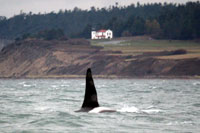
Schofield solder killed in Iraq

January 6, 2009

Schofield soldier, 20, killed in Iraq

Pfc. Christopher Lotter of Pennsylvania joined Army just a year ago

By William Cole
Advertiser Military Writer

A 20-year-old Schofield Barracks soldier who joined the Army just a year ago has been killed in Iraq, the Pentagon said yesterday.

Pfc. Christopher W. Lotter, of Chester Heights, Pa., died New Year’s Eve in Balad from wounds suffered when he was shot by enemy forces in Tikrit, the Army said.

He was the first fatality for the more than 3,500 soldiers of the 3rd Infantry Brigade Combat Team, which deployed to northern Iraq in October and November, Schofield officials said.

A release put out by Multinational Force-Iraq, a U.S. command in the country, previously said a U.S. soldier died Dec. 31 from injuries sustained during combat operations on Dec. 30.

Lotter was assigned to the 3rd Battalion, 7th Field Artillery Regiment of the 3rd Infantry Brigade Combat Team, 25th Infantry Division.

He joined the Army in January 2008 and was assigned to Schofield Barracks in June, officials said. Lotter was single and has no family in Hawai’i, according to the Army.

A family member contacted by phone in Pennsylvania yesterday declined to comment.

A neighbor in the townhouse community where the Lotters live said Christopher was very fit, and before he left, he could frequently be seen washing and cleaning a small green pickup truck.

Although violence is down in Iraq, Hawai’i has continued to experience some troop losses – particularly with the large number of Schofield soldiers in Iraq.

The total includes about 1,000 with the 25th Infantry Division headquarters; 3,500 with the 3rd Brigade; 4,300 with the Stryker Brigade; 700 with the 84th Engineer Battalion; and 375 with the 65th Engineer Battalion.

The 3rd Brigade, which covered Kirkuk province on a previous deployment, is responsible this deployment for Kirkuk and Salah ad Din provinces.

Recent deaths have included that of Sgt. Solomon T. Sam, 26, of Majuro, Marshall Islands, who was killed Dec. 4 when a suicide bomber detonated a car with explosives near a checkpoint in the northern city of Mosul, officials said.

Sam was with the 84th Engineer Battalion.

Pfc. Christopher A. McCraw, 23, of Mississippi, was killed in Baghdad on Oct. 14 when a gunshot hit him in the abdomen under his body armor. McCraw was with the 1st Battalion, 21st Infantry, out of Schofield.

A Hawai’i-based Marine, Lance Cpl. Thomas Reilly Jr., 19, was killed Dec. 21 in a surprise attack while supporting combat operations in Anbar province in western Iraq. He was assigned to the 1st Battalion, 3rd Marines, at Kane’ohe Bay.