I Karera I Palabran Mami (The Journey of Our Words): Chamoru poetry reading in Honolulu

Poetry+Reading+Flier

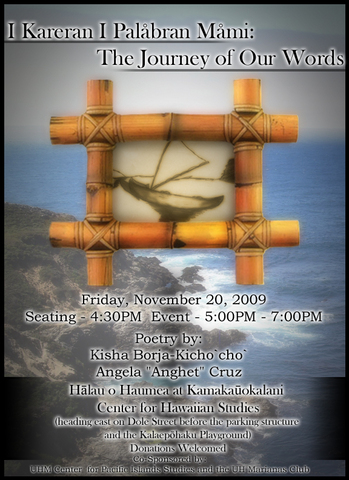
I Karera I Palabran Mami (The Journey of Our Words)

POETS:

Angela T. Hoppe-Cruz (MSW/MA Pacific Isl. Studies Candidate)

Kisha Borja-Ki`cho`cho (MA Pacific Island Studies Candidate).

Both women are Chamoru and were born and raised on the island of Guam.

WHERE: Halau o Haumea, Kamakakuokalani Center for Hawaiian Studies, University of Hawaii at Manoa, 2645 Dole Street

WHEN: Friday, November 20, 2009

TIME: 5:00-7:00 p.m.

Angela Cruz is a Chamoru activist and poet in Hawai’i.  She is a practicum student with the American Friends Service Committee working on Micronesian health and justice issues.  She is also involved in the Third Path Women’s movement for reproductive justice.  She writes:

My dear friend Kisha and I will be reading pieces we have collaborated on as well as our individual poetry. Much of our work centers on the impact militarization has had on our home island community -Guam and the Micronesian islands, much of which is manifest in social, economic and environmental injustice. We will be serving up, Chamoru fiesta plates (prepared by the UHM Marianas Club), laughter and great conversation.

Youth Speaks Hawai`i Fall 2009 Interscholastic Poetry Slam

INTERfall09FLIER

Upcoming Poetry Slam: Support Youth Voices!

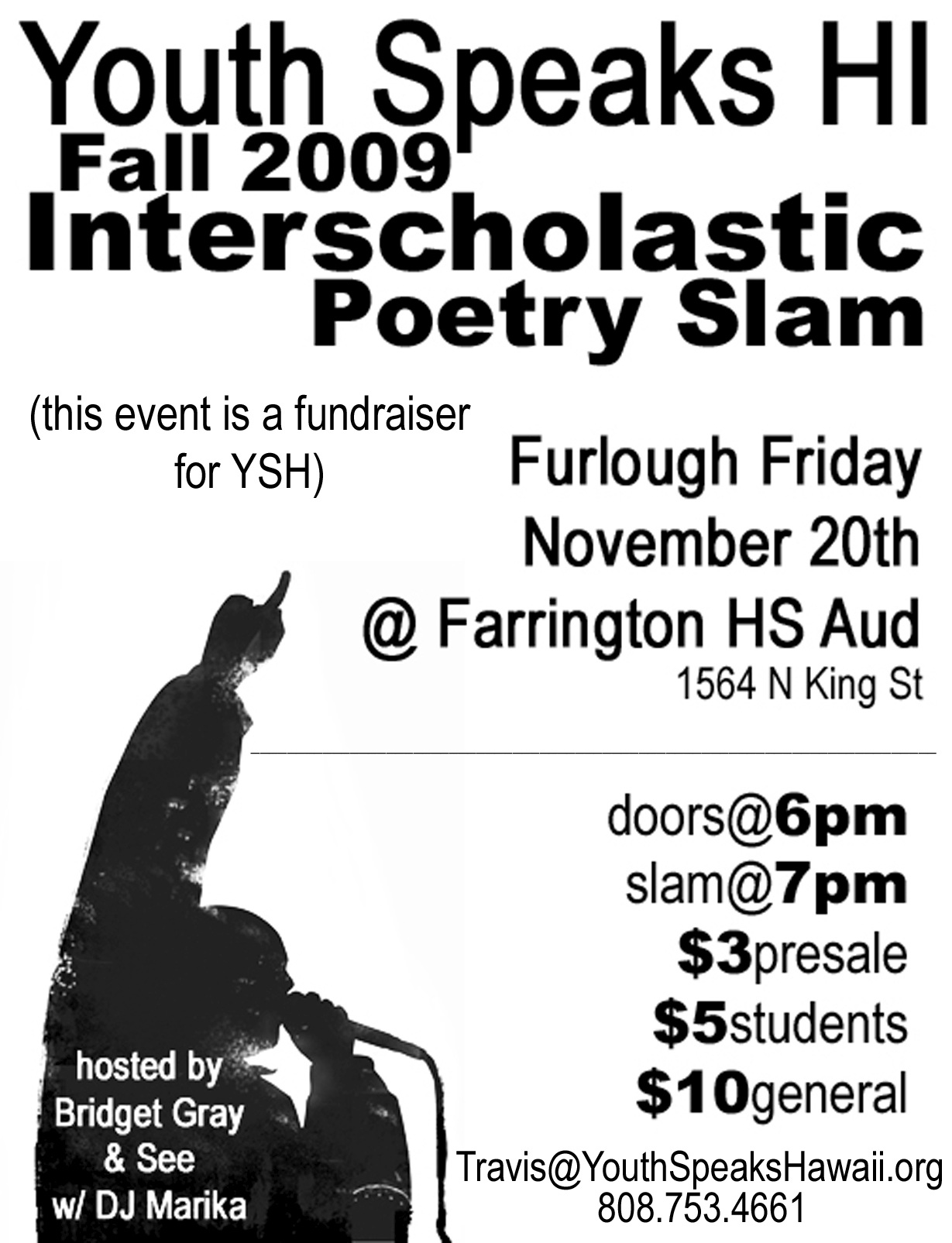
Youth Speaks Hawai`i Fall 2009 Interscholastic Poetry Slam

Farrington High Community Auditorium; 1564 North King Street • Honolulu, HI 96817

Friday, November 20, 2009

7 – 10pm, doors open at 6pm

For ticket information, please call 753-4661 or Travis@YouthSpeaksHawaii.org (Get max. discount! $3; otherwise, $5 w/ ANY school i.d., $10 w/o reservation or school i.d.)

@@@

Youth Speaks Spring 2009 DVD will be on sale at Farrington High on November 20th.

$7 ($5 each if you buy more than one)

Includes all poets, 4 rounds.

Produced by the Farrington Kalihi Media Club

Online orders can be made via email at kalihimedia@gmail.com

Healing from the Center: Decolonizing the Self and Our Communities

09.11.14 HFTCsmallflyer

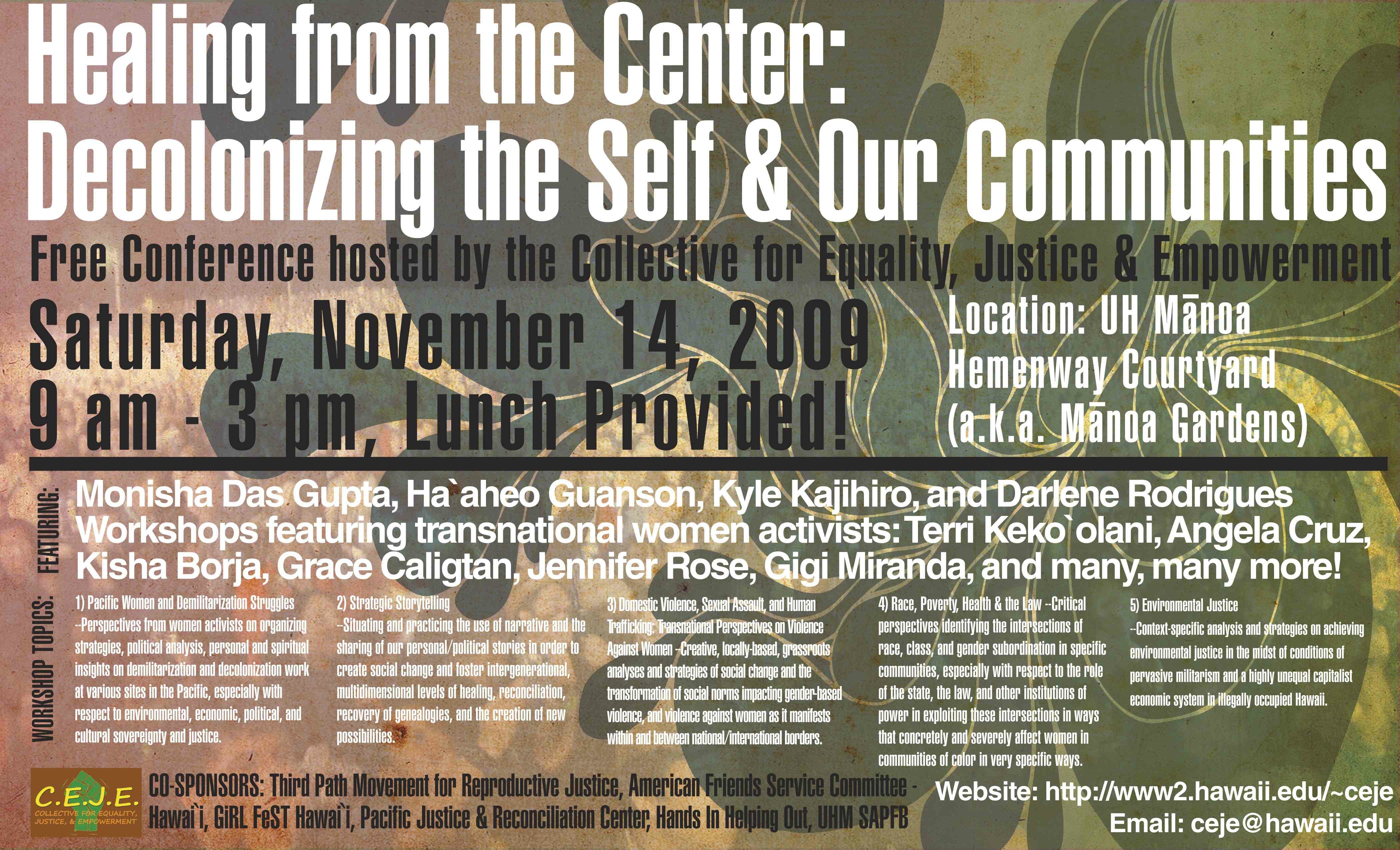
Healing from the Center: Decolonizing the Self and Our Communities

Saturday, November 14, 2009

8:30 am – 4:00 pm.

University of Hawai’i at Manoa, Hemenway Courtyard (“Manoa Gardens”)

LINK TO WEBSITE AND REGISTRATION

Healing is a process of taking back control for our selves, our communities and the land. This conference is a way for participants to deal with different forms of violence that are the results of colonization and to move forward. Real healing begins from the center of each individual and is created through dialogue that changes how we relate to one another while working to decolonize our selves in hope of a better world.

Keynotes: Monisha Das Gupta, Ha`aheo Guanson

Workshops featuring women activists: Terri Keko`olani, Angela Cruz, Kisha Borja, Grace Caligtan, Jennifer Rose, Gigi Miranda and many, many more!

The general timeframe will be as follows (subject to minor changes):

8:30-900: registration

9:00-10:00: opening remarks and ceremony (ha’aheo guanson, darlene rodrigues, monisha dasgupta, ceje organizers)

10:00-12:00: breakout workshops (five simultaneous)

12:00-12:45: lunch

12:45-1:30/1:45: reflections and strategy panel (facilitated; report back from each workshop/sharing)

1:45-2:15: closing words/ceremony (darlene rodrigues)

————————————————————————-

Workshop Brief Descriptions:

1) Pacific Women and Demilitarization Struggles

–Perspectives from women activists on organizing strategies, political analysis, personal and spiritual insights on demilitarization and decolonization work at various sites in the Pacific, especially with respect to environmental, economic, political, and cultural sovereignty and justice.

2) Strategic Storytelling

–Situating and practicing the use of narrative and the sharing of our personal/political stories in order to create social change and foster intergenerational, multidimensional levels of healing, reconciliation, recovery of genealogies, and the creation of new possibilities.

3) Domestic Violence, Sexual Assault, and Human Trafficking: Transnational Perspectives on Violence Against Women

–Creative, locally-based, grassroots analyses and strategies of social change and the transformation of social norms impacting gender-based violence, and violence against women as it manifests within and between national/international borders.

4) Health, Race, Poverty and the Law

–Critical perspectives identifying the intersections of race, class, and gender subordination in specific communities, especially with respect to the role of the state, the law, and other institutions of power in exploiting these intersections in ways that concretely and severely affect women in communities of color in very specific ways.

5) Environmental Justice

–Context-specific analysis and strategies on achieving environmental justice in the midst of conditions of pervasive militarism and a highly unequal capitalist economic system in illegally occupied Hawaii.

Sponsored by the Collective for Equality, Justice and Empowerment

Website: http://www2.hawaii.edu/~ceje/Home.html

Contact information:  ceje@hawaii.edu

Co-Sponsors: Third Path Movement for Reproductive Justice, American Friends Service Committee – Hawai`i, GiRL FeST Hawai`i, Pacific Justice & Reconciliation Center, Hands In Helping Out, UHM SAPFB

Flyer & Artwork: Kamran Samimi / kamransamimi@gmail.com / http://kamransamimi.com

Call to Drum for Sacred Cultural Sites

MESSAGE FROM ANN MARIE KIRK

Drum for our Sacred Cultural Sites throughout Hawai’i Nei

Saturday, November 7th, 2009 at 6pm

Aloha,

The kahea, the call, from Hawea Heiau complex to drum for the proper protection, respect and care for all our sacred cultural sites in Hawai’i nei and the call to drum to honor our kupuna and their presence at all these sites has been heard throughout Hawai’i and worldwide.

The kahea has brought a ripple effect reaching supporters from many places in the world. It is a simple kahea with no expectations. All those who choose to participate are given the freedom to choose their special place and to focus on creating a positive environment to ask the ancestors for guidance.

Those who support our effort will use the pahu, their ipu, ohe pu or whatever instrument they need to join us and this can be as simple as tapping gently over their heart, but most importantly they come with the beat of their hearts, the beat that unites us all as Hawaiians and non-Hawaiians.

We also unite together and drum to let the State Historic Preservation Department hear that throughout our islands we have lost faith in their ability to properly protect and respect our precious and priceless cultural areas. A change must come.

In less than a week we have received responses from many that the beat of the drum on Saturday, Nov. 7th will be taking place in sites around the world including:

Bora Bora, Tahiti

Aotearoa (New Zealand)

Australia

Guatemala

Mexico

At Union Square New York City, New York

San Francisco, California

Ojai, California

New Mexico

Colorado

Oregon

Native American Tribes drumming with us include:

Shumash

Anisnebe

At 6pm on Saturday, as the drumming begins, wherever you are, and even if you are by yourself at your sacred site, please know you are not alone but united with someone else in Hawai’i nei, or around the the world. As Auntie Nani and Auntie Louise sound the pahu for our kupuna iwi ‘o Naue on Kaua’i, the sound of drums will reverberate through Union Square in New York City and the sound will unite us with our friends in Mexico who will be drumming with us.

We will all be connected at all our sacred sites.

In Guatemala, when they heard about the kahea, they emailed us to let us know they will drum too, “ . . . in Guatemala many of our sacred sites are also in danger. Together we can have a strong voice.”

And to quote Auntie Louise from Kaua’i, “The drums will beat to unite us all in our belief and cause. We will be drumming to make sure they receive proper protection, care and respect.”

Please feel free to contact us after the drumming takes place on November 7th to share your thoughts and feelings about what this has meant to your cultural and sacred site.

Our kupuna are with us always, in the sky, the land, the sea and in our hearts and we will fight to make sure they know we are with them and we have not forgotten how important they are to all of us – Hawaiian and non-Hawaiian.

Aloha,

Ann Marie Kirk, Liveable Hawai’i Kai Hui

Chris Cramer, Liveable Hawai’i Kai Hui, East O’ahu Historian

Kaleo Paik, Cultural Keeper

haweaheiau@gmail.com

Drum for our Sacred Cultural Sites throughout Hawai’i Nei

Saturday, November 7th, 2009 at 6pm

Hawea
The drums of Hawea were silenced,
Years of neglect caused its demise.
A once prominent wahipana,
Reduced to rubble and ruin,
Scarred pohaku caused by ignorance,
Left in a pile of disgrace.
A pohaku canvas paints
The history of those long gone.
Sacred `aina used, as was pono,
To build a kauhale, heiau,s
Sacred enclosures for our people,
To come and pay respect.
The essence of the spirit within Hawea
Calls out to be heard.
The vibration echoing the pulse
Of those who have made a stand.
For the sanctity of the Pahu,
The drum to unite us all.

By: Linda Kaleo-o-kalani Paik August, 2009

Please forward to others. Mahalo.

Events featuring Hawai’i-Okinawan playwright Jon Shirota

One of the most important writers to come out of the Asian American community, Jon Shirota will be in Hawai‘i for four events in November 2009:

“An Okinawan Sense of Place,” a talk and discussion, Thursday, Nov. 5, 3–4:30 p.m., room 410, Kuykendall Hall (English department), UH Manoa campus.

Opening of his play Voices from Okinawa. Thursday, Nov. 5, Kumu Kahua Theatre, 46 Merchant St., downtown Honolulu.

“Akisamiyo! From a Pig Farmer to a Writer,” a talk at UH-West Oahu, Monday, Nov. 9, 5–6:30 p.m., beginning with a reception at 4 p.m. This free event is part of the Chancellor’s Lecture Series and is co-sponsored by the UHM Center for Okinawan Studies.

A Celebration of Jon Shirota, Friday, Nov. 13, 7:00-9:00pm at Kapiolani Community College Ohia Cafeteria. Event & Parking are FREE!

WHAT? A Conversation with and Celebration of Jon Shirota!!

WHERE? KapiolaniCC Ohia Cafeteria – http://www.kcc.hawaii.edu/object/ohiamap.html

WHY? This is an opportunity for the Uchinanchu community to come out and honor Jon Shirota, something we have not yet done. If not now, then when?!?

7:00 pm: A Conversation w/ Jon Shirota, followed by Q&A

8:00 pm: A Celebration of Jon Shirota

The Okinawan community will be thanking and honoring Jon with music and dance.

We’ll have Norman Kaneshiro, Jimpu Kai U.S.A. Kin Ryosho Ryukyu Geino Kenkyusho, Okinawa Minyo Kyokai Wakugawa Dojo Derek Ichiro Shiroma Kenkyusho, Tamagusuku Ryu Senjukai Frances Nakachi Ryubu Dojo and a Shishimai performed by Jon Itomura and Eric Nitta.

9:00 pm, Jon will be signing books. Bring your old copies of Lucky Come Hawaii or the new Voices from Okinawa book to get them autographed.

Copies of Voices from Okinawa ($20) will be on sale that night. UH Press printed around 1,000 copies of this and are not planning on printing more! Make sure you get a copy of this wonderful book before it is too late (and get it signed by Jon Shirota and editor Frank Stewart!). More info at: http://manoaokinawaissue.wordpress.com/

FOOD OPTION: You can pre-order a bento and water from Off the Wall (cost $8). Please provide your full name, order and phone number via pigsfromthesea@gmail.com or 734.9562 by the close of Wednesday 11.11 to place an order.

About Jon Shirota

Shirota was born in Peahi, Maui, in 1928. His father immigrated to Hawai‘i from Ginoza Village, Okinawa, in 1907, and his mother immigrated from Kanna Village in 1910. Upon graduating from Brigham Young University in Utah, he worked as a U.S. Treasury agent. In 1963, he was invited to the Handy Writers’ Colony, where he completed Lucky Come Hawaii, the first of his three published novels. His plays have been produced in Honolulu, Los Angeles, New York, and Tokyo. He has received awards from the Rockefeller Foundation, the American College Theater Festival, the Los Angeles Actors Theater Festival of One Acts, the Los Angeles County Cultural Affairs Department, and the Japan-U.S. Friendship Commission and National Endowment for the Arts.

“Voices from Okinawa” at Kumu Kahua Theater, plus events honoring the author

Voices from Okinawa

by Jon Shirota

http://www.kumukahua.org/0910okinawa.html

Kumu Kahua Theatre

46 Merchant Street, Honolulu, Hawai`i 96813

Box Office Phone: (808) 536-4441

Email: kumukahuatheatre@hawaiiantel.net • URL: www.kumukahua.org

Thursday, Friday & Saturday 8pm: November 5, 6, 7, 12, 13, 14, 19, 20, 21, 27, 28; December 3, 4, 5, 2009

Sundays 2pm: November 8, 15, 22, 29; December *6, 2009

(No show Thursday, November 26, because of Thanksgiving)

*American Sign Language Interpretation available

>><<

Haisai Gusuyoo!

I attended the preview of “Voices From Okinawa”, written by Jon Shirota. Within the next 5 weeks that it will be playing, I would like to encourage you and your families to make time to attend this production. The play runs about 1hr 15min. with no intermission. It brings to the forefront the problems…especially US military issues in Okinawa. The personal stories portrayed in the play are very real to life dramas of what is happening in Okinawa now, and which our Okinawa community has not been publicly exposed to very much. It shows that although the war has ended more than 60 years ago, the problems of okinawans not being able to voice their problems, and continued suffering due to US military presence still exist and is still affecting Okinawa. There are a few things that don’t jive with Okinawan life, and the transitions between the scenes seem to soften the heavy, emotional stories through its almost comical music and movements, but al in all it is a play with a strong message that all Okinawans should take to heart and think about. For those of you who just came back with us from the tour…there are parts where it will wrench at your hearts since you will understand the situations so clearly.

This play also comes a a good time when news has been covering the Futenma base issues, and also Camp Schwab in Henoko. Also a good timing prior to the Okinawa Governor’s arrival this month. Please let your relatives and friends know about this play and encourage them to go, or take them with you. We all need to grow in our understanding of the problems presented in “Voices”.

Eric/Ukwanshin Kabudan

Kehaulani Kauanui to speak and launch book: Hawaiian Blood

09.10.23 KauanuiPoster

JOIN US FOR AN EVENING WITH THE AUTHOR OF

HAWAIIAN BLOOD: COLONIALISM AND THE POLITICS OF SOVEREIGNTY AND INDIGENEITY

In the Hawaiian Homes Commission Act of 1921, the U.S. Congress defined “native Hawaiians” as those people “with at least one-half blood quantum of individuals inhabiting the Hawaiian Islands prior to 1778.” This “blood logic” has since become an entrenched part of the legal system in Hawai’i.

Hawaiian Blood is the first comprehensive history and analysis of this federal law that equates Hawaiian cultural identity with a quantifiable amount of blood.  J. Kehaulani Kauanui explains how blood quantum classification emerged as a way to undermine Hawaiian sovereignty. Kauanui provides an impassioned assessment of how the arbitrary correlation of ancestry and race imposed by the U.S. government on the indigenous people of Hawai‘i has had far-reaching legal and cultural effects.

October 23rd, 2009

6:00 PM – 8:00 PM

Native Books / Na Mea Hawai‘i

Ward Warehouse (Ewa end, under the Old Spaghetti Factory)

1050 Ala Moana Blvd., Suite 1000, Honolulu, HI 96814

Phone (O‘ahu): (808) 597-8967

Toll-free (Neighbor Islands): 800-887-7751

Fax: (808) 596-7742

J. Kehaulani Kauanui is an associate professor of anthropology and American studies at Wesleyan University. Currently, she is working on her second book titled, Thy Kingdom Come? Gender & Sexuality in Hawaiian Nationalist Politics–a critical study on gender and sexual politics vis-à-vis state-centered Hawaiian nationalism and the disavowal of Hawaiian indigeneity. Kehaulani was part of the founding steering committee for the Native American and Indigenous Studies Association, established in 2008, and is currently a council member serving a three year term. She is the producer and host of a public affairs radio program, “Indigenous Politics: From Native New England and Beyond,” on WESU that is syndicated on five other stations through the Pacifica-radio network.

Premier documentary: Blue Tarp City – houseless in Wai’anae

Premier of Blue Tarp City, a documentary film about the houseless in Wai’anae.  Blue Tarp City takes a look at how the Wai’anae native Hawaiian houseless community faces disempowerment and serves to recognize their struggle to exist on the edges of society juxtaposed against post-card beaches and palm trees.

Friday, October 16th, 2009 at 5:45 pm at the Dole Cannery Theaters.  You can purchase tix on-line for the shorts “show”  http://hawaii.bside.com/2009/films/bluetarpcity_hawaii2009;jsessionid=A8A3F9D1216628358EF68CA3246FCE5F

Watch the trailer:

‘Ike: Historical Transformations: Reading Hawai’i’s Past to Probe Its Future

‘Ike: Historical Transformations: Reading Hawai’i’s Past to Probe Its Future

Download the event flyer

DATE:  Saturday, October 24th, 2009, 10am-5pm

FEATURED PRESENTERS:

  • Kamana Beamer
  • Lorenz Gonschor
  • Kūhiō Vogeler
  • moderated by Lynette Cruz
  • Kekuni Blaisdell
  • Ikaika Hussey
  • Terri Kekoolani
  • Jon Osorio
  • J. Kehaulani Kauanui
  • Maivân Clech Lâm
  • Keanu Sai
  • moderated by Jon Osorio

and others yet to be confirmed:

Kamakakuokalani Center for Hawaiian Studies (Map/Directions)

2645 Dole St. Honolulu, HI 96822

Info: Attendance is free.

1. Recovering our Political Past: Who Votes? For What Political Status? As Hawaii continues to experience a series of political transformations first launched by its contact with the West and continuing now through the introduction of the Akaka Bill in the U.S. Congress, we focus on two key issues that substantially shaped those transformations: WHO made the decisions that produced the transformations, and what CHOICES did they consider and not consider? Key historical moments will be presented through speeches as might have been delivered in 1882, 1888, 1893, 1898, 1959, 2000, 2009. Presenters include Kuhio Vogeler, Kamana Beamer, Lorenz Gonshor, and others TBD. Moderated by Lynette Cruz.

Co-sponsored by Ka Lei Maile Ali’i Hawaiian Civic Clubs. 10:00 am.

2. History of Hawaiian Political Activism: 1887 to the Present. Kekuni Blaisdell, Ikaika Hussey, Terri Kekoolani, and Jon Osorio examine the various individuals and/or historical developments that were key to the several political transformations of Hawaii since Kamehameha I first established it as a united kingdom. Exploring among others, some of the various political groups in the 19th century Hawaiian Kingdom, the Ku’e petitions, the 1960 land struggles, the 1993 Sovereignty Tribunal, as well as contemporary examples as to how current political activism might redefine the map of Hawai’i’s political future.

Co-sponsored by M.A.N.A. and Kanaka Maoli Tribunal Working Group.12:30 pm.

3. International Routes: De-occupation, Decolonization and the Declaration on the Rights of Indigenous Peoples. Keanu Sai, J. Kehaulani Kauanui, and Maivan Lam discuss the modern trajectory of the Hawaiian Islands within the context of, among other topics, Hague Regulations on the law of occupation, the U.N. Decolonization Protocols, and the U.N. Declaration on the Rights of Indigenous Peoples. This panel seeks to assess the relative merits that are rooted in international relations and international law, and which offer far fuller redress for the overthrow of the Hawaiian monarchy than is contemplated in, for example, the U.S. Congress’ Akaka Bill.

Co-sponsored by Ka Pakaukau. 3:00 pm.

‘Ike: Historical Transformations is presented by Kamakakuokalani Center for Hawaiian Studies and ‘Imi Pono Projects.

All times subject to change, please check back for confimation.

For more information contact arnie@imipono.org

stills/photos by Jon Brekke, unknown and David Ma

Celebrate Indigenous Peoples’ Day – Burning of the Papal Bulls

This week, 350 Hawai’i religious pilgrims visited the grave of Father Damien in Belgium, before flying to Rome for the canonization of Damien on Sunday.   Father Damien is beloved because of his selfless devotion to serve the Hansen’s Disease patients, many of whom were Native Hawaiian, exiled in Kalaupapa, Moloka’i.  How ironic it is that Discoverer’s Day (Columbus Day) only days after Damien’s canonization, commemorates the beginning of the European genocide and colonization of indigenous peoples in the Americas, under the sign of the cross.

Since the Columbus Quincentennial in 1992, indigenous peoples have reclaimed October 12th as International Indigenous Peoples’ Day with celebrations and protests.   Twelve years ago, Tony Castanha, a Boricua (Puerto Rican) in Hawai’i who was reconnecting with his Taino ancestry, began commemorating the day with a ceremonial burning of the 1493 Papal Bull Inter Caetera. The Papal Bull was the holy decree which gave Columbus the Church’s blessing and authorization to “establish Christian dominion over the globe and called for the subjugation of non-Christian peoples and seizure of their lands.” This racist law became one of the foundations of the Christian Doctrine of Discovery and many laws authorizing the taking of native peoples’ land.

Now there is an international movement by indigenous peoples to revoke the Papal Bulls, and hopefully begin the unraveling of more than 500 years of genocidal laws.  Recently the Episcopal Church passed a landmark resolution entitled “Repudiate the Doctrine of Discovery”.

Here is the announcement of the upcoming burning of the Papal Bulls in Honolulu:

CELEBRATE INDIGENOUS PEOPLES’ DAY!

12th Annual Papal Bulls Burning

(This year’s event is dedicated to the life of Kanaka Maoli warrior James Naiokala Nakapa’ahu)
In solidarity with indigenous peoples around the world, please join us for the annual Indigenous Peoples’ Day, Papal Bulls Burning ceremony in Honolulu on Monday, October 12, 5:00 pm, in front of the Roman Catholic Diocese of Honolulu, 1184 Bishop St. (at the top of Fort Street Mall).

Indigenous peoples and supporters elsewhere are encouraged to organize a small ceremonial event and symbolically burn or tear-up copies of the May 4, 1493 papal bull “Inter Caetera” in demonstration against “Columbus Day,” or “Discoverer’s Day” as it’s known as here in Hawai’i. The document can be downloaded from our website at:

http://bullsburning.itgo.com/papbull.htm

*Students are especially encouraged to attend in order to put theory into practice by linking the papal bulls issue with other important indigenous rights’ and global issues we’ve diligently covered in class.

Sponsoring organizations include: Kosmos Indigena, Ka Pakaukau, Matsunaga Institute for Peace, Ahupua’a Action Alliance, Hawai’i Institute for Human Rights, and the Kanaka Maoli Tribunal Komike. For more information, email: castanha@hawaii.edu, or phone (808) 737-6097.

*Indigenous peoples and supporters seek the formal revocation of the 1493 papal bull “Inter Caetera.” This decree was issued by the Vatican to Christopher Columbus on his second voyage to the Caribbean. Along with the 1494 Treaty of Tordesillas, it sought to establish Christian dominion over the globe and called for the subjugation of non-Christian peoples and seizure of their lands. As a result, an estimated 100 million indigenous peoples were killed off in the process of Europe’s colonization of the indigenous world. This papal edict has never been repealed and is the foundation-stone of the international system we live under today and directly related to the corporate-state-military plunder and rape of the planet, which is sometimes linked to the phenomenon known as “globalization.”
Aloha a hui hou.

In peace,

Tony Castana
Coordinator
Kosmos Indigena