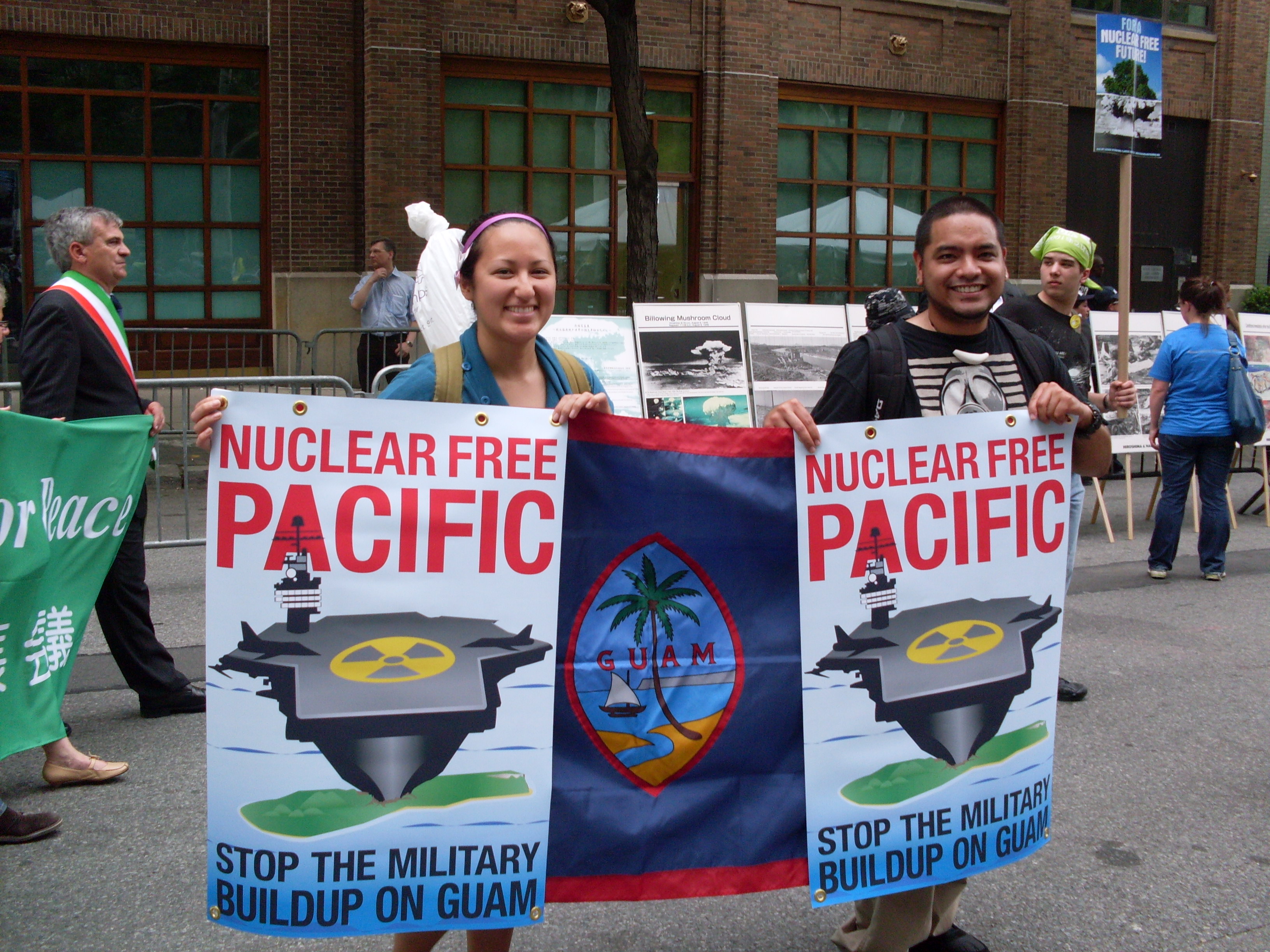
Is DREAM Act a Solution for Millions of Undocumented Youth or a Funnel for Military Recruitment?

Debate: Is DREAM Act a Solution for Millions of Undocumented Youth or a Funnel for Military Recruitment?

Dreamact2

The Development, Relief and Education for Alien Minors Act—DREAM—would allow undocumented young people a chance at citizenship provided they attend college for at least two years or enlist in the military. It’s been described as a dream come true for undocumented youth wanting a chance to stay in this country without the fear of deportation. But many antiwar activists warn that the bill will simply funnel more young people into the military. We host a debate between Camilo Mejía of Iraq Veterans Against the War and pro-DREAM activist Gaby Pacheco. [includes rush transcript]

Read the transcript on Democracy Now!

Another “Superferry” fiasco in the making? Military training proposed at former Kulani prison

The Hawaii Tribune Herald published an article about the proposal to transfer former Kulani Prison land to the state of Hawai’i Department of Defense.    More details are emerging about the scope of training the military plans for the land. Two words come to mind “Hawaii Superferry”.

Here are excerpts from the Hawaii Tribune Herald:

Former prison may be converted into a training facility for military

The former Kulani prison could become a training base for a 150-soldier company to learn how to detect roadside bombs, perform emergency aerial evacuations and make forced entries into buildings.

That’s according to a proposal from the Hawaii Department of Defense, which also wants to operate a quasi-military program for at-risk teens.

Military training was not mentioned in July 2009. That was when state and military leaders announced plans to close the Big Island’s only prison located off of Stainback Highway, about 20 miles south of Hilo.

“In conjunction with the Hawaii Army National Guard training on the 600 acres, DOD intends to develop and operate a short-distance range, conduct Military Operations on Urban Terrain (MOUT) at the former boys’ school, conduct company-size and lower-level training along roadways and the pasture area, and develop landing zones in the pasture and near the camp for emergency evacuation and training,” states the supportive recommendation of Laura Thielen, DLNR chairwoman.

A former quarry would be converted into a live-fire pistol range to replace the one that’s closed at the guard’s Keaukaha Military Reservation in Hilo, said Brig. Gen. Gary Ishikawa.

This is Governor Lingle’s scorched earth campaign at the end of her term.  The transfer of 8000 acres of Waiakea rainforest to the military for company sized training is unconscionable.  The trial balloon was floated by the state last November with a proposal to create a National Guard Youth ChalleNGe academy in the closed Kulani prison site. Many in the community protested the closure of Kulani, one of the most successful sex-offender treatment programs in Hawai’i.  At the time there was no mention of military training, although activists suspected that the military had ulterior motives for the land transfer.  Now we see that this was always the hidden objective for the plan to close Kulani.  It fits with the secretive style of Governor Lingle. She tried to do the same thing with the Hawaii Superferry, trying to sneak then force the project through approval processes without an environmental impact statement.  It created a financial, legal and environmental disaster. In the end, it became clear that the Superferry was  really a front for a military transport prototype.

In Wai’anae: Army delays ‘Ordnance Reef’ study

Ordnance Reef study pushed back

By William Cole

POSTED: 01:30 a.m. HST, Aug 20, 2010

The Army said yesterday that it is delaying a $2.5 million study of grenades, bombs and other ordnance dumped in shallow water off Waianae that was scheduled for October because it first needs to do an environmental assessment.

Conducting the assessment for what is known as Ordnance Reef will push back the technology demonstration project until April or May, the Army said. It said it determined an assessment is required under federal law.

READ MORE

Navy plans expansion of range and training activities in the Pacific

Hawaii-Southern California Traning and Testing Environmental Impact Statement and Overseas Environmental Impact Statement

Here is the link to the Navy website for the project.

The Navy proposes to expand its Hawaii Range Complex to the International Date Line.  It already encompasses 2.1 million square miles of sea, air and land.  The new proposal also includes new training and testing activities involving sonar that could harm marine mammals.   In the first phase of preparation of an environmental impact statement, the Navy is conducting scoping meetings to seek input on what impact issues it must study and address in its investigation.  The meetings are being held in a format that does not allow for public speaking in a forum.  They have broken up the sessions into informational stations to disperse public interaction and opposition.

hstt_region

HAWAI’I SCOPING MEETINGS

Tuesday, August 24, 2010

4:00 to 8:00 p.m.

Kauai Community College Cafeteria

3-1901 Kaumualii Highway

Lihue, Hawaii

Wednesday, August 25, 2010

4:00 to 8:00 p.m.

Keehi Lagoon –Disabled American Veterans Hall – Weinberg Hall

2685 North Nimitz Highway

Honolulu, Hawaii

Thursday, August 26, 2010

4:00 to 8:00 p.m.

Hilo High School Cafeteria

556 Waianuenue Ave.

Hilo, Hawaii

Friday, August 27, 2010

4:00 to 8:00 p.m.

Maui Waena Intermediate School Cafeteria

795 Onehee Ave.

Kahului, Hawaii

Marines expansion threatens to “radically change” aircraft stationing and training in Hawai’i

The Marine Corps is threatening a major expansion in Hawai’i including basing of new aircraft, an increase in troops and dependents and expanded training.  The Navy/Marine Corps is preparing an Environmental Impact Statement for this expansion.  There will be public scoping meetings held in Aug 24-30. From the project website  http://www.mcbh.usmc.mil/mv22h1eis/:

Public Scoping Open Houses

Federal, state, and county agencies and interested parties are invited to attend any of these open houses and encouraged to provide comments. The Navy will consider these comments in determining the scope of the EIS. Five meetings, using an informal open-house format, will be held on the islands of Hawai‘i, O‘ahu, and Moloka‘i as follows:

Meeting Dates/Locations

August 24, 2010 | 5-8pm

Hilo High School Cafeteria

556 Waianuenue Avenue

Hilo, HI 96720

August 25, 2010 | 4-7pm

Waikoloa Elementary & Middle School Cafeteria

68-1730 Ho’oko Street

Waikoloa, HI 96738

August 26, 2010 | 5-8pm

King Intermediate School Cafeteria

46-155 Kamehameha Hwy.

Kāne‘ohe, HI 96744

August 28, 2010 | 1-4pm

Kaunakakai Elementary School Library

Ailoa Street

Kaunakakai, HI 96748

August 30, 2010 | 5-8pm

Waimānalo Elementary & Intermediate School Cafeteria

41-1330 Kalanianaole Hwy.

Waimānalo, HI 96795

Project Overview

The Department of the Navy, U.S. Marine Corps, is preparing an Environmental Impact Statement MV-22 Aircraft (U.S. Marine Corps photo by Lance Cpl. Kelsey J. Green (Released))(EIS) for the basing and operation of MV-22 tiltrotor Osprey aircraft and H-1 Cobra and Huey attack helicopters in support of III Marine Expeditionary Force elements stationed in Hawai’i. Because the squadrons would train on land owned or controlled by the Department of the Army, the Navy has requested that the Army be a cooperating agency for preparation of this EIS.

AH-1Z Aircraft (U.S. Marine Corps photo by Lance Cpl. Christopher O'Quin (Released))The EIS will evaluate a proposal to introduce up to two Marine Medium Tiltrotor (VMM) squadrons with a total of 24 MV-22 aircraft, and one Marine Light Attack Helicopter (HMLA) squadron composed of 18 AH-1Z and 9 UH-1Y helicopters, construction of improvements to accommodate the new aviation squadrons, improvements to training facilities in Hawai’i used by the Marine Corps, and use of Department of Defense training areas statewide.

UH-1Y Aircraft (U.S. Marine Corps photo by Lance Cpl. Christopher O'Quin (Released))This website provides information about the proposed action and alternatives, the EIS schedule, the National Environmental Policy Act (NEPA) process, and points of contact. Project documents will be posted here as they become available.

The Marine Corps requests your input to identify community concerns and issues to be addressed in the EIS. You can participate in a variety of ways:

  • Attend a public scoping open house.
  • Visit this website to learn more about the EIS throughout the process.
  • E-mail us at mv22h1eis@beltcollins.com to submit comments.
  • Mail written comments to Naval Facilities Engineering Command, Pacific, Attn: EV21, MV-22/H-1 EIS Project Manager, 258 Makalapa Drive, Suite 100, Pearl Harbor, HI 96860-3134.

Written comments must be submitted no later than September 7, 2010. Thank you for your interest.

Join DMZ-Hawai’i/ Aloha ‘Aina at the USSF: ‘American Lake’ or Ka Moana Nui?: Demilitarization movements in the Asia-Pacific

‘American Lake’ or Ka Moana Nui?: Demilitarization movements in the Asia-Pacific

Since the 1890s, the US has treated the Pacific ocean as an ‘American Lake’. Today, it seeks a drastic expansion of military bases in the region, primarily to contain a rising China. But movements against US bases in the Asia-Pacific are rising up and declaring a different vision of Ka Moana Nui (the great ocean) as a zone of peace and security through peoples’ solidarity. The voices of peoples of the Pacific are rarely heard in the US. Find out about demilitarization efforts in the Asia-Pacific and how people in the U.S. can be in solidarity. Participants will gain a better understanding of: 1) the crucial role of Pacific islands to the maintenance and expansion of American Empire; 2) the disastrous impacts this network of bases has on the countries and peoples of the Asia-Pacific; and 3) the movements that are resisting U.S. militarization in the Pacific. This will be a panel discussion with representatives from Asia-Pacific nations who are knowledgeable and active in anti-bases struggles. The format will be a panel discussion with some multimedia aids. Activists working on anti-bases movements in Hawai’i, Guahan/Guam, and Korea will be on a panel.

Thu, 06/24/2010 – 3:30pm5:30pm
Event Location: Cobo Hall: D2-10

S. Korea Aegis destroyer scheduled to train at RIMPAC, related to Jeju struggle

Below is an old article about South Korea testing its Aegis destroyer in Hawai’i during the RIMPAC exercises this summer.  Bruce Gagnon wrote this about the article:

This is an indication that the South Korean Navy is now being fully integrated into the command structure of the U.S. Navy and that the Aegis destroyers that would be deployed at the proposed base on Jeju Island will in fact be a part of the larger U.S. military strategy of surrounding China’s coastal region in order to create the ability to choke off their importation of oil via ship.

See the recent New York Times article on China’s fear and response here.

>><<

http://english.yonhapnews.co.kr/news/2010/03/01/0200000000AEN20100301002900320.HTML

S. Korean Aegis destroyer to check its combat capabilities in June

SEOUL, March 1 (Yonhap) — South Korea’s first Aegis destroyer will undergo a comprehensive evaluation of its fighting capabilities near Hawaii in June, a Navy source said Monday.

The source said Sejong the Great will conduct tests while taking part in the multinational Rim of the Pacific (RIMPAC) naval exercise. Lockheed Martin — the developer of the Aegis system — and U.S. Navy experts will act as observers and evaluate the weapons systems during the trial.

Hawai’i Presentation given at the International Conference For a Nuclear Free, Peaceful, Just and Sustainable World

Hawai’i Presentation given at the International Conference For a Nuclear Free, Peaceful, Just and Sustainable World

By Kyle Kajihiro, Program Director, American Friends Service Committee – Hawai’i Area Office, member of DMZ-Hawai’i / Aloha ‘Aina network

April 30, 2010

Aloha kakou. Warm greetings from Hawai’i.

For more than a century, the U.S. has treated the Pacific ocean as an “American Lake” and Pacific islands as stepping-stones to extend the march of “manifest destiny” westward to the Asian prize.

The peoples of the Pacific were merely an afterthought. Henry Kissinger’s remark about nuclear tests in the Marshall islands exemplified this attitude: “There are only 90,000 people out there. Who gives a damn?”

The independent Kingdom of Hawai’i was one of the first overseas casualties of the American empire. In 1893 Hawai’i was invaded and occupied by U.S. troops in order to establish a forward military base in the Pacific. As Stephen Kinzer noted, the U.S.-backed overthrow of the Hawaiian Kingdom was the prototype for the recurring tactic of “regime change”, all the way up to and including the invasion of Iraq.

The U.S. military occupation of Hawai’i enabled America to defeat the Spanish Empire in 1898, acquire its colonies, and emerge as a global power. During WWII, U.S. military bases in Hawai’i were crucial to America’s victory over the Japanese empire and its rise to global, nuclear armed superpower status.

After the war, America established the Pacific Command in Hawai’i, the oldest and largest of the unified commands. It has an area of responsibility that encompasses most of the world’s surface and a majority of its population.

Ke Awalau o Pu’uloa, the true name of what is commonly called Pearl Harbor, was once a marvel of aquacultural and agricultural engineering. It was the food basket for O’ahu. But the U.S. military wanted to turn it into a naval base. Today, what was once a life-giving treasure has become a toxic superfund site with more than 740 contaminated sites identified thus far.

Pearl Harbor also serves another function as the iconic war monument. It is a factory to valorize and reproduce the myth of America’s redemption through militarization and war. Hawai’i and America are still held hostage to this myth.

The military presence in Hawai’i can be imagined as the head of a monstrous he’e or octopus, with tentacles that grab at our brothers and sisters in the Philippines, Guam, Okinawa, Korea, Kwajalein. Hawai’i is simultaneously a victim of American empire and an accomplice in the building of that empire.

America’s bid for “full spectrum dominance” extends from the bottom of the sea to the heavens above, from space to cyberspace. Sensor grids on the sea floor off Kaua’i and radar, antenna and optical tracking stations on the peaks of our sacred mountains are the eyes and ears of the he’e. Supercomputers and fiber optics are its brains and nervous system. To stop a he’e, you must neutralize its head.

According to the 2009 Base Structure Report, the U.S. military operates a total of 139 installations and facilities in Hawaii, with a total area of 239,000 acres. In addition the Hawaii National Guard has 13 installations occupying 858,000 acres. The main islands are completely surrounded by military defensive sea areas, and the entire archipelago is surrounded by 2.1 million square miles of temporary operating area.

The process of militarization destroys Native Hawaiian culture and sacred sites and imperils native ecosystems. It has poisoned our environment and threatened our health with a toxic cocktail of depleted uranium, lead, dioxins, radioactive cobalt 60, chemical weapons, and a host of other substances. It creates economic dependency that verges on addiction and distorts our sense of cultural identity and social priorities.

After 9/11, Hawai’i experienced the largest military expansion since WWII. Despite protests and devastating environmental and cultural impacts, the Army seized 25,000 acres of land and stationed 328 Strykers in Hawai’i. Missile defense programs and congressional earmarks fuel a military-industrial gold rush, cutting off access to some of our best beaches at the missile range on Kaua’i. Even economic stimulus funds have been hijacked to boost construction of military housing and other facilities.

Despite overwhelming odds, people continue to resist. In 1976, the first of several waves of activists landed on Kaho’olawe island to protest the Navy bombing of that sacred place. This movement eventually ended the bombing and forced the clean up and return of the island.

In Makua decades of protest, lawsuits and the assertion of traditional Kanaka Maoli cultural practices have halted Army live fire training for the last five years. There is fierce community opposition to the Army’s plans to resume training in Makua.

In 2003, the community defeated a proposed Marine jungle warfare training facility in Waikane valley. The marines have now begun a process of cleaning up unexploded ordnance.

On Hawai’i island, activists have called for the end of live fire training in Pohakuloa, the clean up of depleted uranium and the cancellation of the lease of state land to the military.

In 2002, the DMZ-Hawai’i / Aloha ‘Aina network was organized to unite the various local struggles against the bases in Hawai’i. Our four demands are: 1. Stop military expansion, 2. Cleanup and return military occupied lands. 3. Develop sustainable economic alternatives and 4. Pay just compensation for the damages caused by the military in Hawai’i.

The arms of the he’e can grow back when they are cut off, as we are seeing with the return of U.S. troops and “lily pad” installations in the Philippines and the relocation of bases from Ecuador to Colombia. We need a different paradigm of peace and security based on meeting human needs and environmental sustainability, not the imposition of order through the threat of overwhelming violence.

We are inspired and encouraged by the emergence of a global network against foreign military bases. In Hawai’i we have organized actions to support Vieques, Okinawa, Guam, Korea and the Marshall Islands.

I’d like to make a special appeal and challenge to our comrades in peace and justice movements to please pay attention to and support the justice struggles on our small islands. The Pentagon wants to rule the planet from a network of strategic island military hubs. To end the present wars and prevent future wars, we must dismantle the architecture of this empire of bases, and the solidarity of people in the heart of the empire to push for the withdrawal of these bases is more important than ever.

In contrast to the imperial vision of the American Lake, peoples of the Pacific have a different vision of peace and security for our region. The Nuclear Free and Independent Pacific movement popularized the concept of Ka Moana Nui, the great ocean that connects the Asia Pacific through solidarity rather than hegemony. To borrow a Hawaiian concept, let us “haku”, that is braid our struggles into an unbreakable cord much stronger than its individual strands to restrain the powerful forces that make wars and rule through nuclear and military terror.

Network for Okinawa announces solidarity actions to protest U.S. military bases in Okinawa

http://closethebase.org/

FOR IMMEDIATE RELEASE

April 20, 2010

CONTACT: John Feffer, Institute for Policy Studies

johnf@ips-dc.org, 202-234-9382, cell: 510-282-8983

New U.S.-Japan coalition demands closure of the Futenma U.S. Marine Corps base and opposes the construction of new bases in Okinawa and Tokunoshima; Holds rally in Washington and posts full-page ad in Washington Post

Washington – April 19 – In the past six months, the governor, mayors, media, and citizens of Okinawa have joined to demand the closure of the Futenma U.S. Marine Base and oppose any new military base construction—in historic solidarity.

On this side of the Pacific Ocean, the Network for Okinawa (NO), an unprecedented grassroots network, has drawn together representatives from peace groups, environmental organizations, faith-based organizations, academia, and think tanks to support these same goals.

The coalition represents hundreds of thousands of Americans concerned about democracy and environmental protection in Okinawa.

On April 23, 2010, the Washington-based coalition will send President Obama and Prime Minister Hatoyama a letter signed by more than 500 organizations demanding the immediate closure of Futenma and the cancellation of plans to relocate it to Henoko Bay.

Network for Okinawa member, Peter Galvin, Conservation Director at the Center of Biological Diversity, explains what is at stake, “Destroying the environmental and social well-being of an area, even in the name of ‘national or global security,’ is itself like actively waging warfare against nature and human communities.”

On April 25, 2010, members of the Network will rally in front of the Japanese Embassy in Washington D.C. at 2 p.m. They are demonstrating to demand the immediate closure of Futenma and to oppose new military base construction at any site in Okinawa, including the island of Tokunoshima. (Tokunoshima is a small northern island in the Ryukyu archipelago; historically a part of Okinawa.) The D.C. protest is an American expression of solidarity with the expected 100,000 Okinawans marching on the same date.

John Lindsay-Poland, of the Fellowship of Reconciliation, advocates nonviolent conflict resolution instead of war to resolve international disputes: “Military bases in Japan and other countries are material projections of our nation’s will to use war and violent force. War is not only brutal, and ecologically devastating, but unnecessary. I want our country to have a different relationship with other peoples of the world.”

During the week of April 26, 2010, the Network and its Tokyo-based affiliated coalition, the Japan-US Citizens for Okinawa Network (JUCON), will place a full-page ad in the Washington Post. JUCON (http://jucon.exblog.jp/) is a coalition of Okinawa and Japan-based NGOs, citizens groups, journalists and prominent individuals.

“The Washington Post ad will draw attention to this critical issue. It will put pressure on both Washington and Tokyo to do the right thing: respect the democratic desires of the Okinawan people and the fragile environment of this beautiful island,” says John Feffer, spokesperson for Network for Okinawa.

BACKGROUND:

Most Americans have heard of the Battle of Okinawa. However, most don’t know Okinawa’s location; or that the U.S. maintains thirty U.S. military bases and facilities on twenty percent of this island, the size of Rhode Island. U.S. troops constructed the first U.S. military bases for the planned invasion of Japan and never left—even after the U.S. “reverted” Okinawa to Japan in 1972.

The U.S. Marine Futenma base—made infamous by the 1995 Marine gang rape of a twelve-year-old girl—generates noise pollution, accidents, and crimes on a daily basis. In fact, former Secretary of Defense Donald Rumsfeld called Futenma the “most dangerous U.S. base in the world.” The next year, the United States and Japan announced Futenma’s closure and the construction of a new base on the east coast of Okinawa in Henoko, a tiny fishing village.

Local residents immediately challenged this plan. During the past fourteen years, Henoko has become a lightning rod for Okinawan grievances over 65 years of unwanted U.S. military bases and over 130 years of unwanted colonial domination by Japan. That’s because Henoko’s emerald waters and coral reef are home for about fifty critically endangered dugongs, a symbol of Okinawan peaceful culture based on the sanctity of life (nuchido takara) and reverence for nature. In 1966, Okinawans designated the dugong (cousin to the manatee) as their living national monument. Nuchido Takara directly translates as “Life is a treasure.”

Okinawa’s unique biodiversity (the island known as the “Galapagos of the East”) captured the attention of transnational environmentalists.

In 2003, a coalition—including the Japan Environmental Lawyers Federation (JELF) and U.S.-based Center for Biodiversity, represented by Earth Justice—sued the U.S. Department of Defense to halt the construction of the base. This marked the first-ever international lawsuit under the U.S. National Historic Preservation Act, as the dugong is protected under Japanese cultural properties law. On January 24, 2008, a U.S. Federal District Court in San Francisco delivered a historic ruling in favor of the plaintiffs, finding that the DoD plan had violated the NHPA. Despite this ruling, the DoD has continued to insist upon Henoko as a site for a Futenma “relocation.”

The Network for Okinawa (http://closethebase.org/) is sponsored by the Institute for Policy Studies in Washington. Members include: American Conservative Defense Alliance, American Friends Service Committee, Center for Biological Diversity, Fellowship of Reconciliation, Greenpeace, Institute for Policy Studies, Just Foreign Policy, Pax Christi USA, the United Methodist Chuch, Veterans for Peace, and Women for Genuine Security.

Members of the Network for Okinawa available for interviews:

• Peter Galvin, Center for Biological Diversity. pgalvin@biologicaldiversity.org; 520-907-1533.

• Kyle Kajihiro, Program Director, American Friends Service Committee – Hawai’i Area Office. kyle.kajihiro@gmail.com; O: 808-988-6266; C: 808-542-3668.

• John Lindsay-Poland, Director, Fellowship of Reconciliation Latin America program, Oakland, California, is active in the global No Bases network and author of Emperors in the Jungle: The Hidden History of the US in Panama (Duke). johnlp@igc.org; C: 510-282-8983.

• Doug Bandow, Robert A. Taft Fellow, American Conservative Defense Alliance and former Special Assistant to President Ronald Reagan. ChessSet@aol.com; 703-451-9169.

• Ann Wright, Retired Army Colonel, former US. Diplomat. microann@yahoo.com; C: 808-741-1141.