Hawai’i vigil in solidarity with Okinawa

P4250185

P4250189

Photos: Jamie Oshiro, Hawai’i Okinawa Alliance

Yesterday, in solidarity with the 90,000+ Okinawans who rallied against U.S. military bases in Okinawa, the Hawai’i-Okinawa Alliance (HOA), the American Friends Service Committee – Hawai’i and DMZ-Hawai’i / Aloha ‘Aina organized a vigil in front of the Japanese Consulate in Honolulu.

Approximately 40 people held signs and candles in front of the Japanese Consulate. Ukwanshin Kabudan, Nakem Youth, Fight for Guahan, Veterans for Peace and Urban Babaylan were some of the groups represented.

10.4 oki dugong 10.4 oki k&y 10.4 oki jo my bk ng jaPhotos: Darlene Rodrigues

People spoke about the impacts of U.S. military bases in Hawai’i, Guam, Korea, and the Philippines and the need for our peoples to be in solidarity for the removal of these bases of war. Wearing a “Deji-wajiwaji!” HOA tee-shirt, World War II Veteran Don Matsuda called for the bases to get out of Okinawa. Kisha Borja-Kicho’cho’ with a contingent from Fight for Guahan expressed solidarity from the Chamoru community in their struggle to resist the U.S. military base expansion on her home island. Many speakers expressed a desire to remove the oppressive military bases and make the Pacific a zone of peace. Several people came after seeing coverage of the event on the television. For some it was their first demonstration.

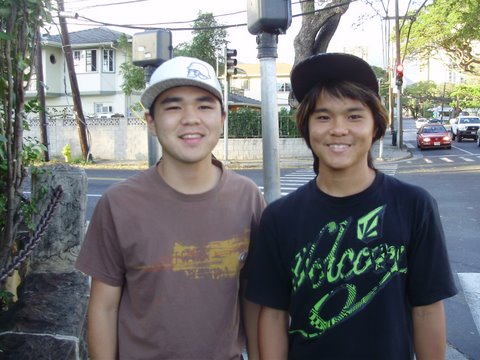
10.4 oki norman Photo: Jeffrey Acido

Norman Kaneshiro sensei and several young Okinawan musicians sang traditional Okinawan songs. We closed the circle with singing “Hana” (Kina Shoukichi’s famous peace anthem).

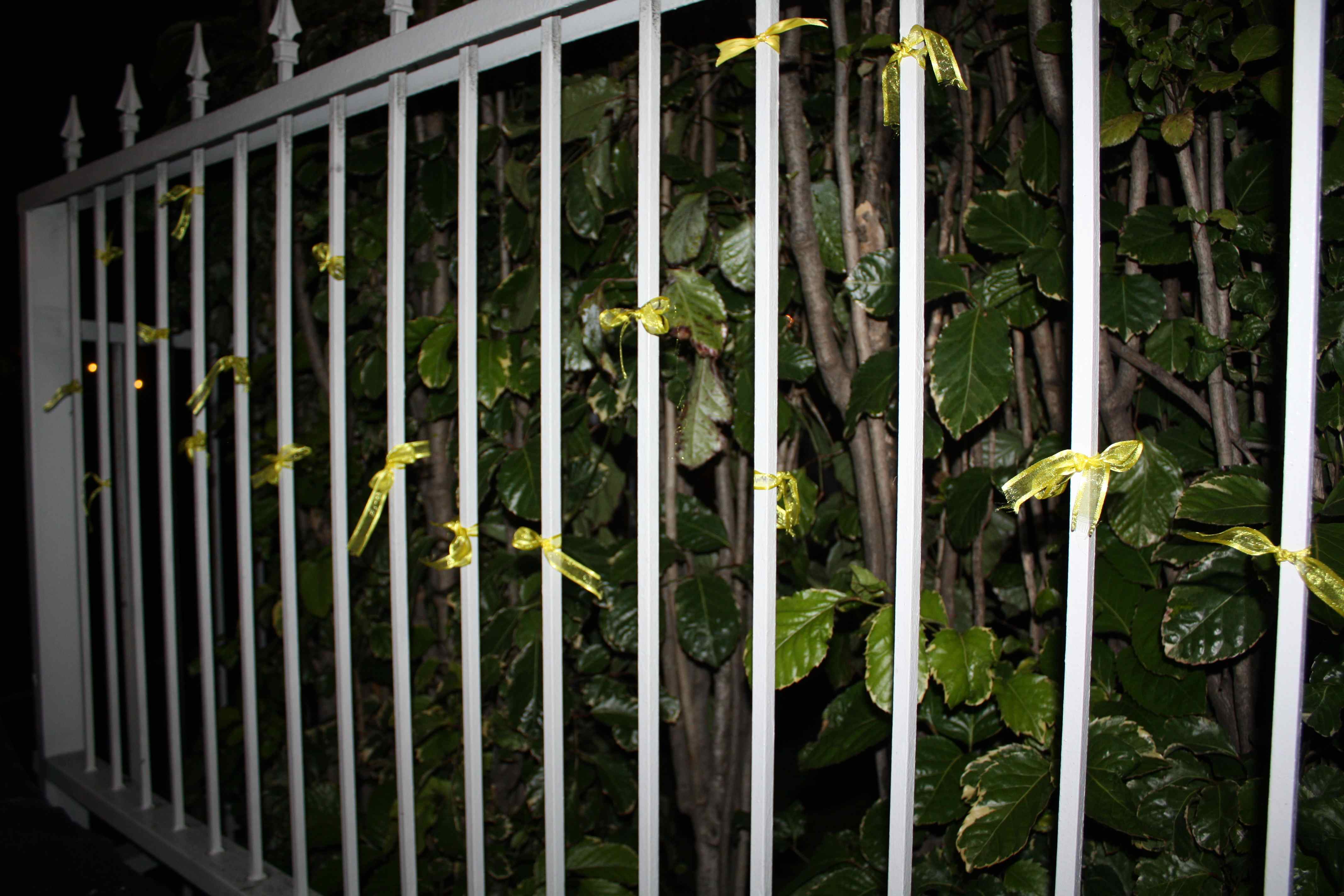
10.4 oki ribbons 10.4 oki candle Photos: Darlene Rodrigues

Then we tied yellow ribbons with messages of peace written on them on the consulate fence.

The event was covered on KITV and KHNL television stations, and there reporters for the Okinawa Times and Ryukyu Shimpo covered the event.

National Guard member convicted of electronic enticement of a child

This is the conclusion of the child enticement case by a Hawaii National Guardsmen.

>><<

http://www.hawaiinewsnow.com/Global/story.asp?S=12378617

Fairness of mandatory prison term for child enticement questioned

Posted: Apr 26, 2010 12:32 PM Updated: Apr 26, 2010 6:40 PM

By Minna Sugimoto – bio | email

HONOLULU (HawaiiNewsNow) – Family and friends of a Hawaii Air National Guard member, convicted of electronic enticement of a child, cried as sheriffs took him away to prison Monday. Matthew Lewis is starting a 10-year prison term, which supporters say is too severe.

Supporters say the former martial arts instructor deserves a second chance because he has no prior criminal record, this was a victim-less crime, and he was found by one psychologist to not be sexually attracted to children.

But state prosecutors say his online chats with an undercover officer, who was posing as a teenager, were sexually-explicit and disturbing.

A former karate instructor was brought to tears as supporters described him as being kind, loyal and disciplined.

“He’s good. He’s really good with the kids, the kids that really need some mentor out there,” Theresa-Ann Pestana, mother of karate students, said. “My boys, they have structure because of him.”

But state prosecutors see a different Matthew Lewis. They say he went online and arranged to meet a 14-year-old girl for sex.

The defense maintains the 34-year-old didn’t break the law because, while he did get into his car and drive to the meeting place, he realized he couldn’t go through with it and didn’t actually stop there.

“One psychologist even opined, ‘It is my clinical opinion that Mr. Lewis is not a predator. He did not exhibit any characteristics normally seen in sexual offenders,'” Harrison Kiehm, defense attorney, said.

“That, in the state’s mind, shows that he is likely to re-offend because if he doesn’t think that he did anything wrong, then what’s to stop him from doing this again,” Albert Cook, deputy attorney general, said.

At trial, jurors deliberated for only an hour before convicting the Hawaii Air National Guardsman of electronic enticement. The punishment under Hawaii’s law is a 10-year prison term. Probation is no longer an option.

“The Legislature said that it doesn’t matter that he has a history of stable employment and that he actually served this country in the military and has actually been in situations where he has almost died for this country,” Kiehm said. “That doesn’t matter. The Legislature says he has to serve 10 years.”

“He know he did wrong,” Pestana said. “But for somebody to witness his friends dying out there and then he has to face this in court, please give him another chance.”

Calling it a serious crime, the judge gave Lewis the mandatory sentence.

“It’s true he doesn’t have any prior convictions,” Cook said. “But it’s also true that through the Internet, we’re able to see a side of Mr. Lewis that most people don’t see.”

The law establishing the mandatory 10-year prison sentence for electronic enticement went into effect in 2008.

The defense plans to appeal.

Insular Empire “Red Pill Tour”

Vanessa Warheit, director of the film Insular Empire: America in the Mariana Islands just posted a new entry about her visit to Hawai’i and what she has dubbed the “Red Pill Tour”, a reference to the scene in The Matrix when Neo takes the red pill that awakens him to the violent and oppressive reality of his existence as he joins the resistance.

It was surreal standing over the map of the Pacific ocean in the Arizona Memorial visitor’s center, talking with Dr. Hope Cristobal a Chamorro leader from Guam, Lino Olopai, a Refaluwasch (Carolinian) master canoe navigator from Saipan, Terri Keko’olani and Vanessa about the “American Lake”, how the Pacific is depicted in the U.S. imperial imagination.  Then Lino struck up a conversation with “cousins” from Kiribati, who happened to be visiting the memorial. In beautiful contrast, it illustrated how peoples of the Pacific see Ka Moana Nui as the medium that unites peoples.

Guam Senator Cruz demands demands radiation tests for Apra harbor

Senator B.J. Cruz from Guam is demanding that the Environmental Protection Agency require the U.S. military to test for radiation contamination be conducted in Apra Harbor before dredging and dumping of the sediment is approved.   He is right to demand these studies.  It is widely known that U.S. navy ships have leaked radioactive water in Apra.  Given the nuclear history of the Mariana islands, it is reasonable to expect that there is radioactive sediment in the harbor.

In Hawai’i, radioactive Cobalt 60 contaminates the sediment in Ke Awalau o Pu’uloa (Pearl Harbor), leaked from the nuclear power plants on navy ships.    The EPA knows this, but is not requiring a thorough clean up.  The EPA should at least require that the military study the contamination of the harbor sediment to know the baseline level of environmental and human health risk that exists.

>><<

http://mvguam.com/index.php?option=com_content&view=article&id=11842:cruz-demands-radiation-tests-&catid=1:guam-local-news&Itemid=2

Cruz demands radiation tests

THURSDAY, 22 APRIL 2010 04:34 BY THERESE HART | VARIETY NEWS STAFF

VICE Speaker BJ Cruz is protesting the U.S. Environmental Protection Agency’s policy decision to not require radiation testing for dredged materials from Apra Harbor that would be dumped into the proposed ocean disposal site.

EPA said the testing was not necessary, prompting Cruz to fire off a letter to Nancy Woo, associate director of EPA’s water division for Region 9.

“It appears then that the dumping of any radioactive sediment under that equivalency threshold is an acceptable practice,” Cruz wrote.

“I take this to mean that, absent any proof that fuel and concentrated waste from nuclear reactors or materials used for radiological warfare were leaked into Apra Harbor, dredging and dumping may proceed without testing. That I cannot accept,” he added.

According to the Federal Register, EPA is proposing to designate the Guam Deep Ocean Disposal Site as a permanent ocean-dredged material disposal site located offshore of Guam. Disposal operations at the site will be limited to a maximum of 1 million cubit yards a calendar year and must be conducted in accordance with EPA’s site management and monitoring plan.

The Federal Register further reads that EPA should conduct an extensive series of tests and studies to determine if radiation exists in Apra Harbor waters or its sediments to independently confirm the Navy’s claim that the amount of leakage from nuclear-powered vessels is insignificant.

Woo has sent Cruz the final environmental impact statement for the designation of an offshore ocean-dredged material disposal site.

*Assurance*

In an April 14 letter, Woo assured Cruz that his concerns regarding radiation in dredged sentiment in Apra Harbor and its dumping in Guam waters have been addressed, but the vice speaker said he was far from reassured.

Woo cited USEPA regulations that prohibit ocean disposal of high-level radioactive waste and materials. Woo also stated that radioactivity testing will be required when there is reason to believe that elevated levels of radiation may be present.

The rules that Woo cites refers to fuel and concentrated waste from nuclear reactors and materials used for radiological warfare.

Cruz said he is concerned that EPA will allow the dumping of any radioactive material below high levels of concentration, which he said, is obvious.

Cruz believes that before any dredging occurs in Apra Harbor, samples taken from the depth of the proposed dredge must first be tested for radiation.

“It is common knowledge that the U.S. Navy discharged radioactive material into Apra Harbor on more than one occasion. It is imperative, then, that no dredging of the harbor take place until adequate radiation testing independent from that reported by the U.S. Navy has been conducted on proposed dredge sites,” wrote Cruz.

U.S. Military Bases and Funshi (Feng Shui)

ANTHROPOLOGY COLLOQUIUM SERIES

U.S. Military Bases and Funshi (Feng Shui): The Anti-Base Movement and Community Development in Yomitan, Okinawa

Tomoaki Hara

Associate Professor of Anthropology, Shizuoka University, Japan

Thursday, April 22nd at 3:00 pm, in Crawford Hall 115

The 1997 city master plan of Yomitan Village, Okinawa, is unique in all of Japan in that it uses funshi (“feng shui”) as one of its key concepts. In the Ryukyu Kingdom prior to the 1879 annexation, feng shui was mainly used by the noble classes and played an important role in governmental public works projects. After the Meiji period, feng shui was introduced into the daily lives of the former commoner people in Okinawa and transformed into funshi. This paper considers the use of funshi by these Okinawan city planners as an example of the cultural identities forged by Yomitan’s community development in its struggle against U.S. military bases established during and after World War II. To properly contextualize the evolution of this unique anti-base movement and community development from the 1970s to the present day, this paper also traces the history of Yomitan before, during, and after the war. Special consideration is given to this movement’s value of bunka (“culture”), its unprecedented construction of public facilities on U.S. military bases, and villagers’ memory of their pre-war land.

Tomoaki Hara is currently a Fulbright Visiting Scholar at UH Mānoa and the East-West Center. He has been conducting ethnographic and historical research in Okinawa and Hawai’i which focuses on the intersections of memory, media, community, and identity of the Okinawan people both within and outside Okinawa. His Japanese publications include Domesticating Electronic Media: A New Perspective of Cross-Cultural Field Studies (co-edited with T. Iida, Serika Shobo 2005) and The Dynamics of Folk Culture: The Interweaving of Folk, Official, Popular, and Academic Culture in Yonaguni, Okinawa (Doseisha 2000). He has also published one of the most extensive English-language review articles on the history of Okinawan studies in Japan, available at: http://office-hara.travel-way.net/contents/okinawanstudies.pdf.

Co-sponsored with the Center for Okinawan Studies.

For further information, please contact Anthropology at anthprog@hawaii.edu.

Hawaii Okinawa Alliance: Candlelight Peace Vigil for Okinawa

Sunset Candlelight Peace Vigil for Okinawa

Japanese Consulate Honolulu

Nu`uanu Avenue & Kuakini,

Sunday, April 25, 2010,

6pm

This Sunday in Okinawa, as well as throughout Japan, Washington, D.C. and here in O`ahu, hundreds of thousands of supporters of demilitarizing Okinawa will be rallying to close down Futenma Marine Corps Airstation in the middle of urban Ginowan City, as well as to oppose all further US military base constructions in Okinawa, particularly the proposed port in Henoko Bay.  We will be showing our solidarity with the people of Okinawa, as well as all peace-seeking peoples longing for a world without militarism or foreign colonization.

This will be a simple candlelight vigil in front of the Japanese Consulate, at the mentioned intersection.  Feel free to bring candles, signs, ribbons, musical instruments, etc.  This will not be a “protest” per se, as the Consulate will surely be closed, but rather a simple act of solidarity and fellowship with those rallying in Okinawa.  Street parking is available but limited on adjacent streets by park; carpooling or taking bus is recommended.  If anything, just come & bring friends and family!

As you may know, US forces invaded Okinawa in 1945 to fight Imperial Japan, and have never left, instead imposing US military bases on approximately 20% of Okinawa Islands best, limited land, and are proposing to build yet more!  Former Defense Secretary Rumsfeld described Futenma as one of the most dangerous airfields in the world, surrounded by neighborhoods, schools, hospitals, etc. that have endured the bases for decades, despite promises by the US to close down the outdated facilities.  The previous US and Japanese government administrations conspired to relocate Futenma partially in rural, northern Okinawa on pristine reef home to endangered species such as the dugong, and are insisting on this construction particularly by the Obama administration now.  The current Japanese Prime Minister, Hatoyama, will be making a decision in May on whether to go forward with the construction despite vehement, majority opposition in Okinawa; thus, this is why the vigils are taking place in Okinawa, with national and international support.

Your support will directly go to the solidarity with the people of Okinawa!  Mahalo & may peace reign on Okinawa, Hawai`i, Guam and the 160 nations burdened with foreign US military!

For more info: Jamie @ 728-0062 or email Pete: dok@riseup.net  Your ideas, energy, resources, etc. is welcomed!

Pete Shimazaki Doktor, Jamie Oshiro & Rinda Yamashiro

HOA (Hawai`i Okinawa Alliance)

Co-sponsored by American Friends Service Committee-Hawai`i

TO FIND OUT INFORMATION ABOUT OTHER OKINAWA SOLIDARITY ACTIONS AROUND THE WORLD CHECK OUT: http://closethebase.org/2010/04/15/join-us-for-a-rally-in-washington-dc-on-sunday-april-25th/

More info:

http://hoa.seesaa.net/

http://closethebase.org/

http://us-for-okinawa.blogspot.com/

http://www.jca.apc.org/wsf_support/2004doc/WSFJapUSBaseRepoFinalAll.html

Barbers Point closure and conversion ‘one of the worst examples’

The closure and redevelopment of Barbers Point Naval Air Station was one of the “worst examples of reusing a shuttered military installation.”   It’s almost as if someone wanted the base realignment to fail.  A successful conversion would have generated momentum for the closure of more military bases.   All bases were closed in the San Francisco Bay Area. The converted sites have become engines for innovation and social entrepreneurship.  The Presidio for example was converted into a sustainable center for many types of non-profit entities.  Closed bases in the bay area have generated more jobs per acre than when the bases were active.   Instead of approaching the closure with a vision, Hawai’i carved up the former base like it was distributing portions of a freshly slaughtered pig.   Let’s see what comes of the new plans.
>><<
Posted on: Sunday, April 18, 2010

After years, plans for old Navy station on Oahu taking shape

Proposal calls for 5 zones, requires $550M in upgrades

By Andrew Gomes
Advertiser Staff Writer

It’s taken eight drafts and more than four years, but the state is close to finalizing zoning and infrastructure plans that will stimulate and shape redevelopment of the former Barbers Point Naval Air Station at Kalaeloa.

The sprawling 3,700-acre base was closed by the military in 1999 and largely turned over to the state. Plans in place since 2005 have envisioned up to 6,350 homes and 3 million square feet of commercial space.

But a major challenge has been how to arrange and accommodate such development given that the Navy’s old electrical, water, sewer and road systems require colossal upgrades.

The continued presence of a general-aviation airport and a Coast Guard station at the former base, as well as the possibility that the city might extend its planned rail transit line to Kalaeloa, further complicates planning.

One thing that seems certain is the old base between Kapolei and ‘Ewa Beach won’t be transformed into anything resembling other O’ahu communities.

“The characteristics of this district will be unique,” said Anthony Ching, executive director of the Hawai’i Community Development Authority, the state agency devising the area’s development rules. “It will not look like Kapolei.”

The latest draft of administrative rules directing development proposes five zoning categories. One zone is open space that includes a shoreline with as much white-sand beach as Waikīkī.

Another zone is devoted largely to recreational, cultural and energy production uses. This zone would allow for what Ching said could be five or more solar farms, including two on land owned by the Department of Hawaiian Home Lands, two on HCDA land and one on private property.

Urban development would be confined to three other zones with different density limits for mixed residential and commercial use.

The HCDA calls the proposed urban zoning “form-based” because it coordinates development by building heights and the amount of housing units and commercial space — not by the type of use.

“We have great hopes for the form-based rule,” Ching said.

finalizing plan

As proposed, the highest-density urban zoning would allow up to 60,000 square feet of commercial space or 60 residential units per acre in buildings up to five stories. Mid-density urban zoning would be limited to four-story buildings with up to 40,000 square feet of commercial space or 40 residential units per acre. The low-density zone would permit buildings no taller than three stories with up to 20,000 square feet of commercial space or 20 residential units per acre.

The latest draft of administrative rules follows a March summit attended by 80 individuals, including representatives of private landowners and government agencies.

The proposed rules will be discussed with landowners and other stakeholders next month, and then scheduled for a public hearing in June.

Tweaking the plan is expected based on feedback. After that, a final plan could be sent to Gov. Linda Lingle for approval in August.

If the timetable is realized, it would give landowners and developers certainty on how they may use parcels for redevelopment more than a decade after the Navy ceased operations as part of a federal base realignment decision.

Firm development rules would spur more wholesale development at the old base that is regarded by some as one of the worst examples of reusing a shuttered military installation.

While there has been some piecemeal development at Kalaeloa over the years that has included industrial businesses and plans for a new FBI headquarters, former bases on the Mainland have blossomed with hotels, shopping centers, homes, offices, universities and parks.

“We’ve been kicking the can down the road and nothing much has happened in the last 10 years,” Ching said. “I do think we’re now poised to do something here.”

20-year process

Detailed zoning rules were slow in the making largely because of challenges in determining how much new infrastructure would be needed to handle certain levels of development.

Much of the work over the past two years involved figuring out how to supply the area with upgraded power. A proposed power line layout has the endorsement from Hawaiian Electric Co., Ching said.

The HCDA estimates it will cost $550 million to improve roads, electricity, sewer and water systems to modern standards throughout the old base. Private landowners are expected to pick up the cost for most of the work, though the state anticipates being responsible for close to $200 million of infrastructure.

Previously, the HCDA had anticipated playing a larger role in developing Kalaeloa as a landowner, but the Navy last year conveyed 500 acres of land that was in limbo to private firm Ford Island Development.

Overall, redevelopment of Kalaeloa is expected to occur over 20 or more years.

Reach Andrew Gomes at agomes@honoluluadvertiser.com.

• • •

800 gallons of sewage spills into Pearl Harbor

http://www.honoluluadvertiser.com/article/20100417/BREAKING01/100417032/800+gallons+of+sewage+spills+into+Pearl+Harbor

Updated at 2:03 p.m., Saturday, April 17, 2010

800 gallons of sewage spills into Pearl Harbor

Advertiser Staff

An estimated 800 gallons of sewage has been discharged into a storm drain at Merry Point, Pearl Harbor today due to a broken pipe, according to the state’s Department of Health Clean Water Branch.

The break occurred in a 16-inch force main, the Clean Water Branch reported. Signs have been posted and military and private commercial divers are advised to stay out of the water through the weekend.

Why is a closing Navy commissary being given away to a private company?

The Honolulu Advertiser reports that the Barbers Point Commissary is closing and that the property will be turned over to the private Ford Island Ventures.  How does a private business get excess public assets?   And who is Ford Island Ventures?

Ford Island Ventures is a joint venture of Hunt Building Co. and Fluor Federal Services LLC. Special legislation in 1999 created a special arrangement in Hawai’i whereby excess Navy properties could be leased or transferred in fee to private entities in exchange for in-kind construction and infrastructure repairs on Ford Island.  This circumvented the usual process for transferring excess military lands.    The Navy gave the developers a 65 year lease of Iroquois Point/Puʻuloa (384 acres), a 34 acre parcel on Ford Island, and the 6.6 acre Hālawa Landing—all underutilized Navy properties. The developers also were allowed to purchase 695 acres of housing at Kalaeloa after three years and given outright ownership of the 515 acre former Waikele Naval Magazine.

The Hawaii Reporter posted a story that contained more information:

NAS Barbers Point closed in July 1999 as a result of the 1993 Base Realignment and Closure (BRAC) legislation. The Navy retained portions of the former base after its closure, including the area containing the commissary. The FY07 National Defense Authorization Act (NDAA) required the Navy to enter into a binding agreement to convey, by sale, lease or combination thereof, any public or private person or entity outside DoD a large part of those portions including the area containing the commissary by Sep. 30, 2008. In Feb. 2009, the Navy entered into a lease with FIV to fulfill the FY 07 NDAA requirement.

It seems that the transfer of land to the private entity was a special provision inserted into the Defense Authorization Act, a giveaway of public assets to private corporations.   Ford Island Ventures it seems has friends in high places.  Environmental watchdog Carroll Cox posted information on his website about Ford Island Ventures conducting illegal business activities in the former nuclear storage bunkers in Waikele gulch.   According to Cox’s investigation, Mayor Hanneman’s administration is allowing the illegal operations to continue despite formal complaints.

>><<

http://www.honoluluadvertiser.com/article/20100417/BREAKING01/304170013/Navy+to+close+Barbers+Point+Commissary+on+April+30

Updated at 7:59 a.m., Saturday, April 17, 2010

Navy to close Barbers Point Commissary on April 30

Advertiser Staff

The Navy said Friday that it plans to close the Barbers Point Commissary on April 30.

The building and property will be turned over to Ford Island Ventures on June 1.

A news release said that while the store continues to serve a number of customers, “the Navy has not had an operational presence in the area since (Naval Air Station Barbers Point) closed in 1999, and there is no longer Navy family housing in the area.”

The 20,000-square-foot store employed 41 people, all of whom have been extended job opportunities with the Defense Commissary Agency, the Navy said.

DeCA operates four other commissaries on Oahu — one at Schofield Barracks, two at Joint Base Pearl Harbor-Hickam and one at Marine Corps Base Hawaii.

+++

http://www.hawaiireporter.com/storyPrint.aspx?cb338aa9-dab6-4167-8059-4c9d1f8eb9dc

Barbers Point Commissary to Close for Business on April 30

By Agnes Tauyan, 4/16/2010 12:12:41 PM

PEARL HARBOR – The Defense Commissary Agency (DeCA) is planning to close the Barbers Point Commissary store on April 30 and turn over possession of the building and property to Ford Island Ventures (FIV) on June 1.

The 20,000 square foot store has 41 employees and is located on part of the 499 acres of land parcels at Kalaeloa that was conveyed by the Navy in February, 2009, to FIV. All 41 employees were extended opportunities for continued employment with DECA.

“The Barbers Point Commissary has served the Navy well for many years,” said Rear Adm. Dixon R. Smith, Commander, Navy Region Hawaii. “Although it continues to serve a number of authorized customers, the Navy has not had an operational presence in the area since the base closed in 1999, and there is no longer Navy family housing in the area.”

DeCA operates four other commissaries on Oahu: one at Schofield Barracks, two at Joint Base Pearl Harbor-Hickam and one at Marine Corps Base Hawaii.

The Navy Exchange will continue to operate the Touch ‘N Go Mini-Mart Gas Station through next year. The Subway Sandwich Shop and the child care center, now operating as Kama’aina Kids and serving military and civilian families in West Oahu, are operating under an agreement with FIV. The athletic fields are also open to the public, and the bowling center re-opened to the public earlier this year.

The Barbers Point Golf Course, the picnic area and cottages at White Plains and Nimitz Beaches continue to be operated by the Navy’s Morale, Welfare and Recreation (MWR) department. These facilities were not affected by BRAC and are not part of the 499 acres of land parcels conveyed to FIV.

NAS Barbers Point closed in July 1999 as a result of the 1993 Base Realignment and Closure (BRAC) legislation. The Navy retained portions of the former base after its closure, including the area containing the commissary. The FY07 National Defense Authorization Act (NDAA) required the Navy to enter into a binding agreement to convey, by sale, lease or combination thereof, any public or private person or entity outside DoD a large part of those portions including the area containing the commissary by Sep. 30, 2008. In Feb. 2009, the Navy entered into a lease with FIV to fulfill the FY 07 NDAA requirement.

+++

http://www.carrollcox.com/WaikeleStorage.htm

Mayor Mufi Hannemann Denies Public’s Right to Recreational Areas

For the past three or four years the Hannemann Administration has known about illegal businesses being conducted by a group called Ford Island Ventures, located in a P-2 preservation zone known as the ”Caves at Waikele.” At the same time, the Department of Planning and Permitting (DPP) has been struggling with Hannemann’s desire to keep the illegal activities going.

The site, known as “the caves” is a former military munitions storage area. For zoning purposes, it was originally classified as military F-1, but, after it was abandoned by the military and no longer used for munitions storage, it was automatically rezoned or reclassified as a P-2 general preservation district.

Although the DPP has no zoning authority over F-1 military, the DPP does administer the zoning code in P-2 districts.   Land Use Ordinance Section 21-3.40  states that the purpose of the preservation districts is to preserve major open spaces and recreational lands.  The purpose of F-1 military zoning is to identify military areas and permit all military activities.   Section 21-3.40 clearly states “should land be removed from either the state designated conservation district or from federal jurisdiction, all uses, structures and development standards shall be as specified for the P-2 general preservation district”.    Therefore, the land is zoned P-2 and that was confirmed by the DPP in their January 7, 2008, letter to the agent representing the business, Ford Island Ventures.

Furthermore, the DPP produced a zoning report dated October 1, 2008, which states that “self storage rental use is not permitted in the P-2 district and is a violation of the zoning code”.  Furthermore, DPP Planner Raymond Young placed an advisory on the property on September 11, 2008, saying that “industrial activity is unauthorized”.

The DPP’s January 7, 2008, letter also states that the Central Oahu Sustainable Community Plan designates Waikele Gulch as part of the Central Oahu Open Space Network and is to be preserved for its scenic resources and recreational values. The plan is for a ravine recreational network, featuring trails and passive open spaces. The DPP stated “the operation of a commercial storage facility within the subject parcel is inconsistent with the Sustainable Community Plan”.

For more than a year I have complained to the Hannemann Administration that legal actions should be taken to shut down the facility and open up the area for public enjoyment, as required. Instead, Hannemann’s administration has ignored my complaints and my queries into this illegal activity, and has ignored its own Department of Planning and Permitting which has already determined that my complaint is valid and the property is in violation of zoning laws. Instead of doing what is legally required, Hannemann is now employing other delaying tactics, such as claiming that I gave them the wrong tax map key numbers or the advisory by the planner was not relevant.

Since receiving my complaint they have asked the Corporation Counsel to determine if DPP has any jurisdiction over the Waikele Caves Storage and its industrial uses, in the Central Oahu Open Space Network and the Sustainable Community Plan,  or zoning authority over P-2 preservation zoned property.  As if these excuses weren’t lame enough, Mr. Alex Sugai, Building Inspector Supervisor, offered more lame excuses in response to my compliant.  He told me that the numerous letters written by the former DPP Director, Henry Eng, and his staff, did not matter.  He said it is now being handled by David Tanoue, the current Director of DPP, and only what he says matters.   Mr. Sugai was instructed to tell me to contact Mr. Tanoue if I didn’t like his answer or response.  Hopefully, Hannemann will do the right thing, and open the area to the public so they can enjoy and appreciate this beautiful canyon.

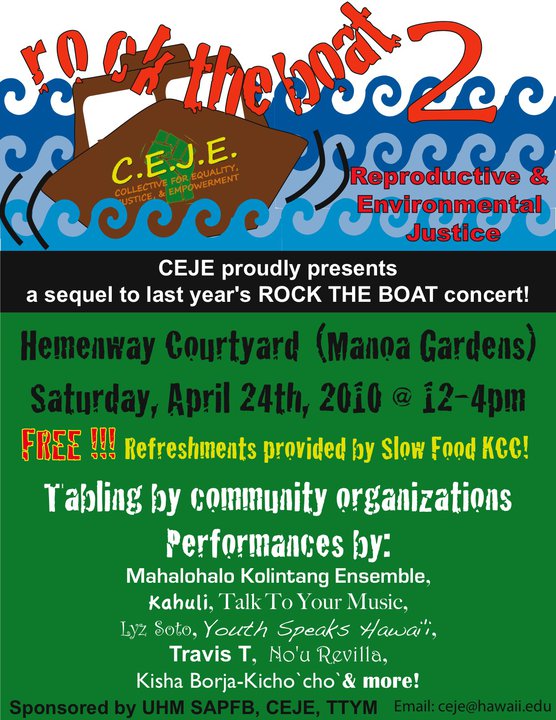
Rock the Boat 2: Concert and Festival for Reproductive and Environmental Justice

ceje rocktheboat 10

CEJE proudly presents the sequel to last year’s Rock The Boat Concert

Hemenway Courtyard (Manoa Gardens)

Saturday, April 24, 12:00 to 4:00 pm

Free,

Refreshments provided by Slow Food KCC

Tabling by Community Organizations

Performances by:

Mahalohalo Kolingtang Ensemble, Kahuli, Talk to Your Music,  Lyz Soto, Youth Speaks Hawai’i, Travis T, No’u Revilla, Kisha Borja-Kicho’cho’, and more

Sponsored by UHM SAPFB, CEJE, TTYM,

Email: ceje@hawaii.edu