PACOM opens new Warfighting Center on Moku’ume’ume (aka Ford Island)

The Pacific Command (PACOM) opened a new Pacific Warfighting Center on Moku’ume’ume (aka Ford Island).  Through earmarks and other plus up funding, Senator Inouye is again pushing military spending on construction and other infrastructure as a way to “lock in” the military in Hawai’i for the next several decades.  Once the ‘foodbasket’ of O’ahu, Ke Awalau o Pu’uloa (Pearl Harbor) has truly become the nerve center of the American military empire in the Pacific, the place where wars come from, “land as a weapon,” to borrow an expression Professor Catharine Lutz used to describe the transformation of Guahan (Guam) into the “tip of the spear” of the U.S. military.

>><<

http://www.honoluluadvertiser.com/article/20100216/BREAKING01/100216079/Military+opens+Warfighting+Center+at+Ford+Island

Updated at 8:31 p.m., Tuesday, February 16, 2010

Military opens Warfighting Center at Ford Island

Associated Press

Top U.S. commanders in the Pacific Ocean on Tuesday opened a $48 million high-tech facility they plan to use for exercises, training and battle simulations.

The Pacific Warfighting Center may also be used to direct forces during disaster relief efforts and war, if needed.

Navy Adm. Robert Willard, the head of the U.S. Pacific Command, said the center has already helped relief efforts in Haiti.

Normally staffed with about 56 people, the facility is capable of holding hundreds more as the need arises.

In a few months, the center will host about 500 people for what Willard called a “large scale command post exercise” involving forces in Hawaii and the Western Pacific region.

“We can take a command post or a field training exercise to a very, very high levels as a consequence of what this facility provides,” Willard said after a dedication ceremony for the center.

The military spent $25.8 million for construction and $22 million on telecommunications infrastructure for the building on Ford Island in Pearl Harbor.

U.S. Sen. Daniel Inouye, D-Hawaii, noted the military is already able to direct forces from the Pacific Command’s headquarters at Camp H.M. Smith but there isn’t enough room there for training.

The warfighting center also has room for the military to run exercises with allies like Japan and South Korea, the senator said.

Inouye said the facility would keep officers keyed in with other U.S. military operations around the world.

“There was a time when I was young when the Pacific War was a Pacific war,” said the 85-year-old Inouye, who was awarded the Medal of Honor for his actions in World War II. “They could ignore the European war and vice versa. But today whatever happens in Kabul has something to do here.”

Willard acknowledged Inouye’s role in arranging funding for the center by introducing him at the ceremony as the “one man” who enabled the center to be built.

Inouye is chairman of both the Senate Appropriations Committee and the defense appropriations subcommittee.

Live-fire over Makua valley

As the Honolulu Weekly reported below, the community turned out to protest the Army’s plan to establish an Asia-Pacific Fusion Counter-IED center at Makua.   Like a pimp, the Army is soliciting other countries to use and abuse Makua.  Stars and Stripes reported that in Thailand during “Cobra Gold” joint military exercises, “U.S. Army Pacific officials briefed the Thai brass on a new Asia-Pacific Fusion Counter-IED Center now starting up in Hawaii.”   Time for the Army to get out of Makua.

>><<

http://honoluluweekly.com/feature/2010/02/live-fire-over-the-valley/

Live-fire over the valley

Citizens ask why the Army needs Mākua at all

Chris Nishijima
Feb 10, 2010

Development

Image: Chris Nishijima

Tension was high at the Waianae Neighborhood Community Center as Waianae Neighborhood Board Chair Jo Jordan opened the Feb. 2 meeting by leading a restive crowd in Hawaii Ponoi. When the song reached its traditional conclusion and most of the room started to sit, many in attendance carried on through the deeper verses of King David Kalakaua’s national anthem.

Before the meeting, Jordan offered condolences to the family and friends of her fellow board member, Michael Anderson, who died during a hiking accident the previous week. Anderson’s empty chair set a somber tone, as did the main business of the evening–the Army’s presence in Makua Valley.

Makua Valley spans more than 4,190 acres and has been the site of military training since World War II. In recent years, Native Hawaiians and environmentalists have been pressing the Army to reduce its impact in Makua, and to halt live-fire training in particular.

“Makua is a want of the Army, not a need,” said William Aila Jr., a Hawaiian cultural practitioner who is active in the community’s attempts to reduce the Army’s presence in the valley. Aila points out that the Army has not trained in Makua at any point during the past five years.

“This is the greatest indication that they don’t need Makua,” he said. “It is a need of the community.”

Others echoed Aila’s concerns, and said that the Army is not properly respecting the area as a sacred part of Hawaiian heritage.

But Army officials insist they understand the community’s concerns.

“We are not some big evil organization,” said Col. Matt Margotta, who represented the Army’s 25th Infantry Division. “We are attempting to better understand the Hawaii community.”

Margotta explained that Makua provides a unique setting which allows the Army to simulate a war zone without taking soldiers stationed on Oahu away from their families for an extended period of time. Margotta also pointed to ways in which the Army’s presence has helped improve the community. He said that the military has spent some $7 million toward repairing roads and $10 million toward protecting Hawaii’s endangered species, 41 of which can be found in Makua Valley.

“The Army recognizes that we have an impact on the community,” he said, “We are trying to change that.”

But many of those in attendance were not satisfied, and voiced concerns over the military turning the area into what they said amounts to a munitions trash heap.

“What you need to do is go back to Kahoolawe and clean it up!” said Shirley Nahoopii of Waianae. “You have not fulfilled your promise to clean up there after you were finished with it! Is Makua going to end up the same way?”

Concerns about the dangers of unexploded ordnances, or UXOs, left over from Army training are widespread in areas surrounding the Makua Valley. That’s why Apple, Inc., is donating more than 300 Apple MacBook computers, each equipped with a unique question-and-answer system, to select public schools.

“The students will be required to answer one question regarding UXOs before signing in,” said Tom Burke of the Hawaii Veteran’s Society, who announced the program at the meeting.

Despite these efforts, some found the program itself, which features a caricatured version of a Native Hawaiian, to be controversial.

“If this is a native, I think it is rather tasteless,” said Johnnie-Mae Perry, a member of the board.

The Army has yet to release a date to resume training in Makua. Another meeting with representatives of the 25th Infantry will announced by the Waianae Coast Neighborhood Board within 60 days.

Protests start off the National Security Studies colloquium

http://www.kaleo.org/protests-start-off-the-national-security-studies-colloquium-1.2149380

Protests start off the National Security Studies colloquium

By JUNGHEE LEE

News Co-Editor

Published: Thursday, February 11, 2010

Junghee Lee

Protesters gathered infront of the Korean Studies building yesterday morning to convey their distrust with the CIA’s presence on campus.

A group of about six protestors gathered together and protested against the colloquium National Security Studies yesterday around 9 a.m., waving signs that read “Stop torture” and “CIA off campus now.”

“They say it’s a seminar but it’s a recruitment,” said protester Ann Wright. “They should recruit at a federal government, not at the campus. Students might be applying for something they don’t know everything of.”

Wright has worked for the government for 40 years and is currently a retired army colonel.

“Students should ask questions and be critical,” Wright said in regard to the job intelligence agencies are asking them to do.

However, students think differently.

“If I do the research ahead of time and speak with recruiters, then I think I’ll make the right choice,” said Randy Cortez, a senior philosophy major.

The colloquium consists of 21 expert panelists from fields such as economics, Asian studies and political science. According to Project Coordinator Jialin Sun, 145 students and around 40 faculty and staff registered for the colloquium.

Some of the topics covered in the colloquium were language and cultural awareness in national security, economic issues in East Asia, and 21st-century Intellectual Community (IC) enterprises.

“To understand the new paradigm operated in a global contact, the IC must bring in the equation of the brain power of the academic community, its expertise and intellect,” said Lenora Gant, director of the Office of the Intelligence Community Centers of Academic Excellence.

University of Hawai‘i at Mānoa Chancellor Virginia Hinshaw attended as a guest speaker and gave welcome remarks in the beginning of the colloquium.

“This is an exciting opportunity to introduce students for their future employment options by the federal government,” Hinshaw said. “Being a public servant is a noble endeavor, and it is important to examine all types of careers.”

At the end of the colloquium, students are encouraged to attend an hourlong networking session.

Protest at UH Challenges Intelligence Community Centers of Academic Excellence & CIA Campus Recruitment

http://www.afterdowningstreet.org/node/50041

Protest at the University of HI Challenges Intelligence Community Centers of Academic Excellence & CIA Campus Recruitment

2010-02-12 04:39

By Ann Wright

Hawaii activists protested on February 10, 2010, the University of Hawaii’s participation with U.S. intelligence agencies in a symposium on national security and called on students and faculty to remember the criminal track record of these agencies in torture, assassination, kidnapping and illegal prisons.

Protesters called on the University administration to reject any request by the federal government to create a National Intelligence Center of Academic Excellence (ICCAE, pronounced “icky”) at the University of Hawaii.

Government intelligence agencies, including the CIA, FBI, National Security Agency, Defense Intelligence Agency, and Homeland Security, have created in the past four years twenty-two Intelligence Community Centers for Academic Excellence on university campuses to provide “systematic long-term programs at universities and colleges to recruit and hire eligible talent for [intelligence community] agencies and components” and to “increase the [intelligence recruiting] pipeline of students.”

However, not only do the centers recruit, but they seem to provide a launching pad for undercover operations for those associated with the university centers. Stan Dei, the Assistant Director at the Intelligence Community Center for Academic Excellence at Trinity University in Washington, DC, was arrested in January, 2010 with three others for plotting to tamper with the telephone system in the New Orleans office of U.S. Senator from Louisiana Mary Landrieu.

According to an article on Raw Story titled “Landrieu phone plot: Men arrested have links to intelligence community,” Dai also was an undergraduate fellow at the Foundation for the Defense of the Democracies (FDD), a national security think tank in Washington, DC with conservative political figures and politicians, among them: former House speaker Newt Gingrich, Sen. Joe Lieberman, Weekly Standard editor William Kristol, Rep. Eric Cantor, former Bush official Richard Perle and columnist Charles Krauthammer on its advisory board.

The two day symposium on national security at the University of Hawaii is billed as a “discussion on the role of language and contemporary issues in Asia and in U.S. security issues with networking sessions for students to interact with Intelligence Community personnel and meet with potential employers.” Attendance at the conference was increased by providing students with breakfast and lunch each day and a gift card.

Asian and Pacific heritage students are the predominant groups at the University of Hawaii and undoubted the reason for the visit by Dr. Lenora Gant, the Director of all of the Intelligence Community Centers of Excellence. The symposium is co-hosted by the School of Pacific and Asian Studies with faculty members from the East-West Center, which is funded by the U.S. Department of State, and other University of Hawaii faculty members making presentations on language, cultural awareness and cyber challenges in national security along with presentations on “The 21st Century Intelligence Community Enterprise: Challenges and Opportunities” by CIA and other intelligence officials.

ICCAEs provide grants to universities to begin a “partnership between the Intelligence Community, colleges and universities to incorporate curriculum and related initiatives. The focus of this effort is to increase the pipeline of competitive applicants to attract, recruit and hire with an emphasis on women and racial/ethnic minorities with critical skills in core business and leadership areas.” (Public Law 108, 177, Section 319).

Once the Intelligence Centers are established on a campus, they use federal funds to provide a cash-strapped university with attractive facilities. At Norfolk State University, a new Video Teleconferencing Training Center was funded through grants from the Office of the Director for National Intelligence (ODNI) and Department of Education.

Outside the School of Korean Studies, the location for the symposium, long-time Hawaii activist Carolyn Hadfield, a coordinator for World Can’t Wait and staff member of Revolution Bookstore, reminded students and faculty going into the building that the CIA and other intelligence agencies had asked their employees to commit illegal actions on behalf of the presidential administrations — crimes of torture, assassination, kidnapping (extraordinary rendition), secret prisons and illegal eavesdropping and wiretapping.

Did they want to be employed by organizations that participate in these criminal actions?

Hadfield also reminded University of Hawaii Chancellor Virginia Hinshaw as she emerged from the conference hall, of the long confrontation to keep the University system out of the unpopular, but financially lucrative for the university, Department of Defense classified research business University Affiliated Research Center (UARC).

Hadfield told the University Chancellor that should they be considering bringing an Intelligence Community Center of Excellence to University of Hawaii, the university administration would face another battle.

###

About the Author: Ann Wright is a retired US Army Reserve Colonel and a former U.S. diplomat who resigned in March, 2003 in opposition to the war on Iraq. She served in as a US diplomat in Nicaragua, Grenada, Somalia, Uzbekistan, Kyrgyzstan, Sierra Leone, Micronesia, Afghanistan and Mongolia. She is the co-author of “Dissent: Voices of Conscience.” Wright has been arrested numerous times for her peaceful, non-violent protests against the wars in Iraq and Afghanistan, torture and other criminal actions by the government of the United States.

I Kareran I Palåbran Måmi (The Journey of Our Words)

WHAT: I Kareran I Palåbran Måmi (The Journey of Our Words)

WHO: Poets, Angela T. Hoppe-Cruz (MSW/MA Pacific Islands Studies Candidate) & Kisha Borja-Kicho`cho` (MA Pacific Island Studies Candidate).  Both women are Chamoru and were born and raised on the island of Guåhan (Guam).

WHERE: University of Hawai`i at Mānoa, Campus Center, Executive Dining Room

WHEN: Friday, February, 12, 2010

TIME: 5:15-8:00pm

We will be reading pieces we have collaborated on as well as our own individual poetry.  Much of our work centers on the impact U.S. militarization and colonialism have had on our home island community of Guåhan and the other Micronesian islands, much of which is manifest in social, economic, and environmental injustice. Our work also focuses on Chamoru culture and identity. Immediately following the reading, there will be a facilitated discussion.
Food will be served (sponsored by the UH Marianas Club and C.E.J.E.).

The event is free and open to the public!

Your support is greatly appreciated!

Hawai’i has highest concentration of nuclear submarines

http://www.honoluluadvertiser.com/article/20100207/NEWS01/2070354?source=rss_localnews

Posted on: Sunday, February 7, 2010

Hawaii-based ‘silent service’ on never-ending training regime

ABOARD THE USS SANTA FE — Riding 60 feet under the ocean surface in a 6,900-ton nuclear submarine that’s longer than a football field, there is almost no sense of movement and very little noise.

The only sound is an occasional chirp over a speaker, signaling nearby marine life. The quiet is broken with a series of orders spoken in rapid-fire fashion:

“Chief of the watch, man battle stations!”

An alarm sounds.

“There is a hostile orange destroyer.” “Orange” signifies potential enemy.

“Make tubes 2 and 4 ready in all respects.”

More than a dozen crew members on the Los Angeles-class submarine are in the cramped 16-by-20-foot control room, a space dominated by twin periscopes, consoles, floor-to-ceiling electronics and airplane-like yokes to steer the vessel.

Eight more sailors are jammed into an adjacent sonar room.

The Santa Fe’s captain, Cmdr. David Adams, a 25-year veteran of the Navy who spent time in Afghanistan in charge of a provincial reconstruction team several years ago, runs one of the periscopes up and down several times in quick succession to observe the suspect vessel.

After a series of directions are given in staccato brevity, Adams gives the order: “Shoot tube 2.”

With that, there is a slight thud and whoosh as water is jetted out of the torpedo tube.

In actual combat, a MK-48 torpedo would have been fired, carrying 665 pounds of high explosives — enough to break the back of a destroyer or cruiser.

The training by the Santa Fe 12 miles south of Pearl Harbor is an aspect of the Navy the public rarely sees, but the “silent service” has continued to be a dominant force in Pearl Harbor — and in the Pacific — since World War II.

The 17 nuclear attack submarines based here — soon to be 18 — are the Navy’s greatest concentration anywhere, surpassing the number of more familiar surface ships in Pearl Harbor by six.

At the same time, the overall number of U.S. submarines in service continues to fall, raising concern by some that the U.S. is losing a submarine arms race in the Pacific to the Chinese, and creating instability in the process.

A total of 224 Navy personnel are on the U.S. Pacific Fleet submarine force staff, there are 2,716 submariners assigned to squadrons here, and each of the 17 subs contributes $17 million annually to the local economy, officials said.

strategic base

The subs are here because Hawai’i’s location 2,400 miles out in the Pacific gives them a head start on missions to the western Pacific to train with allies, and to keep an eye on ships and subs in a region that includes the world’s six largest armies — those of China, the U.S., India, North Korea, Russia and South Korea.

The region also includes the shipping lanes of the Malacca Strait joining the Pacific and Indian oceans and through which passes one-quarter of the world’s traded goods.

“The majority of our work is done forward-deployed,” said Capt. Lindsay Hankins, chief of staff for the Pacific Fleet submarine force. “When you are trying to operate ships, there is a cost in doing that. Having them closer to the area in which you are operating them — in other words the western Pacific — makes it easier for us to get them there.”

The Pentagon was concerned enough about changing dynamics in the region that in its 2006 Quadrennial Defense Review, it upset the 50/50 balance of attack submarines in the Atlantic and Pacific and ordered that 60 percent be based off the West Coast.

The Navy now has 52 attack submarines, with 30 of those in the Pacific. Most are Los Angeles-class boats, a class first deployed in 1976.

Five of the Navy’s subs are from the new Virginia class, including the Hawaii and Texas at Pearl Harbor. A third Virginia-class sub, the North Carolina, is due in Hawai’i this summer.

In the Pacific, the Navy has subs in Hawai’i, Guam, San Diego and Bangor, Wash.

Attack submarines seek out other subs and ships, and can also launch Tomahawk cruise missiles, while Ohio-class submarines, or “boomers,” carry 24 nuclear ballistic missiles.

Total U.S. sub numbers have dropped over the years, from 141 in 1971, to 115 in 1992 and 66 today.

The Heritage Foundation, a conservative think tank, last week said that unless the U.S. reverses the decline of its submarine fleet, U.S. military superiority in the Pacific “will continue to wane, severely limiting the Navy’s ability to operate in the region.”

demand surging

Adams, the Santa Fe’s commander, said the demand by combatant commanders in the Pacific and Middle East for submarines has increased two- or threefold over the past 10 years.

Norman Polmar, a naval analyst and author, said submarines mostly conduct surveillance. A Los Angeles-class submarine periscope has 18x magnification, and can watch airport or shipping activities.

Some subs practice by watching air operations at the Marine Corps base at Kane’ohe Bay.

“They are important,” Polmar said. “They are important because they can go into areas where either for political or military reasons, we can’t send a surface ship.”

But he also thinks the U.S. has as many subs as it needs, and there are other areas the nation should invest more money in — such as amphibious ships to carry jump jets and Marines.

Multiple Pearl Harbor submarines enter and leave Pearl Harbor each month for training or six-month deployments on missions that are classified.

The subs have impressive capabilities. During recent training, when the Santa Fe was running on the surface at 15 knots (17 mph) and Adams spotted two humpback whales ahead, he gave an order and the 360-foot sub came to a stop within 100 yards.

Sonar operators can pick out dolphins swimming in front of the bow. Ships can be identified by the sound of diesel engines and propellers.

“We can pick up the Star of Honolulu because it’s the only thing out there with four screws,” said sonar technician J.R. O’Donnell, 32, of Danville, Ill.

The Santa Fe, commissioned in 1994, also practiced “angles and dangles” — ascending and descending at steep angles. The sub dove from about 200 feet to 600 feet and back multiple times in about a minute and half, at 25 degrees and 20 knots.

“We’re going pretty slow. That’s nothing,” said Fire Control Technician Seaman James Collier, 21. The Navy only will say the subs are capable of diving to 800 feet and can reach 25 knots. The actual capabilities are much greater.

close quarters

Life aboard for the crew of up to 143 means close quarters — in narrow passages, at meals and with berthing. There are five “heads,” or restrooms, six showers and one washer and dryer aboard.

The crew sometimes has to “hot rack,” meaning three sailors rotating in shifts for every two bunks.

Culinary Specialist 1st Class Salvador Rico, 37, was supervising lunch of steak and cheese sandwiches with grilled onions and grilled chicken in a 12-by-10-foot galley, or kitchen. He feeds about 120 people at every meal.

“The sailors, being the customers, they let you know right away — the food is good, or the food is bad,” said Rico, of San Antonio.

Attack subs can go 60 to 90 days at sea before they need to be resupplied with food, officials said. That means little sunlight. Inside lights are brightened or darkened to mimic what’s going on outside.

At sea, crew members wear blue coveralls known as “poopy suits” and their own personal choice in gym shoes.

All submariners have to volunteer for the duty and get a psychological evaluation for fitness. But they are paid more than surface sailors, Navy officials said.

“It’s something that you kind of get used to,” said Collier, of Chillicothe, Ohio. “You feel cramped up at your house, you can just start walking. Here, you don’t have that option.”

There are a few pieces of exercise equipment and some weights, but in general, you have to get along.

“The only thing that keeps you sane are your friends,” Collier said. “As close as we are physically to each other, we become a close-knit family. I’d say more than anywhere in the military, this is more like a family.”

Reach William Cole at wcole@honoluluadvertiser.com.

• • •

• • •

Driving amphibious assault vehicles through ancient fishponds to help endangered birds?

The Marines will drive amphibious assault vehicles through Nu’upi’a ponds to remove invasive weeds and supposedly help create habitat for Ae’o, the endangered Hawaiian Stilt.    And in doing so are spreading the seeds of the pickleweed.  I wonder how the military was allowed to do this in an ancient Hawaiian fishpond.   I can’t imagine that amphibious assault vehicles are good for preservation of cultural sites.   What about letting Hawaiians restore the fishponds?

Check out this article from 2003:  “It’s better than a monster-truck rally.”

>><<

http://www.honoluluadvertiser.com/article/20100207/BREAKING01/100207026/Marine++Mud+Ops++to+help+endangered+birds+next+week

Updated at 12:19 p.m., Sunday, February 7, 2010

Marine ‘Mud Ops’ to help endangered birds next week

Associated Press

Marines at Kaneohe Bay are due to help endangered native birds this week by driving amphibious assault vehicles through the mud as part of three days of exercises that begin tomorrow.

The annual exercises at the Nuupia Ponds Wildlife Management Area at Marine Corps Base Hawai’i are called “Mud Ops.”

The vehicles break up weeds on mudflats, improving foraging and ground-nesting opportunities for endangered Hawaiian Stilts that live there.

Without these efforts, the invasive pickle weed would crowd the birds out of their natural habitat.

The number of Hawaiian stilts using the ponds has grown to 160 from 60 since the Marines began Mud Ops 28 years ago.

Other native and migratory waterbirds have also started using the Windward Oahu ponds more.

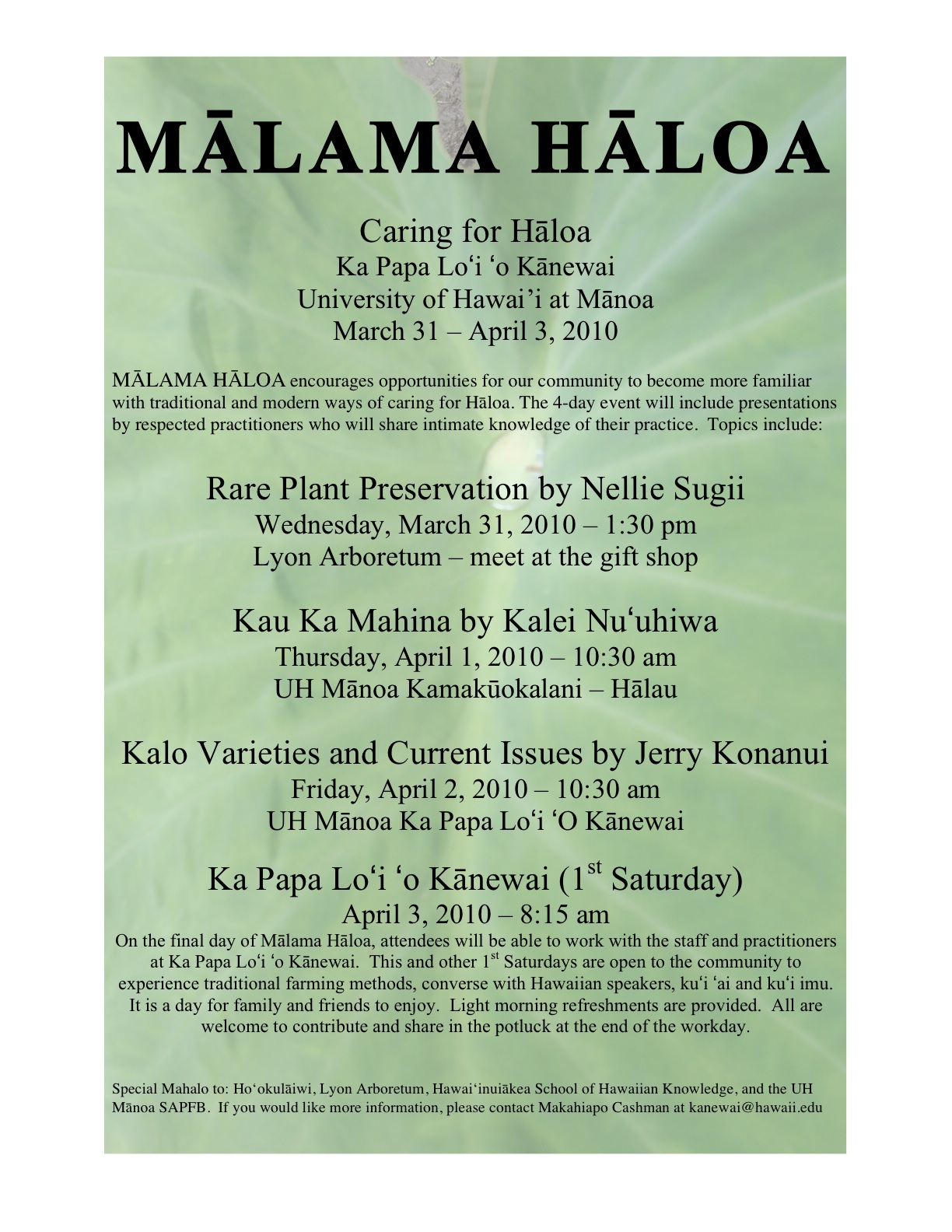
Malama Haloa – Educational Series on Hawaiian kalo and environment

MĀLAMA HĀLOA

encourages opportunities for our community to become more familiar with traditional and modern ways of caring for Hāloa. The 4-day event will include presentations by respected practitioners who will share intimate knowledge of their practice. Topics include:

Rare Plant Preservation by Nellie Sugii

Wednesday, March 31, 2010 – 1:30 pm
Lyon Arboretum – meet at the gift shop

Kau Ka Mahina by Kalei Nuʻuhiwa

Thursday, April 1, 2010 – 10:30 am
UH Mānoa Kamakūokalani – Hālau

Kalo Varieties and Current Issues by Jerry Konanui

Friday, April 2, 2010 – 10:30 am
UH Mānoa Ka Papa Loʻi ʻO Kānewai

Ka Papa Loʻi ʻo Kānewai (1st Saturday)

April 3, 2010 – 8:15 am

On the final day of Mālama Hāloa, attendees will be able to work with the staff and practitioners at Ka Papa Loʻi ʻo Kānewai. This and other 1st Saturdays are open to the community to experience traditional farming methods, converse with Hawaiian speakers, kuʻi ʻai and kuʻi imu. It is a day for family and friends to enjoy. Light morning refreshments are provided. All are welcome to contribute and share in the potluck at the end of the workday.

Special Mahalo to: Hoʻokulāiwi, Lyon Arboretum, Hawaiʻinuiākea School of Hawaiian Knowledge, and the UH Mānoa SAPFB. If you would like more information, please contact Makahiapo Cashman at kanewai@hawaii.edu

10.4 MALAMA_HALOA-FLYER2

Download MALAMA HALOA Poster (PDF)

Researcher warns: Right wing “populist moment” could get worse

Message to the Left: stop whining and organize!

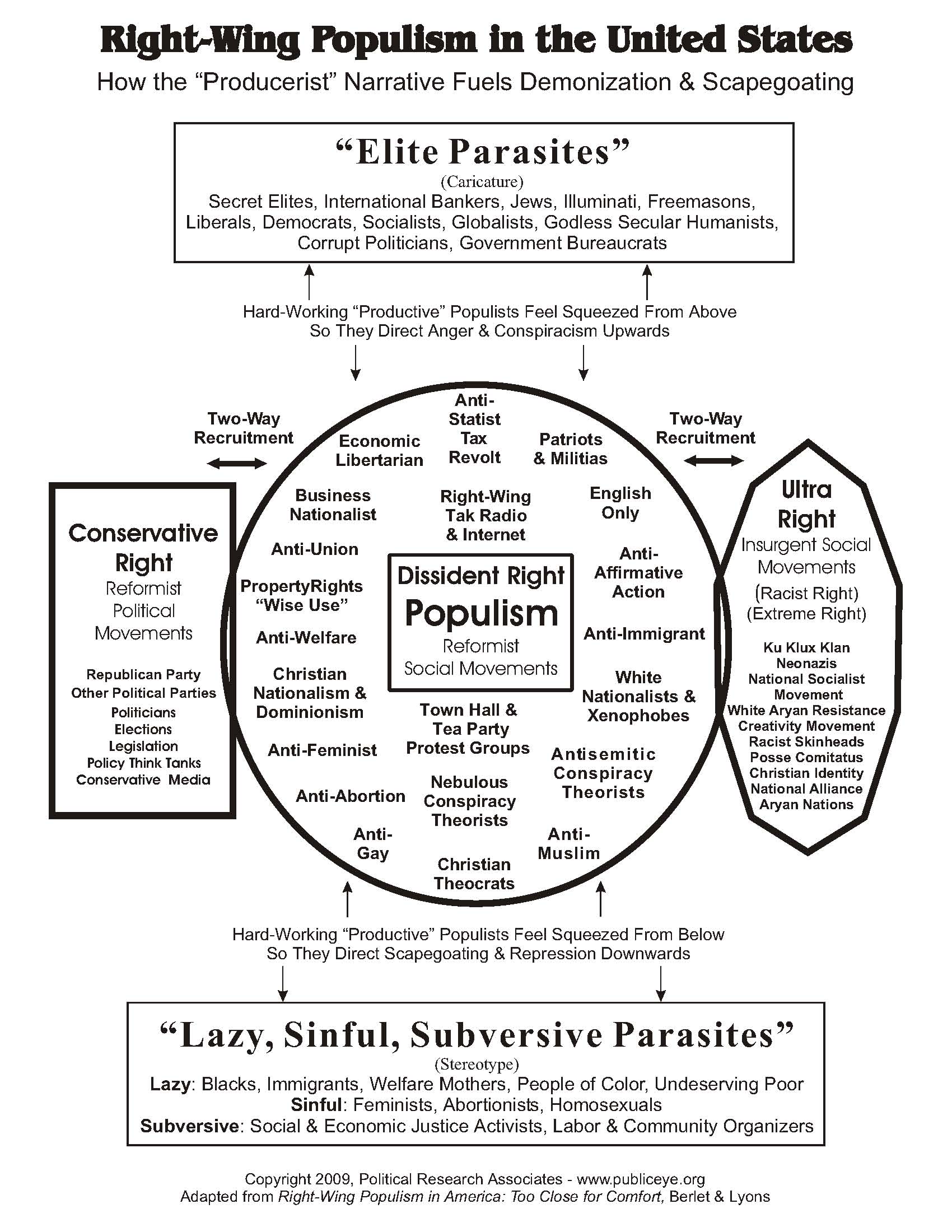
Last night in Honolulu, Chip Berlet, senior researcher of Right wing movements for Political Research Associates and veteran organizer, spoke about the Right wing populism in the U.S. and its current resurgence in the so-called “Tea Party movement” and attacks on President Obama.  He described the history of populist moments in the U.S. as volatile and unpredictable. Often these moments could tip either to the Left or the Right depending on which camp is best able to frame the message and organize legitimate anger.  He cautioned that the Left dismiss or ridicule Right wing populists at their own peril.   The Tea Party movement, like other populist moments, arise from real anger and insecurity about economic and social conditions. However, the Right has tapped this anger and (mis)directed it towards scapegoated groups –  Jewish banking conspiracies on the one hand (elite  parasites) and immigrants, gays and lesbians, Muslims, and the poor (lazy, sinful, subversive parasites). If this trend continues, he warns, conditions could get much worse, veering towards the abyss of fascism.

Populism-chart-handout(2)Berlet described how Right wing movements typically mobilize fears about losing some form of unfair privilege, whether it be economic, political power or social status.  They turn this into a neat rhetorical trick whereby victimizer becomes victim.

The solution, he challenged the audience at the Honolulu Friends Meeting House, is not to make ourselves feel morally superior by dismissing or insulting people who join these movements, which is just a form of retreat, but rather to out organize them. There is no reason why the Left should not be able to build broad coalitions and movements by taking on the real grievances of the people and directing the anger towards more just systemic change.

Regarding the Right wing attacks on Obama and Left wing disappointment, Berlet said that we should “have his back, and kick his butt.”  That is challenge racist attacks on Obama, but also protest and push him on progressive issues.   Berlet faults the centrist Democratic insiders that surround Obama for insulating him from the upwelling anger rather than making him take on these issues.  This has isolated Obama and made him appear aloof and “out of touch” with the struggles of ordinary folk.

He told a story about important lessons from the fight to defeat the anti-gay ballot measure 9 in Oregon in 1992.  A Christian right group called the Oregon Citizen’s Alliance put a constitutional amendment on the ballot to make homosexuality illegal in Oregon.  Gay rights political heavyweights from national organizations did the polling and concluded that with the support of liberal urban centers of Portland and Eugene, they could defeat the ballot measure.  They framed a message that amounted to “smart liberal city folk wouldn’t vote for such an ignorant and bigoted measure”.  Basically, the pollsters and spin doctors were calling everyone outside of the cities ignorant red necks.  This would have been a disaster. most of the state is rural and fairly culturally conservative.  Such an arrogant and short sighted tactical decision would have alienated 80% of the counties and made it impossible to organize for progressive issues for decades.

Instead, progressive organizers pushed the national groups out and decided that their long term success meant organizing on principled unity between a broad coalition of groups, in other words, solidarity.  This was tough because there were contradictions and prejudices against gay rights among many constituencies in the state.  The organizers decided that it was better to fight in a way that built a grassroots movement based on principled unity and solidarity for the long term and possibly lose at the ballot than to pick the politically expedient tactic to win the ballot measure, but poison the political water for decades – a courageous decision and a heavy burden for the organizers to bear.  Ballot Measure 9 was defeated.

Berlet said that the research shows that the best way to win people over and get them to join your group or movement is through face-to-face encounters and respectful, principled dialogue and debate.  Sorry, “internet warriors”.   The point is not to convert the ideologically consolidated leadership, but rather to win over the people who may have reactionary politics on some issues, but who have not yet hardened in their ideological stance.

He challenged the audience to take risks and build broad coalitions to fight for justice and peace. He shared the story of the White Rose Society to make his point.  The White Rose Society was a Catholic student movement in Nazi Germany that courageously educated and organized against Nazism, fully certain that they would be defeated and most certainly killed.   But they felt that morally and politically, they had no choice but to resist the fascist tide.  The leaders were executed, but they inspired others to resist. And anti-fascist movements grew. The emblem of the  white rose has become the international symbol of anti-fascism.

What does all this have to do with demilitarization?   If Right wing populism becomes more powerful and virulent, it may one day turn the existing infrastructure and mechanisms of authoritarian rule and military power into a nightmare of state violence.  One of the “first principles” of the Tea Party movement is “National Defense”, which includes endless wars, runaway military spending, torture and extraordinary rendition, warrantless spying and other attacks on civil liberties.  To rephrase the famous admonition from the radical labor organizer Mother Jones, “Don’t whine, organize!”

Resources for organizers can be downloaded here: http://www.publiceye.org/movement/handouts/berlet.html

Berlet will speak twice on Hawaii island:

Monday, February 8, 2010

2 pm  University of Hawai’i – Hilo, UCB115

7 – 9 pm Keaau Community Center


UPDATED: Rise Up! Roots of Liberation – Youth Camp for Justice and Peace

UPDATE:  Thanks to a special gift from the Hawai’i Peoples Fund, we able to offer a $150 stipend to participants who successfully complete the program.

DEADLINE EXTENDED TO MARCH 1st, 2010

logo copy

youth camp for justice and peace

March 15 – 19, 2010

Camp Kokokahi, Kane’ohe

Who:             Youth ages 15 – 19 with a passion for peace, justice and aloha ‘aina.

What:             Be Real:  Liberate the power of our histories, cultures and identities.

Be the Change: Gain knowledge and skills to help grow our movement for peace & justice.

Connect: Meet other youth who also care about making Hawai’i and the world a better place.

Download the application forms here.

Program eligibility

  • Youth the ages of 15-19 years old.
  • Must be self-motivated and able to work well in a team towards a common goal.
  • Must have the desire to work for justice and peace, protect the environment.

How to apply

1) Complete the application form. Download the application forms here. Have a teacher/adviser complete the recommendation form.  Applicants under 18 years of age must also fill out and return a signed parent permission form .

2)  Mail, fax or email your completed application packet to:

  • Mail:  American Friends Service Committee -Hawai’i Area Program

Rise Up! Roots of Liberation – Youth for Justice and Peace

Attn: Kyle Kajihiro

2426 O’ahu Avenue

Honolulu, HI 96822

  • Fax:      808-988-4876
  • Email: kkajihiro@afsc.org

OR

  • Video:  Send us an online video of your response to the application form.  You must still submit signed teacher/adviser recommendation form and if you are under 18 years of age, a parent/legal guardian permission form.

3) DEADLINE FOR APPLICATIONS EXTENDED: MARCH 1, 2010

This program is FREE.   Spaces are limited.  Applicants will be selected based on your application packets.  We may also call to interview finalists.   Applicants will be notified by March 5, 2010 whether they are admitted to the program.

Thanks to a special gift from the Hawai’i Peoples Fund, we are able to offer a $150 stipend to youth participants who successfully complete the program.

For more information:             Call 808-988-6266.  Email: kkajihiro@afsc.org