Hearing next week on challenge to Army license for depleted uranium
January 6th, 2010
The Atomic Safety and Licensing Board, an agency of the Nuclear Regulatory Commission, will hold a hearing next week on challenges filed by four Hawaii residents to an Army license to possess depleted uranium at Schofield Barracks on Oahu and the Pohakuloa Training Area on the Big Island.
Those challenging the Army’s depleted uranium license are Big Island residents Jim Albertini, Cory Harden, and Isaac Harp, along with Luwella Leonardi of Waianae.
The Army wants to leave depleted uranium deposited during past training exercises in place both in these two Hawaii sites as well as training areas across the country.
Critics say depleted uranium can cause public health problems, especially when it has burned and created fine radioactive dust particles.
Depleted uranium is very heavy and has been used in various U.S. weapons, including some bullets and bombs, and some heavy armor.
DU is a health hazard if it enters the body, such as through embedded fragments, contaminated wounds, and inhalation or ingestion. Simply riding in a vehicle with DU weapons or DU shielding will not expose a service member to significant amounts of DU or external radiation.
The potential for health effects from internal exposure is related to the amount of DU that enters a person’s body.
The hearing before three administrative judges on Wednesday, January 13 will be in the board’s hearing room in Rockville, Maryland. Army representatives will appear before the board in person, while the challengers will participate by videoconference from the University of Hawaii’s Hilo campus.
The hearing will be also be streamed live via the Internet and available for later viewing on the NRC’s web site, although I don’t yet have the URLs.
The Army contends that none of the four challengers has the necessary standing to challenge its handling of depleted uranium because they do not live near the sites and have not proven any actual harm or damage they would personally suffer if the license is granted. In addition, the Army says the arguments raised against the licensing are not specific enough or sufficiently documented to prove that there is a “material issue of law or fact”.
The hearing panel has spelled out specific questions it wants each of the challengers to address in its order setting the hearing.
Isaac Harp of Waimea, who cited “cancer-clusters” near areas where live weapons training has been conducted, has been asked to clarify how he would personally be harmed, and to substantiate a claim that the Army may have used depleted uranium in more than the two areas in Hawaii.
Luwella Leonardi, a Waianae resident, fears contaminated dust from training in Makua Valley threatens her community. She has been asked to “specify the factual foundation for this concern”, including evidence that the dust is radioactive and has a direct impact on health.
Jim Albertini of Malu Aina Farm, who argued the Army has failed to address the hazards of inhaling depleted uranium, has been asked to provide specific information that disputes the Army’s position.
Cory Harden, affiliated with the Sierra Club’s Moku Loa Group, wants to see independent air monitoring by the federal government. The Army says Harden’s petition failed to meet an administrative deadline and should be disregarded.
Schofield Barracks soldier arrested in Kahala store robbery
Advertiser Staff
A 22-year-old Schofield Barracks soldier was arrested yesterday in connection with an early-morning robbery of a convenience store in Kahala.
An employee told police the man entered the store at 12:43 a.m., pulled out a knife, demanded cash and left.
At about 9 a.m., a patrol officer spotted a man in the area where the robbery took place. The clothing the man wearing was similar to that worn by the robber, police said.
The store employee later identified the man and he was arrested on suspicion of first-degree robbery.
– Chris Iijima and Nobuko Miyamoto, War of the Flea
In the following article from the Honolulu Weekly, Sparky Rodrigues of Malama Makua compares the group’s approach to a mosquito biting an elephant. The metaphor evokes the classic description of guerrilla warfare as a “war of the flea”, where small resistance forces utilize asymmetry to their advantage. But the guerrilla strategy relies on mobility, improvisation, the ability to “hit and run” and the support of the community. The Army’s efforts to generate pro-military sentiment in the Wai’anae and Native Hawaiian communities seeks to remove the environment from which the Makua movement draws its support and suggests that the military is applying counterinsurgency methods to its public relations strategy as well as training mission in Makua. It challenges the Makua movement to evaluate how well we are applying these lessons in our strategies and tactics in the social and political arena.
Is the Army committed to changing its tune in Mākua, or is it just paying lip-service?
Catherine Black
Jan 6, 2010
A clash of cultures, and some dialogue as well. Image: Davd Henkin
When Malama Makua, represented by Earthjustice Legal Defense Fund, filed suit against the U.S. Army in 1998, it was a David and Goliath-type facedown, though the group’s president Sparky Rodrigues says its preferred metaphor is “a mosquito biting a rogue elephant as it crashes through the forest. We’re tiny, but we’ve been able to make it stop to itch.”
The Waianae non-profit organization’s original demand was that the Army conduct an Environmental Impact Statement, after a series of fires set off by its live-fire training exercises burned thousands of acres of environmentally and culturally sensitive land. In a 2001 settlement, the Army agreed to do the EIS and has not conducted any live-fire exercises (simulations of combat scenarios using “live” munitions) since 2004.
In July of 2009, however, it seemed as though the valley’s recovery period would end: The Army completed its EIS and issued a Record of Decision advocating a return to live-fire training in the valley.
Yet the mosquito bit again: in August, Malama Makua filed a claim contending that two studies required by the 2001 settlement were poorly conducted and not released for public comment, as mandated. The Army requested that the court dismiss this claim, but in November, U.S. District Court Judge Susan Oki Mollway denied the Army’s request, upholding Malama Makua’s argument that the studies’ methodologies were insufficient to test possible contamination threats to subsurface archeological remains and marine life.
“We have serious concerns about the adequacy of the EIS itself,” says Earthjustice attorney David Henkin, “but before dealing with that larger question, we are asking the court to resolve a threshold issue regarding these studies, which are inadequate. It’s basically a continuation of Malama Makua’s struggle with the Army since 1998, trying to force the Army to do an honest appraisal of the effects of training in a valley full of endangered species and cultural sites, and to address the question of why they can’t do this somewhere else and still accomplish their mission?”
Service, or lip-service?
The Army’s policy is to not comment on ongoing litigation, but local Army Garrison spokesman Dennis Drake signals a number of proposed mitigations to lessen the impact of training at Makua.
These include identifying and protecting culturally sensitive sites; eliminating some of the areas previously used for training such as Kaena Point and one of the valley ridges; investing in native species restoration efforts (the Army spends 10 million dollars annually on environmental protection in Hawaii, and contracts 28 biologists at Makua alone); and a cultural sensitivity training program for soldiers in Makua so that archeological sites–totaling more than 120, including at least two known heiau–are not damaged. The Army also recently launched a new Military Munitions Response Program to engage the community in the process of cleaning up unexploded weapons along the coastline.
Yet according to Rodrigues, “their cultural sensitivity is less than zero. They say they’re doing cultural sensitivity training, but what we’re finding is that it’s not about Hawaiian culture or the community’s culture, but the Army’s culture. Their talk about sensitivity is more for the sound bite, the news report, the press release.”
A changing strategy
The main question at issue is whether the Army’s live fire training–which involves mortar, artillery, anti-tank weapons, grenades and mines–can be done elsewhere. According to Drake, the Army’s new focus for Makua Valley training is in preparing soldiers for the type of situations that might be found in the current wars in Iraq and Afghanistan.
“We’re not doing force on force fighting now, but counter-insurgency training. The big one is defense against IEDs, because that’s the weapon that’s killing the most soldiers right now. So convoy live fire training is a critical task, because if you’re in a convoy and one of your convoy hits an IED and your convoy stops, they could be sitting ducks for an ambush situation.”
The Army recently announced plans to transform Makua Valley into a counterinsurgency training site over the next decade, though it defends its argument, outlined in the July Record of Decision, for conducting up to 32 combined live-fire exercises (what Makua Valley has been traditionally used for) and 130 convoy live-fire exercises (the newer counter-insurgency exercises) per year.
Henkin says, however, that the proposal makes clear it is both reasonable and feasible for the Army to move all of its combined arms training out of the valley.
“The Army should simply do that, rather than try to think of new training it can conduct at Makua,” he says. “After all, the Army has never satisfactorily answered the core question: why it thinks any training whatsoever at Makua is appropriate or vital for national security. No rational planner in the 21st century would decide to conduct military training in the midst of Makua’s biological and cultural treasures.”
Ultimately, Malama Makua and Earthjustice argue that the price for the Army’s live-fire training, which involve potential fire hazards, physical damage to historic sites and toxic waste contamination in an ahupuaa of rich historical, cultural and environmental resources (the area is home to 48 endangered plant and animal species, including the ‘elepaio bird and the endangered Oahu tree snail) is too high, even with the proposed mitigations.
The Army argues that 4,190-acre Makua valley is the only place on Oahu where soldiers can get the type of training they need in order to be prepared for the wars in Iraq and Afghanistan without spending large amounts of money on transportation off-island or cutting into soldiers’ already reduced time at home with their families between deployments.
Although the military’s 133,000-acre Pohakuloa Training Area (PTA) on the island of Hawaii has been suggested as an option, “that alternative is not at all preferable for us,” says Drake. “It’s impractical and costly for small units to deploy to PTA and return each time they desire to train. A battalion or brigade deployment to PTA should occur only when their company-sized units are proficient to the level where they can integrate into a larger exercise.”
As long as Makua is a viable option for smaller-scale exercises, the Army’s reasoning “just makes common sense” says Drake. Doing the training off-island would require more money to ensure that soldiers get the same degree of combat preparation. Drake insists that as long as the Army needs to prepare soldiers for potential combat, there will be a need for a local training area for soldiers stationed in Hawaii. While these reasons don’t eliminate other ranges as possibilities, they do make Makua the most attractive one as long as the costs don’t outweigh the benefits.
A slow shift
This is all part of a larger, ongoing debate over the military’s impact in Hawai’i. For many environmental and cultural stakeholders the costs are too high, and as Rodrigues explains, the Waianae Coast’s military presence is a health and quality of life concern for the region’s already underserved, largely Hawaiian population.
Malama Makua’s outreach has helped to broaden the debate regarding military use of Waianae and state resources, and one positive outcome of the 2001 settlement is that the group has brought thousands of people into a valley that was previously off-limits to the public. They have been leading cultural accesses twice a month since 2002, including overnight Makahiki ceremonies, Christmas vigils and Easter Sunrise services.
“We take everybody back there, students, neighbors, people from other parts of Oahu, even military personnel…in fact it’s good to take people who don’t agree with us,” says Fred Dodge, one of the group’s directors. This, along with participation in many of the coastline’s community organizations, is how Malama Makua is attempting to educate the broader public about the valley’s cultural and ecological importance.
Ultimately the question comes down to how worthwhile it will be for the Army to maintain its training at this particular site. In the coming months, Judge Mollway will likely hear arguments from both sides on whether the Army complied with the settlement agreement, or whether it can return to live-fire training. In the meantime, the soldiers, the community and the valley itself await an outcome that will determine which vision of Makua will prevail.
So here is the Army’s counterinsurgency plan for Makua. They will be “lessening” the impact, moving “storm the hill” type training to Pohakuloa and changing the training to traditional infantry live fire training and roadside bomb detection. Meanwhile they have tried to win support from the Wai’anae community. They plan to return to training as early as March. The Army also wants to train the military troops of other countries in Makua.
Makua Valley eyed for counterinsurgency, road bomb training
By William Cole
Advertiser Military Writer
The Army wants to spend about $3.7 million to transform Makua Valley into a “world-class” roadside bomb and counterinsurgency training center with convoy live fire along hillside roads, simulated explosions and multiple “villages” to replicate the roadside bomb threat in Iraq and Afghanistan — the No. 1 killer of Americans.
As that occurs, the Army said it also wants to eventually transition some of its storm-the-hill traditional live-fire training from Makua to Pohakuloa Training Area on the Big Island.
The counter-improvised explosive device, or IED, focus at Makua is a new proposal by the Army as it also seeks the more immediate return to the traditional infantry live-fire exercises in the 4,190-acre Wai’anae Coast valley — something it hadn’t been able to do since 2004 due to environmental lawsuits.
Schofield Barracks may seek to conduct traditional live-fire drills in Makua involving companies of 150 soldiers with artillery, mortars and helicopter fire as early as March, officials said.
“What this (longer-term) plan enables us to do is to modernize Makua Valley (to meet) what we think is the long and enduring threat,” said Lt. Gen. Benjamin R. “Randy” Mixon, referring to counterinsurgency and roadside bombs.
Mixon is head of the U.S. Army in the Pacific.
He said the plan also would reduce the cultural and environmental impact in Makua — the source of ongoing lawsuits — “because we would shift over time, and I’m talking five to 10 years from now, the heavy ordnance training, artillery training and things of that nature over to Pohakuloa.”
Changes already in the works for Hawai’i’s Stryker Brigade at the Big Island training area, along with possible new training ranges to replace Makua and other improvements, conceivably could total $300 million over the next 15 years, Mixon said.
restarting live fire
The counter-roadside bomb plan represents a fundamental change in what to date had been the Army’s dogged pursuit of traditional infantry live-fire training in Makua Valley, a quest that has cost it millions in court fees.
A lawsuit over training was settled with community group Malama Makua in 2001. However, the Army’s failure to complete an agreed-upon environmental impact statement analysis of decades of military training prevented a return to live fire since 2004 and spawned a series of sub-lawsuits.
The Army last July completed the environmental examination by saying it wanted to conduct up to 32 combined-arms live-fire exercises or 150 convoy live-fire exercises annually in the valley.
“The EIS we consider to be legally sufficient (and) we intend to return to live fire in Makua Valley,” Mixon said last week from his headquarters at Fort Shafter.
David Henkin, an Earthjustice attorney who represents Malama Makua, said he doesn’t know the details of the shift in focus being proposed by Mixon for Makua Valley.
“I guess all I can say is this proposal has never been subjected to any form of environmental review — including public review — so it’s impossible to make any informed statement about it without actually seeing what’s being proposed,” Henkin said.
New construction “raises a lot of concerns about potential damage to subsurface archaeological resources,” Henkin said.
More than 50 endangered plant and animal species, and more than 100 archaeological features, are found in the valley area.
global training site
Mixon said he intends to take the Makua and Pohakuloa plan before the Army chief of staff and other Army officials probably in the next 60 days.
“If I get their support, which I’m sure I will, we will start as soon as we possibly can,” he said. That could mean construction activity at Makua within a year, he added.
Henkin maintains that such a change would require a supplemental environmental impact review.
Mixon said part of his plan includes the development of an IED “fusion center” in Hawai’i that would bring together intelligence gathering, a knowledge base and training to defeat roadside bombs not only in Iraq and Afghanistan, but in Asia-Pacific countries such as Thailand, India and the Philippines, where the bombs also are a growing threat.
He said he’s already obtained “a couple million dollars” in start-up funding from the Pentagon’s Joint IED Defeat Organization.
U.S. soldiers could travel to Pacific partner nations to train their soldiers on roadside bomb techniques, and foreign soldiers might be able to travel to Hawai’i to receive training at Makua, Mixon said.
The three-star general said he envisions Makua as a “world-class IED and counterinsurgency” training center.
Makua’s austere hillside road network is a close approximation of Afghanistan roads. Mixon’s plan includes the installation of a couple dozen mobile structures that would be congregated in two spots and spread out elsewhere to represent villages.
The training would include convoy live fire in response to an attack, and a “shoot house” with about 10 rooms in which soldiers could practice live-fire room clearing, officials said.
Helicopters would be brought in for support and a key component of the plan is the use of unmanned aerial vehicles to look for roadside bomb planters.
Mixon said the fleet of UAVs will be increasing in Hawai’i, and Makua is one of the few allowable places to fly.
Training requirements were examined for Hawai’i with an eye to an integrated approach and “how can we make the best possible use, given the training requirements and the anticipated threat, of Schofield, Makua and Pohakuloa Training Area,” Mixon said.
community talks
Schofield units have been able to rotate annually to the National Training Center in California for large-scale training exercises during a time of war, but those availabilities, at a cost of between $18 million to $22 million, are expected to dwindle if and when the wars in Iraq and Afghanistan wind down, he said.
As a result, more Hawai’i-based service members, including Marines and National Guard soldiers, will be at home station longer and need to get their training in the Isles, Mixon said.
Mixon said he envisions expanding the live-fire capability at Pohakuloa, and if that’s possible, “we would see a gradual shift to a different type of live-fire training (at Makua) which is focused on counter-IED operations in cities and close-quarters combat.”
But he also said the Army would have to retain the ability to use Makua for IED training and — if needed — the traditional company-size combined arms exercises involving mortars, artillery and helicopters firing overhead.
Mixon said he’s been out to the Wai’anae Coast to talk with community representatives in “general terms” about the new Makua plan.
“It’s our desire to continue to train in Makua Valley but look at ways to limit the cultural and environmental impact,” he said.
Reach William Cole at wcole@honoluluadvertiser.com.
Military occupation of Mokapu means the president gets a beautiful, secure playground for his visit to Hawai’i. But the story fails to address the fact that the military forcibly seized this land during WWII, much of it ancestral Hawaiian lands and national lands of the Hawaiian Kingdom. More than two thousand Hawaiian iwi kupuna (ancestral remains) were removed (evicted) from Heleloa sand dunes to build the runway. They sit in cardboard boxes in the Bishop Museum while the families haggle with the Marines over the repatriation of the bones. Meanwhile vast burial sites are being desecrated by expansion of housing on the base and the recreational facilities such as the Klipper golf course. It figures that the President of the U.S. would prove his worthiness to rule the empire by golfing on Hawaiian bones.
Vacationing president using its gym, beach, even its ballroom
By Dan Nakaso
Advertiser Staff Writer
President Obama has stayed even closer than usual to Marine Corps Base Hawaii on his latest O’ahu vacation.
And the reasons are probably as much security-conscious as symbolic for a wartime commander in chief from the Democratic Party.
“The military tends to be more right wing, conservative leaning, and there’s a bias when you have a Democratic, liberal president,” said Michael Naho’opi’i, who graduated from the Naval Academy in 1986, retired as a lieutenant commander and is now executive director of the Kahoolawe Island Reserve Commission. “A lot of it has to do with security. But it does show that he supports the troops.”
As on last year’s Hawai’i Christmas vacation as president-elect, Obama has begun his days with early-morning workouts at Marine Corps Base Hawaii’s Semper Fit gym, which sits next to his beachfront rental home in Kailua.
But on this trip, Obama has returned to the nearly 1,000-acre base several times after working out: to take family and friends for private beach time Dec. 27 at Pyramid Rock out of the eye of reporters and photographers; to play a private basketball game in the gym, also on Dec. 27; to make two widely publicized statements about the Christmas Day attempted terrorist attack on a commercial airliner; and, joined by the first lady, to shake hands with Marines, soldiers and sailors on Christmas Day, for the second year in a row.
As the president’s Hawai’i vacation neared its conclusion, he returned to the base again yesterday, with family and friends, to enjoy the beach after a morning visit to Sea Life Park in Waimanalo.
Last year, during an August vacation break from the presidential campaign trail, Obama stepped out from the same rental home he’s staying in now to deliver a sidewalk statement on Russia’s incursion into neighboring Georgia.
Various media reports at the time referred to the “palm tree-lined driveway” that served as a backdrop for Obama’s statement.
This time, Obama’s entourage erected an ad hoc briefing room, along with a decidedly more presidential-looking podium, inside the Mauka Ballroom of the Marines’ Klipper Golf Course.
“He is the commander in chief and he takes that seriously,” said Dan Boylan, a Hawai’i political commentator and University of Hawai’i-West O’ahu professor. “But the security guys clearly want to keep him close to base.”
Commander in chief
Even for military members who preferred Republican Sen. John McCain for president, Obama is still their commander in chief, said Jim Hickerson, 75, a Vietnam POW and retired Navy captain who lives near the National Memorial Cemetery of the Pacific at Punchbowl.
During his Navy career, Hickerson met and admired President Reagan in California and said, “I am not a very big Obama fan.”
“But it’s great to have a president here, there’s no doubt about it,” Hickerson said. “The president’s the president. I have the utmost respect for the office. He’s our commander in chief. Having him come by (Marine Corps Base Hawaii) is an honor, whether you respect him or not.”
The base is well suited to accommodate the president and his family.
Anderson Hall — where Obama and the first lady thanked military members for their service and wished them Merry Christmas — is outfitted with new 52-inch and 42-inch flat-screen televisions and has been named the best chow hall in the entire Marine Corps three years running.
“We feel our amenities exceed what you would typically find at other bases, without calling them extravagant,” said Col. Robert D. Rice, commanding officer of Marine Corps Base Hawaii. “We’re particularly proud of our Klipper Golf Course and its newly refurbished club. Our Semper Fit gym, where the commander in chief has worked out each morning of his stay thus far, has approximately 20 percent of its strength-training equipment replaced or upgraded each year. Our basketball court in the gym just had its floor resurfaced in September, as it has almost every year in the last several years. Our cardio training equipment is as modern as you’d find in most gyms out in town.”
‘superb relationship’
Marines have been assigned to the Windward side’s Mokapu Peninsula since Dec. 7, 1941, when Japanese fighters strafed Naval Air Station Kane’ohe Bay eight minutes before the main attack on Pearl Harbor.
On Jan. 15, 1952, Marine Corps Air Station, Kaneohe Bay was officially commissioned. Today, Marine Corps Base Hawaii is home to more than 7,500 Marines and more than 7,000 family members, with hundreds more sailors, Marines and civilians pouring in each day.
Rice, the base’s commanding officer, said the Marines “enjoy a superb relationship with the White House staff and Secret Service, and eagerly look forward to supporting future presidential visits to Hawai’i.”
The Marines’ accommodations are good to go for the leader of the free world, said base spokesman Maj. Alan Crouch. But there is one spot on base that even the Marines can’t improve on, Crouch said.
Where the first family enjoyed a beach picnic at Pyramid Rock, Crouch said, “there’s no improving on perfection.”
Reach Dan Nakaso at dnakaso@honoluluadvertiser.com.
President Obama arrived in Hawai’i on Thursday for his winter vacation. Security has been intense, including. as reported in the Honolulu Star Bulletin, a security zone that extended into the sea, blocking a favorite surf spot “Castles”:
Bob Ashton, a local resident and surfer, said the Coast Guard was not letting anyone surf Thursday past a yellow buoy marking the security zone.
But on Christmas surfers were able to catch waves just inside the zone.
“What are we going to do? We’re in board shorts,” Ashton said. “We’re not suicide surfers.”
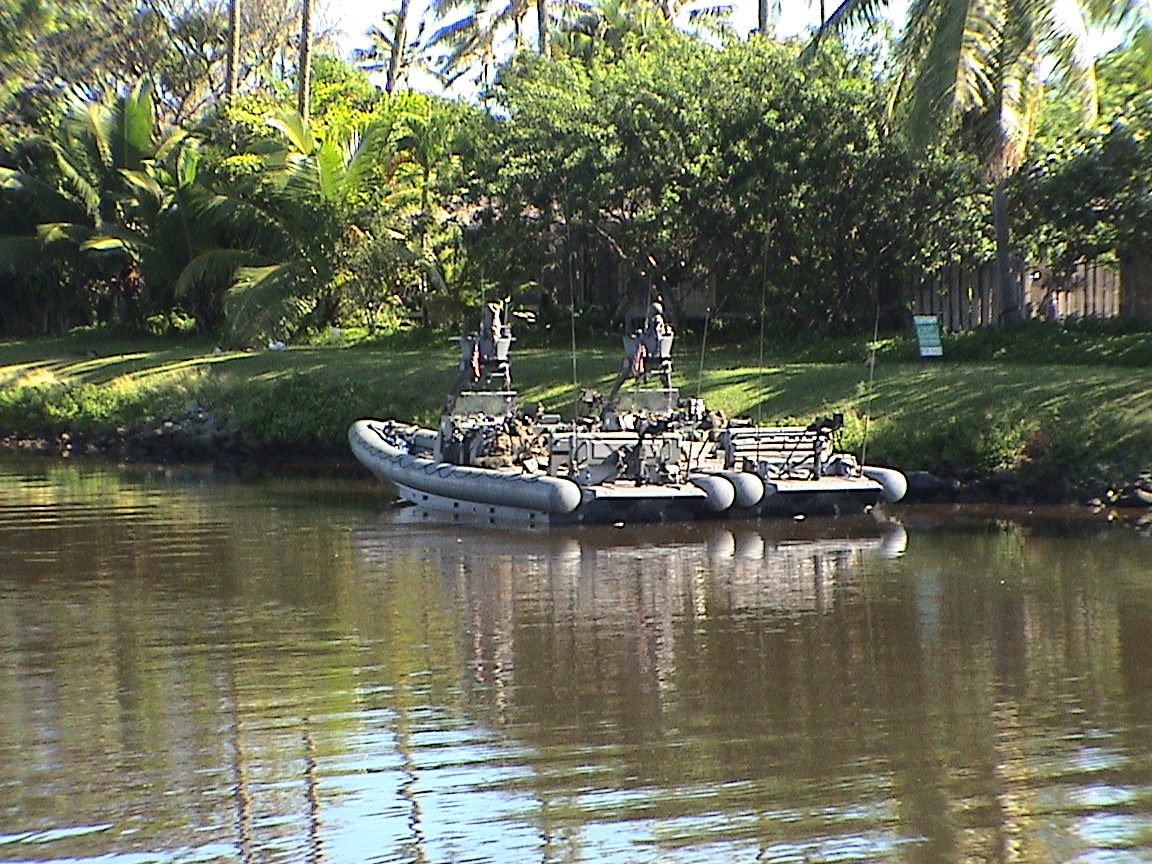
Ikaika Vasconcellos said when he paddled out yesterday, Coast Guardsmen in a motorized rubber boat greeted him and told him he could surf as long as he did not cross an imaginary diagonal line between the yellow security buoy and a white security tent on shore closer to the Obama vacation home.
“They had guns on the boat,” Vasconcellos said. “So we were like, ‘OK, we won’t pass your line.'”
Merry Christmas!
Gunboats in the canal where kayakers are usually paddling. Photo: Kyle Kajihiro
Although much of the Obamas’ activities have been low key, much taking place within the secured compound or on the Kaneohe Marine Corps Base, there have been protests. Thursday afternoon, as the motorcade arrived in Kailua, Hawaiian independence activists demonstrated. The AP story mentioned the action:
A group of Hawaiian sovereignty activists standing near Pinky’s restaurant in Kailua spelled out “End US Occupation of Hawaii.”
Pono Kealoha posted the following video on YouTube:
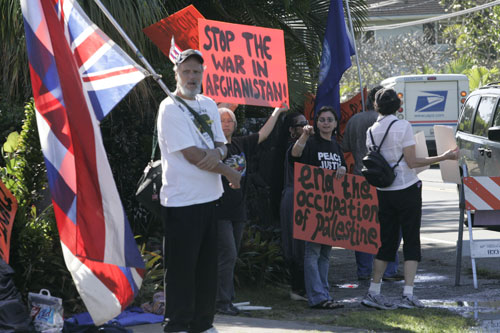
Yesterday peace and anti-war groups held a demonstration at the entrance to Kailuana Place, just outside the security checkpoint.
Obama’s motorcade passed the demonstration on his way to Kaneohe Marine Corps Base where he played golf at the Klipper course, a “golfer’s paradise”. Did someone tell him that he was golfing on the ancestral remains of Kanaka Maoli?
Protesters seizing moment to air out their concerns
By B.J. Reyes
POSTED: 01:30 a.m. HST, Dec 27, 2009
FL MORRIS / FLMORRIS@STARBULLETIN.COM
On one corner, groups opposed to the wars in Iraq and Afghanistan carried signs urging an end to the conflicts on foreign soil.
Across the street, abortion foes protested the inclusion of funding for abortions in any health care reform bill.
“Chaotic,” was Kailuana Place resident Suzanne Sutherland’s description of the scene at the end of her block, where groups set up in hopes of getting President Barack Obama’s attention as he came and went from his vacation rental home.
“There’s children, there’s people coming and going to the beach, there’s the people on the sidewalk — with the cars — their lives are in danger,” Sutherland said. “The cars, they’re in danger of turning and looking at something and having an accident.”
The demonstrations were peaceful, though witnesses said one car that slowed down so someone could make an obscene gesture was involved in a fender bender.
Signs bore statements including “Stop the wars,” “Peace, put it in action” and “I don’t want to pay for baby killing.” At least one demonstrator carried the Hawaii state flag upside down.
“We think it’s really important, not only with the national coverage but international coverage, that people see that there are people here in Hawaii — even while he’s on vacation — who are saying ‘stop the war’ and we greatly oppose the war,” said Liz Rees, 39, of Honolulu, an organizer with the group World Can’t Wait.
Gary Boisclair, a local organizer with the Insurrecta Nex anti-abortion group founded by national activist Randall Terry, carried a sign reading, “President Obama, baby killing is not health care.”
“Today we are hoping to wake up our president and the public to the fact that this health bill cannot be passed with monies — direct or indirect — for the killing of innocent children,” said Boisclair, 41, of Honolulu.
The groups each numbered a few dozen strong by 10 a.m. but were gone by noon.
Obama passed through their ranks at 10:11 a.m. when his motorcade made its way to Marine Corps Base Hawaii at Kaneohe Bay for a round of golf at the base’s Kaneohe Klipper Golf Course.
Aides said Obama played a round of golf with Chicago pal Eric Whitaker and Hawaii friends Greg Orme, Mike Ramos and Bobby Titcomb.
Reporters were not allowed onto the golf course to view the president’s round.
After about six hours on the course, the motorcade left the base but stopped at Pyramid Rock Beach. Obama, wearing a white golf shirt, tan baseball cap and sunglasses, got out to check out the waves as surprised swimmers and sunbathers caught a glimpse of him as he took in the sights for a few minutes.
THE PRESIDENT’S motorcade returned to the vacation residence at 4:52 p.m.
Obama’s day started with a 6:20 a.m. conference call with John Brennan, his Homeland Security and counterterrorism adviser, and Denis McDonough, national security chief of staff.
“He received an update on the heightened air travel safety measures being taken to keep the American people safe and on the investigation,” deputy White House press secretary Bill Burton said in a statement. “The president will continue to actively monitor the situation.”
A Nigerian passenger on a Northwest Airlines flight from Amsterdam allegedly set off an explosive device as the plane prepared to land in Detroit on Friday, according to authorities.
Obama and his wife, Michelle, also got in their usual morning workout at the Marine Corps base health club.
Two separate groups of protesters on Saturday rallied outside the entrance to the Kailuana Place vacation compound in Kailua where President Barack Obama is staying for the holidays.
One group opposed the U.S. being at war. The other was against federal funding being included in health care reform legislation being negotiated in Congress.
“The health bill that will be presented to Obama — if it contains any monies directly or indirectly for abortion, we are begging the president to veto it,” protester Gary Boisclair said.
Several families from around the island held signs with a strong message.
“It’s personal to us because as you can see, we have a baby and every baby deserves to live,” North Shore resident Gwen Seely said.
The protests provoked reactions from drivers passing by. Some were in support of the rallies, while others yelled at the protesters to leave Obama alone.
Honolulu police and the Secret Service monitored the protests, which remained peaceful.
At one point, drivers gawking at the scene caused a fender-bender, but no one was injured.
About a dozen opponents of the wars in Iraq and Afghanistan gathered nearby.
“A lot of people voted for Obama because he said he was for hope and change,” Liz Rees said. “He kind of campaigned as the so-called anti-war president.”
The protesters said they opposed sending more troops overseas.
“I support all the troops, and the best way we can support the troops is to bring them home,” Palolo resident Wally Inglis said.
Both groups were hoping Obama would notice the demonstrations.
“I think it is important while Obama is vacationing that people are out here saying, ‘Hey, we can’t just forget about the rest of the world because it’s Christmas and the holidays,” Rees said.
Protesters Rally Outside President Barack Obama’s Kailua Vacation Rental
Reported by: Brianne Randle
Email: brandle@khon2.com
Last Update: 12/26 7:07 pm
Immediately after a briefing with top security aides, President Barack Obama and first-lady Michelle left their Kailua vacation home around 6:30am for day two of their early morning workout. An hour later they returned.
Outside of their secured street, protesters began to gather. On one side, a dozen people held signs that read “Stop the War in Afghanistan”.
“I think the war has gotta stop, it’s illegal, it’s immoral and it’s wrong,” said protester, CJ Jung.
“We think it’s a good thing that if Obama sees us standing here and knows that even when he’s on vacation in Kailua there are people who oppose the war,” said Liz Rees, protester.
Across the street another group also gathered.
“We’re here to protest against abortion,” said Gwen Seely, protester.
The Seely’s and their 11-month old daughter Regan joined a handful of others in the protest.
“Trying to help our children and hold people accountable for their actions,” said Eric Seely, protester. “And when you’re making public decision you open yourself up to hearing the message from all those concerned.”
While both protests were calm, they did catch the attention of many drivers. Almost too well…
“Screech, slam and then all the neighbors came out to see what happened,” said Kailua resident Suzanne Sutherland.
“I don’t know what the right venue for that is if it’s the street corners where he drives by if that’s appropriate or for them to call their Senators and get their voices heard that way.”
While there was excitement outside of his home, President Obama decided to continue his Hawaiian Holiday. Taking in a picturesque round of golf at Kaneohe’s Klipper course at Marine Corps Base Hawaii.
The 18-hole course is described as a “golfers paradise”. The President played a round with four friends, three of them from Hawaii.
After golf, President Obama stopped at Pyramid Rock Beach which is on base, before returning to his vacation rental in Kailua.
The following article discusses the American Anthropological Association’s condemnation of anthropologists collaborating with military missions such as the Human Terrain System. Applying anthropological knowledge to counterinsurgency missions is incompatible with the ethics of the profession.
The Army public relations campaign regarding training in Makua valley is designed along the lines of counterinsurgency campaign. The point is to figure out what the community’s values, interests and concerns are and to try to address them in order to win trust. The ultimate objective of counterinsurgency is to have control of a population. Meanwhile, the Army’s mission is not questioned.
In the case of Makua, Army live fire training has destroyed endangered species habitat, desecrated sacred sites and shattered the lives of residents who were forcibly removed from their land. With growing pressure to end the Army training in the valley, the Army has begun to enlist the help of prominent Native Hawaiians to sway support for Army training. The Army has also taken the offensive to conduct tours where they can showcase their efforts to preserve the valley, conveniently excluding the voices of the community activists who have struggled for decades to protect the valley and win its ultimate restoration and return. However, as was demonstrated by the Vietnam War, the most sophisticated counterinsurgency strategy cannot make people forget the fundamental humiliation and violence of occupation and militarization. The way to ‘pacify’ a people is to let them live in peace.
Anthropology Association Condemns Work with U.S. Counterinsurgency
Jeff Stein, Spy Talk Columnist
Anthropologists should not be helping U.S. military forces gather information about Afghan villagers and their way of life, a study commission sponsored by their academic organization said today.
The American Anthropological Association, in a study commissioned a year ago, called such work with the Army’s Human Terrain System (HTS) program in Afghanistan “incompatible” with the ethics of the profession.
“When ethnographic investigation is determined by military missions, not subject to external review, where data collection occurs in the context of war, integrated into the goals of counterinsurgency, and in a potentially coercive environment … it can no longer be considered a legitimate professional exercise of anthropology,” the AAA’ s Commission on the Engagement of Anthropology with the US Security and Intelligence Communities said in a report released today.
The commission recommended “that the AAA emphasize the incompatibility of HTS with disciplinary ethics and practice for job seekers and that it further recognize the problem of allowing HTS to define the meaning of anthropology’ within DoD.
The Human Terrain System, headquartered at Ft. Leavenworth, has been dogged by controversy since it was set up two years ago.
Three HTS social scientists have been killed in the course of their work in Afghanistan over the past two years. One of its researchers pled guilty to killing an Afghan who had attacked a fellow HTS social scientist. An HTS translator was charged last year with spying for Saddam Husseins Iraq for a dozen years.
From the beginning, the academic discipline was seen as a potentially important weapon in the U.S. counterinsurgency toolkit in Afghanistan.
Its mission was to “understand the people’s interests, because whoever is more effective at meeting the interests of the population will be able to influence it,” its most fervent advocate, Montgomery McFate, a Harvard- and Yale-trained anthropologist told Wired magazine’s Noah Shachtman in an interview last year.
But critics said anthropologists should not be helping military intelligence gather information about villagers in Afghanistan, Iraq — or anywhere else. Recent reports say the Army plans a $40 million expansion of the HTS program into U.S. commands in Africa, Asia and the Pacific.
“HTS managers insist the program is not an intelligence asset,” the report said. “However, we note that the program is housed within a DoD intelligence asset, that it has reportedly been briefed as such an asset, and that a variety of circumstances of the work of Human Terrain Teams (HTTs) ‘on the ground’ in Iraq and Afghanistan create a significant likelihood that HTS data will in some way be used as part of military intelligence, advertently or inadvertently.
Anthropologists’ research is “potentially irreconcilable” with the Army’s, the report said, leading to “irreducible tensions with respect to the program’s basic identity.”
Serving “as a data source, as a source of intelligence, and as performing a tactical function in counterinsurgency warfare” creates “confusion,” it said, and “any anthropologist considering employment with HTS will have difficulty determining whether or not s/he will be able to follow the disciplinary Code of Ethics.”
Follow Jeff Stein on Twitter: www.twitter.com/spytalker
The Army is going on the public relations offensive by taking groups into Makua valley for tours of the cultural and natural resources of the valley. Undoubtedly, their spin is that Army training and protection of cultural and natural resources are compatible and successful in Makua. I’ll bet that they don’t tell the students that families were evicted and their community destroyed by the military, or that there have been more than 270 fires over the last ten years, or that the act of bombing a place named “the parents”.
MAKUA MILITARY RESERVATION, Hawaii — Alton Exzabe, (far right) cultural resource specialist, points out cultural features at Makua Military Reservation during a student field trip to the area this week.
MAKUA MILITARY RESERVATION, Hawaii – More than 150 Mililani Middle School students had an opportunity to explore many unique cultural and natural resources during two field trips to the area, here, Dec. 15 and 17.
Seventh grade “Laulima,” (working together) students were welcomed to the Makua Military Reservation (MMR) to enhance their study of the Hawaiian ahupuaa system of sustainable land management. The ahupuaa concept is an ancient Hawaiian land division based on natural features such as mountains, streams, and valleys that also includes cultural, human, and spiritual resources.
“This field trip was a great opportunity to extend learning outside of the classroom. We’re able to see, touch and experience the things that we learn and read about in books,” said Michael Diggs, social studies teacher, Mililani Middle School.
After applying ample sunscreen, drinking plenty of water, being outfitted with proper footwear and getting a detailed safety brief by range personnel, students were ready for the field trip to begin. Separated into three groups, the students then hiked to archaeological sites and areas near endangered plant populations.
Kim Welch and Candace Russo, environmental outreach specialists from the Army Natural Resource Program (OANRP), gave a presentation on threatened and endangered species unique to MMR, and what actions the OANRP takes to protect them. The students learned about threats to these species such as invasive non-native plants (weeds), fire, and non-native predators such as rats that eat native bird eggs, plants, seeds and snails.
Some of the endangered species include the Hawaii state flower, Hibiscus brackenridgei; a small forest bird, the Oahu Elepaio; an endangered palm native to the northern Waianae Mountains, the Loulu; and the Kahuli tree snail.
The students also learned that the Hawaii state insect, the Kamehameha Butterfly and the Hawaiian Happy Face Spider can also be found at MMR.
Students visited a petroglyph rock, where Carly Antone, cultural resource specialist, talked about the Army’s efforts to protect and preserve fragile resources such as the petroglyphs.
Students viewed the weathered images of dogs, turtles, birds and people and discussed possible interpretations.
Each group then hiked to an archaeological site, passing various cultural and historic features and enjoying beautiful views of Makua’s landscape along the way. Alton Exzabe, cultural resource specialist, led the students in a discussion on how archaeologists record, research, and interpret resources such as this site.
“The Army’s Cultural Resource Program seeks to protect and preserve Makua’s Resources,” said Jaime Raduenzel, cultural resources outreach specialist. “An important part of that preservation is sharing the resources with the community. Through students visiting Makua, we can improve their awareness and appreciation of cultural resources and the Army’s efforts to manage those resources.”
“I really enjoyed seeing Makua, it’s really neat to be able to actually see the things we read about in class,” said student Megan Yamamoto.
After the field trip the group gathered in a large circle, and sang “Hawaii Aloha” to thank everyone for their visit and then ate their lunches under a mango tree.
World Can’t Wait and other peace groups are calling for a demonstration near President Obama’s winter vacation site in Kailua, O’ahu:
Spread the Word!
Tell Obama what’s on YOUR mind!
Speak Out Against War, Torture and Militarism!
Saturday, December 26
10am
President Obama is scheduled to arrive in Hawai`i on December 23rd and will be staying in Kailua. We urge people to take this opportunity to speak out against the escalation of the war in Afghanistan, the continuation of the U.S. occupation of Iran, torture, support for Israel’s war against the Palestinian people – and the expansion of U.S. militarism everywhere everywhere (including in Hawai`i and Guam). And there are many more issues you may want to speak to!
Where? Kailuana Pl. in Kailua If you’re driving from Honolulu, go across the Pali and through Kailua town to Kalaheo Avenue (you’ll dead end and have to go left or right). Turn left on Kalaheo Avenue. Kailuana is just before Mokapu Blvd and runs along the right side of the canal so if you cross the canal you’ve gone too far. Turn right on Kailuana and go as far as you can. We’ll be at the security check point. From Kaneohe or the H3 take a right turn on to Kalaheo Ave off of Mokapu Blvd, cross over bridge. You’ll probably see police vehicles. Then right after crossing the canal take a left turn onto Kailuana Pl. There will be limited parking because this is a neighborhood. We strongly suggest carpooling. You may have to drop your passengers off near the checkpoint and then go back and park your car in the neighborhood. If you can’t figure out these instructions, just enter Kailuana Place, Kailua, 96734 in mapquest.
BRING SIGNS! We’ll have a limited number of signs against the wars in Afghanistan, the bombing of Pakistan, the occupation of Iraq, torture, and U.S. support for Israel. Bring your own signs with the message you want heard.
There’s a possibility that the plans will change. Today there’s some talk that Obama will delay his Christmas trip until after the health care vote (expected Christmas Eve?). If you have any doubt about whether the protest will happen go to 534-2255.
The U.S. Navy and National Park Service said they will be offering free evening boat tours of Pearl Harbor that are open to the public tonight through Sunday.
The tours will leave from and return to the USS Arizona Memorial Visitor Center on a first-come, first-served basis from 6 p.m. through 8:15 p.m.
The 30-minute tours will feature Christmas music and the boats will pass through the harbor where the ships are decorated for the Christmas season. People will get to see warships and submarines up close while aboard a 150-passenger tour boat.
Tickets and parking are available starting at 5:15 p.m. at the USS Arizona Memorial Visitor Center, which is located off of Kamehameha Highway near Richardson Field and Aloha Stadium.
Due to security measures, handbags, purses, packs and other items that can conceal weapons are not allowed in the visitor center or aboard the tour boats. Do not leave valuables in your car.
Wearing a light jacket or sweater is also recommended.
The tours are a joint community service endeavor with the U.S. Navy, National Park Service and volunteer support from the Pearl City Lions Club.
More information at www.nps.gov/valr/parknews/holiday-lights-tours-2009.htm.