Kanehili: The Kalaeloa Heritage Park

Barbers Point Naval Air Station was the only military base to close in Hawai’i under the 1993 Base Realignment and Closure Act (BRAC).   Most of the land was returned to the State, but much was retained by the Navy including some recreational facilities.  Meanwhile the returned land was carved up between different agencies.  While some BRAC sites in the U.S. were converted into thriving economic development engines for their communities, such as the Presidio in San Francisco, the Barbers Point conversion was a dismal failure. Why?

Part of the problem was the fact that the body created to develop the conversion plan had no power to actually implement its plans. As a result, the planning was piecemeal and half-baked, while competing, parochial interests prevented a real conversion from taking place.  Some argue that this was ‘proof’ that the military was a better steward of the land, but such a conclusion would be too convenient.  The failure of the Barbers Point conversion was so perfect in fact, that one might conclude that the project was set up to fail by design.   A successful conversion where former military facilities could have been converted into engines for innovation and economic development, say in renewable energy, would have stimulated public demand for converting other bases, a dangerous prospect for those entrenched interests that thrive on the military pork economy. So the kiawe grows, the buildings decay and garbage piles up on the beaches.

One bright side of the neglect is the fact that the ancient Kanaka Maoli cultural sites in Kalaeloa (the original name of the Barbers Point site) have enjoyed peace and quiet.  Shad Kane, a community leader in the Kapolei area wrote this post on the cultural sites within Kalaeloa.  Portions with the greatest concentration of sites is still under Navy control until a suitable transfer plan and entity to receive the land can be agreed upon.

>><<

http://culturalkapolei.honadvblogs.com/2009/12/10/kanehili-the-kalaeloa-heritage-park/

Kanehili: The Kalaeloa Heritage Park

December 10th, 2009 by Shad

The Base Realignment and Closure Commission, BRAC, was established on a federal level to consider and re-evaluate the usefulness and planned reuse of military properties. The BRAC Commission recommended the closure of the Barbers Point Naval Air Station in June of 1993. It was reviewed and accepted by then President Clinton and confirmed by the U.S. Senate in September of 1993. The Barbers Point NAS was subsequently closed in 1999.

It was partly an effort to generate more federal dollars to improve the quality of life of the military and their families. It was an attempt to attract and provide quality enlistment opportunities in the transition from the draft to a volunteer enlistment structure of our military. It was also done to provide more monies for military construction projects that would provide for better housing of our military families and also to help make critical military infrastructure more secure. This new direction was also motivated by the increased acts of terrorism around the world and especially since the bombing of the USS Cole in the Persian Gulf. As part of base closure an Environmental Impact Statement to include an inventory of all previous archaeological surveys was conducted. On a federal level BRAC, Base Realignment and Closure, was put in place with dollars to cleanup and facilitate this transition. Simultaneously the State of Hawaii established the BPRC, Barbers Point Redevelopment Commission, to also facilitate this transition on a state level. It is here that we will begin this story.

The International Archaeological Research Institute, Inc., IARII, was requested by Belt Collins Hawaii to provide a synthesis of the cultural resource studies of the ‘Ewa Plain through the 1990s to include the cultural resource inventory of the Naval Air Station at Barbers Point. This synthesis was intended to serve as a review and documentation of all previous historical and archaeological studies that would provide the foundation for a cultural resource management plan of the cultural landscape of the former Barbers Point NAS as a critical part of base closure.

As part of this effort Dave and Myra Tomonari-Tuggle of IARII was privileged to get the assistance of a number of very respected cultural experts to include Rubellite Johnson, Ross Cordy and Earl Neller. This short article in no way can do justice to the intense work and contributions of all involved in the synthesis. All this article can hope to do is draw some attention to the work of these people and the need to care for and preserve the cultural landscape of the former Barbers Point NAS.

To this day much of this cultural landscape belongs to, and is the responsibility of the Navy. Ultimately it will be conveyed to perhaps another agency. It is critical that it be conveyed to an agency that that has the cultural sensitivity, vision and resources to care for and preserve these valued cultural resources. The Ahahui Siwila Hawaii ‘O Kapolei, the Kapolei Hawaiian Civic Club, has been working in partnership with the Kalaeloa Development Authority, the Navy Region Hawaii and Navy Base Police as interim caretakers toward the security, care and preservation of the Kalaeloa Heritage Park.

Historically, much of the ancient Hawaiian geographical boundaries have been altered. The very nature of agriculture and development is to clear and grub the land. Our ancient Hawaiian ancestors delineated boundaries along natural features such as mountain ridges, rivers and shorelines. In areas where there was no natural feature they built ahu or altars. To most of us today they would appear or seem to resemble a stone mound. Upright stones would also serve the same purpose. Today however most of these man-made boundary structures are gone.

Based on the traditions it appears that the cultural landscape of the former naval base is a large geographical area perhaps even an Ili or smaller subdivision of an ahupua’a. This becomes an interesting thought. If that is correct then it would substantiate and support a konahiki living at the Heiau ‘O Pu’uokapolei which is supported by the traditions of the area. By definition an Iliaina is property allotted by a Konahiki to individuals. In return these individuals would provide tribute to the Konahiki at Pu’uokapolei, and he or she would provide similar tribute to the chief of the ahupua’a and he who would provide that same tribute to the chief of the island. All of this supports the large numbers of agricultural mounds and agricultural sinkholes in Kanehili or the former Barbers Point NAS. It also supports the many stories associated with bird catchers smoking and snaring birds for feathers that would serve as tribute to the Konahiki.

One particular tradition is the story of Hi’iakapoliopele. When Hi’iaka left Pu’uokapolei she walked along a trail in the makai direction. As she walked along this trail she passed through Kaupe’a and Kanehili till she reached Kualaka’i where she admired her reflection in the Spring of Hoakalei. The story makes it seem that Hi’iaka walked a long way supporting a large geographical area comprising Kanehili. The synthesis identifies much of the former Barbers Point NAS as Kanehili.

Amongst the properties of the former Barbers Point NAS is one that had been identified by the Barbers Point Redevelopment Commission as the Kalaeloa Heritage Park. Its future reuse as identified by the BPRC was that it should serve as a heritage park and signature property in the future reuse of all cultural properties of the former base. It was meant to serve as a community benefit and a venue to educate both our residents of Kapolei and visitors.


The native plant the Maiapilo thriving in the Kalaeloa Heritage Park

Its reuse was also based on the numbers and excellent condition of valued cultural resources within the proposed Kalaeloa Heritage Park property. These structures are also representative of most of the structures found on other properties throughout the former naval station. Its selection that it serve a community benefit as a heritage park was also based on the lack of soil contamination usually associated with former military bases.

These cultural structures are unique and cannot be found anywhere else. They are entirely constructed of coral and hints of a Tahitian origin by the integration of many upright stones into their construction. The synthesis identify a habitation structure as permanent or temporary by its design construction. It suggests that the occupant may have been a permanent resident of the area or temporary based on its design construction.


Example of a rectangular permanent habitation structure. There would have been poles on each of the 4 corners with an A-frame roof thatched with grasses or native palms. Floor would have been paved with small stones made comfortable with mats. No biting insects made it possible living outdoors in ancient Hawaii

A rectangular habitation structure is identified as a permanent house site and C-shaped or L-shaped structures may have served as temporary house sites. There are many examples in the Kalaeloa Heritage Park.


Example of a C-shaped temporary habitation structure. Many exist at the Kalaeloa Heritage Park

The synthesis identify sinkholes as either burials, agricultural or as water resources. Some of these sinkholes that served as water resources have walls constructed around them in an effort to keep opala or trash out of them. The presence of water in sinkholes is unique to this region. Where in most other places water would travel along surface dissections or rivers, water travelled underground in the porous coral of Kanehili.


Walled sinkhole. Highly probable that it served as a water source.

Some of these sinkholes that served as a water resource also have paved stairs within them to reach the water as the water level varied with the rainy season. In the traditions associated with the place once known as Kanehili is the story of the travels of the gods Kane and Kanaloa. In their travels Kanehili is the place they visited where Kane brought forth water from the sinkholes with the strike of his ko’oko’o (staff).


Large walled sinkhole. Probable water source, however its size seems to indicate a possible religious purpose.

Sinkholes are also identified as agricultural sinkholes. Our ancestors planted their crops within the moist and damp recesses of sinkholes. Amongst those agricultural resources were maia (banana), kou (sugar cane), la’i (ti leaves) and others. There are examples of ti leaves growing out of sinkholes in the Kalaeloa Heritage Park. It is also important to understand these ti leaves may be as old as the culturally modified sinkhole. Amongst these burial sinkholes are chambers and walls within the sink designed and constructed to conceal the kupuna. There are also above ground burials as coral mounds or ahu.


Agricultural sinkhole with ti leaf growing in the Kalaeloa Heritage Park

Perhaps the one most interesting cultural feature is a paved trail of upright stones every 6 to 8 feet. This paved trail of coral slates is perfectly straight. Only approximately 200 yards of this trail exist today. It can be seen on Malden’s Map of 1825. It had to have taken hundreds of people to construct as the trail provided access to several places to include as far away as Honouliuli or where today is the West Loch Golf Course.


Paved trail with upright stones in Kanehili.

The Kalaeloa Heritage Park is perhaps the most important piece of real estate in the former naval air station. It culturally defines who we are as a new community of Kapolei and its namesake Kapo as the elder sister of Pele. It is also interesting as the Pele family is referred to as amongst our Tahitian ancestors. Perhaps the paved trail of upright stones was constructed in their honor. It is interesting as ‘Ewa is referred to by Hawaiian Historian Sam Kamakau as the celebrated lands of our ancestors. The ancestors he is referring is not our ancestors here…………but our ancestors from the southern latitudes.

In an attempt to summarize the Synthesis of Cultural Resource Studies of the ‘Ewa Plain by Dave and Myra Tuggle, this is what seems most obvious. In every area of the former base that was left undisturbed by construction and development, remnants of ancient past can be found. These valued cultural resources stand in support that the traditions such as Hi’iakapoliopele is a history and not a myth or legend as some of us have been made to believe. The synthesis also states that the work is not done. Much more work must be done in the identification of ancient bird bones in sinkholes. Much more data need to be gathered and cataloged. The vastness of the cultural landscape paints a picture of a community of people that lived in Kanehili. It is not a documentation of individual archaeological features but rather a landscape…………..an ancient community that once lived at a place once known as Kanehili.

Just another story of the new city of Kapolei………..

Shad Kane grew up in Wahiawa and later moved to Kalihi where he spent most of his teen years. He attended Kamehameha and graduated from the University of Hawaii. He retired from the Honolulu Police Department in 2000. He is a member of the Kapolei Hawaiian Civic Club and former chair of the Makakilo/Kapolei/Honokai Hale Neighborhood Board, the Kapolei Outdoor Circle, the Friends of Honouliuli, Ka Papa O Kakuhihewa and the Makakilo-Kapolei Lions Club. He is also the Ewa Representative on the O’ahu Island Burial Council and a Native Hawaiian Representative on the Native American Advisory Group (NAAG) to the Advisory Council of Historic Preservation in Washington DC.

Agent Orange’s lethal legacy, part 4

http://www.chicagotribune.com/health/agentorange/chi-agent-orange4dec09,0,2740259,full.story

AGENT ORANGE: PART 4 OF 5

Agent Orange’s lethal legacy: At former U.S. bases in Vietnam, a potent poison is clear and present danger

Bases remain polluted from defoliants, underscoring the urgency of a solvable problem

By Jason Grotto Tribune reporter

December 9, 2009

DA NANG, Vietnam – Part 4 of a Tribune investigation finds that a former U.S. air bases in Vietnam remain highly polluted by defoliants, but the U.S. has done little to clean up the sites it contaminated during the war.

When a small Canadian environmental firm started collecting soil samples on a former U.S. air base in a remote Vietnam valley, Thomas Boivin and other scientists were skeptical they’d find evidence proving herbicides used there by the U.S. military decades ago still posed a health threat.

But results showed levels of the cancer-causing poison dioxin were far greater than guidelines set by the U.S. Environmental Protection Agency for residential areas.

That’s when Boivin, now president of the firm, says he had his “Eureka moment.”

Vancouver-based Hatfield Consultants began tracing the toxin through the food chain, from the soil and sediment of nearby ponds to the fat of ducks and fish to the blood and breast milk of villagers living on the contaminated site.

The breast milk of one woman from the study contained dioxin levels six times higher than what the World Health Organization deems safe. She also had a 2-year-old child with spina bifida, one of the birth defects for which the U.S. Department of Veterans Affairs compensates the children of U.S. veterans.

Since then, Hatfield and Vietnamese scientists have taken samples from nearly 3,000 former U.S. military bases scattered throughout South Vietnam and identified 28 “hot spots,” including three highly contaminated sites around populated areas in Da Nang, Bien Hoa and Phu Cat.

Their findings offered a way to recast the legacy of Agent Orange in Vietnam as a solvable — and urgent — issue. Instead of a messy controversy over birth defects and other complex health issues, the discovery of persistent contamination focused attention on a measurable, present-day problem that could be addressed.

Yet since the first Hatfield study was published in 2000, the U.S. government has done little to help clean up the sites it contaminated during the Vietnam War, providing just $6 million to tackle both the serious health issues related to the contamination and the significant environmental damage caused by the defoliants.

Boivin and others who have worked on the issue say that since the first studies came out, there has been more cooperation between the U.S. and Vietnam. Hatfield started working in Vietnam pro bono in hopes of landing Canadian government subsidies, but the firm later became committed to studying the problem, donating hundreds of hours and resources.

“During the past few years in particular, there’s been huge movement on the U.S. and Vietnamese sides,” Boivin said. “It’s very encouraging to see.”

Yet the United States’ overall pace of action on polluted former military bases in Vietnam has been slow. Officials in Vietnam and the U.S. have not settled on an exact cost, but the price tag to clean up Vietnam War-era hot spots would run into the tens of millions of dollars.

“There’s no question that there are levels of dioxin in Vietnam that are harmful, and there is no doubt that U.S. and South Vietnamese forces storing it there has had a cause and effect,” said Michael Marine, the U.S. ambassador to Vietnam from 2004 to 2007. “It’s a relatively easy argument to make that the U.S. should help to address this issue.”

An invisible threatThe impact of Agent Orange isn’t felt only by soldiers and civilians who were directly sprayed on. The chemical has had a lasting impact in and around the bases where it was stored — and spilled.

When Nguyen Van Dung took a job cleaning sewers at the Da Nang airport in 1996, he didn’t know that U.S. forces had stored hundreds of thousands of gallons of herbicides there during the Vietnam War or that those herbicides contained a highly toxic compound linked to more than a dozen illnesses. He didn’t know that the toxin had soaked into the soil and remained there at dangerously high levels.

Dung moved with his wife, Thu, and their healthy infant daughter into a one-room, cinder-block house next door to the former U.S. air base. During the next 13 years, Dung and Thu, who also works at the airport, had two children with devastating illnesses, including rare blood and bone diseases, that the couple suspect were caused by contamination at the airport.

Their second daughter died when she was 7, and now their 10-month-old son, who suffers from the same ailments, requires painful blood transfusions every month to stay alive.

“I am a man, and men seldom cry,” said Dung, 41, who sat cross-legged on the floor in his home, tears welling in his eyes, as Thu cradled the frail infant in her lap. “But every time my son has a blood transfusion, I cry.”

During the past three years, Hatfield and Vietnamese scientists measured levels of dioxin in the blood and breast milk of workers at the Da Nang airport that were as much as 100 times higher than WHO safety guidelines.

Dioxin is considered the most persistent toxin known. In the environment, its half-life can be decades, meaning it takes that long for the chemical contamination to diminish by half. In the human body, the half-life of dioxin is about 7 1/2 years.

That means that, not even a decade ago, some residents tested by Hatfield could have had even higher levels of the toxin.

Worried for her children

The contamination at Da Nang isn’t confined to the air base. Scientists also found that dioxin from the herbicides had seeped into nearby Sen Lake, where for decades residents bought and sold fish.

The dioxin levels in the fish and in sediment are so high that the Vietnamese government prohibited fishing and swimming in the lake and moved families living close by. The government also sealed the contaminated site with concrete and built a wall around the lake to keep residents out, although reporters on a recent trip to the site met teenagers who were fishing in the lake.

For more than 10 years, Pham Thi Cuc, 74, grew lotus flowers and kept a fishery on the picturesque lake just west of the Da Nang airport. Her business was shut down in 2007 after studies from Hatfield showed that dioxin levels in the lake’s sediment were about 40 times greater than global safety standards.

Blood drawn from Cuc showed that she had some of the highest levels of dioxin ever measured in Vietnam, more than 50 times greater than WHO standards. Her children, who worked with her on the lake and ate large quantities of contaminated fish, also had high levels in their blood.

Although none of them is ill, Cuc said she has lost 10 pounds since the tests because she’s terrified about how the dioxin might affect her children and grandchildren.

Studies have shown that dioxin exposure raises the risk of cancer and other diseases, but it can take decades for its impact on the body to show up, and some exposed people will never suffer ill effects. Scientists believe the chemical disrupts cell development and can even alter a person’s DNA.

In 2006, the EPA began providing technical assistance as a way of contributing to efforts by Vietnamese and private philanthropic foundations, most notably the Ford Foundation, to find inexpensive ways to eliminate the dioxin at the airport and in Sen Lake. In October, the U.S. Agency for International Development signed a $1.4 million contract to research how best to clean up the site, a study the agency says will take three years.

But that won’t alleviate Cuc’s fears about the damage that has already been done.

“I cannot stop worrying about health problems with my children and grandchildren,” she said. “I am old now, so I don’t worry about my health. But I care very much about them.”

The money allocated by Congress also falls far short of what it will take to clean up the Da Nang site, let alone the dozens of other hot spots scattered throughout southern Vietnam.

A report from the Congressional Research Service released in June quoted cost estimates to clean up the Da Nang air base at about $17 million, while the Vietnamese peg the cost to clean up the three major hot spots at about $60 million.

“We both have opened the door to say freely what we think,” said Le Ke Son, deputy director of the Vietnam General Environment Department. “I know the U.S. government cannot do everything, but I think they should show some sympathy to Vietnam for what has happened.”

Fish, ducks taintedEfforts at sealing off contaminated sites in Da Nang appear to have improved the situation there, but doing the same thing in Bien Hoa, an industrial city about 20 miles north of Ho Chi Minh City, formerly Saigon, is much more difficult.

During the war, U.S. forces stored millions of gallons of herbicides at Bien Hoa, the largest air base in Vietnam. In 1970 alone, more than 7,500 gallons of the chemicals were accidentally spilled there.

Vietnamese and American scientists have measured levels of dioxin in the soil and sediment on the base that were more than 1,000 times higher than globally acceptable standards, the highest ever measured in Vietnam.

Dioxin from the contaminated areas seeped into a nearby stream and a lake that sits in the center of the city, inside a large public park used by thousands of residents.

For decades, fisherman harvested fish, snails, frogs and ducks from Bien Hung Lake and sold them to local residents. Dioxin attaches itself to fat cells, and scientists hypothesize that humans are affected when they eat fish and ducks whose fat contains high levels of the poison.

Last year, the provincial government of Dong Nai banned certain foods — including snails, fish, chicken, ducks, shrimp and frogs — produced in two neighborhoods located around the lake.

With money from the Ford Foundation, which has provided about $6.5 million in grants to assist Vietnam with health issues related to the defoliants, the Dong Nai Health Service printed 9,000 fliers explaining the dangers of consuming food from areas around the contaminated site.

However, about 750,000 people live in the city. And for some families, it’s too little too late.

Nguyen Thi Thong, 56, has lived her whole life along the stream polluted by contamination from the Bien Hoa airport. Her father has battled liver cancer for 12 years, and her sister died from rectal cancer before the age of 30. Thong says she struggles with liver problems.

“Many people along the two sides of the spring died around the age of 30 or 40,” she said. “A lot of them because of liver cancer — that’s the No. 1 reason.”

Today, Bien Hoa has the highest rate of cancer in Vietnam, according to officials from the Dong Nai Health Service, with about 1,333 cancer patients for every 100,000 residents. They also say many cancer patients die without ever being diagnosed because Vietnam’s health care system is still developing.

jgrotto@tribune.com

Hawaii A Voice for Sovereignty – Honolulu Public Premiere Screening

Press Release 12/9/09

Othila Media Productions

HAWAII A VOICE FOR SOVEREIGNTY – HONOLULU PUBLIC PREMIERE SCREENING

Honoring Cast and Native Hawaiian People

Sunday, December 13 at 5:00 PM

University of Hawaii, Spalding Auditorium

Honolulu, HI

University of Hawaii Cinema Series, by Don Brown;

Sponsored in part by Hawaiian Studies, UH and Pasifika Foundation Hawaii

US 2009 84 minutes

RECEPTION at 7:00 PM

Second screening at 7:30 PM

This documentary film, directed by photojournalist Catherine Bauknight, explores the culture of the Native Hawaiians and their connection to the land. At the forefront of the film are social, economic, and ecological issues that have developed in Hawaii since the takeover by the U.S. in 1893, revealed in the voice and participation of the grassroots indigenous people and scholars such as author, Dr. Haunani-Kay Trask and Professor Kaleikoa Ka’eo, Senator Kalani English, Bumpy Kanahele, and Clifford Nae’ole, Ramsay Taum, Kahu Hanalei Colleado, and Guy Aina The goal of the documentary is to raise awareness of the issues faced by the Native Hawaiians that threaten their ancient and environmentally sustainable culture. Key contributors to the film and understanding of the Hawaiian culture through music and chants are Charles Ka’upu, Cyril Pahinui, George Kahumoku, Ke’eaumoku Kapu, Lono, Richard Ho’opi’i, Skippy Ioane, Willie K, and Makana, Kamuela Rodrigues,Mark Keali’i Ho’omalu, Ulalena: The Music of Michel Cusson and Luc Boivin.

The film was recently awarded Best Documentary Feature Film and Best Environmental Film in the NY International and Independent Film Festival. It was won the Audience Award Best Hawai’i Film at the Maui Film Festival in June, after privately screening at the Capitol Building in Washington,DC in June.

Panel discussion facilitated by Jon Orsorio, following screening. Panel will include Prof. Haunani-Kay Trask and Bumpy Kanahele. Others TBA.

Entertainment by Skippy Ioane, political poet from Big Island.

Bauknight will take this opportunity to recognize those who worked towards a common goal of representing the voice of the Native Hawaiians and their culture, who are in the film from Oahu, Maui, Big Island, Molokai, Kauai, and those and worked behind the scenes for the goal of the film, such as cultural advisors Clifford Nae’ole, Leona Kalima and cultural and historical advisor, Al Harrington. The film has empowered the people of Hawaii to take a look at their own history and to do their own research to find out more information, according to Wilmont Kahaialii, from Maui.

$5 General Admission / $3 UH Free Parking on Sunday

Further information about the event: Don Brown (808) 223-0130

Film Trailer: www.catherinebaukight.com

email: cbauknight@othilamedia.com

Directions to Spalding Auditorium:

Proceed north on University Ave. two stoplights past Dole St. (Maile Way). Make a right onto the campus. 400 yards past the guard gate, park in the lot on the right at the corner of Maile Way and Farrington Rd. Walk through passage way to the front of the building. Auditorium is on the first floor.

Marine killed in motorcycle crash

http://www.honoluluadvertiser.com/article/20091208/BREAKING01/91208015/Marine+dies+in+Kailua+motorcycle+crash

Updated at 9:51 p.m., Tuesday, December 8, 2009

Marine dies in Kailua motorcycle crash

Advertiser Staff

A motorcyclist died early Tuesday in Kailua after he crashed into a telephone pole and then concrete wall.

The incident happened a little past midnight near Oneawa and Manono streets. Police said the man, a Marine from Marine Corps Base Hawaii, was heading north on Oneawa when he lost control of his 2008 Suzuki GSX-R 1000.

Police said speed may have been a factor but it is unknown if drugs or alcohol played a role. The man, 24, was wearing a helmet and there were no other vehicles involved.

City emergency services spokesman Bryan Cheplic said paramedics pronounced the man dead at 12:34 a.m.

16th Annual Makua Annual Vigil for Peace

Malama Makua is holding its 16th Annual Malama Makua Vigil for Peace

Saturday, December 26th, 2009

4:00pm

At the front gate of the Makua Military Reservation.  Participants are welcome to share prayers, poems, readings, or songs related to peace and the restoration of Makua.

Army will use robots to clear munitions from ‘Ordnance Reef’

http://www.starbulletin.com/news/20091204_Army_enlists_robots_to_clear_munitions_near_Pokai_Bay.html

Army enlists robots to clear munitions near Pokai Bay

The Ordnance Reef project also will study the long-term effects on the area’s sea life

By Gregg K. Kakesako

POSTED: 01:30 a.m. HST, Dec 04, 2009

The Army will undertake an unprecedented $2.5 million underwater robotics demonstration project beginning in October designed to remove or destroy up to 1,500 conventional munitions dumped off Pokai Bay.

Tad Davis, the Army’s deputy assistant secretary for the environment, safety and occupational health, said the Ordnance Reef project will cost $6 million and also includes studying the long-term effects on aquatic life and regenerating coral reefs in the area.

The $6 million does not include another $1.6 million being spent by the National Oceanic and Atmospheric Administration, which placed four underwater sensors at the dump site in July. The sensors will record the speed and direction of ocean currents over a year to determine where munitions materials would go if they were ever released.

Davis met with the Waianae and Nanakuli neighborhood boards last night to review the situation at Ordnance Reef as well as the ongoing effort to clean up the training range at Makua Valley to allow more access to cultural sites in the area.

The Army stopped live-fire training in the 4,190-acre valley in 2004, pending completion of the environmental impact statement in June. However, it has conducted other training exercises that do not require the use of ammunition.

A federal judge said last month the Army will have to show that maneuvers in the Leeward valley would not contaminate ocean resources or damage cultural sites.

Davis said preliminary results of a series of tests sampling the water and sediment in Ordnance Reef earlier this year show “no high levels of metal.”

“It will be a couple of months before we get the results of tests on fish and limu,” Davis said.

The conventional munitions — as opposed to chemical or nuclear ordnance — ranges from .50-caliber or smaller ammunition to 50- to 100-pound bombs and 105 mm projectiles. Many of the bombs and shells have been in the water so long that they have been become part of the reef.

Davis said the Army wants to clear away dumped weapons from the shore to nearly a mile out, up to a depth of 120 feet.

It will be “a synchronized effort” to remove the munitions and destroy them so that the Army will not have to store them, Davis said.

“There are no immediate plans to detonate munitions that are embedded in the coral reef,” Davis said, “but it is certainly on our list of options.”

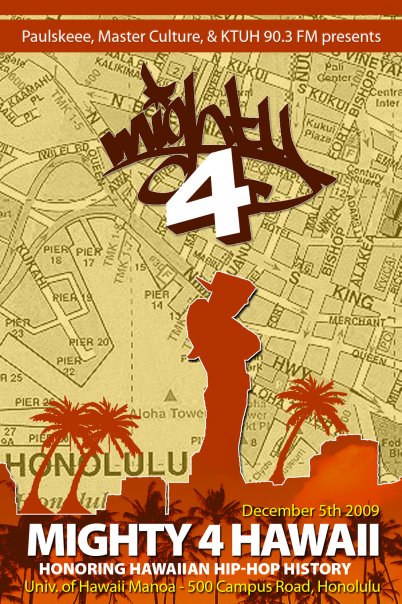
Mighty 4 Hawai’i – Hip-Hop History, BBoy Battle, Graffiti, MCs, DJs

Mighty 4 Hawai’i is a multi-dimensional celebration of Hawai’i’s hip-hop history and talent, and the social message behind the movement.

Saturday, December 5th, 1:00 pm to 9:00 pm

University of Hawai’i at Manoa, Campus Center Ballroom

DJ Jus Jones, Bionicman, Creed Chameleon, BBoy Battle, Mighty 4 appreciation awards to Syze 1, East 3, Skillroy, ABC Crew

Live Graffiti, Open Mic, Hip-Hop History Panel

$10 / Videcameras $10/ Youth 13 and under FREE.

AFSC’s CHOICES project will be attending this show to distribute counter recruitment literature.

mighty4

Might 4 B-boy Battle Hawaii 05DEC09-1

YOU DON’T END A WAR BY SENDING MORE TROOPS!

Call to Action by World Can’t Wait Hawai’i:

YOU DON’T END A WAR BY SENDING MORE TROOPS!

PROTEST/SIGNHOLDING

Wednesday, Dec. 2, 4-6 pm

Federal Bldg, Ala Moana Blvd.

Will we be complicit in expanding the war in Afghanistan?

Or will you join thousands across the U.S. who will be in the streets on Tuesday and Wednesday to say: “NOT IN OUR NAME!”

The war on Afghanistan was wrong with Bush launched it. Obama is wrong to expand it.

On Tuesday at 8pm EST Obama will announce his plans to expand the war on the people of Afghanistan.

We must respond! We know that we won’t stop the war, but we CAN and MUST send a message world-wide that there are people living in this country who refuse to be part of Obama’s murderous expansion of the war!

Spread the word everywhere! Announce the protest in your classes and at work. Bring your signs and noisemakers – and your friends and family.

TONIGHT! Henoko Environmental Activists to Speak in Honolulu

Henoko Environmentalists to Speak at KCC Tuesday, 12/1, 7pm

From: Ukwanshin Kabudan <ukwanshinkabudan@gmail.com>

Takuma Higashionna and Hideki Yoshikawa of the Okinawa Dugong Environmental Assessment Watch Group will be on Oahu this week to report on the status of their struggle to save their coast from the construction of a U.S. Marine airbase. Both men are environmentalists who have been involved with the close-to 5-year sit-in at Henoko in northeastern Okinawa, and also participated in a historic lawsuit that brought the US Department of Defense to court. On Tuesday, December 1, 2009, both men will share information about the environmental issues surrounding the Henoko struggle as well as an update on the situation there. Please attend if you can. Also, please circulate to as many people as you can. Here is the information on the event:

Date: December 1, 2009 (Tuesday)

Time: 7:00pm

Location: Kapiolani Community College, 4303 Diamond Head Road, Honolulu, HI 96813

Building: Naio (entrance will be on the side closest to Lama bldg)

Room: 203 (Computer Lab)

Some notes:

•Campus Map: http://kcc.hawaii.edu/object/naiomap.html

•Parking is free and after 4 pm, you can also park in stalls marked “staff.”

•It is okay for people to bring food and drink to the lab.

•The lab can get cold, so you may need a jacket.

Navy officer removed from command of USS Chafee

http://www.honoluluadvertiser.com/article/20091125/BREAKING01/91125046/Hawaii-based+Navy+officer+removed+from+command+of+USS+Chafee

Updated at 12:59 p.m., Wednesday, November 25, 2009

Hawaii-based Navy officer removed from command of USS Chafee

By William Cole

Advertiser Military Writer

A Hawaii-based Navy officer who was scheduled to take command of the guided missile destroyer USS Chafee last Friday was instead removed from command and has been assigned to a desk job, officials said.

Capt. Richard L. Clemmons Jr., commander of Destroyer Squadron 31, requested last Friday that the former executive officer of the Chafee, Cmdr. Larry Gonzales, be “detached for cause,” according to a Navy release sent out today.

Gonzales’ removal occurred on the same day he was supposed to take command of the Chafee, which is home ported in Pearl Harbor.

Navy Region Hawaii, the command based at Pearl Harbor, said in the release that “based on findings from a (command) investigation, the chain of command has lost confidence in Gonzales’s ability to lead and command.”

The Navy did not explain the reasons for the removal.

The incumbent commanding officer, Cmdr. Heedong Choi, will retain command of the Chafee until arrival of his relief and change of command, anticipated in early spring.

Gonzales’ relief as executive officer is already aboard the Chafee. Gonzales is being temporarily reassigned to a shore command pending further administrative actions, the Navy said.

According to the Naval Inspector General’s office, “detachment for cause” is the administrative removal of an officer from his or her current duty assignment before the planned rotation date.

The need for such an action arises “when an officer’s performance or conduct detracts from accomplishing the command mission and the officer’s continuance in the billet can only negatively impact the command,” according to the Inspector General’s office.

A detachment for cause is one of the strongest administrative measures used in the case of officers. An approved detachment is filed in the officer’s official record and has a serious effect on the officer’s future naval career, particularly with regard to promotion, duty assignment, selection for schools, and special assignment.

Reach William Cole at wcole@honoluluadvertiser.com.