Judge Orders Army to Disclose Impacts on Sacred Hawaiian Valley

http://www.ens-newswire.com/ens/nov2009/2009-11-22-091.asp

Judge Orders Army to Disclose Impacts on Sacred Hawaiian Valley

HONOLULU, Hawaii, November 22, 2009 (ENS) – A federal judge in Honolulu has ruled that the U.S. Army is obliged to give the community meaningful information on how military training at Makua Military Reservation on Oahu could damage native Hawaiian cultural sites and contaminate marine resources on which area residents rely for subsistence.

The community organization Malama Makua, represented by the public interest law firm Earthjustice, had asked the court in August to set aside the Army’s environmental impact statement for proposed military training at the military reservation 38 miles northwest of Honolulu until it completes key marine contamination studies and archaeological surveys.

“For years we’ve been insisting that the Army tell the community the truth about the threats that training at Makua poses to irreplaceable subsistence and cultural resources,” said Malama Makua president Sparky Rodrigues. “Now the court has told the Army that it can’t get away with junk science.”

Under two previous legal settlements with Malama Makua, the Army was required to conduct comprehensive studies to determine the potential for combat training activities to contaminate fish, shellfish, edible seaweed and other marine resources at Makua that Waianae Coast residents gather for subsistence purposes.

The Army was also required to prepare comprehensive subsurface archaeological surveys to identify cultural sites that could be damaged or destroyed by military training.

The Army agreed to take these actions in an October 2001 settlement of Malama Makua’s earlier lawsuit, which challenged the Army’s failure to prepare an environmental impact statement for training at the Makua Military Reservation, as well as a related settlement in January 2007.

The Army filed a motion seeking to dismiss Malama Makua’s August complaint, arguing that, regardless of the scientific adequacy of its studies, it had met all its responsibilities under the settlement agreements.

In denying the Army’s motion, U.S. District Chief Judge Susan Oki Mollway wrote, “The Army has not demonstrated that the settlement agreement provided it with the sole right to determine what was meant by [an archaeological] ‘survey.’ Taken to its logical conclusion, the Army’s argument would allow the Army to satisfy its burden by poking a stick into the ground and calling that action a ‘survey.'”

Judge Mollway also found that Malama Makua had a viable claim when it asserted that the Army had failed to meet its obligations under the settlement agreement in regard to studying the contamination of subsistence marine resources along the Waianae Coast on Oahu’s western shore.

“At the hearing on this motion, the Army argued that it was entitled to summary judgment because the settlement agreement only required it to do a study, which it did,” Judge Mollway wrote.

“The Army contended that what kind of study it did was in its sole discretion. At the hearing, the Army went so far as to argue that it could have satisfied the ‘study’ requirement by simply having a luau, serving food from the area, and seeing whether anyone got sick,” Judge Mollway wrote.

“The Army points to nothing in any agreement giving it the sole discretion to interpret what constitutes any ‘study’ required by any agreement,” Judge Mollway wrote.

The judge said she was not persuaded by the Army’s overall argument that, “as the settlement agreements required no particular methodology, any methodology sufficed.”

“To make a rational decision about whether to allow training at Makua, it’s vital that decision makers and the public have accurate information about the harm to public health and cultural sites that resuming training at Makua could cause,” said Earthjustice attorney David Henkin. “This ruling puts the Army on notice that the Court will not allow the Army to pass off woefully inadequate studies as meaningful.”

The primary use of Makua Military Reservation has been for company-level training exercises by the Army’s 25th Infantry Division, which is based at Schofield Barracks on Oahu.

During these exercises, the Army unit orchestrates the application of several military units, such as infantry, aviation, artillery, engineers, and others, to achieve a combined effect on the enemy greater than if each weapon system were used individually.

In addition, convoy live-fire exercises have been held at Makua Military Reservation, MMR.

In September 1998, the Army temporarily suspended training at MMR due to several wildfires that burned outside the south and north firebreak roads. “There are over 50 occurring or potentially occurring endangered plant and animal species in the MMR region of influence,” the Army states in its final environmental impact statement. “The proximity of these species to a fire hazard presents significant challenges.”

The Army consulted with the U.S. Fish and Wildlife Service, most recently in 2005. The Service advised that the training exercises would not likely jeopardize the continued existence of any species or adversely modify or destroy designated critical habitat.

A June 2008 amendment to the environmental impact statement identifies conservation measures to be implemented on private land but not on the MMR.

While MMR was used for limited training from 2001 to 2004, since the suspension of training there in September 1998, the 25th Infantry Division has attempted to meet its live-fire training requirements by sending its companies to other training locations.

The Army says that given the present number and types of units stationed in Hawaii requiring use of Army live-fire ranges, Hawaii needs the range capacity to support 32 company-level convoy live-fire exercises annually.

The topography of MMR, with steep valley walls enclosing the relatively flat company combined-arms assault course on three sides, and Makua’s isolation from population centers provide the necessary buffer areas that facilitate live-fire training at the reservation, the Army states.

On the other hand, Malama Makua says the valley is a sacred place to native Hawaiians, the mythic birthplace of the Hawaiian people.

Frequent brushfires that imperil the fragile native ecosystem and the potential destruction of Hawaiian artifacts in the valley are the organization’s concerns. Malama Makua also objects to military amphibious exercises conducted on the beach fronting the valley.

Over 100 Native Hawaiian cultural sites have been identified at MMR, including Hawaiian temples, altars, burials and petroglyphs, but the Army, claiming the danger of unexploded ordnance, has refused access to the community except at one cultural site.

“I’ve observed training at Makua and many times have seen mortar rounds missing their targets and landing in places we know are full of ahu [shrines], petroglyphs, imu [earthen ovens], and other cultural sites,” said Malama Makua member and cultural practitioner Leandra Wai. “If the Army doesn’t live up to its promises and do a comprehensive survey of Makua’s cultural sites, we’ll never know what we stand to lose if the Army returns to training.”

Malama Makua has criticized the State of Hawaii for leasing the lands to the military in 1964, at the rate of $1.00 for 65 years, until the year 2029.

Copyright Environment News Service (ENS) 2009. All rights reserved.
Judge sustains Makua complaint

http://www.starbulletin.com/news/20091120_Judge_sustains_Makua_complaint.html

Judge sustains Makua complaint

The ruling reveals doubt about whether Army environmental surveys were sufficient

By Gregg K. Kakesako

POSTED: 01:30 a.m. HST, Nov 20, 2009

A federal judge has sided with Hawaiian activists who want the Army to stop training in Makua Military Reservation, putting the military on notice that it will have to show that maneuvers in the Leeward valley would not contaminate ocean resources or damage cultural sites.

U.S. District Chief Judge Susan Oki Mollway’s actions keep alive a request by the organization Malama Makua to have the court set aside the Army’s environmental impact statement until it completes more marine contamination studies and archaeological surveys.

The Army completed the EIS in June, and in August filed a motion seeking to dismiss Malama Makua’s complaint.

In denying the Army’s motion Wednesday, Mollway wrote that the Army does not have the sole right to determine what qualifies as a survey.

“Taken to its logical conclusion, the Army’s argument would allow the Army to satisfy its burden by poking a stick into the ground and calling that action a ‘survey,'” the judge wrote.

Earthjustice attorney David Henkin, who has represented Malama Makua since 2000, said that he hopes that Mollway will act early next year to permanently bar further training in Makua before the Army resumes any operations using live ammunition.

The Army, which conducted both a survey of cultural sites and several scientific studies on possible water and soil contamination, has said it had met all terms of their October 2001 settlement agreement with Malama Makua.

Under the terms of the agreement, the Army was required to conduct studies to determine the potential for training activities to contaminate fish, shellfish, limu and other marine resources off Makua beach. The Army was also required to prepare subsurface archaeological surveys to identify cultural sites that could be damaged or destroyed by training.

“At the hearing on this motion, the Army argued that it was entitled to summary judgment because the settlement agreement only required it to do a study, which it did,” Mollway wrote. “The Army contended that what kind of study it did was in its sole discretion. At the hearing, the Army went so far as to argue that it could have satisfied the ‘study’ requirement by simply having a luau, serving food from the area and seeing whether anyone got sick.”

Malama Makua President Sparky Rodrigues said: “For years we’ve been insisting that the Army tell the community the truth about the threats that training at Makua poses to irreplaceable subsistence and cultural resources. Now the court has told the Army that it can’t get away with junk science.”

Said Earthjustice attorney Henkin: “To make a rational decision about whether to allow training at Makua, it’s vital that decision-makers and the public have accurate information about the harm to public health and cultural sites that resuming training at Makua could cause. This ruling puts the Army on notice that the court will not allow the Army to pass off woefully inadequate studies as meaningful.”

Dennis Drake, an Army spokesman, yesterday said it is Army policy not to comment on ongoing litigation: “We will abide with the dictates of the court.”

In August Col. Matthew Margotta, commander of U.S. Army Garrison Hawaii, said the Army hoped to resume live-fire training before the end of summer since it believed that the environmental statement completed in June fulfilled its legal obligations. However, no training with live-fire ammunition has taken place.

The Army has said that it needs to rebuild several dirt roads and firing ranges in the training area damaged by heavy rain last year. The Army stopped live-fire training in the 4,190-acre valley in 2004, pending completion of the EIS.

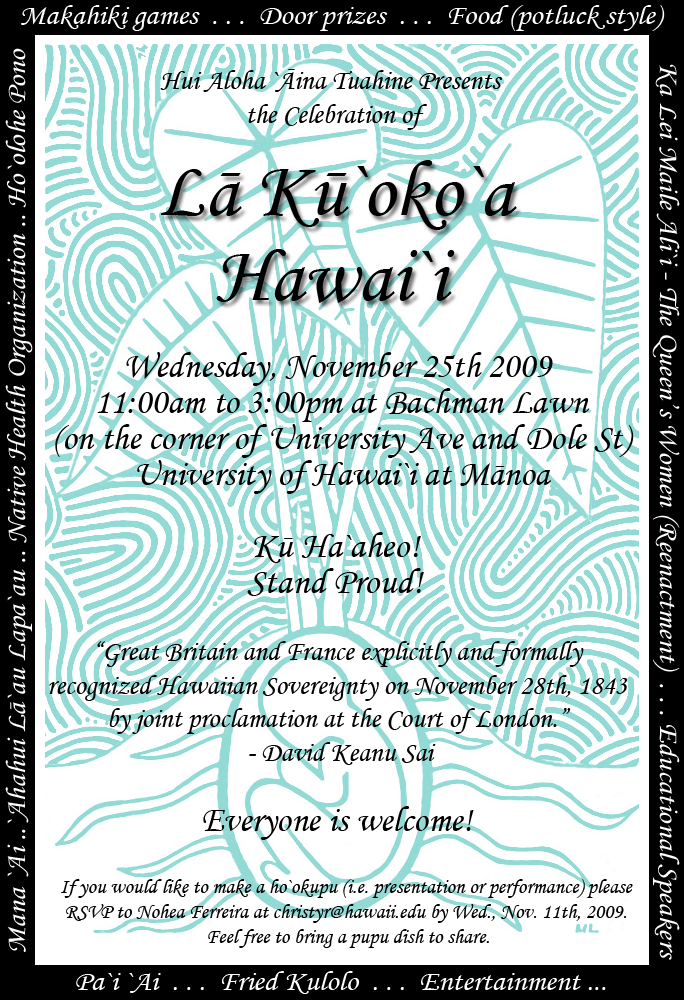
La Ku’oko’a (Hawaiian Independence Day)

La Ku’oko’a

(Hawaiian Independence Day)

November 25, 2009 from 11am to 3pm

University of Hawaiʻi at Mānoa Bachman Lawn (corner of University Ave and Dole St.), Honolulu, Hawaiʻi

Hui Aloha ʻĀina Tuahine

http://tuahine.wordpress.com/

La_Kuokoa_Hawaii_2009

Hawaiian Independence Day

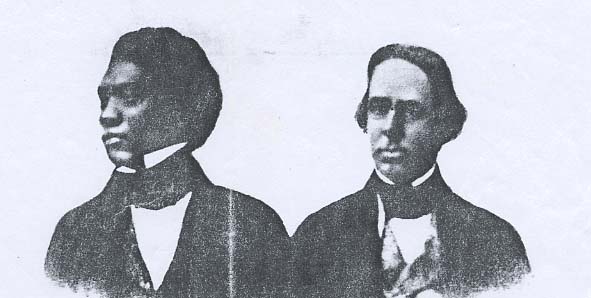
Faced with the problem of foreign encroachment of Hawaiian territory, His Hawaiian Majesty King Kamehameha III deemed it prudent and necessary to dispatch a Hawaiian delegation to the United States and then to Europe with the power to settle alleged difficulties with nations, negotiate treaties and to ultimately secure the recognition of Hawaiian Independence by the major powers of the world. In accordance with this view, Timoteo Ha’alilio, William Richards and Sir George Simpson were commissioned as joint Ministers Plenipotentiary on April 8, 1842. Sir George Simpson, shortly thereafter, left for England, via Alaska and Siberia, while Mr. Ha’alilio and Mr. Richards departed for the United States, via Mexico, on July 8, 1842.

Timoteo Ha’alilio and William Richards:

The Hawaiian delegation, while in the United States of America, secured the assurance of U.S. President Tyler on December 19, 1842 of its recognition of Hawaiian independence, and then proceeded to meet Sir George Simpson in Europe and secure formal recognition by Great Britain and France. On March 17, 1843, King Louis-Phillipe of France recognizes Hawaiian independence at the urging of King Leopold of Belgium, and on April 1, 1843, Lord Aberdeen on behalf of Her Britannic Majesty Queen Victoria, assured the Hawaiian delegation that:

“Her Majesty’s Government was willing and had determined to recognize the independence of the Sandwich Islands under their present sovereign.”

On November 28, 1843, at the Court of London, the British and French Governments entered into a formal agreement of the recognition of Hawaiian independence, with what is called the Anglo-Franco proclamation:

“Her Majesty the Queen of the United Kingdom of Great Britain and Ireland, and His Majesty the King of the French, taking into consideration the existence in the Sandwich [Hawaiian] Islands of a government capable of providing for the regularity of its relations with foreign nations, have thought it right to engage, reciprocally, to consider the Sandwich Islands as an Independent State, and never to take possession, neither directly or under the title of Protectorate, or under any other form, of any part of the territory of which they are composed.

The undersigned, Her Majesty’s Principal Secretary of State of Foreign Affairs, and the Ambassador Extraordinary of His Majesty the King of the French, at the Court of London, being furnished with the necessary powers, hereby declare, in consequence, that their said Majesties take reciprocally that engagement.
In witness whereof the undersigned have signed the present declaration, and have affixed thereto the seal of their arms.
Done in duplicate at London, the 28th day of November, in the year of our Lord, 1843.
[L.S.] Aberdeen
[L.S.] St. Aulaire”

November 28th was thereafter established as an official national holiday to celebrate the recognition of Hawai’i’s independence. As a result of this recognition, the Hawaiian Kingdom entered into treaties with the major nations of the world and had established over ninety legations and consulates in multiple seaports and cities. The Hawaiian Kingdom became the first non-European nation to be admitted into the Family of Nations, while the Ottoman Empire was the first non-Christian nation to be admitted following the Crimean War.

[Historical background provided by D. Keanu Sai. Mahalo.]

USS City of Corpus Christi attack sub to relocate to Pearl Harbor for repairs

http://www.honoluluadvertiser.com/article/20091118/BREAKING01/91118080/Submarine+to+be+relocated+to+Pearl+Harbor

Wednesday, November 18, 2009

Submarine to be relocated to Pearl Harbor

Advertiser Staff

The USS City of Corpus Christi, an attack submarine, is being relocated from Guam to Pearl Harbor for repairs, the Pacific Daily News reported.

The move was announced by Rep. Madeleine Bordallo, Guam’s delegate to Congress.

The Navy is relocating the USS Oklahoma City from Norfolk, Va., to Guam to replace the USS City of Corpus Christi.

The move is scheduled to take place in 2010.

Korea Peace Day to feature film by North Korean refugee youth

Korea Peace Day 2009

Click here to download a pdf of the Korea Peace Day 2009 poster.

For Immediate Release

Contact:

Joon Park (808) 382-5452

Soo Sun Choe soosunc@gmail.com

Korea Peace Day Event to Premiere Film by North Korean Refugee Youth

(Honolulu) A group of University of Hawaii students and faculty will be hosting a Korea Peace Day event on Tuesday, December 1, 2009 at 5:30 PM at the Center for Korean Studies located at the University of Hawaii at Manoa. This event is part of a larger movement across the U.S. to promote greater mutual understanding between the U.S. and the two Koreas.

The event will feature the U.S. premiere of the film, “The Longest Journey,” filmed and produced by North Korean refugee youth living in Seoul, South Korea. The documentary follows the North Korean born youths in revisiting their former places of refuge in China. The event will also feature a photo exhibition, “The Forgotten Faces of North Korea”, from the National Lawyers Guild’s Korea Peace Project, depicting the human side of North Korea.

Second and third generation Korean Americans, including some featured in the PBS documentary film “Homes Apart”, and writers Gary Pak and Brenda Kwon, will share family stories and poetry of how the divisions of war have impacted their families. There will also be a cultural performance by the Korean drumming ensemble Tuh Ool Lim.

Korea Peace Day was conceived by the Association of Scholars Concerned about Korea (ASCK) in 2003, in response to the high levels of tension between the U.S. and North Korea. Since then, annual educational forums have been held on campuses across the country to facilitate dialogue and awareness of the unresolved conflict on the Korean peninsula. “Without the commitment of the involved parties to a formal peace process, we recognize that the situation on the Korean peninsula remains an unstable and volatile one,” said Soo Sun Choe, one of the coordinators of the local group.

The reception and photo exhibit will open at 5:30 PM with the program and film following at 6 PM. The event is free of charge and open to the public. Sponsoring organizations include the Korea Peace Day Working Group and the American Friends Service Committee. For more information, please contact: Soo Sun Choe at soosunc@gmail.com or call Joon Park at (808) 382-5452.

###

Navy abandons repair work on coral reef damaged by the USS Port Royal

The Navy fixed its heavily damaged Aegis missile cruiser, the USS Port Royal, which ran aground near the Honolulu Airport in February but is abandoning repair work on the coral reef damaged by the grounding.

>><<

http://www.starbulletin.com/news/breaking/70222032.html

Navy suspends repair work on coral damaged by warship

By Gregg K. Kakesako

POSTED: 11:47 a.m. HST, Nov 16, 2009

The Navy has decided against additional coral stabilization and rubble removal operations at the site where the $1 billion cruiser USS Port Royal ran aground in February.

Navy and the state Department of Land and Natural Resources divers suspended operations in June because of high summer surf. Up to that point the Navy had spent $7 million reattaching nearly 5,400 coral colonies and righted eight large boulders. In addition, contractors used a barge-mounted, bucket system to remove 250 cubic yards of rubble created by the grounding.

Because of threatened legal action by the state, the Navy has never said what caused the grounding, although there were reports that the ship’s navigational equipment was broken. The state has said it still plans to file suit against the Navy early next year.

The Navy spent $40 million to repair the cruiser which was in Pearl Harbor Naval Shipyard’s dry dock 4 for seven months before returning to the fleet on Sept. 24. The Navy has not said when the cruiser and its crew of 300 sailors will be certified to return to sea duty.

Dry-dock crews from BAE Systems and the shipyard replaced the warship’s sonar dome, reinstalled rudders and completed structural repairs to the ship’s tanks, superstructure and underwater hull. The sonar dome, located under the bow, was the most heavily damaged part of the vessel. In addition, four sections of shafting were replaced, struts that support the propulsion shafts were realigned and the underwater hull was repainted blue.

The $1 billion warship ran aground Feb. 5 in 14 to 22 feet of water about a half-mile from Honolulu Airport. Nine tugboats and ships pulled the ship off the reef on the fourth attempt Feb. 9.

APEC Summit to be held in Hawai’i in 2011

The East West Center issued a press release announcing that the Asia Pacific Economic Cooperation (APEC) Summit will be held in Hawai’i in November 2011.  If past experience with the Asian Development Bank meeting in Honolulu is an indicator, we should expect that Honolulu will be intensely militarized to prevent protest and disruptions.  Earlier this year, it was reported that “secure military facilities” was a selling point for Hawai’i’s bid for the APEC meeting.

>><<

FOR IMMEDIATE RELEASE

Media Contact:

Derek Ferrar,

Media Relations Specialist

808-944-7204

ferrard@eastwestcenter.org

News flash:

Hawai‘i to Host APEC Summit in 2011

HONOLULU (Nov. 14) – President Barack Obama’s selection of Honolulu as the site for the annual APEC Leaders Meeting in November 2011 means that Hawai‘i will both open the U.S. year of hosting APEC with an agenda-setting conference, as well as close the year with the huge Ministerial and Leaders meetings.

President Obama announced Hawai‘i’s winning bid today during a speech at this year’s APEC Leaders Meeting, currently being held in Singapore. Honolulu had already been selected to host the first event, an academic and government officials’ conference and an informal senior officials meeting to be held at the East-West Center in December 2010. Several other smaller ministerial and senior official meetings will be held in other U.S. cities.

East-West Center President Charles E. Morrison, who coordinated the Hawai‘i bid for APEC 2011 and who is currently attending APEC meetings in Singapore, commented: “With at least 19 heads of state, double or triple that number of ministers and many others coming, the annual APEC gathering is one of the world’s largest intergovernmental meetings. The Leaders Meeting in 2011 will be by far the largest such gathering in Hawai‘i’s history.”

APEC, or the Asia Pacific Economic Cooperation, is the premier forum for Asia-Pacific economies to cooperate on regional trade and investment issues. Its annual Leaders and Ministerial meetings are attended by heads of state, cabinet ministers, business leaders and the heads of the World Bank and World Trade Organization, among many others. The Hawai‘i meetings, scheduled for November 12-20, 2011 at the Hawai‘i Convention Center, are expected to draw more than 10,000 people to Honolulu, a welcome boost for the state’s struggling tourism industry.

“APEC 2011 will be a big economic boost and provide huge publicity benefits for Hawai‘i,” Morrison said. “There are lots of preparations to be made over the next two years to maximize the benefits of this meeting, including its longer-term implications as a new business opportunity for Hawai‘i. The Singapore APEC meeting now going on shows that, with good planning, APEC can have many benefits without disrupting normal social and business activity.”

APEC’s annual Leader’s Meeting is hosted each year by a different member economy; 2011 is the United States’ first turn to host since the first meeting convened on Blake Island, Washington in 1993.

Morrison noted that federal officials were impressed by the ease of working with Hawai‘i. “I believe that among the many factors contributing to our selection was the close cooperation between the governor, the mayor, our congressional delegation led by Senator Inouye, and the business and tourism communities,” he said. “It is a lot simpler for federal authorities to work with a unified city/county government like Honolulu’s, which is also just a short walk from the governor’s office.”

He added: “The fact that the president is inviting his counterpart leaders to his native town is taken in many cultures as showing guests the highest respect, and Hawai‘i is the world’s most diverse Asia-Pacific community.”

###

The EAST-WEST CENTER is an education and research organization established by the U.S. Congress in 1960 to strengthen relations and understanding among the peoples and nations of Asia, the Pacific, and the United States. The Center contributes to a peaceful, prosperous and just Asia Pacific community by serving as a vigorous hub for cooperative research, education and dialogue on critical issues of common concern to the Asia Pacific region and the United States. Funding for the Center comes from the U.S. government, with additional support provided by private agencies, individuals, foundations, corporations and the governments of the region.

Schofield (#1) and Kaneohe (#10) make top ten most dangerous military towns in the country

The Daily Finance blog reports that two Hawai’i military towns rank among the ten most dangerous in the country.  Schofield Barracks came out on top with a property crime rate that is 20 times the national average.   Kaneohe Marine Corps Base ranks number ten.

>><<

http://www.dailyfinance.com/2009/11/16/most-dangerous-military-towns/

High crimes: 10 military towns are among the country’s most dangerous

Bruce Watson
Nov 16th 2009 at 6:00AMMilitary bases and the neighborhoods surrounding them often seem like the ultimate refuge of middle-American values. Run with military efficiency and discipline, the well-trimmed yards, cleanly-paved roads and orderly layouts convey an ideal image of life as it should be: safe, peaceful and friendly.

Topping the list of America’s ten worst military neighborhoods is Hawaii’s Schofield Barracks. The area has an estimated 759 property crimes per 1,000 people — more than 20 times the national average of 34 per 1,000 residents and fifteen times Hawaii’s average. As a result, NeighborhoodScout ranks it as one of the worst neighborhoods in the country. Yet, Schofield Barracks’s crime wave is largely comprised of property crimes, not violent crimes. While its property crime rate is more than twenty times the national average, its violent crime rate is (a comparatively minor) 49% higher than the median. This suggests that the large crime jumps in the area are more likely to involve robbery, theft, and motor vehicle theft.

Similarly, the second-ranked neighborhood, the Patton Road area near Alabama’s Redstone Arsenal, has an estimated property crime rate of 691 per 1,000 residents. The remaining eight military neighborhoods — Indiana’s Grissom AFB, an area near Texas’ Lackland AFB, Mississippi’s Meridian Naval Air Station, a predominantly-military neighborhood located near South Carolina’s defunct Myrtle Beach AFB, California’s Presidio of Monterey, Louisiana’s England AFB, Washington’s Ault Field, and Hawaii’s Kaneohe Station — range between 410 and 155 property crimes per 1,000 residents.

However, as the horrific shootings in Fort Hood demonstrate, this perception of structure and normalcy may be deceptive. According to a study by NeighborhoodScout, which offers neighborhood-by-neighborhood crime analyses, some of America’s military towns have crime levels that place them among the country’s most dangerous neighborhoods. While the danger in these areas is much more heavily skewed toward property crimes like vandalism and theft than violent crimes like murder or rape, the statistics are startling.

So why do these ten neighborhoods have such high crime rates? According to Andrew Schiller, founder and president of NeighborhoodScout, the answer may lie in the demographics of the American military. Military bases tend to have high concentrations of young, single men living together in very close quarters. Schiller has also found similar property crime spikes in other areas — like college student neighborhoods — that have large concentrations of single males living together. One possible explanation for these surges in crime rates could be that young men, separated from their parents, wives, families and communities, may feel more temptation to commit certain types of crimes.

Ironically, NeighborhoodScout reports that military neighborhoods as a whole tend to be considerably safer than most of the country. America has 300 neighborhoods in which at least 20% of the population is in the military. In these areas, the median property crime rate is 32 per 1,000 residents, which is 7% below the national average. The violent crime rate is even more striking: at 1.55 crimes per 1,000 residents, it is an impressive 67% lower than the average.

To find out how NeighborhoodScout came up with these numbers, read its methodology. Also, to see its disclaimer, click here.

Note to our readers: An earlier version of this story suggested that the military neighborhood in the Kings Highway/Howard Parkway area of Myrtle Beach was related to the Myrtle Beach AFB. However, as some commenters pointed out, this base has been closed since 1993. We have clarified in the story that NeighborhoodScout included the Kings Highway/Howard Parkway neighborhood because it is a predominantly-military area, with a population that is more than 20% military. As such, we have chosen to include it in our list of America’s most dangerous military neighborhoods.

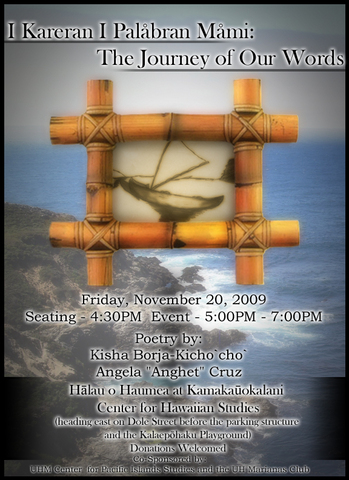
I Karera I Palabran Mami (The Journey of Our Words): Chamoru poetry reading in Honolulu

Poetry+Reading+Flier

I Karera I Palabran Mami (The Journey of Our Words)

POETS:

Angela T. Hoppe-Cruz (MSW/MA Pacific Isl. Studies Candidate)

Kisha Borja-Ki`cho`cho (MA Pacific Island Studies Candidate).

Both women are Chamoru and were born and raised on the island of Guam.

WHERE: Halau o Haumea, Kamakakuokalani Center for Hawaiian Studies, University of Hawaii at Manoa, 2645 Dole Street

WHEN: Friday, November 20, 2009

TIME: 5:00-7:00 p.m.

Angela Cruz is a Chamoru activist and poet in Hawai’i.  She is a practicum student with the American Friends Service Committee working on Micronesian health and justice issues.  She is also involved in the Third Path Women’s movement for reproductive justice.  She writes:

My dear friend Kisha and I will be reading pieces we have collaborated on as well as our individual poetry. Much of our work centers on the impact militarization has had on our home island community -Guam and the Micronesian islands, much of which is manifest in social, economic and environmental injustice. We will be serving up, Chamoru fiesta plates (prepared by the UHM Marianas Club), laughter and great conversation.

Youth Speaks Hawai`i Fall 2009 Interscholastic Poetry Slam

INTERfall09FLIER

Upcoming Poetry Slam: Support Youth Voices!

Youth Speaks Hawai`i Fall 2009 Interscholastic Poetry Slam

Farrington High Community Auditorium; 1564 North King Street • Honolulu, HI 96817

Friday, November 20, 2009

7 – 10pm, doors open at 6pm

For ticket information, please call 753-4661 or Travis@YouthSpeaksHawaii.org (Get max. discount! $3; otherwise, $5 w/ ANY school i.d., $10 w/o reservation or school i.d.)

@@@

Youth Speaks Spring 2009 DVD will be on sale at Farrington High on November 20th.

$7 ($5 each if you buy more than one)

Includes all poets, 4 rounds.

Produced by the Farrington Kalihi Media Club

Online orders can be made via email at kalihimedia@gmail.com