USS Port Royal grounding details emerge

Posted on: Sunday, July 12, 2009

Navy ship grounding detailed

By William Cole
Advertiser Columnist

Here are a few more details of the Feb. 5 grounding of the guided missile cruiser Port Royal in 14 to 22 feet of water off Honolulu International Airport’s reef runway.

The Advertiser ran a story Tuesday about the grounding circumstances based on the Navy’s Safety Investigation Board findings on the accident.

The 567-foot ship was under way at 8:45 a.m. on its first day of sea trials after $18 million in repairs in the shipyard. The fathometer, for determining water depth, was broken, according to the safety board.

At 12:01 p.m., the Voyage Management System’s primary input at the chart table was shifted from a forward Global Positioning System to forward Ring Laser Gyro Navigation.

The Voyage Management System, a digital navigation system that does away with paper charts, dead-reckoned the ship three times and replotted the Port Royal 1.5 miles from its previous position. Ring Laser Gyro is an inertial navigator.

Ship logs indicate a position error between GPS and the Ring Laser Gyro for the duration of the ship’s time at sea. The Voyage Management System plotting was based on the inertial navigation and not the required GPS, and the error was not noted by any watchstanders, the report states.

“The quartermaster of the watch continued to plot fixes as satellite fixes when (Voyage Management System) was aligned to receive (Ring Laser Gyro) input,” the safety board said. “The bridge team did not recognize the input difference on the (Voyage Management System) display, and relied on VMS without question.”

The report said that when the input was switched, the Voyage Management System “indicated numerous positional difference alarms that were not addressed.”

Why or how the navigation system was changed is not addressed in the report, which notes a 3,600- to 3,700-yard ship position shift to the east.

That evening, small boats were operated to return aviation assessors to shore.

At about 8:03 p.m., the Port Royal was soft aground, with its bow’s underwater sonar dome on the reef, the report said.

The safety board report said there were several factors that led to a Ring Laser Gyro position error, including no evidence of a 72-hour calibration, and the fact that the last reset was four days earlier, meaning the system was not getting new GPS data. There was a “large position error” with the GPS interface not enabled, the report said.

The board, however, rejected navigation equipment error as the cause of the mishap.

“Other means were available to assess the ship’s position,” the report said. Those included “distinct visual aids” such as the airport control tower. Or, as one commentator on the earlier Advertiser story put it: “There is no substitute for the Mark One Eyeball.”

Reach William Cole at wcole@honoluluadvertiser.com.

Source: http://www.honoluluadvertiser.com/article/20090712/COLUMNISTS32/907120367/Navy+ship+grounding+detailed

Waimanalo wants Air Force to return Bellows land

Board asked to seek Bellows land

A proposed resolution claims the Air Force no longer needs 400 acres and should give it up

By Kaylee Noborikawa

POSTED: 01:30 a.m. HST, Jul 12, 2009

20090712_nws_bellows1

Some Waimanalo residents are calling for the U.S. Air Force to return about 400 acres from Bellows Air Force Station because the land is being used for recreation rather than critical military purposes.

“I’m asking the neighborhood board to adopt a resolution which asks for the return (of the land), and I expect the neighborhood board to transfer that resolution to Congress, our senators, and President Obama,” said Joseph Ryan, a former member of the Waimanalo Neighborhood Board and a Waimanalo resident since the 1960s.

Ryan drafted the resolution after receiving an environmental assessment in March by the U.S. Air Force which wants to construct at Bellows 48 vacation rentals, a nine-hole disc golf course, a community activity center, a car wash, a water park, a resort pool, and a nine-hole par-3 golf course.

Ryan said his action is not related to the military’s closing of Bellows to the public for a month recently. The popular beach and camping area was closed because of misuse and vandalism, military officials had said. It was reopened over the July 4th weekend.

According to Ryan, the state should get the land, which was appropriated by President Woodrow Wilson in 1917, since the military is no longer using it for its original military purpose.

A total of 1,510 acres of ceded land was appropriated in the presidential executive order, but in 1999, about 1,100 acres were transferred to the U.S. Marine Corps, according to the Corps.

“When the Air Force decided by its EA to use the base for recreational services, they made the decision that this is no longer critical defense purposes. Recreation is a collateral purpose. It doesn’t support the primary mission,” said Ryan.

The military responded by saying that although the primary mission is recreation, the Armed Forces continue to train on the land. Hickam’s 15th Security Forces Squadron, U.S. Marine Corps security forces, and the Honolulu Police Department use Bellows for training, including building clearing, hostage negotiation training, and robbery response.

“Bellows continues to fill key roles in troop recreation and training,” said Capt. Christy Stravolo of the Pacific Air Forces Public Affairs. “One of the key priorities of the Air Force Chief of Staff is airman morale and readiness. Bellows contributes to this priority every day.”

The Bellows Air Force Station offers cabins, camping sites, and other recreational activities for military retirees, soldiers in the reserve/guard, active military members, and U.S. Department of Defense civilians. According to Stravolo, 500,000 visitors use Bellows’ facilities every year.

“Troops can’t afford the expensive commercial establishments, so here’s a chance they have to relax with their families at a very reasonable price. The fees they charge are quite a bit less than Waikiki,” said Gen. Robert Lee.

Lee is in charge of the Army National Guard at Bellows and trains newly promoted sergeants on unit tactics.

“I think we can work it out with the community. We allow the Waimanalo Neighborhood Board to use our facility for their meetings; I believe we can work out a good solution,” Lee said.

MEETING

The Waimanalo Neighborhood Board will meet at 7:30 p.m. tomorrow at Waimanalo Public Library to discuss the recreational use of land at Bellows Air Force Station. Public testimony is welcome.

Source: http://www.starbulletin.com/news/20090712_Board_asked_to_seek_Bellows_land.html

Wai’anae Aunties Expose Illegal Dump site

The Concerned Elders of Wai’anae, one of the core groups of the Wai’anae Environmental Justice Working Group, discovered and reported an illegal dump site in Wai’anae.  It appears that construction and demolition debris has been dumped in a remote corner of land near the Lualualei Naval Magazine on Department of Hawaiian Home Lands land.  Ka Makani Kaiaulu o Wai’anae, the summer youth environmental justice project of the American Friends Service Committee was there to support the Elders.

Here’s the story on KITV news from June 10, 2009:  http://www.kitv.com/video/20022567/

And the first story on KITV from June 9, 2009: http://www.kitv.com/video/20011403/index.html

Waimanalo Wants Bellows Back

I liked this post by Kehau Watson on the community struggle to reclaim Waimanalo from military control and abuse.

Waimanalo Wants Bellows Back

July 9th, 2009 by Trisha Kehaulani Watson

I’ve never written about the same topic twice, until now.

My first blog on Bellows last week provoked a number of colorful responses on the blog site, but the most interesting response I received via email, from a member of the Waimanalo Neighborhood Board.

Seems members of the Waimanalo Neighborhood Board also have questions about the military’s continued presence at Bellows. As such, they are proposing a resolution requesting the return of the lands to the State. It reads in part:

AWARE the Waimanalo Military Reservation was renamed Bellows Field in 1933 and redesignated as Bellows AFB in 1948 and ten years later re-designated as Bellows AFS and the land was used for military purposes until March 2009, and the United States Air Force continues to hold 400 acres, more or less, of the original land appropriated under the 1917 Executive Order and has publicly declared the purpose and “mission” at Bellows AFS, effective March 2009, is “enhancing combat effectiveness by delivering secure, affordable, and customer-focused recreational services” and has published its intention and proposal to construct a water park, swimming and “resort” pools, golf courses, and recreational lodgings on the 400 acres which are Category C–Revenue Generating Programs which “provide recreational activities that benefit military morale [,] foster community spirit and provide alternatives to less wholesome off-duty pursuits , [and] have the greatest capability of generating nonappropriated fund revenues and fund most of their expenses.” (Air Force Instruction (AFI) 32-1022, § 3.2.3, June 29, 1994) and are not “programs required to support the basic military mission”, and

EMPHASIZING the lands held by the United States Air Force at Waimanalo, upon which a “resort” for recreational purposes is proposed, is a “Category C” use of land, approved by the Secretary of the Air Force under the authority of the Secretary of Defense, which cannot reasonably be construed as a “critical area” for defense or military purposes under the Admissions Act, and

IT IS DECLARED BY THE WAIMANALO NEIGHBORHOOD BOARD that since the United States Air Force, on the remaining Crown Land under its control at Waimanalo, no longer uses or intends to use the land for the specific military purposes for which it was appropriated and because the Congress of the United States has properly exercised its Constitutional authority and enacted laws which devolved the Waimanalo Crown Land to the State of Hawaii to be used “solely for the benefit of the inhabitants of the Hawaiian Islands for educational and other purposes” pursuant to the Joint Resolution of Annexation of July 7, 1898, the President and Chief Executive or his designate must return the Waimanalo Crown Land to the State of Hawaii and the Governor and Legislature of the State of Hawaii must revoke the conditional permission allowing for occupation of the Waimanalo Crown Lands as the current use and occupation exceeds the permission given to the United States, and

THEREFORE BE IT URGENTLY, STRONGLY, AND FINALLY RESOLVED THAT THE WAIMANALO NEIGHBORHOOD BOARD having given consideration to all the relevant issues, and provided opportunity for testimony by the public and United States Military Representatives, that the approximately 400 acres, more or less, of remaining land under the control of the United States Air Force must be returned to the State of Hawaii in furtherance of the legislative purposes declared by Congress in § 1, 30 Stat. 750.

You can read their entire proposal and press release below.

Bellows Presentation and Proposed Resolution

Press Release

The Waimanalo Neighborhood Board will be meeting to discuss this issue at its regularly scheduled meeting, Monday, July 13, 2009, at 7:30 at the Waimanalo Public Library.

If you do not know where the library is, I have included a map.

I hope those who commented on my last blog on this topic will make the time to go and share their comments with the neighborhood board in person.

Waimanalo has a beautiful and majestic history. It is best captured in the mele “Waimânalo `Âina Kaulana”:

Uluwehi Waimânalo `âina ho`opulapula
Ipu ia like ala ona pua like `ole

Ho`okahi pu`uwai ho`okahi mana`o
`Aina aloha o ka lehulehu

Hanohano no `oe e Kalanianaole
Ho`oko kauoha `oe na ka hana pololei

Ha`awi ka mae ma`i e ia Waimânalo
Kokua like mai na mana Kahikolu

Kû kilakila na home u`i
Me ka kokua a na mana lani

Ha`ina kêia mele no Waimânalo
`Âina ho`opulapula no Kalaniana`ole

Lush, Waimânalo, homestead land
Its fragrant flowers, incomparable

One heart, one thought
Land of love for the population

You are the glory of (Prince Jonah) Kalaniana`ole
You fulfilled the trust with righteous deeds

Waimanalo gives health
Help and power comes from Trinity

Standing strong, the stalwart homes
With help from the heavenly powers

Tell this song of Waimânalo
Homestead land of Prince Kalaniana`ole

(Traditional, from the G. Cooke Collection, translated by Kanani Mana.)

I have no doubt that if allowed to resume control of their land and space, the Waimanalo community is very capable of making the land now controlled by the military `aina aloha once again.

Source: http://hehawaiiau.honadvblogs.com/2009/07/09/waimanalo-wants-bellows-back/

Rally for Kahana Residents

Terri Keko’olani sent out this call for support on behalf of Kahana residents:

Aloha kakou…

Got a call from Lena, Kahana Valley leader of residents seeking permanent long term leases. She said residents are organizing a

DEMONSTRATION at the state CAPITOL on JULY 8, WEDNESDAY 11am

to oppose Govenor Lingle’s move to veto bill HB 1552.

HB 1552:

  • authorizes DLNR to issue long-term residential leases to Kahana residents
  • establish planning councils to develop a park Master Plan
  • establish a 2-year moritorium on evictions of Kahana valley residents

This is a call for people to once again stand in support of Kahana valley residents who have been fighting to stay on their aina and in their homes.

TELL LINGLE NOT TO VETO THE BILL

SUPPORT LONG TERM LEASES / MASTER PLAN / 2 YR MORITORIUM ON EVICTIONS

City official says Mailiili Stream “was not used as a dump site”

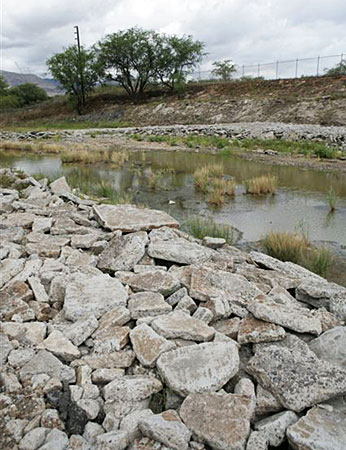
A City official said that the illegal dumping of concrete debris in Mailiili Stream was to create a “temporary path”.  But they dumped this material over the course of two years!  Take a look at this photo below.  How temporary does it look to you?  The City did not obtain the required permit to dump the material. And now that the material is in the stream, a habitat for the endangered Ae’o (Hawaiian Stilt), the City cannot remove the material without the proper permits.

20090616_nws_dumping

Photo by Carroll Cox, EnviroWatch

>><<

City official denies dump allegations

By B.J. Reyes

POSTED: 01:30 a.m. HST, Jul 03, 2009

A city administrator says crews were not using Mailiili Stream as a dump site for concrete, as alleged in a complaint being investigated by city, state and federal agencies.

Jeoffrey Cudiamat, director of facilities maintenance, told a City Council committee that the concrete was being used to “create a temporary path to provide maintenance to remove debris.

“It was not used as a dump site,” he added.

Cudiamat was called before the Council’s Public Safety and Services Committee yesterday but said he could not elaborate on exactly what was done and why because of the pending investigations into the activities at the stream.

Members asked Cudiamat to follow up with the committee to help provide a timetable on when the investigations might be completed.

“We don’t want to interfere with any of the investigations,” said Committee Chairman Donovan Dela Cruz, “but we want to make sure that the Council knows when these investigations are going to be completed so that we can follow up with the administration.

“There’s obviously community concern.”

The Army Corps of Engineers, state Department of Health and other agencies are investigating alleged illegal dumping of concrete at Mailiili Stream, frequented by endangered Hawaiian stilts.

Concrete rubble from sidewalk repairs reportedly was placed in the stream area to restore an access road along the bank that was used to cut brush. The Health Department says no permit was issued for the dumping.

The watchdog group EnviroWatch Inc. first reported the activity in the stream to the city.

Some work already has been done to clear the stream, but city officials say additional permits might be required to finish the removal.

Source: http://www.starbulletin.com/news/20090703_City_official_denies_dump_allegations.html

City Dumps Debris in Wai’anae Stream

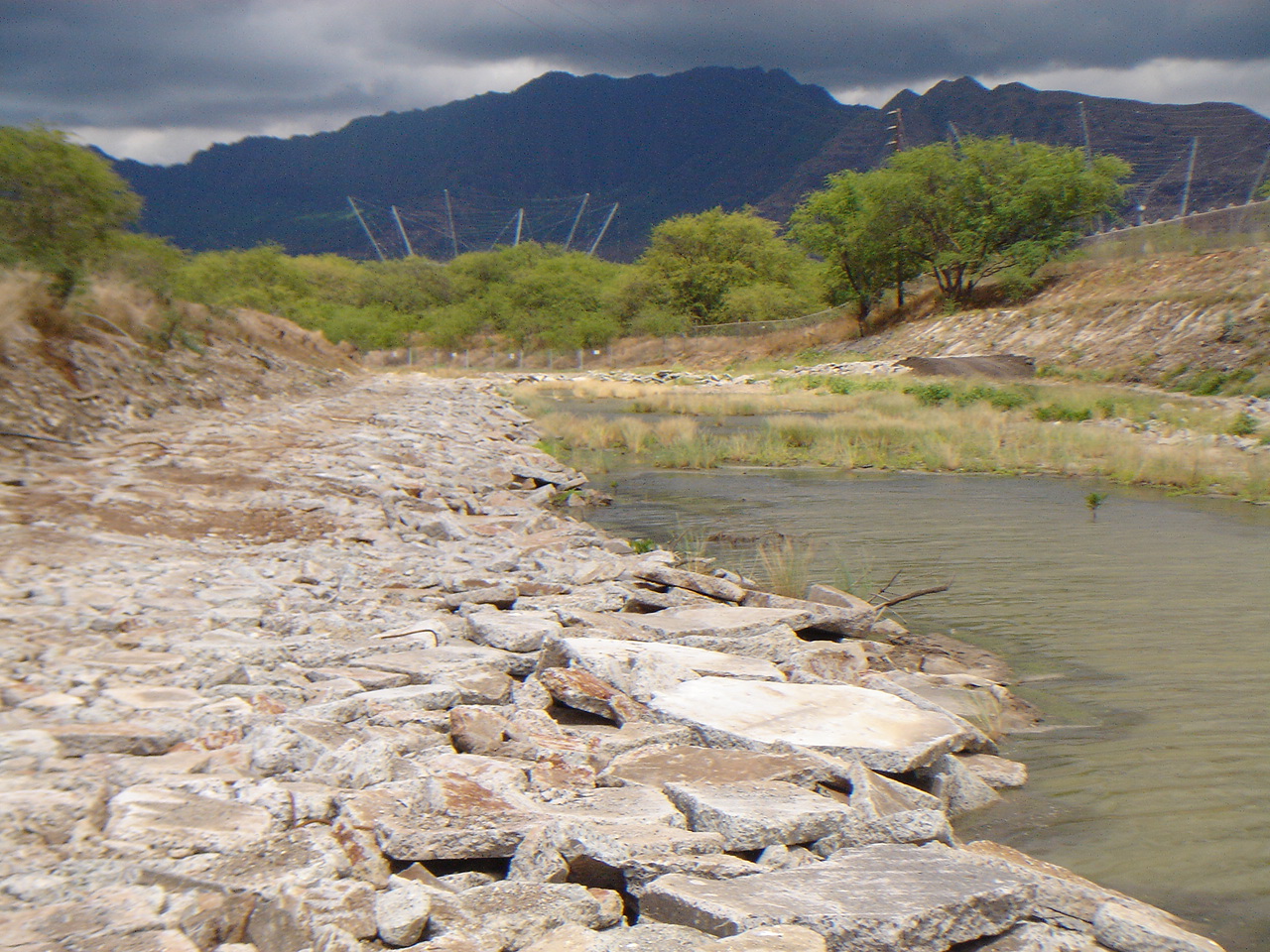
Carroll Cox of EnviroWatch reported the City and County of Honolulu’s illegal dumping of concrete debris in Mailiili Stream in Wai’anae. On June 30, 2009, Cox spoke to students from the summer environmental justice institute Ka Makani Kai’aulu o Wai’anae and gave a tour of environmental justice impacts he has documented in the Wai’anae area.   One site the group visited was the Mailiili Stream dump site.

mailiili-stream

maililiili-rubble

Mailiili Stream dump site.  (Photos: Kyle Kajihiro)

You can see from the above photograph that concrete slabs and other debris were compacted along the shoreline and have filled much of the stream bed.   This stream flows through the 9000 acre Lualualei Naval Magazine and Radio Tower Facility, but most of the stream is dry.  The Navy tapped one of the water sources at the base of the mountain.  In this photo, there is a fence that cuts through the stream in the distance where the Navy occupied land begins, and antenna in the background.

_hawaiian-stilt

Source:  http://resources.edb.gov.hk/biology/english/images/bird/_hawaiian%20stilt.jpg

During the visit, several Ae’o (Endangered Hawaiian Stilt) were seen, obviously distressed.  The birds nest in the shallow water where the dumping occurred.  Below is an article from the Honolulu Star Bulletin about the illegal dumping by the City.

>><<

City’s alleged dumping in stream investigated

By Gary T. Kubota

POSTED: 01:30 a.m. HST, Jun 16, 2009

A number of government agencies are investigating the alleged illegal dumping of concrete by the city in a stream frequented by endangered Hawaiian stilts on the Waianae Coast.

State Health Department spokeswoman Janice Okubo said the dumping of construction materials requires a permit and there are no permits on record for the work in her department.

“We haven’t issued any permits for that dumping,” she said yesterday.

The alleged dumping occurred in Maili at the Mailiili Stream, about two miles mauka of Farrington Highway.

City spokesman Bill Brennan said the city is also looking into the incident.

Brennan said his understanding is that concrete rubble from sidewalk repairs was placed in the stream area to restore an access road along the bank that was used to cut brush.

He said the city employees were unaware that a permit might have been needed for the work.

Brennan said heavy equipment removed material from the area Saturday and put it in a landfill.

“Apparently the area had not been maintained for some time and neighboring properties had used the city flood-control area and access roads along the top of the flood-control bank as storage and for their personal use and to let their horses run free,” Brennan said.

He said the city removed only the sidewalk material not in the stream.

He said the city might need a permit to remove the sidewalk material in the stream.

Other agencies investigating the dumping include the state Department of Land and Natural Resources and the Army Corps of Engineers.

Corps spokesman Dino Buchanan said his agency is investigating whether there was a violation and what, if any, fines might be levied.

The investigations were prompted by requests last week from the group EnviroWatch Inc.

EnviroWatch founder Carroll Cox said he received a complaint from city workers who told him that the dumping had been occurring on weekends for the past two years.

Cox said at least one high-ranking official in the city Department of Facility Maintenance was aware of the dumping and had told him some 100 truckloads had been dumped in the area.

“You can’t mistakenly dump something for two years,” Cox said.

Cox said he’s familiar with the area and knows of about 20 endangered Hawaiian stilts that built their nests in the wetlands area of the stream.

He said the concrete has narrowed the area of nesting and allowed predators such as mongoose and feral cats to have an easier time crossing wetland areas to get to the endangered birds.

Cox said although the city has accepted responsibility, he’s worried that city workers will try to clean the area without proper supervision.

He said the city needs to consult with a number of agencies and seek the proper permits for removal.

Cox said he was upset that the city was the violator and he felt officials needed to be held accountable.

“What kind of example are they setting for other people?” he asked.

Source: http://www.starbulletin.com/news/20090616_Citys_alleged_dumping_in_stream_investigated.html

Wai’anae youth promote Environmental Justice

On June 22, the AFSC launched a new project to train youth from the Wai’anae community in environmental justice organizing skills. The project is called Ka Makani Kai’aulu o Wai’anae.

Ten Wai’anae youth will be enrolled in four weeks of intensive training, political education, field investigations and community organizing to address the environmental injustice issues in their community.

For more information see the Ka Makani Kai’aulu o Wai’anae project page.

Construction halted to protect Hawaiian temple

…And back to a local fight where a developer apparently began clearing an area without proper permits damaging Hawea heiau, one of the few remaining Hawaiian temple sites in East Honolulu.  It appears that the community won a small reprieve with the City stopping construction.  But the more troubling question is “Where was the State Historic Preservation Division, whose job it is to protect these precious cultural resources?”

In a number of recent cases (Naue, Whole Foods, Walmart) SHPD failed miserably to protect sacred places and burials, and through the outcome of its actions in effect, colluded with developers.  In fact, the head of SHPD, Nancy McMahon seems to have a conflict of interest as a former mercenary archeologist for developers. In the Naue case on Kaua’i, where wealthy California developer Joseph Brescia has begun construction of a luxury home atop a Kanaka Maoli cemetery, McMahon’s decisions and interpretations of the law have allowed the developer to commit desecration of dozens of graves and may set bad precedent for future burial cases.

The logic of empire requires the elimination of natives through violent genocide or cultural erasure.

>>><<<

Protection urged for heiau

By Kaylee Noborikawa

POSTED: 01:30 a.m. HST, Jun 20, 2009

The city halted construction at a heiau in Hawaii Kai on June 12, after receiving complaints from residents.

Ann Marie Kirk and Chris Cramer of Livable Hawaii Kai Hui, an organization dedicated to preserving the district, discovered the heiau’s desecration on June 9.

According to Kirk, the lower platform of Hawea heiau was covered with debris and the stone platform was damaged by a bulldozer. There were petroglyphs on large boulders which could not be found and the buffer to the wetland, which houses the endangered alae ula, or Hawaiian moorhen, was also bulldozed over.

“I just feel a deep sense of sadness, but also a belief that Hawea will be saved because it’s our responsibility to our kupuna to make sure that they don’t get erased from the land,” said Kirk.

Hawea heiau is one of the only remnants of a system of more than 15 heiaus that surrounded Maunalua Bay and is still used by native Hawaiians for religious ceremonies, said Cramer, the East Honolulu historian.

“I fear a large circle of upright stones leading from the wetland to the well may be destroyed next, as they are inches from what has been cleared already,” said Cramer.

The heiau is located on the mauka side of the Oahu Club on Hawaii Kai Drive and sits on property owned by the nonprofit Hawaii Intergenerational Community Development. As of 2007, 21st Century Homes, HICD’s for-profit company, planned to build a $200 million luxury condominium, but construction has been delayed several times after meetings with community members about the heiau and getting approval for a height variance.

The Historic Preservation Division is assessing whether the developer followed the draft of a preservation plan for the area.

Several calls to the developer were not returned, but according to the Department of Planning and Permitting, the company did not have a permit for the construction site.

According to the state Historic Preservation Department, the archaeologist could not find Hawea heiau during an inspection last year and the archaeologist may not have agreed that the area was classified as a heiau.

“We know there’s supposed to be a heiau in the vicinity and there have been several efforts to find the precise location of that heiau but when our archaeologist went out on the site, they didn’t find it,” said Pua Aiu, the division administrator. “I’m shocked that she said that,” said Kirk, responding to Aiu’s comments. “It has been recorded in previous archaeological studies and even visited by three archaeologists and a cultural expert from the division who called Hawea a significant site. They really don’t know what they’re doing,” said Kirk, who noted that only a tiny portion of the heiau was covered under the current plan.

“People throughout Oahu and the other islands are extremely upset at what happened. We’re looking at a structure that’s 800 years old,” said Kirk. “It’s a deep lack of respect for Hawaiian culture, but we’re not going to let it continue; it’s going to stop.”

Livable Hawaii Kai Hui members have e-mailed the city, state departments, the Office of Hawaiian Affairs, and several politicians to stop the construction.

“What we’re doing now is mobilizing people to stop what’s going on at Hawea and to make sure that the preservation of Hawea is looked at by cultural experts and archaeologists to make sure that what’s left will be preserved and what’s destroyed will be rebuilt,” said Kirk. “Hawea can still be saved.”

The city halted construction at a heiau in Hawaii Kai on June 12, after receiving complaints from residents.

Ann Marie Kirk and Chris Cramer of Livable Hawaii Kai Hui, an organization dedicated to preserving the district, discovered the heiau’s desecration on June 9.

According to Kirk, the lower platform of Hawea heiau was covered with debris and the stone platform was damaged by a bulldozer. There were petroglyphs on large boulders which could not be found and the buffer to the wetland, which houses the endangered alae ula, or Hawaiian moorhen, was also bulldozed over.

“I just feel a deep sense of sadness, but also a belief that Hawea will be saved because it’s our responsibility to our kupuna to make sure that they don’t get erased from the land,” said Kirk.

Hawea heiau is one of the only remnants of a system of more than 15 heiaus that surrounded Maunalua Bay and is still used by native Hawaiians for religious ceremonies, said Cramer, the East Honolulu historian.

“I fear a large circle of upright stones leading from the wetland to the well may be destroyed next, as they are inches from what has been cleared already,” said Cramer.

The heiau is located on the mauka side of the Oahu Club on Hawaii Kai Drive and sits on property owned by the nonprofit Hawaii Intergenerational Community Development. As of 2007, 21st Century Homes, HICD’s for-profit company, planned to build a $200 million luxury condominium, but construction has been delayed several times after meetings with community members about the heiau and getting approval for a height variance.

The Historic Preservation Division is assessing whether the developer followed the draft of a preservation plan for the area.

Several calls to the developer were not returned, but according to the Department of Planning and Permitting, the company did not have a permit for the construction site.

According to the state Historic Preservation Department, the archaeologist could not find Hawea heiau during an inspection last year and the archaeologist may not have agreed that the area was classified as a heiau.

“We know there’s supposed to be a heiau in the vicinity and there have been several efforts to find the precise location of that heiau but when our archaeologist went out on the site, they didn’t find it,” said Pua Aiu, the division administrator. “I’m shocked that she said that,” said Kirk, responding to Aiu’s comments. “It has been recorded in previous archaeological studies and even visited by three archaeologists and a cultural expert from the division who called Hawea a significant site. They really don’t know what they’re doing,” said Kirk, who noted that only a tiny portion of the heiau was covered under the current plan.

“People throughout Oahu and the other islands are extremely upset at what happened. We’re looking at a structure that’s 800 years old,” said Kirk. “It’s a deep lack of respect for Hawaiian culture, but we’re not going to let it continue; it’s going to stop.”

Livable Hawaii Kai Hui members have e-mailed the city, state departments, the Office of Hawaiian Affairs, and several politicians to stop the construction.

“What we’re doing now is mobilizing people to stop what’s going on at Hawea and to make sure that the preservation of Hawea is looked at by cultural experts and archaeologists to make sure that what’s left will be preserved and what’s destroyed will be rebuilt,” said Kirk. “Hawea can still be saved.”

Source: http://www.starbulletin.com/news/hawaiinews/20090620_protection_urged_for_heiau.html