Army seeks comment on Makua cultural site preservation list

Updated at 12:56 p.m., Tuesday, April 28, 2009

Army seeks comment on Makua cultural site preservation list

Advertiser Staff

The Army today announced the release of its recommended high priority cultural site list for unexploded ordnance clearance at Makua Military Reservation.

The list was drafted in response to public comments received during a 30-day period from Feb. 26 through March 28, which included a community meeting March 9.

A second public meeting to take additional comments will be announced later.

Copies of the list are available at the Hawaii State Library, 478 South King Street, Honolulu; Waianae Public Library, 85-625 Farrington Highway, Waianae; and the Kapolei Public Library, 1020 Manawai Street, Kapolei.

The site list can also be accessed online for reading or download at:

www.garrison.hawaii.army.mil/sitelistmmr/

Issuance of this list starts a 30-day comment period in which the public is invited to provide written responses.

Public comments may be submitted on or before May 28, 2009, by e-mail to peter.yuh@us.army.mil, and by fax to (808) 656-1039.

The public may also submit comments via mail to: U.S. Army Garrison-Hawaii, Directorate of Public Works Environmental Division, Attn: Cultural Site List Comments, 947 Wright Avenue, Wheeler Army Airfield, Schofield Barracks, HI 96857-5013

For further information, please contact the Environmental Division, at 656-6821.

Source: http://www.honoluluadvertiser.com/article/20090428/BREAKING01/90428085

Repairs to reef damaged by Navy ship proceed

Posted on: Tuesday, April 28, 2009

Repairs to Hawaii reef damaged by Navy ship enter new phase

Divers will collect coral displaced by grounded Navy ship
By Curtis Lum
Advertiser Staff Writer

Divers today are expected to begin collecting coral colonies that survived the Feb. 5 grounding of the USS Port Royal and temporarily store them in a safe area until they can be returned to the damaged reef.

Up to 10 civilian divers have been contracted by the Navy to collect and relocate the coral displaced by the grounding off the Honolulu International Airport’s Reef Runway. The Port Royal ran aground Feb. 5 and was freed four days later, but not before the 9,600-ton guided missile cruiser caused “substantial” damage to the reef, according to the state Department of Land and Natural Resources.

State officials told the Navy that they intend to file a full claim against the Navy to cover the cost of mitigating further damage to the reef, the value of the coral reef substrate damaged, attempts to free the Port Royal, and other damage to the reef ecosystem. The state and Navy have since developed a four-phase, multimillion-dollar plan to restore the coral reef.

The first two phases have been completed. The first phase involved Navy divers who did emergency work to reattach dozens of coral colonies and move large rocks to deeper water to prevent them from causing more harm.

Phase II began in early March and involved a contractor, hired by the Navy, to survey and assess conditions on the seabed where the 567-foot warship ran aground. The study found about 7,600 square yards of rubble that may have been created when the ship hit the reef.

The third phase is scheduled to begin today and involve the collection of the surviving coral. DLNR said the coral will be stored offshore and will be reattached in the damaged area at a later date.

In Phase IV, the rubble will be scooped off the ocean floor and transferred to a barge. The debris will be brought to shore and “put to further use,” the state said.

Rear Adm. Joseph Walsh, deputy commander of the U.S. Pacific Fleet, said the Navy is moving as quickly as possible to prevent further damage to the reef. He said seasonally high surf from the south is expected in mid-May and could pose a risk to divers and workers.

Laura H. Thielen, DLNR chairwoman, said she appreciated the Navy’s “timely” response to moving the living coral and removing the loose coral rubble.

“The actions we have agreed to are the next step in our continuing response to the impacts of the grounding,” Thielen said in a statement. “In particular, the action to remove rubble is critical to prevention of further damage to the reef. The state believes future steps will involve identifying projects that can restore the damaged reef and compensate for the loss of coral reef resources.”

The Port Royal’s grounding came on the first day of sea trials following $18 million in repairs and refurbishment.

The ship remains in dry dock and the Navy said it may revise its initial damage estimates of $25 million to $40 million.

Capt. John Carroll was temporarily relieved of his command of the Port Royal and reassigned to the Pacific Fleet staff.

Reach Curtis Lum at culum@honoluluadvertiser.com.

Source: http://www.honoluluadvertiser.com/article/20090428/NEWS08/904280351

Bills to avert Kahana evictions advance

April 26, 2009

Kahana evictions unlikely

2 pending bills seek to reverse threat to 6 Hawaiian families

By Gordon Y. K. Pang
Advertiser Staff Writer

Lawmakers appear poised to give relief to six families that were on the brink of eviction from historic Kahana Valley late last year.

Two bills that address the situation – Senate Bill 638 and House Bill 1552 – have made it to the closing weeks of this year’s Legislature. While there are differences between the bills, leaders from both sides say they feel they can reach consensus.

Kahana has long been considered one of the few remaining intact models of the traditional Hawaiian ‘ahupua’a system where a self-sustaining community cares for and utilizes natural resources along a strip of land, typically a valley, from the mountain to the sea.

‘Ahupua’a O Kahana Valley State Park was created as a living park, and up to 31 families were granted leases to live there in exchange for performing cultural activities for the public for 25 hours a month.

Ululani Birnie, a lifelong Kahana resident, said she and her neighbors take their duty seriously. Over the weekend, volunteers from both within and outside the valley were scheduled to work taro patches and clean stream beds.

Others were set to carve poi boards or weave lauhala, she said.

Last week, university students helped with restoration at Huilua Fishpond, a designated National Historic Landmark.

“The residents want to do things that are right and are for the benefit of the public,” Birnie said. Most spend way more than 25 hours a month, she said.

Last October, the Department of Land and Natural Resources threatened to evict six families f or failing to meet the terms of their leases after state attorneys determined that new leases in the valley could not legally be negotiated since a law that provided for long-term leases there expired in 1993.

community support

When area lawmakers and the Hawaiian community joined Kahana Valley families in objecting to the evictions, Land Board Director Laura H. Thielen backed off and agreed to leave resolution in the hands of the Legislature.

The Senate’s position is now contained in House Bill 1552, and authorizes DLNR to issue long-term residential leases in living parks to people who qualify. Kahana is the state’s only designated living park.

The measure also calls on DLNR to come up with a clear master plan for the park.

“That would take care of the problem,” Birnie said.

That version is supported by area lawmakers Sen. Clayton Hee, D-23rd (Kane’ohe, Kahuku) and Rep. Jessica Wooley, D-47th (La’ie, Ha’aula, Punalu’u).

The House position, now contained in Senate Bill 638, calls for a two-year moratorium on evictions pending the negotiating of long-term leases.

Bizarre twist

It also adds a bizarre twist in that it drags a completely different issue into the mix. An amendment to the bill made in the House Water, Land & Ocean Resources Committee would allow the Department of Hawaiian Home Lands to extend its commercial leases from the existing 65-year limit to 99 years.

Rep. Ken Ito, D-48th (Kane’ohe), said, however, that including the DHHL provision was merely a way to gain the attention of Senate leaders on the issue. Ito said the amendment was not intended to be a horsetrading tool.

“I’m going with Kahana, but I just want them to think about (extending DHHL commercial leases) a little bit more,” Ito said. If senators aren’t agreeable to including the DHHL provision with helping the Kahana families, “I’ll just drop it off the table” and allow Kahana legislation to pass without it, he said.

Hee, who heads the Senate Committee on Water, Land, Agriculture and Hawaiian Affairs, said he was going to take up the issue of extending DHHL commercial lease limits in next year’s session and said he couldn’t understand why it was attached to the Kahana bill.

DHHL Director Micah Kane said his agency believes it is important that his bill pass this year because it would help several of its major lessees that are seeking either financing or refinancing this year.

But according to Ito, “if the thing is off the table, it’s off the table.”

Wooley said it makes sense for the Legislature to pass a bill to help save the families from evictions. Not only does it not cost the state money, the families help save the state money by providing a service at the park to the public, she said.

“The reality is DLNR doesn’t have the resources to do this.”

Source: http://www.honoluluadvertiser.com/article/20090426/NEWS23/904260356/1001

More on Kualaka’i Trail / Road

Posted on: Sunday, April 26, 2009

Fight over name of road isn’t over

By William Cole
Advertiser Columnist

Leading up to a state Senate committee hearing on April 15, there were lots of impassioned feelings over a proposal to ditch the name Fort Barrette Road in Kapolei and rename the roadway Kualaka’i Road.

Some veterans’ groups very much want to keep the name of the roadway in honor of Brig. Gen. John D. Barrette, whose name also applies to the nearby but long-ago shuttered Fort Barrette.

The coastal defense fort, outfitted with 16-inch guns that could hurl a shell 25 miles, was named for Barrette in 1934.

Some Hawaiian groups, meanwhile, very much want to change the name of Fort Barrette Road to Kualaka’i Road in honor of the important trail and place (now Nimitz Beach) that preceded Fort Barrette in ancient Hawaiian history.

Turns out, however, that a Kualaka’i Street already exists, not far from Fort Barrette Road.

Does that end the matter? No, and what will happen next is far from clear.

A concurrent resolution to change the name of Fort Barrette Road passed in the House. The measure was deferred in a Senate committee with the recommendation that the state Department of Hawaiian Homelands and Office of Veterans Services jointly resolve the matter.

The state Department of Transportation said it would change the name with the Legislature’s passage of a resolution, and if the community supported it.

The fact that there already is a Kualaka’i Street (between Kapolei High School and Kapolei Middle School) does not rule out the possibility of a separate Kualaka’i Road, according to the DOT.

DOT spokeswoman Tammy Mori said, “Our position would remain the same.” One Kualaka’i could be differentiated from another by street, boulevard, way, road, etc., Mori said.

The Department of Hawaiian Homelands did not respond to requests for comment.

Mark Moses, director of the Office of Veterans Services, which previously opposed a name change, said “the fact that a Kualaka’i Street exists directly between ‘Ewa and Kapolei in the area where kupuna say the trail existed serves as commemoration of the trail.”

State Rep. Kymberly Pine, R-43rd (‘Ewa Beach, Iroquois Point, Pu’uloa), said she plans to introduce a resolution in the next legislative session calling for the North-South road to be renamed Kualaka’i Road. Pine had opposed changing Fort Barrette Road’s name.

Reach William Cole at wcole@honoluluadvertiser.com.

Source: http://www.honoluluadvertiser.com/article/20090426/COLUMNISTS32/904260363/1018

“Kualaka’i” or “Fort Barrette Road”? The colonial violence of naming

Veteran and military historical groups are fighting to retain the military name for the ancient Kualaka’i trail.  Another struggle for domination of the symbolic landscape and an example of the colonial violence of naming…

Posted on: Wednesday, April 22, 2009

Fort Barrette Road’s name becoming a heated issue

By William Cole
Advertiser Military Writer

KAPOLEI – What’s now Fort Barrette Road has been around at least since 1943, when it was likely just a U.S. military access road from Barbers Point to the coastal defense gun emplacement named after Brig. Gen. John D. Barrette, historians say.
Advertisement

Long before that – perhaps a thousand years or more – Kualaka’i Trail preceded Barrette and the fort named for him, according to Hawaiian oral history.

Those two histories – ancient and 20th century – clashed recently in the state Legislature, in the form of a resolution seeking to change the name of Fort Barrette Road to Kualaka’i Road.

The resolution passed in the House, but was deferred in a Senate committee, leaving impassioned feelings simmering over Hawai’i’s identity and the impact of American military influence on it since the early 1800s.

The proposal to change the name of a 1.38-mile stretch of state road showed just how much so.

Lance Holden, president of ‘Ahahui Siwila Hawai’i O Kapolei, a Hawaiian civic club, said in written testimony on the resolution that the “cycles of evolution” are moving Hawai’i back to original sources.

“Much was lost when the Hawaiian names were discarded to accommodate the new arrivals,” Holden said, “but the ‘ahahui believes that the time has come to return to our roots or they will be forever lost.”

The topic already had heightened sensitivity with the previous name change of the former Naval Air Station Barbers Point to Kalaeloa, and an unsuccessful drive in 1999 to give the base’s military-themed roads Hawaiian names.

A city law has required since 1979 that all new streets receive Hawaiian names, but the requirement was found to be not applicable to Barbers Point.

The state Office of Veterans Services and O’ahu Veterans Council opposed the Fort Barrette Road name change at last week’s transportation committee hearing.

Forty-five organizations and individuals – including 33 Kapolei High School students – submitted testimony in favor of the resolution. Twenty individuals and organizations opposed it.

The massive concrete remnants of fortified Fort Barrette, now owned by the city, dominate the hilltop next to the road.

Rewriting history?

The name-change issue came to a head with charges that Hawaiian groups were trying to rewrite history. Some Hawaiians said they were trying to restore history with the name change.

Jack Miller of Kailua said the “Fort Barrette historical role in the protection of O’ahu by the American military is an important fact that deserves historical notice.”

Cpl. Joseph A. Medlen, with the Coast Artillery Corps, was killed at Fort Barrette in the Japanese attack on Dec. 7, 1941.

“Why have an acrimonious, divisive debate and start changing names?” Miller said in written testimony. “Is Judd Street, Fort Shafter, Nimitz, King Street, Saddle City Road next to be renamed?”

Shad Kane, with the Royal Order of Kamehameha ‘Ekahi, said the place name Kualaka’i was changed by the Navy to Nimitz Beach at Barbers Point Naval Air Station.

A trail connected Pu’uokapolei, the hill upon which Fort Barrette was built, with Kualaka’i, he said.

“This (the road name change) is an effort to restore a history … it is a history that is inclusive of the plantation era and military past,” said Kane, who’s a U.S. combat veteran.

State Sen. J. Kalani English, D-6th (E. Maui, Moloka’i, Lana’i), chairman of the Transportation, International and Intergovernmental Affairs Committee, last week deferred the resolution seeking the name change, and asked the state Department of Hawaiian Homelands and Office of Veterans Services to try to resolve the matter.

“Basically, what I said was, there are two histories – there’s a Hawaiian history and it’s all part of our history, and there’s a military history,” English said. “So why don’t they work together to come back with something next year.”

Board voted ‘no’

Mark Moses, director of Veterans Services, yesterday said, “I’m always willing to sit down and talk.” But he also noted there are some fundamental differences of opinion.

“It’s between change the name, and don’t change the name,” Moses said. “There doesn’t seem to be much room to compromise.”

He said he had heard there also might already be a street on O’ahu named Kualaka’i – the name desired for Fort Barrette Road.

The Department of Transportation said it is willing to rename Fort Barrette Road provided the Legislature requests the name change through the concurrent resolution and the community supports the move.

The ‘Ewa Neighborhood Board voted against changing the name.

According to O’ahu resident John Bennett with the Coast Defense Study Group, Kapolei Military Reservation was built on and adjacent to the 166-foot-elevation volcanic cone that is still dominated by the relics of what was Fort Barrette.

Construction was started in 1931 and completed in 1935, and the military reservation was the second site on O’ahu to receive a pair of massive 16-inch seacoast guns.

Along with other forts and big guns ringing O’ahu, the emplacement was designed to defend against invasion from the sea.

The reservation was named Fort Barrette in 1934 in honor of Brig. Gen. John D. Barrette, who commanded the Hawai’i Separate Coast Artillery Brigade and the Hawaiian Division on a temporary basis, Bennett said. Barrette died in 1934.

The main gate for Fort Barrette was on Wai’anae Road, which later became Farrington Highway. Bennett said on a 1934 map of the military reservation, what became Fort Barrette Road doesn’t appear. It does appear on a 1943 map.

The state DOT said Fort Barrette Road originally was known as Barbers Point Access Road. A portion of the road became Fort Barrette Road in the late 1980s to early ’90s, and in 1995, the entire road was renamed Fort Barrette Road, according to the Department of Transportation.

No attempt is being made to change the name of Fort Barrette itself.

‘a very sacred area’

Micah Kane, chairman of the Department of Hawaiian Homelands, said the DHHL has “been attempting to re-establish a sense of place prior to contact.”

“The region of Kapolei is a very sacred area,” he said. “Throughout Hawaiian history, Kapolei was a gathering place. It was one of two places that Hawaiians would begin their migration to and from Kahiki (Tahiti).”

Kane said as traffic has increased on Fort Barrette Road, parallels can be seen to Kualaka’i, one of the primary trails to the ocean for ancient Hawaiians.

There is some dispute as to how close Kualaka’i Trail came to Fort Barrette Road.

State Rep. Kymberly Pine, R-43rd (‘Ewa Beach, Iroquois Point, Pu’uloa), said new streets are being built all the time in Kapolei and ‘Ewa “and it seems reasonable to name one of those streets after the trail.”

“It’s a really cruel thing to take away the name that has been thought out and honored by veterans,” Pine said. She added that Fort Barrette Road “symbolizes a whole era of Americans fighting for our country.”

Opponents of the name change worry the Fort Barrette Road issue won’t be the last for military place names.

But the DHHL’s Kane said: “I don’t think you can do a carte blanche on this. I think you do it where it is appropriate.”

Right now, he’s seeking reconciliation.

“I think it’s important for the two parties to come together and understand both sides and perhaps there’s a way for us to work together on how to go forward,” Kane said.

Reach William Cole at wcole@honoluluadvertiser.com.

Source: http://www.honoluluadvertiser.com/article/20090422/NEWS01/904220400

Gun sales “blazing” in Hawai’i

The fear of social and economic unrest and crime is driving up gun sales…

Gun sales on Oahu blazing

By Leila Fujimori

POSTED: 01:30 a.m. HST, Apr 22, 2009

First-time gun buyer Anthony Escasa obtained his permit to purchase a PS-90, describing it as a compact, futuristic-looking, semiautomatic weapon used by SWAT teams.

Escasa was one of many lined up at the Honolulu Police Department’s main station recently to register newly purchased firearms. He said the PS-90 could become a collector’s item, citing a campaign promise by then-presidential candidate Barack Obama to reinstate a ban on so-called assault weapons.

The 29-year-old also cited the economic crisis as a big reason.

“People get more desperate and get involved in drugs and criminal activity – breaking into properties,” he said.

By the numbers

16,641: The number of gun registrations in 2008

300: The percentage increase in sales at Magnum Firearms of semiautomatic versions of the AR-15 and AK-47 since the election

Honolulu residents have been registering guns this year at a blistering pace that, if kept up, would result in 18,900 firearms registered this year, a possible 13.5 percent jump from last year, reflecting national trends.

Last year, gun registration by the Honolulu Police Department shot up 23 percent to 16,641 from 13,540 the previous year. In 2006, 12,330 guns were registered.

Nationwide the FBI performed 31 percent more firearms background checks from the month of the presidential election until the month of the inauguration – more than 4.2 million checks from November through January, compared with 3.2 million from November 2007 through January 2008.

Concerns that the new president will outlaw so-called assault weapons, along with fear that the economic crisis will result in civil unrest and a rise in violent crime, might be spurring the upswing in gun ownership.

Some individuals registering military-style firearms said it was better than investing in the stock market, and have seen a doubling in value.

Individuals registered 1,601 guns in January and 1,549 in February. The number includes newly purchased, transferred, inherited and out-of-state guns, according to HPD.

“Sales have been exhausting,” said Art Ong, president of Magnum Firearms gun shop. “In one day it’s like what we did in one week last year. … We have no one else to thank but the Obama administration.”

Magnum’s sales of the semiautomatic versions of the AR-15 and AK-47 have risen about 300 percent since the election, Ong said.

Hawaii is also feeling the nationwide shortage of ammunition and firearms.

“All the wholesalers are wiped out,” Ong said.

Rifle manufacturers cannot keep up. Ong said rifles are back-ordered until July 2010.

Ty Robinson, 33, of Manoa, a hunter who reloads his own casings, said he can no longer stop at Sports Authority and find reloading components, and is forced to buy from the mainland.

Regarding the shortage, Windward Gun Shop owner Joe Graham said, “It’s firearms. It’s ammunition. It’s reloading products. It’s everything related to the industry.”

The ammunition shortage is driving prices up, and retailers are at the mercy of wholesalers, he said.

Graham said customers came in after Attorney General Eric Holder mentioned reinstating the assault weapons ban that former President Bill Clinton started. But Obama said Thursday he will not seek to renew the ban.

Instead, he plans to step up enforcement of laws banning the transfer of such guns across the Mexican border. The Mexican president, who is fighting drug cartels, hoped to persuade Obama to reinstate the ban.

Graham said sales are up 20 percent.

“My partner is out getting a photo of Obama. He’s salesman of the month – not my partner, Obama.”

To some Hawaii residents the illegal use of guns appears to be prevalent, and owning a gun would be a deterrent. They point to the March 28 fatal Chinatown shooting by alleged gang members using a shotgun and an assault-style weapon, and the April 12 fatal shooting of a 54-year-old woman by a 70-year-old man.

Gun enthusiast and entertainer Audy Kimura said several unlikely candidates for gun ownership have recently sought his advice on purchasing firearms. One, a soft-spoken first-grade teacher in her 50s, does not feel safe living alone, he said.

“I know a lot of people who simply could not shoot somebody,” he said. “If you’re one of those people, then the gun may be used on you.”

Source: http://www.starbulletin.com/news/hawaiinews/20090422_Gun_sales_on_Oahu_blazing.html

Abercrombie speaks about Makua and Hawai’i Superferry

Neil Abercrombie, 20-year Congressional Representative from Hawai’i, is making a run for Governor in 2010.  He started out his political career as an anti-war activist at UH in the 1960s.   More recently, he has been a proponent of militarization of Hawai’i, including supporting the largest military land-grab since World War II, the Army Stryker Brigade.  But in recent years, he  has also come out criticizing the Army activities in Makua valley.   To illustrate his contradictory stance, here’s a excerpt from a Honolulu Star Bulletin Article about his views on the Hawai’i Superferry and the military in Hawai’i:

Hawaii Superferry: The service both to the military and local residents was valuable, he says, but the process of approving the environmental impact statement was mishandled. “This was a judgment disaster and a policy disaster.”

Military: Urge the military to leave Makua Valley. “The one time they were able to do some training, they managed to set it on fire.”

It shows a couple of things. First, that the steady efforts to win the clean up and return of Makua has built enough support to force him to recognize this issue.    And second, that there is a calculation that giving up Makua would win enough support from Kanaka Maoli, environmentalists, and peace and demilitarization activists to neutralize his stance on other military expansion efforts.

Here’s the full article:

http://www.starbulletin.com/news/20090414_Abercrombie_anxious_for_campaign_to_begin.html

Abercrombie anxious for campaign to begin

By Richard Borreca

POSTED: 01:30 a.m. HST, Apr 14, 2009

With the impatience of someone who at 70 has finally decided what he wants to do in life, Neil Abercrombie sits in his Kakaako campaign office anxious to get on with what he considers the most important campaign of his political life.

U.S. Rep. Abercrombie is leaving a 20-year career in Washington politics at the time when his Democratic Party controls Congress and when he is close enough to President Barack Obama to have been in the tight crowd along with Oprah Winfrey to celebrate the inauguration upstairs at the White House.

The battle is for governor of Hawaii, a goal more than 18 months away but one Abercrombie is already fighting.

“There is no sense fooling around. If anyone else wants to run for governor, say so. Let’s get going and do it. This is not about options or finessing it,” said Abercrombie, who was the first to declare in a Democratic primary that could also attract Mayor Mufi Hannemann and Senate President Colleen Hanabusa.

For Abercrombie, who came to Hawaii in 1959 as a graduate student and first ran for office in 1970, the governor’s race is to be his last quest.

“I have a renewed sense of energy and joy. This is my 50th anniversary of coming to Hawaii. It is as if this incredible gift has been given to me.

“Everything I have learned about Hawaii makes me who I am today, and I want to bring a culmination in this run and I feel joyous about it.

“I will be able to say I gave every bit of energy and all of my sense of aloha to this campaign, and I will be content,” Abercrombie said last week in an interview with the Star-Bulletin.

Abercrombie went from being a left-wing campus orator and graduate student to serving in the state House and Senate and the Honolulu City Council before winning an office in Congress.

“He has name recognition and a well-tested political operation,” said Neal Milner, University of Hawaii political scientist and ombudsman. “He is formidable.”

Hannemann would be Abercrombie’s strongest rival, said Milner, because the Honolulu mayor also brings a skillful campaign style and the ability to raise campaign cash to the race.

“With Abercrombie,” Milner said, “you have someone who is already tested. It is not like you are suddenly going to find out something about him.”

Abercrombie said all those years in Congress, the Legislature and City Hall have both shaped and changed him. The garrulous Democrat said he has learned, for instance, when to stop talking and listen.

“I understand that it can be construed as lecturing other people, putting yourself in a position where you are telling them what they need to do. That is the wrong way to go about it,” he said. “People vote with you and for you for their own reasons, not yours. You are not the source of your own power, and taking that into account in yourself is something you have to do every day.”

So far Abercrombie has found some valuable friends, picking up old-time Democratic Party war horses like Charles Toguchi, the former state schools superintendent and legislator, and Ed Hasegawa, who worked on the Hawaii Obama campaign. Also, Abercrombie enlisted Andrew Aoki, 40, an attorney and co-founder of 3Point, a public-interest consulting firm, and Kanu Hawaii, a group that promotes the culture of aloha.

In contrast to Abercrombie’s extensive elective track record, Aoki is new to politics.

“I understand the paradox … but it may be that Neil’s time has come. There is an alignment between his principles and the action that this time needs,” Aoki said.

“He is a learner and he is open. His mind is filled with tons of experience, but he is willing to listen to those who feel they are out of the loop.”

This week, Abercrombie is wrapping up a two-week Easter recess trip back to Hawaii. He had campaign meetings on Kauai and in Kalihi and Hawaii Kai last week which supporters said each drew crowds of more than 100. He also plans a fundraising event while in the islands.

Abercrombie said he will continue to work in Washington and commute to his home state when he can. If he resigned, it would trigger a special election because House members cannot be appointed, like senators, and Abercrombie said he did not want the state to go through the expense of holding a special election.
Abercrombie on the issues

As he starts his run for governor, U.S. Rep. Neil Abercrombie is detailing some of his campaign issues.

Housing: Establish a public-private partnership to build and maintain new affordable housing. Demolish Aloha Stadium to allow development of the property and require private developers build a new stadium. “You build us a new stadium so we can really compete in Division I.”

Environment: Move Hawaii toward energy independence using domestically produced fuel and toward growing its own food. “These are self-defense measures, and you have to be completely devoted to them.”

Hawaii Superferry: The service both to the military and local residents was valuable, he says, but the process of approving the environmental impact statement was mishandled. “This was a judgment disaster and a policy disaster.”

Military: Urge the military to leave Makua Valley. “The one time they were able to do some training, they managed to set it on fire.”
With the impatience of someone who at 70 has finally decided what he wants to do in life, Neil Abercrombie sits in his Kakaako campaign office anxious to get on with what he considers the most important campaign of his political life.

U.S. Rep. Abercrombie is leaving a 20-year career in Washington politics at the time when his Democratic Party controls Congress and when he is close enough to President Barack Obama to have been in the tight crowd along with Oprah Winfrey to celebrate the inauguration upstairs at the White House.

The battle is for governor of Hawaii, a goal more than 18 months away but one Abercrombie is already fighting.

“There is no sense fooling around. If anyone else wants to run for governor, say so. Let’s get going and do it. This is not about options or finessing it,” said Abercrombie, who was the first to declare in a Democratic primary that could also attract Mayor Mufi Hannemann and Senate President Colleen Hanabusa.

For Abercrombie, who came to Hawaii in 1959 as a graduate student and first ran for office in 1970, the governor’s race is to be his last quest.

“I have a renewed sense of energy and joy. This is my 50th anniversary of coming to Hawaii. It is as if this incredible gift has been given to me.

“Everything I have learned about Hawaii makes me who I am today, and I want to bring a culmination in this run and I feel joyous about it.

“I will be able to say I gave every bit of energy and all of my sense of aloha to this campaign, and I will be content,” Abercrombie said last week in an interview with the Star-Bulletin.

Abercrombie went from being a left-wing campus orator and graduate student to serving in the state House and Senate and the Honolulu City Council before winning an office in Congress.

“He has name recognition and a well-tested political operation,” said Neal Milner, University of Hawaii political scientist and ombudsman. “He is formidable.”

Hannemann would be Abercrombie’s strongest rival, said Milner, because the Honolulu mayor also brings a skillful campaign style and the ability to raise campaign cash to the race.

“With Abercrombie,” Milner said, “you have someone who is already tested. It is not like you are suddenly going to find out something about him.”

Abercrombie said all those years in Congress, the Legislature and City Hall have both shaped and changed him. The garrulous Democrat said he has learned, for instance, when to stop talking and listen.

“I understand that it can be construed as lecturing other people, putting yourself in a position where you are telling them what they need to do. That is the wrong way to go about it,” he said. “People vote with you and for you for their own reasons, not yours. You are not the source of your own power, and taking that into account in yourself is something you have to do every day.”

So far Abercrombie has found some valuable friends, picking up old-time Democratic Party war horses like Charles Toguchi, the former state schools superintendent and legislator, and Ed Hasegawa, who worked on the Hawaii Obama campaign. Also, Abercrombie enlisted Andrew Aoki, 40, an attorney and co-founder of 3Point, a public-interest consulting firm, and Kanu Hawaii, a group that promotes the culture of aloha.

In contrast to Abercrombie’s extensive elective track record, Aoki is new to politics.

“I understand the paradox … but it may be that Neil’s time has come. There is an alignment between his principles and the action that this time needs,” Aoki said.

“He is a learner and he is open. His mind is filled with tons of experience, but he is willing to listen to those who feel they are out of the loop.”

This week, Abercrombie is wrapping up a two-week Easter recess trip back to Hawaii. He had campaign meetings on Kauai and in Kalihi and Hawaii Kai last week which supporters said each drew crowds of more than 100. He also plans a fundraising event while in the islands.

Abercrombie said he will continue to work in Washington and commute to his home state when he can. If he resigned, it would trigger a special election because House members cannot be appointed, like senators, and Abercrombie said he did not want the state to go through the expense of holding a special election.

Abercrombie on the issues

As he starts his run for governor, U.S. Rep. Neil Abercrombie is detailing some of his campaign issues.

Housing: Establish a public-private partnership to build and maintain new affordable housing. Demolish Aloha Stadium to allow development of the property and require private developers build a new stadium. “You build us a new stadium so we can really compete in Division I.”

Environment: Move Hawaii toward energy independence using domestically produced fuel and toward growing its own food. “These are self-defense measures, and you have to be completely devoted to them.”

Hawaii Superferry: The service both to the military and local residents was valuable, he says, but the process of approving the environmental impact statement was mishandled. “This was a judgment disaster and a policy disaster.”

Military: Urge the military to leave Makua Valley. “The one time they were able to do some training, they managed to set it on fire.”
Waikane Valley Restoration Advisory Board Meeting

Waikane Valley Restoration Advisory Board Meeting

April 15, 2009

7:00 to 9:00 pm

Wai’ahole Elementary School

Public Meeting to discuss the Marine Corps clean up of unexploded munitions in the Kamaka family land in Waikane Valley.

Background

In the 1940s, the military leased nearly 1000 acres of land in Wai’ahole and Waikane Valleys for training with an agreement to return the land in its original condition.   One of the families whose land was leased was the Kamaka family, who had 187 acres in Waikane valley.  This happened to be one of the areas where the heaviest live fire artillery training took place. After the land was returned to the family in the 1970s, Raymond Kamaka began farming the land until unexploded ordnance began to turn up.  When he asked the Marine Corps to clean up the munitions as agreed, the Marines instead moved to condemn the property.   After a long legal and political battle the land was condemned. Raymond refused to accept the court’s ruling and the “blood money” from the military.

In 2003, the Marines announced plans  to resume jungle warfare training in Waikane, geared to fighting insurgencies in the Philippines.  The community blasted the expansion of traning in Waikane and called instead for the clean up and return of the land.   The jungle warfare idea was scrapped, but the Marines refused to discuss clean up at that time.

Then quietly around 2006, the Marine Corps officially “closed” Waikane as an active range, which triggered the Department of Defense Installation Restoration Program (IRP) and the commencement of clean up procedures.   Clean up procedures under the IRP usually have a joing community-military Restoration Advisory Committee to monitor the design and execution of the clean up.

The Waikane Valley RAB began in 2007 and last met in April 2008.   It overseas only the Marine Corps clean up on the Kamaka parcel in Waikane.  There is also an Army Corps of Engineers munitions clean up underway in the remaining portions of Waikane valley under a different program, the Formerly Used Defense Sites (FUDS).   The Army program is several years further along than the Marine Corps clean up. It does not have a RAB.

“Several thousand” chemical munitions in “long trails” off Wai’anae

20090405_nws_armydump1

Photo: Terry Kerby/ Hawaii Undersea Research Lab

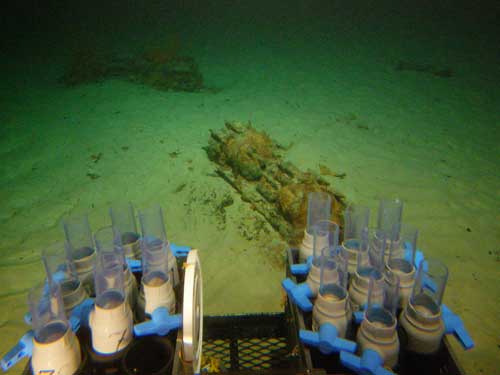
A University of Hawaii deep-diving submersible examines munitions discarded five miles south of the entrance to Pearl Harbor. UH and Army scientists spent 15 days earlier this month mapping the location of munitions dumped in the ocean at a deep-sea disposal site off Oahu.

Army analyzes data from offshore dump

Sonar finds that old munitions lie in “long trails” off Waianae

By Gregg K. Kakesako

POSTED: 01:30 a.m. HST, Apr 05, 2009
Army officials hope to have the results in about six months of tests on water and sediment samples collected during a 17-day, $3 million investigation at a military munitions disposal site five miles south of Pearl Harbor. “We were extremely pleased with the results of the survey effort,” said Tad Davis, deputy assistant secretary for Army Environment, Safety and Occupational Health. “We think we learned a tremendous amount of the technology and what it can do for us … the samples have been sent out to determine if there are trace elements of explosive materials or chemical warfare materials.”

Earlier this month, the University of Hawaii’s two deep-diving submersibles found “several thousand munitions” at depths of 1,500 feet over 240 square miles, Davis said. By comparison, Davis pointed out that the Empire State Building in New York City is 1,400 feet tall.

However, scientists failed to uncover a large cache of munitions.

UH principal investigator Dr. Margo Edwards said: “When we analyzed the sonar data, we saw long trails of reflective targets that we suspected were munitions discarded from a ship as it steamed forward. We were thrilled when the submersibles confirmed this hypothesis. The fact that munitions were discovered in trails, rather than a large pile, makes sense given how ships were navigated at the end of World War II and the fact that ships roll less when they steam into the seas.”

The water and sediment samples collected by the Hawaii Undersea Research Laboratory’s three-man submersibles, Pisces IV and V, will be sent to the Army’s Edgewood Chemical Biological Center and UH and mainland laboratories for analysis of metal content, explosive compounds and chemical agents. Fish and shrimp samples are also being analyzed. The Army believes 16,000 M47-A2 bombs containing 598 tons of mustard gas were dumped in the area, now dubbed Hawaii-05, on Oct. 1, 1944. Each chemical bomb weighs 100 pounds and is nearly 32 inches long. The practice of ocean dumping was banned in 1972. Davis said the Army also will decide over the next six months whether to make onsite inspections of the two other suspected deep-water chemical munitions dumpsites.

Between 1932 and 1944, chemical weapons such as blister agents lewisite and mustard gas and blood agents hydrogen cyanide and cyanogen chloride were discarded in waters off Oahu. The largest dump is reported to be in an area 10 miles west of the Waianae Coast.

University scientists and students also will use the sonar data to map the area and pinpoint the location where munitions were found.

The Pentagon has determined that besides Hawaii, there were 19 chemical weapons sea disposal sites — in the Atlantic Ocean, the Gulf of Mexico, off the coast of Alaska and two instances in the Mississippi, near Louisiana.

The Army has said that it does not plan to remove any of the chemical weapons because there is no data to indicate that they pose a threat to human health or the environment.

Davis said the deep-sea survey is also drawing on the experience and methodology used in another long-term project on the Waianae Coast, where the military already has spent $2.2 million to determine the effects of the dumping of 2,000 World War II-era conventional weapons on the sediment, shellfish, limu and fish near Ordnance Reef. The term “conventional” refers to munitions that are not nuclear, biological or chemical.

At Waianae, the Army’s goal is to clear the water from the shoreline to 120 feet offshore.

Source: http://www.starbulletin.com/news/20090405_army_analyzes_data_from_offshore_dump.html