Kulike Kakou: Voices of Independence

Kulike Kakou: Voices of Independence

Educate ourselves and come together to mobilize our people!!

This event will include speakers, musicians, poets, food, and workshops, tables from student & community groups, and film!

Workshop topics include: Visualizing the National Lands-a hands on workshop identifying the lands, and how they are being exploited; History of Civil Disobedience in Hawai’i: Learning about different struggles that have happened here in Hawai’i (PKO & the fight against UARC); Civil Disobedience: What is it? the logistics what it entails; Homophobia in the community and movement; Art as Resistance: Hawaiian Flag making, how to Stencil & screen print for your movement, cause, etc…

If you or your group wants to get involved or want to table this event contact us at aloha_aina@riseup.net or message us!

and all our welcome to attend, it’s not just for Haumana!!

Look forward to seeing you folks!!

Aloha ‘Aina
Ka Hui Haumana O MANA (MANA Student Hui)

Makua Sunrise 2009

The 13th Annual Makua Sunrise Ceremony

Sunday, April 12, 2009

6:00 am

Makua Valley, inside the military reservation

Interfaith sunrise ceremony to pray for the restoration of life and peace in Makua and the world.

The first Makua sunrise event was held on the beach of Makua on Easter 1997, when the Marines had planned an amphibious invasion training.   Canoes, surfers and others gathered on the beach in prayer and blocked the exercise. The Makua Sunrise ceremony moved into the valley the following year and has been held there ever since.

Participants are welcome to share a prayer, song, poem or thoughts. There is usually a potluck gathering at the beach after the event.

Sponsored by Malama Makua.  Contact Fred Dodge for more information:   makuakauka@hotmail.com

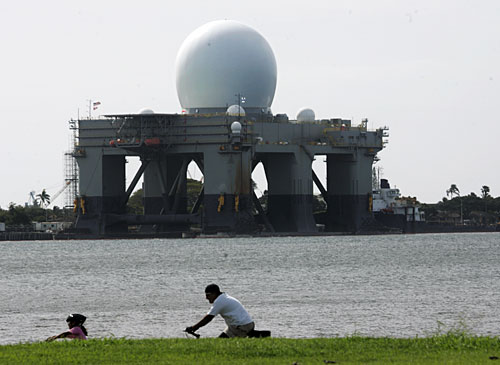
Missile Defense group wants DoD to deploy Sea-Based X-Band Radar

20090401_nws_xband1

Photo: Honolulu Star Bulletin

Use X-Band for launch by N. Korea, group urges

By Gregg K. Kakesako

Apr 01, 2009

A missile defense advocacy group wants the Pentagon to deploy from Pearl Harbor the anti-ballistic missile tracking system known as Sea-Based X-Band Radar to monitor the planned North Korean rocket launch.

However, there has been no official word on what the Pentagon plans to do.

The Pearl Harbor-based destroyer USS Chafee, armed with the sophisticated Aegis radar and missile weapon systems, has been ordered to be part of the flotilla of warships that will monitor the North Korean launch planned between Saturday and April 11. The Chafee initially was in South Korea with six other U.S. warships as part of 12-day joint defense exercises in early March.

The Aegis combat system can simultaneously detect, track and destroy a multitude of targets. But the X-Band radar platform has more powerful sensors, capable of discriminating rocket stages and payload, including a possible dummy warhead.

North Korea has said it intends to launch a satellite, but a 2006 U.N. Security Council resolution bars the rogue state from experimenting with space-launch technology.

Defense Secretary Robert Gates has said there are no plans to shoot it down.

“I think if we had an aberrant missile, one that was headed for Hawaii, that looked like it was headed for Hawaii or something like that, we might consider it,” Gates said this week on “Fox News Sunday.”

Two weeks ago, Adm. Timothy Keating, commander of U.S. forces in the Pacific, said in an interview with ABC News that the U.S. military was “fully prepared” to shoot down the missile if ordered to do so.

In a letter to Gates earlier this week, Riki Ellison, chairman of the Missile Defense Advocacy Alliance, urged the Pentagon to “consider activating all available missile defense assets to the Pacific to protect against an errant space launch attempt or a ballistic missile launch that threatens the United States or our allies.”

On its Web site, the nonprofit alliance, which supports a missile defense shield for the U.S., noted that an ideal orbital launch from North Korea, using optimal rotation of the Earth, would take the booster over Japan and east over the Pacific.

The group noted that the $950 million SBX, perched on a semi-submersible oil rig, is “the most powerful and most capable sensor” to track the launch.

“If deployed, the SBX can begin to emit its sensor 50 or so miles from Hawaii and can become effective by providing sensoring information to the deployed long-range missile defense system in place today,” the group said.

The rig was diverted from tests in 2006 to track a North Korean Taepodong-2 that failed shortly after launch.

The 280-foot radar platform has been a frequent visitor to Pearl Harbor, arriving in February for maintenance work.

A missile defense advocacy group wants the Pentagon to deploy from Pearl Harbor the anti-ballistic missile tracking system known as Sea-Based X-Band Radar to monitor the planned North Korean rocket launch.

However, there has been no official word on what the Pentagon plans to do.

The Pearl Harbor-based destroyer USS Chafee, armed with the sophisticated Aegis radar and missile weapon systems, has been ordered to be part of the flotilla of warships that will monitor the North Korean launch planned between Saturday and April 11. The Chafee initially was in South Korea with six other U.S. warships as part of 12-day joint defense exercises in early March.

The Aegis combat system can simultaneously detect, track and destroy a multitude of targets. But the X-Band radar platform has more powerful sensors, capable of discriminating rocket stages and payload, including a possible dummy warhead.

North Korea has said it intends to launch a satellite, but a 2006 U.N. Security Council resolution bars the rogue state from experimenting with space-launch technology.

Defense Secretary Robert Gates has said there are no plans to shoot it down.

“I think if we had an aberrant missile, one that was headed for Hawaii, that looked like it was headed for Hawaii or something like that, we might consider it,” Gates said this week on “Fox News Sunday.”

Two weeks ago, Adm. Timothy Keating, commander of U.S. forces in the Pacific, said in an interview with ABC News that the U.S. military was “fully prepared” to shoot down the missile if ordered to do so.

In a letter to Gates earlier this week, Riki Ellison, chairman of the Missile Defense Advocacy Alliance, urged the Pentagon to “consider activating all available missile defense assets to the Pacific to protect against an errant space launch attempt or a ballistic missile launch that threatens the United States or our allies.”

On its Web site, the nonprofit alliance, which supports a missile defense shield for the U.S., noted that an ideal orbital launch from North Korea, using optimal rotation of the Earth, would take the booster over Japan and east over the Pacific.

The group noted that the $950 million SBX, perched on a semi-submersible oil rig, is “the most powerful and most capable sensor” to track the launch.

“If deployed, the SBX can begin to emit its sensor 50 or so miles from Hawaii and can become effective by providing sensoring information to the deployed long-range missile defense system in place today,” the group said.

The rig was diverted from tests in 2006 to track a North Korean Taepodong-2 that failed shortly after launch.

The 280-foot radar platform has been a frequent visitor to Pearl Harbor, arriving in February for maintenance work.

Source: http://www.starbulletin.com/news/20090401_use_xband_for_launch_by_n_korea_group_urges.html

State seeks damages from Navy for USS Port Royal reef damage

Wednesday, April 1, 2009

State to seek claims against Navy for damage to reef off airport

Advertiser Staff

The state Department of Land and Natural Resources said today it has formally notified the U.S. Navy that it has identified substantial coral reef damage caused by the grounding of the USS Port Royal in February.

DLNR said immediate measures are needed to stabilize injured coral and to prevent further damage by widespread debris to other areas of the reef.

DLNR said a letter sent to the Navy yesterday also documents the state’s intent to make a claim for damages that include: the cost of emergency mitigation to prevent further damage; the value of the coral reef substrate damaged by the grounding of the Port Royal and associated attempts to free the 567-foot-long vessel; and other secondary and tertiary damage to the reef ecosystem.

The state will be seeking compensation from the Navy to fund and implement coral habitat restoration projects that will enhance Hawaii’s reef systems and mitigate for loss of ecological services caused by the grounding of the vessel.

“While the state also intends to seek compensation from the U.S. Navy for any damage caused by the grounding incident, the first priority remains protection of the remaining coral reef resources,” said Laura H. Thielen, DLNR chairperson.

“We are asking the U.S. Navy to work with us to achieve the mutual goal of protection of the natural resources and minimization of ongoing damage to the same public trust resources,” Thielen said.

Thielen warned that costs will increase substantially unless the Navy acts to immediately mitigate the primary damage impacts by: assisting in the recovery of injured coral; preventing further secondary damage by removing or stabilizing significant amounts of damaged coral rubble prior to the arrival of large south summer swells; and protecting loose live coral to prevent further damage to public trust resources, in coordination with the State and in compliance with emergency permitting requirements.

Officials from DLNR and the attorney general’s office will meet with Navy officials tomorrow.

On February 5, 2009, the Port Royal ran aground atop the coral reef fronting Honolulu International Airport’s Reef Runway in depths of approximately 14 to 22 feet. The vessel was lodged atop the reef for three full days during which several attempts were made to free it.

The area where the Port Royal ran aground was a complex “spur and groove” fringing reef (outcrops of coral interspersed with sandy areas) with a relatively high biodiversity of live coral and live rock, the state said. Numerous printed resources and the evaluation by various coral reef biologists concur that this area was one of the finest remaining reef habitats on the island of Oahu.

The main reef injury scar covers an estimated area of approximately 8,000 square meters. The documentation of the full area and extent of the damage associated with the grounding has not been completed, but it is estimated to cover an area of approximately 25,000 to 40,000 square meters

“The reef that was injured is an ancient one, full of coral colonies some of which took hundreds of years to reach their present size. A complex reef structure such as the one that was present prior to this injury forms numerous and intricate houses for the myriad of fish, invertebrates and sea turtles that use this reef for shelter and food resources,” Thielen said.

Source: http://www.honoluluadvertiser.com/article/20090401/BREAKING/90401076

Army had more gang-related incidents in Hawai’i than anywhere else

Ian Lind found an interesting source of information about gang related activity in Hawai’i.  He noted “the U.S. Army had more gang-related incidents in Hawaii during 2004-2005 than in any other part of the world.”

Here is the full Army report on gang-related activity.

Here’s Ian Lind’s post:

Wednesday…Army reports describe gang-related incidents at Schofield Barracks

March 18th, 2009

You never know what you might find in a collection of government documents. That’s why I love to browse. I used to wander through sections of the university library just to see what was there. Same with bookstores. Now I let my fingers on the keyboard do the walking.

This week, I saw a description of a new web site, GovernmentAttic.org, which compiles documents which have been released in response to Freedom of Information Requests.

Nosing around a bit, I found an interesting report on gang-related crimes involving U.S. Army personnel which described a number of cases in Hawaii.

Taking a closer look, it appears the U.S. Army had more gang-related incidents in Hawaii during 2004-2005 than in any other part of the world, according to a September 2005 report of gang activity compiled by the Army’s Crime Records Center.

Hawaii recorded 8 gang related incidents during the period from January 2004 through August 2005, nearly one-third of the 29 such incidents cited in the report. Bases with the next highest number of incidents were Fort Hood, Texas, which reported four incidents, and Ft. Leanard Wood, Missouri, with three. The Army garrisons at Grafenwoehr and Hohenfels, Germany, also reported a total of three incidents.

The report and assessment of gang activity was ordered by the Army Chief of Staff following two gang-related murders in August 2005, one in Germany and the other in Alaska.

According to the report, incidents were escalated into criminal investigations whenever the initial complaints were found to be credible and the Army had jurisdiction. Two of the resulting 12 investigations by the Army’s Criminal Investigation Division Command were of incidents at Schofield Barracks or involving Schofield soldiers or dependents.

In one Hawaii case, the 20-year old husband of an active duty soldier was arrested on base for driving without a license and a small amount of marijuana was found in his car. “Various gang paraphernalia” were also found, and the man admitted to being a member of the Crips, a gang which originated in Los Angeles in the late 1960s.

In the second incident, a Schofield soldier and a civilian were involved in an off-base verbal confrontation with two civilians, which resulted in the shooting of one of the civilians. An investigation found the soldier was a reported member of the gang known as “La Familia”.

The report provides a summary:

The gang originated in the prisons of Hawaii to protect the members from other gangs. The gang consists of approximately 100 male members aged 18 to 45. Members are predominantly of Pacific Islander race with a few of its members being from other races. The gang tends to recruit anyone who is willing to join. The gang’s main rivals are the United Samoan Organization (USO) gang, which is the largest organized gang in the state of Hawaii (with no known military nexus).

A follow-up report in December 2006 cited two additional drug investigations at Schofield with links to a gang known as “Street Military”.

• The 21-year old husband of a Schofield Solder was stopped for speeding. A search of his car “resulted in the recovery of 17 bags of marihuana (a total of 35 grams), various items of drug parpheralia and a small amount of cocaine. The man claimed to belong to the “Street Military”.

• Another case involved drug dealing by a Schofield solder, who was caught with “illegal drugs and two scales in his barracks room.”

According to the report, the man “had a tattoo of a Kanji symbol that translates to mean family with ‘Bama-Boy’ under it. This is a marking known to be associated with the Street Military street gang.”

The 2006 report includes this description of the “Street Military” gang.

Street Military – Criminal acts attributed to the gang, occurring on and off-post include Illegal Weapons Charges, Possession/Use/Distribution of Controlled Substances, and Desertion. To date there are three incidents involving weapons. This gang is determined to have a moderate propensity to commit violence. Available intelligence suggests that the gang is moderately organized and has a rank structure. The gang was organized on Schofield Barracks, HI.

The gang consists of approximately 20-25 members ages 18-30. The group is comprised of mostly military members that have come from gang related backgrounds (Bloods, Crips, Gangster Disciples, Latin Kings). These members are not known to proclaim gang involvement but due to intelligence gathered they definitely fit the definition of a gang. Due to the versatile background there are no known colors, clothing or signs. Several members are reported to have a Japanese Kanji symbol on their forearm, which translates into “The Family” with their nickname under the symbol. There is additional intelligence that members of Street Military have decided to form a separate gang called “Wolfgang”. These members motivation to sell drugs was to make money to support a music career. This gang was unstable and unorganized which caused it to break down and disseminate.

The 2006 report also cites two investigations by the Honolulu Police Department where gang membership was noted.

One case involved five soldiers who were members of the Street Miltary and were found with illegal drugs.

“The investigation established the individuals had a rifle that was discharged in a parking lot,” the report states.

The last case involved eight juveniles who were sons of active duty soldiers. Two of them claimed to be members of the Crips.

Investigation established the subjects were involved in a disagreement over suspected drug activity. The altercation became physical, at which time one of the suspected gang members produced a screwdriver and stabbed multiple individuals.”

Gang-related incidents accounted for only a very small share of all criminal cases investigated by military authorities and were rated a low-level threat.

But with civilian authorities shying away from public discussion of local gang-related crimes, and news media failing to follow the scent, the Army reports provide a welcome source of information and perspective.

Source: http://ilind.net/2009/03/18/wednesdayarmy-reports-describe-gang-related-incidents-at-schofield-barracks/

Military ignored conditions set by state regulators on undersea warfare exercises

The Coastal Zone Management Act (CZMA) established a regulatory regime to create more consistency in regulating coastal resources, by delegating certain regulatory powers to approved state CZM agencies. This means that on matters of Coastal Zone Management, the federal government should be in accordance with the regulatory guidelines set by the Hawai’i CZM agency. However, in its 2008 annual report, the Hawaii Coastal Zone Management Program reported that in several instances, the U.S. military simply “issued a notice of intent to proceed over both the conditions and objection” of the Hawaii CZM Program. One instance involved the use of sonar and live fire exercises by the Navy undersea warfare exercises (USWEX). The other involved the Navy Hawaii Range Complex. There have been reports of massive fish kill off the island of Ni’ihau and Kaua’i and dead whales washing ashore on Ni’ihau and Kaua’i. It was reported by the Hawaii Independent that the Navy and the DARPA conducted classified exercises in the vicinity of Ni’ihau and Kaua’i during a USWEX event in the Hawaii Range Complex. Here’s an excerpt from the 2008 Hawaii CZM Program annual report:

Federal Consistency Program

The CZMA requires federal agencies to conduct their planning, management, development, and regulatory activities in a manner consistent with federally-approved state CZM programs. The informational and procedural requirements for CZM federal consistency reviews are prescribed by federal regulations.

Because there is a significant federal presence in Hawaii, federal consistency is a valuable State management tool. Federal planning, regulatory, and construction activities have direct and significant effects on land and water environments statewide.

The federal government controls vast tracts of land. The range of federal activities and permits reviewed is extensive and includes harbor projects, beach nourishment projects, military facilities and training exercises, fisheries management plans and regulations, open ocean aquaculture, and dredge and fill operations. In addition, projects funded by certain federal grant programs are reviewed for potential impacts to CZM resources.

Public notices for all federal consistency reviews are published in The Environmental Notice.

The following are noteworthy examples of federal consistency activities:

1. Makua Military Reservation Training Activities: The U.S. Army’s live-fire training exercises at Makua Military Reservation on Oahu were reviewed for impacts on resources in areas beyond the reservation. The reservation itself is a federal area that is excluded from CZM review. However, the CZM Program was concerned about the effects of live-fire training, particularly wildfire on State natural area reserves, critical habitat for endangered species, and historic and cultural resources. Federal consistency negotiations with the Army resulted in mitigation measures to ensure protection of natural and cultural resources.

2. U.S. Navy Undersea Warfare Exercises (USWEX): The CZM Program reviewed a series of USWEX, which are anti-submarine exercises involving the use of mid-frequency active sonar in waters around the State. The primary concern with sonar is its potential to harm marine mammals such as whales and monk seals. USWEX also involves land-based training exercises such as aerial bombing of Kaula Island off of Kauai and Pohakuloa Training Area on the Island of Hawaii. Operational conditions and mitigation measures were required for the sonar use for consistency with CZM enforceable policies. An objection was issued over the use of Kaula Island until a monitoring plan and baseline survey of birds is completed. In response to the Program’s consistency decision, the Navy issued a notice of intent to proceed over both the conditions and objection.

3. U.S. Navy Hawaii Range Complex (HRC): The HRC is one of the Navy’s range complexes used for training operational forces and military systems. The HRC covers 235,000 square nautical miles around the Main Hawaiian Islands, and a 2.1 million square nautical mile Temporary Operating Area of sea and airspace. The biennial Rim of the Pacific naval exercise is included as one of the major activities covered by the review. One of the primary concerns was the Navy’s use of mid-frequency active sonar and its impacts on marine mammals. The CZM Program required mitigation measures for the sonar use to be consistent with CZM enforceable policies. An objection was issued to the use of Kaula Island for bombing until a monitoring plan and baseline survey of birds is completed, and the development and operation of a directed energy (laser) weapon facility at the Pacific Missile Range Facility on Kauai, until potential hazards are identified and operating procedures and safety requirements are developed. The Navy declined to agree and issued a notice of intent to proceed over the conditions requiring sonar mitigation and the objection to the bombing of Kaula Island. However, the Navy is developing a management plan for seabirds at Kaula in response to the CZM review and also agreed to submit a separate CZM review for the directed energy facility when the details are developed.

4. Hawaii Superferry Security Zones: The CZM Program issued federal consistency concurrences for the U.S. Coast Guard to establish security zones for the Hawaii Superferry at Nawiliwili Harbor, Kauai and Kahului Harbor, Maui. The security zones were necessary in consideration of the large number of protestors who prevented the Superferry from entering Nawiliwili Harbor. The Program’s consistency concurrence ensured that public access was maintained by requiring that canoe and boating clubs, small commercial businesses, and Native Hawaiian cultural practitioners be given consideration for access to resources during the activation of the security zone. The Program also required that when the security zone is inactive, public access to and use of established public areas in and around Nawiliwili Harbor and Kahului Harbor be allowed.

The Hawaii CZM Program facilitates cooperation among government agencies in reviewing applications for federal, State, and County permits. Also, pre-application consultation is highly encouraged. Consultations occur by telephone and email, as well as through meetings involving applicants and agencies.

The CZM Program continued its involvement with the federal and State agency coordination initiative involving quarterly meetings with regulatory and resource agencies, and various branches of the military. The meetings are hosted by the U.S. Army Space and Missile Defense Command and the U.S. Navy. This forum provides the participating agencies an opportunity to discuss and coordinate on current and future projects, activities, and issues.

Dumping of contaminated military waste discussed by Nanakuli-Ma’ili Neighborhood Board

Posted on: Tuesday, March 17, 2009

Neighborhood Board to discuss landfill tonight

Advertiser Staff

The Nanakuli-Ma’ili Neighborhood Board will discuss the dumping of contaminated waste by the military at the PVT Landfill at its meeting from 7 to 9 to-night at Nanaikapono Elementary School.

Representatives from the Air Force, U.S. Rep. Mazie Hirono’s office, PVT Landfill, the Environmental Protection Agency, the state Department of Health and elected officials will be on hand to discuss the issue and answer questions from the community.

Claim forms from residents who have sustained dust and dirt damage to their homes and properties from the PVT Landfill will be collected at the meeting.

Source: http://www.honoluluadvertiser.com/article/20090317/NEWS25/903170329/1318

Video shows reef damaged by USS Port Royal

Check out this video of the damage to the reef caused by the grounded USS Port Royal.  Pulverized.

http://kgmb9.com/main/content/view/15031/40/

New Video Shows Reef Damaged by Navy Cruiser

Written by Brooks Baehr – bbaehr@kgmb9.com

March 13, 2009 06:36 PM

Local divers have given KGMB9 viewers what the U.S. Navy and State Department of Land and Natural Resources have refused to supply. The divers took video of coral colonies pulverized by the missile cruiser U.S.S. Port Royal when in ran aground in February.

Kirby Fukunaga is an avid free diver. He frequently fishes off Honolulu International Airport’s reef runway. Fukunaga has documented the GPS coordinates of coral colonies just outside restricted military zones. Fish tend to congregate around the colonies making those spots fertile fishing grounds.

“There’s a lot a lot of flat grounds, but once and a while you come onto a really big reef structure where it holds all the fish,” Fukunaga said.

The Port Royal was stuck on the ocean floor there for more than three days. After it was pulled free Fukunaga and friends went fishing.

He told KGMB9 he was surprised to find the reef had suffered extensive damage.

“It didn’t look like coral, but I guess that was the coral. Just like rubble.” Fukunaga said.

Fukunaga said he is sure the bits and pieces of coral he was looking used to be a thriving coral cluster.

“Yea, I’m sure I got the right spot. I dive there all the time,” he said.

Coral is not rock or plant. Coral is an animal.

Kyle Nakamoto, who joined Fukunaga on a recent dive and video taped the damage, told KGMB9 coral has been killed and the ecosystem has been disrupted.

“In this situation wiping out the homes of a lot of fish. (They) have to relocate … find new homes. It definitely has an impact on the marine life,” Nakamoto said.

The Hawaii Chapter of the Sierra Club has made a formal request to the state for photographs, video, and reports documenting the damage, but Friday said it has yet to receive a reply.

“You have to remember that the state has an obligation to enforce the rules and restrictions about damaging coral reefs and we want to make sure they are doing their job,” said Robert Harris, Director of the Hawaii Chapter of the Sierra Club.

Harris said the state has fined private businesses for damaging coral reefs and he believes it should fine the Navy.

“I mean there has to be a deterrent. If someone damages our natural resources, we should go after them,” he added.

Shortly after the Port Royal was pulled off the reef the State Department of Land and Natural Resources announced plans to save as much coral as possible by re-attaching it to the ocean floor. A spokesperson told KGMB9 that work is far from finished.

The spokesperson said the state will seek compensation from the Navy.

O’ahu Taro Festival

taro-fest-flyer

O’AHU TARO FESTIVAL!

Tuesday March 24th 10 am – 4 pm

Mālama Hāloanakalaukapalili

Don’t Miss This Family Roots Celebration!

Nānā ka maka, hana ka lima.

As the eyes see, let the hands work.

COME GET INVOLVED!

Learn about this amazing plant,

enjoy food & festivities,

and meet taro farmers

from all over Hawai’i nei!

Taro Education Booths,

Music, Art, Games, Food,

Cultural Demonstrations!

Kani ka uwalo, Mele ‘ai pōhaku!

11:oo am-Noon: Join in

Historic, Taro lovers from all Hawai’i will unite

Record Setting, Largest Unified to ku’i kalo- traditional taro

Gathering of Ku’i Kalo! pounding and poi making.

Don’t miss this special event ~ Bring your papa & pōhaku ku’i’ai,

to honor Hāloa, and celebrate we’ll provide the cooked

Hawai’i’s living taro traditions! Hawaiian taro to ku’i! (11-noon)

Festival Location: Hawai i State ʻ Capitol, Downtown Honolulu

Hosted by Nā Kahu o Hāloa, The Guardians of Hāloa, and the Hawaiian Caucus

To get involved contact www.KAHEA.org ~ kahea_alliance@hawaii.rr.com ~ 524-8220

Illustrations kindly donated by www.SolomonEnosGallery.com Support Maoli Art!

Download leaflet (PDF)

Army public meeting on Makua Cultural Sites access

IMPORTANT!

Makua Cultural Sites Meeting

Monday, March 9th, 6:30 P.M.

Nanaikapono Elementary School

89-153 Mano Avenue (Nanakuli ahupua’a)

The U.S Army is holding a community meeting in Wai’anae to prioritize cultural sites that the public wants access to. Malama Makua and Hui Malama Makua are in the process of creating a list of those sites and will be circulating that list at the meeting. We are asking you to kokua. Please attend and support the list of priority sites.

Mahalo a nui loa