New Missile Defense Command

http://www.navytimes.com/news/2009/03/navy_bmd_command_030409/

Navy Times
March 5, 2009

CNO announces new missile defense command

By Andrew Scutro

Next month the Navy will establish a new command with missile defense in mind.

Adm. Gary Roughead, chief of naval operations, announced the coming formation of the Navy Air and Missile Defense Command during a speech before a business group Wednesday night in Northern Virginia.

“We’ll formally stand it up in April, but it will be the place where the Navy comes to bring together the thinking, the ideas, the concept, the intellectual effort for our air and ballistic missile initiatives, efforts and programs so that we can stay in the forefront of this important mission area,” Roughead told the group.

He said it will be based in Dahlgren, Va. – where the Navy has an existing facility – though further details about the new command were not readily available Wednesday night.

Tensions over ballistic missile launches have risen in recent weeks because of news that North Korea was preparing a test launch. The saber-rattling was taken seriously enough to prompt a comment from Adm. Timothy Keating, head of U.S. Pacific Command, who was quoted saying, “If a missile leaves the launch pad, we’ll be prepared to respond upon direction of the president.”

The Navy has had several successful ship-launched intercepts of test ballistic missiles. As of November, Navy shot 19 interceptor missiles at speeding targets and was successful in 16 attempts.

The Nov. 1 test was the first “fleet operational firing.” After two target missiles were fired from the Pacific Missile Range Facility on Kauai, Hawaii, an SM-3 fired from the destroyer Paul Hamilton directly hit the first. Another ship, the destroyer Hopper, failed to intercept the second target missile.

The Missile Defense Agency, which oversees the military’s BMD programs, has also been testing land-based interceptor systems.

The Navy’s Aegis BMD program is directed by Rear Adm. Brad Hicks.

By upgrading existing Aegis radar systems and training ship crews to intercept airborne ballistic missiles, the Navy has been bolstering the usefulness of its older Flight I/II Burke-class destroyers, as well as some of its Ticonderoga-class cruisers.

There are six BMD-capable ships homeported in Pearl Harbor: the cruiser Lake Erie and destroyers Russell, Paul Hamilton, O’Kane and Hopper. The BMD-capable cruiser Port Royal ran aground Feb. 5, suffering extensive damage that will cost millions to repair.

Five are based out of Yokosuka, Japan: the cruiser Shiloh and destroyers John S. McCain, Stethem, Fitzgerald and Curtis Wilbur. Homeported in San Diego are the destroyers Decatur, Milius, Benfold, Higgins and John Paul Jones. Destroyers Stout and Ramage are the two Norfolk-based BMD-capable warships.

Roughead spoke at a meeting of the Fredericksburg Regional Chamber of Commerce Military Affairs Council. Also scheduled to speak was Rep. Robert Wittman, R-Va., following the showing of a film on ballistic missile defense.

UH begins search for chemical weapons dumped at sea

Starbulletin.com

Depth Chargers

The University of Hawaii will search the sea for chemical weapons dumped in 1944

By Gregg K. Kakesako

POSTED: 01:30 a.m. HST, Feb 25, 2009

The University of Hawaii’s two submersibles will spend 15 days beginning Monday filming and taking water and sediment samples south of Pearl Harbor as part of an Army project to determine the risks of nearly 600 tons of chemical weapons dumped there in 1944.

Tad Davis, the Army’s deputy assistant secretary for the environment, safety and occupational health, said yesterday 10 dives will be made by the Hawaii Undersea Research Laboratory submersibles Pisces IV and V at an area dubbed “Hawaii-05” by the Army.

The two submersibles will make the dives in the area where the depth ranges from 900 to 2,000 feet during the day. The work is to continue at night using remotely operated underwater vehicles.

In the past, the Army has said 16,000 M47-A2 bombs containing 598 tons of mustard gas were dumped in the area about Oct. 1, 1944. Each chemical bomb weighs 100 pounds and is nearly 32 inches long. The practice of ocean dumping was banned in 1972.

Between 1932 and 1944, chemical weapons, such as blister agents lewisite and mustard gas and blood agents hydrogen cyanide and cyanogen chloride, were discarded in waters off Oahu. The largest dump is reported to be in area 10 miles west of the Waianae Coast.

Davis has described the job as “the most comprehensible effort to date to address this issue.”

He said the dives by the submersibles are part of the Army’s effort to determine the characteristics of the site.

“We are getting to a critical point in that effort,” Davis said.

All these facts will determine “what risks are associated with those materials remaining where they are.”

Davis also is involved in another long-term project on the Waianae Coast where the military already has spent $2.2 million to determine the long-term effects of the dumping of 2,000 World War II-era conventional weapons on the sediment, shellfish, limu and fish near Ordnance Reef. The term “conventional” refers to munitions that are not nuclear, biological or chemical.

The goal there is to clear the water from the shoreline to 120 feet away.

Davis said University of Hawaii and National Oceanic and Atmospheric Administration scientists will conduct two more studies of the water and the tides.

All the studies will eventually lead to an attempt to remove or destroy in place up to 1,500 conventional munitions near Pokai Bay, using remote underwater drones and other robotic techniques perfected by oil companies. The weapons range from .50-caliber or smaller ammunition to 50- to 100-pound bombs and 105 mm projectiles.

The Pentagon began work on the Pokai Bay Ordnance Reef problem in May 2006.

“I would like to move faster,” Davis said, “and I think we are moving at a deliberate pace. I would still like to move this process faster.”

Davis was to address the International Dialogue on Underwater Munitions Conference today at the Pacific Beach Hotel. He will meet with federal, state and community officials on the Pentagon’s action involving Ordnance Reef, chemical munitions, depleted uranium and flammable items known as propellant grains discovered off Maili Beach in Waianae.

Afflicted areas

Chemical weapons were reportedly dumped at two sites:

  • The largest amount of chemical weapons believed to have been dumped in island waters is in an area 10 miles west of the Waianae Coast. The Army thinks 2,000 tons of lewisite, mustard, hydrogen cyanide and cyanogen chloride were discarded in this area.
  • An additional 19 tons of mustard gas encased in 100-pound bombs and 155 mm and 75 mm projectiles were discarded 10 miles south of Pearl Harbor between 1932 and 1944.

Submerged danger

Types of chemical weapons that the Army dumped in waters off Oahu between 1932 and 1944.

  • Lewisite and mustard gas (blister agents): Effects are irritation and damage to skin and mucous membranes, pain and injury to the eyes and, when inhaled, damage to respiratory tract.
  • Hydrogen cyanide and cyanogen chloride (blood agents): When inhaled, will interfere with tissue oxygenation process, especially in the brain.

Source: U.S Army

Find this article at:
http://www.starbulletin.com/news/20090225_Depth_Chargers.html

Air Force Sergeant killed in motorcycle crash

H-1 Motorcycle Crash Victim Identified

Examiner Says Air Force Sgt. Died Of Multiple Trauma Injuries

POSTED: 5:56 pm HST February 24, 2009
UPDATED: 6:11 pm HST February 24, 2009

HONOLULU — The man killed in Sunday’s deadly motorcycle crash on the H-1 Freeway has been identified as a sergeant in the U.S. Air Force.

The medical examiner determined Willie Davis, 35, of Kapolei, died from multiple traumatic injuries.

Davis was killed after colliding into a guardrail at high speed near Seventh Avenue, police said.

The motorcycle ended up a half mile away on the Kapiolani Boulevard off-ramp.

HPD closed the freeway for 5.5 hours on Sunday while they conducted their investigation and searched the area for evidence.

Celebrate International Women’s Day

Celebrate Resistance and Internationalism
International Women’s Day
Sunday, March 8

4pm
Revolution Books

Short testimonies
Poetry and music
Followed by supper
Celebrate our solidarity with revolutionary women around the world who are fighting against the oppression of women and the emancipation of all of humanity.

On March 8 we will hear testimonies from women from many countries in solidarity with the struggles against women’s oppression in their countries and around the world.

We will especially be recognizing the women of Afghanistan and Iran, who will be holding International Women’s Day protests in Iran, Europe, Los Angeles, and elsewhere on that day. To read the Call to Protest from the March 8 Women’s Assn (Afghanistan/Iran) at www.mars.com

Celebrate International Women’s Day
Sunday, March 8
at Revolution Books

Program begins at 4pm
followed by catered supper
$10 suggested donation; no one turned away
(Men welcome)

For more info: 944-3106 or revolutionbks@yahoo.com

Organized by Revolution Books
Co-sponsored by CEJE (Collective for Equality, Justice and Empowerment)

Revolution Books is located at 2626 South King Street
(located between Puck’s Alley & 7-11 near University Avenue; free parking)
Revolution Books is open daily from noon until 6pm

Stranded Navy ship severely damaged coral reef

The two Navy photos below show the damage to the USS Port Royal. In the first photo, the sonar dome is ripped open and scrapes mar the new high tech anti-fouling blue paint.  The bottom photo shows where propeller blades were sheared off.

In the following photograph by Floyd Morris for the Honolulu Star Bulletin, you can see how close the stranded ship was to recreational and subsistence fishing areas.  The Navy now admits to having dumped 7000 gallons, not 5000 gallons as previously reported, of raw sewage without notifying public health officials.

www.starbulletin.com

Extensive coral reef damage revealed in ship’s grounding

The Navy had previously said that the site consisted only of sand and rocks

By Gregg K. Kakesako

POSTED: 01:30 a.m. HST, Feb 20, 2009

State and Navy divers have determined that the $1 billion warship USS Port Royal damaged a coral reef when it ran aground half a mile south of the Honolulu Airport’s reef runway earlier this month.

“Although initial reports indicated that the ship had grounded on a rock and sand bottom, our subsequent surveys have shown that there is in fact coral reef,” said Department of Land and Natural Resources Director Laura Thielen in a joint news release with the Navy. “Divers from our Division of Aquatic Resources are now working in cooperation with counterparts from the Navy to ensure that no further damage occurs, and to map the full extent of the grounding scar.”

The Navy also faces the possibility of hefty fines since coral is protected by state and federal laws. Deborah Ward, DLNR spokeswoman, said it is “premature” to talk about fines until the joint state-Navy investigation is completed and reviewed by state attorneys. Last year, DLNR fined a Maui tour boat company $550,000 for damaging coral in the waters of Molokini islet.

In addition, the Navy says now that 7,000 – not 5,000 – gallons of waste water were dumped while the ship was aground Feb. 5-9 to prevent it from backing up and endangering the crew.

State and Navy divers will spend another week moving debris from the grounding area to deeper water and reattaching large pieces of coral.

The Navy had originally failed to tell the state and public about the waste-water discharge, even though two Health Department officials attended a meeting with Navy officials at Pearl Harbor on Feb. 8.

The Navy said the waste water consisted mostly of sea water, used to flush waste.

“Keep in mind that while the ship was aground for those 78 hours, the Navy was concerned foremost about the safety of the crew, freeing the ship and minimizing damage to the environment,” said Rear Adm. Joseph Walsh, deputy commander of the Pacific Fleet. “We regret this unintentional grounding, and we are glad that we were able to refloat the ship without injury to the crew while minimizing environmental harm.”

The dumping took place on Feb. 6 after a Navy barge was unable to transfer the waste water and fuel from the 9,600-ton guided-missile cruiser because of rough seas. The Navy said the Port Royal’s crew made every effort to mitigate the effects, including shutting off water to showers and sinks to minimize the released amounts.

The Port Royal was taken to Pearl Harbor Naval Shipyard’s dry dock on Wednesday for repairs. When the grounding occurred, the vessel had begun sea trials after spending six months in the shipyard undergoing $18 million of repairs, maintenance work and repainting.

Although there has been no official damage report or estimate on the cost to repair the cruiser, Walsh has said that water leaked into the sonar dome located below the bow. Also, several of the 10 propeller blades were sheared off.

Photos released by the Navy show scrapes along the hull and at least five blades missing.

Initially, the Navy insisted the area where the ship ran aground in 20 feet of water consisted mainly of rocks and sand.

State and Navy divers from Pearl Harbor’s Mobile Diving and Salvage Unit 1 have been in the water since Feb. 12, tagging and replacing broken coral blocks.

The divers concentrated this week on mapping and photographing the extent of the damage to identify coral colonies that might be reattached to the reef using quick-setting cement.

Thielen said the department developed undersea survey and mapping techniques from two groundings in 2005: the Cape Flattery at Barbers Point and the Casitas at Pearl and Hermes reef in the Northwestern Hawaiian Islands.

Navy and state divers also are noting the locations of detached reef blocks or other debris that might roll in the surf and cause additional damage to the reef over time.

These are being removed by Navy divers and disposed of at a deep-water site approved by the state.

The removed rocks range from 2 to 5 feet in diameter.

The Navy has not decided the fate of Capt. John Carroll, Port Royal’s commander, or any of the sailors who were on watch on the ship’s bridge at the time of the grounding.

Grounded Navy ship damaged Hawaii coral reef

HonoluluAdvertiser.com

February 20, 2009

Grounded Navy ship damaged Hawaii coral reef

DLNR can seek fines for harm caused by warship’s grounding

By William Cole
Advertiser Military Writer

The state for the first time yesterday confirmed there was significant damage to coral reef caused by the 3 1/2-day grounding of the guided missile cruiser USS Port Royal this month off Honolulu Airport’s reef runway.

The Navy, meanwhile, released photos of the 9,600-ton warship in drydock showing damage to its propellers, sonar dome and scrape marks on a hull that just months ago had been repainted a bright blue.

The ship ran aground Feb. 5 half a mile off the reef runway, and was freed Feb. 9.

Divers noted detached coral reef colonies, which are being tagged for possible reattachment using quick-setting cement, the state and Navy said in a joint release yesterday.

Some blocks of reef up to 5 feet in diameter that could roll in the surf and cause more damage are being removed by Navy divers and disposed of in deep water.

The largest blocks are being cemented in place to stabilize them and prevent further movement, according to the release.

“Although initial reports indicated that the ship had grounded on a rock and sand bottom, our subsequent surveys have shown that there is, in fact, coral reef,” said Laura H. Thielen, chairwoman of the state Department of Land and Natural Resources.

State divers “are now working in cooperation with counterparts from the Navy to ensure that no further damage occurs, and to map the full extent of the grounding scar,” Thielen said in the release.

The state divers have been in the water since Feb. 12, conducting an underwater survey of the grounding site. DLNR spokeswoman Deborah Ward yesterday said she couldn’t provide an estimate of the size of the coral reef area damaged.

Robert Harris, director of the Sierra Club Hawai’i Chapter, said the concern is that some coral species take decades, if not centuries, to grow back fully.

“We have a fair amount of reef around the island, but the corals have been under increasing stress due to increasing temperature of the water and other manmade effects,” Harris said. “So there’s been increasing concern about what’s going to happen to reefs.”

The DLNR can seek fines for coral damage; in January 2008 the department fined a Maui tour boat company $550,000 for damaging coral in the waters of Molokini Islet. It was unclear yesterday whether fines would be pursued against the Navy.

Crew kept safe

Rear Adm. Joseph A. Walsh, deputy commander of U.S. Pacific Fleet, said in the release that the Navy regrets the grounding, but is glad the ship was able to be refloated without injury to the crew.

“Keep in mind that while the ship was aground for those 78 hours, the Navy was concerned foremost about the safety of the crew, freeing the ship and minimizing damage to the environment,” Walsh said.

There was no oil leakage. Walsh said at a press conference following the grounding that the marine environment “has been described to me as a sand rock bottom … but it has the potential to sustain life is how it was described to me.”

The 567-foot Port Royal ran aground about 8:30 p.m. on Feb. 5 on its first day of sea trials after being in a Pearl Harbor Naval Shipyard drydock for about three months for $18 million in maintenance.

The Navy was unsuccessful in three attempts to pull the $1 billion warship off the reef in 17 to 22 feet of water, and its very public predicament just half a mile off the reef runway garnered the Navy a lot of unwanted public attention.

After removing 600 tons of weight – including 500 tons of seawater ballast and 40 tons’ worth of anchors and anchor chains – the Navy lightened the ship enough to pull it backward from its perch around 2:40 a.m. on Feb. 9.

The incident heavily damaged the bow-mounted sonar housing and struts, shafts and propellers. Propeller blades were sheared off. The salvage ship Salvor, the Motor Vessel Dove and seven Navy and commercial tugboats were used to pull the Port Royal free.

The ship’s commander, Capt. John Carroll, was temporarily relieved of his duties, pending the investigation outcome. The extent of repairs that are needed and bill for the work are still being determined, the Navy said.

As many as 42 sailors a day from the Navy’s Mobile Diving and Salvage Unit One have been assisting the state effort, moving and reattaching large pieces of coral.

The Navy yesterday said 7,000 gallons of wastewater were released by Port Royal while it was aground to prevent the sewage from backing up into the ship. The state Health Department previously complained the Navy did not officially notify it of the release, which the state agency initially believed was 5,000 gallons.

Capt. W. Scott Gureck, a spokesman for U.S. Pacific Fleet, said there was a miscommunication during a time of hectic activity.

“This (the grounding) was an emergency situation where people could have died,” he said. “The focus was on keeping people alive and keeping a ship from breaking up and causing incredible environmental harm.”

Bellows Landfill cleaned up?

Waimanalo community leaders invite supporters to attend the ceremony for the blessing of the fishpond:

Saturday, February 21, 2009, Meet up at 8:45 am at the Jack in the Box in Waimanalo. Then proceed to the Bellows gate.  Hawaiian flags and signs encouraged.  Bring cameras.  Urge the return of the fishpond to Kanaka Maoli. Contact: Kawehi at kawehi11@yahoo.com.

The military issued a press release today claiming that the clean up of a landfill at Bellows Beach in Waimanalo was complete.  See the article in today’s Honolulu Advertiser below.  But there’s more to this story.   The Waimanalo community fought to get the site cleaned up.  The Air Force initially planned to cap it.  But a clue to what may have tipped the scale to get the clean  up moving is contained in the article:

The Marine Corps then requested funding to remove the landfill in order to use the previously unusable training area

On a recent visit to the clean up site sponsored by the Waimanalo Restoration Advisory Board, we saw the oily water and soil that was excavated from the beach.  We also saw remnants of a loko i’a, an ancient Hawaiian fishpond, the first actual physical evidence of fishponds in Waimanalo to corroborate oral histories.  However the walls of the loko i’a were buried under other parts of the base and would not be restored, only reburied.   The military apparently used the walls of the fishpond to contain their landfill during the 1940s. The Waimanalo community is calling for the fishpond to be restored and returned to the Kanaka Maoli people.

We also learned that practice munitions and the shells from live munitions were found improperly disposed of in the landfill.  When asked, the contractors said that they did not test for the chemical constituents from munitions.  So we don’t know whether the soil and water were contaminated with munitions residue.  The other shocking news was that the contaminated soil from the landfill was being trucked to Nanakuli and dumped in the PVT landfill.  Wai’anae residents were unhappy when they learned that military contamination was being moved from one Hawaiian community to another.

There are several other contaminated sites in Waimanalo. One that the Air Force has refused to address is a cave known from Hawaiian legends, that was used for a dump.   Despite persistent efforts of the Kanaka Maoli community to restore the cave, the Air Force insists that it cannot reopen a project that has been closed without special legislation to do so.

Friday, February 20, 2009

Bellows Beach landfill cleanup done

Advertiser Staff

Kaneohe Marines, Air Force personnel and Congresswoman Mazie K. Hirono will be at a brief blessing ceremony tomorrow at 9:30 a.m. to mark completion of the clean-up of a former landfill at Marine Corps Training Area Bellows, the Marines said today in a news release.

The landfill, known as “LF24” was located on property previously assigned to the U.S. Air Force, then transferred to the Marine Corps in 1999. As part of the transfer process, the Air Force was required to conduct environmental investigations.

These investigations determined the site was not eligible for Comprehensive Environmental Response, Compensation, and Liability Act (CERCLA) funding. The Marine Corps then requested funding to remove the landfill in order to use the previously unusable training area, as well as prevent any buried refuse at the site from unintentionally eroding into the ocean.

Waimanalo residents lobbied the military services to clean up the site, and the requested funds were eventually made available in August, 2007, when Hirono helped earmark $2M in Marine Corps funds to clean up the World War II era landfill. The Marines received the $2M in December 2007 and immediately transferred these funds to the Air Force, whose familiarity with the site and expertise were well documented.

The Air Force selected CH2M Hill as the contractor for the clean-up based on their qualifications and familiarity with the site. Part of the contract emphasized sub-contracting local small businesses. In all, of the 13 sub-contractors used for the project, 11 were based in Waimanalo or the Hawaiian Islands.

The Air Force’s Environmental Restoration department at Hickam Air Force Base led the project and hosted Marines from Marine Corps Base Hawaii, the Hawaii Dept. of Health, members of the Waimanalo community and other key organization personnel as part of a Key Stakeholders Working Group which helped with project oversight.

Source: http://www.honoluluadvertiser.com/article/20090220/BREAKING01/90220072

Stuck Navy ship dumped 5000 gallons of raw sewage, but didn’t report it

The USS Port Royal failed to disclose to State regulators that it dumped 5000 gallons of untreated sewage into the waters off the Honolulu Airport.   Many people fish, swim and paddle canoes in those very waters.   Yummmm…  The Honolulu Advertiser article captured the absurdity of the incident:

The omission was one more bit of embarrassment heaped onto the 3 1/2-day spectacle of a 9,600-ton warship capable of shooting down ballistic missiles in space sitting helplessly aground in 17 to 22 feet of water just off Honolulu International Airport’s reef runway.

Here’s the full article:

Stuck Navy ship failed to report sewage release near Hawaii shore

5,000 gallons of raw wastewater went into sea during Port Royal grounding

By William Cole
Advertiser Military Writer

The Navy is pointing to a breakdown in communication in failing to report to state officials a 5,000-gallon release of raw sewage Saturday night by the grounded cruiser Port Royal, which was refloated early Monday.

The state Department of Health revealed the information yesterday. The Navy had not mentioned the sewage release at news conferences discussing the incident.

“The Navy did its best to keep all the responding organizations informed amid rapidly changing circumstances,” said Capt. W. Scott Gureck, a spokesman for U.S. Pacific Fleet. “Any breakdown in communication under these circumstances was unintentional.”

The omission was one more bit of embarrassment heaped onto the 3 1/2-day spectacle of a 9,600-ton warship capable of shooting down ballistic missiles in space sitting helplessly aground in 17 to 22 feet of water just off Honolulu International Airport’s reef runway.

The Navy said it recovered one of two bow anchors and chains yesterday, dropped by the Port Royal to help free its bow from the rocky and sandy bottom.

Officials said the centerline and starboard anchors and their chains weigh 40 tons. Subject to weather conditions, the Navy said it plans to retrieve the remaining anchor and chain today using the salvage vessel Salvor.

The Clean Water Branch of the state Department of Health said it was notified on Monday by the state Office of Hazard Evaluation and Emergency Response of the raw sewage discharge between late evening Saturday and 10 a.m. Sunday.

The 567-foot Pearl Harbor cruiser ran aground about 8:30 p.m. Thursday a half-mile from shore.

“No official notification (of the sewage discharge) was given to the Department of Health, even though two DOH staff persons attended a meeting at 2 p.m. Feb. 8, 2009 in Building 150 (at the) Pearl Harbor Naval Base,” the Health Department said in a release.

The Health Department said it confirmed the sewage release yesterday morning.

Gureck said had the Navy not discharged the wastewater, it would have backed up onto the ship. About 130 of the 324 sailors had been off-loaded by the time the ship was refloated, officials said.

“The reason (the sewage) was released was to protect the health and welfare of the crew,” Gureck said, adding the release was done at ebb tide to carry it away from recreational waters.

Officials said Navy ships can store about a day’s wastewater, which is released when a ship is at sea.

There remained questions about the Health Department’s jurisdiction regarding a Navy vessel, but Health Department spokeswoman Janice Okubo said the Navy should have notified the state.

The release of 1,000 gallons or more sewage by a permit holder is considered a significant amount, and the public is required to be notified, Okubo said.

The Health Department also said it was notified Monday of the bypass of 12,700 gallons of treated but not ultravioletly disinfected effluent from the Navy’s Fort Kamehameha wastewater treatment plant. The release occurred near the Pearl Harbor channel.

In response, the Health Department is advising the public to stay out of waters fronting the reef runway from Ke’ehi Channel to the Pearl Harbor channel.

A meeting of state and federal agencies, including the state Department of Land and Natural Resources, the Navy, Fish and Wildlife Service and National Oceanic and Atmospheric Administration, was held yesterday to plan for an investigation of the impact of the grounding on the marine environment.

The Port Royal is expected to head to drydock by the end of the week for repairs.

Grounded ship refloated on 8th anniversary of Ehime Maru collision

www.starbulletin.com

Captain of grounded warship relieved of duty

The USS Port Royal ran aground last week but has been refloated and is back at Pearl

By Gregg K. Kakesako

POSTED: 01:30 a.m. HST, Feb 10, 2009

The key to freeing the 9,600-ton guided-missile cruiser USS Port Royal from a rocky and sandy shoal near the Honolulu Airport reef runway was removing more than 600 tons of sea water, anchors, anchor chains, sailors and equipment.

USS PORT ROYAL
Builder: Ingalls Shipbuilding

Cost: $1 billion

Propulsion: 4 gas turbine engines

Length: 567 feet

Beam: 55 feet

Displacement: 9,600 tons

Speed: 30-plus knots

Crew: 24 officers, 340 enlisted

Armament: Standard missile, vertical launch missile, Tomahawk cruise missile, six MK-46 torpedoes, two MK 45 5-inch/.54-caliber guns, two Phalanx close-in-weapons systems

Aircraft: Two SH-60 Seahawk helicopters

Source: U.S. Navy

Rear Adm. Joe Walsh, deputy commander of the U.S. Pacific Fleet, told reporters yesterday that after lightening the load, the salvage ship USNS Salvor and the Motor Vessel Dove were able at 2:40 a.m. yesterday to pull the $1 billion warship off the shoal where it had been lodged since Thursday night.

Walsh said lines from the Salvor and the Dove were attached to the Port Royal’s stern.

Four Navy and three civilian tugboats were aligned on either side of the 567-foot cruiser to assist in the tow, which was timed to take advantage of yesterday morning’s high tide.

Walsh said it took about 40 minutes to free the 15-year-old cruiser, which was stuck in about 22 feet of water.

Initial assessment disclosed that a rubber dome that houses the sonar under the bow of the Port Royal may have been cracked.

Sensors indicate that water entered the dome, Walsh said. The tips of the Port Royal’s two propellers also were sheared off.

Walsh said the cruiser was “structurally sound” and that damage was limited to the hull. None of the sophisticated Aegis combat radar and missile systems were affected, he said.

Speaking in front of the Port Royal at Pearl Harbor, Walsh said the cruiser will be moved to the shipyard by the end of week and placed in dry dock. It had left dry dock on Jan. 6 and spent another month in the shipyard to complete an $18 million renovation and repainting job. There was no evidence of any major damage to the port side of the ship above the waterline.

Walsh was not able to estimate the cost to repair the Port Royal or how long an investigation into the grounding would take. The ship had just finished its first day of sea trials and was offloading sailors, contractors and civilian shipyard personnel to a small boat when it ran aground.

Yesterday, Rear Adm. Dixon R. Smith, commander of Naval Surface Group Middle Pacific, temporarily relieved Capt. John Carroll as the Port Royal’s commanding officer pending the results of the investigation to determine the cause of the ship’s grounding.

Smith made a special trip to the cruiser Friday and spent the weekend on the Port Royal directing the operations.

Carroll assumed command of the Port Royal in October.

Capt. John T. Lauer III, who is assigned to the staff of Naval Surface Group Middle Pacific, has been temporarily assigned as the ship’s commanding officer.

Walsh said he was “very, very satisfied” with how the operation had been conducted and that the Navy started with attempts Friday to pull the Port Royal using just two harbor tugs. Two larger ships with greater towing capacity were later brought in.

Eventually, success was achieved after half of the 320 crew members and more than 500 tons of sea water used as ballast and another 40 tons comprising two anchors, anchor chains and other equipment were taken off the cruiser.

Walsh said the Navy was to return to the site, about a half-mile south of Honolulu Airport, to retrieve the anchors and anchor chains and then determine whether damage was caused to the ocean bottom.

Joining in the site assessment will be representatives from the National Oceanic and Atmospheric Administration, the U.S. Fish and Wildlife Service and state Health and Land departments.

Yesterday an aerial survey of the grounding site showed a sheen of marine diesel fuel about 1.5 miles long and 100 yards wide. However, “it is not clear if the fuel is from the Port Royal or one of the nine other vessels used in the response,” Walsh said.

“There is no threat to the coastline or marine life from the sheen.”

He said the oil spill recovery vessel Clean Islands will remain next to the sheen until it burns away.

The refloating of the Port Royal occurred on the eighth anniversary of the collision of the Ehime Maru with the nuclear submarine USS Greeneville. On Feb. 9, 2001, the Greeneville performed an emergency surfacing movement 10 miles south of Diamond Head and collided with the Japanese training vessel. The Ehime Maru sank within minutes. Nine of its crew members, including four high school students, were killed.

The key to freeing the 9,600-ton guided-missile cruiser USS Port Royal from a rocky and sandy shoal near the Honolulu Airport reef runway was removing more than 600 tons of sea water, anchors, anchor chains, sailors and equipment.

USS PORT ROYAL
Builder: Ingalls Shipbuilding

Cost: $1 billion

Propulsion: 4 gas turbine engines

Length: 567 feet

Beam: 55 feet

Displacement: 9,600 tons

Speed: 30-plus knots

Crew: 24 officers, 340 enlisted

Armament: Standard missile, vertical launch missile, Tomahawk cruise missile, six MK-46 torpedoes, two MK 45 5-inch/.54-caliber guns, two Phalanx close-in-weapons systems

Aircraft: Two SH-60 Seahawk helicopters

Source: U.S. Navy

Rear Adm. Joe Walsh, deputy commander of the U.S. Pacific Fleet, told reporters yesterday that after lightening the load, the salvage ship USNS Salvor and the Motor Vessel Dove were able at 2:40 a.m. yesterday to pull the $1 billion warship off the shoal where it had been lodged since Thursday night.

Walsh said lines from the Salvor and the Dove were attached to the Port Royal’s stern.

Four Navy and three civilian tugboats were aligned on either side of the 567-foot cruiser to assist in the tow, which was timed to take advantage of yesterday morning’s high tide.

Walsh said it took about 40 minutes to free the 15-year-old cruiser, which was stuck in about 22 feet of water.

Initial assessment disclosed that a rubber dome that houses the sonar under the bow of the Port Royal may have been cracked.

Sensors indicate that water entered the dome, Walsh said. The tips of the Port Royal’s two propellers also were sheared off.

Walsh said the cruiser was “structurally sound” and that damage was limited to the hull. None of the sophisticated Aegis combat radar and missile systems were affected, he said.

[Preview] Navy Warship Finally Freed
[Preview]

An investigation is underway into what caused a billion dollar ship to run aground in Hawaiian waters.

[ Watch ]
In partnership with KITV.com

Speaking in front of the Port Royal at Pearl Harbor, Walsh said the cruiser will be moved to the shipyard by the end of week and placed in dry dock. It had left dry dock on Jan. 6 and spent another month in the shipyard to complete an $18 million renovation and repainting job. There was no evidence of any major damage to the port side of the ship above the waterline.

Walsh was not able to estimate the cost to repair the Port Royal or how long an investigation into the grounding would take. The ship had just finished its first day of sea trials and was offloading sailors, contractors and civilian shipyard personnel to a small boat when it ran aground.

Yesterday, Rear Adm. Dixon R. Smith, commander of Naval Surface Group Middle Pacific, temporarily relieved Capt. John Carroll as the Port Royal’s commanding officer pending the results of the investigation to determine the cause of the ship’s grounding.

Smith made a special trip to the cruiser Friday and spent the weekend on the Port Royal directing the operations.

Carroll assumed command of the Port Royal in October.

Capt. John T. Lauer III, who is assigned to the staff of Naval Surface Group Middle Pacific, has been temporarily assigned as the ship’s commanding officer.

Walsh said he was “very, very satisfied” with how the operation had been conducted and that the Navy started with attempts Friday to pull the Port Royal using just two harbor tugs. Two larger ships with greater towing capacity were later brought in.

Eventually, success was achieved after half of the 320 crew members and more than 500 tons of sea water used as ballast and another 40 tons comprising two anchors, anchor chains and other equipment were taken off the cruiser.

Walsh said the Navy was to return to the site, about a half-mile south of Honolulu Airport, to retrieve the anchors and anchor chains and then determine whether damage was caused to the ocean bottom.

Joining in the site assessment will be representatives from the National Oceanic and Atmospheric Administration, the U.S. Fish and Wildlife Service and state Health and Land departments.

Yesterday an aerial survey of the grounding site showed a sheen of marine diesel fuel about 1.5 miles long and 100 yards wide. However, “it is not clear if the fuel is from the Port Royal or one of the nine other vessels used in the response,” Walsh said.

“There is no threat to the coastline or marine life from the sheen.”

He said the oil spill recovery vessel Clean Islands will remain next to the sheen until it burns away.

The refloating of the Port Royal occurred on the eighth anniversary of the collision of the Ehime Maru with the nuclear submarine USS Greeneville. On Feb. 9, 2001, the Greeneville performed an emergency surfacing movement 10 miles south of Diamond Head and collided with the Japanese training vessel. The Ehime Maru sank within minutes. Nine of its crew members, including four high school students, were killed.

Navy warship ran aground, is stuck off Honolulu

Here we go again. Another military accident.  Here’s a story from the Honolulu Star Bulletin:

CRAIG T. KOJIMA / CKOJIMA@STARBULLETIN.COM

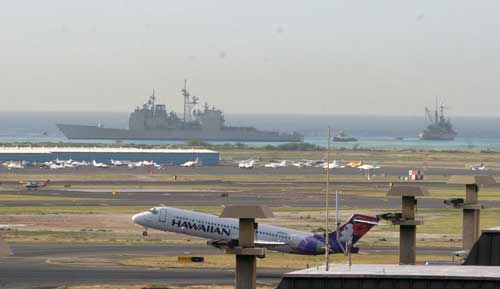
A Hawaiian Airlines jet took off from Honolulu Airport yesterday. In the background is the grounded guided-missile cruiser USS Port Royal.

Navy’s tugs fail to pull warship off sea bottom

The USS Port Royal is just coming back from routine maintenance

By Gregg K. Kakesako

POSTED: 01:30 a.m. HST, Feb 07, 2009

Navy divers and a salvage ship were to try again today to free a 9,600-ton Pearl Harbor warship that ran aground Thursday night about a half-mile south of Honolulu Airport’s reef runway, the Navy said.

The $1 billion guided-missile cruiser USS Port Royal, skippered by Capt. John Carroll, was transferring Navy officials to a small boat when it ran aground just before 8:30 p.m. Thursday about 1.5 miles from the entrance to Pearl Harbor.

The warship is stuck in about 20 feet of water.

No one was injured. The ship has a crew of about 360.

Around 2 a.m. yesterday, at high tide, Navy tugs tried unsuccessfully to pull the 567-foot cruiser off the rocky and sandy bottom.

The Navy said divers from Mobile Diving and Salvage Unit One from Pearl Harbor and the salvage ship USS Salvor would try to tow the warship at high tide at 2:45 this morning.

The grounding and the extent of damage to the Port Royal, which is equipped with a large sonar dome that protrudes below the bow of the warship, are under investigation. Rear Adm. Dixon Smith, commander of Navy Region Hawaii and Naval Surface Group Middle Pacific, made a special trip to the Port Royal yesterday to get a personal assessment of the situation.

Grounding of any Navy vessel generally means the end of a Navy career for its commander. Carroll has commanded the Port Royal since October. He also led the frigate Rodney M. Davis in 2002 and deployed to the Persian Gulf as part of the aircraft carrier USS Nimitz strike group.

Navy and Coast Guard personnel are monitoring the surrounding area from shore, from the air and from the sea for any signs of leaking diesel marine fuel, which propels the cruiser’s four jet turbine engines. There has been no indication that any fuel leaked. The Port Royal has the capacity to carry 600,000 gallons.

The cruiser, which was commissioned in 1994, had just completed an $18 million five-month stint at the Pearl Harbor Naval Shipyard for routine repairs and maintenance and a new paint job.

It had left Pearl Harbor on Thursday for several days of sea trials.

The Port Royal is one of the Navy’s premier warships, equipped with the sophisticated Aegis radar system and capable of shooting down enemy ballistic missiles.

U.S.S. PORT ROYAL
Builder: Ingalls Shipbuilding

Cost: $1 billion

Propulsion: 4 gas turbine engines

Length: 567 feet

Beam: 55 feet

Displacement: 9,600 tons

Speed: 30-plus knots

Crew: 24 officers, 340 enlisted

Armament: Standard missile; vertical launch missile; Tomahawk cruise missile; Six MK-46 torpedoes; two MK 45 5-inch/.54-caliber guns; two Phalanx close-in-weapons systems

Aircraft: Two SH-60 Seahawk helicopters

Source: U.S. Navy

SOURCE: http://www.starbulletin.com/news/20090207_navys_tugs_fail_to_pull_warship_off_sea_bottom.html