Army jury convicts island soldier of assault in death of Iraqi civilian

Army jury convicts island soldier of assault in death of Iraqi civilian

STORY SUMMARY »

A military jury convicted a Schofield Barracks soldier yesterday of a reduced charge of assault in the death of an Iraqi civilian last year.

Army Spc. Christopher Shore of Winder, Ga., was found guilty of aggravated assault in the June 23 shooting death. He was sentenced to 120 days in jail, will have his rank reduced to private and will receive a reprimand. He was originally charged with murder, but that was reduced to manslaughter and the jury found him guilty of the lesser offense.

Shore contends he shot at the civilian but purposely missed after being ordered to kill the man. He says he was following the orders of his platoon leader, Sgt. 1st Class Trey Corrales.

Corrales is charged with premeditated murder and will be tried starting April 22.

FULL STORY »

By Gregg K. Kakesako
gkakesako@starbulletin.com

A 26-year-old Schofield Barracks soldier was convicted yesterday of assault after being cleared of murdering a 28-year-old unarmed, wounded Iraqi civilian last summer.

Spc. Christopher Shore of Winder, Ga., was sentenced to 120 days in jail, will receive an official reprimand, and will be demoted to private.

Derrick Sparks, Shore’s half brother, said the conviction on a lesser charge was “an answer to our prayers. We spent a long time praying. A lot of people prayed for my brother, and I want to tell everybody thank you. … I knew my brother was innocent.”

The verdict, by the jury of five enlisted soldiers and four officers, came after four hours of deliberation. Shore showed little emotion when the verdict was read, but once the court-martial went into a recess, he hugged his father, Brian; his wife, Katherin; and Sparks in the hallway outside of the courtroom.

During the sentencing phase of his court-martial, Shore cried when asked by his attorney Michael Waddington to describe his relations with members of his scout platoon.

Shore recalled that nearly half his platoon of 26 did not survive the 15-month Iraq deployment that ended in October. Ten soldiers died Aug. 22 when their Black Hawk helicopter crashed returning to base.

He initially had been charged with premeditated murder. He said he had been only following the orders of his platoon leader, Sgt. 1st Class Trey Corrales, during an early morning raid June 23 near Kirkuk. Corrales is charged with premeditated murder and will be tried starting April 22.

An investigative officer, following an Article 32 hearing in October, recommended that Shore be charged with aggravated assault. However, Lt. Gen. Benjamin Mixon, in one of his last actions as commanding general of the 25th Infantry Division, sent the matter to a court-martial with the manslaughter charge.

Army prosecutors maintained that Shore could have avoided firing his rifle by leaving the scene as other members of his platoon did.

Army prosecutor Capt. James Leary said Shore’s decision to fire two shots at the victim was itself illegal.

Throughout the investigation, subsequent hearings and this week’s court-martial, both sides did not dispute that Corrales shot the Iraqi. But there was conflicting testimony on whether Shore fired any shots at the victim. Waddington said Shore deliberately aimed away from the Iraqi’s body.

Waddington repeatedly argued during the two-day court-martial that there was not enough forensic evidence to prove that bullets from Shore’s M-4 carbine killed the Iraqi. He described the investigation as “sloppy,” saying investigators initially went to the wrong house and excavated the wrong yard.

Waddington, in closing arguments, said Shore also was under duress because he feared his platoon leader, Corrales.

Yesterday, Waddington read into the court record the written statement of Essa Ahmed, the unit’s interpreter, who said he was asked by Corrales to translate the word “run” in Arabic, which Corrales used several times in instructing the victim.

After hearing four shots, Ahmed said he heard Corrales tell his soldiers, “I killed that mother—-.”

An autopsy later revealed the Iraqi was shot five times in the head, left and right arms, and back.

Source: http://archives.starbulletin.com/2008/02/21/news/story04.html
Crash grounds Guard’s F-15 jets

HonoluluAdvertiser.com

Posted on: Sunday, February 3, 2008

Crash grounds Guard’s F-15 jets

By William Cole
Advertiser Military Writer

The 13 Hawai’i Air National Guard F-15s that were cleared to fly on Jan. 9 are grounded again – except for air defense missions – following the ocean crash Friday of an F-15D.

The pilot, still unidentified by the Air Guard, is at home after he ejected from the Eagle fighter as it lost altitude and control 60 miles south of O’ahu at about 1:37 p.m., officials said.

“He’s not able to grant any interviews yet because of the investigation going on,” said Capt. Jeff Hickman, a Hawai’i National Guard spokesman. “Also, he’s not ready to talk about it yet.”

That pilot did not suffer any broken bones and was alert and walking after being rescued by Coast Guard swimmers.

The Hawai’i Air National Guard’s 20 A, B, C and D model F-15 jets were grounded three times between early November and December after a Missouri Air National Guard F-15C broke apart on Nov. 2.

The pilot ejected and suffered a dislocated shoulder and shattered arm.

Thirteen of 20 Hawai’i Air National Guard F-15 fighter jets stationed at Hickam Air Force Base returned to the air on Jan. 9 after all were examined.

The 199th Fighter Squadron’s remaining F-15 Eagles had remained grounded and were awaiting clearance from Air Combat Command on the Mainland before Friday’s crash and what amounts to a fourth grounding.

A Safety Investigation Board will be convened this week to investigate the circumstances surrounding the crash and make a recommendation to prevent similar occurrences.

The Air Force has said in the past that such a board can include pilots, maintenance personnel and airframe specialists from around the Air Force and Defense Department.

Hickman said they will interview the pilot, and listen to flight recordings before the $28 million jet crashed.

The pilot has been taken off flying status and will assist with the investigation, Hickman said.

The Safety Investigation Board will have about 30 days to investigate and forward conclusions to the convening authority, but the results won’t be made public.

Because the crash is defined as a “Class A” mishap involving costs exceeding $1 million, an Accident Investigation Board also will be convened after the safety investigation.

It also will have about 30 days to report, the results of which will be released to the public.

Hickman said the Coast Guard recovered a small amount of debris from the crash site and the life raft that the pilot used after ejecting and parachuting into 12-foot swells.

Hickman said there will be no routine training flights in the 13 F-15s that were previously cleared to fly, but the “alert” mission for homeland defense sometimes involves practice launches.

The 199th Squadron has 27 pilots who fly the F-15.

Reach William Cole at wcole@honoluluadvertiser.com.

Crashed F-15 passed safety inspection 3 weeks ago

F-15 crash is unlike earlier one, says general

Plane that crashed had passed safety inspection 3 weeks ago

STORY SUMMARY »

A safety team arrives this week to investigate Friday’s F-15 crash south of Oahu, but the Hawaii Air National Guard’s 154th Wing commander said the cause does not appear to be related to structural problems that grounded the Air Force’s entire fleet of F-15s in November.

Brig. Gen. Peter Pawling said the fighter in Friday’s crash was in one piece before the crash. The pilot of the plane was able to eject safely and was released from the Queen’s Medical Center to recuperate at home, a guard spokesman said.

Military analysts said Friday’s crash underscores the Air Force’s need to replace the fleet in the near future.

FULL STORY »

By Gene Park
gpark@starbulletin.com

Although an investigation into Friday’s F-15D crash is ongoing, the Hawaii Air National Guard’s 154th Wing commander said he doesn’t believe the crash was related to the structural problems that grounded all Air Force F-15 for two months.

The F-15D jet that crashed was just put back into service three weeks ago, after undergoing safety inspections.

“The airplane (in Friday’s crash) was still in one piece,” said Brig. Gen. Peter Pawling, commander of the 154th Wing, of Friday’s crash 60 miles south of the Honolulu airport. “There was no inflight breakup.”

All 676 Air Force F-15s were grounded in November after an F-15C broke in two during a training flight in Missouri. An investigation concluded that a defective aluminum beam in the frame cracked.

Hawaii’s F-15s are about 30 years old and were acquired in 1987.

But Pawling said it’s too early to link the plane’s age to the crash, pending the ongoing investigation.

“It could very well be true, but it’s something we’re going to have to scrutinize,” Pawling said.

The Guard has yet to decide whether to retrieve the jet from the ocean bottom, although Pawling said he would like it retrieved. The F-15D models cost about $29.9 million each.

U.S. Coast Guard was able to recover two trash bags and two trash cans full of debris, said Capt. Jeff Hickman, spokesman for the Air Guard.

A safety investigation team comprised of Air Force and Guard officials will assemble in Hawaii this week to investigate the crash.

The plane’s pilot ejected safely at about 1:37 Friday afternoon. The pilot said he could not control the plane and started to lose altitude before the crash, Maj. Gen. Robert Lee said Friday. The plane experienced no problems during a routine exercise earlier that day.

All training missions involving the fighters have been halted, including a mock aerial combat test with the Navy’s newest F-18 Super Hornets.

Pawling said he aims to resume training by Thursday, but wants to focus resources on gathering more information about the crash.

“It’s kind of an emotional experience for us,” Pawling said. “So this will give us a chance to regroup a little bit before we get back into the flying business.”

Hawaii Air Guard F-15s remain on duty to fly, if needed, for air defense missions, Lee said.

The Air Force cleared 13 Hawaii-based F-15s to return to flight duty on Jan. 9. But seven fighters remain grounded pending certification from the Pentagon.

Friday’s crash is the fifth F-15 crash since May of last year.

Some experts who follow military readiness say Friday’s incident is another indication that the F-15 needs to be replaced.

The fighters were designed during the Vietnam War, said Loren Thompson, chief operating officer of the Lexington Institute, an Arlington, Va.-based public policy think tank.

“The F-15 fleet is starting to literally fall out of the sky,” Thompson said. “Even before the planes started crashing, they were flying on flight restrictions because of metal fatigue.”

It’s too early to tell what Friday’s crash may mean for the F-15s future since the cause has not been identified, said John Pike, director of Virginia-based online database GlobalSecurity.org.

“Having said that, these planes have been around for a long time,” Pike said. “You can foresee a time when they’re going to phase out the F-15.”

The Air Force would like to replace the F-15 with the new F-22. Hawaii’s planes are scheduled to be replaced in 2010.

But the F-22 program is under fire because of its cost — about $159 million per plane.

Recent F-15 crashes

Friday’s F-15 crash here was the fifth crash since May of last year. The other incidents were:

» Nov. 2: A Missouri Air National Guard F-15 broke apart in midair, injuring the pilot. The cause was blamed on structural problems.

» June 26: An F-15 from the Oregon Air National Guard’s 142nd Fighter Wing went down in the Pacific Ocean during a training mission with other aircraft, killing the pilot.

» June 11: an F-15C fighter collided in midair with an F-16C and crashed near Eielson Air Force Base in Alaska during a training exercise.

» May 30: A Missouri Air National Guard F-15 crashed in southwestern Indiana during a training mission with the Indiana Air National Guard.

Source: http://archives.starbulletin.com/2008/02/03/news/story02.html

F-15 jet crashes into sea off Oahu

F-15 jet crashes into sea off Oahu

The National Guard pilot is safe after he ejects and parachutes into the roiling water

STORY SUMMARY »

The pilot of a Hawaii Air National Guard fighter jet is reported in good condition after he ejected safely yesterday afternoon from an F-15D that crashed into the ocean about 60 miles south of Honolulu Airport.

The fighter jet, which had been returned to service just three weeks ago, was on a routine training mission at about 1:37 p.m. when the pilot lost control of the plane and ejected, officials said.

A Coast Guard team rescued the pilot at 2:15 p.m.

The Air Force grounded all of its F-15 Eagle jets following the catastrophic failure of a Missouri-based F-15C jet in November.

Thirteen of Hawaii’s F-15s were returned to service Jan. 9 after being cleared for flight. Another seven planes are awaiting clearance.

An investigation into the Missouri crash concluded that a defective aluminum beam in the frame cracked. Another probe found that more than 150 of the military’s F-15s also had the flawed beams.

The Hawaii Air National Guard has halted all training flights but will continue to fly missions related to the defense of the islands, said Maj. Gen. Robert Lee, Hawaii National Guard commander.

FULL STORY »

By Leila Fujimori
lfujimori@starbulletin.com

The Hawaii Air National Guard halted all training missions by its F-15 jet fighters after yesterday’s crash off Oahu’s southern coast, the first in the Guard’s history, said Maj. Gen. Robert G.F. Lee, state adjutant general.

The F-15s “will still continue to maintain the alert status to provide air defense for the state of Hawaii,” he said, which includes periodic alert flights.

The F-15D jet fighter that crashed yesterday was one of 13 Hawaii Air National Guard jets that returned to service Jan. 9 after extensive inspections.

The Air Force grounded all 676 F-15s worldwide after an F-15C broke in two during a routine training flight in Missouri in November. An investigation concluded that a defective aluminum beam in the frame cracked. Another probe found that more than 150 of the military’s F-15s also had the flawed beams.

Seven of the 20 Hawaii-based F-15s belonging to the Air Guard’s 199th Fighter Squadron remain grounded pending word from Washington, Lee said.

The Hawaii Air National Guard pilot ejected safely at about 1:37 p.m. and was in good spirits and in good condition after his rescue, said Capt. Jeff Hickman, a spokesman for the Hawaii National Guard.

“It was the first time we’ve had a pilot have to eject and lose the plane” since the F-15s were acquired in 1987, Lee said.

The pilot, whose identity was not released, had extensive flight experience, Lee said.

The pilot said he could not control the plane and started to lose altitude before the crash, according to Lee. That was when he made the decision to eject and parachuted to the water 60 miles south of Honolulu.

Lee said the plane had experienced no problems during a routine training exercise earlier in the day.

An investigation, likely to take 30 days or more, is under way into the cause of the crash, Hickman said.

A Coast Guard rescue swimmer hoisted the pilot aboard a helicopter at about 2:15 p.m. yesterday about 60 miles south of Honolulu Airport and flew him in good condition to the Queen’s Medical Center for observation, authorities said.

Helicopter pilot Lt. Will Johnson said two other F-15 pilots maintained contact with the downed pilot, reported he was in the water but uninjured, and assisted in locating him.

There was no sign of the jet, but they found the bright green dye marker the pilot left, he said.

Rescue swimmer Petty Officer Dave Burns jumped about 15 feet from the helicopter into 10- to 12-foot swells.

“He was already sitting in his life raft, just waiting for us to pick him up,” Burns said.

The downed pilot walked off the helicopter at Queen’s and shook everyone’s hands.

“It’s definitely a good day when you can bail out of a plane and walk away,” Johnson said.

The Coast Guard dispatched two helicopters and a C-130 plane from Air Station Barbers Point after being notified of the crash at 1:45 p.m. The Coast Guard also sent out the Ahi, an 87-foot patrol boat, and the Kukui, a 225-foot buoy tender, whose crews checked for pollution and debris.

The Associated Press contributed to this story.

Source: http://archives.starbulletin.com/2008/02/02/news/story01.html

F-15 fighter jet crashes off O’ahu

HonoluluAdvertiser.com

Posted on: Saturday, February 2, 2008

Crash raises scrutiny of F-15 fighter jet

By William Cole and Mary Vorsino
Advertiser Staff Writers

The ditching of a Hawai’i Air National Guard F-15D fighter yesterday was at least the fifth crash nationwide for the Eagles since May and will result in even greater scrutiny for an aging aircraft that has been grounded several times in recent months.

The fighter crashed yesterday in the ocean 60 miles south of O’ahu at about 1:37 p.m. after the pilot lost altitude and control, officials said.

“The pilot ejected. He’s safe,” said Capt. Jeff Hickman, a Hawai’i National Guard spokesman.

Hickman said there were two of the twin-tail fighters doing routine “air-to-air” training.

Two Coast Guard cutters were on the scene of the crash, and the pilot was picked up by helicopter and taken to The Queen’s Medical Center, where he was in good condition yesterday evening.

The National Guard did not release the pilot’s name or age, but said he was an experienced pilot.

The pilot’s family was with him at Queen’s and officials said he was in good spirits.

The outcome was far different than the crash of a Missouri Air National Guard F-15C in early November in which the aircraft broke apart and led to a worldwide grounding of the F-15 fleet. The Missouri pilot’s arm was shattered and his shoulder was dislocated.

The Hawai’i Air Guard pilot did not suffer any broken bones.

“He’s a tough guy,” Maj. Gen. Robert G.F. Lee, the head of the Hawai’i National Guard, said of the pilot. “He was up, walking around, smiling, had his family there – so we’re all happy that he’s in good shape.”

Lee said the pilot, who was flying solo in the twin-seat aircraft, “was getting to the point where he said, ‘Hey, I’m getting kind of low, if I can’t control it, I better punch out.’ ”

Lee said he couldn’t release altitude information, but the pilot was “at the low end” of the minimum for ejecting. His ejection seat parachute deployed properly.

Three rescue aircraft crews from Coast Guard Air Station Barbers Point and crewmembers aboard the Coast Guard cutter Ahi, an 87-foot patrol boat, immediately responded to the incident. The Coast Guard was alerted at 1:45 p.m., a release said.

“He seemed OK for having just crashed,” said Coast Guard rescue swimmer Dave Burns, who hoisted the pilot out of the seas with swells up to 12 feet. “It just seemed like he was ready to get out of there. He wasn’t injured. He wasn’t disoriented.”

Burns said the pilot was in a life raft when the Coast Guard arrived. The rescue swimmer jumped into the waves, swam over to the jet pilot and made sure he was OK.

The pilot thanked the crew several times after the rescue, Burns said. Once the helicopter landed, the pilot was able to walk, he said. Coast Guard Lt. Will Johnson, the pilot of the Coast Guard helicopter, said there
was an oil sheen in the water and a smell of oil in the area around where the fighter pilot was rescued.

But Johnson said he saw no wreckage from the downed F-15.

The rescue was Burns’ first time saving someone in the water. “We train for this type of stuff,” Burns said. “I’m just glad the guy was OK. It was a good day for both of us.”

Lee, the state’s adjutant general, had thanks for the Coast Guard, “because as soon as our (operations center) called, their help was there in short time to pick him up.”

Hickman said the second F-15 maintained visual contact with the downed pilot.

Crewmembers from the cutter Ahi, the cutter Kukui, a 225-foot buoy tender, and Coast Guard aircraft crews were remaining on scene to check for pollution and debris.

A crash investigation will take at least 30 days, officials said.

The F-15 is part of the 199th Fighter Squadron, 154th Wing of the Hawai’i Air National Guard.

Before yesterday, the squadron was approaching a record 80,000 hours of accident-free flying in the F-15, Hickman said earlier. Around the late 1960s, a Hawai’i Guard F-4 Phantom pilot did have to eject because of a fuel problem, he said.

The F-15s serve in a homeland defense role for the state. The aircraft also are available for worldwide taskings.

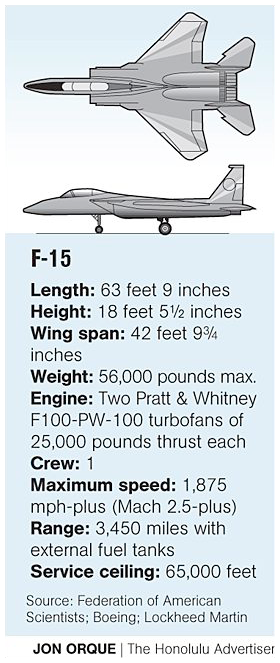
The 63-foot-long F-15s, which can fly faster than 1,875 mph, or Mach 2.5 plus, were deployed to Iraq in 2000 for no-fly-zone duty and patrolled the skies above Honolulu after the 9/11 attacks.

Thirteen of 20 Hawai’i Air National Guard F-15s stationed at Hickam Air Force Base returned to the air in mid-January after the fighters were grounded worldwide on Nov. 3. The day before, an Air National Guard F-15C in Missouri experienced catastrophic structural failure and broke apart in flight during basic maneuver training.

The entire U.S. Air Force F-15 fleet was grounded after the Nov. 2 Missouri crash. The A through D model jets were cleared to fly, but then were regrounded on Nov. 28, and again in early December after another problem aircraft was found.

The newest model, the F-15E, continued to fly and is being used in Iraq and Afghanistan.

In June, an F-15 from the Oregon Air National Guard crashed in the Pacific Ocean on a training mission. Also in June, one of the jets crashed near Eielson Air Force Base in Alaska. And in May, an F-15 went down in southwestern Indiana during training.

The Hawai’i Guard’s seven other F-15 Eagles remain grounded and await clearance to fly from Air Combat Command on the Mainland.

Hawai’i has A, B, C and D models that are on average 25 years old, officials said. The plane that crashed was a newer D model F-15 valued at $28 million.

The Hawai’i Air National Guard first received F-15s in 1987, replacing F-4 Phantoms.

The Hawai’i aircraft flying yesterday has two seats, although officials said there was only the one pilot in the crashed aircraft.

Guard officials said they did not believe the F-15 crash was related to ongoing training at Kane’ohe Bay.

The Navy said last month that F-15 Eagles were to be used in an adversary role as eight U.S. Navy F/A-18 E/F Super Hornet jets from Air Test and Evaluation Squadron Nine were conducting flight operations at Kane’ohe Bay through Feb. 20.

The Navy was to work with the Hawai’i Guard’s 199th Fighter Squadron to test the Navy’s newest fighter aircraft technologies. The Guard’s 199th Fighter Squadron also was expected to conduct operations in and out of the air facility throughout the testing period, said Navy Lt. Mark Huber, a public affairs officer.

The F-15s at Hickam will be replaced by F-22 A Raptors with stealth technology starting in late 2011.

A Coast Guard rescue crew hoisted a downed F-15 Hawai’i Air National Guard pilot from waters about 60 miles south of O’ahu yesterday afternoon. The unidentified pilot was not hurt.

The Washington Post contributed to this report.

Reach William Cole at wcole@honoluluadvertiser.com and Mary Vorsino at mvorsino@honoluluadvertiser.com.
• • •

0822-ha-f15-crash

Ex-Air Force man pleads guilty to child porn

HonoluluAdvertiser.com

Updated at 6:20 p.m., Monday, December 3, 2007

Ex-Hawaii resident pleads guilty to child porn

Advertiser Staff

A former Hawai’i resident today pleaded guilty in Maryland to federal charges of possessing child pornography and could be sentenced to 10 years in prison.

Gregory D. Corbitt, 39, of Glen Burnie, Md., was found in possession of more than 600 images of child pornography in 2006 on Oct. 27 and Nov. 29 while residing at Hickam Air Force Base where his wife was stationed. The images were stored on a laptop computer owned by his wife and compact discs stored at the Hickam home.

Corbitt admitted to Air Force investigators the pornographic images on the computer belonged to him and told agents where to find the additional discs, according to a news release issued by the U.S. attorney’s office in Hawai’i today.

The case against Corbitt was transferred to the Maryland district because he moved there before being indicted here.

Corbitt will be sentenced Feb. 22, 2008.

Soldier held in alleged dorm thefts

Soldier held in alleged dorm thefts

By Gene Park
gpark@starbulletin.com

An Army specialist about to be deployed to Iraq went into the University of Hawaii dormitories Sunday and allegedly pilfered panties and an iPod, police said.

Spc. Mark Heath, 20, was charged Monday night with first-degree burglary and unauthorized entry into a dwelling. He was arrested Sunday after he was caught in the Hale Aloha Lokelani dorms on Dole Street on the university’s Manoa campus.

According to court documents, at about 9 a.m. Sunday, Heath allegedly opened the door to a dorm room and stuck his head inside as he peered in. When he saw a male witness, Heath allegedly fled.

The witness ran after Heath and asked him why he was trying to get into his girlfriend’s room. Heath said he was looking for a male student in another room.

Heath was escorted to security. Police said officers who responded smelled alcohol on his breath. Heath was arrested on suspicion of unauthorized entry into the dorm.

When police patted Heath down, they found a 30- gigabyte iPod in his right pants pocket, the court documents say. Police also found women’s lingerie in his pockets.

A female student approached the officers later and said she was missing an iPod. The student confirmed the iPod and some of the lingerie belonged to her. Heath was arrested on suspicion of first-degree burglary.

Heath belongs to the 2nd Stryker Brigade Combat Team, 25th Infantry Division, which is based at Schofield Barracks and is preparing to deploy to Iraq next month.

Heath is being held in lieu of $100,000 bail and has no prior arrests.

Source: http://archives.starbulletin.com/2007/11/28/news/story05.html

Stryker soldier charged with UH dorm break-in

Army man charged with UH dorm break-in

By Rod Ohira

Advertiser Staff Writer

A 20-year-old man assigned to the Army’s Stryker brigade at Schofield charged in connection with Sunday’s alleged break-in at a University of Hawai’i at Manoa dorm room was in possession of stolen property, which included women’s underwear and an iPod, according to a court document. Mark Andrew Heath, accused of unauthorized entry into a dwelling and first-degree burglary, was being held in lieu of $100,000 bail awaiting a preliminary hearing Thursday at District Court on his warrantless arrest following his initial appearance at court today.

High bail was requested and granted because Heath presents a “danger to the community,” prosecutors said.

According to Schofield public affairs, Heath is a scout with Alpha Troop 2nd Squadron 14th Cavalry. The spokesperson was not sure if Heath is scheduled for deployment to Iraq with the Stryker brigade in coming weeks.

The soldier was arrested at 9:35 a.m. Sunday in the lobby of the Lokelani Dorm building at 2579 Dole St. by police investigating a reported break-in.

The unauthorized entry charge stems from Heath allegedly opening the door and entering a fourth-floor unit, according to an affidavit filed at District Court. A woman resident and her boyfriend were in the unit.

The boyfriend chased down Heath after he allegedly fled from the room.

When asked why he trying to enter the room, Heath allegedly said he was looking for a friend, “Travis Ford in dorm room 453,” the affidavit stated. Police and Campus Security said a check of the name and room number met with negative results, the document said.

According to witnesses, Heath appeared intoxicated, the affidavit said.

The woman resident of the dorm room Heath allegedly entered is the complainant in the unauthorized entry case.

Another 18-year-old female student and Lokelani Dorm resident identified a pink Nano iPod and
ingerie allegedly found in Heath’s possession as belonging to her, leading to the burglary charge.

The student told authorities the items were stolen sometime between Thanksgiving day and Sunday from her dorm room, the court document said. Her’s is a different room than the one in the unauthorized entry case.

UH spokesman Gregg Takayama said school officials are investigating how Heath gained entrance into Lokelani Dorm, which is part of the cluster of Hale Aloha campus dorms.

Takayama said the dorms have around-the-clock front desk check-in where guests are admitted only if escorted by a resident. Takayama declined comment when asked if Heath was a registered guest.

Dorm residents were also advised to lock their doors from the beginning of the current school year, Takayama said.

According to investigators, the dorms are not equipped with security surveillance cameras.

Source: http://the.honoluluadvertiser.com/article/2007/Nov/27/br/br8193742056.html

War and Peace: The challenges of staging modern-day makahiki celebrations on military lands

WAR AND PEACE

The challenges of staging modern-day makahiki celebrations on military lands

By Lisa Asato

Publications Editor

Twenty-first century makahiki festivals encounter modern-day challenges, such as coordinating with the military for access and trying to stay true to tradition, but festival organizers at a recent panel discussion said they are undeterred and continue to learn as they go.

“The difficulty organizing our makahiki with the Navy is simply one of ship movements, and given the extreme difficulty of moving the submarines we have to pretty much plan ahead,” said Shad Kane, who has helped coordinate the Moku‘ume‘ume(Ford Island) and Kapuaikaula (Hickam

Air Force Base) festival for about seven years. “There’s been some years where we actually had to slow up, pull alongside and let the sub pass.”

Speaking to a group of about 75 people at the Kamakaküokalani Center for Hawaiian Studies on Oct. 9, Kane and five other panelists covered everything from the relevance of makahiki in modern times to what they envision for future festivals. Scenarios included an island-wide event with shared opening and closing ceremonies and games among the winners of each ahupua‘a.

But a recurring theme was one of challenges and deciding how true to stay to tradition. “Can you have a makahiki with the food you grow in your ahupua‘a, or do you have to go to Costco and buy sweet potatoes?” asked Kaio Camvel, whose wife’s uncle, Sam Lono, revived makahiki at Marine Corps Base Hawai‘i in the late ’70s on the basis of freedom of religion.

The Hawaiian culture is a “living culture,” Camvel said, so it’s OK to reinvent at times. What’s important for the Mökapu festival, he said, is ceremony, welcoming diverse groups and sharing food and mana‘o.

Makahiki, traditionally a four-month-long season of peace, sport and honoring the Hawaiian fertility god,

Lono, starts with the rising at sunset of Makali‘i, or the Pleiades constellation. This year the season begins Nov. 17.

William Ailä of Hui Malama o Mäkua, said the challenges of holding a makahiki in Mäkua center around destruction of the valley, which is an Army training ground, as well as more fundamental questions such as: Am I good enough? Is my ho‘okupu good enough? Is my oli in the correct form?

“The answer to those challenges are found in the wind,” he said. At times, he said, 40 mph winds in the valley have stopped for half an hour while an oli was being chanted, and at other times the breeze will surge and “all of a sudden you get that cool wind pushing from behind.

That’s the demonstration that what you’re doing may not be completely right, but your efforts are being appreciated.”

Makahiki events

Moku‘ume‘ume (Ford Island) and Kapuaikaula(Hickam Air Force Base)

Sat., Nov. 10

At 7:30 a.m. Lono enters harbor in a procession including canoe clubs, with 8:30 a.m.

landing at Moku‘ume‘ume and 11 a.m. landing at Hickam Harbor beach, followed by festivities and games. Access is limited and participants must RSVP in advance to Shad Kane at kiha@hawaii.rr.com

Kualoa Regional

Sat., Nov. 17; setup,

Nov. 16 after 12 p.m.

Sunrise procession followed by games and potluck at 9 a.m. Games are limited to men, and

competitors must provide their own game implements. Attendees must provide their own food and drink and RSVP in advance by email to Umi Kai at ulupono1@gmail.com

Makua Military Reservation

Fri.-Sat., Nov. 16-17

Community access at 9 a.m. Saturday. To participate in the entire ceremony, call William

Ailä at 330-0376 for a training schedule or email ailaw001@hawaii.rr.com. RSVP is required.

Mokapu (Marine Corps Base Hawai‘i)

Fri.-Sun., Nov. 23-25

Processions, games and cabanas to accommodate about 200. Access is limited and participants must RSVP to Kaio Camvel at iolekaa@hawaii.rr.com

Kaho‘olawe

Thurs.-Sun., Nov. 15-18

Open to Kaho‘olawe returnees and cultural practitioners, the 2007 event is now closed as it requires paperwork and orientation to be completed a month in advance. For information on next year’s event, contact Kim Ku‘ulei Birnie of Protect Kaho‘olawe ‘Ohana at kkb@kahoolawe.org,808-383-1651 or visit www.kahoolawe.org/home/?page_id=7

Wahiawa speaks out on Strykers

Posted on: Wednesday, October 3, 2007

Hawaii Stryker plan gets wary welcome

By Will Hoover
Advertiser Staff Writer

WAHIAWA – An Army proposal to permanently base a $1.5 billion Stryker brigade combat team in Hawai’i received a somewhat warmer reception last night in Wahiawa than
it had in several previous meetings.

Last night’s hearing was the fourth of nine to take place in Hawai’i, Alaska and Colorado regarding a revised environmental impact statement on the Stryker brigade team. The Stryker unit would consist of about 4,000 soldiers, 328 Stryker vehicles and about 600 other vehicles.

Hugh Lowery, a member of the Wahiawa-Whitmore Neighborhood Board’s ad hoc committee that reviewed the EIS proposal, said the committee and community are keeping an open mind.

On the other hand, he said, they would like some reassurances from the military.

“Basically, we said we’ll concur – if,” Lowery said.

“We’d like to see more specifics. When they say ‘significant’ (environmental impacts), what exactly do they mean by that? We live here. And I at least am pro-military and pro-training. The Army is our children, our nieces, our nephews and our grandchildren. But we need to have some controls.”

While most of the 75 people in attendance at Wahiawa District Park spoke against the EIS and the Stryker brigade, numerous residents also spoke in favor of both.

Native Hawaiian Thomas Shirai, a decorated former Coast Guard member, said his grandson is doing his second tour of duty in the Special Forces in Iraq. Shirai said his grandson and other soldiers must have the proper military training, and that projects such as the Stryker brigade are vital to America’s security.

But Kamoa Quitevis, a Native Hawaiian, Navy veteran and Hawaiian cultural monitor, said he strongly opposes the Stryker unit and harshly criticized the revised EIS. He said he has seen the damage done to cultural sites because of the military presence in the Islands.

“We all need to look deeper into this, and really see what is the impact,” Quitevis said. “I don’t seen any information in this draft EIS that is answering any of the questions of how they (the Army) will mitigate the damages to our environment, our health and our culture.”

Native Hawaiian William Prescott, who was raised in Wahiawa and is pro-military, dismissed the cultural arguments as irrelevant. The Hawaiian religion was outlawed by the Hawaiian monarchy in 1819, he said. Consequently, he said all mention of religious cultural sites should either be deleted from the EIS or listed as “formerly considered sacred cultural sites.”

Opponents of the proposal who appeared at earlier meetings in Nanakuli on Monday and in Hilo on Sept. 25 and 26 had been vocal in the condemnation of the Stryker unit and the EIS, citing pollution and limited Island space.

Numerous speakers at those meetings, as well as those last night, criticized the Army’s revised EIS, saying it was incomplete and not objective.

Last October, the U.S. 9th Circuit Court of Appeals in San Francisco ruled that the Army’s 2004 EIS failed to comply with federal environmental law because it did not analyze alternative locations outside Hawai’i.

In July, the Army issued its revised EIS that did not mention a preferred location. However, it considered the possibility of bringing the Stryker project to Hawai’i after a future Iraq deployment, or basing it at Fort Richardson in Alaska or Fort Carson in Colorado.

The Army has said that if it should have to move the Stryker unit out of Hawai’i in late 2008 or early 2009, it would be replaced with a smaller airborne or infantry brigade.

Complaints about the EIS focused on the Army’s decision to not conduct site-specific EIS studies at the Alaska or Colorado locations until a decision has been made to exclude Hawai’i from consideration.

Wai’anae activist William Aila, who spoke at the Nanakuli meeting Monday night, said the Army’s approach appears to be aimed at making Hawai’i the predetermined site.

Paul Thies, chief of the Environmental Planning Branch at the U.S. Army Environmental Center in Washington, D.C., last night said the military was conducting the meetings to hear from the community, and to
listen to all its concerns and thoughts. He said all comments will be taken into consideration.

Reach Will Hoover at whoover@honoluluadvertiser.com.

Source: http://the.honoluluadvertiser.com/article/2007/Oct/03/ln/hawaii710030391.html/?print=on