Radioactive strontium leaked into Kaneʻohe Bay from helicopter crash

Brooks Baehr reports on Hawaii News Now that the fatal Marine Corps helicopter crash in Kaneʻohe Bay in March, resulted in radioactive Strontium 90 leaking into the bay. But the Marines never notified anyone, not even the State Department of Health.

Meanwhile, Hawaii News Now reports that a missile defense test failed to hit its target off Kaua’i:

The Pentagon’s Missile Defense Agency says at approximately 3:53 a.m. (HST), a Standard Missile 3 interceptor missile failed to hit its target over the Pacific Ocean.

But the Pentagon is still planning to procure hundreds of these missiles. Bloomberg reports:

The Pentagon plans to buy more than 300 of the SM-3 Block IB missiles over the next five years, at a cost of $12 million to $15 million per missile, Lehner said.

>><<

State to test for radiation at Kaneohe Sandbar


Posted: Sep 01, 2011 6:36 PM 


By Brooks Baehr

KANEOHE (HawaiiNewsNow) – A small amount of a radioactive isotope leaked into Kaneohe Bay when a CH 53D helicopter from Marine Corps Base Hawaii crashed onto the Sandbar March 29, 2011 killing a Marine and injuring three others.

A Marine Corps spokesperson told Hawaii News Now there was “none at the site once the aircraft was removed,” but the state wants to make sure. Friday representatives from the state Department of Health and Department of Land and Natural Resources will travel by boat to the Sandbar to measure radiation levels.

Environmental watchdog Carroll Cox made the leak public when he contacted the media Thursday.

“What is most troubling to me in this situation was one, the failure to disclose it, and two, to allow it to continue to occur and progress without disclosing it and subjecting other human beings to this potential danger,” Cox told Hawaii News Now.

The CH 53D is equip with an In-Flight Blade Inspection System (IBIS). A device is attached to each rotor to warn the crew of problems with the blade while in-flight. Each device contains a small amount Strontium 90, a radioactive isotope.

“We don’t know if they recovered all six (IBIS devices) or what quantity they recovered or what was the proper disposal,” Cox said.

The Marine Corps spokesperson Maj. Alan Crouch confirmed there “was some contamination” from the inspection system, but said the radiation was “contained,” and there was “none at the site once the aircraft was removed.”

Cox is not so sure. He faults the military and civilians on base for not disclosing the leak and is asking the Marine Corps, the Department of Health, and the DLNR to investigate.

“I’m inclined to believe that there is still radiation out there, period. And until they give me a clear bill of health that they have gone out with a third party, then I would accept that,” Cox said.

Crouch said the leak was not made public because it was “not at a level to require notification.”

Both the Department of Health and the Department of Land and Natural Resources said Thursday they did not know about the radiation leak until receiving letters from Cox this week.

Copyright 2011 Hawaii News Now. All rights reserved.

Another military domestic violence case?

The Honolulu Star Advertiser reports that:

A 32-year-old Ewa Beach man was arrested Friday for beating his wife over the course of several months, police said.

The woman, 23, told police the man since January had subjected her to several episodes of assaults, at all hours, including choking her and injuring her with an undisclosed dangerous instrument.

The man was arrested about 10:50 a.m. at Marine Corps Base Hawaii in Kaneohe on suspicion of kidnapping, felony abuse, assault, abuse of a family member, and terroristic threatening.

Kaneʻohe Marine kills self after hazing by fellow Marines

Marine Times reports:

One Marine faces court-martial and another faces non-judicial punishment for allegedly hazing a lance corporal who killed himself in Afghanistan, according to a military investigation report obtained by Marine Corps Times.

Lance Cpl. Harry Lew, 21, killed himself with a two- or three-round burst from an M249 Squad Automatic Weapon early April 3, according to a Marine Corps investigation. He was hazed that night by two other lance corporals in 2nd Battalion, 3rd Marines, out of Marine Corps Base Hawaii, who were angry he had fallen asleep several times while manning a guard post, the report said.

NBC Bay Area reports:

An investigation into the 21-year-old’s April death says Lew “leaned over his M249 squad automatic weapon as it pointed to the sky, placed the muzzle in his mouth and pulled the trigger.”

Lew wrote on his arm: “may hate me now, but in the long run this was the right choice I’m sorry my mom deserves the truth.”

This violence and suicide is tragic enough, but look at some comments on the Marine Times article. They cheer the torture of Lew and his subsequent suicide, revealing a disturbing psychopathic culture of violence within some military circles:

Alex Milberg · Customer Service Rep. and RSO at Ultimate Defense Weapons Range

Good, one less weak link in the Corps. He endangered the lives of many Marines by falling asleep on post. Proof that hazing saves lives.

Will Jeju become another ‘Pearl Harbor’?

There have been several articles about Jeju referencing the cost of militarization and war to Hawai’i and Ke Awalau o Pu’uloa (Pearl Harbor).  One letter to the editor published in the Jeju Weekly states:

An American Jeju?

Sunday, August 14, 2011, 03:15:11

To the editor,

Jeju Island, fondly referred to as “Korea’s Hawaii,” has more in common with the US state than many know. Besides a lure for honeymooners, a balmy climate, and beautiful volcanic geology they’ve also both suffered American imperialism.

The case of Hawaii is well known – in 1893 the US Marines overthrew the Hawaiian monarchy; five years later it was annexed and declared a US territory. Jeju’s history is more contested but the facts are clear – as early as August 1945 the island was “a truly communal area . . . peacefully controlled by the People’s Committee [of Cheju Island],” a decentralized democratic government that reflected the people’s separatist feelings toward the Korean mainland. [See Bruce Cummings’ “Korea’s Place in the Sun – A Modern History,” New York, 1997, p.219]. Between 1948 and 1953, one-tenth of Jeju’s population was murdered and one-third displaced.

Jeju may soon replicate its Pacific cousin in another way: serving as a base for the American Navy. Plans for a base in Jeju were announced back in 2002, and construction is currently underway in the small fishing village of Gangjeong, not far outside Seogwipo City. The South Korean government insists the base will be for its own national purposes but the ties between the US and Korean militaries should make one sceptical.

Given that the base will be the home to a fleet of Aegis-equipped destroyers (high-tech ships designed to shoot down ballistic missiles) it’s hard not to see it in connection to US plans to create a missile “shield” around China much as is being done in Eastern Europe against Russia. [See “U.S. and Romania Move on Missile Plan,” The New York Times, May 3, 2011.]

Since 2002 the naval base has been suspended and had its location changed several times due to strong opposition on the island. The South Korean government, in an effort to placate the population, has also decided to include in the project a nearby “eco-friendly” park and the economic incentive of a commercial dock for luxury cruise liners. Such movement on the part of the authorities may suggest there is hope for the current protesters and for the island itself in not becoming another Hawaii.

Brendan Brisco has a Master’s degree in Peace and Conflict Studies and currently teaches English Literature at Gangwon-do Foreign Language High School.

In an interview on ohmynews.com, journalist Anders Riel Müller makes similar comparisons with Ke Awalau o Pu’uloa (Pearl Harbor):

http://www.ohmynews.com/NWS_Web/View/at_pg.aspx?CNTN_CD=A0001610491&PAGE_CD=&BLCK_NO=&CMPT_CD=A0101

[Interview] Anders Riel Müller
1. In April 19th, 2011, you have launched ‘SAVE JEJU ISLAND campaign by writing a paper on Ganjeong village with the title of “One Island Village’s Struggle for Land, Life and Peace”.  http://www.savejejuisland.org/Save_Jeju_Island/About_Jeju.html

First, I want to make clear that I was not involved in the launch of savejejuisland.org. The founders just asked to use my piece as the backgrounder for their website. The piece was originally written for the Korea Policy Institute. However the purpose of this article was to present the Gangjeong struggle to an international community who may know very little about Korea, Jeju, Jeju’s history and its natural beauty that is about to be destroyed. I am happy that I succeeded at that.

Yet regarding the building of the new naval base in Gangjeong village, the Korean Navy claimed that the new “eco-friendly” naval base will create jobs and increased security for the island. What do you think of the claim of the Korean Navy?

I think it is very difficult to imagine an eco-friendly naval base with 20 Aegis destroyers. First of al. Aegis destroyers each have a 100,000 horsepower engine running on diesel or natural gas. How can these destroyers in any way be eco-friendly? There will be oil spills, waste disposal, etc. in a highly ecologically sensitive area. On the other question regarding job creation: I have worked in regional development for 7 years. There is a significant difference in assessing job creation quantitatively and qualitatively. The jobs around a naval base are not anything like the jobs that people in Gangjeong today have.

2. The Navy also stated that the new naval base will provides an economic boost for the Jeju island. Then why do you and demonstrators are against economy-centered government policy?

Again the question is not whether Jeju needs jobs, but what kind of jobs they get. Again I only speak on my own behalf, but having worked in a government agency in Denmark for 6 years, we always resisted job creation linked to militarization and the prison system. Our objective was to create jobs that would benefit local people, the local communities and the environment. Military related jobs can hardly be considered sustainable. Jeju is unique because of its unique culture and eco-systems. Economic development should seek to build on these unique features, not destroy them.

3. The third argument of the government is that the naval base will provides vital security for the Jeju island. Don’t you agree with the government?

I am doubtful how a large naval base will increase security for Jeju. I grew upon a small island in the Baltic Sea in Denmark, which in many ways was in the front line of the cold war. Only one hour away from Eastern Germany and close to the Soviet Union. As a strategically important point in a small country the threat of invasion was always present as I grew up. Looking back it seemed insane to even believe that the island could be defended against such a superior power as the Soviet Union. I think it is the same case with Jeju. In case of a war with China or Japan, two super powers, what would the chances be of defending the island without being utterly destroyed in the process? The naval base would not defend Jeju, but the mainland. As such for Jeju residents a naval base is simply a loose-loose situation.

4. The ROK government claims that the base is not intended for use by the United States, as activists concern. Why do think the US may use this new naval base since the US keep aircraft careers anyway in Okinawa?

Resistance in Okinawa against US military presence is extremely strong and I think the US is thinking strategically ahead. The US wants a heavy military presence in the waters surrounding China. Jeju’s strategic location only 450 kilometers from Shanghai is simply optimal for the US. There are very few locations where the US can be this close to one of the largest industrial and financial centers of China. The US may not have a constant military presence, but in case of rising tensions with China, I think there will be no doubt that a Jeju naval base will play an extremely important strategic role again to the detriment of Jeju residents and eco-systems.

5. In the paper you pointed out that, “In a potential military conflict with China, Gangjeong will be an important strategic target, just as Pearl Harbor was for the Japanese in WWII.” Could you elaborate more on this point you made?

For the Japanese, Pearl Harbor was the most important strategic base that halted Japanese expansion in to South East Asia and the Pacific. A naval base on Jeju will make the island a similar target in a future war. During the end of World War II the Japanese heavily fortified Jeju against a possible US invasion after Okinawa. The island was spared because of the nuclear bombing in Hiroshima and Nagasaki, but the islanders still suffered severely as they were forced to build fortifications for the Japanese. My main point here is that strategically located military installations will always be prime targets in a war…and Jeju would be one if the naval base is built.

6. The ROK government’s also claim that the protest is the work of a handful of extreme activists. You were in Jeju physically until recently and encountered many Jeju residents in Ganjeong village. In your opinion, how much the claim of the government is accurate?

I don’t think the local residents in Gangjeong would accept the presence of activist if they did not feel they were a support. What is  important to understand here is that the presence of outsiders give strengths to the villagers. It is always comforting to know that people from the outside cares. The government on the other hand will of course claim that the majority are extremist elements. When I was there, people seemed to go on with their lives greeting us as we walked through the village. I don’t think they would have, if they considered us extremists looking for trouble. We were greeted and accepted by community members. If you take a closer look at who uses extremist actions look to the navy and government. Sending hundreds of police officers and military in to this tiny village every day is an extremist position and excessive use of force and again it shows to me how far Korea is from being a democratic country.

7. You stated in your paper as follows, “if this naval base is not stopped, the Gangjeong villagers’ livelihoods, histories and traditions may soon be erased from memory, all because of strategic geo-political ambitions that have nothing to do with them or their way of life.” Why did you reach such conclusion? Could you explain more on your such conclusion?

Again I want you to look at Pearl Harbor. The reason why it is called Pearl Haror is because of the rich pearl fisheries in the clean water that existed before the naval base. Where do you see any remnants of the small fishing communities and pearl fisheries that took place there before? It was all erased. Today when people think of Pearl Harbor, they think of a naval base, not about the beautiful bay full of Oysters that used to be there. That will be the fate of Gangjeong as well. Once the coastline is paved over, the fisheries ruined, farm land destroyed and the villagers move away, what will be left to remind us of the beautiful place that once was?

8. In your another paper, “South Korea’s Global Food Ambitions: Rural Farming and Land Grabs”, you stated that, “In Seoul, eating out is as common as eating at home (if not more) because the food is cheap, plentiful, and most people work late in this super competitive society. Yet South Korea imports 90% of its food from abroad.” So in your opinion, Korean farmers were victimized by urban policy makers? And why do think Korea is still “super competitive society”?

This is not unique to Korea. I think it is a problem to the whole idea of development thinking: That we go from being a agricultural society, to an industrial society, to a knowledge society. Food in that thinking is merely an input just like energy. Food is energy and we need as much as cheaply as possible to feed the workers who are underpaid. Coming from the outside visiting the country side in Korea, there is no doubt that rural communities were “sacrificed” in the name of development. I used to work in the former communist countries in Europe and I see almost the same level of poverty in the rural areas in Korea as I did there. The difference is thatSouth Korea is one of the richest countries in the world. Poland, for example, is not. I have lived on three continents and I have never lived in a country as status obsessed as South Korea. It is this material status obsession that creates this super competitive society where everything is competition almost from the day you are born. Of course these ambitions have raised the material standard of living very quickly, but once a while we need to stop for a little moment and think: “What did we loose in the process”?

9. You also pointed out that “the official image of Korea as a dynamic, global and high tech society is what most visitors and mainstream Koreans see. Environmental, social, and economic policy is centered on making Korea a modern society…and rural Korea is not part of this plan.” Then what should be done to share the fruits of this Korea’s modernity with the rural Korea?

I have worked with Korean Peasant movements and I think they have a good alternative. The peasant movements are promoting the idea of Food Sovereignty: That farmers in Korea can provide good, healthy, and local food to the cities. Farmers can also provide clean water by using organic agricultural techniques and provide clean energy to the cities through wind and solar energy, but right now all these opportunities are given to large conglomerates and companies. The cities should respect how they are dependent on these services from rural areas and reward them accordingly. Right now, what we see is resource extraction from rural areas in to the cities, but not only that, South Korea is now in the process of buying up farm land in Africa and South East Asia to produce food and energy, meanwhile the farmers in Korea are struggling to survive. Again this is not unique to Korea, but a central problem to the whole idea of modernization, development and progress. We tend to see rural areas as backwards, but we depend on them for so many of the things we take for granted in the cities.

10. A recent Norway’s bomb terrorist Breivik wrote in his paper, before the bomb blast, “a common misconception is that nationalism results in backwardness and halts progress, science and any form of development. The Marxists or capitalist globalists will say that you cannot stop or avoid globalism/multiculturalism which is of course nothing more than propaganda. Japan and South Korea proves very well that this statement is wrong. Both nations are monocultural and at the same time very developed and are considered two of the most successful countries.” As you have lived and studied not only in nordic country, Denmark, but also in Canada and Korea, what do think of Breivik’s analysis and evaluation, seeing Korea and Japan as “the most successful countries”?

Having lived abroad for so many years, it is obvious to me that Breivik has many unfounded romantic notions about Korea and Japan. I doubt he has ever visited, so I don’t understand how he can highlight Korea as “successful” country. There are no ideal countries. We all have good sides and bad sides. But people such as Breivik tend to see the world in very simplified terms such as good and bad, black and white. I think if Breivik had truly studied Korea and Japan, he would have found many things that would contradict his romantic view of these two countries. Breivik has a romantic notion of what Norway used to be as well, a Norway that never existed, just as his perspectives of Korea is an idealized notion of a Korea that never existed. He idealizes warriors and kings and “pure” heroes. In general I think it is dangerous to believe that there is something as a “pure” Korean identity or culture. Identities and cultures are always connected to other identities and cultures and formed through these interconnection. I think this kind of “purity” thinking is dangerous and can lead to disastrous actions such as we saw in Norway.

Air Force space war facility breaks ground in Lualualei

The Air Force recently broke ground on a new radar facility at Lualualei, part of its global RAIDRS system.  It is another link in the space war network.

http://www.hookelenews.com/air-force-space-command-breaks-ground-on-raidrs-program/

Air Force Space Command breaks ground on RAIDRS program

| Aug 05, 2011

Capt. Lawrence Scruggs, chief staff officer of Joint Base Pearl Harbor-Hickam; Col. Steve Butler, chief of space situational awareness and command and control for Air Force Space Command; Col. Douglas Cool, deputy director of Space Superiority Systems Directorate; Lt. Col. David Henry, deputy commander of the 647th Air Base Group; Capt. Patricia Cole, commanding officer of Naval Computer and Telecommunications Area Master Station Pacific; and Harold Haney, assigned to U.S. Strategic Command, break ground on the Rapid Attack Identification, Detection and Reporting System (RAIDRS) at Radio Transmitter Facility Lualualei on July 28. The RAIDRS program will support defense counter space operations and consists of sensor and decision support elements, providing space system users with real-time awareness of the nature and source of attacks. U.S. Navy photo by DC Smith

MC2 Robert Stirrup

Navy Region Hawaii Public Affairs

U.S. Air Force Space Command held a groundbreaking ceremony July 28 for the Rapid Attack Identification, Detection and Reporting System (RAIDRS) at Radio Transmitter Facility (RTF) Lualualei in Waianae, Hawaii.

The RAIDRS program will support defense counter space operations and consists of sensor and decision support elements, providing space system users with real-time awareness of the nature and source of attacks.

The RAIDRS architecture includes five networked antenna array sites worldwide to identify direct radio frequency interference of commercial or military satellites from both friendly and unfriendly sources.

“The mission that we have is very important. As a defense department, our demand for bandwidth has been growing and we’re relying more and more on satellite communications,” said Col. Douglas Cool, deputy director of Space Superiority Systems Directorate. “Today we have the opportunity to break ground on the very first RAIDRS site that will help us find out what is causing problems in our satellite communication and help us find out where those problems are to solve them.”

Capt. Patricia Cole, commanding officer of Naval Computer and Telecommunications Area Master Station Pacific (NCTAMS PAC), offered remarks to the audience.

“I’m very pleased that NCTAMS PAC could represent the Navy in fostering and help enabling this tremendous capability,” Cole said. “This is a great day for both the Air Force and the Navy.”

The RAIDRS site at RTF Lualualei is scheduled to be completed in spring 2012. Other RAIDRS sites in Florida, Germany, Japan and U.S. Central Command are scheduled to be completed within two years.

NCTAMS PAC comprises two major land areas at Joint Base Pearl HarborHickam. The main station and receiver site is NCTAMS PAC Wahiawa and the transmitter site is RTF Lualualei.

Army finishes ordnance clearing off Waianae coast

The AP reports that the army completed a demonstration project to remove underwater unexploded ordnance from “ordnance reef” off the Wai’anae coast using unmanned underwater vehicles:

The Army said Friday it recovered 74 pieces of decades-old exploded ordnance from the ocean floor off Oahu’s Waianae coast during a three-week effort to clear out most of the munitions the military dumped in the area years ago.

The cleanup also recovered 2,300 small arms munitions, U.S. Army Garrison Hawaii said in a news release.

The Army left alone munitions so encrusted with coral that removing them would have damaged the reef. Using a remote controlled robot, the cleanup team attempted to recover more than 150 small, medium and large items that appeared to be weapons. It got 80 of these, but six turned out to not be munitions.

It destroyed more than 330 pounds of explosives, 135 pounds of propellant, and all of the small arms munitions recovered.

Army has no plans for live fire in Makua

The new commanding general of the U.S. Army Pacific may be softening his position with regard to live fire training in Makua. The Honolulu Star Advertiser reports:

There may be no Army live-fire training in Makua Valley for years to come, and possibly never again, the new commanding general of the U.S. Army in the Pacific said.

Lt. Gen. Francis J. Wiercinski, who took over the Fort Shafter-based command in March, said he’s focusing on providing replacement live-fire training for Hawaii soldiers through range improvements at Schofield Barracks and at Pohakuloa Training Area on Hawaii island.

“I firmly believe that if those things stay on track at Schofield and PTA, we will not have to live fire in Makua,” Wiercinski said in a recent interview.

Additionally, Wiercinski is putting on hold his predecessor’s plan to convert Makua into a “world-class” roadside bomb and counterinsurgency training center as the Army continues to deal with litigation that has prevented live fire in the 4,190-acre Waianae Coast valley since 2004.

“I’m not going to move forward with disrupting anything or trying to add another element to this until we get the first steps done,” he said. “I don’t want to complicate what’s already in the court system.”

But Makua is still being held hostage as insurance against delays in the expansion of training areas in Lihu’e (Schofield) and Pohakuloa, which pits communities and islands against one another.  There have been major changes in the army’s command structure that shifted more training and operations to the U.S. Army Pacific:

U.S. Army Pacific oversees issues such as Makua Valley, but also has taken on greater responsibilities across the region.

Troop levels in Alaska and Hawaii have increased as numbers have dropped in South Korea. A series of sub-commands has been added in Hawaii that has bolstered Fort Shafter’s command and control role as an administrative and deployable headquarters.

In years past, U.S. Army Pacific “never really participated in exercises as a headquarters, never participated in operations as a headquarters,” Wiercinski said.

It was always a service component command, meaning it did all of the administrative functions.

“For the first time in the last couple of years, it’s become operationalized,” Wiercinski said. “It gives (U.S. Pacific Command) an extra set of headquarters to be able to do things at a moment’s notice.”

This shift has meant an expansion of Fort Shafter as the Army Pacific headquarters:

In 2001, Fort Shafter had 1,194 soldier “billets,” or positions, and a total population of 4,077, including families and civilian workers, officials said.

That population now stands at 6,306 military members with a total Fort Shafter census of 13,172, according to the command.

While the U.S. tries to reinforce its military presence in east Asia in order to contain China, it is also withdrawing and realigning forces to Guam and Hawai’i in response to protest in Korea, Japan and Okinawa.  The realignment of forces in Korea is having negative repercussions for Hawai’i:

The Eighth Army is becoming a combat unit in a return to its Korean War-era roots.

Fort Shafter will exercise the service component command change with the Eighth Army in August.

For an increase in soldiers in Hawaii, firing ranges have been added at Schofield and a Battle Area Complex for Stryker vehicle training is expected to be completed in late 2012, officials said.

Meanwhile, a new Infantry Platoon Battle Area at PTA that could permanently replace Makua Valley might be ready for use in 2014 or 2015, the Army said.

READ THE FULL ARTICLE


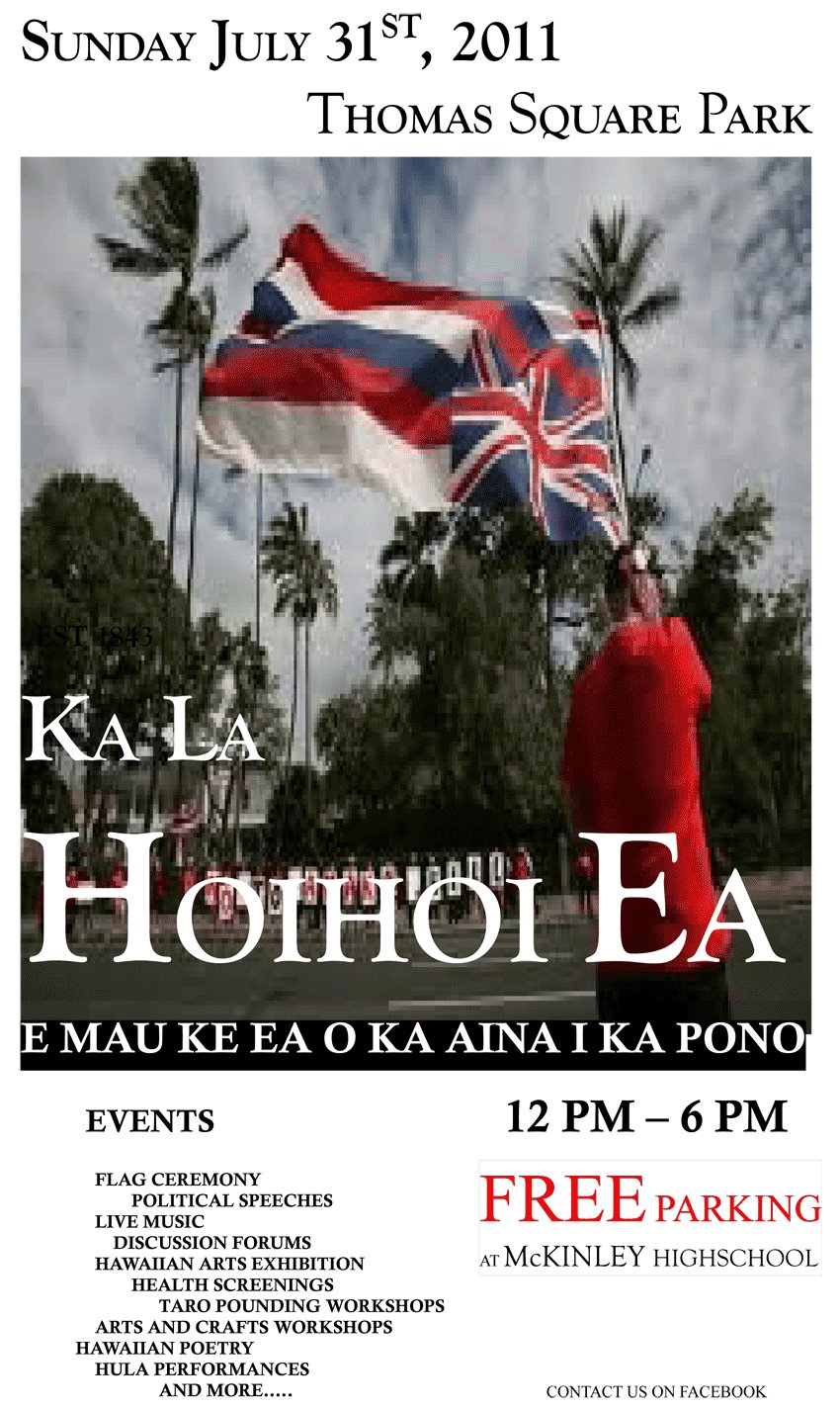
Ka La Ho’iho’i Ea 2011

From http://www.facebook.com/lahoihoiea:

We encourage the observance and celebration of La Ho’iho’i Ea everywhere Hawaiians tread the ‘AINA…

Please join us, Sunday July 31st 2011 ( @ Thomas Square in Honolulu), to celebrate and honor our ancestors, our history, our sovereignty and our unending fight for justice.

La Ho‘iho‘i Ea, celebrated from 1843 to 1893, commemorates the British Crown’s acknowledgment of Hawai‘i as an independent nation. A testament to Hawai‘i and our right to self-governance. Originally La Ho‘iho‘i Ea was a week long annual celebration marked by Hawaiian patriotism and all the best that our islands have to offer including music, crafts, games, food and community. It was celebrated for 50 years until, in 1893, Hawai‘i once again came under illegal occupation, this time by America.

Banned throughout the kingdom in the year 1893 along with other national holidays (i.e. La Kuokoa – Hawaii Independence Day ). La Ho‘iho‘i Ea experienced a rebirth in 1975 when Hawaiian national, scholar, and patriot Dr. Kekuni Blaisdell resurrected this holiday to honor and celebrate our continued independence and sovereignty, despite a century long American occupation.

“Ua mau ke ea o ka aina i ka pono”

“The sovereignty of our nation is preserved through righteousness.”

Kailua man admits aiding Marine to launder bribes

The Honolulu Star Advertiser reports:

A 40-year-old Kailua man admitted in federal court Friday that he helped a Marine Corps sergeant launder bribery money from military contractors in Iraq.

“A friend of mine was getting bribes. I was helping him conceal the bribes,” Francisco Mungia III said.

[…]

The government said Mungia received about $150,000 in 2006-2008 from two contractors doing business in Camp Fallujah, where the sergeant worked as a contracting officer.

Raptor wings clipped after Alaska crash

Here is another military expansion project in Hawai’i.   Senator Inouye’s strategy has been to pack as much construction and long-term capital improvements into the military budget for Hawai’i as a way to prolong the military’s presence and his influence over the shape of Hawai’i’s future long after he is gone. It’s about his legacy.  The Honolulu Star Advertiser reports:

The F-22 Raptor, the Air Force’s most advanced weapons system, is the only fighter capable of “simultaneously conducting air-to-air and air-to-ground combat missions with near impunity,” maker Lockheed Martin says on its website.

Now, if they could only get off the ground.

The Hawaii Air National Guard and active-duty Air Force showcased the stealth aircraft Friday at Joint Base Pearl Harbor-Hickam, where a groundbreaking was held for a $37.1 million maintenance hangar and squadron operations facility for the F-22s.

[…]

But an investigation into “hypoxia-like” symptoms — meaning not getting enough oxygen — experienced by some pilots elsewhere has left all Raptors in the Air Force inventory on stand-down since early May with no end to the grounding in sight.

[…]

F-22 improvement projects at Hickam totaling $156 million are expected to be completed through the next four to five years, officials said.

[…]

An Alaska F-22 pilot died in November when he lost control of his jet during training. The jet crashed about 100 miles north of Anchorage.