The fight to end colonization in the island-territory of Guahan

Perspectives on Social Justice: The fight to end colonization in the island-territory of Guahan

3.28.10 Blog Post written for the Therapeutic Justice Project blog at http://therapeuticjustice.blogspot.com/

By Dr. Hope Cristobal

I was 18 in the fall of 1996— “Rock the vote!” was in the air. MTV touted, “Choose or Lose!” Unfortunately that year, I was about to be labeled the “loser,” not by my choice, however, but by the choice made for me by the United States Department of the Interior.

I am an indigenous Chamoru from the island of Guam (the pronunciation given to the island by foreigners). Guahan, is the actual name given by the indigenous people—it means, “We have.”

“Do you guys wear grass skirts?…Do you even have stop lights there?…What do you call your tribe?…Wow, you speak such good English!” These were common questions I encountered when I moved to Washington State at the age of 17. You see, for the first 17 years of my life, I grew up in a United States colony in the Pacific, and many Americans knew nothing of Guahan, so I did a lot to educate my college friends that year. Yes, Guahan is a colony—or politically termed, an Unincorporated Territory of the United States. This is a fancy name for a place where the people are “part of the United States,” and have American citizenship, but do not fall under the United States Constitution, and thus, do not share in the inherent rights afforded most citizens of this country. As a colony, the people of Guahan have no vote in Congress and are governed and “cared for” by the Dept of the Interior—the same federal department that cares for all the national parks and endangered species.

It was the year of my 18th birthday that I encountered the question, “Who are you going to vote for? Clinton or Dole?” It took me a second. It was in this fraction of time that I witnessed my prior 18 years of oppression come splashing onto me, like a bucket of contaminated water that I had been told was fresh from a spring. I realized my “citizenship” was a lie. You see, as an American citizen who still claimed residency in Guahan, I was not allowed to vote for the president of the United States. But my roommate, who was a resident of the US and who shared equally in our household, could vote. She had a voice, a say for who she wanted to govern her life. I did not. She could “choose,” so did that mean I was left the “loser?”

Growing up in a colony you are governed by an outside force you never see. All decisions are made by an outside invisible entity, and the only thing you can do is follow what you’re told. You do not even determine your own destiny. You become the ignored, the silent—you become a void. On some maps, Guahan doesn’t even exist!

I was taught through my US textbooks, through my school instruction, and through the media in Guam that America is one of the bravest, strongest, most powerful, most benevolent, most generous countries in the world. “America the beautiful!” It is such an honor to be a citizen of such a great country! I learned all about American values: “life, liberty, the pursuit the happiness,” and “equality and justice for all.” I learned how to be a good American. As a matter of fact I was such a good American, I perfected the American education system and graduated with my doctorate degree in 2006!

Growing up in a colony, the US education system never taught me about how to be a successful Chamoru or a great Chamoru. I never learned my own identity, my culture, my language, my values, my ancestors, my saina (my great Chamoru leaders), my Chamoru history, history of the Pacific, the plants, the land, the ocean, the sky, the animals, how to grow food and hunt for fish, how to sail the ocean, how to kiss the back of my grandparents’ hand to show honor and respect, how to ask the ancestors of the jungle permission to enter their sacred place.

As a child, my mom tells the story of how she was hit for speaking Chamoru on school grounds. I tell the story of how I “hit” myself for sounding too Chamoru. Back then, I was degraded and in turn, I degraded others for being too Chamoru—I used a bad word called “chaud.” Before I was de-colonized in my mind, I owned the racism and void taught to me through my education, taught to me through television, read in the news, heard through the radio. I wanted to erase myself in order to fit in with the pressure to be a good American.

After that fateful day in 1996—the day I realized I was covered in contamination fed to me by colonial pressure and American idolization, I no longer wanted to be a part of that self-disgust. This was the day I began to lift the veil of colonialism away from my eyes and re-own my greatness as an indigenous Chamoru.

I went to school to become a psychologist because I wanted to empower my people; I wanted to find a way to re-awaken the power inside of them. I wanted to learn how to take away the pain of colonialism and replace it with a renewed sense of self—a powerful self that has a voice, no matter how small. Today, I am a psychologist living and practicing in California. All my training and research has been based on multicultural psychology, social justice and empowerment practices. I remain active in my Chamoru community and work with an organization called Famoksaiyan (means “to nurture, to grow”), speaking out and educating the American public about the injustice done to the Chamoru people because of their political placement within the American family. In 2007, I took my story to the United Nations’ Committee on Decolonization and urged them to continue their moral and ethical responsibility to eradicate colonies around the world. I am going again this year to remind the Committee that Guahan still needs their help.

My people experience a wide array of health, mental health, and legal problems. Chamorus are over-represented in correctional facilities and within the mental health system. We suffer high rates of teen suicide, school dropouts, depression, family violence, incarceration, poverty, substance abuse and social problems typical to subjugated native peoples. We have the highest rates of cancer, amyotrophic lateral sclerosis, and parkinsonism-dementia on US soil because of the military’s contamination of our land and water. We have high rates of cardiovascular disease, diabetes, hypertension, and obesity because of the change in our diet from indigenous food sources to packaged, processed foods imported from the US.

Today, we face the threat of further loss. In November 2009, the US military released a Draft Environmental Impact Statement (DEIS). In this statement to the Chamoru people, they say they plan to take an additional 40% of our 212 square mile island, in addition to the 1/3 they already own. They propose plans to relocate armed personnel from Okinawa to Guahan, which will increase our population by 45% over the next 4 years. As part of this project, they also plan to rip out 71 acres of our fragile reef to make way for a transient nuclear aircraft carrier. The DoD has rattled our cage and many Chamorus are saying “No!” to the military buildup and its proposed projects.

Even though we are unable to use the US Constitution to fight for our rights, we are gathering together in large numbers to save what we can of Guahan—what “we have”—our language, our culture, and our livelihoods. We are speaking about our experiences, our struggles, and our hopes for our people. We publish and speak out at weareguahan.com. And, we are gaining national and international attention. You can read the March 23rd Washington Post article here: http://weareguahan.com/2010/03/23/washington-post-runs-article-on-buildup/

The story of the US-colonized Chamorus in Guahan is one wrought with political, social, psychological, cultural, and economic subjugation, death, suffering, sacrifice, and alienation. Our struggle: my mother’s struggle and my struggle, has been perpetually memorialized in a very educational new PBS documentary called, The Insular Empire: America in the Mariana Islands, a film by Vanessa Warheit, a fierce Chamoru ally and activist. It will air on KCTS Seattle, March 28, at 7pm. It will replay on April 2 at 4am. Here is a schedule of upcoming national PBS air dates: http://www.mynewsletterbuilder.com/email/newsletter/1410236557 You can also read the blog here: http://theinsularempire.blogspot.com/. Vanessa Warheit and Famoksaiyan are working together to try to bring the film to the Seattle area for a screening with the producer and myself.

The end of colonialism begins on the shores of the United States. I am asking you now, my fellow American social activist, to help end colonialism for all indigenous people!

How can you be helpful to us?

• Educate yourself. If you are reading this right now, you already know so much more than the average American!

• In 5 minutes you can tell 5 more fellow Americans about what you’ve learned about Guahan. Encourage them to tell 5 more people, and so on.

• Sign up on the We are Guahan website and the Insular Empire blog to stay informed.

• You can donate to our California organization, Famoksaiyan. Our Paypal email is supportfamoksaiyan@gmail.com. We operate solely from money donated to us by angel funders such as you, and out of our own pockets. Your money can help conduct educational outreach in the schools and colleges; provide the opportunity for a Chamoru person to speak out at the local, national, and international levels about our injustice; further educate and empower our fellow Chamorus about their rights; and allow the bridging of our fight in Guahan to the fight here in the states.

• Call your local Congressperson and tell them about what you know. Tell them not to support the military buildup in Guahan.

On behalf of the Chamoru people, si yu’us ma’ase, yan saina ma’ase. Thank you for your support, and we also recognize and thank the leaders and guides that have gone before us. Manggaisuette siha ni’ manggaibosa! Blessed are those with voice!

Bio for Dr. Hope A. Cristobal

As an indigenous Chamoru living in the Diaspora, Dr. Hope Cristobal was born and raised on the island-territory of Guahan. She is a psychologist who specializes in the treatment and assessment of indigenous and marginalized populations, focusing on the unique situation for colonized Chamorus from Guahan. Dr. Cristobal believes that the long-term sustainability of the Chamorus is rooted in the resolution of colonization and marginalization, and the installation of community empowerment through the establishment of indigenous-lead, culturally sensitive solutions and programs. In 2007, she testified at the United Nations regarding the psychosocial problems currently facing the Chamoru people and urged the Committee on Decolonization to move forward with their commitment to eradicate colonies around the world. She is an active member of Famoksaiyan and is dedicated to raising awareness among the American public, and Chamorus from the Diaspora, about the social ills facing the colonized Chamoru communities in Guahan. You can contact Dr. Cristobal at hope.cristobal@gmail.com.
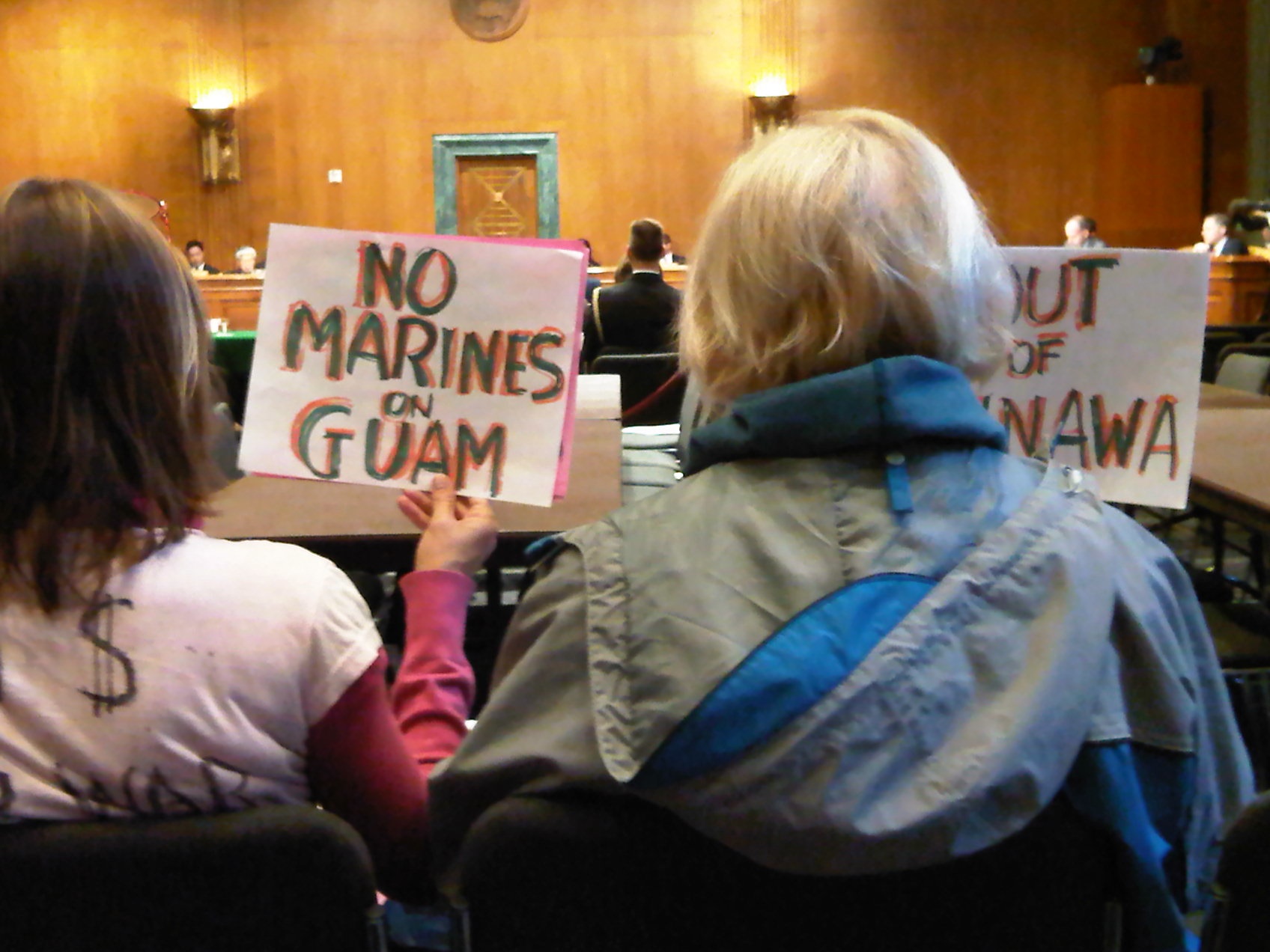
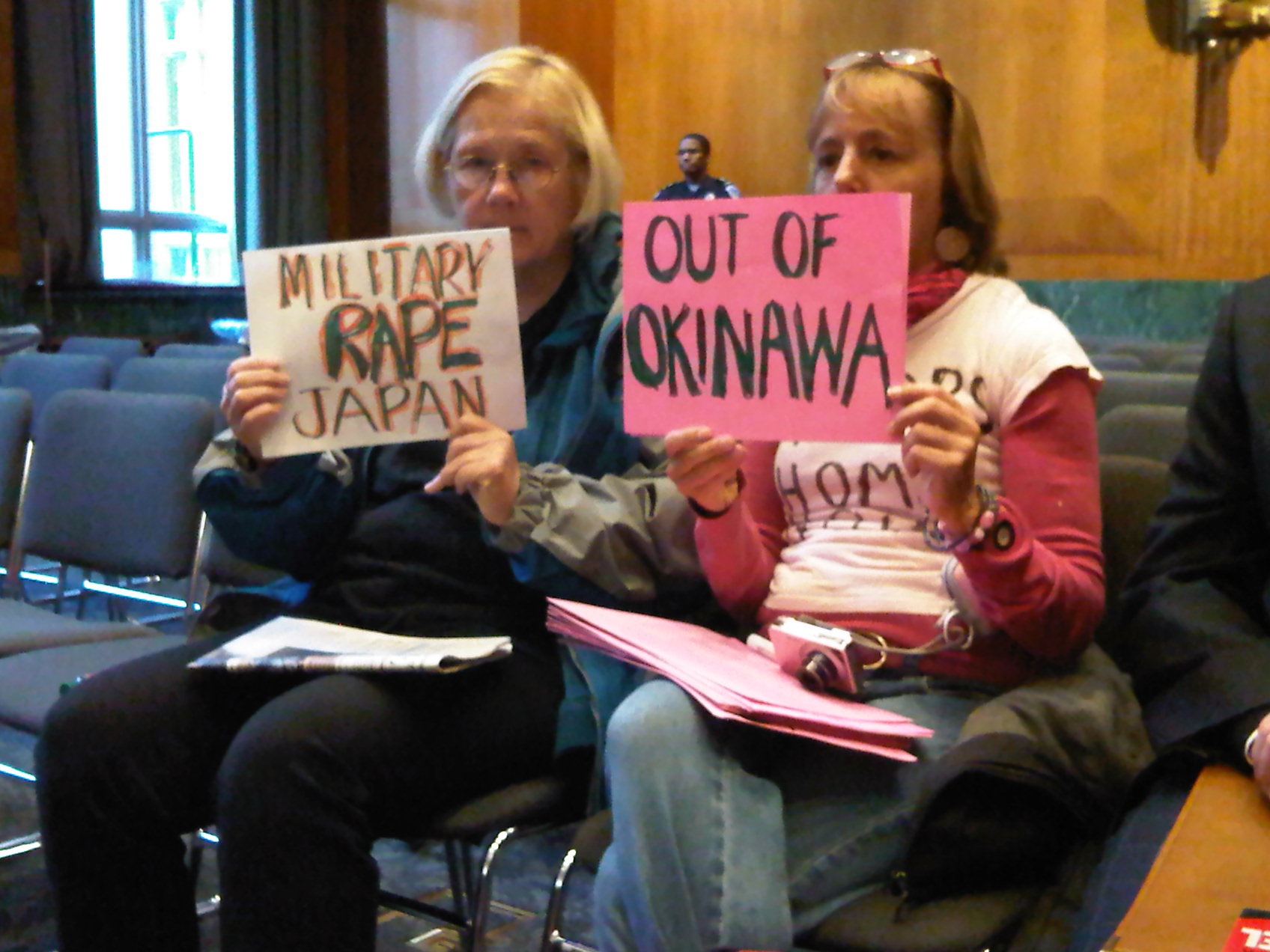
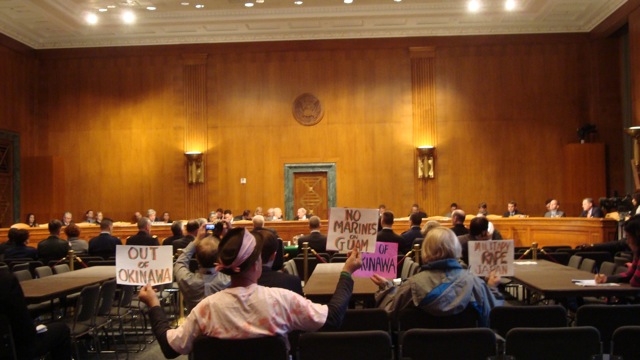
Ann Wright and Medea Benjamin hold signs in solidarity with Guam and Okinawa in Senate Hearing on the Pacific Command

IMG00254-20100326-0939
Ann Wright, Medea Benjamin protest military buildup in Okinawa and Guam at Senate hearing
IMG00253-20100326-0938
Ann Wright, Medea Benjamin protest military buildup in Okinawa and Guam at Senate hearing
DSC00652
Code Pink action at the US Senate. No bases in Okinawa and Guam. Ann Wright and Medea Benjamin
Here is the link to the SEnate Armed Services hearing on FRiday:

http://armed-services.senate.gov/hearings.cfm?h_month=3#month

Archived Webcast

March 26, 2010 – FULL COMMITTEE – To receive testimony on U.S. Pacific Command, U.S. Strategic Command, and U.S. Forces Korea
in review of the Defense Authorization Request for Fiscal Year 2011 and
the Future Years Defense Program.

http://armed-services.senate.gov/e_witnesslist.cfm?id=4500

WITNESSES

UNITED STATES SENATE

COMMITTEE ON ARMED SERVICES

_________________________________________________

There will be a meeting of the Committee on

ARMED SERVICES

Friday, March 26, 2010

9:00 AM

Room SD-106
Dirksen Senate Office Building

OPEN*

To receive testimony on U.S. Pacific Command, U.S. Strategic Command, and U.S. Forces Korea
in review of the Defense Authorization Request for Fiscal Year 2011 and
the Future Years Defense Program.

Archived Webcast


Guam Senator B.J. Cruz to speak in Honolulu about the proposed U.S. military expansion

http://www.law.hawaii.edu/event/2010/04/01

Maoli Thursday: The Guam Military Buildup

Examining Potential Impacts on Culture, Environment, the Economy and the Larger Community

Event Date: April 1, 2010

Ka Huli Ao Center for Excellence in Native Hawaiian Law Presents Maoli Thursday: The Guam Military Buildup: Examining Potential Impacts on Culture, Environment, the Economy and the Larger Community

Thursday, April 1, 2010 from 12:45 – 1:55 p.m.

Moot Court Room

Maoli Thursday is a lunchtime forum and speaker series held every first Thursday of the month.

Please RSVP by Tuesday, March 30, 2010 Via email: nhlawctr@hawaii.edu

Ka Huli Ao invites you to our last Maoli Thursday of the semester. This month’s lunchtime conversation is organized and moderated by law students Chris Odoca and Ana Pat-Borja.

Benjamin “B.J.” Cruz is the Vice Speaker of Guam’s Legislature and the former Chief Justice of the Guam Supreme Court. Mr. Cruz will discuss the proposed transfer of 8,600 U.S. Marines and their families from a U.S. military base in Okinawa to Guam, and the potential impacts on the island’s people and resources. In particular, Mr. Cruz will overview issues raised by the Draft Environmental Impact Statement for the proposed buildup, including projected effects on Guam’s reefs, water resources, and indigenous culture.

We are honored to have Wendy Wiltse, Ph.D., of the U.S. Environmental Protection Agency, Region 9 Honolulu, who will provide additional comments.

Free and open to the public. Refreshments will be served.

Event will be live-streamed at www.KaHuliAo.com

Requests to film the event must be received by 03/30/10;

Email nhlawctr@hawaii.edu for details.

Velvet Imperialists

Foreign Policy in Focus
World Beat:Vol. 5, No. 12

Velvet Imperialists

By John Feffer, March 23, 2010

I’m not a big fan of Dana Rohrabacher, the grandstanding Republican congressman from California. But last week at a congressional hearing on U.S.-Japan relations, he ably cut through the Pentagon’s doublespeak.

The hearing’s topic was the current conflict between Washington and Tokyo over the military bases on the Japanese island of Okinawa. The United States wants to close the aging Futenma air base, send half the Marines over to Guam, and build a replacement facility in a less populated part of the island. Most Okinawans don’t want a new base or an old base expanded to accommodate the remaining Marines from Futenma. The Japanese government hasn’t decided whether to listen to Washington or to its own constituents.

Rohrabacher had a simple question for the Pentagon official at the hearing. “How many U.S. military personnel do we have in Japan?” he asked. Looking very uncomfortable, the official said that he would have to get back to the congressman with those figures.

Excuse me? The congressman wasn’t asking about the location of Osama bin Laden or the Pentagon’s covert plan for Helmand province. The number of U.S. troops in Japan — approximately 47,000 — is no state secret. In response, Rohrabacher quite sensibly pointed out that it’s impossible to make a case for a new base unless we have a clear sense of our capabilities and our needs.

Rohrabacher, of course, was attempting to ride his hobby horse — the China menace — to the finish line. He tried to goad the Pentagon official into stating that China was a threat, but to no avail. The United States is happy that Japan is strengthening its relations with countries in the region, the official said, and China poses certain “challenges” but isn’t a “threat.”

Well, all of that is useful to know. The official’s statement is perfectly consistent with the latest Quadrennial Defense Review (QDR), in which the Pentagon pointedly failed to identify China as the only threat on the horizon that could dethrone the current king of the hill (a major feature of the previous QDR).

But if China’s no threat and the Cold War has been over for a couple decades, chairman of the Asia-Pacific subcommittee Eni Faleomavaega (D-American Samoa) asked, why does the United States need so many troops stationed in Japan? Faleomavaega also wanted to know why the United States has to maintain over 700 bases around the world and tops the list of global arms exporters.

The Pentagon official couldn’t satisfy either Rohrabacher’s anti-China tirade or Faleomavaega’s probing questions about the U.S. empire of bases. And that’s precisely the problem with the Obama administration’s Pacific policy. We are trying to maintain the exact same force posture as previous administrations but at the same time emphasizing our new commitment to multilateralism and our new status as a “global partner.” It’s like Arnold Schwarzenegger going from Terminator to Kindergarten Cop in the space of a year: Audiences above the age of seven are just not convinced.

Most recently, the Pentagon quietly announced that it will not build anything on Okinawa without the approval of the host community. That might make base relocation on the island a little difficult. After all, the prefectural government has come out against any new bases (or base expansions). So have the mayors of the affected communities. And according to a June 2009 opinion poll, 68 percent of Okinawans oppose relocating the Futenma base within the prefecture.

And it’s not as if the people of Guam — where 8,000 of the U.S. Marines from Futenma are slated to relocate — are overjoyed at the expansion of their own base. “They are angry about a major military buildup here, which the government of Guam and many residents say is being grossly underfunded,” writes Blaine Harden in The Washington Post. “They fear that the construction of a new Marine Corps base will overwhelm the island’s already inadequate water and sewage systems, as well as its port, power grid, hospital, highways and social services.”

If the Obama administration is truly committed to gaining the approval of host communities, it might soon find itself without any hosts at all. Here’s the bottom line: It’s not easy to run an empire with velvet gloves. A proper imperialist would have given the thumbs up to Rohrabacher and squelched Faleomavaega’s impertinence. A good old-fashioned hawk would never talk about gaining the consent of a host community. At the same time, velvet imperialists who revel in touchy-feely values of mutuality and good governance are no good at dismantling empires. They’re afraid of appearing weak. They speak of the need to “maintain stability” in an anarchic world. And they love to talk about how military bases are necessary for responding to humanitarian disasters like tsunamis and earthquakes.

In other words, don’t expect the Obama administration to pull a Gorbachev and begin to unravel the U.S. empire of bases. Look instead for an insider who knows the system, as Gorbachev did, to pull the plug. If some future administration chooses Andrew Bacevich as secretary of defense — the Boston University professor served in Vietnam and rose to the rank of colonel — we might actually see Pentagon reform we can believe in.

In the meantime, where should the Marines of Futenma relocate? I vote for Washington, DC. Marines deployed outside the U.S. Capitol could promote democracy by protecting lawmakers who support health care legislation from the wrath of tea party crazies. And if the Pentagon’s so keen on rebuilding cities, parts of the District certainly qualify. If the prospect of having U.S. Marines involved in promoting democracy, maintaining stability, and responding to humanitarian crises at home makes you squeamish, you can begin to understand how the Okinawans might feel.

For more information on our campaign to reduce the U.S. military footprint on Okinawa, visit our new website. And consider contributing a few dollars to help us spread the word with ads in major media.

The Military Yardstick

The Pentagon’s involvement in humanitarian crises — Haiti, Afghanistan — is certainly one example of mission creep. However you might feel about the use of military transport and personnel to deliver food and medical supplies, one important unintended consequence is the application of military yardsticks to judge the success of economic development.

“The current generation of policymakers isn’t the first to have little patience in demanding immediate impact from taxpayer dollars spent overseas,” writes Foreign Policy In Focus (FPIF) contributor Todd Diamond in Do the Military and Development Mix? “But increasingly, development projects are expected to solve the problems not only of historically inoperable states but also of those recently destroyed by war in equally short order. Advanced tools of warfare have greatly expedited our ability to project power. But the success of rebuilding a community, never mind a nation, should not be judged according to a military timeline.”

As the aftershocks of the earthquake in Haiti wear off, the U.S. military has given way to development organizations. And development organizations are giving way to…sweatshops?

“Former President Bill Clinton, currently serving as the UN’s envoy to Haiti, and economist Paul Collier…think Haiti needs to leverage its ‘cheap labor.’ In other words, they think Haiti will solve its problems by opening up more sweatshops,” writes FPIF contributor Tope Folarin in Sweatshops Won’t Save Haiti. “All this ignores the most important point: sweatshop labor’s inherent inhumanity. Sweatshop labor proponents have never worked in the conditions they so enthusiastically endorse for others. When advocating such solutions, they often offer compelling numbers as proof of their effectiveness. But what about the human costs: the extra hours workers spend away from their families, the risk of injury that accompanies repetitive movements, and the loss of morale as some boss demands that you produce even more?”

Finally, in Honduras, resistance to the military coup continues. FPIF contributor Rosie Wong reports on the international fast that mobilized support for the civic organizations arrayed against the coup. “While mass media attempts to sell us stories about how the situation is better, Honduran activists continue to struggle,” she writes in Responding to the Honduran Coup. “In addition to holding at least one major march every month, Hondurans are working hard to organize their communities for a National Constituent Assembly — a people’s project that was supported by Zelaya.”

If you’re in the DC area, join us tonight at Busboys and Poets to hear journalist Mac McClelland talk about her new book, on her time living with associates of a U.S.-designated terrorist organization battling Burma’s dictatorship. If you can’t make the event, we’ll be publishing an interview with McClelland this week on FPIF.

John Feffer is co-director of Foreign Policy In Focus.

http://www.fpif.org/articles/velvet_imperialists

On Guam, planned Marine base raises anger, infrastructure concerns

http://www.washingtonpost.com/wp-dyn/content/article/2010/03/21/AR2010032101025_pf.html

On Guam, planned Marine base raises anger, infrastructure concerns

By Blaine Harden

Washington Post Foreign Service

Monday, March 22, 2010; A01

HAGATNA, GUAM — This remote Pacific island is home to U.S. citizens who are fervent supporters of the military, as measured by their record of fighting and dying in America’s recent wars.

But they are angry about a major military buildup here, which the government of Guam and many residents say is being grossly underfunded. They fear that the construction of a new Marine Corps base will overwhelm the island’s already inadequate water and sewage systems, as well as its port, power grid, hospital, highways and social services.

“Our nation knows how to find us when it comes to war and fighting for war,” said Michael W. Cruz, lieutenant governor of Guam and an Army National Guard colonel who recently returned from a four-month tour as a surgeon in Afghanistan. “But when it comes to war preparations — which is what the military buildup essentially is — nobody seems to know where Guam is.”

The federal government has given powerful reasons to worry to the 180,000 residents of Guam, a balmy tropical island whose military importance derives from its location as by far the closest U.S. territory to China and North Korea.

The Environmental Protection Agency said last month that the military buildup, as described in Pentagon documents, could trigger island-wide water shortages that would “fall disproportionately on a low income medically underserved population.” It also said the buildup would overload sewage-treatment systems in a way that “may result in significant adverse public health impacts.”

A report by the Government Accountability Office last year came to similar conclusions, saying the buildup would “substantially” tax Guam’s infrastructure.

President Obama had planned to visit Guam on Monday as the brief first stop of an Asia trip, but he delayed his travel because of Sunday’s health-care vote in the House. Obama is aware of the problems here and had planned to promise some federal help, White House officials said.

“We’re trying to identify and understand the current conditions on Guam and the potential impact of the relocation,” said Nancy Sutley, head of the White House Council on Environmental Quality, who on Tuesday will lead a delegation to the island. “There’s no question that the environmental conditions on Guam are not ideal.”

Besides a new Marine base and airfield, the buildup includes port dredging for a nuclear-powered aircraft carrier, a project that would cause what the EPA describes as an “unacceptable” impact on 71 acres of a vibrant coral reef. The military, which owns 27 percent of the island, also wants to build a Marine firing range on land that includes one of the last undeveloped beachfront forests on Guam.

‘Should not proceed’

In a highly unusual move, the EPA graded the buildup plan as “environmentally unsatisfactory” and said it “should not proceed as proposed.”

“The government of Guam and the Guam Waterworks cannot by themselves accommodate the military expansion,” said Nancy Woo, associate director of the EPA’s western regional water division. She said Guam would need about $550 million to upgrade its water and sewage systems. White House officials said the EPA findings are preliminary.

Guam government officials put the total direct and indirect costs of coping with the buildup at about $3 billion, including $1.7 billion to improve roads and $100 million to expand the already overburdened public hospital. On this island — where a third of the population receives food stamps and about 25 percent lives below the U.S. poverty level — that price tag cannot be paid with local tax revenue.

“It is not possible and it is not fair that the island bear the cost,” Woo said.

At the peak of construction, the buildup would increase Guam’s population by 79,000 people, or about 45 percent. The EPA said the military plans, so far, to pay for public services for about 23,000 of the new arrivals, mostly Marines and their dependents who are relocating from the Japanese island of Okinawa. Ceded to the United States by Spain in 1898, Guam is a U.S. territory. Its residents are American citizens, but they cannot vote in presidential elections and have no voting representative in Congress.

The Marine Corps is sensing a populist backlash on Guam, which is three times the size of the District of Columbia and more than 6,000 miles west of Los Angeles.

“I see a rising level of concern about how we are going to manage this,” Lt. Gen. Keith J. Stalder, the Hawaii-based commander of Marine forces in the Pacific, said in a telephone interview. “I think it is becoming clearer every day that they need outside assistance.”

The White House said Obama included $750 million in his budget to address the civilian impact of the relocation and has asked Congress for $1 billion next year, but Guam officials say they have received no assurances from the federal government that the money is headed their way.

No input in decision

Guam was not consulted in the decision to move 8,000 Marines — about half those based in Okinawa — to the island. The $13 billion move was negotiated in 2006 between the Bush administration and a previous Japanese government, with Japan paying about $6 billion of the non-civilian cost, as a way of reducing the large U.S. military footprint in Okinawa.

But in the past year, with new leadership in Tokyo, the Japanese role in the move has become complicated. Anti-military sentiment is growing in Okinawa; Japan’s new leaders have yet to decide if they will allow a Marine air station to remain anywhere in the country. Defense Secretary Robert M. Gates has expressed irritation with Japan, even as the Pentagon presses ahead with its plan to shift the Marines to Guam by 2014.

The government of Guam and most of its residents initially welcomed the buildup. It was viewed as good for business, and the military enjoys deep respect here. Many families have members serving in the armed forces; among the 50 states and four territories, this island regularly ranks first in recruiting success. Guam’s killed-in-action rate is about four times as high as on the mainland.

Guam is the only American soil with a sizable population to have been occupied by a foreign military power. During World War II, the Japanese held the island for 2 1/2 brutal years, building concentration camps and forcing the indigenous Chamorro people to provide slave labor and sex. Beheadings were common.

Led by the Marines, American forces liberated the island in 1944, and people here say they still feel a debt to the United States. To repay it, they proudly call their island the “tip of the spear” for projecting U.S. military power in the Far East. Guam already has Navy and Air Force bases that can handle many of the most potent weapons in the U.S. arsenal. Nuclear-powered attack submarines, F-22 fighter jets and B-2 stealth bombers frequent the island, which will soon be protected by its own anti-missile system.

“We don’t mind being the tip of spear, but we don’t want to get the shaft,” said Simon A. Sanchez II, chairman of Guam’s commission on public utilities. “We have been asking for help from Day One, but we have not got any meaningful appropriations.”

‘Not being listened to’

The governor of Guam, Felix Camacho, asked the military last month to slow down the deployment of Marines until sufficient federal money arrives. But as a territory, and without a vote in Congress, the island has negligible lobbying power and no legal means of halting the buildup.

Many residents have hoped that Obama — a fellow Pacific islander, who was born in Hawaii and lived in Indonesia — might understand their anxieties and unlock federal resources. The White House said Obama will visit Guam when his Asia trip is rescheduled, perhaps in June.

“I just want to remind President Obama that his story is our story,” said Victoria-Lola Leon Guerrero, an English instructor at the University of Guam and a leader of a group opposing the buildup. She said her students read Obama’s autobiography, “Dreams From My Father,” focusing on a coming-of-age passage from his years in Hawaii, in which he describes his realization that he was “utterly alone.”

“That’s how we feel here,” she said. “We feel like we are not being listened to, like we are not being respected.”

The federal government’s push to further militarize this island — combined with its heel-dragging in paying for the impact on civilians — has led many Guam residents to doubt the value of their relationship with the United States.

“This is old-school colonialism all over again,” said Lisa Linda Natividad, an assistant professor of social work at the University of Guam and an activist opposing the buildup. “It boils down to our political status — we are occupied territory.”

Staff writer Michael D. Shear in Washington contributed to this report.

U.S. says base relocation plan must have acceptance of local community

http://www.breitbart.com/article.php?id=D9EJ212G0&show_article=1

LEAD: Local agreement necessary for Futemma relocation

Mar 21 09:35 AM US/Eastern

WASHINGTON, March 21 (AP) – (Kyodo)

The United States has told Japan it will not renegotiate the relocation plan for the U.S. Marine Corps’ Futemma Air Station in Okinawa Prefecture if the local community will not accept the relocation, sources close to the bilateral ties said Sunday.

While Japanese Foreign Minister Katsuya Okada is expected to visit the United States later this month, the U.S. side will likely stress that it is necessary to obtain local consent if Okada presents Japan’s proposal for the relocation site.

The Futemma transfer is part of a broader 2006 realignment road map for U.S. forces stationed in Japan, which also includes the relocation of 8,000 Marines to the U.S. territory of Guam by 2014.

The planned transfer of the Marines may be shelved if the Futemma facility is kept in continued use.

Washington has been pressing Japan to stick to the 2006 bilateral deal to transfer the Futemma facility, currently in Ginowan, Okinawa, to the coastal area of the Marines’ Camp Schwab in Nago — a move requiring land reclamation that has triggered strong local opposition.

Tokyo, for its part, plans to finalize the government’s plan on where to relocate it by the end of this month.

The Futemma relocation issue has remained as a major sticking point between the two countries since the coalition government of the Democratic Party of Japan, Social Democratic Party and the People’s New Party was launched last year.

Obama to meet with Guam authorities, but not grassroots leaders concerned about the military buildup

President Obama will meet with local Guam officials on a stopover March 22nd to allay rising concerns about the proposed military expansion in the Marianas islands   But he is not meeting with grassroots leaders who have demanded to be heard about their concerns regarding the military buildup.

>><<

http://www.guampdn.com/article/20100316/NEWS01/100316002/1001/NEWS/%3CB%3EBREAKING-NEWS-%3C-B%3E-8-15-a.m.-Obama-will-be-on-island-March-22-will-make-clear-his-commitment-to-the-people-of-Guam

BREAKING NEWS: 8:15 a.m. – Obama will be on island March 22, will make clear his commitment to the people of Guam

Pacific Daily News • news@guampdn.com • March 16, 2010

8:15 a.m. – President Obama will be on island on March 22 to demonstrate a commitment to people of Guam, according to White House officials who spoke during a press briefing on the president’s trip to Asia.

Obama on the evening of March 22 will be hosting a public event to speak with local Guam authorities and military personnel, said Ben Rhodes, the deputy national security adviser for strategic communications. Obama will leave for Indonesia the following day.

Denis McDonough, chief of staff for the National Security Council, added the president is “going to make sure that we have a very realistic and sustainable well-thought out approach to Guam.”

McDonough was responding to a reporter’s question. The reporter asked: “In addition to speaking to the Guam community and service members, what message is trying to be sent to the Pacific region overall and to Japan and China specifically with that?”

“While there he’ll not only visit with commanders but also with local Guam authorities. And he’s going to make sure that we have a very realistic and sustainable and well thought out approach to Guam,” McDonough said.

“He has a vision which we refer to here as ‘one Guam, green Guam,’ which is apropos of many of the questions heretofore, designed to make sure that we’re investing in capabilities on Guam that are sustainable over the course of time, that are clean energy focused, that do take very concrete steps to reduce the high price of energy on the island, and obviously will lead to an end state that’s politically, operationally, and environmentally sustainable.”

The president will also take a hard look at the infrastructure needs on Guam.

“We’ll obviously be looking at base-related construction that must take into accounts the needs of not only of an increased troop presence or Marine presence, but also the needs of the people of Guam, the impact on the environment, and the important role that the United States plays within the region,” McDonough said.

McDonough concluded: “”I wouldn’t read a particular set of — just to respond to the last part of your question — I wouldn’t read a specific or even general message to Japan or to China into the stop; I’d rather just make clear that we have a commitment to the people of Guam, and that as part of our ongoing plan for our presence in the region, are going to make very common-sense and important investments in the infrastructure there.”

‘Close the Base’: a new website for solidarity with Okinawa

Close the Base is a new website for U.S. solidarity with the anti-bases struggle in Okinawa.  Here’s an excerpt from their site:

We support the unconditional closure of the U.S. Marine Corps base at Futenma and oppose the construction of other U.S. bases in Okinawa.

The Network for Okinawa (NO) is a grassroots network that draws together representatives from peace groups, environmental organizations, faith-based organizations, academia, and think tanks.

Organizations involved in this effort include:

  • American Conservative Defense Alliance
  • American Friends Service Committee
  • Center for Biological Diversity
  • Columban Center for Advocacy and Outreach
  • Fellowship of Reconciliation
  • Greenpeace
  • Institute for Policy Studies
  • Japan Environmental Lawyers Federation
  • Just Foreign Policy
  • Pax Christi USA
  • Peace Action
  • Peace Boat US
  • Peace Philosophy Centre
  • United Methodists
  • Veterans for Peace
  • Women for Genuine Security

Our network supports the democratic decisions of the Okinawan people and opposes the expansion of U.S. military bases on Okinawa.

Thousands Call on Obama to Speak with All of Guam’s People, Hear Concerns About Buildup

FOR IMMEDIATE RELEASE FROM WE ARE GUÅHAN

Thousands Call on Obama to Speak with All of Guam’s People, Hear Concerns About Buildup

March 11, 2010, GUAM – With the largest military realignment in modern history slated to hit the US Territory of Guam, over 11,000 people from the Pacific Island and across the globe signed a petition asking President Barack Obama to speak directly with the people of Guam during his short visit next week. Obama’s visit is an opportunity for the island’s residents, who do not have the right to vote for President, to voice the many concerns they have with the buildup.

We Are Guåhan, a grassroots collective of individuals, families and organizations working to inform the community about the impacts of the buildup, began circulating the petition when it was announced last month that Obama would visit the island, but only speak to military personnel at Andresen Air Force Base.

After review of the Draft Environmental Impact Statement (DEIS), released on November 30, 2009, We Are Guåhan worked with other concerned organizations and individuals to educate the community on the impacts of the buildup. We Are Guåhan, along with Government of Guam agencies, other organizations and concerned individuals submitted thousands of comments on the DEIS– many of them pointing to the negative impacts outlined there for the people, economy and environment.

After the U.S. Environmental Protection Agency’s indictment of the DEIS late February, it has become increasingly clear that the military realignment to Guam will threaten the health and safety of the island’s residents.

“We have not been able to say yes or no to this,” says Jon Blas, resident of the village of Tamuning and member of We Are Guåhan. “Hawaii said no. California said no. But we were never given the opportunity. It’s not fair, especially because it is looking like this is going to hurt us more than help us.”

We Are Guåhan’s growing membership felt that a strong message must be sent to Washington DC. The petition states: “The military buildup will permanently change our island and our lives. The needs of all Guam’s people must come first, for this island is our home. It is critical that President Obama hear our concerns.”

We Are Guåhan will deliver the petition to the White House today both by electronic and paper copy.

There will be a community response on March 19, during Obama’s visit, to break the silence and demonstrate that the island’s people demand to have a  voice in their future. Obama is not currently planning to speak with the people of Guam. We Are Guåhan hopes the 11,000 requests for a forum will change Obama’s plans.

For more information visit We Are Guåhan’s website at www.weareguahan.com. You may also contact Victoria-Lola Leon Guerrero at victoria.lola@gmail.com or (671) 929-6382 (please only use this information for personal media contact. Do not publish this contact information).

US Dream Come True? The New Henoko Sea Base and Okinawan Resistance

http://japanfocus.org/-Makishi-Yoshikazu/1819

US Dream Come True? The New Henoko Sea Base and Okinawan Resistance

By Makishi Yoshikazu

[Why is the news of a plan to move 7,000 US Marine troops from southern Okinawa to Guam creating no good vibes in Okinawa? Because nothing much is changing. The Japanese Government is proceeding with construction of a new US Marine Corps Air Station in Nago, to ‘replace’ the old Futenma base. Throughout the last decade, locals have resolutely fought the US military presence. Period. However, Tokyo and Washington have basically ridden roughshod over locals’ democratic expression of opposition, including, the outcome of the 1997 Nago citizens’ referendum against the relocation of Futenma to Henoko and, since April 2004, residents’ non-violent blockade action to prevent the government’s preliminary site investigations and ocean floor drilling.

In October 2005, Japan and the US reached agreement on plans to construct a military airport in Henoko, shifting the runway location from the shallow reef area slightly to the north and extending the runway from 1,500 to 1,800 m. [1] The new site, located within the US military facility and extended into the deeper Oura Bay, would effectively prevent entry by local protesters.

Okinawan researchers have recently uncovered documentary evidence refuting the claim that ‘Henoko is a Futenma substitute’: the plans call for a newly built upgraded military base using taxpayers’ money despite strong local opposition. The US military claims to be protecting global democracy. Respecting local democracy would be a good start . Miyume Tanji]

Henoko Protesters’ Non-violent Blockade Stops Government Investigation

It was just after sunrise when the boats appeared off the shore of Henoko on 19 April 2004. The boats belonged to the Security Facilities Bureau, Naha Branch, and they were there to conduct a geological survey. The Bureau planned to drill 63 holes under water. This action, which ignored necessary review and public notification procedures, blatantly violated Article 31 of Japan’s Environmental Impact Assessment Law. [2] The Henoko locals responded to this illegal action with a sit-in. They then canoed and swam out to the ocean in scuba gear and physically blocked the investigation by climbing the Bureau’s scaffolds. The protest spread nation-wide, attracting donations and participants to the round-the-clock direct action in Henoko as well as prompting sit-ins at the Diet in Tokyo. The boats for the blockade were provided by supporters, with local fisherpeople taking part. The Henoko locals’ non-violent action gained public support; so did their steely determination, not just to protest, but to stop, the government’s illegal site investigations. The sit-in and blockade continued until September 2, 2005, when the Bureau removed the scaffolds from the ocean, citing concern about typhoon damage. The protesters’ blockade had succeeded.

Meanwhile, Tokyo-Washington meetings for the comprehensive U.S. forces realignment had started. The new sea-based military base in Henoko was part of this realignment. ‘Tell the US that Okinawa will not accept any new base construction’, requested Yamauchi Tokushin and three other delegates from the Okinawan Citizens’ Conference against Futenma Relocation within Okinawa at a meeting with Defense Policy Chief and Director General of the Foreign Ministry’s North American Affairs Bureau. It was cold but, the diplomat, wiping sweat from the nape of his neck, said ‘we realize this must be hard for Okinawans’. From such comments, the delegates discerned that the Japanese government had not conveyed Okinawans’ collective will to the US, and was promoting relocation of Futenma to Henoko. On 29 October, a formal agreement was reached between Japan and US at the Joint Security Committee (referred to as the ‘two plus two meeting’). [3] Strangely, the government of Japan calls this agreement an Interim Report, although nowhere in the document is it so referred to. I sense deceit in this government’s expression. The report is really meant to be the final agreement, yet it is not clearly presented as such.

New Plan of Futenma relocation to Henoko: a US-Japanese ‘Collaboration’, not a ‘Compromise’

At the preliminary two-plus-two meeting on October 24, 2005, the media reported, Japan argued against the US – taking an uncharacteristically bold position on the best location for the new base in Henoko. Japan allegedly ‘resisted’ the original ‘reef plan’ preferred by the US. This involved construction of a military airport on Cape Henoko, which is a shallow reef area and the habitat of rich marine life including dugongs. The reclamation of this reef has been fiercely opposed by environmentalists. Finally at the end of the meeting that dragged until early on the 26 th,, Japan ‘compromised’. The US and Japan agreed on a ‘coastal plan’, which involves construction of a runway covering an L-shaped area extending from the Henoko reef to Oura Bay, embracing Camp Schwab (see Figure 1). [4] However, Figure 1 indicates that the agreed construction method, far from being a compromise reached after long negotiation, was a collaborative scheme by the two governments to upgrade the capacity of the Futenma Marine Corps Air Station.

It is not just a military airport that the US forces want in Henoko. As specified in the relevant Department of Defense Executive Report issued on September 27 th, [5] US forces demanded a special facility called ‘CALA’, or the Combat Aircraft Loading Area within the new base to load ammunition and explosives on aircraft (see Figure 2). The document stipulates, furthermore, that ‘CALA’ needs to be at least 1,250 feet away from any occupied buildings. Currently only Kadena Air Base can meet these conditions and Futenma helicopters are flying to Kadena for loading purposes. The 1997 Executive Report requires a ‘CALA’ to be built next to the new sea-based Air Station because Kadena is too far away. It seems that the reason why the runway of the new Air Station was extended from 1,500 to 1,800 meters at the October two-plus-two meeting was to facilitate a special loading zone.

According to the 1997 Executive Report , the direction of the new runway was decided following research conducted in 1966. In December 1966, in a ‘Master Plan of Navy Facilities on Okinawa, Ryukyu Islands’, [6] the US Navy recommended construction of a 3,000-meter airfield on reclaimed Henoko coral reef to be used by the marines. In addition, it also designed a military port in adjacent Oura Bay (Figure 3) for Navy use. The location of the airfield’s runway in Figure 3 is almost identical to that in the 1997 Executive Report (Figure 2). Figure 3 also depicts a ‘pier’. This pier appears to be simply a variation of the military port proposed in the 1966 Master Plan. In sum, the US wants not just a runway, but also a loading facility and a military port. At the 2005 two-plus-two meeting, the two governments agreed on the construction of ‘a pier for refueling and relevant facilities’, that is, nothing less than a military port: Oura Bay is more than 20 meters deep, enough for a nuclear aircraft carrier to enter alongside the pier.

There are further issues. In the area targeted for the new military airport in the October Agreement, there are historical ruins, the local newspaper Okinawa Taimusu reported. The astonishing thing is that the 1997 Executive Report acknowledged the cultural ruins on the south side of the area as one of the factors militating against airfield development. In short, the Department of Defense in 1997 judged that the ruins in the coastal area posed potential difficulties for the new military base construction. However, the Agreement in October 2005 designated the whole southern coastal area as the future site for the airfield replacing Futenma, despite the US forces’ understanding that the area was problematic. So, why is it OK now? Perhaps the Japanese government promised to legalize the construction by enacting a new law, such as a Special Measures Law for the Protection of Cultural Properties, that makes an exception for the needs of US forces. [7] With the 2005 ‘coastal plan’, the US and Japan are attempting a ‘hat trick’: an Agreement on the construction of a military airport, a special loading zone, and a military port – three new facilities – in Henoko. The construction, far from being a compromise, is the joint work of the two states. The plan is clearly unacceptable. Nago citizens have already rejected the new base construction in the referendum on December 21 1997 even without knowing all that the plan entailed.

Respect the democratic will of local citizens. Stop the Henoko military airport construction plan. This is precisely what the US military has long sought. Blocking the plan is a step toward protecting democracy worldwide.

Makishi Yoshikazu is a Naha born Okinawan architect. Since working for Okinawa Sōgō Jimukyoku (Okinawa Development Agency), he has designed award-winning buildings for Okinawa Christian Junior College, Sakima Museum and many others. He has also been a long-term environmentalist and peace activist in Okinawa. [8]

Translated by Miyume TANJI from a chapter in Makishi’s Okinawa wa Kichi o Kyozetsu Suru (Okinawa Refuses Bases). Tanji’s book Myth, Protest and Struggle in Okinawa will be published by RoutledgeCurzon in 2006

Endnotes:

[1] See Miyagi Yasuhiro, ‘ Okinawa – Rising Magma’, Japan Focus, posted 4 December 2005.

[2] According to the Law, any environmental impact assessment activities can be started only after the publication of a document that explains the methods of such activities reviewed by the Ministry of Environment and relevant ministries/agencies (Article 31).

[3] See ‘Security Consultative Document, U.S.-Japan Alliance: Transformation and Realignment for the Future’ by State Secretary Rice, Defense Secretary Rumsfeld, Minister of Foreign Affairs Machimura, and Minister of Defense for State Ohno, October 29 2005, available.

[4] ‘Futenma Isetsu, Bei ga Henoko Oki ShÅ«seian’ (The US alternative suggestion on Futenma Relocation to Henoko), Asahi Shimbun 25 October 2005; ‘ Japan, U.S. Agree on New Futenma site’ Japan Times 27 October 2005.

[5] The U.S. Department of Defense, ‘Executive Report: Sea-Based Facility, Functional Analysis and Concept of Operations, MCAS Futenma Relocation’ ( 3 September 1997), held by the Okinawa Prefecture Military Base Affairs Division.

[6] Daniel, Mann, Johnson, & Mendenhall, Master Plan of Navy Facilities on Okinawa, Ryukyu Islands, prepared for the Department of Defense (Dec. 29, 1966), held in the Okinawa Prefecture Archives.

[7] In December 2005, the government discussed special legislation to deprive local governments of authority over public water reclamation projects precisely in order to restrict the power of Okinawan Governor Inamine, who is opposed to the new ‘coastal plan’. Similar special legislation (related to US Military Special Measures Law) was passed in April 1997, which removed local government’s power to authorize lease of privately owned land occupied by the US military facilities, when a landowner refused to consent.

[8] On Makishi’s activities as anti-war landowner and marine conservationist, s ee Miyume Tanji, Myth, Protest and Struggle in Okinawa, RoutledgeCurzon, London (forthcoming).

Posted at Japan Focus, February 12, 2006.