Can Japan Say No to Washington?

http://www.tomdispatch.com/post/175214/tomgram:_john_feffer,_can_japan_say_no_to_washington/

Tomgram: John Feffer, Can Japan Say No to Washington?

Posted by John Feffer at 11:15am, March 4, 2010.

When it comes to cracks in America’s imperial edifice — as measured by the ability of other countries to say “no” to Washington, or just look the other way when American officials insist on something — Europe has been garnering all the headlines lately, and they’ve been wildly American-centric. “Gates: Nato, in crisis, must change its ways,” “Pull Your Weight, Europe,” “Gates: Europe’s demilitarization has gone too far,” “Dutch Retreat,” and so on. All this over one country — Holland — which will evidently pull out of Afghanistan thanks to intensifying public pressure about the war there, and other NATO countries whose officials are shuffling their feet and hemming and hawing about sending significant reinforcements Afghanistan-wards. One could, of course, imagine quite a different set of headlines (“Europeans react to overbearing, overmuscled Americans,” “Europeans turn backs on endless war”), but not in the mainstream news. You can certainly find some striking commentary on the subject by figures like Andrew Bacevich and Juan Cole, but it goes unheeded.

The truth is that Europe still seems a long way from being ready to offer any set of firm noes to Washington on much of anything, while in Asia, noes from key American clients of the past half-century have been even less in evidence. But sometimes from the smallest crack in a façade come the largest of changes. In this case, the most modest potential “no” from a new Japanese government in Tokyo, concerning U.S. basing posture in that country, seems to have caused near panic in Washington. In neither Europe nor Asia have we felt any political earthquakes — yet. But just below the surface, the global political tectonic plates are rubbing together, and who knows when, as power on this planet slowly shifts, one of them will slip and suddenly, for better or worse, the whole landscape of power will look different.

John Feffer, the co-director of Foreign Policy in Focus and a TomDispatch regular, already has written for this site on whether Afghanistan might prove NATO’s graveyard. Now, he turns east to explore whether, in a dispute over one insignificant base on the Japanese island of Okinawa, we might be feeling early rumblings on the Asian fault-line of American global power. Tom

Pacific Pushback

Has the U.S. Empire of Bases Reached Its High-Water Mark?

By John Feffer

For a country with a pacifist constitution, Japan is bristling with weaponry. Indeed, that Asian land has long functioned as a huge aircraft carrier and naval base for U.S. military power. We couldn’t have fought the Korean and Vietnam Wars without the nearly 90 military bases scattered around the islands of our major Pacific ally. Even today, Japan remains the anchor of what’s left of America’s Cold War containment policy when it comes to China and North Korea. From the Yokota and Kadena air bases, the United States can dispatch troops and bombers across Asia, while the Yokosuka base near Tokyo is the largest American naval installation outside the United States.

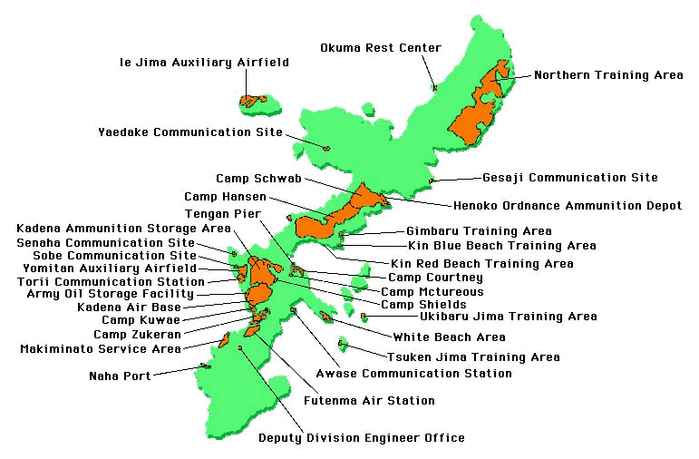
You’d think that, with so many Japanese bases, the United States wouldn’t make a big fuss about closing one of them. Think again. The current battle over the Marine Corps air base at Futenma on Okinawa — an island prefecture almost 1,000 miles south of Tokyo that hosts about three dozen U.S. bases and 75% of American forces in Japan — is just revving up. In fact, Washington seems ready to stake its reputation and its relationship with a new Japanese government on the fate of that base alone, which reveals much about U.S. anxieties in the age of Obama.

What makes this so strange, on the surface, is that Futenma is an obsolete base. Under an agreement the Bush administration reached with the previous Japanese government, the U.S. was already planning to move most of the Marines now at Futenma to the island of Guam. Nonetheless, the Obama administration is insisting, over the protests of Okinawans and the objections of Tokyo, on completing that agreement by building a new partial replacement base in a less heavily populated part of Okinawa.

The current row between Tokyo and Washington is no mere “Pacific squall,” as Newsweek dismissively described it. After six decades of saying yes to everything the United States has demanded, Japan finally seems on the verge of saying no to something that matters greatly to Washington, and the relationship that Dwight D. Eisenhower once called an “indestructible alliance” is displaying ever more hairline fractures. Worse yet, from the Pentagon’s perspective, Japan’s resistance might prove infectious — one major reason why the United States is putting its alliance on the line over the closing of a single antiquated military base and the building of another of dubious strategic value.

During the Cold War, the Pentagon worried that countries would fall like dominoes before a relentless Communist advance. Today, the Pentagon worries about a different kind of domino effect. In Europe, NATO countries are refusing to throw their full support behind the U.S. war in Afghanistan. In Africa, no country has stepped forward to host the headquarters of the Pentagon’s new Africa Command. In Latin America, little Ecuador has kicked the U.S. out of its air base in Manta.

All of these are undoubtedly symptoms of the decline in respect for American power that the U.S. military is experiencing globally. But the current pushback in Japan is the surest sign yet that the American empire of overseas military bases has reached its high-water mark and will soon recede.

Toady No More?

Until recently, Japan was virtually a one-party state, and that suited Washington just fine. The long-ruling Liberal Democratic Party (LDP) had the coziest of bipartisan relations with that city’s policymakers and its “chrysanthemum club” of Japan-friendly pundits. A recent revelation that, in 1969, Japan buckled to President Richard Nixon’s demand that it secretly host U.S. ships carrying nuclear weapons — despite Tokyo’s supposedly firm anti-nuclear principles — has pulled back the curtain on only the tip of the toadyism.

During and after the Cold War, Japanese governments bent over backwards to give Washington whatever it wanted. When government restrictions on military exports got in the way of the alliance, Tokyo simply made an exception for the United States. When cooperation on missile defense contradicted Japan’s ban on militarizing space, Tokyo again waved a magic wand and made the restriction disappear.

Although Japan’s constitution renounces the “threat or the use of force as a means of settling international disputes,” Washington pushed Tokyo to offset the costs of the U.S. military adventure in the first Gulf War against Saddam Hussein in 1990-1991, and Tokyo did so. Then, from November 2001 until just recently, Washington persuaded the Japanese to provide refueling in the Indian Ocean for vessels and aircraft involved in the war in Afghanistan. In 2007, the Pentagon even tried to arm-twist Tokyo into raising its defense spending to pay for more of the costs of the alliance.

Of course, the LDP complied with such demands because they intersected so nicely with its own plans to bend that country’s peace constitution and beef up its military. Over the last two decades, in fact, Japan has acquired remarkably sophisticated hardware, including fighter jets, in-air refueling capability, and assault ships that can function like aircraft carriers. It also amended the 1954 Self-Defense Forces Law, which defines what the Japanese military can and cannot do, more than 50 times to give its forces the capacity to act with striking offensive strength. Despite its “peace constitution,” Japan now has one of the top militaries in the world.

Enter the Democratic Party of Japan (DPJ). In August 2009, that upstart political party dethroned the LDP, after more than a half-century in power, and swept into office with a broad mandate to shake things up. Given the country’s nose-diving economy, the party’s focus has been on domestic issues and cost-cutting. Not surprisingly, however, the quest to cut pork from the Japanese budget has led the party to scrutinize the alliance with the U.S. Unlike most other countries that host U.S. military bases, Japan shoulders most of the cost of maintaining them: more than $4 billion per year in direct or indirect support.

Under the circumstances, the new government of Prime Minister Yukio Hatoyama proposed something modest indeed — putting the U.S.-Japan alliance on, in the phrase of the moment, a “more equal” footing. It inaugurated this new approach in a largely symbolic way by ending Japan’s resupply mission in the Indian Ocean (though Tokyo typically sweetened the pill by offering a five-year package of $5 billion in development assistance to the Afghan government).

More substantively, the Hatoyama government also signaled that it wanted to reduce its base-support payments. Japan’s proposed belt-tightening comes at an inopportune moment for the Obama administration, as it tries to pay for two wars, its “overseas contingency operations,” and a worldwide network of more than 700 military bases. The burdens of U.S. overseas operations are increasing, and fewer countries are proving willing to share the costs.

Of Dugongs and Democracy

The immediate source of tension in the U.S.-Japanese relationship has been Tokyo’s desire to renegotiate that 2006 agreement to close Futenma, transfer those 8,000 Marines to Guam, and build a new base in Nago, a less densely populated area of the island. It’s a deal that threatens to make an already strapped government pay big. Back in 2006, Tokyo promised to shell out more than $6 billion just to help relocate the Marines to Guam.

The political cost to the new government of going along with the LDP’s folly may be even higher. After all, the DPJ received a healthy chunk of voter support from Okinawans, dissatisfied with the 2006 agreement and eager to see the American occupation of their island end. Over the last several decades, with U.S. bases built cheek-by-jowl in the most heavily populated parts of the island, Okinawans have endured air, water, and noise pollution, accidents like a 2004 U.S. helicopter crash at Okinawa International University, and crimes that range from trivial speeding violations all the way up to the rape of a 12-year-old girl by three Marines in 1995. According to a June 2009 opinion poll, 68% of Okinawans opposed relocating Futenma within the prefecture, while only 18% favored the plan. Meanwhile, the Social Democratic Party, a junior member of the ruling coalition, has threatened to pull out if Hatoyama backs away from his campaign pledge not to build a new base in Okinawa.

Then there’s the dugong, a sea mammal similar to the manatee that looks like a cross between a walrus and a dolphin and was the likely inspiration for the mermaid myth. Only 50 specimens of this endangered species are still living in the marine waters threatened by the proposed new base near less populated Nago. In a landmark case, Japanese lawyers and American environmentalists filed suit in U.S. federal court to block the base’s construction and save the dugong. Realistically speaking, even if the Pentagon were willing to appeal the case all the way up to the Supreme Court, lawyers and environmentalists could wrap the U.S. military in so much legal and bureaucratic red tape for so long that the new base might never leave the drawing board.

For environmental, political, and economic reasons, ditching the 2006 agreement is a no-brainer for Tokyo. Given Washington’s insistence on retaining a base of little strategic importance, however, the challenge for the DPJ has been to find a site other than Nago. The Japanese government floated the idea of merging the Futenma facility with existing facilities at Kadena, another U.S. base on the island. But that plan — as well as possible relocation to other parts of Japan — has met with stiff local resistance. A proposal to further expand facilities in Guam was nixed by the governor there.

The solution to all this is obvious: close down Futenma without opening another base. But so far, the United States is refusing to make it easy for the Japanese. In fact, Washington is doing all it can to box the new government in Tokyo into a corner.

Ratcheting Up the Pressure

The U.S. military presence in Okinawa is a residue of the Cold War and a U.S. commitment to containing the only military power on the horizon that could threaten American military supremacy. Back in the 1990s, the Clinton administration’s solution to a rising China was to “integrate, but hedge.” The hedge — against the possibility of China developing a serious mean streak — centered around a strengthened U.S.-Japan alliance and a credible Japanese military deterrent.

What the Clinton administration and its successors didn’t anticipate was how effectively and peacefully China would disarm this hedging strategy with careful statesmanship and a vigorous trade policy. A number of Southeast Asian countries, including the Philippines and Indonesia, succumbed early to China’s version of checkbook diplomacy. Then, in the last decade, South Korea, like the Japanese today, started to talk about establishing “more equal” relations with the United States in an effort to avoid being drawn into any future military scrape between Washington and Beijing.

Now, with its arch-conservatives gone from government, Japan is visibly warming to China’s charms. In 2007, China had already surpassed the United States as the country’s leading trade partner. On becoming prime minister, Hatoyama sensibly proposed the future establishment of an East Asian community patterned on the European Union. As he saw it, that would leverage Japan’s position between a rising China and a United States in decline. In December, while Washington and Tokyo were haggling bitterly over the Okinawa base issue, DPJ leader Ichiro Ozawa sent a signal to Washington as well as Beijing by shepherding a 143-member delegation of his party’s legislators on a four-day trip to China.

Not surprisingly, China’s bedazzlement policy has set off warning bells in Washington, where the People’s Republic is still a focus of primary concern for a cadre of strategic planners inside the Pentagon. The Futenma base — and its potential replacement — would be well situated, should Washington ever decide to send rapid response units to the Taiwan Strait, the South China Sea, or the Korean peninsula. Strategic planners in Washington like to speak of the “tyranny of distance,” of the difficulty of getting “boots on the ground” from Guam or Hawaii in case of an East Asian emergency.

Yet the actual strategic value of Futenma is, at best, questionable. The South Koreans are more than capable of dealing with any contingency on the peninsula. And the United States frankly has plenty of firepower by air (Kadena) and sea (Yokosuka) within hailing distance of China. A couple thousand Marines won’t make much of a difference (though the leathernecks strenuously disagree). However, in a political environment in which the Pentagon is finding itself making tough choices between funding counterinsurgency wars and old Cold War weapons systems, the “China threat” lobby doesn’t want to give an inch. Failure to relocate the Futenma base within Okinawa might be the first step down a slippery slope that could potentially put at risk billions of dollars in Cold War weapons still in the production line. It’s hard to justify buying all the fancy toys without a place to play with them.

And that’s one reason the Obama administration has gone to the mat to pressure Tokyo to adhere to the 2006 agreement. It even dispatched Secretary of Defense Robert Gates to the Japanese capital last October in advance of President Obama’s own Asian tour. Like an impatient father admonishing an obstreperous teenager, Gates lectured the Japanese “to move on” and abide by the agreement — to the irritation of both the new government and the public.

The punditocracy has predictably closed ranks behind a bipartisan Washington consensus that the new Japanese government should become as accustomed to its junior status as its predecessor and stop making a fuss. The Obama administration is frustrated with “Hatoyama’s amateurish handling of the issue,” writes Washington Post editorial page editor Fred Hiatt. “What has resulted from Mr. Hatoyama’s failure to enunciate a clear strategy or action plan is the biggest political vacuum in over 50 years,” adds Victor Cha, former director of Asian affairs at the National Security Council. Neither analyst acknowledges that Tokyo’s only “failure” or “amateurish” move was to stand up to Washington. “The dispute could undermine security in East Asia on the 50th anniversary of an alliance that has served the region well,” intoned The Economist more bluntly. “Tough as it is for Japan’s new government, it needs to do most, though not all, of the caving in.”

The Hatoyama government is by no means radical, nor is it anti-American. It isn’t preparing to demand that all, or even many, U.S. bases close. It isn’t even preparing to close any of the other three dozen (or so) bases on Okinawa. Its modest pushback is confined to Futenma, where it finds itself between the rock of Japanese public opinion and the hard place of Pentagon pressure.

Those who prefer to achieve Washington’s objectives with Japan in a more roundabout fashion counsel patience. “If America undercuts the new Japanese government and creates resentment among the Japanese public, then a victory on Futenma could prove Pyrrhic,” writes Joseph Nye, the architect of U.S. Asia policy during the Clinton years. Japan hands are urging the United States to wait until the summer, when the DPJ has a shot at picking up enough additional seats in the next parliamentary elections to jettison its coalition partners, if it deems such a move necessary.

Even if the Social Democratic Party is no longer in the government constantly raising the Okinawa base issue, the DPJ still must deal with democracy on the ground. The Okinawans are dead set against a new base. The residents of Nago, where that base would be built, just elected a mayor who campaigned on a no-base platform. It won’t look good for the party that has finally brought real democracy to Tokyo to squelch it in Okinawa.

Reverse Island Hop

Wherever the U.S. military puts down its foot overseas, movements have sprung up to protest the military, social, and environmental consequences of its military bases. This anti-base movement has notched some successes, such as the shut-down of a U.S. navy facility in Vieques, Puerto Rico, in 2003. In the Pacific, too, the movement has made its mark. On the heels of the eruption of Mt. Pinatubo, democracy activists in the Philippines successfully closed down the ash-covered Clark Air Force Base and Subic Bay Naval Station in 1991-1992. Later, South Korean activists managed to win closure of the huge Yongsan facility in downtown Seoul.

Of course, these were only partial victories. Washington subsequently negotiated a Visiting Forces Agreement with the Philippines, whereby the U.S. military has redeployed troops and equipment to the island, and replaced Korea’s Yongsan base with a new one in nearby Pyeongtaek. But these not-in-my-backyard (NIMBY) victories were significant enough to help edge the Pentagon toward the adoption of a military doctrine that emphasizes mobility over position. The U.S. military now relies on “strategic flexibility” and “rapid response” both to counter unexpected threats and to deal with allied fickleness.

The Hatoyama government may indeed learn to say no to Washington over the Okinawa bases. Evidently considering this a likelihood, former deputy secretary of state and former U.S. ambassador to Japan Richard Armitage has said that the United States “had better have a plan B.” But the victory for the anti-base movement will still be only partial. U.S. forces will remain in Japan, and especially Okinawa, and Tokyo will undoubtedly continue to pay for their maintenance.

Buoyed by even this partial victory, however, NIMBY movements are likely to grow in Japan and across the region, focusing on other Okinawa bases, bases on the Japanese mainland, and elsewhere in the Pacific, including Guam. Indeed, protests are already building in Guam against the projected expansion of Andersen Air Force Base and Naval Base Guam to accommodate those Marines from Okinawa. And this strikes terror in the hearts of Pentagon planners.

In World War II, the United States employed an island-hopping strategy to move ever closer to the Japanese mainland. Okinawa was the last island and last major battle of that campaign, and more people died during the fighting there than in the subsequent atomic bombings of Hiroshima and Nagasaki combined: 12,000 U.S. troops, more than 100,000 Japanese soldiers, and perhaps 100,000 Okinawan civilians. This historical experience has stiffened the pacifist resolve of Okinawans.

The current battle over Okinawa again pits the United States against Japan, again with the Okinawans as victims. But there is a good chance that the Okinawans, like the Na’vi in that great NIMBY film Avatar, will win this time.

A victory in closing Futenma and preventing the construction of a new base might be the first step in a potential reverse island hop. NIMBY movements may someday finally push the U.S. military out of Japan and off Okinawa. It’s not likely to be a smooth process, nor is it likely to happen any time soon. But the kanji is on the wall. Even if the Yankees don’t know what the Japanese characters mean, they can at least tell in which direction the exit arrow is pointing.

John Feffer is the co-director of Foreign Policy in Focus at the Institute for Policy Studies and writes its regular World Beat column. His past essays, including those for TomDispatch.com, can be read at his website. For more information on the growing movement against the U.S. base in Okinawa, join the Facebook group I Oppose the Expansion of US Bases in Okinawa

Copyright 2010 John Feffer

Women’s Rights Groups Urge the Philippines to Rethink Guam Military Buildup Bid


For Immediate Release

Contact: Ellen-Rae Cachola

Women’s Rights Groups Urge the Philippines to Rethink Guam Military Buildup Bid

By Ellen-Rae Cachola and Terry Bautista

March 1, 2010

In his statement to the press, Mayor James Gordon Jr. spoke with nostalgia about U.S. military presence in Olongapo and across the Philippines. He said that for Olongapo, the Guam military buildup represents the “third wave of progress,” and that “first, when the Americans built their bases here, Olongapo became a city. Second, when they left, we were able to convert their facilities into a free port zone. Now, we are going to supply most of their skilled labor.”

But these waves of “progress” have had troubling consequences on the health, environment and safety of communities surrounding U.S. bases, like Olongapo. Women’s organizations in the Philippines have first hand accounts on the adverse affects of US bases in Olongapo and Subic.  U.S. bases have led to a rise in sex trafficking, prostitution, and violence against women and children. Women who have worked in the industry say that catering to the bases and “Rest and Recreation” of soldiers were the available jobs. Effects of these industries were sexual exploitation, sexually transmitted diseases and reproductive health issues.  Many Amerasian children have not been recognized nor received assistance from their soldier fathers. Also, these bases have left behind toxic pollution that raised serious concerns for long-term environmental and public health. Grassroots groups in the Philippines, including Metro Subic Network and BUKLOD, have worked to address these issues and push for responsibility. But today, the Philippines is tied to U.S. military aid because of treaties like the Visiting Forces Agreement.  Now, this third wave of “progress” will heavily impact Guam, a Pacific Island neighbor to the Philippines.

Filipinos and Guam share histories of colonialism under Spain, Japan and the U.S.  Both countries have been used for geopolitical strategy, wars, market expansionism, and natural resource extraction. Residents in both countries were recruited into the U.S. military for economic purposes.  As Filipinas living in the U.S., we are products of Filipino military servicemen, and workers who were able to gain U.S. citizenship through their labor. Many times, immigrants and refugees come to the U.S., open businesses in poor neighborhoods, and alienate those already residing in these more depressed sections of urban areas.  The Philippine nation has incurred so much debt from the World Bank and other development loans, that the pressure to achieve economic independence has been delegated to its individual citizens.  What is happening in Guam is like a “frontier” in which previously colonized peoples are able to act as settlers, to participate in the profits of modern development.  However, blind complicity to this will silence how people in the Philippines and Guam are actively seeking alternatives to U.S. military and corporate development.

In September 2009, the 7th International Women’s Network Against Militarism (IWNAM) met in Guam, convening women leaders from communities in Australia, Belau, Chuuk, Hawai’i, Japan, Okinawa, Northern Mariana Islands, Palau, the Philippines, Puerto Rico, South Korea and mainland United States to discuss and strategize about the U.S. historic and impending military build up in their countries. The military build up in Guam is to relocate a Marines Base from Okinawa. Lisa Linda Natividad, PhD, says that the history of U.S. military development in Guam has furthered “dispossession of [CHamoru] people from ancestral lands, alarming rates of diseases, environmental contamination and degradation, a segregated school system, suppression of traditional methods in fishing and hunting, and the ongoing deferment of the CHamoru right to self-determination as defined by the United Nations.” People in Guam are now demanding a stop to the military build up because of the ecological, health, cultural and moral impacts that base expansion would have upon an already fragile island ecosystem. The island is only 30 miles long and approximately 5 miles wide. According to Olongapo Mayor James Gordon Jr., about 20,000 workers are needed to build the naval base for 14,200 Marines and their dependents.  “Genuine security does not come from military security,” says Sabina Perez of Chamoru organization Famoksaiyan; “it comes from healing and nurturing our communities.”

The Philippines bid to aid the US military buildup of Guam, without reconsidering its negative impacts, turns a blind eye to the history and present day impacts of U.S. military bases in the Philippines. Governments in U.S., Guam and Philippines should support new ways to forge economic development that is not based on exploitation or perpetuating wars.  Citizens in these countries are already thinking of alternatives. It is up to governments and leaders in the community to be accountable to their citizenry.

For more info: Contact Ellen-Rae Cachola at ellenraec@yahoo.com or visit Women for Genuine Security, http://www.genuinesecurity.org

__._,_.___

More on Nuclear Survivors Remembrance Day

http://mvguam.com/index.php?option=com_content&view=article&id=11167:-nuclear-survivors-remembrance-day-&catid=36:bens-pen&Itemid=67

Nuclear Survivors Remembrance Day

Tuesday, 02 March 2010 03:26 by Sen. Ben Pangelinan

March 1, 2010 marks the 56th year of the explosion of the most devastating instrument of mass destruction of its time and for many decades to come, the nuclear bomb, Code named “Bravo” on the peoples of the Pacific. It was detonated by the United States on the Pacific atoll of Bikini causing unforeseen but not unhoped results on the people and the environment of the Pacific peoples, including the people of Guam.

In a triumph of science for the United States, the bomb, 1000 times more powerful than the bombs dropped on the people of Hiroshima and Nagasaki propelled the United States as the undisputed world power being the only nation to possess and use such an incredibly and indiscriminately destructive force.

We commemorate the people and remember their suffering who live each day of their lives, diminished in its quality from the long term effects of radiation sickness, a multitude of cancers now left to fend for themselves after the destruction of their island homes and dislocated from their ability to survive from the bounties of their oceans.

The explosion vaporized the coral, the land and the water. This toxic mix mushroomed into the atmosphere, traveled and fell upon the islands of Rongelap 100 miles away and Utirik over 300 miles away, buried beneath the radioactive fallout.

To this day, the United States professes it needed the development of such weapons of mass destruction for “the good of mankind and to end all world wars.”

While it has succeeded in the development of the bombs, what it has failed to do is to make good to mankind its promise to take care of the people who lived it, utterly disrupted and destroyed. Nor has it owned up to its responsibility and acknowledge that the debilitating effects of the test reached our shores as well.

Instead, what we have reaped from this policy of nuclear armament and development is a community that struggles to cope with the ill health effects on the child bearing women whose babies are still born, born without limbs, heads and skeletons. In the ensuing years, survivors of the testing are ravaged with cancers at rates beyond existence anywhere else and the people of Guam have not been spared.

The struggle continues for the survivors of ERUB—the islands of Enewetak, Rongelap, Utirik and Bikini, who have become nuclear nomads, looking for a habitable and hospitable place to make their lives whole. It is no coincidence that “erub” in the Marshallese language means broken or shattered. They continue their efforts to mend their lives as they pursue greater compensation from the United States that has underfunded their radiation compensation programs.

Next month, Guam’s community of radiation exposure victims will go before the US Congress to present their own case for inclusion in the Radiation Exposure Compensation Act (RECA). It is a struggle, long and hard, emotional and draining, bolstered by the United States’ own panel of scientific experts, who unequivocally stated that Guam received significant radioactive fallout for the atom bomb tests and should be eligible for compensation under RECA. I hope to be presented the opportunity to continue assisting them in their efforts.

The following month, the Non-proliferation Treaty Review Conference will convene in New York. It is our hope that our President will lead the nations of the world and unite towards an agreement that will rid the world of nuclear arms.

Let the destruction of the past, guide us in our efforts to heal the world and its peoples. Let this day of remembrance of nuclear survivors set our moral compass on the path of justice.

Ben Pangelinan is a Senator in the 30th Guam Legislature and a former Speaker now serving his eighth term in the Guam Legislature. E-mail comments or suggestions to senbenp@guam.net or ctzenben@ite.net

Nuclear survivors worry as U.S. presses for resettlement

http://www.mvariety.com/n-test-affected-islanders-worry-as-us-presses-for-resettlement.php

N-test affected islanders worry as US presses for resettlement

Tuesday, 02 March 2010 00:00 By Giff Johnson – For Variety

MAJURO — Fifty-six years after an American hydrogen bomb blast in the Pacific exposed hundreds of people to radioactive fallout, the U.S. Congress is pressing islanders to return home by next year.

March 1 is a national holiday that recognizes Nuclear Victims Day in the Marshall Islands. This year, which marks the 25th year since Rongelap Islanders’ self-evacuated their radioactive islands, islanders are facing a U.S. ultimatum: move back to Rongelap in 2011 or face cutoff of funding support for the “temporary” community at Mejatto Island in Kwajalein Atoll, where about 400 islanders have lived since their 1985 evacuation.

Afraid

“I don’t want to return to Rongelap,” said Lemeyo Abon, a Rongelap survivor of the U.S. nuclear testing era who turns 70 on July 5. “I am afraid,” she said in reaction to the U.S. Congress’ push to have Rongelap resettled by 2011. “If we go back it will be our death — is it the United States intention to eliminate us?”

The U.S. provided Rongelap Atoll Local Government with a $45 million resettlement trust fund to finance cleanup and rehabilitation work on Rongelap Island when studies after the islanders evacuated showed the atoll still contained high levels of radioactivity. Since 2000, the atoll’s local government has built a power plant, installed water-making equipment, paved roads and has completed nine of a planned 50 homes for a future resettlement. Following advice of U.S. government scientists, land where community facilities and homes are located has had the top 15 inches of top soil scraped off and replaced by crush coral rocks, and land with food crops such as coconut trees has been doused with potassium fertilizer to block uptake of radioactive cesium-137 by the roots.

Temporary

With millions of dollars invested in the cleanup of Rongelap, U.S. congressional leaders want to see Rongelap resettled and the “temporary” home of Mejatto closed by the end of next year. Last October, six leading U.S. senators and representatives issued a letter to the Interior Department critical of the slow pace of resettlement. The letter also directed the Interior Department to withhold partial funding for Rongelap Atoll Local Government for the current fiscal year until it submitted a report on the resettlement to the Congress.

Allen Stayman, staff to Senate Energy and Natural Resources Committee Chairman Jeff Bingaman who was a signer of the letter, said that “it is important to note that (the letter) was sent last October. Since then, congressional staff has had good communications with local government representatives and a target date for completion of resettlement and the closure of the facilities at Mejatto is to be set for the end of the next fiscal year, or October 1, 2011.”

Ongoing support

The U.S. Department of Energy is set to provide ongoing monitoring and support. “The DOE’s position is we support resettlement if the atoll wants to do it,” said Patricia Worthington, who heads the Office of Health and Safety in Washington.

While Rongelap local government is pressing ahead with building 40 more homes this year and next, Mayor James Matayoshi said Rongelap Islanders living on Mejatto have always wanted to return to their home islands, but questions about radiation safety continue to linger — despite U.S. government assurances of safety.

Criminal

If contaminated soil around housing and community facilities is combined with potassium fertilizer treatment of agriculture areas, “the natural background dose plus the nuclear-test-related dose at Rongelap would be less than the usual background dose in the United States and Europe,” said Dr. Terry Hamilton of the California-based Lawrence Livermore National Laboratory in mid-February.

“It is very hard for me to trust and believe any word that is said by Americans after what the United States and the Department of Energy has done to us,” said Abon. “What they did to us is criminal.”

When the 15-megaton Bravo test was detonated in 1954, no warning was given to people on Rongelap and other downwind islands. A snowstorm of radioactivity exposed unsuspecting Rongelap islanders to a near lethal dose of radiation, causing vomiting, skin burns and their hair to fall out — classic symptoms of high-level radiation exposure. In 1998, a U.S. Centers for Disease Control Radiation Studies Branch report on the Marshall Islands said that the 67 U.S. nuclear tests in the Marshall Islands spewed out 150 times more radioactive-iodine 131 than the 1986 reactive accident at Chernobyl. The majority of islanders exposed in 1954 have had thyroid tumors and cancers.

High spirits

Rongelap’s local government is not ignoring the U.S. insistence on resettlement, but a resettlement appears unlikely in 18 months. “People are in high spirits about the possibility of resettling,” Matayoshi said. “But the practicalities are the challenge now.”

Rongelap islanders left in 1985 fearing radiation exposure, which subsequent independent studies confirmed. While there are more than 60 small islands in the atoll, many of which are used for food gathering, the nuclear cleanup work has focused only on the main island. For Matayoshi, a successful resettlement revolves around U.S. commitments to Rongelap to provide safeguards and assurances, and people’s acceptance of these assurances.

DOE’s Worthington said their department wants to partner with Rongelap Atoll Local Government to set up a monitoring program in order to reconfirm the decision made to resettle or to make any adjustments needed. Monitoring will involve doing “whole body counts” for people before they go back and then once they return and continuing in an ongoing manner to maintain assurance of safety, she said. A whole body counter checks for cesium-137 uptake, providing the person being monitored with information within 15 minutes.

Impossible

But Abon sees resettlement of Rongelap Atoll as “impossible” because only a small part of the atoll has had its nuclear contamination cleaned, while the population has grown significantly, meaning they need to use more islands to comfortably resettle.

Availability of imported food, needed to reduce intake of cesium-137 from staple crops such as coconuts, breadfruit and pandanus, is also a big worry to islanders.

“I foresee problems with provisioning the island because Rongelap is so far away from the centers,” said Abon. Remote islands in this western Pacific nation that are scattered over 750,000 square miles of ocean area receive government ship visits once every three-to-four months. Abon said that unlike the other outer island communities, if a ship is delayed to Rongelap, islanders should not eat from the land. “We will be forced to eat off the land. The poison is there even if you can’t taste, smell or see it,” warns Abon.

Matayoshi, whose mother was on Rongelap during the Bravo fallout, believes that the people’s “livelihood will be well-served living on Rongelap because of the convenience and benefits (of power, water and housing) and their access to freedom as the owners of the atoll.”

He adds, however, “We are not forcing anyone to take our view. We’ll lay out what is possible, what the options are and the consequences if we continue to delay the resettlement process.”

Gwyn Kirk: Nuclear Survivors Remembrance Day

Nuclear Survivors Remembrance Day

Gwyn Kirk

March 1, 2010 is the 56th anniversary of the U.S. hydrogen bomb test code-named ‘Bravo’ at Bikini Atoll, a ring of tiny coral islands in the central Pacific. Commemorations in affected communities will feature testimonies from those living with the long-term effects of radiation sickness, many forms of cancer, and extreme social and cultural dislocation caused by imperialist nuclear experimentation. Alongside these testimonies are continued calls for just compensation for loss of life, land, and livelihood, as well as for the eradication of nuclear weapons worldwide.

The triumphally-named ‘Bravo’ detonation was 1,000 times more powerful than the atomic bomb dropped on Hiroshima at the end of World War II. According to the New Zealand-based Nuclear Age Peace Foundation, the explosion “gouged out a crater more than 200 feet deep and a mile across, melting huge quantities of coral, which were sucked up into the atmosphere together with vast volumes of seawater” [http://www.wagingpeace.org/articles/2009/03/05_aotearoa_bikini_day.php]. Particles of radioactive fallout landed on the downwind island of Rongelap (100 miles away) to a depth of one and a half inches in places, and radioactive mist appeared on Utirik (300 miles away). The U.S. navy did not send ships to evacuate the people of Rongelap and Utirik until three days after the explosion.

In February 1946,, Commodore Ben H. Wyatt, then U.S. military governor of the Marshall Islands, traveled to Bikini,–chosen because it was far from major air or shipping lanes—to ask the people if they would leave their atoll temporarily so that the United States could test atomic bombs for “the good of mankind and to end all world wars” [http://www.bikiniatoll.com/history.html]. They agreed to this lofty-sounding goal, but still cannot return to their homeland due to the continuing effects of radioactive contamination on the land, water, vegetation, fish, and shellfish. Bikini Atoll remains uninhabitable to this day.

Indeed, the radioactive legacy of 67 nuclear tests conducted by the United States in the Marshall Islands between June 1946 and August 1958 continues to wreak havoc on the health of Marshallese people and others in Micronesia affected by the fallout. In the years following the explosions many women miscarried; some gave birth to still born babies or to “jellyfish” babies, without heads, limbs or skeletons. Since then, survivors and their descendants have developed many forms of cancer. They have been shuttled from one overcrowded, makeshift home to another, without adequate support or livelihood. Some 3,000 Marshallese people live in Hawai’i where they seek medical treatment for cancer and other health issues associated with nuclear testing, loss of their traditional lifestyle, and displacement from their homeland.

Survivors are active in ERUB (the acronym for Enewetak, Rongelap, Utirik and Bikini Atolls impacted by the U.S. nuclear testing program). In the Marshallese language ‘erub’ means broken or shattered. Organizers say that it “symbolizes the breaking up of our once close-knit communities which were displaced due to the nuclear testing program” [http://www.yokwe.net/index.php?name=News&file=article&sid=2091].

In a recent speech at the National Defense University, Vice President Biden renewed the Obama administration’s stated commitment to reduction and eventual elimination of nuclear weapons, while noting that, in the meantime, the administration has increased funding to maintain the U.S. nuclear stockpile and modernize its nuclear infrastructure.

Biden acknowledged: “As both the only nation to have used nuclear weapons, and as a strong proponent of non-proliferation, the United States has long embodied a stark but inevitable contradiction” [http://www.whitehouse.gov/the-press-office/remarks-vice-president-biden-national-defense-university]. He noted that the United States has ”long relied on nuclear weapons to deter potential adversaries,” but argued that “as our technology improves, we are developing non-nuclear ways to accomplish that same objective” including an adaptive missile defense shield and conventional warheads with worldwide reach [http://www.whitehouse.gov/the-press-office/remarks-vice-president-biden-national-defense-university].

The administration’s approach is to support a series of agreements for strategic nuclear arms reduction between the United States and Russia, a comprehensive test ban treaty, and a non-proliferation treaty. Important as these are, Barry Blechman, co-editor of Elements of a Nuclear Disarmament Treaty, calls such steps “piecemeal agreements,” and urges a much more comprehensive approach [http://www.nytimes.com/2010/02/19/opinion/19blechman.html]. “Those possessing the largest arsenals — the United States and Russia — would make deep cuts first.” Nations with smaller arsenals “would join at specified dates and levels.” He claims that “International precedents already exist for virtually every procedure necessary to eliminate nuclear weapons safely, verifiably and without risk to any nation’s security.’”

The Non-proliferation Treaty Review Conference in New York in May this year will be a crucial test of the international community’s will and ability to unite toward this goal

President Obama will be there, together with government officials and members of non-governmental organizations from many nations. Among the crowds, atomic-bomb survivors from Hiroshima and Nagasaki will attest to their own ghastly experience of nuclear weapons, together with people from the Marshall Islands, including former senator Abacca Anjain-Maddison. She argues that the islanders’ experiences of the terrible long-term damage from Cold War nuclear experiments give them a unique and authoritative voice in this discussion.

President Obama should use all the power of his office to support her call for a world free of nuclear arms. What better day than Nuclear Survivors Remembrance Day to affirm and act on this conviction.

Gwyn Kirk is a founder member of Women for Genuine Security: http://www.genuinesecurity.org

NOTE:  ERUB II along with the Consulate of the Republic of the Marshall Islands will sponsor a ceremony of remembrance of the nuclear survivors of the Bravo blast.

56th ‘BRAVO’ Nuclear Survivors Remembrance Day

Nuclear Survivors Remembrance Day


bravo

March 1, 2010

56th anniversary of the ‘Bravo’ nuclear blast

Hawaii State Capitol Rotunda

10:00 am – 1:00 pm

All are invited to this solemn commemoration of the ‘Bravo’ nuclear test in remembrance of the survivors of the 67 nuclear blasts conducted by the U.S. in the Marshall Islands between 1946 and 1958. This occasion marks the 56th year since Marshallese people on Rongelap and Utrok atolls were exposed to radioactive fallout from the U.S. hydrogen bomb test code-named ‘Bravo’. Bravo’ was 1000 times more powerful than the A-bomb that was dropped on Hiroshima. The radioactive legacy of the U.S. nuclear tests conducted in the Marshall Islands continues to wreak havoc on the health of Marshallese  people and all Micronesians.

Special invited guests include the Honorable Jurelang Zedkaia, President of the Republic of the Marshall Islands (to be confirmed) and retired UH Professor Beverly Keever, author of News Zero.  Survivors will tell their stories, and allies will share their thoughts.

Coordinated by RMI Consulate Office and ERUB II (Enewetak, Rongelap, Utrok and Bikini, the 4 atolls that were directly impacted by the U.S. military nuclear test program in 1946-1958).

For more information call the RMI Consulate office 808-545-7767, Gloria Heine 808-953-8807 or ERUB II: 808-224-6402

Download the poster for the 56th Nuclear Survivors Remembrance Day

Pacific activists link up against buildup

http://mvguam.com/index.php?option=com_content&view=article&id=11059%3A-regions-activists-link-up-against-buildup&Itemid=11

Region’s activists link up against buildup

Tuesday, 23 February 2010 03:08 by Mar-Vic Cagurangan | Variety News Staff

ACTIVISTS from Guam and the CNMI, joined by their supporters from Okinawa and Hawaii, are holding a protest rally today at the front gate of Pacific Command Headquarters at Camp Smith in ‘Aiea, Oahu, to oppose the military expansion in the Marianas.

Joining the Guam and CNMI groups are students from Okinawa and members of the American Friends Service Committee and DMZ Hawai’i/Aloha ‘Ain.

“The grassroots voices of our people are being ignored by the military, U.S. politicians and the mainstream media,” said Kisha Borja-Kicho’cho’, a University of Hawai’i student and a coordinator for the local organization “Fight for Guahan.”

“So, we came to deliver a message directly to the Commander of the U.S. military in the Pacific that we, the peoples of Guahan, the Northern Marianas, Okinawa and Hawai‘i reject any further military build up in the Pacific. Our islands are not weapons to be used in wars against other peoples and countries. We demand peace,” she added.

Dr. Hope Cristobal, criticized the Department of Defense’s plan to take over 40 percent of Guam, where citizens are excluded from voting in national elections.

Retired U.S. Army Reserve Colonel Ann Wright said that across the Pacific, including in Okinawa, Guam and Hawai‘I, people are opposing the military expansion in the region.

“We want Admiral Willard to hear this: No means no. When you force yourself on someone against their will, it’s called rape-rape of the people, the culture and the land. We Americans must stop our government’s military expansion in the Pacific,” Wright said.

AFSC Hawai‘i program director Kyle Kajihiro said Okinawa has been presented with false options.

“Removing bases and troops from Okinawa, does not require moving them to Guam or Hawai‘i. The military can reduce its overall footprint in the Pacific,” he said. “Clean up and give back the lands taken from the peoples in Okinawa, Guam and Hawai‘i.”

When President Obama visits Guam in March, activists will present him a petition telling him that islanders do not want more military in the Mariana Islands.

EPA slams military’s Guam plan

The U.S. Environmental Protection Agency (EPA) sharply criticizes the military’s Draft Environmental Impact Statement for the buildup in Guam and the Mariana islands. See the Pacific News Center video below and the AP article at bottom.  Mahalo to Koohan Paik for these links.

>><<

http://www.pacificnewscenter.com/index.php?option=com_content&view=article&id=3546:epa-deis&catid=50:homepage-slideshow-rokstories

Statement of the military buildup is “environmentally unsatisfactory”. This comes from a comment paper submitted by the USEPA that is over 100 pages long.

Read the Summary in the Cover Letter of EPA’s Assessment of The Guam DEIS

Read the EPA’s Assessment of The Guam DEIS

The U.S. Environmental Protection Agency has reviewed the 9 volume long Draft Environmental Impact statement of the Guam / CNMI military buildup. Their assessment is that the DEIS is “Environmentally Unsatisfactory”. The USEPA gave the DEIS an EU-3 rating. This is the absolute worst rating that the USEPA could have given to the DEIS.

Here’s some of their reasons for this rating. For the EU rating the USEPA cites the lack of a specific plan to address the wastewater treatment and water supply needs of the construction workers and induced population growth. The USEPA says this may result in “significant adverse public health impacts.”

The second reason is that the “project will result in unacceptable impacts to 71 acres of high quality coral reef ecosystem in Apra harbor.”

Then there are the reasons for the 3 rating. The category 3 rating is also the worst rating that they can give it means that the DEIS is inadequate. The first reason for this is that the DEIS offers no specific workable plan for addressing the enormous increase in Guam’s population. Finally, the methodology used in the DEIS for evaluating the full extent of impacts to coral reef habitat is not adequate. That is the DEIS does not present an adequate plan for mitigating the unavoidable loss of coral reef habitat.

The EPA also listed several primary concerns. First that the DEIS inappropiately excludes the impacts of construction workers and induced population growth. Secondly the military realignment to Guam will result in an immediate island-wide shortfall in water supply. This will result in low water pressure which has a direct result on public health. It could lead to increased exposure to water borne disease from sewage stormwater infiltration into drinking water and low water pressure for fire fighting. It could also result in saltwater intrusion into Guam’s acquifer. Then there is the problems of an already inudated wastewater system. The USEPA says the miltary buildup will result in an increase in raw sewage spills. This means people will be exposed to raw sewage in their drinking water supply, ocean recreation, and shellfish consumption. Finally DOD’s inadequate assessment of the dredging of coral in Apra harbor could lead the USEPA to find them in violation of the Clean Water Act.

Furthermore the USEPA states that “These impacts are of sufficient magnitude that EPA believes the action should not proceed as proposed.”

CCU Chairman Simon Sanchez has read some of the USEPA’s comments and he says they mirror most of what GWA has been saying all along. Sanchez will be meeting with the USEPA and DOD on the second week of March.

Meanwhile the USEPA says that if they are unable to resolve their concerns they may forward the matter to the Council on Environmental Quality.


+++

EPA sharply criticizes military’s Guam plan, cites water and sewage problems

AUDREY McAVOY

Associated Press Writer

February 24, 2010 | 9:55 p.m.

HONOLULU (AP) — The Environmental Protection Agency is sharply criticizing the military’s plan to move thousands of Marines to Guam, saying its failure to plan for infrastructure upgrades would lead to raw sewage spills and a shortage of drinking water.

Further, the agency said the military’s plan to build a new aircraft carrier berth at the U.S. territory’s Apra Harbor would result in “unacceptable impacts” to 71 acres of a high quality coral reef.

The EPA outlined the criticisms in a strongly worded six-page letter to the Navy regarding a draft environmental impact statement by the military.

“The impacts are of sufficient magnitude that EPA believes the action should not proceed as proposed and improved analyses are necessary to ensure the information in the EIS is adequate to fully inform decision makers,” the EPA said.

The military’s Joint Guam Program Office said it was evaluating all comments it received on its environmental study and was committed to working with the EPA and other federal agencies to find solutions.

“The issues raised by EPA regarding the potential impacts to Guam from the military buildup are consistent with what we have heard from Guam’s leaders, local agencies and the public,” the military office said in an email statement to The Associated Press on Wednesday.

The military plan includes moving 8,600 Marines, and 9,000 of their dependents, to Guam from Okinawa, Japan. Washington and Tokyo are jointly paying for the transfer, which is designed to reduce the U.S. military’s large footprint on densely populated Okinawa.

The letter said that at its peak, the change is expected to boost the Pacific territory’s population by 79,000 people, or 45 percent, over the island’s current 180,000 residents. The figure includes large numbers of construction workers that will have to move to Guam to build the new facilities.

The EPA’s letter, dated Feb. 17, was first reported by the Pacific Daily News on its Web site Thursday Guam time.

Specifically, the EPA said the military’s plan would lead to the following problems:

— A shortfall in Guam’s water supply, resulting in low water pressure that would expose people to water borne diseases from sewage.

— Increased sewage flows to wastewater plants already failing to comply with Clean Water Act regulations.

— More raw sewage spills that would contaminate the water supply and the ocean.

Regarding coral reefs, the EPA said the military underestimated the effect the aircraft carrier berth would have on a resource that currently provides essential habitats for fish and endangered sea turtles and that supports commercial and recreational fishing.

____

On the Net:

EPA National Environmental Policy Act page for the Department of Defense: http://www.epa.gov/region09/nepa/dod.html

Solidarity Action Against U.S. Military Buildup in Pacific

Please come out and spread the word to make a statement of solidarity of the peoples of the Pacific against the U.S. military buildup in this region. Mahalo.

PRESS RELEASE

IMMEDIATE RELEASE February 20, 2010

CONTACTS:

Kyle Kajihiro, American Friends Service Committee and DMZ Hawai‘i/Aloha ‘Aina http://www.dmzhawaii.org/ Tel. 808-542-3668, Email: KKajihiro@afsc.org

Kisha Borja-kicho’cho’, Fight for Guahan, Email: fightforguahan@gmail.com, Website: We Are Guahan www.weareguahan.com <http://www.weareguahan.com>

Colonel (Ret.) Ann Wright, Email: microann@yahoo.com Tel. 808-741-1141

NO MILITARY BUILDUP IN THE MARIANA ISLANDS

guam air

WHEN: 9:30AM, Monday, February 22, 2010

WHERE: Main gate of the U.S. Pacific Command, Camp Smith, Aiea, Oahu

On Monday, February 22, 2010, at the front gate of Pacific Command Headquarters at Camp Smith, ‘Aiea, Oahu, a delegation from Guam and the Northern Marianas, joined by students from Okinawa and members of the Hawai’i community including American Friends Service Committee (AFSC) and DMZ Hawai’i / Aloha ‘Aina, will deliver the message to the U.S. Pacific Command that the people of Guam and the Marianas Islands oppose the catastrophic military expansion in their islands.

University of Hawai’i student Kisha Borja-Kicho’cho’, a coordinator for the local organization “Fight for Guahan,” said, “The grassroots voices of our people are being ignored by the military, U.S. politicians and the mainstream media. So, we came to deliver a message directly to the Commander of the U.S. military in the Pacific that we, the peoples of Guahan, the Northern Marianas, Okinawa and Hawai‘i reject any further military build up in the Pacific. Our islands are not weapons to be used in wars against other peoples and countries. We demand peace.”

She said that the media has misrepresented the level of support for the military buildup by Guam residents: “The truth is that most do NOT want their island’s population to increase by 25% with 8,000 U.S. Marines and 34,000 Marine families and contractors moving to Guam from Okinawa.”

Borja-Kicho’cho’ and other Guam citizens will place at the front gate of the Pacific Command dramatic photos of unique and pristine areas of Guam that will be seized and destroyed by live fire training and other military activities should the U.S. military build-up take place on Guam.

Dr. Hope Cristobal, a psychologist from Guam, who is featured in the PBS documentary “The Insular Empire: America in the Mariana Islands,” premiering 4pm, Sunday, February 21, 2010 commented: “The Department of Defense plans to have 40% of Guam and become the largest landowner on an island where its citizens have no right to vote for President or Congress because it is an Unincorporated Territory-an occupied land and the occupiers are taking more land.” Dr. Cristobal has testified before the United Nations Special Committee on Decolonization.

Retired U.S. Army Reserve Colonel Ann Wright said, “Across the Pacific – in Okinawa, in Guam, in Hawai‘i – people are saying ‘NO’ to military expansion in our region. We want Admiral Willard to hear this: No Means No. When you force yourself on someone against their will, it’s called rape-rape of the people, the culture and the land. We Americans must stop our government’s military expansion in the Pacific.”

The U.S. wants to move the controversial Futenma military base to a pristine coral reef area of Okinawa and transfer some Marines from Okinawa to Guam. Okinawans nearly unanimously oppose the relocation of the base within Okinawa. The new Japanese administration is also opposed to a base relocation within Okinawa and wants to renegotiate a base relocation agreement negotiated by the previous Japanese administration.

AFSC Hawai‘i Program Director Kyle Kajihiro said, “We’ve been presented with false options. Removing bases and troops from Okinawa, does not require moving them to Guam or Hawai‘i. The military can reduce its overall footprint in the Pacific. Clean up and give back the lands taken from the peoples in Okinawa, Guam and Hawai‘i.”

President Obama will visit Guam in March on his trip to Indonesia and Australia and will be given a petition from tens of thousands of islanders telling the President they do not want more military in the Mariana Islands.

For more information, please see the following websites:

We Are Guahan:   http://www.weareguahan.com

Peace and Justice for Guam and the Pacific:  http://decolonizeguam.blogspot.com/

DMZ-Hawai‘i/Aloha ‘Aina:   www.dmzhawaii.org

US for Okinawa: http://www.us-for-okinawa.blogspot.com/

Insular Empire:   www.theinsularempire.com

####

Ginowan Mayor says relocation of Futenma base to Henoko is unnecessary

Mahalo to Jean Downey, Contributing Editor to  www.kyotojournal.org and http://tenthousandthingsfromkyoto.blogspot.com/ for pointing out the following article and analysis about the relocation of Futenma Marine Air Station.  She also recommends japanfocus.org and Satoko Norimatsu’s www.peacephilosophy.blogspot.com for analysis about developments in Japan and Okinawa related to the bases.

Ginowan Mayor Yoichi Iha has done serious research into the U.S. plans and rationale for relocating Futenma Marine Air Station to Henoko and concludes that the expansion of Camp Schwab in Henoko is unnecessary because the U.S. plans to move practically all Marine forces and installations to Guam.  Ms. Downey explained in an email that it was the Japanese government officials and their construction industry allies, not the U.S., who insisted on the base relocation in Henoko in order to capitalize on the construction contracts.

Here is the link to another excellent article about the issue: Tanaka Sakai, Japanese Bureaucrats Hide Decision to Move All US Marines out of Okinawa to Guam

Last year, several leaders of demilitarization groups in Hawai’i met with Mayor Iha and his contingent in Honolulu.   The Hawai’i delegation included members of the Hawai’i Okinawa Alliance, a Chamorro activist and DMZ-Hawai’i / Aloha ‘Aina.  The Hawai’i and Guam activists expressed support for the anti-bases movement in Okinawa. However, the Mayor would not voice clear support for anti-bases campaigns in Hawai’i or Guam.  It seems that doing so would have undermined his argument.

At the Nuclear Free and Independent Pacific conference in Nukualofa, Tonga in 2003, Kaleikoa Kaeo, a Kanaka Maoli scholar and activist described the U.S. military in the Pacific as a monstrous he’e (octopus), with Hawai’i representing its head.  Taking this metaphor further, the tentacles of the he’e are the bases in Guam, Okinawa, the Philippines , Korea, etc.  But as any fisherman knows, if a tentacle is cut, it will grow back.  The people of the Philippines know this from experience, where bases were pushed out but are creeping back into Mindanao via the Visiting Forces Agreement.  Pushing the military bases out of Okinawa to Guam or Hawai’i is like cutting off another tentacle, which can regenerate unless the head is neutralized.

>><<

http://japanfocus.org/-Iha-Yoichi/3287

Why Build a New Base on Okinawa When the Marines are Relocating to Guam?: Okinawa Mayor Challenges Japan and the US (Japanese Original Text at Peace Philosophy Centre)

Iha Yoichi, Interviewed on Nihon TV, December 11, 2009

Translation by Satoko Norimatsu and Dan Aizawa

Introduction by Satoko Norimatsu

Below is a translation of the transcript of an interview with Iha Yoichi, Mayor of Okinawa’s Ginowan City, broadcast on Nihon TV’s “News 24” on December 11, 2009. Ginowan City is the reluctant host of the controversial Futenma Marine Air Station, and this interview took place shortly after Iha had made a series of presentations on the so-called “Futenma Base transfer” issue to senior figures in the Hatoyama government including the Ministries of Foreign Affairs and Defense. Iha and his staff, based on exhaustive research into U.S. documents, have concluded that the Pentagon is planning to move most of the Marine Corps units and personnel from Okinawa to Guam. Central to US regional military reorganization plans is a recent Guam Environmental Impact Statement pointing to the large scale move of the Marines from Okinawa. This finding is at odds with the widely-held understanding by the Japanese government and media that the majority of the Marines in Okinawa, as many as 10,000, will remain even after the relocation of 8,000 Marines and 9,000 family members to Guam under the May 2006 Japan-U.S. “Roadmap Agreement” that sealed the U.S.-Japan agreement.

The media in both Japan and the United States has been generally silent on the points Iha makes. But if he is right, the fact that the U.S. is planning to move most of the Marines out of Okinawa makes it unnecessary to proceed with the planned construction of a costly, environmentally damaging new base in Henoko. The December 11 Nihon TV interview is one of the very few instances of mainstream media coverage of Iha’s argument. During the 30-minute interview, Iha gave a concise, comprehensive, and accessible explanation of a series of U.S. Government documents that reveal the plan to move the strategic base of the III Marine Expeditionary Force (headquarters and operational units included) from Okinawa to Guam. He underlined the fact that the U.S. and Japanese Governments have failed thus far to explain the plan to the parliament and people of Japan, even though it is Japan that is to bear 60 per cent of the cost of the Marine relocation to Guam, US$6.9 billion.

Iha’s argument challenges the conventional political and media frame of thinking according to which the Hatoyama government now faces a decision over whether the Futenma Air Station is to be “relocated” within Okinawa, elsewhere in Japan, or outside Japan. Drawing on extensive public documentation, Iha suggests that the “relocation” of the Futenma Air Station, in the sense of construction of an alternative base, is not necessary.  Futenma can be closed and returned to the people of Okinawa, and the shoreline and the rich ecological diversity of Henoko can be preserved intact. Indeed, Iha strikes at the very heart of the rationale jointly accepted by the U.S. and the former LDP government of Japan for the construction of the base.

Shortly after this interview, on December 15, DPJ Prime Minister Hatoyama Yukio announced that he would postpone a decision on the issue until mid-2010. The U.S. repeatedly expressed the wish that the agreement be swiftly implemented, but it also expressed understanding of Hatoyama’s December 15 decision, and the careful process that Hatoyama has chosen with consideration to the feelings of the Okinawan people and his domestic political problems on the eve of elections.

Intensive diplomatic exchanges continue around the Futenma issue, in which various scenarios continue to be suggested, but in which there has been no serious discussion of the option of eliminating the Futenma Base without replacement. DPJ Secretary General Ozawa Ichiro on December 29, remarking on the beauty of the seas off Henoko, wondered whether Ie and Shimoji, smaller Okinawan islands, might serve as alternative Futenma relocation sites. Chief Cabinet Secretary Hirano Hirofumi visited Okinawa on January 9 to study the issue, and on January 10 Fukushima Mizuho, leader of the Social Democratic Party (a member of the governing coalition), met with U.S. Congressman Eni Faleomavaega, Chairman of the House of Representatives Subcommittee on Asia, the Pacific and the Global Environment. Fukushima expressed opposition to the Henoko construction plan and Faleomavaega noted that the sentiment of the Okinawan people was “the key consideration”. Foreign Minister Okada and Secretary of State Clinton, meeting in Hawaii on January 12, were officially upbeat about the prospects for the long-lasting bilateral cooperation, evidently seeking to shift the focus away from the wrangle over Futenma.

Iha and Ginowan City remain hopeful that the Hatoyama Administration will in due course make an informed decision and are encouraged that the new government is at least prepared to listen to them when the previous LDP-led Government simply brushed Iha aside at the department-chief level when he visited Tokyo. The media too may slowly be changing. According to a Ginowan City official, NHK, the national broadcaster, is planning a special program on the issue, addressing Iha’s argument, for broadcast after the critical Nago Mayoral Election on January 24th, Nago being the jurisdiction that includes Henoko.

At any rate, it is remarkable that the mayor and the staff of a small city of 92,000 people on the marginalized island have undertaken such extensive research in the U.S. national archives and bravely challenged the national government and the U.S. government with the findings that expose their incompetence.

I would like to thank Gavan McCormack and Mark Selden for their editorial advice on the translation and suggestions for the introduction, and Iha Yoichi, Fukuhara Tomoaki, and Taira Hitomi at Ginowan City Office for their cooperation.


Satoko Norimatsu

January 13, 2010

Ginowan City Office Rooftop Message Addressed to Military Aircraft Flying Overhead

The December 15, 2009 Press Conference

Question: I am the MC of this evening, Konishi Miho….  Today’s “Key Person” is Iha Yoichi, Mayor of Ginowan City, Okinawa Prefecture. The decision on relocation of Futenma Air Station has been postponed to next year. As mayor of Ginowan City that hosts Futenma Base, I am sure you have been listening to the voices of the city’s residents about the relocation of what is said to be the world’s most dangerous base. I would have thought that you would just be happy if the base got relocated somewhere, but I have heard that you are saying that the whole base is to be relocated to Guam.  You have been in Tokyo since yesterday.  Whom have you met with and what have you discussed?

Iha: I met with the Parliamentary Secretary for Defense, Nagashima Akihisa. I also met with the Vice-Ministers for the Ministry of Foreign Affairs and the Cabinet Office, and I have made my submissions. The Futenma Problem has really become a problem for the government, but the issue has tended to be one of whether or not to move the base to Henoko. However, although the U.S. government has been steadily moving ahead with plans to move the Futenma Marines to Guam, and the Japanese government is spending $6 billion towards funding the move, the Japanese people and Diet, and the people of Okinawa, have never been given a proper explanation of these plans. In the U.S., various documents, including an Environmental Impact Assessment on the relocation of the base to Guam, have been made public; I want to make this known in detail in Japan.  The problems surrounding Henoko and U.S. bases within Okinawa Prefecture should be reviewed. The question is: why should a base be required in Henoko when most of the Marines in Okinawa are being relocated to Guam, and the Futenma Base itself is going to be moved to Guam.

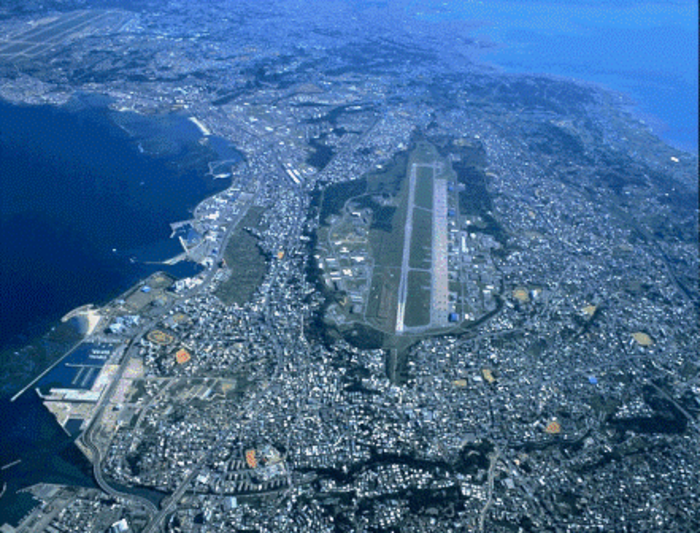
Aerial view of densely populated Ginowan City, with Futenma Air Station occupying 25% of the city’s land.

Question: Let me ask our first question, Mayor Iha.  Is a complete relocation to Guam possible? Defense Minister Kitazawa went to Guam.  He has stated that a complete relocation of facilities to Guam would be impossible; this is different from what you have been saying. What do you think about the Defense Minister’s comments?

Iha: In the “Roadmap” agreement (United States-Japan Roadmap for Realignment Implementation, May 2006), Futenma’s air capabilities were to be relocated to Henoko, but there was no agreement on relocating the Marine units from Futenma to Henoko. However, until October 2005, just half a year earlier, the agreement (U.S.-Japan Alliance: Transformation and Realignment for the Future) was that the Marine units would also be relocated to Henoko. In May 2006, the U.S. Department of Defense changed its plan and decided that all Marine units in Okinawa would be relocated to Guam.

Question: There would be no Marines in Okinawa?

Iha: Most of them will be gone.  It is public knowledge that 8,000 Marines will be relocated to Guam from Okinawa, and 9,000 of their family members will also be moved to Guam. But the number of the family members is less than 9,000 and at present it is said to be actually less than 8,000.

Question: Are they just being loose with the figures?  What does that mean?

Iha:  The Japanese government has agreed to build homes for 9,000 family members in Guam. Ultimately the Marine units relocating to Guam will total 10,600, but that figure is to be made up of units from around the world.

Question: Is Defense Minister Kitazawa wrong?

Iha: Mr. Kitazawa is talking about constructing a replacement for Futenma Air Station in Guam, which is different from the existing U.S.-Japan agreement. Under the U.S.-Japan agreement, Futenma’s replacement facilities were to be built in Henoko, but the reference is to base facilities, not Marine units. Building a new airbase in Henoko and building a new airbase in Guam are two completely different matters. There are already two air fields in Guam, so it is unlikely they will build another. But the reason behind wanting to build an airbase in Henoko was because the first agreement had decided that the Marine units would also be moved to Henoko.

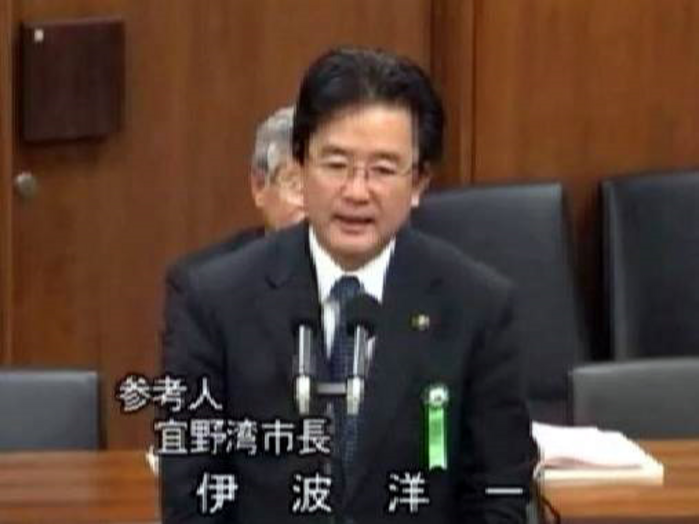
Iha making his case at the House of Representatives Foreign Affairs Committee, April 8, 2009

Question: So why then did Defense Minister Kitazawa make a trip to Guam at this juncture? … Could it be possible that Mr. Kitazawa went to Guam to see whether it would actually be possible to completely relocate U.S. Marines from Okinawa to Guam?

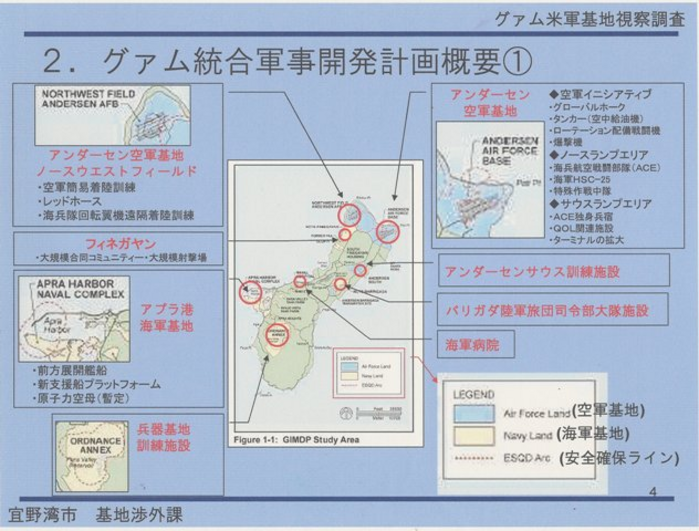
Iha: I think he probably learned other things there.  According to the previous (2005) agreement, only the headquarters of the Marine units was to be moved to Guam. The operational units would not be moved. This is what the government explained.  Much of the debate regarding the relocation has been based on this information. However, this is a debate surrounding the agreement up to October 2005, and the situation changed afterwards. Under the 2005 agreement, the headquarters of the III Marine Expeditionary Force were to be moved to either Guam or Hawaii. At that point, there were no talks on relocating any of the other Marine units to Guam. However, by May 2006, the U.S. Military had decided to turn Guam into a stronghold; and subsequently it decided to move all 8,000 Marines in Okinawa to Guam. This plan was devised in July 2006. We have been able to read the documents on this plan, which is known as the Guam Integrated Military Development Plan.  For the past three years the environmental impact of this Plan has been examined, and the EIS/OEIS (Environmental Impact Statement/Overseas Environmental Impact Statement) Statement was released on November 20, 2009.

Question: Yes we have those documents here with us as well.  I don’t wish to press you, but what do you really think Defense Minister Kitazawa meant by his recent actions and statements?

Iha: We learned a lot from these statements. We learned that the U.S. Marine presence in Okinawa is strictly tactical. This means that up until recently the Marines in Okinawa were there for purposes of forward deployment, to anywhere. That function is now to be moved to Guam. A small contingent of troops will remain in Okinawa, but for Okinawa alone, not for redeployment elsewhere. In the past, U.S. troops would be posted to Okinawa and then they would be redeployed to places like Iraq and elsewhere. Okinawa was the center for deployment of troops, but by 2014 troop deployment capabilities will be moved to Guam entirely.

Question: I guess Mr. Kitazawa had your arguments in mind when he made his statement today.  It sounded as though he had heard that there was a plan to move all the Okinawa Marines to Guam but thought it would be difficult to do so.

Iha: The most important consideration is that everyone, including the media, is thinking about the October 2005 argument. In other words, everyone thinks that only the headquarters will move to Guam and that the Marines will stay in Okinawa. However, this is a misunderstanding. I think Defense Minister Kitazawa, by going to Guam, has understood this.  He must have had such a briefing there, from the relevant departments.  I am pretty sure that he would have been informed of the change in the position of Okinawa, though we need to ask him to be really sure.

Question: But that did not come up in Mr. Kitazawa’s statement today.

Iha: One point that did come up was that we now understand that the troops in Okinawa are there for tactical, not strategic reasons.  It is probably difficult to understand, but let me put it this way.  Do you know how many Marines there are in Okinawa right now?

Question: How many?

Iha: The “quota” for U.S. Marines in Okinawa is said to be 18,000; however, there are only approximately 11,000 at the moment. If, from those 11,000 Marines, 8,000 are relocated to Guam, no more than 3,000 will be left in Okinawa. However, the Japanese government claims that 10,000 Marines will remain in Okinawa.

Question: As (Foreign Minister) Okada is saying?

Iha:  Yes.  There can’t be more than 3,000 Marines remaining.  It doesn’t make sense to think of Okinawa continuing to have 10,000 Marines once Guam becomes the Marines’ stronghold.

Question: After listening to you speak, there seems to be a wide gap between what Mr. Okada and Mr. Kitazawa have been saying and what you have been telling us.  Which is the truth?  I would like you to explain more.  What do you think of the way the Japanese government has been handling this issue?

Iha: The biggest problem is that the U.S. side has failed to explain in detail its Guam relocation plan. There has been no detailed explanation since the May 2006 “Roadmap,” even though the situation has changed considerably since then. (Iha shows a document illustrating the time-line of events.)

Time Line of Events 2005 to Present.  Iha argues that people of Japan have not been informed of developments since 2006 – in blue in the above chart.

The situation has changed since May 2006.  The Guam Integrated Military Development Plan was drawn up, and in 2007 the mayors of Okinawa’s central municipalities went to Guam. In Guam, the Okinawa mayors, myself included, were given detailed explanations on where the Marines from Okinawa would go, where the Futenma helicopter units were to be located. We were given detailed explanation on each of these.  On September 15th, 2008 the U.S. Secretary of the Navy presented to the House of Representatives, a detailed document on the relocation of troops; particularly on the relocation of the various marine units to Guam.  In June 2009 the Commandant of the U.S. Marine Corps presented to the U.S. Senate Committee on Armed Services a detailed document on the 8,000 Marines that were to be relocated to Guam. This document assessed the situation at Futenma, noting that Futenma had become surrounded by local residents and come to be located in a highly populated area. The document assesses the problems of Futenma and the reasons for relocation. However, the shift in the situation from May 2006 to November of 2009 has not been explained in Japan; it has not been explained in the Diet, and the government has not explained it to the Japanese people.

Iha (second from the left) and Central Okinawan Mayors being briefed by Col. Joel Westa at Andersen Air Force Base in Guam, July 2007

Question: It seems strange, as you say, that moves to relocate to Henoko can proceed without such explanation. Let me proceed to the second question. Why has there been no progress on the base relocation? Is someone at fault? Is it the Government of Japan? The U.S.? Or the Okinawan people? Where does the problem lie?

Iha: The people of Okinawa are strongly opposed to relocating the base within Okinawa. It has been 64 years since the war, and 13 years ago, in 1996, there was an agreement. At that time, there was a base relocation plan with a possibility of removal, but that was rejected. The people of Okinawa are strongly opposed to constructing any more new bases. Okinawa Prefecture comprises just 0.6% of Japan’s land mass, and yet 75% of Japan’s U.S. military instillations are located in Okinawa. The people of Okinawa will not accept a resolution to this problem that involves removing a base simply to build it in another location. This would be unacceptable. This is the greatest opposition, and this is why relocation within the prefecture has been opposed so strongly

U.S. Military Facilities on the main island of Okinawa (from the website of Okinawa Prefecture)

Question: So is it just the sentiment of the Okinawan people that has led to the Japanese government dragging its feet on the matter for so long? Do you think there might also be issues concerning concessions, maybe stakeholders who have something to gain by construction?

Iha: That has been said a lot by the media, but we are not debating from that vantage point. For a long time it has been said, and it is the government’s position, that U.S. military bases were a necessity under the Treaty of Mutual Cooperation and Security, and the government assumed from the beginning that there was nowhere else to site them but Okinawa.  In other words, the reason why Henoko was chosen under the previous LDP government was that it was decided that there was nowhere else to build a new base. The sentiments of us Okinawans were always trampled upon.

Question: Let us return to this document…

(The front page of the document)

This is the material on which you base your argument that the total Marine relocation to Guam is possible.  Dated November, 2009, it is titled “Environmental Impact Statement,” and I understand it is a document that shows how new bases impact upon every aspect of the environment, including the area’s residents and its nature.  It is an 8,000-page document that is publically available on the Internet.  You have concentrated on a particular section entitled “Global Alternatives Analysis Summary” (Page 69, Volume 1), which rates the candidate locations using three criteria. Could you explain this for us?

Global Alternatives Analysis Summary

Iha:  The process of relocating Marines from Okinawa started in 2002, when the U.S. began a global realignment of its bases. Within this larger picture Okinawa’s Marines were also included and where they should be relocated. When looking for candidates for a replacement location for Okinawa, Guam got the top score, three stars, as a possible candidate, and Okinawa got only one star.

Question: Okinawa only has one plus.  So you are saying that Guam, which got three stars, is a better relocation site.

Iha: It is not me but the U.S. military that came to such a view. The “Roadmap” was agreed based on this decision on Guam by the U.S. I don’t know if the Japanese government has been given a proper explanation of this U.S. stance on Guam, but regardless of this, the U.S. will go through on its decision to relocate to Guam. Relocating to Guam from Futenma is not to solve the Futenma problem, but is part of a larger U.S. strategic military decision.  I believe that the U.S. will begin large scale relocation of Marines from Okinawa to Guam by 2010.

Question: So all of this has been released by the U.S. military? Surely it cannot be just you who has looked through and analyzed these documents; important people from Ministries of Foreign Affairs (MOFA) and Defense (MoD) must have gone through these documents, analyzed them, and reached the same conclusion as you?

Iha: No. They have not. That is the strange thing about Japan.

Question: Well, surely the MOFA people had better see them….

Iha: This is where the biggest problem lies.  The Japanese government has agreed to spend over $6.9 billion for this relocation, but the Japanese government doesn’t really know what it is going to be spent on.

Question: I wonder is it possible that they know all of this, but since for diplomatic reasons there was no way of reversing, they just let the plan proceed.…?

Iha: No. That’s not the case.  Last week when I met with Foreign Minister Okada, he said he had never heard of what I told him. He had not heard from the US about the Environmental Impact Statement, or about the other things I had told him.

Question:  In other words, he only knew for the first time when you, Mayor Iha, told him?

Iha: Even hearing what I told him, he said that could not be so.  But because of what I as Mayor have been saying, Mr. Okada has decided to reexamine the question of the 8,000 Marines who are supposed to be moving.  Foreign Minister Okada understands there to be 18,000 Marines in Okinawa right now (the “quota”), but the actual number is about 11,000, so there are 7,000 missing somehow. His understanding is that after the relocation of 8,000 Marines to Guam, there will still be 10,000 remaining in Okinawa.  This is the explanation he received from the U.S. So this is why he is not aware of the other plan and does not think the Marine’s operational units will also go to Guam (He thinks it is just headquarters that is to move to Guam.)

Question: How can this have happened? Basic procedures are not being followed if such information is not being properly conveyed.

Iha:  This has been going on for the past three years. During that time, the plan was decided in July 2006, and the documents then uploaded in September onto the U.S. Pacific Command homepage. We downloaded this document, translated it, and analyzed and explained what it was about. (Shows the document “Guam Integrated Military Development Plan.”) This is that plan of September 2006. Next is this document about the airfield (presenting the document). Here you can see in detail which unit goes where at Anderson Air Base [Guam]. Here (pointing at the map) are the areas to be constructed at the expense of the Japanese Government.

A Map of Guam from the Guam Integrated Military Development Plan, translated and analyzed by Ginowan City

This plan has been around for three years. Now the environmental assessment has been done and the Environmental Impact Statement issued. Once revised in accord with opinions received, the plan will, if approved, then be implemented. Approval is anticipated by July 30, 2010.

Question: So an already existing plan is being reviewed. It is not that the plan is still being drawn up. The fact is, as written in this plan, that a new base is to be built to accommodate the Futenma Marines (shows document of the plan). Isn’t it extremely important that this be discussed?

Iha: You are right.  Japan has already decided to pay 30 billion yen for the relocation construction, and the U.S. will pay more than $300 million, bringing the total to about 70 billion yen. This allocation of funds has been decided for the 2010 fiscal plan, so construction will begin in 2010, and the first units from Okinawa will begin relocating to Guam in 2010. At first it will only be the command elements, depending on how the actual construction proceeds, but starting from 2010, and then through 2011, 2012, 2013, and 2014 all units from Okinawa will be relocated to Guam.

Question: It is still possible that the plan might be sent back to the drawing board?

Iha: No, that is not possible. The U.S. has decided, not necessarily in order to solve the Futenma Problem, but anyway it has decided to build a Marine base in Guam as part of its global strategic plans. That means that the Marines in Okinawa will be relocated to Guam.

Question:  So what does it mean when some people talk about the possibility of sending it back to the drawing board?

Iha: I believe such a statement is a threat used to push the Henoko construction.  Relocation to Guam will not be put back to the drawing board. This is because in April, relocation to Guam was already decided by a treaty, the Guam Treaty. According to this treaty, Japan agreed to pay $6.9 billion and the U.S. agreed to pay $4 billion to implement the relocation plan. However, this is quite distinct from construction of a Futennma replacement facility at Henoko. As has been revealed in the Diet, these proceedings do not mean that the U.S. is under any obligation to relocate Futenma. Despite this, work on the Guam transfer continues.

Question: Do you have anything you wish to say to the Japanese government?

Iha: As I have said now, I want the government to give a detailed explanation on the Guam relocation. Japan has agreed to spend a huge sum of money for it, and yet the Japanese government has failed over the past three years to make a detailed explanation of the plans. Since the biggest reason for this is the failure of the U.S. government to inform the Japanese government, I ask the Japanese government to pressure the U.S. government to give a detailed explanation as to which units from Okinawa will move to Guam, and in what form they will be relocated. The Henoko issue should only be discussed after these points have been clarified – whether building a base there is really necessary. Is a new base necessary at Henoko? In my view, no. The reason should be made clear to the people of Japan, and to the Diet. I believe this is the responsibility of the Hatoyama Government. I want the Hatoyama Government to resolve the Futenma problem by cancelling the construction of the Henoko base, and I want it to take up the question of removal of the Marines from Okinawa as a whole.

Question: I get an impression that you are speaking on behalf of all Okinawans, not just as Mayor of Ginowan City.  Have you thought about running for election as Okinawa Governor in November 2010?

Iha: That is a separate issue. A lot will happen between now and then. Right now I want to focus on solving the Futenma problem.

The quiet shore of Henoko, Nago, where protesters have sat in for the last eight years to stop the construction of the Futenma Air Station “replacement facility”

Links

Ginowan City Homepage

宜野湾市ホームページ

Iha Yoichi Presentation “The Marine Corps Relocation to Guam and Elimination of Dangers of Futenma Air Station”

沖縄からグアムへの海兵隊移転と普天間飛行場の危険性除去

Iha Yoichi Presentation “About the Possibility of Relocation of Futenma Air Station to Guam”

普天間基地のグアム移転の可能性について

Iha Yoichi, raised and educated in Okinawa, pursued his career in the City Office of Ginowan and as a Member of the Okinawa Prefectural Assembly before he became Mayor of Ginowan in 2003.  Iha has led numerous local and global initiatives for realizing a peaceful Okinawa without military bases.

Satoko Norimatsu is Director of Peace Philosophy Centre, a peace-education centre in Vancouver, Canada (http://peacephilosophy.com), and is an executive member of Vancouver Save Article 9. She leads youth and community members in activities to promote Article 9, Asian reconciliation, and nuclear disarmament.

Dan Aizawa is a student staff member at Peace Philosophy Centre, majoring in political science and history at the University of British Columbia.

This introduction and translation were prepared for The Asia-Pacific Journal.

Recommended citation: Iha Yoichi, “Why Build a New Base on Okinawa When the Marines are Relocating to Guam?: Okinawa Mayor Challenges Japan and the US,” The Asia-Pacific Journal, 3-1-10, January 18, 2010. 沖縄の海兵隊のほとんどがグアムに行くのに、なんで辺野古が必要なんですか?」-宜野湾市長 伊波洋一 日テレインタビュー完全版

See the following articles related to Okinawa base issues and U.S.-Japan relations:

Tanaka Sakai, Japanese Bureaucrats Hide Decision to Move All US Marines out of Okinawa to Guam

Study Group on Okinawan External Affairs, Okinawan Message to President Obama: Withdraw the Marines

Gavan McCormack, The Battle of Okinawa 2009: Obama vs Hatoyama