Ex-Soldier charged for woman’s murder, was guilty of similar 1980 murder

April 3, 2007

Man charged in woman’s death committed similar 1980 murder

According to court documents, Darnell Griffin constantly harassed his victim

By Rosemarie Bernardo
rbernardo@starbulletin.com

In 1980, Darnell Griffin harassed Lynn Marie Gherardi after she said she did not want to go out with him again, according to witnesses.

On Oct. 10, 1980, Griffin appeared unannounced at her apartment.

Three days later, Gherardi was found strangled to death in her Makiki apartment. The killer: Griffin.

Yesterday, Griffin appeared in court again, this time charged with the strangulation death of 20-year-old Evelyn Luka in September 1999. Witnesses saw Luka leave with someone from Venus Nite Club. She was found unconscious near the H-2 freeway, beaten, raped and strangled. About a month later, Luka died.

art
Griffin was found guilty of Gherardi’s murder in December 1982 and was sentenced to life in prison. He was placed on parole in March 1996. Griffin was living in Salt Lake when the two murders occurred. At the time of Gherardi’s murder, Griffin was 22 and living with his girlfriend.

A native of Chicago, he was based at Schofield Barracks for two years as an E-4 specialist.

According to court documents, at least four witnesses said Griffin constantly harassed Gherardi over the phone and made two unannounced visits to her Makiki home at 1520 Liholiho St.

Griffin wanted to go out with her, but she turned him down because of different interests and her “prejudicial attitude toward him,” witnesses said.

Court-appointed attorney Bruce Masunaga represented Griffin in the 1980 case. He requested that the statements made by the witnesses be thrown out, describing them as hearsay. He said the witnesses were not present during the phone calls made to Gherardi, did not know Griffin’s last name and had never met him.

There was no evidence of any physical threat, harm or injury ever being inflicted or threatened upon Gherardi by Griffin, Masunaga said in court documents.

Griffin had told police that he had gone on at least one date with Gherardi, spoke to her over the phone a few times and had been to her apartment. Police also recovered a letter written to Gherardi by Griffin dated March 25, 1980.

An 11-year-old child told police that he heard a woman scream and cry for about five to 10 minutes while he was playing in his backyard next to Gherardi’s apartment about 6:30 p.m. Oct. 12. “The noises came from the house next to ours on the mauka side of our house,” said the child in a written statement to police.

After the screams, it was silent, he said.

Suspect in killing goes to court

Star-Bulletin staff
citydesk@starbulletin.com

An Ewa Beach man accused in the rape and murder of a 20-year-old woman made his first court appearance yesterday in Honolulu District Court.

Darnell Griffin, 48, was charged Friday in the death of Evelyn Luka, who was last seen alive in September 1999 leaving Venus Nite Club with a male companion. Her body was found left for dead about eight years ago near the Ka Uka Boulevard onramp to the H-2 freeway.

It’s the first arrest Honolulu police have made in a “cold case” using DNA evidence since a 2005 law was passed requiring all convicted felons to submit samples to a national database.

DNA samples obtained last November from Griffin, who had served time and been paroled for a strangling murder in 1980, apparently matched evidence obtained earlier from Luka while she lay in a coma at the Queen’s Medical Center. She had been beaten, strangled and raped.

District Judge Leslie Hayashi ordered Griffin to return tomorrow to Honolulu District Court for a preliminary hearing. He remains in custody in lieu of $5 million bail. Griffin has yet to be assigned an attorney.

Source: http://archives.starbulletin.com/2007/04/03/news/story04.html

Ex-soldier, with prior murder conviction, arrested for 1999 murder

KITV.com

11458959

Darnell Griffin

Police Arrest Man In 1999 Murder Case

Suspect Previously Convicted Of Murder

POSTED: 1:36 pm HST March 30, 2007

HONOLULU — Honolulu police arrested a convicted murder in connection with a murder case that happened in 1999.

Darnell Griffin faces charges of second-degree murder in the death of Evelyn Luka.

Luka was last seen alive leaving Venus nightclub with a man matching Griffin’s description one night, according to police. Her body was found the next day along the H-2 Freeway near the Ka Uka Road overpass.

The 20-year-old woman was barely alive. She remained in a hospital for a month before she died.

Griffin’s registered DNA appeared as a possible match to the cold case. Police arrested him on a parole violation. They tested his DNA and found it was a match in Luka’s case, according to police.

Police are holding Griffin in custody. He is expected to appear in court next week.

Source: http://www.kitv.com/print/11458880/detail.html#

Former Pearl Harbor MP charged with murder

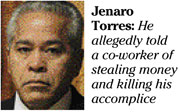
Witness tells of Torres’ confession and threats

By Debra Barayuga
dbarayuga@starbulletin.com

Accused murderer Jenaro Torres threatened to kill a former co-worker and her family if she told anyone he had robbed a bank in Hawaii and killed someone, the woman testified.

Susan Davis said she believed Torres’ threat, and for nearly six months she kept the secret to herself, putting up with his harassment and living in fear.

“‘I’ll know if you told anybody and if you want to see your children and family again’ … that terrified me. I know what he meant,” Davis testified yesterday in Circuit Court. “You’re the only one that knows,” Torres told her, she said.

arttorres

Torres, a former Pearl Harbor military police officer, is charged with second-degree murder in the disappearance and murder of Ruben Gallegos, a Navy Exchange cashier. Gallegos was last seen May 5, 1992, leaving his cashier cage with Torres and carrying a money bag containing about $80,000.

More than five years after Gallegos’ disappearance, Torres confessed to Davis in California over lunch before warning her not to tell anyone, she testified, noting that his revelations shocked her.

“Who’d make up a story like that? Why would you terrify somebody if you’re supposed to be a friend?” she said.

In the past, Torres had bragged to her and other co-workers about his military background, that he knew how to kill and that if they were ever unhappy with their husbands, he could hire someone to get rid of them, according to Davis.

She went out of her way to avoid contact with Torres after that, but he would stop by her desk and make comments like “I’m watching you, good girl,” or, “Good girl, you haven’t told anybody,” she said.

He taunted her with messages on her voice mail, commenting on how lovely the day was and thanking her for being his friend, she testified, her voice breaking.

In June 1998, Navy investigators contacted Davis, and she told them what Torres told her because she could not live in fear anymore, she said.

She told them that over lunch at a Taco Bell, Torres revealed he had robbed a bank in Hawaii so he could go to California to be closer to his mother, who was dying of cancer. He wanted to prove to his siblings that he did care about her and could be there for her and all of them, she said.

Torres told her two other people were involved in the robbery but that something went wrong in the bank and only he came out. Another individual was outside waiting in the getaway car. But as Torres got into the car and tossed the money bag inside, his partner leaned down to pick up the bag and said, “I don’t want any of this. I want out,” Davis recounted.

Torres’ response was, “No one backs out on Jenaro.”

“When he told me at that point, I got scared,” said Davis. “I can’t believe I’m hearing this.”

But curiosity got the best of her, and she asked him if anyone got killed. His answer terrified her, she said.

“I can’t answer that right now,” he told her, Davis testified. “Don’t worry about it. I took care of it.”

He told her their plan was to bury the money then go back for it later, and the money would be split, she said. Military police, alerted about the missing money, arrested Torres when he tried to get back on base about five hours later.

In the trunk of his car were some of Gallegos’ belongings, including his Texas driver’s license and his wallet.

Source: http://archives.starbulletin.com/2007/03/17/news/story06.html

New Network Forms to Close Foreign U.S. Military Bases

A New Network Forms to Close U.S. Overseas Military Bases

Thursday, 15 March 2007

By Medea Benjamin

In a new surge of energy for the global struggle against militarism, some 400 activists from 40 countries came together in Ecuador from March 5-9 to form a network to fight against foreign military bases. The conference began in Quito, then participants traveled in an 8-bus caravan across the country, culminating in a spirited protest at the city of Manta, site of a U.S. base.

While a few other countries such as England, Russia, China, Italy and France have bases outside their territory, the United States is responsible for 95% of foreign bases. According to U.S. government figures, the U.S. military maintains some 737 bases in 130 countries, although many estimate the true number to be over 1,000.

A network of local groups fighting the huge U.S. military complex is indeed an “asymmetrical struggle,” but communities have been trying for decades to close U.S. military bases on their soil. Their concerns range from the destruction of the environment, the confiscation of farmlands, the abuse of women, the repression of local struggles, the control of resources and a broader concern about military and economic domination.

The Ecuadorian groups who agreed the host the international meeting had been fighting against a U.S. base in the town of Manta. The U.S. and Ecuadorian governments had signed a base agreement in 1999, renewable after 10 years. The purpose of the base was supposed to be drug interdiction, but instead it has provided logistical support for the counterinsurgency war in Colombia, placing Ecuador in a dangerous position of interfering in the internal affairs of its neighbor. The base has also affected the livelihoods of local fishermen and farmers and brought an increase in sex workers, while the promised surge in economic development has not materialized.

During Ecuador’s presidential race in November 2006, candidate Rafael Correa criticized the base and after winning the election he quipped, “We can negotiate with the U.S. about a base in Manta, if they let us put a military base in Miami.” His comment displayed the stunning hypocrisy of the U.S. government, a government that would never deign to have a foreign base on its soil but expects over 100 countries to host U.S. bases.

In a great boost to the newly-formed network to close foreign bases, President Correa sent high-level representatives to the conference to express support, and he himself, together with the Ministers of Defense and Foreign Relations, met with delegates from the network to express their commitment to closing the Manta base when it comes up for renewal in 2009.

But the Ecuadorian government’s courageous stand is unfortunately not echoed in most countries, where anti-bases activists usually find themselves fighting against both the U.S. bases and their government’s collusion.

Indigenous representatives attending the conference talked about the destruction of indigenous lands to make way for bases. In the island of Diego Garcia, the indigenous Chagossian people have been driven off their lands, as have the Chamorros from Guam and the Inuit from Greenland. Kyle Kajihiro, director of the organization Area Hawaii, explained that the U.S. military occupies vast areas of Hawaiian territory, territory which was once public land used for indigenous reserves, agricultural production, schools and public parks.

The delegation from Okinawa, Japan, has been trying to dismantle the U.S. bases for the past 50 years. One of their main complaints has been the violence against women. Suzuyo Takazato, the director of Okinawa Women Act Against Military Violence, has compiled

Upside Down World on the No Bases Conference

Ecuador: International Conference for the Abolition of Foreign Military Bases

Written by Marc Becker
Thursday, 15 March 2007

Activists gathered in Quito, Ecuador the first week of March in an International Conference for the Abolition of Foreign Military Bases. The International Network for the Abolition of Foreign Military Bases is a global network of individuals, organizations, social movements, and coalitions working for the closure of foreign military bases and other forms of military presence worldwide.

The no-bases coalition which organized the conference began to converge three years ago at the World Social Forum in Mumbai, India. The conference brought together 300 activists from 40 countries from around the world united in a common concern for the proliferation of military bases, primarily those operated by the United States. At the same time, others strongly urged broadening the network’s scope to include the actions of other countries, particularly the French and Brazilian military presence in Haiti.

The week-long conference began with three days of meeting in the capital city of Quito and was designed to strengthen coordinating efforts. Speakers presented perspectives from around the world on the impacts of military bases, and the struggles of social movements to abolish them. Panels focused on the impact of military bases on the environment, gender, human rights, peace, democracy, and sovereignty. Discussions included struggles against military bases in Vieques, Japan, Korea, Hawaii, and the Philippines. A series of film screenings on struggles against military bases and broader peace issues also ran throughout the event.

On Thursday, March 8, International Women’s Day, activists joined a Women for Peace Caravan from Quito to Manta with intermediary stops demanding the closure of foreign military bases. Local organizers emphasized that the dates were specifically selected to correspond with International Women’s Day. The week culminated with a march calling for the withdrawal of United States troops from the Eloy Alfaro Air Base in Manta, and a festival celebrating the successes of the no-bases campaign.

The gathered delegates drafted a declaration that condemned foreign military bases for their role in “wars of aggression [that] violate human rights; oppress all people, particularly indigenous peoples, African descendants, women and children; and destroy communities and the environment.” Delegates demanded a closure of existing bases, cleanup of environmental contamination, and an end to legal immunity for foreign military personnel. The statement concluded with support and solidarity for “those who struggle for the abolition of all foreign military bases worldwide.”
Manta

Ecuador was selected as the location for the conference because of a growing movement to evict United States troops from the US military base in Manta. When the United States withdrew its Southern Command from Panama, it began to search out alternative methods of maintaining a military presence in the region. Since 1999, the United States has used the Manta base as a so-called Forward Operating Location, purportedly to halt drug trafficking from neighboring Colombia. Some opponents consider former president Jamil Mahuad’s signing of the lease which gave the US military permission to use the land in Manta to be unconstitutional and a violation of national sovereignty. Rather than wait until the lease runs out in 2009, they would prefer to have the troops withdrawn now.

Nieve Solórzano from the Ecuador No-Bases Coalition noted how surprised many in the country were by Mahuad’s agreement, and the negative impact that the foreign military presence had on the city of Manta. The majority of the country is against the base. Instead of impeding drug trafficking, it converts Manta into a trafficking center and increasingly draws Ecuador into regional conflicts. Solórzano welcomed the international gathering as strengthening the local struggle against the base.

A Transnational Institute study documents Manta as just one of about one thousand foreign military bases around the world. The majority of these bases are United States institutions. The United States disputes these figures, claiming instead that they only have 34 permanent bases, and that the rest are just bilateral cooperative agreements that allow for a small military presence. In addition to the United States, several European countries also maintain extra-territorial military bases. Activists criticize foreign bases for their violations of human rights and negative ecological impacts. United States bases in particular have become targets for strong anti-imperialist sentiments.

Correa once famously quipped that it would be ok with him for the United States to maintain a military presence in Manta if in exchange Ecuador were allowed to have a base in Miami. The unlikeliness that the United States government ever to allow a foreign government to maintain troops on its soil highlights the fundamentally unequal nature of international relations, and the hypocrisy of United States pressure on local governments to host such institutions.

Critics charge that the presence of U.S. troops in Manta is dragging Ecuador into a growing regional conflict, and that the mission has expanded into other unrelated activities-especially that of providing surveillance on Colombia’s internal political conflicts and interdiction of immigrants leaving Ecuador. Manta represents more than just a landing strip: it is a vital and strategic position in Bush’s global war.

Official support

The Abolition of Foreign Military Bases conference was planned well in advance of left-populist Rafael Correa’s election last fall to the presidency of Ecuador. The timing, however, provided to be very convenient for the success of the conference. Correa rode a rising tide of anti-imperialist sentiment into office, including campaigning on promises to close the Manta base.

The conference opened on Monday, March 5 at the Catholic University in Quito with an inaugural panel that presented a mixture of ceremony and an opening salvo of forceful statements against foreign military bases. Quito’s mayor, retired General Paco Moncayo, welcomed delegates to Quito, and then Manuel Corrales, the university’s rector, presented a welcome to the university. Correa was invited but unable to attend. In his place, to the cheers of the audience, Subsecretary of the Ministry of Defense Miguel Carvajal confirmed that the Ecuadorian government will not renew the United States lease on the Manta base when it expires in 2009. Correa himself publicly ratified that decision later in the week.

After a full day of speeches, the mayor arranged for a tour of Quito’s historic center and a reception in the City Museum. A mayor’s representative greeted Lindsey Collen from the Mauritius Islands as an honored guest of Quito, and in turn Collen accepted the honor in the name of all of the delegates. A folklore ballet then entertained delegates with traditional Andean songs and dance.

In Manta, Manabí’s governor Vicente Veliz defended Correa’s action to terminate the lease agreement. Veliz condemned the oligarchy that extracted wealth from the country, and congratulated Correa as being the first president in Ecuador since Eloy Alfaro, one hundred years ago, to stand up to the international finance system. Veliz applauded Correa’s support for education and health programs that benefit the Ecuadorian people.

At the conference Correa’s advisor, Fernando Bustamante, reiterated that government would not be renewing the Manta base lease. Bustamante called for respect for Ecuador’s sovereignty, and articulated political stances for peace and ecology instead of militaristic and war-based policies. In particular, Bustamante outlined a peace plan for Ecuador’s northern border to contrast with Plan Colombia.

No-bases

Activists debate whether efforts to terminate foreign military bases are better directed at local host governments or at United States policy. Some argue that the United States government needs to be targeted since it pressures host governments to accept the agreements. Others point to the examples of Vieques and Ecuador, where determined local movements could evict bases, and say that efforts are better targeted there. The cause of the creation of foreign bases is not only imperialism, but also domestic neoliberal policies.

At the conference, Filipino anti-base activist Baltazar Pinguel argued that the movement needs to build on both levels: targeting U.S. policy as well as pressuring local host governments to terminate military agreements. The two struggles are directly linked on a variety of levels, including the cost of the bases to people on both foreign and domestic fronts. Pinguel also pointed to the importance of international coalitions and meetings such as the World Social Forum to build a strong movement. This sentiment echoed throughout the conference.

“The problem is global,” Corazon Valdez Fabros from the international no-bases committee emphasized, “and we need to fight it globally.” Fabros saw this meeting as a step in the right direction. However, some participants cautioned against jumping from national to global struggles and ignoring work on a regional or continental level that could also significantly strengthen the movement.

Miguel Moran, from the local Ecuadorian organizing committee, noted that this was the first international anti-imperialist conference of the new century. He emphasized the importance of the conference as a meeting of peoples, rather than governments, to plan the future of humanity. Chilean activist Javier Garate echoed the necessity of attacking the no-bases issue on various levels and through various strategies, including engaging issues of pacifism and economic profiteering. Baltazar Pinguel noted that the caravan was an effective tool which allowed international and local activists to connect with each other to build a stronger movement. He also encouraged increased anti-base activism in the United States in order “to become an active force for peace right in the eye of the storm.”

Throughout the conference, delegates connected their local struggles with Manta. For example, Nilda Medina from Puerto Rico noted the common links between the struggle at Manta and in Vieques, Puerto Rico, where local pressure forced the United States Navy to withdraw from its base in 2003. Women organized against the base, Medina emphasized, and the government could not stop them. However, “evicting the military is only half the struggle,” Medina emphasized, because recovery and cleanup remain as unfulfilled tasks. “We have to keep walking together,” she declared, “because victory will be ours.”

Kyle Kajihiro pointed to the heroic example of the Vieques struggle as a symbol which encourages Hawaiians to struggle more determinately in the face of oppression. “We cannot just fight on one level,” Kajihiro emphasized, “because this will just move the opposition to another level.” The conference facilitated the development of these networking connections on multiple levels.

Similarly, a delegate from Cuba stood in solidarity with Correa and declared that the Guantanamo and Manta bases are not isolated phenomena, but part of Bush’s international war pattern. Other activists linked Manta with the one hundred year presence of U.S. troops in Panama; the long military presence in Germany, Korea, and Japan; and growing involvement in Paraguay’s triple border region. Finally, Leslie Cagan from United for Peace and Justice (UFPJ) denounced the Bush administration for its occupation of Iraq and construction of massive bases in that country.

Despite the apparently overwhelming presence of foreign military bases around the world, delegates seemed far from defeated. Rather, activists pointed to the fact that foreign military bases are being met with oppositional movements world-wide. The examples of Vieques and Manta illustrate that, through the use of a variety of tactics, foreign military presences can be overcome.

Marc Becker is a Latin America historian and a member of Community Action on Latin America (CALA) in Madison, Wisconsin. Contact him at marc(at)yachana.org

Source: http://upsidedownworld.org/main/content/view/664/1/

An Anti-Bases Network Finds its Base

An Anti-Bases Network Finds its Base

By Herbert Docena 14 March 2007

The consolidation of an international network for the abolition of foreign military bases marks an important advance for the global peace and justice movement

On the perimeter fence of the Eloy Alfaro air base in Manta, Ecuador hangs a sign, “Warning: Military Base. No Trespassing.” Since 1999, the base has been used as a “forward operating location” by the US military – just one of over 737 US military installations currently scattered in over 100 countries around the world.

On March 9, about 500 visitors showed up at the base’s main gate. One of them walks up to the fence and pastes a bright blue and red sticker saying “No Bases!” on the warning sign, a broken rifle forming the diagonal line with the letter “o” to make the universal sign of prohibition.

It is a small, symbolic act of trespassing for a newly formed international network with a big goal: the closure of all such military bases worldwide. But with the successful convening of a conference that launched the International Network for the Abolition of Foreign Military Bases (No Bases) in Quito and Manta, Ecuador from March 5 to 9, 2007, that goal has become a little closer to reality.

Perhaps the largest gathering against military bases in history, the conference drew over 400 grassroots and community-based activists who are at the forefront of local struggles from as far away as Okinawa, Sardinia, Vieques, Pyongtaek, Hawaii, and dozens of other places from more than 40 countries. There were environmentalists, feminists, pacifists, war resisters, farmers, workers, students, parliamentarians, and other activists from social movements, human rights groups, faith-based organizations, and various regional and global networks and coalitions.

But even the final tally of those present probably underestimated the extent of participation in the conference: In the network’s e-mail list on the eve of the conference, an anti-bases activist from Iceland wrote to say that their absence in Ecuador should not be taken to mean that they are absent from the movement. The range of groups that made it to the conference – both in terms of where they come from geographically and politically – demonstrate just how broad the movement against bases has become.

International conferences are sometimes dismissed as talk-fests where nothing gets done. But getting together and talking to each other is often an important first step in building a community. In various panels and self-organized seminars, film-showings, and forums, participants deepened their understanding of the role of military bases in global geo-politics, the various forms and guises that military presence takes, and their impacts on local communities and the environment. They also exchanged lessons about strategies and approaches to more effectively campaign against bases back home. Even the Pentagon has taken note of the growing domestic opposition to their bases and it is these grassroots campaigns that are foiling their plans.

But this was not all. What was significant about the conference was that the participants went beyond talking about how bad bases are and why we should all oppose them. They rolled up their sleeves and, in one intensive workshop after another, set out to establish a network, articulate the bases of unity, agree on a higher level of coordination, and decide more concrete plans for common action.

That task proved to be daunting yet illuminating. As the participants tried to clarify what exactly brought them together, potentially divisive but fundamental questions soon rose to the surface: Should the network just target foreign military bases or also domestic bases? Since they all have military and war-making purposes, shouldn’t all military bases – regardless of whether they are the US’ or Cuba’s – be abolished? What about the “domestic” military bases in Hawaii, Guam, or Puerto Rico? Or in occupied countries such as Iraq and Afghanistan? What about NATO bases which are arguably both “foreign” and “domestic” at the same time? If the network targets only “foreign” bases, how does this distinguish it from all those right-wing nationalist groups in Europe or the Middle East who oppose bases just because they’re “foreign”? And while it was generally agreed that no one comes close to the US in terms of the sheer number of bases, how much effort should the network exert against the bases of Russia or France?

These proved to be important questions because the answers to them touch on the values and identity of the network. Underlying them are broader questions that define some of the diverging – but also overlapping – currents within the network and, perhaps, within the larger anti-war movement.

Broadly – and perhaps crudely – categorized, there are those within the network who oppose bases from what could be called an “antiimperialist” perspective. They see foreign military bases as both the instruments – as well as the visible manifestations – of imperialism.

They are against US bases on foreign soil but will defend Cuba’s or Iran’s right to have domestic military bases for self-defense. Within this current, there are differences on the extent to which the US should be singled out: While there is unanimous recognition that the US is the primary threat, others are quick to point out that the European powers have their own imperialist drives and are equally dangerous. On the other hand, there are those who oppose bases from the perspective of “anti-militarism”: they’re against all military bases – regardless of who owns them.

These debates also raise questions about the nature of “nationalism” and “sovereignty.” In many contexts, mainly but not exclusively in the South, opposition to foreign bases draws from a deep nationalist well, with bases seen as “external” incursions against “sovereignty” and with “nationalism” seen as a necessary bulwark against colonialism. In other contexts, however, “nationalism” and “sovereignty” have become bad words, used to rally public support for wars against “the other” and to justify repressive measures against “foreigners.” Cautiously, the network treaded the fine line between self-determination and chauvinism.

After ten hours of spirited but cordial deliberation, the draft declaration presented in plenary was widely commended as a sharp but nuanced formulation (see full text below) that succeeded in drawing the approval of both anti-imperialist and anti-militarist positions. (Or at the very least, it was not expressly rejected by either.) What may have clinched the day was the broadening of the target of the network to include not just foreign military bases but “all other infrastructure used for wars of aggression.”

The formulation thus takes a more sophisticated understanding of the complex configuration of military bases by allowing for the inclusion of domestic military bases inside the US, as well as in NATO and in other countries. It appealed to those who insisted on a strong focus on foreign military bases – most of which are owned by the US and all of which are arguably used for aggression – while at the same time not contradicting those who wish to expand the focus of their own work.

In contrast to the right-wing, chauvinist opposition to bases, the declaration makes it clear that the network’s objection to bases is not premised on what analysts call the NIMBY (not-in-my-backyard) logic – i.e. foreign military bases are fine as long as someone else bears the noise, the waste, and the crimes – but on the NIABY logic(not-in-any-one’s backyard), i.e. foreign military bases are bad because they “entrench militarization, colonialism, imperial policy, patriarchy, and racism.” In light of the influence of the right-wing objection to bases, the network’s opposition to all bases – and not just those in one’s locality -offers a global counter-pole premised on internationalism and solidarity.

For an incipient grouping still struggling to define its purpose and to sharpen its focus, the importance of clarifying and reaching agreement on the network’s bases of unity should not be underestimated. As Helga Serrano, one of the conference organizers concluded, “The ideological and political bases of unity of the network is more consolidated than we had thought.” It is true that the subsequent session for planning concrete actions and strategies proved to be less clarifying: only a grocers’ list of ideas emerged, not a clear set of priorities. But without coming to an agreement on its common vision, the network could have been paralyzed by unresolved contradictions and confusion. The articulation of collective principles lays the foundations for future actions.

Carrying out these actions requires, in turn, a certain degree of organization. On-guard against threats to their autonomy, wary of centralizing tendencies, but keen to achieve their objectives, many delegates stressed the need to combine openness and horizontality with strategic and organized action. As Joel Suarez, a participant from Cuba said, “We cannot continue with the way we have been organizing. Horizontality is correct but, applied wrongly, it has led to the disintegration and paralysis of the movements. Our advancement depends on the efficiency of our organization. We can’t let this fall apart.” The question, said Serrano, is “how do we create new forms of horizontal relationships?” The challenge, as posed in one panel, was to strengthen the coordination within the network without centralizing and bureaucratizing it.

Put this way, the dilemmas faced by the network is little different from that faced by other networks that have emerged in recent years. Accepting the need for closer interaction while cautious of rushing the process, participants in the end reached a consensus to remain as a loose grouping but with a higher level of coordination. A process was set up for putting in place an open international coordination committee with a clear but circumscribed political mandate and a defined set of responsibilities for carrying out collective projects.

Still, there are significant hurdles to overcome: The network still has to reach out to so many more local anti-bases activists, especially from West and Central Asia; the issue of bases is still not high on the agenda of the anti-war movements; the network lacks resources because the issue is seen as too radical even for sympathizers; and even within the network, there is uneven access to resources and capacities; translation remains to be worked out more efficiently; and so on.

Despite all these obstacles, the network has come a long way. The conference is a milestone in that it marks the consolidation of the international network as both a space where the broadest grouping of organizations, coalitions, and movements can come together and as an organizational vehicle which can carry out globally coordinated campaigns while providing continuing and sustained support to local struggles everywhere.

But it’s more than this. The network’s development could also be seen as evidence of the consolidation of the anti-globalization/anti-war movements that emerged in the last decade. While the idea has been germinating before, the birth of the network could be traced back to a gathering of anti-war/anti-globalization activists, shortly after the invasion of Iraq, in Jakarta, Indonesia in May 2003. Attended by representatives from some of the groups that were behind the coordination of the historic February 15, 2003 global day of action against the war in Iraq and who had previously been active in the anti-globalization movement, the Jakarta meeting endorsed the proposal of launching an international network against bases as one of the priorities for the movements.

A group of organizations in that meeting then carried the idea forward through various World Social Forums, local and regional social forums, and other activist gatherings. As Wilbert van der Zeijden, an activist who was among those who steered the network through the years, said, “This would not have been possible without the World Social Forum process.” While the concept remains debated, the “open space” provided by the social forum process provided opportunities for networking, information-sharing, and organizing that would have been too difficult or too expensive had the space not existed. The consolidation of the network proves that the movement is
capable not only of uniting around a proposal but of actually seeing it through.

Also often underrated and unreported is the degree by which the movement has been getting more efficient at organizing. While there were a few of the usual glitches and some internal disagreements, it felt as though the conference and the run-up to it was, on the whole, better organized politically and logistically than similar projects in the past. International conferences of the scale that activists had been organizing in the last few years require a high level of organization and coordination but, with very limited human and financial resources, and activists are stepping up the plate. As one participant remarked, “Five years of organizing the World Social Forums and other meetings and we’re learning.” Ecuadoran organizers of the network conference themselves acknowledge that they have gained confidence and valuable experience from organizing the Americas Social Forum and other international meetings in the past.

What is remarkable – but often taken for granted – is how activists – who are not trained and salaried professional events organizers – have succeeded in realising ambitious projects for a small fraction of the cost that corporations or governments spend on similar meetings. That the movements are learning and becoming more proficient heralds their development and growing capacity for organized action.

More than anything, the consolidation of the anti-bases network demonstrates that the movements have become more deliberately strategic. The network is a “single-issue” campaign focused on the
issue of bases. And as Lindsey Collen, an activist from Mauritius, warned, “Single-issue fragmentation may lead to short-term success but long-term failure.” The single-minded focus on bases, however, is neither fragmentary nor fragmenting; on the contrary, it arises from a comprehensive understanding of the conjuncture that locates bases within the global strategy of domination.

Rather than being divisive, the emphasis on bases brings together a much more holistic understanding of the ways in which the coercive and corporate sides of militarized globalization come together to perpetuate structures of dispossession and injustice. As Joseph Gerson, an activist-scholar on bases, put it “Bases perpetuate the status quo.” The decision to zoom-in and focus on the issue of bases in a coherent and consistent manner comes out of an objective assessment and a compellingly simple logic: without foreign military bases, wars would be so much more difficult to wage; without wars, the pursuit of geo-strategic and economic interests over democracy and self-determination would be so much harder. As Corazon Fabros, a veteran anti-bases activist from the Philippines, said, “The strategy of empire is global. So must our response.”

Marshall Islander Speaks Out Against Missile Defense Tests

By Que Keju

I first witnessed missiles being launched from Kwajalein Island in the 1960s. The beaches of Ebeye Island, an islet about 5 miles north of Kwajalein, would be swamped with both children and adults each time a launch was scheduled. It was always a spectacular scene each time-fire works, at its best.

Ten years later, when I returned from the states after attending high school, it would not be an uncommon thing to stop in the middle of a basketball or volleyball game to watch streaks of missiles zooming over Ebeye and Kwajalein Atoll. Destination: the Mid-Corridor zone- an off-limit Mid-Western Pacific Ocean “Bermuda Triangle” in the Kwajalein lagoon, and the bull’s eye to incoming ICBMs shot from Vandenberg Air Force Base, where we are this minute. So I’ve completed a circle trying to understand where these missiles were going or coming from, starting on Ebeye Island and ending up here in Vandenberg. So this is the place. This is what it’s all about! What a journey…

What’s the big deal? Actually a lot. First, the Kwajalein landowners are displaced from their land and relocated to Ebeye Island to make room for the Mid-Corridor zone and the missile testing program. Ebeye is only 66 acres and home to more than 10,000 Marshallese. The composition of the population density: Kwajalein landowners mixed with other indigenous Marshallese from other neighboring atolls. The result: community and social ills at peaks. Some say that Ebeye was once the slum of the Pacific. Was? It still is! When the relocation plans were drawn up for the Kwajalein landowners, it was understood and agreed that basic infrastructure would be in place: housing, healthcare, schools, recreation, and land payments, among other perks-don’t worry, be happy! More than 40 years later, the landowners are still grappling with chronic community and social challenges. Ebeye-and Marshall Islands as a nation-has surpassed Nauru, a neighboring Pacific nation, with the highest rate of diabetes. The known diseases such as tuberculosis and acute flues, eradicated from most of the global community decades ago, are but rampant on Ebeye. The power outage saga on Ebeye continues, after four decades, with the two halves of the island sharing basic electricity to run their hospitals, public works, schools, businesses, churches, cooking utensils, basic lighting and food refrigeration for their homes, and, oh yes, the island’s main sewage command center. When power is out on Ebeye, all of the previously mentioned, and essentially the livelihood of these innocent folks, cease. During my trip back there in 2002, I encountered the electric-toilet combination must, and I was shocked: no power, no toilet on all of Ebeye! Please take a moment to recap the more than 10,000 inhabitants scrambling to find basic relief. It was a powerful reminder that we, the big city dwellers here in the U.S., are so fortunate to have such basic infrastructure 24/7.

Sadly though, five miles south of Ebeye lies Kwajalein Island; a pristine community of both military and civilian personnel, ready to mobilize and man the Star Wars Program. Some of the best burgers and fries in the world are grilled and bubbled down there. There is a golf course; several movie venues; a radio station and accesses to cablevision and speedy internet service; a bowling alley; sports courts and fields; scuba diving, sports fishing and sailing; and retail stores operation with prices ridiculously cheaper than U.S. wholesales, where you can buy the cheapest Paul Mitchell Awapuhi Shampoo and the Detangler Conditioner, or the current copy of Fortune Magazine. Life is good on Kwajalein! Yet misery reigns on Ebeye. That’s sad.

Secondly, the SDI Program is flawed. The American Physical Society-among many others-informs us that in the end, when all the mobilizing forces think that the program is finally ready, by then it’ll be obsolete. We learn that 9 out of 10 test missiles miss their targets. In looking at the program’s basic premise, it isn’t so difficult to question and be skeptical as to how the program can effectively intercept-and-destroy 5, 10, or even 15 incoming Intercontinental Ballistic Missiles, considering the time it would take to respond-or rather react-if such missiles travel at blazing speeds of 18,000 mph. And when we think about the working wonders of the ever-confusing decoys, it wouldn’t be so difficult either to seriously doubt the precision of the SDI.

Third, if the SDI is unrealistic, compromises have to be made, and fraud is powerfully played. Homing Devices are used in order to convince the American public that this program is real. Heating certain elements within the launched unit is tactically done to easily track and hit the “bad missile.” Doctoring data, tweaking test results and making false statements are a norm in the program’s attempts to glue down the trust of the American public. Then when the whistleblowers from the Pentagon, MIT, Boeing and Lockheed reveal the deception, the GAO (Government Accountability Office) steps in to set the record straight, concluding only that no wrongdoing was ever done. Amongst the bad there is always the good one; one of GAO’s own whistleblowers came forth to tell us that even the overseer is fraudulent, and that it is a serious matter that there is no one to oversee the overseer.

Is this SDI an exploratory program? But it’s taking a toll on a lot of things, especially humans.

Rather than exhausting precious energies on the SDI Program, perhaps we need to cross over to the realistic side and concentrate on improving the overall defense of the United States by revisiting tangible mechanisms such as the airport systems, the country’s seaports, or the ever expansive and multi-nationally laid borders from sea to the mountaintops. When we’re reminded that the 911 terrorists used box cutters to infiltrate our airports, and until we finally realize that 16,000 containers enter the U.S. seaports daily with fewer than 2% of them opened for inspection by U.S. Customs, no one can dispute that it is time to cross over. It’s now-or-never.

Instead of firing off ICBMs to the Mid-Corridor Zone, the U.S. ought to share its might in health, education, transportation, communications, investments and outright good will to keep Kwajalein and the rest of the Republic of the Marshall Islands afloat. If good programs are to spill over to regions such as the Marshalls and the rest of Micronesian, they ought to be in the forms of solid institutions and effective systems.

Lastly, each time we explore the phenomena of the SDI or the exploitation of indigenous Marshallese through A- and H-Bomb tests, it isn’t rhetoric or blah-blah-blahs. It’s all real stuffs! We’re fiddling around with innocent folks’ lives. Two years ago in 2004, I had the grand opportunity to translate in a documentary film yet to be released by Adam Jonas Horowitz, personal stories of some of the only remaining few survivors of the nuclear fallout on Rongelap Atoll from the bomb tests in the 50s. Two of these ladies finally succumbed to nuclear radiation just a few months ago. I will forever revere the endurance of Ariko Bobo and Elmira Matayoshi. In 1993 my father, Jinna Keju, agonized and was bedridden in the hospital on Majuro, Marshalls for over a month. He lays in the Monkubok cemetery on Ebeye. Three years later in 1996, my sister, Darlene Keju-Johnson, also lost her battle to cancer. Both Jinna and Darlene had the symptoms of cancers from nuclear radiation. My mother, Alice Keju, who lives on Ebeye today, is a cancer survivor; she went through a mastectomy about 15 years ago.

My friends, you have the energy, the know-how, the deep convictions. It is time to cross over to the other side, the realistic side. It’s now…or never!

Ketak Le eo!

Declaration: International Conference for the Abolition of Foreign Military Base

March 9, 2007

Declaration: International Conference for the Abolition of Foreign Military Base

Quito and Manta, Ecuador

We come together from 40 countries as grassroots activists from groups that promote women’s rights, indigenous sovereignty, environmental justice, human rights, and social justice. We come from social movements, peace movements, faith-based organizations, youth organizations, trade unions, and indigenous communities. We come from local, national, and international formations.

United by our struggle for justice, peace, self-determination of peoples and ecological sustainability, we have founded a network animated by the principles of solidarity, equality, openness, and respect for diversity.

Foreign military bases and all other infrastructure used for wars of aggression violate human rights; oppress all people, particularly indigenous peoples, African descendants, women and children; and destroy communities and the environment. They exact immeasurable consequences on the spiritual and psychological wellbeing of humankind. They are instruments of war that entrench militarization, colonialism, imperial policy, patriarchy, and racism. The United States-led illegal invasions and ongoing occupations of Iraq and Afghanistan were launched from and enabled by such bases. We call for the immediate withdrawal of all foreign troops from these lands and reject any planned attack against Iran.

We denounce the primary responsibility of the U.S. in the proliferation of foreign military bases, as well as the role of NATO, the European Union and other countries that have or host foreign military bases.

We call for the total abolition of all foreign military bases and all other infrastructure used for wars of aggression, including military operations, maneuvers, trainings, exercises, agreements, weapons in space, military laboratories and other forms of military interventions.

We demand an end to both the construction of new bases and the reinforcement of existing bases; an end to and cleanup of environmental contamination; an end to legal immunity and other privileges of foreign military personnel. We demand integral restauration and full and just compensation for social and environmental damages caused by these bases.

Our first act as an international network is to strengthen Ecuador’s commitment to terminate the agreement that permits the U.S. military to use the base in Manta beyond 2009. We commit to remain vigilant to ensure this victory.

We support and stand in solidarity with those who struggle for the abolition of all foreign military bases worldwide.

Foreign Military Bases Out Now! Manta Si! Bases No!

Hawaiian Star Wars

Hawaiian Star Wars

John Lasker / Mar 7, 2007

In January, a Chinese missile snarled and flashed its fangs 500-miles above the earth’s surface. China, in a show of its space war-fighting capabilities, had obliterated one its own weather satellites with a ground-based missile interceptor. Later that month, while still in the fall-out of China’s provocative action, the United State’s Missile Defense Agency (MDA) shot down a dummy ballistic missile as it skirted the edge of space, 70-miles above the Pacific and not far from Kaua’i.

The dummy missile had been launched from a mobile platform floating off the coast of Kaua’i. Traveling at more than 10,000 feet per second as it closed in on the dummy, the interceptor missile had been fired from the Pacific Missile Range Facility (PMRF) at Barking Sands on Kaua’i’s western shore.

For the MDA and many of its private contractors from the aerospace industry, it was reason to stand up and cheer. This was the first time the Pacific Range had showcased the THAAD (Terminal High Altitude Area Defense) system since Missile Defense had moved it from a New Mexico desert in October. THAAD is, in military parlance, a mobile ballistic missile interceptor.

But while the invading MDA unit and their peers at PMRF celebrated, it was more bleak news for island peace activists and those worried about the militarization of Hawai’i.

There is no doubt that missile defense tests or ‘Star Wars’ tests are on the upswing in the Pacific and Hawai’i. Some peace activists and arms control experts believe this is a sign that beginnings of a new arms race, a chess match of space-combat prowess between China and the United States, is brewing in the Pacific.

This potential arms race has far greater implications than which nation can build the more powerful laser or the first to launch a ‘killer satellite’ constellation. It is a race that signals to the international community that a future war between China and the U.S. may be inevitable. A war between an emerging superpower and the current champion that could be sparked by the skyrocketing demand for energy resources. A war fought on traditional battlescapes such as land, water and air, and not-so-traditional-cyberspace and outer space. It is a conflict where the frontlines could easily engulf the Islands.

‘If you think about it,’ says a Naval officer from the Islands who spoke on the condition of anonymity, ‘the threats we’re facing are going to be coming from space.’

In the mean time, some are speculating on what China was trying to accomplish by turning a satellite no bigger than a refrigerator into a 1,000 little floating pieces.

‘The [anti-satellite] test could have been a strategic move by the Chinese to bully the United States into actually discussing (a space weapons) treaty,’ states space-weapons expert Theresa Hitchens. The current White House is telling the world there’s no need for a treaty, says Hitchens, who directs the left-leaning Center for Defense Information, a Washington-based think tank.

‘There certainly are many in U.S. policy and military circles who believe that China is the new threat, and that the United States must ready itself for an eventual military conflict in the Pacific,’ she says.

Son of Star Wars

Maine resident Bruce Gagnon is the coordinator for Global Network Against Weapons and Nuclear Power in Space. He has traveled the world warning peace activists and university crowds about the MDA, which he calls the ‘son of Star Wars.’

Since President Ronald Reagan called for a space shield in the early 1980s, the Pentagon and its space hawks have spent more than $100 billion on research. More than 20 years later, former-Secretary of Defense Donald Rumsfeld promised to revive missile defense. And though he’s gone, he and others managed to double funding for missile defense and make it the premier research quest of the Pentagon.

All U.S. missile defensive capabilities, however, have an offensive application as well, says Gagnon. That is why he calls Star Wars a ruse, a Trojan horse.

‘It has always been my contention that the Missile Defense Agency is in fact creating an offensive program that includes anti-satellite weapons and other first-strike space weapons programs,’ he says.

Gagnon, a veteran of the Air Force, has kept a close eye on the Pacific. He has traveled to Japan to rally peace activists there as that nation spends more and more on U.S. missile defense. Citing Pentagon documents and major newspaper reports, the Global Network coordinator says the Pentagon is slowly doubling its military presence in the Asian-Pacific region. Pentagon officials say over 50 percent of their ‘forward looking’ war games took place in Asia during the last decade.

Like other observers, Gagnon agrees a Sino-American war could erupt over the global competition for oil. But he also believes this: The U.S. may try to manage China’s development before it even comes to this. ‘China, if left alone, will become a major economic competitor with the U.S.,’ he says. ‘The U.S. wants to control the keys to China’s development.’

To do so, the U.S. will arm the Pacific with a high-tech arsenal, such as space weapons, which can, among other things, knock out satellites and thus blind a modern war force. ‘China imports much of its oil through the Taiwan Strait and thus if the U.S. can militarily dominate that region, then the Pentagon would have the ability to choke off China’s ability to import oil,’ he says. ‘The U.S. could then theoretically hold them hostage to various political demands.’

Some of Gagnon’s peers in the arms-control field have labeled him a chicken little and his theories too far out there. But after what the national office of the ACLU uncovered, he’s being criticized less and less these days. Two years ago, the ACLU discovered that ‘agents’ from NASA and the Air Force were secretly monitoring him and his family.

Full Spectrum Dominance

Just hours after China blew up its own weather satellite, calls were made on Capital Hill to ramp up the U.S. space warfighting arsenal.

Peace activists and arms-control experts could only shake their heads.

They know the Pentagon has quietly been making the case for ‘full-spectrum dominance’ for the last 10 years. Besides rising missile defense budgets, numerous defense papers have called for the U.S. to militarize the ultimate high ground, even the moon.

Why the Pentagon desires to weaponize space while also shifting much of their global warfighting focus and missile-defense research from Europe to Asia-Pacific is the subject of a contentious debate. China does have a small cache of intercontinental ballistic missiles that could reach the U.S. The world’s fastest growing economy has also made overtures to regain its lost province-Taiwan.

But China isn’t the only Asian nation keeping the Pentagon on edge. North Korea has threatened to strike Hawai’i with ballistic missiles and in the late 1990s fired a ballistic missile over Japan. Last year the regime detonated a nuclear weapon underneath a mountain and test-fired several ballistic missiles-on July 4 no less.

‘Our stance is the increasing missile defense tests are a destabilizing factor. The tests are provoking an arms race in the region between nuclear powers’

-Kyle Kajihiro
local peace activist,
DMZ Hawai’i

Kyle Kajihiro is one of Hawai’i’s most notable peace activists. He directs the Honolulu-based DMZ Hawai’i and believes there may be a simpler reason as to why missile defense research is on the rise around the Islands.

As if mirroring the resurgence of Star Wars, the increasing militarization of Hawai’i has coincided with two significant events, the National Missile Defense Act of 1999 and the election of President Bush in 2001. What’s too easy, Kajihiro adds, is targeting the current wave of Republican leadership in Washington for allowing defense funding to pour into the islands. You also have to blame the gatekeeper who has the keys to the federal safe that houses the Pentagon’s money, the peace activist says.

‘Sen. Daniel Inouye wants the money to pour in. They (Inouye and allies) want defense contractors to set up shop here,’ Kajihiro says. ‘The Congressional earmarks are not necessary. That’s my gut feeling. The North Korean threat has been completely exaggerated.’

There’s no debate that Sen. Inouye is a war hero and his contribution during World War II a story of legendary proportions. Sixty years later, however, Inouye’s influence and power as one of Washington’s veteran senators has allowed Hawai’i to become a ‘destabilizing’ factor in the Pacific, Kajihiro says.

Fifteen years ago the Navy’s Pacific Missile facility at Barking Sands was on the Pentagon’s list for downsizing and possible closure. In 1999, Kajihiro claims that Inouye sought to rejuvenate the facility by co-sponsoring the National Missile Defense Act.

The Clinton administration, which significantly cut missile defense funding during the 1990s, criticized the bill. But it passed anyway and Inouye secured nearly $50 million to upgrade the missile range. ‘It was the beginning of the flood gates opening for a lot of these missile defense projects around Hawai’i,’ says Kajihiro.

Sen. Inouye is the third most senior senator. He also chairs the Senate Defense Appropriations Committee and has declared many times his position has helped Hawai’i economically. Indeed, according to Taxpayers for Common Sense, a non-partisan think tank, 60 to 65 percent of all military-related earmarks during the last several years went to the states of senators who sit on the Defense Appropriations Subcommittee.

As Christmas neared in 2001, a time Congress worked furiously in the wake of 9/11 to beef up 2002’s defense budget, Sen. Inouye’s committee quietly doubled Hawai’i’s defense budget for that year. The Islands would receive a total of $850 million, which doesn’t include payroll or day-to-day expenses.

Of the $400-million plus in new 2002 appropriations, $75 million was allocated for cleaning up unexploded ordinance at Kaho’olawe. But $150 million went to missile defense research. Other funds were added to ambiguous projects that peace activists claim could someday contribute to space weapons.

For instance, $6 million was given to the Silicon Thick Film Mirror Coating program, an ongoing research project on Kaua’i. Peace activists say the coating will someday be applied to space-based mirrors that will relay ground-based or space-based lasers around the globe.

Twenty million also went to the Air Force’s Maui Space Surveillance System, located on the summit of Haleakala Mountain. There, the U.S. military operates its largest telescope-the Advanced Electro-Optical System. One of its responsibilities is to monitor asteroids that may strike earth.

‘I’m not buying any of it,’ says Kajihiro, who believes he telescope will be used for missile defense and space combat. The military says the telescope can also track satellites; it also admits that laser-beam research continues at the site.

During this decade, Hawai’i has annually ranked in the top five for states receiving defense funding. According to Kajihiro, the militarization of Hawai’i ‘is really driven by the appropriations.’ He adds, ‘Sen. Inouye says it’s about defending Hawai’i. Our stance is the increasing missile defense tests are a destabilizing factor. The tests are provoking an arms race in the region between nuclear powers.’

The millions of dollars that are being spent on missile defense research around Hawai’i do not entirely go to military personnel. Take for example the THAAD system, which was moved from New Mexico to Kaua’i. THAAD is managed by the MDA, but its primary contractor and researcher is aerospace giant Lockheed Martin.

Between the years 2001 and 2006, five of Inouye’s 20 top campaign finance contributors were defense contractors, says Kajihiro, citing information received from [Opensecrets.org]. Inouye’s biggest contributor from defense contractors was Lockheed Martin.

‘Sen. Inouye has said he’s anti-war, but at the same time he’s pro-military build-up, pro-military pork. It’s kind of weird. It’s hypocritical,’ says Kajihiro.

Sen. Inouye’s office failed to return phone calls for this story.

Terminal Fury

When asked about the Joint Space Control Operations-Negation program and their field tests during classified ‘Terminal Fury’ exercises, Major David Griesmer, a public information officer for U.S. Pacific Command, said, ‘I don’t know anything about it.’

Griesmer’s statement is revealing when trying to gauge the entire picture of missile defense research ongoing around the Islands. Millions of unclassified military funding is being pumped into the Islands to test missile defense. But what about classified or secret missile defense research?

Terminal Fury is a ‘command post exercise,’ says Griesmer, ‘involving multiple bases, a naval component, air component and army component.’

‘Some involved don’t even come to Hawai’i,’ he adds.

Yet for the last three Terminal Fury’s, reports the civilian-owned CS4ISR Journal, the Joint Space Control Operations-Negation (JSCON) conducted field tests. The tests would be the first known anti-satellite tests conducted by the U.S. military since 1985 when a F-15 destroyed a satellite with a missile. ‘[The JSCON] program will help the Pentagon figure out which satellite-killers to buy,’ states the C4ISR Journal.

The journal would not say what satellite killer technology was used, but suggested it was probably the Counter Communications System or CounterCom. The $75 million ground-based device is classified, but it was declared operational by the Pentagon several years back. While not an actual killer, the device allegedly can make a satellite go dead.

Here’s a partial list of missile defense and space weapons research ongoing around the Islands and in the Pacific.

Sea-based X-Band Radar

At the Pacific Missile Range Facility on Kaua’i, the Missile Defense Agency (MDA) is testing THAAD, a ground-based missile-to-space interceptor system. But at sea and at Pearl Harbor, the MDA is testing the Aegis Ballistic Missile Defense System. Named after the shield of Zeus, the Aegis technology fires an interceptor missile that simply slams into a ballistic missile and destroys it. The technology has been applied to only a handful of ships, including Pearl Harbor’s USS Lake Erie, but many other ships from the Pacific fleet are slated to acquire it. Since the late 1990s, the Erie has shot down nearly a dozen dummy missiles, some of which were 200 miles above the earth’s surface.

The floating Sea-based X-Band Radar platform is perhaps the strangest looking craft to have ever sailed the Pacific. Built on a modified oil-drilling platform, the X-Band’s gigantic white dome could easily be mistaken for some alien craft. The distance from the water to the top of the radar dome is roughly 250 feet. The MDA has said the radar has enough detection and target resolution power that it can distinguish a warhead from a decoy or a piece of space debris. The X-band arrived in Pearl Harbor early in 2006, took part in several ballistic missile tests and then headed to its current home in Alaska. The X-band cost between $900 million and $1 billion to build.

Maui Space Surveillance System

Since calling for Star Wars, the U.S. military envisioned high-powered lasers or directed-energy weapons shooting down ballistic missiles in the earth’s atmosphere or in space. But since then, the Pentagon is leaning more toward a missile-to-missile strategy not only because the technology is more feasible but because it is also cheaper. Nevertheless, the U.S. has spent hundreds of millions, if not billions, of dollars on combat energy beam weapons. Again, just days after the Chinese satellite incident, the U.S. Air Force launched its ‘ABL’ or Air Borne Laser aircraft from Vanderberg Air Force Base north of Los Angeles. For the first time the aircraft test fired in flight. The aircraft is a Boeing 747-sized airplane that has been gutted and turned into a flying laser canon. On the Islands, the Air Force is researching space-related lasers at Maui Space Surveillance System (MSSS) on Haleakala mountain. Two laser beam director/trackers are in use at MSSS but experts say they are not powerful enough to be deemed weapons. These same experts say nearly all astronomical sites across the U.S. don’t project lasers into space.

While they have no connection to Hawai’i as of yet, the most controversial missile defense tests on the horizon are the Space-based test bed maneuvers, activists claim. Space-based test beds are killer satellites that are loaded with missiles or high-powered lasers. When such a satellite constellation may launch is unknown; the U.S. military has targeted the middle of next decade. What is certain is the money the MDA wants for the space-based test bed: The agency as submitted to Congress a request or $675 million to develop this experimental constellation for the years 2008 through 2011, according to Space News.


No Bases Network born in the Middle of the World

No Bases Network born in the Middle of the World

Helga Serrano Narváez

The consolidation of the International Network for the Abolition of Foreign Military Bases is one of the main achievements of the International Conference for the Abolition of Foreign Military Bases held in Ecuador on 5-9 March, 2007. The 400 delegates from 40 countries celebrated with applauses the formal founding of the Network, as well as the agreements reached to establish coordination mechanisms and more articulated global actions.

The ideological and political basis of the Network, confirmed in the Final Declaration, is a central unifying factor which will allow the Network to move firmly forward in its construction. The Declaration places the No Bases Network in the framework of the movements that struggle for peace, justice, self-determination of peoples and ecological sustainability. It also recognizes that foreign military bases are instruments of war that entrench militarization, colonialism, imperial policy, patriarchy, and racism.

It affirms that foreign military bases and all other infrastructure used for wars of aggression, violate human rights; oppress all people, particularly indigenous peoples, African descendants, women and children; and destroy communities and the environment. Therefore, the Network demands the abolition of all foreign military bases. It was stated that if the empire is global, resistance should be global as well. And this implies challenging militarism and imperialism, and its bases structure, which is the U.S. empire. The Declaration denounces the primary responsibility of the U.S. in the proliferation of foreign military bases, as well as the role of NATO and other countries that have or host foreign military bases.

The Conference also approved resolutions that stand in support and in solidarity with those who struggle for the abolition of all foreign military bases, while also calling for the immediate withdrawal of all foreign troops from Iraq and Afghanistan and reject any planned attacks against Iran.

Skeleton of the empire

During the Conference, participants acknowledged the negative effects caused by the installation of more than 737 US bases in 130 countries around the World. These have affected the lives of women and children, as a result of rapes and sexual aggressions, frequently left unpunished. Only in Philippines, it is calculated that since 1945, there have been 50.000 unacknowledged children of US soldiers. In Okinawa, where 75% of the US bases in Japan are located, there was an increase in sexual violence and rapes.

The United States-led illegal invasions and ongoing occupations of Iraq and Afghanistan were launched from and enabled by bases in Turkey, Saudi Arabia and Diego Garcia. To open way for the US base in Diego Garcia island, which forms part of the Chagos Archipielago in Mauritius, 2000 people were displaced and are forbidden to return. The use of the Guantanamo base for torture of prisoners by US troops and as a concentration camp, caused indignation and concern.

Participants also were informed of the contamination caused by the US military presence, such as the situation of Vieques in Puerto Rico, which was used as a training camp for many years. Only when the US troops left could people see the magnitude of the environmental damage and the urgent integral restauration and full and just compensation that should be demanded to the US.

People frequently mentioned how foreign military bases affect peoples’ sovereignty, such as the Manta Base in Ecuador which is used by U.S. soldiers after the signing of an unconstitutional “Cooperation Agreement”. As occurs in Manta, and in all cases presented, U.S. soldiers have immunity so they can move around freely without any fear due to the privileges contemplated in such Agreements.

But we also saw that where there is a base, there is a resistance movement. Experiences were shared from Japan, Korea, Puerto Rico, Mauritius, Guam and Manta, among others, as well as the recent demonstrations in Vicenza, Italy. These experiences provided inspiration for consolidating the Global No Bases Network.

The Conference fulfilled its objective not only to analyze the impact of foreign military bases on the population and the environment -also presented in publications prepared by the different organizations- but also to reach consensus on global objectives, strategies and coordination mechanisms to strengthen local struggles and global actions. There was a commitment to develop strategic alliances with global movements that struggle for global peace and justice; expand the No Bases Network; generate global actions; and influence global public opinion. The International Coordinating Committee, established in the Conference, will develop communication and information, lobbying, research, support local struggles and promote global campaigns.

Military bases in the public agenda

It is also important to highlight the impact of the Conference through its dissemination in mass media, electronic lists, Websites and news agencies. The foreign military bases agenda was on the media before and during the Conference. The constant interviews to international scholars and activists forced the U.S. Embassy in Quito to develop a strategy to try to minimize the role of its bases, especially of the Manta Base. It organized visits for foreign and domestic press, trying to challenge the comments made by researchers, who even based some of the data on figures provided by the Pentagon itself.

The Conference also came to the attention of the President of Ecuador, Mr. Rafael Correa, who met with a delegation from the Conference, along with Lorena Escudero, Minister of Defense. For the first time since the President took office on January 15, 2007, he ratified his pledge that the government will not renew the Agreement with the U.S. for the use of the Manta Base, due in 2009. This firm position was widely disseminated in domestic and foreign media. The participation of local and national government authorities in the Conference was also highlighted by the international delegates.

The leadership and participation of women was recognized as a key element for the success of the Conference. This was clear not only in the organization of the Conference itself, but also in the “Women for Peace” Caravan carried out on March 8, International Women’s Day, when 8 buses full of delegates traveled from Quito to Manta for the activities in the port where the U.S. personnel is stationed. Another important aspect, which made this Conference different than other events, was the massive participation of youth, both in the self-organized events in Quito, as well as in the Forum and demonstration in Manta.

The spirit of the encounter and the recognition of similar struggles around the world, mobilized immediate solidarity and commitments. However, more is needed for the Network to develop, grow and have a global impact. This implies the construction of common agendas, so that this issue may be faced both in the majority world and the developed world. If there are no structural changes in the North, it will be difficult to reach our objectives.

The building of the Network also requires a horizontal and open dialogue that recognizes the rich contributions and experiences of all movements, both in the South and in the North. It implies creating new forms of relation, cooperation, equity and solidarity. The richness of our diversity, of all our countries and regions, and the respect to the diverse processes is a must. A Global Network cannot work without a balanced participation of all regions, and this implies additional efforts to assure the participation of compañeros and compañeras from Africa, Asia and Pacific, Latin America and the Caribbean, in the networks’ and movements’ meetings. For the International No Bases Network it is essential to maintain a strong relation with the anti-war movements that struggle for peace and global justice.

– Helga Serrano Narváez, journalist, is member of the Asociación Cristiana de Jóvenes (ACJ/YMCA) de Ecuador and of the Interim International Coordinating Committee of the Global No Bases Network.