Stop the helicopter training on Mauna Kea

The Honolulu Star Advertiser article  “Delay in copter-training permit will cost $8 million, Army says” talks about the environmental assessment for army High-Altitude Mountainous Environment Training. (HAMET) for helicopters.  But why is it assumed that the army should naturally be allowed to encroach into ecologically and culturally sensitive areas on Mauna Kea and Mauna Loa to train for an illegal war in Afghanistan?   As Bianka Isaki commented on Facebook, the headline should be “Army stupidly insists on wasting $8m of taxpayer contributions on a project that cannot comply with natural resource use regulations”. Others have pointed out that the Colorado high altitude training area is the proper place to conduct such training.  But the army complains about the cost of having to train in Colorado while completing a state environmental review of the project:

The Army wants to use landing zones on Mauna Kea and Mauna Loa for high-altitude helicopter pilot training. A Black Hawk medevac helicopter from Wheeler Army Airfield was used in April as the Army conducted noise and ground-effects testing on Hawaii island.

The Army, which is completing a third environmental review for high-altitude helicopter training on Hawaii island, said it will have to spend $8 million to conduct most of the training in Colorado because it is running out of time to practice in Hawaii before a January deployment to Afghanistan.

[…]

The Army hopes to get state Land Board approval in September to be able to conduct high-altitude training on six landing zones on Mauna Kea and Mauna Loa in October before it has to ship its nearly 100 helicopters to Afghanistan in November, officials said.

Ninety pilots out of 260 would be trained in Hawaii if the state grants a “right of entry” permit for the conservation district land, according to the Army.

[…]

Opponents say the helicopter training will interfere with critical habitat for endangered species and is an affront to the sacredness of Mauna Kea and Mauna Loa.

The latest draft environmental assessment for the Hawaii island training, released on July 23 and intended to cover both federal and state requirements, has a 30-day public comment period ending Aug. 23.

As expected, the army spokesperson cited the helicopter shot down by Taliban fighters as the need for the training:

Col. Mike Donnelly, a spokesman for U.S. Army Pacific, said the deaths of 30 Americans in a Chinook helicopter crash Saturday in Afghanistan “is a stark reminder of how important training is and the inherent risks of flying a helicopter in a combat zone.”

These troops would not have died, and this training would not be needed if the U.S. were not occupying Afghanistan.

Native Hawaiians are not happy about the military occupying and desecrating Hawaiian sacred sites:

But Hanalei Fergerstrom, a Big Island resident who opposes the Mauna Kea and Mauna Loa training, said that, as a Hawaiian religious practitioner, “I’m not happy with the Army telling me they are going to fly helicopters in my temple.”

The army already controls more than 120,000 acres at Pohakuloa.  Although the army is not acquiring new land, it is effectively extending its activities over a vast areas beyond their existing lands.  Military activities are encroaching on protected areas.  The state correctly required the army to conduct a more thorough state environmental review:

The latest problem faced by the Army in securing a permit stemmed from a state Attorney General opinion — detailed in a June 20 letter from Gov. Neil Abercrombie to Lt. Gen. Francis Wiercinski, head of the Army in the Pacific — that the Army needed to complete a state environmental assessment for the training in addition to the federal studies it already conducted.

Wiercinski said recently that the state Department of Land and Natural Resources couldn’t continue to provide individual special-use permits to the Army as it did in years past. “I understand that, because people will always take you to court on a waiver, and then everything stops,” Wiercinski said. “If you don’t do it right, it just keeps getting messed up.”

The Army now wants flights from Bradshaw Army Airfield at Pohakuloa Training Area to six existing Mauna Kea and Mauna Loa landing zones.

[…]

The Sierra Club’s Moku Loa Group said helicopters will fly over the only designated critical habitant for the endangered palila bird, a finch-billed Hawaiian honeycreeper.

The Army said in its latest report that a 2,000-foot altitude has been established to protect the palila and its habitat from planned operations.

Cory Harden, a Hawaii island Sierra Club board member, said she is sympathetic to the greater cost and time away from families with high-altitude training in Colorado, “but I’m also concerned about the impacts (on Mauna Kea and Mauna Loa).”

“I share the concerns about the endangered species and the impacts to cultural practitioners and hikers,” she said. “That’s a beautiful peaceful place up there, and you have more helicopters going in and out. It destroys it.”

Given the past history of violations of conservation zones by the army, mitigation measures will be meaningless without effective oversight and enforcement.

The army seeks a permit for a Right of Entry via Hawai’i Department of Land and Natural Resources, Division of Forestry and Wildlife Special Use PermitComments are due on August 21, 2011.   See KAHEA posts  here and here for more information.  Send comments to:

United States Army Garrison, Hawai’i (USAG-HI), 851 Wright Avenue, Wheeler Army Airfield, Schofield Barracks, Hawai’i 96857-5000. Contact: Mr. William Rogers (808) 656- 3075

AND

Portage, 1075 S. Utah Ave., Suite 200, Idaho Falls, ID 83402. (208) 419-4176
Taxpayers Stuck With Unsold Ferries in Default

Bloomberg published an article about the wasteful Maritime Administration (MARAD) loan guarantee program, which became the reluctant owner of two high-speed ferry ships after the Hawaii Superferry went bankrupt in 2009:

Two passenger ferries sit at a dock in Norfolk, Virginia, waiting for someone to take them off the government’s hands.

The U.S. Maritime Administration has taken bids for them in an attempt to recover some of the $138 million in taxpayer money paid to cover defaults on loans it guaranteed for the owners, Hawaii Superferry Inc. The company sought bankruptcy protection and defaulted in 2009.

The unwanted ferries are reminders of the defaults and oversight problems reported as recently as December in the so- called Title XI program as vessel owners have won $798 million in new loan guarantees this year, the most since 2001. As it considers two applications for an additional $712 million in guarantees, the maritime agency is trying to recover what it can on $311 million paid out to cover six defaults since 2008.

After protests and legal challenges disrupted Hawaii Superferry operations, the Hawai’i Supreme Court finally ruled that the special legislation retroactively exempting the Superferry from the state’s environmental review laws was illegal.  However, it was the company’s arrogance and collusion with state officials to circumvent the environmental review process that doomed the venture from the start. As the article points out, even down to the rationale for the MARAD loan guarantee program, the Superferry project was driven by politics and military and special interests:

The program’s bipartisan supporters, such as former Senator Trent Lott, a Mississippi Republican, and Democratic Senator Daniel Inouye of Hawaii, credit Title XI with creating jobs and supporting national defense and the U.S. commercial fleet. The U.S. fleet shrank from 17 percent of the world’s oceangoing merchant ships in 1960 to less than 1 percent in 2008, according to the Bureau of Transportation Statistics.

Five guarantees approved since President Barack Obama took office in 2009 will create 8,000 jobs, maritime agency Administrator David Matsuda said in an e-mail.

The program has survived elimination attempts because supporters in Congress “logroll” to keep funding it, said Chris Edwards, director of tax policy studies at the Cato Institute. “Some of these ships are built in their districts, and they’ll fight to the death for it,” Edwards said in an interview. His Washington-based group advocates reducing government spending and lower taxes.

[…]

Politics drove decisions to give guarantees to some companies that eventually defaulted, Clayton Cook, the maritime agency’s general counsel from 1970 through 1973, said in an interview.

He cited American Classic Voyages Co., chaired by billionaire real-estate investor Sam Zell, which received a $1.1 billion guarantee for two cruise ships under the banner of Project America. Five subsidiaries of the company accounted for $330 million of the $490 million that defaults cost the government from 1993 through 2002.

Inouye sponsored a provision in a defense bill called the U.S. Flag Cruise Ship Pilot Project, he said at a hearing in 1999. The project gave American Classic Voyages exclusive rights to operate cruise ships in Hawaii, the company said in a Securities and Exchange Commission filing in 2000. The ships were to be built at Ingalls Shipbuilding in Pascagoula, Mississippi, Lott’s hometown. Lott declined to be interviewed.

American Classic Voyages filed for Chapter 11 bankruptcy in October 2001. The default cost taxpayers $187 million, according to the maritime agency.

Hawaii Connections

“The project, while proceeding with considerable difficulty, including delays and increased costs in construction, ultimately became a victim, like many other industries, of the September 11 attack on our nation,” Inouye said in a floor speech in 2003.

Inouye didn’t respond to a question about the default, saying in an e-mail that “loan-guarantee programs are one of the many ways that government can partner with the private sector to create jobs and expand the economy.”

Hawaii Superferry, chaired by former Navy Secretary John Lehman, spent up to $20,000 a year lobbying Congress, the maritime agency, the Environmental Protection Agency and other agencies on Title XI and “vessel financing issues” between 2004 and 2006, according to federal lobbying disclosures. The loan guarantees helped the firm finance the ferry purchases from shipbuilder Austal USA, based in Mobile, Alabama.

The Superferry’s default occurred because a Hawaii court ruled the state shouldn’t have let the company skip an environmental impact study, said William Schubert, maritime administrator from December 2001 to February 2005. “The people of Hawaii wanted the service, and when it went to the state Supreme Court it pretty much put an end to the program,” Schubert said in a phone interview.

The quote from Schubert is incorrect on a few ponts.  Activists figured out early on that the Superferry business model was unprofitable.  As Austal USA, the shipbuilder, pointed out to the Hawaii Superferry executives in the beginning, the ships on order were too large for the Hawai’i market. But they did meet military specifications, which in the end, paid off for Austal, who leveraged the Hawaii Superferry as a proof of concept to win a contract to supply Joint High Speed Vessels to the military.  Some people from some islands may have wanted the Superferry.  But many strongly opposed the project as another threat to the environment and sustainability.  And Hawaii taxpayers were left holding the bag for $40 million in state harbor improvements that were never recovered from the company.

“What you haven’t heard about APEC” now streaming online

Watch the streaming video of the recent First Friday television program “What you haven’t heard about APEC”.

Victor Menotti, Executive Director of the International Forum on Globalization joined Jonathan Osorio and host Manu Kaiama on the August 5, 2011 First Friday Olelo show to discuss what the upcoming APEC meeting is about and why it matters to Hawai’i.  They discuss what people from the Pacific should know about APEC’s meeting in Honolulu this November and decisions governments may make that could change everything from local land use decisions to rising military tensions between the US and China.

As Jon Osorio says on the program “APEC is a sovereignty issue”.
Victor Menotti says “APEC is colonization right now, in real time.”
The show will be rebroadcast on Channel 52 NATV on Wednesday August 10, 17, 24, 31 at 10am (Hawaii time).

Bahrain: Shouting in the Dark

One forgotten uprising of the ‘Arab Spring’ took place in tiny Bahrain.

I have posted articles on this site about the protests in Bahrain and why it matters.  Bahrain is in the backyard of Saudi Arabia. It is also the location of the U.S. 5th Fleet.  The U.S. and western countries turned a blind eye when the Bahraini ruling monarchy and gulf states violently crushed the peaceful protests.

Al Jazeera produced an excellent documentary “Bahrain: Shouting in the Dark” about the protests in Bahrain. (Warning: the images are graphic).

Where is the NATO and U.S. military support for these protesters?

International Solidarity grows for Jeju anti-base struggle

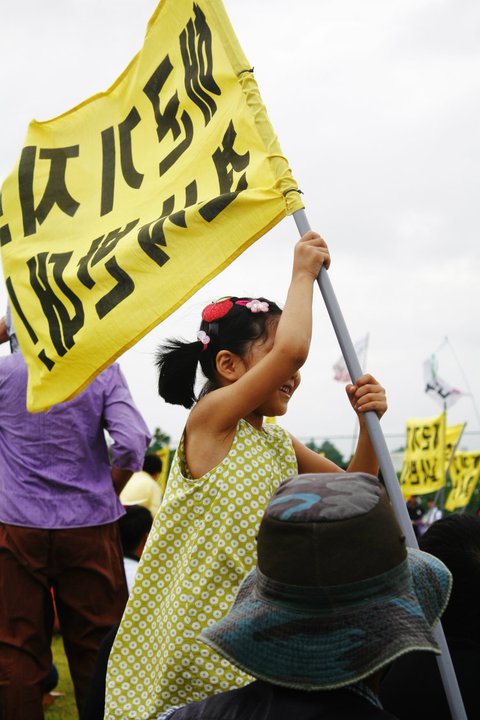
A girl holds a banner that reads “Against the Naval Base no matter what (or even until death)!” Photo: Emily Wang.

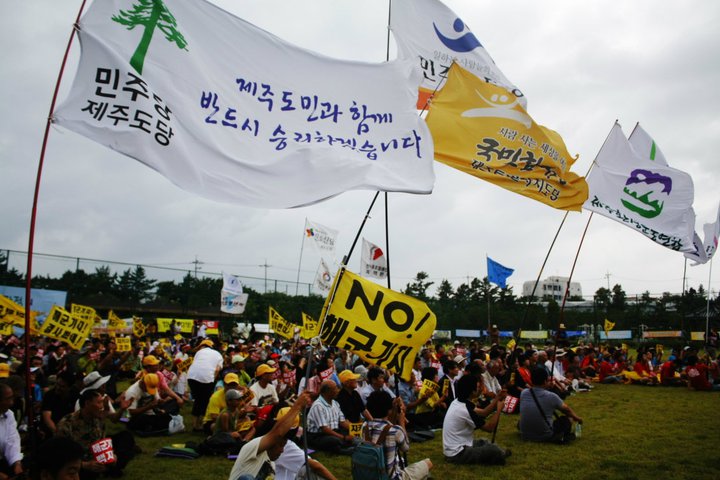
Today, the 66th anniversary of the U.S. atomic bombing of Hiroshima, there was a large rally against a naval base in Jeju island.

You can follow the developments on the Save Jeju Island website.  Also there is a Save Jeju Island page on Facebook.

And please SIGN THE SAVE JEJU PETITION ON AVAAZ, an international petition site:  http://www.avaaz.org/en/save_jeju_island/

Photo: Emily Wang

In Organizing Notes, Bruce Gagnon reported:

villagers and supporters now have blocked all the construction entrances to the Navy base construction project.

The villagers have two basic demands:

1) Stop construction

2) Begin from scratch and do an entire new assesment of whether the base is actually needed or not. Included would be a proper environmental impact statement (EIS) which was never done in the first place.

The five opposition political parties in South Korea are now supporting these demands. Several of these political leaders have joined the blockades at the construction entrances and leading Catholic bishops in South Korea are regularly visiting the village and holding mass on the disputed rocky coastline.

Some mainstream newspapers in South Korea now seem to be searching for some “middle ground” which indicates the protests, and growing global support, are having an impact. You can see one such article here

Gloria Steinem wrote a beautiful op ed in the New York Times:

THERE are some actions for which those of us alive today will be judged in centuries to come. The only question will be: What did we know and when did we know it?

I think one judgment-worthy action may be what you and I do about the militarization of Jeju Island, South Korea, in service of the arms race.

[…]

The island itself is said to be the body of the Creation Goddess, and is often called Women’s Island. It is home to the legendary women deep-sea divers known as Haenyeo, as well as sacred goddess groves and shamanistic traditions. For many women especially, it is becoming a symbol of what once was and could be.

Christine Ahn of the Korea Policy Institute also got an op ed in yesterday’s New York Times:

I.H.T. Op-Ed Contributor

Unwanted Missiles for a Korean Island

By CHRISTINE AHN

Published: August 5, 2011

SEOUL — Gangjeong, a small fishing and farming village on Jeju Island 50 miles south of the Korean peninsula, is a pristine Unesco-designated ecological reserve where elderly Korean women sea divers, haenyo, still forage for seafood. It is also the site of a fierce resistance movement by villagers who oppose the construction of a South Korean naval base on the island that will become part of the U.S. missile defense system to contain China.

South Korea’s president, Lee Myungbak, says the base is needed to protect Seoul from an attack from Pyongyang. The problem with that assertion is that the Aegis destroyers that Lee pledged to deploy at the base aren’t designed to protect South Korea from North Korean Taepodong ballistic missiles (TBM).

In a 1999 report to the U.S. Congress, the Pentagon verified that the Aegis system “could not defend the northern two-thirds of South Korea against the low flying short range TBMs.”

Thus, instead of protecting South Koreans, the militarization of Jeju Island will introduce new security threats to the country by fueling an arms race in an increasingly tense region of unresolved conflicts. The naval base on Jeju Island will equip South Koreans and their American allies with the capability to strike long-range ballistic missile batteries in southeast China that target Japan or Taiwan. Washington sees this base as a central pillar to its defense system in the Asia-Pacific region. China, no doubt, sees it as a new threat.

The result of building the base, therefore, will only be increased stress on the U.S.-China relationship. One South Korean military analyst, Cheong Wook-sik, said that China sees the U.S. Asia-Pacific missile defense system “as the 21st century’s greatest threat.”

And a Chinese Air Force colonel, Dai Xu, speaking more generally about Washington’s Asia-Pacific strategy, wrote recently that Beijing “cannot always put up with American provocations.” He added that China “must draw a clear red line against American attempts to surround it.”

Meanwhile, on the American side, a 2009 Rand Corporation report confirmed that, given China’s growing economic threat to the United States, the Jeju naval base is crucial for America “to project power in the East China Sea and southward.”

Washington hasn’t been forthcoming about this base being built for U.S. interests, particularly in light of growing South Korean resentment of the high costs of U.S. military bases on the peninsula, and tensions over the recent admission by three U.S. veterans of dumping Agent Orange at Camp Carroll in southeast South Korea in 1978.

When I called the Korean Embassy in Washington to register my complaint about the Jeju naval base, the response was: “Don’t call us; call the U.S. State or Defense Departments; they are the ones who are pressuring us to build this base.”

Gangjeong villagers have used every possible democratic means to overturn the decision by Seoul to construct the base there. For four long years, the villagers have squatted on their farmland that was seized by the government, and laid down in front of cement trucks intending to pour concrete over the volcanic rock where pure spring water meets the ocean. Despite the fact that 94 percent of Gangjeong residents voted against the base, the central government, the military and Jeju officials colluded to make Gangjeong the designated site.

This week, the South Korean government ordered the police take further measures to restrict protesters, many of whom have already been arrested, heavily fined and barred from entering the waters and land that they have lived on and depended upon for generations.

Jeju is a bellwether of how conflicts in the Asia Pacific may be resolved in the near future. Will the South Korean people allow its government to blindly follow U.S. plans to draw its country in a standoff against China? Will the South Korean government choose to resolve conflicts through dialogue and cooperation?

No one in the United States, North and South Korea, Japan and China wants another militarized conflict; we still haven’t healed from last century’s wars. This is perhaps more apparent in Korea than anywhere else, a country where a militarized division still separates millions of families.

We must not allow an unneeded military base to destroy Gangjeong’s rich marine ecology and the livelihoods of farmers, fishermen and haenyo — people who provide us with human security — certainly not in the name of “national security.”

Christine Ahn is the executive director of the Korea Policy Institute and a member of the Global Campaign to Save Jeju Island.


Jeju Island Activist Sung-Hee Choi Interviewed in Prison

Jeju Island Activist Sung-Hee Choi Interviewed in Prison

By David Vine


July 26, 2011

Last week, I had the honor of going to prison. I was conducting research on South Korea’s beautiful Jeju Island, off the country’s southern coast, and was lucky enough to be one of the two people per day allowed to speak with the renowned imprisoned activist Sung-Hee Choi.

Choi was arrested for her attempts to prevent the construction of a naval base in Jeju’s Gangjeong Village, a base that many suspect would become a new port for the U.S. Navy. Despite the opposition of people like Choi, who has repeatedly laid her body in front of construction equipment, the South Korean government has been trying to create a base on Jeju since at least 2002, on an island that South Korea has declared, no less, an “Island of Peace.” Twice already, protestors have forced the government to find another construction site.

In the newest site, Gangjeong, where thousands of tons worth of construction supplies sit near the water, the base would pave over a delicate and rare volcanic beachfront, endanger local marine life, and destroy the heart of a beautiful seaside village. For five years, Gangjeong’s people have been struggling to stop the base.

Over the weekend, hundreds of South Korean police started assembling around Gangjeong in what villagers feared would be an imminent attempt to evict them by force from their permanent seaside protest site. This week, after protestors chained themselves to trees to block a police front hoe, the arrival of several politicians appears to have reduced tensions and forced the police, at least temporarily, to halt their eviction plans.

The following are Sung-Hee Choi’s words from our conversation last Thursday. I have lightly edited the transcript for ease of reading. Tomorrow morning, I return to Jeju to monitor the ongoing standoff with Sung-Hee’s powerful words still fresh in my mind.

SUNG-HEE CHOI: The United States and South Korea use military exercises in the Asia-Pacific region that are aimed against China not North Korea. There is big evidence that the United States will want the Jeju naval base, even though this is officially denied every time: They say, “This is not a U.S. naval base. This is a South Korean base.” So this is really a trick. They are really deceiving people. There is no problem for the U.S. military to use it. First, the U.S. and South Korean mutual defense treaty, which was signed in 1954, allows the United States to use of all South Korean military facilities. Second, the SOFA [Status of Forces Agreement] facilities are really meant for the U.S. military. Third, the U.S. military strategic flexibility policy under which South Korea has allowed U.S. forces in Korea to assume expanding regional and global roles beyond deterring North Korea.

The United States military can clearly use any South Korean base.

It is not only the military, but also corporations like Samsung and Daerim that are benefiting from the building of the base. It is not only a military part, but also the commercial part. What I am afraid about is the entrance of fascism in the whole island.

DAVID VINE: Fascism?

SUNG-HEE: Yes, fascism. Yes. In the mainland, and now Jeju island is being dominated by Samsung.

A base on Jeju would be a tragedy for Jeju Island and its people, because of what they have already experienced in 1948, when the South Korean military massacred 40,000 [accused communists].

Jeju’s people’s history is one of struggling against outside powers: the United States and Japan. U.S. military weapons [were involved in the massacre] just a few years after the South Korean liberation from Japan. Jeju’s own identity is constant. Jeju has been the victim of the outside powers.

Why are we still struggling? Not only for the environment, but also for the history of the Jeju island and South Korea, which have been struggling against the powerful countries.

Another thing that I am thinking is that, day by day, Jeju island is a red button for the United States military. The United States already occupies all of the region that it covets. The United States already occupies Hawai’i, Okinawa, Philippines—or, they used to. Now they want to occupy Jeju island. This is a peace island. This is for peace. Now the vision of the peace activists here is for keeping the island as a real peace island.

Brother Song [a fellow activist] and [former Jeju Governor] Shin Goo-beom have tried to find alternatives for villagers for how to develop Gangjeong village for our future generation. One option is to build a UN Peace School. They are all talking about this. And also the chairman and the villagers’ committee, they are all talking about this. That needs to be our vision. That needs to be our ultimate goal. That is a concrete vision to create a real peace school for future generations in Jeju island.

And I really hope that you can talk about how the villagers are suffering. How they love their hometown. I really hope that you will please communicate how the islands in the Asia-Pacific region are now a target of an empire base for the United States.

DAVID: Why do you think there are so many people who are so dedicated to the struggle? Like yourself. People willing to go to jail. People willing to go on hunger strikes. There are many anti-base movements but people seem to be very passionate, and I wonder why—either personally for yourself or for others—you think people are so dedicated, so strong in their opposition?

SUNG-HEE: As I have written before, I feel a responsibility to talk for the voiceless animals and creatures who cannot speak. Second, for our future generations who will be the victims of war if we don’t stop the base. I think the villagers love their hometown so much. It is their hometown. They love it so much.

It is about love. It is about a love that cannot speak. It is about the sea that cannot speak. It is about the creatures who cannot speak aloud. We are basically talking about, we are basically talking….

And then, an automated voice and background music abruptly cut Sung-Hee off, announcing that our time had expired and instructing visitors to leave quickly. Sung-Hee grabbed her pen and the scrap of paper next to her and furiously wrote a few final words. She held the paper briefly up to the glass between us before a guard took her away. The paper read:

It is about love for the people who cannot speak now.

It is about love.

David Vine is Assistant Professor of Anthropology at American University in Washington, DC, and the author of Island of Shame: The Secret History of the U.S. Military Base on Diego Garcia (Princeton University Press).

Source: http://www.fpif.org/blog/jeju_island_activist_sung-hee_choi_interviewed_in_prison


US military will be based on Australian soil – just don’t call it a US ‘base’

When is a foreign military base not a military base?  When it’s a ‘lily-pad’ in the U.S. military’s global network of bases.

The Herald Sun reports: “US military hardware and personnel are set to be permanently placed in Australia, though both governments continue to avoid the word “base””. The U.S. is negotiating an agreement with Australia:

Defence Minister Stephen Smith in Washington yesterday revealed he was keen to cement formal links so that the US could:

POSITION military equipment on Australian soil.

HAVE greater access to Australian training and test ranges, such as Shoalwater Bay in Queensland and Woomera in SA.

REGULARLY use Australian bases and ports.

“The strategic focus of our discussions with the United States is to the north of Australia and to the strategically important arc running from the Indian Ocean through to the Asia-Pacific region,” Mr Smith told the Brookings Institution.

As the article points out, the bases would be aimed at containing China:  “Mr Smith will have raised eyebrows in Beijing with his admission that Australia is the “southern tier” of America’s strategic interest.”

Orca and Superferries

The Honolulu Star Advertiser reports that researchers studying the effects of naval sonar on marine mammals spotted a pod of orca off Kaua’i:

The whales appeared at about 9 a.m. Sunday in the channel between Kauai and Niihau where Baird and other Cascadia scientists are conducting a three-week project for the Navy to gauge the effect of sonar training on various species of marine mammals.

The project, which began Wednesday and ends Aug. 8, involves tagging tooth-whale species, including false killer whales, short-finned pilot whales and Blainville’s beaked whales.

[…]

The scientists will study the habitat and population, and the behavior and response to sonar during an upcoming submarine training exercise.

Meanwhile, the Maritime Administration received four bids for the two Hawaii Superferry catamarans:

An effort by the federal government to sell the two former Hawaii Superferry high-speed catamarans has attracted four interested buyers, though it’s not certain when or if a winning bidder will be picked.

The U.S. Department of Transportation’s Maritime Administration said on Monday it received four bids to buy the two ships, the 321-foot Alakai and 338-foot Huakai. But the agency said it can’t identify the bidders or say when it might complete its review of the bids.

The first time the ships came up for auction during foreclosure proceedings, no bidders came close to the actual cost of building the ships:

The agency provided two loan guarantees totaling roughly $140 million toward the $190 million construction cost of the two ships for the Superferry. At the foreclosure auction, no one bid more than $25 million per ship, so the agency kept the vessels.

The Superferry were proposed as transport vessels for Strykers and other military equipment.  It was the prototype for the Joint High Speed Vessel, a fast military transport ship.  Community protest and legal challenges successfully stopped the invasive project.

Helicopter training on Mauna Kea and Mauna Loa, Army-Native Hawaiian convenant and more military housing

The Army wants to conduct helicopter training exercises on Mauna Kea and Mauna Loa.   Jim Albertini of Malu ‘Aina issued the following call to oppose the Army’s High Altitude Mountainous Environment Training (HAMET) on the slopes of the sacred Mauna Kea and Mauna Loa.  The Army had conducted these helicopter training exercises in the past under temporary permits from the state.  Now they are seeking a regular and permanent right of access which would also affect the endangered Palila bird .  Recently, the Army had to move its helicopter training to Colorado, an existing high altitude training area, because the state required the Army to follow the law and complete an environmental review for its proposed actions which did not fit the Army’s schedule.  The Army has previously violated permits and laws by recklessly landing in the protected Mauna Kea Ice Age Reserve and in other locations where it was not allowed to train. The draft environmental assessment is now out and public comments are being accepted until August 21st:

More military training on Hawaii Island for wars of aggression: Speak OUT!

“…no significant direct, indirect, or cumulative impacts on natural resources…” !!! WHO SAYS? The people, plants, animals, the aina, air, water, etc. are all interconnected.  What effects one effects all. The impacts are not just physical, but cultural, psychological, and spiritual. The training proposed is all part of U.S. occupation and what the Nuremberg trials following WWII called the Supreme War crime –waging a war of aggression. We want to stop all these illegal wars.  We do not want the U.S. training anywhere to do to others what the U.S. has already done to Hawaii: overthrow and occupy its government and nation, desecrate its sacred sites, and contaminate its air, land, water, people, plants, and animals with a wide range of military toxins.  We want the U.S. to stop bombing Hawaii and clean up its opala (rubbish).  Justice demands an end to U.S. occupation and the restoration of the Hawaii nation.   And all of this being done on the slopes of the Sacred Mountains.  Akua weeps.

Jim Albertini

> From Hawaii’s OEQC July 23, 2011 “The Envornmental Notice”
> http://oeqc.doh.hawaii.gov/Shared%20Documents/Environmental_Notice/current_issue.pdf
> High Altitude Mountainous Environment Training Draft EA

> Permits:
> Right of Entry via Hawai’i Department of Land and Natural Resources, Division of Forestry and Wildlife Special Use Permit
> Proposing Agency:
> United States Army Garrison, Hawai’i (USAG-HI), 851 Wright Avenue, Wheeler Army Airfield, Schofield Barracks, Hawai’i 96857-5000. Contact: Mr. William Rogers (808) 656- 3075
> Approving Agency:
> Department of Land and Natural Resources Kalanimoku Building, 1151 Punchbowl Street, Honolulu, Hawai’i 96813. Contact: William J. Aila, Jr., (808) 587-0400
> Consultant:
> Portage, 1075 S. Utah Ave., Suite 200, Idaho Falls, ID 83402. (208) 419-4176
> Status: Anticipated Finding of No Significant Impact.
> 30-day comment period begins; comments are due on August 21, 2011.
> Send comments to the Proposing Agency and the Consultant
> The proposed action is to provide 90 helicopter pilots and crew 180 hours of high altitude training in October 2011 in preparation for deployment to Afghanistan to satisfy mandatory annual training requirements. The Army’s preferred alternative consists of flying to, hovering, and touch and go landings at three (3) landing zones (LZs) located on the slopes of Mauna Kea and three (3) LZs located on the slopes of Mauna Loa. Aircraft landing in the LZs would not be picking up or dropping off troops or supplies. Aircraft will be spending a minimal amount of time in the LZ areas, and ground time should not exceed 10 minutes per landing.
>
> Familiarity with this specialized high altitude environment is critical to save the lives of our 25th Combat Aviation Brigade aircrews and the Soldiers they transport when operating in support of Operation Enduring Freedom in Afghanistan.
Based on careful review of the analysis and conservation measures set forth in the EA and consideration of public comments received to date, implementing the Preferred Alternative would result in no significant direct, indirect, or cumulative impacts on natural resources, cultural resources, water resources, recreational resources and other resources assessed in the EA. Implementing the Preferred Alternative is not a major federal or state action that would significantly impact the quality of the environment.

Meanwhile, the Army seems to be digging in for a longer stay.  In a press release Native Hawaiian Covenant promotes partnerships”, the Army describes how it is spending a lot of money to cultivate a stable of Native Hawaiian “leaders” to support the military mission in Hawai’i and counter the opponents of military activities.   The Native Hawaiian liaison office functions as a cross between glorified hospitality program and counter insurgency asset:

Through the covenant, Army civilians and Soldiers new to the islands now receive an informative briefing on the Native Hawaiian people, history and culture. This critical information gives Army individuals an opportunity to learn the culture of the community around them and be sensitive to its customs.

In addition, Native Hawaiian cultural practitioners lead free Hawaiian workshops for those interested in learning about the different aspects of Hawaiian culture. Featured workshops include hula, ukulele, lei-making, Hawaiian legends, Hawaiian language, Hawaiian healing plants and coconut weaving.

“Positive responses from Soldiers and their families have been received through these briefings and workshops we offer,” said Annelle Amaral, Native Hawaiian liaison, USAG-HI. “We have found that it not only teaches the culture, but it provides an opportunity to spend time with their families and meet new friends. To be a part of this has been truly rewarding.”

A monthly “Ho olauna” bulletin is a resource for interested Army individuals, containing Hawaiian history, a featured Hawaiian word, upcoming Hawaiian events, happenings around town, a featured dining spot and volunteer opportunities. This resource keeps readers informed and offers opportunities for them to experience life outside the Army bases.

The program is also actively constructing its own list of “approved” Native Hawaiians that can be consulted to meet various federal requirements:

Through the covenant, the Army’s cultural and natural resources representatives are leading tours of the Kahuku Training Area and Makua Military Reservation for surrounding community members.

The program is even appropriating Kanaka Maoli concepts and mining the wisdom and reputation of elders to lend support to the military’s mission:

“Right now, we’re working on a ‘hanai’ concept, where we bring our young Army families and our elderly Hawaiian aunties and uncles together for a ‘talk-story’ session. This will fill the gap for one group (of people) who miss their families, and the other group (of people) who miss the opportunity to share life-lessons they’ve learned.” 

Apparently, military personnel stationed in Hawai’i are not getting the message about malama ‘aina.   Recently, fishermen and cultural practitioners at Ka’ena Point documented drunken and destructive military offroading.    As previously reported on this site, this is a recurring problem.   We recently did an ‘Olelo television program on the problem of military off-roading and the efforts to protect Ka’ena.

Military construction is also booming.  Lend Lease company recently won an extension of its contract to construct, refurbish and manage thousands of homes for military personnel.

Lend Lease has secured approval from the US Department of the Army for a US$168m (£103m) change to the scope of its Island Palm Communities project in Hawaii.

Lend Lease will now build more larger homes than previously planned, reflecting the changing needs of military service members and their families.

Island Palm Communities, a partnership between Lend Lease and the Army, is the largest residential privatisation project ever awarded by the US Army. The partnership will develop, design and construct 5,241 new homes, renovate 2,515 existing homes, and provide property and maintenance management services through to 2054.

Lend Lease group chief executive officer and managing director Steve McCann said that the increased work scope reflected Lend Lease’s collaborative working relationship with the US Army. “We continue to work very closely with our long term partner to bring quality homes to US Army service members and their families,” he said.

Rising tension in Gangjeong, Jeju island

Sign the petition to Save Jeju – No Naval Base!

The Jeju Weekly published a good update on the Jeju anti-base protests and recent crackdown by authorities:

Rising tension in Gangjeong

Conflict continues surrounding naval base construction on the south of the island

Tuesday, July 19, 2011, 13:25:27

Nicole Erwin contributor@jejuweekly.com

On the proposed site of the base sits the tent where film critic Yang Yoon-Mo lived for three years. Yang, after a 70-day hunger strike in jail, is no longer allowed access to the site. Photo by Alpha Newberry


Four passenger vans of Seogwipo City police came to Gangjeong on the morning of July 15 to arrest three men: village Chief Kang Dong Kyun, activist Song Kang Ho, and Ko Kwon Il, all key figures in a protest movement against construction of the Gangjeong naval base, located on the south side of the island.

The orders came from Chief of Police Song Yang Wa after receiving a warrant from the Jeju District Court. On the same day came a directive issued by the South Korean Navy and Minister of Justice Lee Gui Nam that aims to bar the village chief along with 71 other individuals and members of five civil service organizations from entering the land, owned by the government, on which the naval base is to be constructed. Kang Dong Kyun has since been released.

Protesters of the base have occupied the land — on the shores of Jongdeok — for some time, and these latest arrests come not long after the June 20 clash between Kang and Song on one side and Samsung and Daelim workers along with South Korean naval officers on the other. On June 20, Kang and Song attempted to board a Samsung-owned barge. They were violently resisted, and Song was transported unconscious to a local hospital. He later checked out with minor back pain.

A villager anxiously looks on as village leader Kang Dong Kyun has a heated discussion with workers on the dredger. Photo by Alpha Newberry

[…]

Governor Woo Keun Min has not been without comment. On a July 1 interview with Headline Jeju he said, “I think this is the time for Gangjeong village residents, the navy, the government and Jeju Island to make a rational decision together in order to map out specific construction plans of naval base.” The governor also restated that he would settle the related conflicts based on the principle of connecting national security to future Jeju development and protecting Gangjeong residents before everything else.

Other civil action is pending. Since Jongdeok is located in an “absolute preservation area,” protesters say that construction is not legal at all. Jeju University Law Professor Shin Yong In says the base resisters are awaiting the Supreme Court ruling on the litigation appeal in the “Change of Disposition on Absolute Preservation Area” submitted by the citizens of Gangjeong.

The Jeju District Court dismissed the case in question earlier on the grounds that “there is no standing of citizens.” Shin said the court did not judge the illegality in the change of disposition on an absolute preservation area. The ruling is expected within the next year. If a Supreme Court ruling is in favor of the litigation then the Navy will be forced to build elsewhere. If built, the 97.5 billion won ($86 million) naval base, is proposed to be the home of 20 Aegis destroyer warships.

READ THE FULL ARTICLE