Save Jeju Island–No Naval Base Petition

Hawaiʻi Peace and Justice / American Friends Service Committee Hawaiʻi and DMZ-Hawaiʻi / Aloha ʻAina hosted a visit by Ko YouKyoung, a leader in the Korean anti-bases movement.  She showed a documentary about the struggle of Pyongtaek villagers to resist eviction and destruction of their town and farm land for the expansion of a U.S. military base and discussed the challenges and successes.  She shared that although the villagers were unable to stop the destruction of the their land and homes by the brutal violence of the South Korean state, they were able to save their community through the courageous solidarity and development of leadership. This has had a profound impact on other struggles, including the current struggle in Jeju to oppose a new naval base.

Please sign the Save Jeju Island – No Naval Base petition to support the Jeju islanders in their fight to stop the construction of a South Korean / US naval base in their “peace island”:

President Lee Myung Bak
Cheong Wa Dae
1 Cheongwadae-ro, Jongno-gu
Seoul, Republic of Korea

Dear President Lee:

As concerned members of the international community, we urge you to stop construction of the naval base on Jeju Island, which Gangjeong residents have vehemently opposed by protesting daily and risking their lives and personal freedom. Since plans for the naval base were announced five years ago, 95% of Jeju residents have voted against the base and used every possible democratic means to block its construction. Yet their protests have fallen on deaf ears in your government.

We share the residents’ outrage that the South Korean government is willing to sacrifice the safety of the island residents in order to build this U.S. missile defense outpost as part of a provocative strategy to surround China. Jeju residents refute the claim that this naval base will improve the Korean peoples’ security; they know it will further destabilize the Asia-Pacific region and make the island a prime target for military retaliation. The Jeju people’s resistance to the militarization of their island stem from the April 3, 1948 massacre when up to 80,000 civilians – many of their family – were slaughtered by ROK troops during a democratic uprising. In 2006, the late President Roh Moo Hyun officially apologized for the massacre by designating Jeju the “Island of Peace.” This naval base violates your government’s commitment to the people of Jeju and their desire for peace.

Citizens of other countries have visited Gangjeong and are in steady communication with its residents. We are deeply concerned about the health and safety of several peace activists, including Professor Yang Yoon Mo and Sung Hee Cho, who were on 60-day hunger strikes and arrested for nonviolent protest. The elderly Professor Yang is now hospitalized, and Ms. Cho remains behind bars, facing up to five years in prison. We are alarmed that another activist, Brother Song, was recently beaten unconscious when he tried to prevent a construction vessel from pouring concrete onto the coral reefs. By authorizing the use of violence against nonviolent peace activists, you undermine your government’s reputation and give the world cause to question your commitment to South Korea’s hard-won democracy.

Famed for its extraordinary beauty and pristine environment, Jeju is home to three designated UNESCO World Heritage Sites and one of 28 finalists for the New 7 Wonders of Nature. It perplexes us that, despite First Lady Kim Yoon-ok’s efforts for the “Jeju, for New 7 Wonders Campaign,” your government is jeopardizing Jeju’s chances by allowing the construction of this naval base. By dredging the Jeju coastline to accommodate U.S. Aegis destroyer warships, the South Korean Navy and Samsung Corporation are already threatening the island’s soft coral habitat and rich marine life.

Not only is Jeju’s Joongduk coastline where dolphins migrate to from Alaska in the summer, its waters are famed because of the hundreds of Korean women, haenyeo, who dive for seafood and kelp, key staples of the Korean diet. In 2005, The New York Times featured a story about these extraordinary women divers. The naval base will destroy the waters that haenyeo and fishermen depend upon for survival. It has already displaced Gangjeong citrus growers whose lands have been confiscated, greenhouses demolished, and fruit trees uprooted. Gangjeong villagers are not deceived by the ROK Navy’s false claims that the base would have minimal impact on the environment, and neither are we. They know that the base imperils their community, their livelihoods, and Jeju’s natural ecology.

We stand with the residents of Jeju in their nonviolent protest to protect not only Jeju’s rich marine ecosystems and their way of life, but also peace in this increasingly fragile and militarized region in the world. We demand that you act immediately to stop construction of the naval base on Jeju.

Sincerely,

SIGN THE PETITION!

For more information see Foreign Policy In Focus “Postcard from…Jeju”.

Here are a list of action steps and resources from Waging Peace – The Nuclear Age Peace Foundation:

  1. You can write to the South Korean Defense Attaché assigned to Washington D.C. at this email: defenattache@yahoo.com and demand an end of the Navy base construction, or you can call the South Korean Embassy in Washington at 202-939-5600 to show your solidarity with the Gangjeong villagers on Jeju Island. Or call the South Korean embassy in your own country.
  2. You can watch this video interview with Yan Yoon-Mo, who is still on his hunger strike, and share it with others. The more people that know about the situation on Jeju island, the better.
  3. You can follow Bruce K. Gagnon, Coordinator of Global Network Against Weapons & Nuclear Power in Space via his website: www.space4peace.org and blog: http://space4peace.blogspot.com/
  4. You can also follow the Save Professor Yang and Sung Hee-Choi of Jeju Island facebook page.
  5. For more information stay informed via the following websites and blogs:


U.S., China broach South China Sea in Hawaii talks

Travis Quezon, the editor of the Hawaii Independent, covered recent U.S.-China security talks in Hawai’i for Reuters.

The United States and China kicked off a new round of consultations on the Asia Pacific region in Hawaii on Saturday by broaching the flaring tensions in the South China Sea, a U.S. official said.

The first set of talks in the superpowers’ Asia Pacific push — agreed upon by U.S. President Barack Obama and Chinese President Hu Jintao — came at the end of a difficult week for the two countries over the growing antagonism in the South China Sea between China and its neighbors.

In a statement after the talks, U.S. Assistant Secretary of State for East Asian and Pacific Affairs Kurt Campbell reported that they discussed the recent tensions between China, Vietnam and the Philippines in the South China Sea and concerns over China’s growing military power:

“We want tensions to subside,” Campbell said. “We have a strong interest in the maintenance of peace and stability. And we are seeking a dialogue among all the key players.”

China has shown increasing assertiveness in its claim to the entire South China Sea, believed to be rich in oil and gas. Vietnam has accused Chinese boats of harassing a Vietnamese oil exploration ship in the region.

Campbell said the U.S. delegation stressed China’s military expansions have raised concerns, but hoped greater transparency and dialogue would help ease those concerns.

[…]

Earlier in the week, [China’s Vice Foreign Minister Cui Tiankai] told foreign reporters in Beijing China had not provoked any incidents in the South China Sea and said if Washington wanted to play a role it should urge restraint on other claimants.

[…]

The two delegations also discussed North Korea and Campbell said he asked China to urge North Korea to deal responsibly and appropriately with South Korea without provocation.


Honolulu Solidarity Demonstration Against Militarism and Overseas U.S. Bases

RALLY AGAINST MILITARISM & OVERSEAS U.S. BASES

THURSDAY,

JUNE 30 4-6pm,

FEDERAL BUILDING  (Ala Moana Blvd & Punchbowl)

Aloha, this Irei-no-Hi, the Okinawan Memorial Day for ALL War Dead (June 23).  This day commemorates the end of war between Imperial powers Japan & USA in Okinawa.  Unfortunately, 66 years after the fact, Okinawa remains heavily occupied by US forces to project its wars worldwide; indeed, the war has never ended for Okinawa.

In anticipation of national governmental decisions on their imposition of yet more military facilities in Okinawa, community leaders in Okinawa are putting out an international call to rally for demilitarization, self-determination & peace in Okinawa.  Given neither the Japanese or US governments are heeding the will of the people, it is critical to voice opposition (see appeal that follows).

This comes at a critical time, when given the economic and political situation, US congressional committees are questioning the costs of the proposal to relocate thousands of Marines to Guam.  This may be a rare time when some traditionally war hawks may be reviewing the spreading of bases in Okinawa to Guam (see links below).  Of course, it is important to  remember US war/military funding continues to dwarf most other nations’ defense spending combined, and that economic cost-cutting continues to disproportionately fall on the working and dwindling middle classes, let alone remember that ultimately the people in general, whether taxpayers in USA or Japan, whether poverty draft soldiers or civilian ‘collateral damage’ bear the brunt of these costs.

However, this is hardly just about Okinawa!  Popular opposition is growing in Guam that stands to be completely overwhelmed by the proposed relocation.  Korea also faces militarist impositions in Jeju Island.  Of course, Hawai`i remains heavily occupied by armed forces with almost 25% of O`ahu reserved for military agendas.  Of 192 nations in the world, US forces are in approximately 130, with 50 nations “hosting” permanent US bases.  We will hold our rally on June 30 in solidarity with Okinawa, as we are almost a day behind them, making the timing more proximate to the rallies in Okinawa and Japan on July 1st.

While this open rally is in response to a call from Okinawa, its peaceful protest will not be limited to militarism in Okinawa, but in solidarity with other struggles including Guam, Korea and here in Hawai`i.  Feel free to bring friends, signs, instruments, etc. showing solidarity for peace & justice, and/or against global military empire!  You may consider carpooling or bus as parking is limited in area (although you may consider a nominal purchase to park at restaurant row across the street).  If people aren’t in front of the Federal Building, then we will be on Ala Moana Blvd raising consciousness.  For those unable to attend or outside of O`ahu Island, please consider organizing rally or sending messages of solidarity- info follows.

Nuchi du Takara…Life is a Treasure- let’s defend it.

Solidarity/Yuimaaru/Lokahi,

Pete Shimazaki Doktor & Jamie Oshiro
HOA (Hawai`i Okinawa Alliance)

808-782-0023/dok@riseup.net

###

Open Call for the Simultaneous Protest: No Helipad in Takae, No Base in Henoko, Okinawa!

From “No More Trampling on Okinawa! Urgent Action Committee.”

We have acted to remove all military bases in Okinawa. Especially from the later part of December 2010 to march 2011, we have also acted to prevent US and Japanese government from constructing helipads in Takae that started in December 2010 by, for example, Demonstration, Petition to Ministry of Defense or USA embassy.

For now, construction in Takae is stopped because there is a promise that they must not construct in the breeding season of Sapheopipo noguchii (from March to June).  But it never means that they already gave up their plan. In Jury, it’s highly possible that they will forcibly start the construction again.  And DPJ, the Japanese government party, decided constructing military base in Henoko where relocation of Hutenma Base is allocated. This plan is wholly same as the plan of LDP, the previous Japanese government party, although DPJ had promised that the base in Hutenma would be moved out of Japan, at least out of Okinawa.

So it’s also possible that Japanese government will pressure Okinawa to admit their latest (but in fact former) plan in Jury, preparing for the “2 plus 2” meeting.  In order to push back against the pressure of Japanese government and US military, would you make a big simultaneous protest with us, in your own places? It will surely effective to raise our objection in public against military bases, not only at Japan but also all over the world.

We plan to make a demonstration and front of Ministry of Defense in Tokyo and to hand in requests to it at July 1, when the construction in Takae may resume. (Further details will be announced later.)    This is an open call to anti-war activists, non-activist citizens, mass or grassroots media, politicians or government officials, to anyone whom you can contact.

Call for opposition to construction of U.S. base or helipads in Okinawa. Make a protest against relative authorities of Japan and U.S. if you can. Or send us your anti-base message, and we will hand it to the Ministry of Defense in Tokyo when we petition.   If you’d like to join this simultaneous protest, please email us.  no.base.okinawa@gmail.com  Let’s make this action together.

No More Trampling on Okinawa! Urgent Action Committee

http://d.hatena.ne.jp/hansentoteikounofesta09

http://twitter.com/domannakademo

no.base.okinawa@gmail.com

U.S. backs Saudi military intervention in Bahrain

The U.S. has a keen interest in suppressing the popular uprising in the tiny Persian Gulf island kingdom of Bahrain.  Since WWII, the U.S. has stationed its 5th Fleet in Bahrain and has  propped  up the ruling family, which is Sunni and allied with Saudi Arabia. But the Bahraini population has traditionally been Shia and aligned with Iran.   Seeing the uprising against the ruling family as Iranian influenced, the U.S. has given tacit support to Saudi military intervention and violent repression of the protests. Here is a recent report from Russia Today:


Rhetoric Versus Reality: US Involvement in Bahrain

by grtv

While NATO continues bombarding Libya, they have quite a different approach with other countries–take for instance Bahrain. The country’s crown prince was in Washington DC last week and made a statement at a briefing with Secretary of State Hillary Clinton. “We are committed to changes and to find out ways to closer work with the US. We are a very important ally to the US,” said the prince.

Clinton expressed support for Bahrain, stressing it was a very important for the US. While they were talking about reforms, however, dialogue out of Bahrain shows that that is very far from the case overseas.

Michel Chossudovsky, the director of the Center for Research on Globalization, joins RT to talk about the matter.

Bahrain is a very interesting place with a tortured history of invasion and conquest spanning millennia. But this history has made the people and culture quite diverse, cosmopolitan and tolerant. There are many parallels that remind me of Hawai’i. The name Bahrain, like Kailua, means “Two Seas”. The pearl industry was a major industry in Bahrain as it was in Ke Awalau o Pu’uloa (Pearl Harbor) during the early-1800s. Like Hawai’i, Bahrain is strategically located, making it a coveted location for a military base and a prime target for war between competing powers. Like Hawai’i, “prosperity” and “modernization” has meant the destruction of the environment and loss of traditional ways of living.

In his article “Bahrain: U.S. Backs Saudi Military Intervention, Conflict With Iran” March 16, 2011, Rick Rozoff describes the U.S. interests in Bahrain:

That Saudi military forces entered Bahrain two days after Secretary Gates left would lead any sensible person to draw the conclusion that the Pentagon chief had discussed more than Iran and Libya with the kingdom’s top two government and defense officials. Though discussions on Iran would not have been unrelated to those concerning a U.S.-backed deployment of Saudi and other Gulf Cooperation Council forces to Bahrain, as some 70-75 percent of Bahrain’s population is Shi’a Muslim by way of confessional background although the ruling family is Sunni.

A Bahraini protester quoted by Reuters on March 15 commented on the Saudi-led military incursion this way: “It’s part of a regional plan and they’re fighting on our (land). If the Americans were men they would go and fight Iran directly but not in our country.”

The U.S. Fifth Fleet, one of six used by Washington to patrol the world’s seas and oceans, is headquartered near Manama, where between 4,000-6,000 American military personnel are stationed. Unlike Tunisia and Egypt, U.S. military partners but not hosts of American bases, Bahrain is vital to U.S. international military and energy strategy, and allowing a doctrinal affinity to in any manner augment Iran’s influence in its Persian Gulf neighbor is anathema to the White House, State Department and Pentagon.

The Fifth Fleet’s area of responsibility encompasses 2.5 million square miles of water, including the Persian Gulf, the Red Sea, the Gulf of Oman, the Arabian Sea and the Indian Ocean as far south as Kenya. [4] Aircraft carriers, destroyers and other warships are assigned to it on a rotational basis and the fleet is the naval component of U.S. Central Command, sharing a commander and headquarters in Bahrain with U.S. Naval Forces Central Command. Central Command’s purview stretches from Egypt in the west to Kazakhstan, bordering Russia and China, in the east.

The Fifth Fleet has approximately 30,000 personnel stationed across the region.

The geopolitical importance of Bahrain was demonstrated when the U.S.’s top military officer, chairman of the Joint Chiefs of Staff Admiral Michael Mullen, visited several nations in the Middle East and the Horn of Africa last month: Israel, Jordan, Saudi Arabia, Qatar, the United Arab Emirates, Djibouti and Kuwait, with a last-minute stop in Bahrain not listed on his itinerary.

[…]

The day after Saudi and Emirati military forces arrived in Bahrain, several thousand protesters descended on the Saudi embassy to demonstrate their opposition to the intervention. As the Reuters news agency reported, “Bahrainis are concerned that their tiny island could become a proxy battleground for a wider stand-off between the Sunni-ruled Gulf Arab countries, all U.S. allies, and Shi’ite-ruled Iran, a U.S. foe.”

In March, when troops fired on peaceful demonstrators, commentator George Galloway discussed “War on Libya, Saudi Arabian Invasion of Bahrain”:

10 lawmakers sue Obama over unauthorized military operations in Libya

The AP reports that a bipartisan group of ten members of congress are is suing President Barack Obama and  Secretary of Defense Robert Gates for taking military action against Libya without war authorization from Congress: “The lawmakers say Obama violated the Constitution in bypassing Congress and using international organizations like the United Nations and the North Atlantic Treaty Organization to authorize military force.”

The plaintiffs in the case are:  Democratic Reps. Dennis Kucinich of Ohio, John Conyers of Michigan and Michael Capuano of Massachusetts and Republican Reps. Walter Jones and Howard Coble of North Carolina, Tim Johnson and Dan Burton of Indiana, Jimmy Duncan of Tennessee, Roscoe Bartlett of Maryland and Ron Paul of Texas.

They seek a court order suspending military operations without congressional approval.

Korea women want nature instead of naval base on Jeju Island

Jeju island off of South Korea is a gem of beauty, abundant natural resources and resilient people.   It is a recognized as world peace island and an endangered soft coral marine environment.   The island is also made famous by the women pearl divers who have always been cultural and community leaders.  Jeju has a long tradition of activism against Japanese imperialism as well as the American-backed dictatorship in South Korea.  For this fighting spirit many have been massacred by the South Korean state.  The proposed naval base on Jeju, which will be used to support the US missile defense encirclement of China, has been met with growing resistance.   A beautiful statement against the military base construction in Jeju Island from a coalition of women’s organizations in Korea was posted on the Women News Network:

Korea women want nature instead of naval base on Jeju Island

Gyung-Lan Jung – Women News Network – WNN Opinion

Gangjeong Village on Jeju Island must be a place of peace, life and healing for the Korean Peninsula!

For the past ten years, the issue of the naval base on Jeju has changed from Hwasunri to Wimiri to Gangjeong, totally destroying the communities of these villages who have been living together like family for generations.

This issue has caused deep frictions within the residents of the island, and not only the residents of the proposed base area, but the majority of the Jeju Prefecture population are against the base construction.

The ocean around Gangjeong Village, the proposed base site, borders a UNESCO-designated Biosphere Reserve, and is also designated as Natural Memorial 442, a natural protection area home to clusters of soft coral.

This place is now being destroyed by the military’s unilateral forced construction.

In the local ecosystem, as the precious rocks of Gureombi, many lives of Gangjeong are dying, including the crab designated by the Ministry of the Environment as an endangered species, Sesarmops intermedium.

The beautiful scenery and nature is being covered by garbage indiscriminately disposed of by construction companies, and the underground water which is the source of much life is being tainted by dust and foreign objects discharged in the construction process, left neglected with holes.

Professor Yang Yoon-Mo, who settled by the sea of Gangjeong on his own and spent over three years with the local people trying to protect their village, was jailed and even now more than 60 days since he began a hunger strike is putting his life on the line, asking “If I die, scatter my ashes in the Gureombi sea.” Choi Sung-hee, who has also dedicated herself fully to protecting the peace of Gangjeong, is also in jail on the 12th day of a hunger strike.

As popular opinion throughout Korea strengthens against the base, and as activities by people around the country supporting actions in solidarity against the base construction such as sending support items, banners, donations and volunteers continue, the navy is becoming more frenzied to build this military base – with no clear purpose – and continues its oppression, reacting to protests with more military violent methods.

Knowing these facts, we women strongly condemn the navy for forcing through the naval base construction, and the Jeju Prefectural Government for silently allowing this to happen.

Jeju still has the memory of the massive state violence of 4.3. Despite losing their parents and siblings, every day the people had to hold their breath and hide their tears. Furthermore, through the “guilty-by-association” restrictions, innocent people had to live as if guilty. Even now 60 years on, the people of Jeju Island who lost members of their families and have been living with grief for years are not able to raise their voices, and their bitterness cannot be brushed away.

However, the new form of massive state violence in the form of the naval base is threatening our lives and peace.

We deeply share the concern of the Jeju Islanders that the animosity and conflict amongst the community as a result of the forced construction of the naval base may once again repeat the pain of the 4.3 Incident.

Having experienced the tragic history of the 4.3 Incident, and still feeling the pain of this experience, Jeju understands just how important peace is. Thus, we do not want such a difficult past to be once again brought upon the next generations of Jeju through the naval base. We do not hope for a village without peace, with the blessings of nature destroyed and the community broken down.

We hope that the ocean will be able to retain its current form, generously providing us all we ask for when we need a rest or when our stomachs are empty. We hope that will remain a place where the mothers of mothers connect lives, and many stories and breaths are left. We hope Jeju Island to be left as a peaceful place where we ourselves and our children can continue to live.

We women, deeply hoping for peace and not war on this land, oppose the military base. Peace is not just a value that cannot be seen, but is an extremely important, real thing that can change the fate of a community or a country.

And, as people who can shape Jeju, want to ask about the Jeju naval base: Can peace and military bases coexist? Is a wrong choice being rationalised with the excuse of supposed practical advantages?

Jeju Island, the island of peace, does not belong to a few politicians or military officials. The many islanders of Jeju are the custodians of Jeju Island, and they have a right to live in peace and safety. It is necessary to guarantee the future of the children.

We intend to work together with the people of Jeju Island to build a path of solution for Jeju, where life and peace breathe. As well as national actions in solidarity to stop the construction of the naval base, we will spread word of the naval base issue internationally, and actively stand together with the residents of Gangjeong to protect the beautiful natural legacy and realise Jeju as the Island of Peace.

_________________

Women Making Peace located Seoul, South Korea, is part of 34 Korean women’s groups who have come together in agreement to work with the people of Jeju Island to create peace. Below is the list of those who have signed on to this plea:

34 Women’s Groups – Korea

Women Making Peace
Kyunggi Women’s Association United,
Gwangju-Jonnam Women’s Association United,
Daegu-Kyungbuk Women’s Association United,
Busan Women’s Association United,
Kyungnam Women’s Association
Korean Association of Christian Women for Women Minjung
Daegu Women’s Association
Daejun Women’s Association
Busan Counseling Center Against Sexual Violence
The Korean Catholic Women’s Community for a New World
Suwon Women’s Association
Ulsan Women’s Association
Jeju Women’s Association
Jeju Women’s Human Rights Solidarity
Chungbuk Women’s Association
Pohang Women’s Association
Korea Sexual Violence Relief Center
Korea Women Workers Association
Korea Women’s Associations United
Korean Womenlink
Korea Women’s Studies Institute
Korea Women’s Hotline
Korea Women Migrants’ Human Rights Center
National Solidarity for the Solution for Sexual Trafficking
The National Association of Parents for Charm/education
Women’ Social Education Center
Kyungnam Women’s Associations United
Chonbuk Women’s Associations United
Pusan Women’s Center for Social Research
Saewoomtuh for Prostituted Women
Korean Differently-Abled Women’s United
Korean Association of Women Theologians
Housewives Movement for Togetherness

_________________________________

South Korea Women Make Peace Commission Chairperson Gyung Lan Jung Ms. Gyung-Lan Jung is the Chairperson of South Korea’s Women Making Peace Commission.

Around the Globe, US Military Bases Generate Resentment, Not Security

Writing on the Nation blogKatrina vanden Heuvel zeroes in on the social and financial costs of U.S. foreign military bases:

As we debate an exit from Afghanistan, it’s critical that we focus not only on the costs of deploying the current force of more than 100,000 troops, but also on the costs of maintaining permanent bases long after those troops leave.

This is an issue that demands a hard look not only in Afghanistan and Iraq, but around the globe—where the US has a veritable empire of bases.

According to the Pentagon, there are approximately 865 US military bases abroad—over 1,000 if new bases in Iraq and Afghanistan are included.  The cost?  $102 billion annually—and that doesn’t include the costs of the Iraq and Afghanistan bases.

In a must-read article in the Bulletin of the Atomic Sciences, anthropologist Hugh Gusterson points out that these bases “constitute 95 percent of all the military bases any country in the world maintains on any other country’s territory.”  He notes a “bloated and anachronistic” Cold War-tilt toward Europe, including 227 bases in Germany.

She describes the global anti-bases movement:

Institute for Policy Studies (IPS) fellow Phyllis Bennis says that the Pentagon and military have been brilliant at spreading military production across virtually every Congressional district so that even the most anti-war members of Congress are reluctant to challenge big Defense projects.

“But there’s really no significant constituency for overseas bases because they don’t bring much money in a concentrated way,” says Bennis.  “So in theory it should be easier to mobilize to close them.”  What is new and heartening, according to Bennis, is that “there are now people in countries everywhere that are challenging the US bases and that’s a huge development.”

[…}

IPS has worked diligently not only with allies abroad but also in the US to promote a more rational military posture with regard to bases.  Other active groups include the American Friends Service Committee and the Fellowship of Reconciliation, the latter focusing on bases in Latin America.

In 2010, IPS mobilized congressional opposition to the building of a new base in Okinawa by working with groups in the US and in Japan.  This campaign included the creation of a grassroots coalition of peace, environmental and Asian American groups called the Network for Okinawa, a full-page ad in the Washington Post, articles in various progressive media, and a series of congressional visits.  (The East Asia-US-Puerto Rico Women’s Network Against Militarism also played a key role, linking anti-base movements in Okinawa, Guam, Puerto Rico and Hawaii.)

Yes, that’s right.  U.S. bases in Hawai’i are foreign bases in an occupied country.  As Thomas Naylor writes in Counterpunch “Why Hawai’i is Not a Legitimate State – What the Birthers Missed” (There’s a typo in the title of the original article.):

Notwithstanding a series of clever illegal moves by the U.S. government, Hawaii cannot be considered a legally bona fide state of the United States.  In 1898 the United States unilaterally abrogated all of Hawaii’s existing treaties and purported to annex it on the basis of a Congressional resolution.  Two years later the U.S. illegally established the so-called Territory of Hawaii on the basis of the spurious Organic Act.  After a period of prolonged belligerent occupation by the U.S., Hawaii was placed under United Nations Charter, Article 73, as a “non-self-governing territory” under the administrative authority of the United States.  Then in 1959 the U.S. falsely informed the U.N. that Hawaii had become the 50th state of the United States after an illegal plebiscite.  Among those allowed to vote in this invalid election were members of the U.S. military and their dependents stationed in Hawaii.  In other words, Hawaii’s occupiers were permitted to vote on its future.

[…}

Hawaii became an alleged state of the United States as a result of a foreign policy based on full spectrum dominance and imperial overstretch – the same foreign policy employed by Obama over a century later in places like Afghanistan, Iraq, Libya, Pakistan, and Palestine.


Ainu and Okinawan Human Rights- United Nations Forum on indigenous issues

A coalition of Asian Indigenous Peoples advocacy groups delivered a Collective Statement to the United Nations Permanent Forum on Indigenous Issues, in United Nations Headquarters, New York,
16-27 May, 2011, which brings up the issue of U.S. militarization in Okinawa (Henoko & Takae) < http://okinawabd.ti-da.net/e3421074.html>.    The groups utilized the U.N. Declaration on on the Rights of Indigenous Peoples to challenge the imposition of U.S. military bases on indigenous territories.   Chamorro activist and legal scholar Julian Aguon wrote a short article about how the Declaration applies to issues and problems facing Kanaka Maoli people in Hawai’i.

The statement addresses the failure of the Japanese government to recognize Ryukyuan/Okinawan people as an indigenous people and blasts the U.S. military bases in Okinawa as a form of discrimination against the Okinawan people:

Second, regarding the Ryukyuan/Okinawan people, the Government of Japan has not implemented the recommendations of the UN Human Rights Committee and the Committee on the Elimination of Racial Discrimination, which call on the government to recognize Ryukyuan/Okinawan people as an indigenous people. As a result, as reported by UN Special Rapporteur Contemporary Forms of Racism, Racial Discrimination, Xenophobia and Related Intolerance, Doudou Diene, the heavy presence of the U.S. military bases in Okinawa remains as a form of discrimination against the people of Okinawa. At present, two new military bases construction plans are being carried out under the agreement between the governments of Japan and the U.S., despite the longtime opposition from local indigenous peoples’ communities.

One massive military base is being constructed in Henoko and Oura bay. While the International Indigenous Forum on Biodiversity (IIFB) expressed its concerns on this plan in the closing statement of the 10th Conference of the Parties to the Convention on Biological Diversity (CBD COP10) in Nagoya in 2010, the Government of Japan has ignored the concerns raised in the statement and is proceeding with the plan. Another military base, six new helipads, is being constructed in Yambaru forest, Takae district of the Okinawa island. In response to their protest, the Okinawa Defense Bureau, the local agency of the Government of Japan, has filed Strategic Lawsuit against Public Participation (SLAPP) against local indigenous community members.

The reluctance of the Japanese government to implement the UNDRIP at the local level violates Ainu and Okinawan rights to participate in the decision-making process. The authorization of the construction of the Industrial Waste Dumping Site in Mombetsu city, Hokkaido Prefecture, and the construction of military bases in Henoko and Oura bay and helipads in Takae, not only violates Article 29 of the UNDRIP but also seriously violates the indigenous peoples’ right to Free, Prior and Informed Consent (FPIC) which is clearly stated in Article 32. It also denies the important role of indigenous and local community to preserve bio-diversity as stipulated in Article 8(j) of the Convention on Biological Diversity (CBD).

The statement calls for:

1. We recommend the Government of Japan shall establish national and local systems in conjunction with indigenous peoples to obtain their free and informed consent prior to the approval of any project affecting their lands or territories and other resources, in accordance with the UNDRIP.
2. We recommend that the city government of Mombetsu shall respect Free, Prior and Informed Consent of the local Ainu community concerned, and to reconsider the authorization of the Industrial Waste Dumping Site.
3. We recommend that the Goverments of Japan and the U.S. immediately stop the construction of the military bases in Henoko and Oura bay as well as helipads in Takae and review the plans.
4. We request the Special Rapporteur on the situation of human rights and fundamental freedoms of indigenous people shall use his good office to directly intervene in the Government of Japan regarding the construction of the Industrial Waste Dumping Site in Mombetsu city, Hokkaido Prefecture, and the construction of military bases in Henoko and Oura bay and helipads in Takae, Okinawa Prefecture.

Jen Teeter wrote a great article about the issue on the Ten Thousand Things blog:

Wednesday, June 1, 2011

Ainu and Okinawan Human Rights- United Nations Forum on indigenous issues

The tenth session of the United Nations Permanent Forum on Indigenous Issues convened at the United Nations Headquarters, New York from the 16th to 27th of May. Shimin Gaikou Centre (Citizens’ Diplomatic Centre for the Rights of Indigenous Peoples) vice president, Makiko Kimura, on behalf of her organization, Asia Indigenous Peoples’ Pact, Forest Peoples’ Programme, Citizens’ Network for Biological Diversity in Okinawa, No Helipad Takae Resident Society, and Mo-pet Sanctuary Network, submitted a collective statement to the forum.

These organizations urge the Japanese government to fully realize the United Nations Declaration on the Rights of Indigenous Peoples (UNDRIP) and address human rights violations against the Ainu and Okinawan communities. Japan ratified UNDRIP in 2007, and subsequently recognized the Ainu people as the indigenous people of Japan, but does not recognize the indigeneity of the Okinawan people despite UN recommendations.

The report addresses how the government of Japan has violated Articles 29 and 32 of UNDRIP by authorizing projects which affect the lands and/or resources of indigenous peoples (including Okinawans) without “free, prior and informed consent” of the indigenous inhabitants. The report highlights a proposed industrial waste facility project in Monbetsu, Hokkaido, and the (de)construction which will result from the proposal of a new U.S. military base and helipads in Okinawa. The organizations request the direct intervention of the Special Rapporteur to the forum to halt further construction and ensure the establishment of a system by which the Ainu and Okinawans must provide free, prior, and informed consent before such projects are authorized.

READ THE FULL ARTICLE

Updates on Jeju island resistance to military base expansion

MacGregor Eddy posted on the Facebook group Save Prof Yang and Sung Hee-Choi of Jeju Island that “Yang Yoon-Mo after 60 day hunger strike is released. Sung-Hee Choi goes on trial June 10. Keep writing those letters to Korean embassies, they are having an effect.”   Both Professor Yang and Sung Hee Choi have begun to take food again.

I am reposting two articles from Bruce Gagnon’s blog Organizing Notes about the situation in Jeju island, South Korea, where Gangjeong villagers are waging a struggle to stop the construction of a naval base in their pristine coastal waters.  One protest leader Professor Yang has been imprisoned and on a hunger strike for more than 58 days.  Another activist Sung Hee Choi is also in jail and on a hunger strike for 14 days.    Bruce is the coordinator of the Global Network Against Weapons & Nuclear Power in Space.  He is on the 9th day of his hunger strike.  

Sung Hee Choi has maintained the blog No Bases Stories of Korea, one of the best news sources for resistance to military bases in Korea.  We hope she is in good health and is released from jail soon so that she can continue to chronicle the movement.

Meanwhile continue to send messages to the Korean Embassy or to a local consulate urging the Korean government to cancel the naval base in Jeju.  The online comment form for the Korean Embassy is here: http://www.dynamic-korea.com/embassy/meet.php

(It’s ironic that the banner at the top of the page says “Help us make Jeju Island one of the  “New 7 Wonders of Nature”” even as the government moves to destroy some of its bountiful ocean resources in Gangjeong, one of the home towns of the famous women pearl divers of Jeju.)

Here is the email for the Korean Consulate in Hawai’i: consulatehi@mofat.go.kr

>><<

http://space4peace.blogspot.com/2011/05/blindness-of-militarism.html

Tuesday, May 31, 2011

THE BLINDNESS OF MILITARISM


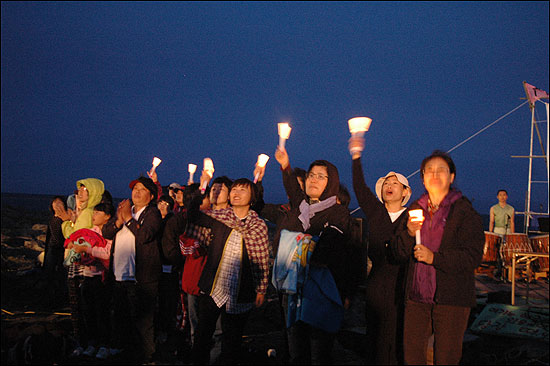
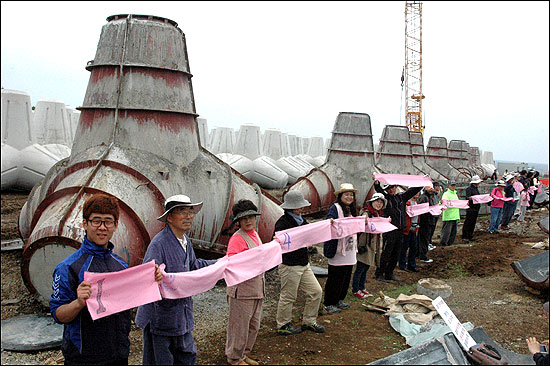
Over the past weekend hundreds rallied in Gangjeong village in South Korea to protect the rocks and the plant and animal life that will be destroyed once the thousands of huge “tetra pods” are all placed in the water and cement gets poured over everything to build the piers in order to dock the visiting U.S. warships.

The military (who says they are out to bring security) does not care about the life forms that are killed. Their brazen quest for power and control separates them from the living world around them. Power is like a drug and they always need more as the addiction numbs them to life. The plants, the rocks, the coral, the fish, the clean water do not exist in their minds. It is a spiritual disconnection.
[…]
Here in the U.S. we witnessed last week the U.S. House of Representatives voting to give the president formal power to declare war anyplace and anytime he wishes. The Constitution says that only Congress can declare war but now that the corporations own Congress the loyalty of both parties has switched from protecting the people to protecting the profits and global imperial agenda of the corporations. This is the time that we live in. Democracy has been smothered just like the life forms living among the rocks in Gangjeong will be smothered by the concrete.

Today begins my 9th day of fasting in solidarity with all life forms in and around Gangjeong village on Jeju Island. My heart is with Yang Yoon-Mo who is now on his 58th day of hunger striking and Sung-Hee Choi on her 14th day.

I am grateful to those who have been writing me and sending messages to the South Korean embassy in their country. In recent days I’ve heard from people in Germany, Denmark, Sweden, Scotland, Wales, England, China, Philippines, Japan, Hawaii, and all over the U.S. who are taking steps to show support. Many of these same people are fasting for a day or more. Thanks to all of you. Please keep spreading the word. I will return to Bath Iron Works again today.


http://space4peace.blogspot.com/2011/05/words-from-sung-hee-choi.html

Sunday, May 29, 2011

WORDS FROM SUNG-HEE CHOI

JungJoo Park from South Korea has provided us with the latest communication from Sung-Hee Choi who is now on her 11th day of hunger striking on Jeju Island, South Korea. It is Sung-Hee laying under the construction vehicle and in the middle of the photo above.

JungJoo writes, “What Sung-hee in a prison said to people who support her a few days ago.”

The revolution comes in time we do not know.
It comes suddenly when we are in desperate, so close to give up.
I believe in that long water flow which are made by tiny water drops gathering rather than someone’s big power at certain time.
I especially believe the power of culture, power of arts, no, I believe the power of cultured people and artists.
And I believe the truth will be spread out to this whole world as our young generation begin to stand up.
But our fight has to be fun.
And again, our youth should be a source of strength for our fight.
You do not know how much I miss you, Gangjeong village, Gureombi…
I miss them so much, appreciate them so much, and I’d love to see them all.
Brother, Taewhan, will you sing again?
And everyone, will you sing together?
We get together again and do a dance on Gureombi?
But on the other hand, I am glad to come trapped.
More and more people coming to Gureombi, more things are doing!!
Here, I read books that I missed so far, and think a lot of ideas I missed.
There is a passage, especially coming so often these days.
“The absolute, must open one side of the door if the other side is closed.”
Let’s walk together toward the open door!
(And the tears flow quietly)
I’ve never ever cried while visiting.
But so many young people have come, my tears of happy flowing.
Please call more young people of 20’s. Let my tears flowing more.
For a while I was totally numb.
I got here so unjustly.
If your transparent and clear forces get together, It will change everything at the moment nobody can expected.
At the moment we think of defeat, we are really missing out on everything.
But we do not fail as long as we do have beliefs.
I believe history.
Take courage and anger at the same time.
Lying down under a dump truck and crane must be finished by our generation.
You do your things in your way.
More enjoyable, more fun!
Not short time later, a lightning flash occurs and the naval base will be destroyed.
At that moment we must able to say openly.
‘I am that thunder and lightning.’
I believe history and you.
Your infinite power available is up to you!


– Sung-Hee Choi
Jeju Island, South Korea

Bring War Dollars Home by Closing Down Bases

This article by Christine Ahn and Sukjong Hong came out a few months ago, but it is very relevant to the struggles happening in Jeju, Okinawa, Guam and Hawai’i.

>><<

Bring War Dollars Home by Closing Down Bases

By Christine Ahn and Sukjong Hong

Foreign Policy in Focus

March 31, 2011

On the eighth anniversary of the U.S. invasion of Iraq, U.S. fighter planes took off to start yet another military action — this time, in Libya. A recent Gallup poll found that only 47 percent of Americans approved of military action in Libya, the lowest level of support for military intervention in 40 years. At the same time, U.S. President Barack Obama has sent Congress a budget that includes $1.2 trillion dollars for military and security expenditures. Clearly, Americans are weary of war, especially during an economic crisis that has threatened jobs, health plans, and pensions most families need to survive.

The hopeful news is that a grassroots movement of ordinary people across U.S. towns and cities has launched the New Prioritiescampaign, uniting under the demand to “bring the troops and war dollars home” by cutting defense spending instead of benefits, jobs, and basic government services. Worldwide actions are also being planned for the Global Day of Action on Military Spending on April 12th to shine a light on egregious amounts of military spending by the world’s governments. Central to these efforts must include demands to shut the 1,000-plus U.S. military bases in over 46 countries.

Bases are the most visible structures of the U.S. drive to maintain global military hegemony. Yet for most Americans, bases remain out of sight and outside the national discourse on war. Many don’t know about the enormous footprint of U.S. military installations around the world and how they undermine the lives and aspirations of the people who live directly in their shadow. Ending U.S. wars is essential, but closing down foreign bases is even more critical to dismantling U.S. militarism and global hegemony.

On the island of Cheju off the coast of South Korea, villagers are struggling to prevent the construction of a South Korean naval base intended for U.S. military use. In 2009, one of us traveled there and can still remember the tattered yellow flags lining the fence posts of homes, symbolizing the movement’s determination to stop the project. Walking along the endangered rocky coastline at the edge of this quiet village of farmers and fisherfolk, it was clear that Cheju Island and other sites of U.S. military bases in Korea have borne enormous costs to the people and to the future of peace in the region.

A Huge Financial Cost

Most figures used to estimate the cost of U.S. wars omit the global network of U.S. bases that provides vital resources and infrastructure to existing military conflicts. The Pentagon’s 2010 Base Structure Report, for example, lists 662 overseas bases but fails to include the 411 bases in Afghanistan, the 88 remaining bases in Iraq, or sites in Qatar and other countries where U.S. military personnel are stationed. Maintaining and constructing all U.S. bases cost American taxpayers $41.6 billion in 2010, according to Undersecretary of Defense Dorothy Robyn.

Of these 662 overseas bases, more than 70 military installations and bases and 28,500 U.S. troops are stationed in South Korea. Ted Galen Carpenter and Doug Bandow of the Cato Institute estimate that the cost of U.S. bases in Korea “probably runs on the order of $15 to $20 billion annually.” Although the United States and South Korea have agreed to reduce and consolidate the number of U.S. military bases in Korea, other bases and training ranges — including Osan Air Base in Pyeongtaek — are expanding displacing thousands of villagers and destroying Korea’s productive and limited farmland.

The agreements governing the responsibility for U.S. base relocation in Korea illustrate the unequal dynamic prevalent in countries that host U.S. bases. Under the Special Measures and Base Relocation Agreements, the United States and South Korea agreed to share the cost burden of moving U.S. bases, with South Korea obligated to pay more than half that cost. In 2008, South Korea paid $741.4 million, angering South Koreans unhappy over having to foot the majority of the moving bill and pay to clean up 60 years of environmental contamination. At some of the 23 bases ”returned” to South Korea, the levels of contamination are 100 times above the limit set by Korean law. Cleanup at these sites will require years of decontamination at enormous cost to South Korean citizens, not to mention the public health and ecological consequences for generations to come.

Moreover, U.S. bases and troop presence are an extension of U.S. intervention in South Korea. Historically, the U.S. military provided legitimacy, economic aid, and protection to dictatorial regimes that maintained their power with brute force. Today, the U.S. and South Korean governments control and suppress dissent through the infrastructure of bases, particularly Pyeongtaek and Osan, which are now major U.S. military intelligence outposts for the U.S. National Security Agency (NSA). While conducting research for his book Spies for Hire on the privatization of U.S. intelligence, Tim Shorrock found unsavory evidence of eavesdropping on Korean civilian activities by U.S. military bases located there. Although the primary target of surveillance activity is North Korea, U.S. intelligence also monitors China and Vietnam from Korean bases. What worries Shorrock is that since 9/11, what is considered a threat has widened to include almost any activity that questions or challenges U.S. interests. His discovery of the U.S. military in Korea colluding with Korean police to monitor anti-base activities is “an amazingly frank assessment that the anti-bases movement is being as closely monitored, and probably more so, than Al Qaeda – and basically puts the movement in the same camp as global terrorists.” But it’s not just anti-base movements. Recently protests against the U.S.-Korea Free Trade Agreement were also noted in the log of the U.S. forces in Korea.

Resistance to U.S. Military Bases in Korea

Given the fierce opposition to U.S. military bases throughout the Asia-Pacific rim, the United States has become savvy at reducing its military footprint in regions where its presence is politically contested. Rather than establish its own base, the U.S. military has sought the cover of the South Korean military in the construction of a new naval base in Cheju, an island located off the southern coast of South Korea.

The people of Cheju Island are known for their fierce resistance to Korea’s division and occupation by U.S. troops over the south during the post-World War II period. For their resistance, the people of Cheju paid dearly. Following the April 3 rebellion of 1948, South Korean government forces killed up to 30,000 people – more than one in ten residents –for opposing separate elections between the north and south and the U.S. occupation of the southern half of Korea. In a long-awaited gesture of apology, in 2005, former President Roh Moo-Hyun named Cheju the “Peace Island.”

Cheju Island is a designated UNESCO World Heritage Site and a national protected area by the Korean Cultural Heritage Administration. The Joongduk coastline, adjacent to Gangjeong village, is home to rare sea life, including soft coral, and is the seasonal habitat for dolphins migrating across the Pacific Ocean from Alaska during the summer.

In 2002, Seoul announced plans to build a naval base on Cheju. After two villages resisted, Gangjeong Village became the government’s third target. In 2007, 94 percent of the Gangjeong Village People’s Council voted “no” to the base plans. The government then proceeded to pressure residents. Some 1,500 farmers and fishermen live in Gangjeong village, including the legendary Haenye pearl divers—women in their 50s and older who forage in the sea for their livelihoods. Some of the villagers, including a few elderly Haenye divers, sold their farmland to the military under pressure from the South Korean government. According to Sung-Hee Choi, a South Korean peace activist and blogger, many of the villagers who signed the contract now regret their decision. However, they’ve been told that if they renege, they would have to pay back the money plus interest. Still, dozens of families are resisting the naval base construction.

In May 2009, the South Korean government approved construction of the joint U.S.-South Korean naval base. The military has begun to dredge the Joongduk coastline to accommodate the massive naval warships. If construction proceeds, it will not only destroy the rare coral reefs and surrounding ecosystems, it will kill the area’s fishing industry and displace citrus growers in Gangjeong village whose lands will be confiscated as part of the base expansion.

Gangjeong villagers have filed several lawsuits without much success. On December 15, 2010, a Cheju court ruled that the naval base did not infringe on the rights of the villagers, despite the projected destruction of the tangerine groves and the soft coral habitat where the villagers fish. The Gangjeong villagers have used every possible democratic means to block the base construction, but the South Korean government has been completely unresponsive. On Christmas Day, some 500 supporters joined dozens of villagers to block the cement trucks brought in by the Navy to pour concrete over the coral reefs along the shoreline.

The Cheju facility is ostensibly a South Korean naval base, but for all intents and purposes it will be used by the U.S. military. This was confirmed when Americans made calls to the South Korean embassy urging them to close the base, to which the South Korean embassy responded, “Call your own government, which is pressuring us to build this base.” The villagers are currently occupying the site, stopping the construction cranes from dredging up the shoreline and facing off against riot police.

Not for Korean Security

When most Americans learn how U.S. military bases are infringing on the sovereignty and rights of the Korean people, most agree that it’s high time for troops to be withdrawn. But many ask, what about the threat of nuclear-armed North Korea — who will protect the Korean people?

Although the U.S. military has long stated that it maintains a presence in South Korea to protect the civilian population, South Koreans have experienced the impunity with which U.S. troops behave on their territory. Organizations have documented thousands of crimes committed by soldiers against South Koreans. Between 1988 and 1996, U.S. troops committed an average of two crimes per day, ranging from the mundane to the heinous. The frequency of crimes committed by U.S. military personnel demonstrates the impunity with which U.S. forces act in South Korea — and likely, in many other host countries in which Status of Forces Agreements clearly give the U.S. military the upper hand. Furthermore, contrary to most fear-mongering projections of a nuclear-North Korea, “Most economic and military indicators show that South Korea has an edge over North Korea in almost all measures of power,” writes Jae-Jung Suh.

But perhaps more relevant today than the U.S.-South Korean military alliance is the grander regional alliance the United States has been forming in response to the perception of a growing Chinese military and economic threat. A key indicator of this is how the Mutual Defense alliance of the U.S. and South Korea has been transformed. Under the 2009 “Strategic Flexibility” agreement signed by Presidents Obama and Lee, the defense of South Korea is returned to Seoul, allowing the United States to deploy its forces outside Korea. Under the new arrangement, not only will South Korea be used as a rapid deployment hub for US military objectives elsewhere, South Korean troops will also be deployed for U.S.-led military deployments beyond Korean borders.

The realignment and consolidation of U.S. bases is also revealing. Many of the larger U.S. bases are along Korea’s West Coast and have moved away from the Demilitarized Zone toward more southern locations. This network of bases is part of a new missile defense shield directed as much toward China as toward North Korea. In the region as a whole, U.S. base expansions are taking place in Japan, Okinawa, Guam, Australia, and other key locations in the Asia-Pacific theatre, which effectively form a belt of bases that encircle China and Russia. The United States, South Korea and Japan have strengthened their tri-lateral alliance, which has resulted in more intense and frequent joint war games among all three nations, including the recent Key Resolve Foal Eagle ROK-U.S. joint military exercises involving 13,000 US troops and a nuclear aircraft carrier,

In a 2007 interview, former U.S. Forces in Korea Commander General B.B. Bell explained why South Korea was so vital to the United States by saying, “Twenty-five percent of the world’s trade flows through northeast Asia. Whether it’s Korea, Japan, or China, if you’re trading in the world, one out of every four things you trade, commodity-wise and dollar-wise, is going through that area.” Korea itself is the seventh-largest U.S. trading partner. Bell further explained the need for U.S. military engagement in Northeast Asia “because of the natural resources, lines of communication, and products that we will have to deliver around the world.”

But there’s more than cargo protection driving U.S. base strategy — U.S. bases are there to encircle China. Of all U.S. military bases, South Korea is the closest spot to Beijing, a strategic location to gather intelligence, and a key point for a possible standoff with China. The Project for the New American Century clearly states this: “Raising U.S. military strength in East Asia is the key to coping with the rise of China to great-power status.”

This broader regional strategy also explains U.S. pressure on South Korea to build a naval base in Cheju. Bruce Gagnon of the Global Network Against Weapons and Nuclear Power in Space explains why villages in Cheju are being destroyed to accommodate the expansion of the U.S. military base: “China imports 80 percent of its oil on ships and a Navy base on Cheju would help give the U.S. ability to ‘control’ this vital shipping lane in the Yellow Sea. While the declining U.S. economy can’t compete with China anymore, the Pentagon is embarking on a strategy that says if we can control access to declining supplies of oil then we will still hold the keys to the global economic engine.” This year, China surpassed the United States in energy consumption. As Michael Klare puts it, “China’s decisions on energy preferences will largely determine whether China and the United States can avoid becoming embroiled in a global struggle over imported oil and whether the world will escape catastrophic climate change.”

With bases encircling China, the U.S. military has the capacity to stave off a growing Chinese presence and control its growing demand for energy. South Koreans know this reality well. In a recent visit to Pyeongtaek, when Bruce Gagnon asked the Pyongtaek Peace Center, an organization based in South Korea, to whom the United States was directing its aggression, Center representatives replied, “Russia and China. Russia has large supplies of natural gas. It’s about energy wars.”

Close Down U.S. Bases and Cut Military Spending

As grassroots efforts are made in the U.S. to shift funding from the military budget to our communities, we must remember the active struggles of groups overseas that are directly resisting the footprint of U.S. military bases. Whether in Okinawa, Guam, or Korea, residents are on a daily basis fighting to stop the construction or expansion of U.S. military bases. Not only are the massive joint U.S.-South Korean military exercises diverting critically needed public dollars in both countries, they are moving the two Koreas further away from the promise of reconciliation and reunification. U.S. bases in Korea are no longer needed. The real issue is how these bases are serving to keep tensions high on the Korean peninsula and in the region as a whole.

Rather than accept the unending stalemate that continually threatens to erupt into war, in the United States, a broad movement is calling for the end of the Korean War, in solidarity with groups in South Korea that have long campaigned for the same demand. The signing of a peace treaty is the first step to demilitarizing not just the Korean peninsula, but also the Asia-Pacific region as a whole, and paving the way for a self-determined reunification of the two Koreas.

Bringing the war dollars home refers not just to active, hot-wars but also to the network of bases that makes war and U.S. empire-building possible and thwarts democratic advancement and the development of more just, equitable societies.

Perhaps few can express the importance of this struggle better than those who have defended their rights to land and life against US military interests. From 2004 to 2007, for nearly 1000 days, villagers in Pyongtaek, South Korea held candlelight vigils to stop the expansion of the US military base, Camp Humphreys. When asked by the South Korean Defense Ministry for the price for his land, Pyongtaek village leader Kim Ji Tae replied, “The price will be unimaginably high. The price must include every grain of rice grown and harvested here. It must include all of our efforts to grow them, as well as our whole life here, including our sighs, tears, and laughter. The price must include the stars, which have witnessed our grief and joy, and the wind, which has dried our tears. If all of these could be added, I would tell you the price.”

We must call for the defunding of U.S. bases and war games, and join this global people’s struggle for peace and sovereignty.

Christine Ahn is the executive director of the Korea Policy Institute and a columnist for Foreign Policy In Focus. Sukjong Hong is a member of Nodutdol for Korean Community Development and a contributor to Foreign Policy In Focus.