Tripler plans to release soldier who held off Hawaii police in standoff

Posted on: Wednesday, July 9, 2008

SOLDIER’S FAMILY

Tripler plans to release soldier who held off Hawaii police in standoff

By Rob Perez
Advertiser Staff Writer

A Schofield Barracks soldier who was hospitalized last week after threatening suicide during an 18-hour standoff with police is scheduled to be released as soon as tomorrow despite concerns from his family that he is not ready.

Stephanie Kerry, the mother of Sgt. Jesse Kerry, said her son still is having trouble dealing with the traumatic effects from deployments to Afghanistan and Iraq and questioned whether the military has provided adequate treatment for him and many other soldiers in similar situations.

“I think Jesse and other soldiers like him are battling things that require more time,” she said. “This is extremely serious, and people need to realize that.”

A spokeswoman for Tripler Army Medical Center, where Kerry was taken for psychiatric evaluation after the June 30 standoff in Waipahu, said federal law prohibited her from commenting on individual cases. But the hospital issued a general statement: “Every patient is assessed individually. Based upon clinical evaluation, a personalized treatment plan is given, which works toward a discharge date.”

In a phone interview from her Valley, Ala., home yesterday, Stephanie Kerry said she was told by her son’s physician Monday that the soldier probably would be released tomorrow.

She said that when she expressed concern that her son wasn’t ready to be released, the doctor told her the military can’t hold someone for an involuntary psychiatric evaluation for more than 72 hours.

Stephanie Kerry said her son told her previously that he is suffering from post-traumatic stress disorder, and that the effects are so serious that she believes he needs more treatment. She wasn’t sure whether he would be able to stay at Tripler beyond tomorrow, even if he asked to do so.

Since Jesse Kerry’s 2004-05 tour in Afghanistan and a 2006-07 deployment to Iraq, where he witnessed two friends in his convoy killed by a roadside bomb, the 23-year-old married man and father of a son has been drinking more and battling depression and nightmares, his mother said.

APPARENT SUICIDE TRY

About two weeks before the standoff, which forced the evacuation of nearby homes in a Royal Kunia townhouse complex, police were called to Kerry’s home because of a domestic dispute, several neighbors said as the standoff unfolded. His wife was escorted away, and the woman and son later left for the Mainland, the neighbors said.

When Kerry surrendered to police and the standoff ended, he had cuts on both wrists.

Stephanie Kerry said her son started having psychological problems after his deployment to Afghanistan and had a serious incident in May 2006 that prompted his command to “red flag” his file.

Yet he was deployed to Iraq a few months later, she said.

An Army spokeswoman said she could not comment on Kerry’s case because of privacy laws. But the spokeswoman said that, speaking generally, a soldier’s file can be flagged for many reasons ranging from obesity to misconduct.

Stephanie Kerry said she didn’t know whether her son was formally diagnosed with PTSD, but he told her he had the disorder and was prescribed sleep medication and an anti-depressant. She said her son didn’t seem to be getting the care he needed, and his current treatment didn’t appear to reflect the seriousness of PTSD and what happened last week.

“It seems as though he’s just being fast-tracked” out of the hospital, she said.

When Kerry’s father, Freelon, asked his son in a phone conversation Monday night whether he was doing OK, the soldier replied, “Not really,” Stephanie Kerry said. After a short pause, she said, her son added, “Yeah, I’m OK.”

INVISIBLE WOUNDS

About 20 percent of military service members who have returned from Iraq and Afghanistan report symptoms of PTSD or major depression, according to a study released in April by the RAND Corp., a nonprofit research organization.

Returning soldiers who have trouble dealing with the stresses of war have access to a variety of services, ranging from outpatient programs to intensive in-patient treatment. But critics nationally say the military’s mental health network falls far short of what is needed, partly because of a shortage of personnel. Also, many troops simply don’t seek treatment.

A specialist with the nonprofit Helping Hands Hawai’i said the symptoms Kerry’s mother described were similar to what many other soldiers have described.

“The battle does not end on the battlefield,” said William “Clay” Park, a Helping Hands case manager and Vietnam war veteran. “It comes home with you. A lot of these guys self-medicate themselves with alcohol or drugs.”

Reach Rob Perez at rperez@honoluluadvertiser.com.

Source: http://the.honoluluadvertiser.com/article/2008/Jul/09/ln/hawaii807090406.html

Veteran kills family and self in Mililani

artmurder01a
CINDY ELLEN RUSSELL / CRUSSELL@STARBULLETIN.COM
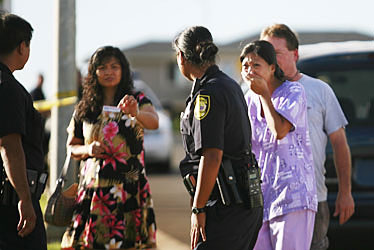
A woman identified herself to Honolulu police yesterday as a relative of one of the residents at 95-1042 Moohele St. in Mililani Mauka upon arrival at the scene with another relative, right. According to HPD, a man killed his wife and son before hanging himself there.

Family killed in Mililani

» Police say Michael James murdered his wife and son, then killed himself
» It is the third murder-suicide on Oahu in less than 3 months

STORY SUMMARY »

A Mililani Mauka man killed his wife and their son Tuesday before taking his own life, the third murder-suicide on Oahu this year.

artmurder01b

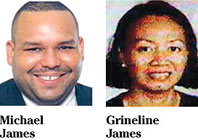
Police say it appears Farrington High School teacher Grineline James and son Michael Jr. were killed at the hands of Michael A. James, who committed suicide yesterday at the home at 95-1042 Moohele St.

Neighbors and Grineline James’ co-workers expressed shock and confusion over the violent end to a nice, quiet family.

Catherine Payne, principal of Farrington High School, praised her employee as a dedicated teacher, one of the best at the school.

artmurder01c

“It’s very, very tragic. It’s beyond my comprehension that something like that could happen. She was such a good person and a wonderful mother to her son,” Payne said.

Honolulu police expressed frustration at the third domestic murder-suicide in Honolulu in less than three months. More than half of the 11 homicides on Oahu this year involve domestic violence.

“If you’ve got domestic violence going on in your family, do something about it,” said Honolulu Police Department Maj. Frank Fujii. “I’m sure that all the victims that died as the result of domestic violence, none of them thought that it was going to happen to them.”

ROB SHIKINA AND ROSEMARIE BERNARDO

FULL STORY »

artmurder01d
PHOTOS BY DENNIS ODA / DODA@STARBULLETIN.COM
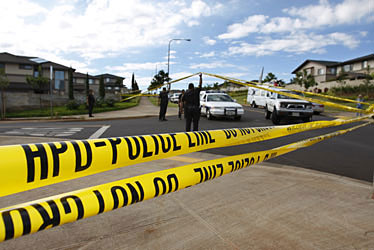
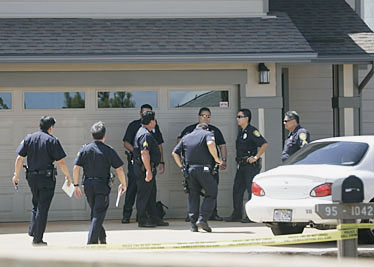
Police lifted up the crime scene tape yesterday to let in a neighbor who lives next door to a house where a double murder-suicide occured in Mililani Mauka. The house, shown on the left side of the picture, is at the corner of Moohele and Ukuwai streets. Below, police gathered in front of the house.

By Rob Shikina
and Rosemarie Bernardo
rshikina@starbulletin.com
rbernardo@starbulletin.com

Three family members were found dead in a Mililani Mauka home yesterday in a double murder and suicide.

Police made the grisly discovery yesterday about noon after a postal worker found a suspicious note in the mailbox and reported it to a supervisor, who called police.

Video: Family of 3 Found Dead in Mililani Police found a family of three dead in a Mililani home after a woman mail carrier found a note in the family’s mailbox. In partnership with KITV.com

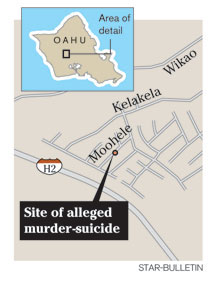
Arriving officers found the front door at 95-1042 Moohele St. unlocked. Inside they found more notes directing them to the dead family on the second floor: a 43-year-old man, a 39-year-old woman and a boy, 7.

Neighbors identified the man as Michael A. James, a retired veteran who worked from home selling insurance. His son was Michael, and his wife was Grineline James, a Farrington High School teacher.

An online listing said James worked for Benchmark Life Insurance & Annuity Consulting Group from that address.

Honolulu Police Department Maj. Frank Fujii said police believe James killed his wife and son Tuesday evening and committed suicide yesterday morning.

Police found the woman and child in a bed covered with a sheet, while James was found hanged in a home office. He left a suicide note saying he killed his wife and son, police said.

artmurder01e
PHOTOS BY DENNIS ODA / DODA@STARBULLETIN.COM
Police gathered in front of the house.

Fujii declined to describe the injuries but ruled out gunshot wounds.
Yesterday’s discovery disturbed the quiet, new neighborhood as police taped off one end of Moohele Street until shortly after 6:15 p.m. The house where the killings occurred is at the corner of Moohele and Ukuwai streets. On the driveway a basketball hoop stood next to a white Hyundai sedan.

Video: Neighbors Shocked Over Mililani Deaths Many neighbors say that the neighborhood is very quiet and are surprised at what had happened in the James’ family home. In partnership with KITV.com

Mark Pacpaco, 31, who lives directly behind there on Moohele Place, said the family moved there about 18 months ago. He talked with James about landscaping and said James was a retired veteran.

“The guy always had a smiling face,” he said. “He seemed like a real nice guy.”

Donna Carter, who lives across the street, said James introduced his family when she moved in last December.

“They were a nice family,” she said. “Mike was really friendly. He was the first one to come and welcome us.”

“He loved his son,” she said, adding that he enjoyed playing basketball with his son.

The family was quiet and kept to themselves, she said.

“I’m just very upset,” she said. “It’s a shame. You hate to see a family destroyed like that.”

Catherine Payne, principal of Farrington High School, said Grineline James had worked at Farrington since January 2003.

“She was a magnificent teacher, very much loved by her students and her colleagues,” Payne said. “We’re just devastated by her loss.”

Payne described her as a “quiet but strong person,” adding she was “very kind and thoughtful.”

“She was one of the best teachers in the school. Every student in her class learned from her,” she said.

Grineline James told co-workers that she would be away next week to attend the funeral of her husband’s brother.

Police Chief Boisse Correa visited the house briefly yesterday evening and left without speaking to reporters. Relatives arrived in a blue van and spoke briefly with police. One woman raised her hand to her mouth during the conversation.

Fujii said the double murder is the 10th and 11th homicides this year. More than half of them are related to domestic violence.

MURDER-SUICIDES

The other murder-suicide cases on Oahu this year:

» May 26: Police responded at 6:39 p.m. to a dropped 911 call at 99-801 Halawa Heights Road. The officers heard nothing but a disconnected phone, entered the apartment and found 60-year-old Eliseo Dumlao Jr. and 45-year-old Marissa Dumlao shot dead. Police found a 9 mm handgun on the husband’s chest and said he shot his wife before killing himself. Marissa Dumlao left behind an 18-year-old daughter.

» April 25: At 11:51 p.m., neighbors of 91-1635 Kaukolu St. heard gunshots coming from the home. Police found 38-year-old Della Dikito shot dead in the bathroom. Her husband, 39-year-old Domingo Dikito, was found in the garage, dead from a self-inflicted gunshot wound. The couple left behind three daughters – ages 8, 13 and 15 – and an 18-year-old son.

OTHER DEATHS
Other homicide cases on Oahu related to domestic violence this year:

» Jan. 9: Jenny Hartsock, 39, was stabbed multiple times allegedly by her 40-year-old husband Roy William Hartsock outside their apartment at 757 Gulick Ave. in Kalihi.

» Jan. 16: Janel Tupuola, 30, was beaten to death, allegedly by her ex-boyfriend, 29-year-old Alapeti Siuanu Tunoa Jr. Police said Tunoa used the butt of a shotgun and beat Tupuola in the middle of a street in front of horrified spectators. The couple had a 2-year-old daughter.

Source: http://archives.starbulletin.com/2008/07/03/news/story01.html

Autopsy reveal cause of death in veteran-family murder-suicide

Starbulletin.com

Posted on: Thursday, July 3, 2008 4:47 PM HST

Autopsies reveal cause of death in murder-suicide

Star-Bulletin Staff
citydesk@starbulletin.com

Michael Anthony James strangled his wife and drowned his 7-year-old son before hanging himself in the family’s Mililani Mauka home this week, autopsies revealed today.

The city’s medical examiner said Michael Anthony James, Jr., had drowned. Police sources indicated that the father drowned his son in the bathtub and that Grineline D. James, 39, died by strangulation at the hands of her husband.

Both deaths were classified as homicides, the medical examiner said today.

Michael Anthony James, 43, died by asphyxia due to hanging, a suicide. He was pronounced dead at 1:07 p.m. Wednesday.

Police said before he killed himself he placed the bodies of his wife and son on a bed and covered them with a sheet.

The medical examiner’s office withheld information about when each person died, citing an ongoing investigation. Police had said the mother and child died Tuesday night and James died Wednesday morning.

A toxicology report is pending.

Soldier peacefully ends standoff with police

HonoluluAdvertiser.com

July 1, 2008

Man gives up peacefully in Waipahu

By Dave Dondoneau
and David Waite

ROYAL KUNIA – A standoff involving a Schofield Barracks soldier ended peacefully at about 10:40 a.m. today when the man walked out of his Royal Kunia townhouse with his hands up and surrendered to police.

Neighbors said they were told the soldier had returned earlier this year from Iraq and was diagnosed recently with post traumatic stress disorder.

Police began evacuating residents of one area of the Villas at Royal Kunia at about 4 p.m. yesterday after becoming concerned that the soldier might be a threat to himself or others.

The soldier, who lives in unit 20 of the townhouse complex at 94-976 Hanauna St., was described by neighbors as tall and thin. They said they often saw him in front of his unit cooking food on an outdoor grill with friends.

Neighbors said the man’s wife left with the couple’s two children yesterday to return to the Mainland. They said police were called to the home about two weeks ago and escorted the wife from the home following a domestic argument.

Neighbors Jade and Emery Black were evacuated yesterday at about 6 p.m. They said they had heard “the guy had two guns.”

Jade Black watched the police operation from across the street until midnight and then went to stay with friends.

The Blacks returned this morning to find the situation had not been resolved.

Andy Reckers and wife, Hannah, went to walk their dog – adopted from the Hawaiian Humane Society six days ago – and saw police surrounding the townhouse complex when they returned.

They also stayed overnight with friends hoping to return to their home this morning.

Levi Reulecke and his wife, Ericka, who live diagonally across in the same cluster from the unit in question, said police came to their home about 8:15 last night and told them to leave.

They said they were surprised by all of the commotion and that their neighbor in question “seemed like a normal guy – until yesterday.”

About 10:15 a.m. this morning, police were allowing some of the residents who were evacuated earlier to return to get some of their belongings and to retrieve their cars.

The west-bound lanes of Anonui Street, which connects with Hanauna Street, were open but the east-bound lanes of Anonui remained closed to traffic.

Police had set up shade tents and brought in an air-conditioned trailer to allow SWAT team members to take a break from the heat.

Halawa Heights killer faced sex-assault rap

Looks like Eliseo Dumlao, a retired military man, was in the midst of a sex assault case when he killed his wife and himself.

>><<

starbulletin.com

May 29, 2008

Halawa Heights killer faced sex-assault rap

By Leila Fujimori
lfujimori@starbulletin.com

The 60-year-old Halawa Heights man who fatally shot his 45-year-old wife and then killed himself Monday had been arrested 2 1/2 weeks earlier for allegedly sexually assaulting an 18-year-old woman.

Police arrested Eliseo Bueno Dumlao Jr. on May 8 on suspicion of fourth-degree sexual assault, a misdemeanor, in a case involving an 18-year-old woman, according to the city Prosecutor’s Office. The case was pending investigation for felony charges.

The sexual assault was reported Jan. 6, the Prosecutor’s Office said.

Dumlao’s wife, Marissa, and her 18-year-old daughter had previously moved out of the Halawa Heights apartment, and Marissa Dumlao had returned Monday evening to retrieve some clothes, a police official said.

Police responded to a dropped 911 call at 6:39 p.m. Monday at 99-801 Halawa Heights Road, Apartment 4. Upon their arrival at the Dumlaos’ second-floor walk-up, officers could hear the sound of a disconnected phone, police said.

When no one responded, police entered through a back window and found Eliseo and Marissa Dumlao in their bed, each with a gunshot wound to the head, police said.

A 9 mm semiautomatic handgun was found on Eliseo Dumlao’s chest, police said. Autopsies revealed she had been murdered and that he had committed suicide.

Police canvassed the neighborhood that night looking for Marissa Dumlao’s daughter to ensure she was all right. She was later located in good condition.

The couple had recently married. Neighbors and their landlord said there were few signs of domestic problems.

Marissa Dumlao’s co-worker at Maile’s Lei Stand at Honolulu Airport said she noticed a change in Dumlao’s usually friendly demeanor. Aurora Doble said Dumlao had grown quiet lately. Doble could sense Dumlao had problems, but she did not ask questions.

Eliseo Dumlao’s only prior criminal convictions were for driving under the influence, a petty misdemeanor, in 1999 and 2002.

Court records show Dumlao was previously married and that his ex-wife filed for divorce in 2001.

This was the second murder-suicide on Oahu in a little more than a month.

On April 25, Domingo “Bunny” Dikito, 39, shot and killed his wife, Della Dikito, 38, in their Ewa Beach house. Their 8-year-old daughter, who was at home, witnessed the shooting.

Dikito then went out into the garage and killed himself.

Ex-military man involved in murder-suicide

Article URL: http://starbulletin.com/2008/05/28/news/story03.html

May 28, 2008

Police say shootings were murder-suicide

By Gene Park

gpark@starbulletin.com

Police classified Monday’s Halawa Heights shooting as a murder-suicide case, the second on Oahu in 32 days.

A 60-year-old man shot his 45-year-old wife in the head, before turning the 9 mm handgun on himself in their Halawa Heights apartment shortly after 6:39 p.m., investigators said.

The city Medical Examiner’s Office is not yet releasing the couple’s identities, but a co-worker identified the woman as Marissa Dumlao, and her husband as Eliseo Dumlao Jr.

Monday’s shooting comes just after a month when Domingo “Bunny” Dikito shot his wife Della Dikito before killing himself at their Ewa Beach home on April 25.

Such cases show the importance of reaching out for help, said Suzanne Green, a domestic violence educator for the Hawaii State Coalition Against Domestic Violence.

“We’re always glad there’s coverage because this has been such a secret and silencing crime,” Green said. “The longer we keep it silent, the more women get hurt and the more we continue to blame them.”

Green said she is disheartened to read online comments about how women in murder-suicide cases should learn to restrain what they say if they see their spouse’s anger rise.

“It’s irrational thinking by our society that what we do causes violence,” Green said. “When someone gets their car stolen, we don’t blame them for getting it stolen. A crime is a crime, and someone’s choice of hurting someone else is their choice.”

Police responded at 6:39 p.m. Monday to a dropped 911 call at 99-801 Halawa Heights Road in Aiea.

Officers entered the second-story unit through a back window and found the couple dead. A 9 mm semiautomatic handgun was found on Eliseo’s chest. Marissa is survived by an 18-year-old daughter, who was not living with them, police said. The couple recently was married.

Eliseo Dumlao was convicted of driving under the influence of alcohol in 1999 and in 2002.

According to accounts from neighbors, the couple’s landlord and friend Aurora Doble, there were little signs of possible domestic troubles. Doble worked with Marissa at Maile’s Lei Stand at the Honolulu Airport.

“Only lately she has been quiet,” said Doble, adding that Marissa began work at the stand in October last year. “Somehow I could sense that she had problems, but I didn’t ask.”

Doble said she found out about the case when she saw morning news footage of the couple’s apartment. Doble had given Marissa a ride home to the apartment before.

Doble said although she did not know the couple well, her husband knew Eliseo because they served in the Navy together.

“I’ll always remember when before she would come to work, she would pass by the bakery,” Doble said. “I’m going to miss her buying my favorite pastries. I’m really going to miss her.”

Green said the group will plan a silent march, just as they did for Della Dikito when she was shot by her husband in April’s murder-suicide case. She also advised others who are in fear of a similar situation to reach out to victims advocates for help.

“They won’t be forced to do anything or take any action,” Green said. “They’ll just find someone that will listen to them and not blame them.”

Halawa Shooting by Retired Military Man Ruled Murder-Suicide

Halawa Shooting Ruled Murder-Suicide

Co-Workers Remember Slain Woman As Talented Leimaker

POSTED: 4:09 pm HST May 27, 2008
UPDATED: 4:33 pm HST May 27, 2008

HONOLULU — Honolulu Police Department investigators said it appears a Halawa Heights man shot and killed his wife before killing himself in a double fatal shooting on Monday night.

Friends remembered the woman, who worked as a lei maker at the airport.

Friends told KITV that the woman said she had problems with her husband’s temper even before they were married on Valentine’s Day this year.

The crime happened in a second-floor unit of a Halawa Heights apartment on Monday night.

The medical examiner said Eliseo Dumlao Jr., 60, and his wife, Marissa, 45, both died of gunshots to the head. Eliseo Dumlao’s death was ruled a suicide and his wife’s a homicide.

“Just seemed like a normal family, totally normal family. That’s why it was a shock to everybody, what went down last night,” Halawa resident Shaff Bautista said.

The Dumalos’ landlord said they were good tenants, who moved there in March from Waipahu.

Marissa Dumlao was a lei maker at Maile’s airport lei stand, where her friends hugged and cried as news spread of her death.

“She is a very kind lady. She is a nice lady,” fellow leimaker Aurora Doble said.

Doble said Marissa Dumlao did the work of two lei makers, working extremely quickly to make the most intricate orchid lei. She said Marissa Dumlao never talked about problems at home and was very generous with co-workers.

“I’m not going to forget what she did. Every time she’d go to the store, she bought my favorite food,” Doble said.

Other friends said they repeatedly told Marissa Dumlao to move out of their apartment because he had a temper that would flare up when he drank. Friends said the couple separated for a month or two several times before marrying in February. Records show he has two driving under the influence convictions from 2002 and 1999.

Eliseo Dumlao Jr. had retired from the Navy and worked in the kitchen at Tripler Army Medical Center.

Marissa Dumlao’s 18-year-old daughter was not home at the time her mother was killed, police said. She was located on Monday night and found unhurt.

Friends said Marissa Dumlao stayed with her husband in spite of their problems because she could not drive and relied on him to drive her places and because she needed medical insurance for herself and her daughter through her husband.

Source: http://www.kitv.com/news/16408861/detail.html

Schofield soldier acquitted of killing an Iraqi

Soldier acquitted in killing of Iraqi

A jury rejects charges by the prosecution that the soldier’s story had several holes in it

Schofield Barracks soldier Trey Corrales credits his acquittal of premeditated murder to his commander’s testimony about Corrales’ role in a coordinated operation to root out insurgents in Iraq.

In a Wheeler Army Air Field courtroom last night, a military jury declared Sgt. 1st Class Corrales not guilty of killing the unarmed Iraqi civilian who was a suspected insurgent.

After the verdict, Corrales talked about the importance of the testimony of Lt. Col. Michael Browder, who detailed how drones, helicopters and soldiers were used to track down insurgents about to set off a roadside bomb in June.

Corrales said it feels like a 200-pound weight had been lifted from his shoulders.

“I felt confident. I know this is going to sound weird, but I wasn’t surprised,” he said. “But it was just a long time coming.”

Corrales’ wife, Lily, told their daughter Victoria, 7, “Your daddy’s free! He’s OK,” moments after the verdict was read. The sergeant held his 10-year-old son, Trey II, in a long embrace.

GENE PARK AND AP

FULL STORY »

By Gene Park
gpark@starbulletin.com

Decorated Schofield Barracks soldier Trey Corrales was acquitted yesterday of charges that he killed an unarmed, suspected Iraqi insurgent in June.

Sgt. 1st Class Corrales faced life in prison without parole after being charged with premeditated murder, obstruction of justice and allegedly soliciting the murder by instructing a subordinate to fire at the Iraqi, tentatively identified by the Army as Salih Khatab Aswad.

After more than seven hours of deliberation, the nine-member jury panel returned with the not-guilty verdict on all charges. Corrales appeared calm, and his family and fellow soldiers immediately hugged each other tight.

“I haven’t been nervous this whole time,” Corrales said after the verdict. “I still have so much faith and confidence in this Army.”

The three-day trial ends what Corrales described as a harrowing period for him and his wife and three children. He said it felt like he had left one battlefield and entered another.

He said his immediate thoughts after the verdict was read went to the 10 soldiers from his platoon who died in a helicopter crash last August. The soldiers were intended to be witnesses in Corrales’ trial.

“When this happened, I felt robbed,” Corrales said through tears. “I wanted to be with them. But I wanted to be with (my daughter) and my son and my wife. Being a soldier, you’re split between two worlds and two loves.”

Earlier in the day, Army prosecutor Capt. Laura O’Donnell told the jury not to believe Corrales’ account of the shooting, where he denied premeditation, the alleged planting of an AK-47 rifle onto the unarmed man and ordering Pvt. Christopher Shore to shoot the wounded Iraqi.

There were holes in Corrales’ account of the June 23 incident, she said, including how the detainee was able to make it to the back yard after the raided home near Kirkuk was declared secure by

Corrales’ 25th Infantry Division elite scout platoon.

“That detainee somehow made it past 16 soldiers,” she said. “That detainee magically made it to the back yard. That doesn’t make sense. What makes sense is the accused pushed him to the back yard.”

But defense attorney Frank Spinner called into question the testimony of several witnesses, including Shore’s. Shore, convicted of aggravated assault in relation to the shooting, is serving time in the Ford Island brig.

Spinner said Shore’s initial statement about the incident was that he was unsure whether he shot the wounded man. He later testified that he had shot to the right of the man, missing him.

“This whole theory … is threadbare,” Spinner said. “The centerpiece of their case wasn’t even addressed.”

Spinner attributed the shooting to the “fog of war,” where the rules of engagement becomes ambiguous according to different situations.

“This was a dynamic environment, an intense mission,” Spinner said.

Corrales credited testimony from his battalion commander at the time, Lt. Col. Michael Browder, in selling the case that it was a coordinated effort to root out insurgent movement in the area.

Corrales said he expects criticism from people who are surprised with the verdict, particularly those “who sympathize with the insurgents.”

He said Iraqi insurgents have a different value of human life than ordinary citizens do, including those in Iraq.

“The rules here in America, we can’t take them to Iraq and apply those same rules to the insurgents on the ground,” he said. “If we did, there wouldn’t be just 4,000 American soldiers, sailors, Marines and airmen dead right now.”

Corrales said he was grateful to get another chance to spend more time with his family, especially since he is expected to deploy back to Iraq this October. He returned to Schofield Barracks last October from Iraq.

Source: http://archives.starbulletin.com/2008/04/26/news/story01.html

Another KBR Rape Case

Published on Thursday, April 3, 2008 by The Nation

Another KBR Rape Case

by Karen Houppert

Editor’s Note: Lisa Smith is a pseudonym used on request. Additional reporting by Te-Ping Chen. Research support provided by the Investigative Fund of The Nation Institute.

Houston, Texas

It was an early January morning in 2008 when 42-year-old Lisa Smith*, a paramedic for a defense contractor in southern Iraq, woke up to find her entire room shaking. The shipping container that served as her living quarters was reverberating from nearby rocket attacks, and she was jolted awake to discover an awful reality. “Right then my whole life was turned upside down,” she says.

What follows is the story she told me in a lengthy, painful on-the-record interview, conducted in a lawyer’s office in Houston, Texas, while she was back from Iraq on a brief leave.

That dawn, naked, covered in blood and feces, bleeding from her anus, she found a US soldier she did not know lying naked in the bed next to her: his gun lay on the floor beside the bed, she could not rouse him and all she could remember of the night before was screaming and screaming as the soldier anally penetrated her while a colleague who worked for defense contractor KBR held her hand–but instead of helping her, as she had hoped, he jammed his penis in her mouth.

Over the next few weeks Smith would be told to keep quiet about the incident by a KBR supervisor. The camp’s military liaison officer also told her not to speak about what had happened, she says. And she would follow these instructions. “Because then, all of a sudden, if you’ve done exactly what you’ve been instructed not to do–tell somebody–then you’re in danger,” Smith says.

As a brand-new arrival at Camp Harper, she had not yet forged many connections and was working in a red zone under regular rocket fire alongside the very men who had participated in the attack. (At one point, as the sole medical provider, she was even forced to treat one of her alleged assailants for a minor injury.) She waited two and a half weeks, until she returned to a much larger facility, to report the incident. “It’s very easy for bad things to happen down there and not have it be even slightly suspicious.”

Over the next month and a half, she says, she faced a series of hurdles. She would be discouraged from reporting the incident by several KBR employees, she says. She would be confused by the lack of any written medical protocol for sexual assault (as the only medical person on site, she treated herself with doxycycline). She would wander through a tangled maze of interviews with KBR and Army investigators about the incident without any clear explanation of her rights. She would be asked to sign several documents agreeing not to publicly discuss the incident, she says. She describes having her computer–which she saw as her lifeline, her main access to the outside world–confiscated by Army investigators as “evidence” within hours of receiving her first e-mail from a stateside lawyer she had reached out to for help.

And eventually she would find herself temporarily assigned to sleeping quarters between two Army Criminal Investigation Division (CID) officials, who, she says, assured her that it was for her own safety, since her alleged assailants were at the same camp for questioning; they roamed freely. When she wanted to move about the camp to get meals etc., she was escorted.

Smith felt very alone. But she was not.

In fact, a growing number of women employees working for US defense contractors in the Middle East are coming forward with complaints of violence directed at them. As the Iraq War drags on, and as stories of US security contractors who seem to operate with impunity continue to emerge (like Blackwater and its deadly attack against Iraqi civilians on September 16, 2007), a rash of new sexual assault and sexual harassment complaints are being lodged against overseas contractors–by their own employees. Todd Kelly, a lawyer in Houston, says his firm alone has fifteen clients with sexual assault, sexual harassment and retaliation complaints (for reporting assault and/or harassment) against Halliburton and its former subsidiary Kellogg, Brown & Root LLC (KBR), as well as Cayman Island-based Service Employees International Inc., a KBR shell company. (While Smith is technically an SEII employee, she is supervised by KBR staff as a KBR employee.)

Jamie Leigh Jones, whose story made the news in December–when she alleged that her 2005 gang rape by Halliburton/KBR co-workers in Iraq was being covered up by the company and the US government–also initially believed hers was an isolated incident. But today, Jones reports that she has formed a nonprofit to support the many other women with similar stories. Currently, she has forty US contractor employees in her database who have contacted her alleging a variety of sexual assault or sexual harassment incidents–and claim that Halliburton, KBR and SEII have either failed to help them or outright obstructed them.

Most of these complaints never see the light of day, thanks to the fine print in employee contracts that compels employees into binding arbitration instead of allowing their complaints to be tried in a public courtroom. Criminal prosecutions are practically nonexistent, as the US Justice Department has turned a blind eye to these cases.

Jones’s case was the subject of a House Judiciary hearing in December. Right now, Jones’s lawyers are awaiting a decision on whether she will get her day in court or be forced to submit to binding arbitration, which KBR is insisting on. Likewise, the company is pressuring Lisa Smith into pursuing her claims against the company through its Dispute Resolution Program based on the contract she signed before she went to Iraq. Critics argue that the company’s arbitration system allows it to minimize bad publicity and lets assailants off the hook.

Smith, who retained a lawyer only two weeks ago, is weighing her options.

KBR attorney Celia Balli, responding to a letter from Smith’s lawyer, wrote in a letter dated March 17, “The Company takes Ms. Smith’s allegations very seriously and has and will continue to cooperate with the proper law enforcement authorities in the investigation of her allegations to the extent possible.” Balli noted that the matter has been turned over to the CID and said that Smith has been “afforded with counseling and referral services through the Company’s Employee Assistance Program.” Balli wrote in the letter that there are “inaccuracies” in the description Smith has put forward regarding her treatment after the alleged sexual assault. “Therefore, the Company requests that you fully investigate all the facts alleged by Ms. [Smith] as the Company intends to pursue all available remedies should false statements be publicized.”

Such “investigation” may prove difficult for her attorney. In the next sentence, the company says it is “not in a position to release any personnel or investigative records regarding Ms. [Smith’s] allegations at this time.” In response to a request for comment on this story, a company spokesperson wrote in an e-mail that Smith’s “allegations are currently under investigation by the appropriate law enforcement authorities. Therefore, KBR cannot comment on the specifics of the allegations or investigation.” The spokesperson added, “Any allegation of sexual harassment or assault is taken seriously and investigated thoroughly.” It remains unclear, however, what law enforcement investigation is examining the KBR employee’s role in the alleged assault, since Army CID is charged with investigating only cases that involve US military personnel.

For her part, Smith can’t quite call herself a victim yet. In the course of several conversations over several days, she never once says the word “victim” out loud. Let alone “rape.” Let alone “gang rape.”

She simply describes what happened, moving through the course of events as if this had happened to someone else, as if the recitation of details were an act of contrition she was compelled to perform.

Like many rape survivors, she feels guilty. In this case, Smith confesses that she broke company policy the evening of the incident by having a drink (alcohol is expressly forbidden). She had landed at Camp Harper only a week earlier, when she returned from a stateside R&R with her family. Since arriving in Iraq six months earlier, she had been at a larger facility, Camp Cedar. But her new posting at Camp Harper put her in a smaller outpost of sixty people: part US military, part KBR employees, part SEII workers. When some KBR colleagues invited her to join them for a drink after work, she did.

Smith says she had only one drink–and she asked someone to hold it after a few sips while she went outside for a smoke. Smith’s attorney, Daniel Ross, speculates that someone slipped the date-rape drug Rohypnol in her drink.

Smith’s memory of the evening is fuzzy, and the only thing she remembers clearly about the events surrounding her assault is the aforementioned moment of oral and anal penetration. She also remembers screaming.

The morning after the incident, Smith says, she was called into the office of her supervisor, who was Camp Harper’s KBR manager; he appeared to know–at least in part–what had happened. She would later learn from an Army investigator that her supervisor had been in the room where the drinking and alleged rape had taken place at least twice that evening. Smith, who appears to have blacked out, has no direct knowledge of his participation–or indeed of who else among the crowd initially gathered in the room may have been involved. “He was one of the people involved in saying, ‘Don’t say anything,'” Smith says of her conversation with the KBR camp manager the morning following the incident. “Then he said, ‘This will never happen again.'”

Smith offered to pack up and go home. But he sent her back to work. First, though, he responded to Smith’s plea to get the soldier she still had not been able to rouse out of her bed by contacting the military’s Special Forces liaison at Camp Harper. The liaison, whom Smith knew only by his nickname, DJ, was direct. “He told me not to speak of this to anyone and that he would take care of it,” Smith says.

Smith sat tight for a few days but then contacted a friend at Camp Cedar, where her permanent assignment was, and asked if the Employee Assistance person for KBR was back from her R&R yet. She was not. Smith was worried about even discussing the incident, since she knew that none of her conversations were confidential. “Camp Harper has only three phones,” she says. “One is in the camp manager’s office. One is in the Operations Office. And one is in a hallway.” She wavered. A few days later, when she knew that the Employee Assistance person for KBR would be back, Smith called her on the phone. The Employee Assistance woman was a friend of hers and, without getting too specific about the details of the incident, Smith sought her advice. “We had worked other situations together in the past, and I talked to her and she was like, ‘I don’t know if I’d report that. You know what happens when you report things.’ And I did. I’d seen it.”

Despite Smith’s silence, rumors were circulating at the camp. Two and a half weeks after the incident, she was questioned by someone from the KBR Employee Relations office, who appeared to be investigating a series of improprieties at the camp, Smith says. Fearful, she denied knowledge of any wrongdoing at the camp.

When Smith returned to her original posting at Camp Cedar, a larger facility with a human resources person and more friends she could approach for advice, she recontacted the man from Employee Relations who had been investigating “improprieties” and told him her story.

This set the wheels in motion for a series of interviews, most of which concluded with Smith being asked to sign a nondisclosure statement by representatives of the company, she says.

Eventually, shortly before she was slated to return to the United States for R&R, one of the investigators for KBR suggested that Smith get tested for STDs, hepatitis, HIV, etc. and took her to the nearby military Combat Support Hospital. “The doctor took me into her office, and we talked a long time before she did an exam,” Smith says. “We talked about the assault and the details and she was actually very, very kind and encouraged me to report it to the military. She tried convincing me that it wasn’t my fault [for having a drink]. She was just a really kind lady–and that was the first time I had given any of the whole details of all that had happened.”

In fact, military protocol compelled the doctor to report the incident; Smith was immediately contacted by the Army Criminal Investigation Division and questioned.

A few days later, shortly after contacting an attorney in the United States to advise her on her rights, the attorney sent her a draft letter he was sending to KBR on her behalf, notifying the company that he was representing her and briefly summarizing her accusations. The military came to her office within hours, she alleges, and confiscated her computer as “evidence,” effectively limiting her access to the outside world. The CID did not respond to requests for comment.

Many victims of sexual assault find themselves without meaningful recourse when they work for US defense contractors that are powerful companies on foreign soil. “It’s one big battle over where to fight the battle,” said Smith’s attorney Ross, who is considering if and how and against whom to file charges on behalf of his client.

Take Jamie Leigh Jones’s case, for example.

Since Jones alleged she was gang raped in 2005, while KBR was still a Halliburton subsidiary, her case is covered by an extralegal Halliburton dispute-resolution program implemented under then-CEO Dick Cheney in 1997. The program has all the hallmarks of the Cheney White House’s penchant for secrecy. While Halliburton declared the program’s aim was to reduce costly and lengthy litigation (and limit possible damage awards in the process), in practice it meant that employees like Jones signed away their constitutional right to a jury trial–and agreed to have any disputes heard in a private arbitration hearing without hope of appeal. (While two lower courts declared the tactic illegal, in 2001, the Texas Supreme Court overturned those rulings.)

Accordingly, Jones faces two major roadblocks in the fight for justice. The first is the battle to have the perpetrators prosecuted in criminal court–which, because of Order 17, may be nearly impossible. According to the order, imposed by Paul Bremer, US defense contractors in Iraq cannot be prosecuted in the Iraqi criminal justice system. While they can technically be tried in US federal court, the Justice Department has shown no interest in prosecuting her case. In fact, for more than two years now, the DOJ has brought no criminal charges in the matter. Representative Ted Poe, a Texas Republican who has taken up Jones’s cause, reports that federal agencies refuse to discuss the status of the investigation; meanwhile, in December, the DOJ refused to send a representative to the related Congressional hearing on the matter.

Even more appalling, the Justice Department, which can and should prosecute most of these cases, has declined to do so. “There is no rational explanation for this,” says Scott Horton, a lecturer at Columbia Law School who specializes in the law of armed conflict. Prosecutorial jurisdiction for crimes like the alleged rape of Jones is easily established under the Military Extraterritorial Jurisdiction Act and the Patriot Act’s special maritime and territorial jurisdiction provisions. But somebody has to want to prosecute the cases.

Horton wonders what the 200 Justice Department employees and contractors stationed in Iraq do all day, noting that there has not been a single completed criminal conviction against a US contractor implicated in a violent crime anywhere in Iraq since the invasion.

“We have a complete process in place for solving military criminal violations when soldiers commit crimes, but for the 180,000 employees of private contractors over there, there is nothing,” says Horton. “It’s like Texas west of the Pecos in 1890 over there!” It’s just common sense that you’re going to have some violent crimes when you throw this many people together, he says. “Think about it. You have 180,000 people over there, you’re going to have a few crimes. I don’t know how anybody could fairly view this as a partisan issue. Crimes happen when you bring people together anywhere, and in a war setting, without adult supervision, crimes are going to increase. That is just a fact. And if you eliminate law enforcement, the crimes are going to get worse because people will quickly learn they can get away with it.”

Things don’t look a whole lot rosier when it comes to seeking relief in the civil courts.

For example, KBR is fighting tooth and nail to make sure Jones’s case stays in private arbitration, as per her contract. And given that in February, a federal district court ruled that Tracy Barker–another KBR employee who says she was sexually assaulted–couldn’t present her case in open court, prospects for the civil suit Jones brought last May look dim.

And that’s particularly troubling, according to Jones’s attorney Todd Kelly, because the clandestine nature of arbitration allows corporate malfeasance to go unchecked. Trials serve a purpose above and beyond pronouncing verdicts. “It’s like the Enron trial here in Houston,” he says. “Where every day in the Houston Chronicle there was a story exposing what egregious things go unchecked in the corporate culture. The United States got to peek into the corporate underwear drawer and saw it was not as pretty as it looked from the outside.” Kelly argues that Halliburton and KBR ought to be similarly exposed to public scrutiny via jury trials. These civil remedies arranged in a secretive manner have repercussions beyond the dollar figures. “It allows for future rapes to occur,” he says, arguing that these defense contractors have been able to quietly settle and compel victims to remain silent: the public remains oblivious to the crimes, no one is punished and a hostile and violent workplace continues unchecked.

In the future, the sole recourse for victims like Jones may be through Congress. Last October the House overwhelmingly passed legislation that requires the FBI to investigate allegations of wrongdoing and permits all US contractors to be tried under American jurisdiction. The Senate has yet to vote on the legislation.

For her part, Jones intends to persevere. “Part of the reason I’m going forward with this case is to change the system,” she says. “Who knows how many of us rape victims are out there?”

Smith, who is now back in the United States on two weeks R&R, is uncertain what the future holds for her. “I don’t think I’ve been able to make any decisions or plans or goals yet,” she says. First of all, there is the fact that she arrived home from Iraq to learn that her husband had been rushed to the hospital earlier that day after a partial stroke. She needs her job with SEII because she is the one who gets health insurance–vital not only for the two teenage daughters still living at home but for her husband, with his health problems. She worries, “Human Resources made me sign statements saying that I’m supposed to be back in Dubai on April 7 at 10 p.m., and if I’m not there I will not be reimbursed my $1,600 airfare or for my two weeks’ vacation.”

And indeed, the March 17 letter her attorney received from KBR attorney Celia Ballí says that Smith can be placed on medical leave “pending resolution of the investigations related to this matter” but warns, “However, per Company policy, [her] leave will be unpaid.” She is welcome to apply for workers’ comp, the lawyer states.

Can she return to her old job as a paramedic in Lena, Illinois?

“Yes, my license is in good standing, and I’ve never had a problem,” she says. “But it means a difference of about $6,000 a month in salary and no health insurance. My biggest reason for working for KBR in the first place was so I could get insurance for my husband and girls…” Smith’s sentence trails off. She begins a new one. Stops midway. She tries again to organize her thoughts. “I’ve been trying to figure out how I’m going to go back to work. How am I going to make myself do this?” she says, manifesting the confused indecisiveness and sense of a “foreshortened future” that are hallmarks of post-traumatic stress disorder.

Has she seen a rape crisis counselor?

Not yet, Smith says. “Someone from KBR Employee Assistance gave me a flier to call someone in Houston,” she says, but it turned out to be for general financial or emotional problems during deployment. They referred her to a website. “I’m 9,000 miles away in Iraq and the website says, ‘Please put in your zip code and we’ll refer you to a rape crisis counselor in your zip code area.'”

Smith, who says she cannot sleep, appears exhausted. She tells her story without affect, little inflection and tamped emotion. She only tears up twice, most visibly when speaking about one of her sons, a 22-year-old US soldier who served in the Middle East recently. While she was in the process of debating whether–and how–to go about reporting her assault, she contacted him to see what his feelings were on the matter. “I didn’t want him upset with his mom,” she says, explaining that she was very loyal to the mission in Iraq and that he was similarly loyal to his service. “I was assaulted by somebody who was wearing the same uniform as him, and I just didn’t want him to think bad of me. My children are pretty much my world.” Smith’s eyes fill with tears, and she pauses to collect herself. “I didn’t want him to be upset because I was calling out somebody who was wearing his same uniform. They’re supposed to be proud of what they do. And I’m proud of my sons. And in my mind, I live that war every day. I can make all sorts of excuses under the sun for bad behavior.”

Her son advised her to make the formal complaint.

“He was like, ‘Of course you’re going to talk to CID, Mom. Of course you are.'” Smith smiles. “He doesn’t think people should be allowed to wear his uniform and act like that. He’s been in the war too and says it’s no excuse. They’re better trained than that. That’s what my son thought. And he’s not angry at his mom.”

©2008 The Nation

Source: http://www.thenation.com/doc/20080421/houppert

Dad accused of rape

Dad accused of rape

Video clips show two attacks on baby girl by a 30-year-old man

Star-Bulletin staff

A 30-year-old Honakai Hale man who allegedly raped his infant daughter and videotaped the attacks has been charged with sex assault and child abuse.

art3a
Danny Franklin Friddle:
Video shows him allegedly assaulting his baby daughter

Danny Franklin Friddle was arrested Wednesday after police obtained two video clips, lasting a total of 14 minutes, of Friddle engaging in sexual acts with a baby girl who appeared to be less than 6 months old in one segment, according to a police affidavit.

Time stamps on the footage show the videos were taken June 2006 and January 2007, police said.

Police charged Friddle yesterday with eight counts of first-degree sexual assault, two counts of third-degree sexual assault and one count of first-degree promoting child abuse.

He was held last night at the Honolulu cellblock on $100,000 bail.

Kalihi police obtained the mini-DV videotape of the sexual assault Monday from a 35-year-old woman who found it in a bag along with Friddle’s work identification from Alii Security Systems Inc., according to court documents. The plastic bag was left on a bus stop bench along Kalena Drive.

The woman took the tape to her sister’s apartment, hoping to find the owner, but what she saw prompted her to turn it in to the police, who tracked down Friddle from the identification card, court documents say.

The woman who turned over the video told police that she saw Friddle use his hands to touch the baby’s uncovered genitalia and move the baby’s hand away while smiling to the camera, Honolulu police Detective Fred Denault wrote in the affidavit.

After viewing the video, Denault reported witnessing Friddle rape an unidentified girl, who was less than 6 months old at the time, in a video time-stamped June 25, 2006. The clip was about five minutes long.

In a second clip, dated Jan. 28, 2007, Friddle molests for nine minutes an unidentified girl who is about 1 year old, Denault reported. Court documents do not make it clear if the videos were of the same girl.

On Wednesday, Denault tracked down Friddle’s ex-wife, who has since remarried a Marine.

Friddle and the woman married Dec. 22, 2005, and lived together at 92-370 Waiomea St., which is his current residence.

Friddle and his ex-wife had a daughter together. The woman moved out in September 2006 and divorced Friddle a year later, Denault said in the report.

Denault showed the woman an edited portion of the video with the toddler dated Jan. 28. The woman identified the girl as her daughter and the place as Friddle’s Waiomea Street home.

Source: http://archives.starbulletin.com/2008/03/15/news/story03.html