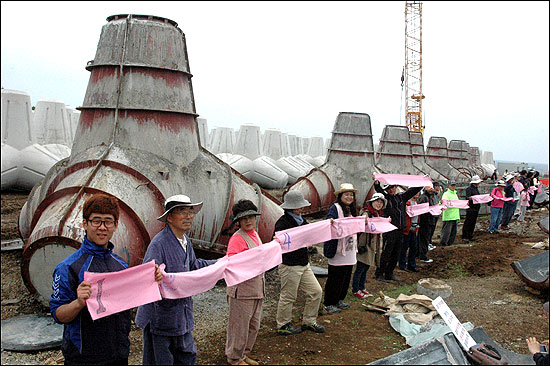
Pacification of Okinawa – Senators call Base Realignment Plan “unrealistic, unworkable and unaffordable”

The Asahi News published a series of articles from Wikileaks diplomatic cables that reveal Tokyo-D.C. deception & fraud re the planned “Futenma Replacement” U.S. Marine base in Okinawa.   The Network for Okinawa published a synopsis of the disclosures and links to each article in the series.

These damaging disclosures were followed by a statement by powerful U.S. Senators calling for a reworking of the plans for bases and troops realignment in East Asia. The Asahi Shimbun reports:

Three influential U.S. senators, in joint statement on May 11, called on the Pentagon to abandon plans to relocate the U.S. Marine Corps Air Station Futenma to the Henoko district of Nago in Okinawa Prefecture.

The senators are Carl Levin, D-Michigan, chairman of the Senate Armed Services Committee, John McCain, R-Arizona, the ranking minority member on the committee and committee member Jim Webb, D-Virginia, who also serves as chairman of the East Asian and Pacific Affairs Subcommittee of the Foreign Relations Committee.

The three recommended the Pentagon consider integrating Futenma’s functions at Kadena Air Base, also in Okinawa.

The Armed Services Committee has authority over the Pentagon’s budget and the senators’ recommendations carry considerable weight. It will likely make more difficult implementation of the Japan-U.S. agreement reached in May 2010 to relocate Futenma to Nago.

Joseph Gerson made the following remarks in an email communication:

As the following article from today’s Asahi Shimbun indicates, the powers that be in the U.S. Congress have decided to pacify Okinawan public opinion – and to reinforce both the U.S. presence on Okinawa and the U.S.-Japan military alliance – by raising the white flag of surrender on Henoko/Nago, and pressing to move Futenma’s functions to Kadena Air Base, one of the largest in the world.  The Pentagon won’t click its heals immediately and follow suit, but this will probably be where the U.S. and Japanese governments eventually go.

Would that all U.S. forces were leaving Okinawa, Guam and elsewhere…

Here is the statement from Senators Webb, Levin and McCain

SENATORS LEVIN, McCAIN, WEBB CALL FOR RE-EXAMINATION OF MILITARY BASING PLANS IN EAST ASIA

Warn present realignment plans are unrealistic, unworkable and unaffordable

Washington, D.C. – U.S. Senators Carl Levin (D-MI), John McCain (R-AZ), and Jim Webb (D-VA) call on the Department of Defense (DoD) to re-examine plans to restructure U.S. military forces in East Asia, while providing assurances to Japan, Korea, and other countries that the United States strongly supports a continuous and vigorous U.S. presence in the region. The senators believe the current DoD realignment plans are unrealistic, unworkable, and unaffordable.

“Much has changed since the US-Japan Roadmap for Realignment Implementation agreement was signed in 2006,” said Senator Levin. “The projected times are totally unrealistic. The significant estimated cost growth associated with some projects is simply unaffordable in today’s increasingly constrained fiscal environment. Political realities in Okinawa and Guam, as well as the enormous financial burden imposed on Japan by the devastation resulting from the disastrous March 2011 earthquake and tsunami, also must be considered.”

“The Asia-Pacific region’s growing role in the global distribution of power requires us to consistently review and update plans for the U.S. military’s role in the region,” said Senator McCain. “In addition, it’s very important to maintain strong bilateral alliances to ensure regional security and our national security interests.”

“Our country has reached a critical moment in terms of redefining our military role in East Asia,” said Senator Webb. “This moment in history requires that we clearly articulate our operational doctrine, thus reshaping the structure of our military posture in that region, particularly in Korea, Japan and Guam. The success of our relationships is guaranteed by the stability our forward-deployed military forces provide in this region and by our continuing close alliances with Japan and Korea.”

Senators Levin, McCain and Webb Propose

· Placing the realignment of the basing of U.S. military forces in South Korea on hold pending further review, and reevaluate any proposal to increase the number of family members accompanying military personnel.

· Revising the Marine Corps force realignment implementation plan for Guam to consist of a presence with a permanently-assigned headquarters element bolstered by deployed, rotating combat units that are home-based elsewhere, and consideration of off-island training sites.

· Examining the feasibility of moving Marine Corps assets at MCAS Futenma, Okinawa, to Kadena Air Base, Okinawa, rather than building an expensive replacement facility at Camp Schwab – while dispersing a part of Air Force assets now at Kadena to Andersen Air Base in Guam and/or other locations in Japan.

The proposals would save billions in taxpayer dollars, keep U.S. military forces in the region, greatly reduce the timing of sensitive political issues surrounding MCAS Futemna, and reduce the American footprint on Okinawa. The recommendations were based on proposals made by Senator Webb to the Committee and build upon the concerns expressed by Congress in the National Defense Authorization Acts for the past two years.

LETTER FROM SEN. ARMED SERVICES CHAIR LEVIN, ASIA SUBC. CHAIR WEBB TO DOD SEC. GATES LAST FRIDAY:

Dear Secretary Gates:

The purpose for this letter is to give you our observations and recommendations regarding the future U.S. defense posture and restructuring of our forces in East Asia. During the recent Senate recess, we visited Guam, Tinian, Okinawa, and Tokyo. Numerous meetings with US military commanders and diplomats, government officials, business leaders, and members of local communities allowed us to assess the current status of the planned realignment of our military forces and the political dynamics associated with them.

Our country has reached a critical moment in terms of redefining our military role in East Asia. This moment in history requires that we clearly articulate our operational doctrine, thus reshaping the structure of our military posture in that region, particularly in Korea, Japan and Guam. Importantly, it also warns against a basing policy that now seems to be driven by little more than the momentum of DOD appropriations related to construction projects, rather than an analysis of the logic that set those projects into motion. It calls upon those of us in the Congress, and especially on the Armed Services Committee, to both evaluate and become the stewards of the vital role that the United States military will play in Asia throughout the present century.

Much has changed since the US-Japan Roadmap for Realignment Implementation agreement was signed in 2006. The projected times are totally unrealistic. The significant estimated cost growth associated with some projects is simply unaffordable in today’s increasingly constrained fiscal environment. Political realities in Okinawa and Guam, as well as the enormous financial burden imposed on Japan by the devastation resulting from the disastrous March 2011 earthquake and tsunami, also must be considered. What has not changed is that our country is the key to stability in this region. The success of our relationships is guaranteed by the stability our forward-deployed military forces provide and by our continuing close alliance with Japan.

In our view, present realignment plans are unrealistic and unworkable. They need to be carefully re-examined, while providing assurance to Japan, Korea, and other countries in East Asia that we strongly support a continuous and vigorous US presence in the region. Our observations are brief and general in nature, intended as the basis for detailed analysis by your staff.

Observations:

Korea

We are not confident that the proposed basing realignment in Korea is proceeding from an operational posture that fits our future role in Korea and the region writ large. Unlike any other “permanent” posturing of US forces abroad, our military forces in Korea are justified in terms of “local defense” – in other words, the defense of South Korea against an attack from the north. By contrast, our forces in Okinawa and Germany are considered to be available for multiple contingencies throughout their regions and beyond. This reality calls into question their size, positioning, and compatibility with the South Korean military. Thus, the credibility of our commitment to the defense of Korea should not be measured by the simple number of our troops, but by the specific missions that they perform. In that regard, we recommend a stringent review of their present missions to examine which are redundant, or capable of being performed by the South Korean military, and which are unique to the special capabilities of our own.

The ongoing construction of facilities at Camp Humphreys has been taking place through three separate funding mechanisms, only one of which seems to have been subject to careful review by the Congress. First, the South Korean government has been funding “one for one” replacement facilities for the transplacement of US bases in Seoul. Second, the US Commanding General seems to have had wide latitude in approving projects from discretionary funds under his control. And third, future projects, especially those related to the reconfiguration of combat units now on or near the DMZ, will be funded through specific appropriations and thus should receive closer scrutiny by Congress. In some respects this scrutiny is at risk because the momentum from the projects already underway threatens the ability of the Congress to properly examine issues related to the size, functioning and capabilities of US forces that were raised in the above paragraph.

Additionally, the estimated costs for relocations to Camp Humphreys are growing substantially. It is unclear how they will be distributed and whether the Republic of Korea’s share of costs is over and above its total direct financial contribution to support US troops in ways not contemplated when the relocation agreement was adopted. In today’s fiscal environment, we must achieve cost savings and identify cost avoidances in current and planned military construction projects. We recommend that the proposed restructuring of US forces in South Korea be placed on hold until the review mentioned above has taken place.

The US commander in Korea has decided that the number of American family members and civilians be dramatically increased under a process known as “tour normalization.” This process, which would convert almost all US military assignments in Korea from “deployed” status, without family members, to “accompanied” status, would drive up housing, medical, school, recreational, and other infrastructure costs. We are not convinced of the arguments that have been used to support this concept. Nor have we seen clear, measurable data that properly calculates the cost.

We question the analysis that has been used to support the decision to pursue tour normalization. There is an inherent contradiction in planning to increase the number of U.S. military family members in South Korea when there is the real potential that a destabilizing security situation in North Korea could unfold rapidly and unpredictably. We recommend that this proposal be the subject of further, careful review.

Okinawa / Guam

The issues related to downsizing the US presence on Okinawa and transferring some of these functions to Guam are militarily complex, potentially costly, and politically sensitive. The US and Japanese governments have been working for fifteen years to come up with an acceptable formula. A general framework has now been agreed upon, whereby the US will relocate many of its bases from the populous southern end of Okinawa, moving some forces to the less populous north and also rebasing 8,000 US Marines on Guam. However, a stalemate has ensued, with many in Okinawa growing intransigent and, to a lesser extent, many on Guam losing their enthusiasm.

On Okinawa, the most difficult issue regards the long-standing dilemma of relocating the US Marine Corps air facility at Futenma, now operating in a highly populated section of the island and the subject of numerous protests. The Marine Corps insists that any relocation must remain on Okinawa due to the unique air / ground partnership that is characteristic of Marine Corps operations. One option – moving Marine Corps helicopter and other functions from Futenma to nearby Kadena Air Force Base – has been opposed because it would bring increased noise levels to Kadena. Many Okinawans, including many leaders, are adamant that the facility should be relocated off-island.

The present compromise reached between the US government and the Government of Japan calls for the construction of a contiguous, partially offshore replacement facility to the far north at Camp Schwab. The US government and the GOJ seem determined to pursue this option in order to bring final closure to the debate, but it is rife with difficulties. This would be a massive, multi-billion dollar undertaking, requiring extensive landfill, destruction and relocation of many existing facilities, and in a best-case scenario, several years of effort – some estimate that the process could take as long as ten years. Moreover, the recent earthquake and tsunami around Sendai in the north of Japan is creating an enormous burden on the Japanese economy and will require years of reconstruction.

On Guam, environmental issues have not been resolved, and many community leaders are concerned that local communities and facilities would be overwhelmed by any large increase in our military presence. Their clear message is that federal money would be necessary to build up infrastructure outside of the bases in a manner commensurate with an increase in the bases themselves. Although several issues are being debated related to firing ranges on Guam and training activities on places like Tinian, the principal issue for military planners involves whether to relocate families along with the 8,000 Marines who would be assigned to that island or to configure the Marines mostly as deployed units rotating into and out of Guam from a home base such as Hawaii or Camp Pendleton. This distinction would make a strong difference in terms of infrastructure costs for schools, medical, recreational facilities, and housing. A good estimate is that 8,000 Marines would become 23,000 Americans if family members were included.

It should also be noted that Guam’s Anderson Air Force Base is a large, under-utilized facility. Mindful that B-52 missions were conducted continuously there in the 1970s, we estimate that Anderson Air Force Base is now operating at less than half of its capacity.

Recommendations.

The Marine Corps should consider revising its implementation plan for Guam to a stripped-down presence with a permanently-assigned (family accompanied) headquarters element bolstered by deployed, rotating combat units that are home-based elsewhere, and the construction of a “Camp Fuji” style training site on Tinian. The “planned” versus “preferred” options for Marine Corps presence on Guam need to be resolved so that the Navy can develop and provide to the Committee the master plan for the overall buildup on Guam that was first requested in 2006.

DOD should immediately examine the feasibility of moving the Marine Corps assets at Futenma into Kadena Air Force Base, while dispersing a percentage of Air Force assets now at Kadena into other areas of the Pacific region. A number of other options exist in Japan and, especially, Anderson Air Force Base in Guam. In addition, the 6,000-acre ammunition storage area at Kadena could potentially be down-sized, especially in light of the two ammunition storage areas already located on Guam – one of them comprising 8,000 acres in and of itself, and the other one already located on Anderson Air Force Base.

Reducing the burden of the US presence on the people of Okinawa is an important goal associated with the realignment roadmap. Relocating Marine Corps aviation assets as outlined above will allow the US to return the land at the Futenma Air Base faster and at substantially less expense than the current plan for the Replacement Facility at Camp Schwab. Additionally, it is imperative that we pursue every opportunity to avoid unnecessary and unaffordable costs to the US taxpayer. Money saved by abandoning the Camp Schwab FRF could be applied to new projects in the revised realignment plan following negotiations with the Government of Japan to formulate a new cost-sharing agreement.This option would keep our military forces in the region, would greatly reduce the timing of the sensitive political issues surrounding Futemna, could save billions in costs that would have gone into the offshore facility at Camp Schwab, would reduce the American footprint on Okinawa, and potentially could result in the return of more land to the Okinawan people if the size of the ammunition storage area at Kadena could be reduced.

We look forward to discussing these and other possibilities with you and your staff at your earliest convenience.


Kwajalein landowners agree to extend U.S. Missile base

Sad news. The Kwajalein landowners in the Marshall Islands agreed to extend the U.S. missile defense base for another 50 years.  They will immediately cash in on $32 million sitting in escrow since 2003.

http://mvguam.com/index.php?option=com_content&view=article&id=17966%3Armi-agrees-to-extend-us-base&catid=59%3Afrontpagenews&Itemid=109

RMI agrees to extend US base

Monday, 09 May 2011 03:32 by Giff Johnson For Variety

* Islanders eye $32 million payday

(Majuro) – Eyeing a $32 million payday, Marshall Islanders ended an eight-year holdout Saturday, agreeing to extend for 50 years the United States’ use of a sophisticated anti-missile defense base in the western Pacific.

Former Marshall Islands President and paramount chief Imata Kabua, who led island landowners refusing to approve an agreement for U.S.-use of the Reagan Test Site at Kwajalein Atoll beyond 2016, on Saturday said he is ready to sign the new agreement to trigger the large payment.

Kwajalein, an atoll dotted with radar, missile tracking gear and launch pads nestled amid palm trees, has been the Pentagon’s primary site for testing missile defense technology since the early 1960s. Last month, a dummy target warhead launched from Kwajalein toward Hawaii was successfully destroyed in mid-flight by a missile launched from a U.S. Navy vessel.

But since 2003, landowners led by Kabua said the U.S. rent offer of $15 million annually was inadequate and demanded $19 million. Saturday, in the face of growing pressure from a majority of Kwajalein landowners, those holding out agreed to accept the deal as negotiated in 2003 between their government and the United States in order to gain access to a more than $32 million payday.

Landowners have repeatedly criticized the base agreement with the U.S., because they say it is doing nothing to address festering health, sanitation and utility problems on Ebeye, an overcrowded island next to the U.S. Army base headquarters where about 12,000 Marshall Islanders live in slum conditions on 80 acres (32.4 hectares) of land.

The agreement they are expected to sign on Tuesday will extend U.S. use of Kwajalein to 2066, with an option for the U.S. to renew to 2086. It also includes provisions requiring the U.S. Defense Department to provide seven-years’ notice if it wants to close the base.

“We’ve been consulting with the landowners on draft land-use agreements over the past two years to ensure they are in accordance with the military-use and operating-rights agreement (a governmental agreement approved in 2003),” said U.S. Ambassador Martha Campbell Friday in Majuro. “They’ve been steadily improving and it now looks like we’re done. Although eight years ago Kwajalein leaders vowed they would not approve the deal between the U.S. and Marshall Islands governments, this week,” Kabua said, “when (Marshall Islands) President Zedkaia is ready to sign, I will sign it with him.”

President’s office officials said Zedkaia will join landowners on Tuesday at a signing ceremony.

Motivating the landowners to drop their demands is the escalating amount of money in an escrow account, now over $32 million, waiting to be released when the landowners sign the agreement authorizing U.S. use of the military installation through 2066. The Marshall Islands constitution requires landowner approval of all leases since all land in the country is privately owned.

The current land-use agreement signed by landowners in 1986 approving U.S. use of Kwajalein expires in 2016. Under that deal, landowners have been receiving about $12 million annually in rent. The difference in rent levels was paid into escrow since 2003.

As of this week, the escrow fund stood at $32,195,821.57, said officials in the Ministry of Finance in Majuro.

Campbell said once landowners sign the agreement, she and Marshall Islands Foreign Minister John Silk will send an instruction letter to the Bank of Guam to release the more than $32 million for the landowners. This is double the annual rental payments, which are split into quarterly payments, and a quarter of the country’s annual national budget.

Confirming that a signing ceremony as announced for Tuesday should proceed as planned, Marshall Islands Attorney General Frederick Canavor Jr. on Saturday said, “We have a final land-use agreement version approved by everyone. It will secure for the Defense Department a base that is not only a key missile defense facility, but also one used for U.S. Air Force B-52 target practice, Space Shuttle tracking, and refueling for military vessels and aircraft traveling between Asia and the United States.”

Here’s another story from Radio New Zealand


APEC will cause surge in prostitution

The Honolulu Star Advertiser reports “Prostitution expected to surge for APEC”:

“When big events come to town, the number of prostitutes increases on the street, and APEC is a big event,” said Ben Rafter, president and chief executive of Aqua Hotels & Resorts, operator of Aqua Waikiki Wave.

APEC Leaders’ Week — Nov. 7 to 13 — will bring about 20,000 attendees, including President Barack Obama, other heads of state from APEC’s 21 countries, ministers, political staff, business leaders and media.

The Pro Bowl, military exercises and the Asian Development Bank meeting in 2001 all drew more prostitutes to Waikiki, said Bob Finley, who has been a Waikiki resident since the 1970s and is chairman of the Waikiki Neighborhood Board.

As usual, the government and business response is to beef up security and police to target the women, most of whom are trafficked to Hawai’i to meet the demand from the large influx of transient male populations such as tourists, conventioneers and the military.  Why do they not identify the ‘johns’ as the problem?  Kaleo Keolanui, president of the Hawaii Hotel & Visitor Industry Security Association even framed it as if the women were the predators:

“We have travelers from all over the world mixed with our military population, which makes for an ideal prey for the prostitutes,” Keolanui said. “Why? Because they have money, and they’re here for a very short period of time. It’s a huge concern.”

The link between military populations and prostitution is plain knowledge. However, whenever the military proposes to expand in Hawai’i and are asked to study the impact on prostitution and sex crimes, the environmental impact statements are always silent.

It’s ironic that the corporate and government elites are worrying about prostitution with APEC.  When whole industries have been developed in ways to pimp Hawai’i to the outsider such as corporate tourism and the military, prostitution will be part of the mix.   APEC is itself a grotesque example of Hawai’i being prostituted to cater to the desires of the international conference industry.   Maybe it’s time to rethink the ways that Hawai’i is always forced to ‘turn tricks’ for others.

Native American Activist Winona LaDuke on Use of “Geronimo” as Code for Osama bin Laden and the “Militarization of Indian Country”

Winona LaDuke has just published a book The Militarization of Indian Country in which she discusses the situation in Hawai’i and the Native-owned military contracting industry.  I spoke with someone from her organization as they were researching information for the book.  I haven’t seen it yet to know how the information was incorporated.  Today, she was on Democracy Now! She discusses the military assault on Hawai’i and the use of “Geronimo” as code name for Osama bin Laden.  One figure she cites – 79,000 acres – of military expansion in Hawai’i doesn’t sound correct.  But she describes Kaho’olawe, Pohakuloa and the Stryker Brigade expansion. Here’s the video of the program and an excerpt from the transcript:


Source: http://www.democracynow.org/2011/5/6/native_american_activist_winona_laduke_on

We’re joined now by Winona LaDuke, Native American activist, writer. She lives and works on the White Earth Reservation in northern Minnesota. She’s executive director of the group Honor the Earth. She was Ralph Nader’s running mate in 1996 and 2000 presidential elections. And her new book is called The Militarization of Indian Country. She’s joining us from Minneapolis.

Winona, thank you so much for being with us. Let’s start off by talking about who Geronimo was and the significance of his name being used.

Let me see how the New York Times described the moment: “The code name for bin Laden was ‘Geronimo.’ The president and his advisers watched Leon E. Panetta, the C.I.A. director, on a video screen, narrating from his agency’s headquarters across the Potomac River what was happening in faraway Pakistan.

“’They’ve reached the target,’ he said.

“Minutes passed.

“’We have a visual on Geronimo,’ he said.

“A few minutes later: ‘Geronimo EKIA.’

“Enemy Killed In Action. There was silence in the Situation Room.”

Winona LaDuke, your response?

WINONA LADUKE: I mean, you know, the reality is, is the military looks at it from its own perspective. This was one of the most expensive single campaigns to find somebody, bin Laden. And the reality was, is that the Geronimo campaign, the campaign against the Apache people, was one of the most expensive wars ever waged by the United States government. You know, for 13 years, they spent millions of dollars, essentially. Five thousand soldiers, and additional, went after these people, relentlessly, for that long period of time. So, from the military’s perspective, that’s a little of how they were looking at it.

You know, from our perspective, of course, and from, I think, all Americans’ perspective, Geronimo is a hero. He’s a national patriot for our peoples. And in that, it is indeed an egregious slander for indigenous peoples everywhere and to all Americans, I believe, to equate Osama bin Laden with Geronimo.

JUAN GONZALEZ: Well, Winona, in terms of the military, this seems to be a constant historical inability to grasp, the relationship of the government to Native American people. I was struck particularly by—during the wars in Kosovo, when the United States used—constantly talked about the Apache helicopters that were leading the fight against ethnic cleansing, or the new helicopter that supposedly was going to be the stealth helicopter that the military developed but then had to scrap, the Comanche helicopter. And there seems to be a constant insensitivity to the long struggle for freedom and defense of their land by the Native American peoples on the part of the U.S. military.

WINONA LADUKE: The reality is, is that the military is full of native nomenclature. That’s what we would call it. You’ve got Black Hawk helicopters, Apache Longbow helicopters. You’ve got Tomahawk missiles. The term used when you leave a military base in a foreign country is to go “off the reservation, into Indian Country.” So what is that messaging that is passed on? You know, it is basically the continuation of the wars against indigenous people.

Donald Rumsfeld, when he went to Fort Carson, named after the infamous Kit Carson, who was responsible for the deaths of thousands of Navajo people and their forced relocation, urged people, you know, in speaking to the troops, that in the global war on terror, U.S. forces from this base have lived up to the legend of Kit Carson, fighting terrorists in the mountains of Afghanistan to help secure victory. “And every one of you is like Kit Carson.”

The reality is, is that the U.S. military still has individuals dressed—the Seventh Cavalry, that went in in Shock and Awe, is the same cavalry that massacred indigenous people, the Lakota people, at Wounded Knee in 1890. You know, that is the reality of military nomenclature and how the military basically uses native people and native imagery to continue its global war and its global empire practices.

AMY GOODMAN: Winona, you begin your book on the militarization of Native America at Fort Sill, the U.S. Army post near Lawton, Oklahoma. We broadcast from there about a year ago in that area. Why Fort Sill? What is the significance of Fort Sill for Native America?

WINONA LADUKE: Well, you know, that is where the Apaches themselves were incarcerated for 27 years for the crime of being Apache. There are two cemeteries there, and those cemeteries—one of those cemeteries is full of Apaches, including Geronimo, who did die there. But it is emblematic of Indian Country’s domination by military bases and the military itself. You’ve got over 17 reservations named after—they’re still called Fort something, you know? Fort Hall is, you know, one of them. Fort Yates. You know, it is pervasive, the military domination of Indian Country.

Most of the land takings that have occurred for the military, whether in Alaska, in Hawaii, or in what is known as the continental United States, have been takings from native land. Some of—you know, they say that the Lakota Nation, in the Lakota Nation’s traditional territory, as guaranteed under the Treaty of 1868 or the 1851 Treaty, would be the third greatest nuclear power in the world. You know, those considerations indicate how pervasive historically the military has been in native history and remains today in terms of land occupation.

I must say, on the other side of that, we have the highest rate of living veterans of any community in the country. It’s estimated that about 22 percent of our population, or 190,000 of our—or 190,000—or 190,000 living veterans in Native America today. And all of those veterans, I am sure, are quite offended by the use of Geronimo’s name, you know, in the assault on bin Laden and in the death of bin Laden.

JUAN GONZALEZ: Winona, in your book, you go through a lot of these takings of land and what it’s been used for. Obviously, the nuclear accident following the tsunami in Japan has been in the news a lot lately, but you talk about the origins of the United States’s own nuclear power, the mining of uranium, the development of Los Alamos Laboratory. Could you talk about that and its connection to Indian Country?

WINONA LADUKE: You know, native people—about two-thirds of the uranium in the United States is on indigenous lands. On a worldwide scale, about 70 percent of the uranium is either in Aboriginal lands in Australia or up in the Subarctic of Canada, where native people are still fighting uranium mining. And now, with both nuclearization and the potential reboot of a nuclear industry, they’re trying to open uranium mines on the sacred Grand Canyon. You know, we have been, from the beginning, heavily impacted by radiation exposure from the U.S. military, you know, continuing on to nuclear testing, whether in the Pacific or whether the 1,100 nuclear weapons that were detonated over Western Shoshone territory. You know, our peoples have been heavily impacted by radiation, let alone nerve gas testing. You’ve got nerve gas dumps at Umatilla. You’ve got a nerve gas dump at the Skull Valley Goshute Reservation. You have, you know, weapons bases, and the military is the largest polluter in the world. And a lot of that pollution, in what is known as the United States, or some of us would refer to as occupied Indian Country, is in fact all heavily impacting Indian people or indigenous communities still.

JUAN GONZALEZ: You also talk about the radiation experimentation in Alaska in the 1960s in your book. I don’t think—very few people have heard of that. Could you tell us a little bit more about that?

WINONA LADUKE: Yeah. You know, I was an undergraduate at Harvard, and I remember I used to—I researched all this really bizarre data, but there was this project at Point Hope, where the military wanted to look at the radiation lichen-caribou-man cycle, of bio-accumulation of radiation. And so, they went into the Arctic. You know, there’s widespread testing on native people, because we’re isolated populations. We’re basically—you know, most of us in that era were genetically pretty similar. It was a good test population, and there was no accountability. You know, testing has occurred, widespread. But in that, they wanted to test, so the village of Point Hope was basically irradiated. Didn’t tell the people. Documents were declassified in the 1990s. And all that time, this community bore a burden of nuclear exposure that came from the Nevada test site, you know, and in testing those communities.

You know, Alaska itself is full of nuclear and toxic waste dumps from the military, over 700 separate, including, you know, perhaps one of the least known, but I did talk about it in this book, The Militarization of Indian Country, VX Lake, where they happened to forget about some nerve gas canisters, a whole bunch of them, and they put them out in the middle of the lake, and they sank to the bottom. And then they remembered a few years later, and then they had to drain the darn lake to go get all these—you know, all the nerve gas, VX, out of the bottom of the lake. And, you know, they renamed it Blueberry Lake, but it’s still known as VX Lake to anybody who’s up there. And, you know, the unaccountability of the military, above reproach, having such a huge impact on a worldwide scale, having such a huge take at the federal trough, the federal budget, and in indigenous communities an absolutely huge impact in terms of the environmental consequences of militarization.

AMY GOODMAN: We’re talking to Winona LaDuke, Native American activist, writer. Her latest book is called The Militarization of Indian Country. Winona, talk about the history of native participation in and opposition to war. But begin with your dad, with your father.

WINONA LADUKE: Yeah, you know, I wrote this book out of a debt, really, to my father. My father was a Korean War resister, and he spent 11 months in prison for refusing to fight a war that he did not believe was his. There is a long history of native people, whether the Zunis, whether the Hopis, whether Iroquois, whether the Ojibwes, who said, “You know, that’s really not our war. We’re staying here.”

The United States, you know, people—one of the reasons that it is said that native people received citizenship in 1924 was so that they could be drafted. And they have been extensively drafted. You know, for a whole variety of social, political, historic, cultural and economic reasons, native people have the highest rate of enlistment in this country, from historic to present. You know, in some places, in our Indian communities, you have very dire economic situations, and the military recruiters are very aggressive. And young people do not have a lot of choices. I mean, I had a young man from my community say, “Auntie, I joined the military.” I said, “Why did you join the military?” He says, “Because I was either going to jail or going to the military.” You know, and I have heard that story more than once in Indian Country.

So, having said that, you have a history of warrior societies, of people who are proud, who have defended our land. You know, 500 years is a long time to defend your territory. And, you know, we’re still here. And within that, our warrior societies continue, whether it is at Oka, whether it was at Wounded Knee, whether it is on the front lines of the tar sands in Alberta, Canada, or whether it is in the Grand Canyon, defending our territory. At the same time, you have a number—you know, a large rate of enlistment. And so, you have native veterans who are, in our community, highly regarded for who they are as courageous individuals and a very significant part of our communities. At the same time, there is no program to reintegrate these individuals into our society. A lot of—you know, the highest rate of homelessness is in the veterans in this country. And many other issues of PTSD and such exist widespread in our communities because of our isolation and our high rates of enlistment and our high rates of veterans.

AMY GOODMAN: Winona LaDuke, you also talk, when talking about Fort Sill, about the Comanche people asking for Fort Sill not to destroy Medicine Bluff. Can you talk about the sacred places in the United States, starting with Fort Sill? Where are they threatened, and how do you preserve these lands?

WINONA LADUKE: Well, you know, the military has—the U.S. government is the largest landowner. The United States—you know, native people are large landowners, but the military has a huge chunk of our territories. And in those, there are a number of places that are our sacred sites. Perhaps the best examples are really in Hawaii, where the military took the island of Kaho’olawe, an entire island, to turn it into a bombing range for 40 years. You know, that was my first politicization, I would say, as to the impact of the military in indigenous communities. Took a whole island, and then, eventually, the island is now returned. The aquifer is cracked from bombing. And, you know, it is in—it’s unconscionable, the practice. Today, Hawaii, you see the continuation of the expansion of military holdings there. Pohakuloa is an expansion for the Stryker that they are looking at on the Big Island of Hawaii to take another 79,000 acres of land—there’s only so much land on an island—full of sacred sites, full of historic sites, that Hawaiians, Native Hawaiians and all people have a right to visit but now is becoming a part of a military base. And increasing land takings, particularly in Hawaii, is one of the worst cases.

JUAN GONZALEZ: And Winona, as we mentioned earlier, you were a vice-presidential candidate twice on the ticket, an Independent ticket, with Ralph Nader. And as you see now, in these years of the last few years of the Obama administration, do you see any significant change in the way that the Native American nations across the country have been treated under the Obama administration?

WINONA LADUKE: You know, I would say that things are better. I would say we’ve got a few egregious problems still. You know, you have, for instance, the U.N. Declaration on the Rights of Indigenous People. As you likely know, there were four holdout countries, as of 2007, that did not sign on. U.S. and Canada are the only two countries that have yet to sign on the Declaration on the Rights of Indigenous Peoples. The Obama administration made some lip service to it, posturing. I was thinking maybe we’re in like some kind of yoga position on it; I don’t know what posture he’s in. But we’d like to see that carried out. As well, you know, apology—you know, these are, in many ways, symbolic gestures. There was an apology to native peoples that was issued, but no one heard it. So its’ kind of like saying, you know, “I’m sorry,” to a wall. Probably should have a little formal apology.

But then there is the reality of—that things in Indian Country are not getting better. You can’t keep putting money in the federal budget for the military and robbing everything else, so that people on my reservation and other reservations don’t have housing, don’t have education money, don’t have health service, you know, don’t have basic, basic rights. And the only way in the native community, really, to get economically ahead, in many cases, is to become a military contractor.

I don’t know if you noticed in the book that it turns out that Blackwater is a Native American contractor. Now, I didn’t know that, you know, and I really hadn’t thought of them as a Native American contractor. But with the Chenega native corporation, they’ve got about $1.9 billion in federal contracts that they received, most of those as a sole-source, non-bid contractor, because they went under the shell of an Alaskan native corporation, the Chenega Corporation. And so, you know, native communities are becoming military contractors because that’s where the money is. You know, so the irony of the whole history of colonization, military colonization, valiant patriots like Geronimo fighting against the U.S. taking of our lands, the destruction of our peoples, to now a situation where the largest private army in the world is a Native American contractor. And the fact that they so egregiously abuse the name of Geronimo and, in widespread cases, you know, refer to Indian Country as the territory that is to be taken by the U.S. military, you know, it is time to revisit this history.

AMY GOODMAN: Finally, Winona LaDuke, ending on where we began, with Geronimo, you supported President Obama, Barack Obama, for president, the first African American president, who—it was under him that this Geronimo name was given. Of course, I’m sure it wasn’t he, himself, who gave this name for this operation to kill bin Laden. He was born in Hawaii. His school, native name, and you talk about Hawaii being so important in native history. Your thoughts about President Obama in light of what—this latest controversy?

WINONA LADUKE: Well, you know, I think a formal apology is due to the native community, to the family of Geronimo, as requested.

I think that a review of the impact of militarization on Indian Country—you know, we are trying to get back some of our land that is held by the military, but it’s so darn toxic. And the military is busy making more things toxic, getting more exemptions under federal law, so that they are above any environmental laws. You know, it would be nice to get something back that was taken, and to get it back clean and to get it back good, whether Badger Munitions in Wisconsin, Fort Wingate. But we don’t want—we don’t want toxic land, you know, back, returned to our people.

Reviewing the military psychology of Kit Carson, you know, and using that nomenclature, how offensive it is to native people. And talking about some kind of a justice, in terms of—I don’t have an answer—it’s a tricky one—how you make justice with the military. But what I would say is that what was done historically was wrong, what was done this week was wrong, and it would be an opportunity for the Obama administration to do the right thing in relation to Indian Country, because Indian Country is not to be assaulted by the U.S. military.

AMY GOODMAN: Winona LaDuke, I want to thank you very much for being with us, Native American activist, writer. She lives and works on the White Earth Reservation in northern Minnesota, executive director of the group Honor the Earth. Her new book, just out, The Militarization of Indian Country.

Killing ‘Geronimo’ over and over again

In my previous post about the killing of Osama bin Laden and the reaction by many Americans, I lamented how:

The jubilation over the killing of bin Laden reminded me of the grisly trophy photos of lynchings with leering faces and tortured black bodies, much like the torture photos to emerge from Abu Ghraib prison or the so-called ‘Kill Team’ photos of Afghan civilians murdered by U.S. troops.


But I forgot to mention the racist code-name assigned to bin Laden: “Geronimo”.   Geronimo (or Goyathlay as he was known to his people), the great Apache warrior who resisted U.S. invasion of his peoples’ land and evaded troops for many years, has come to represent indigenous resistance to colonization, and in his surrender, the subjugation of American Indians.   So potent is his symbolism that the elite secret society at Yale, “Skull and Bones” allegedly robbed Goyathlay’s tomb and still possesses his bones.

The Native American community reacted with justifiable horror to the news of Osama bin Laden’s U.S. military code name.   Indian Country Today reported “Bin Laden Code-name “Geronimo” Is a Bomb in Indian Country”:

The US government may have captured and killed Osama Bin Laden with a surgical strike, but it also dropped a bombshell on Native America in the process. “We’ve ID’d Geronimo,” said the voice of the Navy SEAL who reported the hunt for Osama bin Laden was over. The President, and all those gathered in the situation room, waited on edge for the voice to return with the triumphant news, that in fact, “Geronimo” was dead.

According to multiple sources, “Geronimo-E KIA” is the message that was sent to the White House by the strike team to announce that bin Laden, the “E,” or Enemy, was Killed In Action.

As news of bin Laden’s death spread relief across America and the world, revelations that the assigned code name of Enemy Number One was “Geronimo,” a legendary Apache leader, caused shock waves in Indian communities across the country. It is being interpreted as a slap in the face of Native people, a disturbing message that equates an iconic symbol of Native American pride with the most hated evildoer since Adolf Hitler.

The death of bin Laden is arguably the most important news story of the year, and embedded within it is a message that an Indian warrior, a symbol of Native American survival in the face of racial annihilation, is associated with modern terrorism and the attacks on 9/11.

The “bin Laden is dead” news story will make thousands of impressions on the minds of people around the globe, and the name Geronimo will now be irrevocably linked with the world’s most reviled terrorist.

I share the author’s outrage at the symbolic lynching of Geronimo and all native peoples.   Yet, it is an honest reflection of the ethos of the U.S. and its military culture that “Geronimo” was chosen as the code name for Osama bin Laden.  As historian Richard Drinnon noted in his landmark work “Facing West: The Metaphysics of Indian-Hating and Empire-Building“, “cowboys and Indians” has been the racist mythos of U.S. imperialism. From the calvary’s genocidal Indian Wars straight across the Pacific to the savagery of the Philippines War, then on to WWII, Korea, Vietnam, and now Iraq and Afghanistan, it’s been about cowboys versus Indians.  In this narrative, Indians are not real humans. So their slaughter becomes acceptable, even necessary for civilization to proceed, like the clearing of forest for development.

I found it troubling that the Indian Country Today article so readily demonized bin Laden as “the most hated evildoer since Adolf Hitler” in order to set Goyathlay apart as a heroic figure.

If we set aside the unlawful and morally repugnant tactics of Osama bin Laden and Al Qaeda, is not his stated objective – to drive the infidels from the Muslim holy land – the same reason Goyathlay and his band of warriors waged a guerrilla war against the United States for so many years?  In his time, Geronimo was called the “worst Indian who ever lived” by white settlers while he was a hero to Native Americans, all because he resisted the U.S. invasion of native lands and terrorized white folk.  Many in the Muslim world hold up bin Laden and his movement as heroes because they stood up to the western imperialists.

The violence of the colonized is a mirror to the violence of the colonizer, showing us where terror must be defeated, at the heart of the imperial relations that created it.  As long as the U.S. follows the road of empire, the wars will never end, people will resist, sometimes violently, and cowboys will slaughter millions and ravage whole countries over and over again to get Geronimo ‘dead or alive’.

‘Geronimo’ reminded me of the true story of Ko’olau the Leper, a Hawaiian folk hero who contracted Hansen’s Disease and rather than be imprisoned in a leper colony, hid in the Napali coast of Kaua’i.  Over the weekend at the Wai’anae Library there was a reading of “The Legend of Ko’olau” by playwright Gary Kubota.   I was told that the play is very powerful.  Hopefully it will be produced in the near future.

Like Goyathlay (Geronimo), Ko’olau fought off the foreign militia that had overthrown the Hawaiian monarchy when they came to capture him.  Living off the land, he evaded capture for many years until his death by the disease.   In one encounter, Ko’olau shot and killed the sheriff and most of his posse.

So on the topic of outlaws and heroes, I close with some lyrics from Bob Marley’s immortal classic “I Shot the Sheriff”:

Oh, now, now. Oh!
(I shot the sheriff.) – the sheriff.
(But I swear it was in selfdefence.)
Oh, no! (Ooh, ooh, oo-oh) Yeah!
I say: I shot the sheriff – Oh, Lord! –
(And they say it is a capital offence.)
Yeah! (Ooh, ooh, oo-oh) Yeah!

Sheriff John Brown always hated me,
For what, I don’t know:
Every time I plant a seed,
He said kill it before it grow –
He said kill them before they grow.

Grieving for our Full Humanity

“He who fights with monsters should look to it that he himself does not become a monster. And when you gaze long into an abyss the abyss also gazes into you.”

– Friedrich Nietzsche, “Beyond Good and Evil”, Aphorism 146 (1886)

When the news broke  that U.S. special forces have killed Osama bin Laden, U.S. citizens celebrated in the streets as if they had just won a championship sports tournament, complete with cheerleaders and chants of “U.S.A! U.S.A! U.S.A!”

Pundits were on television hyping the momentous importance of the event.  “Cutting off the head of a snake,” said one tough sounding commentator. But what if the serpent was really a hydra of war and violence that grows back two heads each time one is cut off, feeding off the violence and hatred directed against it?

It felt strangely anti-climactic, like the crowds and commentators were trying very hard to convince themselves of the goodness and significance of the event to mask a lingering uneasiness, an emptiness they felt.   Why were the radical Islamist blogs silent?   The objective of the wars was met, so why does the war on terror  continue?  Even Stratfor predicts “In spite of the sense of justice and closure the killing of bin Laden brings, however, his death will likely have very little practical impact on the jihadist movement.”

Bin Laden’s first win was luring the U.S. into endless wars and occupations in Muslim countries.  Now even in death, he scores an ideological win becoming a martyr for his movement.

It reminded me of a movie where the ‘hero’ kills the ‘villain’ only to discover that this fulfilled the villain’s endgame to lure the hero into committing the murder, thereby becoming the evil that the hero hated most and releasing it on the world.  An empty robe, a wisp of smoke and distant laughter.  How do you fight ghosts?  The day bin Laden’s death was announced, military bases in the Pacific region were put on elevated threatcon Bravo.

Other, more muted voices have instead called for a time of reflection.  Kristen Breitweiser, a 9/11 widow writes that “today is not a day of celebration for me.”

The jubilation over the killing of bin Laden reminded me of the grisly trophy photos of lynchings with leering faces and tortured black bodies, much like the torture photos to emerge from Abu Ghraib prison or the so-called ‘Kill Team’ photos of Afghan civilians murdered by U.S. troops.

Jeffrey Acido of Nakem Youth and Hawai’i Peace and Justice posted the following reflection from a Christian perspective. He writes:

The God that Obama invokes is not the God of Christianity.  It is a God made in the image of Imperialism.  It hijacked the name Christian and reads the Bible from a perverted lens.  This imperial religion’s symbol is not the cross that liberates but the bomb that destroys. Their favorite hymn, the stars spangled banner, sing of bombs bursting in air—it is the only time they are allowed to cry. Its followers not only kill but are already dead.   This imperial religion is obsessed with security but never peace.

Thanks to Jeffrey for sharing his prophetic words.

>><<

Grieving for our Full Humanity

by Jeff Acido on Tuesday, May 3, 2011 at 12:42am

“Osama is Dead!” read the headlines all over the news outlets shortly after word got out.  “The war on terror is over,” remarked many political pundits.  Soon after, the United States president Barrack Hussein Obama addressed the American people and the world: “We will be true to the values that make us who we are. And on nights like this one, we can say to those families who have lost loved ones to Al Qaeda’s terror: Justice has been done”.  The atmosphere seemed to be a college frat party—blow up beach ball thrown around, a cheerleading squad performing a routine one would do in a football game, and shouts of “USA!, USA!” to celebrate the death of a person as a victory for a whole nation.    As many Americans continued to gather in front of the White House the president ended his speech with these peculiar remarks: “Let us remember that we can do these things not just because of wealth or power, but because of who we are: one nation, under God, indivisible, with liberty and justice for all”.

When is life grievable?  If we are not capable of grieving for a life lost, whether a victim or perpetrator, then I do not think we are capable of healing from the very act that caused the tragedy; neither can we prevent and bring to attention the roots and causes of the heinous act.   When we do not grieve life outside of ours we delude ourselves that we are the only ones who see the Truth.  And no other truths stand before us.  A thirsty soul looking for healing cannot be quenched from a well that only springs forth perverted versions of the truth—one does not heal but drowns and gets drunk in self-righteousness.

President Obama attributed the death of Osama as an American ‘value’ and that this act brought out ‘justice’.  These remarks give me reason on why Americans continue to live with racism, economic exploitation, and all the other ‘isms’ we see in the world as reality—something that ought to happen.  As long as Americans view justice as devoid of the ability to grieve and make this in turn a value, American transgressions will not only be tolerated but also glorified—these in turn gets translated into foreign and domestic policies.  American foreign policies only see others as foreign bodies or ‘just another’ body.  Domestic policies are increasingly being treated like foreign policies—if they are colored, queer, speak another language, poor, woman, indigenous, and do not look like the white-middle class-man they aspire to be then they too must be ‘foreign’—therefore treated like a ‘foreign body’—therefore a ‘nobody’—therefore has no right to live.

President Obama does not claim sole credit for this act of ‘justice’ he admits in the end that the act of killing is not his act alone but done under the empowerment of ‘one nation’ that holds (economic) wealth and (military) power, who believes in (American) liberty and guided by (Christian) God.

I want to say to all my brothers and sisters who are in the struggle against oppression at home and abroad that President Obama and those who are happily parading the streets of Osama’s death do not represent all Americans, nor certainly represent all Christians.

There is Kristen Breitweiser, an American widow, whose husband was killed in the morning of September 11, humbly says:  “Forgive me, but I don’t want to watch uncorked champagne spill onto hallowed ground where thousands were murdered in cold blood.”  No apology should be asked when speaking the truth.  Yet, Kristin asks for one, knowing that the truth might hurt—it is a symptom of someone grieving and aware of the fact that the truth is not always palatable—but always healing.

She does not agree with the President and the One Nation when she says, “I don’t want to see any ugly blood stained sheets as proof of death or justice…And it breaks my heart to witness young Americans cheer any death — even the death of a horrible, evil, murderous person — like it is some raucous tailgate party on a college campus”.  As her phone rings and the media calls her to echo the shouts of American jingoism she says: “I have to be honest, today is not a day of celebration for me.”

In the same manner as our sister Kristen Breitweiser, I too am sorry.  I do not readily identify myself as an “American” despite holding an American passport but I am always ready to say that I am a Christian.  But not the same as the Christianity that Obama and those happily waving the American flag in front of the White House embody.

The God that Obama invokes is not the God of Christianity.  It is a God made in the image of Imperialism.  It hijacked the name Christian and reads the Bible from a perverted lens.  This imperial religion’s symbol is not the cross that liberates but the bomb that destroys. Their favorite hymn, the stars spangled banner, sing of bombs bursting in air—it is the only time they are allowed to cry. Its followers not only kill but are already dead.   This imperial religion is obsessed with security but never peace.

This is Imperial Christianity and we have seen this God at its best (or worst).  It already dropped its bombs in Nagasaki, Hiroshima, and the Pacific Islands. It put Japanese/Americans in concentration camps; occupies Hawaii and the Philippines.  It lynched Blacks, Filipinos and other colored peoples in the US.  And now is slowly turning once loving communities against each other via its church—The military.

The Christianity that holds the cross as a symbol of liberation affirms life at all costs.  It lives on hope and practices peace.  Sister Soelle reminds us that it is ‘the religion of slaves’—a religion that summons a god that can always be seen in times of despair and desolation—a god that allows for a moment of grieving—for the other, the foreign, and ourselves.  It is a god that sees and hears only through our own eyes and ears.  In desperate and delicate times this god requires us to pray and pray with our feet.

We cannot be silent when our future ancestors, the children of today and tomorrow, ask us: “what did you do when people were suffering in the Philippines, Hawaii, and Middle East?” or “How did you treat the homeless at the park?”   To be silent in the face of war and people suffering is to imbibe our youth and propel into the future the testimony that it is acceptable to see a life or an object be treated with disrespect simply because they are powerless.

We must not let ourselves stray away from the genealogy of hope, love and struggle. We owe it to those terrorized into silence, petrified into permanent grieving, and the ancestors that have fought tirelessly to always affirm life.

Affirm Life.


Jeffrey Acido

Honolulu, Hawaii

5/3/11

The African ‘Star Wars’; Are We Still on an Imperial Planet?

Helpful analysis about events in Africa and the U.S. anxiety about China. First from Asia Times reporter Pepe Escobar writing an op ed for Al Jazeera. The second article “China as Number One?” by Tom Englehardt from Tom Dispatch.  It follows his earlier article “Sleepwalking into the Imperial Dark.” He is not as concerned about China’s rise and asks:

What if, in fact, the U.S. was indeed the last empire?  What if a world of rivalries, on a planet heading into resource scarcity, turned out to be less than imperial in nature?  Or what if — and think of me as a devil’s advocate here — this turned out not to be an imperial world of bitter rivalries at all, but in the face of unexpectedly tough times, a partnership planet?

Unlikely?  Sure, but who knows?  That’s the great charm of the future.  In any case, just to be safe, you might not want to start preparing for the Chinese century quite so fast or bet your bottom dollar on China as number one.  Not just yet anyway.

>><<

Source: http://english.aljazeera.net/indepth/opinion/2011/04/2011422131911465794.html

The African ‘Star Wars’

It is the Pentagon’s Africom versus China’s web of investments – the ultimate prize: Africa’s natural resources.

Pepe Escobar

Last Modified: 26 Apr 2011 13:54

From energy wars to water wars, the 21st century will be determined by a fierce battle for the world’s remaining natural resources. The chessboard is global. The stakes are tremendous. Most battles will be invisible. All will be crucial.

In resource-rich Africa, a complex subplot of the New Great Game in Eurasia is already in effect. It’s all about three major intertwined developments:

1) The coming of age of the African Union (AU) in the early 2000s.

2) China’s investment offencive in Africa throughout the 2000s.

3) The onset of the Pentagon’s African Command (Africom) in 2007.

Beijing clearly sees that the Anglo-French-American bombing of Libya – apart from its myriad geopolitical implications – has risked billions of dollars in Chinese investments, not to mention forcing the (smooth) evacuation of more than 35,000 Chinese working across the country.

And crucially, depending on the outcome – as in renegotiated energy contracts by a pliable, pro-Western government – it may also seriously jeopardise Chinese oil imports (3 per cent of total Chinese imports in 2010).

No wonder the China Military, a People’s Liberation Army (PLA) newspaper, as well as sectors in academia, are now openly arguing that China needs to drop Deng Xiaoping’s “low-profile” policy and bet on a sprawling armed forces to defend its strategic interests worldwide (these assets already total over $1.2 trillion).

Now compare it with a close examination of Africom’s strategy, which reveals as the proverbial hidden agenda the energy angle and a determined push to isolate China from northern Africa.

One report titled “China’s New Security Strategy in Africa” actually betrays the Pentagon’s fear of the PLA eventually sending troops to Africa to protect Chinese interests.

It won’t happen in Libya. It’s not about to happen in Sudan. But further on down the road, all bets are off.

Meddle is our middle name

The Pentagon has in fact been meddling in Africa’s affairs for more than half a century. According to a 2010 US Congressional Research Service study, this happened no less than 46 times before the current Libya civil war.

Among other exploits, the Pentagon invested in a botched large-scale invasion of Somalia and backed the infamous, genocide-related Rwanda regime.

The Bill Clinton administration raised hell in Liberia, Gabon, Congo and Sierra Leone, bombed Sudan, and sent “advisers” to Ethiopia to back dodgy clients grabbing a piece of Somalia (by the way, Somalia has been at war for 20 years).

The September 2002 National Security Strategy (NSS), conceived by the Bush administration, is explicit; Africa is a “strategic priority in fighting terrorism”.

Yet, the never-say-die “war on terror” is a sideshow in the Pentagon’s vast militarisation agenda, which favours client regimes, setting up military bases, and training of mercenaries – “cooperative partnerships” in Pentagon newspeak.

Africom has some sort of military “partnership” – bilateral agreements – with most of Africa’s 53 countries, not to mention fuzzy multilateral schemes such as West African Standby Force and Africa Partnership Station.

American warships have dropped by virtually every African nation except for those bordering the Mediterranean.

The exceptions: Ivory Coast, Sudan, Eritrea and Libya. Ivory Coast is now in the bag. So is South Sudan. Libya may be next. The only ones left to be incorporated to Africom will be Eritrea and Zimbabwe.

Africom’s reputation has not been exactly sterling – as the Tunisian and Egyptian chapters of the great 2011 Arab Revolt caught it totally by surprise. These “partners”, after all, were essential for surveillance of the southern Mediterranean and the Red Sea.

Libya for its part presented juicy possibilities: an easily demonised dictator; a pliable post-Gaddafi puppet regime; a crucial military base for Africom; loads of excellent cheap oil; and the possibility of throwing China out of Libya.

Under the Obama administration, Africom thus started its first African war. In the words of its commander, General Carter Ham, “we completed a complex, short-notice, operational mission in Libya and… transferred that mission to NATO.”

And that leads us to the next step. Africom will share all its African “assets” with NATO. Africom and NATO are in fact one – the Pentagon is a many-headed hydra after all.

Beijing for its part sees right through it; the Mediterranean as a NATO lake (neocolonialism is back especially, via France and Britain); Africa militarised by Africom; and Chinese interests at high risk.

READ THE FULL ARTICLE

+++

http://www.tomdispatch.com/post/175386/tomgram%3A_engelhardt%2C_are_we_still_on_an_imperial_planet/#more

Tomgram: Engelhardt, Are We Still on an Imperial Planet?

Posted by Tom Engelhardt at 5:20pm, May 1, 2011.

[Note for TomDispatch Readers: A final thanks to all of you who, in response to recent TD pleas, urged others to sign up for the email notice that goes out every time this site posts a piece. If you meant to do so, but haven’t yet, now’s still the perfect time! Just tell friends, acquaintances, colleagues, relatives to go to the “subscribe” window at the upper right of TomDispatch’s main screen, put in their email addresses, hit “submit,” answer the “opt-in” email that instantly arrives in your inbox (or, unfortunately, spam folder), and receive notices whenever a new post goes up. It’s been a specular little drive for new subscribers and so for all of you who lent a hand: our appreciation.

A couple of weeks ago, I wrote a piece on what it felt like to be inside an imperial power in decline, “Sleepwalking into the Imperial Dark.”  Consider today’s post a stand-alone follow-up to that.  Finally, special thanks go to TD copyeditor Christopher Holmes, who is always “number one,” and to Erica Hellerstein, TD’s intern, for a job consistently well done.  Tom.]

China as Number One?

Don’t Bet Your Bottom Dollar
By Tom Engelhardt

Tired of Afghanistan and all those messy, oil-ish wars in the Greater Middle East that just don’t seem to pan out?  Count on one thing: part of the U.S. military feels just the way you do, especially a largely sidelined Navy — and that’s undoubtedly one of the reasons why, a few months back, the specter of China as this country’s future enemy once again reared its ugly head.

Back before 9/11, China was, of course, the favored future uber-enemy of Secretary of Defense Donald Rumsfeld and all those neocons who signed onto the Project for the New American Century and later staffed George W. Bush’s administration.  After all, if you wanted to build a military beyond compare to enforce a long-term Pax Americana on the planet, you needed a nightmare enemy large enough to justify all the advanced weapons systems in which you planned to invest.

As late as June 2005, neocon journalist Robert Kaplan was still writing in the Atlantic about “How We Would Fight China,” an article with this provocative subhead: “The Middle East is just a blip. The American military contest with China in the Pacific will define the twenty-first century. And China will be a more formidable adversary than Russia ever was.”  As everyone knows, however, that “blip” proved far too much for the Bush administration.

Finding itself hopelessly bogged down in two ground wars with rag-tag insurgency movements on either end of the Greater Middle Eastern “mainland,” it let China-as-Monster-Enemy slip beneath the waves.  In the process, the Navy and, to some extent, the Air Force became adjunct services to the Army (and the Marines).  In Iraq and Afghanistan, for instance, U.S. Navy personnel far from any body of water found themselves driving trucks and staffing prisons.

It was the worst of times for the admirals, and probably not so great for the flyboys either, particularly after Secretary of Defense Robert Gates began pushing pilotless drones as the true force of the future.  Naturally, a no-dogfight world in which the U.S. military eternally engages enemies without significant air forces is a problematic basis for proposing future Air Force budgets.

There’s no reason to be surprised then that, as the war in Iraq began to wind down in 2009-2010, the “Chinese naval threat” began to quietly reemerge.  China was, after all, immensely economically successful and beginning to flex its muscles in local territorial waters.  The alarms sounded by military types or pundits associated with them grew stronger in the early months of 2011 (as did news of weapons systems being developed to deal with future Chinese air and sea power).  “Beware America, time is running out!” warned retired Air Force lieutenant general and Fox News contributor Thomas G. McInerney while describing China’s first experimental stealth jet fighter.

Others focused on China’s “string of pearls”: a potential set of military bases in the Indian Ocean that might someday (particularly if you have a vivid imagination) give that country control of the oil lanes.  Meanwhile, Kaplan, whose book about rivalries in that ocean came out in 2010, was back in the saddle, warning: “Now the United States faces a new challenge and potential threat from a rising China which seeks eventually to push the U.S. military’s area of operations back to Hawaii and exercise hegemony over the world’s most rapidly growing economies.”  (Head of the U.S. Pacific Command Admiral Robert Willard claimed that China had actually taken things down a notch at sea in the early months of 2011 — but only thanks to American strength.)

Behind the overheated warnings lay a deeper (if often unstated) calculation, shared by far more than budget-anxious military types and those who wrote about them: that the U.S. was heading toward the status of late, great superpower and that, one of these years not so far down the line, China would challenge us for the number one spot on the seas — and on the planet.

READ THE FULL ARTICLE

A Beast in the Heart of Every Fighting Man – Who pays?

Today’s Honolulu Star Advertiser reports that a planned Post Traumatic Stress Disorder (PTSD) treatment center has been delayed due to difficulty in the consultation process regarding the preservation of historic properties:

The reason for the long delay lies with the VA’s difficulty in navigating the National Historic Preservation Act of 1966, and Section 106 of that act, which requires federal agencies to take into account effects on historic properties, and consult with state and other preservation agencies over their proposed actions.

[…]

Pua Aiu, administrator for the State Historic Preservation Division, said it’s taken a long time to gain consensus on the project because it’s going in on the “relatively pristine” Tripler grounds, an area that’s eligible for listing on the National Register of Historic Places.

“And when that happens, (consultation) normally takes a long time,” Aiu said.

Aiu said it’s not unusual for an agency to come in and “they believe their project is really good, and we believe their project is really good, but they have to accommodate the historic preservation rules. It’s a federal law.”

The VA came in initially with a project “that was simply unacceptable to be put on a property that’s eligible for the (National Register),” she said.

Veterans’ advocates say that the facility is desperately needed and criticize the “bureaucratic impasse” that has delayed the project.

There is no doubt that the epidemic of PTSD America’s wars have unleashed on our communities desperately needs attention. But as the New York Times article “A Beast in the Heart of Every Fighting Man” makes painfully clear, PTSD is merely a symptom of the profound moral, spiritual and social “disease” of war and militarism.  Treating symptoms will not cure the disease.

And why should Hawai’i’s cultural resources, environment and communities have to pay the terrible costs of war, whether they are in Makiki, Moanalua, Lihu’e (Schofield), Makua, or Pohakuloa?

Here is a sample of an excellent article in the New York Times about the Stryker Brigade murders of civilians in Afghanistan:

April 27, 2011

A Beast in the Heart of Every Fighting Man

By LUKE MOGELSON

Last May, in the small village of Qualaday in western Kandahar Province, a young Army lieutenant and his sergeants met with several elders to discuss the recent killing of a local mullah. The desert heat was fierce, and the elders led the soldiers across their village to sit under the shade of nearby trees. Three days had passed since they were last there; during that interval the place appeared to have been abandoned. When they sat down, some of the soldiers removed their helmets, and a few elders their sandals and turbans. A freelance photographer was permitted to make an audio recording of the discussion. The lieutenant wanted to know where everyone had gone. One elder explained: People left because they were afraid.

“Ask them, ‘Do they understand why we shot this dude?’ ” the lieutenant told his interpreter. During their last patrol to Qualaday, soldiers in the platoon had attacked Mullah Allah Dad with rifles and a fragmentation grenade that blew off the lower halves of his legs and badly disfigured his face. The soldiers claimed that Allah Dad was trying to throw a grenade at them. Two days after the killing, however, a company commander attended a council during which the district leader announced that people believed the incident had been staged and that the Americans had planted the grenade in order to justify a murder.

“Tell them it’s important that not only the people in this village know, but the people in surrounding villages know, that this guy was shot because he took an aggressive action against coalition forces,” the lieutenant told his interpreter. “We didn’t just [expletive] come over and just shoot him randomly. We don’t do that.”

Last month, in a military courtroom at Joint Base Lewis-McChord near Tacoma, Wash., 22-year-old Jeremy Morlock confessed to participating in the premeditated murder of Mullah Allah Dad, as well as the murders of two other Afghan civilians. In exchange for his agreement to testify against four other soldiers charged in the crimes, including the supposed ringleader, Staff Sgt. Calvin Gibbs, the government reduced Morlock’s mandatory life sentence to 24 years, with the possibility of parole after approximately 8. The rest of the accused, who are still awaiting trial, contest the allegations against them.

The story that has been told so far — by Morlock in his confession and by various publications that relied heavily on the more sensational accusations from interviews hastily conducted by Army special agents in Afghanistan — is a fairly straightforward one: a sociopath joined the platoon and persuaded a handful of impressionable subordinates to join him in sport killing as opportunities arose. There may indeed be truth to this, though several soldiers in the platoon give a more complicated account. Certainly it’s a useful narrative, strategically and psychologically, for various parties trying to make sense of the murders — parents at a loss to explain their sons’ involvement and lawyers advocating their clients’ innocence and a military invested in a version of events that contains and cauterizes the problem.

On the day of Jeremy Morlock’s confession, I watched as several of his friends and relatives took the stand to vouch movingly for his character and struggle to fathom how the young man they knew could have committed the crimes to which he confessed. I watched, too, as Morlock himself recounted his failed ambition to follow in the footsteps of his father, a former master sergeant who died in a boating accident not long before Morlock deployed. “If he had been alive when I went to Afghanistan,” Morlock told the judge, “I know that would have made a difference. . . . I realize now that I wasn’t fully prepared for the reality of war as it was being fought in Afghanistan.”

Among the witnesses who testified that day was Stjepan Mestrovic, a sociologist who specializes in war crimes. Mestrovic was allowed to study an internal 500-page inquiry into the Fifth Stryker Brigade’s “command climate,” the purpose of which was to assess whether shortcomings in leadership might be partly to blame for the murders, and to identify any officers who should be held to account. In court, Mestrovic said he was shocked by how dysfunctional the brigade appeared to have been, and he added, “In a dysfunctional unit, we cannot predict who will be the deviant — but we can predict deviance.”

I met with Mestrovic later that evening and asked him to elaborate. Before becoming involved in Morlock’s case, he served as an expert witness at trials related to Abu Ghraib, the Baghdad canal killings and Operation Iron Triangle, a case with some similarities to this one, in which American soldiers in Iraq murdered three unarmed noncombatants. He excoriated the tendency of the Army — and the news media — to blame such crimes on “a few bad apples” or a “rogue platoon.” Close examination of these events, Mestrovic argued, invariably reveals that the simplistic bad-actor explanation “doesn’t fit the picture.”

Of course, while the murders in southern Afghanistan reflect most glaringly upon the men who committed them, the need to revisit these crimes goes beyond questions of culpability and motive in one platoon. As with Abu Ghraib and Haditha and My Lai, it’s hard not to consider how such acts also open a window onto the corroding conflicts themselves. This isn’t to suggest that military personnel are behaving similarly throughout Afghanistan as a result of the conditions there; it is only to say that 10 years into an unconventional war whose end does not appear imminent, the murder of civilians by troops that are supposed to be defending them might reveal more than the deviance of a few young soldiers in a combat zone.

READ THE FULL ARTICLE

Two updates on Jeju island resistance to military base expansion

MacGregor Eddy writes on Facebook group Save Prof Yang and Sung Hee-Choi of Jeju Island that Professor Yang has been released on June 1 on probation. He had been on a hunger strike for more than 50 days but is now taking food. The South Korea (ROK) is building a Naval base destroying the lovely coral reefs at Gangjeong village. There is US pressure and US money. Sung-Hee Choi is still in jail. But she is taking food.

Bruce Gagnon coordinator of the Global Network Against Weapons & Nuclear Power in Space wrote two excellent posts on the situation in Jeju island, where the Gangjeong villagers are resisting the construction of a naval base that would obliterate their pristine environment:

http://space4peace.blogspot.com/2011/05/blindness-of-militarism.html

Tuesday, May 31, 2011

THE BLINDNESS OF MILITARISM


http://3.bp.blogspot.com/-EJzrt9bZpgA/TeTb9VG7KOI/AAAAAAAAEBI/vIOTrK1-KQM/s1600/jejupods.jpg


Over the past weekend hundreds rallied in Gangjeong village in South Korea to protect the rocks and the plant and animal life that will be destroyed once the thousands of huge “tetra pods” are all placed in the water and cement gets poured over everything to build the piers in order to dock the visiting U.S. warships.

The military (who says they are out to bring security) does not care about the life forms that are killed. Their brazen quest for power and control separates them from the living world around them. Power is like a drug and they always need more as the addiction numbs them to life. The plants, the rocks, the coral, the fish, the clean water do not exist in their minds. It is a spiritual disconnection.

[…]

Today begins my 9th day of fasting in solidarity with all life forms in and around Gangjeong village on Jeju Island. My heart is with Yang Yoon-Mo who is now on his 58th day of hunger striking and Sung-Hee Choi on her 14th day.

I am grateful to those who have been writing me and sending messages to the South Korean embassy in their country. In recent days I’ve heard from people in Germany, Denmark, Sweden, Scotland, Wales, England, China, Philippines, Japan, Hawaii, and all over the U.S. who are taking steps to show support. Many of these same people are fasting for a day or more. Thanks to all of you. Please keep spreading the word. I will return to Bath Iron Works again today.

And here is the earlier post with a message from Sung Hee Choi a Korean activist who was in jail and on the 7th day of her hunger strike against the naval base.

http://space4peace.blogspot.com/2011/05/words-from-sung-hee-choi.html

Sunday, May 29, 2011

WORDS FROM SUNG-HEE CHOI

JungJoo Park from South Korea has provided us with the latest communication from Sung-Hee Choi who is now on her 11th day of hunger striking on Jeju Island, South Korea. It is Sung-Hee laying under the construction vehicle and in the middle of the photo above.

JungJoo writes, “What Sung-hee in a prison said to people who support her a few days ago.”

The revolution comes in time we do not know.
It comes suddenly when we are in desperate, so close to give up.
I believe in that long water flow which are made by tiny water drops gathering rather than someone’s big power at certain time.
I especially believe the power of culture, power of arts, no, I believe the power of cultured people and artists.
And I believe the truth will be spread out to this whole world as our young generation begin to stand up.
But our fight has to be fun.
And again, our youth should be a source of strength for our fight.
You do not know how much I miss you, Gangjeong village, Gureombi…
I miss them so much, appreciate them so much, and I’d love to see them all.
Brother, Taewhan, will you sing again?
And everyone, will you sing together?
We get together again and do a dance on Gureombi?
But on the other hand, I am glad to come trapped.
More and more people coming to Gureombi, more things are doing!!
Here, I read books that I missed so far, and think a lot of ideas I missed.
There is a passage, especially coming so often these days.
“The absolute, must open one side of the door if the other side is closed.”
Let’s walk together toward the open door!
(And the tears flow quietly)
I’ve never ever cried while visiting.
But so many young people have come, my tears of happy flowing.
Please call more young people of 20’s. Let my tears flowing more.
For a while I was totally numb.
I got here so unjustly.
If your transparent and clear forces get together, It will change everything at the moment nobody can expected.
At the moment we think of defeat, we are really missing out on everything.
But we do not fail as long as we do have beliefs.
I believe history.
Take courage and anger at the same time.
Lying down under a dump truck and crane must be finished by our generation.
You do your things in your way.
More enjoyable, more fun!
Not short time later, a lightning flash occurs and the naval base will be destroyed.
At that moment we must able to say openly.
‘I am that thunder and lightning.’
I believe history and you.
Your infinite power available is up to you!


– Sung-Hee Choi
Jeju Island, South Korea


Sung Hee is the original blogger for http://nobasestorieskorea.blogspot.com/. It is one of the best sources of information about the Jeju struggle and other anti-bases movements in Korea.  We hope she is alright and freed from jail soon.

Support the people of Jeju in their struggle against the naval base, which will be used as part of the U.S. missile defense network to encircle China.  You can write to the Korean Embassy urging them to free Sung Hee and stop the construction of the naval base in Jeju on their website: http://www.dynamic-korea.com/embassy/meet.php

(Ironically, when you go to the website, the banner reads “Help us make Jeju Island one of the “New 7 Wonders of Nature”” even as the Korean government is preparing to destroy the rich marine environment at Gangjeong village, one home of the famous women divers of Jeju.)

Army desecrates more Native Hawaiian burials in Lihu’e (Schofield), O’ahu

The Army has desecrated another set of iwi kupuna (Native Hawaiian ancestral human remains) approximately 600 yards from the site of a previous desecration in 2010.

Thomas Lenchanko, a lineal descendant of families from the Lihu’e / Kukaniloko area and spokesperson for ‘Aha Kukaniloko has demanded immediate access to the site. The families have told the Army that the area is sacred and should be avoided by Stryker Brigade construction projects. But the Army has continued to ignore community concerns and have continued destructive activity in the vicinity, resulting in the desecration.

Chris Monahan, an independent archaeologist hired to review the adequacy of the Army’s cultural and archaeological surveys for its Stryker brigade project found that the Army failed to conduct adequate cultural and archaeological studies of the proposed project areas. Monahan calls for a more comprehensive and rigorous study of cultural sites and resources and stronger protections of these sites.


—–Original Message—–

From: Gilda, Laura Ms CIV US USA IMCOM [mailto:laura.gilda@us.army.mil]

Sent: Friday, April 29, 2011 10:05 AM

To: michael.vitousek@hawaii.gov; pua.aiu@hawaii.gov; phyllis.l.cayan@hawaii.gov; shadkane@gmail.com; KEONAHALEIWA@aol.com; Alicegreenwood60@yahoo.com; kawaihapai@hawaii.rr.com; kaleop@me.com; Clyde Namuo; pjrcgo@gmail.com; Kai Markell; Keola Lindsey; Everett Ohta; halealoha@wave.hicv.net; kawikam@hawaii.rr.com

Cc: Lucking, Laurie J Dr CIV US USA IMCOM; ljluck@aol.com; Yuh, Peter Mr CIV US USA IMCOM; Abramson, Kerry Mr CIV US USA USARPAC; Char, Alvin L Mr CIV US USA IMCOM

Subject: Notice: Inadvertent Discovery of Human Remains at Schofield Barracks Apr27,2011 (UNCLASSIFIED)

Classification: UNCLASSIFIED

Caveats: FOUO

Aloha,

The US Army Garrison Hawaii (USAG-HI) is notifying you of an inadvertent discovery of partial and displaced human remains under the provision of Appendix C (Inadvertent Discovery Plan) of the Programmatic Agreement for the Army Transformation of the 2nd Brigade, 25th ID to a Stryker Brigade Combat Team (SBCT).

On Wednesday, April 27, 2011 at approximately 9:30am, possible human remains were inadvertently discovered in the Battle Area Complex (BAX) project area by archaeological and cultural construction monitors for Garcia and Associates (GANDA). USAG-HI Oahu Archaeologist, John Penman, was notified and immediately visited the project location and assessed one molar tooth to be human and several small bone fragments in poor condition. SHPO was notified by phone of the discovery at 12:05am. On Thursday, April 28, 2011, Dr. Sara Collins, physical anthropologist with Pacific Consulting Services Inc. (PCSI), visited the location. Dr. Collins examined the remains and determined they were human, indentifying one molar tooth and approximately 20 small fragments of a human femur or tibia with a minimum number of individuals (MNI) of one (1).

These remains are approximately 600 meters from the May 2010 discovery.

The fragments were discovered during mechanical soil extraction from a borrow pit within the project area. The fragments were discovered within disturbed soil at the edge of a borrow pit. All construction stopped at the time of discovery and the construction contractor was immediately notified that the entire borrow pit is off limits for construction activities until further notice. The original locations of the scattered fragments were marked and the fragments consolidated at the main concentration. These fragments were recovered within a 2 meter diameter area. The area surrounding the discover location was marked of with flagging. A site protection fence will be erected around the area. The GANDA cultural monitors assisted with covering the fragments and conducted protocols as appropriate.

Laura Gilda

Archeologist

USAG-HI DPW ENV Cultural Resources

808-655-9731 desk

808-384-7796 cell

808-655-9705 fax

Cultural Resources Section, 1513 Kolekole Avenue, Bldg 494, Schofield Barracks (physical)

DPW-ENV Division, 947 Santos Dumont, Bldg 105, 3rd Floor, WAAF,

Schofield Barracks, 96857 (mail)

Classification: UNCLASSIFIED

Caveats: FOUO