Japan Focus: New Year 2011, Okinawa and the Future of East Asia

Thanks to Gavan McCormack, Norimatsu Satoko and Mark Selden for this excellent recap of events surrounding the U.S. military base controversy in Okinawa and an analysis of prospects for for the future. Please visit the Japan Focus website for some of the best analysis of Japan and East Asia issues.

>><<

New Year 2011, Okinawa and the Future of East Asia

by Gavan McCormack, Norimatsu Satoko and Mark Selden

http://www.japanfocus.org/-Norimatsu-Satoko/3468

The mood across East Asia as 2011 dawns is one of foreboding. Can the militarization and confrontation that gathered momentum through 2010 in the spiral of incidents (Cheonan in March, Senkaku in September, Yeonpyeong in November) and massive regional war rehearsals by the US and its allies be halted and reversed? The fear that events might slide during 2011 into catastrophe is hard to resist.

In Japan, the gloom was compounded by a sense of despair at the betrayal of its electoral pledges by the Democratic Party of Japan, and the reassertion of precisely the clientelist and neo-liberal policies the DPJ had attacked on the part of its conservative Liberal Democratic Party predecessors when it won office in 2009. Then, Hatoyama Yukio, enjoying near landslide support, promised far-reaching change: an “equal” relationship with the United States, closer ties with China, the vision of an East Asian Community and the transformation of the South China Sea into a “Sea of Fraternité,” a reversal of the “structural” (i.e., inequality deepening) “reforms” of the LDP, and the recovery without substitution in Okinawa of the US base lands in the middle of Ginowan City (Futenma Marine Air Station). By late 2010, these promises had either evaporated or been reversed under a combination of American and conservative Japanese pressures, and reinstatement of policies if anything to the right of the LDP. As this happened, the nine month Hatoyama government’s support fell steadily, from 70 plus per cent in September 2009 to around 20 per cent in May 2010 on the eve of its collapse, and that of the Kan Naoto government that succeeded it from 60 plus per cent in June 2010 to around 25 per cent by year’s end. Dispirited, disillusioned and feeling disfranchised, far more Japanese people supported no party than either of the two main parties. One looked in vain to the Kan government for any regional or global diplomatic initiative to reverse the vicious cycle of regional confrontation. Instead, it seemed to have embraced at least as passionately as its predecessor the role of US subordinate “client state” in which resort to military power increasingly overshadowed diplomacy.
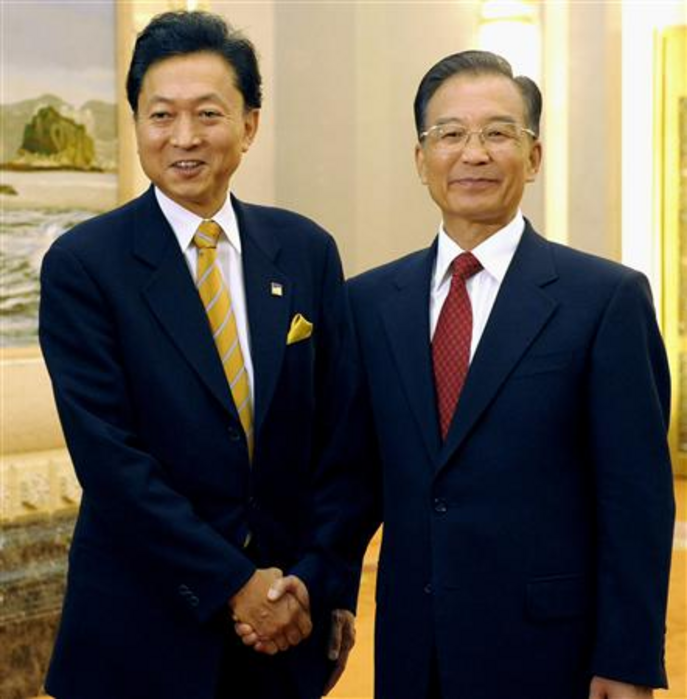
Hatoyama Yuki and Hu Jintao at the bilateral summit on October 10, 2009. There Hatoyama proposed the idea of transforming the East China Sea into a “Sea of Fraternité,” which was welcomed by Hu.

Yet the process of reconstituting state and economy in Japan to advance the clientelist and neo-liberal agenda is not without challenge. That challenge is best seen through focus on the contest between the national government, the bureaucracy, and almost all the national media on the one hand, and the people of one region, Okinawa, on the other, odds so unequal as to defy even such analogies as David and Goliath. The improbable fact as of early 2011 is that the advantage is with the Okinawan resistance and the nation state is on the ropes. For 14 years now, national governments, one after another, have declared various plans to foist new US Marine Corps high tech facilities on Okinawa but have been consistently beaten back. 2010 marked a significant upswing in the stakes, the intensity of the confrontation, and the overall balance of advantage. It is a mistake to see the Okinawan struggle as local, or “Okinawan,” because its implications are national, regional, and global with the nature of Japanese democracy and US strategic planning for its empire of bases across the Pacific in the balance. For example, the Okinawan resistance has already delayed US plans to expand its bases on Guam with the transfer (paid largely by Japan) of 8,000 Marines and dependents from Okinawa. In 2011 the best hope for peace and democracy in Japan and throughout the region is the continuing success of the Okinawan struggle in stalemating US-Japan plans for base reorganization and expansion.

It should be unnecessary to revisit here the Okinawa story of 2010, but in broad outline it included the following: in January the election of a Nago City mayor who declared that “no new base will be built in this city, whether on land or on sea;” in February the adoption by the Okinawa assembly of a unanimous resolution to the same effect; in April the gathering of the “All-Okinawan” mass meeting of some 90,000 people, including the Governor and heads of all local governing authorities, to reinforce the same demand (prefectural support for such positions was running at 84 per cent levels, according to a Ryukyu Shimpo opinion survey); followed in May by the “surrender” and then resignation of Prime Minister Hatoyama. Hatoyama under overwhelming American and Japanese bureaucratic and media pressure, capitulated, signed the 28 May agreement with Washington, and promptly resigned. The year turns on the axis of that infamous agreement, which Tokyo University political scientist Shinohara Hajime described as “Japan’s second defeat” (i.e., ranking with the surrender of 1945).1
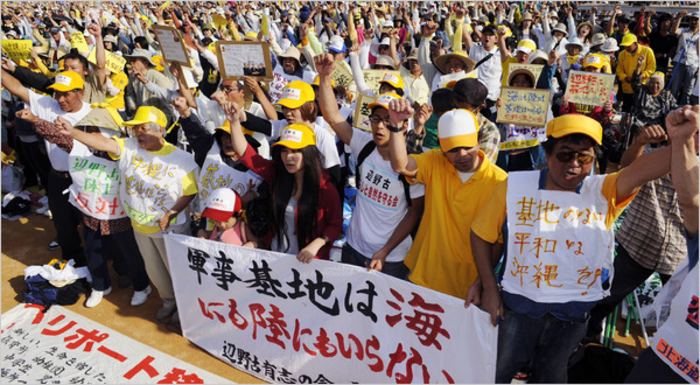
All-Okinawa rally of April 25, 2010 to oppose construction of a new base in Henoko (Photo by New York Times)

The new Prime Minister made it his priority to “restore” relations with Washington, which meant to restore the relationship of faithful service. Kan and his ministers repeatedly bowed their heads to Okinawa saying how sorry they were that they had had to renege on their pre-election pledges that Futenma would not be replaced with a new base within Okinawa, but that there was no alternative and the matter was closed. Rather than seek to advance Okinawan interests by attempting to re-negotiate with Washington, Prime Minister Kan and his ministers concentrated instead on a search for a formula to overcome stubborn Okinawan resistance and to combat the extraordinary levels of hostility to Tokyo and the DPJ that its retreat had fostered. As confidence and trust in the DPJ collapsed, in the Upper House elections of July, it was unable to field a single candidate in Okinawa. In September, the pro-base forces (backed by Tokyo) were again decisively defeated in a Nago City Assembly election. In November, Nakaima Hirokazu was re-elected Governor, backed by the Kan government on the understanding that his opposition to any new base construction was less adamant than that of his opponent, in other words, in the expectation that he would be amenable to persuasion provided the price was right. The one candidate who explicitly endorsed the national government’s position for implementation of the May agreement to relocate Futenma to Henoko was dismissed with a derisory 2 per cent of the vote.

As 2010 wound down, the Japanese state chose the Emperor’s birthday holiday, on a day and at an hour when it expected the people’s defenses might be low, to launch an assault at what it presumed was one of the weakest point of the Okinawan resistance movement, beside Prefectural Road 70 in northern Okinawa.
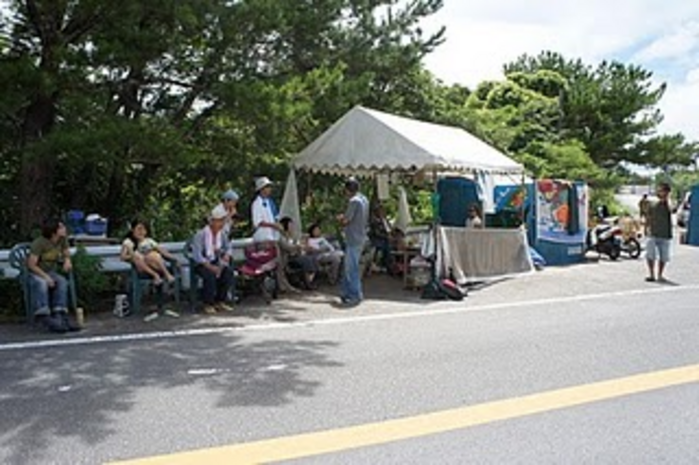
Takae Protest Tent (Photo by Norimatsu Satoko)

Just before dawn on December 22nd, the Okinawa Defense Bureau (ODB, the Okinawan branch of the Japanese Ministry of Defense) re-started construction of new US helipads in Takae, a village in Yanbaru Forest, rich with 4,000 species of wild life. The plan, defying local protest, is to build six helipads within the Northern Training Area in exchange for returning half of the massive US Marine jungle training center. The helipads are to accommodate the V-22 Osprey – an accident-prone aircraft, capable of vertical and parallel take-off and landing. Residents of the 160-household Takae village have been sitting-in around the clock to protest the helipad construction plan since 2007. In November 2008, the ODB prosecuted 15 protesters for obstructing traffic, and though the suit was dropped for 13 of them, two were charged, and the case is continuing.

On the night of December 23rd, in deliberate harassment, a military helicopter hovered 15 meters above the sit-in tent, blowing it down and damaging its contents. Residents immediately filed a complaint against ODB, demanding investigation. When local residents went to the ODB office on December 28 with Okinawan members of the Diet and Prefectural assembly, ODB chief Mabe Ro was not available to meet them. When they finally met several hours later, he merely repeated that the US military had not confirmed the incident. Having visited the Takae tent only a few days before the incident, we note that the new Takae helipads and the “Futenma Replacement Facility” in Henoko are both to be Osprey-capable. If the helipad construction at Takae were to proceed , this would pave the way for forcible construction of the Henoko base. It would also mark a significant reversal of a 14 year-long successful people’s struggle.
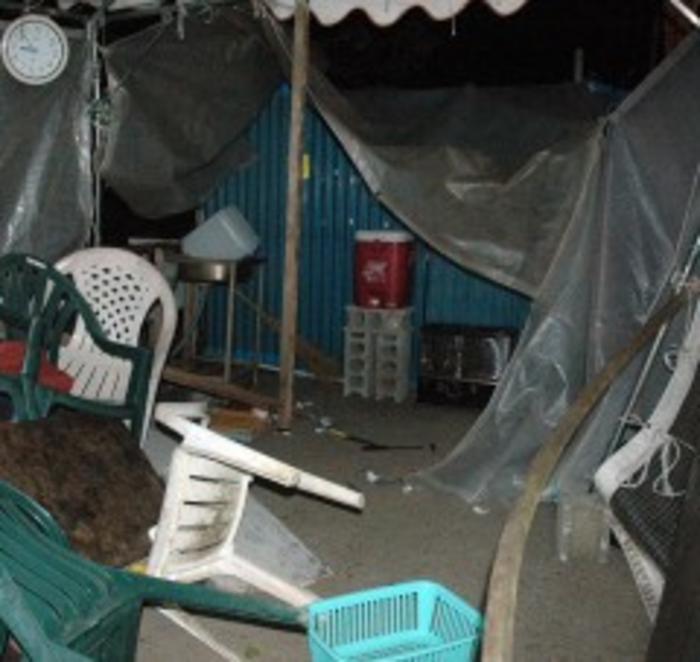
Inside the damaged tent, an hour after the helicopter hovering incident in Takae(Photo from Ryukyu Shimpo)

In 2010, the Japanese government tightened the screws on Nago City for its stubborn refusal to submit to base construction plans by suspending part of its budget, explicitly restoring the “carrot and sticks” link between base consent and fiscal policy that it had earlier denounced on the part of the LDP. The Kan government also threatened Governor Nakaima and the Okinawan people by intimating that unless Okinawa surrendered to Tokyo, the dangerous and disruptive Futenma Marine base would remain indefinitely. Cabinet Secretary Sengoku Yoshito told a Tokyo press conference that Okinawans would have to “grin and bear” (kanju) the new base. Within days, public outrage forced him to withdraw his words. In December 2010, Prime Minster Kan flew in to Okinawa, expressed his “unbearable shame as a Japanese” at the way the prefecture had been treated only to go on to say that relocation of the Futenma base to Henoko “may not be the best choice for the people of Okinawa but in practical terms it is the better choice.” Governor Nakaima countered that the Prime Minister had got it wrong, and that any relocation within the prefecture would be “bad.” Kan, as he entered the prefectural hall on December 17 to meet with Nakaima, encountered some 500 protesters outside the building. Their placards read “Rescind!” (the US-Japan plan to build a base in Henoko), and made noises with cans, mocking Prime Minister “Kan” as an empty “can.”
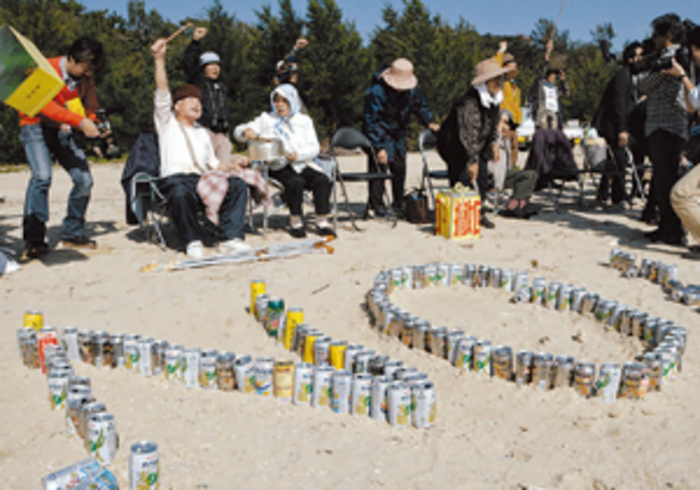
Protesters showing “NO” formed with empty cans on Henoko Beach, so Prime Minister Kan can see from his helicopter. (Photo from Okinawa Taimusu)

So apparently fearful was the Prime Minister of the reception he could expect from Okinawans that, on this December visit, he met no one but the Governor. Avoiding even the members of his own party, he presented a forlorn spectacle surveying his rebellious prefecture from the safety of an SDF helicopter. It is hard to think of any previous Prime Minister in modern times so distrusted and rejected in any part of the country.

While these Tokyo visitors pressed their unwelcome suit upon Okinawans, a different set of visitors gathered in Naha with prominent members of the Okinawan resistance and their academic and other citizen leaders and activists.Days later, Foreign Minister Maehara Seiji followed Kan to Okinawa. When he offered to address the dangers posed by the Futenma base by saying that he would relocate the schools and hospitals of the densely populated Ginowan, local people were incredulous and Governor Nakaima denounced as “the utmost degeneracy” any suggestion that Futenma air base might become permanent. “The basic problem, he said, “is to advance by even one day the removal of the dangers of Futenma, and it is turning things upside down to start extrapolating from the assumption that it is going to be permanent.”2

A December 19 forum cosponsored by the Asia-Pacific Journal (APJ) and Okinawa University, addressed the question “Where is Okinawa going?” Speakers at three sessions – environmental, geopolitical, and economic – engaged in discussion with nearly 200 participants on goals and ideals while addressing contemporary challenges to Okinawa and the region.

Kawamura Masami, Director of Okinawa BD (Citizens’ Network for Biological Diversity in Okinawa), an NGO that fielded one of the largest representations at the 10th Conference of Parties to the Convention on Biological Diversity in Nagoya, October 2010, discussed Okinawa BD’s activities, illustrating characteristics and difficulties of “politicized” environment movements in Okinawa while suggesting strategies to overcome obstacle to broader civil participation. Sakurai Kunitoshi, an environmental assessment specialist, emphasized civil society engagement to empower and provide leadership for Okinawans to rebuild the prefecture, by taking advantage of Okinawa’s rich environment based upon the principles of “Conserve, Use, and Know the environment.”
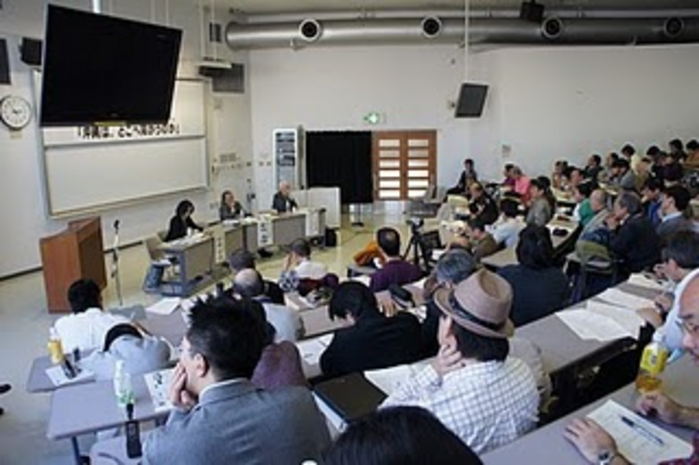
Forum “Where is Okinawa Going” held at Okinawa University, December 19, 2010

Amid rising tensions in East Asia, typified by the China-Japan conflict over the Senkaku/Diaoyu Islands, historian Arasaki Moriteru and APJ coordinator Gavan McCormack spoke of the danger of Okinawans getting caught up in the Japanese national narrative of their islands as “inherent territory” of Japan. Arasaki stressed Okinawa’s significance as a “space of livelihood” for people in the area’s fishing community, while McCormack presented an international vision of Okinawa as a place in the Asia-Pacific notable for its tradition of serving as a peaceful bridge between China, Korea, Japan and insular areas.

In the final session, political scientist Shimabukuro Jun pointed out that Okinawa’s history of “economic development” has only reinforced its status as a military colony and made it an integral part of the post-war AMPO (US-Japan security treaty) system, which de facto overrides Japan’s peace constitution. Shimabukuro called for a redefined local autonomy and legislation that would provide Okinawa with “regional sovereignty.” Miyagi Yasuhiro, a former Nago assembly member who led the 1997 plebiscite that said “no” to the Henoko base plan, explained that Nago had never prospered under the system of subsidies (bribes) from the Japanese government in exchange for hosting military bases. He urged Okinawans to unite in opposing military base expansion, and to engage in new forms of economic and social planning when the government’s Okinawa development program expires in 2012.

The forum’s nearly two hundred participants, boosted no doubt by anger at Prime Minister Kan’s cavalier visit to Okinawa the previous day, discussed the issues of Okinawa’s future within the broader context of alternative courses for the Asia-Pacific region notable both for economic dynamism and the dangerous clashes taking place in 2010. Expansive plans for US base construction in both Okinawa and Guam thus need to be assessed in light of the responses to conflicts between North and South Korea and between China and Japan, responses notable for provocative joint US-Japan-South Korea military exercises replicating the Cold War alliance structures of the 1950s and directed against China and North Korea. Above all, the subordination of Okinawa to US and Japanese security concerns—intensified in the wake of the clash over the Senkaku/Diaoyu islands—needs to be set off against alternative environmentally sound and peaceful possibilities for a region whose history throughout the long twentieth century has been one of sacrifice to imperial and military demands.

In short, the significance of the long-running Okinawa struggle extends far beyond the projected base construction and transfer. The sharp focus on Futenma (and Henoko) has always been tactical, but it is also a measure of the careful strategic planning and organization that underpinned the long-running Okinawan struggle. Even if, as one Okinawan newspaper calculated, Futenma was indeed returned to its owners without replacement, the outcome would merely be to reduce Okinawa’s percentage of the total US base land in Japan from 74 to 72 per cent. While the tactical focus is therefore indisputably Futenma/Henoko/Takae, Okinawan civil society’s strategic orientation has always been towards demilitarization in general, the implementation of the Japanese constitution, especially Article 9 (peace), 12-40 (human rights and livelihood), and 92-95 (local self-government) in particular, and, particularly given Okinawa’s close proximity to China, Taiwan, and Southeast Asia, alternative regional economic possibilities. It is high time to overcome Okinawa’s subordination to the imperatives of the US-Japan Security Treaty.

Beyond the base confrontation, Okinawans are able to see with increasing clarity, through the exposures of “secret diplomacy” and other revelations of the inner workings of the government and the US-Japan-Okinawa relationship, that they had been consistently lied to, tricked, and cheated within the state system they were incorporated in from 1972. That was the case in the deals that Tokyo thrashed out with the Nixon administration in the late 1960s leading to the 1972 reversion and was equally the case in the deals done by the Democratic Party government in Tokyo with the Obama administration in 2009-10. Detail after detail confirms the pattern and demonstrates Tokyo’s contempt for Okinawa and its ongoing efforts to neutralize Okinawan democracy.

In 1965, as was disclosed only recently in declassified documents from the US archives, then US ambassador Edwin Reischauer (éminence grise of Japanese studies in the US through much of the post-war era), proposed a formula for managing Okinawa: “if Japan would accept nuclear weapons on Japanese soil, including Okinawa, and if it would provide us with assurances guaranteeing our military commanders effective control of the islands in time of military crisis, then we would be able to keep our bases on the islands, even though ‘full sovereignty’ reverted to Japan.”3 Nuclear weapons were later in fact removed, but otherwise the Reischauer formula has underpinned the Okinawan position within the US-Japan relationship ever since: free use of the bases under “full sovereignty” – words as requiring of parentheses now as then.

Reischauer’s further 1965 advice on the channelling of discreet funds to aid conservative (pro-US) candidates in elections was also followed, and essentially has been followed in Okinawan elections ever since, though in more recent times the Japanese government has substituted cabinet secretariat secret funds for the CIA or other, direct, American sources. The way in which the crucial 1998 election, in which determinedly anti-base Governor Ota Masahide was defeated following large infusion of those special funds is just one of the many revelations of 2010.4

The Okinawan City of Nago has attracted particular attention from the Japanese nation state for the past 14 years because its initially local resistance to the base construction project, first materializing in the 1997 plebiscite in which a clear majority opposed any new base construction, slowly spread prefecture-wide and now shows signs of spreading to the rest of Japan. Massive Tokyo interventions against Nago—in the form of bribery and coercion—followed the 1997 Nago Plebiscite in a desperate effort to crush or neutralize this local democratic will. Continuing without break, they led to the DPJ’s abject failure in the Nago election of 2010. By holding the nation state, and its US backer, at bay for that time, the citizens of Nago (and more broadly of Okinawa as a whole) have already accomplished a huge victory. It remains to be consolidated, and Tokyo today imposes new fiscal sanctions on the city to try to wrest submission from it. The Nago accomplishment is a victory for democracy in one city, but it will remain a brittle victory until it is consolidated first at prefectural and then at national level. As we argue in the New Year edition of theRyukyu shimpo, it is time now to go from 14 years of successful resistance to a new phase in which positive Okinawan agendas, programs and vision are articulated to help lift Japan as a whole out of the doldrums of subordination to American power and policies.5

Forty years ago, in December 1970, the citizens of Koza (now Okinawa City) rose up in anger at the trampling on their rights by the US occupying forces. In a single night, they destroyed more than 80 US military and private vehicles and many buildings in a spontaneous burst of rage. These events, known generally as the “Koza Riots,” are better described as the “Koza Uprising,” for this was the sole occasion in post-war Japan in which Okinawan or Japanese people actually rose up, desperately if futilely, against US military occupation. Forty years on, a former official of the city lamented that “fundamentally, nothing has changed … in the name of democracy, we have had an occupation, with the same treatment meted out to us as to Iraqis and Afghanis, while both the US and Japan turn a blind eye. The anger that exploded 40 years ago has not abated.”6
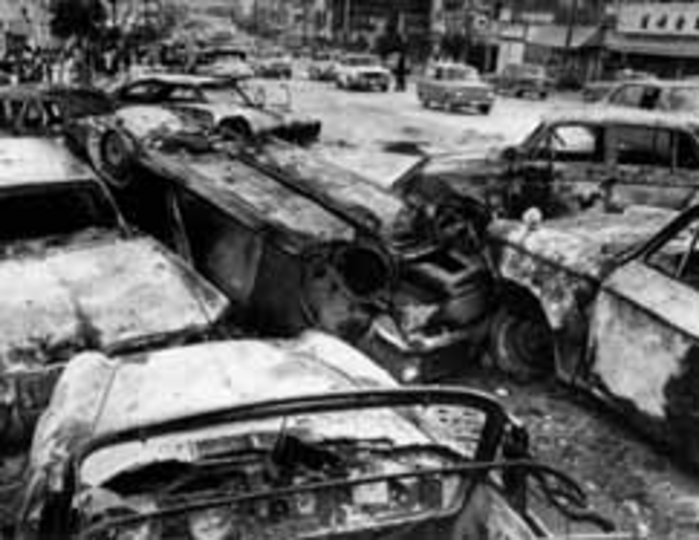
Aftermath of Koza Uprising, December 20, 1970

Okinawa was once the independent Ryukyu Kingdom, negotiating treaties with neighboring foreign countries and kingdoms through the 1850s and only fully subordinated within the modern Japanese state in 1879. As resentment deepens today over ongoing discrimination, some begin to draw attention to the past, and to suggest a future either on a renegotiated and more autonomous basis within the Japanese state or as an independent entity outside it. In June 2010, a “Declaration of Independence” was issued at a meeting on Iriomote Island, in the name of “The Federation of Ryukyu Self-Governing Republics.” Its initial demands of the Japanese national government included apology and compensation for the abolition of the Ryukyu Kingdom and subordination of the islands as Okinawan prefecture in 1879, abolition of the Reversion Agreements of 1969-72 (on grounds of dubious legality and the complex of secret deals that enveloped them) and negotiation of a new, autonomous status.7 The past is unlikely to be a sure guide to the future, but as resentment builds, and so long as Ampo (the US-Japan Security Treaty) continues to take precedence over Kempo (the constitution of Japan, with its core principles of peace, human rights, and self-government), support for independence will grow.8

On December 17, the Japanese Cabinet approved the New National Defense Program Guideline, which stressed increasing confrontation over the “grey zones” and identified the threat of the military modernization of China as part of the “Security Environment Surrounding Japan.” It unveiled a plan to enhance the SDF presence in “southwestern Japan,”9 including Ishigaki. Four days later, we called on Ohama Nagateru, former Mayor of Ishigaki. Ohama, as mayor from 1994 to 2010, had encouraged citizens to establish an Article 9 (no-war clause of the Japanese Constitution) monument in the city, and had initiated various projects to strengthen ties with Taiwan and China, including a sister city agreement with Su-ao, Taiwan. While Tokyo was proposing to reinforce the SDF on the Sakishima Islands, the southernmost islands of Japan bordering China/Taiwan and including Ishigaki, Ohama took a very different view.
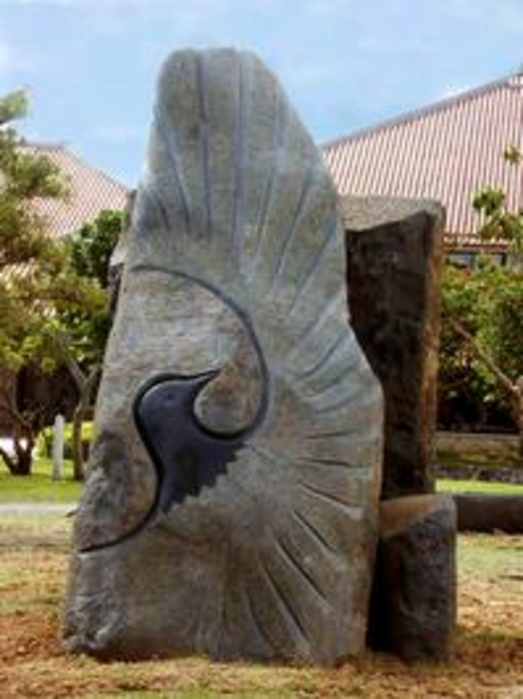
Article 9 monument on Ishigaki Island (Photo from JANJAN)

“We don’t need the SDF on these small islands near the border,” he said, explaining that a fishery rights agreement was on the verge of being completed around the contested Senkaku/Diaoyu Islands before the September 7 ship collision that led Japan’s Coast Guard to detaining the captain of the Chinese fishing boat, thereby provoking an international incident. “A territorial dispute certainly can lead to war,” he said, warning against the military build-up around the border. Ohama also stressed the island’s bitter collective memory of the Japanese military’s failure to protect local citizens in the past. During the Battle of Okinawa, 3,800 people, one out of seven on the island, died of malaria, as local citizens were forced by the Japanese military to move to a malaria-infested mountain area. Ohama, who lost in the February 2010 mayoral election to LDP/Komeito-backed Nakayama Yoshitaka, warned of recent provocative moves by city officials, such as two city assembly members landing on one of the disputed Senkaku islands, and passage of a law designating January 14 as “Senkaku Day” to commemorate the day in 1895 when Japan incorporated the islands as its territory, now part of Ishigaki City in Japanese understanding.
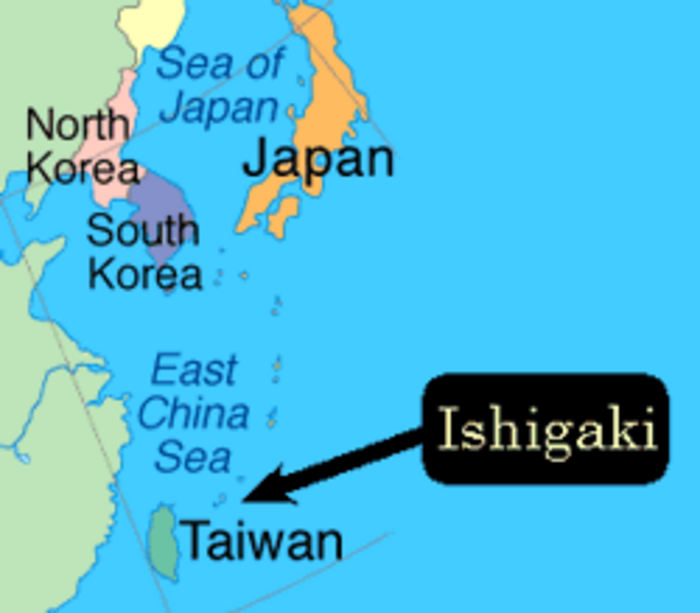
Ishigaki Island (Map from Ishigaki Tourist Information website)

Nago Mayor Inamine’s determination to prevent construction of a base in his city has assured that Nago remains at the forefront of Okinawan resistance. In July 2010, the Mayor refused to permit the Okinawa Defense Bureau to conduct a further assessment with an eye to building a Futenma replacement base. Inamine’s bold act recently gained nationwide support, as hundreds of people elsewhere in Japan transferred their resident tax to Nago, in response to the Defense Ministry’s suspension of a 1.6 billion yen (approximately 20 million US dollars) “realignment subsidy,” one provided specifically to municipalities that host US military bases during the base construction process. The payments of those who have chosen to pay their tax to Nago instead of to the municipality of their residence is small (as of January 6 just 4.7 million yen, or approximately 60,000 US dollars),10 insignificant against the forgone subsidy. But it carries the symbolic meaning of citizens’ support to a city that is determined to finance its own economic activities, even resisting central government bribery for hosting a new base. In late December 2010, Inamine told a group of American University students visiting Okinawa, that “People here are hanging on to their conviction not to allow another base in Okinawa, and not to succumb to state power. I would like young people like you to go back to the US and tell people about it.”
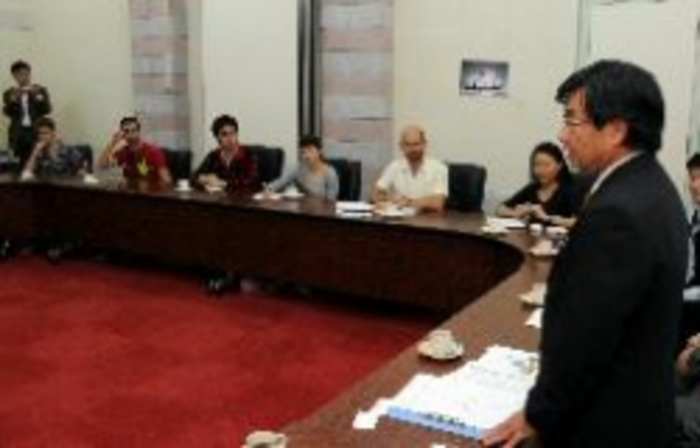
Nago Mayor Inamine speaks to US students(Photo from Okinawa Taimusu)

The New Year Day issue of Ryukyu Shimpo carried encouraging news for anti-base forces. As of December 31, 2010, an unprecedented number of over 20,000 plaintiffs have joined the collective lawsuit against the government over the noise pollution of Kadena US Air Force Base. This is the third such lawsuit, the first being in 1982 and the second in 2000. The second was called a “mammoth lawsuit,” with 5,500 plaintiffs, one-fourth the present number. The second lawsuit demanded that the government ban landing and take-off between 7 pm and 7 am, restrict aircraft noise, and pay compensation for the psychological damage inflicted by the noise. The third lawsuit is expected to make similar demands.
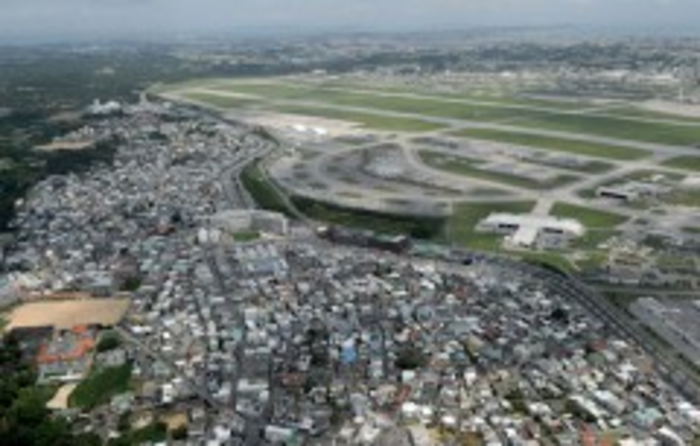
Kadena US Air Force Base and adjacent neighborhood (Photo from Ryukyu Shimpo)

The Kadena-based F-15s are among the aircraft that impose the greatest burden on surrounding neighborhoods. About one hundred aircraft are permanently stationed and operated there, and foreign-based planes also frequently visit. Residents complain of being woken up by 110-120 decibel sound blasts, the kind of noise one hears when a car revs its engine from one meter away. In the first two lawsuits, the high court turned down the plaintiff’s demand for a flight ban, saying it was a third-party (US military) operation that the Japanese government could not control. The plaintiffs of the second lawsuit have appealed to the Supreme Court.

Takara Tetsumi, a constitutional law specialist at the University of Ryukyus compares this large-scale suit to the movement for Okinawan reversion to Japan prior to 1972, both based on the constitutional principle of the right of peaceful existence. Ryukyu Shimpo calls the lawsuit “a modern-day popular uprising.”11 The suit, coming at a time when China-Japan tensions have led to heightened pressures for militarization, is the latest sign that Okinawa will continue at the center of efforts to define Japan’s future.

Gavan McCormack, Norimatsu Satoko and Mark Selden are coordinators of The Asia-Pacific Journal. They visited Japan, including Okinawa and Ishigaki, in December 2010, and were joint organizers and participants in the Forum at Okinawa University, “Where is Okinawa Going?”

Recommended citation: Gavan McCormack, Norimatsu Satoko and Mark Selden, New Year 2011, Okinawa and the Future of East Asia, The Asia-Pacific Journal Vol 9, Issue 2 No 3, January 10, 2011.

Notes

1 See Gavan McCormack,  The Battle of Okinawa 2010: Japan-US Relations at a Crossroad.

2 Okinawa Taimusu, 29 December 2010.

3 Steve Rabson, “‘Secret’ 1965 memo reveals plans to keep US bases and nuclear weapons in Okinawa after reversion,” The Asia-Pacific Journal, 21 December 2009.

4 Ida Hiroyuki, “Kambo kimitsuhi yaku 3 oku en ga Okinawa chijisen ni nagarekonda shoko,” Shukan kinyobi, 22 October 2010, p. 20-21.

5 “Teiko koeta bijon o,” Ryukyu shimpo, 4 January 2011.

6 Okinawa Taimusu, 17 December 2010.

7 On the Declaration of Independence issued by “Ryukyu Jichi Kyowakoku Renpo” (by the alliance of Amami, Okinawa, Miyako, and Yaeyama islands) on 23 June 2010, see Matsushima Yasukatsu, “Yuimaru Ryukyu no jichi – ‘Ryukyu’ dokuritsu de ‘heiwa na shima’ e,” Shukan kinyobi, 23 July 2010, p. 22; also “NPO Hojin Yuimaru Ryukyu no jichi,” (link).

8 Paraphrasing the sentiment expressed by Ryukyu University’s Shimabukuro Jun, “Jichishu to nari kizuna o saisei suru,” Asahi shimbun, 24 August 2010.

9 Japan Ministry of Defense, Summary of National Defense Guidelines, FY2011.

10 “Furusato nozei kyuzo,” Ryukyu Shimpo, 6 January 2011

11 For discussion on the Kadena noise lawsuits, see “Kokunai saidai genkoku 2 man kyo ? Kadena bakuon 3ji sosho, 2ji no 4bai,” Ryukyu Shimpo, 1 Jan 2011 (link) and“Genkoku 2man kyo gendai no minshu hoki dahiko sashitome ni fumikome,” Ryukyu Shimpo, 3 Jan 2011 (link).

‘I didn’t think of Iraqis as humans,’ says U.S. soldier who raped 14-year-old girl before killing her and her family

Steven Green, the former soldier sentenced to five life terms for raping and killing a 14 year-old Iraqi girl and killing her family spoke to a reporter for the Daily Mail newspaper:

An Iraq War veteran serving five life terms for raping and killing a 14-year-old Iraqi girl and killing her parents and sister says he didn’t think of Iraqi civilians as humans after being exposed to extreme warzone violence.

Steven Green, a former 101st Airborne soldier, in his first interview since the 2006 killings, claimed that his crimes were fuelled in part by experiences in Iraq’s violent ‘Triangle of Death’ where two of his sergeants were gunned down.

The story is as horrifying and shocking as the first time I read about it:

At the Iraqi home, Barker and Cortez pulled Abeer into one room, while Green held the mother, father and youngest daughter in another.

Pfc. Jesse V. Spielman, of Chambersburg, Pennsylvania, stood guard in the hall. As Barker and Cortez raped the teen, Green shot the three family members, killing them.

He then went into the next room and raped Abeer, before shooting her in the head. The soldiers lit her remains on fire before leaving. Another soldier stood watch a few miles away at the checkpoint.

Mission accomplished?  Who is ultimately responsible for war crimes of this nature? The persons who pull the trigger of the gun? Or the ones who pull the trigger on the troops sent into war?

Solidarity Actions to Protest US Military Expansion in Takae (Okinawa)

U.S. military helicopters buzzed the peace encampment near the Yambaru forest  in Takae, at the northern end of Okinawa. Construction of the jungle warfare training area has begun.  This is another site of community resistance to U.S. military base expansion in Okinawa, but it has gotten far less media attention than Futenma and Henoko.  Groups in Japan are mobilizing to protest the U.S. expansion of training in the rainforest of Yambaru.   They requested international groups to send messages of solidarity:

Email your message/request to: no.base.okinawa@gmail.com

Please include in your email the following information:

*** Name (for an individual) or name of your organization
*** Your message/request (length is up to you)

Both Japanese and English messages will be accepted.

Deadline: January 8 (Sat.), 2011 (Remember that Japan is a day ahead of Hawai’i)

>><<

Reposting from Satoko Norimatsu of Peace Philosophy Centre:

Sunday, January 02, 2011

Please Join Action for Takae at US Embassy!

高江ヘリパッド工事強行とテント損壊事件についてアメリカ大使館への抗議と申し入れへの呼びかけ

★ See a YouTube video of the Okinawan media reports on the December 23 incident of a US helicopter hovering above the Takae protest tent, which caused damage to the tent and some items in the tent.

(日本語ではこちらをご覧ください。)
Please Join Us in Our Action for Preserving the Pristine Yanbaru Forest and People of Takae, Okinawa!

We invite you to join us in our protest at the U.S. Embassy in Tokyo over the restart of the U.S. helipads construction in Takae, Higashi Village of Okinawa, and the destruction of the sit-in tent by a U.S. helicopter, either by sending us your message/request to the US Embassy by email by January 8, or physically joining our action on January 10 in Tokyo (see instruction at the bottom).

The Yambaru Forest is a habitat for endangered species such as Yambaru Kuina (Okinawan Rail) and Noguchi Gera (Okinawan Woodpecker). It is known internationally as a region rich in biodiversity. Takae, situated in Yambaru, is a small village of about 160 residents, including many who moved here for its pristine nature.

However, the U.S. Marine Corps has been using the Yambaru Forest for combat training. In 1957, th US military started using the area as “Northern Training Area” (Jungle Warfare Training Center), and currently there are 15 U.S. helicopter takeoff and landing zones (helipads) in Higashi Village. Residents of Takae have constantly suffered from the noise and the risk of helicopter crashes. To make matters worse, the Japanese and US governments decided to build 6 new helipads, surrounding the residential neighborhood of Takae.

Construction of new helipads will not only further endanger the livelihood and lives themselves of Takae residents, but also further destroy the precious environment with its wealth of species, forest and rivers. New military facilities also pave the way to the possibility of a new war. Residents of Takae have protested against the helipads construction for the above reasons. In 2006, we passed a resolution against the new helipads, and demanded of the relevant authorities that they review the construction plan. Takae residents and their supporters from across Japan and from around the world have continued to sit-in, monitoring the site and trying to persuade the government against the construction.

The Japanese and US governments, however, have not listened to the voices of opposition by the residents, and have not provided sincere explanation or proper opportunities for public hearing. The Japanese government even decided, all of a sudden, to prosecute some of the local protesters for obstructing traffic.

Just before dawn on December 22, 2010, at 6:30 AM, some 100 members of the Okinawa Defense Bureau, ignoring the ongoing court proceedings, barged into the site without warning to restart the helipad construction. On the next night, December 23rd, a US helicopter hovered only 15 meters above the sit-in tent, causing the tent to blow down. Such military exercise over a public road threatens the safety of local residents. The Japanese and US governments are harming the people of Takae by forcing through the construction work without sufficient explanation or consent by local residents. Such an approach by the two governments is unacceptable.

Residents of the Henoko district in Nago City, where the Japanese and US governments plan to build a replacement base for MCAS Futenma, have also been sitting-in for over 2,400 days, in order to preserve their life and the beautiful ocean. We urge you also to say “NO” to the new base plan in Henoko.

Following our protest to the Ministry of Defense on December 22 and the December 26 demonstration in Shinjuku, “Save Takae/Okinawa – an urgent appeal and demonstration against construction of helipads,” we will go to the US Embassy in Tokyo and the Japanese Ministry of Defense on January 10 (Mon.), 2011, to protest. We would like to collect as many requests/demands as possible and deliver them to the US government. We accept both individual and organizational messages. Just one sentence message, such as “We do not need US helipads in the pristine forest” will suffice, or a longer message is welcome too. The Takae and Henoko issues are not just about war and military bases, but they are also about environmental preservation, biological diversity, and an alternative, “slow-life” lifestyle. Please express your message in your own words. Please follow the below instruction and send your message by January 8, 2011.

With our voices and with our actions, let us stop the helipad construction in Takae, and the base construction in Henoko. Let us bring a peaceful and fulfilling life to Takae and Henoko!

(The original document in Japanese is at: http://takae.ti-da.net/e3296164.html. Translated by Norimatsu Satoko and Gavan McCormack)

★Email your message/request to: no.base.okinawa@gmail.com

Please include in your email the following information:

*** Name (for an individual) or name of your organization
*** Your message/request (length is up to you)

Both Japanese and English messages will be accepted.

Deadline: January 8 (Sat.), 2011

If you can physically join our action at the US Embassy, please meet us in front of Toranomon JT building, at 3 PM on January 10, 2011. (Take Exit 3 of Subway Ginza Line “Toranomon” station. Walk four minutes straight on Sotobori Street, towards Tameike Sanno). We particularly appreciate participation of people from US!

Address: Toranomon JT Building, 2-1, 2 chome, Toranomon, Minato-ku, Tokyo – see MAP here. Address in Japanese: 2011年1月10日(月・休)15時 虎ノ門JTビル前集合(地下鉄銀座線「虎ノ門駅」3番出口より、外堀通りを溜池山王方面へ直進、徒歩4分)

Organizer: Okinawa o fuminijiruna (Do not trample on Okinawa!) Urgent Action Committee; Yuntaku Takae; Okinawa One-tsubo Anti-war Landowners Association Kanto Bloc (URLs below)

呼びかけ:沖縄を踏みにじるな!緊急アクション実行委員会(新宿ど真ん中デモ)

http://d.hatena.ne.jp/hansentoteikounofesta09/

ゆんたく高江 http://helipad-verybad.org/

沖縄・一坪反戦地主会 関東ブロック http://www.jca.apc.org/HHK/

★There will be another action on the same day at the Ministry of Defense. We will meet in front of the MoD at 6:30 PM. The organizer of this action is “Committee for Not Allowing Base Construction in Henoko.” See Map of MoD here: http://www.mod.go.jp/e/access/index.html
In Japaneese, 1月10日18時半 防衛省前集合
主催:辺野古への基地建設を許さない実行委員会ttp://www.jca.apc.org/HHK/NoNewBases/NNBJ.html

★For the background information in English about the Takae issue, go to:

Voices of Takae (English version)
http://nohelipadtakae.org/files/VOT-english2010Oct14.pdf

Postcard…from Takae, by Jon Mitchell

http://www.fpif.org/articles/postcard_fromtakae

Navy Awards Two Contracts to Build New Combat Ships

The New York Times reports that Lockheed Martin and Austal USA got nice Christmas gifts from the Navy:

The Navy on Wednesday awarded two companies contracts that could be worth a total of more than $7 billion to build 20 of its new littoral combat ships, splitting the purchase to obtain the vessels more quickly.

Navy officials said that if it exercises all of its options under the contracts, Lockheed Martin would assemble 10 of the coastal warships for $3.62 billion over six years and Austal USA, a unit of an Australian company, would build 10 for $3.52 billion.

The littoral combat ship (LCS) is the U.S. Navy’s response to China’s fast shallow-water naval vessels.   This new ship design highlights the changing nature of naval warfare and the geopolitical importance of the Asia Pacific region.

Austal USA also built the two Hawaii Superferry ships, which were prototypes for the Joint High Speed Vessel (JHSV), a major contract that Austal USA recently won from the US Navy.  Activists opposed to the Hawaii Superferry pointed out that the ferry was just a front for these larger military plans.  At the time, these theories were ridiculed by the media and politicians.  But it seem now that the activists were right. And Austal is laughing all the way to the bank.

Global Day of Action on Military Spending

Check out this website and call to action for a Global Day of Action on Military Spending. It’s a great resource to discuss the cost of militarization and alternative social and fiscal priorities. 

Here’s some background info from the website:

In 2009, global military spending surged to an all-time high of US $1.53 trillion. Given the numerous crises facing the planet — economic, environmental, health, diplomatic — it is imperative that we create a global movement to shift this money to human needs. We know that there are thousands of organizations and millions of individuals who support this point of view – what is needed is to begin a serious mobilizing effort to make it visible.

As part of this campaign, we propose a Global Day of Action on Military Spending for April 12, 2011 to coincide with the release of the Stockholm International Peace Research Institute’s annual report, which will include new figures on military expenditures. On this day, people all over the world will join together in joint actions to focus public, political, and media attention on the costs of military spending and the need for new priorities. Such events will help us to build the international network around this issue.

While each location will craft its own approach, we hope there will be a common focus on calling attention to the overall size of global military spending. This would need in most cases to be linked to a related national (or local) issue, such as the Afghanistan war, anti-bases efforts, arms trade deals, work against small arms, resources for nonviolent conflict resolution, Article 9 campaign etc. We very much hope that peace groups will use this as an opportunity to connect up with anti-poverty, environmental, pro-democracy organizations and others who share our perspective.

As for types of actions: a whole range is possible! — from street theatre/demonstrations and erecting banners to seminars, signature collection and much more. Many slogans come to mind:What Would You Do With $1.5 Trillion? $1.5 Trillion Is Insane! Trillions for War or Trillions for Peace? etc. We plan to issue a Toolkit before long to assist organizers. A key aspect is the visual side. By generating some captivating images, we plan to attract widespread media coverage and make available photos of our rallies and events. We will compile an album of pictures from around the world and post them online to document the global movement and to use to accompany stories about the SIPRI report and our own actions.

We have commitments from organizations in the United States (in Washington, New York, Boston, Western Massachusetts, the Bay Area, Maine and Honolulu) as well as South Korea, Switzerland, South Africa, Lebanon, the Philippines, and Greece. Can we add you to our list?

Two articles with analysis of the tensions in Korean peninsula

Mahalo to Marta Duenas of West Coast Famoksaiyan for posting the following articles about the tensions in the Korean Peninsula on her listserve.   Another blog for Famoksaiyan is here.  I am just reposting what she sent in her email as it captures my sentiments.  Mahalo to Satoko Norimatsu and her Peace Philosophy Centre blog, to Gavan McCormack and the Japan Focus website and Christine Ahn and Foreign Policy In Focus for keeping us informed about critical issues in the Asia Pacific region.  Please support these important groups.

>><<

From: Martha Duenas
Date: Tue, Dec 28, 2010 at 5:19 PM
Subject: [famoksaiyanfriends] Gavin McCormack on Korean Tensions / Christine Ahn on Resolving the Face-Off in Korea
To: Famoksaiyan Friends <famoksaiyanfriends@lists.riseup.net>

Peace Philosophy Centre: http://peacephilosophy.blogspot.com/

Satoko Norimatsu of Peace Philosophy Center has posted valuable information & analysis on the Asia-Pacific region, US military presence and government compliance in creating the volatile tensions that threaten the true and genuine security of the people in this region. Jeju Island is under assault at this very moment with threats of SWAT team force and arrest for protecting their land and seas from US military expansion. The communities, the people in these regions desire the peaceful way of life we have all known in the past to secure the future for our children.

War and all that exists for war makes money. War builds economies. But war kills. War destroys. War is not hope. We cannot want war.

Please visit the links at the bottom of this article for more information on the work of Gavin McCormack and Satoko Norimatsu.

Monday, December 27, 2010
Gavin McCormack on Korean Tensions
Gavin McCormack’s talk at the Foreign Correspondents Club of Japan (FCCJ) Professional Luncheon on December 15, 2010

How the shadows have fallen over East Asia in the space of these past few years. Just three years ago, North and South Korean leaders met and signed an agreement to cooperate and work out a path to peaceful unification of their divided peninsula, and specifically to turn the contested West Sea area into a zone of peace and cooperation; two years ago Barack Obama came to office in the United States promising a better world, progress toward nuclear disarmament, an end to war, dialogue with all “enemies;” just over one year ago, Hatoyama Yukio became Prime Minister of Japan, promising change, the vision of an East Asian Community, equi-distant diplomacy with China and the United States, and transformation of the South China Sea into a “Sea of Fraternité” (Yuai no umi) (and Ozawa Ichiro led his famous friendship mission of 600 to Beijing, derided by Richard Armitage as the Japanese People’s Liberation Army descending on China).
Now, as 2010 moves towards its end, massive military exercises (war games) take place around the Korean peninsula and in the Sea of Japan. Are they defensive? Are they provocative? Are we heading towards war?The governments that came to power in Korea in 2008 and in US and Japan in 2009 turned away from peaceful change. LMB scrapped the cooperation agreement negotiated by his predecessor; Obama continued, and intensified the two wars he inherited (while engaging in pressures and threats, rather than negotiations, that suggested the possibility of a third and even a fourth, in Iran and North Korea); and Japan moves simultaneously towards participation in collective war-rehearsing exercises that are almost certainly unconstitutional, presses for construction of a new base for the Marines in Henoko, and to reinforce the SDF military presence on the outlying islands.

The downward spiral accelerated through this year,, which has been punctuated by three major events: Cheonan in March, Senkaku in September, and Yeonpyeong in November.

CLICK HERE FOR THE COMPLETE TEXT OF GAVIN McCORMACK’S TALK
~ ~ ~ ~ ~ ~ ~ ~ ~ ~ ~ ~ ~ ~ ~ ~ ~ ~ ~ ~ ~ ~ ~ ~ ~ ~ ~ ~ ~ ~ ~ ~ ~ ~ ~ ~ ~ ~ ~ ~ ~ ~ ~ ~
McCormack, Takesada & Wada, Analysis on Korean Tension
See HERE for program information on the FCCJ website
CLICK HERE TO VISIT THE ASIA-PACIFIC JOURNAL: JAPAN FOCUS

~ ~ ~ ~ ~ ~ ~ ~ ~ ~ ~ ~ ~ ~ ~ ~ ~ ~ ~ ~ ~ ~ ~ ~ ~ ~ ~ ~ ~ ~ ~ ~ ~

Foreign Policy in Focus

Resolving the Face-Off in Korea

By Christine Ahn, December 22, 2010

On Monday, the Korean peninsula averted a cataclysmic showdown that could have escalated into full-blown war. The United Nations Security Council wasn’t able to conclude a statement that would defuse tensions, with countries lining up along Cold War divisions.

Seconds before I appeared on Al-Jazeera International Sunday night, the producer informed me that South Korea, despite pleas from both Russia and China to cancel the live fire artillery drills, had in fact started the exercises. Having been to North Korea several times, and knowing how their worldview centers on the right to defend their sovereignty, I feared the worst.

But by the time I returned home, the South Korean military drills were over. It lasted 94 minutes. North Korea, which had promised to retaliate with even more force than the November 23 shelling of Yeonpyeong island, decided that the South’s aggression was “not worth reacting” to. According to the North’s Korean Central News Agency, “The world should properly know who is the true champion of peace and who is the real provocateur of a war.”

Peace Parlay

Without a doubt, New Mexico Governor Bill Richardson’s trip to Pyongyang was crucial to cooling the tensions. Richardson has experience dealing with Pyongyang. In 1996 he went to secure the release of an American civilian who had illegally crossed the Yalu River into North Korea. But as the former energy secretary in the Clinton administration and governor of the state that houses the Los Alamos National Lab, Richardson knows energy, especially policy governing nuclear energy. At the eleventh hour, Richardson was able to secure a deal with Pyongyang in which they agreed to allow UN inspectors to monitor its nuclear program and an offer to sell 12,000 plutonium fuel rods to South Korea. North Korean officials are also considering Richardson’s recommendation to establish a hotline between North Korea and South Korea as well as a tri-lateral commission consisting of North Korea, South Korea, and the United States to address military disputes.

In addition to Richardson’s swift diplomacy, several other factors may have played a role in de-escalating the crisis. One, according to independent journalist Tim Shorrock, may have been the strong caution expressed in a December 16 press conference by U.S. General James Cartwright, the number two ranking officer at the Joint Chiefs of Staff. Cartwright explained that North Korea, in response to South Korea’s live artillery drill, could react and fire back on the islands, which “would start potentially a chain reaction of firing and counter-firing. What you don’t want to have happen out of that is for the escalation to be—for us to lose control of the escalation.” According to an email from Shorrock, Cartwright “seemed to be saying very diplomatically that South Korea should back off.”

An important Bloomberg story about the Northern Limit Line (NLL), which received very little play in the media, is key to understanding the root cause of the current crisis over the disputed waters in the West Sea. This area has been the site of multiple deadly naval clashes, which occurred in 1999, 2002, 2009, last March and November. The cycle of violence nearly ended on October 4, 2007 when then-South Korean President Roh Moo-hyun and North Korean leader Kim Jong-Il pledged to hold talks to “discuss ways of designating a joint fishing area in the West Sea to avoid accidental clashes and turning it into a peace area.” According to Henry Em, Associate Professor of East Asian Studies at New York University, “The 2007 agreement was thrown out as part of the new government’s strategy of getting tough with North Korea… [which] has been met with North Korea’s get-tough policy toward South Korea, with tragic and dangerous consequences.”

A Disputed Boundary

North Korea felt justified in retaliating against the South Korean shelling on November 23 because the nearly 4,000 shots the South Korean military fired within a four-hour period emanated from waters Pyongyang considers to be North Korean territory. Although Yeonpyeong Island, and four other nearby islands, were designated as South Korean under the 1953 armistice agreement, the waters surrounding them were not. In 1953, to restrain then-South Korean leader Syngman Rhee from continuing to attack the North, the United States unilaterally drew the NLL, which follows the coast of North Korea approximately 3 miles off-shore.

Not only is the NLL illegitimate because North Korea never agreed to it, international maritime convention considers 12 miles to be the boundary of any country’s waters. Yeonpyeong Island, from which South Korea conducted live artillery drills on November 23 and earlier this week, lies within 12 nautical miles of North Korea’s coastline. North Korea’s insistence that the South was conducting live artillery drills within its territorial boundaries is therefore not without basis.

But it’s not just the North Koreans who think the NLL isn’t legal. On December 17, two Bloomberg reporters discovered secret telegrams sent by former secretary of state Henry Kissinger in 1975 stating that the Northern Limit Line is “clearly contrary to international law.” The confidential February 1975 telegram from Kissinger reads, “As we have noted before (Ref B) Northern Patrol Limit Line does not have international legal status. NPLL was unilaterally established and not accepted by NK. Furthermore, insofar as it purports unilaterally to divide international waters, it is clearly contrary to international law and USG law of the sea position. Armistice provides two sides must respect each other’s “contiguous waters”, which negotiating history indicates would mean as maximum 12 miles.”

The Bloomberg reporters also quote a December 19, 1973 cable to Washington from Ambassador Francis Underhill who wrote, “The ROK and the U.S. might appear in the eyes of a significant number of other countries to be in the wrong” if an incident occurred in disputed areas. According to Mark J. Valencia, a maritime lawyer with the National Bureau of Asian Research, “If it ever went to arbitration, the decision would likely move the line further south.”

According to The New York Times, “Park In-kook, the South Korean ambassador, noted that the line had been established in 1953 and that North Korea had accepted it under a 1992 agreement, diplomats said.” Park may be referring to the North-South Joint Agreement on Reconciliation, Nonaggression, and Cooperation and Exchange, which did not specifically mention the Northern Limit Line, and in fact neither side has implemented it.  The clearest expression of agreement between North and South Korea addressing the disputed West Sea waters was set forth by North and South Korean leaders in their 2007 summit meeting.  In that meeting both sides agreed to establish a “peace zone” in the West Sea. Unfortunately, as soon as President Lee Myung Bak took office in 2008, he backed away from the agreements made in the 2000 and 2007 North – South summit meetings in favor of a more hard-line approach to the North.

Resolving the Stalemate

Since it’s unlikely that Lee Myung Bak will revive the 2007 agreement between North and South Korea, veteran Korea expert Selig Harrison proposed a solution in a New York Times op-ed last week: “The solution could be quite straightforward: the United States should redraw the disputed sea boundary, called the Northern Limit Line, moving it slightly to the south.” It’s that easy. And Harrison asserts that this is possible because “President Obama has the authority to redraw the line” as the United States is still the head of the United Nations Command for Korea. After consulting with Seoul and Pyongyang, the United States should get to work to not only redraw the line but also seriously move toward peace talks. This could be the first priority of the trilateral commission, if it were established.

As I remained fixed to my computer watching for developments and following twitter feeds over the weekend, I couldn’t help but feel both anxious and enraged. This ongoing game of brinkmanship played by our world leaders could have had horrific consequences. As I watched footage of elderly Koreans forced out of their homes and into bunkers, I imagined how traumatic it must have been, especially for the survivors of the Korean War.

Tragically, Koreans on the peninsula and in the diaspora must not only live with the painful memories of the Korean War, which claimed millions of lives and separated millions of families. We must also live with the hard truth that the Korean War is still not over 60 years later and the country remains divided. And all for what purpose and whose objectives? Certainly not for the security of the lives of ordinary Koreans, north and south.

Christine Ahn is a columnist with Foreign Policy In Focus, a policy analyst with the Korea Policy Institute, and a member of the National Campaign to End the Korean War.

http://www.fpif.org/articles/resolving_the_face-off_in_korea?utm_source=feedburner&utm_medium=feed&utm_campaign=Feed%3A+FPIF+%28Foreign+Policy+In+Focus+%28All+News%29%29&utm_content=FeedBurner

[Jeju Update] 34 people arrested but released except for Prof. Yang/ Island Assembly and Parties denounce Island government and navy

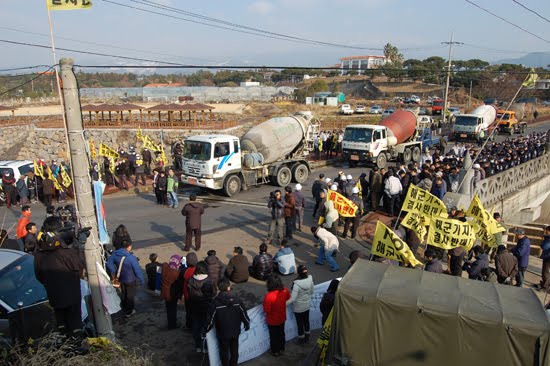
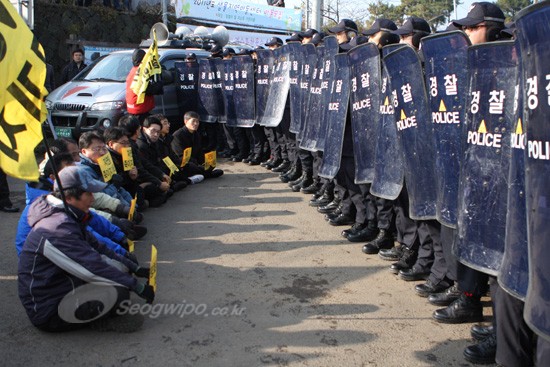
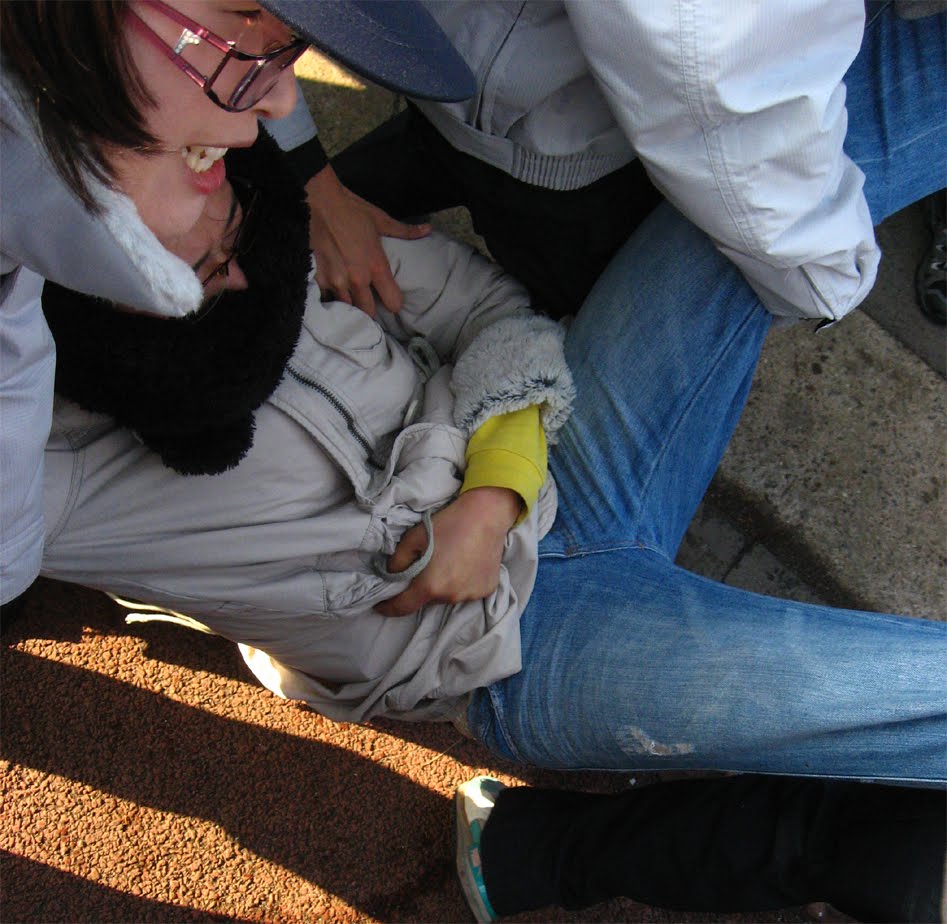
Korea activist Sung-Hee Choi reports in her blog  that 34 people were arrested but released except for Prof. Yang in Jeju island protests of military  base construction on a world peace island.   Some photos from the blog are re-posted below.  Visit the No Bases Stories Korea blog.  As reported previously, although the proposed base is technically a South Korean naval base, its actual purpose would be to support U.S. encirclement of China.

http://4.bp.blogspot.com/_gnM5QlRx-4c/TRkW-jWGscI/AAAAAAAAHIw/05hq78L56to/s1600/overview-news+Jeju.jpg

http://1.bp.blogspot.com/_gnM5QlRx-4c/TRj6nU69y4I/AAAAAAAAHFw/ZcotLNLPDzw/s1600/arrest+0_Seogwip.jpg

http://3.bp.blogspot.com/_gnM5QlRx-4c/TRjznHOAntI/AAAAAAAAHEQ/RCuGoKjZEAg/s1600/M-arrest0.jpg

Photo by arrest by Gangjeong artist Kim on Dec. 27, 2010

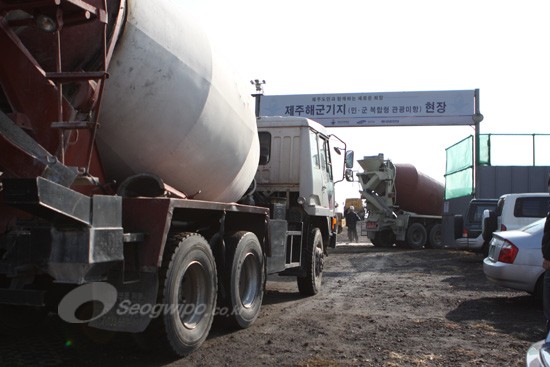
65 Cement-mixer trucks made entry after the arrest of 34 people— the Jeju Island tears

http://4.bp.blogspot.com/_gnM5QlRx-4c/TRjpmY4YyWI/AAAAAAAAHDo/SLgsAtFfamQ/s1600/Construction1.jpg

* Image source: Kim Kyung-Duk, Seogwipo Daily Newspaper, Dec. 27, 2010김경덕, 서귀포 일간 신문, 2010년 10월 27일(클릭)

Community resists military expansion on Jeju Island

Thanks to Bruce Gagnon for posting these updates on the critical situation in Jeju island, Korea, where villagers are resisting the construction of a new military base.

Mon 12/27/2010 12:54 PM

RESISTANCE BEGINS ON JEJU ISLAND

I got these photos from a Jeju Island media outlet….you can see more of them if you click here

I’ve not yet heard from Sung-Hee Choi yet, she might have been arrested for all I know.

It is obvious that the Navy has pushed through with their cement trucks and will now begin to pour concrete over the sea life that lives among the rocks along the coastline of the Gangjeong village.

All of this in order to build a Navy base that is needed as the U.S. Navy builds more ships and deploys them in the region. Maine’s Sen. Olympia Snowe (Republican) has said over and over again to the media in our state that more Navy ships are needed to “protect” against China’s expanding power. There can be now doubt that this base has nothing to do with North Korea. It is all about projecting power toward China in order to block their ability to import oil on ships along the waterway between Jeju Island and mainland China. The Chinese import 80% of their oil via this sea route and if the U.S. can successfully “choke off” their ability to transport oil then the U.S., who can’t compete with China’s growing economy, would be able to still hold the “keys” to their economic engine.

It is hardball politics that the U.S. is playing here in this expensive and dangerous game. The people on Jeju Island, sadly enough, are just pawns in the way of imperial designs.
Bruce K. Gagnon
Coordinator
Global Network Against Weapons & Nuclear Power in Space
PO Box 652
Brunswick, ME 04011
(207) 443-9502
globalnet@mindspring.com
www.space4peace.org
http://space4peace.blogspot.com/ (blog)

Mon 12/27/2010 4:34 AM

NAVY MAKES MOVE TODAY ON JEJU ISLAND

As I write this the people of the Gangjeong village on Jeju Island in South Korea are in the midst of the fight of their lives. It is today that they face down the Navy and the plans to destroy their sacred coastline for the Navy base where U.S. Aegis destroyers (built here in Bath, Maine) will be ported.

As I write this they might be sitting in the road trying to block the construction machinery from beginning work. They might be getting arrested in large numbers. They are so isolated and few around the world know anything of their struggle to save the rocks, the water, the coral, the fish and their way of life.

On Christmas day a Catholic mass was held for the villagers along the rocky coastline by the Bishop of Jeju Island. Below is the latest report we got from Global Network board member Sung-Hee Choi who has been at the village for the last couple of weeks standing with the people and helping to spread word about their fight to others in Korea and around the world:

In the Joongduk coast – the planned naval base area – snowflakes fell onto the beautiful coast rocks and sea, as well, displaying a mysterious view as the sea horizon became clouded. It was a terrible feeling to think that the most beautiful rocks and sea in the Jeju Island might be covered with concrete if the naval base construction is enforced.

At 3:00 pm, there was a peace mass, called, ‘the Christmas missal to save life and peace of the Jeju Island,’ lead by Fr. Kang Woo-Il, Chairman of the Catholic Bishops’ Conference of Korea & the Bishop of the Catholic Jeju district, along with many fathers and nuns in the Jeju island. The event was hosted by the Special Committee for the Island of Peace, Catholic Jeju district. About 400~500 followers and Gangjeong villagers gathered and represented their will to save the Jeju island of Peace from the naval base construction.

Bishop Kang Woo-Il led the mass and said, “Military base cannot save peace and life”
and that he “would be together with the lonely and oppressed Gangjeong villagers.”

The least we can do is to let others know about this terrible moment so that the valiant struggle of the Gangjeong villagers is not done without the world knowing about it. Please pass on word about this and also call the South Korean embassy in your country and protest the construction of the Navy base for U.S. warships on Jeju Island.

As you can see in the small yellow signs being held by the people in the crowd that read “No War” the villagers understand that construction of this Navy base, so close to China’s coastline, is a wildly provocative move in the U.S. military strategy to surround China. It will only bring more conflict to their part of the world.

Bruce K. Gagnon
Coordinator
Global Network Against Weapons & Nuclear Power in Space
PO Box 652
Brunswick, ME 04011
(207) 443-9502
globalnet@mindspring.com
www.space4peace.org
http://space4peace.blogspot.com/ (blog)

Harriet Hanako Hanzawa/Kondo’s Instructions for War

Source: http://hawaiinewsdaily.com/2010/12/harriet-hanako-hanzawakondo%E2%80%99s-instructions-for-war/

Harriet Hanako Hanzawa/Kondo’s Instructions for War

1:53 pm

By Dwight Kondo

by Dwight Kondo

Puna, Hawaiian Kingdom

1338-121610

My mother’s instruction, as my father and she waited with me at Honolulu International Airport, was simple though incongruent with sending a son to War. As the other soldiers began to line up to board, she broke her silence and seemed to search with teary eyes for a message that would protect and bring me home safely from Vietnam. I had volunteered to go.

She then became momentarily stern. Seriousness veiled her fears and she gave me her orders in a tone she might have used when I was leaving home as a child to visit and stay with a significant aunt. I was her first and only to go to War.

Mother’s instructions, as I think back now, were profound. Perhaps, if more mothers had given the same instructions to soldier/sons over the last 10,000 years, things would not be as they are today.

Breaking the silence she turned abruptly to me as other soldiers began shuffling past. This was her transmission:

DON’T KILL ANYONE.

DON’T GET KILLED.

And finally, spoken as a wizen Nisei daughter of the War years with the US Fleet in Pearl Harbor:

And…DON’T DO ANYTHING DIRTY!

I realized when I arrived ‘In Country’ and looked around a bit, Mother meant for me to stay out of the brothels so common to War. During her War, her family lived on School Street less than a thousand feet mauka up Nu’uanu Stream from the brothels of Smith and Pauahi Streets in Chinatown and infamous Hotel Street. Mother told me that the girls who served there, especially the Japanese ones, pitifully, were referred to as Kamikazis

When I got my ‘boonies hat’ I took it to the seamstress at Long Binh and had her embroider a title from Three Dog Night: MAMA TOLD ME NOT TO COME.

I never realized its double meaning.

My father, that night mostly quiet, stepped forward, shook my hand and advised me to take care of myself and said, “Good Luck”. I boarded the chartered United Airlines jet full of soldiers. I wondered, as no doubt all the others on board, how many of us would be coming home in a year. There seemed no friendships starting here and, aside from the kindness of the older stewardesses, it was a quiet and introspective flight. Bewildered. In less than a day, the doors of the jet opened up to the blast of the tropical heat of Ton Son Nhut Airport, Saigon. We had each come alone to Vietnam to experience the mystery of War. In some 364 days, we each had to go back home alone, if at all.

Legend has it that in War, the seriously wounded or dying cry out to their mothers. I can only imagine that ultimately, the sins and horror of War most deeply offends any mother. More than any other, She has brought forth our lives and patiently taught the toddlers to walk. And when these babies march off to War, I bet she worries most if she will ever hear those footsteps again.

Deep down, more than our warrior machismo dares admit, we know this. If and when we are ever afraid of dying, we know it is She that will be hurt the most.

Mother recently related a conversation she had in the Hawaii Kai Long’s Drugs. While talking to a man in US Army uniform, she related to him that her son had gone to Vietnam. When he asked how I had fared, she said I was unscathed. Then she added that I never really came home, either. The older soldier said, maybe to comfort her to know that as a Mother of a soldier, most of us never do. I believe I would say the same thing, too, if it were me explaining War gently to a Mother.

My mother’s instruction for me in War was Mercy. I am so grateful that I could heed her instructions. When I see her now I know when she reviews Life, if there is such a place, she will not be ashamed of what her child did in times of War. That the child she bore did not become one of the monsters that have too long humiliated us all. That she, as a Mother, had done her duty.

Army announces Programmatic EIS for construction at Pohakuloa Training Area

Classification: UNCLASSIFIED
Caveats: FOUO

FOR MG TERRY / LTC NILES / USARPAC MS. NIELSEN for PTA PEIS NOI notifications

Aloha ‘Okou,

I hope that this email finds you well. Unfortunately time constraints preclude my ability to call all of you today.  Therefore I am sending this email to ensure that you receive this information.

I wanted to personally notify you of the Army’s action to publish a Notice of Intent in the Federal Register this week, stating that the Army will prepare a Programmatic Environmental Impact Statement (PEIS) at Pohakuloa Training Area on the Big Island — which will evaluate the potential environmental effects associated with the modernization of training ranges, infrastructure, and support facilities there.

The PEIS will also specifically evaluate the potential environmental effects associated with the construction and operation of an Infantry Platoon Battle Area at PTA.

The Army is seeking public input to identify community concerns or issues as part of the PEIS process – which is being conducted in accordance with the National Environmental Policy Act (NEPA).

The proposed actions at PTA involve upgrading existing ranges to current standards and/or constructing new ranges; upgrading and/or constructing new Soldier support facilities in the cantonment area; and improving or constructing roads and utilities at PTA.  The proposed action would improve the current shortfall in collective live-fire training capabilities for units stationed in Hawaii.

The PEIS will evaluate constructing and operating an Infantry Platoon Battle Area —  which includes an infantry Platoon Battle Course, a live-fire shoot house, and a Military Operations on Urban Terrain (MOUT) facility.  The PEIS will also consider alternate courses of action, including modernizing PTA’s existing training ranges, infrastructure and facilities, or a No Action alternative.

Public scoping meetings to receive community input are scheduled to be held in Hilo on 11 Jan and in Waimea on 12 Jan.

Tues., 11 Jan 2011:
Hilo Intermediate School
5:50 – 6:45 p.m. – Open House       7:00-9:00 p.m. – Open Microphone session

Wed.,  12 Jan 2011
Waimea Elementary & Intermediate School
5:30-6:45 p.m. – Open House         7:00-9:00 p.m. – Open Microphone Session

I will be at both public meetings. I hope that you will be able to attend one or the other of the meetings.

A Public Notice will be advertised in the Hawaii Tribune Herald and West Hawaii Today, and a media release issued to all media.

Section 106 consultation will be conducted on this project, and we have already started the archaeological field work to enable us to do this, as those who have been working for CSH are undoubtedly aware.  Fieldwork will be ongoing into the new year as well using PTA Cultural Resources staff.

For additional information on this effort, please do not hesitate to contact me or our action officer, Mike Egami at 808-656-3152. Unfortunately, I will be on leave from December 21 through December 28, returning on December 29.


However, I do eventually read through all of my emails, so please feel free to send one back, or call me when I return should you have questions or concerns.  And of course, we have our next Cultural Advisory Committee meeting on January 14.

Have a wonderful, safe and enjoyable holiday season, and I look forward to seeing all of you in the new year!

Mahalo nui loa,

Julie

Dr. Julie M. E. Taomia
Archaeologist, Cultural Resources Section
Environmental Division
Directorate of Public Works
Pohakuloa Training Area
US Army Garrison
(808)969-1966
http://ice.disa.mil/index.cfm?fa=card&service_provider_id=83121&site_id=46&service_category_id=5

Classification: UNCLASSIFIED
Caveats: FOUO