Site visit to cultural sites threatened by Stryker brigade expansion in Lihu’e, O’ahu

Article and photos by Summer Nemeth

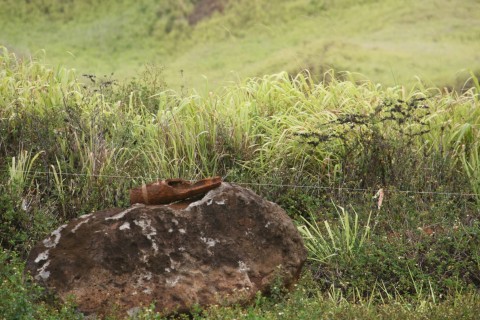
A piece of rusted ordnance atop a pohaku that was clearly impacted by past training at Lihue.

On Wednesday, July 14, 2010, I received a call from Keona Mark, a cultural monitor with Garcia & Associates (GANDA) who has been working up at Lihue. She invited me to attend a site visit that Saturday (7/17) to see some ki’i pohaku (petroglyph rocks) that are threatened by future Stryker training in the BAX at Schofield Barracks. She had told me that the invitation was limited to 10 people. I asked if others could attend, and she told me I was the last person that they had selected to go.

As soon as I got the call, I began to call others who were on the previous visit to address the desecration of ‘iwi kupuna (ancestral remains) in the “borrow pit” located in the same area (BAX). No one that I talked with received an invitation. That evening, I attended a Wahiawa Hawaiian Civic Club (WHCC) meeting, and asked if anyone had been invited the Saturday site visit. Uncle Tom Lenchanko had received a call from Keona, and had shared his mana’o on the ki’i pohaku issue with her. He said that the sites should not be moved. I was disappointed to learn that Jo-Lin Kalimapau, historian of the WHCC, was not asked to attend, as I was told by Keona that she could not make the access.

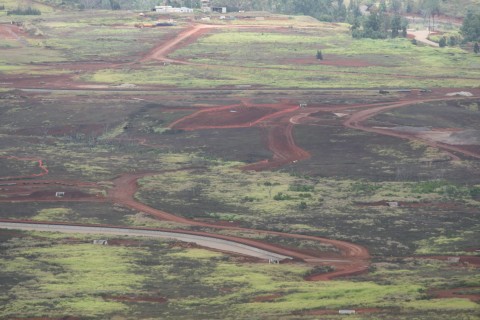
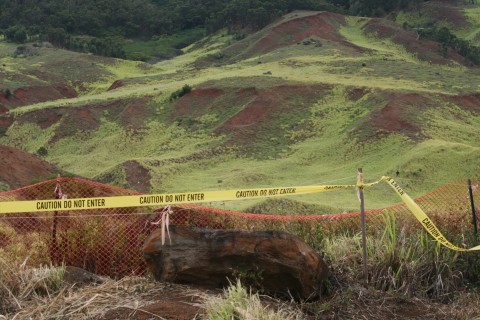
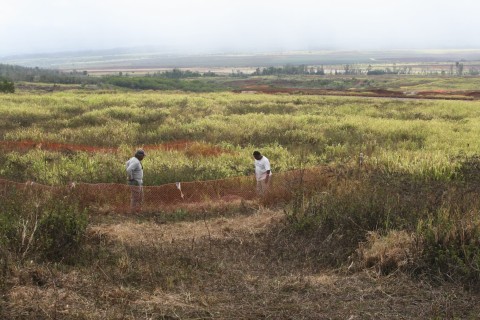
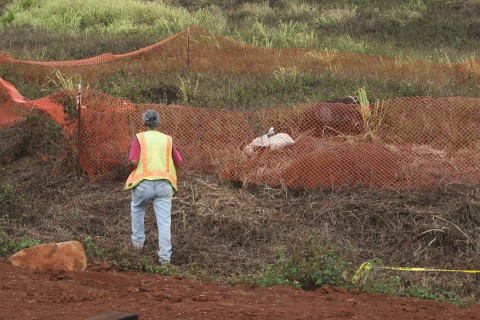
At center of photo, ‘Borrow Pit’ in BAX, where ʻiwi kupuna were desecrated during SBCT construction.
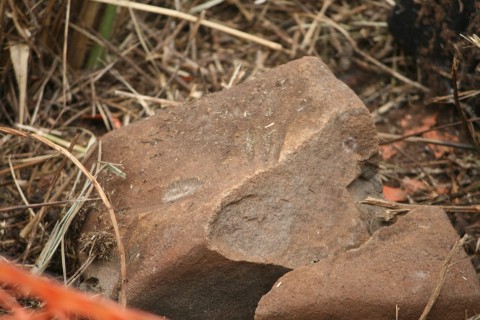
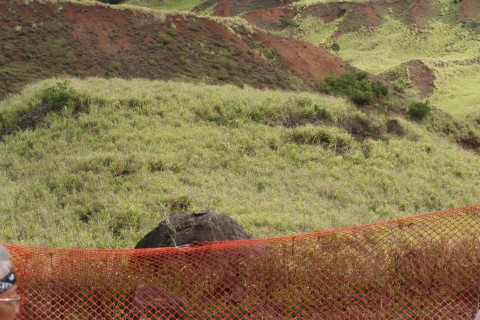
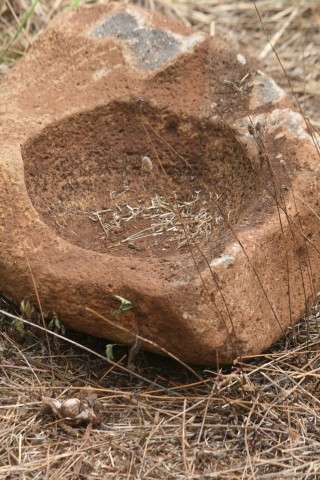
Pohaku damaged during Army training at Lihue (BAX).
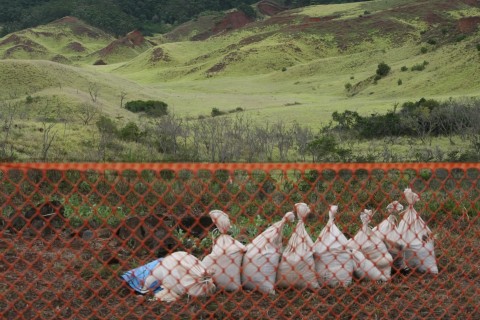
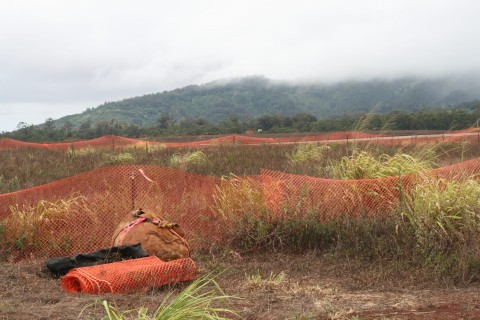
One option for site protection is sandbag placement.

I had also put in a call to Kamoa Quitevis, former cultural monitor at Lihue and Kahuku, who now works for OHA. He was not informed about this visit, nor was he invited to attend, but he was able to share with me his mana’o on the issue. Years ago, Kamoa, while working at Lihue, had recommended to the Army that these ki’i pohaku remain in place.

On Saturday morning, we drove to the training area and were escorted to a temporary structure where we were briefed on the site visit (I have recorded some video on the briefing that I will share with everyone). I had asked Keona Mark why those of us in attendance were selected to represent the community. She told us that she wanted to invite “open-minded” people to share their manaʻo on the protection of sites that would be impacted in the BAX. I was disappointed that not all 10 invitees were in attendance, and also disappointed that some cultural monitors, who were given an assignment to invite people from their communities, chose to bring their ohana instead. I felt that this was a sign that they were not communicating with others in the community who should have been informed about the situation at Lihue (including plaintiffs in lawsuits relating to Stryker expansion, those who had given testimony on the SBCT EIS, and those with ties to the ʻaina).

Cultural monitors suggested that pohaku be placed here (mauka of training area)
Haleʻauʻau heiau buffer

At the briefing we were told that this site visit was a response to a consultation letter dated September of 2006. According to Laura Gilda of GANDA, the consultation was put on hold because they were unable to clear ordnance at Lihue due to an injunction which halted all work in the project area (I will include the letter at the end of this reflection). I then realized then that my attendance on this “site visit” was actually part of the Army’s checklist to meet requirements for Section 106 of the National Historic Preservation Act (NHPA).

Haleʻauʻau
Haleʻauʻau
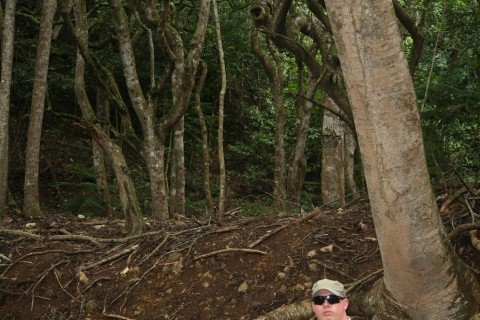
A Cultural Monitor stands next to one of the kiʻi pohaku  found in the BAX
A Cultural Monitor stands next to one of the kiʻi pohaku found in the BAX
Keona Mark, cultural monitor, walking toward a kiʻi pohaku.

We were told that the Army needed feedback from the community on the protection of kiʻi pohaku that will be impacted by SBCT training (some of which are very near to targets where 50cal ammunition would be fired upon).

There were several options that we would need to consider:

1) Leaving the pohaku in place without protection.

2) Leaving pohaku in place with protection (options included soil barrier, sandbags – which would have to be replaced regularly to ensure protection, metal coffin – metal box covering pohaku which could be a hazard to soldiers in the training area, or bury pohaku in place).

3) Moving pohaku outside of the BAX, or above firebreak road. At the end of the tour, we were taken to one of the suggested areas that cultural monitors felt kiʻi pohaku should be moved. We could not enter into this area because it had not been cleared of UXO.

This artifact was in the path of a bulldozer when cultural monitors first discovered it.
One of the kiʻi pohaku moved without community consultation.
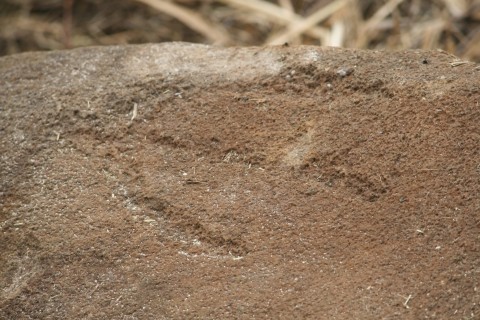
One of the many kiʻi pohaku of Lihue located in what is now the BAX

Throughout the consultation we were escorted to different sites on the BAX. We went first to Haleʻauʻau Heiau, but could only stand outside the buffer and peer in. There is unexploded ordnance on this heiau, and further access was considered too dangerous.

There were a few other kiʻi pohaku that we could not see close up because of UXO issues. Instead, cultural monitors would walk down to the area and point out where the petroglyphs were located. We were shown poor quality photographs of the carvings along with sketches and written descriptions (please see the attached packets below).

We were also told that these kiʻi pohaku were aligned with Haleʻauʻau, and it looked like the alignment was also in the direction of Kukaniloko. There was a lot of discussion between those on the tour during the consultation process. Many felt it would be best to move the pohaku out of harm’s way, although I felt that moving the pohaku would permanently disconnect us from discovering the kaona our ancestors had intended for us to learn. I was extremely disappointed to learn that several pohaku and artifacts had already been moved from their original locations without community consultation.

In my short visit to Lihue, I was surprised that these artifacts and cultural sites still exist after almost 100 years of military training. What we were able to see today was just a handful of kiʻi pohaku and Haleʻauʻau Heiau, but according to the map we were shown at the beginning of the day, there is much, much more that we did not have clearance to see.

The Army wants us to see these sites and artifacts as separate entities, rather than parts of a larger complex within a Traditional Cultural Property.

So the questions remain: Was the SBCT EIS really complete if protections for this sacred area and all of its cultural resources were not included? Has the Army completed a thorough cultural survey of Lihue, Kahuku, Mokuleia and Makua? If surveys were complete, why were these results not included in the EIS before a decision was made to transform the 25th Infantry Division in Hawaii to an Stryker Brigade Combat Team? If thorough surveys were not complete, why were they allowed to continue construction of the BAX and other firing ranges? Why was this consultation visit limited to 10 people, and why were cultural monitors allowed to hand-pick community representatives rather than inviting those who have addressed concerns for cultural sites in the past? What is the real reason behind delaying this consultation process for 4 years?

This community consultation process is serious – the Army has been able to avoid reaching out to the larger community thus far, and we need to hold them accountable for what they have done and continue to do to our wahi pana!

In order to force them to consult with more of us, we need more kanaka maoli to specifically request to become concerned parties to the section 106 consultation relating to cultural sites in Lihue. I urge everyone to demand access to see Lihue! It is important for you to see this desecration with your own eyes, and to connect with this ʻaina before the Army attempts to obliterate the physical proof of our existence here. To request section 106 consultation status, or to demand access, contact:

Dr. Laurie J. Lucking

Chief, Cultural Resources Section

Environmental Division

Directorate of Public Works

US Army Garrison, Hawaii

Phone: 808-656-6790

Fax: 808-656-1039

Email: laurie.lucking@us.army.mil

Court says US-Colombia base deal unconstitutional

http://ph.news.yahoo.com/afp/20100818/twl-colombia-us-military-court-7e07afd.html

Court says US-Colombia base deal unconstitutional

AFP

BOGOTA (AFP) – – Colombia’s constitutional court Tuesday declared a US-Colombian accord that gave the US military access to at least seven Colombian bases to be unconstitutional.

The court ordered the government to submit the agreement to the Colombian Congress, arguing that it should be executed in the form of an international treaty that would be subject to congressional approval in order to comply with constitutional norms.

The court did not address whether the agreement itself was appropriate.

The agreement “is an arrangement which requires the state to take on new obligations as well as an extension of previous ones and as such should be handled as an international treaty, that is, subject to congressional approval,” said the court’s chief justice Mauricio Gonzalez.

The court decided in March to review the agreement after a group of lawyers filed a complaint arguing it was unconstitutional.

The lawsuit claimed the October 2009 military accord was invalid because it was signed by the government of President Alvaro Uribe without prior discussion in Congress, as mandated by the constitution.

The military pact, part of a joint effort to counter drug trafficking and insurgencies, has been denounced by neighboring Venezuela as US interference in the region, raising tensions between Bogota and Caracas.

Opponents also accuse Uribe of ignoring the advice of the State Council — the highest court on administrative matters — which also urged that the congress take up the agreement before it was signed.

The Uribe administration deemed the State Council’s opinion non binding, and said the accord was not new but merely an extension of a 1974 military pact with the United States, and as such required no legislative oversight, government officials said.

Bogota and Washington last October signed a military pact that allows US troops to use Colombian bases, drawing fierce criticism from many Latin American governments who called it an affront to Colombian and Latin American sovereignty.

In a region in which the United States historically has been the power player, its partners still are keen to stress that they are not being dominated.

The United States since 2000 has channeled more than six billion dollars to Colombia through its Plan Colombia initiative to fight drug trafficking and insurgencies.

Hundreds of PTSD soldiers likely misdiagnosed

http://www.staradvertiser.com/news/breaking/100722849.html

Hundreds of PTSD soldiers likely misdiagnosed

By ANNE FLAHERTY

Associated Press

POSTED: 06:41 a.m. HST, Aug 15, 2010

WASHINGTON — At the height of the Iraq war, the Army routinely fired hundreds of soldiers for having a personality disorder when they were more likely suffering from the traumatic stresses of war, discharge data suggests.

Under pressure from Congress and the public, the Army later acknowledged the problem and drastically cut the number of soldiers given the designation. But advocates for veterans say an unknown number of troops still unfairly bear the stigma of a personality disorder, making them ineligible for military health care and other benefits.

READ MORE

‘Scapel’ can’t remove viral diseases of imperialism

The New York Times has published a new article in its series “Shadow Wars”, about the expanding covert war that rages in many countries even as troop withdrawals are planned for Iraq and debated for Afghanistan.

The article makes several important observations to consider:

  • “While the stealth war began in the Bush administration, it has expanded under President Obama…”
  • “The administration’s demands have accelerated a transformation of the C.I.A. into a paramilitary organization as much as a spying agency, which some critics worry could lower the threshold for future quasi-military operations.”
  • “For its part, the Pentagon is becoming more like the C.I.A. Across the Middle East and elsewhere, Special Operations troops under secret “Execute Orders” have conducted spying missions that were once the preserve of civilian intelligence agencies. With code names like Eager Pawn and Indigo Spade, such programs typically operate with even less transparency and Congressional oversight than traditional covert actions by the C.I.A.”
  • “…private contractors have taken on a prominent role, raising concerns that the United States has outsourced some of its most important missions to a sometimes unaccountable private army.”

The full implications of these changes and the blurring of traditional lines of authority and accountability for military operations are not yet known.  A disturbing revelation is the fact that old covert operatives of the Iran-Contra era have been recalled to run these new covert operations:

Michael G. Vickers, who helped run the C.I.A.’s campaign to funnel guns and money to the Afghanistan mujahedeen in the 1980s and was featured in the book and movie “Charlie Wilson’s War,” is now the top Pentagon official overseeing Special Operations troops around the globe. Duane R. Clarridge, a profane former C.I.A. officer who ran operations in Central America and was indicted in the Iran-contra scandal, turned up this year helping run a Pentagon-financed private spying operation in Pakistan.

These are some of the same guys that created the “blowback” problem of Al-Qaeda, who were initially trained, funded and armed by the C.I.A.

These developments have alarmed even old covert operatives such as Jack Devine, a former C.I.A. clandestine officer who was involved in the covert war against the Soviet Army in Afghanistan in the 1980s. Devine was quoted as saying:  “We got the covert action programs under well-defined rules after we had made mistakes and learned from them…Now, we’re coming up with a new model, and I’m concerned there are not clear rules.”

The new covert strategy has been touted as a surgically precise ‘scapel’, in contrast to the ‘hammer’ of conventional warfare.  But a scapel can be a poor tool to remove a viral phenomenon such as the global networked resistance that has spread as a reaction to imperialism and globalization.

>><<

http://www.nytimes.com/2010/08/15/world/15shadowwar.html?_r=1&hp=&pagewanted=all

Secret Assault on Terrorism Widens on Two Continents

By SCOTT SHANE, MARK MAZZETTI and ROBERT F. WORTH

Published: August 14, 2010

WASHINGTON — At first, the news from Yemen on May 25 sounded like a modest victory in the campaign against terrorists: an airstrike had hit a group suspected of being operatives for Al Qaeda in the remote desert of Marib Province, birthplace of the legendary queen of Sheba.

But the strike, it turned out, had also killed the province’s deputy governor, a respected local leader who Yemeni officials said had been trying to talk Qaeda members into giving up their fight. Yemen’s president, Ali Abdullah Saleh, accepted responsibility for the death and paid blood money to the offended tribes.

READ MORE

Lutz: US Military Bases on Guam in Global Perspective

http://www.japanfocus.org/-Catherine-Lutz/3389

US Military Bases on Guam in  Global Perspective1

Catherine Lutz

The island of Guam is a most remarkable place of cultural distinctiveness and resourcefulness and of great physical beauty.  The Chamorro people who have lived here for 4000 years also have an historical experience with colonialism and military occupation more long-lived and geographically intensive, acre for acre, than anywhere else in the Pacific and perhaps even in global comparative scale (Aguon 2006).  It is today embroiled in a debate over when, how, or if the United States military will acquire more land for its purposes and make more intensive use of the island as a whole.

This military expansion has been planned in Washington, with acquiescence and funding from Tokyo, in order to relocate some 8,000 Marines and 9,000 dependents from Okinawa, as well as US Navy, Army, and Air Force assets and operations to Guam and the Commonwealth of the Northern Marianas (CNMI) (Erickson and Mikolay 2006).  The plans are breathtaking in scope, including removal of 71 acres of coral reef from Apra Harbor to allow the entry and berthing of nuclear aircraft carriers, the acquisition of land including the oldest and revered Chamorro village on the island at Pagat for a live-fire training range, and an estimated 47 percent increase in the island’s population, already past its water-supply carrying capacity. The military expansion is being planned with one-third of the island already in military hands and a substantial historical legacy of environmental contamination and depletion, external political control, and other problems brought by the existing military presence.

Pushback has been substantial, something that is particularly remarkable in a context in which many islanders consider themselves very loyal and patriotic Americans and many have military paychecks or pensions as soldiers, veterans, or contract workers (Diaz 2001).  Dissent among a variety of Guam’s social sectors rose dramatically with the appearance of a draft Environmental Impact Statement in November 2009 which first made clear how extensive Washington’s plans for the island were (Natividad and Kirk 2010).  It rose, as well, when it became clear that Guam’s political leaders and citizens were to be simply informed of those plans, rather than consulted or asked permission for the various uses.  That dissent received support from movements against simultaneous US base expansion plans in Okinawa and South Korea, as well as from the US EPA response to the draft EIS, which found it deeply inadequate as a fair and clear assessment of the environmental costs of the military’s desires.  The Final EIS, just released at the end of July, puts the aircraft carrier berthing plan on hold and draws out the buildup timeline to lower the population growth rate, but otherwise retains its scale and scope. A demonstration at a sacred site at Pagat on July 23, 2010 provided the most potent symbolic expression of resistance to the base plan.

My first exposure to Guam was in 1977, when I made a very brief stay over on my way to Ifalik atoll in the Federated States of Micronesia (then still a UN Trust Territory) for ethnographic fieldwork that was part of my graduate training as an anthropologist.  My miseducation up to that point had been profound:  I could come to that nation of islands without having first learned – through many years of education in US schools –  the hard facts about the colonial status of the area to which I was coming.  My anthropological training back then focused, as most such programs did, on the beauty of indigenous ideas and rituals, of kinship systems and healing practices.  However helpful attention to such things was toward the goal of a humane and anti-racist understanding of the world, the cultural worlds that anthropology had tried to document were treated as if they occurred in a vacuum, outside of the influence of powerful economic and political forces and outside of history.

My miseducation led me to be surprised when my initial permission to travel to Ifalik was granted not by Chamorros and Carolinians, but by US bureaucrats, then operating as Trust Territory officials.  I only then came to realize what this all actually meant – that Ifalik, like Guam, has had an deeply colonial history, and that the lives the people there have led were in some ways of their own creative making and in other ways they were the result of choices by people in other remote locations, most recently in Tokyo and Washington, DC.

Such is no less true now than it was in 1950 or 1977.  It is the reason the people of Guam today wait to hear exactly how many more acres of their land will be taken for military purposes, how many tens of thousands of new people and new vehicles will be visited on the island, how many over flights and aircraft carrier visits, and toxic trickles or spills will be visited upon them. It is why they wait, not for rent payments for the land, but to hear whether there will be some US federal dollars allocated to cover some percentage of the externalized costs of the increased tempo of military operations on the island. That is Guam’s colonial history and colonial situation.  It is colonial even as many of Guam’s residents take their US citizenship seriously and want to make claims to full citizenship on the foundation of the limited citizenship they now have.  It is colonial even as Guam’s many military members – those born on Guam and those born in the 50 United States – can and do see themselves as doing their duty to the US civilian leadership who deploy them to bases here and around the world.  It is colonial even as many of Guam’s citizens have been acting in the faith that they should be able to make and are making their own choices about whether Guam becomes even more of a battleship or not.  But social science will call it nothing more than colonial when a people have not historically chosen their most powerful leaders and have been told to background their own national identity in favor of that of the power which has ultimate rule.  The US presence in Guam is properly called imperial because the US is an empire in the strict sense of the term as used by historians and other social analysts of political forms.

Besides colonialism, another concept relevant to Guam’s situation is militarization.  It refers to an increase in labor and resources allocated to military purposes and the shaping of other institutions in synchrony with military goals.  It involves a shift in societal beliefs and values in ways that legitimate the use of force (Ferguson 2009).  It helps describe the process by which 14 year olds are in uniform and carrying proxy rifles in JROTC units in all of Guam’s schools, why a fifth to a quarter of high school graduates enter the military, and why the identity of the island has over time shifted from a land of farmers to a land of war survivors to a land of loyal Americans to a land that is, proudly, “the Tip of the Spear,” that is, a land that is a weapon.  This historical change – the process of militarization or military colonization – has been visible to some, but more often, hidden in plain sight.

US global military basing system

Guam’s military bases are part of the expansive US military basing system around the world and on the US mainland.  That system is vast in scale and impact and has a particular if contentious rationale.  It is important to examine what it means to live next to military facilities for several reasons:

(1) To study them with the tools of anthropology and the perspective of social science allows us to question the common sense about them and to see invisible processes.

(2) Like most social phenomena, bases are often hidden in plain sight.  They are normalized from day to day, but are partially denormalized when they grow or shrink.  Even then, much remains invisible and accepted as the natural order of things.

(3) Like social phenomena in which power is involved, their effects can be systematically hidden by advertising, fear, and public relations work.

Military base communities are in many ways as distinctive sociologically and anthropologically as the military bases they sit next to, because they respond in almost every way to the presence of those bases.  They are not simply independent neighbors, but over time become conjoined, although one is always much more powerful than the other.

Officially, as of late 2008 (the last date for which the DoD has made such data public) over 150,000 troops and 95,000 civilian employees are massed in 837 US military facilities in 45 countries and territories, excluding Iraq and Afghanistan. There, the US military owns or rents 720,000 acres of land, and owns, rents or uses 60,000 buildings and manages structures valued at $145 billion. 4742 bases are located in the domestic United States. These official numbers are quite misleading as to the scale of US overseas military basing, however. That is because they not only exclude the massive buildup of new bases and troop presence in Iraq and Afghanistan, but also secret or unacknowledged facilities in Israel, Kuwait, the Philippines and many other places.

U.S. military bases worldwide

Large sums of money are involved in their building and operation.  $2 billion in military construction money has been expended in only three years of the Iraq and Afghanistan wars.  Just one facility in Iraq, Balad Air Base, houses 30,000 troops and 10,000 contractors, and extends across 16 square miles with an additional 12 square mile “security perimeter.”  The Guam build-up has been projected to cost between $10 and $15 billion, with much of that amount in contracts going to businesses in the U.S., Japan, South Korea, and, less significantly, Guam itself.

These military facilities include sprawling Army bases with airfields and McDonalds and schools, and small listening posts.  They include artillery testing ranges, and berthed aircraft carriers.2 While the bases are literally barracks and weapons depots and staging areas for war making and ship repair facilities and golf courses and basketball courts, they are also political claims, spoils of war, arms sales showrooms, toxic industrial sites, laboratories for cultural (mis)communication, and collections of customers for local shops, services, bars, and prostitution.

The environmental, political, and economic impact of these bases is enormous. While some people benefit from the coming of a base, at least temporarily, most communities and many within them pay a high price: their farm land taken for bases, their bodies attacked by cancers and neurological disorders because of military toxic exposures, their neighbors imprisoned, tortured and disappeared by the autocratic regimes that survive on US military and political support given as a form of tacit rent for the bases.

The count of US military bases should also include the eleven aircraft carriers in the US Navy’s fleet, each of which it refers to as “four and a half acres of sovereign US territory.” These moveable bases and their land-based counterparts are just the most visible part of the larger picture of US military presence overseas.  This picture of military access includes (1) US military training of foreign forces, often in conjunction with the provision of US weaponry, (2) joint exercises meant to enhance US soldiers’ exposure to a variety of operating environments from jungle to desert to urban terrain and interoperability across national militaries, and (3) legal arrangements made to gain overflight rights and other forms of ad hoc use of others’ territory as well as to preposition military equipment there.  In all of these realms, the US is in a class by itself, no adversary or ally maintaining anything comparable in terms of its scope, depth and global reach.

These three elements come with problems: The training programs strengthen the power of military forces in relation to other sectors within those countries, sometimes with fragile democracies. Fully 38 percent of those countries with US basing were cited in 2002 for their poor human rights record (Lumpe 2002:16). The exercises have sometimes been provocative to other nations, and in some cases have become the pretext for substantial and permanent positioning of troops; in recent years, for example, the US has run approximately 20 exercises annually on Philippine soil.  Recently (July, 2010) announced joint US-South Korean military exercises in the Yellow Sea, just off the coast of China, have produced strong protest from it and arguably will lead to increases in its military spending.

The attempt to gain access has also meant substantial interference in the affairs of other nations: for example, lobbying to change the Philippine and Japanese constitutions to allow, respectively, foreign troop basing, US nuclear weapons, and a more-than-defensive military in the service of US wars, in the case of Japan.  US military and civilian officials are joined in their efforts by intelligence agents passing as businessmen or diplomats; in 2005, the US Ambassador to the Philippines created a furor by mentioning that the US has 70 agents operating in Mindanao alone.

Given the sensitivity about sovereignty and the costs of having the US in their country, elaborate bilateral negotiations result in the exchange of weapons, cash, and trade privileges for overflight and land use rights. Less explicitly, but no less importantly, rice import levels or immigration rights to the US or overlooking human rights abuses have been the currency of exchange (Cooley 2008).

Bases are the literal and symbolic anchors, and the most visible centerpieces, of the U.S. military presence overseas.  To understand where those bases are and how they are being used is essential for understanding the United States’ relationship with the rest of the world, the role of coercion in it, and its political economic complexion.  We can begin by asking why this empire of bases was established in the first place, how the bases are currently configured around the world and how that configuration is changing.

What are bases for?

Foreign military bases have been established throughout the history of expanding states and warfare. They proliferate where a state has imperial ambitions, either through direct control of territory or through indirect control over the political economy, laws, and foreign policy of other places. Whether or not it recognizes itself as such, a country can be called an empire when it projects substantial power with the aim of asserting and maintaining dominance over other regions.  Those policies succeed when wealth is extracted from peripheral areas, and redistributed to the imperial center.  Empires, then, have historically been associated with a growing gap between the wealth and welfare of the powerful center and the regions it dominates. Alongside and supporting these goals has often been elevated self-regard in the imperial power, or a sense of racial, cultural, or social superiority.

The descriptors empire and imperialism have been applied to the Romans, Incas, Mongols, Persians, Portuguese, Spanish, Ottomans, Dutch, British, Germans, Soviets, Chinese, Japanese, and Americans, among others. Despite the striking differences between each of these cases, each used military bases to maintain some forms of rule over regions far from their center.  The bases eroded the sovereignty of allied states on which they were established by treaty; the Roman Empire was accomplished not only by conquest, but also “by taking her weaker [but still sovereign] neighbors under her wing and protecting them against her and their stronger neighbors… The most that Rome asked of them in terms of territory was the cessation, here and there, of a patch of ground for the plantation of a Roman fortress” (Magdoff et al. 2002).

What have military bases accomplished for these empires through history?  Bases are usually presented, above all, as having rational, strategic purposes; the imperial power claims that they provide forward defense for the homeland, supply other nations with security, and facilitate the control of trade routes and resources.  They have been used to protect non-economic actors and their agendas as well – missionaries, political operatives, and aid workers among them.  Bases have been used to control the political and economic life of the host nation. Politically, bases serve to encourage other governments’ endorsement of the empire’s military and other foreign policies. Corporations and the military itself as an organization have a powerful stake in bases’ continued existence regardless of their strategic value (Johnson 2004).

Alongside their military and economic functions, bases have symbolic and psychological dimensions.  They are highly visible expressions of a nation’s will to status and power.  Strategic elites have built bases as a visible sign of the nation’s standing, much as they have constructed monuments and battleships. So, too, contemporary US politicians and the public have treated the number of their bases as indicators of the nation’s hyperstatus and hyperpower.  More darkly, overseas military bases can also be seen as symptoms of irrational or untethered fears, even paranoia, as they are built with the long-term goal of taming a world perceived to be out of control.  Empires frequently misperceive the world as rife with threats and themselves as objects of violent hostility from others.  Militaries’ interest in organizational survival has also contributed to the amplification of this fear and imperial basing structures as the solution as they “sell themselves” to their populace by exaggerating threats, underestimating the costs of basing and war itself, as well as understating the obstacles facing preemption and belligerence (Van Evera 2001).

As the world economy and its technological substructures have changed, so have the roles of foreign bases. By 1500, new sailing technologies allowed much longer distance voyages, even circumnavigational ones, and so empires could aspire to long networks of coastal naval bases to facilitate the control of sea lanes and trade. They were established at distances that would allow provisioning the ship, taking on fresh fruit that would protect sailors from scurvy, and so on.  By the 21st century, technological advances have at least theoretically eliminated many of the reasons for foreign bases, given the possibilities of in transit refueling of jets and aircraft carriers, the nuclear powering of submarines and battleships, and other advances in sea and airlift of military personnel and equipment.  Bases have, nevertheless, continued their ineluctable expansion.

States that invest their people’s wealth in overseas bases have paid direct as well as opportunity costs, whose consequences in the long run have usually been collapse of the empire. In The Rise and Fall of Great Powers, Kennedy notes that previous empires which established and tenaciously held onto overseas bases inevitably saw their wealth and power decay as they chose “to devote a large proportion of its total income to ‘protection,’ leaving less for ‘productive investment,’ it is likely to find its economic output slowing down, with dire implications for its long-term capacity to maintain both its citizens’ consumption demands and its international position” (Kennedy 1987:539).

Nonetheless, U.S. defense officials and scholars have continued to argue that bases lead to “enhanced national security and successful foreign policy” because they provide “a credible capacity to move, employ, and sustain military forces abroad,” (Blaker 1990:3) and the ability “to impose the will of the United States and its coalition partners on any adversaries.”  This belief helps sustain the US basing structure, which far exceeds any the world has seen: this is so in terms of its global reach, depth, and cost, as well as its impact on geopolitics in all regions of the world, particularly the Asia-Pacific.

A short history of US basing

After consolidation of continental dominance, there were three periods of expansive global ambition in US history beginning in 1898, 1945, and 2001. Each is associated with the acquisition of significant numbers of new overseas military bases. The Spanish-American war resulted in the acquisition of a number of colonies, but the US basing system was far smaller than that of its political and economic peers including many European nations as well as Japan.  In the next four decades US soldiers were stationed in just 14 bases, some quite small, in Puerto Rico, Cuba, Panama, and the Virgin Islands, but also, already, extending across the Pacific to Hawaii, Midway, Wake, and Guam, the Philippines, Shanghai, two in the Aleutians, American Samoa, and Johnston Island (Harkavy 1982). This small number was the result in part of a strong anti-statist and anti-militarist strain in US political culture (Sherry 1995). From the perspective of many in the US through the inter-war period, to build bases would be to risk unwarranted entanglement in others’ conflicts.

England had the most during this period, with some countries with large militaries and even some with expansive ambitions having relatively few overseas bases; Germany and the Soviet Union had almost none.  But the attempt to acquire such bases would be a contributing cause of World War II (Harkavy 1989:5).

From 14 bases in 1938, by the end of WW II, the United States had built or acquired an astounding 30,000 installations large and small in approximately 100 countries. While this number contracted significantly, it went on to provide the sinews for the rise to global hegemony of the United States (Blaker 1990:22).  Certain ideas about basing and what it accomplished were to be retained from World War II as well, including the belief that “its extensive overseas basing system was a legitimate and necessary instrument of U.S. power, morally justified and a rightful symbol of the U.S. role in the world” (Blaker 1990:28).

Nonetheless, pressure came from Australia, France, and England, as well as from Panama, Denmark and Iceland, for return of bases in their own territory or colonies, and domestically to demobilize the twelve million man military (a larger military would have been needed to maintain the vast basing system). More important than the shrinking number of bases, however, was the codification of US military access rights around the world in a comprehensive set of legal documents.  These established security alliances with multiple states within Europe (NATO), the Middle East and South Asia (CENTO), and Southeast Asia (SEATO), and they included bilateral arrangements with Japan, Taiwan, South Korea, Australia and New Zealand.  These alliances assumed a common security interest between the United States and other countries and were the charter for US basing in each place.  Status of Forces Agreements (SOFAs) were crafted in each country to specify what the military could do; these usually gave US soldiers broad immunity from prosecution for crimes committed and environmental damage created.  These agreements and subsequent base operations have usually been shrouded in secrecy.

In the United States, the National Security Act of 1947, along with a variety of executive orders, instituted what can be called a second, secret government or the “national security state”, which created the National Security Agency, National Security Council, and Central Intelligence Agency and gave the US president expansive new imperial powers.  From this point on, domestic and especially foreign military activities and bases were to be heavily masked from public oversight (Lens 1987).  Many of those unaccountable funds then and now go into use overseas, flowing out of US embassies and military bases. Including use to interfere in the domestic affairs of nations in which it has had or desired military access, including attempts to influence votes on and change anti-nuclear and anti-war provisions in the Constitutions of the Pacific nation of Belau and of Japan.

Nonetheless, over the second half of the 20th century, the United States was either evicted or voluntarily left bases in dozens of countries.3 Between 1947 and 1990, the US was asked to leave bases in France, Yugoslavia, Iran, Ethiopia, Libya, Sudan, Saudi Arabia, Tunisia, Algeria, Vietnam, Indonesia, Peru, Mexico, and Venezuela. Popular and political objection to the bases in Spain, the Philippines, Greece, and Turkey in the 1980s enabled those governments to negotiate significantly more compensation from the United States. Portugal threatened to evict the US from important bases in the Azores, unless it ceased its support for independence for its African colonies, a demand with which the US complied.4 In the 1990s and later, the US was sent packing, most significantly, from the Philippines, Panama, Saudi Arabia, Vieques, and Uzbekistan (Simbulan 1985).

At the same time, remarkable numbers of new US bases were newly built (241) after 1947 in remarkable numbers in the Federal Republic of Germany, as well as in Italy, Britain, and Japan (Blaker 1990:45).  The defeated Axis powers continued to host the most significant numbers of US bases: at its height, Japan was peppered with 3,800 US installations.

As battles become bases, so bases become battles; the bases in East Asia acquired in the Spanish American War and in World War II, such as Guam, Okinawa and the Philippines, became the primary sites from which the United States waged war on Vietnam.  Without them, the costs and logistical obstacles for the US would have been immense.  The number of bombing runs over North and South Vietnam required tons of bombs to be unloaded, for example, at the Naval Station in Guam, stored at the Naval Magazine in the southern area of the island, and then shipped to be loaded onto B-52s at Andersen Air Force Base every day during years of the war.  The morale of ground troops based in Vietnam, as fragile as it was to become through the latter part of the 1960s, depended on R & R at bases throughout East and Southeast Asia which allowed them to leave the war zone and be shipped back quickly and inexpensively for further fighting (Baker 2004:76).  In addition to the bases’ role in fighting these large and overt wars, they facilitated the movement of military assets to accomplish the over 200 military interventions carried out by the US in the course of the Cold War period (Blum 1995).

While speed of deployment is framed as an important continued reason for forward basing, equally important is that troops could be deployed anywhere in the world from US bases without having to touch down en route.  In fact, US soldiers are being increasingly billeted on US territory, including such far-flung areas as Guam, which is presently slated for a larger buildup for this reason as well as to avoid the political and other costs of foreign deployment.

With the will to gain military control of space, as well as gather intelligence, the US over time, especially in the 1990s, established a large number of new military bases to facilitate the strategic use of communications and space technologies. Military R&D (the Pentagon spent over $52 billion in 2005 and employed over 90,000 scientists) and corporate profits to be made in the development and deployment of the resulting technologies have been significant factors in the growing numbers of technical facilities on foreign soil. These include such things as missile early-warning radar, signals intelligence, space tracking telescopes and laser sources, satellite control, downwind air sampling monitors, and research facilities for everything from weapons testing to meteorology.  Missile defense systems and network centric warfare increasingly rely on satellite technology and drones with associated requirements for ground facilities.  These facilities have often been established in violation of arms control agreements such as the 1967 Outer Space Treaty meant to limit the militarization of space.

The assumption that US bases served local interests in a shared ideological and security project dominated into the 1960s: allowing base access showed a commitment to fight Communism and gratitude for US military assistance. But with decolonization and the US war in Vietnam, such arguments began to lose their power, and the number of US overseas bases declined from an early 1960s peak. Where access was once automatic, many countries now had increased leverage over what the US had to give in exchange for basing rights, and those rights could be restricted in a variety of important ways, including through environmental and other regulations. The bargaining chips used by the US were increasingly sophisticated weapons, as well as rent payments for the land on which bases were established.5 These exchanges were often linked with trade and other kinds of agreements, such as access to oil and other raw materials and investment opportunities (Harkavy 1982:337). They also have had destabilizing effects on regional arms balances, particularly when advanced weaponry is the medium of exchange. From the earlier ideological rationale for the bases, global post-war recovery and decreasing inequality between the US and countries – mostly in the global North – that housed the majority of US bases, led to a more pragmatic or economic grounding to basing negotiations, albeit often thinly veiled by the language of friendship and common ideological bent. The 1980s saw countries whose populations and governments had strongly opposed US military presence, such as Greece, agree to US bases on their soil only because they were in need of the cash, and Burma, a neutral but very poor state, entered negotiations with the US over basing troops there (Harkavy 1989:4-5).

The third period of accelerated imperial ambition began in 2000, with the election of George Bush and the ascendancy to power of a group of leaders committed to a more aggressive and unilateral use of military power, their ability to expand the scope of US power increased by the attacks of 9/11. They wanted “a network of ‘deployment bases’ or ‘forward operating bases’ to increase the reach of current and future forces” and focused on the need for bases in Iraq. While the unresolved conflict with Iraq provides the immediate justification, the need for a substantial American force presence in the Gulf transcends the issue of the regime of Saddam Hussein. This plan for expanded US military presence around the world has been put into action, particularly in the Middle East, the Russian perimeter, and, now, Africa.

New U.S. Military Bases, 1991-2003

Pentagon transformation plans result in the design of US military bases to operate ever more as offensive, expeditionary platforms from which to project military capabilities quickly anywhere.  Where bases in Korea, for example, were once meant primarily to defend South Korea from attack from the north, they are now, like bases everywhere, project power in many directions and serve as stepping stones to battles far from themselves.  The Global Defense Posture Review of 2004 announced these changes, focusing not just on reorienting the footprint of US bases away from Cold War locations, but on grounding imperial ambitions through remaking legal arrangements that support expanded military activities with other allied countries and prepositioning equipment in those countries to be able to “surge” military force quickly, anywhere.

The Department of Defense currently distinguishes three types of military facilities. “Main operating bases” are those with permanent personnel, strong infrastructure, and often including family housing, such as Kadena Air Base in Japan and Ramstein Air Force Base in Germany.  “Forward operating sites” are “expandable warm facilit[ies] maintained with a limited U.S. military support presence and possibly prepositioned equipment,” such as Incirlik Air Base in Turkey and Soto Cano Air Base in Honduras (US Defense Department 2004:10).  Finally, “cooperative security locations” are sites with few or no permanent US personnel, which are maintained by contractors or the host nation for occasional use by the US military, and often referred to as “lily pads.” In Thailand, for example, U-Tapao Royal Thai Navy Airfield has been used extensively for US combat runs over Iraq and Afghanistan. Others are now cropping up around the world, especially throughout Africa, as in Dakar, Senegal where facilities and use rights have been newly established.

Are Guam’s bases domestic or overseas bases? Are there racial underpinnings to the differences in how Guam’s basing is handled?

The history just recounted mostly refers to US bases on other countries’ sovereign soil. Is Guam’s situation anomalous?  Is Guam’s Andersen AFB a domestic base or a foreign base?  As Guam is a US territory, it is neither a fully incorporated part of the US nor a free nation.  The island’s license plate, which notes it is “Where America’s Day Begins,” also reads, “Guam USA.” This expresses the wish of some, rather than the reality.  It perhaps would better read, Guam, US sort of A.  International legal norms make the status clear, however.  Guam is a colony, and primarily a military colony, in keeping with the idea that the US’ imperial history, especially in the second half of the 20th century, has been a military colonialism around the world.

Guam’s status shifts by context, however.  The DoDs Base Structure Report places Guam and its 39,287 “owned” acres (39 percent of the island’s territory) between Georgia (560,799 acres) and Hawaii (175,911 acres).  No Status of Forces Agreement (SOFA) regulates the US forces on Guam, and as far as I know, the DoD does not need to report each day to the government of Guam on how many soldiers have been brought in or sent out of Guam, nor is it negotiating with Guam about its plans to grow its bases on Guam.

Map of US military bases on Guam (1991)

One very important and empirical index of the degree to which Guam’s bases are foreign or domestic is the quality of care that has been taken with its environment and health (Castro 2007).  Overseas bases have repeatedly inflicted environmental devastation.  Unexploded ordnance killed 21 people in Panama before the US was evicted and continues to threaten communities nearby.  In Germany, industrial solvents, firefighting chemicals, and varieties of waste have ruined ecological systems near some US bases.  The Koreans are finding extremely high levels of military toxins in bases returned to them by the US from near the DMZ. Ebeye atoll suffers severe water quality and quantity problems due to the US military presence (Soroko 2006).

While Guam’s environment has been treated carelessly through the years, environmental standards have not been high enough for domestic US bases either.  Fort Bragg in North Carolina, for example, engaged in outdoor burning of very large numbers of its unwanted, old wooden barracks at one point in the 1970s, and an ancient water treatment plant was used on Fort Bragg up until quite recently.  One can also point to the US Army Corps of Engineers’ Formerly Used Defense Sites whose cleanup would be so expensive that they are termed “national sacrifice zones,” or permanent no man’s lands by some.

But activists have long considered the environmental and judicial standards that are negotiated into each country’s SOFA as an index of how much respect their country is accorded.  It is possible to measure the quantity of toxins variously introduced into the environment of Guam, Germany, the Philippines, California, and North Carolina, for example.  The broad differences in that quantity roughly occur on a scale that appears quite racial, with the US mainland at the top, Germany next, and the Philippines and Guam at the bottom.  If Guam’s political status were truly domestic, we might expect Guam to look more like the mainland in terms of how the environment has been cared for. It does not.

But the internal racial history of the US itself demonstrates that the military base has been a booby prize for many of the internally colonized in the US as well: the distinction between domestic and foreign bases has been blurry on the mainland as well.  All domestic military bases are in fact, of course, built on Native American land, and even after that land was taken, the bases were often intentionally sited on land inhabited by poor white, black and Indian farmers.  Thousands of them lost their land in North Carolina alone in the buildup to WW II (Lutz 2001).

And there, too, we can ask, as we ask on Guam, who benefited then and who benefits now from base building and base buildups?  What costs are externalized and borne by others?  And how has a rhetoric of national security over all contributed to the notion that the military can be and should be excepted from environmental protection standards?

The externalized costs of bases

The people of Guam have been engaged in a several year exercise of trying to detail the impact of military bases in order to gain some relief from the expected continuing externalization of the physical and social costs of military basing onto the people of Guam.  Among the health and environmental issues pertaining to base expansion are the long term maintenance of roads, the stressed and declining water supply, and the likely upswing in crime rates.

In this final section, the economic impact of bases is examined, as this has been crucial in Guam and elsewhere for the arguments made for military expansion.  Obviously the health and wellbeing of people affected by military basing are crucial, but the economic effects have been the primary thing that people in many base communities have focused on.  This is so for two reasons.  The first is that the military itself publicizes its arrival or expansion as an economic boon, noting the dollars brought in via soldier’s salaries, civilian work on post, and construction and other sub-contracts that could provide jobs. So the First Hawaiian Bank published a Guam Economic Forecast that claimed “The military expansion is anticipated to benefit Guam’s economy in the amount of $1.5 billion per year once the process begins.”6

The second reason for the economic focus is that they appear overall to be positive, unlike the environmental, sovereignty, cultural, crime, and noise effects. But one of the reasons they look positive is because the powerful benefit and have the resources to convince others that they, too, benefit even when they palpably do not.  Moreover, the military has large numbers of personnel, military and civilian, doing public relations work with media and communities to make their case for simple economic positives. In addition, those locals who are most likely to benefit financially have the funding and motivation to do similar public relations work.  For example, the Chamber of Commerce funded a 2008 survey that found that “71 per cent of Guam residents supported an increase in the United States military presence, with nearly 80 per cent of the view that the increasing military presence would result in additional jobs and tax revenue; according to the poll, 60 per cent felt the additional Marines on the island would have a positive effect and would ultimately improve the island’s quality of life.”7 This poll was as much an attempt to create reality as to reflect it. It builds on an existing cultural narrative, one that is purchased with media time and power, a narrative that says “you will all benefit.”

What are the economic effects of bases?  Three major factors can be identified. First, the economic effects are primarily redistributional rather than generative (unlike, for example, manufacturing or education jobs). Certain sectors atrophy and others grow in military districts, often in very strong fluctuations. In 2007 in Guam, for example, “While employment in manufacturing, transportation and public utilities and retail trade decreased, increases were seen for jobs in the service sector and public sector; with the construction sector experiencing the largest increase, that is, 1,450 jobs, or 35 per cent.”8 Usually, retail jobs are the main type of work created around military bases. Unfortunately, those jobs pay less than any other category of work, accelerating the growth of inequality in military communities.

Second, the military is a highly toxic industrial operation and it externalizes many of its costs of operation to the communities that host it and serve it. These costs include such things as environmental waste, PTSD in returning war veterans and high rates of domestic violence, rapid deterioration of roads and other public amenities, and, in many communities, decline in human capital development of populations that have gone into the military (Lutz and Bartlett 1995, Lutz 2001). JROTC, for example, only appears to add resources to school districts while it in fact draws on significant local education resources, while serving as recruiting devices. The math on these costs – the subtraction from the general welfare and general public funds – is rarely done.

Finally, military economies are volatile.  While the “war cycle” is different than the business cycle, it also has booms and busts.  For example, businesses in military personnel cities like Fayetteville, North Carolina regularly go under when service members are deployed to US war zones.  Any major deployment from Guam’s bases can be expected to significantly harm local enterprise dependent on military business.  Moreover, a volatile real estate market catering to foreign military personnel sends property prices spiralling and forces local working families into more substandard housing.

Conclusion

There are legal questions in the Guam military buildup as well. In her testimony before the UN Committee of 24 in 2008, Sabina Flores Peres referred to the extremity of “the level and grossness of the infraction” of the UN Charter by the US in its further militarization of the island. This is not hyperbole, because Guam’s militarization is objectively more extreme in its concentration than that found virtually anywhere else on earth.  There are only a few other areas that are in similar condition – all, not coincidentally islands such as Okinawa, Diego Garcia, and, in the past, Vieques, Puerto Rico (see e.g., Inoue 2004, Yoshida 2010 and McCaffrey 2002).  This was the product of an island strategy for the US Navy, developed in the face of decolonization and anxieties about the fate of continental US bases in that context in the 1950s and 1960s (Vine 2009).

Guam, objectively, has the highest ratio of US military spending and military hardware and land takings from indigenous populations of any place on earth.  Here there might have been rivals in Diego Garcia or in some areas of the continental US if the US had not forcibly removed those indigenous landowners altogether or onto the equivalent of reservations, something the US had hoped to do in Guam as far back as 1945.  The level and grossness of the infraction has to do with the racial hierarchy that fundamentally guides the US in its “negotiations” with other peoples over the siting of its military bases and the treatment they are accorded once the US settles in.  As the military budget suddenly and intensely comes under scrutiny in the United States in the summer of 2010 during severe economic crisis, the hope must be that the project of building yet more military facilities on Guam will hit the chopping block.  As a human rights issue, however, the US treatment of Guam’s people should have no price tag.

Catherine Lutz is the Thomas J. Watson Jr. Family Professor in Anthropology and International Studies at the Watson Institute for International Studies at Brown University.  She is the author of The Bases of Empire: The Global Struggle against U.S. Military Posts and (with elin o’Hara slavick, Carol Mayvor and Howard Zinn), Bomb after Bomb: A Violent Cartography.

Recommended citation: Catherine Lutz, “US Military Bases on Guam in Global Perspective,” The Asia-Pacific Journal, 30-3-10, July 26, 2010.

References

Aguon, Julian. (2006) The Fire This Time: Essays on Life Under U.S. Occupation. (Tokyo: Blue Ocean Press).

Baker, Anni (2004) American Soldiers Overseas: The Global Military Presence (Westport, CT: Praeger).

Blaker, James R. (1990) United States Overseas Basing: An Anatomy of the Dilemma (New York: Praeger).

Blum, William (1995) Killing Hope: U.S. Military and CIA Interventions since World War II (Monroe, ME: Common Courage Press).

Castro, Fanai (2007) Health Hazards: Guam. In Outposts of Empire, Sarah Irving, Wilbert van der Zeijden, and Oscar Reyes, eds. (Amsterdam: Transnational Institute).

Cooley, Alexander. Base Politics: Democratic Change and the U.S. Military Overseas. Ithaca, NY: Cornell University Press, 2008.

Department of Defense Base Structure Report Fiscal Year 2009 Baseline (A Summary of DOD’s Real Property Inventory). Link.

Diaz, Vicente (2001) Deliberating Liberation Day: Memory, Culture and History in Guam. In Perilous Memories: the Asia Pacific War(s). Takashi Fujitani, Geoff White and Lisa Yoneyami, eds. (Durham: Duke University Press).

Erickson, Andrew S. and Mikolay, Justin D. (2006) A Place and a Base: Guam and the American Presence in East Asia. In Reposturing the Force: U.S. Overseas Presence in the 21st Century. Carnes Lord, ed. (Newport: Naval War College).

Harkavy, Robert E. (1982) Great Power Competition for Overseas Bases: The Geopolitics of Access Diplomacy (New York: Pergamon Press).

—— (1989) Bases Abroad: The Global Foreign Military Presence (Oxford: Oxford University Press).

Inoue, Masamichi S. (2004) ‘“We Are Okinawans But of a Different Kind”: New/Old Social Movements and the U.S. Military in Okinawa,’ Current Anthropology, Vol. 45, No. 1.

Johnson, Chalmers (2004) The Sorrows of Empire: Militarism, Secrecy, and the End of the Republic (New York: Metropolitan).

Kennedy, Paul M. (1987) The Rise and Fall of Great Powers: Economic Change and Military Conflict from 1500-2000 (New York: Random House).

Lens, Sidney (1987) Permanent War: The Militarization of America (New York: Schocken).

Lumpe, Lora (2002) U.S. Foreign Military Training: Global Reach, Global Power, and Oversight Issues. Foreign Policy in Focus Special Report, May.

Lutz, Catherine (2001) Homefront: A Military City and the American 20th Century (Boston: Beacon Press).

Lutz, Catherine and Lesley Bartlett (1995) Making Soldiers in the Public Schools: An Analysis of the Army JROTC Curriculum. (Philadelphia: American Friends Service Committee).

Magdoff, Harry, Foster, John Bellamy, McChesney, Robert W. and Sweezy, Paul (2002) U.S. Military Bases and Empire, The Monthly Review Vol. 53, No. 10.

McCaffrey, Katherine (2002) Military Power and Popular Protest: The U.S. Navy in Vieques, Puerto Rico (New Brunswick, N.J: Rutgers University Press).

Natividad, LisaLinda and Gwyn Kirk (2010) “Fortress Guam: Resistance to US Military Mega-Buildup,” The Asia-Pacific Journal, May 10, 2010, link.

Sherry, Michael S. (1995) In the Shadow of War: The United States Since the 1930’s (New Haven: Yale University Press).

Simbulan, Roland (1985) The Bases of our Insecurity: A Study of the U.S. Military Bases in the Philippines (Manila, Philippines: BALAI Fellowship).

Soroko, Jennifer (2006) ‘Water at the intersection of militarization, development, and democracy on Kwajalein Atoll, in the Republic of the Marshall Islands’. MA thesis, Department of Anthropology, Brown University.

US Defense Department (2004) Strengthening U.S. Global Defense Posture, Report to Congress (Washington, D.C.).

Van Evera, Stephen (2001) Militarism (Cambridge, MA: MIT). Available [online] here. Date last accessed July 23, 2010.

Vine, David. (2009) Island of Shame: The Secret History of the U.S. Military Base on Diego Garcia. Princeton: Princeton University Press.

Yoshida, Kensei (2010) Okinawa and Guam: In the Shadow of U.S. and Japanese “Global Defense Posture,” The Asia-Pacific Journal, link.

Endnotes

1 This paper is an updated and revised version of an invited Presidential Lecture given at the University of Guam on April 14, 2009.  Portions appeared in the Introduction to The Bases of Empire: The Global Struggle against US Military Posts. New York: New York University Press, 2009.

2 The major concentrations of U.S. sites outside those war zones as of 2007 were in South Korea, with 106 sites and 29,000 troops, Japan with 130 sites and 49,000 troops, most concentrated in Okinawa, and Germany with 287 sites and 64,000 troops.  Guam with 28 facilities has nearly 6,600 airmen and soldiers and is slated to radically expand over the next several years (Base Structure Report FY2007).

3 Between 1947 and 1988, the U.S. left 62 countries, 40 of them outside the Pacific Islands (Blaker 1990:34).

4 Luis Nuno Rodrigues, ‘Trading “Human Rights” for “Base Rights”: Kennedy, Africa and the Azores’, Ms. Possession of the author, March 2006.

5 Harkavy (1982:337) calls this the “arms-transfer-basing nexus” and sees the U.S. weaponry as having been key to maintaining both basing access and control over the client states in which the bases are located.  Granting basing rights is not the only way to acquire advanced weaponry, however.  Many countries purchased arms from both superpowers during the Cold War, and they are less likely to have US bases on their soil.

6 Economic Forecast — Guam Edition 2006-2007, First Hawaiian Bank, pp. 8-9.

7 Link, 18 February 2008.

8 Link, September 2007, Current Employment Report.

Trauma of war haunts families in Hawai’i

Thanks to Cory Harden for sharing this information:

From Mental Health America of Hawaii

On June 28, 2010, MHA-Hawai`i presented a Brown Bag Mental Health Seminar called “Understanding the Effects of War.”

Judge Michael Broderick, Lead Judge of the Special Division of the Family Court, which includes domestic abuse cases, explained that the most common theme among military families experiencing domestic violence is, “Where has he gone?” They are wondering why the soldier they love has come back, seemingly a different person.

“I do not hear this about any other category of person in my court.” He quoted:

* “He was one type of man before he was deployed, and he is another type of man after he has returned.”

* “I don’t recognize my husband.”

* “He never acted that way before he went to war.”

* “Ever since he came back from Iraq, he has not been himself.”

* “I want my husband back.”

* “He is an angry, depressed, suicidal person; he was never any of those things before he went to war.”

It is the Judge’s observation that war has significantly damaged the vast majority of men who appear on his domestic abuse calendar.

He explained that 5% -10% of the domestic abuse cases in his court involve soldiers; that equals to 15 a week, or about 720 a year on Oahu alone.

His is a civil, not a criminal calendar, which means the cases involve physical abuse, malicious property damage or extreme psychological abuse. These range from relatively mild (“shoved me in the shoulder”) to very severe (“threw me down the stairs, kicked me in the ribs, put a knife to my throat, and said, ‘If you ever leave me I will kill you.’”)

“Unfortunately,” said Judge Broderick, “most of the allegations involving soldiers are on the severe end of the spectrum.”

These severe cases involve choking, punching, threatening to kill the spouse/girlfriend, breaking down a locked bedroom door, calling 50 times a day, and sending 100 text messages over 48 hours. Many involve romantic jealousy – the accurate, or inaccurate, belief by the man that his wife/girlfriend is involved with someone else – and this often involves the period while the soldier was at war.

Children are often part of the restraining orders Judge Broderick issues, because, he said, “It has become crystal clear that children who are exposed to domestic violence, who hear it or see it, are damaged.”

Timing of when the military domestic violence cases come to his court is important. “These cases,” continued Judge Broderick, “come to court almost always within days or weeks of the soldier returning from the war.”

“And the more deployments, the more severe the abuse,” he reported.

One piece of good news: the Judiciary has recently convened a committee to look into the development of a Veterans Court, which would divert soldiers who are accused of certain crimes into treatment rather than sending them to jail.

Documentary about Afghanistan war has Hawai’i connections

“Restrepo” is a critically aclaimed documentary about a military unit deployed to the Korangal valley in Afghanistan in 2007-2008.   The film is now showing on O’ahu at the Mililani Stadium 14 theaters until Tuesday, August 17.  Here’s a short excerpt from the Honolulu Star Advertiser review:

Clinard and Sgt. Mitchell Raeon, who were both on the deployment with the Italy-based 173rd Airborne Brigade and now are stationed at Schofield Barracks, spoke with audience members about “Restrepo” after the film was shown Friday at the Mililani Stadium 14 theaters.

The 90-minute documentary will play in Mililani at least through Tuesday, theater representatives said.

“(Almost) every last person in the theater stayed and there was a slew of questions,” said Staff Sgt. Amber Robinson, a spokeswoman for the 3rd Brigade at Schofield.

Soldiers who were there and the film’s makers have spoken to audiences around the country about the hardships in eastern Afghanistan and the fallout from that service.

Eastern Kunar and Nuristan provinces, meanwhile, have a past unwanted connection to Hawaii and a possible future one, as well.

On the same 2007-2008 deployment by the 173rd Airborne Brigade, 1st Lt. Jonathan P. Brostrom of Aiea was killed along with eight other soldiers when an overwhelming force of militants attacked his platoon in the village of Wanat in the neighboring Waigal Valley.

Five Pearl Harbor Navy SEALs were killed in June 2005 in an ill-fated commando mission and the subsequent crash of a rescue helicopter in Kunar, two events in which a total of 19 lives were lost.

The 3,800 soldiers of Schofield’s 3rd Brigade have been tapped for duty in Kunar and Nuristan when they deploy to Afghanistan in the spring.

Pilger: The Lies Of Hiroshima Are The Lies Of Today

August 6, 2010 was the 65th anniversary of the atomic bombing of Hiroshima.  Monday, August 9 was the anniversary of the atomic bombing of Nagasaki.

At the invitation of Maui Peace Action and other interfaith and peace groups, I spoke at the Maui commemoration of the Hiroshima A-bombing. My talk was entitled “Remembering Hiroshima as an Act of Liberation”.

Humanity has been hostage to nuclear terror since Hiroshima.  Remembering this event is about facing the horror and transforming this violence into compassion, hope and social change.

As John Pilger explains powerfully in the article below, the world has also been hostage to a great lie to justify the Bomb, the argument that the Bomb was dropped to end the war and save lives:

The atomic bombing of Hiroshima and Nagasaki was a criminal act on an epic scale. It was premeditated mass murder that unleashed a weapon of intrinsic criminality. For this reason its apologists have sought refuge in the mythology of the ultimate “good war”, whose “ethical bath”, as Richard Drayton called it, has allowed the west not only to expiate its bloody imperial past but to promote 60 years of rapacious war, always beneath the shadow of The Bomb.

The most enduring lie is that the atomic bomb was dropped to end the war in the Pacific and save lives.

In reality, Japan was trying to surrender, and the bomb was not necessary to end the war.   The real reason for dropping the bomb was to keep Russia out of the war in the Pacific and curtail its influence in the post-war world order, and to demonstrate the power of the weapon to the world.

In other words, the Bomb was dropped as an act of terrorism.   The U.S. “uses” nuclear weapons the same way an armed robber uses a loaded gun to threaten, intimidate and coerce obedience.

The Maui meeting was attended by approximately 70-80 people of all ages and different ethnicities.     It was prayerful, political and hopeful. I was impressed with the presentation by Buddhist youth involved in the Arms Down campaign of the world Religions for Peace.

>><<

http://www.informationclearinghouse.info/article20444.htm

The Lies Of Hiroshima Are The Lies Of Today

By John Pilger

06/08/08 “ICH” — – On the anniversary of the dropping of the atomic bomb on Hiroshima on August 6, 1945, John Pilger describes the ‘progression of lies’ from the dust of that detonated city, to the wars of today – and the threatened attack on Iran.

When I first went to Hiroshima in 1967, the shadow on the steps was still there. It was an almost perfect impression of a human being at ease: legs splayed, back bent, one hand by her side as she sat waiting for a bank to open. At a quarter past eight on the morning of August 6, 1945, she and her silhouette were burned into the granite. I stared at the shadow for an hour or more, then walked down to the river and met a man called Yukio, whose chest was still etched with the pattern of the shirt he was wearing when the atomic bomb was dropped.

He and his family still lived in a shack thrown up in the dust of an atomic desert. He described a huge flash over the city, “a bluish light, something like an electrical short”, after which wind blew like a tornado and black rain fell. “I was thrown on the ground and noticed only the stalks of my flowers were left. Everything was still and quiet, and when I got up, there were people naked, not saying anything. Some of them had no skin or hair. I was certain I was dead.” Nine years later, when I returned to look for him, he was dead from leukaemia.

In the immediate aftermath of the bomb, the allied occupation authorities banned all mention of radiation poisoning and insisted that people had been killed or injured only by the bomb’s blast. It was the first big lie. “No radioactivity in Hiroshima ruin” said the front page of the New York Times, a classic of disinformation and journalistic abdication, which the Australian reporter Wilfred Burchett put right with his scoop of the century. “I write this as a warning to the world,” reported Burchett in the Daily Express, having reached Hiroshima after a perilous journey, the first correspondent to dare. He described hospital wards filled with people with no visible injuries but who were dying from what he called “an atomic plague”. For telling this truth, his press accreditation was withdrawn, he was pilloried and smeared – and vindicated.

The atomic bombing of Hiroshima and Nagasaki was a criminal act on an epic scale. It was premeditated mass murder that unleashed a weapon of intrinsic criminality. For this reason its apologists have sought refuge in the mythology of the ultimate “good war”, whose “ethical bath”, as Richard Drayton called it, has allowed the west not only to expiate its bloody imperial past but to promote 60 years of rapacious war, always beneath the shadow of The Bomb.

The most enduring lie is that the atomic bomb was dropped to end the war in the Pacific and save lives. “Even without the atomic bombing attacks,” concluded the United States Strategic Bombing Survey of 1946, “air supremacy over Japan could have exerted sufficient pressure to bring about unconditional surrender and obviate the need for invasion. Based on a detailed investigation of all the facts, and supported by the testimony of the surviving Japanese leaders involved, it is the Survey’s opinion that … Japan would have surrendered even if the atomic bombs had not been dropped, even if Russia had not entered the war and even if no invasion had been planned or contemplated.”

The National Archives in Washington contain US government documents that chart Japanese peace overtures as early as 1943. None was pursued. A cable sent on May 5, 1945 by the German ambassador in Tokyo and intercepted by the US dispels any doubt that the Japanese were desperate to sue for peace, including “capitulation even if the terms were hard”. Instead, the US secretary of war, Henry Stimson, told President Truman he was “fearful” that the US air force would have Japan so “bombed out” that the new weapon would not be able “to show its strength”. He later admitted that “no effort was made, and none was seriously considered, to achieve surrender merely in order not to have to use the bomb”. His foreign policy colleagues were eager “to browbeat the Russians with the bomb held rather ostentatiously on our hip”. General Leslie Groves, director of the Manhattan Project that made the bomb, testified: “There was never any illusion on my part that Russia was our enemy, and that the project was conducted on that basis.” The day after Hiroshima was obliterated, President Truman voiced his satisfaction with the “overwhelming success” of “the experiment”.

Since 1945, the United States is believed to have been on the brink of using nuclear weapons at least three times. In waging their bogus “war on terror”, the present governments in Washington and London have declared they are prepared to make “pre-emptive” nuclear strikes against non-nuclear states. With each stroke toward the midnight of a nuclear Armageddon, the lies of justification grow more outrageous. Iran is the current “threat”. But Iran has no nuclear weapons and the disinformation that it is planning a nuclear arsenal comes largely from a discredited CIA-sponsored Iranian opposition group, the MEK – just as the lies about Saddam Hussein’s weapons of mass destruction originated with the Iraqi National Congress, set up by Washington.

The role of western journalism in erecting this straw man is critical. That America’s Defence Intelligence Estimate says “with high confidence” that Iran gave up its nuclear weapons programme in 2003 has been consigned to the memory hole. That Iran’s president Mahmoud Ahmadinejad never threatened to “wipe Israel off the map” is of no interest. But such has been the mantra of this media “fact” that in his recent, obsequious performance before the Israeli parliament, Gordon Brown alluded to it as he threatened Iran, yet again.

This progression of lies has brought us to one of the most dangerous nuclear crises since 1945, because the real threat remains almost unmentionable in western establishment circles and therefore in the media. There is only one rampant nuclear power in the Middle East and that is Israel. The heroic Mordechai Vanunu tried to warn the world in 1986 when he smuggled out evidence that Israel was building as many as 200 nuclear warheads. In defiance of UN resolutions, Israel is today clearly itching to attack Iran, fearful that a new American administration might, just might, conduct genuine negotiations with a nation the west has defiled since Britain and America overthrew Iranian democracy in 1953.

In the New York Times on July 18, the Israeli historian Benny Morris, once considered a liberal and now a consultant to his country’s political and military establishment, threatened “an Iran turned into a nuclear wasteland”. This would be mass murder. For a Jew, the irony cries out.

The question begs: are the rest of us to be mere bystanders, claiming, as good Germans did, that “we did not know”? Do we hide ever more behind what Richard Falk has called “a self-righteous, one-way, legal/moral screen [with] positive images of western values and innocence portrayed as threatened, validating a campaign of unrestricted violence”? Catching war criminals is fashionable again. Radovan Karadzic stands in the dock, but Sharon and Olmert, Bush and Blair do not. Why not? The memory of Hiroshima requires an answer.

www.johnpilger.com

Partial transcript of First Friday show with guest Annelle Amaral, Native Hawaiian liaison

On Friday, August 6, 2010, Annelle Amaral was the guest on the “First Friday” live call-in program on ‘Olelo Community Television, Channel 53.  The taped program will run on subsequent Fridays for the month of August.    The program is also available online on-demand: http://olelo.granicus.com/MediaPlayer.php?view_id=30&clip_id=15103

Annelle Amaral is the Native Hawaiian liaison for  the Army Garrison Hawai’i.  In 2008, she was awarded a contract (W912CN-08-C-0051) to perform the duties of the Army’s Native Hawaiian liaison in Hawai’i.  The original contract and its eight modifications are worth $742,392 until August 15, 2010.  Below is a partial transcript fo the First Friday program.

>><<

First Friday 8/6/2010 – Guest: Annelle Amaral

Mililani Trask:

. . . Tonight we are going to be talking a look at a topic that has become controversial in the community because some people feel that there shouldn’t be a native Hawaiian covenant with the US Army. In part it is controversial because there’s not much known about what the covenant is, how it came about, and who the people are who are involved, and what the goal of this covenant really is. Tonight we’ll be taking a look at that . . .

Mililani:

. . . Joining us tonight to take a look at our main show which is focusing on the native Hawaiian covenant with the Army. Joining us tonight is Annelle Amaral someone who I have worked with for many years, someone who has been involved in many ways with the Hawaiian community. She was among the first women to become a fully vested police officer in the state of Hawaii. When she was a police officer she created the rape prevention education program which eventually covered all islands and reached 40,000 citizens. She was appointed to head up the affirmative action office by ex-governor George Ariyoshi she did a lot of grievances and mediation during that time. She went to the legislature in 1988 she served there until 1996 in the house of reps and was the majority floor leader when she left in 1996. She is a Hawaiian and in recent years she also had acted as a facilitator for some real difficult issues involving US government agencies private sector as well as the military. These issues such as the Superferry, Mauna Kea, and of course the Makua valley problems, and a number of other things. But let’s welcome to the show Annelle Amaral. And ask you Annelle to start by telling us a little bit about yourself and your background here in Hawaii.

Annelle Amaral:

Aloha and thank you for having me here, I appreciate it. Let’s see, what can I tell you about myself? I was born on the island of Hawaii raised here on Oahu. I’m a graduate of Star of the Sea High School, that’s a nice Catholic all girls school, not KS by the way. I also graduated from the University of Dayton. I have a BA in journalism, though I never worked in the field of journalism. You’ve given my background of work and what I found after sitting through far too many hearings at the legislature, and finding very little resolution there, I found myself drawn to the field of facilitation. Feeling as if, if people could just hear one another if they could just quiet the voices in their heads and listen to one another we actually would find ourselves agreeing more often than not, and though I after the leg became more and more involved with facilitation as a private business. It is to that end by the way that I end up here now as a contractor with the US Army.  It was Peter Adler who was putting together a team of facilitators when the Stryker hearings first began back in I think was 2001. And he asked if I would join his team and I did.

There were about 7 of us then. It turned out I ended up being the last facilitator standing and ended up facilitating almost all the Stryker hearings and facilitating almost all of the Makua meetings. The last facilitation I did for Stryker was at Kawananakoa School and at the end of the day when everyone was headed home it turned into sort of a bad scene with one young lady screaming at me and with a group gathered around me and sort of shoving and pushing and a camera in my face to try to provoke me and I ended up being escorted to my car by the police. So I went to the then colonel, the garrison commander, the day after and told him it was time for him to look for another facilitator. That clearly I was no longer perceived as neutral and I could no longer function in this capacity.  At that point, Col Margotta asked if I would consider another job, another task, and we talked about how hard the situation was becoming between Hawaiians and the Army and that clearly there had to be another way, another path. So he said to me, would you be willing to help us write a native Hawaiian community plan for the Army?  And my response was I am not crazy. There is no way I’m going to write a native Hawaiian plan I said what I will do is I will help bring together Hawaiian leaders that could advise you and I would be happy to staff that effort and together we would write the plan, and if he was interested in that. And so that, actually,  was the beginning of what ended up being the Native Hawaiian Advisory Council which is a group of people that come with either some substantive experience in broad subject matter areas like education, or economic development, or business, or people that come with a large constituency that have worked on Hawaiian issues like membership org like the Association of Hawaiian Civic Clubs and there’s another group,  whose name slips my mind, but they represent cultural practitioners, Aha Kiole, and so we invited them to come and to work together to draft up a plan. The end result of what essentially is about a year and a half of work is the signing of a covenant that essentially sort of mirrors the family covenant with the Army . . . we recognize, we are committed to, that’s sort of the way the family covenant goes.

Mililani:

You know Annelle, back in March, KITV news had done coverage of this and they had quoted you saying the relationship between native Hawaiians and the Army has become increasingly hostile as the years have progressed and I think that that’s probably a good place to begin because as you had pointed out, the Stryker hearings were terrible and you know that from coming up to Hilo. There was strong opposition to Stryker and I’m not surprised that you had to be escorted to your car because the issues that Hawaiians have with the military have gone on for years starting from the overthrow and they really haven’t ever been addressed. I’d like to ask you Manu if you’d maybe look at some of these issues and then we can come back, because some of these issues such as the situation with Pohakuloa, Stryker, Makua we can then focus in on but there’s a background of history that really is a terrible history.

Manu Kaiama:

Yeah I would assume that that’s something that you looked at within your group because unfortunately the American military truly has a less than glorious history in the islands. We have to begin with the military’s involvement in the illegal overthrow of our queen . . . with the excuse of protecting American interests . . . theft of crown and government land . . . not looking back at 1893, let’s roll it forward . . .161 military installations in Hawaii . . . 7 superfund sites . . . military makes up top polluters . . . Kahoʻolawe . . . Stryker Brigade . . . most recent EIS seriously flawed . . . Makua . . . Schofield Barracks . . . Depleted Uranium . . .

Mililani:

I think Depleted Uranium is also a big one, I think we’ve talked about it for the Big Island, but you can see that a lot of the history and a lot of the problems relate specifically to military use and toxicity . . . I wanted to go back Annelle to the community plan of action, you had brought some people together. When I looked at the plan of action, it seemed that there was a framework to actually address some of these horrible things that Manu has raised I mean the actual language, the preambular section, here it says the military is recognizing here, “our training programs require access to lands for the purpose of conducting activities that we realize may impact the environment, social and cultural conditions. It is our responsibility to prevent pollution, minimize adverse impacts to land, and to conserve protect and preserve our natural and cultural resources. So in this action plan there actually is this recognition and there is this commitment and there is also a statement that we are going to be sensitive to the relationship with native Hawaiian peoples. Now this is strong words in a community plan of action how are the Native Hawaiian Adv council people who were working on this and who are working on this now. What is their actual role in ensuring that these commitments come about? We have some Hawaiians, actually we have a list that’s going to be showing provided to us by Annelle, some folks on the list are Hawaiian and they are members of the NHAC other signatories actually are folks signing for the military. But those Hawaiians that are the Native Hawaiian Advisory group worked on this plan and are aware of this commitment, what is their role? What are they doing?

Annelle:

The first thing that we’ve accomplished is that we have come to agreement on this language that we are talking about right now, this preamble, this one goal, this covenant, this promise, this sacred promise that we’ve made to one another. The next thing that we will do is start to work on steps to begin to address that. Now I will tell you that we have not yet come up with specific steps as it relates to this language that you just read out. We meet on a quarterly basis, the signing was in March, the meeting after that was in May, and actually that was a short meeting because our garrison commander left and we were being introduced to the new garrison commander. So the next meeting we’ll have in August. Our commitment is now that we’ve finished the business of putting together this broad language together we will begin to work on specific issues and identify the steps forward. Actually, the first meeting that we’re going to have in August what is on the table is a discussion first about economic opportunities. So that is in that meeting in august. But the work ahead is in these three documents that we were discussing.

Mililani:

You know Annelle, one of the things that you just bring up now, is looking for economic opportunities, and one of the big criticisms that has come out is that when this group came together, it was flawed because many of them were actually subcontractors from the military and that they were actually there they were receiving money from the military and the example was of course the Danners, Jade and Robin Danner who have military contracts for digitizing military data but the point was that are these really, these members of the NHAC, are they really independent can they really be honest if they in fact are receiving contracts from the US military and one of the purposes in the preamble is to create opportunities for mutual enrichment. That can have a cultural interpretation but clearly that has an interpretation in terms of the contract money that they’re getting from the US government.

Annelle:

I think you have to admit that the Council on Native Hawaiian Advancement does a little more than just digitizing some documents with department of defense some more than that. They are not entirely supported with that one contract. And it is true that also on our council sits Bruce Kepler, who is an attorney with an organization that gets department of defense money. My hope is, quite frankly, that we will be able to create an educational program to help more native Hawaiians who own their own businesses to be able to compete for these contracts and other contracts that are available right now for NHOs (Native Hawaiian Organizations). Right now we only have 15 native Hawaiian organizations, we get millions of dollars of contracts that go unclaimed by native Hawaiians because we’re not qualified, and instead, those contracts are picked up by native Alaskans and Native Americans.

Mililani:

Well the thing is what is really the purpose of the effort? Is the purpose of the effort to address the commitments . . . in the covenant or is it really just a cover so people who are getting these contracts can say that they are going to be a part of the advisory council, but to the extent that they are, what are they doing outside of that to address some of these environmental, social and cultural conditions . . . the long litany of which Manu just read?

Annelle:

Well Jade Danner is a member of our council and helped to craft this language as did all the other members of the council. So it would seem to me that all of us are part of producing a larger effort than simply economic development. Economic development is one piece of it, and as I said, we’re going to be discussing that in August. We haven’t started the discussion yet, but we will start and this is not an economic development council it is a council that deals with all facets of our life – employment and enrichment and sustainability of us as individuals is I think one good goal to go towards, but there are other aspects that we’ll be working on.

Manu:

Do the council members paid for their membership, for participating?

Annelle:

No, they’re all volunteers.

Mililani:

I don’t know if you took a look at who the members of the council are – they are Peter Apo, Jade Danner, Chris Dawson, Neil Hannahs, Alan Hoe, Rev. Bill Kaina, Charles William Kapua, Jalna Keala, Bruss Kepler, Leimomi Kahn, Deejay Mailer, Kaleo Patterson and William Richards those are the Hawaiians that signed the covenant, but they also together comprise what we are calling the Native Hawaiian Advisory Council. Annelle, are these people here representing Hawaiian organizations? Are they representing the Bishop Estate? In what capacity are these people serving?

Annelle:

These people, Mililani, were invited because of the whole body of work that they as individuals have done in the Hawaiian community. The wisdom, the knowledge of all of their work when it’s brought to the table is amazingly powerful. But they do not come to the table representing their businesses or where they work, they come to the table as Hawaiians who love things Hawaiian and who want to help create some positive solutions. No, they don’t come representing their organizations.

Mililani:

When I looked at the materials you had sent me, it seemed that they were clearly identified because they were people who were high profile and because they would be viewed as Hawaiian leadership. Also when I look at some of the press releases that are coming out from the military itself they’re identified in this way. Here’s a press release: ʻNative Hawaiians and Army talk about ʻIwi Kupuna.ʻ This was the recent July NAGPRA event that you had . . . and this was released by the US Army Garrison Hawaii Public Affairs Department, it says, “among those attending were reps of native Hawaiian organizations, later it goes through identifying Bishop Estate, Kamehameha Schools, but the military itself is saying reps of NHOs, and you’re saying they really are not . . .

Annelle:

This is the workshop that we had though. So, the workshop we had on NAGPRA at the end of July, what we intended there was to invite individuals from different native Hawaiian organizations to hear what NAGPRA defines as claimants, to understand the law, and to make informed choices as to whether or not they or their organizations qualifies as claimants for the ʻiwi kupuna found at Schofield BAX. So in that press release, when we talk about organizations, those people were invited to that training were invited because of the organizations they belong to that’s different from the NHAC.

Mililani:

Do these organizations provide funding, did the Bishop Estate or Kamehameha Schools ever provide funding for this effort.

Annelle:

No. The work that we do, the work that I do is funded by the Army

Manu:

You know there are so many things for me . . . when I look at this sheet for the NHAC and they are characterized as native Hawaiian leaders, I think that’s a loose interpretation because when I look at the names, and I know many of these people, I have aloha for many of them, but I don’t know what group of n Hawaiians they have led so I guess ʻleadersʻ meaning not that they lead native Hawaiians but they are native Hawaiians and maybe in a leadership position in their job or in their community.

Annelle:

These people have not led native Hawaiians? Rev. Kaina has not led native Hawaiians?

Manu:

I’m not saying all of them, but I wouldn’t consider all of them for example Peter Apo as a native Hawaiian leader.

Annelle:

Ok, he’s a former legislator, he’s led somebody.

Manu:

So that’s my point, the use of the term ʻNative Hawaiian leaderʻ is a little bit misleading or confusing. Because . . . when you have something like a huge media blast: US Army Hawaii Covenant with Native Hawaiiansʻ not with ʻsome Hawaiians in leadership positionsʻ but with ʻnative Hawaiians’ . . . it’s putting out to the general public that look, we are on this road, and native Hawaiians are on that waʻa also. It almost marginalizes those of us who have legitimate claims against the military for some of the wrongs that have been committed. So, my point is this kind of looks to me like an illusion of inclusion type deal . . . we are going to put this forward, we are going to have a big celebration, have a covenant signing and have a bunch of people willing to sign it, because I noticed that there were many people who could have tried to be involved in this, but the invitation wasn’t extended to them. And what we’re doing is we are making an illusion to the general public that things are going in a positive direction with the military and the Hawaiians and you read the covenant and I just don’t understand what the native Hawaiians are getting out of this. The Army is going to consider our culture and historical experience. I see the Army as being the recipient of everything here, and us, nothing that can even be quantified. And that goes even further for the things that you’ve been sponsoring. Like teaching the military wives hula or moʻolelo or oli …

Mililani:

It’s not things that get to the issue I think. But you know Manu, if I could just ask you, you’re a lineal descendent of Makua. I think maybe if we looked at an actual problem, the situation at Makua, the situation with Depleted Uranium on the Big Island, where there’s great concern. Initially Army said that there was no DU, but now we have the testing, we know there is. There was hope that when this covenant would be signed, there would then be a follow up and a way to address it. And I think that some of the folks in Makua were hoping that would come about as well, because there was an event in Makua. (To Manu) But yourself, as a lineal descendant, what issues do you raise, and how can these issues be addressed by either the military or yourself (Annelle), or possibly this Native Hawaiian community leaders group.

Manu:

Well, they do not speak for me so I can’t even answer that question.

Mililani:

No I mean as a lineal descendent at Makua.

Manu:

No, but you’re saying how can we work with them. So I don’t want them speaking for me. I find it very mahaʻoi that they went and signed this as native Hawaiians and they’re talking about many sensitive issues that Hawaiians do not want to be delegated to the sidelines on this because they are really, really important issues. So I don’t really have an answer for that . . . maybe in your plan Annelle, you guys have an answer of rolling it out to the people who have really been affected by the military and their misuse of the land, and maybe reaching out to lineal descendants, I don’t know. So is that a plan?

Annelle:

We don’t deal specifically with those issues, with any specific issue, quite frankly. The intention of the work of the council is to deal with the large issues that impact the lives of native Hawaiians and in a way that the Army may have some influence. So when it comes to Makua, I think that the division, the cultural resources deals directly with the issues around Makua, as does natural resources. The people in training, and so there are specific people who deal with the Makua issue. The council does not deal with that, neither do we deal with Depleted Uranium . . .

Mililani:

I think that’s the point.

Annelle:

It’s not within our skill range to deal with those specific issues.

Mililani:

But I think that’s the point, when you have a community plan of action, a preamble, and it says here . . . we realize that these things may impact the environment, social and cultural conditions. It’s our responsibility to prevent pollution, to minimize these adverse impacts. So, when we begin the native community plan of action, then we have this covenant, you would expect that there would be some responsible action on the part of the military to address this. When I went back and did the research for Makua, the military released these statements that say: ʻthe native Hawaiian community leaders day at the Makua Military Reserve was a Key part of releasing the military reserve EIS record of decision. This was done quote to counter negative media and native Hawaiian opposition when the record of decision was released. The strategic communications plan called for a community leader and media day consisting of noted native Hawaiian businesses, education and community leaders and all newspaper and TV stations. Native Hawaiian leaders were solicited from throughout the community. So what really happened was Native Hawaiian Community Leaders Day was sponsored but it was a cover for bringing out this EIS and the record of decision, and at the end, what happened was that the Army announced that they were planning to resume training with live ammunition at Makua on August 31st. I think that the point that Manu is making is a good one. In that we have issues, we have a covenant, we have a plan, we say we’re going to address it, but what actually happens is there’s a native community leadership day to cover a military announcement that they we’re going to resume bombing, and it comes up looking like Hawaiians are endorsing it because these leaders are there. So how is that actually addressing the concerns of lineal descendents and others in Makua who are saying that they don’t want any more live fire and actually you were informing us that everything had fallen apart after this and it was back in court.

Well, alright, so, back the truck up . . . the article that you are reading is 2009; the signing of the covenant is 2010. The leadership day is a day to announce the record of decision, and what the garrison commander does in that meeting where certain Hawaiians were invited, not all Hawaiians, but some Hawaiians were brought, was for the purpose of the garrison commander to make an announcement about the use of Makua for training. Live fire training has in fact, till now, till August 6th not taken place at Makua . . .

Mililani:

Why? Why hasn’t it taken place?

Annelle:

Well, as I’ve later read is there are different types of training strategies I think that are being planned for Makua, as well as for Pohakuloa. And that’s the bringing out with these commanders, bringing out their strategies for training. In part, the use of live fire has, I think, not taken place because there are still a couple of issues still pending in the court. One of them had to do with a shellfish study, and another had to do with cultural sites, so those are the two issues that I think are still pending in the courts, and that’s I think why live fire has not resumed live fire training. But when they are talking about the live fire training, they really are talking about a different kind of training in Makua than what you’ve seen in the past. That was the purpose of this prolonged explanation by the garrison commander in 2009. Given the situation in Afghanistan, the different way they would be using the land for training. Let me be real clear, the Army only has only one mission, and the only mission of the Army is to protect and defend this nation. And those that work for the Army only have one purpose, and that one purpose is to assure that the mission of the Army is carried out and that soldiers are trained properly to be able to carry it out. I mean, it’s that simple.

Mililani:

I think that puts things down pretty clearly, in that this is Hawaii, this is our land. We know that the mission of the military is basically for the making of war, and to defend a country, but it may not be ours. It’s the US and they are an occupying force.  The thing is that if you’re . . .

Annelle (interrupting):

Well, you and I disagree there because I see myself as American

Mililani:

…We still haven’t had reparations for the overthrow, we’ve had an apology. The US has admitted to the illegality of the overthrow. The US admitted to the illegality of the military occupation, but we’ve never seen the reparations, we’ve never seen the restitution. We have military bombing at Makua, it hasn’t been cleaned up. We have DU up on Pohakuloa, and that’s a problem . . .

Annelle (interrupting):

And isn’t the Akaka Bill one of those steps toward getting reconciliation and reparations?

Mililani: The Akaka Bill? The Akaka Bill is not on this show, what’s on this show is the covenant and how it’s supposed to be addressing these issues.

*Questions

Mililani: . . . You know we’re obviously  . . . were coming to the end of our program now, we didn’t get to half of our questions . . . we may have to revisit this.  In fact, the American Friends Service Committee has called in saying that their research shows that this contract is worth $742.000 is that correct and will they have a chance to make some response . . .

Yes AFSC, we will bring you on to respond to this show. And Annelle is it true that you have a contract for 3 years worth $750,000?

Annelle:

I . . . if they say it’s true it must be true . . .

Army paid Native Hawaiian liaison $742,392

Through the Freedom of Information Act, the AFSC Hawai’i recently obtained the contract between the Army Garrison Hawai’i and Annelle Amaral (W912CN-08-C-0051), the Army’s Native Hawaiian liaison in Hawai’i.  The original contract and its eight modifications are worth $742,392 until August 15, 2010.

Download the contract and modifications here.

The statement of work states:

(a) Prepare a written Community Relations Plan (CRP) which shall present a clear, comprehensive and responsive program to present and explain the issues of the presence of the Army in Hawaii to the affected communities, neighborhood boards, special interest groups, resource agencies at all levels of government, and interested individuals.

(b) Represent USAG-HI leadership at community meetings with community groups to provide information to community on the Army’s positions, activities, accomplishments as they relate to Native Hawaiian issues and other concerns;

(c) Obtain outside points of view, opinions, or advice of noted community leaders, organizations, or  experts to avoid too limited judgment on critical community and transformations issues, and provide feedback to USAG-HI leadership;

(d) Enhance USAG-HI’s understanding of, and develop alternative solutions to, complex community issues, and provide advice on Native Hawaiian issues and concerns, and propose a way-ahead;

(e) Provide training or workshops to USAG-HI or Army personnel on Native Hawaiian issues and concerns.

(f) Attend monthly USAG-HI command and staff meetings or special topic planning meetings.  The SP shall attend meetings and serve as the subject matter expert and provide technical and functional advice and assistance on  community support and related special project issues.  Meetings will be held on the Islands of Oahu and Hawaii.

Her job is primarily to “fix” the Army’s community relations problem with Kanaka Maoli and organize a pro-military Native Hawaiian front.  The “Native Hawaiian Covenant” and the Makua community leaders media event were examples of this tactic.

These are the same counterinsurgency methods used in Afghanistan and Iraq to try to win over a segment of the native population as a fig leaf of legitimacy for what is an illegal occupation.   As is true for people around the world, no amount of community relations can change the basic historical truths and the material consequences of imperialism in Hawai’i.  The Army cannot “P.R.” away a peoples’ hunger for justice.

As expected, the line of discourse has been “Can’t we all get along?”; “How can we have a win-win situation?”;  “Can’t we have reconciliation?”  The Army has acknowledged some of its past harm, and expressed an openness to listening and doing things better.  But ultimately, the message is an appeal to support the troops, our loved ones in the military who need to train before they are put in harm’s way.

But there cannot be a real reconciliation without sincere and just resolution of the historical wrongs committed by the U.S. and its military in Hawai’i, or without addressing the immorality and illegality of the current policies/wars.    As long as the military occupies hundreds of thousands of acres of Hawaiian national land and uses these lands to practice invading and waging wars against other countries, how can anyone seriously believe there can be reconciliation?  The people of Hawai’i did not declare a war or launch an invasion of other peoples’ countries.  The way to keep our loved ones safe is by keeping them out of the war.

In March, Annelle Amaral was quoted on KITV as saying

The relationship between Native Hawaiians and the military becomes increasingly hostile as the years progress. Enough already. It’s time for us to learn to work on building bridges instead of blowing them up.

The only ones blowing things up is the military.  Is the military “building bridges” by continuing destruction of sacred sites on land that was stolen from the Hawaiian Kingdom?

Some questions that emerge:  Was this a congressional earmark or sole source (no-bid) contract?  If so, who directed the earmark?   Since the contract is listed as an “NHO award” (Native Hawaiian Organization), it was most likely awarded as a sole source contract, that is a contract that is awarded by the government without any request for proposals or competition, and an unlimited size award.  Alaska Native and Native Hawaiian Organizations are given special contracting privileges – called “Special 8A” under the minority contracting set-asides.

The community relations plan developed by the Native Hawaiian liaison must be released to the public.    What advice was given to the Army to solve it’s problem with the Kanaka Maoli?

Annelle Amaral was on “First Friday” on 8/6/10, a live call-in program on ‘Olelo Community Television, Channel 53.  The taped program will run on subsequent Fridays for the month of August.    It is also available online on-demand:

http://olelo.granicus.com/MediaPlayer.php?view_id=30&clip_id=15103