Army finds human remains at Oahu base

http://www.mauinews.com/page/content.detail/id/531657.html?nav=5031

Army finds human remains at Oahu base

By AUDREY McAVOY, The Associated Press

POSTED: May 19, 2010

HONOLULU – Army contractors discovered human remains believed to be ancient Hawaiian while workers were excavating at a Schofield Barracks construction site, officials said Tuesday.

The Army hasn’t determined the remains are Hawaiian, but it’s assuming they are just to be safe as it investigates the site. William Aila of the group Hui Malama I Na Kupuna O Hawaii Nei said the fragility and deteriorated state of the bones indicate they’re ancient, and thus Hawaiian.

Cultural and archaeological monitors hired by the Army to look out for bones and cultural artifacts found the remains Friday as workers were using a front-end loader to level and clear land for the construction of a training site.

A forensic anthropologist from the Joint POW/MIA Accounting Command confirmed the bones were human Saturday.

It’s important in Hawaiian culture to leave bones undisturbed because of the belief that people infuse their life force into the ground once they are buried. Since this process isn’t finished until the bones have dissolved, digging them up interrupts a person’s journey in the afterlife.

Aila said the disturbed remains should be put back where they were found so the individual can continue on his or her journey.

”It’s like being ripped from the dark and put back into the bright sunlight where they don’t belong,” he said.

The equivalent for Christians, Aila said, would be ”somebody reaching their hand up into heaven and pulling your spirit down from heaven.”

Aila said the Army should rebury the bones, or iwi, screen the disturbed dirt for additional remains and stop digging in the area. After the remains are reinterred, the Army should hold a ceremony to apologize to the individual whose bones were dug up, he said.

The Army has fenced off about 500 square feet around the spot where the bones were found and has halted all further construction at the site.

”It’s all about the investigation – not about the work – and doing the right thing, handling the remains with respect and dignity,” said Loran Doane, a spokesman for Army Garrison-Hawaii. ”That’s what our focus is on.”

David Henkin, an Earthjustice lawyer who has repeatedly sued the Army over protection of Hawaiian cultural sites, said the case was an example of threats faced by such resources.

”It certainly illustrates the risk of harm to cultural remains when the Army goes forward with activities in the very sensitive areas that it controls,” Henkin said.

Pagat now historic site – will be affected by military expansion

http://www.guampdn.com/article/20100520/NEWS01/5200301/Pagat-now-historic-site

Pagat now historic site

By Peter Urban • PDN Washington Bureau • May 20, 2010

The National Trust for Historic Preservation will announce today that the Pagat area of Yigo, which some islanders believe is threatened by the coming military buildup, will join an elite list of 11 historic, endangered sites from around the country.

Inclusion on this list will ensure watchdogs on Guam, in the mainland and in government will see what happens to Pagat during the buildup, said Joe Quinata, who helped spearhead Pagat’s application.

Quinata works for the Guam Preservation Trust, which pushed to put Pagat on the list earlier this year.

In this area, remnants of an ancient Chamorro village pepper the jungle floor and a large cave, which was probably once a source of fresh water for the villagers. It still welcomes hikers and tourists every day.

Quinata said he hoped Pagat’s place on this list will keep it this way.

“It’s a spotlight. It puts the players into perspective and it pressures them to make the right decisions,” he said yesterday. Pagat’s inclusion on the list isn’t official until today and the Guam Preservation Trust will call a press conference to provide more details.

The site of Pagat village and Pagat cave is close to where the military plans to build a firing range for Marines who will transfer to Guam from Okinawa in the near future.

Once the firing range is operational, access to the village site and cave will be at least partially restricted to the public, according to Pacific Daily News files.

The draft Environmental Impact Statement released last year suggests the area would be off limits to hikers year round, but retired Marine Corps Col. John Jackson, director of the Joint Guam Program Office, said last January that the cave will be open to anyone about 13 weeks a year.

This was “not very well articulated” in the draft EIS, creating confusion, he said.

Thirteen weeks a year isn’t enough — and who knows if that window won’t shrink to less or no time per year, Quinata said yesterday. He asked: How will the public protect the historic site if they can’t go there?

Maj. Neil Ruggiero, JGPO spokesman, wrote in an e-mail yesterday that the site won’t need protection.

Live fire at the range won’t damage any of the archeological remains in the Pagat area, Ruggiero wrote.

Although the area may be accessible less often, management by the Department of Defense will protect Pagat from “vandalism, illegal dumping, theft, and other forms of degradation,” he wrote.

Pacific Daily News files show that Pagat Cave has often been plagued by illegal dumping, but yesterday it was cleaner than it has been in years.

Mayors, the Guam Visitors Bureau and volunteers led a major cleanup last November, after PDN published a story about how GovGuam Christmas decorations were dumped on the Pagat path.

Quinata yesterday said it was better to leave the area open and educate the public to cherish it than to take it away to protect it.

Quinata spoke at a Mayors Council meeting yesterday, stating that although the area had made the list, local efforts to protect the area must continue.

“Our message is not that we don’t want the buildup,” Quinata told mayors during their regular council meeting. “We’re focusing to protect and preserve Pagat village.”

The list

Most of the places that have been selected for the list are historical structures that are still standing, but are threatened by urban development or poor maintenance. Schools, stadiums, hotels and bridges that are historic, but not ancient, dominate the list.

Richard Moe, president of the national trust, said yesterday that Pagat was selected because so many islanders were worried about the military buildup’s devastating threat. The list has been released annually for 23 years by the private nonprofit corporation.

“These endangered places — from a Civil War battlefield to the farthest U.S. territory in the Pacific — are enormously important to our understanding of who we are as a nation and a people,” Moe said.

Quinata said he expected the Pagat area site would be chosen because it was “unique,” and threatened by a shift that could transform the entire island.

The debate over how progress may trample Guam’s culture is on everyone’s mind, he said.

Gov. Felix Camacho, who is currently in Washington, D.C., said Pagat’s inclusion on this list could help change the plan to build the firing range. Camacho believes Marines should continue to use the range on Tinian instead.

“First and foremost is the historic significance of that site, and this (recognition) certainly would play against their demand,” Camacho said.

The national trust has waded in these waters before.

In 2007, the national trust selected Piñon Canyon in Colorado, which included an American highway that predates automobiles and undisturbed prehistoric archeological sites, but was threatened by a growing Army base.

Congress and the Army have since chosen to expand a different base, according to the national trust’s website and the Denver Post.

<B>Illuminated:</B> Candles are lit as the Pacific  Daily News takes video images inside the otherwise dark interior of  Pagat Cave yesterday.

Illuminated: Candles are lit as the Pacific Daily News takes video images inside the otherwise dark interior of Pagat Cave yesterday. (Jacqueline Hernandez/Pacific Daily News/jhernande7)

<B>Cave entrance: </B>One of two entrance trails to  Pagat Cave is photographed yesterday. The cave, within the ancient Pagat  Village, has gained national attention as an endangered national  historic site.

Cave entrance: One of two entrance trails to Pagat Cave is photographed yesterday. The cave, within the ancient Pagat Village, has gained national attention as an endangered national historic site. (Jacqueline Hernandez/Pacific Daily News/jhernande7)

  • The archaeological site of Pågat, which means to counsel or advise in the Chamorro language, contains the remnants of a large latte village that is believed to have been a part of a larger exchange network.
  • The area has been included on Guam Register of Historic Places, as well as the National Register of Historic Places, since 1974.
  • Archaeological evidence suggests that occupation of the site began about 900 years ago. A large, permanent latte village developed on a relatively isolated limestone bench and continued to be occupied until the 16th or even 17th century.
    ON THE NET
  • Guampedia: http://guampedia.com/pagat/
    AT A GLANCE

    Among the other 2010 endangered sites are:

  • Hinchliffe Stadium, one of the last remaining Negro League ballparks, which played host to such legends as Josh Gibson, Buck Leonard and Dizzy Dean and now stands vacant and dilapidated;
  • America’s State Parks and State-Owned Historic Sites, facing uncertain futures and the closure of many parks and significant historic places due to state budget shortfalls from coast to coast;
  • Wilderness Battlefield, site of one of the most important engagements of the Civil War and the first meeting of legendary Gens. Robert E. Lee and Ulysses S. Grant; the site has drawn the interest of a big-box retailer, which has generated controversy;
  • The historic mining towns of Benham and Lynch, at the base of Eastern Kentucky’s rugged Black Mountain.
  • The century-old Industrial Arts Building in Lincoln, Neb., with its dramatic trapezoidal exposition space and natural skylights.
  • The Juana Briones House in Palo Alto, Calif., the oldest structure in the city, built by one of the original Hispanic residents of San Francisco.
  • The Merritt Parkway in Fairfield County, Conn., one of America’s most scenic roads, which spans 37.5 distinctive miles.
  • Metropolitan A.M.E. Church in Washington, D.C., a major landmark of African American heritage.
  • Saugatuck Dunes, along the shores of Lake Michigan, which boasts a spectacular and sparsely developed landscape.
  • Threefoot Building, a 16-story art deco skyscraper that has been a mainstay of downtown Meridian, Miss.
  • Army Stryker construction disturbs Native Hawaiian burials in Schofield

    Stryker brigade expansion project disturbed Native Hawaiian Burials (iwi kupuna) in the Lihu’e / Schofield Barracks area.  Community groups told the Army that the entire area was culturally significant and needed to be protected from military activity.   Native Hawaiian cultural monitors rediscovered the Hale’au’au Heiau that the Army had listed as destroyed.  This put a cramp on their plans for the Stryker expansion.  As as result the cultural monitors were removed from the project.  Now new cultural monitors have identified the bones of iwi kupuna.  The Army must stop the Stryker project.  It is a corrupt, destructive and wasteful project that is driven by political motives to entrench the Army in Hawai’i.  Strykers Out of Hawai’i!

    >><<

    From: Doane, Loran Mr CIV US USA IMCOM [mailto:Loran.Doane@us.army.mil]

    Sent: Tuesday, May 18, 2010 1:28 PM

    Subject: Army Protects Discovery at Schofield (UNCLASSIFIED)

    Classification: UNCLASSIFIED

    Caveats: FOUO

    Release number: 2010-05-06

    May 18, 2010

    FOR IMMEDIATE RELEASE

    Army Protects Discovery at Schofield

    SCHOFIELD BARRACKS, Hawaii – Army-contracted archaeological and cultural monitors discovered suspected human remains on a Schofield Barracks construction site, Friday, while supervising a routine ground excavation.

    Army archaeologists and cultural resource specialists were immediately dispatched to the site to make an initial determination as to whether the remains were likely human. Dr. James Pokines, forensic anthropologist with the Joint POW/MIA Accounting Command, confirmed on Saturday that the remains were indeed human.

    Protective fencing has been erected in the area, and all construction activities at the site have been halted until further notice.

    Procedures in the form of an “Inadvertent Discovery Plan” were in place and put into action, with site identification, protection and notifications to the Hawaii State Historic Preservation Office (HSHP) and the Oahu Burial Council (OBC).

    “Anytime there is construction taking place and in which digging occurs,there is always a possibility that one could encounter an unexpected find,” said Laurie Lucking, Cultural Resource manager for U.S. Army Garrison-Hawaii. “It is for this reason that we have contingency plans and procedures in place so that finds like this can be treated with the utmost dignity and respect.”

    The Army will continue to work closely with the necessary state and federal agencies, to ensure compliance with the Native American Graves Protection and Repatriation Act in order to protect and preserve Hawaii’s rich historical and cultural heritage.

    –30–

    MEDIA NOTE: Media who would like should contact Loran Doane, Media Relations chief, U.S. Army Garrison-Hawaii Public Affairs at (808) 656-3157 or cell (317)-847-2222.

    Classification: UNCLASSIFIED

    Caveats: FOUO

    The Futenma Base and the U.S.-Japan Controversy: an Okinawan perspective

    http://www.japanfocus.org/-Yoshio-SHIMOJI/3354

    The Futenma Base and the U.S.-Japan Controversy: an Okinawan perspective

    Yoshio SHIMOJI

    Introduction

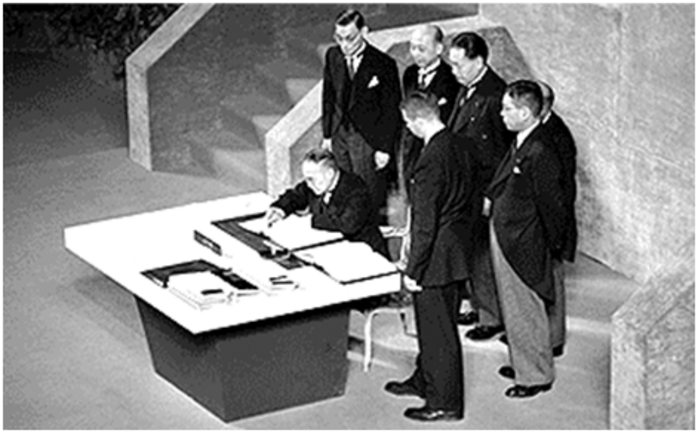
    This year marks the fiftieth anniversary of the conclusion of the revised Japan-U.S. Mutual Security Treaty (Ampo). The original treaty was signed on September 8, 1951, the same day the San Francisco Peace Treaty was signed. One of its provisions stipulated that Japan must guarantee the U.S. the same stable use of military bases as it did under the occupation. Without accepting that requirement, Japan could never have won its independence.

    Yoshida Shigeru signs the San Francisco Treaty for Japan
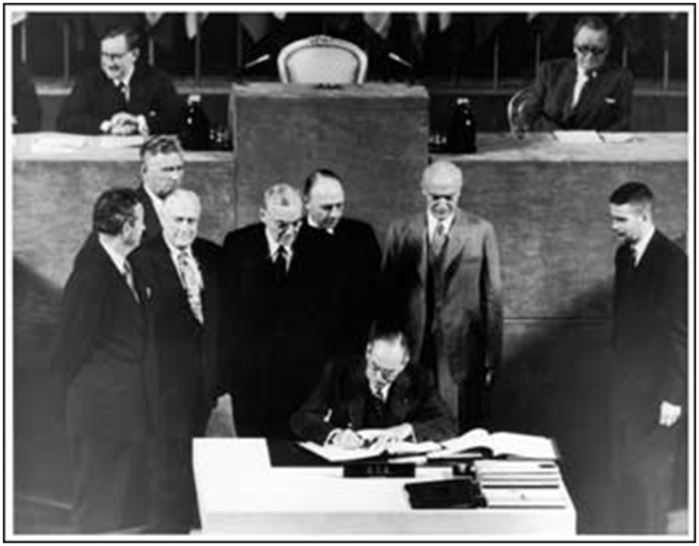
    Dean Acheson signs the San Francisco Treaty for the United States

    This stipulation was carried over to the revised Mutual Security Treaty of 1960 (Article 6) and with it the U.S. has been assured of its continued formidable military presence in Japan, dominating its sea, land and air space to this day.

    Japan’s independence was also achieved at the cost of Okinawa, which was kept under harsh military administration until the reversion of its administrative rights to Japan in 1972. But even after reversion, the U. S. bases in Okinawa remained intact. Today, the negative side of the Japan-U.S. Mutual Security Treaty appears most conspicuously in Okinawa, where 75 percent of U.S. bases and facilities in Japan are concentrated. Although those bases and facilities (totaling 85 in number, and 31,000 ha in area) are formally offered to U.S. Forces under the Security Treaty, they are in essence spoils which U.S. forces won in war.

    From Okinawa’s perspective, Japan’s independence appears only an illusion. Japan is still a semi-independent or client nation unable to challenge Uncle Sam’s demands; hence, Prime Minister Hatoyama Yukio’s wish list in his inaugural speech showcasing, among other things, the desire to make Japan a partner equal to the U.S.

    Early history of Ginowan City

    The U.S. Marine Corps Air Station Futenma, currently a hot issue straining the Japan-U.S. relationship because of the dispute over its relocation, is located in the middle of densely populated Ginowan City. Houses cluster closely around the fences close together, even abutting the approach lights on both sides of the runway. This unbelievable situation has something to do with the city’s post-war history.

    While the battle was still going on in the south, the invading U.S. Army encroached upon large swaths of land in the central part of the island, where villages, farmland, school yards and cemeteries existed cheek by jowl with each other. The people who surrendered or survived the battle were herded into concentration camps, mostly in the north.

    When they were allowed to return home a few years after the war ended, many people from central Okinawa found their hometowns and villages turned into vast military bases. Reluctantly, they began to live alongside barbed-wire fences, some earning a meager livelihood by working for the bases. This is how Ginowan City, which now surrounds the Futenma Air Station, came into being [1].

    Futenma Air Station occupies 25% of densely populated Ginowan City

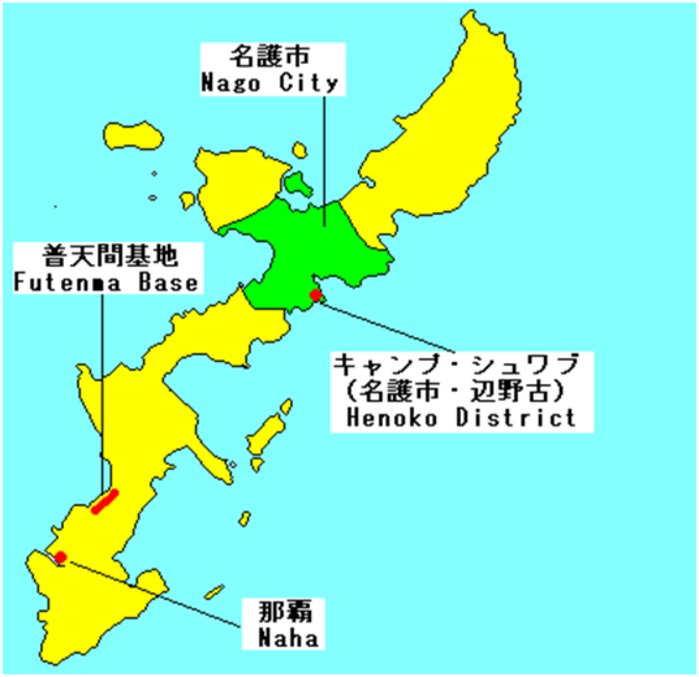
    In response to the strong demand of the residents of Ginowan for its closure because of various hazards it poses, Japan and the U.S. struck a deal in 1996 to close the base and return the land when a suitable relocation site was found elsewhere on the island.

    Henoko as a site for relocation

    Apparently, from early on, the U.S. had Henoko in mind as a site for the relocation. The Marine Corps Okinawa submitted a blueprint every fiscal year to the Pentagon and eventually to the U.S. Congress for approval in the 1960’s, with an air station and port facilities to be constructed on reclaimed land off the coast at Henoko. Whether it would be a replacement for Futenma or an outright new air base is not clear, but the design for its functions was the same as the current V-shaped runway plan set forth in the United States-Japan Roadmap for Realignment Implementation agreed in 2006 (hereafter called 2006 Road Map): to integrate the newly constructed air base with Camp Hansen, Camp Schwab and the central and northern training areas, thus strengthening military functions (as had been the plans for Okinawan bases during the Vietnam War) and deterrence capability against North Korea, China or Russia today [2].

    Map showing Futenma and Henoko sites

    However, the ’60’s plan didn’t materialize, probably because the U.S. Congress didn’t pass the bill for the necessary appropriations due to skyrocketing expenditure on the Vietnam War, as Masaaki Gabe suggests [3], or because U.S. lawmakers were afraid the whole project would prove useless if Okinawa were returned to Japan in the future. The situation is totally different today, however. If all goes according to Pentagon plans, Tokyo will shoulder all the expenses for land reclamation and the construction of runways and other facilities, not to mention the high-end equipment, as well as the cost of relocating thousands of US troops to Guam.

    The Futenma issue started as part of the 1995 Special Actions Committee on Okinawa (SACO) initiative to reduce burdens on Okinawa. But fifteen years later, the burdens remain as heavy, nor will they be lightened if Futenma’s operations are moved to another location within Okinawa. Moving the base around in Okinawa or, more broadly, in Japan will clearly signal that Tokyo has yet again consented to a permanent U.S. military presence or “a life-of-the-alliance presence for U.S. forces” in Japan (2006 Road Map) , a transparent cover term for the unlimited occupation of Japan. This must be prevented by all means. This is the essential issue concerning Futenma, one which cuts to the very heart of the U.S-Japan strategic alliance.

    Marines and Washington’s explanation

    Washington persists in saying that Henoko is the best site for the relocation of Futenma if Japan wishes to continue to maintain the American military deterrence capability, warning that contingencies could occur in the Pacific region, for example, in the Korean Peninsula or the Taiwan Straits, requiring the Marines’ presence as essential deterrence.

    On January 6, 2010, the U.S. Marine Corps Okinawa announced its position on the relocation of Futenma. In order to counter contingencies effectively, a helicopter squadron must be deployed within a 20-minute distance from a base where ground forces are standing by. This is why they claim Futenma’s function must be relocated to Henoko, which is adjacent to Camp Schwab and Camp Hansen where the Marines’ ground troops are stationed.

    Aerial photograph of Cape Henoko

    Note that this is an argument based on tactical rather than strategic reasoning.

    According to this explanation, a helicopter squadron must pick up ground troops in 20 minutes and transport them to the frontline in a short span of time (perhaps one hour). But can one realistically imagine such a situation in and around Okinawa Island? Do the Marines think a ground battle similar to the World War II Battle of Okinawa will be replicated in the southern section of this island? Is Okinawa still a war zone in their thinking?

    Suppose war occurred in the Korean Peninsula and the Marines from Okinawa successfully landed there in one hour. Would 17,000 Marines go into battle against North Korea’s 1.2 million standing army? The same issue pertains to the Taiwan Straits. As is well known, China has a 1.6 million regular army. Or can they function as a bulwark against potential missile attacks, say, by North Korea, China or Russia?

    Of course, the Marines alone may not work as deterrents against outside threats; they may be an integral part of the USF Japan together with the Navy and the Air Force. However, if contingencies occurred in the Korean Peninsula or in the Taiwan Straits, they would certainly have to increase their number substantially, probably to 500,000 troops at a minimum. But assembling troops takes several weeks or even months as the Persian Gulf War and the initial stage of the Iraq War demonstrated.

    Consequently, the explanation by the Marines and Washington that a helicopter squadron must be deployed within a 20-minute distance from a base where ground forces stand by and, therefore, the claim that Henoko is the best relocation site for Futenma’s operations lacks credibility.

    The Marines aren’t here to defend Japan

    The Okinawan press reports that Camp Hansen (Kin) and Camp Schwab (Henoko) are both empty shells these days because their occupants were deployed to Iraq and now to Afghanistan to fight against insurgents there.

    Obviously, the U.S. Marines or the 3rd Marine Expeditionary Force, to be more specific, are stationed in Okinawa not to defend Japan as ballyhooed but simply to hone their assault skills in preparation for combat elsewhere. It’s a cozy and easy place to train, with Tokyo providing prodigious financial aid, which Washington demands in the name of “host nation support.” I liken it to turf dues exacted by an organized crime syndicate, which offers protection from rival gangs.

    In 2003, for example, Japan’s direct “host nation support” amounted to $3,228.43 million or $4,411.34 million if indirect support is added. Compare these figures with Germany’s and Korea’s support. Germany’s direct host nation support in the same year was $28.7 million (1/112th that of Japan) and indirect support $1.535.22 million. Korea’s direct host nation support in that same year was $486.31 million (about 1/7th that of Japan) and indirect support $356.5 million [4].

    For ten years from 2001 through 2010, Japan shouldered an average annual sum of $2,274 million for host nation support [5], which incidentally is known as “sympathy budget” as if Japan were voluntarily doling out money out of compassion for those U.S. service members who are deployed in this far-away country. The amount Japan has financed to support USF Japan operations since the system started in 1978 totals an astounding $30 billion.

    That the Marines are based in Okinawa not to defend Japan but mainly to strengthen U.S. interests in the Asia-Pacific and beyond is widely recognized, as the following quotation from GlobalSecurity.org suggests:

    “The Regiment (3rd Battalion 6th Marines) continues to support the defense of the Nation by maintaining forces in readiness in support of contingency operations and unit deployments to the Mediterranean, Pacific rim and around the globe.”(Italics mine)

    Pundit Kevin Rafferty is more direct saying, “some of the bases (in Japan) are staging-posts for deployment in Afghanistan and elsewhere [6].”

    When Marine contingents were compelled to move out of Gifu and Yamanashi Prefectures in mainland Japan in the face of mounting anti-U.S. base demonstrations and moved to Okinawa in the 1950’s, a number of Pentagon strategists are reported to have cast doubt on the wisdom of such a shift.

    The U.S. Army was the major element in the U.S. Forces in Okinawa during the occupation period which ended in 1972 with reversion. Apparently, the Army recognized the limited value of being stationed in Okinawa and so withdrew, leaving behind only a few hundred troops. The Marines grabbed this chance to expand their role and function, taking over everything from the departing Army. They are not, however, deterrents against outside “threats” as they boast.

    Guam Integrated Military Development Plan

    Washington has remained adamant in insisting that Futenma’s operations be moved to Henoko. On meeting Foreign Affairs Minister Okada Katsuya in Tokyo last October, U.S. Defense Secretary Robert Gates urged Tokyo to implement the agenda specified in the 2006 Road Map as soon as possible.

    In return, Washington would relocate to Guam 8,000 (later modified to 8,600) Marine personnel, consisting mostly of command elements: 3rd Marine Expeditionary Force Command Element, 3rd Marine Logistics Group Headquarters, 1st Marine Air Wing Headquarters, and 12th Marine Regiment Headquarters. The remaining Marines in Okinawa would then be task force elements such as ground, aviation, logistics and other service support members.

    Japan agreed under pressure to fund $6.09 billion of the estimated $10.27 billion for the facilities and infrastructure development costs — another example of extortion. Upon completion of the relocation of Futenma’s function to Henoko and the transfer of the Marine command units to Guam, the U.S. would return six land areas south of Kadena Air Base, including the Marine Corps Air Station Futenma. In trying to sell this package, Washington claims that this reduces Okinawa’s burdens tremendously.

    Note, however, that these lands will be returned only if their replacements are found somewhere within Okinawa: for example, Henoko for Futenma, the very question which is straining the bilateral relationship. The 2006 Road Map clearly states: “All functions and capabilities that are resident in facilities designated for return, and that are required by forces remaining in Okinawa, will be relocated within Okinawa. These relocations will occur before the return of designated facilities.”

    This is the gist of the 2006 agreement particular to bases on Okinawa. However, a curious situation has developed over the U.S. Forces realignment. Two months after the 2006 Road Map was agreed, the U.S. Pacific Command announced the Guam Integrated Military Development Plan, and on September 15, 2008 the Navy Secretary, who also represents the Marines when dealing with Congress, submitted a report titled “Current Situation with the Military Development Plan in Guam” to the Chairman of the U.S. House of Representatives Committee on Armed Services [7]. In April 2008, this plan was entirely incorporated into the “Guam Integrated Master Plan,” and in November, 2009 a public hearing was held on a “Draft Environmental Impact Statement/ Overseas Environmental Impact Statement [8].”

    These documents show that the U.S. military considers Guam strategically most important in the Asia-Pacific region and plans to transform already existing bases there into a colossal military complex by expansion and development. The U.S. military’s strategic thinking is apparently motivated by the rise of China, particularly by China’s development of new types of long-range missiles. The plan includes re-deploying 8,600 Marines now stationed in Okinawa and relocating most of the Marine capabilities, including helicopter and air transport units in Futenma, to Guam.

    A Conundrum

    How should we interpret this situation: Futenma’s relocation to Henoko so urgently demanded by the U.S. government, on the one hand, and the U.S. military’s Guam military development plan in which most of Futenma’s operations are to be moved to Guam, on the other? What is the current obfuscation all about?

    One answer may be that the U.S. government is manipulating the situation in order to retain every right to a permanent military presence in Japan. This suggests that U.S. policymakers mistrust Japan and the Japanese people despite repeated statements that Japan is the U.S.’s most important ally. In other words, their “deterrence” is not only directed against North Korea, China or Russia, but also against Japan.

    When the Cold War ended with the collapse of the Soviet Union in 1991, many expected a substantial reduction of the U.S. footprint on Okinawa. The drawdown of U.S. troops in Europe augured well for Okinawa, or so it seemed to me. Then came the 1995 Nye Report and the new US policy based upon it, shattering Okinawan hopes and expectations. On the pretext that the U.S. military presence was a driving force for keeping peace and prosperity in this allegedly volatile region, it announced that the U.S. would continue to maintain bases and troops in East Asia at approximately the same level as before.

    William Cohen, Secretary of Defense under the Clinton administration, thwarted our hopes around 2000, when the two Koreas seemed to be reducing tensions on the peninsula and even, perhaps inching to reunification, by saying that there would be no U.S. military withdrawal from Okinawa even if peace was established in a unified Korean Peninsula.

    That the U.S. intends to perpetuate its military presence in Japan is evident from its insistence that not only Futenma’s operations be transferred to a new high tech base at Henoko, but also that other facilities such as Naha military port, whose return was promised years before Futenma, must be relocated within Okinawa. The 2006 Road Map betrays Washington’s real intention by accidentally stating, “A bilateral framework to conduct a study on a permanent field-carrier landing practice facility will be established, with the goal of selecting a permanent site by July 2009 or the earliest possible date thereafter.” (Italics mine)

    The Defense Ministry’s bureaucrats and their close associates at the Ministry-affiliated National Institute for Defense seem well aware of Washington’s designs, for their East Asia Strategic Review 2010 is written on this unspoken premise.

    Concluding Remarks

    As suggested above, the Futenma relocation issue is grounded on political rather than military foundations, and the party most responsible for this confusion is the U.S. government, not the Hatoyama government, despite the latter’s ham-fisted handling of the matter. U.S. Marine Corps Air Station Futenma should be closed down and the land returned to its legitimate owners unconditionally and without delay in accordance with the overwhelming wish of the Okinawan people. The U.S. has no inherent right to demand a quid pro quo in exchange for its return. Military training can be conducted on the vastness of U.S. soil with impunity and to their satisfaction.

    Yoshio Shimoji, born in Miyako Island, Okinawa, M.S. (Georgetown University), taught English and English linguistics at the University of the Ryukyus from April 1966 until his retirement in March 2003. This is a revised and expanded version of an article posted at the website of Peace Philosophy Centre.

    Recommended citation: Yoshio Shimoji, “The Futenma Base and the U.S.-Japan Controversy: an Okinawan perspective,” The Asia-Pacific Journal, 18-5-10, May 3, 2010.

    Articles on related themes:

    Gavan McCormack, The Travails of a Client State: An Okinawan Angle on the 50th Anniversary of the US-Japan Security Treaty

    Kikuno Yumiko and Norimatsu Satoko, Henoko, Okinawa: Inside the Sit-In

    Urashiima Etsuko and Gavan McCormack, Electing a Town Mayor in Okinawa: Report from the Nago Trenches

    Iha Yoichi, Why Build a New Base on Okinawa When the Marines are Relocating to Guam?: Okinawa Mayor Challenges Japan and the US

    Iha Yoichi. Ginowan City Mayor Iha Yoichi’s letter to U.S. President George W. Bush dated October 15, 2003 (Japanese and English).  Posted at Ginowan City home page.

    Tanaka Sakai, Japanese Bureaucrats Hide Decision to Move All US Marines out of Okinawa to Guam

    Gavan McCormack, The Battle of Okinawa 2009: Obama vs Hatoyama

    Hayashi Kiminori, Oshima Ken’ichi and Yokemoto Masafumi, Overcoming American Military Base Pollution in Asia: Japan, Okinawa, Philippines

    See also: the Peace Philosophy Center, particularly the two articles posted on March 16, 2010 entry on recent plans for a new offshore base and plans for a naval base and casino.

    Notes

    [1] Land seizure was not limited to central Okinawa; in fact, it was almost universal throughout the island at the time. If that was the first wave of land seizure, the second one started in the early 50’s, hard hitting Iejima, where 35.3 percent of the island’s land area is still military, the Isahama district of Ginowan and the Gushi district of Oroku (later incorporated with Naha City). Land expropriation was brutally undertaken, as Ota (1995) writes: “In some cases during the 1950’s, bayonets and bulldozers were used to expropriate Okinawans’ land and uproot owners from their homes.” It was indeed a flagrant violation of the Hague Convention (Article 46), which clearly states: “Family honour and rights, the lives of persons, and private property, as well as religious convictions and practice, must be respected. Private property cannot be confiscated.”

    [2] The Ryukyu Shimpo, June 4, 2000 (morning edition): pages 1 and 7. Also, The Okinawa Times, June 3, 2001 (morning edition): pages 1, 3 and 21.

    [3] The Ryukyu Shimpo (ibid.): page 7.

    [4] See the U.S. Defense Department’s 2004 Statistical Compendium on Allied Contributions to the Common Defense.

    [5] Japanese Ministry of Defense web site.

    [6] The Japan Times: April 27, 2010.

    [7] Ginowan City Home Page.

    [8] Yoshida. 2010.

    References

    Ginowan City. 2010. “Possibility of Futenma’s Relocation to Guam,” Mayor’s explanatory document prepared for the Meeting on Okinawa’s Military Base Problems held December 12, 2009. Home page.

    Ministry of Foreign Affairs of Japan. 2006. “United States-Japan Roadmap for Realignment

    Implementation”

    McCormack, Gavan. 2007. Client State: Japan in American Embrace (Japanese translation). Gaifusha: Tokyo.

    Ota, Masahide. 1995. Essays on Okinawan Problems (English). Yui Publishing Company: Okinawa.

    ____________. 2004. Discrimination against Okinawa and the Pacific Constitution (Japanese). BOC Publishing Company: Tokyo.

    The National Institute for Defense. 2010. “East Asia Strategic Review 2010” (Japanese).

    Rafferty, Kevin. 2010. “Hatoyama’s fate tied to Futenma” in the April 27, 2010 Japan Times.

    The Okinawa Times, June 3, 2001 (morning edition)

    The Ryukyu Shimpo, June 4, 2000 (morning edition)

    U.S. Department of Defense. 2004. “2004 Statistical Compendium on Allied Contributions to the Common Defense”.

    Yoshida, Kensei. 2007. Okinawa: The Military Colony (Japanese). Kobunken: Tokyo.

    ____________. 2010. Okinawa-Based Marines will Go to Guam (Japanese). Kobunken: Tokyo.

    Rothman: The People of Vieques, Puerto Rico Deserve Justice from the U.S. Government

    FOR IMMEDIATE RELEASE:

    May 17, 2010

    CONTACT: Aaron Keyak

    office: (202) 225-5061

    cell: (202) 905-6361

    email: aaron.keyak@mail.house.gov

    Rothman: The People of Vieques, Puerto Rico Deserve Justice from the U.S. Government

    Hackensack, NJ – Today, Congressman Steve Rothman (D-NJ), a member of the Science and Technology Committee of the U.S. House of Representatives, will be joined by Assemblywoman Nellie Pou, Chair of the Legislative Latino Caucus, and other members of the caucus at a press conference in Hackensack, NJ to fight for justice for the people of Vieques, Puerto Rico.

    Vieques is a small island off the South East coast of Puerto Rico that was used as a bombing range by the U.S. Navy from World War II until 2003. The munitions used in and around Vieques contained toxins that have affected the health of the residents. A year ago Congressman Rothman successfully pressured the Agency for Toxic Substances and Disease Registry (ATSDR) to re-examine the agency’s inadequate health assessments for the inhabitants of the island of Vieques, because there are still issues that need to be addressed.

    “The injustice toward the people of Vieques, Puerto Rico must end. Vieques is a small island off the south east coast of Puerto Rico that was used as a bombing range by the U.S. Navy from World War II until 2003. The munitions used in and around Vieques contained toxins that have affected the health of the residents. Yet in 2003, the Agency for Toxic Substances and Disease Registry (ATSDR) issued a report that said that the levels posed no health risk. The conclusions in this report strain credibility, are inconsistent,and demand a thorough reexamination,” said Congressman Rothman.

    What: Press conference on the inadequate health assessment report by ATSDR and the high rates of disease among the people of Vieques

    When: Today, May 17, 2010 at 9:30 am

    Where: Plaza outside of Congressman Rothman’s Hackensack, NJ office

    25 Main Street

    Suite 101

    Hackensack, NJ

    Who: Congressman Steve Rothman, Assemblywoman Nellie Pou, Assemblyman Vincent Prieto, Assemblyman Angel Fuentes, and Assemblywoman Annette Quijano.

    Contact: Aaron Keyak at aaron.keyak@mail.house.gov or (202) 905-6361

    A full statement from Congressman Rothman:

    The injustice toward the people of Vieques, Puerto Rico must end. Vieques is a small island off the south east coast of Puerto Rico that was used as a bombing range by the U.S. Navy from World War II until 2003. The munitions used in and around Vieques contained toxins that have affected the health of the residents. Yet in 2003, the Agency for Toxic Substances and Disease Registry (ATSDR) issued a report that said that the levels posed no health risk. The conclusions in this report strain credibility, are inconsistent, and demand a thorough reexamination.

    The people of Vieques deserve answers for the undisputed high rates of disease that they have encountered over the years. Residents of Vieques have a 25% higher infant mortality rate, 30% higher rate of cancer, a 95% higher rate of cirrhosis of the liver, a 381% higher rate of hypertension, and a 41% higher rate of diabetes than those on the main island of Puerto Rico.

    I have brought this issue to the attention of the highest levels of our government and all of the appropriate federal agencies. ATSDR was finally convinced to re-open this case and made this known in response to my demands during a hearing of the House Science and Technology Committee, of which I am a member, on March 12, 2009. They have now begun an independent reexamination of their 2003 conclusions and have stated that they will issue their initial findings by the end of the summer or early fall 2010.

    In addition, I have been assured that this issue will be included in the White House Task Force’s examinations and recommendations to President Barack Obama regarding Puerto Rico. I look forward to reading a new and improved report from ATSDR that will finally reveal the truth and open the door for justice to be realized by the people of Vieques. Finally, I intend to question ATSDR’s Director Henry Falk later this week when he appears before our House Science and Technology Committee.

    We must bring the issues surrounding the health of Vieques to light. I am confident we will finally be able to bring justice to Vieques. The time for the U.S. government to right this wrong is long overdue.

    ###

    Aaron Keyak

    Communications Director

    Congressman Steve Rothman (NJ-9)

    2303 Rayburn HOB

    o: 202/225-5061

    c: 202/905-6361

    akeyak@gmail.com

    Making the Invisible Empire Visible

    http://www.japanfocus.org/-John-Junkerman/3359

    Making the Invisible Empire Visible

    Film Review by John Junkerman

    Mention “The Insular Empire” to the average American, and they’d likely have no idea what you were talking about. They probably still wouldn’t get it if you gave them another clue: “America in the Mariana Islands.” These are the title and subtitle of a new film by Vanessa Warheit, which began screening on PBS earlier this year.

    It is the singular misfortune of the residents of Guam and the Northern Marianas to have been born on tiny islands of great strategic value in the mid-Pacific Ocean. The consequence has been their colonial subordination for four centuries to a succession of empires: Spain, the United States, Germany, Japan, and, since the Pacific War, the US again.

    A “colony” of the American “empire”? Of course, the US does not acknowledge that the “territory” of Guam and the “commonwealth” of the Northern Mariana Islands are colonies. But, as the film points out, the residents of these islands bear American passports yet have only token representation in the US Congress. They have the ‘right’ to fight in the US military (soldiers from Guam have died in Iraq and Afghanistan at a per capita rate four times as high as any US state), but they don’t have a vote in the election of the commander-in-chief. One third of Guam is controlled by the US military and the island is slated for a massive military buildup, but as a “non-self-governing territory,” the islanders have no say in the matter.

    The principle of government with the consent of the governed, over which the American colonies fought the War of Independence, does not apply to the Mariana Islands. Yes, these are colonies.

    It is one of the ironies of the American “empire of bases” (in Chalmer Johnson’s apt phrase) that the empire remains largely invisible to all but the soldiers who occupy these bases spread across the globe and the citizens of the lands that host them. What is true of the de facto American empire is even more true of these colonies: to Americans, they are no more than tiny specks in the ocean, 6,000 miles from the coast of California. This film, the first comprehensive telling of the story of the Marianas to the American public, performs the invaluable service of making this invisible empire visible.

    The film could not be more timely. The transfer of 8,000 Marines (and nearly 10,000 dependents and civilians) to Guam from the Futenma air base on the equally militarized Japanese island of Okinawa is scheduled to take place in 2014. Preparations for the $12 billion base construction project (which will include extensive dredging of coral reef so the naval base can accommodate aircraft carriers, among numerous other expansions) are already underway. The project will bring in some 79,000 people, including temporary construction workers, boosting the population of the already crowded island by 40 percent. While welcomed by some sectors on Guam as an economic transfusion, the buildup threatens to destroy the island’s natural beauty and cause an environmental disaster. The US Environmental Protection Agency in February blasted the military’s draft environmental impact statement as “environmentally unsatisfactory,” citing expected shortages of drinking water, the over-burdening of the island’s crumbling sewage treatment infrastructure, and inadequate plans to mitigate ecological damage.

    But the military’s presence and proposed expansion are not the focus of this film, only in part because the military refused to allow the filmmakers access to the bases and declined requests for interviews. Rather, the film aims to illuminate the history that has left these islands pawns in America’s global chess game. It is a complex history: despite being part of the same archipelago, Guam (an American colony since the Spanish-American War in 1898), and the Northern Marianas (which include the islands of Saipan and Tinian) have different colonial pasts and distinct political status today. This history is deftly told with inventive graphics and superbly researched archival footage, reflecting the eight painstaking years spent in producing the film.

    The islands’ complex history is matched by a deeply conflicted identity. Much of the population is intensely loyal to the US, reflecting the pervasive presence of the military and the high levels of enlistment, yet the islanders are perpetual second-class citizens. English is spoken and the dominant culture is American (the world’s largest K-Mart is on Guam), yet there are persistent efforts to preserve the indigenous Chamorro language and culture. Guam’s economy is heavily dependent on tourism and the military, but a different course of development might have been chosen if the islanders had control of their land and destiny (choices that the Guam Buildup will put forever out of reach).

    Warheit has provided depth and character to these issues of identity by following four individuals, two each from Guam and the Northern Marianas, through the course of the film. The eldest, Carlos Taitano, a former speaker of the Guam Legislature, was born in 1917 and thus witnessed and participated in Guam’s postwar history, during which “the people of the Marianas were a distant afterthought,” he observes. A businessman (the island’s Coca-Cola bottler) and an advocate of statehood, he died in 2009, before the film was released, his distant dream unrealized.

    Carlos Taitano

    When Hope Cristobal represented Guam in the Miss Universe pageant in 1967, she visited the States for the first time and encountered anti-Vietnam War protests in San Francisco, opening her eyes to a counter-military narrative she had never imagined on Guam. She has since become an advocate for Guam’s self-determination and the director of a museum of Chamorro culture. It is, in many ways, a reclamation project: when she was a schoolgirl, she was punished for speaking the Chamorro language (recalling the forced Americanization of Native Americans, and the parallel Japanization of the Okinawa islanders), and few young people now speak the language.

    Hope Cristobal

    Where Guam was occupied by the US Navy and Air Force, Saipan (in the Northern Marianas) was used by the CIA as a secret base to train Chinese and Southeast Asian insurgents, and Lino Olopai found work on the base as a security guard. Pete Tenorio worked as a caddy on the CIA’s golf course. The Northern Marianas were then a UN trust territory under US administration, until 1975, when a plebiscite approved a “covenant” that made the islands an American commonwealth.

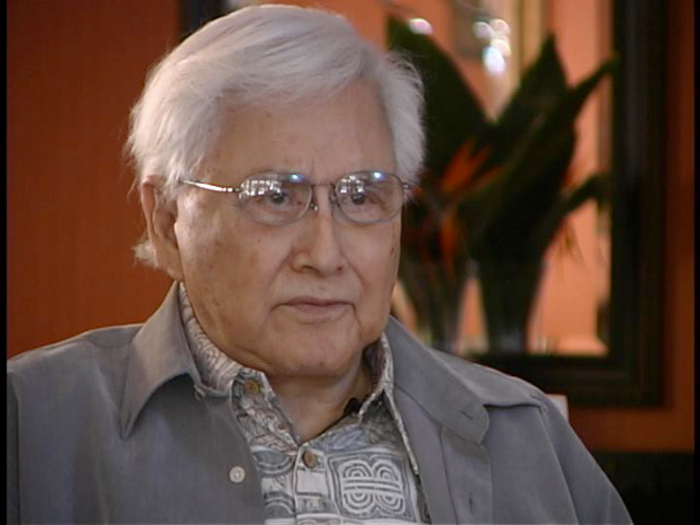
    Lino Olopai and Pete Tenorio appear in an excerpt of the film.

    Tenorio entered politics and eventually was elected “resident representative” of the commonwealth, with an office in Washington, DC, where he negotiates not with Congress but with the Department of the Interior’s Office of Insular Affairs. “People here [in the US] are just not aware of this relationship,” he says in frustration, “and if they’re not aware, what’s our solution to it?” Olopai pressed for independence at the time of the plebiscite and when the commonwealth status was approved, he left Saipan for the Caroline Islands to reconnect with his roots. There he learned the dying art of celestial navigation, which he has continued to teach to others since his return to Saipan.

    While the US military is not the focus of the film, its presence is inescapable. US soldiers march in uniform in Guam’s annual Liberation Day parade, commemorating the defeat of the Japanese occupation of the island on July 21, 1944. More than 60 years later, the military is still lionized as Guam’s “liberator,” but, as Hope Cristobal comments, “The US has not given us anything but the military.” If the Guam Buildup goes forward as planned, there will be precious little room left on Guam for anything but the military.

    For many years, Cristobal made an annual trek to the UN, to appeal for Guam’s self-determination before the Special Committee on Decolonization. In one of the most poignant moments of the film, her daughter Hope Cristobal, Jr. follows in her footsteps and testifies at the UN. The road ahead for Guam is a long one, she comments, “but even if you make one ripple in this big ocean, it still counts.”

    The compact (59-minute) and information-packed format of the film make it a valuable resource for teaching and organizing. For information on PBS broadcasts and other screenings of the film, consult the blog here. The film is available on DVD, and a Japanese-subtitled version will be available soon, through the same blog address.

    John Junkerman wrote this review for The Asia-Pacific Journal.

    John Junkerman is an American documentary filmmaker and Japan Focus associate living in Tokyo. His most recent film, “Japan’s Peace Constitution” (2005), won the Kinema Jumpo and Japan PEN Club best documentary awards. It is available in North America from First Run Icarus Films. He co-produced and edited “Outside the Great Wall,” a film on Chinese writers and artists in exile that will be released in Japan and abroad later this year.

    Recommended citation: John Junkerman, “Making the Invisible Empire Visible,” The Asia-Pacific Journal, 20-1-10, May 17, 2010.

    Okinawans surround Futenma Air Base with a 13 km ‘Human Chain’; solidarity demo in Honolulu

    Yesterday, tens of thousands of Okinawans surrounded the Futenma Air Base with a Human Chain 13 kilometers long calling for the removal of the U.S. military base. There is video at the Okinawa Times website:

    http://www.okinawatimes.co.jp/article/2010-05-16_6534/

    On Friday, 5/14/2010, the Hawai’i Okinawa Alliance held a demonstration in front of the Federal Building in Honolulu in solidarity with the Okinawa action.   Also in support were Fight for Guahan, youth from the Rise Up! Roots of Liberation camp, the American Friends Service Committee, DMZ-Hawai’i / Aloha ‘Aina, Hawai’i Puerto Rican scholar/activist Tony Castanha, and professors Mari Matsuda and Vincent Pollard.  Also joining the demonstration were TAKAHASHI Masaki and ICHINOSE Emiko, former Peace Boat comrades who were visiting Hawai’i to write a book about the “hidden” history of occupation, militarism, corporate tourism and genetic engineering in Hawai’i.

    UK Asked Red Cross to Investigate Fallujah Birth Defects

    http://www.independent.co.uk/news/uk/home-news/mod-asked-red-cross-to-look-into-iraq-birth-defects-1964491.html

    MoD asked Red Cross to look into Iraq birth defects

    Letter reveals Government wanted charity to investigate claims following Fallujah attacks

    By Robert Verkaik, Law Editor

    Thursday, 6 May 2010

    Britain was so concerned about reports from Iraq of an alarming increase in the number of babies being born with deformities that ministers asked the Red Cross to investigate the claims, it has emerged. The Government took the action last year amid allegations that weapons used by American and British forces in Iraq were linked to a rise in foetal abnormalities seven years after the invasion.

    A letter seen by The Independent, and written by the international development minister, Gareth Thomas, reveals that the Government contacted the International Committee of the Red Cross sometime before September last year.

    Mr Thomas wrote to Clare Short, who resigned from the Government in protest over the war, in answer to questions she had posed on behalf of a constituent.

    “On DfID’s request,” said Mr Thomas, “the ICRC has discussed this [reports of a rise in foetal abnormalities] with the technical director of Al-Fallujah General Hospital as well as another doctor based there. Both responded that although there were occasional cases of foetal abnormalities, these did not exceed two to three cases per year.”

    In another letter written in January this year Mr Thomas said that because of the continuing dearth of reliable information on such cases, DfID had formally asked the Iraqi Ministry of Health to release any data regarding the claims.

    Allegations that the British Government was complicit in the use of chemical weapons linked to an upsurge in child deformity cases in Iraq are being investigated by the Ministry of Defence.

    The legal case, which is being prepared for the High Court by Public Interest Lawyers, specifically raises serious questions about the UK’s role in the American-led offensive against the City of Fallujah in the autumn of 2004 in which hundreds of Iraqis died.

    After the battle, in which it is alleged that a range of illegal weaponry was used against the civilian and insurgent population, evidence has emerged of large numbers of children being born with severe birth defects. Iraqi families who believe their children’s deformities are caused by the deployment of the weapons have begun legal proceedings against the UK Government.

    They accuse the UK Government of breaching international law, war crimes and failing to intervene to prevent a war crime.

    Lawyers for the Iraqis have sent a letter before action to the Ministry of Defence asking the Government to disclose what it knows about the Army’s role in the offensive, the presence of prohibited weapons and the legal advice given to the then prime minister, Tony Blair.

    Last month the World Health Organisation said it was investigating evidence of a worrying rise in the incidence of birth defects in the city which Iraqi doctors attribute to the use of chemical weapons in the battle.

    Phil Shiner, of Public Interest Lawyers, said: “The Government at all levels have deliberately buried their head in the sand on this. Having aided and assisted the US in indiscriminate attacks on civilians in Fallujah using illegal weapon systems, this letter shows it is hiding behind weasel words that Fallujah General Hospital ‘could not confirm a rise in [foetal] abnormalities’. This letter shows it knew full well there was a major problem in September 2009.”

    Mazin Younis, a UK-based Iraqi human rights activist, said: “When I visited Fallujah weeks before the attack, I was shocked to see the majority of people had not left the city. The unlawful use of white phosphorus as a weapon in built-up areas was shown by media in the first days of war, but was never objected to by our British government who assisted in the attack on Fallujah.”

    A government spokesman yesterday confirmed that the letters had been written.

    Corporate interests Behind “Reduction of Okinawa’s Burden”

    This post on the Peace Philosophy blog exposes the corporate agendas behind the Okinawa base relocation issue.

    >><<

    http://peacephilosophy.blogspot.com/2010/05/corporate-interests-behind-futenma.html

    Thursday, May 13, 2010

    Corporate Interests Behind “Reduction of Okinawa’s Burden” 「沖縄の負担軽減」の本当の意味

    This is a summary translation of one part of Tokyo Shimbun journalist Handa Shigeru’s lecture in Tokyo on December 15, 2009. I thought it would provide some significant background in understanding the current plan by the Hatoyama Govenment to build a runway off the coast of Henoko by placing thousands of steel pilings on the sea bed. Handa Shigeru has been writing extensively about corporate interests and corruption involving the plan to build a “replacement facility” for Futenma Air Station. I will provide more translation as time permits.  Read more…