Dugong Sighted – What is Sacred?

A dugong, the endangered sea manatee of Okinawa, a sacred animal deity that is recounted in ancient Okinawan songs, was recently seen in Henoko, proposed site of the military base relocation from Futenma. A ho’ailona (sign)?

Meanwhile, Carolyn Raffensperger, Executive Director of the Science and Environmental Health Network., asks “what is sacred?” She reflects on the new science that is showing how environmental contamination can be linked to many diseases formerly blamed on “lifestyle choices”.  She also refers the recent adoption of the UN Declaration on the Rights of Indigenous Peoples and the protections it enshrines for indigenous peoples of the world.  Not mentioned in Raffensperger’s article is another clause referring to militarization:

Article 30
1. Military activities shall not take place in the lands or territories of indigenous peoples, unless justified by a relevant public interest or otherwise freely agreed with or requested by the indigenous peoples concerned.
2. States shall undertake effective consultations with the indigenous peoples concerned, through appropriate procedures and in particular through their representative institutions, prior to using their lands or territories for military activities.

In Hawai’i, the military destruction of sacred places like Lihu’e, Mauna Kea, Makua and Mokapu continues despite protests.   Clearly in the case of Okinawa, Guahan/Guam, Hawai’i, these conditions were not met.

>><<

http://okinawa-dugong.blogspot.com/2010/05/dugong-was-seen-in-henoko-bay.html

Tuesday, May 11, 2010

Dugong was seen in Henoko Bay!

See the following link from Ryukyu Asahi Broadcasting news report!

http://www.qab.co.jp/news/2010051217881.html

Ryukyu Asahi Broadcasting (QAB) captured a Dugong, swimming in the Eastern Coast of Nago City.

Both Environmental Ministry and Defense Ministry have admitted that the ocean area from Henoko Bay to Kayo Bay is “the important sea area for the inhabitant of Dugong.”

The Nature Conservation Society of Japan is warning that, “seagrass beds, which feed dugong, are distributed in the shallows in front of the Camp Schweb. Therefore, even the pier plan proposed by the government, surely vanish the seagrass beds. Moreover, change of sea current would possibly vanish the distribution of the seagrass.”

+++

http://womensearthalliance.blogspot.com/2010/05/following-article-has-been-written-by.html

Thursday, May 6, 2010

What is Sacred?

The following article has been written by Carolyn Raffensperger, Executive Director of the Science and Environmental Health Network.

What is sacred? What does the law recognize as sacred? These were the questions that haunted me yesterday, the third full day of the delegation’s trip to Nevada and Arizona to join with indigenous people to protect sacred sites from defilement and desecration.

Our first stop was at a uranium mine owned by Dennison Mines Corp.

The mine is one of the stand-by projects of Dennison. The corporation is awaiting the price of uranium to go up and the boom of nuclear power to resume. Dennison, according to its website, “enjoys a global portfolio of world-class exploration projects…” The problem is that the neighbors of the mine, in this case Navajo and Havasupai do not enjoy the exploration or the mining. The legacy of uranium mining in the Southwest is grievous. Cancer, contaminated land, and water are the consequences of six decades of a nuclear weapons program and nuclear power. Indigenous people bear the brunt of the environmental problems associated with uranium mining.

This is personal for me. One of my dearest friends, an indigenous woman, grew up playing in the mine tailings near Tuba City AZ. Monday she had surgery for her third cancer. She is in her 30s. The mining official we met with yesterday argued that the uranium miners’ high cancer rate was caused by their smoking rather than the radioactivity associated with the radon in the mines or the uranium itself.

The old argument that most cancers are a result of lifestyle “choices” is increasingly discredited by science. Just today the President’s Cancer Panel, a distinguished group of scientists issued a new report on environmental causes of cancer. Radon is fingered as one of the culprit carcinogens.

Northern Arizona is full of places sacred to the Hopi, Navajo, Havasupai and other tribes that have called this place home for millennia. But it is also pock marked by uranium mines and old mine tailings. Over 10,000 new uranium mine claims were staked between 2005 and 2009.

U.S. law, particularly the antiquated General Mining Act of 1872 treats all mines and potential mines as part of the wild frontier, the cowboy west. There are few barriers to mines except some procedural hoops that might delay a mine from opening for a few months or years.

The tribes consider this land to be sacred. There are springs and mountains, canyons and buttes that hold the religion, the stories and the histories of these people. It is the relationship of a community of humans to a place that makes that place sacred. Yet U.S. law only recognizes religion, which amounts to beliefs held by individuals. Indigenous spirituality is made up of the web of exquisitely-tended relationships that manifest and express beliefs.

We are only beginning to shape laws to reflect the sacred. The U.N. Declaration of the Rights of Indigenous People includes this statement:

“Article 25: Indigenous peoples have the right to maintain and strengthen their distinctive spiritual relationship with their traditionally owned or otherwise occupied and used lands, territories, waters and coastal seas and other resources and to uphold their responsibilities to future generations in this regard.”

While not law in the United States, the Declaration sets the standard for how the law should treat the sacred places and relationships of indigenous people. The Declaration was not signed by the United States because it clashes with the U.S. private property regime. Private property trumps the sacred. Uranium mining trumps the rights of indigenous people to care for their springs and their holy sites.

The question of what is sacred sometimes only surfaces when we see what has been defiled–the rage we feel when we think a cancer might have been prevented, or an ocean might not have been polluted. How could we contaminate the very land from which we live? How can we contaminate the bodies of our children? How can we defile the places where we bury the dead? How can we destroy the places of great beauty and much history? All of these are sacred. We know this in our hearts.

Hawai’i contractors feeding on Guam’s destruction and loss

The following editorial from the Honolulu Star Bulletin reflects the pro-business thinking about militarization of Guam.  Now that the wave of military expansion has swept past Hawai’i to Guam, the largest contractors are positioning themselves to feed on the ensuing disaster and misery the buildup will cause there.   Will Hawai’i workers participate in this cannibal feast on our brothers and sisters in Guam?

>><<

http://www.starbulletin.com/editorials/20100512_4B_Guam_deal_benefits_Hawaii.html

EDITORIAL

$4B Guam deal benefits Hawaii

POSTED: 01:30 a.m. HST, May 12, 2010

Hawaii’s construction industry has gained part of $4 billion in initial contracts for building military facilities on Guam for U.S. military forces to be transferred from Okinawa. The potential boost to Hawaii’s companies was provided last year but the weakening of a provision that then-Rep. Neil Abercrombie attached to a defense spending bill casts uncertainty about the opportunities for rank-and-file workers.

The total five-year construction project is expected to cost $10 billion, $6 billion of it to be paid by Japan. Opponents of Abercrombie’s initial proposal warned that it could double the cost during a recession that has entailed huge deficit spending. He responded that it came “at a time when a depressed economy has dealt a body blow to our construction industry.”

A project that includes headquarters, homes and facilities for the relocation of 8,000 Marines and supporting units from Okinawa to Guam is expected to create 15,000 construction jobs, increasing the island territory’s population by 14 percent. The seven companies that won bids include four joint ventures based in Hawaii: CNMS; Core-Tech-AMEC-SKEC, LLC; Guam MACC Builders JV; and KiewitMortenson.

Before resigning from Congress to run for governor, Abercrombie first proposed requiring contractors for the project to hire Americans for 70 percent of the jobs created. Instead, Congress agreed to require the contractors to advertise and recruit American workers under U.S. Labor Department oversight before hiring any foreign workers.

That does not mean they will be paid average Hawaii or even mainland wages. The 1931 Davis-Bacon Act requires that civilian workers in federal projects be paid the local prevailing wage, and Congress rightly rejected Abercrombie’s proposal that it be Hawaii’s prevailing wage, which is at least twice that of Guam. The Congressional Budget Office estimated that Abercrombie’s proposal would have doubled the construction cost, and Navy Secretary Ray Mabus said the Pentagon could not afford such a price tag. It has become alarmingly apparent that government spending cannot continue with a blank-check mentality.

Instead, the defense spending act calls for a reassessment of Guam’s wages and, if necessary, an adjustment. The Labor Department has scheduled a three-day public conference on the issue on Guam next week.

In the past, Abercrombie has said, contractors have been allowed to “bring in thousands of foreign workers, pay a bounty of $1,000 per worker to the government of Guam, pay the workers bare subsistence wages with no benefits, house them in work camps and charge them for room and meals.”

The construction contracts are great for the four Hawaii joint ventures, but the makeup of their Guam workforce is uncertain. The Labor Department should determine how to require adequate wages to lure American workers without shocking Guam’s island economy with abnormally high pay.

13 Kilometer Human Chain protest May 16 in Okinawa

According to email notices being distributed widely on listserves, Okinawans are planning another massive “human chain” protest at Futenma air base in Ginowan City:

“13 Kilometer Human Chain” Protest Announced For May 16″

A massive 13 kilometer long human chain will protest against the Futenma relocation of the American military base in Okinawa on May 16, 2010, according to Sankei.

Mayor Youichi Iha told a news conference on Tuesday that people in Okinawa Prefecture want the central government to negotiate with the US to remove the bases from Okinawa…

The people of Ginowan and other municipalities accommodating US bases, together with peace activists, plan to surround Futenma Air Station with a human chain on Sunday to demand its removal. The event’s organizers are calling for more than 30,000 participants, as the air field has a circumference of 11.5 kilometers.

Supporters from Guam, the Philippines, Korea, and the US will participating in the island wide march, the international conference, the indigenous people’s meeting, Human Chain at Futemma and visits with local folks opposing the bases.

Japanese and Okinawan journalists are continuing to ask who wants to profit from the base deals and have found opposing interests behind opposing proposals:

The Feud Behind the Scenes: Relocation of the US base on Okinawa, by Abe Takeshi, Okinawa Times:

Construction companies in the land reclamation camp were also bolstering their local offensive, forming a front led by Bechtel, the giant American construction company with close ties to the U.S. government.

Local firms in the pontoon camp who had joined the race for construction contracts as the representatives of “local interests,” were now the first to fall by the wayside. With the choice last December of a shoal reef as the construction site, all possibilities ended for building a runway on floating pontoons. At this point, Ishikawa-jima Harima Heavy Industries and several steel companies in the pontoon camp switched sides to the landing wharf camp.

Meanwhile the Hawai’i Okinawa Alliance is organizing a demonstration in solidarity with the Futenma action May 14 at 4:30 pm at the Federal Building in Honolulu.  Also, groups in Tokyo will encircle the Diet building on May 14.

Obama and U.S. Military Engagement in Africa

http://www.fpif.org/articles/obama_and_us_military_engagement_in_africa

Obama and U.S. Military Engagement in Africa

By Daniel Volman, May 5, 2010

Originally published in Pambazuka

When Barack Obama took office as president of the United States in January 2009, it was widely expected that he would dramatically change, or even reverse, the militarized and unilateral national security policy toward Africa that had been pursued by the Bush administration. But, after a little more than one year in office, it is clear that the Obama administration is essentially following the same policy that has guided US military involvement in Africa for more than a decade. Indeed, it appears that President Obama is determined to expand and intensify US military engagement throughout Africa.

Thus, in its budget request for the State Department for the 2010 financial year, the Obama administration proposed significant increases in funding for US arms sales and military training programmes for African countries, as well as for regional programmes on the continent, and is expected to propose further increases in its budget request for the 2011 financial year.

The 2010 budget proposed to increase foreign military funding spending for Africa by more than 300 per cent, from just over US$8.2 million to more than US$25.5 million, with additional increases in funding for North African countries. Major recipients included Chad, the Democratic Republic of Congo (DRC), Djibouti, Ethiopia, Kenya, Liberia, Morocco, Nigeria and South Africa.

The 2010 State Department budget request also proposed increased funding for several other security assistance programmes in Africa, including the African Contingency Operations and Training Assistance programme (which is slated to receive US$96.8 million), the International Narcotics Control and Law Enforcement programmes in Algeria, Cape Verde, the Democratic Republic of Congo, Ethiopia, Gambia, Ghana, Guinea-Bissau, Liberia, Morocco, Nigeria, Sierra Leone, Sudan and Uganda, anti-terrorism assistance programmes in Kenya and South Africa, and the Africa regional programme.

The same is true for funding in the Defense Department budget for the operations of the new Africa Command (AFRICOM) which became fully operational in October 2008 and the Combined Joint Task Force-Horn of Africa (CJTF-HOA) forces, which have been stationed at the US military base in Djibouti since 2002. The Obama administration requested US$278 million to cover the cost of AFRICOM operations and Operation Enduring Freedom-Trans-Sahara Counter-Terrorism Partnership operations at the AFRICOM headquarters in Stuttgart, Germany. The administration also requested US$60 million to fund CJTF-HOA operations in 2010 and US$249 million to pay for the operation of the 500-acre base at Camp Lemonier in Djibouti, along with US$41.8 million for major base improvement construction projects. And the administration is now considering the creation of a 1,000-man Marine intervention force based in Europe to provide AFRICOM with the capability to intervene in Africa.

The continuity with Bush administration policy is especially evident in several key regions. In Somalia, for example, the Obama administration has provided some US$20 million worth of arms to the Transitional Federal Government (TFG) and initiated a major effort to provide training to TFG troops at the CJTF-HOA base in Djibouti and in Europe. Furthermore, President Obama has continued the programme initiated by the Bush administration to assassinate alleged al-Qaeda leaders in Somalia and, in August 2009, he authorised an attack by US Special Forces units that killed Saleh Ali Saleh Nabhan, who was accused to being involved in the bombing of the US embassies in Kenya and Tanzania by al-Qaeda in August 1998.

In the Sahel, the Obama administration has also sought increased funding for the Trans-Saharan Counter-Terrorism Program (US$20 million in 2010) and begun a special security assistance programme for Mali to provide the country with some US$5 million of all-terrain vehicles and communications equipment. Administration officials have justified this escalating military involvement in the Trans-Saharan region by arguing that the increasing involvement of al-Qaeda in the Islamic Maghreb in criminal activity (including kidnapping for ransom and drug-trafficking) constitutes a growing threat to US interests in this resource-rich area.

In Nigeria, which supplies approximately 10 percent of US oil imports, the Obama administration has decided to expand US military support to Nigerian military forces, despite concerns about security in the Niger Delta, Islamic extremism in northern Nigeria and the country’s fragile democratic institutions. Thus, during her visit to Nigeria in August 2009, Secretary of State Hillary Clinton promised that the administration would consider any request by the Nigerian government for military support to enhance its capacity to repress armed militants in the Niger Delta region. The failure of the Nigerian government to implement major elements of its amnesty programme in this vital oil-producing area has recently led to a resumption of violent incidents and attacks on oil installations in the Niger Delta.

In Central Africa and the Horn of Africa, the Obama administration is increasing security assistance to Uganda, Rwanda, the Kenya, Ethiopia and other countries in the region, and has conducted major training exercises both in Uganda and in Djibouti for the new East African Standby Force (EASF). The EASF is a battalion-sized force authorised by the African Union for independent African peacekeeping operations and other missions, but it remains dependent upon external support – especially from the United States – and is not expected to be able to operate on its own for many years to come. And in the Democratic Republic of Congo, the Obama administration has just authorised the deployment of US Special Forces troops to train an infantry battalion at a base at Kisangani that was recently rehabilitated by the United States. The Obama administration has chosen to engage in this training programme despite the continuing involvement of Congolese troops in gross human rights violations (including the rape and murder of civilians) and in the illegal exploitation of the country’s mineral resources.

This growing US military engagement in Africa reflects the Obama administration’s genuine concerns about the threat posed by Islamic extremism and by instability in key resource-producing regions, and its desire to help resolve conflicts throughout the continent. However, all these measures increase the militarisation of Africa and tie the United States even more closely to unstable, repressive and undemocratic regimes. Furthermore, despite President Obama’s rhetorical commitment to an approach that combines military and non-military activities, the administration lacks a comprehensive and effective plan to address the underlying issues – the lack of democracy and economic development – that lead to extremism, instability and conflict in Africa.

This is chiefly because the Obama administration lacks the diplomatic and economic means to address these issues. The State Department and the Agency for International Development have been systematically starved of funding and other resources for years and simply lack the capacity to engage in Africa in the manner that would make such an effort possible. It will take many years and substantial increases in funding to build this capacity. And the Obama administration’s food security programme – its one major new initiative for Africa – is highly problematic since it relies on the use of expensive petroleum-based fertilizers, the mechanisation of agricultural production and the use of genetically-modified seeds.

In the meantime, President Obama has decided that he has no choice except to rely primarily on military instruments and to hope that this can protect US interests in Africa, at least in the short term, despite the risk that this military engagement will exacerbate existing threats. The Obama administration would be well advised to curtail its military engagement in Africa and devote its attention to developing the capacity for diplomatic and economic efforts to address Africa’s underlying problems (as Joint Chief of Staff Admiral Michael Mullen argued in a recent speech) and to working with the European Union, China and other stakeholders on a cooperative engagement with Africa that will not further undermine African security and jeopardise America’s long-term interests.

Daniel Volman is the director of the African Security Research Project in Washington DC and a member of the board of directors of the Association of Concerned Africa Scholars. He is a specialist on US military policy in Africa and African security issues and has been conducting research and writing on these issues for more than 30 years.

Recommended Citation:

Daniel Volman, “Obama and U.S. Military Engagement in Africa” (Washington, DC: Foreign Policy In Focus, May 5, 2010)

Fortress Guam: Resistance to US Military Mega-Buildup

http://www.japanfocus.org/-Gwyn-Kirk/3356

Fortress Guam: Resistance to US Military Mega-Buildup

LisaLinda Natividad and Gwyn Kirk

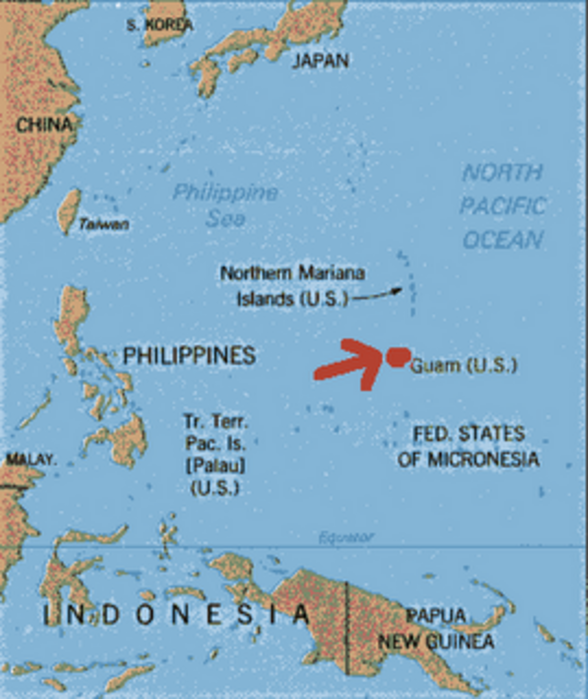
United States presidents rarely visit the U.S. territory of Guam (or Guåhan in the Chamorro language), but President Obama may visit in June 2010. This will be a significant stop for residents of this small island, 30 miles long and eight miles wide, dubbed, “Where America’s day begins.” Guam is the southern-most island in the Northern Mariana chain that also includes Rota, Tinian, and Saipan. It is the homeland of indigenous Chamorro people whose ancestors first came to the islands nearly 4,000 years ago. Formed from two volcanoes, Guam’s rocky core now constitutes an “unsinkable aircraft carrier” for the United States military in the words of Brig. Gen. Douglas H. Owens, a former commanding officer of Guam’s Andersen Air Force Base.1

The reason given for Obama’s unprecedented visit to the island in a White House Conference call by Ben Rhodes, Deputy National Security Advisor for Strategic Communications, is this:

While there he’ll not only visit with commanders but also with local Guam authorities. And he’s going to make sure that we have a very realistic and sustainable and well thought out approach to Guam. He has a vision which we refer to here as “one Guam, green Guam,” which is apropos of many of the questions heretofore, designed to make sure that we’re investing in capabilities on Guam that are sustainable over the course of time, that are clean energy focused, that do take very concrete steps to reduce the high price of energy on the island, and obviously will lead to an end state that’s politically, operationally, and environmentally sustainable.

So the President, while there, will also take a hard look at the project and infrastructure needs on Guam. We’ll obviously be looking at base-related construction that must take into accounts(sic) the needs of not only of an increased troop presence or Marine presence, but also the needs of the people of Guam, the impact on the environment, and the important role that the United States plays within the region… I’d rather just make clear that we have a commitment to the people of Guam, and that as part of our ongoing plan for our presence in the region, are going to make very common-sense and important investments in the infrastructure there.2

Barely mentioned in the shadows of these fine words with their emphasis on sustainability, are the real reasons for Obama’s visit: to rally community and official support for the Department of Defense plan to relocate 8,600 Marines from Okinawa (Japan) to Guam, provide additional live-fire training sites, expand Andersen Air Force Base, create berthing for a nuclear aircraft carrier, and erect a missile defense system on the island.

Military Bases on Guam 1991

Despite their economic dependence on the U.S. military, which occupies one-third of the island’s landmass and dominates the island’s economy, people in Guam have expressed strong opposition to the proposed enormous increase in the US military presence on economic, environmental, and cultural grounds. Due to Guam’s status as an unincorporated U.S. territory, however, local communities are highly constrained in their ability to influence the political process. Indeed, they were not even consulted when the expansion plans were developed. Jon Blas of the coalition We Are Guahan stated, “We have not been able to say yes or no to this. Hawaii said no. California said no. But we were never given the opportunity.”3 After more than a century of U.S. control, the justification of military development for purposes of “national security” has been widely accepted by most island residents, many of who rely on the military for jobs given the lack of alternative employment. However, following the release of the DOD’s Draft Environmental Impact Statement (DEIS) in November 2009, which for the first time revealed details of the proposed military build-up, community members started to question the enormous sacrifices they are being ordered to make in the name of “national security”.

The situation is complicated by the fact that the United States proposal is contingent on the willingness of the recently elected Democratic Party government of Japan to honor the previous administration’s agreement to relocate an established U.S. Marines base from a dense urban area in Okinawa to a new facility on a coastal site at Henoko in northern Okinawa. The former Japanese government had agreed to contribute $6 billion towards construction of the Henoko base and the relocation of Marines to Guam. The incoming coalition government was successful at the polls partly due to campaign commitments to review the U.S.-Japan military alliance in general, and the base construction in particular. Some members criticized Japan’s acquiescence toward U.S. foreign policy; others resented the U.S. “occupation mentality.”4

Defense Secretary Robert Gates and President Obama made hasty visits to Tokyo last fall, invoking the importance of the alliance and pressing to keep the Okinawa-Guam accord intact. Indicative of the turn in opinion, some Japanese media bridled at this “bullying” and “high-handed treatment.” Prime Minister Hatoyama announced that his government would make its decision on the Futenma relocation issue by December 2009, later deferring a response until May 2010. In a March 3rd interview with the Asahi Shimbun, Richard P. Lawless, former deputy undersecretary of Defense for Asia-Pacific affairs, who was involved in negotiating the agreement with Japan, expressed frustration that “the Japanese government seems intent on playing domestic politics and doesn’t fully understand the magnitude of the issue.”5 Under steady US pressure, the Hatoyama government in early May abandoned its resistance to the Henoko plan. The question remains, however, whether it is prepared to impose its will on an Okinawan population which strongly opposes the new base. Meanwhile, Guam’s Congressional representative, Madeleine Bordallo, who fervently supported the military build-up as the primary way to boost Guam’s weak economy has moderated her position with a range of stipulations as a result of the outpouring of pubic testimony at town hall meetings, public hearings, community events, and in media reports. This article examines the issues of base expansion on Guam and assesses the movement against military expansion on Guam.

History of Guam

Archeological evidence indicates that Guam’s indigenous Chamorro people first arrived in these islands around 2,000 BCE. Chamorros lived in coastal villages where they fished, farmed, and hunted to sustain themselves. They were skilled navigators who traded throughout Micronesia. The arrival of Ferdinand Magellan in the Marianas in 1521 marked the first contact with the western world. In 1565, Spain sent an expedition to claim Guam for the Spanish Crown and in 1668 Father Diego Luis de San Vitores started a Catholic mission. This foreign influence, with attendant violence and epidemics of diseases, decimated the local population.

Latte stones, the foundations of Chamorro homes from 500 A.D.

For 250 years, Spanish galleons plied between Asia, Europe and the Americas, carrying silks, spices, porcelain, cotton, and ivory from Manila to Acapulco, the viceroyalty of New Spain (Mexico). These goods were then transported overland to Vera Cruz and loaded onto ships for Spain. On the return journey, cargo included Mexican silver, Spanish administrators, missionaries, and provisions for the garrison in the Marianas. En route from Acapulco, the vessels replenished supplies of food and water on Rota and Guam.6

Spain remained Guam’s colonizer until the conclusion of the Spanish-American War. Under the terms of the 1898 Treaty of Paris, Cuba, Guam, Puerto Rico, and the Philippines were ceded to the United States. Spain sold the Northern Mariana Islands and the Caroline Islands to Germany, thus separating Guam politically and culturally from neighboring islands in the Marianas and throughout Micronesia. President McKinley placed Guam under the jurisdiction of the Department of the Navy, which used the island as a refueling and communications station. During this time, Naval admirals served as governors and most administered the island as though they were running a ship.7 The Naval administration also regulated land acquisition, the sale of liquor, marriages, taxation, agriculture, and schooling. An old military plan to put Chamorro people on reservations in the north and south of the island, leaving two-thirds of the land for military use, did not materialize.8 However, people’s demand for citizenship was denied as an encroachment on military control.9

On December 8, 1941, Japanese warplanes bombed U.S. military installations on Guam, the same day as the attack on Pearl Harbor. Japanese forces took the island two days later and renamed it “Omiya Jima”.10 For 31 months the people of Guam were subjected to hardship and atrocities inflicted by the Japanese Imperial Army; including forced labor to build runways, incarceration in concentration camps (such as Manenggon), executions, slaughter, forced prostitution, and rape. Chamorros resisted the Japanese invasion and, in allegiance to the U.S., assisted in hiding an American soldier, George Tweed, from Japanese forces for the entire occupation period. Recollections of World War II experiences evoke tears and trauma memories for most war survivors to this day.11

Hailed as “liberation forces,” U.S. troops landed on Guam on July 21, 1944 after thirteen consecutive days of naval bombardment in which thousands lost their lives.

Planting the US flag on Guam

The bombing, followed by fierce combat, ravaged the island, and the main city of Hagatna was virtually destroyed. As soon as the U.S. military secured Guam, they turned the island into a strategic forward base for the final push toward Japan. As was occurring in Okinawa at approximately the same time, thousands of acres were taken for the construction of naval and air force facilities and many Chamorros were dispossessed of their ancestral clan lands (such as the village of Sumay) and moved to neighboring locations designated by the U.S. military.

Political and Economic Status

The Organic Act of Guam passed by the U.S. Congress in 1950 made Guam an unincorporated territory of the United States with limited self-governing authority. The Organic Act placed Guam under the administrative control of the Department of the Interior. With a current population of approximately 173,456, Guam is one of 16 non-self-governing territories listed by the United Nations, and represented by one non-voting delegate in the U.S. Congress. Residents are U.S. citizens but not entitled to vote in presidential elections. Federal-territorial policies are decided in Washington, 7,938 miles away, placing a number of restrictions on the island and hampering the development of a viable civilian economy.

Prior to WWII, Guam was self-sufficient in agriculture, fishing, hunting, and husbandry. US Naval administrators encouraged food production for local and military needs.12 Nearly every family grew vegetables and produced meat; some specialized in fishing; and there was a viable copra industry.13 Following World War II, the military took a large portion of arable land to build bases and other installations, equivalent to nearly 50 percent of the island’s landmass, including some of the most fertile land near popular fishing grounds. Since then, some lands have been returned following civic protest, with the U.S. presently occupying nearly one-third of the island, part of which is not presently being used. Currently, nearly 90 percent of Guam’s food is imported.

The island’s economy is geared toward the military: both in support of the US military and in charting the career path for youth. The military is by far the major employer, with most families connected to someone serving in the military or employed to support military operations. There are three JROTC programs in the island’s public high schools, as well as an ROTC program at the University of Guam. According to Washington Post reporter Blaine Harden, “Guam ranked No. 1 in 2007 for recruiting success in the Army National Guard’s assessment of 54 states and territories.”14 A key reason for this is economic. Poverty rates on Guam are high, with 25% of the population defined as poor. Between 38% and 41% of the island’s population qualifies for Food Stamps. Wage rates are low; schools are underfunded; and there are few opportunities for technical training on the island. The fact that Guam was occupied by Japan during World War II is another issue in recruitment. Harden notes:

“People here grow up with war ringing in their ears—as described by their grandparents… ‘If there is a group of Americans who understand the price of freedom, we do,’ said Michael W. Cruz, lieutenant governor of Guam and a colonel in the Army National Guard. Cruz’s grandmother …was held in a concentration camp. She was forced to watch as Japanese soldiers chopped off the heads of her brother and her eldest son. Her eldest daughters were forced into prostitution.”15

Many young people yearn to leave “the rock” to continue their education, to find work, and to experience a wider world. Indeed, more Chamorros currently live outside Guam than on the island, a social indicator consistent with that of other indigenous peoples who have a colonial history.

The island’s infrastructure is poor. The only civilian hospital operates at 100% capacity three weeks out of the month and its school system struggles to meet payroll several times a year. The island’s water supply is barely adequate to sustain the current population and the only civilian landfill for trash disposal is nearly at full capacity. Government of Guam agencies that oversee education, mental health, substance abuse, and the landfill are currently under federal receivership, meaning that the federal government has hired an independent entity to take over certain functions of these agencies due to substandard conditions.

The other significant industry on Guam is tourism, mainly catering to visitors from Japan, Korea, and Taiwan on 3-4 day tours. Tour companies offer fishing trips, beach weddings, honeymoon suites, and golf courses (including a 24-hole course). Major hotels surround the beautiful Tumon Bay, a “mini Waikiki,” with name-brand stores, dance clubs, and strip clubs. Tourism provides sporadic, low-paying jobs for local people, but has declined in recent years due to economic recession, especially the weakness of the Japanese economy.

Fortress Pacific: Proposed Military Build-up

Guam’s military significance is being redefined as part of a major realignment and restructuring of U.S. forces and operations in the Asia-Pacific region. According to Captain Robert Lee, “We’re seeing a realignment of forces away from Cold War theatres to Pacific theatres and Guam is ideal for us because it is a US territory and therefore gives us maximum flexibility”.16 Much may be coded into the phrase “Pacific theaters”, but a key point is that Guam’s status as a U.S. territory gives military planners great freedom of operation without having to negotiate with another national government.

The proposal released by the Pacific Command in 2006, comprised several elements:

Transfer of 8,000 Marines from Okinawa and 1,000 Army personnel from South Korea by 2014;

Development of a Marine Corps base and training area;

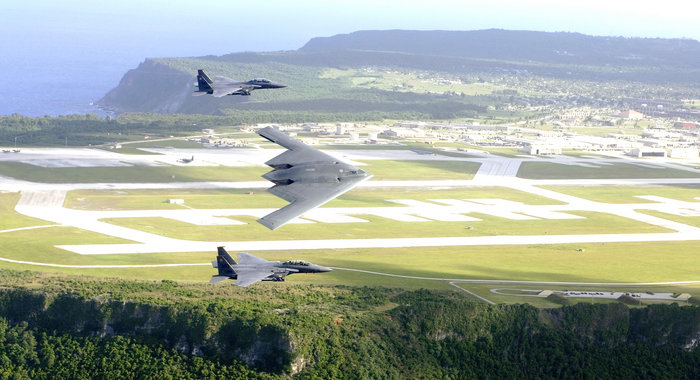
Expansion of Andersen AFB as part of the Global Strike Force, including home-based B52s, and rotation of B1 supersonic strike aircraft and B2 Stealth bombers from Hawaii, Alaska, and continental U.S.;

Expansion of U.S. Naval Base, for submarines and aircraft carrier groups—already 3 nuclear-powered submarines are home-based, with 3 more subs planned. Expansion to include nuclear aircraft carrier transient operational capability (the U.S. military will have 6 of its 11 nuclear submarines in the Pacific by 2010); and

Ballistic Missile Defense capability to intercept attack against assets.

Andersen Air Force Base

Described as the “largest project that the Department of Defense has ever attempted,17 this plan also defines Guam as a power projection hub, the “tip of the spear,” “Fortress Pacific,” and “America’s unsinkable aircraft carrier.” Commenting on this military investment, Admiral Johnson said: “Guam is no longer the trailer park of the Pacific. Guam has emerged from backwater status to the center of the radar screen. This is rapidly becoming a focus for logistics, for strategic planning.”18 He noted, “Guam also offers the Air Force’s largest fuel supply in the United States, its largest supply of weapons in the Pacific and a valuable urban training area in an abandoned housing area at a site known as Andersen South.”19

Addressing service members posted to Guam, a military website waxes enthusiastic about the pleasures of Guam for military personnel:

Have you received orders to Guam? … Forget what you have heard. You are heading to a true Pacific Island tropical paradise … Guam offers wide beaches, snorkeling and scuba diving, deep-sea sport fishing, world-class golf courses, lush tropical jungles and a rich cultural and historical heritage. The Commander Naval Region Marianas main base and Andersen Air Force Base each have large well stocked commissaries and exchanges, well equipped and managed Morale Welfare and Recreation clubs and facilities… private military beaches, a marina and other dedicated military recreational facilities… plus great dining and varied nightlife.20

Between 2006 and 2009, while Department of Defense contractors prepared a Draft Environmental Impact Statement as required under the National Environmental Policy Act, speculation was rife among business owners, elected leaders, and community members about the projected population increase, the economic impact of military expansion, and the consequences of the addition of tens of thousands of people on the already fragile and contaminated social and environmental infrastructure. Arguments in favor of the anticipated construction boom emphasized economic growth and the potential for expanded services and amenities. Opponents were skeptical about the much-touted economic advantages. They argued that the island lacks the environmental capacity for a major increase in population; that military-related personnel could outnumber the Chamorro population, currently 37% of the total; and that Guam’s status as an unincorporated territory and its dependence on the federal government makes it difficult for leaders to take an independent political position. Moreover, opponents criticized inadequate opportunities for public meetings and comment.

The voices of the Guam Chamber of Commerce and other business leaders have shaped public discussion. In their view, the militarization of the island is the only viable means to boost Guam’s weak economy. Contractors have been lining up—from Washington-DC, to Hawaii, the Philippines, Australia, New Zealand, and Japan—jockeying for a piece of the action. “On Capitol Hill, the conversation has been restricted to whether the jobs expected from the military construction should go to the mainland Americans, foreign workers or Guam residents,” commented Democracy Now reporter Juan Gonzalez.21 “But we rarely hear the voices and concerns of the indigenous people of Guam, who constitute over a third of the island’s population”. More recently, Chamorro human rights attorney, Julian Aguon, and Chamorro educator and poet, Melvin Won Pat-Borja, have articulated dissent to the planned build-up on Democracy Now in an effort to gain national and international support for their struggle.

When the military held Environmental Impact meetings in Guam, Saipan, and Tinian in April, 2007, some 800 people attended and over 900 comments were received. Concerns included social, economic and cultural factors, international safety, law enforcement, transportation and infrastructure issues, marine resources/ecology, air quality, water quality, and overloading limited resources and services. In January 2008, Congresswoman Donna Christensen from the Virgin Islands convened U.S. Congressional Hearings on Guam, on an invitation-only basis. Protests resulted in the inclusion of public testimony as an “addendum” to the official proceedings. A year later, the Joint Guam Program Office (JGPO) held public meetings. Far from responding to the concerns voiced during earlier hearings, the JGPO announced that the military planned to take additional lands, including 950 acres for a live firing range. Although people stated concerns, there were no recording devices to document community sentiment.

Organizers created educational spaces as a way to get information to the public, including “Beyond the Fence” a one-hour weekly public radio show. Faculty members at the University of Guam organized public forums for community education and discussion regarding the proposed build-up, including talks by Prof. Catherine Lutz, editor of Bases of Empire; former U.S. Army Colonel Ann Wright; and activists from Okinawa, mainland Japan, and Hawaii. In September 2009, the university hosted presentations by participants of the 7th International Network of Women Against Militarism conference, women who live with the effects of U.S. bases and military operations in their home communities. This included scholars and activists from Australia, Commonwealth of the Northern Mariana Islands, Republic of Belau (Palau), Hawaii, Japan, Marshall Islands, Okinawa, the Philippines, Puerto Rico, South Korea, and the continental United States.

At the international level, the United Nations Special Committee on Decolonization is another venue for speaking out about the military proposals. Attending its October 2008 meeting, several Chamorro speakers expressed concern over the planned military expansion, arguing that this “hyper-militarization” poses grave threats to the Chamorro people’s right to self-determination as the influx of military personnel and their dependants could challenge locally established law creating a Commission on Decolonization and asserted their right to vote. This concern about self-determination is particularly grave in light of the absence of a system to ensure that military personnel and their families do not register to vote in two different jurisdictions. They also argued that increased militarization would devastate the environmental, social, physical and cultural health of Guam. A representative of the Chamoru Nation urged the U.N. committee to send representatives to the island to conduct an assessment of the current situation on the island’s people.22 A follow-up delegation was sent to the U.N. in 2009 and the next visit is planned for May 2010 bearing the same message and concerns.

U.S. Military Legacy to Guam

Opponents of the build-up have emphasized the negative impact of the U.S. military on Guam, manifested in poor health, radiation exposure, contaminated and toxic sites, curbing of traditional practices such as fishing, and major land takings, which started in the early 20th century. The incidence of cancer in Guam is high and Chamorros have significantly higher rates than other ethnic groups.23 Cancer mortality rates for 2003-2007 showed that Chamorro incidence rates from cancer of the mouth and pharynx, nasopharynx, lung and bronchus, cervix, uterus, and liver were all higher than U.S. rates.24 Chamorros living on Guam also have the highest incidence of diabetes compared to other ethnic groups, and this is about five times the overall U.S. rate.

The entire island was affected by toxic contamination following the “Bravo” hydrogen bomb test in the Marshall Islands in 1954.25 Up to twenty years later, from 1968 to 1974, Guam had higher yearly rainfall measures of strontium 90 compared to Majuro (Marshall Islands). In the 1970s, Guam’s Cocos Island lagoon was used to wash down ships contaminated with radiation that had been in the Marshall Islands as part of an attempt to clean up the islands. Guam’s representative, Madeleine Bordallo, introduced a bill in Congress in March 2009, to amend the Radiation Exposure Compensation Act (RECA) to include the Territory of Guam in the list of affected “downwinder” areas with respect to atmospheric nuclear testing in Micronesia (HR 1630). In April 2010, Senator Tom Udall introduced an amendment to RECA with the inclusion of Guam for downwinders’ compensation. While these initiatives have been the priority of the Pacific Association for Radiation Survivors for over five years now, people on Guam have yet to receive compensation for their suffering. The territory currently qualifies for RECA compensation in the “onsite-participants” category but not for downwind exposure.

Andersen AFB has been a source of toxic contamination through dumpsites and leaching of chemicals into the underground aquifer beneath the base. Two dumpsites just outside the base at Urunao were found to contain antimony, arsenic, barium, cadmium, lead, manganese, dioxin, deteriorated ordnance and explosive, and PCBs.26 Other areas have been affected by Vietnam-war use of the defoliants Agent Orange and Agent Purple used for aerial spraying, which were stored in drums on island. Although many of the toxic sites on bases are being cleaned up, this is not necessarily the case for toxic sites outside the bases.

Draft Environmental Impact Statement

The Draft Environmental Impact Statement (DEIS) regarding the military build-up was released in November 2009, a nine-volume document totaling some 11,000 pages, to be absorbed and evaluated within a 90-day public comment period. In response, there was an outpouring of community concern expressed in town hall meetings, community events, and letters to the press. Despite its length, the DEIS scarcely addressed questions of social impact, and it contains significant contradictions and false findings that were exposed in public comments and in the media. Some stated plans contained in the DEIS were outright flawed, as admitted by a DOD consultant.

Several major concerns have been raised with respect to the following issues: the impact of up to nearly 80,000 additional people on land, infrastructure and services; the “acquisition” of 2,200 acres for military use; the impact of dredging 70 acres of vibrant coral reef for a nuclear aircraft carrier berth; and the extent to which the much-touted economic growth would benefit local communities.

Impacts of population increase. A top estimate for increased population is nearly 80,000, a 47 percent increase over current levels; including troops, support staff, contractors, family members, and foreign construction workers. Proponents emphasize that the construction workers constitute a transient labor force that will leave when their contracts are over. Others argue that some will stay, marry, have children, and hope to get other work, as happened during the last major period of military construction in the 1970s. These people will be an added burden on local services that are already stretched to capacity because they will be housed off-base, will not use on-base medical services, and will be consumers of the island’s infrastructural resources.

Impacts on land and ocean. The military seeks to acquire an additional 2,200 acres of private and public land, which would bring its land holdings to 40 percent of the island. Included in the lands ear-marked for acquisition is the oldest Chamorro village of Pagat, registered at the Department of Historic Preservation as an archaeological site, with ancient latte stones of great cultural significance. The Marines propose to use the higher land, above the historic site, for live fire training but seek to control the entire area, from the higher land down to the ocean, where there are beautiful beaches. This proposal, described as “sacrilege” by local people, would restrict their access to the site to just seven weeks out of the year. The military already has a live-fire range on Guam and also on Tinian, where it controls nearly two-thirds of the island through leases with the government of the Commonwealth of the Northern Mariana Islands (CNMI). Many community members argue that the military, which already controls a third of the land area of Guam, should stay within this existing “footprint”.

A key question is whether the DOD would purchase, lease, or use powers of eminent domain to acquire land identified in the DEIS. Addressing the Guam Legislature on February 16, 2010, Congresswoman Bordallo formally opposed the use of eminent domain for the acquisition of lands. Speaking of Nelson family clan land designated for acquisition, Gloria Nelson, former Director of the Department of Education, stated in a DOD-sponsored public hearing on the Marianas Build-Up, “I don’t want to talk about the market value of my land because my land is not on the market.”

Another highly controversial proposal is the creation of a berth for a nuclear aircraft carrier, which will involve the detonation and removal of 70 acres of vibrant coral reef in Apra Harbor. Environmentalists and local communities oppose this on the grounds that coral provides habitat for a rich diversity of marine life and is endangered worldwide. Environmentalists also question how the disposal of huge quantities of dredged material would affect ocean life and warn that such invasive dredging may spread contaminants that have been left undisturbed in deep-water areas of the harbor. Opposition to this plan has been expressed by the Guam Fishermen’s Cooperative and the U.S.-based Center for Biological Diversity. On February 24, 2010, Guam Senator Judith Guthertz wrote a letter to the Secretary of the Navy, Ray Mabus, reiterating her proposal that the existing fuel pier that has been used by the USS Kitty Hawk be used as the site for the additional berthing to avoid the proposed dredging of Apra Harbor. Such an alternative plan would avoid the destruction of acres of live coral.

Economic Costs and Benefits

Since the announcement of the relocation plan to transfer 8,000 Marines and their dependents from Okinawa to Guam, the general sentiment shared by the media and members of the island’s business community is that the transfer would stimulate the local economy. In January 2010, the Guam Chamber of Commerce published a white paper entitled, “An Opportunity that Benefits Us All: A Straightforward, Descriptive Paper on Why We Need the Military Buildup.” Among the benefits presented are opportunities for the creation of employment, fostering business and entrepreneurship, the generation of revenues, and the expansion of tourism.

The overall cost of the buildup has been estimated at $10-15 billion. The DEIS makes it clear that this money is solely for new military construction on existing bases, on newly acquired lands, or for the expansion of a road to connect the bases. The DEIS assumes that most construction jobs will go to contract workers from Hawaii, the Philippines, or other Pacific-island nations, who can be expected to send most of their earnings as remittances to families back home. Military personnel are likely to spend much of their money on-base.

An economist at the University of Guam, Claret Ruane, published a paper examining the macroeconomic multipliers used in the DEIS to compute projected economic growth as a result of the military buildup. It states, “…that economic studies that use Hawaii’s spending multiplier tend to present a rosier picture of the positive economic impacts of proposed changes.” Ruane recomputes the multiplier and suggests that while the DEIS reflects the highest gains at $1.08 billion in 2014, a more realistic estimate is $374 million in the same year. It is noteworthy that 2014 is the year with the highest expected impact on the Gross Island Product.

The Guam Economic Development Authority estimated costs to local government at around $1 billion although the governor has said this is more likely to be $2-3 billion. More recently, it has been reported that the island will need $3-4 billion to upgrade its utilities infrastructure. While grants have recently been awarded to the Government of Guam for infrastructural upgrades, they do not begin to cover the costs necessary for the anticipated population influx.

Additional negative impacts include increased noise, worse traffic congestion, and higher rental prices. As local people earn considerably less than military personnel, they will be crowded out of the rental market. Other potential problems include the likely increase in crime and prostitution, increased dependence on the U.S., and an undermining of Chamorro culture and right to self-determination.

Shift in Leadership Stance

Both Congressional Representative Bordallo and Governor Felix Camacho have wavered in their positions after hearing the outpouring of popular opinion. At the start of the DEIS process, Bordallo was quiet about concerns in the proposed DOD plan. After attending town hall meetings for two days where people passionately shared personal testimonies, she listed several significant stipulations in her address to the Guam Legislature on February 16, 2010 stating that she will do the following:

support limiting all military expansion to Defense Department properties on island;

oppose any federal effort to acquire additional land by eminent domain;

challenge aircraft carrier berth plans that will result in significant loss of coral;

call for increased federal assistance and a clear strategy for improving the island’s roads, schools, water and wastewater, and Guam’s only seaport to support the buildup;

oppose drilling any new wells to accommodate the Marine relocation until an independent assessment is made about the capacity of the northern aquifer;

argue that all contract workers must be housed on-base. Any proposal to house guest workers outside the gates must address their impact on civilian infrastructure such as water, wastewater and power.

argue that all contract workers must use military health and other facilities. The study on the socioeconomic impacts of the buildup must be rewritten to address these impacts.

Nonetheless, Congresswoman Bordallo framed her remarks by reminding residents of the need to work together to address these challenges because of the buildup’s importance to the region. “We are not embarking on this buildup solely for economic reasons. We are doing this because we appreciate more than any other American community our liberation and our freedom and the sacrifices it will take to preserve that freedom for generations to come”.27

Congresswoman Bordallo met with Governor Felix Camacho and members of the Guam Legislature in February and March to reach a consensus on buildup issues. The Governor and Speaker Judith Won Pat both said Bordallo’s speech underscored their concerns.28 In addition, Bordallo and Camacho are now asking that the move of the Marines be spread out over a longer period of time to lessen its overall impact and in order to phase the financing.

Outside Guam, Senator Jim Webb, a member of the Senate Committee on Armed Services and Chair of the East Asia and Pacific Affairs Subcommittee of the Senate Foreign Relations Committee, voiced agreement with some of these points. After visiting Guam to assess the build-up plan, he commented:

The U.S. military occupies or retains over one-third of the island’s territory, and I do not believe that additional lands should be acquired. If they must be acquired out of a national security interest, the U.S. government out of respect for the people of Guam should seek private arrangements for use of the land and not exercise its right of eminent domain.29

He noted “great concerns” about the plan to place live-fire ranges on Guam for Marine Corps training, and recommended that this be transferred to Tinian. Finally, he urged the government to provide “the civilian infrastructure and services needed to support an increased population on the island. The priorities include port modernization, water acquisition, wastewater treatment, healthcare, and schools.”30

In addition, the Environmental Protection Agency (EPA), charged with evaluating and commenting on federal projects that might harm the environment, gave the DOD’s DEIS a scathing review. The EPA’s unusually harsh critique has generated concern in Washington and the interest of New York Times and Washington Post reporters have given it increased media visibility.

In their 95-page analysis, EPA scientists’ main concerns are the inadequacies of DOD plans to address the water supply and wastewater treatment needs of the increased population, which “will result in unsatisfactory impacts to Guam’s existing substandard drinking water and wastewater infrastructure which may result in significant adverse public health impacts” and “unacceptable impacts to 71 acres of high quality coral reef ecosystem in Apra Harbor”.31

The DOD must consider all public comments on the DEIS, but the EPA cannot compel compliance. However, the EPA has already referred the DEIS to the White House Council on Environmental Quality (CEQ), a high-level federal interagency body that can make recommendations directly to the President as to whether a project should be abandoned or modified in cases where discussion is in process among the DOD, EPA, USDA, and Department of the Interior. Also, together with the Army Corps of Engineers, the EPA is authorized to grant or withhold permits for detonation of the coral. Many opponents of the build-up felt vindicated by the EPA’s review. Congresswoman Bordallo and acting Governor, Michael Cruz, also praised the critique and called on the DOD to address the concerns raised.32

One Guam, Two Guams

Many public comments on the DEIS focused on unequal amenities and opportunities inside and outside the military fencelines: military personnel have higher earning power than members of local communities; the military hospital and on-base schools have better facilities than the civilian hospital and public schools; water use by a larger military population is likely to result in shortages for local people; private military beaches deny local community access to their ancestral heritage. Some commentators refer to a double standard, the parallel existence of Two Guams; one opponent of the build-up called it an “apartheid” system.

In mid-March 2010, the White House, sensitive to the criticisms of the environmental impact statement, issued a press statement emphasizing the administration’s commitment to “One Guam, Green Guam”, quoted earlier, promising to balance the military’s needs with the concerns of local people, to promote renewable energy, and to reduce fuel and energy costs on the island. As detractors noted, this does not address people’s core concerns. Is it possible to undertake a vast military expansion with sensitivity to the environment and other critical issues?

Educating and Organizing

The gradual increase in education and organizing on Guam has resulted in an outpouring of public questioning and opposition. In turn, this has been instrumental in causing a shift in the positions of several key leaders, high-level discussion in Washington, and Obama’s plan to visit Guam in June 2010– a stop-over postponed from March due to the Congressional vote on healthcare reform.

Long-standing community connections and Chamorro cultural revival, with an emphasis on reclaiming history, language, literature, and ancient traditions, have been a foundation of the movement against militarization. Groups like I Nasion Chamoru, Guahan Coalition for Peace and Justice, Tao’tao’mona Native Rights, and Guahan Indigenous Collective have mobilized different sections of the island community. A new coalition, We Are Guåhan, brought together people from diverse ethnic and occupational backgrounds to advocate for transparency and democratic participation in decisions regarding the future of the island. In California, Famoksaiyan is active in urban centers, particularly among young Chamorros in diaspora.

Because the proposed build-up involves transferring Marines from Okinawa, alliances between Chamorro groups, Okinawan anti-bases activists, and partner organizations in mainland Japan have strengthened opposition to military base expansion in all three places, as organizers stand together in solidarity trying to stop the military from pitting one community against another. Through Pacific-islander networks, Chamorro activists are supported by veteran organizers from Belau, the Marshall Islands, and Hawaii; they are also linked to communities in Latin America and Europe resisting U.S. military expansion through the No US Bases Network.

Chamorro activists are aware of the experiences of long-standing opposition anti-base movements in Okinawa, where opposition over a decade has thus far thwarted US plans to construct a new base at Henoko. Likewise, in South Korea, village residents and supporters waged a 3-year struggle from 2004-2007 to stop the U.S. military taking productive farmland for base expansion in the Pyongtaek area south of Seoul, and current opposition centers on a proposed new Navy base on Jeju Island south of the Korean peninsula.

Okinawan opposition to U.S. bases goes back to 1945, with support from disaffected U.S. troops, particularly African Americans, in the 1970s, and leadership provided by an anti-base governor and Japanese and Okinawan activists during the 1990s. Thousands of Okinawans have worked on U.S. bases as civilians; some receive rent for military use of their land from the Japanese government. Dispossessed Okinawan landowners have been among the participants in the anti-base movement. One significant difference between Okinawa and Guam is the fact that, despite the huge bases located in Okinawa, the U.S.-military economy is now estimated to account for less than 10% of the Okinawan economy, even including indirect income. Like Guam, Okinawa was decimated during World War II; people were dislocated and much of the most fertile land was appropriated for U.S. bases before they were allowed to rebuild their villages. By contrast, Guam has been under colonial rule for centuries. The population is much smaller than Okinawa, and two-thirds of Guam’s residents are outsiders, many of whom are attached to the military. In addition, islanders’ U.S. patriotism runs deep with wartime experiences as recent as World War II and the “liberation” of the island from Japan by U.S. forces. Guam is heavily dependent on the military, which shapes the local economy, patterns of land-use, political priorities, and perhaps most dangerously, the psyches of the people.

The military is adept at playing off one community against another as it seeks to control land and resources to support its over-riding mission: readiness and global domination. After the Philippine Senate withdrew permission for the U.S. Navy to use Subic Bay Naval Base, nuclear submarines started docking at White Beach, Okinawa. Now concerted Okinawan opposition to U.S. bases, specifically the Marines base at Futenma and plans to build a new base at Henoko is being used by the military to put pressure on other locations in the region, notably Guam and Tinian, a small Mariana Island that is politically a part of the Commonwealth of the Northern Mariana Islands (CNMI). Two-thirds of Tinian is currently leased by the U.S. military as part of the CNMI commonwealth negotiations. While members of the Japanese Social Democratic Party have suggested Tinian as an alternative for the Futenma relocation, some islanders have begun to organize a resistance movement. Most recently, the Republic of Belau (Palau) Senate has asked its President to offer its island of Angaur as an alternative location for the Marines base at Futenma.

The struggle against increased militarization on Guam and the Marianas is at a critical stage. After the marathon effort to respond to the DEIS, local organizers are working to keep up with the fast pace of political developments taking place in Washington, balancing the urgency of the hour with longer-term concerns. Given the difficult of getting mainstream media coverage in the continental U.S., the PBS release of Vanessa Warheit’s documentary, The Insular Empire, screened on the island and in selected U.S. cities in March and April 2010, was well timed. There is an urgent need for public education and solidarity actions in the Asia Pacific region and continental United States to increase pressure on the Japanese and U.S. governments regarding the proposed build-up. In January 2010, residents of Okinawa’s Nago City elected a mayor who opposes the construction of the new Marines base in nearby Henoko. The Washington Post quoted Lt. Gen. Keith J. Stalder, commander of U.S. Marine forces in the Pacific as saying, “National security policy cannot be made in towns and villages”.33 In Okinawa and Guam, the question is whether military objectives trump democracy. As Richard P. Lawless told the Asahi Shimbun, “there is no plan B on Henoko”.34 On May 4, under relentless U.S. pressure, Prime Minister Hatoyama visited Okinawa to announce that he would bow to U.S. demands to proceed with the construction of the base at Henoko. The Okinawan population, however, has never been more united in its opposition to construction of a new base on the island.

Commenting on the fact that President Obama is expected to leave the military enclave of Andersen Air Force Base to meet Guam’s leaders and officials during his June visit, Judith Won Pat, Speaker of the Guam Legislature, said that, “the Obama visit appears to be a ‘game-changing’ move to gain local support”.35 The President should take this opportunity to hear people’s deep concerns about the impact of so many additional people on their already weak and overburdened infrastructure, fragile ecosystem, and island culture. He should listen to respected historians like Hope Cristobal, a former Guam senator, and to women leaders, professors, and state representatives active in Fuetsan Famalao’an, who have come together out of concern over the military buildup. He should visit the Hurao Cultural Camp that teaches young children Chamorro language and culture. He should hear the Chamorro people’s deep love for their land, seeking to honor their ancestors and provide for their children. Above all, he should rethink the expansion of U.S. bases in Okinawa, Guam and South Korea. A small fraction of the 2011 federal budget, proposed at $3.8 trillion and including $708 billion for the Department of Defense, could provide residents of Guam with needed medical and educational facilities and improved infrastructure. It could clean-up contaminated water, underwrite job-training programs, and provide for projects that emphasize economic, environmental and cultural sustainability and security. This is a vision for One Guam that leaders in Washington and Guam should consider and support.

LisaLinda Natividad, Ph.D. is an Assistant Professor with the Division of Social Work at the University of Guam. She is also President of the Guahan Coalition for Peace and Justice.

Gwyn Kirk, Ph.D. is visiting faculty in Women’s and Gender Studies at University of Oregon (2009-10) and a founder member of Women for Genuine Security (www.genuinesecurity.org).

Recommended citation: LisaLinda Natividad and Gwyn Kirk, “Fortress Guam: Resistance to US Military Mega-Buildup,” The Asia-Pacific Journal, 19-1-10, May 10, 2010.

Further Resources

Link 1

Link 2

Maga’haga: Guam Women Leaders Say No to the Military Build-up (Part 1 of 2) on youtube.com.

Vanessa Warheit, The Insular Empire (Horse Opera Productions, 2009)—screened on PBS. Link.

Notes

1 Accessed here.

2 Kerrigan, Kevin. www.pacificnewscenter.com, March 16, 2010.

3 We Are Guåhan press release, March 11, 2010.

4 McCormack, Gavan. 2010. The Travails of a Client State: An Okinawan Angle on the 50th Anniversary of the US-Japan Security Treaty, The Asia-Pacific Journal.

5 Kato, Yoichi. 2010. U.S. Official: Japan Could Lose Entire Marine Presence If Henoko Plan Scrapped. Asahi Shimbun. 3/5/10 online here.

6 Accessed here.

7 Department of Chamorro Affairs, 2008. I Hinanao-ta: A pictorial journey through time. p. 24.

8 Personal communication, Hope Cristobal, historian and former Guam Senator, Sept. 2009.

9 Department of Chamorro Affairs 2008.

10 Accessed here.

11 Palomo, Tony. “Island in Agony: The War in Guam,” in Geoffrey M. White, ed., Remembering the Pacific War. Occasional Paper 36, Center for Pacific Island Studies, School of Hawaiian, Asian & Pacific Studies, University of Hawai’i at Manoa, 1991,133-44.

12 Department of Chamorro Affairs 2008, 25

13 Department of Chamorro Affairs 2008, 25, 34

14 Accessed here.

15 op. cit.

16 Bohane, B., America’s Pacific Speartip, The Diplomat, Sept/Oct. 2007.

17 Assistant Secretary of the Navy, B. J. Penn quoted in Bohane, B., America’s Pacific Speartip, The Diplomat, Sept/Oct 2007, 25.

18 Brooke, James. Guam: What the Pentagon Forgets it Already Has, New York Times, April 7, 2004.

19 op cit

20 Accessed here.

21 Accessed here.

22 Accessed here.

23 Haddock, R. L., & Naval, C. L., 1997. Cancer in Guam: A review of death certificates from 1971-1995. Pacific Health Dialogue, 4(1), 66-75. p. 74.

24 Guam Cancer Facts and Figures 2003-2007, published by the Department of Public Health and Social Services Guam Comprehensive Cancer Control Coalition (October 2009).

25 de Brum, Tony. BRAVO and Today: US Nuclear Tests in the Marshall Islands The Asia-Pacific Journal May 19, 2005

26 EPA/Record of Decision /R09-04/002 2004, 1-1. Accessed here.

27 Tamondong, Dionesis. 2010. “Bordallo Addresses Buildup,” Pacific Daily News, February 17, 2010. Accessed here.

28 op cit

29 Accessed here.

30 op cit

31 Accessed here.

32 Weaver, Teri. 2010. EPA analysis finds military’s plan for Guam growth is ‘inadequate,’ Stars and Stripes, Pacific edition. Saturday February 27. Accessed here.

33 Harden, Blaine. 2010. Mayor’s election in Okinawa is setback for U.S. air base move, Washington Post 1/25/10. Accessed here.

34 Kato 2010.

35 Cited by Jeff Marchesseault, February 1, 2010, from this source.

Hawai’i Okinawa Alliance calls for demonstration in solidarity with Okinawa and All Pacific

PAN-PACIFIC RALLY TO DEMILITARIZE THE PACIFIC:

SOLIDARITY WITH OKINAWA, GUAM, TOKUNO ISLAND, KOREA & HAWAI`I

END THE OCCUPATION OF FUTENMA!

PRINCE KUHIO FEDERAL BUILDING, HONOLULU (300 ALA MOANA BLVD & PUNCHBOWL)

FRIDAY, MAY 14, 2010 4:30-6:30

On May 16, 2010, Okinawans will be encircling Futenma Marine Corps Air Station in Ginowan City, Okinawa, forming a human chain around the enormous military base as a vote of mass opposition and solidarity against further base expansion in Okinawa, particularly Henoko in northern rural Okinawa, the proposed site of Futenma’s relocation.   On May 14, diverse people of O`ahu will gather in solidarity with the Futenma rally and other people’s movements throughout the Pacific.

However, this isn’t just about Okinawa.  This is an international problem.  US military forces are deployed in 130 countries around the world, with permanent bases in 50 nations and growing.  Because of local resistance in Okinawa, alternative sites have been proposed, such as in Guam and Tokuno Island in the Ryukyu Archipelago (north of Okinawa).  From the illegal overthrow and military occupation of Hawai`i in 1893, the US, along with other colonizers, have occupied nations throughout the Pacific with military forces and agendas.  We stand with our Pasifika sisters & brothers united against further military occupation and expansion, including localities not mentioned in this appeal.

We demand the clean-up and return of lands back to civil societies to restore true human security and self-determination throughout our island homes.  Recent proposals to relocate forces from Okinawa to Guam, the Marianas, and Tokuno Island are just spreading this problem.  This is not a “not in my backyard” movement, but a “no militarism anywhere” unity rally.  To date, policy makers have not listened to island residents, so we unite as an ohana (family), defending our rights, our homes, our human security and our legacies.   Similarly, we want occupation armed forces to return to their home fronts, to help rebuild their communities and ultimately our collective human security.

US Armed Forces invaded Lu Chu (b.k.a. Okinawa) in 1945, and have never left.  Taking over and expanding Imperial Japanese airfields built by conscripted Okinawans, US military continued to occupy almost 20% of the island of Okinawa, including Futenma Marine Corps Air Station.  Called “the most dangerous airfield” by former Secretary of Defense Rumsfeld, the Japanese and US governments agreed to Okinawan demands for the reduction of military occupation, including Futenma MCAS, which sits in the middle of urban Ginowan City, surrounded by neighborhoods, schools, hospitals and local business that must live with overhead jets and constant fear of accidents, such as the helicopter crash into Okinawa International University in 2004.  In addition to inevitable accidents and the social problems resulting from foreign military occupation, communities around Futenma must endure up to 200 decibel-shrieking flights a day over their neighborhoods and studies have found disproportionate low-weight births and lower academic outcomes in surrounding schools attributed to the noise pollution.  Slated for closure by 2014, Japanese Prime Minister Hatoyama recently announced that complete closure of Futenma is now somehow “impossible.”

Among the tired excuses for continued military occupation of Okinawa is the Cold War relic North Korea.  For 60 years, militarist strategies have failed to end the war between the Koreas.  It is clear that these militant policies don’t resolve conflict, but acerbate tensions, suffering and militarism on all fronts.  We call for peaceful resolution to such conflicts through diplomatic, cultural and economic exchange towards our collective security, as militaristic approaches have failed.  We link our struggles for peace with the people of the Koreas, sisters and brothers divided by failed, archaic politics.

Guahan, better known as the US colony of Guam, has shown widespread opposition to the resettlement of occupational forces from Okinawa to Guam that will overwhelm the fragile ecology of this even smaller island and reef system.  Meanwhile, other Micronesian and Mariana islands have been considered for relocation, while islanders disproportionately serve and die as fodder for a foreign commander-in-chief they could never vote for as non-citizens, nor serve as officers in this military poverty draft.

As island cousins, we sound the call to unite for our common defense against all forms of militarism and colonization, and our collective aspirations for international peace through social justice, sustainability, self-determination and mutual support.  After WWII, Okinawans in Hawai`i came together to help war-torn Okinawa; it is time we come support again.  Supporters include: DMZ-Hawai`i Aloha Aina, AFSC-Hawai`i, Ohana Koa NFIP and Buddhist Peace Fellowship-O`ahu; contact us to add your associations.

Parking is limited to streets, so consider carpooling and bus.  Feel free to bring signs, banners, instruments, friends and family to this unity rally committed to non-violence and popular sovereignty.

Yuimaaru/Laulima/Solidarity,

HOA (Hawai`i Okinawa Alliance)

Pete Shimazaki Doktor dok@riseup.net

Jamie Oshiro 808-728-0062

Impacted Sites

http://hoa.seesaa.net/

‘Do not allow Guam to sink into oblivion’

Nuclear Nonproliferation Treaty Conference 2010 NYC

by: Melvin Won Pat-Borja, Guahan Coalition for Peace and Justice/We Are Guahan

During a congressional hearing on the Guam military buildup in early April, US Representative Hank Johnson said that he feared the Military Relocation on Guam would cause our tiny island to capsize and sink. The comment, though not meant to be taken literally, caused an uproar among Chamorus everywhere. People were so outraged at his perceived ignorance that they continually bashed him in the media and all over the internet. The sad truth however is that Guam WILL sink. It will sink under the weight of tons of toxic waste dumped by the military each year, sink under the pressure of contaminated drinking water, sink under the weight of overpopulated schools, massive amounts of traffic, inadequate health care, and extreme over population. If this military expansion goes as planned, the people of Guam will surely sink to the bottom of the Marianas Trench and become nothing more than a footnote in America’s colonial history.

Our story began centuries ago when we first sailed from the coast of south east asia and made this beautiful chain of islands our home, but for the sake of time, THIS story will begin when the DEIS (draft environmental impact statement) for Guam and the military buildup was released in November of last year. The document laid the blueprint for the transfer of 8,000 marines and their 9,000 dependents from Okinawa to Guam. It was an 11,000 page document that held our future in the margins of the paper it was printed on and the public was only given 90 days to comment on it. The plans suggested that Guam was the best alternative to right the wrongs that America’s armed forces had imposed on the people of Okinawa. The Department of Defense had chosen Guam because South Korea, the Philipines, California, and Hawaii all said “no.” But the sad reality is that Guam was never offered that same courtesy. We are an unincorporated territory of the United States, leaving us victim to whatever decision America makes, whether it is beneficial for us or not. Guam is America’s dirty little secret, the step child that no one ever talks about. We are affectionately referred to as the place “where America’s day begins,” but no one likes to admit that America starts each day with injustice. We have traditionally been loyal servants, patriots, and second class citizens, enlisting more soldiers per capita than anywhere else in the world. It makes me wonder if America could even have a military without people like us. We are as American as apple pie and baseball when there is war on the horizon or when strategic positioning in the Pacific is needed, but we are not American when it is time to vote in congress or the senate or when it is time to elect a new president.

When you read about the military buildup on Guam, many media sources portray the move as positive on all sides, hailing economic benefits as its saving grace. The people of Guam have been sold the idea of 33,000 new jobs that will stimulate our suffering economy, providing work for families in desperate need of some kind of income. Our government has been sold the idea that millions of federal dollars will go to fund desperately needed infrastructural upgrades. And the rest of the nation has been sold ideas of potential business ventures that promise them desperately needed money and success. Indeed, the global economy has created desperate times for all of us and it seems that selling Guam to the highest bidder is the answer.

Thousands of jobs and millions of dollars have a way of sounding too good to be true and upon reading the massive 11,000 page document it has become clear that it is indeed a wolf in sheep’s clothing. Nothing is what it seems and all of their promises are empty. Like their promise of 33,000 new jobs predicting an economic upturn for Guam in reality, a mere 17 percent of those jobs will go to the local community while the vast majority of jobs will go to the foreign work force from around the region. As we speak, people from all over the world and the US are making preparations to move to Guam in search of business opportunities. They promise financial prosperity to the people, but even the measly 17 percent of total jobs they will offer are mostly temporary construction work, which will cause unemployment to sky-rocket once the construction is completed. The DEIS even states that they predict a “recession-like atmosphere” after the construction phase is over. They say that there are incredible gains for our local government, which will absorb millions of dollars from the federal government, but nowhere in the DEIS does the federal government make any kind of commitment to support infrastructure outside the fence. In fact, of the billions of dollars coming from the federal government and the Japanese Diet, a vast majority is earmarked for infrastructural upgrades on base only. The DEIS suggests that the government of Guam will reap its financial benefits from an increase in tax dollars as a result of the population boom, but it doesn’t take into account the amount of money we will also have to spend in order to service all these people. They predict that Guam’s population will increase by almost 80,000 people. On an island that is only 31 miles long and 7 miles wide with a current population of 170,000 people it’s not hard to imagine Guam sinking to the bottom of the ocean floor. When you translate these numbers into social services, it becomes clear that the Government of Guam will find itself in dire straits trying to maintain an acceptable level of community care. The DEIS predicts that our hospital, which sees a shortage of beds on a daily basis, will see an increase of over 41,000 patients. Yet the DEIS only has plans to upgrade Naval Hospital, a facility that not only denies health services to our general public, but consistently fails to care for our local veterans as well. They predict that the Department of Public Health and Social Services along with the Department of Mental Health and Substance Abuse will see an increase of nearly 23,000 more patients. Our Public School system will see 8,000 new students and the DEIS recommends that we build 5 new public schools. We will also require 532 new teachers in our public school system, which already has to fill 300 vacancies each year. There are a number of infrastructural upgrades that Guam will require in order to cope with the demands that 80,000 more people bring to our community, but there is no commitment by the Military or the Federal Government to support us financially. We are being forced to bear the burden of this buildup on our own. Once again, America has found a way to make a mess and the people of Guam will be forced to clean up after them.

Of course with any massive change in population we must also take into account the impact that such changes will have on our environment. Two major proposals in the DEIS are the dredging of 71 acres of coral reef in Apra Harbor to make room for a nuclear aircraft carrier and the acquisition of ancestral land for a live firing range. The military plans to dock their nuclear aircraft carrier in our local harbor instead of using their own Kilo Wharf, the harbor that they already occupy. The US Environmental Protection Agency claims that this dredging project is unprecedented and that the impact on the biologically diverse ecosystem cannot be mitigated. DoD experts claim that most of the reef in the area they want to dredge is already dead and that there isn’t much wildlife that will be adversely impacted, but our local marine biologists have found species of coral that have not yet been identified and could be endemic to this region. Furthermore, the way in which they propose to dredge the reef may have lasting impact on surrounding reefs and ecosystems as a result of sediment which could suffocate and destroy the species of coral down current. The plans for Apra Harbor in the DEIS demonstrate the military’s lack of concern and insensitivity to the issues facing Guam; in fact, it was just recently discovered by a local marine biologist that certain sections in the DEIS (particularly the sections on Apra Harbor) were plagiarized!

The land that the military wishes to acquire for their firing range is rich in cultural history and significance, containing ancient artifacts and ancestral remains that cannot be mitigated or replaced by any sum of money. Some parcels of land are owned by local residents who refuse to sell or lease, but the military insists on applying pressure to these private land owners as the threat of eminent domain hangs in the balance like it did after world war II, when residents were given a “take it or lose it” option when it came to private property. Most of the land that the military currently occupies was “purchased” for little to nothing in most cases and not selling was not an option.

Upon review of the DEIS, the US Environmental Protection Agency rated it “insufficient” and “environmentally unsatisfactory,” giving it the lowest possible rating for a DEIS. Among other things, the US EPA’s findings suggest that Guam’s water infrastructure cannot handle the population boom and that our fresh water resources will be at high risk for contamination. Our waste water system is in desperate need of upgrades and the population increase threatens to cause overflow and run off which could permanently pollute our fresh water lens. The increase in demand for fresh water will require that we dig up 22 new water wells especially to serve the military population up north, but several experts believe that digging so many new wells in close proximity to each other puts us at high risk of salt water contamination. Once a fresh water well is contaminated by salt water, the effects are irreversible. Officials at the Guam Waterworks Authority claim that we have more than enough water to handle the burden of 80,000 additional people, but the DEIS has plans for a desalinization plant, which is normally only used if fresh water resources are limited or jeopardized. In addition, the US EPA predicts that without infrastructural upgrades to our water system, the population outside the bases will experience a 13.1 million gallon water shortage per day in 2014. And this is where the battle gets interesting.

Though it seems that the odds are already stacked against us and that we can rely on no one but ourselves, we have found that special interest groups like the Guam Chamber of Commerce and the Guam Visitors Bureau have been avid proponents of the military buildup. They target our marginalized population enticing them with dreams of economic prosperity. Over 25 percent of Guam’s population lives below the poverty line and poverty is possibly the most powerful weapon in conquering a people. These special interest groups and even some government officials including our Governor and our representative in congress prey on our people, dangling money over their heads while unemployment looms in the background like the Gestapo. These house slaves promise that life will be so much better with the buildup and threaten that foreign countries will invade if the buildup does not happen. We are being subjugated by US imperialism and dependency and our own people have become our own worst enemy. Right now, our representative in congress claims that the people of Guam welcome this buildup with open arms and that we will gladly “take one for the team.” But we have never really been a part of America’s Team. We are like the black athletes of the 30’s and 40’s whose accolades on the field were heralded, but couldn’t even get a cab off the field.

We, the people, have found ourselves backed into a corner, deserted on the battlefield, left to fight the world’s largest superpower. It is truly a case of David vs. Goliath. Though the military buildup on Guam seems like a losing battle, this terroristic threat to our homeland has caused an uprising among the youth and many have stepped up to fight and defend our island and its people. But we cannot win this alone, so we are calling on our brothers and sisters from across the globe; those of you who know the bitter taste of oppression, we urge you fight alongside us in solidarity. We want this buildup no more than Okinawa wants the Marines to stay put. The military has already stolen almost 30 percent of the total land mass in Guam. We cannot allow them to take even more from us. We have sacrificed time and again for a country that has led us astray with empty promises and half-truths; who have held us hostage with US citizenship, fear, and economic dependency. We need your help. We need environmental law experts to help us take this issue to court. We need media support to get our message out to the rest of the world. We need more representation and influence to help us fight in congress and the senate. We need the international community to help us stay afloat and not allow us to sink into a sea of indifference, ignorance, and apathy. I pray that these words do not fall on deaf ears and that the world will come to the aid of a people and an island who have been mistreated for over 500 years of uninterrupted colonization. Please do not allow Guam to sink into oblivion.

U.S. Bases in Colombia Rattle the Region

http://www.colombianobases.org/index.php/news/1-aca/64-us-bases-in-colombia-rattle-the-region

U.S. Bases in Colombia Rattle the Region

By Benjamin Dangl, March 2010 issue

On the shores of the Magdalena River, in a lush green valley dotted with cattle ranches and farms, sits the Palanquero military base, an outpost equipped with Colombia’s longest runway, housing for 2,000 troops, a theater, a supermarket, and a casino.

Palanquero is at the heart of a ten-year, renewable military agreement signed between the United States and Colombia on October 30, 2009, which gives Washington access to seven military bases in the country. Though officials from the U.S. and Colombian governments contend the agreement is aimed at fighting narcotraffickers and guerrillas within Colombian borders, a U.S. Air Force document states the deal offers a “unique opportunity” for “conducting full spectrum operations” in the region against various threats, including “anti-U.S. governments.”

The Pentagon sought access to the bases in Colombia after Ecuadorian President Rafael Correa canceled the lease for the U.S. military base in Manta, Ecuador. The U.S. capability in Colombia will now be greater than at Manta, which worries human rights advocates in Colombia and left-leaning governments throughout the region.

“The main purpose of expanding these bases is to take strategic control of Latin America,” opposition senator Jorge Enrique Robledo of the Polo Democrático Alternativo told me over the phone from Bogotá.

Every president in South America outside of Colombia is against the bases agreement, with Hugo Chávez of neighboring Venezuela being the most critical. Chávez said that by signing the deal the United States was blowing “winds of war” over the region, and that the bases were “a threat against us.”

“Colombia decided to hand over its sovereignty to the United States,” said Chávez in a televised meeting with government ministers. “Colombia today is no longer a sovereign country. . . . It is a kind of colony.” The Venezuelan president responded by deploying troops to the border in what has become an increasingly tense battle of words and flexing of military muscle.

Correa in neighboring Ecuador said the new bases agreement “constitutes a grave danger for peace in Latin America.”

Colombian President Alvaró Uribe dismissed critics and said the increased U.S. collaboration was necessary to curtail violence in the country. Uribe told The Washington Post, “We are not talking about a political game; we are talking about a threat that has spilled blood in Colombian society.”

But plans for the expansion of the bases show that the intent is to prepare for war and intimidate the region, likely spilling more blood in the process.

The Palanquero base, the largest of the seven in the agreement, will be expanding with $46 million in U.S. taxpayers’ money. Palanquero is already big enough to house 100 planes, and its 10,000-foot runway allows three planes to take off at once. It can accommodate enormous C-17 planes, which can carry large numbers of troops for distances that span the hemisphere without needing to refuel.

The intent of the base, according to U.S. Air Force documents, “is to leverage existing infrastructure to the maximum extent possible, improve the U.S. ability to respond rapidly to crisis, and assure regional access and presence at minimum cost. . . . Palanquero will provide joint use capability to the U.S. Army, Air Force, Marines, and U.S. Interagency aircraft and personnel.”

The United States and Colombia may also see the bases as a way to cultivate ties with other militaries.“The bases will be used to strengthen the military training of soldiers from other countries,” says John Lindsay-Poland, the co-director of the Fellowship of Reconciliation Task Force on Latin America and the Caribbean Program. “There is already third-country training in Colombia, and what the Colombia government says now is that this agreement will strengthen that.”

“This deal is a threat to the new governments that have emerged,” says Enrique Daza, the director of the Hemispheric Social Alliance, currently based in Bogotá. These new governments are “demanding sovereignty, autonomy, and independence in the region, and this bases agreement collides directly” with that, he says.

The Obama Administration, with the new agreement, is further collaborating with the Colombian military in spite of that institution’s grave human rights abuses in recent years.

In a July 2009 letter to Secretary of State Hillary Clinton, Senators Patrick Leahy and Christopher Dodd wrote: “What are the implications of further deepening our relationship with the Colombian military at a time of growing revelations about the widespread falsos positivos (“false positives”) scandal, in which the Colombian military recruited many hundreds (some estimates are as high as 1,600) of boys and young men for jobs in the countryside that did not exist and then summarily executed them to earn bonuses and vacation days?”

The military base agreement needs to be understood in the context of two other U.S. initiatives in Colombia.

First, Plan Colombia, which began under President Clinton, committed billions of dollars ostensibly to fight the war on drugs but also to fighting the guerrillas, intensifying the country’s already brutal conflict in rural areas. This has led to increasing displacement of people from areas that are strategically important for mining multinationals.

Second, the U.S.-Colombia free trade agreement, which was signed in 2006, could pry open the country to more U.S. corporate exploitation. But it has been met with opposition in the United States, delaying its ratification. Daza says the signing of the bases deal is part of “a military strategy that complements the push for the free trade agreement.” The trade accord will serve “transnational corporate investments,” and these investments, he says, “are sustained by a military relationship.”

Opposition to the military bases agreement is vocal in Colombia. In a column written in July 2009, Senator Robledo denounced it, saying, “There is no law that allows bases of this type in Colombia.” One struggle, Robledo said, is on the legal and political front. The other is among social movements in Colombia and beyond. “It is important to organize a type of democratic citizens’ movement, a national campaign against these foreign bases, as well as a continental social alliance that promotes the denunciation of this agreement,” he says.

Daza is working with Mingas, a cross-border solidarity organization consisting of activists in Colombia, Canada, and the United States. Mingas wrote a letter to Obama, condemning the President’s decision to go forward with the deal on the bases. “At the Summit of the Americas in April 2009 you promised to foster a ‘new sense of partnership’ between the United States and the rest of the Western Hemisphere,” the letter states. “But your Administration has yet to address the grave concerns expressed by national leaders throughout Central and South America and the Caribbean regarding the U.S.-Colombia military base agreement.”

By signing this bases agreement, and by equivocating over the coup in Honduras, Obama has sent ominous signals to Latin America.

“Obama has not renounced the policies of Bush,” Robledo says. “Speaking in economic and military terms, on the fundamental issues, the similarities between Bush and Obama are bigger than the differences. Obama has not produced a change.”

Benjamin Dangl is the author of “The Price of Fire: Resource Wars and Social Movements in Bolivia,” the forthcoming “Dancing with Dynamite: Social Movements and States in Latin America,” and the editor of Toward Freedom and Upside Down World.

The Struggle against US bases in Korea – for Denuclearization and Peace

http://www.spark946.org/bugsboard/index.php?BBS=eng_1&action=viewForm&uid=64&page=1

The Struggle against US bases in Korea – for Denuclearization and Peace

May 1, 2010

Oh Hye-ran,  Solidarity for Peace and Reunification of Korea (SPARK)

Korea-U.S. Alliance – Obstacle to Peace

In July 1953, only 2 months after they signed the “Korean War Armistice Agreement,” South Korea and the United States entered into an alliance through the “Korea-U.S. Mutual Defense Treaty”. A military alliance is an arrangement in which parties come together for the purpose of a potential war. The South Korea-U.S. alliance is premised on a temporary truce after the Korean War, and its continued existence means the state of war has not yet ended.

Article IV: 60 of the Korean War Armistice Agreement recommended that “a political conference” be held “within three (3) months after the Armistice Agreement is signed”, “to settle through negotiation the questions of the withdrawal of all foreign forces from Korea and the peaceful settlement of the Korean question”. The Korea-U.S. alliance contradicts Article IV: 60, which recommends the replacement of the Armistice Agreement with

Truth about the N. Korean nuclear issue and the key to the denuclearization of the Korean Peninsula

Solidarity for Peace and Reunification of Korea (SPARK) presentation May 5, 2010, a Nuclear Nonproliferation Treaty side event:

Truth about the N. Korean nuclear issue and the key to the denuclearization of the Korean Peninsula

1. The reality of the US nuclear war threat against the DPRK (Democratic Peoples Republic of Korea, i.e. North Korea)

(1) The establishment of ROK (Republic of Korea, i.e. South Korea)-US alliance: the beginning of the US attack threat towards the DPRK

The Korean War that began in 1950 came to a conclusion with the Korean War Armistice Agreement on July 27, 1953. However, according to international law, the Agreement only meant a temporary cease fire and as such it did not end the war. Thus, Article IV 60 in the Agreement stated that a political conference should be held to discuss “the questions of the withdrawal of all foreign forces from Korea, the peaceful settlement of the Korean question, etc.” But, on August 8, 1953, the US and the ROK signed a Mutual Defense Treaty and established alliance relationship. The Mutual Defense Treaty is an act of violating Article II 13, 3 and 4 that prohibits the increase of military personnel and equipment in Korea from outside and Article II 12 that prescribes the complete cessation of all hostilities in Korea. Thus, the Mutual Defense Treaty is a breach of the purpose of the Korean War Armistice Agreement for the peaceful settlement of the Korean question.

(2) The US nuclear weapons deployment in the Korean Peninsula and its nuclear war threat against the DPRK

a. The US nuclear war threat against the DPRK

During the Korean War the US twice warned of its use of nuclear weapons. On June 21, 1957, the US declared one-sidedly the abolition of Article II 13, 4 and launched its tactic nuclear weapons in the ROK. The US, from 1976 to 1994, practices the Teamspirit exercise that was the largest scale nuclear attack exercise against the DPRK. Such exercise has continued with different names. While the US withdrew tactic nuclear weapons from the ROK in 1991, it has maintained the so-called “extended nuclear deterrence” (nuclear umbrella). From January to June in 1998, the US operated nuclear weapons drop exercises. The Bush government designated the DPRK as a target for first nuclear strike in the US Nuclear Posture Review (NPR) of 2002 and strived to develop nuclear bombs to destroy the DPRK underground nuclear facilities. The US military station in Pyongtaik which will have the US “KORCOM” is being built for protection from the DPRK nuclear attacks in the case of nuclear war on the Korean Peninsula.

b. The US operation plans to attack the DPRK

The US designed Operation Plan 5027 with a view to occupy Pyongyang. The OPLAN 5027-98 includes a preemptive strike plan against the DPRK. In 2002 the ROK Defense Minister and the US Secretary of Defense agreed to the strategic planning guidance manifesting that OPLAN 5027 purports to destroy the DPRK military army, overthrow the DPRK regime, and promote conditions for the reunification of Korea. In preparation for the US’s returning wartime operation control authority to the ROK, the US has been working on “New Combined Operation Plan 5012” which will integrate the existing OPLAN 5027 and 5026. Along with 5027, the US has designed several Operation Plans. OPLAN 5026 is designed for the US preemptive precise strike against the DPRK and 5029 is designed for the US military intervention at the time of an emergency situation in the DPRK, including the seizure of weapons of massive destruction. Particularly, OPLAN 5029 is a very provocative plan in that the US intends to deploy military troops into the DPRK even in peace-time. As such, it is an act of intervening in domestic affairs and a breach of international law.

2. The US Repeated breach of Agreements and The DPRK nuclear weapons

(1) 1994 DPRK-USA Agreed Framework and Joint DPRK-USA Communique

As the US suspicion about the DPRK nuclear weapons plan in 1994 generated the so-call first N. Korean Nuclear Crisis, the Agreed Framework between the USA and the DPRK was adopted to resolve the nuclear issue on the Korean Peninsula. Its main content states that the DPRK will “freeze its graphite-moderated reactors and related facilities and that the US would provide “formal assurances to the DPRK, against the use or threat of use of nuclear weapons by the US and “undertake to make arrangements for the provision to the DPRK of a LWR (Light Water Reactor) project by a target date of 2003.

But, anticipating the imminent demise of the DPRK, the US did not fulfill the requirements of the Agreed Framework. In 1998, the US raised suspicions about the possibility of the DPRK’s Geumchang-ri nuclear weapons plan and practiced a simulated nuclear attack targeted at the DPRK, but failed to find any evidence. The 2000 DPRK-US Joint Communique included replacing the 1953 Armistice Agreement with permanent peace arrangements.

But in 2001 the Bush administration ignored the agreed point. In the January 2002 State of the Union address, President Bush referred to the DPRK, Iran, and Iraq as states that constitute an “axis of evil” and thus as a target for use of nuclear weapons. In September 2002 the Bush administration announced a shift in U. S. policy toward possible “preemptive military action” as its National Security Strategy, and then invaded Iraq in 2003. This is the background which led the DPRK to announce on February 10, 2005 that it had acquired nuclear weapons. This indicates that the US threat of use of nuclear weapons against the DPRK has eventually driven the DPRK to develop nuclear weapons.

(2) September 19 Joint Statement and the Disarray of Six-Party Talks

Confronted by the DPRK’s announcement of its acquisition of nuclear weapons, the Bush administration agreed to negotiate with the DPRK, of which outcome was the September 19 2005 Joint Statement. The Joint Statement includes the provisions of the denuclearization of the Korean Peninsula, the normalization between the DPRK and the US, and between the DPRK and Japan, financial and energy support for North Korea, and the promotion of a peaceful Korean Peninsula, and Peace and Security in North-East Asia. But, on the next day after signing the Joint Statement, the US put into effects financial sanction against the DPRK, making it explicit that it had no intention to comply with the Joint Statement.

In response to such an act of violation, the DPRK proceeded with a nuclear test on October 9, 2006 and it was a fatal blow to the US. Then, the US agreed to “Initial Actions for the Implementation of the Joint Statement” at the Six-Party Talks on February 13, 2007 and restored the Joint Statement. On October 3, 2007, the US agreed to the second steps to implement the Joint Statement. But, the US made additional requirements allowing “extracting sample ores, unnoticed visit, and examining unreported facilities,” which are beyond the agreed stipulations at Six-Party Talks, such as the DPRK’s disablement of nuclear weapons and its responsibility of report. As David Albright, the Director of the US Science and International Security Institute, expressed, this was tantamount to “demanding the right to inspect the DPRK’s military facilities,” a “demand which no sovereign nation can accept.”

3. The Obama Administration and the Continuing US Threats against the DPRK

After his inauguration, President Obama sent Sallig Harrison to deliver his message to the DPRK that if the DPRK hands in its reported 30.8 kg plutonium to the IAEA, the US will consider a peaceful treaty and the normalization of relations between the US and the DPRK. When Stephen Bosworth as Obama’s envoy visited Pyongyang in February 2009, the DPRK proposed the US withdrawal of hostile policies toward the DPRK, the elimination of the US extended nuclear deterrence toward the ROK, and the abolishment of the US-ROK alliance as the precondition for its abolishment of nuclear weapons. As the DPRK did not receive a proper response from the Obama administration, the DPRK launched a satellite on April 5, 2009. The UN Security Council reproached the DPRK’s satellite launch, which is their exercise under international law, through Chair’s unprecedented statement. In response, the DPRK enacted its second nuclear test on May 25, 2009, and the UN Security Council adopted Resolution 1874 (2009).

In 2010 QDR report, the Obama administration referred to the DPRK as one of the main nations threatening its national security. The 2010 BMDR states that “North Korea, which has demonstrated its nuclear ambitions and continues to develop long-rang missiles, is of a particular concern.” The 2010 Nuclear Posture Review has not excluded the DPRK and Iran from nations targeted for the US preemptive nuclear strikes. In March 2010, the US executed the preemptive attack exercises against N. Korea called Key Resolve/Foal Eagle. The Key Resolve is an exercise to train to deploy the US military army in foreign countries, following OPLAN 5027, to the Korean Peninsula in the event of war. Walter L. Sharf, the Chief Commander of US Armed Forces in Korea, openly revealed the fact that the US Army special forces to destroy the N. Korean WMD has been participating in the military exercise.

4. Eliminating the hostile US-DPRK relation is essential to the denuclearization of the Korean Peninsula

(1) The DPRK’s nuclear program is a means to its survival.

A report from the US Atlantic Council Working Group has stated that the reason why the DPRK has acquired nuclear weapons lies in its fear of the US military operations against the DPRK (A Framework for Peace and Security in Korea and Northeast Asia, 2007, p. 1). Dennis Blair, the former director of the USDNI, said that “Pyongyang probably views its nuclear weapons as being more for deterrence, international prestige, and coercive diplomacy than for warfighting” and that “we also assess Pyongyang probably would not attempt to use nuclear weapons against U.S. forces or territory unless it perceived the regime to be on the verge of military defeat”(Testimony at Senate Select committee on Intelligence, 2009, 2, 12). Henceforth, it is fair to say that the DPRK’ s development of nuclear weapons is for self-defense rather than for attack.

(2) The DPRK has declared that it will commit to denuclearization if a peace treaty is established.

The North Korean nuclear issue is the product of a deep-rooted hostile state between the US and the DPRK. The long-standing hostility between the US and the DPRK stemmed from the fact that the US and the DPRK failed to legally settle the unfinished Korean War. Consequently, if the US and the DPRK wish to end their hostile relation for a peaceful relation, it is imperative that both states legally end the Korean War and conclude a peace treaty which provides mutual respect for sovereignty and mutual no-invasion. In this context, in January 2010, the foreign ministry of N. Korea declared that the denuclearization has been its consistent policy goal and that “a peace treaty will impel the elimination of the US-DPRK hostile relations and the denuclearization of the Korean Peninsula with rapid speed.”

5. The reason why US-ROK alliance should be abolished along with the elimination of the US-DPRK hostile relations

(1) US-ROK alliance cannot coexist.

US-ROK alliance regards the DPRK as its military enemy and aims at the overthrow of the DPRK’s socialist system by military and non-military means under the flag of value-based alliance. In this regard, the US-ROK alliance is a fundamental contradiction to a peace treaty which promotes the legal purge of the US-DPRK hostility. Therefore, as soon as the US and the DPRK eliminate their hostile relation, US-ROK alliance should be abolished.

(2) The DPRK is no longer a military threat.

The Korean Bank has shown that the GNI of South Korea ($934,700 million), as of 2008, amounts 37.7 times over the GNI of North Korea ($24,700 million). In 2008, according to S. Korean Unification Ministry’s estimation, the military defense expense of N. Korea was $550 million, but S. Korea spent $24.7 billion, which is 45 times more than N. Korea’s expense. The S. Korean government also admits that S. Korea’s military forces (even excluding the US army forces in S. Korea) is superior to N. Korea’s. N. Korea’s acquisition of nuclear weapons does not reverse S. Korean military forces superior to N. Korea. Viewed from limitations in military effect of N. Korean nuclear weapons and the nature of deterrence of N. Korean nuclear weapons with respect to the US and S. Korea, N. Korea’s nuclear weapons cannot be perceived as a military threat against S. Korea.

(3) The invasive nature of US-ROK alliance

The US-ROK alliance is claimed as a defense alliance, but in reality it is an offensive alliance targeting military occupation of the DPRK. As the US and S. Korea promote “ROK-US Strategic Alliance,” the invasive nature of US-ROK alliance has been manifest. In June 2009, the ROK-US summit adopted “Joint Vision for the Alliance of ROK and USA” to build up “a comprehensive alliance.” A comprehensive alliance provides a model for a dependence alliance that subjects S. Korean national interests and strategies to those of the United States. A comprehensive alliance, standing for value-based alliance, considers nations of different social value and system as potential enemies. As a consequence, N. Korea is perceived as the object for absorptive unification. As such, it stands for a global alliance which allows the ROK-US alliance forces to intervene in local and global security matters beyond the geographical sphere of the Korean Peninsula.

(4) S. Koreans’ suffering from the ROK-US alliance

As of September 30, 2008, there are 87 USAFK bases in S. Korea, equivalent to the land of 32,436 acre. In addition, US army forces in S. Korea have been using 37 ROK-US common training fields (in total, at least 49.000 acre). 5 main airports for S. Korean army are designated as Collateral Operation Bases to be used for the US military reinforcements. The financial burden of S. Korean people due to ROK-US alliance is huge. Under the pretense of “defense expense sharing,” S. Korea has paid for the annual expense of US Armed forces in Korea for 22 years since 1980 and is paying about $700 million this year. Further, S. Korea should spend about $6.3 million to cover the expense for the USAFK base transfer only this year. The total expense for the USAFK base transfer is estimated more than $13 billion and S. Korea is expected to pay almost all of it.

Further, residents of areas surrounding US military bases have suffered enormously. Due to US military base expansion and transfer, many village people in Pyongtaik and Mugeun-ri have been forced to abandon their cherished life base inherited from their ancestors. Furthermore, with respect to the issue involved in restoration of returned and polluted military stations, the US Army resists accepting its accountability and pushes the estimated $ 1 billion estimated for restoration to S. Korean government’s responsibility.

6. Danger of Extended Deterrence and Illusion of a “Nuclear-free World” Construction

(1) Danger of Nuclear Extended Deterrence

The United States has promised to provide “nuclear umbrella(extended deterrence)” for S. Korea. However, it should be noted that the US incurred war crisis in the Korean Peninsula 4 times during the Cold War period and 5 times since the beginning of the post-Cold War period. The extended deterrence policy has turned out not to increase alliance security, but for constant war crisis.

Further, the nuclear extended deterrence (first strike threat against N. Korea) policy has created a reverse effect that enabled N. Korea to obtain nuclear weapons. As the Obama government reaffirmed the extended deterrence policy in the recent NPR, the DPRK responded to it by announcing that it would increase nuclear weapons acquisition and pursue modernization.

The reaffirmation of the first use policy is meant to abandon ‘Geneva Agreed Framework (1994)와 9․19 Joint Statement(2005) on security assurance for non nuclear states and undermine the international reliability upon the US nuclear reduction imperative to implement the vision of a “nuclear-free world.” Thus, the US persistence on its nuclear umbrella policy demonstrates that the US will not give up its hegemony over against N. Korea and at the same time that it will deal with its alliance party S. Korea under the US dominant hegemony.

(2) Problem involved in strengthening conventional military forces in the name of the reduction of nuclear weapons role

The US moves toward the direction that strengthens conventional arms capacities in exchange for a reduction in the nuclear weapons role. But, it becomes evident that those countries, including N. Korea, that have been threatened by possible nuclear attacks from the US will feel more exposed to US conventional military attacks. Then, it would make these countries more difficult to give up nuclear weapons programs and the military arsenal increase.

(3) Nuclear Umbrella Policy as a US hegemony policy over against N. Korea puts the entire Korean people into danger.

The US’s nuclear war scenario against N. Korea allows the US to strike 700 targeted areas, including nuclear weapons, missiles, and operation (center) bases, in N. Korea even before N. Korea attacks S. Korea or immediately after a war. In 1994 the Clinton administration proposed a “surgery-model precision attack” targeting the Youngbyon nuclear facilities and exercised a simulation test. The result derived from the test was that the attack will become a full-scale war, incurring the heavy casualties of 52, 000 American soldiers and 490,000 S. Korean soldiers. Thus, the Clinton administration had to cancel its attempt to attack N. Korea. In 2004, an American anti-nuclear group, Natural Resources Defense Council also conducted a similar simulation and reported the estimated casualty number from 840,000 to 1,250,000.

7. Towards the genuine achievement of a “nuclear-free world”

It is urgent that NGOs not allow the vision of a “nuclear-free world” to be rendered into another logic of the US nuclear hegemony. In order to undertake this task, NGOs should demand that nuclear weapons states, including the US, should embrace a no-first use policy, legally binding NSAs toward non-nuclear states, the abolishment of an extended deterrence policy, and the responsibilities of nuclear weapons reduction.

We believe that the denuclearization of the Korean Peninsula through concluding a peace treaty can contribute to and enhance the vision of a “nuclear-free world.” N. Korea has declared that if the US abolish its hostile policy toward N. Korea, its nuclear umbrella, and the US-ROK alliance, N. Korea will give up its nuclear weapons. For sixty years since the Korean War Armistice Agreement on July 27, 1953, the Korean Peninsula has been in a war state. A peace treaty in the Korean Peninsula can mark a turning point leading N. Korea to give up nuclear weapons.

Concluding a peace treaty in the Korean Peninsula, one of the main world conflict regions, we believe, will bring the denuclearization of the Korean Peninsula, and further promote the denuclearization of North-East Asia. This will be an important step towards a nuclear-free world.