Chalmers Johnson: ‘Another battle of Okinawa’

http://www.latimes.com/news/opinion/commentary/la-oe-johnson-20100506,0,4706050.story

Another battle of Okinawa

Despite protests, the U.S. insists on going ahead with plans for a new military base on the island.

By Chalmers Johnson

May 6, 2010

The United States is on the verge of permanently damaging its alliance with Japan in a dispute over a military base in Okinawa. This island prefecture hosts three-quarters of all U.S. military facilities in Japan. Washington wants to build one more base there, in an ecologically sensitive area. The Okinawans vehemently oppose it, and tens of thousands gathered last month to protest the base. Tokyo is caught in the middle, and it looks as if Japan’s prime minister has just caved in to the U.S. demands.

In the globe-girdling array of overseas military bases that the United States has acquired since World War II — more than 700 in 130 countries — few have a sadder history than those we planted in Okinawa.

In 1945, Japan was of course a defeated enemy and therefore given no say in where and how these bases would be distributed. On the main islands of Japan, we simply took over their military bases. But Okinawa was an independent kingdom until Japan annexed it in 1879, and the Japanese continue to regard it somewhat as the U.S. does Puerto Rico. The island was devastated in the last major battle in the Pacific, and the U.S. simply bulldozed the land it wanted, expropriated villagers or forcibly relocated them to Bolivia.

From 1950 to 1953, the American bases in Okinawa were used to fight the Korean War, and from the 1960s until 1973, they were used during the Vietnam War. Not only did they serve as supply depots and airfields, but the bases were where soldiers went for rest and recreation, creating a subculture of bars, prostitutes and racism. Around several bases fights between black and white American soldiers were so frequent and deadly that separate areas were developed to cater to the two groups.

The U.S. occupation of Japan ended with the peace treaty of 1952, but Okinawa remained a U.S. military colony until 1972. For 20 years, Okinawans were essentially stateless people, not entitled to either Japanese or U.S. passports or civil rights. Even after Japan regained sovereignty over Okinawa, the American military retained control over what occurs on its numerous bases and over Okinawan airspace.

Since 1972, the Japanese government and the American military have colluded in denying Okinawans much say over their future, but this has been slowly changing. In 1995, for example, there were huge demonstrations against the bases after two Marines and a sailor were charged with abducting and raping a 12-year-old girl. In 1996, the U.S. agreed that it would be willing to give back Futenma, which is entirely surrounded by the town of Ginowan, but only if the Japanese would build another base to replace it elsewhere on the island.

So was born the Nago option in 1996 (not formalized until 2006, in a U.S.-Japan agreement). Nago is a small fishing village in the northeastern part of Okinawa’s main island and the site of a coral reef that is home to the dugong, an endangered marine mammal similar to Florida’s manatee. In order to build a large U.S. Marine base there, a runway would have to be constructed on either pilings or landfill, killing the coral reef. Environmentalists have been protesting ever since, and in early 2010, Nago elected a mayor who ran on a platform of resisting any American base in his town.

Yukio Hatoyama, the Japanese prime minister who came to power in 2009, won partly on a platform that he would ask the United States to relinquish the Futenma Marine Corps Air Station and move its Marines entirely off the island. But on Tuesday, he visited Okinawa, bowed deeply and essentially asked its residents to suck it up.

I find Hatoyama’s behavior craven and despicable, but I deplore even more the U.S. government’s arrogance in forcing the Japanese to this deeply humiliating impasse. The U.S. has become obsessed with maintaining our empire of military bases, which we cannot afford and which an increasing number of so-called host countries no longer want. I would strongly suggest that the United States climb off its high horse, move the Futenma Marines back to a base in the United States (such as Camp Pendleton, near where I live) and thank the Okinawans for their 65 years of forbearance.

Chalmers Johnson is the author of several books, including “Blowback” and the forthcoming “Dismantling the Empire: America’s Last, Best Hope.”

Copyright © 2010, The Los Angeles Times

‘We will stand up for a new fight’

Mahalo to Makiko SATO for translating the following message from Hiroshi ASHITOMI, one of the leaders in the anti-bases movement in Okinawa.  Ashitomi-san visited Hawai’i at the invitation of the Hawai’i Okianwa Alliance to build support for the Henoko struggle.

>><<

Sent: Thursday, May 06, 2010 11:32 AM
Subject: 安次富浩さんからの談話 ,(辺野古浜通信)
・・・・・・・・・・・・・・・・・・・・・・・・・・

鳩山の裏切り(公約違反)に対して、絶望しない。 金持ちボンボンの鳩山に失望したけれど わたしたちは、子どもたちのため、この海を守る夢があります。

Though we have been disappointed at Hatoyama, a wealthy naive son, we will not be in despair towards his betrayal, for we have the dream of saving this sea for the sake of our children.

埋立の代わりに、環境破壊しないという杭打ち提案は、環境を知らない無知の戯言である。 徳之島は、琉球弧の兄弟島である。琉球史を知らぬ官僚どもの提案は、断じて許せない。 徳之島は琉球圏内であり、県外ではない。

The new suggestion of the pile-driving construction method instead of the reclamation, on the excuse of less harm to the environment, is a lie deriving from the ignorance of those unfamiliar with the environment.  Tokunoshima is a brother island of Okinawa in the Arc of Ryukyu. We never forgive this new suggestion made by bureacrats who know nothing about the history of Ryukyu. Tokunoshima is within the range of Okinawa, not outside of Okinawa.

新たな闘いを徳之島の皆さんと沖縄県民、全国の人々とともに 立ち上がっていきます。

We will stand up for a new fight, along with people of Tokunoshima, people of Okinawa, and those in the rest of Japan.

勝利は、主権者たるわたしたち住民の側にあり、決して政治家の側にあるのではない。

Victory will be on the side of us local citizens as sovereigns. It will never be on the side of politicians.

by Hiroshi Ashitomi  安次富浩
http://henoko.ti-da.net/
* Hiroshi Ashitomi is an Okinawa-based lawyer and long-time activist. He participated in the establishment of what is called ‘One-Tsubo (3.3 sqm)-Landlord Campaign’ in 1982 for protecting Okinawa land from the expansion of the US bases in Okinawa, Now, he is leading the famous opposition activism on Henoko beach which has continued for quite a long time, and now has just turned out to be continuing further due to the US miliatry policy and Japanese bureacrats having interests in that.

S. Korea Aegis destroyer scheduled to train at RIMPAC, related to Jeju struggle

Below is an old article about South Korea testing its Aegis destroyer in Hawai’i during the RIMPAC exercises this summer.  Bruce Gagnon wrote this about the article:

This is an indication that the South Korean Navy is now being fully integrated into the command structure of the U.S. Navy and that the Aegis destroyers that would be deployed at the proposed base on Jeju Island will in fact be a part of the larger U.S. military strategy of surrounding China’s coastal region in order to create the ability to choke off their importation of oil via ship.

See the recent New York Times article on China’s fear and response here.

>><<

http://english.yonhapnews.co.kr/news/2010/03/01/0200000000AEN20100301002900320.HTML

S. Korean Aegis destroyer to check its combat capabilities in June

SEOUL, March 1 (Yonhap) — South Korea’s first Aegis destroyer will undergo a comprehensive evaluation of its fighting capabilities near Hawaii in June, a Navy source said Monday.

The source said Sejong the Great will conduct tests while taking part in the multinational Rim of the Pacific (RIMPAC) naval exercise. Lockheed Martin — the developer of the Aegis system — and U.S. Navy experts will act as observers and evaluate the weapons systems during the trial.

Does Guam have an identity crisis?

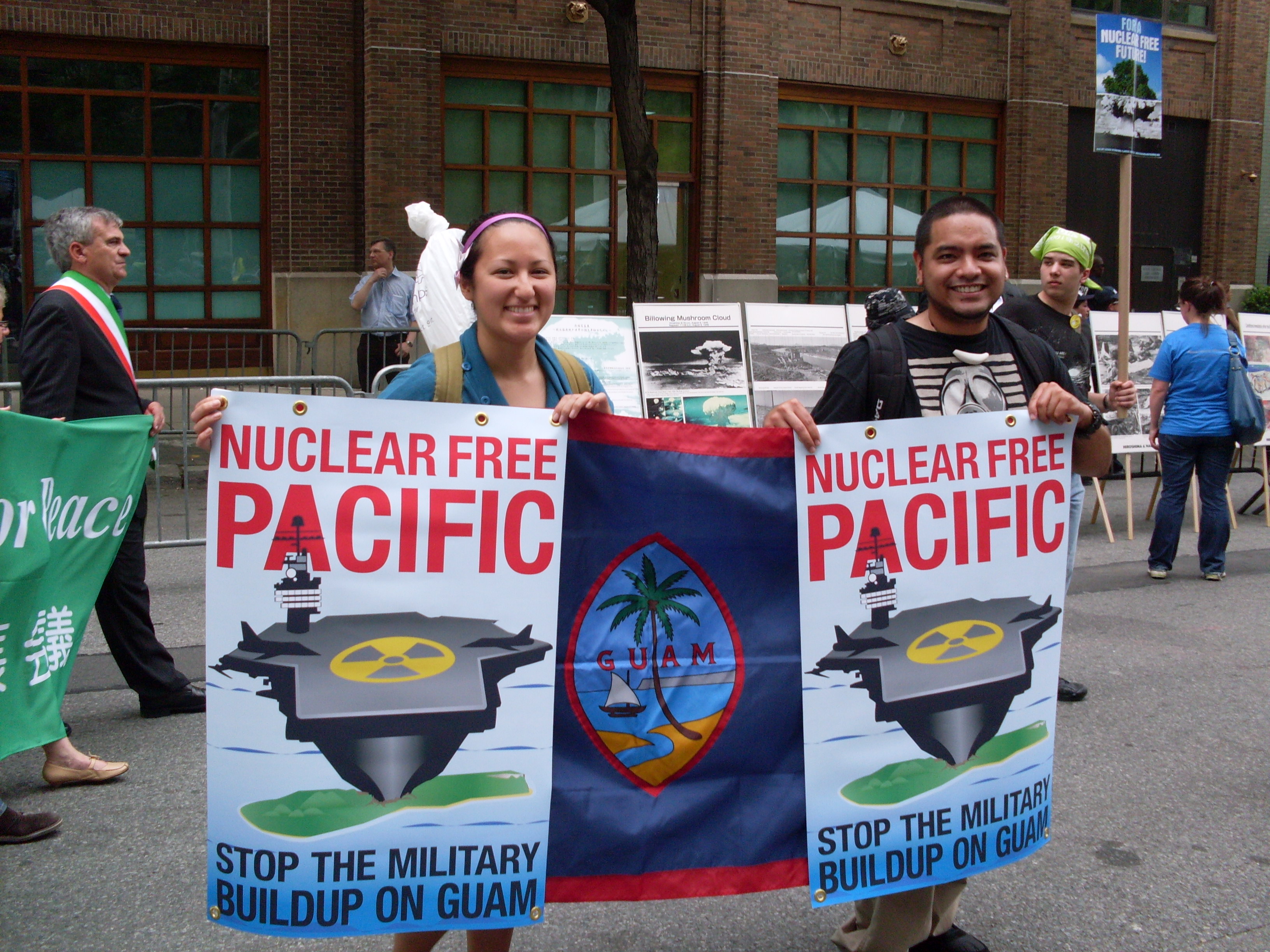
This article on the struggle to recover Chamoru culture and identity in Guahan came across as patronizing to me.  Is it an identity crisis in Guam/Guahan?   It’s more like colonial trauma caused by 500 years of occupation and oppression by three different colonizers.  Occupation creates schizophrenia in a people.  With this perspective, the survival and resilience of Chamoru culture is amazing.   Sometimes it takes a crisis like the military expansion threat to highlight the contradictions and energize the resistance.

>><<

http://www.theworld.org/2010/04/29/guam-people-ponder-their-identity/

Guam people ponder their identity

By The World April 29, 2010 

Download MP3
Last weekend 90,000 people turned out to protest the continued presence of US forces on the Japanese island of Okinawa. The protestors want US forces moved off the island, something Washington is loathe to do – still, there are plans to move 8,000 Okinawa Marines to Guam. Guam is a US territory in the Pacific, but as The World’s Mary Kay Magistad reports, plans for the military build-up on Guam have ignited soul-searching about just how American people there feel. (Photos: Mary Kay Magistad)


Drive around Guam, and you might think you were in an American suburb – same chain stores, same chain restaurants, same American culture – on the surface.

Chamorro dancers

But beneath the surface is 4,000 years of Chamorro tribal history – history young Chamorros who have grown up as US citizens are starting to rediscover. This group of teenagers – is dressed in grass skirts – the girls with flowers in their hair, the guys with loin clothes and fighting sticks.

They shout about how Chamorros need to remember their roots. One is 20-year-old Rico Sablan:

“My message was talking about the outsiders came and tried to change our culture, and my message was saying – stand strong for our people and keep our people strong.”

The outsiders who first came were the Spanish – some 400 years ago, bringing with them disease that wiped out all but a couple thousand Chamorros. Survivors intermarried with the Spanish colonizers and other settlers, so the language is now heavily accented with Spanish. Much Chamorro oral tradition has been lost too, so the songs and dances performed by these young people tonight are a reconstruction – a best guess of what they might have been.

Dancer Rico Sablan says given Guam’s colonial past, he has mixed feelings about the US military’s plans to move 8,000 marines here, in addition to the 6,000 military personnel already in Guam.

“Don’t get me wrong, I feel safe with them coming here. But don’t take the land from the people.”


In recent months, Guamanians have been weighing what an expanded US military presence might mean for them. There are concerns about the environmental impact, about Guam taxpayers being asked to bear too heavy a burden.

Seventeen-year-old Alyssa Eclavea, who’s at the evening gathering, has her own worries:

“I’ve looked up some stories in Okinawa, that they’ve been raping women, or young ladies, as young as 12 years old. And if they bring those Marines to our island, there are so many beautiful women on our island, it’s going to happen.”

Michael Bevacqua

Although, that’s not been a problem on Guam so far. And Guam has hosted far more US military personnel in the past – some 200,000 at the end of World War II. But Guam’s civilian population was much smaller then, and felt less empowered. Now some in the generation that has grown up American are questioning American dominance. Michael Bevacqua has a white American father and a Chamorro mother:

“I don’t know how American I feel, I mean I prefer living on Guam, I like living on Guam, I spent half of my life in the States getting educated and I think for me my perspective is that America is a colonizer.”

Guam is a US territory, and Guamanians are US citizens. They have full rights to live, work and vote in the rest of the United States. But while on Guam, they can’t vote for president – they can only elect one non-voting representative to Congress. Still, the US military says it has consulted extensively with Guamanians, about their concerns about the military build-up. John Jackson directs the Joint Guam Program Office for the Secretary of the Navy:

“We received responses everything from Yankee go home to welcome back Marines we are glad to have you here. And everywhere in between. So it is a reflection of Guam’s society, a reflection of the society of the United States. Many different views on many different subjects.”

Jackson says some of the environmental or cultural concerns have led to modifications of the plan. But he says – the overall expansion will go ahead – because it serves US security interests in the region:

“Guam’s strategic location enhances the flexibility of the US forces in the Pacific, which allows for greater freedom of action as well as the ability to respond to crisis whether it is, say, humanitarian assistance or disaster-related crisis or perhaps deterrence or military action.”

This is being done, in part, with an eye to China’s military build-up and increasingly muscular navy, which is starting to roam deeper into waters traditionally patrolled by the US Pacific Fleet. The move to Guam is to also meant to avoid what’s been happening in Okinawa – protests that create uncertainty about how long US bases can stay. Guam, as a US territory, can’t exactly kick them out. And many Chamorros feel it shouldn’t, anyway. Many have served in the US military.

Sergeant-Major Juan Blaz

Retired Sergeant-Major Juan Blaz served 21 years in the US army, was wounded three times in Vietnam, and received the Distinguished Service Cross. He says, he’s a fiercely proud American, and he doesn’t see what all the fuss about the military expansion is about:

“I think it is great for the island and the island in part is also a great contributing factor to our nation and defense of our nation.”

This difference in attitude is somewhat generational. Older Guamanians have positive memories of US forces liberating Guam from the Japanese. At least some younger ones are caught between their US passports and a growing awareness of an identity separate from America. Still, there may be room for both. Several of the guys here, shouting fiercely in loincloths, plan to join the US military once they’re old enough.

For The World, I’m Mary Kay Magistad, Guam.


Environmental Protection of Bases?

From Foreign Policy In Focus:

http://www.fpif.org/articles/environmental_protectionof_bases

Environmental Protection of Bases?

By David Vine. Edited by John Feffer, April 22, 2010

Just weeks before today’s Earth Day, and for the second time in little more than a year, environmental groups have teamed with governments to create massive new marine protection areas across wide swaths of the world’s oceans. Both times, however, there’s been something (pardon the pun) fishy about these benevolent-sounding efforts at environmental protection.

Most recently, on April 1, the British government announced the creation of the world’s largest marine protection area in the Indian Ocean’s Chagos Archipelago, which would include a ban on commercial fishing in an area larger than California and twice the size of Britain. British Foreign Secretary David Miliband called it “a major step forward for protecting the oceans.

A representative for the Pew Charitable Trusts—which helped spearhead the effort along with groups including the Marine Conservation Society, the Royal Society for the Protection of Birds, and Greenpeace—compared the ecological diversity of the Chagos islands to the Galapagos and the Great Barrier Reef. The Pew representative described the establishment of the protected area as “a historic victory for global ocean conservation.” Indeed, this was the second such victory for Pew, which also supported the creation, in the waning days of the George W. Bush administration, of three large marine protection areas in the Pacific Ocean, around some of the Hawai’ian islands and the islands of Guam, Tinian, and Saipan.

The timing of the announcements for both the Indian Ocean and Pacific marine protection areas—on the eve of upcoming British parliamentary elections and in the days before Bush left office when he was trying to salvage a legacy—suggests that there’s more here than the celebratory announcements would suggest.

A Base Issue

Both marine protection areas provide safe homes for sea turtles, sharks, breeding sea birds, and coral reefs. But they are also home to major U.S. military bases. Chagos’s largest island, Diego Garcia, hosts a secretive billion-dollar Air Force and Navy base that has been part of the CIA’s extraordinary rendition program. The Pacific protection areas are home to U.S. bases on Guam, Tinian, Saipan, Rota, Farallon de Medinilla, Wake Island, and Johnston Island.

In both cases, the otherwise “pristine” protected environments carve out significant exceptions for the military. In Chagos, the British government has said, “We nor the US would want the creation of a marine protected area to have any impact on the operational capability of the base on Diego Garcia. For this reason…it may be necessary to consider the exclusion of Diego Garcia and its three-mile territorial waters.” In the Pacific, the Bush administration stressed that “nothing” in the protected areas “impairs or otherwise affects the activities of the U.S. Department of Defense.”

The incongruity of military bases in the middle of environmental protection areas is particularly acute since many military installations cause serious damage to local environments. As Miriam Pemberton and I warned in the wake of Bush’s announcement, “Such damage includes the blasting of pristine coral reefs, clear-cutting of virgin forests, deploying underwater sonar dangerous to marine life, leaching carcinogenic pollutants into the soil and seas from lax toxic waste storage and military accidents, and using land and sea for target practice, decimating ecosystems with exploded and unexploded munitions. Guam alone is home to 19 Superfund sites.”

Similarly, the base on Diego Garcia was built by blasting and dredging the island’s coral-lined lagoon, using bulldozers and chains to uproot coconut trees from the ground and paving a significant proportion of the island in asphalt. Since its construction, the island has seen more than one million gallons of jet fuel leaks, water fouled with diesel fuel sludge, the warehousing of depleted uranium-tipped bunker buster bombs, and the likely storage of nuclear weapons.

For all the benefits that marine protection areas might bring, governments are using environmentalism as a cover to protect the long-term life of environmentally harmful bases. The designation also helps governments hold onto strategic territories. Indeed, all of the Pacific and Indian Ocean islands involved are effectively colonies, including the Chagos Archipelago, which Britain refers to as the British Indian Ocean Territory and which was illegally detached from Mauritius during decolonization in the 1960s.

Ratifying Expulsion

The environmental cover-up goes deeper. In addition to the Mauritian sovereignty claim on Chagos, the islands are also claimed by their former indigenous inhabitants, the Chagossians, whom the U.S. and British governments forcibly removed from their homeland during the base’s creation in the late 1960s and early 1970s. Since their expulsion, the Chagossians have been struggling for the right to return and proper compensation. Three times since 2000, the British High Court has ruled the removal unlawful, only to have Britain’s highest court overturn the lower-court rulings in 2008. The Chagossians have appealed to the European Court of Human Rights and expect hearings to begin this summer.

Again, the timing of the announcement of the Chagos marine protection area is far from coincidental. It could cement forever the Chagossians’ exile no matter the ruling of the European court. “The conservation groups have fallen into a trap,” explained Chagossian Roch Evenor, secretary of the UK Chagos Support Association. “They are being used by the government to prevent us returning.”

Others agree. In a letter to Greenpeace UK, Mauritian activist Ram Seegobin wrote, “Clearly, the British government is preparing a fall-back plan; if they lose the case in Europe, then there will be another ‘reason’ for denying the banished people their right of return.”

British lawyer Clive Stafford Smith, director of the human rights organization Reprieve, was even more direct: “The truth is that no Chagossian has anything like equal rights with even the warty sea slug.”

While the Pew Charitable Trusts, a foundation created by the children of one of the founders of Sun Oil Company, has been working behind the scenes for three years with British officials on the marine protection areas, other environmentalists have opposed the plan. “Conservation is a laudable goal,” Catherine Philp argued recently in The Times of London, “but it is a hollow and untruthful one when decided on behalf of the true guardians of that land who were robbed of it; not for the protection of the environment, but for a cheap media win and the easy benefit of the military-industrial machine.”

It did not have to be this way. The Chagossians, as one of their leaders, Olivier Bancoult, has said, once “lived in harmony with our natural environment until we were forcibly removed to make way for a nuclear military base.” The U.K. and U.S. governments could correct this injustice and protect the environment at the same time by finally allowing the Chagossians to return and serve as the proper guardians of their environment. It is not too late to correct this mistake. It is not too late to prevent the good name of environmentalism from being used to compound injustices that have been covered up for too long.

David Vine is assistant professor of anthropology at American University in Washington, DC, the author of Island of Shame: The Secret History of the U.S. Military Base on Diego Garcia (Princeton University Press, 2009), and a contributor to Foreign Policy In Focus.

Recommended Citation:

David Vine, “Environmental Protection of Bases?” (Washington, DC: Foreign Policy In Focus, April 22, 2010)

Hatoyama betrays Okinawa – Japan to relocate Futenma to Henoko

Okinawans say “No!”

Japanese Prime Minister Hatoyama has betrayed the Okinawan people. After months of waffling, he decides to go with the original plan to relocate Futenma base to Henoko and wants to “apologize” to the Okinawan people and asked them to “bear the burden”.  Satoko Norimatsu who writes the Peace Philosopy Blog posted the following article.

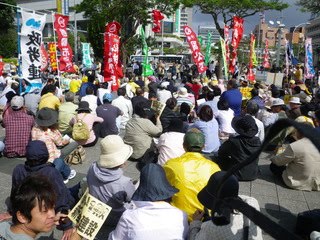
In Okinawa, protest followed Hatoyama around the island. Thanks to the Kyoto Action blog: http://blog.goo.ne.jp/chuy/ and Jean Downey for sharing the information.

okinawa demo pic kyoto action

9 a.m. – 400 people gather at the Okinawa Prefecture Office

pref1

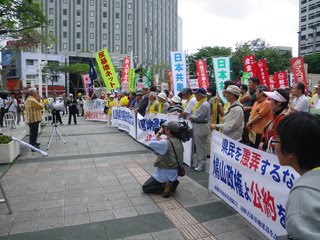
Prefectural Assembly members remind the Hatoyama Administration: “Keep your campaign pledges!”

pref

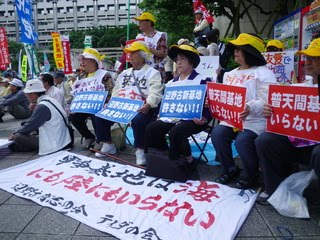
Futenma Volunteer Group and Ti-da Organization oppose bases at Futenma

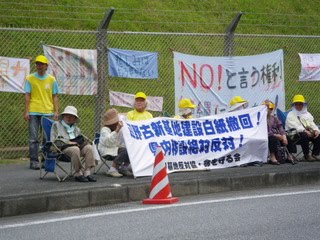
schwab

4 pm – Protesters at Camp Schwab insisting, “We have the right to say NO!”

>><<

http://peacephilosophy.blogspot.com/2010/05/i-want-to-apologize-to-okinawan-people.html

Monday, May 03, 2010

“I want to apologize to Okinawan People.” 「沖縄の人々に陳謝したい。」

こんな裏切りというものがあるのだろうか。

What a betrayal.

According to Rykyu Shimpo, May 4, Hatoyama flew in Okinawa with an SDF aircraft, and met with Governor Nakaima on the morning of May 4. Hatoyama told him that relocating Futenma overseas was “impossible,” from the “deterrance perspective.” It was “not realistic” to relocate it completely out of the prefecture either. “I would have to ask people of Okinawa to bear burden.”

Nakaima responded merely by asking the Prime Minister to receive the Okinawan’s voice sincerely and to try to reduce the burden of Okinawans and to eliminate the danger of Futenma Air Station.

Hatoyama arrived in Naha in a Self Defense Force aircraft at 9 AM, and went to pay tribute at the cemetery for the war-dead in Itoman City before he met with the Governor.

On the afternoon of the same day, he is scheduled to visit an elementary school near Futenma to talk to citizens, then to Nago, to meet with the anti-base mayor Inamine and to visit Camp Schwab.

For the first time since taking office, Hatoyama set his foot in Okinawa, in a military aircraft.

On the day after the 63rd anniversary of Japan’s post-war Peace Constitution coming into effect, its Prime Minister virtually reinforced that Article 9 had never applied to Okinawa and it never would.

Eleven days before the 38th anniversary of Okinawa’t return to Japan, Okinawans were told that it would always stay as a military colony.

Only 9 days after the historic rally in which Okinawans once again opposed to a new base, a plan to build a brand-new Marine air station over the pristine ocean off Henoko is announced, just like that.

At the Itoman cemetery, what did Hatoyama have to tell the dead souls of Okinawans and their unborn children?

PeacePhilosopher

In These Times: The Poisoning of Puerto Rico

http://www.inthesetimes.com/main/article/5869/

The Poisoning of Puerto Rico

The U.S. Navy left Vieques, but for many, the cancer remains.

By Jacob Wheeler May 3, 2010

Vieques, puerto rico — on March 31, retired Sgt. Hermogenes Marrero was told during a visit to the Veterans Affairs (VA) outpatient clinic in Mayaguez, Puerto Rico, that he didn’t have cancer — or at least, his official VA computer file no longer showed any record of cancer.

But Marrero was not relieved. He had been diagnosed twice before with colon cancer and suffers today from a dozen other illnesses, including Lou Gehrig’s disease, failing vision, a lung condition that keeps him on oxygen around the clock, not to mention tumors throughout his body. The terminally ill and wheelchair-bound, 57-year-old veteran immediately suspected that the U.S. government had manipulated his medical record.

Marrero is the star witness in a lawsuit filed in 2007 against the U.S. government by Mississippi attorney John Arthur Eaves on behalf of more than 7,000 residents of the picturesque, yet heavily polluted, Puerto Rican island of Vieques. From 1941 until 2003 the U.S. Navy operated a base here, conducting bombing runs and testing chemical weapons for use in foreign wars, from Vietnam to Yugoslavia to Iraq.

The three-quarters of Vieques’ population listed as plaintiffs in the suit blame the billions of tons of bombs dropped by the Navy on Vieques’ eastern half, and the toxic chemicals released into the water, air and soil during that period, for their physical and psychological illnesses. Viequenses today suffer 30-percent higher cancer rates than other Puerto Ricans, 381-percent higher rates of hypertension, 95-percent higher rates of cirrhosis of the liver and 41-percent higher rates of diabetes. Twenty-five percent more children die during infancy in Vieques than in the rest of Puerto Rico.

Early in World War II, when fortunes looked grim for the Allies, the U.S. Navy occupied three-quarters of Vieques, which sits eight miles from the Puerto Rican mainland, moved one-third of its population to the nearby Virgin Islands, and planned to relocate the entire British fleet there in the event of a German invasion of England. Instead, Vieques became the U.S. testing ground for nearly every weapon used during the Cold War.

Though Marrero spent only 18 months on Vieques during his tour in the early 1970s, the Special Forces Marine suffers today from many of the same medical conditions as the local population. The Puerto Rican native, raised in Queens, N.Y., arrived on the island in 1970 with the task of guarding the vast array of chemical weapons the Navy stored and tested there. Marrero was exposed to toxics, including napalm and Agent Orange — which at the time he thought was weed killer. He developed massive headaches, bled from his nose, and suffered nausea and severe cramps. “I witnessed some of the most awesome weapons used for mass destruction in the world,” Marrero says. “I didn’t know how dangerous those chemicals were, because it was on a need-to-know basis.

Today Marrero waits in the city of Mayaguez in western Puerto Rico for his chance to testify in court against the U.S. military for poisoning the people of Vieques and U.S. soldiers based there.

“These are American citizens, yet we violated their human rights,” says the humbled former Marine. “This would never have been allowed to happen in Washington or Seattle or Baltimore.”

The king can do no wrong

Before John Arthur Eaves’ lawsuit can be heard, however, it must first be approved by the First Circuit Court in Boston after the suit was rejected on April 13 by federal judge Daniel R. Dominguez, who sits on the U.S. District Court in San Juan. Eaves will officially appeal the case to the First Circuit Court early this summer. But the U.S. Navy has invoked sovereign immunity, a strategy that comes from the monarchic period when kings were immune from being sued. Unless a federal judge in Boston rejects sovereign immunity, no scientific evidence will ever reach the courtroom.

“The U.S. government wants the case to be dismissed — the ‘king can do no wrong’,’ ” says Eaves. “We claim their actions should not be protected under sovereign immunity, because when the government steps outside its discretion, its actions are no longer protected. We know that in at least one year the Navy violated the Environmental Protection Agency’s [EPA] standards 102 times.”

Washington rejects allegations that the Navy’s activities on Vieques poisoned residents — even though the government has admitted the presence of napalm, agent orange, depleted uranium, white phosphorous, arsenic, mercury, lead and cadmium on the former bombing range. In February 2005, the EPA identified Vieques as a Superfund site, which placed the cleanup of hazardous sites in federal hands.

In its defense, the U.S. government cites a controversial 2003 study by the Centers for Disease Control’s Agency for Toxic Substances and Disease Registry (ATSDR). But Arturo Massol, a biologist at the University of Puerto Rico who has studied toxic contamination on Vieques, calls the ATSDR study unscientific, if not outright criminal.

“A battalion of researchers came here and used poorly designed scientific experiments to conduct a political assessment that intentionally covered up reality,” Massol says. “The Navy is gone, but these agencies should be charged as accessories to murder because preventative policies could have been established after 2003.”

The bombing range on eastern Vieques was indisputably subjected to more than 60 years of non-indigenous chemicals, Massol says. There are no other sources of industrial pollution on the island. Those toxic metals accumulated in the biomass of plants and were eaten by grazing cows and fish. Once pollution reached the vegetation and the base of the food chain, it was transferred into humans. Massol and other independent scientists found that Vieques animals had 50 times more lead and 10 times more cadmium than animals on mainland Puerto Rico.

Under President Barack Obama, however, the U.S. government has shown signs of changing its tune. A U.S. congressional investigation last May into Hurricane Katrina trailers contaminated with formaldehyde accused the ATSDR of colluding with the Federal Emergency Management Agency (FEMA) to “deny, delay, minimize, trivialize or ignore legitimate health concerns.” When the Vieques case resurfaced, a team of ATSDR scientists began re-examining environmental health data on the island.

On Feb. 12, 2008, during his heated primary campaign against Hillary Clinton, then Sen. Obama wrote a letter to Puerto Rican Governor Acevedo Vila, stating that, were he to be elected president, “My Administration will actively work with the Department of Defense as well to achieve an environmentally acceptable clean-up … We will closely monitor the health of the people of Vieques and promote appropriate remedies to health conditions caused by military activities conducted by the U.S. Navy on Vieques.” Yet today, the Obama White House remains silent on the issue.

Living in the line of fire

Nanette Rosa, a plaintiff in the lawsuit, remembers what daily life was like in the Vieques village of Esperanza when the Navy airplanes took off from the island’s west coast and flew overhead to drop bombs in the east.

“When the wind came from the east, it brought smoke and piles of dust from where they were bombing,” Rosa says. “From January until June, they’d bomb every day, from 5 a.m. until 6 p.m. It felt like you were living in the middle of a war.”

Her neighbors in Esperanza developed breathing problems and skin rashes. Then in 1993, Nanette traveled to the port town of Fajardo to have her fourth child, Coral. The girl weighed only four pounds and doctors diagnosed her with “blue baby syndrome” (a result of high nitrate contamination in the groundwater, which decreased her oxygen-carrying capacity). Doctors in San Juan performed a colostomy on Coral, and when she was six-months-old, they found eight tumors in her intestines and stomach. The day before Coral’s first birthday, Nanette was told to celebrate because this would be the baby’s last.

Instead, in January 1995, Nanette sold her new house for a $600 plane ticket and flew to Brooklyn to seek help. Doctors at Kings County Hospital removed half of Coral’s intestines and stomach, which saved her life. Broke and without financial support, Nanette spent three months sleeping on a bench in the hospital.

Miraculously, Coral is alive today and about to turn 17. Her cancer is in remission, but doctors recently found three lumps in one of her breasts. Coral’s younger sister Ainnanenuchka, 14, has been diagnosed with Ewing’s Sarcoma (cancer in her blood and bones), and part of her leg was removed and implanted in her chin.

“I’m 100 percent confident that the lawsuit will succeed, because the Lord told me so,” says Nanette, now 38 and a Pentecostal optimist. “I read in the Bible that every damage caused to the Earth has to be repaid.”

And if the lawsuit doesn’t succeed?

“I leave it in God’s hands. If I have to go to jail, it’s worth it to save my daughters’ lives.”

[Note: The lawsuit was recently dismissed, with prejudice, by Judge Daniel Dominguez of the U.S. District Court for the District of Puerto Rico, who sided with the U.S Justice Department in its contention that the case should not be seen on its merits because of “sovereign immunity”.]

Jacob Wheeler is a contributing editor at In These Times.

Guam: military buildup impact study contains “inaccurate, inadequate information and plagiarized materials”

This is what happens when the military predetermines the outcome, hires mercenary environmental firms to make the results ‘to fit’, then tries to force the decision on the local community. It’s called environmental racism. It’s called imperialism.

>><<

http://mvguam.com/index.php?option=com_content&view=article&id=11944:plagiarism-irks-senators&catid=1:guam-local-news&Itemid=2

Plagiarism irks senators

Thursday, 29 April 2010 02:54 by Jennifer Naylor Gesick | Variety News Staff

Military asked to draft a new impact study for Guam buildup

GUAM senators are demanding that the Department of Defense draft a new environmental impact statement, irked that the draft impact study presented to the local community contained a string of inaccurate, inadequate information and plagiarized materials.

They are also asking the defense department to conduct a new impact study for important projects such as Apra Harbor and the firing range proposed on Route 15.

Speaker Judi Won Pat responded with utter disgust to the discovery that portions of the draft impact study were plagiarized. “If they are going to plagiarize something that has nothing to do with Guam, then that makes me question all the contractors and experts they consulted,” she said.

“This makes me wonder how much of the entire DEIS is flawed. The military needs to do some inquiries here,” Won Pat added.

She questioned why the contractor TEC, Inc., which wrote the report for the military, would cut and paste scientific information from a source that did not study Apra Harbor.

Won Pat added that it is the plagiarism along with several other discoveries of inadequate and wrong information that prompted the legislature to pass Resolution 275, which says the senators feel that whole sections of the DEIS should be dealt with separately.

Federal visit

Won Pat said, “It is very timely,” because Guam is going to be visited by high-level officials in the next few weeks.

Guam is expecting a visit this week from Assistant Secretary of Defense for Asian and Pacific Security Affairs Wallace C. Gregson. The senators plan to meet with him, and he is scheduled to give a lecture at the University of Guam entitled “Where America’s Day Begins: Guam and U.S. Engagement in the Asia Pacific.”

Senator Rory Respicio was also upset at the recent developments. “I’m shocked,” he said. “When anything like this is discovered, it makes the entire document suspect.”

“We have already found many problems ourselves and we know that EPA finds it insufficient,” added Respicio. “I wonder how many other items like this are scattered throughout the voluminous report? Could it be that EPA was also aware of this, and perhaps other instances where DEIS findings were taken from other sources without acknowledgment?”

He suggested, as others have, that Guam should take more time for the military buildup process. “This is just one more reason that we need to slow down this process and work together, both the federal and local governments, to do it right,” said Respicio.

Suspicion

Senator Judi Guthertz, chairwoman of the military buildup committee, said, “Dr. Jason Biggs revealed what many suspected all along. The company contracted by the Department of Navy to draft the impact statement for the Guam military buildup did not do a good job.”

“In many ways, the multi-thousand page report is misleading, inaccurate, condescending to the people of Guam, and now — thanks to Dr. Biggs’ discovery – we know it is, at least in part, a dishonest document,” said Guthertz.

“The company contracted to do the draft study knows little about Guam and obviously scrambled to find information it could claim to help justify the military buildup preferred option plans for Guam,” Guthertz said.

Palau: Senate asks U.S. to consider Angaur as Futenma relocation site

http://www.mvariety.com/2010042826058/local-news/senate-asks-u.s.-to-consider-angaur-as-futenma-relocation-site.php

Senate asks U.S. to consider Angaur as Futenma relocation site

Wednesday, April 28 2010 15:19 By Bernadette H. Carreon

KOROR (Palau Horizon) – The Senate has adopted a resolution asking President Johnson Toribiong to offer the State of Angaur as an alternative location for the United States’ Airbase following plans to relocate the Futenma Airbase from Okinawa, Japan.

Resolution 8-53 stated that Angaur State can be utilized for the “United States military, strategic planning for the relocation of the Futenma Airbase from Okinawa, Japan.”

Resolution 8-53 requests President Johnson Toribiong to discuss with the government of the United States, through diplomatic channels the plan.

The resolution said that under the Compact of Free Association, U.S. has the right options to use lands in Palau for military defense.

The resolution cited that on the April 13-15, 2010 issue of the Palau Horizon, two members of the Japanese Diet; namely, the Honorable Takamine Zenshin and Tinian-born Representative Teruya Kantoku, expressed strong desire for the Island of Tinian in the Commonwealth of the Northern Mariana Islands as a likely site to relocate Futenma Airbase from Okinawa, Japan.

The senators said historically Angaur has been used as a military support by the U.S. during World War II.

The resolution stated that a nearly 10,000 feet runway was constructed on Angaur Island from September 17-30, 1944 following a six-day, non-stop bombardment by USS Tennessee and landing on Angaur of the US 81st Infantry Division under the Command of Major General Paul J. Muller and from this newly constructed airfield US military aircrafts flew over to and bombed the Island of Peleliu and that said Angaur airfield provided much needed support for the invasion and the eventual US victory of the Battle of Peleliu.

It added, several years later said Angaur Airfield was put to civilian use as interim airport for commercial airplanes to land throughout the time Airai International Airport was under construction for resurfacing and extension of the runways.

Under Title III, Article II – Defense Sites and Operating Rights – in Section 321 of the Compact of Free Association “allows the United States to establish and use defense sites in Palau, and may designate land and water areas and improvements in accordance with terms and conditions set forth in a separate subsidiary agreement known as the Military Use and Operating Rights Agreement.”

Japan wanted the airbase out of Okinawa.