Move Troops Back to U.S.

http://www.guampdn.com/article/20100409/OPINION02/4090325/Author-Move-troops-back-to-U.S

Guam Pacific Daily News

Author: Move Troops Back to U.S.

By Doloris Cogan • April 9, 2010

cogan

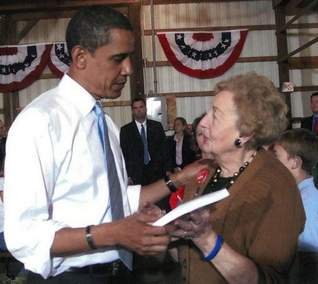
Guam book for Obama: Doloris Cogan, author of “We Fought the Navy and Won: Guam’s Quest for Democracy,” gives President Obama, then a U.S. senator, a copy of her book during a campaign stop in Indiana. (Photo courtesy of Doloris Cogan)

It’s time to start thinking outside the box. I have read the Region IX EPA comments on the proposed move to Guam of U.S. troops on Okinawa. My conclusion is that both the environmental impact and the cost would be absolutely devastating.

Therefore, I think it’s time to start moving those troops and their families back to the United States, where there are plenty of empty barracks and unemployed workers to build whatever may be lacking. In this space age of the Internet, the Predator, fast fighters and cargo planes, security no longer depends on large forward bases. There is no need for a heavier military footprint on Guam than the island already has.

There is no need to train American pilots on foreign soil or on the Pacific islands. Our National Guard forces from all 50 states serving in Iraq and Afghanistan have proved that.

Many entrepreneurs on Guam will say this idea would deprive them of economic opportunities desperately needed on the island. To them I say, go after federal appropriations for improved roads, schools, trash removal, toxic waste cleanup, land surveys and outstanding reparations for land confiscated by the military decades ago. All that would provide jobs.

You now have the attention of President Barack Obama and Congress. Strike while the iron is hot! The Organic Act of Guam is almost 60 years old, and your infrastructure could use some repairs. Some of the money saved by not making that expensive move from Okinawa to Guam could be used for the above purposes.

Blaine Harden raised the proposed move of the Marines above the radar by writing what became a front-page story in The Washington Post on March 22. I was delighted to see Lt. Gov. Mike Cruz quoted in Harden’s news story, along with many sons and daughters of the heroes in my book, “We Fought the Navy and Won: Guam’s Quest for Democracy.” I met Cruz and many of those sons and daughters in July of 2008 when my book was brand new and I went to Guam for the celebration of Liberation Day.

Guam is at another real crossroads of its history. Decisions should not be made quickly or without full discussion. Saving the island for future generations is up to you.

I met Obama twice at public rallies when he was campaigning for the presidency in Indiana and had an opportunity to ask questions, as well as give him my book, which he later acknowledged with a short personal letter. I’m proud of the picture I have of the two of us and my book, which I used as my 2008 Christmas card. His decision to visit Guam tells me he knows a lot about the island and the implications of moving more troops there.

(Recently) I was in San Diego, signing copies of my book at the Chamorro Cultural Fest. I was thrilled to meet so many Chamorros who are well-educated and holding responsible positions in the Navy and private industry. Guam’s young people are specialists in the high technologies and communications. I’m convinced they can turn those skills into new professions and industries on Guam, supplementing the military economy and tourism.

What’s more, they understand and practice democracy. They could be USAID workers and ambassadors to Third-World countries, and would know better than to try to impose their (or our) culture on their hosts.

This is a great time to be alive and meet the challenges ahead. My interest in Guam is as strong now as it was 60 years ago when I wrote and edited the Guam Echo, airmailed monthly from Washington to 500 Guam members of the Institute of Ethnic Affairs. We wrote in the Guam Echo about “self-determination” for indigenous inhabitants all over the world, and in San Diego I met a few Chamorro leaders hoping and searching for more of that and and less “military domination” for Guam. Self-determination is an “ideal” still discussed at the United Nations, and in the context of the proposed move and the the civil rights of the local Chamorros, it could come up again.

Now is the time to work together to find solutions to whatever serious problems exist. I tend to agree with Theodore Parker, who said, “I do not pretend to understand the moral universe; the arc is a long one … and from what I see I am sure it bends towards justice.”

As writer/editor of the Guam Echo from 1947 to 1950, Doloris Cogan helped get the Organic Act of Guam through Congress, and from 1951 to 1955, she served as Pacific Island Assistant in the Department of the Interior, implementing the act.

http://www.guampdn.com/article/20100409/OPINION02/4090325/Author-Move-troops-back-to-U.S.

Okinawa Peace Project study tour will take place in the Fall

The US for Okinawa website just announced that they will sponsor another study tour to Okinawa in September 2010.  See the website for reports on the most recent study tour of Okinawa.

>><<

http://www.us-for-okinawa.blogspot.com/

Wednesday, April 7, 2010

OKINAWA PEACE PROJECT

“OKINAWA PEACE PROJECT”
沖縄ピースプロジェクト
FALL 2010 (Tentative dates Sept 22 – 26th)

If you love the ocean and love to learn through direct experience…this study program is for you. Please join us !

沖 縄・辺野古の海は、ジュゴンなどの海洋ほ乳類やウミガメが生息し、国際的 に絶滅の危機にあるサンゴが広く育つ海洋生物の宝庫です。この地に新しく基 地が建設されることになれば、大浦湾が埋め立てられ、マングローブなどの野 生生物に取り返しのつかないダメージを与えることになります。これは、一帯 の貴重な海洋生物多様性に対する重大な危機です。

「US for Okinawa」では、沖縄の状況をより深く知ることのできるスタディツ アーを計画しています。ぜひご参加ください!

Okinawa Peace Project Study Program Outline:
* Learn more about the US Military bases in Okinawa
* Participate in our Ocean Conservation study program
* Scuba diving and Snorkeling exploration trip
* Canoe, beach clean-up, visit the mangroves
* Art & Music event in Okinawa

★2010年秋 沖縄ピースプロジェクト スタディプログラム★
・沖縄の米軍基地についてもっと学ぼう
・ 海洋保全スタディプログラムに参加しよう
・スキューバ・ダイビング、シュノーケリング
・カヌー、海岸清掃、マングローブの森訪問
・ 沖縄でのアート&ミュージック・イベントなど

– This program is not limited to certified Scuba divers –
お問い合わせはこちら:
CONTACT Emilie McGlone at us.for.okinawa@gmail.com

BACKGROUND:
The sea in Henoko is a treasure trove for marine life, where the large marine mammal the Dugong and the sea turtle live, and internationally endangered species of coral grow widely. In November 2009, 36 species of new strains of shellfish were discovered in the area. The construction of replacement facilities for Futenma Air Station means that this area will be landfilled in order to construct the new base, rendering as yet unknown environmental damage to the surrounding areas and wildlife.

There are only about 10 to 20 dugongs left off the coast of Henoko in Ohura Bay, Okinawa. Dugongs are now believed to be an endangered species in Japan. In 2006, WWF Japan designated 2010 as “International Year of Dugong.” This year, we hope to join them in raising awareness about the plight of this graceful mammal. The vibrant biodiversity found in Ohura Bay, on the east coast of Okinawa, may be in danger. The plan to build the new military facility, which would likely involve land reclamation activities in Ohura Bay, could lead to the destruction of the area’s precious marine biodiversity.

OBJECTIVE: As well as directly learning about the situation of the military bases in Okinawa, this study tour will examine dangers of the the Futenma Base which we are now seeking to be closed, meet people protesting against the proposed relocation of the base to Henoko in Nago City, and seek ways to strengthen solidarity of voices against the military bases from now. US for OKINAWA, together with other environmental and conservation organizations such as PangeaSeed, WWF, and Peace Boat seeks to create an Ocean Conservation study program based on the necessity to raise awareness about the fragile aquatic ecosystem in Okinawa and the threat being posed by the construction of new military facilities on the island by the United States government. Volunteers will work in partnership with local divers and water enthusiasts to combat these challenges through environmental education at the local and international levels, beach clean-ups, coral reef conservation, monitoring and data collection of the Okinawan dugong`s habitat and local ecosystem. We are committed to the conservation of the Okinawan land, water and aquatic life that is the livlihood of the people who inhabit the islands.

———————————————-
Organized by:

US FOR OKINAWA: A deliberate double entendre, US may be read both as “us” (you, me, everyone), as well as U.S. (reflecting the proactive stance of Americans in Japan who support a base-free Okinawa). US for OKINAWA was organized out of shared concern regarding the danger that the U.S. Futenma Air Base poses to the people of Okinawa, as well as the pressure exerted by the U.S. on the new Japanese administration to construct a replacement facility for the base in Henoko, an environmentally fragile area on the eastern part of the island.

『US for OKINAWA』は、在沖米軍基地の縮小と撤廃を求める新しいネットワークです。ここには日本に住み、沖縄のことを気にかけるアメリカ人、日本人、カナダ 人、ニュージーランド人、オーストラリア人、ウェールズ人、メキシコ人とその他の市民が集まり、都内を中心に活動を始めています。(USは私たちという意 味ですが、同時にここでは基地のない沖縄を目指す日本在住のアメリカ人たちを意味しています。)
『US for OKINAWA』は、米軍基地・普天間基地が沖縄の人々に与える危険性と、アメリカ政府が日本の新政府に対して貴重な自然環境が残る辺野古への移転を強く 要請していることへの共通の懸念から組織されました。辺野古基地建設はジュゴンの絶滅を招くばかりか、汚染・騒音公害・安全性の問題や(米軍兵による)犯 罪をただ県内の別の地域に移動するだけになります。

PANGEASEED: PangeaSeed is a Tokyo-based grassroots organization dedicated to educating and raising international awareness on the plight of sharks. Through volunteer activism and various mediums including art, music, film,and photography, PangeaSeed aims to create an open dialog with the global community to develop an understanding of the need to preserve and protect sharks and their habitat.

PangeaSeedは、地球を愛し、サメを愛する、ボラン ティアグループです。私たちは、社会の意識を高め、極めて重要な問題に光を当てるため、国や地域を超えたアート・音楽・映像を組み合わせたスペシャルイベ ントを企画開催しています。現在、誕生してから4億年以上の歴史を持ち、「生きた恐竜」とも呼ばれるサメが、フカヒレ料理の材料とするための乱獲や海洋環 境の破壊によって絶滅の危機に瀕しています。
わたしたちは、このサメの危機的状況についての社会的認識を高めることに焦点を当てたイベントを、 国内外で開催しています。また、啓発活動の継続、地域社会の協力、積極的な行動を通して、現状を変えていくことに全力を注ぎます。

RESOURCES:
NO BASES NETWORK http://closethebase.org/environmental-issue/
WWF http://www.wwf.or.jp/activities/2010/03/789315.html
PROJECT AWARE http://www.projectaware.org/about/index.php
PANGEASEED : http://www.pangeaseed.com
PROTECT LIFE SOCIETY: http://www.geocities.jp/nobasehenoko/

Upheaval in Kyrgyzstan Could Imperil Key U.S. Base

“Upheaval in Kyrgyzstan could Imperil key U.S. Base”?  More like U.S. Base created conditions that bred corruption and fueled popular unrest that eventually toppled the government.

>><<

http://www.nytimes.com/2010/04/08/world/asia/08bishkek.html?hp

Upheaval in Kyrgyzstan Could Imperil Key U.S. Base

By CLIFFORD J. LEVY

Published: April 7, 2010

MOSCOW — The president of Kyrgyzstan was forced to flee the capital, Bishkek, on Wednesday after bloody protests erupted across the country over his repressive rule, a backlash that could pose a threat to the American military supply line into nearby Afghanistan.

The New York Times

Opposition politicians, speaking on state television after it was seized by protesters, said they had taken control of the government after a day of violent clashes that left more than 40 people dead and more than 400 wounded. The instability called into question the fate of a critical American air base in the country.

Riot police officers fired rounds of live ammunition into angry crowds of demonstrators who gathered around government buildings to rally against what they termed the government’s brutality and corruption, as well as a recent decision to increase utility rates sharply. Witnesses said that the police seemed to panic, and that there was no sign of supervision. In several cases, demonstrators wrested their weapons away from them.

By early Thursday morning, opposition officials occupied many government buildings in Bishkek, and were demanding that the president, Kurmanbek Bakiyev, sign a formal letter of resignation. Mr. Bakiyev has issued no public remarks since the protests began. An official at the Bishkek airport said Mr. Bakiyev was flying to Osh, a major city in the southern part of the country.

A coalition of opposition parties said a transition government would be headed by a former foreign minister, Roza Otunbayeva. “Power is now in the hands of the people’s government,” she said in a televised address on Wednesday evening.

Those same opposition leaders were angered last spring when Obama administration officials courted Mr. Bakiyev — who they admitted was an autocrat — in an ultimately successful attempt to retain rights to the military base, Manas, used to supply troops in Afghanistan. President Obama even sent him a letter of praise.

Russia had offered Mr. Bakiyev a sizable amount in new aid, which the United States interpreted as an effort to persuade him to close the base in order to limit the American military presence in Russia’s sphere of influence. After vowing to evict the Americans last year, Mr. Bakiyev reversed course once the administration agreed to pay much higher rent for the base.

An American official said late on Wednesday that flights into the base at Manas had been suspended. Lt. Cmdr. Bill Speaks, a spokesman for United States Central Command, said late on Wednesday that some troops and equipment scheduled to transit from Manas to Afghanistan were likely to be delayed because of the government upheaval and that the military was preparing to use other routes.

The American attitude toward Mr. Bakiyev ruffled opposition politicians in Kyrgyzstan, who said it was shameful for the United States to stand for democratic values in the developing world while maintaining an alliance with him.

The Kyrgyz president’s son, Maksim, had been scheduled to be in Washington on Thursday for talks with administration officials. The opposition views the younger Mr. Bakiyev as a vicious henchman for his father, and was infuriated that he was granted an audience. The State Department said late on Wednesday that it had canceled the meetings.

Opposition leaders have been divided in recent weeks over whether they would continue to allow the American military base to remain, but it seems clear that they harbor bitterness toward the United States. And neighboring Russia, which has long resented the base, has been currying favor with the opposition.

“The political behavior of the United States has created a situation where the new authorities may want to look more to Russia than to the United States, and it will strengthen their political will to rebuff the United States,” said Bakyt Beshimov, an opposition leader who fled Kyrgyzstan last August in fear for his life.

Mr. Beshimov was one of numerous opposition politicians and journalists who in recent years have been threatened, beaten and even killed. Kyrgyzstan, with five million people in the mountains of Central Asia, is one of the poorest countries of the former Soviet Union, and has long been troubled by political conflict and corruption. Mr. Bakiyev himself took power in 2005 after the Tulip Revolution, one of a series of so-called color revolutions that seemed to offer hope of more democracy in former Soviet republics. Since then, the Kyrgyz human rights situation has deteriorated. Mr. Bakiyev easily won another term as president last year, but independent monitors said the election was tainted by extensive fraud.

Tensions in Kyrgyzstan have been brewing for months, and seemed to be touched off in the provincial city of Talas on Tuesday by protests over soaring utility rates. Then on Wednesday, thousands of people began massing in Bishkek, where they were met by heavily armed riot police officers. Dmitri Kabak, director of a local human rights group in Bishkek, said in a telephone interview that he was monitoring the protest when riot police officers started shooting. “When people started marching toward the presidential office, snipers on the roof of the office started to open fire, with live bullets,” Mr. Kabak said. “I saw several people who were killed right there on the square.”

Dinara Saginbayeva, a Kyrgyz health official, said in a telephone interview that the death toll could rise, and that more than 350 people had been wounded in Bishkek alone. Opposition leaders said as many as 100 people may have died.

While the fighting was raging, security forces still loyal to the president arrested several prominent opposition leaders, including Omurbek Tekebayev, a former speaker of Parliament, and Almazbek Atambayev, a former prime minister and presidential candidate. They were later released after the government’s resistance appeared to wither.

While opposition leaders have promised to pursue a less authoritarian course, Central Asia has not proved fertile ground for democracy. Mr. Bakiyev himself took office declaring that he would respect political freedoms.

Whatever happens domestically, a new government will have decide how to balance the interests of the United States and Russia, which both have military bases in Kyrgyzstan and want to maintain a presence in the region. Paul Quinn-Judge, Central Asia project director for International Crisis Group, a research organization, said Russia had stoked anti-American sentiment in Kyrgyzstan in recent months, often over the issue of the base.

Nevertheless, Mr. Quinn-Judge said he suspected that opposition politicians would in the end decide to permit the base, though not before giving the United States a hard time. “My gut feeling is that it can be smoothed over,” he said. “But they have got to move fast to reach out to the opposition, and do it with a certain degree of humility.”

Elisabeth Bumiller contributed reporting from Washington.


European day of protest against nuclear weapons

Press release  –  www.bombspotting.org <http://www.bombspotting.org>

Contact:

Hans Lammerant – 0479/68 24 43

Inez Louwagie – 0498/68 29 40

Now or never: get rid of nuclear weapons.

3 April: Bombspotting Kleine Brogel

Today, one month before NPT Review Conference, Vredesactie is organising a Bombspotting action on the military base at Kleine Brogel, protesting the nuclear weapons that are stored there.

This action is part of a European day of protest against nuclear weapons, during which demonstrations are staged at all the nuclear weapons bases in Europe.

2010 offers unique opportunities for nuclear disarmament. As of 3 May 2010, the 187 countries that signed the Non-Proliferation Treaty, the treaty that is supposed to stop the spread of nuclear weapons, are reuniting. In 2010, NATO is reviewing its strategy and this time it can choose to do so without nuclear weapons.

Throughout Europe the political will to get rid of the NATO nuclear weapons is growing. Belgian top politicians are pleading for a nuclear-free Europe, but so far our government has not dared to take a stand. The Bombspotters demand that the Belgian government assume its responsability: the nuclear weapons have to go and as a member of NATO Belgium has to plead for the unconditional rejection of the illegal nuclear strategy.

Government, assume your responsability: disarm

One year ago president Obama put nuclear disarmament back on the international political agenda, but so far not much has been achieved. The START treaty finally has a successor, but large steps towards nuclear disarmament have not been made.

Despite all the rhetoric about a nuclear weapons-free world the nuclear states are not making any serious commitments to put that theory into practice, and are modernising their nuclear weapons.

In May of 2010, the NPT Review Conference starts. All countries that have signed the Non-Proliferation Treaty will be making new agreements about the further application of this treaty and therefore also about the requirement to disarm, contained within this treaty. In 2010 NATO will review its Strategic Concept. In november a new version of this Strategic Concept will be approved and in doing so the nuclear strategy of NATO will be determined for the coming decade.

Belgium is quite capable of playing a roll in further steps towards nuclear disarmament. The Bombspotters demand that the Belgian government assume its responsability: the nuclear weapons have to go and as a member of NATO Belgium has to plead for the unconditional rejection of the illegal nuclear strategy.

Belgium is one of the five countries that have put nuclear weapons on the agenda of the next informal NATO meeting with ministers of foreign affairs in Talinn on 22-23 April. But no one can say what this initiative really means. We therefore ask that the Belgian government make a clear case for the removal of the nuclear weapons.

Dozens of non-violent actions

“We are not part of the negotiations. We can not form new treaties, but we can prevent the illegal agreements concerning nuclear weapons from being executed in silence, far away from any public Vredesactie Contact: Hans Lammerant – 0479 68 24 43   Inez Louwagie – 0498 68 29 40 scrutiny. That is why as of december 2009 Vredesactie is staging non stop non-violent actions at the military base at Kleine Brogel”, says Inez Louwagie of Vredesactie.

Hundreds of people and organisations have responded to the appeal. Dozens of actions have been executed in the meantime. In december Saint Nicolas jumped the fence at Kleine Brogel. In January a team of non-violent action trainers made the world news. They walked through an open gate and almost reached the plane hangars where the nuclear bombs are stored. The day after the appeal for nuclear disarmament by our four top politicians and the rather unambitious response of our prime minister, again forty Bombspotters were present at Kleine Brogel. Singing choirs sang war songs, some people from Ghent dug a tunnel to the nuclear weapons, …

Today, 3 April, is the main event of this series that will continue until the start of the NPT-conference in May 2010. Hundreds of Bombspotters will perform non-violent actions on and around the military domain. They will have pic-nics on the landing strip, make their protests heard with fanfares, keep a silent vigil with Pax Christi, …

European day of action

Today’s action is also part of a European day of action against nuclear weapons. Anywhere in Europe where nuclear weapons are deployed, non-violent actions are being organised. In Great-Britain, Trident Ploughshares organises a blockade at the base of Faslane, where the British nuclear submarines are stationed. In France, non-violent actions are being organised at the base of Mont-Marsan (a nuclear weapons warehouse), in Brest at the FOST-headquarters (Force Océanique STratégique, the French nuclear submarines) and on 2 April at the ministry of defence in Paris. In Germany there will be a demonstration at the base of Büchel on 4 April, and the removal of the NATO nuclear weapons is one of the central demands of the Easter marches that take place all over Germany. In holland, Ontwapen organises a cleanup-action near and on the base of Volkel. In Turkey, actions take place in Ankara and Istanbul. Finally in Italy a demonstration was organised on 21 March at the base of Aviano.

The Bombspotting campaign

Just like the previous years the Bombspotting action is preceded by threatening words from the government, the installing of miles of barbed wire and the deployment of more than a thousand soldiers and police personnel. And yet the Bombspotting campaign is nothing but a non-violent attempt to make sure international law is applied.

Nuclear weapons can not be used without violating international humanitarian law. Their deployment and the training of Belgian pilots for their use, constitutes the preparation of crimes of war. The decision of the International Court of 8 July 1996 concerning nuclear weapons was therefore the incentive to start a campaign in order to incite our government to respect international humanitarian law and put an end to the deployment of nuclear weapons. Since 1997, a large group of people have participated in non-violent civilian inspections, during which in, analogy with the UN-inspectors in Iraq, they try to end the deployment of illegal weapons of mass destruction. The Belgian justice system has never dared to have a thorough judicial discussion in court. The only reaction from the government that remains, is to convert the base into a fort to protect its illegal policies from its civilians. The actions have succeeded in putting nuclear weapons on the political agenda, and an ever growing group of politicians have spoken out against further deployment of nuclear weapons. In 2005 Belgian parliament for the first time drafted a resolution asking for their removal. This year, Jean-Luc Dehaene, Willy Claes, Guy Verhofstadt and Louis Michel echoed the same point of view, as did dozens of members of parliament from all parties in a letter to president Obama. Will this growing political conscience finally be put into practice by the Belgian government in 2010?

The ministry of defence states that it is tired of the Bombspotting actions. Vredesactie will gladly put a stop to the Bombspotting campaign, when the Belgian government aligns itself with international humanitarian law and removes the nuclear weapons from Kleine Brogel.

Updates and pictures will be made available through www.bomspotting.be <http://www.bomspotting.be> . Vredesactie Contact: Hans Lammerant – 0479 68 24 43   Inez Louwagie – 0498 68 29 40

In Kyrgyzstan the Tulips Turn Blood Red

“The developments in Kyrgyzstan are being followed warily in Washington, Berlin, and London because of the Manas air base developed by the United States and used by the NATO allies. It forms a key supply terminal in their northern logistical support network, supporting military operations in Afghanistan. The protestors are focused on the same facts. By and large, the crowds in Bishkek show no signs of being anti-U.S. or anti-Russian, but they are concerned about the corrupt relationship that has developed between the United States military and their leaders.”

>><<

http://harpers.org/archive/2010/04/hbc-90006837

April 7, 10:38 AM, 2010

In Kyrgyzstan the Tulips Turn Blood Red

By Scott Horton

The tulips are pushing up, so it must be time for more political tremors in the home of the “Tulip Revolution,” the mountainous Central Asian republic of Kyrgyzstan. Yesterday demonstrators tried to storm government buildings in the remote administrative center of Talas, and today protest actions swept across the country’s north. Here’s a summary of the latest developments in the Guardian:

At least 180 people in Kyrgyzstan have been wounded and 17 killed in clashes between riot police and anti-government demonstrators. Police opened fire when thousands of protesters tried to storm the main government building in the capital Bishkek and overthrow the regime. Reporters saw bodies lying in the main square outside the office of Kurmanbek Bakiyev, the central Asian republic’s president, and opposition leaders said that at least 17 people were killed in the violence.

Bakiyev declared a state of emergency, as riot police firing tear gas and flash grenades beat back the crowds. There were also unconfirmed reports that the country’s interior minister had been beaten by an angry mob. Opposition activist Shamil Murat told Associated Press that he saw the dead body of minister Moldomusa Kongatiyev in a government building in the western town of Talas. Murat said the protesters beat up Kongatiyev and forced him to order his subordinates in the Kyrgyz capital of Bishkek to stop a crackdown on an opposition rally there. The protests, which began last week in several Kyrgyz provincial cities, erupted today in Bishkek when around 200 people gathered outside the offices of the main opposition parties.

Demonstrators dodged attempts by police to stop them and marched towards the centre of the city, reports said. The crowd, armed with iron bars and stones, then tried to seize the main government building using an armoured vehicle. Several shots rang out from the building, the White House. Opposition activists also took over the state TV channel, broadcasting speeches in support of the uprising.

What has precipitated this unrest? A weak economy, high unemployment, crushing poverty. But Kyrgyzstan is a very poor country, and the people are used to making do with very little. Expectations are not high. The more immediate precipitant is corruption. Kyrgyz felt their concerns about out-of-control corruption by the leadership were validated when Italian criminal-justice authorities issued a warrant for the arrest of a close business associate of President Bakiyev’s son, Maksim, in connection with a fraud investigation. Then both the president and the opposition convened a kurultai–invoking the ancient Kyrgyz tradition of spontaneous plebiscite to decide important issues. It’s clear that things did not go as the government hoped at these events; strong anti-government sentiment was apparent. And the opposition emerged resolved to use the same tactics against Bakiyev that he used to come to power in 2005.

The presence of fully-outfitted riot police discharging live ammunition into a crowd usually brings demonstrations quickly to a halt. The Kyrgyz demonstrators, however, regroup and strike back violently at the military and police forces deployed against them. It may seem unlikely that such protests can succeed in the face of a trained military and police force, but a popular uprising did topple the government just a few years ago, in 2005.

The developments in Kyrgyzstan are being followed warily in Washington, Berlin, and London because of the Manas air base developed by the United States and used by the NATO allies. It forms a key supply terminal in their northern logistical support network, supporting military operations in Afghanistan. The protestors are focused on the same facts. By and large, the crowds in Bishkek show no signs of being anti-U.S. or anti-Russian, but they are concerned about the corrupt relationship that has developed between the United States military and their leaders. Both former president Askar Akayev and the current incumbent Kurmanbek Bakiyev developed “special relationships” with the U.S. logistical supply point—as members of their immediate families garnered sweetheart deals from the Pentagon that supported the base operations. Kyrgyz political figures often sneer at American government officials who preach transparency and anti-corruption tactics and then cut the most obviously corrupt deals in the country.

I asked Alex Cooley, a Columbia University professor who has studied the politics of the Manas air base, how he expected these developments to affect the relationship:

The United States has founded its engagement with the Kyrgyz government on providing lucrative contacts–for fuel and other Manas-related services–worth hundreds of millions of dollars to entities controlled by the Bakiyev ruling family. In the event that the government collapses, its successor will deem these contracts improper and will either terminate or renegotiate them. In fact, in the aftermath of the Tulip Revolution, then interim president Bakiyev publicly denounced the airbase deals that the United States had cut with the deposed Akayev family and demanded a huge increase in base-related rent. The larger lesson for the Defense Department should be clear: placating authoritarian regimes with private contracts and pay-offs does not guarantee long-term stability of relations; in volatile political climates like Kyrgyzstan, it may, in fact, sow the seeds for discontent and political challenges to the regime.

But protestors also express anger at OSCE for providing military and police support, as seen in this footage posted by Reuters TV, in which a woman shakes her fist in anger at the heavy-handed techniques of the police, noting that OSCE has trained the police to repress the people.

The unrest in Kyrgyzstan is among other things a test for the short-term, and probably short-sighted, policies behind the U.S./NATO support arrangements in Kyrgyzstan. The United States has curried favor with powerful political figures intent on rent seeking. What happens when those figures buckle and fold in the face of public unrest? The U.S. proclivity for “sweet deals” with those in power will complicate things in time of transition.

Video of Civilian Deaths in Iraq and America’s Culture of Violence

http://blog.sojo.net/2010/04/07/video-of-civilian-deaths-in-iraq-and-americas-culture-of-violence/

Video of Civilian Deaths in Iraq and America’s Culture of Violence

by Logan Laituri 04-07-2010

100407-iraq-video

“C’mon, just let us shoot…”

“I think they just drove over a body.” “Really? Ha!”

“Well it’s their fault for bringing their kids into a battle.”

These are things one might expect to hear in a living room, uttered by pre-pubescent boys playing the latest Call of Duty video game, not the utterances of grown men, moral agents acting on behalf of and as representatives of U.S. citizens abroad. Obscenely ironic is the fact that this is exactly what was spoken by several commissioned officers in the U.S. Armed Forces.

By now, many of you have likely heard of the videos released on Monday depicting the morally reprehensible actions of some Apache helicopter pilots in Iraq in July of 2007 as they fired upon several people, including two Reuters journalists. If you have the stomach for it, I recommend watching at least the 17 minute clip released by WikiLeaks (below).  Several years ago, I would not have encouraged folks to watch such a graphic depiction of morbid carnage.  However, my current belief is that we as a society have become detrimentally detached from the violence our government presumes to be conducting in our name, essentially giving our leaders a blank check for military force while we immerse ourselves in the latest release from Apple, Inc. or episode of American Idol.

For those that are able, watch how the 30 millimeter rounds tear up solid asphalt. Unless my training has been outdated, that particular caliber round is not to be used against personnel. Anything above 7.62 millimeters is strictly for use against equipment (that restricts anti-personnel weaponry to only rifles, carbines, and squad automatic weapons). In the videos, the Apache pilots are likely talking to an infantry platoon on the ground. “Bushmaster” is the infantry element, trying to get to the location to take pictures, while “Crazyhorse” are probably the pilots. It took me a full 24 hours just to build the nerve to watch the video myself after being alerted to the New York Times article by a friend and fellow combat veteran. The most gut-wrenching part for me, ironically enough (and indescribably tragic), is that “Bushmaster” was the call sign for my infantry company in Iraq in 2004. “Crazyhorse” is another radio call sign I am eerily familiar with. I am not yet sure if that particular unit was in Iraq again in 2007, but it is entirely possible.

Just as disturbing is the initial response by the military — providing pictures of RPGs and AK-47s — which does not satisfy my own concern for justice. As I stated in a blog post I uploaded the day I testified at the Truth Commission on Conscience in War (it was an original form of my testimony that I scrapped), my own Battalion Commander promised to drop weapons to “protect” his soldiers from the juridical claims of those “quaint” international treaties we signed into U.S. law back in 1977.

But can we really place the entirety of the blame on a few people whose fingers are closest to the trigger? No person is able to stoop to the depraved moral place those pilots were at without some social framework that enables such a lofty fall from common understandings of basic dignity. Those pilots are byproducts of a culture compromised by concessions to violence, not trailblazers forging gruesome new ground.

By this, I mean that I do not believe this culture originates in the military, but can be easily solidified there. For example, just think of the way firing ranges in military training differ from those in law enforcement ranges. In the former, any and all human-shaped targets are shot down, but in the latter one is required to differentiate between bad guy and good guy, between firearm and photographic equipment.

Despite the incredible disgust and shame I felt as I watched the clips, I do have cause for hope. Thursday I will be screening the documentary Soldiers of Conscience at the local university. The University of Hawaii has a big ROTC program, which includes cadets from my own school, Hawaii Pacific University. I know that the future leaders of our military are taking the imperative of conscience very seriously; on a panel with me after the screening will be the Professor of Military Science (basically the ROTC commander) as well as a senior ROTC cadet. They have already screened the documentary once in their required ROTC course this semester and are looking forward to input from other students on Thursday.

As the video makes clear, there are people in uniform who disregard very basic concepts of restraint and moderation. There are also those who would disagree with the language used, but side with the official response by the military, that the pilots were acting in accordance with the Law of Land Warfare (FM 27-10) and their rules of engagement at the time. But it is important to remember that there are also men and women in uniform who are as disgusted by the lack of humanity displayed in the videos as you and I are.

portrait-logan-laituri

Logan Laituri is an Army veteran with combatant service in Iraq during OIF II and experience with Christian Peacemaker Teams in Israel and the West Bank. He blogsCenturion’s Guild. sporadically and is a co-founder of

Tokunoshima, a proposed site for relocation of Futenma base, is really part of the Ryukyu/Okinawa

Satoko Norimatsu posted a very interesting explanation of the history of Tokunoshima, one of the islands where the Japanese government is proposing to relocate some U.S. Marine Corps functions.  Currently, politically speaking, Tokunoshima is a part of Kagoshima prefecture.  But historically and culturally, Tokunoshima is part of the Ryukyu (Okinawan) culture.   With apologies to Norimatsu-san, I have reposted her entire article below.   I was struck by how much the photo looks like Hawai’i.  It could be Waimanalo or somewhere on Kaua’i.   Tokunoshima cannot be a replacement for Futenma.

>><<

Tuesday, April 06, 2010

Is Tokunoshima Really Outside of Okinawa? 徳之島案は「県外」とは言えない

Tokunoshima Island – from the website of Tokunoshima Tourist Office

According to Ryukyu Shimpo (April 6 and 7 – quoted below in Japanese), Okinawa Governor Nakaima Hirokazu met with Chief Cabinet Secretary Hirano Hirofumi in Tokyo on April 1. Hirano talked about three plans – building a heliport within the inland section of Camp Schwab, reclaiming to build an artificial island off Katsuren Peninsula, and moving part of the Futenma training functions to Tokunoshima Island (photo above), a Kagoshima Prefecture island 200 kilometer north of Okinawa Island. Nakaima indicated that it was not a written proposal and he did not consider it official. Although the details and emphasis on the different components of the plan seem to differ depending on who speaks (Hirano, Kitazawa or Okada) about it, the government’s mind seems to be set on the combination of these three plans – to temporarily move the training functions of Futenma to Tokunoshima Island and Camp Schwab (on the 500m X 500m heliport to be built in the inland section) while the mega reclamation project off Katsuren (White Beach) is underway.

Hirano before told Nakaima that, although the government hopes for the “best” plan, eventually they might have to settle for the “better” plan. Ryukyu Shimpo called this plan the “worst” in its March 27th Editorial, one with which Okinawa would end up with two additional bases. The new Camp Schwab heliport would simply mean transfer of Futenma dangers (noise and accident risks) to the communities of Nago, neighbouring Camp Schwab. Other concerns include destruction of the forests and red soil flowing into the ocean. The planned artificial island off Katuren is a lot bigger than the coastal Henoko plan in the 2006 Agreement.


Medoruma Shun on March 31
refers to the April 3 issue of Weekly Gendai that reported that Ota Norio, head of the Okinawa Chamber of Commerce approached Hatoyama Government right after its inception in September 2009. Ota met with DPJ’s Secretary General Ozawa Ichiro on October 15 to present this plan, which had a “favourable response” from Ozawa. In the NHK news analysis program “Close-up Gendai” on April 1, it was also reported that Makino Seishu, a DPJ parliamentarian was frequenting trips to Tokunoshima Island and was often seen having intimate conversation with Hatoyama during the Diet sessions.
Governor Nakaima expressed his strong opposition to the plans saying that Okinawans wanted the Futenma Air Station to be relocated outside of the prefecture. Nakaima, however, is showing reservations to the idea of attending the Okinawa Citizens’ Rally planned on April 25, to which its organizers are expecting to draw 100,000 people, about 10% of Okinawa’s population. Governor’s participation will be a key to the success of this rally, according to the Ryukyu Shimpo on April 7, and both Japanese and US Governments are paying close attention to it.
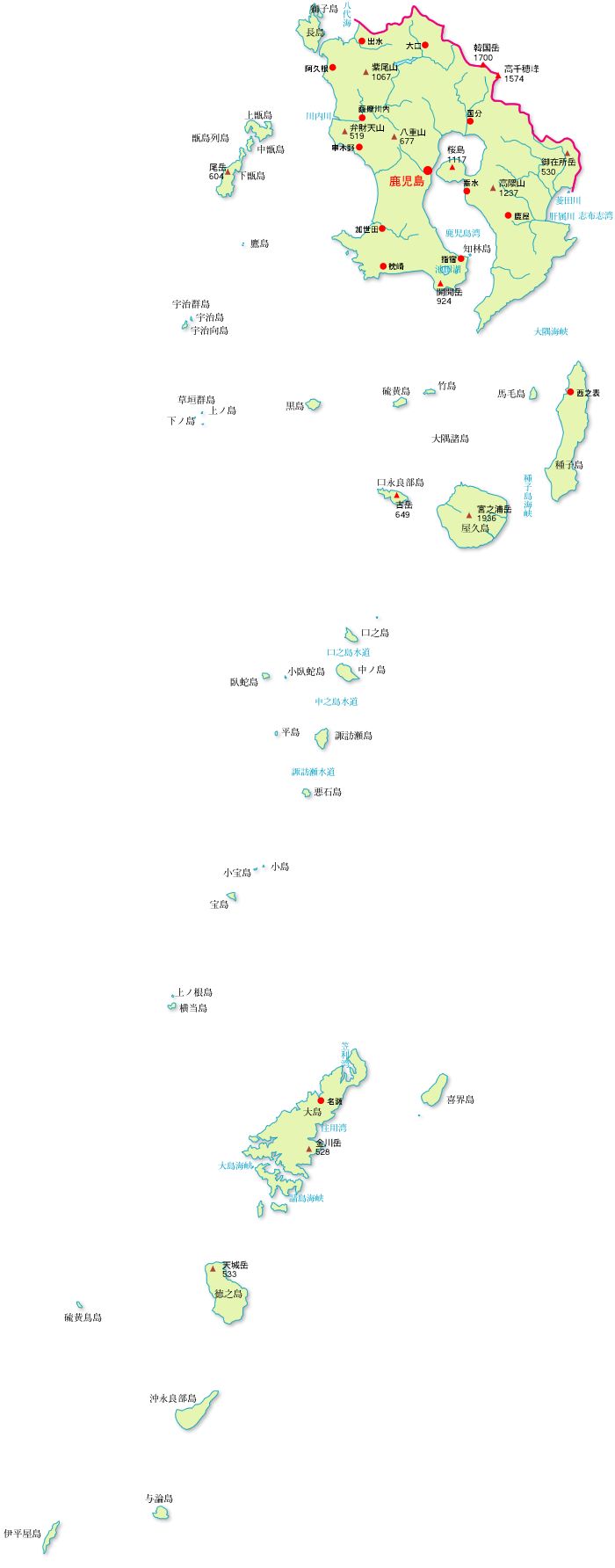
Above is a map of Kagoshima Prefecture, the southernmost prefecture of Kyushu, north of Okinawa. Tokunoshima Island, one of the Amami Islands, is the fourth island from the bottom, just south of the bigger Amami Oshima. Medoruma in his April 5 blog quotes Ota Masahide, former Okinawa Governor from a new book “Future of Okinawa” (Fuyo Shobo, 2010) on the question of why Okinawa only, out of all the 47 prefectures of Japan, was separated from Japan when it was the whole country that lost the war to the U.S. Ota discovered many shocking facts in his extensive research of the US archives. US started planning the occupation of Okinawa two years before the start of the Battle of Okinawa, which began by the invasion of Kerama Islands, east of the main Okinawa Island on March 26, 1945. Admiral Chester Nimitz ordered the occupation of the islands south of the 30 degrees latitude north. Then Assistant Secretary of State Dean Acheson testified in the US Congress that they made that decision because the 30 degrees line was the border between “Yamato(Japanese) Race” and “Ryukyu(Okinawa) Race,” and also because they wanted to maximize the occupiable area beyond Okinawa Prefecture. From the Japanese perspective too, according to Ota, that the Emperor was only concerned with the protection of Japan’s Mainland and protection of the Imperial System. The Emperor and the government leaders then did not consider Okinawa as inherent lands of Japan.
Medoruma quoted Ota’s research and analysis because the current government’s plan for Futenma relocation are ALL underneath the 30 degrees latitude north. When the Hatoyama Administratoin proundly referred the Tokunoshima plan as a “kengai” plan (a plan to move Futenma Air Station out of Okinawa Prefecture), “many Okinawans and residents of Amami islands must have perceived the deep-rooted discrimination in the minds of ‘Yamatonchu'(Okinawan way of calling the people of Mainland Japan),” Medoruma says. “Presenting Tokunoshima as a “kengai” plan only reminds Okinawans of the history of Japan’s unfair treatment of Okinawa and Amami Islands, and would only result in reinforcement of the resentment and anger of Okinawans.”
In the above map, the 30 degrees latitude north line is just north of Kuchinoshima Island, a tiny island below the round-shaped island(Yakushima), south of mainland Kagoshima.
Technically Tokunoshima is outside Okinawa, but culturally and historically, it is not.
PeacePhilosopher

琉球新報(4月7日)
平野氏から3案提示 普天 間移設先
http://ryukyushimpo.jp/news/storyid-160462-storytopic-53.html

仲 井真弘多知事は1日に東京で平野博文官房長官と会談した際、平野氏から米軍普天間飛行場移設先としてキャンプ・シュワブ陸上、勝連半島沖埋め立て、徳之島 の3案を提示されたことを明らかにした。6日、記者団に答えた。ただ知事は「雑談であり協議が始まったとは思っていない。きちんと紙で提示してもらわない と、反対するしかないと伝えた」と述べ、正式な提案ではないとの認識を示した。
知事は2日の北沢俊美防衛相との会談に言及し「平野氏の話とニュ アンスが違う。(政府内で)よく整理できていない感じを受けた」と述べ、政府内で見解が統一されていないとの見方を示した。
平野氏との会談で知 事が「これは正式な協議なのか」と尋ねたのに対し、平野氏は「まだ仕掛品(しかかりひん)だ」と検討段階にあることを強調したという。知事は「構想段階を 出ていないような、雑談の話を協議と言われても難しい。県民が100%の県外移設を要求している中で、(3案は)非常に難しい」と実現を困難視した。
最初に徳之島に移し、その後シュワブ陸上、将来的に勝連半島沖に移設するという3段階移設の報道について、知事は「よく分からない」と述べた。

琉 球新報4月6日
普天間移設「徳之島にまず移転」 平野長官、知事伝達
http://ryukyushimpo.jp/news/storyid-160430-storytopic-53.html

米 軍普天間飛行場の移設問題で、平野博文官房長官が1日に仲井真弘多知事と都内で会談した際、米海兵隊ヘリ部隊をまず鹿児島県・徳之島に移す考えを伝達して いたことが分かった。その後、キャンプ・シュワブ沿岸部の陸上にヘリコプター離着陸帯を建設し、将来的には沖縄本島東岸の勝連半島沖埋め立てによる人工島 に移設する3段階の内容だ。複数の政府関係者が5日、明らかにした。
政府は先月26日、岡田克也外相を通じルース駐日米大使に(1)シュワブ沿 岸部の陸上にヘリ離着陸帯を造り部隊の一部を暫定的に移駐(2)この後、鹿児島県・徳之島か勝連半島沖合埋め立てによる人工島にヘリ部隊を全面的に移す― との二段構えの構想を提示した。平野氏が示した案ではシュワブ陸上に加え、徳之島と勝連半島沖いずれも移設先となる。対米打診案とは異なっており、対処方 針が定まっていない政府の混乱が読み取れる。
政府関係者によると、鳩山由紀夫首相は徳之島への移設に傾いており、2日の関係閣僚会議でも検討を 指示したという。一方、平野氏は勝連半島沖に造る人工島に航空自衛隊那覇基地や米軍那覇港湾施設(那覇軍港)も移し、米軍と自衛隊の大規模な基地を造成す る構想を支持している。このため平野氏は首相の意向も踏まえ、仲井真氏に徳之島と勝連半島沖双方を移設の対象にする案に言及したとみられる。
平 野氏は仲井真氏との会談で、徳之島への移設

構想に触れた上で「その後、シュワブ陸上にヘリ駐機場を造りたい。将来は勝連半島沖の埋め立て地に自衛隊基地も 集約したい」と説明。仲井真氏は沖縄県内への移設に強く反対した。

Fuse Yūjin: The Complete Withdrawal of the US Military from Ecuador: A Victory for Sovereignty and Peace in Latin America

Japan Focus has translated into English two important articles about anti-bases struggles.  Below is the second of two parts, ‘The Complete Withdrawal of the US Military from Ecuador: A Victory for Sovereignty and Peace in Latin America’ by Fuse Yūjin.   It gives an excellent overview of the campaign to oust the U.S. military base from Manta, Ecuador.   Part 1, Marines Go Home: Anti-Base Activism in Okinawa, Japan and Korea by Kageyama Asako gives an excellent comparative analysis of the demilitarization struggles in Okinawa, Korea and Hokkaido.  These articles are valuable reference materials for Hawai’i activists.

>><<

http://japanfocus.org/-Fuse-Yujin/3336

The Complete Withdrawal of the US Military from Ecuador: A Victory for Sovereignty and Peace in Latin America

Fuse Yūjin

Translated by Philip Seaton

US forces withdrew completely from Ecuador in September 2009. How does the Democratic Party of Japan’s coalition administration see the “victory for sovereignty and peace” as it sways between the imperatives of the Okinawan people’s will and the US-Japan Alliance with respect to the transfer of the Futenma Base on Okinawa? This is the second in a two part series on US military bases. The first part is Kageyama Asako and Philip Seaton, Marines Go Home: Anti-Base Activism in Okinawa, Japan and Korea

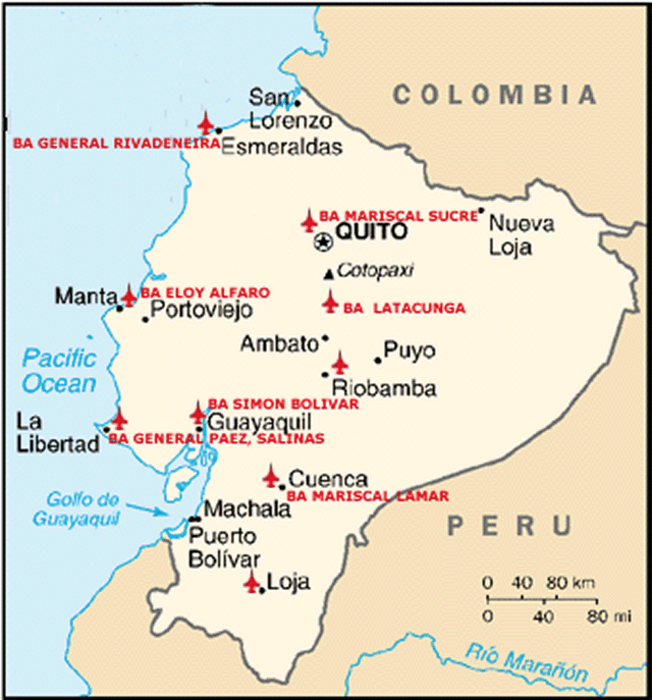
In Spanish, Ecuador means “equator”. Manta is a port town facing the Pacific Ocean in the west of the country. On the coast is a large Ecuadorian air force base. From 1999, the American military had been using the base as a Forward Operating Location (FOL).

US planes withdrawn from Manta, Ecuador, were transferred to Colombia.

Ecuadorian President Rafael Correa announced that the agreement leasing the base, which expired in November 2009, would not be renewed. The American military ceased operations from the base on 17 July 2009. The last personnel left the base on 18 September, and the facilities used for a decade by the American military were all returned to Ecuador.

At a ceremony marking the American withdrawal, Foreign Minister Fander Falconí made the following strong statement: “The withdrawal of the American military is a victory for sovereignty and peace. Never again foreign bases on Ecuadorian territory, never again a sale of the flag.”1

Meanwhile, a relieved Defense Minister Javier Ponce commented: “I am glad that President Correa has fulfilled his election pledge and preserved the constitution.”

On the same day in the capital Quito, the citizens’ group Anti-Bases Coalition Ecuador held a concert of celebration. In exuberant Latin style about 200 people celebrated the American military withdrawal with singing and salsa dancing at an amphitheater. Messages of congratulation were read out from anti-base movements across the globe, starting with Japan, and each was greeted by loud applause.

Helga Serrano, the coordinator of the Anti-Bases Coalition, commented during a slide show that looked back over the struggle, “This is a victory not only for the Ecuadorian people, but also for the network of people across South America and the globe who have fought for the removal of foreign military bases.”

Ecuador as a base for US intervention in Colombia

Using the pretext of “cracking down on drug trafficking”, the US was able to sign a ten-year lease on the base with former President Jamil Mahuad in 1999. Following the signing, AWACS (Airborne Warning and Control System) and P3C maritime patrol aircraft were stationed at the base, along with around 400 military personnel at its peak.

Martha Youth, a spokeswoman for the US Embassy in Quito, announced at the closing ceremony on 18 September that along with other Forward Operating Locations in Central and South America, a total of 700 tons of drugs with a value of 35.1 billion USD had been seized. “We’ve done good work in cooperation with the Ecuadorian authorities”, she said.2

However, Pablo Lucio Paredes, head of CONADE (Comisión Nacional de Control Antidopaje del Ecuador) gave a different view.

“Our country has received no benefits from American operations out of the Manta base these ten years. From the outset, the base’s real purpose was linked to the American geopolitical strategy to involve our country in the civil war in neighboring Colombia.”

The US base was located at Manta, Ecuador

In the same year that the Manta Air Base lease was signed, the pro-American government in Colombia started a cleanup operation Plan Colombia against the rebel group FARC (Fuerzas Armadas Revolucionarias de Colombia, Revolutionary Armed Forces of Colombia). Then in 2001, when the US began its global “war on terror,” Plan Colombia also came to be seen as part of it.

As operations against FARC intensified, conflict expanded into the border regions with Ecuador. The Colombia military, with support from the US, engaged in the large-scale aerial dispersion of defoliant on the pretext of “the elimination of drugs”. This caused serious damage to the health and agriculture of people living on the Ecuadorian side of the border.

Around the Manta Air Base, women and young people faced greater harm: there was an expansion of the sex industry and increased numbers of crimes committed by American service personnel, who were given local immunity from prosecution under the terms of the Status of Forces Agreement (SOFA). Furthermore, there were successive incidents of fishing boats or boats carrying immigrants being attacked or detained by the American naval vessels that frequently came to Manta port. All these incidents caused mistrust of the American military to slowly grow.

Foreign Bases Outlawed Under the New Constitution

Against this background, in 2006 local groups opposing the base joined forces with national human rights groups, farmers, indigenous peoples groups, young people and students to form the Anti-Bases Coalition Ecuador. In November of the same year, Rafael Correa was elected president of Ecuador with a pledge to prevent renewal of the base lease. Expectations that the base would be removed increased sharply.

Then in March 2007, with the support of the new government, the first International Conference for the Abolition of Foreign Military Bases was convened in Quito and Manta by an international network of anti-base activists.3 President Correa, who had pledged the introduction of a new constitution during the election, held a referendum on establishing a Constituent Assembly in April 2007. The electorate gave their approval. The Anti-Bases Coalition Ecuador proposed inclusion of a clause forbidding the establishment of foreign military bases to the committee drafting the new constitution.

The process of creating the new constitution was thoroughly grounded on the principle of “participatory democracy”. Prior to the establishment of the Constituent Assembly in November 2007, debates were held in local communities and schools. As a result, around 3,500 proposals were submitted to the committee drafting the constitution, and a number of forums with citizens’ participation were held while the Assembly was in session.

Then on 1 March 2008 there was an incident in which the Colombian military launched a cross-border attack on a “FARC Camp” said to be just inside Ecuador, in which 25 people were killed.

A few days later, Admiral James Stavridis of U.S. Southern Command stated in testimony to congress that he had observed military action by Ecuadorian and Venezuelan forces on the border with Colombia, and that the Colombian military, with continuous support from the US, prevailed in the fierce battles.4 It is clear that the US forces based at Manta were either directly or indirectly involved in the operations.

Just as it was being made clear once again that the real role of the Manta Base was a “launch pad for intervention in the Colombian civil war”, on 1 April 2008 the Constituent Assembly approved by a large majority the inclusion almost without change of the clause forbidding the presence of foreign bases put forward by the anti-base movement. The new constitution was put to a referendum on 28 September, and it was approved with a majority of 64 per cent on a voter turnout of 94 per cent.

Toward a South America Without American Bases

At the ceremony on 18 September 2009 marking the complete withdrawal of American forces from the Manta base, Foreign Minister Falconí said, “Now in Latin America there is a new vision and deep-seated change to reject all forms of subordination to others.”

For a long time, South America has been called the “US’s back yard”. However, there is now a broadening “domino effect” whereby countries are trying to break away from subordination to America and overcome the neo-liberal economics pushed onto them by America. The undercurrent to the expulsion of the American military from the Manta base was also this larger flow of events.

In January 2009, the Bolivian people also approved in a referendum a new clause in the constitution forbidding the establishment of foreign military bases.

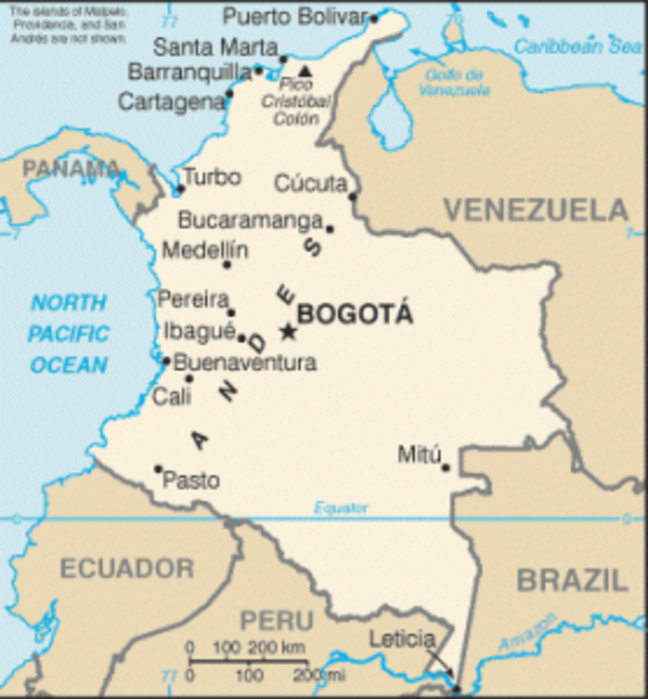
By contrast, in August 2009, the American and Colombian governments approved a deal for the US military to use seven Colombian military bases for the next ten years as a replacement for the Manta base.

Location of seven new US military bases in Colombia

In response to this, the Union of South American Nations (UNASUR) consisting of twelve South American countries including Colombia approved a resolution at its meeting of the heads of state in Argentina, August 2009, that the stationing of foreign troops must not threaten the sovereignty and territorial integrity of all South American nations, nor the peace and stability of the region.  Furthermore, as a measure to ensure this, UNASUR intends to concretize the “inspection of military bases” in the future.

At the concert of celebration held in Quito there were also representatives of Colombian anti-base groups. The Anti-Bases Coalition Ecuador presented them with a boat on which both the Ecuadorian and Colombia flags were painted.

As Helga Serrano from the Anti-Bases Coalition explained, “The boat represents our wish to pass our fight over to Colombia. Now we are working toward the goals of the removal of all American military bases from South America and the declaration of our region as a region of peace. We have started to discuss how we can forge a common strategy that transcends national borders.”

Fuse Yūjin is a journalist. This article appeared in the 20 November 2009 edition of Shūkan Kinyōbi (Weekly Friday). Notes and links have been added by the translator to provide additional context. Quotations are retranslations from the Japanese and may differ from the original.

Philip Seaton is an associate professor in the Research Faculty of Media and Communication, Hokkaido University. An Asia-Pacific Journal Associate, he translated this article for the Journal. He is the author of Japan’s Contested War Memories and translator of Ayako Kurahashi’s My Father’s Dying Wish. Legacies of War Guilt in a Japanese Family. His webpage is www.philipseaton.net

Recommended citation: Fuse Yūjin and Philip Seaton, “The Complete Withdrawal of the US Military from Ecuador: A Victory for Sovereignty and Peace in Latin America,” The Asia-Pacific Journal, 14-2-10, April 5, 2010.

Notes

1 France 24, US quits air base used in anti-drug operations, 19 September 2009.

2 Washington Post, As U.S. Closes Military Post, Ecuador Hails Restoration of ‘Sovereignty’, 19 September 2009.

3 Transnational Institute, Ecuador: International Conference for the Abolition of Foreign Military Bases, 15 March 2007. For more on this developing movement, see Andrew Yeo, ‘Not in Anyone’s Backyard: The Emergence and Identity of a Transnational Anti-Base Network’, International Studies Quarterly (2009) 53, 571-594.

4 Admiral James Stavridis, Congressional Testimony, March 2008. Note: The testimony is available in full on video via this link. The text in this translated article is a paraphrase.

5 Colombia Reports, Colombia stands isolated at UNASUR meeting, 28 August 2009.

Kageyama Asako: Marines Go Home: Anti-Base Activism in Okinawa, Japan and Korea

Japan Focus has translated into English two important articles about anti-bases struggles.  Below is the first of a two part series in Japan Focus by Kageyama Asako.   It gives an excellent comparative analysis of the demilitarization struggles in Okinawa, Korea and Hokkaido. Part 2, ‘The Complete Withdrawal of the US Military from Ecuador: A Victory for Sovereignty and Peace in Latin America’ by Fuse Yūjin looks at the victorious campaign to oust the U.S. military base from Manta, Ecuador.  These articles are valuable reference materials for Hawai’i activists.

>><<

http://japanfocus.org/-Kageyama-Asako/3335

Marines Go Home: Anti-Base Activism in Okinawa, Japan and Korea

Kageyama Asako

Compiled, edited and translated by Philip Seaton1

The US military’s Kooni Firing Range in the South Korean village of Maehyang-ri was closed in 2005, following a concerted effort by anti-base activists. Maehyang-ri was one of three anti-base struggles featured in the documentary film Marines Go Home: Henoko, Maehyang-ri, Yausubetsu (official website here, trailer here) directed by Hokkaido-based independent filmmaker Fujimoto Yukihisa. In this article, journalist and filmmaker Kageyama Asako (narrator and co-producer of Marines Go Home) discusses the lessons from Maehyang-ri in the context of the Futenma relocation debate that is at the heart of current US-Japan conflict.

This is part of a two-article series that considers the base relocation issue from perspectives beyond Okinawa. The other is ‘The Complete Withdrawal of the US Military from Ecuador: A Victory for Sovereignty and Peace in Latin America’ by Fuse Yūjin.

The Futenma base relocation issue has been dominating the headlines in Japan ever since the formation of the Hatoyama administration in September 2009. Understandably the focus has been on Okinawa, long the center of anti-base activism. But we should see the Futenma base relocation issue as part of a much broader problem. In this article I want to consider the Futenma issue in the context of other activities within the international anti-bases movement.

I have been involved in the anti-bases movement for many years and serve on the Hokkaido Asia Africa Latin America Solidarity Committee (HAALA). HAALA is an organization that opposes neo-colonialism, respects the rights of people to self-determination and aims for the equality of all peoples. Revocation of the US-Japan Security Treaty and the removal of all American bases from Japan are among its aims. We have links with Vietnam, Nicaragua, Cuba and South Africa among others and are involved in various humanitarian projects there. A representative of the Japan Africa Asia South America Solidarity Committee went to Ecuador to attend the anti-base activities described in Fuse Yūjin’s article [add link], and have also visited Venezuela and Bolivia.

The International Network for the Abolition of Foreign Military Bases (INAFMB) took off at the World Social Forum held in Mumbai in January 2004 and was launched officially as a result of its first international conference in Quito and Manta, Ecuador, in March 2007. I attended the Mumbai meeting as the representative of HAALA. It was an unforgettable experience. To have 130,000 people gathering from across the globe under the slogan ‘Another world is possible’ in a meeting of such diversity and vibrancy was enough to really make one believe it could happen. In particular, the demonstrations by members of India’s so-called ‘untouchables’ caste left a particularly strong impression. Their cries of ‘If another world is possible then it must include us’ brought it home that only by raising one’s voice is there any hope to change things.

World Social Forum 2004

Marines Go Home

In response to the calls to action in Mumbai, and also as part of the fortieth anniversary celebrations of HAALA, we started making a documentary film: Marines Go Home, Henoko, Maehyang-ri, Yausubetsu. Marines Go Home (2005, official website here, trailer here) focuses on some of the individuals and activists dedicated to the removal of US bases from three towns and villages in Japan and South Korea. In Yausubetsu (in Eastern Hokkaido), the film depicts the ‘live in protest’ of Kawase Hanji, who for many years refused to leave his home in the middle of Yausubetsu Enshujo (Yausubetsu Maneuver Area), a Japan Ground Self Defense Forces (JGSDF) firing range in Eastern Hokkaido.2 Yausubetsu is the largest training area in Japan. Each year since 1997, US marines have been coming to Yausubetsu to conduct live-fire training, all paid for by the Japanese taxpayer.3

The local struggle against the training exercises has continued for over 40 years. For many years, the Yausubetsu Peace Bon Festival was held on Kawase’s property. This festival and the Yausubetsu issue have long been at the heart of HAALA’s activities (and as such, a number of members appear in Marines Go Home). The fortieth festival was held in 2004.
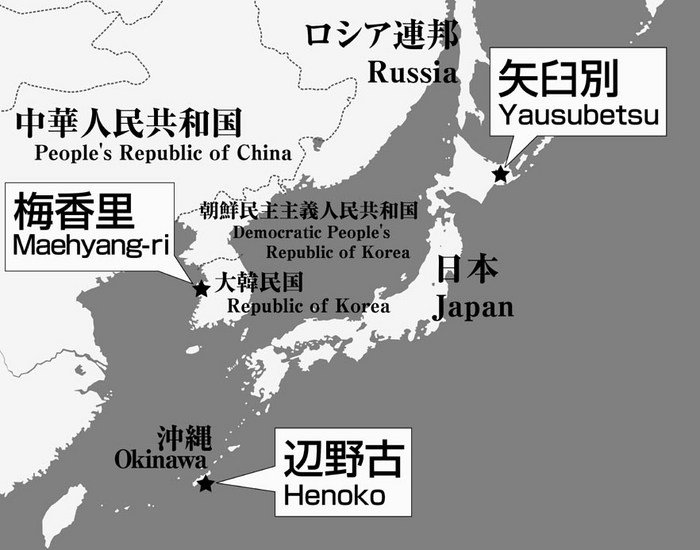
In September 2003, HAALA arranged for a special guest to visit Yausubetsu to witness a US Marines Corps training exercise. Chun Man-kyu was the leading figure in the struggle to close a firing range just off the coast of Maehyang-ri village in South Korea. The American military started using the Kooni firing range there in 1951. Up until the closure of the firing range in 2005, twelve local people had been killed, either in accidents or by unexploded ordinance from the range. There was also an incident in 2000 when an A-10 fighter dropped six missiles into the sea very close to a residential area and damaged 700 houses.

Finally, the film documents the protests against the surveying work being undertaken off the coast at Henoko in preparation for the transfer and upgrading of the Futenma air base to Camp Schwab in Henoko, part of Nago city, Okinawa. The first plan in 1996 was to construct a floating heliport. This was rejected in a plebiscite in 1997. In 2002 the plan was changed to a permanent base with a runway built on a massive landfill. This plan was withdrawn after desperate protest in September 2005, only to be replaced by a new and even bigger plan drawn up by the Japanese and American governments the following month (October 2005) for a two-runway base in Henoko along the coast of Camp Schwab in Oura Bay. The deep water in Oura Bay means nuclear aircraft carriers would be able to visit. All these plans have been made in the face of stiff local opposition and would destroy a pristine marine habitat supporting among other species rare blue coral reefs and the internationally protected dugong.4 Just before the Democratic Party of Japan defeated the Liberal Democratic Party in the 30 August 2009 general election, the outgoing and deeply unpopular Aso administration signed the so-called Guam Treaty, which the US interprets as binding the Hatoyama to an agreement to build the Henoko base.5

Protestors try to prevent survey work on the proposed Henoko offshore runways site.

Marines Go Home was released in 2005 (and an updated version was produced in 2008, official site here). A lot has happened since Marines Go Home was first released. The anti-base movement in Hokkaido suffered two keenly-felt losses in 2009 when first Kawase Hanji and then former US marine Allen Nelson6 (a staunch supporter of the ‘Marines Go Home’ message) died. With Kawase’s death, a rethinking of the strategies used by anti-base activists in Yausubetsu became necessary. The strategy could no longer be built around the theme ‘preserve Kawase’s way of life’. Thankfully, a woman who used to lodge with Kawase continues to live in the firing range, although conditions are tough. The people in and around Yausubetsu will continue the struggle, although as a vital site for the anti-bases protest movement this struggle needs as much local and international support as possible. It would be too much to ask local people to assume the whole burden of organizing activities and maintaining homes, livelihoods and places to gather within the firing range.

Kageyama interprets for the late Allen Nelson during a talk at Hokkaido University in 2007.

Anti-base activists in Henoko have also faced a mounting struggle. As part of the planned redeployment of American forces agreed by the US and Japan in 2006, there were plans to construct deep-water port facilities at Henoko. This decision required another environmental survey, but in contrast to previous protests (depicted in the 2005 film) in which protesters canoed out to occupy the survey rigs and delay work, this time the Japan Coast Guard obstructed the protests. The Coast Guard had previously stayed out of the standoff between contractors and protestors. The level of violence used against the protestors reached life-threatening levels on occasions. Furthermore a Marine Self Defense Forces frigate was sent to the area. According to local media, the frigate had divers on board who set up survey equipment on the seabed under the cover of darkness. It was also a clear warning to protestors that the Japanese government, without any legal basis, was prepared to deploy military forces. Despite the risks, the protests have continued on land and at sea.7

The protestors also faced a split in the anti-base movement during the 2006 Nago mayoral elections.8 That election was won by the LDP-Komeito-backed Shimabukuro Yoshikazu, who supported the construction of the base. The anti-base movement vote was split between two anti-base candidates, both of whom were city councilors: Oshiro Yoshitami and Gakiya Munehiro. Gakiya was supported by the Social Democratic Party, Communist Party, Okinawa Social Mass Party, Democratic Party and the unions, but had voted for the move from Futenma to Henoko in 1990, so many opponents of the base felt unable to support him.

After the 2006 election, the number of people in the tented camp dwindled in the face of the confusion over the mayoral race and the violent tactics being used against protestors. In the midst of all this, the leader of the Inochi wo Mamoru Kai (Saving Life Society), Kinjo Yuji passed away. It was a tough time, yet the movement survived.

The anti-base movement was brought together again with the January 2010 election of Inamine Susumu as mayor of Nago on an anti-base ticket.9 Earlier there had been change on the prefectural level: at the 2008 Okinawa Prefectural Assembly elections, LDP-Komeito lost its majority, allowing the assembly to pass a resolution opposing construction of a new base on 18 July 2008.10 Then during the 2009 general election, the LDP-Komeito coalition lost all its parliamentary seats in Okinawa. This was a backlash against the government on the bases issue, and also over the deeply unpopular healthcare reforms adversely affecting the elderly. The new extent of unanimity in Okinawan opposition to the Henoko plan was demonstrated on 24 February 2010 when ‘Okinawa assembly members voted unanimously to adopt a written request urging the central government to relocate the Futenma base outside the prefecture.’11

With the exception of the governor, the entire Okinawan leadership was now in the hands of anti-base forces, and even the Governor has faced tremendous pressure to reject the Henoko plan. Following the wave of optimism that accompanied the victory of the Democratic Party of Japan in the August 2009 elections on a specific pledge to move bases outside the prefecture, or outside of Japan, serious doubts have arisen about the base decision. In the face of intense US pressure, the DPJ is actively exploring alternative base sites including Henoko and other Okinawan islands as well as on mainland Japan and in Guam. Of course, even if the Hatoyama administration succeeds in honoring its election pledge to move Futenma out of the prefecture or out of Japan altogether, this would not be more than a slight dent in the US military presence in Japan: at present (March 2010) comprising 85 facilities covering 77,000 acres of land, and numbering 36,000 on-shore personnel and 11,000 personnel afloat.12 Nor would this halt the increased integration of US and Japanese military forces, a process which is accelerating. The US military continues to conduct live-fire exercises in Yausubetsu. Indeed, the majority of SDF facilities are used jointly by the Japanese and US militaries on a daily basis, as are a number of civilian facilities such as ports and airports.

Marines training with GSDF soldiers at Yausubetsu, March 2008.

So while all attention is focused on Futenma, what is actually occurring is the ‘Okinawaization’ of Japan. As former marine Allen Nelson has testified, during the Vietnam War Okinawa was used as a training location for soldiers en route to Vietnam.13 This role seems to be being extended across Japan. The political need to reduce the burden on Okinawa was the underlying reason for the relocation of US Marine Corps live fire drills from Okinawa to Yausubetsu in 1997, and those ‘skills’ practiced in Hokkaido have been exported to conflicts in other parts of the globe. As Saito Mitsumasa has demonstrated, the Misawa base in Aomori has long been a key part of the projection of US nuclear strike capability in Asia, which makes a mockery of Japan’s three non-nuclear principles (as does the much more public revelations of the ‘secret pacts’ during the Cold War to allow nuclear weapons into Japan, which was officially acknowledged by the DPJ government in March 2010). Furthermore, Misawa is currently being used as a forward staging area for bombing missions in Iraq and Afghanistan.14 These developments illustrate that US forces are not in Japan for the protection of Japan or peace and stability in Asia, but for the projection of American power throughout Asia and the Pacific, even to the Middle East.

Learning from Maehyang-ri

In the context of the Futenma base clash there are many lessons to be learned from the successful campaigns in Maehyang-ri to shut the firing range. Of course there are some important differences between Japan and South Korea, too. But we can summarize the keys to success as follows.

A helicopter gunship blasts an island off the coast of Maehyang-ri.

The first is the political background, namely the democratization of South Korea in the 1980s, and particularly following the 1987 presidential election after years of military dictatorship. Citizen’s groups mushroomed, and the anti-base group in Maehyang-ri was founded in 1988. Previously, any opposition to the base risked repression as a ‘North Korean spy’. The Maehyang-ri struggle was an integral part of the democratization process.

Even so, and this is the second point, citizens showed great resilience in the struggle. Despite democratization they still faced repression and intimidation. In November 1988, local residents demanded the removal of the base. In protest they occupied the base and tried to prevent the live-fire exercises. They occupied the base again in 1989 and risked their lives to stop the exercises.

In response the American military forbade entry to the base. In retribution they dumped four trucks worth of sand on Chun Man-kyu’s fields. When irate local people tried to occupy the base, 50 people including Chun were arrested. Then in 2000 after the incident in which an A-10 plane dropped its payload causing damage to many homes, the US military continued training as if nothing had happened. This triggered widespread protests across the country. Around 40,000 police were deployed. They arrested 100 protestors, including Chun, and 500 people were injured in clashes. Despite all these trials, the protest movement persevered until it was eventually able to get the base closed in 2005. The role of direct action was vital, as was the resilience people showed in the face of the risks that direct action entailed.

Chun Man-kyu inspects the ordinance littering the beach of Maehyang-ri.

Third, international solidarity in the anti-base movement was also vital. Chun’s active development of links with groups in other countries (Marines Go Home shows him on his September 2003 visit to the Yausubetsu firing range meeting Kawase Hanji) raised the profile of Maehyang-ri. It became a rallying call for the anti-bases movement, alongside the campaign to stop US navy live-fire exercises on Vieques, Puerto Rico.

In fact, the Maehyang-ri protestors learned one of their most effective strategies from Japan. In Yokota, for many years Japanese citizens had been filing lawsuits against the US military and Japanese government on the basis of noise pollution caused by US jets using the base. In 1998, 15 residents of Maehyang-ri filed similar suits, which ended in victory in the courts in 2003. The base was breaking Korean law regarding the levels of noise pollution, so local people had “a real case to present to the government”.15 The verdict pronounced for the first time that the noise pollution from the American base was unlawful. Each plaintiff was awarded about 10,000 dollars in damages. Following this, in 2001 a further 2,000 plaintiffs sued the Korean government. The ruling in December 2004 ordered the government to pay total damages of 10 million dollars.

The legal victory over noise pollution at Maehyang-ri has a counterpart in the lawsuit filed in San Francisco that the construction of the Henoko base would violate the National Historic Preservation Act. The court found in favor of the plaintiffs in January 2008.16 This should have provided the appropriate legal barrier to the Henoko base issue, although the US and Japanese governments forged ahead in signing the Guam Treaty in 2009, which is an agreement to do something already declared illegal by the courts.17

But, as in the Henoko case, we cannot decontextualize the Maehyang-ri campaigns from broader US military strategy. The current US strategy in South Korea stresses the creation of ‘hub bases’. The Maehyang-ri firing range may have closed, but farmers have been evicted from their land around the Songtan Air Base (also known as Osan Air Base) and the army base Camp Humphries in Pyeongtaek to expand the bases there. This occurred during the presidency of President Roh Moo-hyun, a lawyer and central figure in the democratization movement.

The Pyeongtak struggle was fierce. In 2005 around 200 farming households were thrown off their land under a compulsory land acquisition order. Having been removed from their land they also lost their livelihoods. The farmers and their supporters continued to resist, but the Korean government deployed 10,000 police and 1,000 troops. They cordoned off the villages and moved in heavy equipment to destroy the farmland and buildings. The final villagers were forced to leave in April 2007.18

This is not to say that the Kooni firing range in Maehyang-ri was shut down because it was unnecessary: it had often been called the best firing range in Asia by the US military. Ultimately, Maehyang-ri was breaking Korean law and untenable in the face of local opposition. But when it was shut down, training was simply shifted to other South Korean facilities, Alaska, Okinawa or elsewhere. Bases will not be returned because they are ‘not needed’. Neither is it a question of saying that a base can be closed when an alternative is found. Anti-base forces are not interested in saying ‘not in my back yard’. We are saying ‘not in anyone’s back yard’ to the over 1,000 overseas bases that the US military maintains throughout the world.

A Global Struggle

In 2005 I attended the fifth World Social Forum in Porto Alegre, Brazil. I showed a 15-minute segment of Marines Go Home (at the time still under production). It was not easy to screen the film outside in a tent, or to give the accompanying talk in English, but it was warmly received. A Korean woman asked me to explain more about the Henoko struggle, Indian and American participants shook my hand, and a person from Iraq pointed out that ‘Marines Go Home’ is a slogan there, too. I really felt as if the messages of Kawase Hanji, Chun Man-kyu and all the activists in Henoko were resonating elsewhere.

It is all too easy to see base struggles in isolation, but in reality there are similar issues in many places. Japanese people are often surprised to learn that anti-base protests exist in the US, too. In 2006 I spent a lot of time in the US collecting materials for our next film, America Banzai: crazy as usual (official site here). With colleagues in the Southwest Workers Union (who I had met through WSF), I learned about the fight against the environmental damage and noise pollution caused by the Kelly Air Force Base (since 2001 the Kelly Field Annex, part of the Lackland Air Force base in San Antonio, Texas). The base had handled nuclear and chemical weapons. Waste was just dumped into local creeks causing serious health problems from cancer to birth defects. Local residents protested on numerous occasions to the air force and US government. Only after Kelly Air Force base closed were the causes of the health problems partially disclosed, but the air force and government never admitted any responsibility or compensated residents.

Some of those activists appeared in America Banzai. In 2009, a number of people who had appeared in America Banzai visited Japan to take part in a speaking tour to similarly affected places in Japan: Kanagawa, Iwakuni and Okinawa. The discussions of the damage caused by the Kelly Air Force base made quite an impression. Many Japanese think that the base issue exemplifies an American double standard by which things that would not be permitted in the US are forced onto Japan. This is not the case. Both countries suffer from the same problems. Whether in Japan, South Korea or the US, the fundamental problem is the government and military riding roughshod over local people. One senses, however, a heavy element of racism and discrimination surrounding the bases issue. In the case of Kelly Air Force Base, most local residents were poor Mexicans. Laws, it seems, are adhered to more closely when the people harmed by the bases are not the poor, indigenous peoples, immigrants, Japanese, Koreans or others.

Given the complexity of the bases issue, there is little reason for confidence that President Obama and Prime Minister Hatoyama will bring much ‘change’, despite the moods of public optimism following the launches of their respective administrations in 2009. However, Prime Minister Hatoyama’s decision to delay a final verdict on the Futenma base has at least provided a chance to increase discussion of the bases issue in the Japanese media. What has ensued is a major power struggle between popular local opposition to bases and the powerful vested interests promoting them. One can only hope that come May, when Prime Minister Hatoyama announces his decision, he chooses the will of the Okinawan people over the demands of the US. After all, would that not be fulfilling the ideals that America has so frequently used as an excuse to go to war: the spread of democracy, and the respect for the will of the people that democracy entails.

Kageyama Asako is a Hokkaido-based journalist and filmmaker. In addition to Marines Go Home, she has been involved in three films shot in the US: 「アメリカばんざい Crazy as Usual」 (English title God Bless America), 「アメリカ – 戦争する国の人びと」 (English title God Help America) and 「One Shot One Kill – 兵士になるということ」. Details on all these films are available here. To order the films, email morinoeigasha@gmail.com

Philip Seaton is an associate professor in the Research Faculty of Media and Communication, Hokkaido University. An Asia-Pacific Journal Associate, he compiled this article for the Journal. He is the author of Japan’s Contested War Memories and translator of Ayako Kurahashi’s My Father’s Dying Wish. Legacies of War Guilt in a Japanese Family. His webpage is www.philipseaton.net

Recommended citation: Kageyama Asako and Philip Seaton, “Marines Go Home: Anti-Base Activism in Okinawa, Japan and Korea,” The Asia-Pacific Journal, 14-1-10, April 5, 2010.

Notes

1 The article has been compiled through correspondence between Kageyama Asako and Philip Seaton. We are grateful to Mark Selden for his helpful comments.

2 See Tanaka Nobumasa, ‘Defending the Peace Constitution in the Midst of the SDF Training Area’.

3 “[Live-fire] training has been conducted on mainland Japan since the governments of Japan and the United States formally agreed to cease the firing of artillery on Okinawa in 1996. Fire maneuver areas were chosen on the mainland for artillery training exercises at Hijudai, East and North Fuji, Ojojihara and Yausubetsu. The signed agreement requires the Japanese government to fund all additional expenses not incurred when firing on Okinawa, such as transportation of personnel, equipment and barracks facilities.” Leatherneck, ‘3/12 Marines rain steel at Yausubetsu’.

4 For a detailed history see Gavan McCormack and Matsumoto Tsuyoshi, ‘Okinawa Says “No” To US-Japan Base Plan’ and Gavan McCormack, ‘The Travails of a Client State: An Okinawan Angle on the 50th Anniversary of the US-Japan Security Treaty’. For updates on the anti-base struggles and US-Japan negotiations over the closure of the Futenma Base and the construction of a new base see numerous entries at the Peace Philosophy Centre.

5 Gavan McCormack, ‘The Battle of Okinawa 2009: Obama vs Hatoyama’.

6 Allen Nelson’s story is described in Philip Seaton, ‘Vietnam and Iraq in Japan: Japanese and American Grassroots Peace Activism’.

7 For more on the protests, see Kikuno Yumiko, ‘Henoko, Okinawa: Inside the Sit In’. See also the 2008 version of the documentary film Marines Go Home.

8 See Urashima Etsuko, ‘The Nago Mayoral Election and Okinawa’s Search for a Way Beyond Bases and Dependence’; The Japan Times, ‘Base moderate elected Nago mayor’, 23 January 2006.

9 See Urashima Etsuko and Gavan McCormack, ‘Electing a Town Mayor in Okinawa: Report from the Nago Trenches’.

10 Gavan McCormack and Matsumoto Tsuyoshi, ‘Okinawa Says “No” To US-Japan Base Plan’.

11 The Japan Times, ‘No head-start base talks with U.S.’, 25 February 2010.

12 This data accessed on 24 March 2010 from U.S. Forces Japan.

13 Philip Seaton, ‘Vietnam and Iraq in Japan’, The Asia-Pacific Journal.

14 Saito Mitsumasa, ‘Mission Impossible? Misawa as the Forward Staging Area for the Secret US-Japan Nuclear Deal and the Bombing of Iraq’. On secret pacts, see The Japan Times, ‘Secret Pacts Existed; denials “dishonest”’, 10 March 2010.

15 South Korean Defense Analysis Official, interviewed by Andrew Yeo, ‘Local Dynamics and Framing in Korean Anti-Base Movements’, Kasarinlan: Philippine Journal of Third World Studies 2006 21 (2): 34-60, page 54.

16 For more on the lawsuit see Miyume Tanji, ‘U.S. Court Rules in the “Okinawa Dugong” Case: Implications for U.S. Military Bases Overseas’, Critical Asian Studies 40:3 (2008), 475-487.

17 See Gavan McCormack, ‘The Battle of Okinawa 2009’, The Asia-Pacific Journal.

18 For more on Pyeongtaek, see Andrew Yeo, ‘Local Dynamics’, Kasarinlan.

UK designates Chagos marine reserve, but right of return for Chagos refugees unclear

According to this AP article, the UK has outdone the US and created the largest marine reserve in the world in Chagos, surpassing the Papahanaumokuakea national marine monument.  However, as the Times reported earlier this environmentally friendly move may make it more difficult for the evicted Chagos islanders to return to their island home in Diego Garcia, now a strategic U.S. military base.   The Papahanaumoku national marine monument in the northwestern Hawaiian islands was a groundbreaking environmental measure, but it included exemptions for the U.S. military to operate in the reserve.   Chamoru fishing people and rights activists are afraid that a similar marine monument proposed for the Mariana islands could give the federal government more control over indigenous subsistence resources.  At least Greenpeace recognizes the Chagossian struggle:

“The creation of this marine reserve is a first step towards securing a better and sustainable future for the Chagos Islands,” said Greenpeace activist Willie Mackenzie. “But this future must include securing justice for the Chagossian people and the closure and removal of the Diego Garcia military base.”

>><<

http://hosted2.ap.org/HIHON/117a0477c44849128ee910aa1d0181d9/Article_2010-04-01-EU-Britain-Marine-Reserve/id-p51a71e31adf24909bc6aeb6d7009f6a7

Apr. 1, 2010 3:18 PM EDT

UK creates world’s largest marine reserve

DAVID STRINGERDAVID STRINGER, Associated Press Writer

LONDON (AP) — Britain said Thursday it will create the world’s largest marine reserve by banning fishing around the U.K.-owned archipelago in the Indian Ocean — a cluster of 55 islands across about a quarter of a million square miles of ocean.

Foreign Secretary David Miliband said commercial fishing will be halted around the Chagos Islands to allow scientific research and the preservation of coral reefs and an estimated 60 endangered species.

His ministry insisted the move would not affect operations on the island of Diego Garcia, which Britain leases to the U.S. military for use as a base. Miliband told lawmakers in 2008 that the U.S. had belatedly informed Britain it had used Diego Garcia as a stop for CIA extraordinary rendition flights.

Conservation groups and scientists welcomed the move to protect waters around the islands, reputedly some of the world’s cleanest ocean, and claimed it would become as important for research as the Great Barrier Reef or Galapagos Islands.

“The territory offers great scope for research in all fields of oceanography, biodiversity and many aspects of climate change, which are core research issues for U.K. science,” Miliband said Thursday, announcing the decision.

Halfway between Africa and Southeast Asia, the Chagos Islands have been frequently controversial for the British government.

The European Court of Human Rights is considering a long running appeal from Chagossians evicted from their homes to nearby Mauritius between 1967 and 1973 to make way for the military base. Islanders are seeking to return to their former homes.

“The creation of this marine reserve is a first step towards securing a better and sustainable future for the Chagos Islands,” said Greenpeace activist Willie Mackenzie. “But this future must include securing justice for the Chagossian people and the closure and removal of the Diego Garcia military base.”

Miliband said the protected zone would cover 210,000 square miles (544,000 square kilometers) of ocean, which is home to about 220 types of coral, 1,000 species of fish and 33 different seabirds.

The Chagos Environment Network — a coalition of ocean scientists — said the area will replace the Papahanaumokuakea Marine National Monument, in Hawaii, as the world’s largest marine reserve.

Miliband said Britain has agreed to transfer control of the territory to Mauritius “when it is no longer needed for defense purposes,” but has not specified any timeframe.

Under the terms of the lease of Diego Garcia, the U.S. military can remain on the island until at least 2036.