Vicenza citizens remove sections of fence blocking access to the river

In Vicenza, Italy, construction companies building the new U.S. military base erected fences along public land near the river without permission from Local Authorities.  As reported by Enzo Ciscato, of the No Dal Molin movement, “The Workers of the “Independent Municipality No Dal Molin” have brought a state of free transit on the public land by the river.”  In other words the activists removed big sections of the fence. Great video here:

http://www.nodalmolin.it/spip.php?article874

Presidio Permanente No Dal Molin
Vicenza – Italy
www.nodalmolin.it <http://www.nodalmolin.it/>

Massive artificial island proposed as alternative to Futenma base

http://peacephilosophy.blogspot.com/2010/03/no-longer-relocation-idea-of-massive.html

Tuesday, March 16, 2010

No Longer “Relocation” – An Idea of a Massive Artificial Island with Three Runways over 3,000 metres

もう「移設」とはとても呼べない

http://ryukyushimpo.jp/uploads/img4b9ed86310b7f.jpg

Ryukyu Shimpo, on March 16, reported some details of the plan to build a massive artificial island off Katsuren Peninsula.

Unbelievable. As Miyagi Yasuhiro said, how can we call this “Futenma relocation site” any more?

The area to be reclaimed East of Hikashima Island is said to be 1,021 hectares. It is going to accommodate not only USMC (as “relocation” of Futenma Air Station) but also Air Self Defense Force (as relocation of ASDF Naha Base) and the US military port facilities (also relocation of Naha military port).

In the plan, there will be three runways to be built – one 3,000 meter, and two 3,600 meter ones. Bridges will be built from that artificial island to Hamahika Island and Miyagi Island.

Medoruma Shun sharply criticizes this “outrageous” plan makes no military sense. Osprey(V-22) and helicopters (the kind of aircrafts that were planned to be based in the V-shape Henoko runway plan) do not need such long runways. He wonders if there is a plan to base B52.

The plan was suggested by Ota Norio, Chair of Okinawa Chamber of Commerce to Chief Cabinet Secretary Hirano and Defense Minister Kitazawa. The same concept was embraced in 2005 by Robert Eldridge, who taught at Osaka University back then. Now Eldridge is Deputy G-5, U.S. Marine Corps Bases of Okinawa. Eldridge has also been meeting with Hirano to explain this possibility.

According to Medoruma, Ota has been endorsing the plan to build a base off Katsuren Peninsula. Medoruma suspects that Ota wants to expand the reclamation area to increase the construction costs for the benefit of related businesses. He also points out that in the March 13 edition of Rykyu Shimpo, Kokuba Koichiro, Supreme Advisor of the Terrace Hotel contributed an article promoting the reclamation project. He has previously assumed positions like President of Kokuba Construction and President of the association of Okinawa’s construction companies. He is also known to be endorsing a plan to introduce a casino to Okinawa. “Those industries are becoming active around this plan,” Medoruma warns.

琉球新報 3月16日

【東京】米軍普天間飛行場移設をめぐり、地元経済界関係者から政府側に伝えられた勝連半島沖埋め立て案は、うるま市浜比嘉島の沖合1300メートルのリーフ内に約1021ヘクタールを埋め立てて人工島を造成し、航空自衛隊那覇基地や米軍那覇港湾施設(那覇軍港)の機能も併せ持つ集約案であることが15日までに分かった。滑走路は3000メートル1本と3600メートル2本の計3本を擁し、人工島は架橋で浜比嘉島と宮城島にそれぞれ接続させる。

提案者は、日米特別行動委員会(SACO)と米軍再編のころにも勝連半島沖埋め立て案を提唱していた沖縄商工会議所の太田範雄名誉会頭。民主党の犬塚直史参院議員の仲介で北沢俊美防衛相と会った。太田氏によると平野博文官房長官の側近にも説明したという。

同じ場所を埋め立てて米軍と自衛隊の統合基地を造る構想は、米軍再編協議の2005年当時、大阪大学准教授で、現在は在沖米海兵隊外交政策部(G5)次長を務めるロバート・エルドリッジ氏が提言していた。海兵隊の運用にもかなっているとされた。関係者によると、今回も同氏が平野官房長官に会い構想を説明しているという。

太田氏の案では、名護市辺野古沿岸部への日米合意案の埋め立て面積160ヘクタールの6倍以上となる。平安座島と宮城島の間を埋め立て石油コンビナートを造った際の埋め立て面積約194ヘクタールの5倍ともなり、環境への影響は避けられない。

人工島造成は2段階で、第1段階は普天間移設先として約400ヘクタールを埋め立て、3000メートルの滑走路を造る。その後、さらに造成して飛行場とヘリポート部分は最終的に710ヘクタールまで埋め立て、港湾施設区域に50ヘクタール、米軍補給施設区域に102ヘクタール、自衛隊基地部分として159ヘクタールを造成し、軍港と空自那覇基地の部隊を移駐させる。人工島部分は、浮原島と南浮原島は埋め立てない。

太田氏の構想では、空自と軍港を併設せず普天間を単独で移設させる案も用意しており、その場合、位置は浮原島と宮城島の間を約200ヘクタール埋め立てて、1800メートルの滑走路を造る。

Uruma, Okinawa residents rally against relocation of Futenma base to White Beach district

http://mdn.mainichi.jp/mdnnews/news/20100326p2a00m0na019000c.html

Okinawa residents hold rally against Futenma relocation

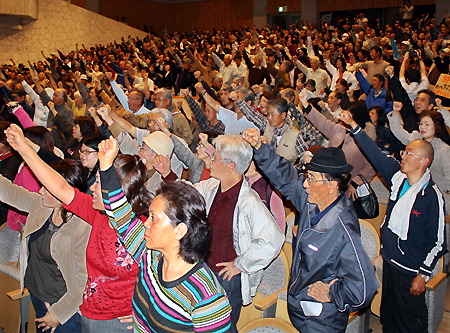
Uruma, Okinawa residents raise fists against base relocation to their area.

Uruma residents raise their fists during a rally Thursday night against the relocation of U.S. Air Station Futenma to an offshore area of the city. (Mainichi)

URUMA, Okinawa — Residents of this Okinawa Prefecture city have held a rally to express their opposition to a government plan to relocate U.S. Marine Corps Air Station Futenma to an offshore area of the city.

More than 500 people attended the rally held at a hall in Uruma on Thursday night. The gathering was organized by a liaison council of citizens opposing the relocation that was formed by former prefectural assembly members and others.

It was attended by representatives of the ruling Democratic Party of Japan, the coalition partner Social Democratic Party and the Japanese Communist Party as well as the Okinawa Social Mass Party, a local party.

Mitsue Tomiyama, co-leader of the council, expressed anger at the relocation plan. “How far will the government ridicule local residents?”

The rally attendees adopted a resolution stating that “we are protesting to the government for ridiculing Okinawa. The loss of the sea would lead to the death of Okinawa.” They then demanded that the government withdraw the plan to relocate Futenma to an offshore area of the White Beach district of Uruma, and close down Futenma base.

On March 19, the Uruma Municipal Assembly unanimously adopted a resolution opposing the plan while Mayor Toshio Shimabukuro has also voiced opposition to the plan.

Disarm Now! For Peace & Human Needs – March and Rally, NYC

English-half-page

International Day of Action – Sunday, May 2

4 February 2010

Join people from around the world for an afternoon of action!

2:00 PM – Rally near Times Square (exact location to be announced)

3:30 PM – March across 42nd Street to the United Nations

4:00 – 5:30 PM – International Peace & Music Festival in Dag Hammarskjold Plaza (47th St. between First and Second Aves.)

In the coming weeks, we will be confirming a line-up of rally speakers and performers to both inform and inspire us in addition to greetings from delegations from our international partners who are helping to organize this International Day of Action.

At the Peace Festival, there will be tents and tables that will provide information and organizing resources so that we can continue our work for a safe, nuclear-free, peaceful and just world for all!  There will be a tent with the Japanese delegation including Hibakusha (survivors of the nuclear attacks on Hiroshima and Nagasaki) as well as many other issue based tents and tables.

Disarm Now!

Mobilizing Call of the NPT Review 2010

Today our world is facing crises on an unprecedented scale: global warming, poverty, war, hunger, and disease. They threaten the very future of life as we know it, and on a daily basis bring death, sorrow and suffering to the majority of people on our planet. Yet these problems are almost entirely the results of human action and they can be equally be resolved by human action. We have an unprecedented opportunity to create the political will to manage the riches and natural bounty of our world in such a way as to meet the needs of all peoples, and to enable us to live together in peace and justice.

Such is the desire of the overwhelming majority of peoples, yet we face a situation today where global military spending – money for killing – has now reached a total of $1.46 trillion in 2008. Furthermore, nine countries maintain arsenals of nuclear weapons – all together, over 23,000 warheads. These uniquely destructive weapons can not only destroy life on our planet many times over, but they are also used as political weapons of terror, reinforcing an unjustifiable global inequality. The eradication of these weapons will not only end the threat of global annihilation and this hierarchy of terror, but it will unlock enormous resources to address climate change and mass poverty, serve as the leading edge of the global trend towards demilitarisation, and make advances in other areas of human aspiration possible.

In spite of treaty obligations and international resolutions and rulings over the decades since the criminal atomic bombings of Japan by the United States in 1945, the nuclear weapons states have failed to eliminate their nuclear arms. Their continued possession of these weapons, together with modernisation of systems and increasingly aggressive nuclear use policies in recent years, have contributed to an increasing tendency towards their proliferation, and a greater likelihood of nuclear war.

The nuclear Non-Proliferation Treaty (NPT) requires both non-proliferation and disarmament, and must be supported and strengthened – yet it lacks a concrete process for achieving these essential goals. Furthermore, there are grave problems with its Article IV. This guarantees the right to peaceful nuclear energy but overlooks the inextricable link between nuclear power and weapons technologies and their health and environmental costs. The newly-launched International Renewable Energy Agency (IRENA) provides an opportunity to phase out nuclear power, superseding the Article IV guarantee. This said, the NPT continues to provide the framework for advancing towards an essential new initiative – a timetable for the elimination of nuclear weapons so urgently sought by the global majority.

The NPT Review Conference in May 2010 presents a precious opportunity to take that initiative. It is an opportunity that must on no account be missed. After the spiraling aggression of the Bush era, the Obama presidency provides a new context for our campaigning. President Obama’s commitment, alongside that of President Medvedev of Russia, to global abolition of nuclear weapons is greatly welcomed, and their first steps towards bilateral reductions and support for treaties restricting nuclear developments are positive. However, the goal of global abolition cannot be postponed into the indefinite future, for only a defined, achievable and timetabled process can halt the proliferation that threatens us all.

To this end, to secure a future for humanity and our planet, to help create the conditions for a world of peace, justice and genuine human security, we urge the 2010 NPT Review Conference to make an unambiguous commitment to begin negotiations on a convention for the time-bound elimination of all nuclear weapons, a Nuclear Weapons Convention.

Such a step will not happen without the active encouragement of civil society, giving voice to the yearning of the global majority for a world free from the fear of nuclear annihilation. We urge all those who share this vision to join us in mobilising for the international peace conference in New York on May 1 st and the International Day of Action for a Nuclear Free World, in New York and globally, on May 2nd, as well as for the presentation of petition signatures to the NPT Review Conference.

See all the signers:  http://peaceandjusticenow.org/wordpress/call-to-action/disarm-now/

Peace Philosophy Centre posts a concise chronology of the Futenma Replacement Facility issue in Okinawa

Mahalo to Satoko Norimatsu <satoko@peacephilosophy.com> for compiling this excellent concise chronology of events related to the Futenma Replacement Facility in Okinawa on her Peace Philosophy Centre blog.

>><<

http://peacephilosophy.blogspot.com/2010/03/this-is-history-of-development-of.html

Friday, March 26, 2010

History of the Development of “Futenma Replacement Facility” Plans

This is the history of the development of “Futenma Replacement Facility” plans, compiled from the information gathered from the following sources:

1996

The Japan-US agreement on the Special Action Committee on Okinawa (SACO) called for Futenma Air Station to be shut down and returned to Okinawa by the end of 2003. This agreement was made on condition that an alternative facility (“Sea Based Facility”) would be constructed within Okinawa. However, it was impossible to find a construction site that the US Military, Japanese Government, Okinawa Prefecture, the municipal office and residents of the local area would agree on.

The following locations were proposed: 1) The northwest forest area within the Kadena Ammunition Storage (cancelled due to local opposition); 2) The Kadena Air Force Base, within which the Futenma Air Station facility might have been integrated (stalled due to opposition from the US Air Force and from the three municipalities where Kadena base is located); 3) Reclaimed land on a coastal area adjacent to Camp Schwab (proposed by the US side but opposed by the Japanese government because of anticipated local resistance). In September 2006, then Prime Minister Hashimoto proposed construction of a removable “marine heliport” on Henoko Bay instead; 4) The White Beach coastal area (cancelled due to opposition from the Prefecture and local municipal bodies).

In the end, the U.S. and Japanese governments agreed in the SACO final report on a site: the coastal area adjacent to Camp Schwab, without specifying an exact location. Naturally, Nago citizens were alarmed.

SACO called for Futenma’s return largely in response to huge anti-US base rallies the year before in 1995, held in the rising sentiment after three US Marines raped a 12-year-old Okinawan girl. A total of 100,000 people participated in the rallies.

The initial plans for the replacement base called for a small, temporary facility, for helicopter use only, that could be removed easily when it became unnecessary.

1997

On December 21, Nago Plebiscite was held. The majority of the citizens were against a new base. On December 24, Higa Tetsuya, then Nago Mayor, expressed his support for the base with Prime Minister Hashimoto and announced his resignation right at the Prime Minister’s residence in Tokyo.

1998

On February 6, two days prior to the Mayoral Election, Ota Masahide, then Okinawa Governor expressed his opposition against the replacement facility plan. In the following Mayoral election, Tamaki Yoshikzau, whom the base opponents supported, was defeated by pro-base Kishimoto Tateo by a narrow margin (Tamaki 15,103 votes; Kishimoto 16,253). The conflicting results of the 1997 plebiscite and the 1998 mayoral election have been referred to as the “public opinion paradox.” While Okinawan voters opposed new military base construction in opinion polls, when it came to election times, they placed greater importance on economic rejuvenation brought by government subsidies provided to host communities of military bases.

The temporary heliport plan changed drastically when Inamine Keiichi became governor in 1998.

1999

Governor Inamine announced plans for a large-scale offshore airport. The airport would be for dual military-civilian use for 15 years, after which it would become entirely civilian. Part of the problem was that the U.S. government never gave serious consideration to the 15-year military use cap. The estimated construction time itself would have been 15 years. Such a base would destroy the coral reef, and the massive land reclamation would kill off the area’s dugongs (endangered Asian manatees).

Upon Governor’s request, Nago Mayor Kishimoto Tateo also accepted this conditional plan. This plan with the above conditions by Okinawa was approved in a Cabinet meeting as well.
2002

The Japanese Government, Okinawa Prefecture and Nago City agreed on the construction of an airport (both for military and civilian use) with a 2,000 meter runway by reclamation, about 2 kilometer off the coast of Henoko.

2004

In April, the Japanese government finally began an environmental assessment, and got ready to bore into the sea bed surrounding the proposed site. These moves were interpreted as the beginning of construction, and opposition movements organized a heroic sit-in campaign to prevent it. This nonviolent civil disobedience was hugely successful. Henoko has come to be a symbol of the peace and environmental movements.

2005

Rather than directly face off against the protesters as the Japanese government did, the U.S. military had a different idea: Quadrennial Defense Review (QDR), or global military transformation. Instead of letting Futenma and Henoko be political issues within Okinawa, QDR transformed these issues into part of a global military realignment.

On October 29, 2005, Japan and the U.S. agreed on a new plan to build a 1,800 meter-long runway inshore from Henoko, partially on the peninsula, instead of entirely offshore. This facility would have a military port function.

This way, Governor Inamine’s idea of an offshore dual-use airport was abandoned without even nominal consultation.

The new base would be fundamentally different from Futenma in its capabilities . This is not a replacement of Futenma, whose main function is training. This is a new, different, upgraded facility that U.S. Marines will receive for free and will use as a forward base capable of attacking foreign territories, not just for training.

2006

In April, Nukaga Fukushiro, Japan’s Defense Agency chief at the time, told Nago mayor Shimabukuro Yoshikazu about yet another new plan, this time to build a V-shaped runway. Shimabukuro and Ginoza Mayor agreed. (Then Okinawa Governor Inamine did not agree, but later new Okinawa Mayor Nakaima supported Nago Mayor.) In May, the Cabinet passed a resolution to build these runways, with an even larger port facility — perfect for Marines.

May 2006 “Roadmap for Realignment Implementation”
“The United States and Japan will locate the FRF (Futenma Replacement Facility) in a configuration that combines the Henokosaki and adjacent water areas of Oura and Henoko Bays, including two runways aligned in a “V”-shape, each runway having a length of 1,600 meters plus two 100-meter overruns. The length of each runway portion of the facility is
1,800 meters, exclusive of seawalls (see attached concept plan dated April 28, 2006). This facility ensures agreed operational capabilities while addressing issues of safety, noise, and environmental impacts.”

2009

In September, a new coalition government of DPJ (Democratic Party of Japan), PNP (People’s New Party), and SDP (Social Democratic Party of Japan) is formed. The new government starts to review the whole FRF plan.

2010

On January 25, Inamine Susumu, the anti-base candidate wins the Nago Mayoral Election. This election was viewed by many that for the first time in thirteen years since the 1997 plebiscite, the “public opinion paradox” – the incongruence between the public opinion and election results was resolved.

Miyagi Yasuhiro concludes, “At the time of the Nago referendum in 1997, the new base was going to take the form of a removable marine heliport. In 1999, that was changed to a joint military-civilian “airport.” In 2006 the new base was further widened to require coastal landfill. In the 10 years of delay, the two governments have exponentially increased the capacity of the substitute air base. ”

Back to 1966…

Miyagi also refers to the two plans that were drawn up by the US Navy and the Marine Corps in 1966 for an airport in Henoko, very much like the plan in the 2006 agreement. (See Makishi Yoshikazu’s article for details.) “It is no longer a substitute for Futenma Air Station, but it now appears that Japan is constructing what the US military has wanted to build since the 1960s.”

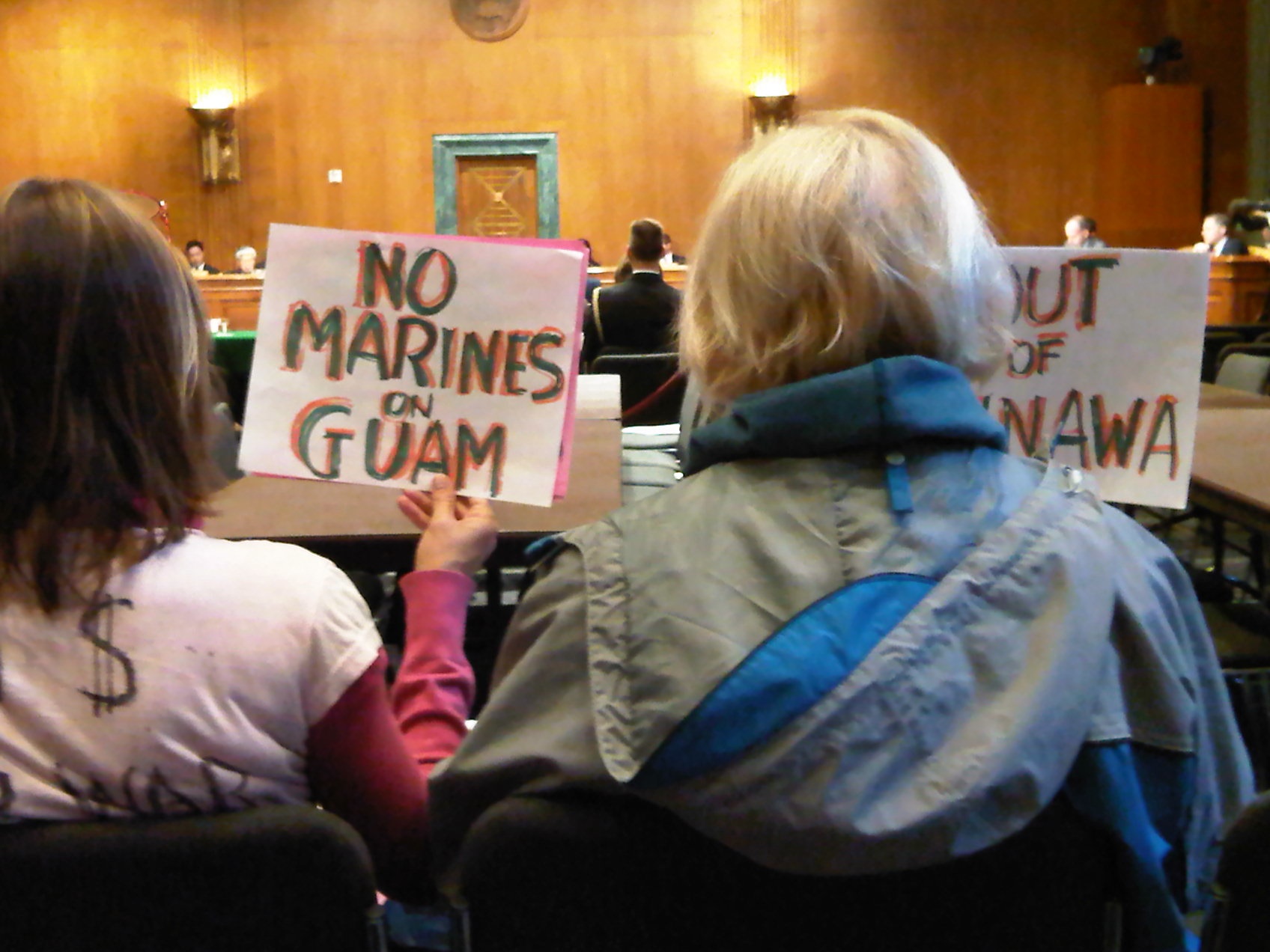
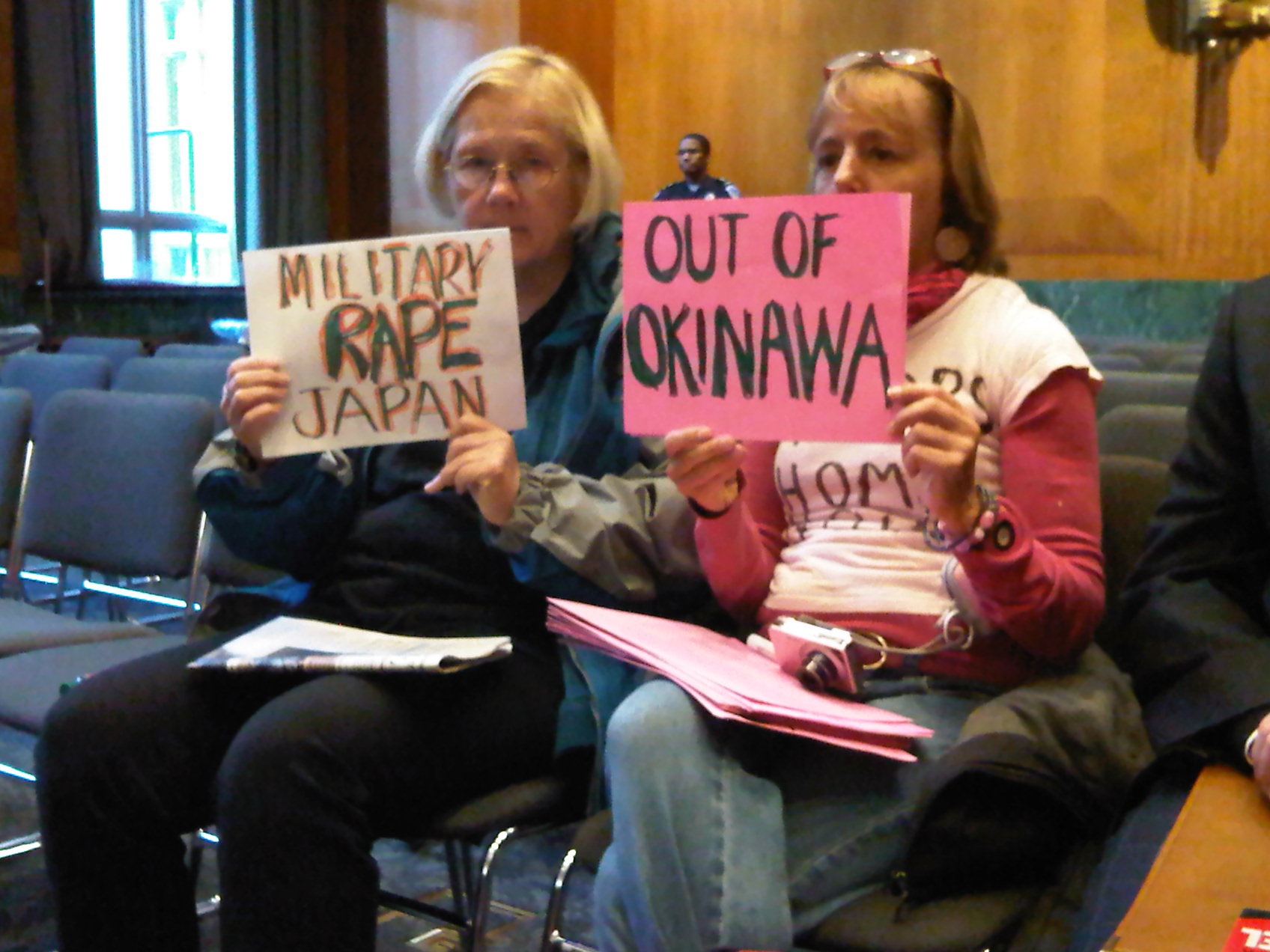
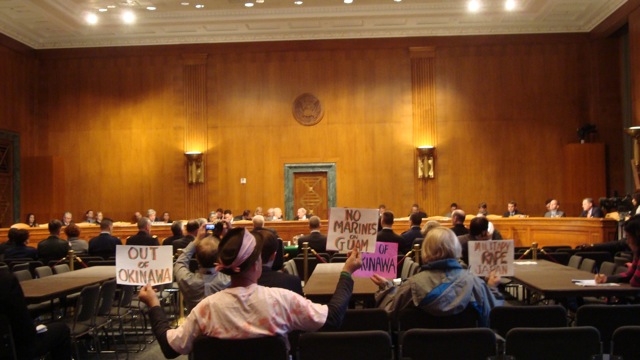
Ann Wright and Medea Benjamin hold signs in solidarity with Guam and Okinawa in Senate Hearing on the Pacific Command

IMG00254-20100326-0939
Ann Wright, Medea Benjamin protest military buildup in Okinawa and Guam at Senate hearing
IMG00253-20100326-0938
Ann Wright, Medea Benjamin protest military buildup in Okinawa and Guam at Senate hearing
DSC00652
Code Pink action at the US Senate. No bases in Okinawa and Guam. Ann Wright and Medea Benjamin
Here is the link to the SEnate Armed Services hearing on FRiday:

http://armed-services.senate.gov/hearings.cfm?h_month=3#month

Archived Webcast

March 26, 2010 – FULL COMMITTEE – To receive testimony on U.S. Pacific Command, U.S. Strategic Command, and U.S. Forces Korea
in review of the Defense Authorization Request for Fiscal Year 2011 and
the Future Years Defense Program.

http://armed-services.senate.gov/e_witnesslist.cfm?id=4500

WITNESSES

UNITED STATES SENATE

COMMITTEE ON ARMED SERVICES

_________________________________________________

There will be a meeting of the Committee on

ARMED SERVICES

Friday, March 26, 2010

9:00 AM

Room SD-106
Dirksen Senate Office Building

OPEN*

To receive testimony on U.S. Pacific Command, U.S. Strategic Command, and U.S. Forces Korea
in review of the Defense Authorization Request for Fiscal Year 2011 and
the Future Years Defense Program.

Archived Webcast


Gen. Mixon rebuked by Pentagon over anti-gay remarks

http://www.honoluluadvertiser.com/article/20100326/NEWS01/3260359/Army+commander+in+Hawaii+rebuked+by++Pentagon++Gates

Posted on: Friday, March 26, 2010

Army commander in Hawaii rebuked by Pentagon, Gates

Commander of U.S. Army Pacific called repeal ‘ill-advised’

By William Cole

Advertiser Military Writer

The top uniformed officer in the U.S. military yesterday sharply criticized Fort Shafter’s Lt. Gen. Benjamin R. “Randy” Mixon after Mixon said he is against repealing the “don’t ask, don’t tell” policy regarding gays in the military.

Adm. Mike Mullen, the chairman of the Joint Chiefs of Staff, and Defense Secretary Robert Gates took Mixon to task on the same day that the Pentagon announced new limitations on “don’t ask, don’t tell,” which prohibits gays from openly serving in the military.

President Obama has called for a repeal of the 1993 law.

Mixon yesterday did not publicly address the rebuke from the Pentagon’s top military and civilian leaders or his status afterward.

“At this time, Gen. Mixon does not have any comment, but we appreciate your concern,” said his spokesman, Lt. Col. Mike Donnelly.

Mixon, who has led the U.S. Army in the Pacific from Fort Shafter since Feb. 1, 2008, was commissioned an officer in the Army in 1975. Before arriving at Fort Shafter, he was commander of the 25th Infantry Division at Schofield Barracks. During 2006-07, he commanded 23,000 U.S. troops in northern Iraq.

Mixon penned a letter to the editor that was published March 8 in the military newspaper Stars and Stripes in which he made reference to reports that most service members are in favor of repealing “don’t ask, don’t tell.”

“I do not believe that is accurate. I suspect many servicemembers, their families, veterans and citizens are wondering what to do to stop this ill-advised repeal of a policy that has achieved a balance between a citizen’s desire to serve and acceptable conduct,” Mixon said in the letter.

The three-star general added that “now is the time to write your elected officials and chain of command and express your views.”

Both Gates and Mullen yesterday said Mixon’s actions were inappropriate. Mullen said the issue is being addressed and that he had spoken specifically to Gen. George Casey, the chief of staff of the Army, about Mixon.

Mullen said if there is a policy that someone in uniform disagrees with “and you feel so strongly about it, you know, the answer is not advocacy, it is in fact to vote with your feet.”

polarizing issue

The swift rebuke has returned the polarizing issue of “don’t ask, don’t tell” to Hawai’i, and raised anew the rights of military leaders to criticize U.S. policy.

While other U.S. general officers have spoken out against a repeal of “don’t ask, don’t tell,” the comments have been in response to questions from Congress.

That’s where Mixon erred, said Lawrence Korb, a senior fellow at the Center for American Progress, and a former assistant secretary of defense in the Reagan administration.

“If Congress were to ask the general, ‘What do you think about this?’ I think it would be perfectly appropriate to say he doesn’t agree with it,” Korb said. “But this was a little bit different. He was telling people to write letters.”

Korb said officers can express concerns through their chain of command, but once a policy is decided upon by the president and Pentagon, “you’ve got to follow it. If you can’t, the honorable thing to do is step down.”

Other flag officers have gone public with complaints or political views before. Some survived with careers intact, and some did not.

Korb said Army Gen. David Petraeus, now head of the U.S. military effort in the Middle East, wrote an opinion piece that was published in 2004 before the presidential election.

The newspaper piece talked “about how good things were going in Iraq. I criticized him for that,” Korb said. “A, it was too close to the election, and B, it wasn’t true.”

In 2008, a public disagreement with the Bush administration over its Iran policy led Navy Adm. William “Fox” Fallon to resign from the position that Petraeus now holds.

The Pentagon yesterday made policy changes that make it harder to discharge gay members of the military.

reactions varied

The news of Mixon’s admonishment and continued efforts to repeal “don’t ask, don’t tell” brought a variety of reactions.

One Hawai’i soldier, who requested anonymity because he was not authorized to speak, said, “Don’t ask, don’t tell, it works.”

Repealing the policy would diminish the high standards of the military because openly gay people would draw attention to themselves, he said.

Gay activists will “fuel it up. I demand this now. I demand that now,” the soldier said.

“I support Lt. Gen. Mixon’s statement,” he said. “If we feel that it (a repeal of ‘don’t ask, don’t tell’) is wrong, we should be able to say it’s wrong without repercussions.”

Army Spc. Michael Bowyer, 28, said there are mixed emotions about a possible repeal of “don’t ask, don’t tell,” which he believes is not discriminatory and does not prevent gays from serving.

“I think most people would be OK with it (a repeal). It is going to take some getting used to,” Bowyer said. “Are we going to have to have separate showers and latrines and all that stuff?”

Bowyer said he doesn’t have a problem with gays serving openly, although religiously, he believes homosexuality is wrong.

“I’ve had friends who are gay and I’ve never had a problem working with them,” he said.

Shannon Smith, a lesbian who was on active duty in the Army for six years, including three at Fort Shafter, and then was a Reservist at Fort Shafter from 2002 to 2005, said a repeal of “don’t ask, don’t tell” is important because the policy is discriminatory.

“We can go serve and die for our country, but oh my God, don’t be gay,” she said.

Gay soldiers knew other gay soldiers and Smith, now 41, remembers two girls getting caught. “They just turned all our names in and I remember how scared I was living in the barracks knowing they (military officials) could come in at any time,” she said.

Smith said under a repeal of “don’t ask, don’t tell,” gay soldiers would continue to blend into the ranks because the military weeds out bad behavior.

“You can have a straight person in the military and if they don’t behave appropriately, that should be dealt with,” she said. “Just because you are gay, that shouldn’t be a reason to be pointed at or segregated.”

The whole issue of a repeal would settle down after a while, she believes

“It doesn’t matter if you are gay or straight — you are supposed to be carrying yourself and handling yourself in a professional manner in the military,” Smith said. “That (being gay) shouldn’t be the defining factor.”

Reach William Cole at wcole@honoluluadvertiser.com.

Japan to propose moving half of key US base off Okinawa

http://newsinfo.inquirer.net/breakingnews/world/view/20100326-260888/Japan-to-propose-moving-half-of-key-US-base-off-Okinawa

Japan to propose moving half of key US base off Okinawa

Agence France-Presse

Posted date: March 26, 2010

TOKYO—Japan has decided to propose to Washington to relocate half of a controversial US military airbase away from the southern island of Okinawa, a report said Thursday, citing the top government spokesman.

The government had agreed on a plan to move 50 percent of the functions of the US Marines’ Futenma airbase to several regions outside Okinawa, Chief Cabinet Secretary Hirofumi Hirano told senior ruling coalition officials, Jiji Press reported.

It gave no details of the alternative locations for the airbase away from the southernmost island.

Hirano also said Foreign Minister Katsuya Okada would meet with US ambassador John Roos Friday ahead of his visit to Washington on Sunday on his way to the Group of Eight foreign ministerial meeting in Canada, Jiji Press said.

The government of Prime Minister Yukio Hatoyama, who came to power last year, has been reviewing a 2006 pact to relocate the Futenma airbase within Okinawa prefecture.

The 2006 agreement, signed by the previous conservative government and Washington, would move the base from a crowded residential district to a quieter coastal part of the island, despite opposition from local residents.

Hatoyama and his coalition partners have explored the possibility of scrapping the 2006 deal and moving the base off Okinawa but have met with repeated US refusals.

Hatoyama’s junior coalition partner, the Social Democrats, has pushed for complete removal of the Futenma base from Okinawa, a tiny region which hosts more than half of some 47,000 US troops based in Japan.

Army ‘convenant’ with Native Hawaiians – a $500,000 publicity stunt

The Army is trying to buy supportive Native Hawaiians who will sign their covenant for their public relations campaign.  It would all be funny if it weren’t so sad that some would stand with the Army in their strategy to counter resistance movements in Makua and elsewhere.  After spending a half-million dollars for a ‘facilitation’ contract to garner Native Hawaiian support, this covenant turned out to be an expensive piece of paper with no substance.   It will be interesting to see if the Hawaiians who signed the Army covenant will be trotted out when protests heat up against renewed training at Makua.

>><<

http://www.hawaiinewsnow.com/Global/story.asp?S=12200459

Army signs Native Hawaiian covenant

Posted: Mar 24, 2010 6:02 PM Updated: Mar 24, 2010 6:02 PM

WAIKIKI (HawaiiNewsNow) – The Native Hawaiian community and the military have often been at odds over the use of land across the islands. But Wednesday, representatives from both signed a promise to work together.

It’s called the Native Hawaiian Covenant, a simple one-page statement along with six goals designed to heal the hard feelings between the two groups.

The Royal Order of Kamehameha started the ceremony with an offering at the Kukalepa Memorial at Fort DeRussy. The memorial stands in honor of maoli killed in battles. After the playing of the Star Spangled Banner and Hawaii Ponoi, members of the army and the Native Hawaiian Community stepped forward to sign the covenant.

It states the army will work to protect and preserve the fragile environment of the islands, as well as keep a dialogue open with Native Hawaiians while meeting the military’s missions.

One development is already planned at Makua Valley. The leeward Oahu training ground has been the center of several battles from groups who say military action there is destroying cultural sites and living species

“Through funding obtained from Senator Daniel Inouye’s office, we are creating a visitor’s center at the Makua Military reservation that will provide a location to describe the history of the valley and the rare cultural artifacts and unique plants and animal life located in that beautiful valley,” said Maj. Gen. Michael Terry, the Commanding General of the U.S. Army Hawaii. “We encourage people to visit Makua and fully support cultural access events and activities there.”

“It is the responsibility of the army and other other branches of service to safeguard us from unwarranted aggression,” said Neil Hannahs, a Kamehameha Schools Land Manager and member of the Native Hawaiian Advisory Council formed for this covenant. “The Kanaka Maoli advisory council recognizes these circumstances, and strives through this covenant to respect the importance of host culture needs and values while also recognizing the contribution of the military’s presence in ensuring our security and freedom.”

The covenant ceremony ended with hula, and the planting of an ulu to symbolize a new beginning.

Here is the complete text of the Native Hawaiian Covenant:

US Army-Hawaii’s Covenant with Native Hawaiians

We recognize that…

…The Native Hawaiians are nâ kanaka ôîwi Hawaii…the aboriginal peoples of Hawai’i.

…Native Hawaiian’ cultural and historical experiences are shaped by the land and surrounding ocean…that as the Army maintains and uses the land of Hawai’i, it is mindful to protect and preserve this fragile environment and ensure that what remains is a meaningful legacy for future generations.

We are committed to:

Providing sustainable installation support and services for Joint War fighters, our Army Families, and the military community that meets current and future mission requirements, safeguards human health, improves quality of life and enhances the natural environment;

Providing proactive dialogue with Native Hawaiians to ensure the meaningful exchange of information and to enable sound, informed decisions by the Army that respects the legacy of the Native people of Hawai’i while meeting the mission and goals of the Army;

Building a partnership between the Native Hawaiian community and the US Army, a relationship that promotes mutual cooperation, understanding and enhances the standing of each within the community;

We are committed to a mutually beneficial relationship between Native Hawaiians and the US Army, Hawai’i by:

– Enhancing education and understanding of Native Hawaiian issues, culture, and values to Army Soldiers and Families

– Enhancing education and understanding of Army values, culture and actions to the Native Hawaiian community

– Leveraging opportunities for proactive dialogue between the Army and Native Hawaiians

Army tries to patch the bridges it has blown up

The Army is trying to patch up the broken relations with the Kanaka Maoli community through a concerted public relations and counter organizing campaign. They have hired Annelle Amaral to be a Native Hawaiian liaison to organize a Native Hawaiian front supportive of the Army’s activities in Hawai’i.  She is quoted as saying:

“The relationship between Native Hawaiians and the military becomes increasingly hostile as the years progress. Enough already. It’s time for us to learn to work on building bridges instead of blowing them up.”

Um, the only ones blowing things up is the military.  The activists are actually trying to stop the destructive activities of the military.  Hawai’i did not invade the U.S., take American land or destroy American sacred places.   Ms. Amaral needs to stop perverting the history of the U.S. military’s oppressive role in Hawai’i and start supporting her own people who stand up to defend the culture and land.

>><<

http://www.kitv.com/news/22948373/detail.html

Native Hawaiians, Army Sign Covenant

Agreement Aims For Better Relations

Dick Allgire KITV 4 News Reporter

HONOLULU —

U.S. Army officials signed a covenant with Native Hawaiians Wednesay, which they hope will bring greater understanding, more dialogue, and better relations. A ceremony for the covenant signing was held on the lawn at Fort DeRussy in Waikiki. It’s an attempt by the U. S. Army to mend fences with the Native Hawaiian community.

Many Native Hawaiians blame the Army for its role in the overthrow of their kingdom, and with modern issues like the live fire training at Makua Valley, the relationship between Native Hawaiians and the military has been contentious.

“The relationship between Native Hawaiians and the military becomes increasingly hostile as the years progress. Enough already. It’s time for us to learn to work on building bridges instead of blowing them up,” said Hawaiian activist Annelle Amaral.

The covenant promises a mutually respectful attitude, more dialogue, and preservation of culturally sensitive areas.

“We are creating a visitors center at the Makua military reservation which will provide a location to describe the history of the valley and the rare cultural artifacts, and plants located in that beautiful valley,” said Maj. Gen. Michael Terry.

As Hawaiian and military leaders signed the covenant the Hawaiians at the ceremony made it clear they don’t represent all Native Hawaiians. They did stress the importance of good relations with the Army.

“To respect the importance of host culture needs and values, while also recognizing the contribution the military presence makes in assuring our security and freedom,” said Neil Hannahs, a Native Hawaiian Advisory Council member.