Thousands Call on Obama to Speak with All of Guam’s People, Hear Concerns About Buildup

FOR IMMEDIATE RELEASE FROM WE ARE GUÅHAN

Thousands Call on Obama to Speak with All of Guam’s People, Hear Concerns About Buildup

March 11, 2010, GUAM – With the largest military realignment in modern history slated to hit the US Territory of Guam, over 11,000 people from the Pacific Island and across the globe signed a petition asking President Barack Obama to speak directly with the people of Guam during his short visit next week. Obama’s visit is an opportunity for the island’s residents, who do not have the right to vote for President, to voice the many concerns they have with the buildup.

We Are Guåhan, a grassroots collective of individuals, families and organizations working to inform the community about the impacts of the buildup, began circulating the petition when it was announced last month that Obama would visit the island, but only speak to military personnel at Andresen Air Force Base.

After review of the Draft Environmental Impact Statement (DEIS), released on November 30, 2009, We Are Guåhan worked with other concerned organizations and individuals to educate the community on the impacts of the buildup. We Are Guåhan, along with Government of Guam agencies, other organizations and concerned individuals submitted thousands of comments on the DEIS– many of them pointing to the negative impacts outlined there for the people, economy and environment.

After the U.S. Environmental Protection Agency’s indictment of the DEIS late February, it has become increasingly clear that the military realignment to Guam will threaten the health and safety of the island’s residents.

“We have not been able to say yes or no to this,” says Jon Blas, resident of the village of Tamuning and member of We Are Guåhan. “Hawaii said no. California said no. But we were never given the opportunity. It’s not fair, especially because it is looking like this is going to hurt us more than help us.”

We Are Guåhan’s growing membership felt that a strong message must be sent to Washington DC. The petition states: “The military buildup will permanently change our island and our lives. The needs of all Guam’s people must come first, for this island is our home. It is critical that President Obama hear our concerns.”

We Are Guåhan will deliver the petition to the White House today both by electronic and paper copy.

There will be a community response on March 19, during Obama’s visit, to break the silence and demonstrate that the island’s people demand to have a  voice in their future. Obama is not currently planning to speak with the people of Guam. We Are Guåhan hopes the 11,000 requests for a forum will change Obama’s plans.

For more information visit We Are Guåhan’s website at www.weareguahan.com. You may also contact Victoria-Lola Leon Guerrero at victoria.lola@gmail.com or (671) 929-6382 (please only use this information for personal media contact. Do not publish this contact information).

US Dream Come True? The New Henoko Sea Base and Okinawan Resistance

http://japanfocus.org/-Makishi-Yoshikazu/1819

US Dream Come True? The New Henoko Sea Base and Okinawan Resistance

By Makishi Yoshikazu

[Why is the news of a plan to move 7,000 US Marine troops from southern Okinawa to Guam creating no good vibes in Okinawa? Because nothing much is changing. The Japanese Government is proceeding with construction of a new US Marine Corps Air Station in Nago, to ‘replace’ the old Futenma base. Throughout the last decade, locals have resolutely fought the US military presence. Period. However, Tokyo and Washington have basically ridden roughshod over locals’ democratic expression of opposition, including, the outcome of the 1997 Nago citizens’ referendum against the relocation of Futenma to Henoko and, since April 2004, residents’ non-violent blockade action to prevent the government’s preliminary site investigations and ocean floor drilling.

In October 2005, Japan and the US reached agreement on plans to construct a military airport in Henoko, shifting the runway location from the shallow reef area slightly to the north and extending the runway from 1,500 to 1,800 m. [1] The new site, located within the US military facility and extended into the deeper Oura Bay, would effectively prevent entry by local protesters.

Okinawan researchers have recently uncovered documentary evidence refuting the claim that ‘Henoko is a Futenma substitute’: the plans call for a newly built upgraded military base using taxpayers’ money despite strong local opposition. The US military claims to be protecting global democracy. Respecting local democracy would be a good start . Miyume Tanji]

Henoko Protesters’ Non-violent Blockade Stops Government Investigation

It was just after sunrise when the boats appeared off the shore of Henoko on 19 April 2004. The boats belonged to the Security Facilities Bureau, Naha Branch, and they were there to conduct a geological survey. The Bureau planned to drill 63 holes under water. This action, which ignored necessary review and public notification procedures, blatantly violated Article 31 of Japan’s Environmental Impact Assessment Law. [2] The Henoko locals responded to this illegal action with a sit-in. They then canoed and swam out to the ocean in scuba gear and physically blocked the investigation by climbing the Bureau’s scaffolds. The protest spread nation-wide, attracting donations and participants to the round-the-clock direct action in Henoko as well as prompting sit-ins at the Diet in Tokyo. The boats for the blockade were provided by supporters, with local fisherpeople taking part. The Henoko locals’ non-violent action gained public support; so did their steely determination, not just to protest, but to stop, the government’s illegal site investigations. The sit-in and blockade continued until September 2, 2005, when the Bureau removed the scaffolds from the ocean, citing concern about typhoon damage. The protesters’ blockade had succeeded.

Meanwhile, Tokyo-Washington meetings for the comprehensive U.S. forces realignment had started. The new sea-based military base in Henoko was part of this realignment. ‘Tell the US that Okinawa will not accept any new base construction’, requested Yamauchi Tokushin and three other delegates from the Okinawan Citizens’ Conference against Futenma Relocation within Okinawa at a meeting with Defense Policy Chief and Director General of the Foreign Ministry’s North American Affairs Bureau. It was cold but, the diplomat, wiping sweat from the nape of his neck, said ‘we realize this must be hard for Okinawans’. From such comments, the delegates discerned that the Japanese government had not conveyed Okinawans’ collective will to the US, and was promoting relocation of Futenma to Henoko. On 29 October, a formal agreement was reached between Japan and US at the Joint Security Committee (referred to as the ‘two plus two meeting’). [3] Strangely, the government of Japan calls this agreement an Interim Report, although nowhere in the document is it so referred to. I sense deceit in this government’s expression. The report is really meant to be the final agreement, yet it is not clearly presented as such.

New Plan of Futenma relocation to Henoko: a US-Japanese ‘Collaboration’, not a ‘Compromise’

At the preliminary two-plus-two meeting on October 24, 2005, the media reported, Japan argued against the US – taking an uncharacteristically bold position on the best location for the new base in Henoko. Japan allegedly ‘resisted’ the original ‘reef plan’ preferred by the US. This involved construction of a military airport on Cape Henoko, which is a shallow reef area and the habitat of rich marine life including dugongs. The reclamation of this reef has been fiercely opposed by environmentalists. Finally at the end of the meeting that dragged until early on the 26 th,, Japan ‘compromised’. The US and Japan agreed on a ‘coastal plan’, which involves construction of a runway covering an L-shaped area extending from the Henoko reef to Oura Bay, embracing Camp Schwab (see Figure 1). [4] However, Figure 1 indicates that the agreed construction method, far from being a compromise reached after long negotiation, was a collaborative scheme by the two governments to upgrade the capacity of the Futenma Marine Corps Air Station.

It is not just a military airport that the US forces want in Henoko. As specified in the relevant Department of Defense Executive Report issued on September 27 th, [5] US forces demanded a special facility called ‘CALA’, or the Combat Aircraft Loading Area within the new base to load ammunition and explosives on aircraft (see Figure 2). The document stipulates, furthermore, that ‘CALA’ needs to be at least 1,250 feet away from any occupied buildings. Currently only Kadena Air Base can meet these conditions and Futenma helicopters are flying to Kadena for loading purposes. The 1997 Executive Report requires a ‘CALA’ to be built next to the new sea-based Air Station because Kadena is too far away. It seems that the reason why the runway of the new Air Station was extended from 1,500 to 1,800 meters at the October two-plus-two meeting was to facilitate a special loading zone.

According to the 1997 Executive Report , the direction of the new runway was decided following research conducted in 1966. In December 1966, in a ‘Master Plan of Navy Facilities on Okinawa, Ryukyu Islands’, [6] the US Navy recommended construction of a 3,000-meter airfield on reclaimed Henoko coral reef to be used by the marines. In addition, it also designed a military port in adjacent Oura Bay (Figure 3) for Navy use. The location of the airfield’s runway in Figure 3 is almost identical to that in the 1997 Executive Report (Figure 2). Figure 3 also depicts a ‘pier’. This pier appears to be simply a variation of the military port proposed in the 1966 Master Plan. In sum, the US wants not just a runway, but also a loading facility and a military port. At the 2005 two-plus-two meeting, the two governments agreed on the construction of ‘a pier for refueling and relevant facilities’, that is, nothing less than a military port: Oura Bay is more than 20 meters deep, enough for a nuclear aircraft carrier to enter alongside the pier.

There are further issues. In the area targeted for the new military airport in the October Agreement, there are historical ruins, the local newspaper Okinawa Taimusu reported. The astonishing thing is that the 1997 Executive Report acknowledged the cultural ruins on the south side of the area as one of the factors militating against airfield development. In short, the Department of Defense in 1997 judged that the ruins in the coastal area posed potential difficulties for the new military base construction. However, the Agreement in October 2005 designated the whole southern coastal area as the future site for the airfield replacing Futenma, despite the US forces’ understanding that the area was problematic. So, why is it OK now? Perhaps the Japanese government promised to legalize the construction by enacting a new law, such as a Special Measures Law for the Protection of Cultural Properties, that makes an exception for the needs of US forces. [7] With the 2005 ‘coastal plan’, the US and Japan are attempting a ‘hat trick’: an Agreement on the construction of a military airport, a special loading zone, and a military port – three new facilities – in Henoko. The construction, far from being a compromise, is the joint work of the two states. The plan is clearly unacceptable. Nago citizens have already rejected the new base construction in the referendum on December 21 1997 even without knowing all that the plan entailed.

Respect the democratic will of local citizens. Stop the Henoko military airport construction plan. This is precisely what the US military has long sought. Blocking the plan is a step toward protecting democracy worldwide.

Makishi Yoshikazu is a Naha born Okinawan architect. Since working for Okinawa Sōgō Jimukyoku (Okinawa Development Agency), he has designed award-winning buildings for Okinawa Christian Junior College, Sakima Museum and many others. He has also been a long-term environmentalist and peace activist in Okinawa. [8]

Translated by Miyume TANJI from a chapter in Makishi’s Okinawa wa Kichi o Kyozetsu Suru (Okinawa Refuses Bases). Tanji’s book Myth, Protest and Struggle in Okinawa will be published by RoutledgeCurzon in 2006

Endnotes:

[1] See Miyagi Yasuhiro, ‘ Okinawa – Rising Magma’, Japan Focus, posted 4 December 2005.

[2] According to the Law, any environmental impact assessment activities can be started only after the publication of a document that explains the methods of such activities reviewed by the Ministry of Environment and relevant ministries/agencies (Article 31).

[3] See ‘Security Consultative Document, U.S.-Japan Alliance: Transformation and Realignment for the Future’ by State Secretary Rice, Defense Secretary Rumsfeld, Minister of Foreign Affairs Machimura, and Minister of Defense for State Ohno, October 29 2005, available.

[4] ‘Futenma Isetsu, Bei ga Henoko Oki ShÅ«seian’ (The US alternative suggestion on Futenma Relocation to Henoko), Asahi Shimbun 25 October 2005; ‘ Japan, U.S. Agree on New Futenma site’ Japan Times 27 October 2005.

[5] The U.S. Department of Defense, ‘Executive Report: Sea-Based Facility, Functional Analysis and Concept of Operations, MCAS Futenma Relocation’ ( 3 September 1997), held by the Okinawa Prefecture Military Base Affairs Division.

[6] Daniel, Mann, Johnson, & Mendenhall, Master Plan of Navy Facilities on Okinawa, Ryukyu Islands, prepared for the Department of Defense (Dec. 29, 1966), held in the Okinawa Prefecture Archives.

[7] In December 2005, the government discussed special legislation to deprive local governments of authority over public water reclamation projects precisely in order to restrict the power of Okinawan Governor Inamine, who is opposed to the new ‘coastal plan’. Similar special legislation (related to US Military Special Measures Law) was passed in April 1997, which removed local government’s power to authorize lease of privately owned land occupied by the US military facilities, when a landowner refused to consent.

[8] On Makishi’s activities as anti-war landowner and marine conservationist, s ee Miyume Tanji, Myth, Protest and Struggle in Okinawa, RoutledgeCurzon, London (forthcoming).

Posted at Japan Focus, February 12, 2006.

March 4 militancy led by women

Mahalo to Katy Rose for this link:

>><<

http://weknowwhatsup.blogspot.com/2010/03/m4-militancy-led-by-women.html

Monday, March 8, 2010

M4: Militancy led by women

March 4th Movement: Militancy led by women
http://www.youtube.com/watch?v=Kls5uAmYMek exellent video!

I just watched the video of the UC Davis. (Spoiler) the film shows students led by a woman activist marching down the I-80. She is watched by a crowd of people discussing the consequences of walking onto the freeway. Without judgment she told people that we should not be “alarmist” but recognize we are going into a situation of conflict. In front arm and arm with bicycles protecting her and her comrades they marched slowing to the one line flank of police. They gently but forcefully continued to march- the crowd of hundreds- some chanting in the back and those in front with silent resolve. The faces of the police were shielded by their riot helmets- still no one threw anything at the police. They were all united in their method to push back. With the woman- in front and arms link through the bike spokes they pushed and pushed and stood their ground not moving back and inch. They broke the police line with the might of their numbers. Without succumbing to the fear of violence the students of UC Davis marched onto the 1-80 freeway.

Still they were not left alone. The police (this time in black clad) came with a two line flank with pellet guns. The students continued their resolve only they did not have bicycles in front of them. Men, women, activists with only clothes as protection continued to march toward the police. The police came back with a vengeance. They began to spray pellet bullets at the students. The ricochet from the ground created a dust of smoke. The activists bodies were sprayed with pellets. The police let fly first the feet then the legs and then the torso. Still crowd slowly pressed forward. As you watch the video another person- a woman joins the ranks in arms to press onto the freeway. Unarmed or protected the students retreated from that front. If only momentarily.

First of all the acts of bravery captured on tape at UC Davis should be hailed by our movement. Even still there are countless other acts across the country and our fists go up to you and your comrades. Women have contributed to the militancy, dynamism, complexity and creativity of the movement. This is in part because women of color in particular have been admitted into college in higher levels than our male counterparts while male admission into colleges has dropped at higher rates. We have had more access to higher education in recent years which contributes to the diversity and leadership of women in the Public Education Defense Movement.

Women also are represented in higher percentages as K-12 teachers and support staff ( T.A. yard supervisors, janitors etc). The consequences of that are more women are involved in the movement and taking leadership roles.

It is incredible to see how situations are different in terms of female leadership. In my experience as an activists organizing mainly with women I have seen women be reluctant to join the movement. But when women join they do not quit easily and they are willing to challenge not only the problems put in front of them but all the obstacles which keep us from moving. At UCLA it was a woman who jumped over the police barricades and threw open the door of Covel Commons. It was women who organized the siege after the Regents voted for the increase and a majority of women who sat around the parking lots and refused to let the Regents go without a fight.

http://www.youtube.com/watch?v=2yYpjYDd7Og

Now that March 4th has passed women will most likely continue to play a leading role in organizing for Free Education for All People. We will speak up and will not shut up! The movement must still address the needs more so of working women and be more inclusive.

We need to offer child care at our meetings.

Spanish translation for Spanish speaking only people

Try to have meetings after 5pm and on the weekends

Welcome younger people’s voices in the movement

Listen and respect women’s suggestions in meetings. It is my experience that women’s suggestions tend to be attacked with more ease and less tact by both genders.

Welcome and encourage women speakers at rallies

Recognize essential auxiliary tasks which women tend to take the lead on (banner/poster making, chant sheets, handing out literature, meeting facilitation/ chair) encourage men to take on these tasks and women to take on others.

Women will continue to play a leading role in this movement. Women throughout the world stated they wanted a world run by ourselves. Students, workers and community to run education. We can not stop there. The capitalist system will continue to try to divide us and use sexism to encourage male egoism in our meetings and movement. This will hurt all of us. The system attempts to discourage female involvement because we tend to have children, work and go to school. Our movement needs to continue to accommodate the needs of women and encourage more involvement of all people.

Happy International Women’s Day! Thanks to all the women militants for standing up for our rights and the male comrades for supporting us! The March Forth Movement has begun a new era of activism and strength and women led the way.

US for OKINAWA and Peace Boat create Study Program to Okinawa!

Peace Boat and US for Okinawa are planning a study program to Okinawa April 1 – 5, 2010. Deadline for applications is March 16, 2010.

http://us-for-okinawa.blogspot.com/2010/03/us-for-okinawa-and-peace-boat-create.html

Thursday, March 4, 2010

US for OKINAWA and Peace Boat create Study Program to Okinawa!

Are you interested in learning more about the U.S. military base issue in Okinawa? Do you want to help prevent the dugong from becoming extinct in Japan? Do you want to hear the reason for local people’s opposition to military bases with your own ears? If you answered yes to any of these questions then please join *US for OKINAWA Peace Action Network* on an active study program of Japan’s subtropical south this April.

US for OKINAWA is joining local residents in Ginowan City, Okinawa in asking the U.S. government to shut down the dangerous Futenma Air Base located right in the middle of their city. The base has endangered the lives of the local residents through military accidents, and lacks a buffer zone around it to protect surrounding schools, homes, hospitals and businesses. The U.S. and Japanese governments have agreed that the base poses an unacceptable safety risk to Ginowan City, but the U.S. government insists that closing Futenma is contingent on constructing–and Japan paying for–a new military facility elsewhere on Okinawa island. Because nearly 20% of Okinawa is already occupied by U.S. military facilities, this demand does nothing to lighten the burden on the local people.

In addition, new construction plans include inundating the environmentally fragile bay around Camp Schwab, the Henoko district, with dirt and concrete to vastly expand the base at the expense of unique coral reefs and the feeding ground of a gentle ocean mammal called the dugong. The U.S. (as well as some Japanese officials) insists that the construction must go through, despite fierce opposition by the majority of residents in Henoko. We want to listen to the voices of the local people and help them be heard both in Washington and mainland Japan.

In cooperation with Peace Boat and local partners in Okinawa, US for OKINAWA is organizing a study program to Okinawa from *April 1st to April 5th*. The goal of the study tour is to witness firsthand what is really happening in Okinawa, and to help raise more awareness of the base issue both in mainland Japan and in the U.S. and other countries.

We will be visiting U.S. military installations in Ginowan, meeting public officials in Ginowan and Henoko, listening to local testimonies, and visiting the beautiful bay of Henoko that is scheduled for destruction.

If you are interested in the study tour please contact Jonathan Yamauchi of US for OKINAWA at: jonathan.yamauchi[a]gmail.com. Please note that this program is not-for-profit, and costs are being kept to a strict minimum. Organisers are now in discussions with local partners to set the price of the programme, and more information will be available soon.

The deadline for applications is *Friday, March 16th*.

Feel free to get in touch if you have any questions, and for further detailed information about the program.

Niheideburu, thank you!

Guam: Japan Group Shares Experience With Military Presence

These people-to-people exchanges and solidarity efforts are very encouraging.   The peoples of our region can make peace despite the oppressive and militarized policies of our governments.

>><<

http://mvguam.com/index.php?option=com_content&view=article&id=11288:japan-group-shares-experience-with-military-presence&catid=1:guam-local-news&Itemid=2

Marianas Variety

Japan Group Shares Experience With Military Presence

Tuesday, 09 March 2010 04:54

by Therese Hart | Variety News Staff

Tsuru Masaaki, leader of the 21-member delegation known as the Kyushu block Japan Congress against Atomic and Hydrogen Bombs said yesterday that the delegation’s mission was to share with Guam residents and leaders, the hardships their people have gone through with the military presence in Japan and to learn from local residents and leaders the issues facing Guam and the impending military buildup and its presence here.

When asked by Variety if the group planned to have an alliance with Guam, Masaaki said that they had no particular plan to draft any joint resolution or take any kind of action, but because they met with Guam residents and exchanged experiences, “we promised to continue to help and to have an exchange so in the future, we’re going to do something.”

“We came here to know the situation of Guam because we heard that in Guam people have the same kind of problems as the people in Japan. We came here to see the situation, only, not really have a special purpose of implementation.

Masaaki is from the Fukuoka Prefecture and is an attorney, as well as the executive chairman of Fukuoka local Japan Congress against Atomic and Hydrogen Bombs Saga Prefecture.

Uezu Yoshinao from Okinawa shared his views of the military presence in Okinawa, saying that Futenma Airbase is the most dangerous air base in the world.

Yoshinao backed up his statement saying that Futenma airbase is located near residential homes and public buildings. In August, 2004, a U.S. helicopter crashed and parts of the copter flew towards the residential area.

“Years ago, a U.S. helicopter crashed and part of the copter flew towards the residential area and people were really scared. Fortunately, there was nobody who was injured by that accident, but people are always facing that kind of fear,” said Yoshinao.

Yoshinao said that this situation would never have existed in the United States.

“In the U.S. this location cannot exist. Futenma airbase is near a residential area and public buildings. If this were in the U.S. you couldn’t build an airport in that area that is close to a residential area. So why in Japan, can you be allowed to do that and not in the U.S.? So as soon as possible, the airbase should be removed from there,” said Yoshinao.

Yoshinao said that incidents that will never be forgotten is one such as the rape of young Okinawan girls by U.S. military personnel.

The raping of young girls in Okinawa … this is just one example…The people of Okinawa has been suffering so that is why we want the U.S. bases out of Okinawa,” he said.

Yoshinao said he believes that the U.S. bases or military presence in Okinawa is representative of the United States itself. Therefore, the U.S. government must take responsibility for the base.

Senator Tina Muna Barnes said that it was clear from the beginning of the dialogue that local prefectures from Japan have the same concerns as Guam.

“They are on a fact-finding mission. There are concerns and parallels with issues such as ours regarding their land, their marine life, the aspect of how air space is being utilized, and self determination. I think all those things — we share all those concerns as common ground — so when is the United States going to step up to the plate to make sure there’s collaboration and there’s a fair playing field for everyone,” opined the lawmaker.

South Korea: Nationwide Protests Against US-ROK War Games

Mahalo to Sung Hee Choi for these reports on peace/anti-war/anti-militarism demonstrations across Korea in response to provocative U.S.-Republic of Korea joint military exercises.

>><<

http://nobasestorieskorea.blogspot.com/2010/03/key-resolve-us-sk-annual-war-exercise.html

Monday, March 8, 2010

Key Resolve, US-SK Annual War Exercise Starts in the Korean Peninsula on March 8 and Nationwide Protests against it, as Well

* Image source: Solidarity for Peace And Reunification of Korea (SPARK)
‘Let’s stop the war and blossom the flowers’
TANGO, CFC, Sungnam
(reference source: Koh Sung-Jin
image source: Cho Sung-Bong, Tongil News, March 8, 2010
)

The civil society organizations including Solidarity for Peace And Reunification of Korea,
Korean Confederation of Trade Unions, Korea Alliance of Progressive Movements and Pan-Korean Alliance for Reunification (PKAR), South Korean branch, by starting with the press interview on March 8, in front of Theater, Air, Navy, Ground Operation (TANGO), Combined Forces Command, in Chungye Mt. Sungnam, South of Seoul, announced that, “By coming 18, we, through ‘the simultaneous anti-war & peace joint actions’ centered in the main USFK bases and cities nationwide, including Seoul, will urge to sop the invasive war exercise, and will spread our will for the realization of peace that has been longtime wished for.”

image source: Cho Sung-Bong, Tongil News, March 8, 2010
“Let’s stop the war and blossom the flowers”

Pyeongtaek
( reference/image source: Pyeongteak Peace Center)

About 30 activists from various organizations in Pyeongteak have gathered in front of Songtan branch, Pyeongteak City Hall on March 8, to denounce the Key Resolve exercise and to urge the stop of the additional runway in the Songtan USFK. The Pyeongtaek activists pointing out that the construction for additional runway in the Songtan USFK, which is planned to be completed by 2011, is for the realization of the strategic flexibility in the Korean peninsula, appealed to Pyeongtaek citizens to stop the construction. [The activists also pointed out that the planned return of the war time operation right from the USFK to ROK military has also been conditioned under the strategic flexibility]. The participants decided that they would make the issue of runway by the coming local election on June 2.

Click the image for larger view

“Stop the Key Resolve/ Foal Eagle War exercise and
the 2nd Runway Construction in the Songtan USFK Base!”


-Leaflet distributed to the citizens in Pyeongteak on March 8-

The leaflet was made by Gyunggi-do branch, Korean Alliance for Progressive Movement, Gyunggi-do headquarter of Korean Confederation of Trade Unions and the Pyeongtaek Area Democratic Organizations’ Council.


Incheon
( reference/image source:
Incheon branch, Solidarity for Peace And Reunification of Korea)

The Incheon activists, having the protest in front of Incheon City Hall criticized that the Key Resolve
that has been with the advanced weapons, was not for the defense exercise but for the attack against North Korea, and was the illegal war exercise, a violation of constitution that pursed the peaceful unification.

They also said that, if the United States and South Korea truly want the dialogue with North Korea,
both authorities of them should stop the Key Resolve war exercise, as they had stopped the Team Spirit military training in 1994 for the talk with North Korea. Saying that the western sea in front of Incheon is always in tension including the military clash, they denounced the war exercise that threatened the peace and heightened tension in the Korean peninsula.
Finally activists appealed to the citizens to abolish the US-SK war alliance with anti-war peace actions.

Chungnam-do (province)
Image source: SPARK
In front of Chungnam Province Hall (original source: Ohmynews)

Kunsan
Image source: Solidarity for Peace And Reunification of Korea (SPARK)
In front of Kunsan AFB (original source: Newsis)


Busan
Image source: Solidarity for Peace And Reunification of Korea (SPARK)
In front of the United States Consulate (original source: Voice of People)

Jeju Island Farmers Continue to Resist Navy Base

For more photos, please see here:

http://nobasestorieskorea.blogspot.com/2010/03/gangjeong-is-strong-and.html

http://space4peace.blogspot.com/2010/03/jeju-island-farmers-continue-to-resist.html

Monday, March 08, 2010

JEJU ISLAND FARMERS CONTINUE TO RESIST NAVY BASE

gang3

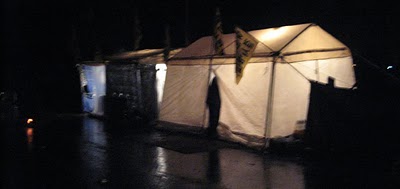
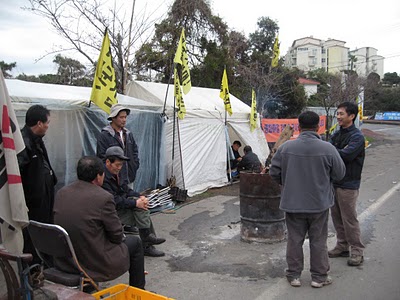
It has been raining on and off for more than a month in the Gangjeong village. Still the lights in the tents have never been put out in the nights. About 4-5 people in shifts make vigil every day and night. The tents are just off from the site for the planned ceremony for the naval base construction.


gang1

Flags cover the tent site. “We death-defiantly oppose the naval base!”

gang2

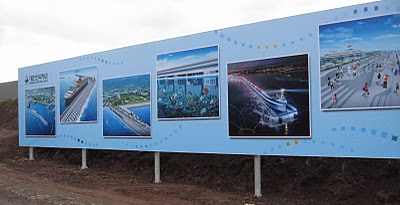
The Navy set up the board depicting how the naval base would be fantastic site for tourists with all the luxurious cruises, flowers and photo-taking tourists. “It’s just nonsensical. If the military base is set-up, who can freely take the pictures of the base? The Navy is insisting the logic that persuades nobody,” villagers say.

By Sung-Hee Choi

Inchon, South Korea

Why it was important to visit the village and hear the villagers’ voice itself? – “Navy’s media manipulation’ should be watched,” the villagers say.
It has constantly been raining in the Gangjeong village for more than a month, except for the few hours off, each day. When I went to the village in the late night of March 5, it was such a raining night, too. Since the police raid on Jan. 18, the villagers have set up the tents and have been doing the tent vigils just near the site of the planned ceremony for the naval base.

A few South Korean newspapers have written that the tension had been high since Jan. 18. According to some articles, it was Feb. 24 that the joint chief of the Navy visited the current governor and Gangjeong village. According to another article, on the very same day, Kim Tae-Young, the Minister of the National Defense Department was announcing in Seoul that the Department wanted to have the ceremony for the naval base construction in March.

Furthermore, an article said that “according to the Navy, the land compensation for the planned area has been done by 51% while compensation for the fishing industry has been done by 80%.”

I had to see myself what were really going on in Gangjeong and listen to the villagers who will now sit in the middle of a dangerous chess game as the U.S. makes a move to checkmate Russia and China in the region, by the naval base plan that the villagers have opposed for more than three years.

Have the villagers given up the struggle? To say conclusion first, the answer was clearly ‘no’. The villagers have never given up their struggle. Their will has seldom been changed. Furthermore, I found during this visit, that they have the confidence in their struggle to win.

It should be all Koreans’ concern that the planned Jeju naval base issue is not only the Island matter but also the matter that tests all South Koreans’ awareness and morality against the U.S. domination strategy to make the North East Asia as dangerous war base against China and Russia, for the interest of a few arms sales corporations.

What the villagers want is their voice to be heard despite Navy’s manipulation of the public opinion.

Even though the tent was not so cold inside as imagined, one can easily imagine all the inconvenience the villagers have had to endure and the desperate spirit that they are going through.

About 4-5 five men sleep in that inconvenient tent every night. They simply call it “Watchful situation” before the highest conflict with the Navy is foreseen in coming soon.

But to my interpretation of the news articles on the Navy plan and progress of land and fishing compensation, the villagers’ response was in a word – ‘a laugh’.

“The Navy and Defense Department are trying to make the naval base construction as if it is an established fact. They are manipulating the public opinion and most media is uncritically supporting them repeating only their words with half-truth. We need the press that really reflects our voice.”

A villager, Mr. Kim who was proud of 400 years history of the village naturally formed and was among the 23 villagers who started the struggle three years ago emphasized that.

“The Navy is simply attempting to enforce the construction, ignoring all the rational and persuasive procedures. They know they cannot but lose in the lawsuits that we have appealed. Regarding the lawsuits, it is almost likely we win. The Navy can hardly repel that. You know what? The lawyers of the Navy showed that they wanted to delay the trial because they, themselves know that they cannot win the trial. That is why they are anxious and trying to manipulate through the press as if all the preparations for the naval base construction are going well.”

“Why the Navy and police raided us in the dawn when there was little press on January 18? They did that because they did not want our voice to be heard.”

“They say it is a civilian-military complex beauty harbor for tourism. The Navy says that if the base is constructed in the Jeju, it would help the villagers with economic benefit of $5,000 each whenever a cruises come in the harbor. But I remember when Kang Chang-Soo, the high Navy officer was saying about the naval base plan years ago, he was not mentioning about cruise AT ALL. Further, the soil of Gangjeong is the best all over the Jeju Island. Gangjeong, as its name, Gang (means river) and Jeong (means water) implies, it is the blessed watery land. You will get water anywhere in Gangjeong. You can never find such land around this area. In the 1960-70s, Gangjeong was famous for the rich rice harvest until the crops were replaced mostly to tangerine. The area where the Navy wants to come in with the base has been once the rice fields that have once fed all the Island people. Whatever crops you raise here, whether it is, rice, garlic or tangerine, you would get the best harvest. Then why we have to give up this best farming land for the sake of naval base whose economic benefit is already clear to be treacherous.”

(His account of why the villagers cannot but oppose the naval base, in light of economic point of view, remind me the Pyeongtaek where the best rice fields in South Korea were forcefully taken away for the base expansion of the U.S. Forces in Korea in 2007, despite people’s strong opposition against it.)

“Look, even though the Navy says about 50 % of the land was compensated, it is exaggeration and lie. You should know why I emphasize the fact that the Gangjeong is the naturally formed village for 400 hundred years. Did you see any apartments in Gangjeong? No, unlike most villages, there is no apartment here. That is one aspect of what the naturally formed village is about. By rule, you cannot sell the land more than 5% inside the naturally formed land. You should know that the Navy bought most of it from the outsiders of the Gangjeong village, who had owned the lands in the village.”

He also said that even though the Navy says in the media that 80% of fishing industry has been compensated, as he knows, no compensation has practically been done. Each of the sea diving women have not gotten money yet because of the complicated distributing issue.

In conclusion, most Gangjeong villagers who have opposed the base from the beginning with the 680 opposition ballots among 700 participants in the general village meeting on August 10, 2007, have still remained true to their original faith and the Navy has not been able to either show the responsible plan nor succeed to get peoples’ hearts.

What makes people angry is the institutional violence under the name of “national policies” that says the nation cannot consider villagers’ opinion such as the vote mentioned above because it is the ‘national policy’.

Yes. Their opinions are not only totally ignored but manipulated as opposite. That is what makes the villagers mad about it and here is the point that the people should really pay attention to.

How the Villagers see the prospect of the Struggle.

The mayor (Kang dong Kyun) whom I met on March 6 was confident that the villagers would have the high possibility to win all the lawsuits that they have appealed including the administrative lawsuit, last April 2009, in which they appealed against the Minister of the National Defense Department for the cancellation of the approval on the national defense/ military facility business realization plan. The procedures that the Navy claims to have gotten through and approved have been done in reality in the illegal and snatched way, totally nonsensical, supported by state power that totally ignore people’s opinion. The Navy knows it themselves and knows that it will lose in the lawsuits, the villagers say.

And the Island governing election is coming on June 2. The Jeju media is covered with all the election issues and the candidates in the opposition parties who know that the naval base issue would be the hot potato have been even saying that they would review all the plans on the naval base from the beginning despite the fact that one of them was mentioning simply to change the site of the base to Hwasoon that was the original candidate site but withdrawn because of people’s fierce struggle for five years there (another betrayal then!).

However, if the Navy still enforces the plan of the base in Gangjeong, then the villagers cannot but fight, at the risk of physical conflict, the mayor said in grave voice.

The mayor was foreseeing the Navy may want to have the ceremony around mid-April, not necessarily related to the lawsuit trial dates and results.

“What we can expect is if the construction begins, the Navy would want to avoid all the conflicts. They would make the police be in front of the struggle, instead of itself. Then, the right-wing thugs in the area will be employed, too, making the situation easily imaginable of dangerous violence against the villagers.”

Yes. It would be the frightening situation, then. The small village of about 600 households with 2,000 residents might turn into the tragically dangerous site. It was one of the reasons that the villagers could not lose their tension. And it may be one of the reasons why more people need to go to Gangjeong, to find the ways to support them.

One of the things I found in the village situation was that more cultural activists are needed in Gangjeong. Currently a movie critic has lived in the tent for more than six months in the cold and windy Joongduk coast. And there are two cartoonists who have done most of the cultural activities, there. But the village needs more artists to go there, to record, and to make their cultural activism to support the tent vigil and other activities.

The Gangjeong village people have fought hard. As a villager said, if the Navy base is set up, all the Jeju Island will be the military base, far different from the Island of Peace.

The South Korea and U.S. are making one of the biggest annual war exercises against North Korea, all over the area of South Korea. They are called “Key Resolve” from March 8-18 and the “Foal Eagle” from March 3 to April 30.

These military war games go against the current of negotiating the Peace Treaty in which the talks on the non-nuclearization of the Korean peninsula should be done at the same time. The US-SK alliance, and US-SK-Japan war alliance, whose first three party military exercise would be done this April, seems to be anxious to anchor in the Jeju Island with this naval base construction plan.

As a villager said, there is no need to set up the base in Jeju if it is against the North Korea. South Korea has already many naval base in Busan, Jinhae, etc.

The base is really against China and will be surely used by the United States, the villagers clearly say. It would be then my and our responsibility to share the struggle with the villagers against the naval base so that the Jeju Island remains as the true Island of Peace, not as the island of war base.

The Travails of a Client State: An Okinawan Angle on the 50th Anniversary of the US-Japan Security Treaty

Gavan McCormack provides an excellent analysis of Japan’s ‘client state’ position, the anti-bases movement in Okinawa and the crisis it represents for the US-Japan Security Treaty.

He links the bases issue to “poison” of war and occupation of other countries:

While official 50th anniversary commemorations celebrate the US military as the source of the “oxygen” that guaranteed peace and security to Japan, it is surely time for Japanese civil society to point out that the same oxygen is elsewhere a poison, responsible for visiting catastrophe in country after country in East Asia and beyond, notably Korea (1950s and since), Iran (1953), Guatemala (1954), Vietnam (1960s to 70s), Chile (1973), the Persian Gulf (1991), Afghanistan (2001-), and Iraq (2003-), and that now threatens Pakistan, Somalia, Yemen, and (again) Iran. Millions die or are driven into exile, and countries are devastated as the US military spreads its “oxygen” by unjust, illegal and ruthless interventions and permanent occupations. The degree to which allied countries share criminal responsibility has been the subject of major public review in Holland (which found that the Iraq War was indeed illegal and aggressive) and in the UK (where the Chilcot Inquiry continues). It is time for similar questions to be asked in Japan of the Iraq and Afghan wars, and Japan’s direct and indirect involvement in them.

His description of Okinawa as Japan’s ‘war state’ could also apply to the role of Guam and Hawai’i in American policy.   Unfortunately, his critique of U.S. military interventions and wars does not include Guam, Hawai’i or the other American colonies, some of the earliest casualties of the American Empire.

>><<

http://japanfocus.org/-Gavan-McCormack/3317

The Travails of a Client State: An Okinawan Angle on the 50th Anniversary of the US-Japan Security Treaty

Gavan McCormack

“It is incredible how as soon as a people become subject, it promptly falls into such complete forgetfulness of its freedom that it can hardly be roused to the point of regaining it, obeying so easily and so willingly that one is led to say that this people has not so much lost its liberty as won its enslavement.”

Etienne de la Boétie (1530-1563). Discours de la servitude volontaire ou le Contr’un (Discourse on Voluntary Servitude, or the Anti-Dictator).[1]

For a country in which ultra-nationalism was for so long a problem, the weakness of nationalism in contemporary Japan is puzzling. Six and a half decades after the war ended, Japan still clings to the apron of its former conqueror. Government and opinion leaders want Japan to remain occupied, and are determined at all costs to avoid offence to the occupiers. US forces still occupy lands they then took by force, especially in Okinawa, while the Government of Japan insists they stay and pays them generously to do so. Furthermore, despite successive revelations of the deception and lies (the secret agreements) that have characterized the Ampo relationship, one does not hear any public voice calling for a public inquiry into it. [2] Instead, on all sides one hears only talk of “deepening” it. In particular, the US insists the Futenma Marine Air Station on Okinawa must be replaced by a new military complex at Henoko, and with few exceptions politicians and pundits throughout the country nod their heads.

Okinawa in the East China Sea. Why the Ryukyus are the “Keystone of the Pacific” for US strategic planners

Chosen dependence is what I describe as Client State-ism (Zokkoku-shugi). [3] It is not a phenomenon unique to Japan, nor is it necessarily irrational. To gain and keep the favor of the powerful, dependence can often seem to offer the best assurance of security for the less powerful. Dependence and subordination during the Cold War brought considerable benefits, especially economic, and the relationship was at that time subject to certain limits, mainly stemming from the peculiarities of the American-imposed constitution (notably the Article 9 expression of commitment to state pacifism).

But that era ended, and instead of gradually reducing the US military footprint in Japan and Okinawa as the “enemy” vanished, the US decided to ramp it up. It pressed Japan’s Self Defence Forces to cease being “boy scouts” (as Donald Rumsfeld once contemptuously called them) and to become a “normal” army, able to fight alongside and if necessary instead of, US forces and at US direction, in the “war on terror,” specifically in support of US wars in Iraq, Afghanistan and Pakistan. It wanted Japanese forces to be integrated under US command, and it wanted greater access to Japan’s capital, markets and technology. “Client State” status required heavier burdens and much increased costs than during the Cold War, but it offered greatly reduced benefits.

Ever since the Hatoyama team first showed signs of being likely to assume government, and talked of “equality” and of renegotiating the relationship, Washington has maintained a ceaseless flow of advice, demand and intimidation to push it into the kind of subservience that had become the norm. The same “Japan experts” and “Japan-handlers” that in LDP times offered a steady stream of advice to “show the flag,” “put boots on the ground” in Iraq, and send the MSDF to the Indian Ocean, now send a steady drumbeat of: Obey! Obey! Obey! Implement the Guam Treaty! Build the new base at Henoko!

Yet, with the important exception of Okinawa, there is little sign of outrage in Japan. Instead, US demands are echoed by a chorus of Japanese voices agreeing that Hatoyama and his government be “realistic.” One well-placed Japanese observer recently wrote of the “foul odor” he felt in the air around Washington and Tokyo given off by the activities of the “Japan-expert” and the “pro-Japan” Americans on one side and “slavish” “US-expert” and “pro-American” Japanese on the other, both “living off” the unequal relationship which they had helped construct and support.[4]

Another recent Japanese critic, quoting the passage from de la Boétie that prefaces this article, writes:

“Struggling to be ‘best’ under the American umbrella, and taking it as matter for pride when cared for by the US, has become a structure in which ‘servitude’ is no longer just a necessary means but is happily embraced and borne. ‘Spontaneous freedom’ becomes indistinguishable from ‘spontaneous servitude’.” [5]

As the security treaty in its current form marks its 50th anniversary in 2010, it should be possible to reflect on the relationship, to continue it unchanged, straighten it out and revise it if necessary, or even to end it, but such reflection is blocked by a combination of cover-up of the past record, one-sided pressure to revise in a certain way, and political hype and rhetoric. As a result, in the year of the “golden Jubilee” anniversary, a more unequal, misrepresented and misunderstood bilateral relationship between two modern states would be difficult to imagine.

Although Hatoyama called for an “equal” relationship, the truth is that the US state does not admit the possibility of equality in its relations with any other state. The “closeness” and “reliability” of an ally is simply a measure of its servility. According to one senior member of the cabinet of Britain’s Tony Blair, looking back on her Government’s role in the war on Iraq, despite being the US’s supposedly closest of allies, “We ended up humiliating ourselves [with] unconditional, poodle-like adoration” because the “special relationship” meant “we just abjectly go wherever America goes.”[6] Her words deserve to be taken seriously by all America’s allies.

Only twice have Japanese governments made an effort to think of an alternative to the dependence rooted in the treaties of 1951 (San Francisco) and 1960 (Ampo) that have formed the legal frame for the post-Occupation relationship. In 1994 the Higuchi Commission recommended to Prime Minister Murayama Tomiichi that Japan revise its exclusively US-oriented, dependent diplomacy to become more multilateral, autonomous, and UN-oriented. [7] However, a US government commission headed by Joseph Nye then advised President Clinton almost precisely the opposite: since the peace and security of East Asia was in large part due to the “oxygen” of security provided by US forces based in the region, the existing defence and security arrangements should be maintained, the US military presence in East Asia (Japan and Korea) held at the level of 100,000 troops rather than wound down, and allies pressed to contribute more to maintaining them. Higuchi was forgotten and the Nye prescription applied. Not until 2009 was there any serious questioning of the wisdom of the Nye formula.

It was Nye and his associates (notably Richard Armitage) who from 1995 drew up the detailed sets of post-Cold War policy prescriptions for Japan. Paradoxically, but also reflecting the “Client State” phenomenon, they came to be respected, even revered, as “pro-Japanese” or “friends of Japan.” They and their colleagues drew the 2000 goal (in the “Armitage-Nye Report”) of turning the relationship into a “mature” alliance by reinforcing Japanese military subordination and integration under US command, removing barriers to the active service of Japan’s Self-Defense Forces on “collective security” missions, and taking the necessary steps towards revising the constitution, and in 2007 the further agenda of strengthening the Japanese state, revising the (still unrevised) constitution, passing a permanent law to authorize regular overseas dispatch of Japanese forces, and stepping up military spending.[8] The agreements on relocating US Forces in Japan (Beigun saihen, 2005-6) and Guam Treaty (2009) were the detailed policy instruments towards those goals. The “Futenma Replacement” (Henoko) project formed a central plank.

As Hatoyama’s team began to talk of equality and of an Asia-Pacific Community, it was Joseph Nye who issued a series of warnings, first spelling out (in December 2008) the acts that Congress would be inclined to see as “anti-American,” prominent among them being any attempt to revise the Beigun Saihen agreements (including the Futenma transfer).

The Treaty system whose anniversary is celebrated in 2010 has been unequal throughout its 50 years and is encrusted with deception and lies. The 1960 Treaty, rammed through the Diet in the pre-dawn hours and in the absence of the opposition, reconfirmed the (1951) division of the country into a demilitarized mainland “peace state” Japan and a directly American-controlled Okinawan “war state.” That division was maintained even when, in 1972, Okinawa was restored to nominal Japanese administration, in a deal that was also a model of deception. Firstly, the Okinawa “return” was in fact not a “giving back” but a “purchase,” Japan paying the US even more (for “return” of assets that in fact the US military retained) than it had paid seven years earlier to South Korea in compensation for forty years of colonial rule. And secondly, although the deal was declared to be one of reduction of Okinawan bases to mainland levels and without nuclear weapons, “kaku-nuki hondo-nami,” it was neither. The “war state” function remained central, bases remained intact and the US was assured (in the secret agreement, or mitsuyaku) that its nuclear privilege would remain intact. Despite the nominal inclusion of Okinawa under the Japanese constitution, then and since it has continued in fact to be subject to the over-riding principle of priority to the military, that is, the US military, and in that sense, ironically, matching North Korea as a “Songun” state.

Both governments prefer secret diplomacy to public scrutiny. By simple bureaucratic decision, Japan instituted a system of subsidy for US wars known as the “omoiyari” (sympathy) payments and expanded the scope of the security treaty from Japan and the “Far East” (according to Article 6) into a global agreement for the combat against terror. “Client State” Japan pays the US generously to continue, and not to reduce, its occupation.[9]

In mainland Japan, political and intellectual resistance to the Nye Client State agenda for Japan quickly crumbled nationally from 1995 with the return to power in Tokyo of the LDP, and the qualities of nationalism, democracy and constitutionalism were gradually relegated to second place to the “higher” cause of the alliance. In Okinawa, however, forced to bear the brunt of US military rule, civil democracy in the form of anti-base resistance grew steadily and the Client State agenda was never able to attain legitimacy. Consequently, for 14 years, through the terms of 8 Prime Ministers and 16 Defense Ministers, the 1996 bilateral agreement to substitute a Henoko base for the Futenma one made no progress. It was blocked by the fierce, uncompromising, popularly-supported Okinawan resistance.

In 2005 Okinawan civil society won an astonishing, against all odds, victory over the Koizumi government and its US backers, forcing the Government of Japan to abandon the “offshore” (on-reef, floating, pontoon structure) Henoko base project. It was a historic event in the history of democratic and non-violent civic activism. The government returned to the offensive in 2006, however, with its design for an enlarged, “on-shore” Henoko base to be built on reclaimed land that would jut out into Oura bay from within the existing Camp Schwab marine base. This dual runway, hi-tech, air, land and sea base able to project force throughout Asia and the Pacific was far grander and more multifunctional than either the obsolescent, inconvenient and dangerous Futenma or the earlier offshore, pontoon-based “heliport.”
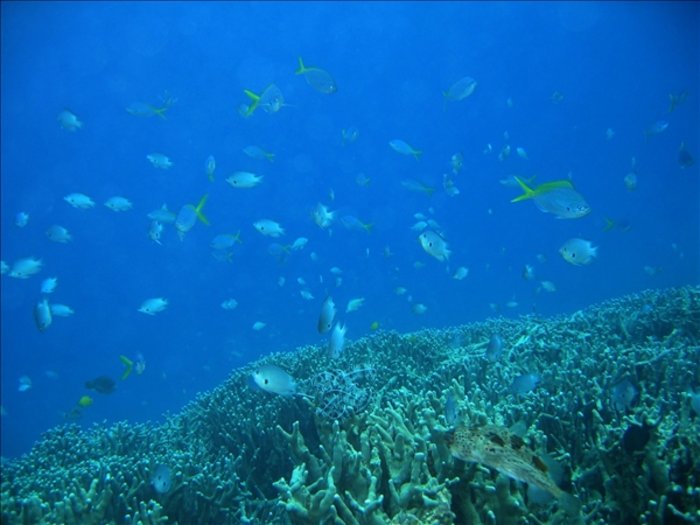
Oura Bay

Though widely reported (with the subterfuge that is characteristic of the “Alliance”) as a US “withdrawal” designed to reduce the burden of post-World War II American military presence in Okinawa, the 2006 agreement would actually further the agenda of integration of Japanese with US forces and subjection to Pentagon priorities and increase the Japanese financial contribution to the alliance (with Japan paying $6.1 billion for US marine facilities on Guam and up to $10 billion for a new Marine Base at Henoko). “Consolidation” and “reinforcement” were the appropriate terms.

When Obama took office in early 2009, his Japan expert advisers seem to have advised him to move quickly to pre-empt any possible policy shift under a future DPJ government. They therefore exploited the interval when the LDP still enjoyed the two-thirds Lower House majority delivered by Koizumi’s “postal privatization” triumph of 2005 to press the 2006 agreement into a formal treaty and had Prime Minister Aso ram it through the Diet (in May 2009), so as to tie the hands of the Democratic Party forces about to be elected to government.

The Guam Treaty of 2009 was a defining moment in the US-Japan relationship, when both parties went too far, the US in demanding (hastily, well aware that time was running out to cut a deal with the LDP) and Japan in submitting to something not only unequal (imposing obligations on Japan but not on the US), but also unconstitutional, illegal, colonial and deceitful. [10] Yet few Japanese seemed able to detect the “foul odor” that arose from the deal.

In Okinawa, however, the Hatoyama DPJ election victory of August 2009, marked not only by the national party’s electoral pledge to relocate the Futenma base outside the prefecture but by the clean sweep within the prefecture of committed anti-base figures, was taken as signalling that a new and favourable tide to Okinawa was rising. Opposition to any “within Okinawa” Futenma relocation became almost total across the political spectrum. When a committed anti-base candidate was elected mayor of Nago City on 24 January 2010, the threat to Oura Bay (and its dugong, coral and turtles) seemed drastically diminished. Having witnessed the lies and deceptions by which over 13 years the temporary, pontoon-supported “heliport” gradually evolved into the giant, reclamation, dual-runway and military port project of 2006, and having experienced the emptiness of the promise of economic growth in return for base submission, Okinawans were in no mood to be tricked again.
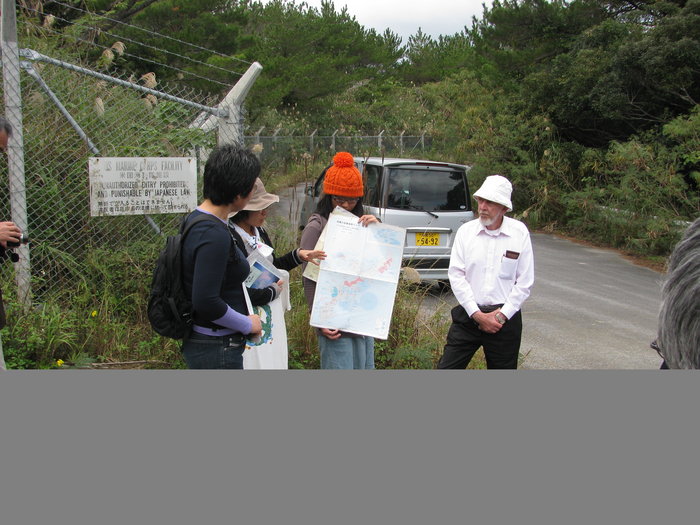
Author being briefed at the site of the Helipad Sit-In, Higashi village, Yambaru, Okinawa, 6 December 2009.

If the two elections gave great heart to Okinawans, however, they also shook the “alliance” relationship. Washington insisted on fulfilment of the Guam Treaty but the Henoko base could only now be built if Hatoyama was prepared to adopt anti-democratic measures of something akin to martial law to defy the will of Okinawan voters and protesters. That would be a peculiar way to celebrate the 50th anniversary of the “Alliance.”

At Honolulu in January 2010, Hillary Clinton insisted that the Ampo base system was indispensable for East Asian, especially Japan’s, security and prosperity. It was essentially Joseph Nye’s 1995 point. But is it true? The idea that the peace and security of East Asia depends on the presence of the Marines in Okinawa (the “deterrence” function) is tendentious. There is today almost zero possibility of an attack on Japan by some armed force such as was imagined during the Cold War, and in any case the Marines are an expeditionary “attack” force, held in readiness to be launched as a ground force into enemy territory, not a force for the defense of Okinawa or Japan as stipulated under Article 4 of the Treaty of Mutual Cooperation and Security. Since 1990, they have flown repeatedly from bases in Japan for participation in the Gulf, Afghanistan, and Iraq Wars.

Furthermore, the hullabaloo in Japan surrounding the Henoko project rests on a serious misunderstanding. As Ginowan City mayor, Iha Yoichi, has repeatedly shown from his analysis of US military planning documents, the Pentagon from 2006 has been committed to transfer main force Futenma marine units to Guam, upgrading it into the military fortress and strategic staging post covering the whole of East Asia and the Western Pacific (and thus undercutting the strategic importance of any new Okinawan base). [11] Iha’s analysis was at least partially confirmed by a senior official of Japan’s defense bureaucracy who described the 3rd Marine Division as a “force for deployment at any time to particular regions beyond Japan …. not for the defense of particular regions.” [12] In short, the Guam Treaty is concerned not with a Futenma substitute, or even with the defense of Japan, but with construction of a new, upgraded, multi-service facility that U.S. Marines will receive for free and will use as a forward base capable of attacking foreign territories.

US military footprint on Guam

Virtually without exception, American officials, pundits and commentators support the Guam treaty formula and show neither sympathy nor understanding for Japanese democracy or Okinawan civil society, and by and large the Japanese pundits and commentators respond to this in “slave-faced” manner (do-gan in Terashima’s term). The Okinawa Times (19 January 2010) notes that the 50th anniversary offered a “chance to reconsider the Japan-US Security treaty that from Okinawa can only be seen as a relationship of dependence.” To seriously “re-consider” would require wiping the “slave faces” off Japan’s politicians and bureaucrats.

Hatoyama’s government has enunciated idealistic sentiments – including statements such as from Party Secretary-General Ozawa Ichiro saying that “Okinawa beautiful blue seas must not be despoiled” [13], and the postponing of a decision on the Futenma issue to May opened the issue to a measure of public scrutiny and discussion. However, neither the Prime Minister nor any of his senior ministers offered leadership or did anything to encourage discussion on the nature of the alliance or Okinawa’s burdens. Instead, the Hatoyama government backed itself into a corner by assuming the legitimacy of the Guam Treaty, from which it followed that Futenma could not be returned unless or until it was replaced. Furthermore, prominent ministers, in “Client State” spirit, publicly identified with the position of the US government. Thus Foreign Minister Okada in Nago on 5 December 2009 pleaded with Okinawans to understand the “crisis of the alliance” and the “difficulty” of the negotiations. He suggested that Okinawans should have sympathy for President Obama “who might not be able to escape criticism for weakness in his dealings with Japan at a time of falling popularity” if the Guam Treaty deal was not implemented. [14]

When Hatoyama announced the postponement of decision till May 2010, a Pentagon Press Secretary declared that the US “did not accept” the Japanese decision, [15] and Joseph Nye referred to the DPJ as “inexperienced, divided and still in the thrall of campaign promises,” plainly meaning that attempts to renegotiate the Guam Agreement would not be tolerated. [16]

Yet, the mood in Okinawa unquestionably strengthened following the Hatoyama victory and the sweeping aside of the representatives of the “old regime” in Okinawa in August 2009. Opinion polls had long shown levels of around 70 per cent against the Guam formula (for Henoko construction), [17] but that figure rose steadily, so that one May 2009 survey found a paltry 18 per cent in favour of the Henoko option on which Washington was adamant, and by November that figure had fallen to 5 per cent; hardly anyone. [18] Both Okinawan newspapers, and the most prominent figures in Okinawan civil society, were strongly opposed. [19] The signals of anger and discontent rose to their peak in February 2010 with the adoption by the Okinawan parliament (the Prefectural Assembly) of an extraordinary resolution, unanimously demanding that Futenma be closed (moved “overseas or elsewhere in Japan”), [20] and Okinawa’s 41 local district mayors also unanimously declared themselves of the same view. [21]

It meant that, while Tokyo struggled desperately to find a way to implement the Guam Treaty, Okinawa unanimously rejected it. There is no longer a “progressive-conservative” divide in Okinawan politics on this question. The Mayor of Okinawa’s capital, Naha, who in the past served as President of the Liberal Democratic Party of Okinawa, recently made clear that, as a prominent Okinawan conservative, he was disappointed by the Hatoyama government’s reluctance to redeem its electoral pledge on Futenma and hoped the Okinawan people would remain united “like a rugby scrum” to accomplish its closure and return (i.e., not replacement). [22] No local government or Japanese prefecture in modern history had ever been at such odds with the national government.

Early in March, Defense Vice-Minister Nagishima Akihisa bluntly declared that the US demands would be met, even if it meant alienating Okinawans (who would be offered “compensation.”) [23] With Hatoyama likewise insisting that he would honour alliance obligations, and the likelihood high that other formulas would prove unworkable or impossible to clear in such a tight timetable, Okinawans braced themselves. By May, 2010 Hatoyama would have to either reject the US demands, risking a major diplomatic crisis, or submit to them, announcing with regret that there is no “realistic alternative” to the “V-shaped” base at Henoko, thus provoking a domestic political crisis.

While official 50th anniversary commemorations celebrate the US military as the source of the “oxygen” that guaranteed peace and security to Japan, it is surely time for Japanese civil society to point out that the same oxygen is elsewhere a poison, responsible for visiting catastrophe in country after country in East Asia and beyond, notably Korea (1950s and since), Iran (1953), Guatemala (1954), Vietnam (1960s to 70s), Chile (1973), the Persian Gulf (1991), Afghanistan (2001-), and Iraq (2003-), and that now threatens Pakistan, Somalia, Yemen, and (again) Iran. Millions die or are driven into exile, and countries are devastated as the US military spreads its “oxygen” by unjust, illegal and ruthless interventions and permanent occupations. The degree to which allied countries share criminal responsibility has been the subject of major public review in Holland (which found that the Iraq War was indeed illegal and aggressive) and in the UK (where the Chilcot Inquiry continues). It is time for similar questions to be asked in Japan of the Iraq and Afghan wars, and Japan’s direct and indirect involvement in them.

The 50th anniversary should be a time for the Japan whose constitution outlaws “the threat or use of force in international affairs” to reflect on how it has come to rest its destiny on alliance with the country above all others for whom war and the threat of war are key instruments of policy, and whether it should continue to offer unqualified support and generous subsidy, and whether it should continue to “honour” the Guam treaty, at all costs maintaining the marine presence in Okinawa. As a first step, it is time to debate openly the unequal treaties, secret diplomacy, lies, deception and manipulation of the last 50 years and time to reflect upon, apologize, and offer redress for the wrongs that have for so long been visited upon the people of Okinawa as a result.

Gavan McCormack is a coordinator of The Asia-Pacific Journal – Japan Focus, and author of many previous texts on Okinawa-related matters. His Client State: Japan in the American Embrace was published in English (New York: Verso) in 2007 and in expanded and revised Japanese, Korean, and Chinese versions in 2008. He is an emeritus professor of Australian National University. The present paper is an expanded version of his article published in Japanese in Shukan kinyobi on 5 March 2010.

Recommended citation: Gavan McCormack, “The Travails of a Client State: An Okinawan Angle on the 50th Anniversary of the US-Japan Security Treaty,” The Asia-Pacific Journal, 10-3-10, March 8, 2010.

Notes

[1] In English as The Politics of Obedience: The Discourse of Voluntary Servitude, translated by Harry Kurz and with an introduction by Murray Rothbard, Montrèal/New York/London: Black Rose Books, 1997. Web version here. I am indebted to Nishitani Osamu (see note 5) for drawing my attention to de la Boétie.

[2] Foreign Minister Okada Katsuya did set up an “Experts” committee to investigate the so-called “Secret Agreements” between US and Japanese governments on nuclear and other matters and report back during 2010, but it was of limited focus, precipitated by the common knowledge that such documents existed in the US archives and a series of public statements by former senior officials testifying to their existence. Early reports from Tokyo suggest that no such documents had been found, which raised the possibility they had been deliberately destroyed.

[3] Client State: Japan in the American Embrace, New York, Verso, 2007. Expanded Japanese edition as Zokkoku – Amerika no hoyo to Ajia de no koritsu, Tokyo, Gaifusha, 2008.

[4] Terashima Jitsuro, “Zuno no ressun, Tokubetsu hen, (94), Joshiki ni kaeru ishi to koso – Nichibei domei no saikochiku ni mukete,” Sekai, February 2010, 118-125. Terashima refers to Japanese intellectuals by the term, “do-gan” (literally “slave face”, a term he invents based on his reading of a savagely satirical early 20th century Chinese story by Lu Hsun).

[5]. Nishitani Osamu, “’Jihatsuteki reiju’ o koeyo – jiritsuteki seiji e no ippo,” Sekai, February 2010: pp. 134-140, at p. 136.

[6] Clare Short, formerly International Development Secretary, “Clare Short: Blair misled us and took UK into an illegal war,” The Guardian, 2 February 2010.

[7] Boei mondai kondankai, “Nihon no anzen hosho to boeiryoku no arikata – 21 seiki e mukete no tenbo,” (commonly known as the “Higuchi Report” after its chair, Higuchi Kotaro), presented to Prime Minister Murayama in August 1994.

[8] Richard L. Armitage and Joseph S. Nye, “The U.S.-Japan Alliance: Getting Asia right through 2020,” Washington, CSIS, February 2007.

[9] For details, see my Client State, passim.

[10] “The Battle of Okinawa 2009: Obama vs Hatoyama,” The Asia-Pacific Journal, 16 November 2009.

[11] “Why Build a New Base on Okinawa When the Marines are Relocating to Guam?: Okinawa Mayor Challenges Japan and the US.” See also Iha Yoichi, interviewed in “Futenma isetsu to Henoko shin kichi wa kankei nai,” Shukan kinyobi, 15 January 2010, pp. 28-9.

[12] Yanagisawa Kyoji (special researcher and former Director of National Institute for Defense Studies), “Futenma no kakushin –kaiheitai no yokushiryoku o kensho seyo,” Asahi shimbun, 28 January 2010.

[13] “Santo raigetsu isetsusaki oteishi,” Okinawa Times, 29 December 2009.

[14] Quoted in “Kiki aoru dake de wa nasakenai,” editorial, Ryukyu shimpo, 7 December 2009. For a fascinating transcript of the meeting, see Medoruma Shun’s blog, “Uminari no hitobito,” “Okada gaisho to ‘shimin to no daiwa shukai’, zenmen kokai,” in 7 parts, beginning here.

[15] “Pentagon prods Japan on Futenma deadline,” Japan Times, 8 January 2010.

[16] Joseph S. Nye Jr, “An Alliance larger than One Issue,” New York Times, 6 January 2010.

[17] “Futenma hikojo daitai, kennai isetsu hantai 68%,” Okinawa Times, 14 May 2009. In the Northern Districts (including Nago Ciy) opposition was even higher, at 76 per cent.

[18]“Futenma iten: Genko keikaku ni ‘hantai” 67%, Okinawa yoron chosa,” Mainichi shimbun, 2 November 2009; for a partial English account, “Poll: 70 percent of Okinawans want Futenma moved out of prefecture, Japan,” Mainichi Daily News, 3 November 2009.

[19] Open Letter to Secretary of State Clinton, by Miyazato Seigen and 13 other representative figures of Okinawa’s civil society, 14 February 2009, (Japanese) text at “Nagonago zakki,” Miyagi Yasuhiro blog, 22 March 2009; English text courtesy Sato Manabu. They demanded cancellation of the Henoko plan, immediate and unconditional return of Futenma, and further reductions in the US military presence.

[20] “Kengikai, Futenma ‘kokugai kengai isetsu motomeru’ ikensho kaketsu,” Okinawa Times, 24 February 2010. A resolution to the same effect had been passed by a majority in July 2008.

[21] “Zen shucho kennai kyohi, Futenma kengai tekkyo no shiodoki,” editorial, Ryukyu shimpo, 1 March 2010. The rising tide of Okinawan sentiment on this issue is plain from the fact that the figure had been 80 per cent, or 31 out of the 41 mayors, in October “Futenma ‘kengai’ ‘kokugai’ 34 nin,” Okinawa Times, 30 October 2009).

[22] Onaga Takeshi, “Okinawa wa ‘yuai’ no soto na no ka,” Sekai, February 2010, pp. 149-154.

[23] John Brinsley and Sachiko Sakamaki, “US base to stay on Okinawa, Japanese official says,” Bloomberg, 2 March 2010.

Militarization would desecrate Pagat, Chamorro sacred site

From the Marianas Variety

Sacrilege in Pagat

Friday, 26 February 2010 01:58

Letter to the Editor

WHAT is Pagat? For the people who wrote the draft environmental impact statement, it is nothing more than a place to shoot off high-powered guns. For some people, it is worthless jungle, just as lattes and lusongs are worthless rocks. But many of us recognize it for what it is in its own right – a truly sacred place that, amazingly to this day, remains untouched by modern life.

Pagat’s caves and ancient Chamorro villages are places where we can touch and honor what was part of the daily lives of our ancestors who settled in the jungles for over 3,500 years. Amazing! Today, a walk through Pagat is a cherished visit with the ancestors, to the very roots of the island’s culture. It is the purest essence of Chamorro spirituality. It is our Sistine Chapel.

As an example of the deep reverence the Chamorros have for Pagat, we pray before entering the trail, speak in hushed voices, and respect the plants and animals encountered along the way. All the while we are filled with the sense that this experience is precious and its beauty humbles us. The idea of artillery echoing through this hallowed valley and destroying the lattes and lusongs is nothing short of sacrilegious. A firing range in Pagat would be no less an outrage than when the Taliban blew up the treasured, ancient Buddhas carved into the cliffs of Afghanistan.

The people of Guahan will never allow Pagat to be taken away, damaged, or restricted from future generations. Our people have protected the site for thousands of years, and will continue to do so, no matter how many powerful, ill-informed outsiders try to destroy what we have.

Christina Illarmo
Mangilao

Japanese groups conduct fact-finding visit to Guam

http://mvguam.com/index.php?option=com_content&view=article&id=11256:fact-finding-mission&catid=1:guam-local-news&Itemid=2

Fact-finding mission

Friday, 05 March 2010 01:20

by Mar-Vic Cagurangan | Variety News Staff

Japanese lobby groups coming to Guam

A 20-MEMBER delegation consisting of representatives from an influential coalition of Japanese lobby groups, is arriving on Guam tomorrow on a four-day fact-finding mission to assess the island’s capacity to accommodate the troops that will be relocated from Okinawa.

“They will meet our officials and members of the community and go back to Japan to share the outcome of their trip with their elected leaders,” said Debbie Quinata, maga’haga of Chamorro Nation, who is hosting the delegation from the left-leaning Japan Congress Against A and H Bombs.

The visiting coalition, led by Tsuru Masaaki, is represented by leaders of human rights groups, peace movement and labor unions from 10 prefectures.

“They are not here to play. After their trip, they will write a report that will be submitted to the Japanese Diet,” Quinata said.

She said the delegation is specifically interested in the financial aspect of the military buildup as it relates to the Japanese government’s $6 billion contribution to the Marines relocation cost, which is greeted with protests from Japanese taxpayers.

“This group is particularly opposed to the Japanese government’s intention to use the people’s taxes to subsidize the troop relocation expenses and to participate in infringing on the rights of the people of Guam,” Quinata said.

The delegates will arrive on Saturday night and visit the proposed firing range site for the Marines on Route 15 the next day. The tour also includes a visit to Pagat, an ancient site, which will also be affected by the firing range project.

They will meet with Lt. Gov. Mike Cruz in Adelup on Monday morning. A separate meeting with speaker Judi Won Pat, vice speaker BJ Cruz, and Sens.Judy Guthertz, and Senator Ben Pangelinan follows next on the same day.

Participating groups include the Nagasaki Prefecture Movement for Peace, Miyazaki Federation of Social Democrats and Kagoshima Prefecture Teachers Union, among others.

+++

http://mvguam.com/index.php?option=com_content&view=article&id=11274:japan-group-tours-guam&catid=1:guam-local-news&Itemid=2

Japan group tours Guam

Monday, 08 March 2010 05:32

by Therese Hart | Variety News Staff

A 21-member delegation from various organizations in Japan arrived on Guam Saturday evening for a study-tour related to the military buildup.

Yesterday, the group toured the Nelson family property in Pagat, Mangilao, to view the proposed live fire range. During the public comment period for the draft environmental impact statement, members of the Nelson family testified at many of the meetings in strong opposition to using their family land for the firing range.

Family members reiterated their opposition regarding the use of their land for military operations. And although Congresswoman Madeleine Z. Bordallo has stated for the record that she will oppose any land taking, family members remain concerned that Bordallo’s opposition in Washington D.C. might not be enough if the federal government decides to invoke its eminent domain authority on lands for military use.

“If they want it; there’s not much anyone can do once the decision has been made. I hope that Madeleine will lobby hard against any land taking. In the first place, the federal government should deal directly with private property owners,” said landowner Ted Nelson.

The group listened carefully as members of the We Are Guahan group shared with them the concerns raised since the DEIS was released.

The delegation will pay a courtesy call on Lt. Gov. Mike Cruz today at 9 a.m. as well as members of the 30th Guam Legislature at 10 a.m.

Organizations represented in the delegation include the Social Democratic Party of Japan, the Japan Congress Against A- and H-Bombs, and several Japanese labor unions and peace organizations, according to Vice Speaker Benjamin J. F. Cruz.

The group is expected to share comments with Guam leaders regarding the U.S.-Japan alliance and the issues surrounding Guam’s concerns about the buildup.