Gwyn Kirk: Nuclear Survivors Remembrance Day

Nuclear Survivors Remembrance Day

Gwyn Kirk

March 1, 2010 is the 56th anniversary of the U.S. hydrogen bomb test code-named ‘Bravo’ at Bikini Atoll, a ring of tiny coral islands in the central Pacific. Commemorations in affected communities will feature testimonies from those living with the long-term effects of radiation sickness, many forms of cancer, and extreme social and cultural dislocation caused by imperialist nuclear experimentation. Alongside these testimonies are continued calls for just compensation for loss of life, land, and livelihood, as well as for the eradication of nuclear weapons worldwide.

The triumphally-named ‘Bravo’ detonation was 1,000 times more powerful than the atomic bomb dropped on Hiroshima at the end of World War II. According to the New Zealand-based Nuclear Age Peace Foundation, the explosion “gouged out a crater more than 200 feet deep and a mile across, melting huge quantities of coral, which were sucked up into the atmosphere together with vast volumes of seawater” [http://www.wagingpeace.org/articles/2009/03/05_aotearoa_bikini_day.php]. Particles of radioactive fallout landed on the downwind island of Rongelap (100 miles away) to a depth of one and a half inches in places, and radioactive mist appeared on Utirik (300 miles away). The U.S. navy did not send ships to evacuate the people of Rongelap and Utirik until three days after the explosion.

In February 1946,, Commodore Ben H. Wyatt, then U.S. military governor of the Marshall Islands, traveled to Bikini,–chosen because it was far from major air or shipping lanes—to ask the people if they would leave their atoll temporarily so that the United States could test atomic bombs for “the good of mankind and to end all world wars” [http://www.bikiniatoll.com/history.html]. They agreed to this lofty-sounding goal, but still cannot return to their homeland due to the continuing effects of radioactive contamination on the land, water, vegetation, fish, and shellfish. Bikini Atoll remains uninhabitable to this day.

Indeed, the radioactive legacy of 67 nuclear tests conducted by the United States in the Marshall Islands between June 1946 and August 1958 continues to wreak havoc on the health of Marshallese people and others in Micronesia affected by the fallout. In the years following the explosions many women miscarried; some gave birth to still born babies or to “jellyfish” babies, without heads, limbs or skeletons. Since then, survivors and their descendants have developed many forms of cancer. They have been shuttled from one overcrowded, makeshift home to another, without adequate support or livelihood. Some 3,000 Marshallese people live in Hawai’i where they seek medical treatment for cancer and other health issues associated with nuclear testing, loss of their traditional lifestyle, and displacement from their homeland.

Survivors are active in ERUB (the acronym for Enewetak, Rongelap, Utirik and Bikini Atolls impacted by the U.S. nuclear testing program). In the Marshallese language ‘erub’ means broken or shattered. Organizers say that it “symbolizes the breaking up of our once close-knit communities which were displaced due to the nuclear testing program” [http://www.yokwe.net/index.php?name=News&file=article&sid=2091].

In a recent speech at the National Defense University, Vice President Biden renewed the Obama administration’s stated commitment to reduction and eventual elimination of nuclear weapons, while noting that, in the meantime, the administration has increased funding to maintain the U.S. nuclear stockpile and modernize its nuclear infrastructure.

Biden acknowledged: “As both the only nation to have used nuclear weapons, and as a strong proponent of non-proliferation, the United States has long embodied a stark but inevitable contradiction” [http://www.whitehouse.gov/the-press-office/remarks-vice-president-biden-national-defense-university]. He noted that the United States has ”long relied on nuclear weapons to deter potential adversaries,” but argued that “as our technology improves, we are developing non-nuclear ways to accomplish that same objective” including an adaptive missile defense shield and conventional warheads with worldwide reach [http://www.whitehouse.gov/the-press-office/remarks-vice-president-biden-national-defense-university].

The administration’s approach is to support a series of agreements for strategic nuclear arms reduction between the United States and Russia, a comprehensive test ban treaty, and a non-proliferation treaty. Important as these are, Barry Blechman, co-editor of Elements of a Nuclear Disarmament Treaty, calls such steps “piecemeal agreements,” and urges a much more comprehensive approach [http://www.nytimes.com/2010/02/19/opinion/19blechman.html]. “Those possessing the largest arsenals — the United States and Russia — would make deep cuts first.” Nations with smaller arsenals “would join at specified dates and levels.” He claims that “International precedents already exist for virtually every procedure necessary to eliminate nuclear weapons safely, verifiably and without risk to any nation’s security.’”

The Non-proliferation Treaty Review Conference in New York in May this year will be a crucial test of the international community’s will and ability to unite toward this goal

President Obama will be there, together with government officials and members of non-governmental organizations from many nations. Among the crowds, atomic-bomb survivors from Hiroshima and Nagasaki will attest to their own ghastly experience of nuclear weapons, together with people from the Marshall Islands, including former senator Abacca Anjain-Maddison. She argues that the islanders’ experiences of the terrible long-term damage from Cold War nuclear experiments give them a unique and authoritative voice in this discussion.

President Obama should use all the power of his office to support her call for a world free of nuclear arms. What better day than Nuclear Survivors Remembrance Day to affirm and act on this conviction.

Gwyn Kirk is a founder member of Women for Genuine Security: http://www.genuinesecurity.org

NOTE:  ERUB II along with the Consulate of the Republic of the Marshall Islands will sponsor a ceremony of remembrance of the nuclear survivors of the Bravo blast.

Army to shut road sections

http://www.starbulletin.com/news/hawaiinews/20100228_Army_to_shut_road_sections.html

Army to shut road sections

By Star-Bulletin staff

POSTED: 01:30 a.m. HST, Feb 28, 2010

The Army plans to close a portion of Wilikina Drive and Kaukonahua Road next month as it continues to develop an alternate route for its vehicles to travel from Schofield Barracks to Helemano Military Reservation and the Kahuku Training Area, minimizing travel on public roads.

Wilikina Drive will be closed in both directions from the intersection of Kamananui Road to Kaukonahua Road from 1 a.m. tomorrow through 5 p.m. Friday. During the road closures, motorists are advised to use Kaukonahua Road or Kamehameha Highway as alternate routes.

Kaukonahua Road will be closed in both directions from Kamananui Road to Wilikina Drive from 1 a.m. March 8 through 5 p.m. March 12. During the road closures, motorists are advised to use Wilikina Drive or Kamehameha Highway as alternate routes.

56th ‘BRAVO’ Nuclear Survivors Remembrance Day

Nuclear Survivors Remembrance Day


bravo

March 1, 2010

56th anniversary of the ‘Bravo’ nuclear blast

Hawaii State Capitol Rotunda

10:00 am – 1:00 pm

All are invited to this solemn commemoration of the ‘Bravo’ nuclear test in remembrance of the survivors of the 67 nuclear blasts conducted by the U.S. in the Marshall Islands between 1946 and 1958. This occasion marks the 56th year since Marshallese people on Rongelap and Utrok atolls were exposed to radioactive fallout from the U.S. hydrogen bomb test code-named ‘Bravo’. Bravo’ was 1000 times more powerful than the A-bomb that was dropped on Hiroshima. The radioactive legacy of the U.S. nuclear tests conducted in the Marshall Islands continues to wreak havoc on the health of Marshallese  people and all Micronesians.

Special invited guests include the Honorable Jurelang Zedkaia, President of the Republic of the Marshall Islands (to be confirmed) and retired UH Professor Beverly Keever, author of News Zero.  Survivors will tell their stories, and allies will share their thoughts.

Coordinated by RMI Consulate Office and ERUB II (Enewetak, Rongelap, Utrok and Bikini, the 4 atolls that were directly impacted by the U.S. military nuclear test program in 1946-1958).

For more information call the RMI Consulate office 808-545-7767, Gloria Heine 808-953-8807 or ERUB II: 808-224-6402

Download the poster for the 56th Nuclear Survivors Remembrance Day

Pacific activists link up against buildup

http://mvguam.com/index.php?option=com_content&view=article&id=11059%3A-regions-activists-link-up-against-buildup&Itemid=11

Region’s activists link up against buildup

Tuesday, 23 February 2010 03:08 by Mar-Vic Cagurangan | Variety News Staff

ACTIVISTS from Guam and the CNMI, joined by their supporters from Okinawa and Hawaii, are holding a protest rally today at the front gate of Pacific Command Headquarters at Camp Smith in ‘Aiea, Oahu, to oppose the military expansion in the Marianas.

Joining the Guam and CNMI groups are students from Okinawa and members of the American Friends Service Committee and DMZ Hawai’i/Aloha ‘Ain.

“The grassroots voices of our people are being ignored by the military, U.S. politicians and the mainstream media,” said Kisha Borja-Kicho’cho’, a University of Hawai’i student and a coordinator for the local organization “Fight for Guahan.”

“So, we came to deliver a message directly to the Commander of the U.S. military in the Pacific that we, the peoples of Guahan, the Northern Marianas, Okinawa and Hawai‘i reject any further military build up in the Pacific. Our islands are not weapons to be used in wars against other peoples and countries. We demand peace,” she added.

Dr. Hope Cristobal, criticized the Department of Defense’s plan to take over 40 percent of Guam, where citizens are excluded from voting in national elections.

Retired U.S. Army Reserve Colonel Ann Wright said that across the Pacific, including in Okinawa, Guam and Hawai‘I, people are opposing the military expansion in the region.

“We want Admiral Willard to hear this: No means no. When you force yourself on someone against their will, it’s called rape-rape of the people, the culture and the land. We Americans must stop our government’s military expansion in the Pacific,” Wright said.

AFSC Hawai‘i program director Kyle Kajihiro said Okinawa has been presented with false options.

“Removing bases and troops from Okinawa, does not require moving them to Guam or Hawai‘i. The military can reduce its overall footprint in the Pacific,” he said. “Clean up and give back the lands taken from the peoples in Okinawa, Guam and Hawai‘i.”

When President Obama visits Guam in March, activists will present him a petition telling him that islanders do not want more military in the Mariana Islands.

EPA slams military’s Guam plan

The U.S. Environmental Protection Agency (EPA) sharply criticizes the military’s Draft Environmental Impact Statement for the buildup in Guam and the Mariana islands. See the Pacific News Center video below and the AP article at bottom.  Mahalo to Koohan Paik for these links.

>><<

http://www.pacificnewscenter.com/index.php?option=com_content&view=article&id=3546:epa-deis&catid=50:homepage-slideshow-rokstories

Statement of the military buildup is “environmentally unsatisfactory”. This comes from a comment paper submitted by the USEPA that is over 100 pages long.

Read the Summary in the Cover Letter of EPA’s Assessment of The Guam DEIS

Read the EPA’s Assessment of The Guam DEIS

The U.S. Environmental Protection Agency has reviewed the 9 volume long Draft Environmental Impact statement of the Guam / CNMI military buildup. Their assessment is that the DEIS is “Environmentally Unsatisfactory”. The USEPA gave the DEIS an EU-3 rating. This is the absolute worst rating that the USEPA could have given to the DEIS.

Here’s some of their reasons for this rating. For the EU rating the USEPA cites the lack of a specific plan to address the wastewater treatment and water supply needs of the construction workers and induced population growth. The USEPA says this may result in “significant adverse public health impacts.”

The second reason is that the “project will result in unacceptable impacts to 71 acres of high quality coral reef ecosystem in Apra harbor.”

Then there are the reasons for the 3 rating. The category 3 rating is also the worst rating that they can give it means that the DEIS is inadequate. The first reason for this is that the DEIS offers no specific workable plan for addressing the enormous increase in Guam’s population. Finally, the methodology used in the DEIS for evaluating the full extent of impacts to coral reef habitat is not adequate. That is the DEIS does not present an adequate plan for mitigating the unavoidable loss of coral reef habitat.

The EPA also listed several primary concerns. First that the DEIS inappropiately excludes the impacts of construction workers and induced population growth. Secondly the military realignment to Guam will result in an immediate island-wide shortfall in water supply. This will result in low water pressure which has a direct result on public health. It could lead to increased exposure to water borne disease from sewage stormwater infiltration into drinking water and low water pressure for fire fighting. It could also result in saltwater intrusion into Guam’s acquifer. Then there is the problems of an already inudated wastewater system. The USEPA says the miltary buildup will result in an increase in raw sewage spills. This means people will be exposed to raw sewage in their drinking water supply, ocean recreation, and shellfish consumption. Finally DOD’s inadequate assessment of the dredging of coral in Apra harbor could lead the USEPA to find them in violation of the Clean Water Act.

Furthermore the USEPA states that “These impacts are of sufficient magnitude that EPA believes the action should not proceed as proposed.”

CCU Chairman Simon Sanchez has read some of the USEPA’s comments and he says they mirror most of what GWA has been saying all along. Sanchez will be meeting with the USEPA and DOD on the second week of March.

Meanwhile the USEPA says that if they are unable to resolve their concerns they may forward the matter to the Council on Environmental Quality.


+++

EPA sharply criticizes military’s Guam plan, cites water and sewage problems

AUDREY McAVOY

Associated Press Writer

February 24, 2010 | 9:55 p.m.

HONOLULU (AP) — The Environmental Protection Agency is sharply criticizing the military’s plan to move thousands of Marines to Guam, saying its failure to plan for infrastructure upgrades would lead to raw sewage spills and a shortage of drinking water.

Further, the agency said the military’s plan to build a new aircraft carrier berth at the U.S. territory’s Apra Harbor would result in “unacceptable impacts” to 71 acres of a high quality coral reef.

The EPA outlined the criticisms in a strongly worded six-page letter to the Navy regarding a draft environmental impact statement by the military.

“The impacts are of sufficient magnitude that EPA believes the action should not proceed as proposed and improved analyses are necessary to ensure the information in the EIS is adequate to fully inform decision makers,” the EPA said.

The military’s Joint Guam Program Office said it was evaluating all comments it received on its environmental study and was committed to working with the EPA and other federal agencies to find solutions.

“The issues raised by EPA regarding the potential impacts to Guam from the military buildup are consistent with what we have heard from Guam’s leaders, local agencies and the public,” the military office said in an email statement to The Associated Press on Wednesday.

The military plan includes moving 8,600 Marines, and 9,000 of their dependents, to Guam from Okinawa, Japan. Washington and Tokyo are jointly paying for the transfer, which is designed to reduce the U.S. military’s large footprint on densely populated Okinawa.

The letter said that at its peak, the change is expected to boost the Pacific territory’s population by 79,000 people, or 45 percent, over the island’s current 180,000 residents. The figure includes large numbers of construction workers that will have to move to Guam to build the new facilities.

The EPA’s letter, dated Feb. 17, was first reported by the Pacific Daily News on its Web site Thursday Guam time.

Specifically, the EPA said the military’s plan would lead to the following problems:

— A shortfall in Guam’s water supply, resulting in low water pressure that would expose people to water borne diseases from sewage.

— Increased sewage flows to wastewater plants already failing to comply with Clean Water Act regulations.

— More raw sewage spills that would contaminate the water supply and the ocean.

Regarding coral reefs, the EPA said the military underestimated the effect the aircraft carrier berth would have on a resource that currently provides essential habitats for fish and endangered sea turtles and that supports commercial and recreational fishing.

____

On the Net:

EPA National Environmental Policy Act page for the Department of Defense: http://www.epa.gov/region09/nepa/dod.html

Solidarity Action Against U.S. Military Buildup in Pacific

Please come out and spread the word to make a statement of solidarity of the peoples of the Pacific against the U.S. military buildup in this region. Mahalo.

PRESS RELEASE

IMMEDIATE RELEASE February 20, 2010

CONTACTS:

Kyle Kajihiro, American Friends Service Committee and DMZ Hawai‘i/Aloha ‘Aina http://www.dmzhawaii.org/ Tel. 808-542-3668, Email: KKajihiro@afsc.org

Kisha Borja-kicho’cho’, Fight for Guahan, Email: fightforguahan@gmail.com, Website: We Are Guahan www.weareguahan.com <http://www.weareguahan.com>

Colonel (Ret.) Ann Wright, Email: microann@yahoo.com Tel. 808-741-1141

NO MILITARY BUILDUP IN THE MARIANA ISLANDS

guam air

WHEN: 9:30AM, Monday, February 22, 2010

WHERE: Main gate of the U.S. Pacific Command, Camp Smith, Aiea, Oahu

On Monday, February 22, 2010, at the front gate of Pacific Command Headquarters at Camp Smith, ‘Aiea, Oahu, a delegation from Guam and the Northern Marianas, joined by students from Okinawa and members of the Hawai’i community including American Friends Service Committee (AFSC) and DMZ Hawai’i / Aloha ‘Aina, will deliver the message to the U.S. Pacific Command that the people of Guam and the Marianas Islands oppose the catastrophic military expansion in their islands.

University of Hawai’i student Kisha Borja-Kicho’cho’, a coordinator for the local organization “Fight for Guahan,” said, “The grassroots voices of our people are being ignored by the military, U.S. politicians and the mainstream media. So, we came to deliver a message directly to the Commander of the U.S. military in the Pacific that we, the peoples of Guahan, the Northern Marianas, Okinawa and Hawai‘i reject any further military build up in the Pacific. Our islands are not weapons to be used in wars against other peoples and countries. We demand peace.”

She said that the media has misrepresented the level of support for the military buildup by Guam residents: “The truth is that most do NOT want their island’s population to increase by 25% with 8,000 U.S. Marines and 34,000 Marine families and contractors moving to Guam from Okinawa.”

Borja-Kicho’cho’ and other Guam citizens will place at the front gate of the Pacific Command dramatic photos of unique and pristine areas of Guam that will be seized and destroyed by live fire training and other military activities should the U.S. military build-up take place on Guam.

Dr. Hope Cristobal, a psychologist from Guam, who is featured in the PBS documentary “The Insular Empire: America in the Mariana Islands,” premiering 4pm, Sunday, February 21, 2010 commented: “The Department of Defense plans to have 40% of Guam and become the largest landowner on an island where its citizens have no right to vote for President or Congress because it is an Unincorporated Territory-an occupied land and the occupiers are taking more land.” Dr. Cristobal has testified before the United Nations Special Committee on Decolonization.

Retired U.S. Army Reserve Colonel Ann Wright said, “Across the Pacific – in Okinawa, in Guam, in Hawai‘i – people are saying ‘NO’ to military expansion in our region. We want Admiral Willard to hear this: No Means No. When you force yourself on someone against their will, it’s called rape-rape of the people, the culture and the land. We Americans must stop our government’s military expansion in the Pacific.”

The U.S. wants to move the controversial Futenma military base to a pristine coral reef area of Okinawa and transfer some Marines from Okinawa to Guam. Okinawans nearly unanimously oppose the relocation of the base within Okinawa. The new Japanese administration is also opposed to a base relocation within Okinawa and wants to renegotiate a base relocation agreement negotiated by the previous Japanese administration.

AFSC Hawai‘i Program Director Kyle Kajihiro said, “We’ve been presented with false options. Removing bases and troops from Okinawa, does not require moving them to Guam or Hawai‘i. The military can reduce its overall footprint in the Pacific. Clean up and give back the lands taken from the peoples in Okinawa, Guam and Hawai‘i.”

President Obama will visit Guam in March on his trip to Indonesia and Australia and will be given a petition from tens of thousands of islanders telling the President they do not want more military in the Mariana Islands.

For more information, please see the following websites:

We Are Guahan:   http://www.weareguahan.com

Peace and Justice for Guam and the Pacific:  http://decolonizeguam.blogspot.com/

DMZ-Hawai‘i/Aloha ‘Aina:   www.dmzhawaii.org

US for Okinawa: http://www.us-for-okinawa.blogspot.com/

Insular Empire:   www.theinsularempire.com

####

Ginowan Mayor says relocation of Futenma base to Henoko is unnecessary

Mahalo to Jean Downey, Contributing Editor to  www.kyotojournal.org and http://tenthousandthingsfromkyoto.blogspot.com/ for pointing out the following article and analysis about the relocation of Futenma Marine Air Station.  She also recommends japanfocus.org and Satoko Norimatsu’s www.peacephilosophy.blogspot.com for analysis about developments in Japan and Okinawa related to the bases.

Ginowan Mayor Yoichi Iha has done serious research into the U.S. plans and rationale for relocating Futenma Marine Air Station to Henoko and concludes that the expansion of Camp Schwab in Henoko is unnecessary because the U.S. plans to move practically all Marine forces and installations to Guam.  Ms. Downey explained in an email that it was the Japanese government officials and their construction industry allies, not the U.S., who insisted on the base relocation in Henoko in order to capitalize on the construction contracts.

Here is the link to another excellent article about the issue: Tanaka Sakai, Japanese Bureaucrats Hide Decision to Move All US Marines out of Okinawa to Guam

Last year, several leaders of demilitarization groups in Hawai’i met with Mayor Iha and his contingent in Honolulu.   The Hawai’i delegation included members of the Hawai’i Okinawa Alliance, a Chamorro activist and DMZ-Hawai’i / Aloha ‘Aina.  The Hawai’i and Guam activists expressed support for the anti-bases movement in Okinawa. However, the Mayor would not voice clear support for anti-bases campaigns in Hawai’i or Guam.  It seems that doing so would have undermined his argument.

At the Nuclear Free and Independent Pacific conference in Nukualofa, Tonga in 2003, Kaleikoa Kaeo, a Kanaka Maoli scholar and activist described the U.S. military in the Pacific as a monstrous he’e (octopus), with Hawai’i representing its head.  Taking this metaphor further, the tentacles of the he’e are the bases in Guam, Okinawa, the Philippines , Korea, etc.  But as any fisherman knows, if a tentacle is cut, it will grow back.  The people of the Philippines know this from experience, where bases were pushed out but are creeping back into Mindanao via the Visiting Forces Agreement.  Pushing the military bases out of Okinawa to Guam or Hawai’i is like cutting off another tentacle, which can regenerate unless the head is neutralized.

>><<

http://japanfocus.org/-Iha-Yoichi/3287

Why Build a New Base on Okinawa When the Marines are Relocating to Guam?: Okinawa Mayor Challenges Japan and the US (Japanese Original Text at Peace Philosophy Centre)

Iha Yoichi, Interviewed on Nihon TV, December 11, 2009

Translation by Satoko Norimatsu and Dan Aizawa

Introduction by Satoko Norimatsu

Below is a translation of the transcript of an interview with Iha Yoichi, Mayor of Okinawa’s Ginowan City, broadcast on Nihon TV’s “News 24” on December 11, 2009. Ginowan City is the reluctant host of the controversial Futenma Marine Air Station, and this interview took place shortly after Iha had made a series of presentations on the so-called “Futenma Base transfer” issue to senior figures in the Hatoyama government including the Ministries of Foreign Affairs and Defense. Iha and his staff, based on exhaustive research into U.S. documents, have concluded that the Pentagon is planning to move most of the Marine Corps units and personnel from Okinawa to Guam. Central to US regional military reorganization plans is a recent Guam Environmental Impact Statement pointing to the large scale move of the Marines from Okinawa. This finding is at odds with the widely-held understanding by the Japanese government and media that the majority of the Marines in Okinawa, as many as 10,000, will remain even after the relocation of 8,000 Marines and 9,000 family members to Guam under the May 2006 Japan-U.S. “Roadmap Agreement” that sealed the U.S.-Japan agreement.

The media in both Japan and the United States has been generally silent on the points Iha makes. But if he is right, the fact that the U.S. is planning to move most of the Marines out of Okinawa makes it unnecessary to proceed with the planned construction of a costly, environmentally damaging new base in Henoko. The December 11 Nihon TV interview is one of the very few instances of mainstream media coverage of Iha’s argument. During the 30-minute interview, Iha gave a concise, comprehensive, and accessible explanation of a series of U.S. Government documents that reveal the plan to move the strategic base of the III Marine Expeditionary Force (headquarters and operational units included) from Okinawa to Guam. He underlined the fact that the U.S. and Japanese Governments have failed thus far to explain the plan to the parliament and people of Japan, even though it is Japan that is to bear 60 per cent of the cost of the Marine relocation to Guam, US$6.9 billion.

Iha’s argument challenges the conventional political and media frame of thinking according to which the Hatoyama government now faces a decision over whether the Futenma Air Station is to be “relocated” within Okinawa, elsewhere in Japan, or outside Japan. Drawing on extensive public documentation, Iha suggests that the “relocation” of the Futenma Air Station, in the sense of construction of an alternative base, is not necessary.  Futenma can be closed and returned to the people of Okinawa, and the shoreline and the rich ecological diversity of Henoko can be preserved intact. Indeed, Iha strikes at the very heart of the rationale jointly accepted by the U.S. and the former LDP government of Japan for the construction of the base.

Shortly after this interview, on December 15, DPJ Prime Minister Hatoyama Yukio announced that he would postpone a decision on the issue until mid-2010. The U.S. repeatedly expressed the wish that the agreement be swiftly implemented, but it also expressed understanding of Hatoyama’s December 15 decision, and the careful process that Hatoyama has chosen with consideration to the feelings of the Okinawan people and his domestic political problems on the eve of elections.

Intensive diplomatic exchanges continue around the Futenma issue, in which various scenarios continue to be suggested, but in which there has been no serious discussion of the option of eliminating the Futenma Base without replacement. DPJ Secretary General Ozawa Ichiro on December 29, remarking on the beauty of the seas off Henoko, wondered whether Ie and Shimoji, smaller Okinawan islands, might serve as alternative Futenma relocation sites. Chief Cabinet Secretary Hirano Hirofumi visited Okinawa on January 9 to study the issue, and on January 10 Fukushima Mizuho, leader of the Social Democratic Party (a member of the governing coalition), met with U.S. Congressman Eni Faleomavaega, Chairman of the House of Representatives Subcommittee on Asia, the Pacific and the Global Environment. Fukushima expressed opposition to the Henoko construction plan and Faleomavaega noted that the sentiment of the Okinawan people was “the key consideration”. Foreign Minister Okada and Secretary of State Clinton, meeting in Hawaii on January 12, were officially upbeat about the prospects for the long-lasting bilateral cooperation, evidently seeking to shift the focus away from the wrangle over Futenma.

Iha and Ginowan City remain hopeful that the Hatoyama Administration will in due course make an informed decision and are encouraged that the new government is at least prepared to listen to them when the previous LDP-led Government simply brushed Iha aside at the department-chief level when he visited Tokyo. The media too may slowly be changing. According to a Ginowan City official, NHK, the national broadcaster, is planning a special program on the issue, addressing Iha’s argument, for broadcast after the critical Nago Mayoral Election on January 24th, Nago being the jurisdiction that includes Henoko.

At any rate, it is remarkable that the mayor and the staff of a small city of 92,000 people on the marginalized island have undertaken such extensive research in the U.S. national archives and bravely challenged the national government and the U.S. government with the findings that expose their incompetence.

I would like to thank Gavan McCormack and Mark Selden for their editorial advice on the translation and suggestions for the introduction, and Iha Yoichi, Fukuhara Tomoaki, and Taira Hitomi at Ginowan City Office for their cooperation.


Satoko Norimatsu

January 13, 2010

Ginowan City Office Rooftop Message Addressed to Military Aircraft Flying Overhead

The December 15, 2009 Press Conference

Question: I am the MC of this evening, Konishi Miho….  Today’s “Key Person” is Iha Yoichi, Mayor of Ginowan City, Okinawa Prefecture. The decision on relocation of Futenma Air Station has been postponed to next year. As mayor of Ginowan City that hosts Futenma Base, I am sure you have been listening to the voices of the city’s residents about the relocation of what is said to be the world’s most dangerous base. I would have thought that you would just be happy if the base got relocated somewhere, but I have heard that you are saying that the whole base is to be relocated to Guam.  You have been in Tokyo since yesterday.  Whom have you met with and what have you discussed?

Iha: I met with the Parliamentary Secretary for Defense, Nagashima Akihisa. I also met with the Vice-Ministers for the Ministry of Foreign Affairs and the Cabinet Office, and I have made my submissions. The Futenma Problem has really become a problem for the government, but the issue has tended to be one of whether or not to move the base to Henoko. However, although the U.S. government has been steadily moving ahead with plans to move the Futenma Marines to Guam, and the Japanese government is spending $6 billion towards funding the move, the Japanese people and Diet, and the people of Okinawa, have never been given a proper explanation of these plans. In the U.S., various documents, including an Environmental Impact Assessment on the relocation of the base to Guam, have been made public; I want to make this known in detail in Japan.  The problems surrounding Henoko and U.S. bases within Okinawa Prefecture should be reviewed. The question is: why should a base be required in Henoko when most of the Marines in Okinawa are being relocated to Guam, and the Futenma Base itself is going to be moved to Guam.
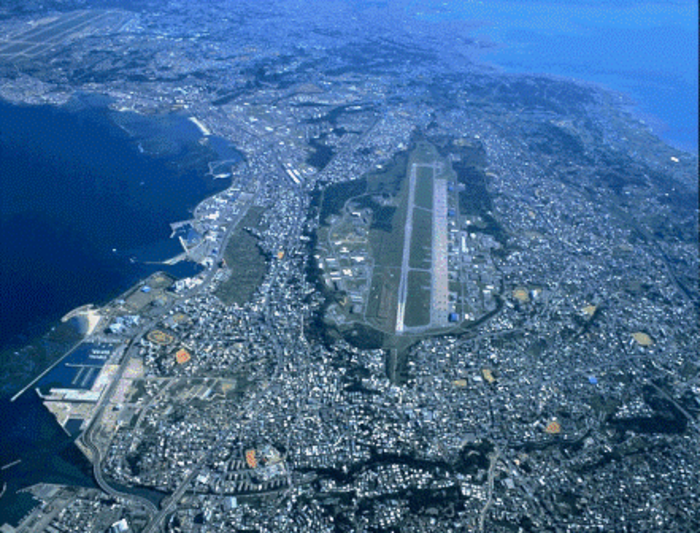
Aerial view of densely populated Ginowan City, with Futenma Air Station occupying 25% of the city’s land.

Question: Let me ask our first question, Mayor Iha.  Is a complete relocation to Guam possible? Defense Minister Kitazawa went to Guam.  He has stated that a complete relocation of facilities to Guam would be impossible; this is different from what you have been saying. What do you think about the Defense Minister’s comments?

Iha: In the “Roadmap” agreement (United States-Japan Roadmap for Realignment Implementation, May 2006), Futenma’s air capabilities were to be relocated to Henoko, but there was no agreement on relocating the Marine units from Futenma to Henoko. However, until October 2005, just half a year earlier, the agreement (U.S.-Japan Alliance: Transformation and Realignment for the Future) was that the Marine units would also be relocated to Henoko. In May 2006, the U.S. Department of Defense changed its plan and decided that all Marine units in Okinawa would be relocated to Guam.

Question: There would be no Marines in Okinawa?

Iha: Most of them will be gone.  It is public knowledge that 8,000 Marines will be relocated to Guam from Okinawa, and 9,000 of their family members will also be moved to Guam. But the number of the family members is less than 9,000 and at present it is said to be actually less than 8,000.

Question: Are they just being loose with the figures?  What does that mean?

Iha:  The Japanese government has agreed to build homes for 9,000 family members in Guam. Ultimately the Marine units relocating to Guam will total 10,600, but that figure is to be made up of units from around the world.

Question: Is Defense Minister Kitazawa wrong?

Iha: Mr. Kitazawa is talking about constructing a replacement for Futenma Air Station in Guam, which is different from the existing U.S.-Japan agreement. Under the U.S.-Japan agreement, Futenma’s replacement facilities were to be built in Henoko, but the reference is to base facilities, not Marine units. Building a new airbase in Henoko and building a new airbase in Guam are two completely different matters. There are already two air fields in Guam, so it is unlikely they will build another. But the reason behind wanting to build an airbase in Henoko was because the first agreement had decided that the Marine units would also be moved to Henoko.
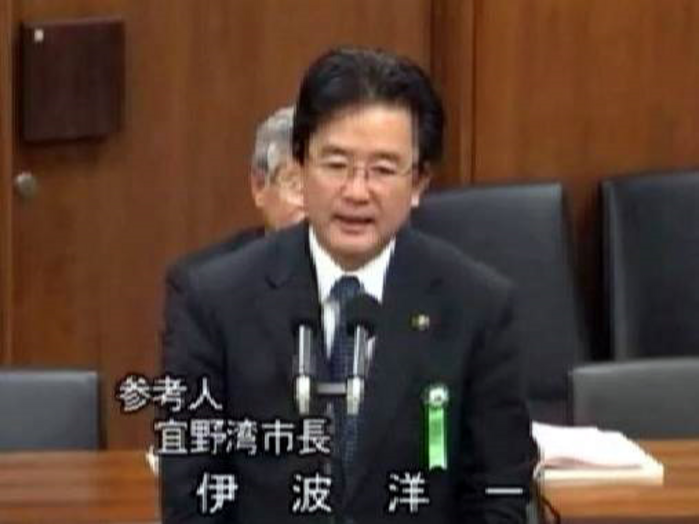
Iha making his case at the House of Representatives Foreign Affairs Committee, April 8, 2009

Question: So why then did Defense Minister Kitazawa make a trip to Guam at this juncture? … Could it be possible that Mr. Kitazawa went to Guam to see whether it would actually be possible to completely relocate U.S. Marines from Okinawa to Guam?

Iha: I think he probably learned other things there.  According to the previous (2005) agreement, only the headquarters of the Marine units was to be moved to Guam. The operational units would not be moved. This is what the government explained.  Much of the debate regarding the relocation has been based on this information. However, this is a debate surrounding the agreement up to October 2005, and the situation changed afterwards. Under the 2005 agreement, the headquarters of the III Marine Expeditionary Force were to be moved to either Guam or Hawaii. At that point, there were no talks on relocating any of the other Marine units to Guam. However, by May 2006, the U.S. Military had decided to turn Guam into a stronghold; and subsequently it decided to move all 8,000 Marines in Okinawa to Guam. This plan was devised in July 2006. We have been able to read the documents on this plan, which is known as the Guam Integrated Military Development Plan.  For the past three years the environmental impact of this Plan has been examined, and the EIS/OEIS (Environmental Impact Statement/Overseas Environmental Impact Statement) Statement was released on November 20, 2009.

Question: Yes we have those documents here with us as well.  I don’t wish to press you, but what do you really think Defense Minister Kitazawa meant by his recent actions and statements?

Iha: We learned a lot from these statements. We learned that the U.S. Marine presence in Okinawa is strictly tactical. This means that up until recently the Marines in Okinawa were there for purposes of forward deployment, to anywhere. That function is now to be moved to Guam. A small contingent of troops will remain in Okinawa, but for Okinawa alone, not for redeployment elsewhere. In the past, U.S. troops would be posted to Okinawa and then they would be redeployed to places like Iraq and elsewhere. Okinawa was the center for deployment of troops, but by 2014 troop deployment capabilities will be moved to Guam entirely.

Question: I guess Mr. Kitazawa had your arguments in mind when he made his statement today.  It sounded as though he had heard that there was a plan to move all the Okinawa Marines to Guam but thought it would be difficult to do so.

Iha: The most important consideration is that everyone, including the media, is thinking about the October 2005 argument. In other words, everyone thinks that only the headquarters will move to Guam and that the Marines will stay in Okinawa. However, this is a misunderstanding. I think Defense Minister Kitazawa, by going to Guam, has understood this.  He must have had such a briefing there, from the relevant departments.  I am pretty sure that he would have been informed of the change in the position of Okinawa, though we need to ask him to be really sure.

Question: But that did not come up in Mr. Kitazawa’s statement today.

Iha: One point that did come up was that we now understand that the troops in Okinawa are there for tactical, not strategic reasons.  It is probably difficult to understand, but let me put it this way.  Do you know how many Marines there are in Okinawa right now?

Question: How many?

Iha: The “quota” for U.S. Marines in Okinawa is said to be 18,000; however, there are only approximately 11,000 at the moment. If, from those 11,000 Marines, 8,000 are relocated to Guam, no more than 3,000 will be left in Okinawa. However, the Japanese government claims that 10,000 Marines will remain in Okinawa.

Question: As (Foreign Minister) Okada is saying?

Iha:  Yes.  There can’t be more than 3,000 Marines remaining.  It doesn’t make sense to think of Okinawa continuing to have 10,000 Marines once Guam becomes the Marines’ stronghold.

Question: After listening to you speak, there seems to be a wide gap between what Mr. Okada and Mr. Kitazawa have been saying and what you have been telling us.  Which is the truth?  I would like you to explain more.  What do you think of the way the Japanese government has been handling this issue?

Iha: The biggest problem is that the U.S. side has failed to explain in detail its Guam relocation plan. There has been no detailed explanation since the May 2006 “Roadmap,” even though the situation has changed considerably since then. (Iha shows a document illustrating the time-line of events.)

Time Line of Events 2005 to Present.  Iha argues that people of Japan have not been informed of developments since 2006 – in blue in the above chart.

The situation has changed since May 2006.  The Guam Integrated Military Development Plan was drawn up, and in 2007 the mayors of Okinawa’s central municipalities went to Guam. In Guam, the Okinawa mayors, myself included, were given detailed explanations on where the Marines from Okinawa would go, where the Futenma helicopter units were to be located. We were given detailed explanation on each of these.  On September 15th, 2008 the U.S. Secretary of the Navy presented to the House of Representatives, a detailed document on the relocation of troops; particularly on the relocation of the various marine units to Guam.  In June 2009 the Commandant of the U.S. Marine Corps presented to the U.S. Senate Committee on Armed Services a detailed document on the 8,000 Marines that were to be relocated to Guam. This document assessed the situation at Futenma, noting that Futenma had become surrounded by local residents and come to be located in a highly populated area. The document assesses the problems of Futenma and the reasons for relocation. However, the shift in the situation from May 2006 to November of 2009 has not been explained in Japan; it has not been explained in the Diet, and the government has not explained it to the Japanese people.
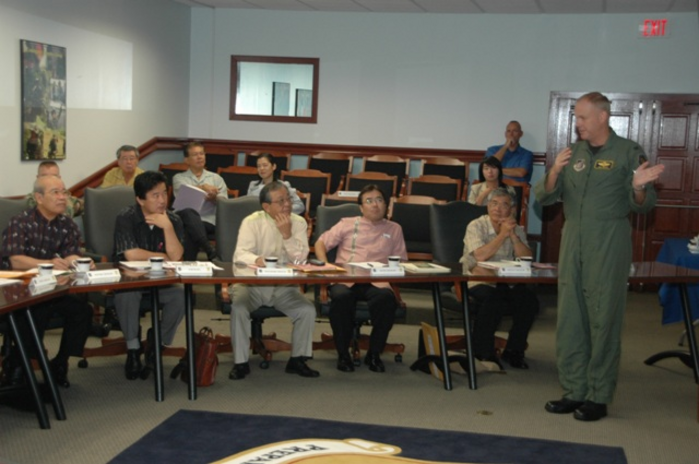
Iha (second from the left) and Central Okinawan Mayors being briefed by Col. Joel Westa at Andersen Air Force Base in Guam, July 2007

Question: It seems strange, as you say, that moves to relocate to Henoko can proceed without such explanation. Let me proceed to the second question. Why has there been no progress on the base relocation? Is someone at fault? Is it the Government of Japan? The U.S.? Or the Okinawan people? Where does the problem lie?

Iha: The people of Okinawa are strongly opposed to relocating the base within Okinawa. It has been 64 years since the war, and 13 years ago, in 1996, there was an agreement. At that time, there was a base relocation plan with a possibility of removal, but that was rejected. The people of Okinawa are strongly opposed to constructing any more new bases. Okinawa Prefecture comprises just 0.6% of Japan’s land mass, and yet 75% of Japan’s U.S. military instillations are located in Okinawa. The people of Okinawa will not accept a resolution to this problem that involves removing a base simply to build it in another location. This would be unacceptable. This is the greatest opposition, and this is why relocation within the prefecture has been opposed so strongly
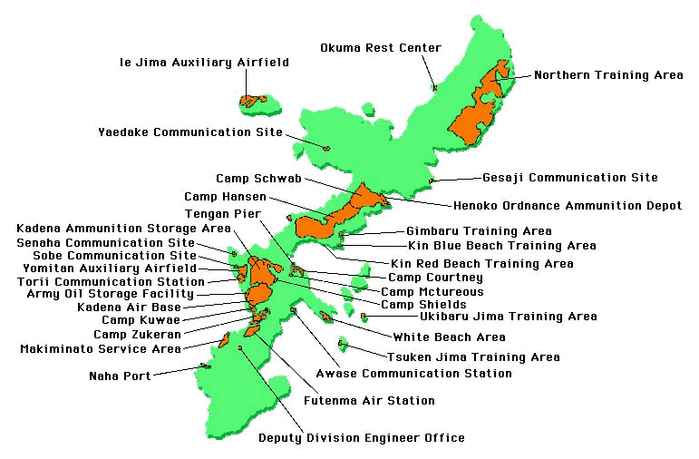
U.S. Military Facilities on the main island of Okinawa (from the website of Okinawa Prefecture)

Question: So is it just the sentiment of the Okinawan people that has led to the Japanese government dragging its feet on the matter for so long? Do you think there might also be issues concerning concessions, maybe stakeholders who have something to gain by construction?

Iha: That has been said a lot by the media, but we are not debating from that vantage point. For a long time it has been said, and it is the government’s position, that U.S. military bases were a necessity under the Treaty of Mutual Cooperation and Security, and the government assumed from the beginning that there was nowhere else to site them but Okinawa.  In other words, the reason why Henoko was chosen under the previous LDP government was that it was decided that there was nowhere else to build a new base. The sentiments of us Okinawans were always trampled upon.

Question: Let us return to this document…
(The front page of the document)

This is the material on which you base your argument that the total Marine relocation to Guam is possible.  Dated November, 2009, it is titled “Environmental Impact Statement,” and I understand it is a document that shows how new bases impact upon every aspect of the environment, including the area’s residents and its nature.  It is an 8,000-page document that is publically available on the Internet.  You have concentrated on a particular section entitled “Global Alternatives Analysis Summary” (Page 69, Volume 1), which rates the candidate locations using three criteria. Could you explain this for us?

Global Alternatives Analysis Summary

Iha:  The process of relocating Marines from Okinawa started in 2002, when the U.S. began a global realignment of its bases. Within this larger picture Okinawa’s Marines were also included and where they should be relocated. When looking for candidates for a replacement location for Okinawa, Guam got the top score, three stars, as a possible candidate, and Okinawa got only one star.

Question: Okinawa only has one plus.  So you are saying that Guam, which got three stars, is a better relocation site.

Iha: It is not me but the U.S. military that came to such a view. The “Roadmap” was agreed based on this decision on Guam by the U.S. I don’t know if the Japanese government has been given a proper explanation of this U.S. stance on Guam, but regardless of this, the U.S. will go through on its decision to relocate to Guam. Relocating to Guam from Futenma is not to solve the Futenma problem, but is part of a larger U.S. strategic military decision.  I believe that the U.S. will begin large scale relocation of Marines from Okinawa to Guam by 2010.

Question: So all of this has been released by the U.S. military? Surely it cannot be just you who has looked through and analyzed these documents; important people from Ministries of Foreign Affairs (MOFA) and Defense (MoD) must have gone through these documents, analyzed them, and reached the same conclusion as you?

Iha: No. They have not. That is the strange thing about Japan.

Question: Well, surely the MOFA people had better see them….

Iha: This is where the biggest problem lies.  The Japanese government has agreed to spend over $6.9 billion for this relocation, but the Japanese government doesn’t really know what it is going to be spent on.

Question: I wonder is it possible that they know all of this, but since for diplomatic reasons there was no way of reversing, they just let the plan proceed.…?

Iha: No. That’s not the case.  Last week when I met with Foreign Minister Okada, he said he had never heard of what I told him. He had not heard from the US about the Environmental Impact Statement, or about the other things I had told him.

Question:  In other words, he only knew for the first time when you, Mayor Iha, told him?

Iha: Even hearing what I told him, he said that could not be so.  But because of what I as Mayor have been saying, Mr. Okada has decided to reexamine the question of the 8,000 Marines who are supposed to be moving.  Foreign Minister Okada understands there to be 18,000 Marines in Okinawa right now (the “quota”), but the actual number is about 11,000, so there are 7,000 missing somehow. His understanding is that after the relocation of 8,000 Marines to Guam, there will still be 10,000 remaining in Okinawa.  This is the explanation he received from the U.S. So this is why he is not aware of the other plan and does not think the Marine’s operational units will also go to Guam (He thinks it is just headquarters that is to move to Guam.)

Question: How can this have happened? Basic procedures are not being followed if such information is not being properly conveyed.

Iha:  This has been going on for the past three years. During that time, the plan was decided in July 2006, and the documents then uploaded in September onto the U.S. Pacific Command homepage. We downloaded this document, translated it, and analyzed and explained what it was about. (Shows the document “Guam Integrated Military Development Plan.”) This is that plan of September 2006. Next is this document about the airfield (presenting the document). Here you can see in detail which unit goes where at Anderson Air Base [Guam]. Here (pointing at the map) are the areas to be constructed at the expense of the Japanese Government.
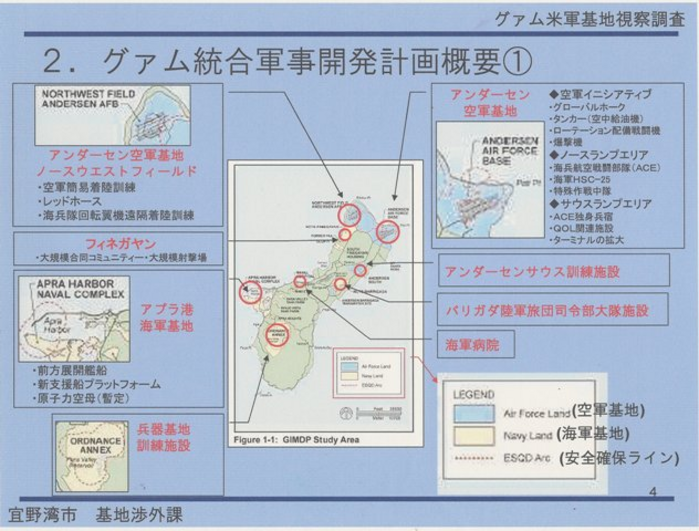
A Map of Guam from the Guam Integrated Military Development Plan, translated and analyzed by Ginowan City

This plan has been around for three years. Now the environmental assessment has been done and the Environmental Impact Statement issued. Once revised in accord with opinions received, the plan will, if approved, then be implemented. Approval is anticipated by July 30, 2010.

Question: So an already existing plan is being reviewed. It is not that the plan is still being drawn up. The fact is, as written in this plan, that a new base is to be built to accommodate the Futenma Marines (shows document of the plan). Isn’t it extremely important that this be discussed?

Iha: You are right.  Japan has already decided to pay 30 billion yen for the relocation construction, and the U.S. will pay more than $300 million, bringing the total to about 70 billion yen. This allocation of funds has been decided for the 2010 fiscal plan, so construction will begin in 2010, and the first units from Okinawa will begin relocating to Guam in 2010. At first it will only be the command elements, depending on how the actual construction proceeds, but starting from 2010, and then through 2011, 2012, 2013, and 2014 all units from Okinawa will be relocated to Guam.

Question: It is still possible that the plan might be sent back to the drawing board?

Iha: No, that is not possible. The U.S. has decided, not necessarily in order to solve the Futenma Problem, but anyway it has decided to build a Marine base in Guam as part of its global strategic plans. That means that the Marines in Okinawa will be relocated to Guam.

Question:  So what does it mean when some people talk about the possibility of sending it back to the drawing board?

Iha: I believe such a statement is a threat used to push the Henoko construction.  Relocation to Guam will not be put back to the drawing board. This is because in April, relocation to Guam was already decided by a treaty, the Guam Treaty. According to this treaty, Japan agreed to pay $6.9 billion and the U.S. agreed to pay $4 billion to implement the relocation plan. However, this is quite distinct from construction of a Futennma replacement facility at Henoko. As has been revealed in the Diet, these proceedings do not mean that the U.S. is under any obligation to relocate Futenma. Despite this, work on the Guam transfer continues.

Question: Do you have anything you wish to say to the Japanese government?

Iha: As I have said now, I want the government to give a detailed explanation on the Guam relocation. Japan has agreed to spend a huge sum of money for it, and yet the Japanese government has failed over the past three years to make a detailed explanation of the plans. Since the biggest reason for this is the failure of the U.S. government to inform the Japanese government, I ask the Japanese government to pressure the U.S. government to give a detailed explanation as to which units from Okinawa will move to Guam, and in what form they will be relocated. The Henoko issue should only be discussed after these points have been clarified – whether building a base there is really necessary. Is a new base necessary at Henoko? In my view, no. The reason should be made clear to the people of Japan, and to the Diet. I believe this is the responsibility of the Hatoyama Government. I want the Hatoyama Government to resolve the Futenma problem by cancelling the construction of the Henoko base, and I want it to take up the question of removal of the Marines from Okinawa as a whole.

Question: I get an impression that you are speaking on behalf of all Okinawans, not just as Mayor of Ginowan City.  Have you thought about running for election as Okinawa Governor in November 2010?

Iha: That is a separate issue. A lot will happen between now and then. Right now I want to focus on solving the Futenma problem.
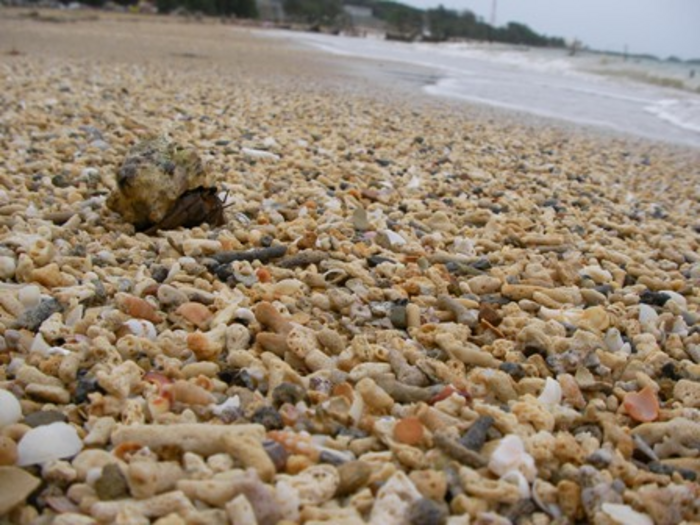
The quiet shore of Henoko, Nago, where protesters have sat in for the last eight years to stop the construction of the Futenma Air Station “replacement facility”

Links

Ginowan City Homepage

宜野湾市ホームページ

Iha Yoichi Presentation “The Marine Corps Relocation to Guam and Elimination of Dangers of Futenma Air Station”

沖縄からグアムへの海兵隊移転と普天間飛行場の危険性除去

Iha Yoichi Presentation “About the Possibility of Relocation of Futenma Air Station to Guam”

普天間基地のグアム移転の可能性について

Iha Yoichi, raised and educated in Okinawa, pursued his career in the City Office of Ginowan and as a Member of the Okinawa Prefectural Assembly before he became Mayor of Ginowan in 2003.  Iha has led numerous local and global initiatives for realizing a peaceful Okinawa without military bases.

Satoko Norimatsu is Director of Peace Philosophy Centre, a peace-education centre in Vancouver, Canada (http://peacephilosophy.com), and is an executive member of Vancouver Save Article 9. She leads youth and community members in activities to promote Article 9, Asian reconciliation, and nuclear disarmament.

Dan Aizawa is a student staff member at Peace Philosophy Centre, majoring in political science and history at the University of British Columbia.

This introduction and translation were prepared for The Asia-Pacific Journal.

Recommended citation: Iha Yoichi, “Why Build a New Base on Okinawa When the Marines are Relocating to Guam?: Okinawa Mayor Challenges Japan and the US,” The Asia-Pacific Journal, 3-1-10, January 18, 2010. 沖縄の海兵隊のほとんどがグアムに行くのに、なんで辺野古が必要なんですか?」-宜野湾市長 伊波洋一 日テレインタビュー完全版

See the following articles related to Okinawa base issues and U.S.-Japan relations:

Tanaka Sakai, Japanese Bureaucrats Hide Decision to Move All US Marines out of Okinawa to Guam

Study Group on Okinawan External Affairs, Okinawan Message to President Obama: Withdraw the Marines

Gavan McCormack, The Battle of Okinawa 2009: Obama vs Hatoyama

Fil-Am officer heads $15-B US military buildup in Guam

This article illustrates how militarism turns the victims of Empire into cannibals, feeding on other lands and peoples through the process of militarization.   It highlights the rise of Capt. Ulysses Zalamea, a Filipino-American U.S. naval officer who was recruited in Subic and who now heads up the $15 billion military expansion on Guam.  Politicians and businesses from is own hometown Subic Bay and Olongapo City, once the epitome of the worst impacts of U.S. military bases, are now cashing in on their “experience” to bid for contracts to militarize Guam and the Northern Marianas.  Contractors from Hawai’i are also joining this feeding frenzy.

It  was a shock to see Dean Alegado quoted as one of the organizers of this conference that is promoting Filipino business opportunities in the militarization of Guam.   Before returning to the Philippines several years ago, Alegado was a professor at the University of Hawai’i and was very active in a number of progressive Filipino organizations including the Filipino American Coalition for Environmental Solidarity (FACES), an international network working to address the environmental justice issues related to the military contamination in the Philippines.  So it would be contradictory and especially disheartening if he were supporting a military expansion that will inflict the same horrors on Guam.

>><<

http://newsinfo.inquirer.net/inquirerheadlines/nation/view/20100221-254441/Fil-Am-officer-heads-15-B-US-military-buildup-in-Guam

Fil-Am officer heads $15-B US military buildup in Guam

By Robert Gonzaga

Philippine Daily Inquirer

First Posted 00:32:00 02/21/2010

OLONGAPO CITY—As a young recruit in the US Navy 30 years ago, the man who would rise to the highest reaches of the world’s remaining military superpower could not have dreamt of the impact he would have on the world.

But Capt. Ulysses Zalamea, 53, the Filipino-American US naval officer in charge of the planning and execution of the $15-billion US military buildup in Guam, would show through his rapid rise soon after he joined the US Navy that he had “the right stuff.”

Zalamea said about $1 billion worth of projects are scheduled to be completed or begun this year.

After finishing his training at Recruit Training Command in San Diego, California, he was assigned as enlisted recruiting officer to the US Navy in Los Angeles.

From there, he went on to command the USS Oak Hill and serve in the Pentagon and various posts in the North Atlantic Treaty Organization as the US representative.

Today, he is the deputy director of the Joint Guam Program Office.

Zalamea, who hails from Pagsanjan, Laguna, is the highest ranking Filipino-American in the US Navy, Dean Alegado, executive director of the Association of Pacific Islands Local Government (APILG) Conference, told businessmen, contractors, Olongapo City officials and tourism workers on Tuesday.

Bemedalled officer

Zalamea, who was recruited by the Navy here in Subic in 1977, distinguished himself and received the Meritorious Service Medal Award thrice, the Navy Commendation Medal six times, and the Navy Achievement Medal. These were only a few among the many accolades he has received over the years.

Alegado said Zalamea was the “main draw” of the opening last Feb. 18 of the third APILG conference that tackled the Guam military buildup that would need the services of skilled Filipino workers and contractors. The conference ends Sunday.

Zalamea, who earned his undergraduate degree from the Far Eastern University in Manila, will be in charge of the “most important and biggest infrastructure projects in the Pacific region in the last 30 years,” Alegado said.

“The objective of the conference is to take advantage of the massive development in Guam in terms of supplying skilled workers and creating business opportunities for Filipino contractors and service providers,” he said.

The buildup came about after the US government approved the relocation of its naval base from Okinawa, Japan, to Guam starting 2012.

Zalamea said the project will start this year.

“We have over 200 proposals from contractors from all over and we are going to narrow it down to four or five,” Zalamea said.

He said four or five companies will tap subcontractors in Guam, the Pacific region or the US mainland for the project.

“I hope I can open doors for other Filipinos as the US Navy has given me so much opportunity when I was starting out. The buildup in Guam is one such opportunity for Filipino businessmen and workers,” he said.

Alignment of stars

Alegado said: “With Zalamea attending the conference and being the main speaker, all the stars are aligning for us. I hope we can take advantage of that.”

So far, the response of local governments and Filipino businessmen has been “overwhelmingly positive,” he said.

He said over 1,500 contractors had signed up for contractual bidding processes, which were earlier conducted in Washington, Honolulu and Guam. About 50 of them are Filipino-owned, mostly contractors for manpower services.

Major engineering work will proceed for the next four years, while 14,200 military personnel and their 38,070 dependents will move to Guam from Okinawa from 2012 to 2016.

Aurelio Pineda, president of the Metro Olongapo Chamber of Commerce and Industries (MOCCI), said Filipino contractors who plan to operate in or send workers to Guam for the build-up project are getting a shot at being close to the key players during the conference,

“Contractors will process those who will work in Guam. They will have to be accredited by the US Navy for security reasons, but the responsibility will be up to them. This policy protects our workers against illegal recruiters,” he said.

“Attending this conference will clear up all the questions in the minds of contractors and community leaders. The key players in the Guam buildup will be here to do that. This is a networking opportunity for Filipino businessmen.”

To waive US visas

Pineda said Olongapo establishments were preparing a “warm welcome.”

“We are thankful that they have chosen Olongapo to host this conference. We want to expose them to the tourism attractions in Subic and Olongapo,” he said.

Councilor Edwin Piano, who heads the city’s Guam Build-Up task force, said the quota of Filipino workers who can be sent to Guam, pegged at only 7,000, had been waived. Olongapo’s target of sending more than 20,000 skilled workers to Guam is now possible, he said.

Paving the way for the hiring of Filipino workers is a bill filed in the Guam legislature that would also waive the need for US visas, Piano said.

“Getting those visas is hard and expensive so this is another welcome development for us,” he said.

Mayor James Gordon Jr. said that after two years of working to create opportunities for workers and businessmen in Guam, “we are prepared for the buildup. Our intent is to bring skilled workers and Filipino investors to Guam. We want a piece of that action.”

He said the exodus of skilled workers to Guam had started in Olongapo with the shipyard there “recruiting exclusively Filipinos who are well trained.”

Underwater welders

“Most are underwater welders. They are highly paid. We are the preferred source of workers in Guam,” Gordon also said.

He also said the island’s nearness to the Philippines would create an opportunity for medical tourism for Olongapo and the rest of the country.

“Guam is only three and a half hours away from here. Everything is falling into place in medical tourism. In Olongapo, there are high-quality hospitals. We want patients in Guam to come here,” he said.

US military personnel, contractors, and mayors from the Commonwealth of the Northern Mariana Islands, Federated States of Micronesia, Republic of the Marshall Islands, Republic of Belau, the American Samoa, Hawaii and Guam are taking part in the APILG conference.

Japanese factions differ on Futenma

http://www.stripes.com/article.asp?section=104&article=68111

Japanese factions still differ on Futenma

By David Allen, Stars and Stripes

GINOWAN, Okinawa — At odds over plans to relocate Marine Corps Air Station Futenma to Okinawa’s northeast shore, the two minority parties of a special committee backed away from promises to submit their ideas for alternate locations at a meeting Wednesday evening.

Kantoku Teruya, a committee member and Social Democratic Party representative from Okinawa, told reporters in Tokyo on Tuesday that there was some “out-of-the-ring fighting” between members of the two minority parties in the ruling coalition.

“Apparently, more adjustment is needed,” said Mikio Shimoji, a People’s New Party representative on the committee from Okinawa, in a telephone interview Wednesday. “However, I have no intention of changing our proposals.”

Prime Minister Yukio Hatoyama formed the committee to review the 2006 agreement to build a new air facility on the lower part of Camp Schwab and reclaimed land in Oura Bay.

After a two-day visit to Guam last week, members of the SDP and the PNP announced they would submit their ideas for alternatives to the Camp Schwab plan at the committee’s next meeting.

The SDP was expected to favor moving the Marine air operations to Guam. The PNP favors moving the Marines to Kadena Air Base and a portion of Camp Schwab away from the pristine waters of Oura Bay.

The committee committed itself to making a final report on its review to Hatoyama in March.

Guam leaders criticize military buildup

http://www.stripes.com/article.asp?section=104&article=68110

Guam leaders balk at U.S. military buildup

By Teri Weaver, Stars and Stripes

Pacific edition, Friday, February 19, 2010

TOKYO — Guam’s leaders in recent days have ratcheted up criticism of a proposed massive military buildup, with the island’s sole delegate to Congress vowing to withdraw support unless the Pentagon slows its plans.

In her biennial speech Tuesday night to the Guam Legislature, Madeleine Bordallo asked the Navy to stretch the construction phase to eight to 10 years as the military moves 8,600 Marines from Okinawa to Guam.

Currently, the plan calls for reaching the construction peak in four years, a move that could temporarily add nearly 80,000 people to the island by 2014.

“We will do everything that we can, federally and locally, to stop that from happening,” Bordallo said during her address. “We have our foot on the brakes.”

On Monday, Gov. Felix Camacho had a similar tone in his State of the Island speech, calling on the military to rethink plans to dredge acres of coral out of Apra Harbor to make way for an aircraft carrier berth.

He also said he would not support any move by the military to force the island to give up specially designated lands for native Chamorro and other islanders, a part of which the military would like for firing ranges.

And last Friday, the legislature unanimously passed a local resolution calling the military’s voluminous impact statement on the project “grossly flawed.”

The resolution outlined multiple complaints about the military’s proposal to lessen the impact of its expansion, including a lack of money to help upgrade the island’s infrastructure as it prepares to handle a permanent influx of nearly 34,000 new residents.

The flurry of commentary — including from buildup supporters such as Bordallo and Camacho — came as time was running out for public comment on the military’s nine-volume environmental impact statement detailing the project. The deadline for submission was Wednesday.

The solicitation period began before Thanksgiving, followed by more than a dozen public hearings on the buildup plan earlier this year. As residents and leaders learned more, some began focusing on what they saw as worrisome: disrupting fishing areas, digging more wells into the island’s aquifer, and bringing in thousands of migrant construction workers without explaining how the temporary surge in population will affect the island’s aging infrastructure.

Some of those issues are being addressed, just not in the environmental impact statement, said Simon Sanchez, who chairs the island’s Consolidated Commission on Utilities. The commission — which includes local water, power and sewage officials — meets regularly with military planners to talk about the next phase in planning for the buildup: how to nail down the military’s pledges to help pay for its impact outside its fences.

“We are making progress,” Sanchez said Wednesday.

Those discussions aren’t a part of the impact statement, a federally required document meant to assess the project’s effects on the island. And the statement, to this point, is in draft form. The military must gather the hundreds of comments, analyze them and explain whether they will incorporate or reject them. The final document — called an EIS — is due out this summer.

“We appreciate Governor Camacho and Congresswoman Bordallo’s continued support for the build-up,” Marine Corps Maj. Neil Ruggiero, a spokesman for the military’s Joint Guam Program Office, wrote in a statement. “Their comments, like all comments, are important and will be taken into consideration for the final EIS.”

Sanchez said he understood the growing concern from the island, and he, too, worries the military’s current explanations fall short of explaining how the federal government will help the island deal with population growth outside military bases during construction.

“We’re worried about the surge phase,” Sanchez said. “That’s the biggest concern.”

That’s what Bordallo, a Democrat, has asked the military to stall. Both she and the governor, a Republican, support a slower building phase so that the island’s current population of 178,000 can accommodate the incoming workers and troops. As a delegate from a U.S. territory, Bordallo cannot vote on the floor of Congress. But she does have a full vote in committees, including the U.S. House Armed Services Committee, which handles Pentagon spending.

Two requests Wednesday by Stars and Stripes for comment from Bordallo, who was on the island, were not answered by her staff.

Bordallo repeated her overall support for the military expansion on Guam during her speech Tuesday, despite her funding caveat.

“It would not be an exaggeration to say that this draft EIS has done more harm than good,” she told the island’s legislature. “I see great opportunities in this buildup and we must not let these challenges overcome the greater goal of creating a better life and more opportunities for our people.”

The governor, on Monday, struck a different tone.

While he too said he supports the basic idea of the buildup, he wants to make sure that Guam and its future generations are treated with respect.

“Throughout the past four and a half centuries, our people have adapted to changes that have been thrust upon us,” Camacho said. The island’s “culture is dynamic, adaptive and vibrant, as evidenced in our language, beliefs and practices. We have retained important aspects of our culture that we cherish — our social values, respect for elders, love for family and our faith in God.”

To that end, he has proposed legislation to change the island’s name from Guam to Guahan, the Chamorro name for the island that means “we have.”