NZ spy station eavesdropping on Asian satellites

http://www.stuff.co.nz/sunday-star-times/news/3257142/Spies-on-the-ground-beat-ears-in-the-sky

Spies on the ground beat ears in the sky

By NICKY HAGER – Sunday Star Times

Last updated 05:00 24/01/2010
spybase

Photo: Marlborough Express
Waihopai spy station.

INQUISITIVE MARLBOROUGH locals have outsmarted government attempts to keep the targets of the Waihopai spy station secret – and have discovered that it is eavesdropping on Asian satellites carrying the communications of New Zealand’s friends and trading partners in that region.

The Government Communications Security Bureau (GCSB), refuses to disclose its targets. However, one of the station’s large spherical covers (or radomes) was damaged in a 2008 anti-war protest. This left the listening antenna uncovered for 15 months, during which time people living near the base collected photographs and measurements of the uncovered satellite dish.

Their findings, along with measurements by a registered surveyor, were analysed by a former navy and police telecommunications engineer for the Sunday Star-Times, revealing the satellite dish’s targets (see below). The Kiwi spy base was pointed at various times at regions occupied by Japanese, Chinese and Russian satellites. On one day in 2009 the target was one of two Asian telecommunications satellites, one Japanese and one Vietnamese, according to the surveyor’s measurements.

Both satellites provide regional phone, data, internet and television links to private companies, individuals and government agencies in Japan, South-East Asia and down to Australia and New Zealand.

Former diplomat Terence O’Brien was not surprised by the spying on Asian targets but said New Zealand needed to sort out whether our future was in Asia or still “being shaped by influences from the North Atlantic”. “We’re supposed to be getting closer to Asia… which has a considerable influence on our future prosperity and wellbeing,” whereas spying on Asia as part of an Anglo alliance was “back in an old, comfortable North Atlantic view of the world”.

Spying on East Asian countries, and especially Japan, would be consistent with the GCSB’s long-term operations. In 2006, the Star-Times reported on a misplaced 1986 GCSB annual report found among former Prime Minister David Lange’s papers deposited in the National Archives.

The report, stamped “Top Secret Umbra”, described the GCSB’s operations, including interception of Japanese government communications, with “most of the raw data” supplied by the allied US National Security Agency (NSA) and British government communications headquarters.

The GCSB has also monitored communications by the governments of the Phillipines, Laos, and South Pacific.

The GCSB’s Waihopai station has two main listening dishes. The first, established in 1989, targets South Pacific nation communications carried by the Intelsat 701 satellite. The targets of the second dish, built in 1998, have been unknown until now. The station is part of a secret network of listening stations around the world run by the GCSB’s US, British, Canadian and Australian intelligence allies.

GCSB spokesman Hugh Wolfensohn said he could not comment on the calculations about the direction of the satellite dish, but “people are free to draw whatever conclusions they wish”.

WHAT OUR SPIES WERE LISTENING TO

The satellite dish was not fixed on one satellite, but shifted between satellites for periods of weeks or months. Measurements by local people, which were only approximate, pointed to areas of sky occupied only by Japanese, Chinese and Russian satellites.

The more accurate surveyor’s measurements revealed that on July 10, 2009, the dish was aimed at a satellite positioned above the equator, far above Indonesia. Two Asian telecommunications satellites are “parked” there: one owned by Japan’s JSAT corporation and another by Vietnam’s state-owned Post and Telecommunications Group.

A former navy and police telecommunications engineer, Lionel Hussey, of Christchurch, said that based on the surveyor’s measurements, “I would give these two satellites very high but equal probability of being under surveillance.”

Okinawa Times article about Hawaii solidarity against US bases (Japanese language)

http://www.okinawatimes.co.jp/article/2010-01-18_1767/

[ハワイ]「基地いらない」米国務長官訪問に県人ら抗議集会

「沖縄にもグアムにもハワイにも基地はいらない」とデモをする人たち=ホノルル市・東西センター前

[画像を拡大]

2010年1月18日 09時41分

【知花愛実通信員】12日、米国のヒラリー・クリントン国務長官がホノルル市を訪れ、市内にある東西 センターでアジア太平洋問題についてスピーチを行った。滞在中、太平洋地域のリーダーと面会し討議するほか、この後、パプアニューギニアを訪問し、環境保 護問題などについて会議を行う。

クリントン国務長官到着時、東西センターの前では、反戦・反基地を訴える活動家らが集まり、懸案の普 天間基地移設問題を前に、基地縮小の意を訴えた。地元ハワイの人々をはじめ、ネーティブハワイアン、グアム、沖縄などさまざまな地域出身の人々が集まり、 抗議行動に参加していた。

代表のカイル・カジヒロさんは「沖縄にも、グアムにも、ハワイにもどこにも基地はいらない。私たちは 基地の移設より、全面的な縮小を求めている。私たちの住んでいる所は、遠く小さな島国かもしれないが、基地のために利用される必要はない、平和に暮らす権 利がある。アジア太平洋が一つのコミュニティーとして団結してそれを訴えていくべきだ」と述べた。

News from Jeju anti-bases struggle: Police raided peaceful sit-in, people arrested, injured

Here are some dispatches about the South Korean police raid of the Gangjeong village protest against a Navy base. This is on Jeju Island in South Korea, a world designated peace island. But the Korean Navy wants a Navy base.  This is widely understood to be a base that will be used by U.S. aegis ships. See updates about the arrests and how to help at this site: http://nobasestorieskorea.blogspot.com/

“ My heart is broken. We are helpless and they are forcefully driving the naval base. The Jeju is the Island of the Peace. There should be absolutely no war base. We need the support by all Koreans and all international peace-loving people. We are just the innocent farmers without much knowledge. We need your help.”

(A villager, Hong Keun-Pyo, 52, during the talk by phone on Jan. 18, 2010)

Update (around 10pm)

Situation on Jan. 18, Gangjeong Village, Korea

Around 5am: 500 police were mobilized with three cranes. Police raided the planned site for the ceremony for starting to work on the naval base. It is in the east side of the village and the village people had been barricading the site with the cars since when the cranes contracted by the navy first entered the site on Jan. 6. About 30 village people succeeded to block it at the time (click HERE) It is known that the police harshly acted today, against the people who are mostly in their old ages. The village people laid their bodies on the ground and cried to rather kill all of them. They pushed the old women and men. The police did not even mind women’s under wears were taken off during the body struggles. The whole story reminds the Pyeongteak when the police attacked the village early in the dawn of May 4, 2006.

Around 6~8pm: About 47 village people including a mayor were taken away to the police station. The police unconditionally took away all the people if they protested.

8~10:30am: five activists including Secretary Go Yu Gi, and two Catholic fathers were taken away to the police, after the short press interview. The activists strongly protested against the police and were dragged from the cranes they were protesting on the top of them. All the captured were separately detained in the three police stations of the Jeju Island. Some may be released soon or some may be even restrained. We don’t know yet but the mayor is expected to get the arrest warrant.

Wounded

A 70year old man is in comma. He hit his head on the stone when he was pushed by a police man. He was protesting against the police who was pushing an old woman.

A Korean Confederation of Trade Union activist, 41 was carried to the hospital but released hours later.

After 1pm.

The remaining village people and the activists continued to confront against the police without the clash.

Currently (at 8pm), about 30~40 people including 20 village people (mostly in their ages of 40~60) and 20 Jeju activists (30~40 years old) are doing the candle light vigil overnight in the confined area. The police blocked the people entering the place. The police are expected to be mobilized again tomorrow morning. A Jeju activist there says, once they are all taken away by the police tomorrow, they may not be able to enter the area again. Because of small numbers there, brutal taking away is expected. But she said the protests in front of the area will go on, afterward. It is possible to contact with the people there by phone and all the international message are carried briefly via it. It empowers the people there.

In the area for the planned ceremony, all the barricades of cars by the village people were removed. Wire fence was set up. And the contracted cranes have done the basic construction process. There are about 6 cranes in the area for tomorrow’s continued construction.

What you can do.

  • Send the strong solidarity message to the village people
  • Put the pressure to the South Korean government

Prime Minister’s Office

Central Government Complex, 55 Sejong-no, Jongno-Gu, Seoul, Korea (110-760)

Tel: 82-2-2100-2114

webmaster@pmo.go.kr

www.pmo.go.kr

(Find English at the top right)

Consider to come to the village and join the struggle. Even if it is a few days, it will be the greatest support to the village people. The Jeju organizations can provide the accommodation place but not airplane fees. The experience of the Vieques will be much help here in Jeju that is an isolated place from the mainland of Korea. More details will be followed later.

Superferry craft Haiti-bound

http://www.honoluluadvertiser.com/article/20100119/NEWS01/1190362/Superferry+craft+Haiti-bound

Posted on: Tuesday, January 19, 2010

Superferry craft Haiti-bound

Advertiser Staff

One of two high-speed catamarans built for Hawaii Superferry is being sent to Haiti to help with relief efforts following the devastating earthquake.

The U.S. Department of Transportation said the Huakai is among five ships owned or controlled by the federal Maritime Administration being prepared for the relief operation.

“Sending these ships will help those on the front line of this effort save as many lives in Haiti as possible,” U.S. Secretary of Transportation Ray LaHood said in a statement. “These ships will add crucial capabilities by supporting operations to move large volumes of people and cargo.”

Huakai was built for Hawaii Superferry but was never used for ferry service in the Islands because the company ceased operations and went bankrupt last year. The Huakai and a sister vessel, the Alakai, have been berthed in a Norfolk, Va., shipyard since last summer.

The Maritime Administration, which guaranteed loans for construction of the catamarans and holds first priority mortgages, took possession of the vessels after they were abandoned by the company.

Austal USA, the Alabama shipbuilder that built the vessels, and the state of Hawai’i, which provided $40 million in harbor improvements, hold second and third mortgages.

The Maritime Administration has looked into the possible sale or charter of the catamarans.

The Insular Empire: America in the Mariana Islands to show in Honolulu

mail8-blogheader

What is it like
to be a colonial subject
of the greatest democracy on earth?

The Insular Empire: America in the Mariana Islands

What: FREE public screening of the PBS documentary The Insular Empire: America in the Mariana Islands. Screening will be followed by a panel discussion with the filmmaker and special guests. Refreshments.

When: February 21, 2010

Where: UHM, Architecture Auditorium, Room 205

Time: Doors open at 3pm/Screening 4-5pm

with special guest panel

  • Lino Olopai
  • Dr. Hope Cristobal, Jr
  • Angela Hoppe Cruz
  • Terri Keko’olani
  • Vanessa Warheit

Sponsored by:

  • The Hawai’i Council for the Humanities
  • UHM Center for Pacific Islands Studies
  • Hawai’i People’s Fund
  • UHM Department of Anthropology
  • AFSC Hawai’i
  • UHM Marianas Club
  • Pacific Islanders in Communications

www.theinsularempire.com

IEHawaiiFlyer[1]

Download the leaflet

Is Hatoyama government backtracking on bases in Okinawa?

This editorial writer claims that the Hatoyama government in Japan is seeking “hana michi”, a graceful and face-saving surrender after challenging the US base relocation agreement.   Let’s hope that this is wishful thinking on the writer’s part and not the inclination of the Japanese government.  The people of Okinawa want the U.S. bases out.   Will Japan choose to once again play faithful sidekick to the U.S., or will it defend the human rights of Okinawans to live in peace without the occupying American military bases?

>><<

http://www.honoluluadvertiser.com/article/20100117/NEWS08/1170353

Posted on: Sunday, January 17, 2010

Japan hastens to repair rift over Okinawa

By Richard Halloran

The Japanese have a ritual called “hana-michi,” which literally means “path of flowers” and in practice means to allow a defeated adversary to make a graceful exit.

The term comes from the kabuki theatre. A trounced opponent, whether in a sword fight or social conflict, is permitted to dash down a ramp called the “hana-michi” running through the audience, to stop to flourish his sword or hands in defiance, and to disappear out the door.

It appears that the government of Prime Minister Yukio Hatoyama in Tokyo, after having caused a serious rift in the Japan-U.S. alliance, has begun to move down a “hana-michi” to seek a graceful exit from the ensuing turbulence. In that “hana-michi,” the Hatoyama regime is evidently being abetted by President Obama’s administration.

The split between Tokyo and Washington was rooted in an agreement between previous administrations in the two capitals under which U.S. forces in Japan would be realigned. A contentious provision in the agreement would have a U.S. Marine Corps air station in the crowded town of Ginowan on the island of Okinawa moved to a less populated place on the island.

The Hatoyama government, in effect, reneged on the agreement even though the pact had taken 13 years to negotiate. Senior officials in the Obama administration, notably Secretary of Defense Robert Gates, were taken by surprise and visibly disturbed. Most important, muttering seeping out of Washington held that the Japanese had betrayed the trust of the Americans.

Things went from bad to worse from mid-September, when Hatoyama took office, until year-end. Then, from Japanese press reports, Hatoyama officials became aware that they had severely damaged Japan’s relations with the U.S., especially in security. They began seeking repairs that would not make them lose face before their constituents.

That led Foreign Minister Katsuya Okada to make a hastily arranged trip to Honolulu last week to meet with Secretary of State Hillary Clinton, who was stopping in Hawai’i on her way to the South Pacific. They talked for 80 minutes, which meant little over half an hour with translation. Okada did affirm that his government was committed to resolving by May the issue of the Marine air station in Okinawa.

(Instead of going on to Australia, Clinton turned around and went back to Washington to help with relief efforts in Haiti.)

To embark on its “hana-michi,” the Hatoyama government has asked the U.S. to engage in new, wide-ranging discussions about the U.S.-Japan alliance even before settling the Futenma problem. Somewhere in those talks, the Japanese evidently hope to escape from the impasse they have caused. Clinton has agreed.

Assistant Secretary of State for East Asia Kurt Campbell suggested the rationale for the new discussions during a press briefing before Clinton left Washington. In recent weeks, he said, the message from Tokyo “has been that the government of Japan needs more time to work on these issues, and our response has been that we believe that this is the best approach.”

At the same time, Clinton reiterated the Obama administration’s position that the best way to resolve the Futenma issue would be for the Japanese government, despite political opposition at home, to abide by the agreement already reached.

In a subtle way, Clinton indicated that Japan had been demoted a notch in the eyes of Obama officials. Until now, Japan has been singled out by Republican and Democratic administrations as “the cornerstone” of U.S. security in Asia. In a policy address after meeting with Okada, Clinton said “the cornerstone” of U.S. involvement in Asia rested on “alliances with Japan, South Korea, Australia, Thailand and the Philippines.”

Few people anywhere understand subtlety and indirection so well as the Japanese.

EMERGENCY: The Police Raid the Gangjeong Village, Jeju, South Korea

Jeju is a small island off the coast of South Korea. It is known for its beautiful volcanic landscape and semi-tropical climate, abundant seafood and strong tradition of peace activism.  The island is designated as a world peace island. But the Korean government wants to build a navy base on the island, which activists believe will primarily support U.S. military strategy.   The village of Gangjeong has protested the construction of the base.  However, this morning, police raided the activists’ protest camp.

>><<

http://nobasestorieskorea.blogspot.com/2010/01/wmergency-police-raided-gangjeong.html

Monday, January 18, 2010

EMERGENCY: The Police Raided the Gangjeong Village

Update: Current situation at 10: 30am (Korean time)

About 500 policemen were mobilized to the village Gangjeong at 5am this morning.

Not only 40 village people including the Mayor, Kang Dong Kyun, and Yang Hong Chan, Chairman of the Committee against the military base, but Go Yu Gi, Secretary of the Pan-Island Committee against the Military Base were captured by the police at 10:20am (Korean time).

Mr. Go Yu Gi is the person who first let me know the news and has had the press interview at 10am as he arrived in the village.

In the press interview at 10am, the village people and activists had announced the total struggle to prevent the South Korean navy’s plan to have the ceremony to starting to work on Feb. 5, 2010.

_____________________________________________________________________

Dear all,

Many of you would probably know Bruce Gagnon’s international petition against the Jeju naval base construction and have heard about the Gangjeong village people’s struggle against the naval base.

http://www.space4peace.org

I just got the message from a key activist in the Jeju organization.

He said the police raided the Gangjeong village early this morning in large number.

He got the news at 6:30am this morning in the Jeju city which is about an hour distance by car from the Gangjeong village. As soon as he heard the news from the people in Gangjeong, he is now heading to the village.

According to him, the police captured three people. The mayor is not heard to be among those. We don’t know yet whether people were wounded or not.

The village people and the Jeju organizations were supposed to have the press interview this morning, to announce the organized tent vigil, joined by the activist organizations.

The Gangjeong village people had set up the fence in their village, to prevent the crane cars contracted by the navy. The navy has planned to work on the ceremony of the starting to work on the naval base on Feb. 5 and the crane cars first entered the village on Jan. 6 but at the time the village people blocked it.

The Jeju organizations and village people have appealed the lawsuit against the Jeju special self-government and provincial assembly for improper and illegal processing and enforcing of the Jeju naval base. The case had the high probability of victory for people and the Navy should at least wait for the result.

The people in Gangjeong which is the most beautiful and pristine village in the Jeju island, but faces the horrible missile defense system in their loved village, need your strong support.

Please email to Bruce Gagnon for your sign against the Jeju naval base construction.

Please post in your website his petition.

We need all your strong solidarity messages as well.

I will send you the updated news again as I heard.

Thanks very much,

No Base Stories of Korea’

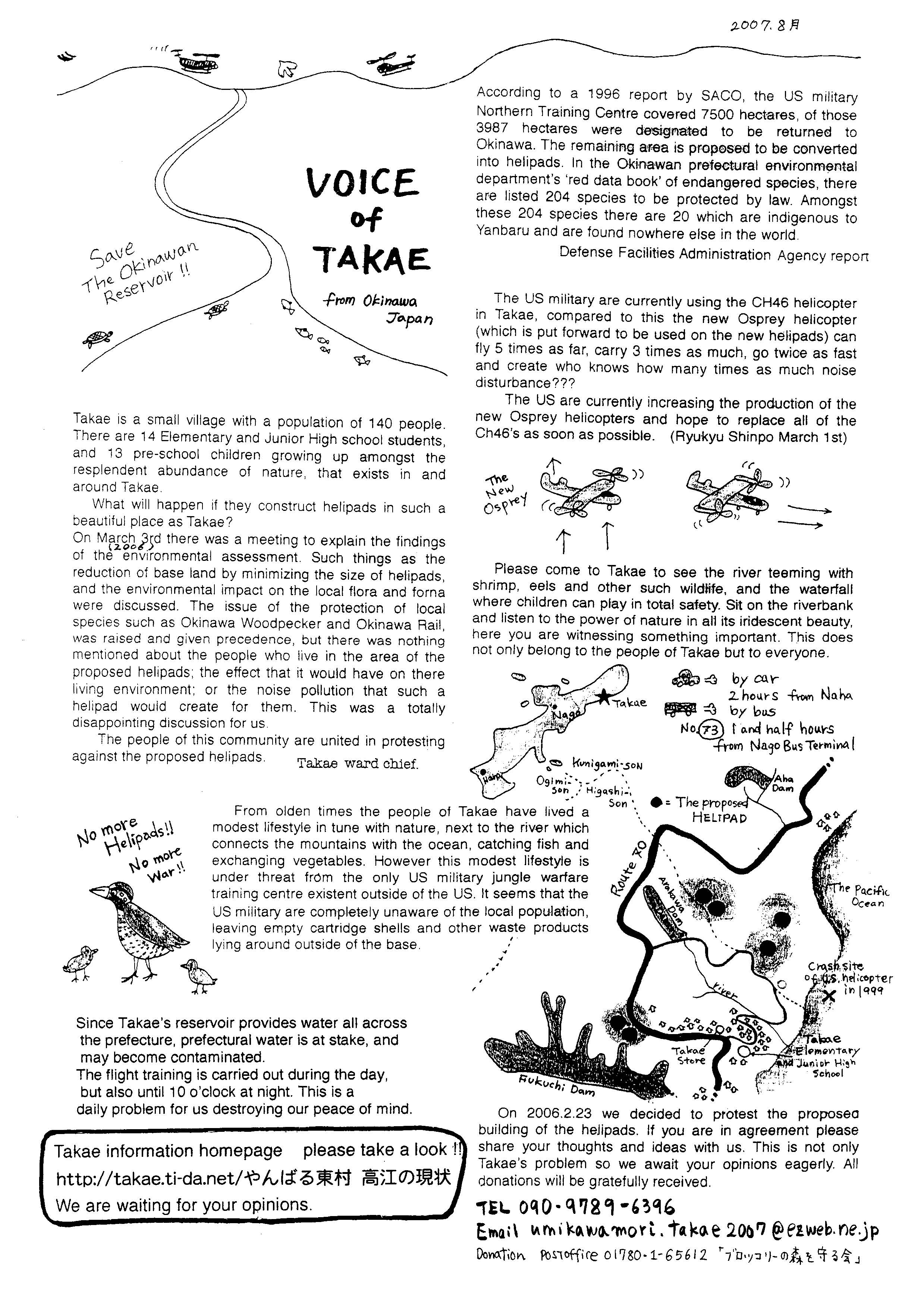
Okinawa: Another village fights against U.S. military base expansion

There has recently been much attention focused on the conflict between the U.S. and Japan over the relocation of Futenma air station from Ginowan city to Henoko/Oura.  However, there is another base expansion in Takae, in the north of Okinawa that threatens rain forest habitat to many of Okinawa’s rare species.

Download the Voice of Takae in English voice of takae

Here’s a call for support on an online petition:

Stop US helipad plan in Okinawa to save great nature.

Target: to be submitted to the Japanese Parliament Speakers of lower and upper houses

Sponsored by: citizens of Higashi village against helipad construction

Paper based petitions(over 21,830 personnel signed) and web based petittion (550 personnel signed in care2 till then) against helipad construction plan was presented in the Japanese Diet after “in house” meeting on 7th Feb 2008.

Total signer’s number of over 22,000 is well above the targeted 15,000, which is 100 times of Higashi village population(about 150).

However, US and Japanese governments show no intention to quit the plan, which means we still need to continue this campaign.

On the contrary, Okinawa Defence bureau bring case to the court argueing that citizen are illegally prohibiting the construction plan.

Court case has started in January 2009. Over 20 voluntier lawyers are supporting the citizen, claiming that resistance of the citizen in non-violent form is solely the expression of resistance and that it is Okinawa Defence bureau who is violating legal process of this procedure. Another pettion in the paper form for supporting the court to reject the case in favor of the resisting citizens is in the way. Form is available in citizens of Higashi village against helipad construction homepage, http://takae.ti-da.net/

Apart from court case problem, construction plan has been stalled. Okinawa Defence bureau was intended to change the situastion by bringing the case into the court. The result was that lots of Okinawa citizen came to know the Takae problem from this news and support movement has widely spread since then.

It is promised by the Okinawa Defence bureau that they will not start construction work until the court case come to an conclusion.

As a result, no construction work took place since 2008.

For further detail of the past, see below.

<About the situation in Takae in February 2008>

No majour construction-related progresses have taken place since New years day, although two dump trucks were recorded to carry in pebbles and sand for surfacing last week. No surfacing worker was allowed to enter for this occasion.

Prediction from these is that as fiscal year 2007 of Japan is close to the end(in March) the constructor needed to show a sign that they are making progress of some kind.

Environment assessment procedure made an agreement that no construction work should be done during the breeding period of wild life(from March to June).

Our position is that no construction should take place at any time. Concerning breeding time, two newly born babies are in Takae and another baby is expected in this spring.

This place has been primarily used for living, it should be so in the future as far as people wish.

ex-title:Save okinawa Woodpecker and rail from US military helipad—

——————————————————————————————

Takae US military helipads construction has started in July 2007, which has close link with Henoko air base in plan. Local citizens are objecting against the plan by 24 hours sitting in.

Takae people and its nature was unwishingly pushed to the front line of US military operations, militarism move of this kind is soon supposed to spread to the entire Japan.

We call petition to the world for the Japanese parliament against the helipad plan by demanding following two claims.

First claim: Immediate stop of illegal helipad construction of US military in Takae, Higashi village, Okinawa JAPAN.

Second claim: Entire northern training area of Okinawa should be returned to people of Okinawa, as it was deprived by US military force during and after world war II against international law and it has continuously been provided by Japanese government againt Okinawan people’s will.

Dead line is scheduled 10th Janury of the year 2008, in order to be submitted in the next annual parliament meeting in 2008.

——————————————————————————————

Further information is available here. http://okinawaforum.org/disagreeblog/VOT-en.pdf

Comment by WWF Japan.  http://www.wwf.or.jp/news/press/2007/p07061401.htm#eng

Greenpeace Japan is kindly mentioning on this petition in their Blog. http://www.greenpeace.or.jp/info/features/okinawa/blog_eng/index_html

The militarization of Saddle Road

This article describes the funding mechamisms by which the military paid for much of the Saddle Road realignment to suit their operational needs.

The original Army newsletter containing the article is found here: http://www.sddc.army.mil/EXTRACONTENT/Translog/2009%20TRANSLOG%20Fall%2009.pdf

>><<

http://www.thefreelibrary.com/Defense+access+roads:+Hawaii+road+shows+program%27s+benefits+to…-a0215842041

Defense access roads: Hawaii road shows program’s benefits to military and nation.

saddleroad-1

A recent ceremony in Mauna Kea State park, Hawaii, illustrated that Military Surface Deployment and Distribution Command not only moves over the roads, but has a role in creating them as well.

Representatives from SDDC’s Transportation Engineering Agency joined officials from partner agencies in an Aug. 18 ceremony opening the latest 6.5 miles of the Saddle Road construction project. The project is administered by TEA as part of the Defense Access Road program.

Robert Korpanty, chief, Office of the Special Assistant for Transportation Engineering and Infrastructure, spoke on behalf of TEA at the ceremony. He said key partners involved in the project include the Federal Highway Administration, TEA, the Department of the Army at multiple levels, U.S. Army Garrison, Hawaii, Pohakuloa Training Area, and the Hawaii Department of Transportation.

saddleroad-2

The DAR program is the method for DOD to pay for public highway improvements required because of sudden or unusual DOD-generated traffic impacts. The program is co-administered by TEA and the Federal Highway Administration for the Department of Transportation. Within DOD, this responsibility falls under SDDC’s core competency to ‘Provide Defense Transportation Engineering.’

TEA’s mission is to provide DOD with the research, engineering, and analytical expertise to improve the deployability of U.S. armed forces, the transportability of equipment, the infrastructure of the Defense Transportation System, and the management and execution of the DOD transportation programs for national defense.

Since its original incarnation more than 60 years ago, SDDC has worked with installations, FHWA and local highway authorities to address impacts resulting from sudden or unusual military actions. Discussions on the importance of Saddle Road to national defense began more than 20 years ago, and the road was certified under the DAR Program in June 1989.

“Since that time, DOD has been committed to seeing this project successfully executed through DAR Program in coordination with HI-DOT, FHWA and other local transportation officials,” Korpanty said. “Congressional members and their staffs have been key supporters of the project and integral in the complete funding of the project.”

“This is the third portion of the project, and completes 23 miles of road,” said David Gedeon, overall program manager for the project from the Central Federal Lands Highway Division of the FHWA.

Gedeon said the Aug. 18 ceremony marked the end of the original 15-mile Defense Access Road program project. Ground was broken on the project five years ago, with 23 miles built to date including portions that have been funded by the State of Hawaii.

County of Hawaii Mayor William Kenoi said each time another section of Saddle Road is completed, the Island of Hawaii benefits.

“Saddle Road links east Hawaii to west Hawaii so people can spend more time with their families,” Kenoi said.

Debra Zedalis, the director for Installation Management Command, Pacific, said a new Saddle Road is also a great benefit to the military in Hawaii.

“This is a great improvement, and we’ve had great support from the State of Hawaii. Of course, we get to benefit from that improvement. We’re glad to be partners. This is the spirit of aloha,” she said.

saddleroad-3

During his keynote speech at the ceremony, Senator Daniel Inouye said he insisted that a citizen advisory group task force comprised of representatives from all interested parties be set up, so any problems relevant to the construction of a new Saddle Road could be ironed out long before construction began.

On the east side of the island, 12 miles remain to be constructed using funds from the State of Hawaii. Eight of the 12 miles should be completed within the next 18 months. On the western end of Saddle Road, a Supplemental Environmental Impact Statement will have to be completed in order to start work on the last 10-mile section, said Gedeon. Because the Army purchased additional land for training at PTA in 2006 that would be bisected by the route of the highway proposed in the original EIS in 1999, the SEIS will evaluate the impact of an alternate route, which the Army suggested, that will not affect training.

Inouye, a Medal of Honor recipient, said when he originally became a territorial representative for Hawaii 55 years ago, he thought something should be done to link the two sides of the Big Island, but at the time there wasn’t much local interest.

He said that once PTA became the most important training area for troops in the Pacific, and funds were available under the DAR program, he saw a chance to not only benefit the troops, but to join the east and west sides of Hawaii.

“Although SDDC is an Army command, the DAR program supports all branches of the military. By mitigating DOD-generated traffic impacts on public highways, the DAR program allows installations to meet their mission goals while improving daily traffic conditions, reducing congestion, increasing safety and decreasing travel times near military facilities,” said Darryl Hampton, the senior engineer in TEA’s DAR program office. “As the Army continues to grow and transform to meet future needs, the DAR program is a potential tool to meet transportation needs.”

Recent major DAR initiatives include projects associated with Army Base Realignment and Closure 2005 actions, the Grow the Army initiative and other DoD growth initiatives.

Since the BRAC announcement in 2005, yearly Military Construction appropriations have more than doubled for the DAR program, and additional requirements are expected to support the Grow the Force initiative, leading to even further increase.

The future requirements include potential projects at seven military facilities affected by BRAC and three facilities affected by GTF. As the DOD representative for the DAR program, TEA managed more than $371 million of DAR program projects over the past year at 11 military service locations throughout the country.

TEA has been working with Fort Belvoir, Va., HQDA, FHWA, and the Virginia Department of Transportation over the past three years to address the impact of relocating nearly 19,000 DOD personnel to the post. The DAR program is working with FHWA to construct $38M in new public highway access roads to DOD facilities at the Engineering Proving Ground there.

Over the past four years, TEA has been working with Army installations to identify any access road deficiencies that present mission critical needs on the public highway system to support the BRAC implementation. The DAR program has certified projects at four installations (Fort Belvoir, Fort Lee, Fort Bragg and Fort Carson). The projects will implement over $100M in projects to support the relocation associated with BRAC actions.

TEA is also providing support to Air Force, Navy and Marine Corps facilities as they implement BRAC and Grow the Force. The DAR program is integral in supporting the Minuteman Missile Program for the Air Force. The DAR program provides the mechanism for the maintenance of 1,700 miles of roadway that are used between the Air Force Bases and the silo sites for the 73-ton Transporter Erector vehicle.

By Donna Kiapak and Mike Petersen

SDDC Command Affairs

Chamorro Self-Determination

http://overseasreview.blogspot.com/2010/01/chamorro-self-determination.html

15 January 2010

Chamorro Self-Determination

(Marianas Variety)

By Ben Pangelinan

Over 3,600 years before the lost European Ferdinand Magellan ascended into our small island chain, 3,830 years before my grandmother was born and 3,887 years ago before I was born —the Chamorro people sailed the oceans and lived on this land they called Guahan.

While we may assume that all was well, there was turmoil and fights among the natives, as territories were established, villages were staked out and boundaries were defended. Then in 1668 they came to settle, bringing their own social and religious systems, work, faith and institutions to make our heathen lives civilized and whole.

Some of the natives succumbed and converted. Maga lahis Hineti, Ayihi, So’on and Odo fought on the sides of the occupiers and were rewarded with title and status. Hurao, Ahgao, Hula, Chaifi, Mata’pang and Tolahi and many others resisted and fought these outsiders. They resisted and waged fierce battles to preserve our land, sea, and the fruits and bounties that were ours. They believed it was more important to live as we knew how and to serve our wants and needs as we saw fit. (I Manmanaina-ta: I Manmaga’lahi yan I manma’gas; Geran Chamoru yan Espanot 1668-1695. Ed Benavente 2007).

The resistance lasted for over 27 years and resulted in bloodshed. From the very beginning, the people strongly resisted and would not abandon their ancient customs or bow to the authority of the Spaniards. Governor de la Corta wrote in his Memoria “one does not know which to admire most, whether the tenacity of the Spaniards in conflicts with the elements against a cunning and treacherous people during no less than 20 years of resistance, or that of the natives pursuing such a cruel and prolonged war which could only end in their annihilation and ruin.”

The truth of these words, “annihilation and ruin” is reflected in the “reduccion” which sought to convert the natives. Beginning in 1668, marked by the killing of Pale Diego de San Vitores in 1672 and ending in 1698, it saw the reduction of the Chamorro people from the estimated 60,000 to 100,000 at the time of discovery to just 3,678, according to the 1710 census, a mere 12 years after the end of the war. (The Marianas Islands 1884-1887 Random Notes. Francisco Olice y Garcia. Translated and Annotated by Marjorie G. Driver. Second Edition 2006).

Insight to the determination of the Chamorros to defy the occupiers in the face of certain annihilation and ruin is most clearly articulated by Chief Hurao:

“The Europeans would have done better to remain in their own country. We have no need of their help to live happily. They take away from us the primitive simplicity in which we live. They dare to take away our liberty, which should be dearer to us than life itself. They try to persuade us that we will be happier, and some of us had been blinded into believing their words. But can we have such sentiments if we reflect that we have been covered with misery and illness ever since those foreigners have come to disturb our peace? For what purpose do they teach us except to make us adopt their customs, to subject us to their laws, and lose the precious liberty left to us by our ancestors?

We are stronger than we think! We can quickly free ourselves from these foreigners! We must regain our former freedom.” (Speech by Chief Hurao. Dated: 1671).

But heart and determination was not enough to overcome the resources and the advance weapons of the occupiers. For the next 200 plus years, the people lived under the control and domination of this outside metropolitan government. Then in 1898, as part of the spoils of the Spanish-American War, a new domination was begun. This time it was under the United States of America. While the Spanish used force, faith and bullets to impose their will, this new power was more beguiling using seduction and law to get their way.

An interesting fact of the event of this war, which placed Guam under the United States, was that it was declared after the passage of the Tellar amendment to ensure that the United States would not establish permanent control over Cuba following the cessation of hostilities with Spain. The amended resolution demanded the Spanish withdrawal and authorized the President to use as much military force as he thought necessary to help Cuba gain independence from Spain. Of the four territories taken by the United States because of the war, Cuba, the Philippines, Puerto Rico and Guam, Puerto Rico and Guam continue to be under the administrative control of the United States. While the new occupier had a different approach towards the natives, they had one thing in common with the old—they imposed a government upon us, not of our own choosing. 1898 did not only bring a new occupying government over the people of Guam, it also brought a new occupant to Guam and that was my grandmother who was born on this island.

For the next four decades, the United States wielded its authority over the people, making decisions, which suited their needs and determined for us, the natives, what our needs were. Once again, the native leaders rose up to regain our rights, as a people in our own land..

Using reason and law, the weapons of the new occupiers, instead of sword and violence of the old, our leaders fought for our rights to govern ourselves and determine for ourselves what is best for our people. Once again, the occupier’s resources overwhelmed the meager resources of our people. We petitioned the Congress and even walked out of an institution they said gave us democracy and self-government when it was obvious they only did it to appease us. They continued to deny our right to self-determination and to our sisters in waiting—Puerto Rico, Cuba and the Philippines.

Once again, war came and the geopolitical events affecting independent states brought us a short era of foreign domination and occupation of a new power as Japan invaded Guam. Again, our people resisted and fought, while the United States left the Chamorros behind to deal with the invading enemy. The need for a base of operations to defeat the Japanese saw the return of the Americans, as she reclaimed her lost territory to serve as the launching point to end the war. As part of the structure of the new world order, the states of the world organized as a Union Nations dedicated to resolving future disputes in a peaceful manner and recognized the need to respect and honor the rights of those peoples liberated from domination and war.

The signatory states of the United Nations Charter freely agreed to obligate themselves and accept responsibility for the “administration of territories whose people have not yet attained a full measure of self-government recognize the principle that the interests of the inhabitants of these territories are paramount … and to this end they would seek to develop self-government, to take due account of the political aspirations of the people, and to assist them in the progressive development of their free political institutions, according to the particular circumstances of each territory and its people and their varying stages of advancement.” (Chapter X1, Article 73 (b). United Nations Charter).

At the signing of the United Nations Charter, nearly 100 nations were voluntarily placed on the list of non-self governing territories by the signatory states which held these places before World War II and entrusted to them the administration of the affairs to be governed according to the Charter. The United States as part of this event, accepted the obligation over Guam, American Samoa, the Virgin Islands, Puerto Rico and the Trust Territory of the Pacific Islands (Micronesia).

Since the establishment of the list, over 80 of the territories from the original list of non-self governing territories have been herded by their administrative authority through the process of self-determination, attaining the free expression of the people, their ultimate desire. Despite this progress, by 1960 the General Assembly believed that the pace of decolonization of the non-self governing territories, which still included Guam was too slow and adopted two landmark resolutions.

The Declaration on the Granting of Independence to Colonial Countries and Peoples marked the shift from the “principle of self determination for these territories” to “all peoples have the right to self-determination.” It further states that, “All people have the right to self-determination by virtue of that right, they freely determine their political status and pursue their economic, social and cultural development” (Resolution 1514(XV).

A component of that Declaration of Colonial People, Resolution 1514 set forth three ways in which these territories can attain a full measure of self-determination as envisioned in the Charter.The first option is Free association with an independent State as a result of the voluntarily choice expressed through an informed and democratic process. The second option is through Integration with an independent State based on complete equality between the peoples of the non-self governing territory and the independent State. And the third option was Independence. Whatever the option chosen by the people of the non-self governing territory, it must be the result of the freely expressed wishes of these peoples.

As of today, there remain 16 non-self governing territories from the original list of close to 100 who have yet to exercise self-determination and freely express their choice. Guam, the Virgin Islands, and American Samoa, all administrated by the United States are part of the last remaining 16. There have been attempts by administrating authorities to redefine not only the process of self-determination and decolonization, but the status of self government as well. Decolonization is what happens when one exercises self-determination. It is direct democracy and affirmative action freely expressed by the people themselves, clearly a right inherent in the people of Guam and clearly remains unexercised to this date.

With the signing of the Treaty of Paris on April 11, 1899 between Spain and the United States, Guam’s status as a territory under the sovereignty of the United States was cemented in law with the ratification of the treaty. While we may not accept it, Guam and its people became the property of the United States and the governing of the people of Guam and their rights fell to the Congress. Article IX of the Treaty of Paris declared, “The civil rights and political status of the native inhabitants… shall be determined by the Congress.”

The subsequent placement of Guam on the United Nations list of Non-Self-Governing Territories by the United States effectively transferred the purview and process of determining the civil rights and political status for the people of Guam to the United Nations. The ratification and the acceptance of the United Nations Charters and Resolutions by the United States now governs the processes for granting the rights of the people of Guam to freely determine their political status and freely pursue their economic, social and cultural development, in my opinion, confers upon the people of Guam the rights contained in the applicable United Nations process.

The petition for citizenship and the subsequent granting of such citizenship by the Organic Act is consistent with the responsibility of the United States as the administrating authority over Guam to “provide progressive development of their free political institutions” in no way can be defended as the free expression of the people of Guam. Acceptance of such incremental development and the improvement in such status is not the free exercise of choosing such status and most certainly not the will of the people. It is still a will imposed upon the people—no matter how generous, no matter how benevolent, no matter how good the administrating authority is. The true test of their goodness is when we decide on our own what we want for ourselves and they support it. Unfortunately, they have not been good.

When we talk about self-determination, one of the key elements of this exercise is the free and educated expression of the people’s right in determining their political status for themselves. As the administrating authority, it is the responsibility of the United States to fund the education process, so that the status option, whichever one is selected is not the status offered by those who have the most money to present their case.

An educated choice is the essential element in the exercise of self-determination and the people must be educated on the promise and the reality of each option to ensure a free choice.

Who are the people vested with the right of self-determination? It is clear that these people are the native inhabitants of a territory who are living under a political status or part of a political relationship with another state without their free expression to do so. These are the people to which the United Nations Charter speaks to as the colonial peoples of the non-self governing territories. Beginning with the Guam Legislature’s empanelling of the Political Status Commission in 1973, the struggle by the people of Guam to exercise their right to self-determination as recognized under the international law was initiated. A special Commission on the Political Status of Guam followed leading to Guam’s first political status plebiscite in 1976. The plebiscite was open to all the voters of Guam with a majority selecting the option of improved status quo.

In 1977, the federally sanctioned Constitutional Convention resulted in the draft of a constitution that was approved by the Congress but ultimately rejected by the people of Guam. The constitution was still subject to a status imposed upon the people, not of their own choosing. With a new Commission on Self-Determination in 1980, another status plebiscite, opened to all registered voters was approved. The plebiscite was held in 1982 with seven available status options. When none received a majority, a run off was held with the choice of commonwealth status eclipsing statehood by a three to one margin. For the next fifteen years, Congress and the President deferred any concrete action to approve the Guam Commonwealth Act.

The Commonwealth Act provided for Chamorro self-determination, mutual consent and immigration control, agreed to by the United States in the Covenant with the Northern Marianas. In 1997 during a congressional hearing before the House Resources Committee, it became clear that federal officials would not support these provisions in Guam’s Commonwealth Act.

With the continued inaction by the United States, the people of Guam and the leaders of Guam turn to the international basis of the right of the people of Guam to self-determination as embodied by the acceptance of the United States of the United Nations Charters and Resolutions which clearly outline the process for the decolonization of a people who remain under the list of non-self governing territories. This foray into accepting a constitution, drafting a constitution, voting on a constitution without the freely expressed wishes of the people as to the political status upon which this constitution will be used to govern, is what is missing.

From that failure, the direction has changed. It is now the policy of the people of Guam to seek first the expression of our right to self-determination through the freely exercised vote on a plebiscite for the statuses available to us under the United Nations articles and resolutions. No granting of any amount of internal self-governance without the people of Guam first freely voting on the political status that frames such self-governance can be interpreted as an expression and the fulfillment of the right of the people of Guam to self-determination.

We look forward to this continued effort, this continued quest of the people of Guam – the colonized people of Guam to exercise and make their fully educated choice on the options presented to us under the UN Charter and UN Resolution to fulfill the right of self-determination inherent in a people subjugated and dominated by administrating powers over the last four hundred years.