Catherine Lutz: US Bases and Empire – looking at the Asia-Pacific

From the online journal Japan Focus, an excellent article by Catherine Lutz, the editor of the book Bases of Empire.

US Bases and Empire: Global Perspectives on the Asia Pacific

Catherine Lutz

Much about our current world is unparalleled: holes in the ozone layer, the commercial patenting of life forms, degrading poverty on a massive scale, and, more hopefully, the rise of concepts of global citizenship and universal human rights. Less visible but equally unprecedented is the global omnipresence and unparalleled lethality of the U.S. military, and the ambition with which it is being deployed around the world. These bases bristle with an inventory of weapons whose worth is measured in the trillions and whose killing power could wipe out all life on earth several times over. Their presence is meant to signal, and at times demonstrate, that the US is able and willing to attempt to control events in other regions militarily. The start of a new administration in Washington, and the possibility that world economic depression will give rise to new tensions and challenges, provides an important occasion to review the global structures of American power.

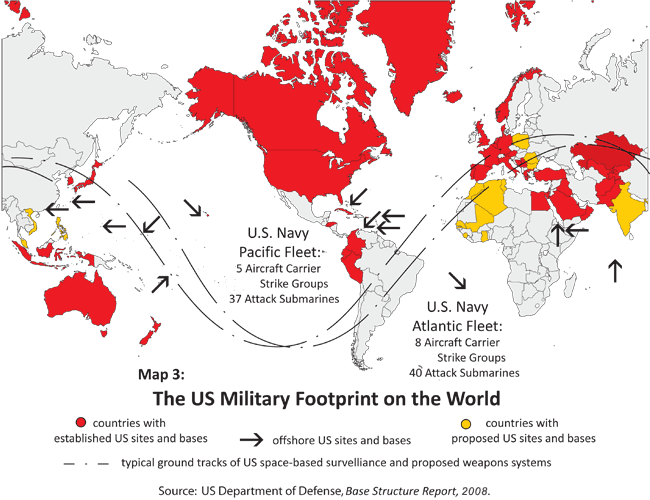
Officially, over 190,000 troops and 115,000 civilian employees are massed in 909 military facilities in 46 countries and territories.[1] There, the US military owns or rents 795,000 acres of land, and 26,000 buildings and structures valued at $146 billion. These official numbers are quite misleading as to the scale of US overseas military basing, however, excluding as they do the massive buildup of new bases and troop presence in Iraq and Afghanistan, as well as secret or unacknowledged facilities in Israel, Kuwait, the Philippines and many other places. $2 billion in military construction money has been expended in only three years of the Iraq and Afghanistan wars. Just one facility in Iraq, Balad Air Base, houses 30,000 troops and 10,000 contractors, and extends across 16 square miles with an additional 12 square mile “security perimeter.”
usmilyglobal

Deployed from those battle zones in Afghanistan and Iraq to the quiet corners of Curacao, Korea, and England, the US military domain consists of sprawling Army bases, small listening posts, missile and artillery testing ranges, and berthed aircraft carriers.[2] While the bases are literally barracks and weapons depots and staging areas for war making and ship repair facilities and golf courses and basketball courts, they are also political claims, spoils of war, arms sales showrooms, toxic industrial sites, laboratories for cultural (mis)communication, and collections of customers for local bars, shops, and prostitution.

The environmental, political, and economic impact of these bases is enormous and, despite Pentagon claims that the bases simply provide security to the regions they are in, most of the world’s people feel anything but reassured by this global reach. Some communities pay the highest price: their farm land taken for bases, their children neurologically damaged by military jet fuel in their water supply, their neighbors imprisoned, tortured and disappeared by the autocratic regimes that survive on US military and political support given as a form of tacit rent for the bases. Global opposition to U.S. basing has been widespread and growing, however, and this essay provides an overview of both the worldwide network of U.S. military bases and the vigorous campaigns to hold the U.S. accountable for that damage and to reorient their countries’ security policies in other, more human, and truly secure directions.

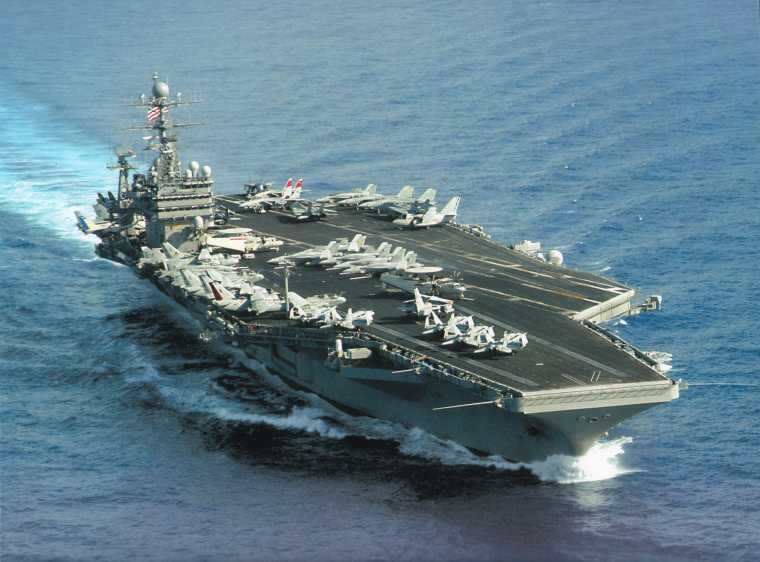
Military bases are “installations routinely used by military forces” (Blaker 1990:4). They represent a confluence of labor (soldiers, paramilitary workers, and civilians), land, and capital in the form of static facilities, supplies, and equipment. They should also include the eleven US aircraft carriers, often used to signal the possibility of US bombing and invasion as they are brought to “trouble spots” around the world. They were, for example, the primary base of US airpower during the invasion of Iraq in 2003. The US Navy refers to each carrier as “four and a half acres of sovereign US territory.” These moveable bases and their land-based counterparts are just the most visible part of the larger picture of US military presence overseas. This picture of military access includes (1) US military training of foreign forces, often in conjunction with the provision of US weaponry, (2) joint exercises meant to enhance US soldiers’ exposure to a variety of operating environments from jungle to desert to urban terrain and interoperability across national militaries, and (3) legal arrangements made to gain overflight rights and other forms of ad hoc use of others’ territory as well as to preposition military equipment there. In all of these realms, the US is in a class by itself, no adversary or ally maintaining anything comparable in terms of its scope, depth and global reach.

US forces train 100,000 soldiers annually in 180 countries, the presumption being that beefed-up local militaries will help pursue U.S. interests in local conflicts and save the U.S. money, casualties, and bad publicity when human rights abuses occur.[3] Moreover, working with other militaries is important, strategists say, because “these low-tech militaries may well be U.S. partners or adversaries in future contingencies, [necessitating] becoming familiar with their capabilities and operating style and learning to operate with them” (Cliff & Shapiro 2003:102). The blowback effects are especially well known since September 11 (Johnson 2000). Less well known is that these training programs strengthen the power of military forces in relation to other sectors within those countries, sometimes with fragile democracies, and they may include explicit training in assassination and torture techniques. Fully 38 percent of those countries with US basing were cited in 2002 for their poor human rights record (Lumpe 2002:16).

The US military presence also involves jungle, urban, desert, maritime, and polar training exercises across wide swathes of landscape. These exercises have sometimes been provocative to other nations, and in some cases have become the pretext for substantial and permanent positioning of troops; in recent years, for example, the US has run approximately 20 exercises annually on Philippine soil. This has meant a near continuous presence of US troops in a country whose people ejected US bases in 1992 and continue to vigorously object to their reinsertion, and whose Constitution forbids the basing of foreign troops. In addition, these exercises ramp up even more than usual the number and social and environmental impact of daily jet landings and sailors on liberty around US bases (Lindsay Poland 2003).

Finally, US military and civilian personnel work to shape local legal codes to facilitate US access. They have lobbied, for example, to change the Philippine and Japanese constitutions to allow, respectively, foreign troop basing, US nuclear weapons, and a more-than-defensive military in the service of US wars, in the case of Japan. “Military diplomacy” with local civil and military elites is conducted not only to influence such legislation but also to shape opinion in what are delicately called “host” countries. US military and civilian officials are joined in their efforts by intelligence agents passing as businessmen or diplomats; in 2005, the US Ambassador to the Philippines created a furor by mentioning that the US has 70 agents operating in Mindanao alone.

Much of U.S. weaponry, nuclear and otherwise, is stored at places like Camp Darby in Italy, Kadena Air Force Base in Okinawa, and the Naval Magazine on Guam, as well as in nuclear submarines and on the Navy’s other floating bases.[4] The weapons, personnel, and fossil fuels involved in this US military presence cost billions of dollars, most coming from US taxpayers but an increasing number of billions from the citizens of the countries involved, particularly Japan. Elaborate bilateral negotiations exchange weapons, cash, and trade privileges for overflight and land use rights. Less explicitly, but no less importantly, rice import levels or immigration rights to the US or overlooking human rights abuses have been the currency of exchange, for example in enlisting mercenaries from the islands of Oceania (Cooley 2008).

Bases are the literal and symbolic anchors, and the most visible centerpieces, of the U.S. military presence overseas. To understand where those bases are and how they are being used is essential for understanding the United States’ relationship with the rest of the world, the role of coercion in it, and its political economic complexion. I ask why this empire of bases was established in the first place, how the bases are currently configured around the world and how that configuration is changing.

What Are Bases For?

Foreign military bases have been established throughout the history of expanding states and warfare. They proliferate where a state has imperial ambitions, either through direct control of territory or through indirect control over the political economy, laws, and foreign policy of other places. Whether or not it recognizes itself as such, a country can be called an empire when it projects substantial power with the aim of asserting and maintaining dominance over other regions. Those policies succeed when wealth is extracted from peripheral areas, and redistributed to the imperial center. Empires, then, have historically been associated with a growing gap between the wealth and welfare of the powerful center and the regions it dominates. Alongside and supporting these goals has often been elevated self-regard in the imperial power, or a sense of racial, cultural, or social superiority.

The descriptors empire and imperialism have been applied to the Romans, Incas, Mongols, Persians, Portuguese, Spanish, Ottomans, Dutch, British, Soviet Union, China, Japan, and the United States, among others. Despite the striking differences between each of these cases, each used military bases to maintain some forms of rule over regions far from their center. The bases eroded the sovereignty of allied states on which they were established by treaty; the Roman Empire was accomplished not only by conquest, but also “by taking her weaker [but still sovereign] neighbors under her wing and protecting them against her and their stronger neighbors… The most that Rome asked of them in terms of territory was the cessation, here and there, of a patch of ground for the plantation of a Roman fortress” (Magdoff et al. 2002).

What have military bases accomplished for these empires through history? Bases are usually presented, above all, as having rational, strategic purposes; the empire claims that they provide forward defense for the homeland, supply other nations with security, and facilitate the control of trade routes and resources. They have been used to protect non-economic actors and their agendas as well – missionaries, political operatives, and aid workers among them. In the 16th century, the Portuguese, for example, seized profitable ports along the route to India and used demonstration bombardment, fortification, and naval patrols to institute a semi-monopoly in the spice trade. They militarily coerced safe passage payments and duties from local traders via key fortified ports. More recently as well, bases have been used to control the political and economic life of the host nation: US bases in Korea, for example, have been key parts of the continuing control that the US military exercises over Korean forces, and Korean foreign policy more generally, extracting important political and military support, for example, for its wars in Vietnam and Iraq. Politically, bases serve to encourage other governments’ endorsement of US military and other foreign policy. Moreover, bases have not simply been planned in keeping with strategic and political goals, but are the result of institutionalized bureaucratic and political economic imperatives, that is, corporations and the military itself as an organization have a powerful stake in bases’ continued existence regardless of their strategic value (Johnson 2004).

Alongside their military and economic functions, bases have symbolic and psychological dimensions. They are highly visible expressions of a nation’s will to status and power. Strategic elites have built bases as a visible sign of the nation’s standing, much as they have constructed monuments and battleships. So, too, contemporary US politicians and the public have treated the number of their bases as indicators of the nation’s hyperstatus and hyperpower. More darkly, overseas military bases can also be seen as symptoms of irrational or untethered fears, even paranoia, as they are built with the long-term goal of taming a world perceived to be out of control. Empires frequently misperceive the world as rife with threats and themselves as objects of violent hostility from others. Militaries’ interest in organizational survival has also contributed to the amplification of this fear and imperial basing structures as the solution as they “sell themselves” to their populace by exaggerating threats, underestimating the costs of basing and war itself, as well as understating the obstacles facing preemption and belligerence (Van Evera 2001).

As the world economy and its technological substructures have changed, so have the roles of foreign bases. By 1500, new sailing technologies allowed much longer distance voyages, even circumnavigational ones, and so empires could aspire to long networks of coastal naval bases to facilitate the control of sea lanes and trade. They were established at distances that would allow provisioning the ship, taking on fresh fruit that would protect sailors from scurvy, and so on. By the 21st century, technological advances have at least theoretically eliminated many of the reasons for foreign bases, given the possibilities of in transit refueling of jets and aircraft carriers, the nuclear powering of submarines and battleships, and other advances in sea and airlift of military personnel and equipment. Bases have, nevertheless, continued their ineluctable expansion.
carriergulf

US Aircraft Carrier in the Persian Gulf

States that invest their people’s wealth in overseas bases have paid direct as well as opportunity costs, whose consequences in the long run have usually been collapse of the empire. In The Rise and Fall of Great Powers, Kennedy notes that previous empires which established and tenaciously held onto overseas bases inevitably saw their wealth and power decay. He finds that history

. . . demonstrates that military ‘security’ alone is never enough. It may, over the shorter term, deter or defeat rival states….[b]ut if, by such victories, the nation over-extends itself geographically and strategically; if, even at a less imperial level, it chooses to devote a large proportion of its total income to ‘protection,’ leaving less for ‘productive investment,’ it is likely to find its economic output slowing down, with dire implications for its long-term capacity to maintain both its citizens’ consumption demands and its international position (Kennedy 1987:539).[5]

Nonetheless, U.S. defense officials and scholars have continued to argue that bases lead to “enhanced national security and successful foreign policy” because they provide “a credible capacity to move, employ, and sustain military forces abroad,” (Blaker 1990:3) and the ability “to impose the will of the United States and its coalition partners on any adversaries.”[6] This belief helps sustain the US basing structure, which far exceeds any the world has seen: this is so in terms of its global reach, depth, and cost, as well as its impact on geopolitics in all regions of the world, particularly the Asia-Pacific.

A Short History of US Bases

In 1938, the US had 14 military bases outside its continental borders. Seven years and 55 million World War II deaths later (of which a small fraction — 400,000 — were US citizens), the United States had an astounding 30,000 installations large and small in approximately 100 countries. While this number was projected to contract to 2,000 by 1948, the global scale of US military basing would remain a major legacy of the Second World War, and with it, providing the sinews for the rise to global hegemony of the United States (Blaker 1990:22).

After consolidation of continental dominance, there were three periods of expansive global ambition in US history beginning in 1898, 1945, and 2001. Each is associated with the acquisition of significant numbers of new overseas military bases. The Spanish-American war resulted in the acquisition of a number of colonies, many of which have remained under US control in the century since. Nonetheless, by 1920, popular support for international expansion in the US had been diminished by the Russian Revolution, by growing domestic labor militancy, and by a rising nationalism, culminating in the US Senate’s rejection of the League of Nations (Smith 2003). So it was that as late as 1938, the US basing system was far smaller than that of its political and economic peers including many European nations as well as Japan. US soldiers were stationed in just 14 bases, some quite small, in Puerto Rico, Cuba, Panama, the Virgin Islands, Hawaii, Midway, Wake, and Guam, the Philippines, Shanghai, two in the Aleutians, American Samoa, and Johnston Island (Harkavy 1982). This small number was the result in part of a strong anti-statist and anti-militarist strain in US political culture (Sherry 1995). From the perspective of many in the US through the inter-war period, to build bases would be to risk unwarranted entanglement in others’ conflicts. Bases nevertheless positioned the US in both Latin America and the Asia-Pacific.

Many of the most important and strategic international bases of this era were those of rival empires, with by far the largest number belonging to the British Empire. In order of magnitude, the other colonial powers with basing included France, Spain, Portugal, the Netherlands, Italy, Japan, and, only then, the US. Conversely, some countries with large militaries and even some with expansive ambitions had relatively few overseas bases; Germany and the Soviet Union had almost none. But the attempt to acquire such bases would be a contributing cause of World War II (Harkavy 1989:5).

The bulk of the US basing system was established during World War II, beginning with a deal cut with Great Britain for the long-term lease of base facilities in six British colonies in the Caribbean in 1941 in exchange for some decrepit US destroyers. The same year, the US assumed control of formerly Danish bases in Greenland and Iceland (Harkavy 1982:68). The rationale for building bases in the Western Hemisphere was in part to discourage or prevent the Germans from doing so; at the same time, the US did not, before Pearl Harbor, expand or build new bases in the Asia-Pacific on the assumption that they might be indefensible and that they could even provoke Japanese attack.

By the end of the war in 1945, the United States had 30,000 installations spread throughout the world, as already mentioned. The Soviet Union had bases in Eastern Europe, but virtually no others until the 1970s, when they expanded rapidly, especially in Africa and the Indian Ocean area (Harkavy 1982). While Truman was intent on maintaining bases the US had taken or created in the war, many were closed by 1949 (Blaker 1990:30). Pressure came from Australia, France, and England, as well as from Panama, Denmark and Iceland, for return of bases in their own territory or colonies, and domestically to demobilize the twelve million man military (a larger military would have been needed to maintain the vast basing system). More important than the shrinking number of bases, however, was the codification of US military access rights around the world in a comprehensive set of legal documents. These established security alliances with multiple states within Europe (NATO), the Middle East and South Asia (CENTO), and Southeast Asia (SEATO), and they included bilateral arrangements with Japan, Taiwan, South Korea, Australia and New Zealand. These alliances assumed a common security interest between the United States and other countries and were the charter for US basing in each place. Status of Forces Agreements (SOFAs) were crafted in each country to specify what the military could do; these usually gave US soldiers broad immunity from prosecution for crimes committed and environmental damage created. These agreements and subsequent base operations have usually been shrouded in secrecy.

In the United States, the National Security Act of 1947, along with a variety of executive orders, instituted what can be called a second, secret government or the “national security state”, which created the National Security Agency, National Security Council, and Central Intelligence Agency and gave the US president expansive new imperial powers. From this point on, domestic and especially foreign military activities and bases were to be heavily masked from public oversight (Lens 1987). Begun as part of the Manhattan Project, the black budget is a source of defense funds secret even to Congress, and one that became permanent with the creation of the CIA. Under the Reagan administration, it came to be relied on more and more for a variety of military and intelligence projects and by one estimate was $36 billion in 1989 (Blaker 1990:101, Weiner 1990:4). Many of those unaccountable funds then and now go into use overseas, flowing out of US embassies and military bases. There they have helped the US to work vigorously to undermine and change local laws that restrict its military plans; it has interfered for years in the domestic affairs of nations in which it has or desires military access, including attempts to influence votes on and change anti-nuclear and anti-war provisions in the Constitutions of the Pacific nation of Belau and of Japan.

The number of US bases was to rise again during the Korean and Vietnam Wars, reaching back to 1947 levels by the year 1967 (Blaker 1990:33). The presumption was established that bases captured or created during wartime would be permanently retained. Certain ideas about basing and what it accomplished were to be retained from World War II as well, including the belief that “its extensive overseas basing system was a legitimate and necessary instrument of U.S. power, morally justified and a rightful symbol of the U.S. role in the world” (Blaker 1990:28).

Nonetheless, over the second half of the 20th century, the United States was either evicted or voluntarily left bases in dozens of countries.[7] Between 1947 and 1990, the US was asked to leave France, Yugoslavia, Iran, Ethiopia, Libya, Sudan, Saudi Arabia, Tunisia, Algeria, Vietnam, Indonesia, Peru, Mexico, and Venezuela. Popular and political objection to the bases in Spain, the Philippines, Greece, and Turkey in the 1980s enabled those governments to negotiate significantly more compensation from the United States. Portugal threatened to evict the US from important bases in the Azores, unless it ceased its support for independence for its African colonies, a demand with which the US complied.[8] In the 1990s and later, the US was sent packing, most significantly, from the Philippines, Panama, Saudi Arabia, Vieques, and Uzbekistan (see McCaffery, this volume).

At the same time, US bases were newly built after 1947 in remarkable numbers (241) in the Federal Republic of Germany, as well as in Italy, Britain, and Japan (Blaker 1990:45). The defeated Axis powers continued to host the most significant numbers of US bases: at its height, Japan was peppered with 3,800 US installations.

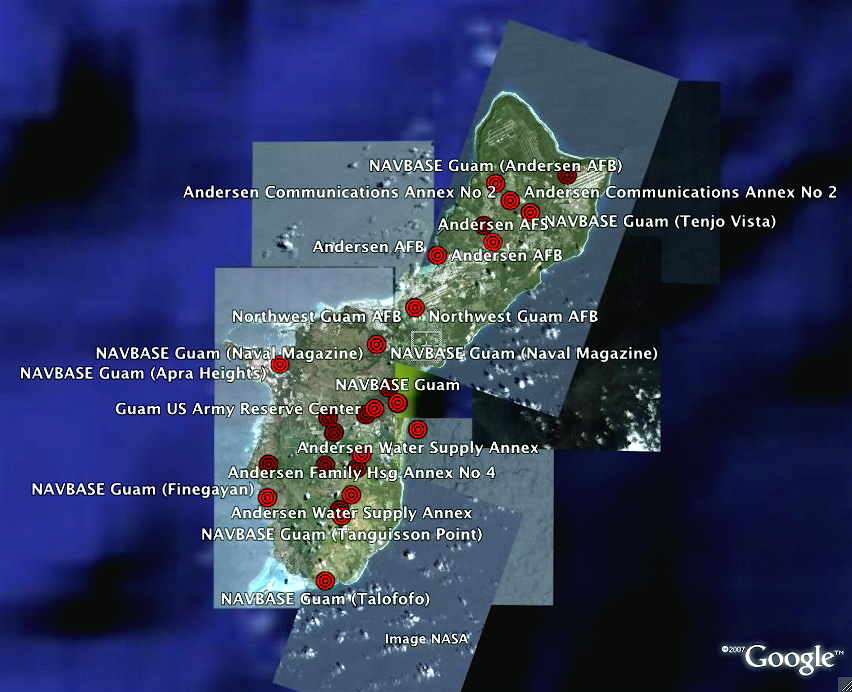
As battles become bases, so bases become battles; the bases in East Asia acquired in the Spanish American War and in World War II, such as Guam, Okinawa and the Philippines, became the primary sites from which the United States waged war on Vietnam. Without them, the costs and logistical obstacles for the US would have been immense. The number of bombing runs over North and South Vietnam required tons of bombs unloaded, for example, at the Naval Station in Guam, stored at the Naval Magazine in the southern area of the island, and then shipped up to be loaded onto B-52s at Anderson Air Force Base every day during years of the war. The morale of ground troops based in Vietnam, as fragile as it was to become through the latter part of the 1960s, depended on R & R at bases throughout East and Southeast Asia which would allow them to leave the war zone and yet be shipped back quickly and inexpensively for further fighting (Baker 2004:76). In addition to the bases’ role in fighting these large and overt wars, they facilitated the movement of military assets to accomplish the over 200 military interventions the US waged in the Cold War period (Blum 1995).

While speed of deployment is framed as an important continued reason for forward basing, troops could be deployed anywhere in the world from US bases without having to touch down en route. In fact, US soldiers are being increasingly billeted on US territory, including such far-flung areas as Guam, which is presently slated for a larger buildup, for this reason as well as to avoid the political and other costs of foreign deployment.
guam-military-presence

U.S. military bases on Guam

With the will to gain military control of space, as well as gather intelligence, the US over time, and especially in the 1990s, established a large number of new military bases to facilitate the strategic use of communications and space technologies. Military R&D (the Pentagon spent over $52 billion in 2005 and employed over 90,000 scientists) and corporate profits to be made in the development and deployment of the resulting technologies have been significant factors in the ever larger numbers of technical facilities on foreign soil. These include such things as missile early-warning radar, signals intelligence, space tracking telescopes and laser sources, satellite control, downwind air sampling monitors, and research facilities for everything from weapons testing to meteorology. Missile defense systems and network centric warfare increasingly rely on satellite technology and drones with associated requirements for ground facilities. These facilities have often been established in violation of arms control agreements such as the 1967 Outer Space Treaty meant to limit the militarization of space.

The assumption that US bases served local interests in a shared ideological and security project dominated into the 1960s: allowing base access showed a commitment to fight Communism and gratitude for US military assistance. But with decolonization and the US war in Vietnam, such arguments began to lose their power, and the number of US overseas bases declined from an early 1960s peak. Where access was once automatic, many countries now had increased leverage over what the US had to give in exchange for basing rights, and those rights could be restricted in a variety of important ways, including through environmental and other regulations. The bargaining chips used by the US were increasingly sophisticated weapons, as well as rent payments for the land on which bases were established.[9] These exchanges were often become linked with trade and other kinds of agreements, such as access to oil and other raw materials and investment opportunities (Harkavy 1982:337). They also, particularly when advanced weaponry is the medium of exchange, have had destabilizing effects on regional arms balances. From the earlier ideological rationale for the bases, global post-war recovery and decreasing inequality between the US and countries – mostly in the global North – that housed the majority of US bases, led to a more pragmatic or economic grounding to basing negotiations, albeit often thinly veiled by the language of friendship and common ideological bent. The 1980s saw countries whose populations and governments had strongly opposed US military presence, such as Greece, agree to US bases on their soil only because they were in need of the cash, and Burma, a neutral but very poor state, entered negotiations with the US over basing troops there (Harkavy 1989:4-5).

The third period of accelerated imperial ambition began in 2000, with the election of George Bush and the ascendancy of a group of leaders committed to a more aggressive and unilateral use of military power, their ability to do so radically precipitated and allowed by the attacks of 9/11. They wanted “a network of ‘deployment bases’ or ‘forward operating bases’ to increase the reach of current and future forces” and focused on the need for bases in Iraq: “While the unresolved conflict with Iraq provides the immediate justification, the need for a substantial American force presence in the Gulf transcends the issue of the regime of Saddam Hussein.” This plan for expanded US military presence around the world has been put into action, particularly in the Middle East, the Russian perimeter, and, now, Africa.

Pentagon transformation plans design US military bases to operate even more uniformly as offensive, expeditionary platforms from which military capabilities can be projected quickly, anywhere. Where bases in Korea, for example, were once meant centrally to defend South Korea from attack from the north, they are now, like bases everywhere, meant primarily to project power in any number of directions and serve as stepping stones to battles far from themselves. The Global Defense Posture Review of 2004 announced these changes, focusing not just on reorienting the footprint of US bases away from Cold War locations, but on grounding imperial ambitions through remaking legal arrangements that support expanded military activities with other allied countries and prepositioning equipment in those countries to be able to “surge” military force quickly, anywhere.

The Department of Defense currently distinguishes between three types of military facilities. “Main operating bases” are those with permanent personnel, strong infrastructure, and often including family housing, such as Kadena Air Base in Japan and Ramstein Air Force Base in Germany. “Forward operating sites” are “expandable warm facilit[ies] maintained with a limited U.S. military support presence and possibly prepositioned equipment,” such as Incirlik Air Base in Turkey and Soto Cano Air Base in Honduras (US Defense Department 2004:10). Finally, “cooperative security locations” are sites with few or no permanent US personnel, which are maintained by contractors or the host nation for occasional use by the US military, and often referred to as “lily pads.” In Thailand, for example, U-Tapao Royal Thai Navy Airfield has been used extensively for US combat runs over Iraq and Afghanistan. Others are now cropping up around the world, especially throughout Africa, as in Dakar, Senegal where facilities and use rights have been newly established.

Critical observers of US foreign policy, Chalmers Johnson foremost among them, have thoroughly dissected and dismantled several of the arguments that have been made for maintaining a global military basing system (Johnson 2004). They have shown that the system has often failed in its own terms, that is, it has not provided more safety for the US or its allies. Johnson shows that the US base presence has often created more attacks rather than fewer, as in Saudi Arabia or in Iraq. They have made the communities around the base a key target of Russia’s or other nation’s missiles, and local people recognize this. So on the island of Belau in the Pacific, site of sharp resistance to US attempts to install a submarine base and jungle training center, people describe their experience of military basing in World War II: “When soldiers come, war comes.” Likewise, on Guam, a common joke has it that few people other than nuclear targeters in the Kremlin know where their island is. Finally, US military actions have often produced violence in the form of blowback rather than squelched it, undermining their own stated realist objectives (Johnson 2000).

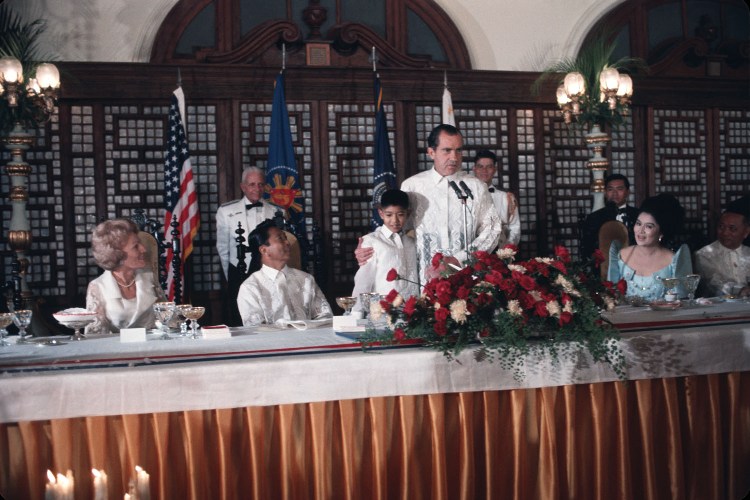
Gaining and maintaining access for US bases has often involved close collaboration with despotic governments. This has been the case especially in the Middle East and Asia. The US long worked closely with the dictator, Ferdinand Marcos, to maintain the Philippines bases, with various autocratic or military Korean rulers from 1960 through the 1980s, and successive Thai dictators until 1973, to give just a few examples.
marcos-and-nixon

Marcos and Nixon

Conclusion: The World Responds

Social movements have proliferated around the world in response to the empire of US bases, with some of the earliest and most active in the Asia Pacific region, particularly the Philippines, Okinawa, and Korea, and, recently, Guam.[10] In defining the problem they face, some groups have focused on the base itself, its sheer presence as out of place in a world of nation states, that is, they see the problem as one of affronts to sovereignty and national pride.
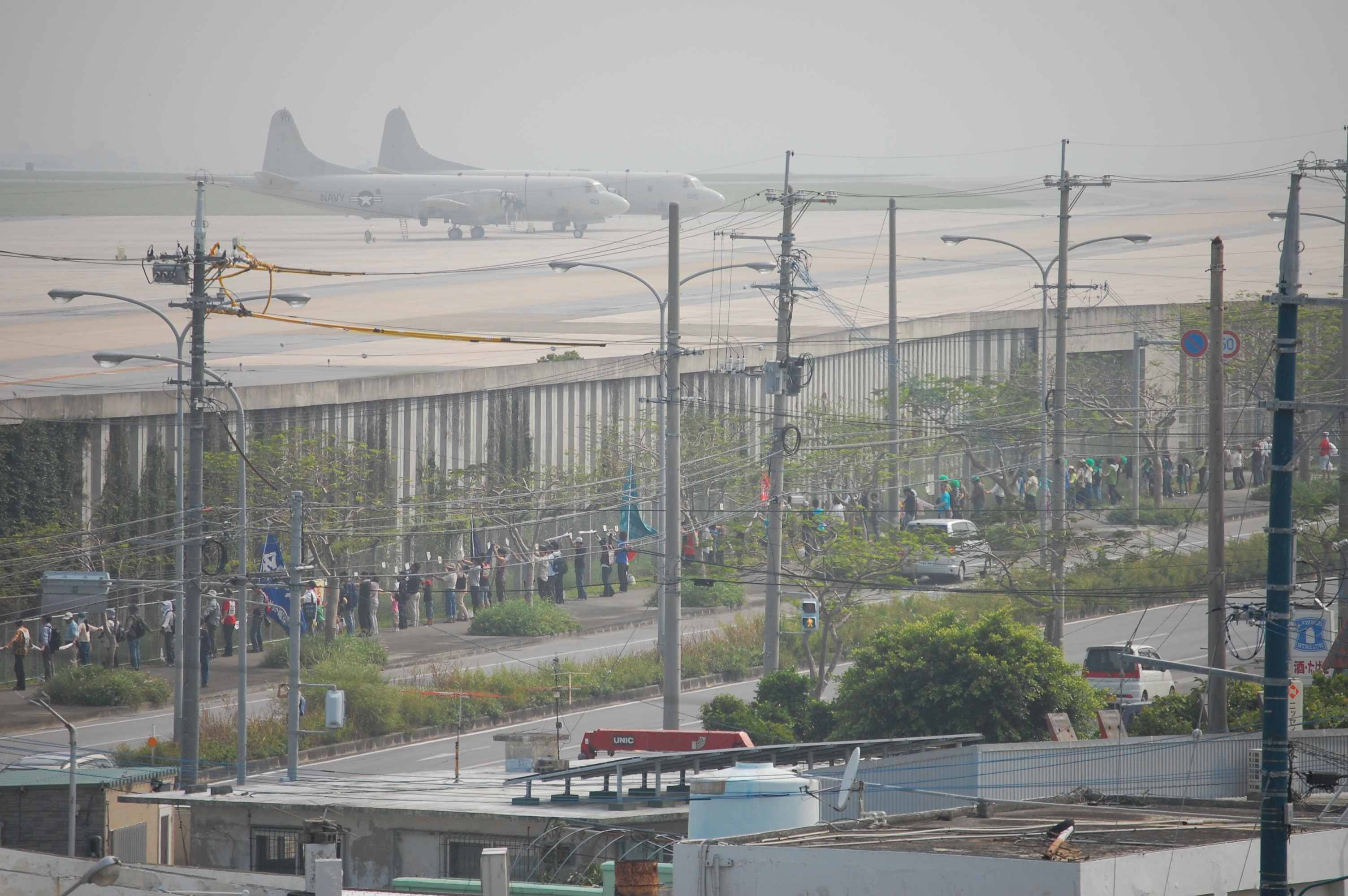
okinawa-human-chain-2

Demonstrators link hands encircling the US base at Kadena, Okinawa

Others focus on the purposes the bases serve, which is to stand ready to and sometimes wage war, and see the bases as implicating them in the violence projected from them. Most also focus on the noxious effects of the bases’ daily operations involving highly toxic, noisy, and violent operations that employ large numbers of young males. For years, the movements have criticized confiscation of land, the health effects from military jet noise and air and water pollution, soldiers’ crimes, especially rapes, other assaults, murders, and car crashes, and the impunity they have usually enjoyed, the inequality of the nation to nation relationship often undergirded by racism and other forms of disrespect. Above all, there is the culture of militarism that infiltrates local societies and its consequences, including death and injury to local youth, and the use of the bases for prisoner extradition and torture.[11] In a few cases, such as Japan and Korea, the bases entail costs to local treasuries in payments to the US for support of the bases or for cleanup of former base areas.

The sense that US bases impose massive burdens on local communities and the nation is common in the countries where US bases are most ubiquitous and of longest-standing. These are places where people have been able to observe military practice and relations with the US up close over a long period of time. In Okinawa, most polls show that 70 to 80 percent of the island’s people want the bases, or at least the Marines, to leave: they want base land back and they want an end to aviation crash risks, an end to prostitution, and drug trafficking, and sexual assault and other crimes by US soldiers (see Kozue and Takazato, this volume; Sturdevant & Stoltzfus 1993).[12] One family built a large peace museum right up against the edge of the fence to Futenma Air Base, with a stairway to the roof which allows busloads of schoolchildren and other visitors to view the sprawling base after looking at art depicting the horrors of war.

In Korea, many feel that a reduction in US presence would increase national security.[13] As interest grew since 2000 in reconciliation with North Korea, many came to the view that nuclear and other deterrence against North Korean attack associated with the US military presence, have prevented reunification. As well, the US military is seen as disrespectful of Koreans. In recent years, several violent deaths at the hands of US soldiers brought out vast candlelight vigils and other protest across the country. And the original inhabitants of Diego Garcia, evicted from their homes between 1967-1973 by the British on behalf of the US, have organized a concerted campaign for the right to return, bringing legal suit against the British Government (see Vine 2009). There is also resistance to the US expansion plans into new areas. In 2007, a number of African nations balked at US attempts at military basing access (Hallinan 2007). In Eastern Europe, despite well-funded campaigns to convince Poles and Czechs of the value of US bases and much sentiment in favor of taking the bases in pursuit of solidifying ties with NATO and the European Union, and despite economic benefits of the bases, vigorous protests including hunger strikes have emerged (see Heller and Lammerant, this volume).[14]

In South Korea, bloody battles between civilian protesters and the Korean military were waged in 2006 in response to US plans to relocate the troops there. In 2004, the Korean government agreed to US plans to expand Camp Humphries near Pyongtaek, currently 3,700 acres, by an additional 2,900 acres.
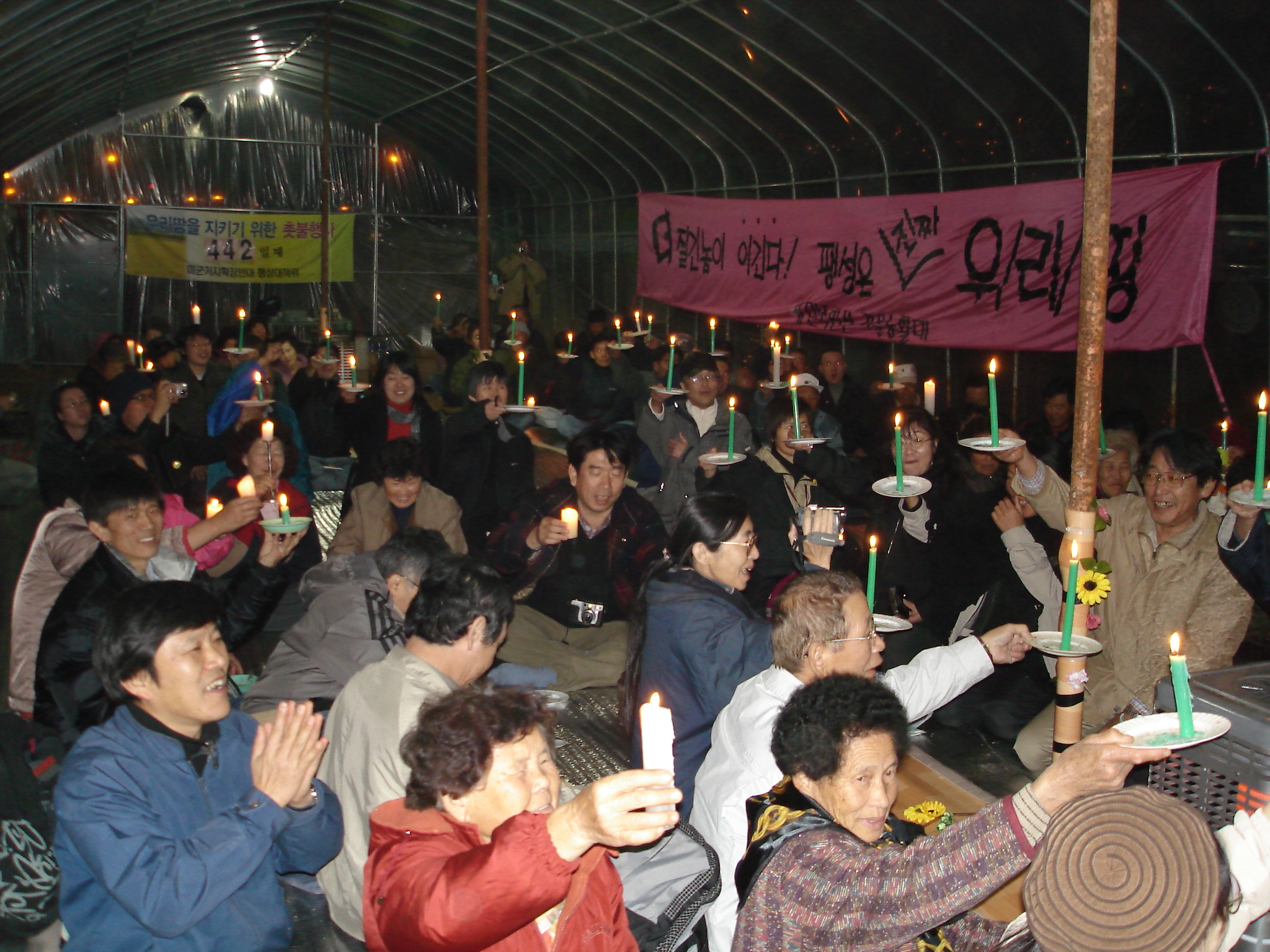
farmers-protest-vigil-pyongtaek-area-2

Farmers and supporters vigil, Pyongtaek

The surrounding area, including the towns of Doduri and Daechuri, was home to some 1,372 people, many elderly farmers. In 2005, residents and activists began a peace camp at the village of Daechuri. The Korean government eventually forcibly evicted all from their homes and demolished the Daechuri primary school, which had been an organizing center for the resisting farmers.
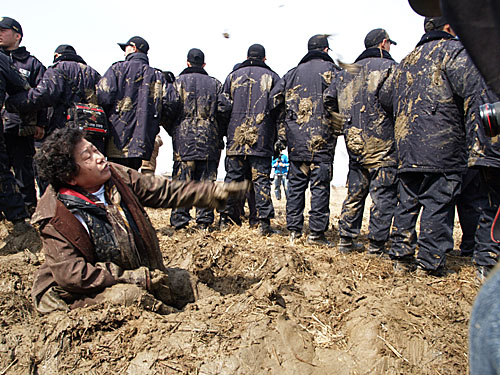
korean-farmer-fighting-to-stay
Korean farmer resisting police eviction to make way for a base

The US has responded to anti-base organizing, on the other hand, by a renewed emphasis on “force protection,” in some cases enforcing curfews on soldiers, and cutting back on events that bring local people onto base property. The Department of Defense has also engaged in the time-honored practice of renaming: clusters of soldiers, buildings and equipment have become “defense staging posts” or “forward operating locations” rather than military bases. The regulating documents become “visiting forces agreements,” not “status of forces agreements” or remain entirely secret. While major reorganization of bases is underway for a host of reasons, including a desire to create a more mobile force with greater access to the Middle East, Eastern Europe, and Central Asia, the motives also include an attempt to derail or prevent political momentum of the sort that ended US use of Vieques and the Philippine bases. The US attempt to gain permanent basing in Iraq foundered in 2008 on the objections of forces in both Iraq and the US (see Engelhardt, this volume). The likelihood that a change of US administration will make for significant dismantling of those bases is highly unlikely, however, for all the reasons this brief history of US bases and empire suggests.

Catherine Lutz is Research Professor at the Watson Institute for International Studies and Professor of Anthropology at Brown University. This article is the revised and condensed introduction to The Bases of Empire: The Global Struggle against US Military Posts (ed.). London: Pluto Press and New York: New York University Press (with The Transnational Institute), 2009.

Posted at The Asia-Pacific Journal on March 16, 2009.

Recommended citation: Catherine Lutz, “US Bases and Empire: Global Perspectives on the Asia Pacific,” The Asia-Pacific Journal, Vol. 12-3-09, March 16, 2009.
Sources

Aguon, Julian (2006) Just Left of the Setting Sun (Tokyo: Blue Ocean Press).

Baker, Anni (2004) American Soldiers Overseas: The Global Military Presence (Westport, CT: Praeger).

Bello, Walden, Hayes, Peter and Zarsky, Lyuba (1987) American Lake: Nuclear Peril in the Pacific (New York: Penguin).

Blaker, James R. (1990) United States Overseas Basing: An Anatomy of the Dilemma (New York: Praeger).

Bloomfield, Lincoln P. (2006) Politics and Diplomacy of the Global Defense Posture Review. In Reposturing the Force: U.S. Overseas Presence in the 21st Century. Carnes Lord, ed. (Newport: Naval War College).

Blum, William (1995) Killing Hope: U.S. Military and CIA Interventions since World War II (Monroe, ME: Common Courage Press).

Campbell, Kurt M. and Ward, Celeste Johnson (2003) ‘New battle stations?’ Foreign Affairs, Vol. 82, No.5.

Castro, Fanai (2007) Health Hazards: Guam. In Outposts of Empire, Sarah Irving, Wilbert van der Zeijden, and Oscar Reyes, eds. (Amsterdam: Transnational Institute).

Cheng, Sealing (2003) ‘”R and R” on a “Hardship Tour”: GIs and Filipina Entertainers in South Korea,’ National Sexuality Resource Center. Available online.

Cliff, Roger and Shapiro, Jeremy (2003) The Shift to Asia: Implications for U.S. Land Power. In The U.S. Army and the New National Security Strategy, Lynn E. Davis and Jeremy Shapiro, eds. (Santa Monica, CA: RAND).

Cooley, Alexander (2008) Base Politics: Domestic Institutional Change and Security Contracts in the American Periphery (Ithaca, NY: Cornell University Press).

Davis, Lynn E. and Shapiro, Jeremy eds. (2003) The U.S. Army and the New National Security Strategy (Santa Monica, CA: RAND).

Department of Chamorro Affairs (2002) Issues in Guam’s Political Development: The Chamorro Perspective (Guam: Department of Chamorro Affairs).

Diaz, Vicente (2001) Deliberating Liberation Day: Memory, Culture and History in Guam. In Perilous Memories: the Asia Pacific War(s). Takashi Fujitani, Geoff White and Lisa Yoneyami, eds. (Durham: Duke University Press).

Donnelly, Thomas et al. (2000) Rebuilding America’s Defenses: Strategy, Forces and Resources for a New Century. A Report of The Project for the New American Century. http://www.newamericancentury.org/RebuildingAmericasDefenses.pdf. Date last accessed Oct. 8, 2007.

Dower, John (1987) War Without Mercy: Race and Power in the Pacific War (New York: Pantheon Books).

Erickson, Andrew S. and Mikolay, Justin D. (2006) A Place and a Base: Guam and the American Presence in East Asia. In Reposturing the Force: U.S. Overseas Presence in the 21st Century. Carnes Lord, ed. (Newport: Naval War College).

Gerson, Joseph and Birchard, Bruce (1991) The Sun Never Sets (Boston: South End Press).

Gusterson, Hugh (1999) ‘Nuclear weapons and the other in the Western imagination,’ Cultural Anthropology, Vol. 14, No.1, pp. 111-143.

Harkavy, Robert E. (1982) Great Power Competition for Overseas Bases: The Geopolitics of Access Diplomacy (New York: Pergamon Press).

—— (1989) Bases Abroad: The Global Foreign Military Presence (Oxford: Oxford University Press).

—— (1999) ‘Long cycle theory and the hegemonic powers’ basing networks,’ Political Geography, Vol. 18, No. 8, pp. 941-972.

—— (2006) Thinking about Basing. In Reposturing the Force: U.S. Overseas Presence in the 21st Century. Carnes Lord, ed. (Newport: Naval War College).

Henry, Ryan (2006) Transforming the U.S. Global Defense Posture. In Reposturing the Force: U.S. Overseas Presence in the 21st Century. Carnes Lord, ed. (Newport: Naval War College).

Inoue, Masamichi S. (2004) ‘”We Are Okinawans But of a Different Kind”: New/Old Social Movements and the U.S. Military in Okinawa,’ Current Anthropology, Vol. 45, No. 1.

Irving, Sarah, van der Zeijden, Wilbert and Reyes, Oscar (2007) Outposts of Empire: The Case against Foreign Military Bases (Amsterdam: Transnational Institute).

Johnson, Chalmers (2000) Blowback (New York: Henry Holt).

—— (2004) The Sorrows of Empire: Militarism, Secrecy, and the End of the Republic (New York: Metropolitan).

Kennedy, Paul M. (1987) The Rise and Fall of Great Powers: Economic Change and Military Conflict from 1500-2000 (New York: Random House).

Lindsay-Poland, John (2003) Emperors in the Jungle: The Hidden History of the U.S. in Panama. (Durham: Duke University Press).

Lens, Sidney (1987) Permanent War: The Militarization of America (New York: Schocken).

Lumpe, Lora (2002) U.S. Foreign Military Training: Global Reach, Global Power, and Oversight Issues. Foreign Policy in Focus Special Report, May.

Lutz, Catherine (2001) Homefront: A Military City and the American 20th Century (Boston: Beacon Press).

McCaffrey, Katherine (2002) Military Power and Popular Protest: The U.S. Navy in Vieques, Puerto Rico (New Brunswick, N.J: Rutgers University Press).

Magdoff, Harry (2003) Imperialism Without Colonies (New York: Monthly Review Press).

Magdoff, Harry, Foster, John Bellamy, McChesney, Robert W. and Sweezy, Paul (2002) ‘U.S. Military Bases and Empire’, The Monthly Review Vol. 53, No. 10.

Robinson, Ronald, Gallagher, John and Denny, Alice (1961) Africa and the Victorians: The Official Mind of Imperialism (London: Macmillan).

Roncken, Theo (2004) La Lucha Contra Las Drogas Y La Proyeccion Militar de Estados Unidos: Centros Operativos de Avandzada en America Latina Y el Caribe (Quito, Ecuador: Abya Yala).

Scanlan, Tom, ed. (1963) Army Times Guide to Army Posts (Harrisburg: Stackpole).

Sherry, Michael S. (1995) In the Shadow of War: The United States Since the 1930’s (New Haven: Yale University Press).

Shy, John (1976) A People Armed and Numerous: Reflections on the Military Struggle for American Independence (New York: Oxford University Press).

Simbulan, Roland (1985) The Bases of our Insecurity: A Study of the U.S. Military Bases in the Philippines (Manila, Philippines: BALAI Fellowship).

Smith, Neil (2003) American Empire: Roosevelt’s Geographer and the Prelude to Globalization. (Berkeley: University of California Press).

Soroko, Jennifer (2006) ‘Water at the intersection of militarization, development, and democracy on Kwajalein Atoll, in the Republic of the Marshall Islands’. MA thesis, Department of Anthropology, Brown University.

Sturdevant, Saundra Pollock and Stoltzfus, Brenda (1993) Let the Good Times Roll: Prostitution and the U.S. Military in Asia (New York: New Press).

Theweleit, Klaus (1987) Male Fantasies: vol. 1. Women, Floods, Bodies, History. Steven Conway, trans. (Minneapolis: University of Minnesota Press).

US Defense Department (2004) Strengthening U.S. Global Defense Posture, Report to Congress (Washington, D.C.).

Van Evera, Stephen (2001) Militarism (Cambridge, MA: MIT). Available [online] at http://web.mit.edu/polisci/research/vanevera/militarism.pdf. Date last accessed Oct. 8, 2007.

Wallerstein, Immanuel (2003) The Decline of American Power (New York: New Press).

Weigley, Russell Frank (1984) History of the United States Army (Bloomington, IN: Indiana University Press).

Weiner, Tim (1990) Blank Check: The Pentagon’s Black Budget (NY: Warner Books).

Notes

[1] Department of Defense (2007) Base Structure Report: Fiscal Year 2007 Baseline Report, available [online] here. Date last accessed June 5, 2008. These official numbers far undercount the facilities in use by the US military. To minimize the total, public knowledge and political objections, the Department of Defense sets minimum troop numbers, acreage covered, or dollar values of an installation, or counted all facilities within a certain geographic radius as a single base.
[2] The major current concentrations of U.S. sites outside those war zones are in South Korea, with 106 sites and 29,000 troops (which will be reduced by a third by 2008), Japan with 130 sites and 49,000 troops, most concentrated in Okinawa, and Germany with 287 sites and 64,000 troops. Guam with 28 facilities, covering 1/3 of the island’s land area, has nearly 6,600 airmen and soldiers and is slated to radically expand over the next several years (Base Structure Report FY2007).
[3] Funding for the International Military Education and Training (IMET) Program rose 400 percent in just eight years from 1994 to 2002 (Lumpe 2002).
[4] The deadliness of its armaments matches that of every other empire and every other contemporary military combined (CDI 2002). This involves not just its nuclear arsenal, but an array of others, such as daisy cutter and incendiary bombs.
[5] A variety of theories have argued for the relationship between foreign military power and bases and the fate of states, including long cycle theory (Harkavy 1999), world systems theory (Wallerstein 2003), and neomarxism (Magdoff 2003).
[6] Donald Rumsfeld, ‘Department of Defense Office of the Executive Secretary: Annual Report to the President and Congress’, 2002, p. 19, available online. Date last accessed Oct. 8, 2007.
[7] Between 1947 and 1988, the U.S. left 62 countries, 40 of them outside the Pacific Islands (Blaker 1990:34).
[8] Luis Nuno Rodrigues, ‘Trading “Human Rights” for “Base Rights”: Kennedy, Africa and the Azores’, Ms. Possession of the author, March 2006.
[9] Harkavy (1982:337) calls this the “arms-transfer-basing nexus” and sees the U.S. weaponry as key to maintaining both basing access and control over the client states in which the bases are located. Granting basing rights is not the only way to acquire advanced weaponry, however. Many countries purchased arms from both superpowers during the Cold War, and they are less likely to have US bases on their soil.
[10] For other studies documenting the effects of and responses to U.S. military bases’, beyond this volume, see Simbulan (1985); Bello, Hayes & Zarsky (1987); Gerson & Birchard (1991); Soroko (2006).
[11] On the latter, see New Statesman, Oct. 8, 2002.
[12] The Asia-Pacific Journal: Japan Focus is a good source on the issues as well.
[13] Global Views 2004: Comparing South Korean and American Public Opinion. Topline Data from South Korean Public Survey, September 2004. Chicago: The Chicago Council on Foreign Relations, The East Asia Institute, p. 12.
[14] Common Dreams, Feb. 19, 2007, available [online] here. Date last accessed Aug. 10, 2007.

Source: http://japanfocus.org/-Catherine-Lutz/3086

The Guam Treaty as a Modern ‘Disposal’ of the Ryukyus

The Guam Treaty as a Modern ‘Disposal’ of the Ryukyus

September 22, 2009

By Kunitoshi Sakurai
Source: Japan Focus

Introduction by Gavan McCormack

Translation by Takeda Kyousuke and Takeda Yuusuke

[Introduction: Little attention internationally was paid to the agreement signed in February, 2009 between the newly commissioned Obama government in the US and the declining and soon to be defeated Aso government in Japan — the Guam Treaty. Many commentators drew the bland conclusion that by choosing Tokyo as her first destination Secretary of State Hillary Clinton was merely showing how highly the Obama government intended to regard the Japan alliance. Another view, advanced in these pages, was less benign. (See “Hillary in Japan – The Enforcer,” 22 February 2009) It was that Clinton went quickly to Tokyo fearing the Aso government might collapse in order to tie it and any successor government to the extraordinary deals that had been done between the Pentagon and Japanese governments over the preceding years. The Guam Agreement was the culmination of those deals, Okinawa the sacrificial victim.

Clinton went, in other words, as “enforcer,” to lay down the law to Japan on the multi-billions of dollars that were required of it and to press the militarization of Northern Okinawa. Japan was to pay just over $6 billion to relocate 8,000 Marines from Okinawa to Guam (of which $2.8 billion was to be in cash in the current financial year), about $11 billion to build a new base for the marines in Okinawa itself, continuing general subsidies of about $2.2 billion per year (“Sympathy” budget or “Host Nation Facilities Support”) towards the costs of US bases in Japan, and payments on Missile Defense systems, estimated by the government of Japan at somewhere between $7.4 and $8.9 billion to the year 2012. As the Japanese economy reeled under the shock of its greatest crisis in 60 years, these were staggering sums. It was once said, of George W. Bush, that he was inclined to think of Japan as “just some ATM machine” for which a pin number was not needed. Under Obama, too, that relationship seemed not to change.

The “Special Agreement” on the relocation of marines from Okinawa to Guam signed by Clinton and Japanese Foreign Minister Nakasone Hirofumi was necessary for two reasons. First, because Okinawan resistance had forestalled all plans for base construction in Northern Okinawa for more than a decade, ever since the deal concerning the Futenma base “return” was reached between the US and Japanese governments in 1996, and adopted in revised form in 2006. Since the target date of 2014 for the handover of Futenma seemed increasingly unrealistic, a formal diplomatic agreement was the device chosen to bring maximum pressure to bear on the Okinawan opposition. Second, because the Aso government’s days were clearly numbered, and Washington wanted to get a deal signed and ratified by the Diet that would be enforceable against any subsequent government, so as to obviate any possibility of legal challenge.

The immensely unpopular Aso government (support rate languishing around the 14 per cent mark when the US pressed home the Guam deal) subsequently rammed the Agreement through the Diet on 13 May 2009, overruling the Upper House (which it did not control) by exercising its extraordinary constitutional powers under Article 59. After that, Aso’s star kept falling till his government eventually collapsed after being ignominiously dismissed at the polls on 30 August 2009.

Obama came to office promising change, but at least so far as Okinawa was concerned, his government moved quickly to enforce a key policy of the Bush administration, pushing home its advantage against an enfeebled, extremely unpopular government while it still enjoyed the Diet Lower House majority won four years earlier by Koizumi on his “reform” policy (which meant postal privatization). Much of Aso’s legislative record — pleasing as it was to Washington — was of dubious constitutional propriety since he had recourse repeatedly to Article 59 (passage of a bill once rejected by the Upper House upon its adoption a second time by two-thirds majority in the lower house). In less than nine months, Aso exploited the Lower House majority he inherited to railroad ten major bills (including virtually all the legislation of importance to Washington) through the Diet. Adopting a device unused for 51 years, he was in effect sidelining, even in a sense abolishing, the Upper House.

During those last months, while Aso clung to power and took every possible step to please Washington and to tie down the Guam deal before democracy could intervene, support for the opposition Democratic Party of Japan (DPJ) grew steadily. Knowing well the DPJ’s position on US-Japan relations, including opposition to the building of any new base in Okinawa, i.e. that the existing Futenma base should be returned, not replaced, the US viewed the DPJ with apprehension distrust.

Opposition Democratic Party leader Ozawa Ichiro spent a perfunctory 30 minutes with Clinton during her February tour, but found three times as much time a week later to meet and discuss the future of the region with the Secretary of the Chinese Communist Party’s International Section. He also made clear his dissent from the new president’s resolve to expand and intensify the Afghanistan war, and then went further, raising the possibility of reducing the US presence in Japan to the (Yokosuka-based) US 7th fleet. His message was clear. If the 7th Fleet was indeed sufficient to all necessary purposes for the defence of Japan, then the bases – all thirteen of them with their more than 30,000 officers and military personnel (other than Yokosuka) – were unnecessary. A chorus of anxious and alarmed voices rose from Washington, and pressure was applied in multiple fora. Prominent US scholar-bureaucrats issued veiled threats about the “damage” the DPJ leader Ozawa Ichiro was causing the alliance by his references to an autonomous foreign policy. In controversial circumstances, Ozawa was ousted from leadership of the DPJ and replaced by Hatoyama in May.

The drumbeats of “concern,” “warning,” “friendly advice” from Washington that Hatoyama and the DPJ had better not take seriously the party’s electoral pledges and commitments, much less actually think of trying to carry them out, rose steadily leading up to the election and its aftermath. How Hatoyama and his government will respond remains to be seen, but the exchange in late July between the DPJ’s Okada Katsuya (who in September was to become Foreign Minister) and Under Secretary of Defense for Policy Michele Flournoy was suggestive (Nikkei Net, 26 July 2009):

Fluornoy: The reorganization of US forces in Japan is in accord with agreement between the two countries.
Okada: There are 64 years of history dragging along behind the US-Japan relationship.

So, too, was Okada’s comment to British journalist Simon Tisdall, weeks after the election victory: “If Japan just follows what the US says, then I think as a sovereign nation that is very pathetic.” (The Guardian, 10 August)

After more than six decades, an alternative government inclining towards an independent view of Japan’s defence and security and towards a renegotiated US-Japan alliance now takes office. The pattern in Okinawa is especially clear. In Okinawa in August the DPJ swept the polls, the DPJ recording a higher vote (in the proportional section) than ever before, and all five newly elected representatives promptly declaring their opposition to the base construction project.

Even if it should choose to try to buckle under US pressure, the Hatoyama government will not easily be able to sweep away this deep Okinawan anger and disaffection. Nor does it seem that the Obama administration will henceforth be able to manage Japan — like its predecessors, Republican and Democrat — by simply dictating to a faithful and unquestioning “ally.” The world will be hearing much more about Henoko in coming months and years.

Here Professor Sakurai, president of Okinawa University in Naha and a distinguished scientist, argues that the Japanese government’s environmental impact survey, on which the project to construct the new base at Henoko rests, is fatally flawed. If he is right, the Hatoyama Government must cancel it and issue orders for an internationally credible, independent scientific survey in its stead.

For an alternative, civil society-rooted view of how the Hatoyama government might proceed towards a revised relationship with the United states, see Maeda Tetsuo, “Escape from Dependency: An Agenda for Transforming the Structure of Japanese Security and the US-Japan Relationship,” — Gavan McCormack]

The Modern “Disposal” of the Ryukyus

The year 2009 marks the 400th anniversary of the Satsuma clan’s invasion of the Ryukyu Islands [today known as Okinawa], and the 130th anniversary of the “Disposal” of the Ryukyus by the Japanese Government in the Meiji Era. Both are pivotal incidents in the history of Ryukyu/Okinawa. Both are remembered as shobun or “disposal.” They were events of such moment as to change the fate of the islands forever, and both were the consequence of overwhelming external intervention. Today in Okinawa it is feared that the “Japan-U.S. Agreement on the Implementation of the Relocation of a Part of the Third Marine Expeditionary Force Personnel and Their Dependents from Okinawa to Guam” (hereafter abbreviated as “Guam Treaty”), which was concluded on 17 February 2009, may become a modern “Disposal of the Ryukyus”.

This is because of the possibility that, without asking for the opinions of the Okinawan people, the Japanese and U.S. governments might make Okinawa into a permanent military installation equipped with the latest military facilities. The Guam Treaty, which basically affects only Okinawa, is required to abide by article 95 of the Japanese Constitution, which states “Any special law that is effective only in a particular region must be approved by the majority of the residents in a referendum before it can be enacted” prior to its conclusion or ratification. However, this treaty is about to be pushed on to the people of Okinawa without their being consulted, much less giving their consent. The U.S. bases in Okinawa were built during and after the end of World War Two and through the post war era, irrespective of the will of the people of Okinawa. Now, after decades since Okinawa’s reversion to Japan, this history is about to be repeated.

Public Opinion Says No

The public opinion of the people of Okinawa on construction of new bases is simple: they don’t want any. For the Nago referendum of 21 December 1997, over 200 officials from Naha Defense Facilities Administration Bureau were mobilized into the area to support the “yes” case. The officials distributed to all houses colored brochures declaring “Sea bases are safe” “The base will lead to the promotion of development projects in northern Okinawa”, but citizens stubbornly chose to differ. In addition, various surveys by the local press have clarified that over 80 percent of citizens oppose relocation within the prefecture (for example, the morning edition of Okinawa Times 12 August 2005 showed that 82 percent of people are against relocation to Henoko). The most recent evidence of public opinion is the resolution against the construction of new bases adopted on 18 July 2008 by the Okinawa Prefectural Assembly.

Why are people so negative? It is because the people of Okinawa [in 1945] experienced catastrophic ground war. That experience has left the words “Life is a precious treasure” deeply engraved on their hearts. In 1972, when Okinawa achieved its reversion to Japan from American administration, the overwhelming majority of the people dreamed of an “Okinawa without bases” and of “rejoining the country with a Peace Constitution”. The people wanted the bases removed and everlasting peace. However, the mainland government turned a blind eye to these demands, and decided to leave the U.S. bases as they were, instead offering Okinawa subsidies for economic support. Okinawa was given three times as much funding for public works projects as similar prefectures. The Japanese Government wanted the U.S. bases to continue.

Today, Okinawa, which is only 0.6 percent of Japan’s area, contains 75 percent of U.S. bases in Japan. After World War Two, for over 60 years Okinawa was made to take part in the Korean War, Vietnam War, Gulf War, Afghanistan War, and Iraq War, all of which victimized the people of Asia. Now, the various violations of human rights and the environmental destruction caused by the bases have reached a limit. As Kurt Campbell has put it, “too many eggs are stacked on a small basket”.

Persistent Violations of Human Rights

One awful incident of human rights violation which we can never forget is the case in 1995 of three U.S. servicemen raping a 12-year-old Japanese girl. Such problems — including the violation of human rights of women — caused by the U.S. bases and U.S. soldiers (and their family members) are common, and virtually every day there are articles about them in the local press. Yet, incidents which come to light are only the tip of an iceberg. Countless violations go unreported.

Early in the morning of 4 April 2009, in a hit-and-run accident near the entertainment district of Naha City, three people crossing the crosswalk on a green light were run over by a Y-numbered vehicle and seriously injured. Y-numbered cars are registered as vehicles for US army/navy civilian employees. An hour later, the car stained with blood was found in a vacant lot in the bar quarter of Kin Town, near Camp Hansen, with two men who seemed to be U.S. soldiers standing beside it. On 10 December 2008, at Igei District of Kin Town, a stray bullet which probably came from Camp Hansen damaged the license plate of a car parked at the garage of a civilian. In the past, on at least two occasions people have been seriously injured by stray bullets in Igei District. Now the same kind of incident is repeated in the same place. To make matters worse, the U.S. army did not admit that the bullet came from their camp, and the Japanese Government could do nothing about it. The Okinawa freeway goes right by Camp Hansen. Near Igei District there is a sign saying “Beware of stray-bullets”. I duck my head every time I pass this area. Security is always threatened in Okinawa.

As a university professor, the helicopter crash incident at Okinawa International University on 13 August 2004 remains clear and vivid in my mind. It was unbelievable that there were no casualties. Moreover, I was very shocked to know that president Tomoaki Toguchi and all other people concerned were shut out from their university for 7 days. Okinawa International University is located adjacent to the Futenma base, and when the helicopter crashed into the campus, the marines rushed from the base to occupy the university. In order to secure the fuselage and to cover up all evidence of the incident, they cordoned off the area to prevent entry by university staff and mass media. On 11 August 2005, one year after that incident, I sent a statement of protest to the Japanese and the US Governments, to both President Bush and Prime Minister Koizumi. I said that if a US helicopter happened to crash into Okinawa University, I, as president of the university, would not permit U.S. soldiers to enter my campus without my permission. Okinawa’s present situation is such that a university president has to take such measures.

The U.S. Marine Futenma Air Station, surrounded by a thickly populated district, is located so close to the residential area that it would not clear US safety standards under Air Installation Compatible Land Use Zone (AICUZ). Donald Rumsfeld, when Secretary of Defense, visited this area and pointed out the danger. Therefore, taking the opportunity of the rape incident in 1995, the SACO (Special Action Committee on Okinawa) decided the base should be relocated to Henoko, reaching agreement in December 1995 supposedly to “reduce the burden of Okinawa”. The helicopter crash occurred in 2004 (one year after the deadline for relocation under the SACO final agreement) but before Futenma Air Station was relocated, proving that the location of the base was dangerous.

This SACO agreement, seen from the U.S. military point of view offered a new facility with the latest technology and a naval port in a thinly populated area with all expenses covered by the Japanese people’s hard-earned taxes, while requiring only the abandonment of an inconvenient, obsolete base in the middle of a thickly populated district. In other words, it was an “unexpected windfall”. However, even if a Futenma Air Station substitute facility is needed for national security, there is no necessity for the new relocation area to be in Okinawa. As for the people, who live in a place where “too many eggs are stacked on a small basket”, they have the right, from a human security perspective, to demand the base be relocated somewhere else, inside or outside Japan.

Why the Guam Treaty Now?

The Guam Treaty between the Japanese and the U.S. Governments was supposed to reduce Okinawa’s burden. However, considering what is taking place in areas such as Kadena Air Base, Camp Hansen, and White Beach Military Port, the treaty is only making matters worse for Okinawa. In Kadena Air Base, dawn takeoffs and landings of F-15 jet fighters leave residents of the area around the bases — such as Kadena Town, Chatan Town and Okinawa City — sleepless. However, the authorities do not listen to the protests of those citizens.

Even though there is a noise abatement regulation between the U.S. and Japanese Governments on Kadena Air Base, a clause annexed to it states that exceptions may be made when requested by the USAF. The USAF claims that dawn takeoff is necessary for safe return to mainland USA and never takes the suffering of local residents into consideration. Meanwhile, the Japanese Government just keeps repeating, “We will ask the U.S. forces to improve this situation.” In 2009, squadrons of F-22 stealth jet fighters (one of which recently crashed in mainland USA) flew to Okinawa, and they now conduct daily training.

In Camp Hansen (known for the number of accidents caused by stray-bullets), the Japanese Self Defense Force and U.S. forces have started joint training for urban-warfare. Also in the White Beach Military Port area, increasing numbers of nuclear submarines call at the port. This is due to their mission of collecting information in preparation for possible military action in the Taiwan Strait.

The burden of such intensification of base functions is always accompanied by some compensation. Since reversion of Okinawa to Japan in 1972, over a 30 year period three “Okinawan Promotion and Development” plans were carried out and in 2002, a further, 10 year promotion plan to 2012 was launched. These four government-led development plans, which have lasted for 40 years in total, will end in a few more years. They have provided Okinawa with nearly 10 trillion yen worth of public works (mainly construction related) as a form of compensation for Okinawa’s acceptance of the bases.

However, regardless of the SACO agreement, the relocation of Futenma Air Station to the Henoko area has been deadlocked because of fierce (but non-violent) protests by the local residents against the relocation plan.

Frustrated, in May 2007 the Japanese Government took its next move, enacting the “Bill on Special Measures to Implement U.S. Military Realignment”. Under this new law, the acceptance of the U.S. bases became a kind of “piecework” for the people of Okinawa. The level of subsidy was linked to base acceptance and the Defense Force Facilities Bureau paid local self government authorities to the extent that they adopted the Futenma Replacement Facility. It was an undisguised “carrot and stick” approach. Subsidy was paid only when the local government actually completed each step in the relocation process. The government classified the level of cooperation into four stages:

(1) announcement of the acceptance of the U.S. bases in the area (10 percent of the full amount of the subsidy to be paid);

(2) commencement of the environmental impact assessment (hereafter “EIA”) process (25 percent to be paid);

(3) commencement of the main construction works, for example land reclamation (66.7 percent to be paid); and

(4) final implementation of the realignment plan (full amount to be paid).

Incidentally, as I will discuss later, public works funded by such subsidies cause serious damage to the delicate natural environment of Okinawa. Not only the environment, but also the sense of pride and self governance of Okinawa, are violated.

Why should there be another “Ryukyu Disposal” now? After the reversion to Japan, Okinawa became split between on the one hand the Okinawan people, wanting the “Peace Constitution” of Japan to be applied to their island and for their home to be free of military bases, acting to make their military base issue one of the main points of contention in Japanese politics, and on the other hand the Japanese Government and some of its collaborators in Okinawa intent on concentrating U.S. bases under the Japan-U.S. Security Treaty in Okinawa, and struggling to prevent the bases from becoming the main political issue. The past 30 years of Okinawan “promotion and development” plans and the ongoing plan is a political measure of the Japanese Government’s efforts to prevent the base issue from becoming a major political issue. This strategy, although it caused environmental destruction, has been politically successful to some extent.

Such a strategy can be best seen in the way the local government of Okinawa has acted for the last 10 years under former governor Inamine (1998-2006) and incumbent governor Nakaima (2006-) to avoid making the military base issue into the main political issue. This started right after the resignation of former governor Ota (1990-1998), who for eight years following the 1995 rape of the school-girl strived to make the military base issue a main political issue.

Nevertheless, the Okinawan public has continued nonviolent protests against the construction of the Henoko base replacement for the Futenma Air Station, and a wide variety of Okinawan people support the idea of stopping the governmental plan to relocate the base within Okinawa, due to the fear of human rights violations and environmental destruction caused by the presence of the base itself.

This was evident in the victory of the Opposition in the Prefectural Assembly election of June 2008, and the Assembly’s adoption of “Opinion and Resolution against the Construction of a New Military Base in Henoko” by the Assembly on 17 July 2008. Also, at the level of national politics, there is currently a chance of change of the administration [such as occurred with the landslide victory of the Democratic Party of Japan in the 30 August 2009 elections GMc]. It amounts to a crisis for the plan made by Japanese and US Governments to relocate the base within Okinawa. This may be seen as the biggest reason for concluding the Guam Treaty in February 2009.

Environmental Destruction Caused by the “Promotion and Development” of Okinawa

The Japaese government-led “promotion and development” plan for Okinawa, soon to reach its 40th year, was provided as a compensation for keeping the US bases in the region. However, state funded public works are standardized nation-wide and often do not meet the needs of particular regions. This is especially the case in Okinawa. Agricultural and road construction public works have caused massive red clay runoff into the sea, killing the coral and causing serious ocean pollution. Public works ill-suited to the environment of Okinawa have resulted in the widespread destruction of Okinawa’s mountains, rivers, and sea.

Okinawa is the prefecture that has conducted the most land reclamation. After its reversion to Japan, Okinawa went through rapid land reclamation projects under the slogan “close the gap” between Okinawa and the Japanese mainland. During the eight year-period 2000 to 2007, Okinawa acquired more land from land reclamation projects than any other prefecture. The land reclamation project of the year 2000 (the year of the G8 Okinawa Summit) was the most significant of all, constituting one-quarter of all newly gained land nationwide. Reclamation became its own end, and much reclaimed land was left unused. One of Okinawa’s characteristics is that such projects may bring a temporary benefit, but job opportunities do not last. Natural shorelines and wetlands have steadily shrunk. Furthermore, the precious coral reef that is left around the main island of Okinawa faces a critical situation because of new reclamation projects to begin at Henoko and Awase. To fulfil our responsibility to the children of the next generation, we must stop such undertakings.

The Course of Relocation of Futenma Air Station to Henoko

The U.S. plan to build a base in Henoko has existed from as early as the Vietnam War era. According to the December 1966 master plan of the U.S. navy, the marines were to reclaim the sea near Henoko and construct an airfield with a 3000 meter-long runway, while the navy was to build a port in Oura Bay. This old plan came back to life in 1996 in the form of the SACO agreement (following the 1995 assault by U.S. troops on the school girl.). The SACO agreement on the construction of a “Futenma Air Station substitute facility” in the Henoko area is described as relieving Okinawa of its burden. In reality, however, this is not simply a “substitute facility”. Rather it is to be a state of the art facility equipped with naval port (which does not exist in the current Futenma Air Station) in addition to the flight facility.

Originally, the plan was to build a heliport inside Camp Schwab. As time passed, other plans were raised, such as “limiting the use of the base to 15 years after which the site would be returned and incorporated in plans for the development of the northern region of the island” or “joint usage of the facility by both U.S. forces and the Okinawans”. They were designed to take advantage of the weakness of the northern regional economy, which suffers from depopulation. However, all such plans eventually evolved into the plan for construction of a permanent base. When the plan for building a new base off the coast of Henoko came up against a blank wall as a result of the local residents’ non-violent protest, U.S. forces and the Japanese Government came up with a plan to build it on the shore of Henoko Bay, in a restricted area attached to Camp Schwab which would be almost impossible for civil activists to enter for purposes of protest. They later further expanded their plan and came up with a plan for “V” shaped runways.

It is not surprising that some residents suspected that the whole thing was a result of a hunt for concessions by interested parties. If the plan for building the base off the coast of Henoko should be adopted, they would need to fill in the deep sea outside the coral reef and it would be difficult for low-skilled local construction companies to take part. On the other hand, if the plan for building it on the shore were to be adopted, reclamation works only in the shallow waters inside the coral reef would be required and local construction companies would have a chance to participate.

The governor of Okinawa Prefecture and the mayor of Nago City have recommended construction “a little off-shore”, aiming to increase the landfill area for the benefit of local firms. Although they explain to the public that this decision comes from their desire to protect residents from noise pollution and other dangers, nobody doubts the hidden intention. Meanwhile, the Japanese Government and U.S. forces insist upon their “strictly on-shore” plan. This is from fear that if they should adopt the “a little off-shore” plan, it would be easier for local activists to restart their protests.

The mass media from the Japanese mainland reports this as if the discrepancy between the Japanese Government and local governments of Okinawa is the main conflict. Such reporting leads the people of Japan to believe, falsely, that it is best for the people of Okinawa if the governor’s plan is adopted. As if in support of this concern, the draft EIA report for Henoko which was submitted on 1 April 2009 included six alternative plans for “a little off-shore” plan, all of which seemed designed to prepare the way to a compromise with the governor’s plan.

Yet, the large majority of public opinion of Okinawa is against the construction of the new base. Therefore, the true question at issue is whether or not to allow the base to be built.

The Henoko EIA is not an EIA

The Henoko environmental impact assessment (EIA) has, at least in form, been steadily moving ahead. On 1 April 2009, an enormous, 5,400 page draft EIA report was tabled. However, in many respects the Henoko EIA contravened the intention of the EIA Law. As a member and councilor of the Japan Society for Impact Assessment, I cannot acknowledge this as a true EIA. Due to space limitations, I will indicate just four points that are crucial violations of the EIA Law.

First, the Agreement on the Realignment of the United States Armed Forces in Japan (the so-called Roadmap) of May 2006 set the goal of a new base by the year 2014. Therefore, the EIA procedures were obliged to follow that goal,. This is a big problem. Natural phenomena are very unstable, and since understanding the behavior of animals like the dugong was necessary, the people, experts, and even the prefectural governor called for a long-term field study. However, the Okinawa Defense Bureau (hereinafter “ODB”) decided that the goal of 2014 was the higher priority, and started the study without making any definite statement about a long-term field study. A year later, on 14 March 2009, they suddenly declared a conclusion of the study and on 1 April 2009, the draft EIA report was submitted. That report does not include the study of the impact of typhoons on the local environment, even though the ODB itself recognized its necessity. Unfortunately for ODB, no typhoon struck Okinawa in that year, hence no study could be conducted.

Second, the ODB conducted a “present condition study” (at a cost of more than two billion yen) without receiving the benefit of the scoping document required by the EIA Law. This study was conducted before the EIA team had set a goal to complete all procedures before 2014. On top of that, they used the results of the study as “existing information”, and started working on their draft EIA report. The equipment for the dugong and the coral reef’s research were set up by divers at night, while the Japan Maritime Self-Defense Force brought up their minesweeper “Bungo” to intimidate civilians engaged in nonviolent opposition activities. As a natural result of the operation conducted by people who were ignorant of the behavior of coral reef and the dugong, the equipment damaged the coral reef, and the video cameras turned out to threaten the dugong. The draft EIA report of 1 April 2009 says that there are no dugong in the coastal area of Henoko, but it is highly likely that such a result was caused by the threatening activities of the survey teams for dugong have actually been seen for many years in the east coast of the Okinawan mainland, including the coastal area from Kin Bay to Henoko to the north. Dugong trenches (the pattern of their grazing on seaweed) have also been spotted.

Now, according to the draft EIA report, the only dugong confirmed in the study was one offshore from Kayo and two in the bay of the Kouri islands. The report only considers the impact of the construction of a new base on the three dugong that were found, and with such invalid data concludes that the construction would have little impact on the ecosystem of the Okinawan dugong. This is clearly a leap in logic. As the draft EIA report says, according to the past research results of the Ministry of the Environment (MOE), the research results of the Naha Bureau of the Defense Facility Administration, and the survey results of 10 different fishermen’s cooperative associations that relates to this, it is clear that Henoko Bay provides (or provided) perfect conditions for dugong habitat. Therefore, the EIA procedures could not be said to have been properly conducted unless quantitative assessments were made as to the extent to which the dugong might be deprived of the possibility of maintaining and reproducing their population if a new base was constructed in the Bay of Henoko, their vital habitat.

Third, since it is the Japanese Government (Ministry of Defense) that conducts the survey but the actual base will be run by the US, beyond Japanese control, the project content listed in the scoping document is virtually zero. The scoping document submitted on 14 August 2007 was a slipshod piece of work, with only 7 pages allocated to explanation of the contents of the project. In the section on “the aviation model planned to be used”, one line refers to “US tilt-rotor aircraft and aircraft which are capable of short takeoff and landing.” Although the U.S. has since 1996 made clear their intention to deploy the next generation vertical takeoff and landing (VTOL) Bell-Boeing V-22 Osprey, this matter is not mentioned at all in either the scoping document of August 2007 or the draft EIA report of April 2009. The Osprey is an aircraft notorious for its frequency of accidents, a fact that the Japanese Government has been concealing.

For those reasons, the Okinawa EIA Prefectural Reviewing Committee pointed out that ODB should start EIA procedures over again when they are ready with a clearer plan for the project. Taking this into consideration, on 11 January 2008 the ODB submitted a 150 page-long additional document on their plan. Yet, since they provided their information only little by little, the view that the ODB should be asked to go back to the drawing board as stated in article 28 of the EIA Law grew stronger within the committee. Shocked, the prefectural government tried to settle this issue by having the ODB rewrite the scoping document instead of starting its work again from scratch. One reason why things turned out this way is that there was no expert in EIA Law on the committee. Its interpretation was exclusively that of the prefecture’s environmental policy department.

ODB rewrote its scoping document twice according to the prefecture’s formula, respectively on 5 February and on 14 March 2008 before its final submission; in other words it made additions and modifications to the plan twice. The prefecture’s department of environmental policy originally said that the documents submitted by ODB in February and March 2008 were rewritten scoping documents, but later they changed that explanation to avoid being criticized for violation of article 8 of the EIA Law which guarantees citizens the rights to express their opinions on scoping documents. Violation of these rights is clearly against the spirit of the EIA Law as a procedural-law. The Okinawa prefectural government now says that the scoping document of the project is the one submitted on 14 August 2007 and the documents submitted in February and March 2008 are merely additional information. In any case, local residents were only able to submit opinion papers on the ODB’s original plan, and were denied opportunity to question or make submission about the two modified versions of the plan.

Moreover, the ODB plan, which was released to the public on 1 April 2009, included a newly added plan for four helipads. Needless to say, this is another example of ex post facto high-handedness.

The fourth issue concerns the unwillingness of ODB to make assessments concerning the environmental impact which would be caused by the new plan, released in January 2008, to purchase 17 million square-meters of sea-sand (all collected from waters near Okinawa) from private enterprises for use in the landfill projects. This vast amount is about 12.4 times all sea-sand collected in Okinawa in the year 2006, and equivalent to 1.14 times all the sea-sand collected in the year 2005 nation-wide. The effect caused by such projects on the environment of the coastal areas and beaches of Okinawa would be incalculable.

The people of Okinawa know from experience the severe damage from salt at the time of typhoons if they were to damage their beaches by collecting sea-sand offshore. Nevertheless, ODB claimed that there would be no problem in buying legally collected sand from private enterprises, and that there was no need to conduct an EIA on this issue. Even though collection of sea-sand on a small scale might have no environmental effect serious enough to require an EIA, if repeated countless times it would have a considerable effect. This is an example of what is known as the “fallacy of composition”.

Soon after that, the ODB was forced by growing public anxiety to revise their original plan and announce that they would purchase sand from outside Okinawa. Yet, considering the cost, it is clear that a large part of the sea-sand would be collected from the waters of Okinawa and the issue still remains a great concern.

The coastal areas of Henoko are classified as rank 1 (areas to be strictly protected) under the Okinawa Prefectural Government’s Guidelines for Environmental Protection. They require special care. That is to say, this area has extraordinary importance for the environment. For example, the massive colony of blue coral found a few years ago in the northern Oura Bay (near Henoko) turned out to be equivalent in size and rarity to its famed counterpart in Shiraho, Ishigaki-Island. No matter how careful they may be about the protection of the environment, as long as they continue to build bases, these environments will continue to perish. Despite references in the Henoko EIA to “concern for the environment”, since there is no option to stop the project it amounts in fact to a “death sentence”.

The eastern coast of the island of Okinawa (especially the Henoko area) is known to be the northernmost habitat of dugong. The International Union for the Conservation of Nature (IUCN) at its fourth international conference on nature conservation held on 14 October 2008 in Barcelona adopted for the third time a recommendation for the protection of the dugong. In October 2010, the Tenth Meeting of the Conference of Parties to the Convention on Biological Diversity is to be held in Nagoya (COP 10). The whole world watches to see what efforts Japan, the host country of this conference, will make for the protection of the dugong. Besides, there has been a lawsuit in the U.S. Federal Court of San Francisco about the protection of the dugong in Okinawa, arising out of the fear that they might become extinct as a result of construction of a new base at Henoko. On 24 January 2008 the Case was decided in favor of the plaintiff [i.e. the dugong and Okinawan environmentalists] in accordance with the National Historic Preservation Act. The Court ordered the Pentagon to evaluate how the construction and use of the new base in the Henoko area would affect the endangered dugong of Okinawa, and to take the result of the evaluation into account as they actually execute the construction plan and operate the base. The Pentagon responded by saying that the Japanese Government’s EIA procedures would do this task for them. However, it is questionable if the U.S. Federal Court would be satisfied with the result gained in the draft EIA report — that “Dugong are not in the Henoko area, but in the offshore area of the Kayo region. Considering the distance between these two areas, it is doubtful that construction or use of the new base in Henoko would ever affect them.”

Taking into account that this draft EIA report was tabled on 1 April (April Fool’s Day), I even think that this plan itself must be some kind of a joke, with the real thing to be turned in separately, later.

For a Foreign Policy We Could Be Proud Of

Now, let me summarize my position. The realignment plan for the U.S. forces which is behind the May 2007 “Bill on Special Measures to Implement U.S. Military Realignment” includes the relocation of the Marine Corps to Guam, relocation of Futenma Air Station to Henoko, and return of the Okinawan bases south of Kadena to the land’s civilian owners. However, due to protests by local residents and delay of EIA, it was found impossible to move the base by 2014 as originally agreed by both the U.S. and the Japanese Governments. Also, since there has been volatility in the political situation [deepened as a result of the change of government following the national elections of 30 August 2009, GMc], both governments agreed to make another international agreement called the Guam Treaty aside from the Agreement of the Realignment of the United States Armed Forces in Japan (so-called Roadmap) made in May of 2006, to bind themselves to the plans.

This Guam Treaty is totally unacceptable, since it forces the people of Okinawa to accept the plan to relocate the Futenma base to the Henoko area without listening to their opinion. The Japanese Government states that diplomacy and national defense should be under the control of the national government. But the presence of the U.S. bases constitutes an everyday threat to the lives of the people of Okinawa. Therefore, from the viewpoint of human rights, the Okinawan people have the right to demand the abolition of military bases from their island.

“Today’s self-government law provides that the national government and the local government should be considered equal. In brief, this means that even if decisions concerning the Japan-U.S. Security Treaty are made by the national government, local governments reserve the right to make decisions on how and where to actually construct the bases.” (Sato Manabu, Okinawa Times 17 March 2009)

Since the reversion of Okinawa to Japan, U.S. bases in Japan have been concentrated in Okinawa. In compensation, the government conducted many public works in Okinawa. As a result, serious environmental disruptions were expected, and EIAs (though sometimes used as a device to secure consent for their projects) were conducted because of that fear, resulting in mass production of EIAs. Since many of the EIAs in Okinawa such as those for Awase Wetland, New-Ishigaki Airport, Takae Helipads, and Henoko were made by companies specializing in conducting EIAs, a negative chain reaction resulted, spreading and expanding tactics that go against the spirit of the EIA Law.

The EIA system, which has been an indispensable part of Japanese society’s attempt to realize sustainable development, has been flawed in Okinawa, and now, that flaw is boomeranging back on the entire nation. The whole of Japanese society stands to be seriously damaged by forcing the bases on to Okinawa and acting as if this has nothing to do with the rest of the country.

In February 2003, just a year before his death, the late Chief Cabinet Secretary Gotoda Masaharu said, “Since Japan relied on the U.S. entirely on national defense, it ended up being a “client state” of the U.S.” Taking Gotoda’s words into account, Gavan McCormack, emeritus professor of Australian National University, says in his book Client State, Japan in American Embrace that “Japan has virtually changed itself into a client state of the U.S.” If Japan is a “client state” of the U.S., Okinawa may be described as its “military-colony”. As a Japanese citizen I strongly demand that the Japanese Government practice a foreign policy that the people of Okinawa can be proud of.

Author Note: Sakurai Kunitoshi is President of Okinawa University in Naha, a well-known scholar in the field of environmental studies, author, inter alia, of Chikyu bunmei no jouken (The Conditions for a Global Civilization), with Sawa Takamitsu, Iwanami Shoten, 1995.

This article is based on his testimony on 8 April 2009 as expert witness to the Foreign Affairs Committee of the Japanese House of Representatives examining the Guam Treaty. It was published in Japanese as “Arata na Ryukyu shobun to shite no Nichi-Bei Guamu kyotei,” Sekai, July 2009, pp. 96-105. English translation by Takeda Kyousuke and Takeda Yuusuke.

Gavan McCormack’s introduction was completed on September 15, 2009.

Recommended citation: Sakurai Kunitoshi, “The Guam Treaty as a Modern ‘Disposal’ of the Ryukyus,” The Asia-Pacific Journal, Vol. 38-1-09, September 21, 2009.

See the following relevant articles on the United States military bases and Asia:

Hayashi Kiminori, Oshima Ken’ichi and Yokemoto Masafumi, Overcoming American Military Base Pollution in Asia: Japan, Okinawa, Philippines

Miyume Tanji, Community, Resistance and Sustainability in an Okinawan Village: Yomitan

Hideki Yoshikawa, Dugong Swimming in Uncharted Waters: US Judicial Intervention to Protect Okinawa’s “Natural Monument” and Halt Base Construction

Gavan McCormack, Okinawa’s Turbulent 400 Years

Catherine Lutz, US Bases and Empire: Global Perspectives on the Asia Pacific

Sakurai Kunitochi, Okinawan Bases, the United States and Environmental Destruction

From: Z Net – The Spirit Of Resistance Lives
URL: http://www.zcommunications.org/znet/viewArticle/22658

Anti-military protest erupts at Okinawa Prefecture Hall

Anti-military protest erupts at Okinawa Prefecture Hall

Date Posted: 2009-09-24

Peace groups, protesters and demonstrators opposed to Futenma Marine Corps Air Station have very vocally taken their case to the Okinawa Prefecture Hall.

“Let’s not make new military bases on Okinawa,” shouted many of the peace activists as they shouted, sang, raised their fists and broke out in a chorus of yells and chants. “Others demanded the U.S. “military go home. We support the new political power.” Still others insisted the Prefecture “close Futenma Air Station right now, stop the construction work at Henoko, and at Takae area’s helipad.” The protesters also demanded all environmental assessments be canceled.

“All Okinawan people have to recognize that political power has changed to our side,” says Hiroshi Ashitomi, “and it was made by us, and with our steady mass people’s campaign, military base construction can be stopped.” Ashitomi, leader of a heliport opposition union, says “we will try to stop the process of assessments, and we are going to publish the military’s hiding of facts that should be publicized.” He was referring to how lands were taken by the U.S. military after World War II by force, and how current bases continue to rely on the illegal confiscations of the past.

Source: http://www.japanupdate.com/?id=9805

Street Report from the G20/Showcase for New Weapons

Street Report from the G20

Sep 26, 2009 By Bill Quigley

Bill Quigley’s ZSpace Page / ZSpace

The G20 in Pittsburgh showed us how pitifully fearful our leaders have become.

What no terrorist could do to us, our own leaders did.

Out of fear of the possibility of a terrorist attack, authorities militarize our towns, scare our people away, stop daily life and quash our constitutional rights.

For days, downtown Pittsburgh, home to the G20, was a turned into a militarized people-free ghost town. Sirens screamed day and night. Helicopters crisscrossed the skies. Gunboats sat in the rivers. The skies were defended by Air Force jets. Streets were barricaded by huge cement blocks and fencing. Bridges were closed with National Guard across the entrances. Public transportation was stopped downtown. Amtrak train service was suspended for days.

In many areas, there were armed police every 100 feet. Businesses closed. Schools closed. Tens of thousands were unable to work.

Four thousand police were on duty plus 2500 National Guard plus Coast Guard and Air Force and dozens of other security agencies. A thousand volunteers from other police forces were sworn in to help out.

Police were dressed in battle gear, bulky black ninja turtle outfits – helmets with clear visors, strapped on body armor, shin guards, big boots, batons, and long guns.

In addition to helicopters, the police had hundreds of cars and motorcycles , armored vehicles, monster trucks, small electric go-karts. There were even passenger vans screaming through town so stuffed with heavily armed ninja turtles that the side and rear doors remained open.

No terrorists showed up at the G20.

Since no terrorists showed up, those in charge of the heavily armed security forces chose to deploy their forces around those who were protesting.

Not everyone is delighted that 20 countries control 80% of the world’s resources. Several thousand of them chose to express their displeasure by protesting.

Unfortunately, the officials in charge thought that it was more important to create a militarized people-free zone around the G20 people than to allow freedom of speech, freedom of assembly or the freedom to protest.

It took a lawsuit by the Center for Constitutional Rights and the ACLU to get any major protest permitted anywhere near downtown Pittsburgh. Even then, the police “forgot” what was permitted and turned people away from areas of town. Hundreds of police also harassed a bus of people who were giving away free food – repeatedly detaining the bus and searching it and its passengers without warrants.

Then a group of young people decided that they did not need a permit to express their human and constitutional rights to freedom. They announced they were going to hold their own gathering at a city park and go down the deserted city streets to protest the G20. Maybe 200 of these young people were self-described anarchists, dressed in black, many with bandanas across their faces. The police warned everyone these people were very scary. My cab driver said the anarchist spokesperson looked like Harry Potter in a black hoodie. The anarchists were joined in the park by hundreds of other activists of all ages, ultimately one thousand strong, all insisting on exercising their right to protest.

This drove the authorities crazy.

Battle dressed ninja turtles showed up at the park and formed a line across one entrance. Helicopters buzzed overhead. Armored vehicles gathered.

The crowd surged out of the park and up a side street yelling, chanting, drumming, and holding signs. As they exited the park, everyone passed an ice cream truck that was playing “It’s a small world after all.” Indeed.

Any remaining doubts about the militarization of the police were dispelled shortly after the crowd left the park. A few blocks away the police unveiled their latest high tech anti-protestor toy. It was mounted on the back of a huge black truck. The Pittsburgh-Gazette described it as Long Range Acoustic Device designed to break up crowds with piercing noise. Similar devices have been used in Fallujah, Mosul and Basra Iraq. The police backed the truck up, told people not to go any further down the street and then blasted them with piercing noise.

The crowd then moved to other streets. Now they were being tracked by helicopters. The police repeatedly tried to block them from re-grouping ultimately firing tear gas into the crowd injuring hundreds including people in the residential neighborhood where the police decided to confront the marchers. I was treated to some of the tear gas myself and I found the Pittsburgh brand to be spiced with a hint of kelbasa. Fortunately I was handed some paper towels soaked in apple cider vinegar which helped fight the tears and cough a bit. Who would have thought?

After the large group broke and ran from the tear gas, smaller groups went into commercial neighborhoods and broke glass at a bank and a couple of other businesses. The police chased and the glass breakers ran. And the police chased and the people ran. For a few hours.

By day the police were menacing, but at night they lost their cool. Around a park by the University of Pittsburgh the ninja turtles pushed and shoved and beat and arrested not just protestors but people passing by. One young woman reported she and her friend watched Grey’s Anatomy and were on their way back to their dorm when they were cornered by police. One was bruised by police baton and her friend was arrested. Police shot tear gas, pepper spray, smoke canisters, and rubber bullets. They pushed with big plastic shields and struck with batons.

The biggest march was Friday. Thousands of people from Pittsburgh and other places protested the G20. Since the court had ruled on this march, the police did not confront the marchers. Ninja turtled police showed up in formation sometimes and the helicopters hovered but no confrontations occurred.

Again Friday night, riot clad police fought with students outside of the University of Pittsburgh. To what end was just as unclear as the night before.

Ultimately about 200 were arrested, mostly in clashes with the police around the University.

The G20 leaders left by helicopter and limousine.

Pittsburgh now belongs again to the people of Pittsburgh. The cement barricades were removed, the fences were taken down, the bridges and roads were opened. The gunboats packed up and left. The police packed away their ninja turtle outfits and tear gas and rubber bullets. They don’t look like military commandos anymore. No more gunboats on the river. No more sirens all the time. No more armored vehicles and ear splitting machines used in Iraq. On Monday the businesses will open and kids will have to go back to school. Civil society has returned.

It is now probably even safe to exercise constitutional rights in Pittsburgh once again.

The USA really showed those terrorists didn’t we?

Bill is a human rights lawyer with the Center for Constitutional Rights. Quigley77@yahoo.com

>><<

Robocops Come to Pittsburgh and bring the latest weaponry with them

by Mike Ferner

September 28, 2009

No longer the stuff of disturbing futuristic fantasies,an arsenal of “crowd control munitions,” including one that reportedly made its debut in the U.S., was deployed with a massive, overpowering police presence in Pittsburgh during last week’s G-20 protests.

Nearly 200 arrests were made and civil liberties groups charged the many thousands of police (most transported on Port Authority buses displaying “PITTSBURGH WELCOMES THE WORLD”), from as far away as Arizona and Florida with overreacting and they had plenty of weaponry with which to do it.

Bean bags fired from shotguns, CS (tear) gas, OC (Oleoresin Capsicum) spray, flash-bang grenades, batons and, according to local news reports, for the first time on the streets of America, the Long Range Acoustic Device (LRAD).

Mounted in the turret of an Armored Personnel Carrier (APC), I saw the LRAD in action twice in the area of 25th, Penn and Liberty Streets of Lawrenceville, an old Pittsburgh neighborhood. Blasting a shrill, piercing noise like a high-pitched police siren on steroids, it quickly swept streets and sidewalks of pedestrians, merchants and journalists and drove residents into their homes, but in neither case were any demonstrators present. The APC, oversized and sinister for a city street, together with lines of police in full riot gear looking like darkly threatening Michelin Men, made for a scene out of a movie you didn t want to be in.

As intimidating as this massive show of armed force and technology was, the good burghers of Pittsburgh and their fellow citizens in the Land of the Brave and Home of the Free ain’t seen nothin yet. Tear gas and pepper spray are nothing to sniff at and, indeed, have proven fatal a surprising number of times, but they have now become the old standbys compared to the list below that s already at or coming soon to a police station or National Guard headquarters near you.

Proving that “what goes around, comes around,” some of the new Property Protection Devices were developed by a network of federally-funded, university-based research institutes like one in Pittsburgh itself, Penn State’s Institute for Non-Lethal Defense Technologies.

· Raytheon Corp.’s Active Denial System, designed for crowd control in combat zones, uses an energy beam to induce an intolerable heating sensation, like a hot iron placed on the skin. It is effective beyond the range of small arms, in excess of 400 meters. Company officials have been advised they could expand the market by selling a smaller, tripod-mounted version for police forces.

· M5 Modular Crowd Control Munition, with a range of 30 meters “is similar in operation to a claymore mine, but it delivers…a strong, nonpenetrating blow to the body with multiple sub-munitions (600 rubber balls).”

· Long Range Acoustic Device or “The Scream,” is a powerful megaphone the size of a satellite dish that can emit sound “50 times greater than the human threshold for pain” at close range, causing permanent hearing damage. The L.A. Times wrote U.S. Marines in Iraq used it in 2004. It can deliver recorded warnings in Arabic and, on command, emit a piercing tone…”[For] most people, even if they plug their ears, [the device] will produce the equivalent of an instant migraine,” says Woody Norris, chairman of American Technology Corp., the San Diego firm that produces the weapon. “It will knock [some people] on their knees.” CBS News reported in 2005 that the Israeli Army first used the device in the field to break up a protest against Israel’s separation wall. “Protesters covered their ears and grabbed their heads, overcome by dizziness and nausea, after the vehicle-mounted device began sending out bursts of audible, but not loud, sound at intervals of about 10 seconds…A military official said the device emits a special frequency that targets the inner ear.”

· In “Non-lethal Technologies: An Overview,” Lewer and Davison describe a lengthy catalog of new weaponry including the “Directed Stick Radiator,” a hand-held system based on the same technology as The Scream. “It fires high intensity sonic bullets’ or pulses of sound between 125-150db for a second or two. Such a weapon could, when fully developed, have the capacity to knock people off their feet.”

· The Penn State facility is testing a “Distributed Sound and Light Array Debilitator” a.k.a. the “puke ray.” The colors and rhythm of light are absorbed by the retina and disorient the brain, blinding the victim for several seconds. In conjunction with disturbing sounds it can make the person stumble or feel nauseated. Foreign Policy in Focus reports that the Department of Homeland Security, with $1 million invested for testing the device, hopes to see it “in the hands of thousands of policemen, border agents and National Guardsmen” by 2010.

· Spider silk is cited in the University of Bradford’s Non-Lethal Weapons Research Project, Report #4 (pg. 20) as an up-and-comer. A research collaboration between the University of New Hampshire and the U.S. Army Natick Research, Development and Engineering Center is looking into the use of spider silk as a non-lethal “entanglement” material for disabling people. They have developed a method for producing recombinant spider silk protein using E. coli and are trying to develop methods to produce large quantities of these fibres.”

· New Scientist reports that the (I’m not making this up) Inertial Capacitive Incapacitator (ICI), developed by the Physical Optics Corporation of Torrance, California, uses a thin-film storage device charged during manufacture that only discharges when it strikes the target. It can be incorporated into a ring-shaped aerofoil and fired from a standard grenade launcher at low velocity, while still maintaining a flat trajectory for maximum accuracy.

· Aiming beyond Tasers, the Homeland Security Advanced Research Projects Agency, (FY 2009 budget: $1B) the domestic equivalent of the Defense Advanced Research Projects Agency (DARPA), plans to develop wireless weapons effective over greater distances, such as in an auditorium or sports stadium, or on a city street. One such device, the Piezer, uses piezoelectric crystals that produce voltage when they are compressed. A 12-gauge shotgun fires the crystals, stunning the target with an electric shock on impact. Lynntech of College Station, Texas, is developing a projectile Taser that can be fired from a shotgun or 40-mm grenade launcher to increase greatly the weapon’s current range of seven meters.

· “Off the Rocker and On the Floor: Continued Development of Biochemical Incapacitating Weapons,” a report by the Bradford Disarmament Research Centre revealed that in 1992, the National Institute of Justice contracted with Lawrence Livermore National Lab to review clinical anesthetics for use by special ops military forces and police. LLNL concluded the best option was an opioid, like fentanyl, effective at very low doses compared to morphine. Combined with a patch soaked in DMSO (dimethylsufoxide, a solvent) and fired from an air rifle, fentanyl could be delivered to the skin even through light clothing. Another recommended application for the drug was mixed with fine powder and dispersed as smoke.

· After upgrades, the infamous “Puff the Magic Dragon” gunship from the Vietnam War is now the AC-130. “Non-Lethal Weaponry: Applications to AC-130 Gunships,” observes that “With the increasing involvement of US military in operations other than war…” the AC-130 “would provide commanders a full range of non-lethal weaponry from an airborne platform which was not previously available to them.” The paper concludes in part that “As the use of non-lethal weapons increases and it becomes valid and acceptable, more options will become available.”

· Prozac and Zoloft are two of over 100 pharmaceuticals identified by the Penn State College of Medicine and the university’s Applied Research Lab for further study as “non-lethal calmatives.” These Selective Serotonin Reuptake Inhibitors (SSRIs), noted the Penn State study, “…are found to be highly effective for numerous behavioral disturbances encountered in situations where a deployment of a non-lethal technique must be considered. This class of pharmaceutical agents also continues to be under intense development by the pharmaceutical industry…New compounds under development (WO09500194) are being designed with a faster onset of action. Drug development is continuing at a rapid rate in this area due to the large market for the treatment of depression (15 million individuals in North America)…It is likely that an SSRI agent can be identified in the near future that will feature a rapid rate of onset.”

In Pittsburgh last week, an enormously expensive show of police and weaponry, intended for “security” of the G20 delegates, simultaneously shut workers out of downtown jobs for two days, forced gasping students and residents back into their dormitories and homes, and turned journalists’ press passes into quaint, obsolete reminders of a bygone time.

Most significant of all, however, was what Witold Walczak, legal director of the Pennsylvania ACLU, told the Associated Press: “It’s not just intimidation, it’s disruption and in some cases outright prevention of peaceful protesters being able to get their message out.”

#####

Mike Ferner is a writer from Ohio and president of Veterans For Peace

A win for war resisters! Watada finally getting out

Ehren Watada was the first officer to refuse orders to deploy to the war in Iraq.  His decision was based on his conclusion that the war in Iraq was illegal under international law and the U.S. Constitution and his oath as an officer he had a duty to disobey an unlawful order.  The court martial essentially put the war on trial, which was what the military judge bent over backwards to prevent, basically denying Watada a defense.  When the prosecution expert witness began to support the defense argument under cross examination, the judge declared a mistrial, in violation of double jeopardy.   It is a big win for all military resisters.

>><<

Posted on: Saturday, September 26, 2009

Army to discharge Hawaii soldier who took stand against Iraq war

By Michael Tsai
Advertiser Staff Writer

Ehren Watada’s transformation from U.S. Army officer to internationally celebrated (and vilified) war resistor to private citizen is nearly complete.

First Lieutenant Watada, the first commissioned officer to publicly refuse deployment to Iraq, is being allowed to resign from the Army following a high-profile, three-year legal battle that included unsuccessful attempts by the Army to court martial him.

According to Watada’s Washington-based attorney, Kenneth Kagan, the Army will grant Watada a discharge “under other than honorable conditions.”

Watada, who holds a desk job at Fort Lewis in Washington state, will officially complete his service on Friday, Kagan said.

“I’m very happy, obviously,” said Watada’s father, retired Campaign Spending Commission executive director Bob Watada. “I’ve supported him from the beginning.”

The Kalani High School graduate came to national and international attention in 2006 when he refused to deploy to Iraq, arguing that the United States’ 2003 invasion of Iraq and subsequent occupation of the country were violations of international law and that his participation would constitute participation in a war crime.

Watada offered to deploy instead to Afghanistan but was denied.

Watada’s stand underscored vigorous and heated debate about the war at a time when U.S. citizens increasingly defined themselves in relation to political and philosophical positions for or against the Bush administration and its post-9/11 policies.
mixed opinions

While anti-war activists and other liberal interests hailed Watada as a man of conscience and principle, many conservatives and some affiliated with the military condemned him as a coward and a traitor.

Kagan said the truth, as always, is more complex.

“There are very few instances in which a commissioned officer has refused a deployment because his involvement would constitute participation in an action that is in violation of international law and the commission of a war crime,” Kagan said.

“What’s striking is that (Watada) was not an evangelist for his point of view. He did not try to proselytize to his fellow soldiers and officers, and he did not criticize or condemn those who chose to deploy. He never claimed to be a pacifist or conscientious objector. He took a principled stand that the invasion and occupation were violations of international laws.”

Watada was tried in military court in February 2007 for “missing movement” and “conduct unbecoming an officer and a gentleman” (related to comments Watada made regarding the Bush administration and the war in Iraq). The proceedings ended in a mistrial after the court held that it did not have the jurisdiction to rule on Watada’s claim that U.S. military action in Iraq violated international law.

double jeopardy

Watada’s legal team successfully pre-empted a second court-martial attempt by arguing “double jeopardy,” a legal restriction preventing a person from being tried twice for the same offense.

U.S. District Court Judge Benjamin Settle issued an injunction preventing Watada from being retried on three of the five counts against him; he deferred judgment on the two remaining counts related to “conduct unbecoming an officer and a gentleman.”

On May 7, the Army announced that it would not seek to retry Watada on the original three counts of missing movement, but retained the option of trying him on the remaining two counts.

Watada submitted his resignation during the summer and received notice last week that the Army had accepted it. He had attempted to resign twice before (once before his refusal to deploy and once after) but had been denied.

Kagan said other alternatives, such as administrative separation, could have taken up to a year and a half to complete.

“When the Army realized they could not beat him in court, they threw up their hands and looked for some way to handle the situation quickly and quietly,” Kagan said.

Kagan said discharging Watada “under other than honorable conditions” was a “face-saving device” for the Army.

“It’s a way of them getting the last negative word,” Kagan said. “But (Watada) never saw the inside of a jail cell and was never court-martialed.”

Kagan said Watada’s only regret is that he was not able to present his case in open court.

Reach Michael Tsai at mtsai@honoluluadvertiser.com.

Source: http://www.honoluluadvertiser.com/article/20090926/NEWS08/909260338/Army+to+discharge+Hawaii+soldier+who+took+stand+against+Iraq+war

Army to discharge Ehren Watada next month

Army to discharge Ehren Watada next month

By Gregg K. Kakesako

POSTED: 04:10 p.m. HST, Sep 25, 2009

First Lt. Ehren Watada, the first commissioned military officer to refuse deployment to Iraq because he believed it was an illegal war, has won his three-year legal battle with the Army.

With little fanfare, the Army at Fort Lewis in Washington state accepted the resignation of the 1996 Kalani High School graduate last Friday and he will be discharged during the first week in October.

Rather than seek a second court martial against the infantry officer, the Army will grant Watada a discharge “under other than honorable conditions.”

Joseph J. Piek, Fort Lewis spokesman, said “this is an administrative discharge and the characterization of Lt. Watada’s discharge is not releasable under the privacy act.”

Watada, 31, told the Star-Bulletin an phone interview today that he was “glad to finally bring this chapter to a close and to move on.”

“The actual outcome is different from the outcome that I envisioned in the first place, but I am grateful of the outcome.”

Watada said there were “many skilled lawyers” who represented him and that he was “thankful to the people from all walks of life that supported me and agreed with my stand.”

In May, Watada won a significant legal victory when the U.S. Department of Justice dropped efforts to retry him. The Army had wanted to appeal U.S. District Judge Benjamin Settle’s decision last October that a second court-martial would violate Watada’s constitutional protection against double jeopardy.

Following the Justice Department’s decision, the Army made it clear the only course available to Watada is what the Army calls “Resignation for the Good of the Service in Lieu of General Court-Martial,” he said. Either Watada could voluntarily resign or be forced out with a discharge “under other than honorable conditions.”

Either way, Watada said today, the result would be the same except it would take longer if he was forced out.

Watada said he turned his resignation papers in July and it was approved by the commanding general at Fort Lewis and sent to his higher headquarters. Watada learned of the Army’s final approval on Sept. 18.

Watada was initially charged with missing the 2nd Infantry Division’s 3rd Stryker Brigade Combat Team’s deployment on June 22, 2006, considered by the Army as the most serious charge, and conduct unbecoming an officer.

Source: http://www.starbulletin.com/news/bulletin/Army_to_discharge_Ehren_Watada_next_month.html

Israeli military resisters speak out against Israel’s occupation of Palestinian territories

The talk by Maya Wind and Netta Mishly, two Israeli women who refused compulsory military service in Israel due to the Israeli occupation of Palestine, spoke eloquently tonight about the conditions in the occupied territories and their decisions to refuse to participate in it.   They gave a very clear analysis of the economic and political factors enabling Israel’s occupation of Palestinian territories and appealed to people in the U.S. to cut military aid to Israel and to divest from companies that invest in Israel.

Earlier in the day, they met with a group of students from the Hakipu’u Learning Center Hawaiian Charter School where they exchanged stories and information about the Israeli occupation of Palestinian territories and the U.S. occupation of Hawai’i.

>><<

Source:http://www.honoluluadvertiser.com/apps/pbcs.dll/article?AID=/200909200200/NEWS01/909200352

Posted on: Sunday, September 20, 2009

Meetings put focus on Israeli military action

By Michael Tsai
Advertiser Staff Writer

Hawai’i is shaping up to be an unlikely flashpoint for debate about Israeli military action in the Gaza Strip with visits this week from controversial Israeli opposition leader Tzipora Malka “Tzipi” Livni and a pair of Israeli women once imprisoned for refusing mandatory service in the Israeli army.

Livni, the opposition leader and head of the Ariel Sharon-founded Kadima, the largest party in the Israeli Knesset, or parliament, will be the featured speaker at Gov. Linda Lingle’s 2009 International Women’s Leadership Conference Tuesday at the Sheraton Waikiki Hotel and Resort.

Though widely praised for her efforts to secure peace in the Palestinian territories through diplomatic means, Livni has been vilified in other quarters as a nationalist hawk whose term as foreign minister was marked by heavy-handed military actions, including the bombardment of Gaza last December and January.

Tomorrow, Maya Wind and Netta Mishly will visit the University of Hawai’i-Manoa campus as part of their “Why We Refuse: A National Tour of Israeli Young Women for Peace.”

Wind and Mishly, both 19, were imprisoned for refusing to serve in the Israeli army, a requirement for all Israelis upon high school graduation. Both are part of a group of conscientious objectors known as the Shministim.

The UH event is sponsored by Friends of Sabeel-Hawai’i, World Can’t Wait, Jewish Voice for Peace-Hawai’i, and the national organization Code Pink.

The groups also plan to demonstrate in Waikiki on Tuesday to protest Livni’s appearance at the governor’s conference.

2 protests planned

One group of protesters will situate themselves at Royal Hawaiian and Kala-kaua from 7:30 to 9 p.m. Another group is expected to demonstrate on Beach Walk throughout the day.

Margaret Brown, of the Friends of Sabeel-Hawai’i, said the UH event was planned before organizers learned of Livni’s visit.

“(The) tour of the Shministim was planned for the Mainland independently of the governor’s invitation to Livni,” Brown said. “However, those of us involved in organizing the tour saw this as an opportunity to draw some comparisons between the kind of leadership exhibited by these 19-year-old war resisters and the leadership of a politician who has helped lead Israel into its most brutal war in Gaza.”

Lingle was unavailable for comment due to her observance of Rosh Hashanah, the Jewish New Year, a spokes-man said.

Livni, identified as a former agent for the Israeli intelligence agency Mossad by The Times of London, has held numerous posts in the Israeli government, including foreign minister, justice minister and vice prime minister.

narrow win

Livni’s Kadima party narrowly beat out rival Likud for the most seats in this year’s Knesset elections (held a year early due to the resignation of prime minister Ehud Olmert). Regardless, President Shimon Peres tapped Likud’s Benjamin Netanyahu to form the coalition government, the first time that the leader of the largest party was given this responsibility.

Although lauded by some for her expressed stands against violence and her promotion of a two-state solution for the Israeli-Palestinian situation, Livni has been criticized for her alleged complicity in atrocities against Palestinian civilians during her time as foreign minister.

In a much-circulated article titled “Former Israeli Foreign Minister Tzipi Livni is No Role Model for Hawai’i’s Women,” retired U.S. Army Col. Ann Wright said Livni was a “key Cabinet member in the Israeli government’s decisions to conduct massive military attacks (in) Lebanon in 2006 and Gaza in 2008,” which resulted in thousands of civilian deaths.

Livni’s appearance in Hawai’i comes a week after a United Nations report that found evidence of war crimes by both Israeli and Palestinian forces.

World Can’t Wait member Carolyn Hadfield said Livni’s appearance at the leadership conference is especially inappropriate given Hawai’i’s history as an illegally overthrown nation.

“In Hawai’i, where there are issues of occupation, for Lingle to bring in an occupier and hold her up as a role model in Hawai’i is outrageous,” Hadfield said.

Reach Michael Tsai at mtsai@honoluluadvertiser.com.

U.S. troops open fire in the Philippines

http://newsinfo.inquirer.net/inquirerheadlines/nation/view/20090920-226058/Shooting-by-American-troops-lawfulmilitary

Shooting by American troops lawful-military

By Tarra Quismundo
Philippine Daily Inquirer

Posted date: September 20, 2009

THE PHILIPPINE military maintained Saturday that American soldiers acted within the bounds of the law when they fired their machine guns in self-defense following an explosion believed targeted at them at the Jolo pier in Sulu on Monday.

The avowal was in reaction to the claim by the leftist group, Bagong Alyansang Makabayan (Bayan), which said that United States forces, stationed in Mindanao as part of anti-terror operations jointly undertaken with the Armed Forces of the Philippines (AFP), were cleared of any liability too quickly while questions on their continued presence here had yet to be settled.

“It is part of their right to defend themselves. They are targets for liquidation or harm by terrorists. It’s normal that they also take precautionary measures to defend themselves,” said Lieutenant Colonel Romeo Brawner Jr., military spokesman.

He said the RP-US Visiting Forces Agreement (VFA), which sets the parameters covering the conduct of soldiers while engaged in training exercises and intelligence or technical assistance in the country, did not bar American troops from carrying firearms.

“They are allowed to carry guns. The VFA only says they cannot engage in combat, but they have the right to defend themselves,” said Brawner, adding that a Philippine investigation found nothing unlawful about the discharge of firearms from US guns.

“We also expect that it is a natural tendency for soldiers when under attack … that the immediate reaction is to seek cover, determine the source of attack and fire back,” Brawner told the Philippine Daily Inquirer when reached by phone Saturday.

Bayan, which had long called for the abrogation of the VFA, expressed concern over the VFA Commission’s speedy resolution of the incident wherein it concluded that the discharge was “a justified response” to a threat.

While US military officials said that their troops fired just a single burst, civilian witnesses said arms were let loose for about 20 minutes and described the US soldiers’ response as an “overreaction.” The fusillade damaged a mosque.

“The presidential VFA Commission seems to be working on damage control. It is amazing that in a matter of 24 hours, they have cleared the US forces from any liability, despite numerous eyewitness accounts,” Bayan secretary general Renato Reyes Jr. said in a statement.

“The impression we’re getting is that a coverup is in the works,” he said.

But Brawner said that the investigation went through a process and that local officials took part in it.

Denying an unfair investigation was conducted, Brawner said: “In the first place, in order for a liability to be established, there should be a complaint. But there was no complainant.”

Women Activists Explore Post-military economy

Activists explore post-military economy

Friday, 18 September 2009 03:18 MVG Reporter

PEOPLE will have to work together if they want to sustain an economy after the military. This was emphasized during the fourth day of the 7th Meeting of the International Network of Women Against Militarism at the University of Guam in Mangilao.

The morning a panel focused on the topic “Beyond the Military Economy: Exploring Alternatives for Sustainability.”

Participating were Alma Bulawan of the Buklod Center Philippines, Dr. Hannah Middleton of the Australian Anti-Base Campaign, Dr. Miyume Tanji of Curtin University of Technology in Australia, and Isabella Sumang of Palau.

Each panelist gave a perspective of the impact the military has had on their respective regions.

Bulawan had indicated that when there were bases in the Philippines, businesses were set up to cater to the military as well as prostitution. It appears now that with those bases closed, businesses and the prostitution still remain.

She referred to the Subic Bay and Clark Freeport Zones, which formerly hosted the U.S. Naval Base and the Air Force Base and have each seen the creation and development of businesses.

Despite the conversion of the old bases, Bulawan said the Philippines continues to face economic challenges.

As for Australia, Middleton explained how millions of Australian dollars are spent on military defense and other armed forces programs. A recent poll showed that 70 percent of Australians do not want any more money spent on the military.

She added that the Australians believe the money should go on helping the environment, improving hospitals and even to create jobs.

“We expect one million Australians will be unemployed in 2010, money should be spent to help them find jobs,” she said.

During the open forum, several concerns were brought up including a question on whether they felt that the threat of an invasion and war is real here in Micronesia.

Sumang responded that it could be the case especially when there is a military presence. “You have that threat hanging over your head,” she said.

Middleton offered another perspective saying that the threat is an excuse to keep military bases in the region.

“It’s not real,” she pointed out.

The women’s conference concludes today at the Carmel on the Hill Retreat Center in Malojloj or the former Carmelite Convent.

Participants are expected to discuss Human Trafficking and Prostitution and gather together in group meetings to develop short term and long term goals.

The conference wraps up with an art celebration featuring music, visual artworks and poetry reading starting at 6 p.m.

Source: http://mvguam.com/index.php?option=com_content&view=article&id=8568:activists-explore-post-military-economy&catid=1:guam-local-news&Itemid=2