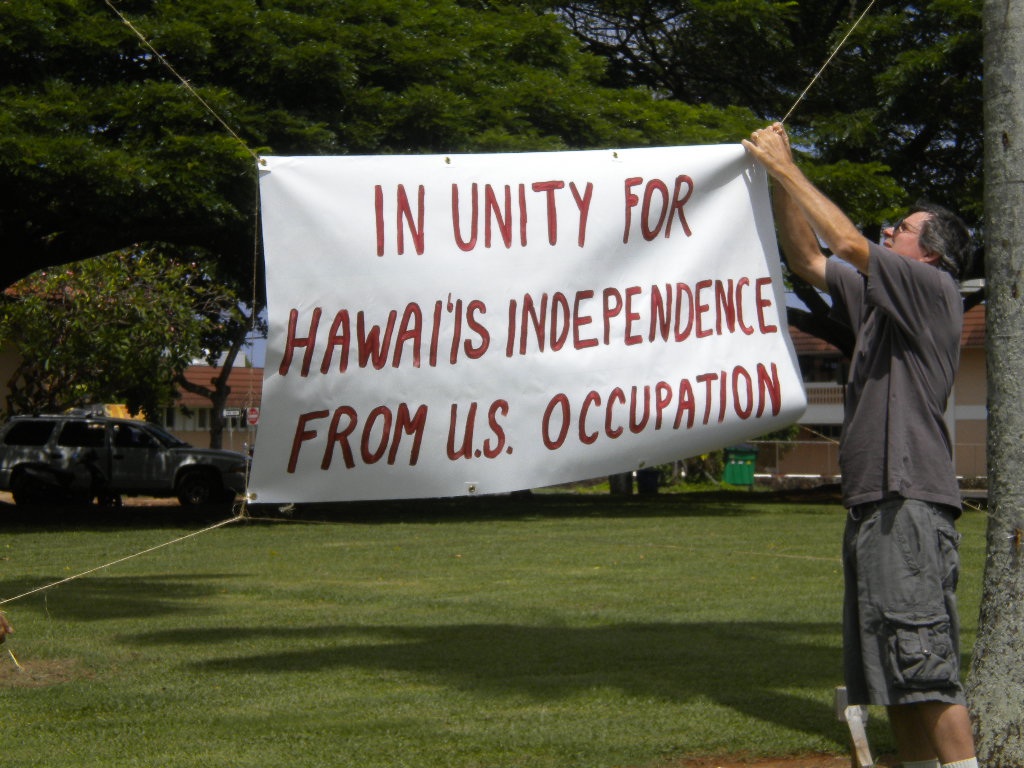
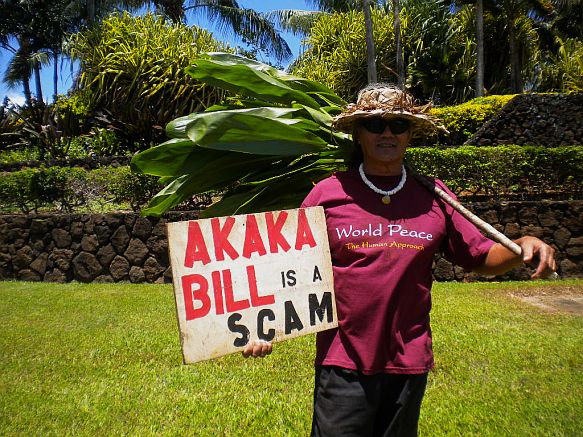
U.S. backing away from anti-missile bases in Poland and the Czech Republic

This could be a very positive turn of events in Europe.  The people of Poland and the Czech Republic fought very hard against the establishment of missile defense bases in their countries that were proposed by the Bush Administration.   It looks as if the Obama Administration is shifting away from the provocative missile bases. Stay tuned.

>><<

US to abandon Polish-Czech missile shield, lobbyist says

ANDREW RETTMAN

Today @ 09:03 CET

The United States has all-but abandoned plans to house anti-missile bases in Poland and the Czech republic, according to a senior White House lobbyist.

Riki Ellison, the chairman of the 10,000 member-strong Missile Defense Advocacy Alliance, said in Polish daily Gazeta Wyborcza on Thursday (26 August) that the US has changed its mind to avoid a rift with Russia and is now looking at Israel, Turkey, the Balkans or ship-borne facilities instead.

“The signals given by generals from the Pentagon are clear: the current US government is looking for different solutions on the question of missile defence than Poland and the Czech republic,” he said.

“The new [US] team is paying more attention to Russian arguments,” the lobbyist added.

“Obama’s people believe that many problems in the world can be more easily solved together with Moscow …It’s a question of priorities. For many Democrats, the priority is disarmament and they are capable of sacrificing a lot in order to achieve a new agreement with Russia on the reduction of strategic [nuclear] weapons.”

President Barack Obama ordered a review of the Bush-era missile shield plan shortly after coming into office this year.

He unveiled his vision for a nuclear weapons-free world at a major foreign policy speech in Prague in April, while sounding a note of scepticism over the value of the shield.

“As long as the threat from Iran persists, we will go forward with a missile defence system that is cost effective and proven,” he said.

The multi-billion dollar project was to install 10 interceptor missiles at a facility in Poland and a radar base in the Czech republic. It also envisaged placing US Patriot missiles in Poland.

Russia said the scheme was aimed at degrading its nuclear capability and amounted to a new Cold War.

Many ordinary people in the Czech Republic also said they were against the shield in opinion polls. But the Polish and Czech centre-right political elite saw it as US gold-plating of anti-Russian security guarantees offered by Nato.

Source: http://euobserver.com/9/28587/?rk=1

Chalmers Johnson: Three good reasons to liquidate U.S. Empire, and ten steps to get there

photo

Soldiers line up at Manas Air Base in Kyrgyzstan. The US operates 865 bases in more than 40 countries and territories. (Photo: US Department of Defense)

Source: http://www.truthout.org/073009X

Three Good Reasons to Liquidate Our Empire: And Ten Steps to Take to Do So

by: Chalmers Johnson  |  Visit article original @ TomDispatch.com


However ambitious President Barack Obama’s domestic plans, one unacknowledged issue has the potential to destroy any reform efforts he might launch. Think of it as the 800-pound gorilla in the American living room: our longstanding reliance on imperialism and militarism in our relations with other countries and the vast, potentially ruinous global empire of bases that goes with it. The failure to begin to deal with our bloated military establishment and the profligate use of it in missions for which it is hopelessly inappropriate will, sooner rather than later, condemn the United States to a devastating trio of consequences: imperial overstretch, perpetual war, and insolvency, leading to a likely collapse similar to that of the former Soviet Union.

According to the 2008 official Pentagon inventory of our military bases around the world, our empire consists of 865 facilities in more than 40 countries and overseas U.S. territories. We deploy over 190,000 troops in 46 countries and territories. In just one such country, Japan, at the end of March 2008, we still had 99,295 people connected to U.S. military forces living and working there – 49,364 members of our armed services, 45,753 dependent family members, and 4,178 civilian employees. Some 13,975 of these were crowded into the small island of Okinawa, the largest concentration of foreign troops anywhere in Japan.

These massive concentrations of American military power outside the United States are not needed for our defense. They are, if anything, a prime contributor to our numerous conflicts with other countries. They are also unimaginably expensive. According to Anita Dancs, an analyst for the website Foreign Policy in Focus, the United States spends approximately $250 billion each year maintaining its global military presence. The sole purpose of this is to give us hegemony – that is, control or dominance – over as many nations on the planet as possible.

We are like the British at the end of World War II: desperately trying to shore up an empire that we never needed and can no longer afford, using methods that often resemble those of failed empires of the past – including the Axis powers of World War II and the former Soviet Union. There is an important lesson for us in the British decision, starting in 1945, to liquidate their empire relatively voluntarily, rather than being forced to do so by defeat in war, as were Japan and Germany, or by debilitating colonial conflicts, as were the French and Dutch. We should follow the British example. (Alas, they are currently backsliding and following our example by assisting us in the war in Afghanistan.)

Here are three basic reasons why we must liquidate our empire or else watch it liquidate us.

1. We Can No Longer Afford Our Postwar Expansionism

Shortly after his election as president, Barack Obama, in a speech announcing several members of his new cabinet, stated as fact that “[w]e have to maintain the strongest military on the planet.” A few weeks later, on March 12, 2009, in a speech at the National Defense University in Washington DC, the president again insisted, “Now make no mistake, this nation will maintain our military dominance. We will have the strongest armed forces in the history of the world.” And in a commencement address to the cadets of the U.S. Naval Academy on May 22nd, Obama stressed that “[w]e will maintain America’s military dominance and keep you the finest fighting force the world has ever seen.”

What he failed to note is that the United States no longer has the capability to remain a global hegemon, and to pretend otherwise is to invite disaster.

According to a growing consensus of economists and political scientists around the world, it is impossible for the United States to continue in that role while emerging into full view as a crippled economic power. No such configuration has ever persisted in the history of imperialism. The University of Chicago’s Robert Pape, author of the important study Dying to Win: The Strategic Logic of Suicide Terrorism (Random House, 2005), typically writes:

“America is in unprecedented decline. The self-inflicted wounds of the Iraq war, growing government debt, increasingly negative current-account balances and other internal economic weaknesses have cost the United States real power in today’s world of rapidly spreading knowledge and technology. If present trends continue, we will look back on the Bush years as the death knell of American hegemony.”

There is something absurd, even Kafkaesque, about our military empire. Jay Barr, a bankruptcy attorney, makes this point using an insightful analogy:

“Whether liquidating or reorganizing, a debtor who desires bankruptcy protection must provide a list of expenses, which, if considered reasonable, are offset against income to show that only limited funds are available to repay the bankrupted creditors. Now imagine a person filing for bankruptcy claiming that he could not repay his debts because he had the astronomical expense of maintaining at least 737 facilities overseas that provide exactly zero return on the significant investment required to sustain them? He could not qualify for liquidation without turning over many of his assets for the benefit of creditors, including the valuable foreign real estate on which he placed his bases.”

In other words, the United States is not seriously contemplating its own bankruptcy. It is instead ignoring the meaning of its precipitate economic decline and flirting with insolvency.

Nick Turse, author of The Complex: How the Military Invades our Everyday Lives (Metropolitan Books, 2008), calculates that we could clear $2.6 billion if we would sell our base assets at Diego Garcia in the Indian Ocean and earn another $2.2 billion if we did the same with Guantánamo Bay in Cuba. These are only two of our over 800 overblown military enclaves.

Our unwillingness to retrench, no less liquidate, represents a striking historical failure of the imagination. In his first official visit to China since becoming Treasury Secretary, Timothy Geithner assured an audience of students at Beijing University, “Chinese assets [invested in the United States] are very safe.” According to press reports, the students responded with loud laughter. Well they might.

In May 2009, the Office of Management and Budget predicted that in 2010 the United States will be burdened with a budget deficit of at least $1.75 trillion. This includes neither a projected $640 billion budget for the Pentagon, nor the costs of waging two remarkably expensive wars. The sum is so immense that it will take several generations for American citizens to repay the costs of George W. Bush’s imperial adventures – if they ever can or will. It represents about 13% of our current gross domestic product (that is, the value of everything we produce). It is worth noting that the target demanded of European nations wanting to join the Euro Zone is a deficit no greater than 3% of GDP.

Thus far, President Obama has announced measly cuts of only $8.8 billion in wasteful and worthless weapons spending, including his cancellation of the F-22 fighter aircraft. The actual Pentagon budget for next year will, in fact, be larger, not smaller, than the bloated final budget of the Bush era. Far bolder cuts in our military expenditures will obviously be required in the very near future if we intend to maintain any semblance of fiscal integrity.

2. We Are Going to Lose the War in Afghanistan and It Will Help Bankrupt Us

One of our major strategic blunders in Afghanistan was not to have recognized that both Great Britain and the Soviet Union attempted to pacify Afghanistan using the same military methods as ours and failed disastrously. We seem to have learned nothing from Afghanistan’s modern history – to the extent that we even know what it is. Between 1849 and 1947, Britain sent almost annual expeditions against the Pashtun tribes and sub-tribes living in what was then called the North-West Frontier Territories – the area along either side of the artificial border between Afghanistan and Pakistan called the Durand Line. This frontier was created in 1893 by Britain’s foreign secretary for India, Sir Mortimer Durand.

Neither Britain nor Pakistan has ever managed to establish effective control over the area. As the eminent historian Louis Dupree put it in his book Afghanistan (Oxford University Press, 2002, p. 425): “Pashtun tribes, almost genetically expert at guerrilla warfare after resisting centuries of all comers and fighting among themselves when no comers were available, plagued attempts to extend the Pax Britannica into their mountain homeland.” An estimated 41 million Pashtuns live in an undemarcated area along the Durand Line and profess no loyalties to the central governments of either Pakistan or Afghanistan.

The region known today as the Federally Administered Tribal Areas (FATA) of Pakistan is administered directly by Islamabad, which – just as British imperial officials did – has divided the territory into seven agencies, each with its own “political agent” who wields much the same powers as his colonial-era predecessor. Then as now, the part of FATA known as Waziristan and the home of Pashtun tribesmen offered the fiercest resistance.

According to Paul Fitzgerald and Elizabeth Gould, experienced Afghan hands and coauthors of Invisible History: Afghanistan’s Untold Story (City Lights, 2009, p. 317):

“If Washington’s bureaucrats don’t remember the history of the region, the Afghans do. The British used air power to bomb these same Pashtun villages after World War I and were condemned for it. When the Soviets used MiGs and the dreaded Mi-24 Hind helicopter gunships to do it during the 1980s, they were called criminals. For America to use its overwhelming firepower in the same reckless and indiscriminate manner defies the world’s sense of justice and morality while turning the Afghan people and the Islamic world even further against the United States.”

In 1932, in a series of Guernica-like atrocities, the British used poison gas in Waziristan. The disarmament convention of the same year sought a ban against the aerial bombardment of civilians, but Lloyd George, who had been British prime minister during World War I, gloated: “We insisted on reserving the right to bomb niggers” (Fitzgerald and Gould, p. 65). His view prevailed.

The U.S. continues to act similarly, but with the new excuse that our killing of noncombatants is a result of “collateral damage,” or human error. Using pilotless drones guided with only minimal accuracy from computers at military bases in the Arizona and Nevada deserts among other places, we have killed hundreds, perhaps thousands, of unarmed bystanders in Pakistan and Afghanistan. The Pakistani and Afghan governments have repeatedly warned that we are alienating precisely the people we claim to be saving for democracy.

When in May 2009, General Stanley McChrystal was appointed as the commander in Afghanistan, he ordered new limits on air attacks, including those carried out by the CIA, except when needed to protect allied troops. Unfortunately, as if to illustrate the incompetence of our chain of command, only two days after this order, on June 23, 2009, the United States carried out a drone attack against a funeral procession that killed at least 80 people, the single deadliest U.S. attack on Pakistani soil so far. There was virtually no reporting of these developments by the mainstream American press or on the network television news. (At the time, the media were almost totally preoccupied by the sexual adventures of the governor of South Carolina and the death of pop star Michael Jackson.)

Our military operations in both Pakistan and Afghanistan have long been plagued by inadequate and inaccurate intelligence about both countries, ideological preconceptions about which parties we should support and which ones we should oppose, and myopic understandings of what we could possibly hope to achieve. Fitzgerald and Gould, for example, charge that, contrary to our own intelligence service’s focus on Afghanistan, “Pakistan has always been the problem.” They add:

“Pakistan’s army and its Inter-Services Intelligence branch… from 1973 on, has played the key role in funding and directing first the mujahideen [anti-Soviet fighters during the 1980s]? and then the Taliban. It is Pakistan’s army that controls its nuclear weapons, constrains the development of democratic institutions, trains Taliban fighters in suicide attacks and orders them to fight American and NATO soldiers protecting the Afghan government.” (p. 322-324)

The Pakistani army and its intelligence arm are staffed, in part, by devout Muslims who fostered the Taliban in Afghanistan to meet the needs of their own agenda, though not necessarily to advance an Islamic jihad. Their purposes have always included: keeping Afghanistan free of Russian or Indian influence, providing a training and recruiting ground for mujahideen guerrillas to be used in places like Kashmir (fought over by both Pakistan and India), containing Islamic radicalism in Afghanistan (and so keeping it out of Pakistan), and extorting huge amounts of money from Saudi Arabia, the Persian Gulf emirates, and the United States to pay and train “freedom fighters” throughout the Islamic world. Pakistan’s consistent policy has been to support the clandestine policies of the Inter-Services Intelligence and thwart the influence of its major enemy and competitor, India.

Colonel Douglas MacGregor, U.S. Army (retired), an adviser to the Center for Defense Information in Washington, summarizes our hopeless project in South Asia this way: “Nothing we do will compel 125 million Muslims in Pakistan to make common cause with a United States in league with the two states that are unambiguously anti-Muslim: Israel and India.”

Obama’s mid-2009 “surge” of troops into southern Afghanistan and particularly into Helmand Province, a Taliban stronghold, is fast becoming darkly reminiscent of General William Westmoreland’s continuous requests in Vietnam for more troops and his promises that if we would ratchet up the violence just a little more and tolerate a few more casualties, we would certainly break the will of the Vietnamese insurgents. This was a total misreading of the nature of the conflict in Vietnam, just as it is in Afghanistan today.

Twenty years after the forces of the Red Army withdrew from Afghanistan in disgrace, the last Russian general to command them, Gen. Boris Gromov, issued his own prediction: Disaster, he insisted, will come to the thousands of new forces Obama is sending there, just as it did to the Soviet Union’s, which lost some 15,000 soldiers in its own Afghan war. We should recognize that we are wasting time, lives, and resources in an area where we have never understood the political dynamics and continue to make the wrong choices.

3. We Need to End the Secret Shame of Our Empire of Bases

In March, New York Times op-ed columnist Bob Herbert noted, “Rape and other forms of sexual assault against women is the great shame of the U.S. armed forces, and there is no evidence that this ghastly problem, kept out of sight as much as possible, is diminishing.” He continued:

“New data released by the Pentagon showed an almost 9 percent increase in the number of sexual assaults – 2,923 – and a 25 percent increase in such assaults reported by women serving in Iraq and Afghanistan [over the past year]. Try to imagine how bizarre it is that women in American uniforms who are enduring all the stresses related to serving in a combat zone have to also worry about defending themselves against rapists wearing the same uniform and lining up in formation right beside them.”

The problem is exacerbated by having our troops garrisoned in overseas bases located cheek-by-jowl next to civilian populations and often preying on them like foreign conquerors. For example, sexual violence against women and girls by American GIs has been out of control in Okinawa, Japan’s poorest prefecture, ever since it was permanently occupied by our soldiers, Marines, and airmen some 64 years ago.

That island was the scene of the largest anti-American demonstrations since the end of World War II after the 1995 kidnapping, rape, and attempted murder of a 12-year-old schoolgirl by two Marines and a sailor. The problem of rape has been ubiquitous around all of our bases on every continent and has probably contributed as much to our being loathed abroad as the policies of the Bush administration or our economic exploitation of poverty-stricken countries whose raw materials we covet.

The military itself has done next to nothing to protect its own female soldiers or to defend the rights of innocent bystanders forced to live next to our often racially biased and predatory troops. “The military’s record of prosecuting rapists is not just lousy, it’s atrocious,” writes Herbert. In territories occupied by American military forces, the high command and the State Department make strenuous efforts to enact so-called “Status of Forces Agreements” (SOFAs) that will prevent host governments from gaining jurisdiction over our troops who commit crimes overseas. The SOFAs also make it easier for our military to spirit culprits out of a country before they can be apprehended by local authorities.

This issue was well illustrated by the case of an Australian teacher, a long-time resident of Japan, who in April 2002 was raped by a sailor from the aircraft carrier USS Kitty Hawk, then based at the big naval base at Yokosuka. She identified her assailant and reported him to both Japanese and U.S. authorities. Instead of his being arrested and effectively prosecuted, the victim herself was harassed and humiliated by the local Japanese police. Meanwhile, the U.S. discharged the suspect from the Navy but allowed him to escape Japanese law by returning him to the U.S., where he lives today.

In the course of trying to obtain justice, the Australian teacher discovered that almost fifty years earlier, in October 1953, the Japanese and American governments signed a secret “understanding” as part of their SOFA in which Japan agreed to waive its jurisdiction if the crime was not of “national importance to Japan.” The U.S. argued strenuously for this codicil because it feared that otherwise it would face the likelihood of some 350 servicemen per year being sent to Japanese jails for sex crimes.

Since that time the U.S. has negotiated similar wording in SOFAs with Canada, Ireland, Italy, and Denmark. According to the Handbook of the Law of Visiting Forces (2001), the Japanese practice has become the norm for SOFAs throughout the world, with predictable results. In Japan, of 3,184 U.S. military personnel who committed crimes between 2001 and 2008, 83% were not prosecuted. In Iraq, we have just signed a SOFA that bears a strong resemblance to the first postwar one we had with Japan: namely, military personnel and military contractors accused of off-duty crimes will remain in U.S. custody while Iraqis investigate. This is, of course, a perfect opportunity to spirit the culprits out of the country before they can be charged.

Within the military itself, the journalist Dahr Jamail, author of Beyond the Green Zone: Dispatches from an Unembedded Journalist in Occupied Iraq (Haymarket Books, 2007), speaks of the “culture of unpunished sexual assaults” and the “shockingly low numbers of courts martial” for rapes and other forms of sexual attacks. Helen Benedict, author of The Lonely Soldier: The Private War of Women Serving in Iraq (Beacon Press, 2009), quotes this figure in a 2009 Pentagon report on military sexual assaults: 90% of the rapes in the military are never reported at all and, when they are, the consequences for the perpetrator are negligible.

It is fair to say that the U.S. military has created a worldwide sexual playground for its personnel and protected them to a large extent from the consequences of their behavior. As a result a group of female veterans in 2006 created the Service Women’s Action Network (SWAN). Its agenda is to spread the word that “no woman should join the military.”

I believe a better solution would be to radically reduce the size of our standing army, and bring the troops home from countries where they do not understand their environments and have been taught to think of the inhabitants as inferior to themselves.

10 Steps Toward Liquidating the Empire

Dismantling the American empire would, of course, involve many steps. Here are ten key places to begin:

1. We need to put a halt to the serious environmental damage done by our bases planet-wide. We also need to stop writing SOFAs that exempt us from any responsibility for cleaning up after ourselves.

2. Liquidating the empire will end the burden of carrying our empire of bases and so of the “opportunity costs” that go with them – the things we might otherwise do with our talents and resources but can’t or won’t.

3. As we already know (but often forget), imperialism breeds the use of torture. In the 1960s and 1970s we helped overthrow the elected governments in Brazil and Chile and underwrote regimes of torture that prefigured our own treatment of prisoners in Iraq and Afghanistan. (See, for instance, A.J. Langguth, Hidden Terrors [Pantheon, 1979], on how the U.S. spread torture methods to Brazil and Uruguay.) Dismantling the empire would potentially mean a real end to the modern American record of using torture abroad.

4. We need to cut the ever-lengthening train of camp followers, dependents, civilian employees of the Department of Defense, and hucksters – along with their expensive medical facilities, housing requirements, swimming pools, clubs, golf courses, and so forth – that follow our military enclaves around the world.

5. We need to discredit the myth promoted by the military-industrial complex that our military establishment is valuable to us in terms of jobs, scientific research, and defense. These alleged advantages have long been discredited by serious economic research. Ending empire would make this happen.

6. As a self-respecting democratic nation, we need to stop being the world’s largest exporter of arms and munitions and quit educating Third World militaries in the techniques of torture, military coups, and service as proxies for our imperialism. A prime candidate for immediate closure is the so-called School of the Americas, the U.S. Army’s infamous military academy at Fort Benning, Georgia, for Latin American military officers. (See Chalmers Johnson, The Sorrows of Empire [Metropolitan Books, 2004], pp. 136-40.)

7. Given the growing constraints on the federal budget, we should abolish the Reserve Officers’ Training Corps and other long-standing programs that promote militarism in our schools.

8. We need to restore discipline and accountability in our armed forces by radically scaling back our reliance on civilian contractors, private military companies, and agents working for the military outside the chain of command and the Uniform Code of Military Justice. (See Jeremy Scahill, Blackwater:The Rise of the World’s Most Powerful Mercenary Army [Nation Books, 2007]). Ending empire would make this possible.

9. We need to reduce, not increase, the size of our standing army and deal much more effectively with the wounds our soldiers receive and combat stress they undergo.

10. To repeat the main message of this essay, we must give up our inappropriate reliance on military force as the chief means of attempting to achieve foreign policy objectives.

Unfortunately, few empires of the past voluntarily gave up their dominions in order to remain independent, self-governing polities. The two most important recent examples are the British and Soviet empires. If we do not learn from their examples, our decline and fall is foreordained.

——–

Chalmers Johnson is the author of Blowback (2000), The Sorrows of Empire (2004), and Nemesis: The Last Days of the American Republic (2006), and editor of Okinawa: Cold War Island (1999).

[Note on further reading on the matter of sexual violence in and around our overseas bases and rapes in the military: On the response to the 1995 Okinawa rape, see Chalmers Johnson, Blowback: The Costs and Consequences of American Empire, chapter 2. On related subjects, see David McNeil, “Justice for Some. Crime, Victims, and the US-Japan SOFA,” Asia-Pacific Journal, Vol. 8-1-09, March 15, 2009; “Bilateral Secret Agreement Is Preventing U.S. Servicemen Committing Crimes in Japan from Being Prosecuted,” Japan Press Weekly, May 23, 2009; Dieter Fleck, ed., The Handbook of the Law of Visiting Forces, Oxford University Press, 2001; Minoru Matsutani, “’53 Secret Japan-US Deal Waived GI Prosecutions,” Japan Times, October 24, 2008; “Crime Without Punishment in Japan,” the Economist, December 10, 2008; “Japan: Declassified Document Reveals Agreement to Relinquish Jurisdiction Over U.S. Forces,” Akahata, October 30, 2008; “Government’s Decision First Case in Japan,” Ryukyu Shimpo, May 20, 2008; Dahr Jamail, “Culture of Unpunished Sexual Assault in Military,” Antiwar.com, May 1, 2009; and Helen Benedict, “The Plight of Women Soldiers,” the Nation, May 5, 2009.]

Light punishment for assault at Fort Lewis

The man accused of assaulting a female soldier at Fort Lewis slipped through the administrative crack because he was technically discharged from the military at the time of the crime.  He contacted the victim from Hawai’i.

>><<

Last updated August 23, 2009 1:50 p.m. PT

Light punishment for assault at Fort Lewis

By SEAN ROBINSON
THE NEWS TRIBUNE

FORT LEWIS, Wash. — Taylor Mack woke up choking.

She retched blood, spat out a tooth, and squinted through a fog of swollen pain. Her face was broken. She didn’t know it yet.

Slow recognition. Empty apartment, fast-food bag on the bedside table … Fort Lewis.

The barracks. Here with Andre, the night before … and he had wanted to, but she said no … and then something flying at her face a foot, a fist? She couldn’t remember, and Andre was gone.

It was 2:30 a.m. on June 19, 2007. Mack, then 20, was about to stumble into a Catch-22: a legal snafu, excused by the gods of procedure, footnoted with official sympathy.

Mack made one mistake. She got herself assaulted on military property by a soldier who wasn’t a soldier anymore, a man who slipped between the layers of military and federal authority.

Her attacker, Andre John Roberts, 26, had just been discharged. Hours after admitting his crime, Roberts left the base, escorted by military personnel. Officially, he was a civilian, beyond military control. Unofficially, he was free.

More than two years later, Mack is still waiting for justice. Roberts’ whereabouts are unknown. He did not respond to voice mail messages.

Military officials, responding to inquiries from The News Tribune, now say the case was mishandled.

“Clearly this is not the best we can do,” Joseph Piek, Fort Lewis spokesman, said in a written statement. “Mistakes were made, and those mistakes resulted from a genuine misunderstanding by the military police of Roberts’ status at the time of the incident.”

Mack, a Lacey resident, doesn’t think much of that. For two years, she and her mother, Kim Johnson, have sought action on the case. They blame Roberts, but they also blame what they see as a tepid response from Fort Lewis officials.

“It’s been two years, and he’s never gotten in trouble for it,” Mack says. “All they’re trying to do is save themselves.”

“…a Caucasian female with blonde hair entered the CQ (charge of quarters) area. She was crying and hysterical with blood running down her face. Her face was swollen and she was missing a tooth. She was confused and disoriented and appeared to have been assaulted. I called 911 and requested police and medical assistance.” – Statement from military police report, 6-19-07

Before the night of the assault, Mack knew Andre Roberts a little. He was dating a friend of hers. He’d deployed to Iraq, returned in late 2006, and kept in touch. Young and far from his New Jersey roots, Roberts began spending more time at Mack’s mother’s house sleeping on the couch, going on family camping trips.

“It’s like I adopted this other child,” Kim Johnson recalled.

By summer 2007, Roberts was approaching his discharge date. Johnson recalls that he started getting “kind of clingy,” hinting that he might re-enlist if Mack would be his girlfriend.

Mack wasn’t interested. She already had a boyfriend. Her mother, leery of the needy talk, warned her to avoid Roberts.

On Monday, June 18, Roberts called Mack, seeking help with paperwork related to his discharge. Could Taylor just come to the post and look over the forms? She was smart about that stuff.

Mack said she would come after work.

She did not know that Roberts had been discharged almost three weeks earlier. By military standards, he was already a civilian, though he was still staying on the base with friends.

Records obtained by The News Tribune show Roberts was discharged May 31, 2007 but it wasn’t that simple. He had blown off his outprocessing, the paperwork aspect of leaving the Army.

“Because Roberts was not at his place of duty and did not perform his required outprocessing, he was discharged in absentia,” said Piek, the Fort Lewis spokesman.

Roberts was out, but not gone. He was flopping with friends in the barracks, bunking without authorization.

“It is believed that he was being permitted to stay at the unit barracks by friends, without the knowledge of the unit chain of command,” Piek said. “This is a violation of unit and Army policy regarding visitors to the barracks.”

The standard procedure for checking such violations is loose, officials said. Unit leaders conduct occasional barracks inspections, but they typically rely on soldiers to report violations.

When Mack arrived at Fort Lewis the evening of June 19, Roberts was already toasted.

“He’d been drinking before I got there,” she said. “They drink all the time. That’s all the guys seem to do in the barracks.”

As the evening wore on, he bought burgers and took her to an empty barracks apartment – a friend’s old room. Roberts had the key code. He and Mack could stay here, he said.

He wasn’t interested in discharge paperwork. He wanted to talk about something else – about their relationship, their future. He said he was in love.

“I’m like, I have a boyfriend – I’ll never leave my boyfriend for you,'” Mack remembered saying. “I think in the back of his mind he was hoping he could win me away, and that would never happen.”

Roberts wanted to lie on the bed with Mack. She wasn’t into it.

“That’s when the (expletive) hit the fan and he started kicking me in the back, and I’m like, Dude, don’t – seriously, stop,'” she remembered.

Mack stood. She told him she was leaving.

“That’s the last thing I remember,” she said. “Before standing up and spitting my teeth out of my mouth.”

“…Mack walked into the building bleeding from her face and mouth, stating she wasn’t sure what happened or where she was, but that she was (had been) with Roberts.” – Excerpt from military police report, 6-19-07

Roberts wasn’t around. Military police started searching for him. Mack had called her mother, who was driving up to the post. Police took statements, and sent Mack to Madigan Army Medical Center.

While they gathered statements and surveyed the bloody scene at the barracks apartment, Roberts walked into the charge of quarters area and turned himself in. It was 5 a.m., and he was still drunk. He blew a blood-alcohol level of 0.086 on a breath tester.

“Roberts was apprehended, transported to this station, where he was advised of his legal rights, which he waived, rendering a sworn written statement admitting to the offense.” – Statement from military police report, 6-19-07

After citing him, military police handed Roberts off to his old unit: the 542nd Maintenance Company. Standard procedure in such cases: Give the guy back to his commander until the legal stuff’s done.

“Thinking Mr. Roberts was still in the Army, the military police were planning to turn the case over to his chain of command for action as appropriate under the Uniform Code of Military Justice,” said Piek.

The unit took him, Fort Lewis records say, but confusion lingered.

“The noncommissioned officer who picked him up was not in Mr. Roberts’ former chain of supervision, was not familiar with his status, and also believed him to be in the Army,” Piek said.

Piek did not identify the soldier who picked up Roberts. He added that personnel with firsthand knowledge of the incident are no longer stationed at Fort Lewis or have left the Army.

How is unclear, but unit leaders soon realized Roberts was a civilian, already discharged, someone else’s problem.

Military officials did not alert the Pierce County Sheriff’s Department; there was no formal requirement to do so. They didn’t request a hold for the U.S. Marshals service, which they could have considered.

Instead, a few hours after he confessed to beating Taylor Mack bloody, they escorted him off the base and released him into Pierce County.

“He had already been a civilian since 31 May and was no longer under military control,” said Piek.

At the hospital, military police asked Mack and her mother to go over the incident again and supply a more detailed statement.

Both women were worn out. They wanted to go home and get some sleep. Johnson said she and her daughter would come back to Fort Lewis that evening.

When they arrived, military police said Roberts had been released.

Johnson couldn’t believe it.

“That was it,” she said. “We went to give our side and it was never ever brought up again.”

Johnson asked about the Pierce County Sheriff’s Department. Could that agency help? She remembers military police saying she could seek a restraining order against Roberts.

When she and Mack tried that a few days later, they got nowhere. The incident took place on federal property, they were told. This was a Fort Lewis issue.

Johnson wrote to her congressman, Adam Smith, and the state attorney general, Rob McKenna. Letters came back, advising her to talk to Army prosecutors. She tried that too, and hit dead ends.

“I contacted as many people as I possibly could,” she said. “Basically, it was kind of like we’ll get back with you, we’ll call you, and they never called back, and I would follow up.”

When she did get through, she ran into a new obstacle. Johnson wasn’t the victim – her daughter should do the talking, officials said.

Taylor Mack, still recovering from multiple surgeries to her face and jaw, didn’t feel like talking to anybody. Dismayed by Roberts’ release and the apparent lack of action, she believed the authorities weren’t interested.

On Sept. 14, 2007, Capt. Kenneth Tyndal, a federal prosecutor assigned to Fort Lewis, charged Roberts with assault.

Three months had passed since Roberts signed a statement admitting to the assault. The gap in time was standard for routine cases. “It’s not considered a delay,” said Emily Langlie, spokeswoman for the U.S. Attorney’s Office in Seattle.

The charging statement was one sentence long, filling a single page: misdemeanor assault, the lowest level in the federal code, worth six months in jail at most.

Tyndal is deployed overseas, and could not be reached to discuss his decision.

There was a higher level of assault in the code a felony offense with a stiffer potential penalty, linked to attacks that caused “serious bodily injury.”

The original military police report provided nothing to support the tougher charge. It looked like a straight domestic case.

“All we see is what’s in the file,” said Emily Langlie, spokeswoman for the U.S. Attorney’s Office. “The police report indicated one punch and a knocked-out tooth.”

The police report includes an area labeled “injury type,” with a series of checkmark boxes. “Minor injury” was checked, as was “tooth loss.”

Boxes labeled “broken bones,” “severe laceration,” and “unconsciousness” were left blank.

Taylor Mack had been beaten into unconsciousness and left in a barracks apartment. For weeks, she ate through a straw.

“He broke my jaw,” she says. “He broke my nose, broke my eye socket. I had a concussion. I had to get my teeth re-implanted. I couldn’t eat anything besides liquids for a month.”

Those injuries weren’t listed in the police report. There is no sign in records of the incident to show that police followed up on their initial assessment.

Langlie said the U.S. Attorney’s Office could consider revising the original charges if new information comes to light.

Fort Lewis officials say they’re not satisfied by their response to the incident, or the still unanswered questions surrounding Roberts’ departure from Fort Lewis.

Military police acted according to what they knew at the time, said Piek, the Fort Lewis spokesman.

“It’s important to note that, in the final analysis, what was supposed to happen did happen: Because he was a civilian at the time of the incident, Mr. Roberts’ case was referred to the U.S. Attorney’s Office, and he was charged by the U.S. Attorney for his actions,” Piek added.

The charge was a paper move; the citation was sent to a forwarding address. No one actually looked for Roberts. He was never taken into custody. He didn’t show up for his arraignment in U.S. District Court in Tacoma.

That prompted another paper move. The court issued a warrant for Roberts’ arrest. It remains active one among hundreds of federal warrants in Western Washington.

Since 2007, Roberts has spoken to Mack a few times. He’s called via cellphone and sent messages from his MySpace Page, asking her to be his friend.

The page says he’s in Hawaii. His wireless phone number has a Maryland area code. Mack said Roberts has talked of re-enlisting in the military, but it’s unclear whether he has.

He’s told Mack he thought she was dead when he left her in the barracks apartment. She’s asked him why he attacked her. He never answers.

“Andre also has told me that Fort Lewis made him come back at some point, like before he left to go home, they made him come back and clean the room, clean all the blood and all that. He told me the room looked like a murder scene.”

The official response to her case still rankles.

“He almost killed me. He left me for dead in an abandoned room,” Mack said. “All he had to do is clean the room and then they sent him on his merry little way.

Source:  http://www.seattlepi.com/local/6420ap_wa_fort_lewis_assault.html

Marchers take to the streets to protest ‘Fake Statehood’ and demand independence

dsc034381
Photo: Kyle Kajihiro

dsc03442

Photo: Kyle Kajihiro

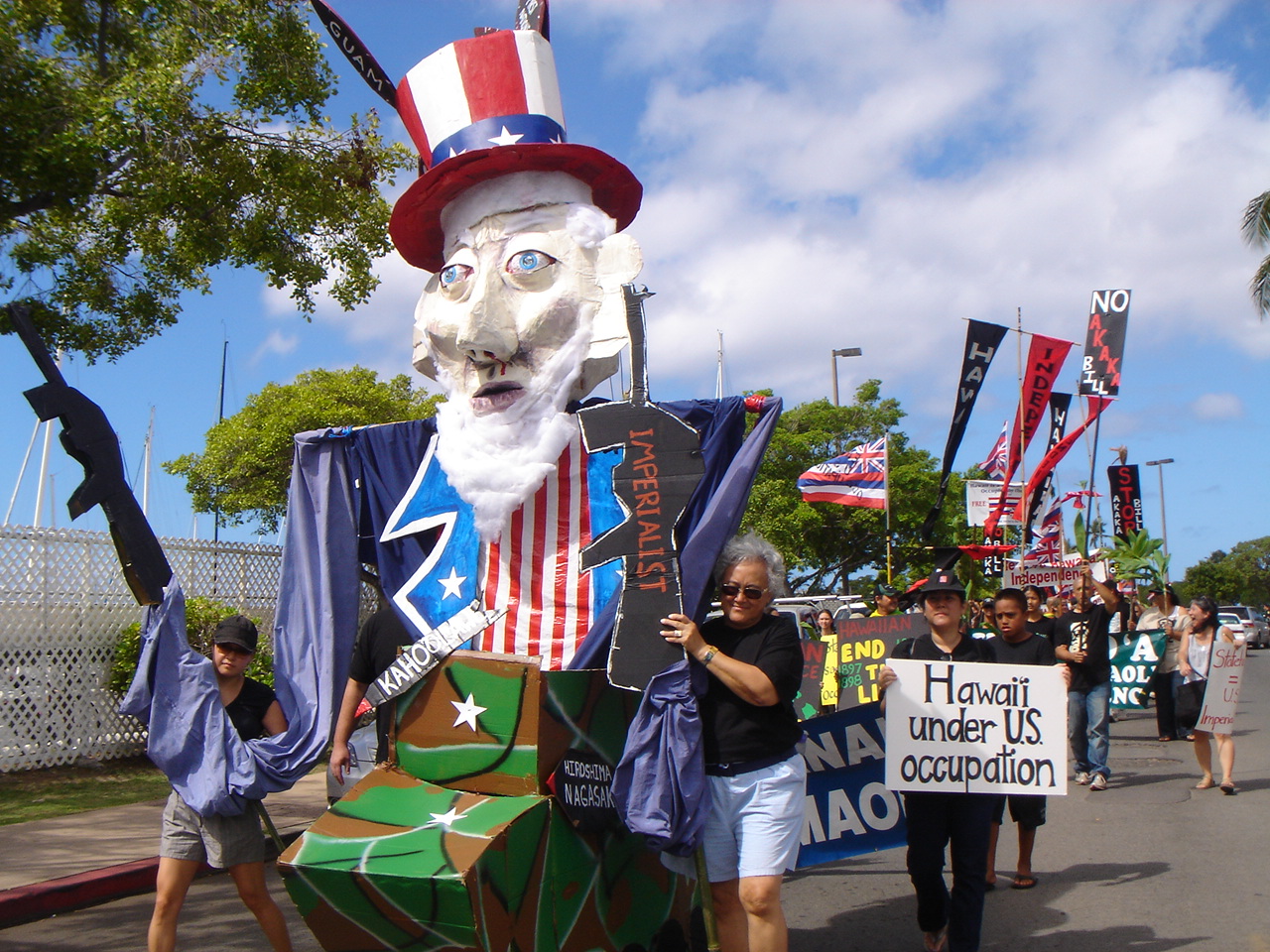
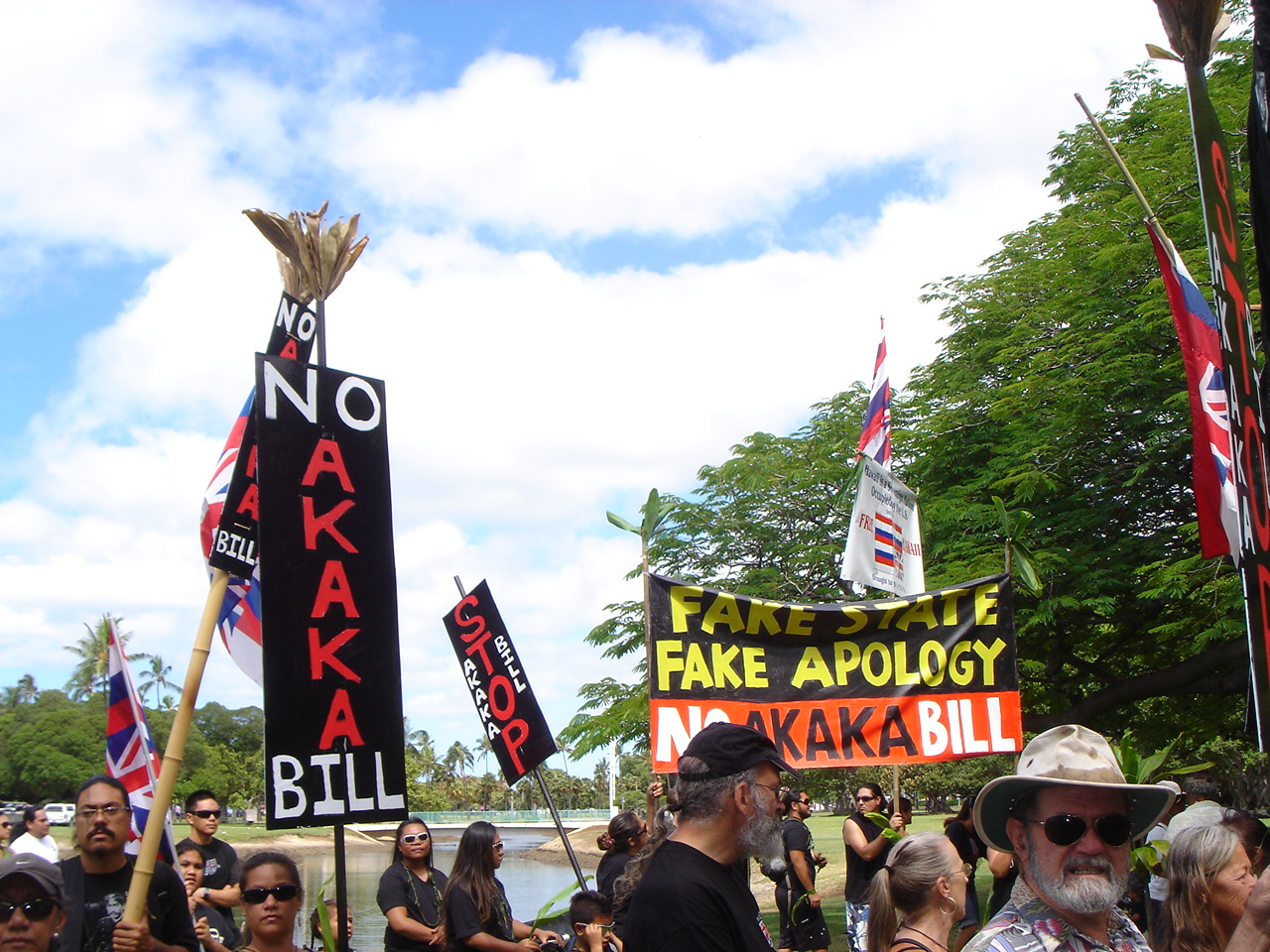
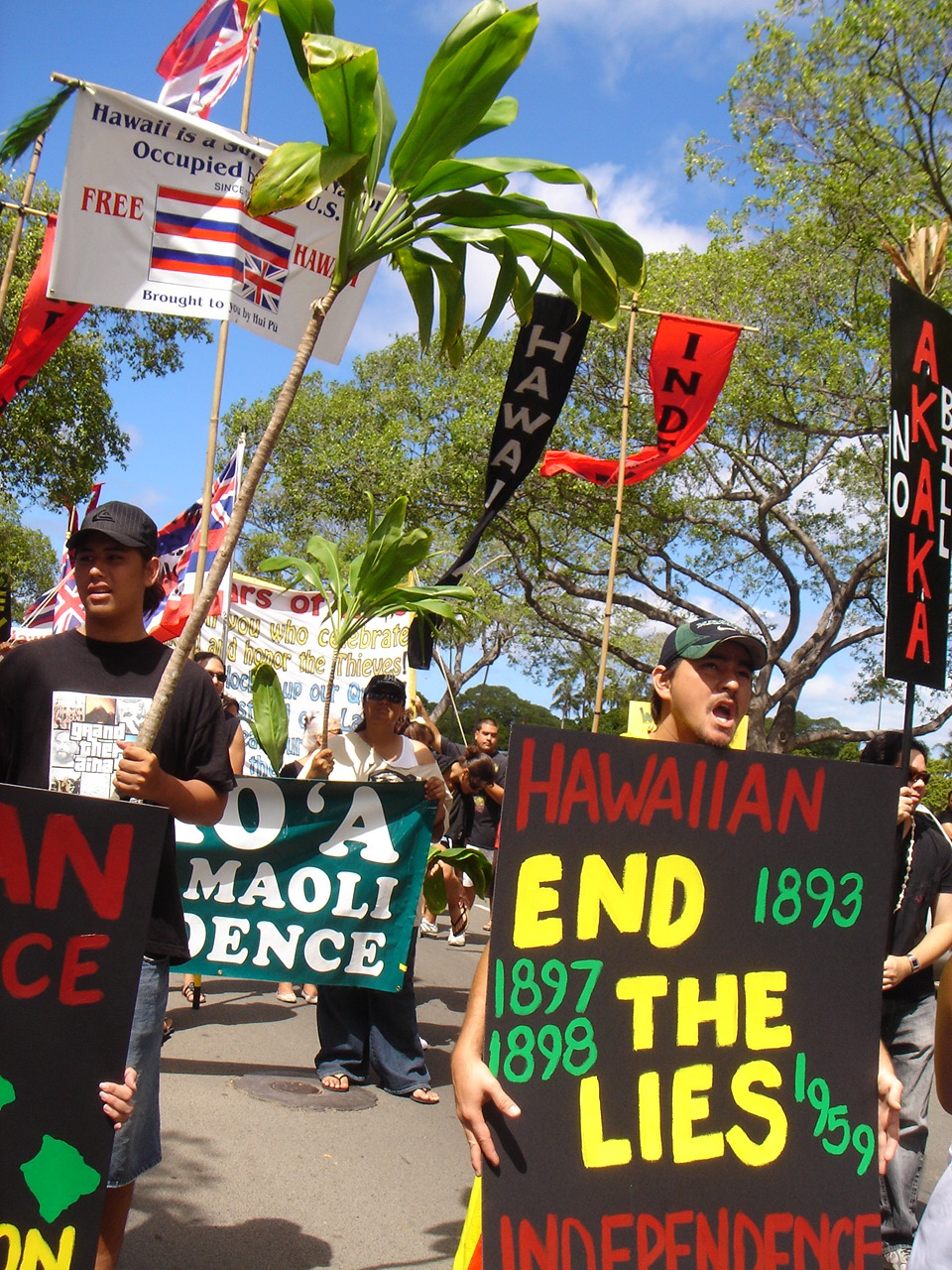
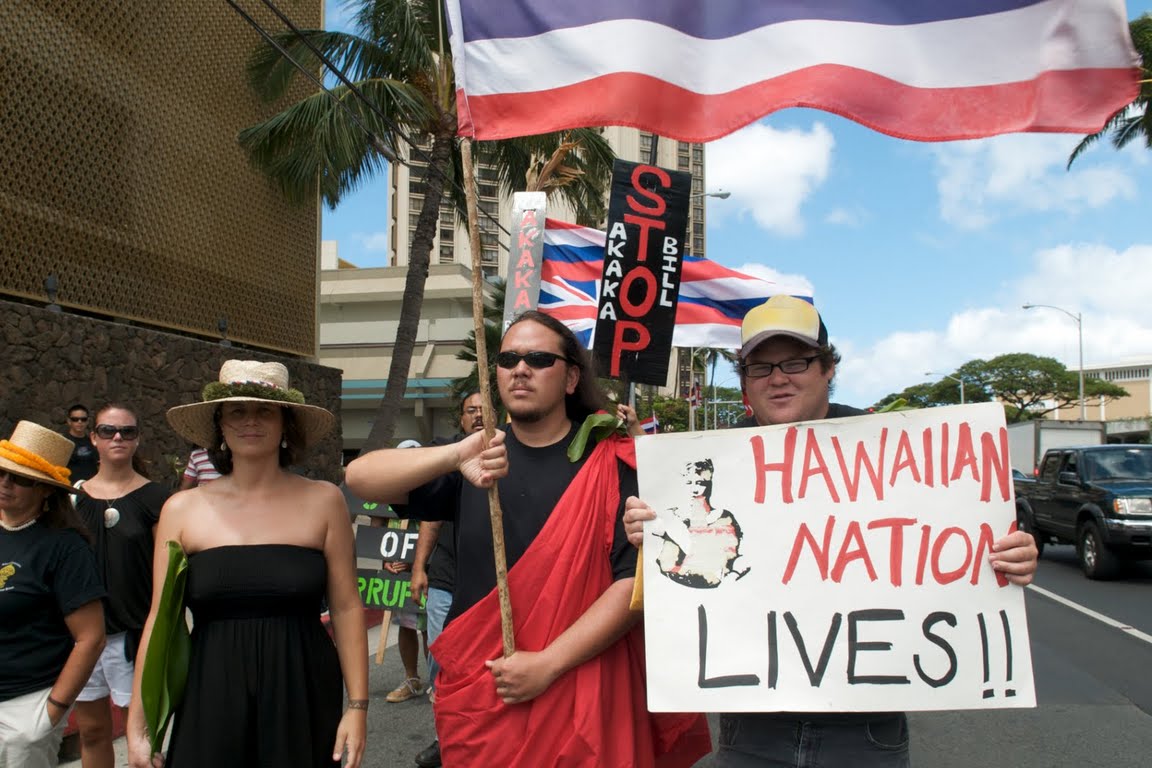
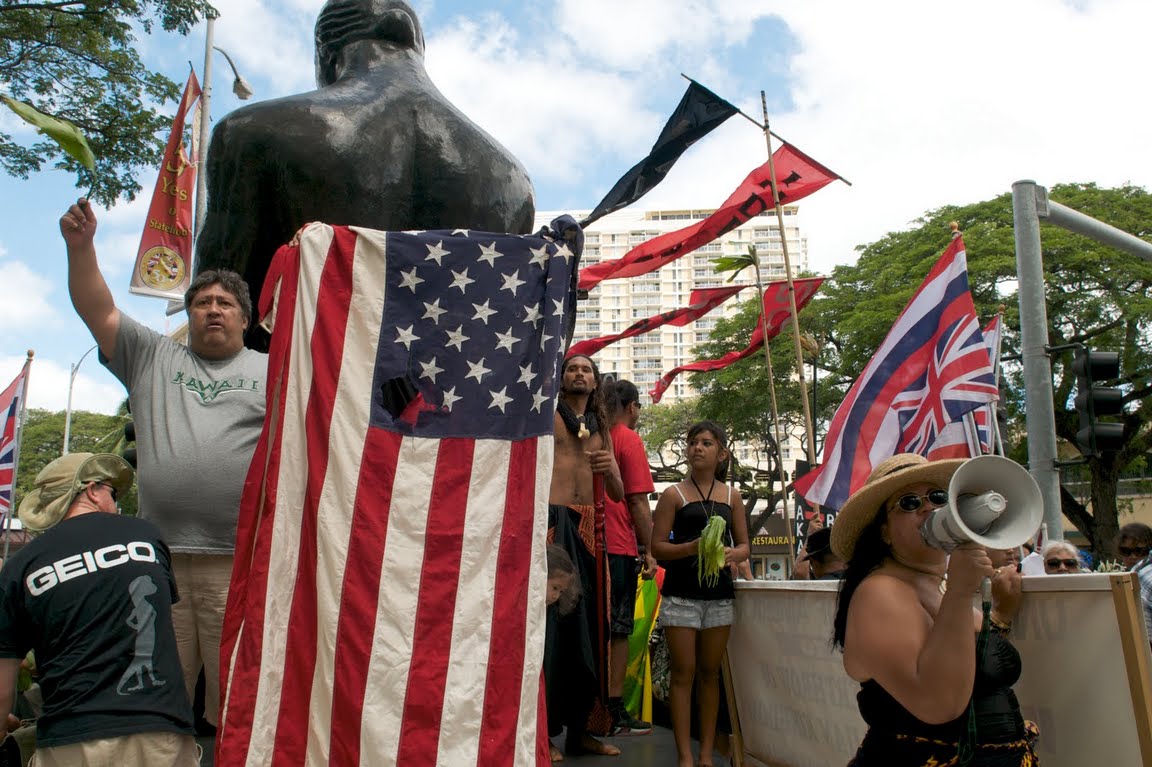
Today, the 50th anniversary of Hawai’i’s ‘admission’ to the United States was marked by protests on nearly every island and several cities around the world.   In Honolulu, around 400 people marched from Ala Moana Park to the Convention Center, where the “official” statehood commemoration conference was taking place.  Although the overall tone of the commemoration was more reflective than celebratory, the mood of the marchers was colorful and spirited, a celebration of resistance.   There were protesters from kupuna in their wheelchairs to infants.  And marching with us were the ancestors.

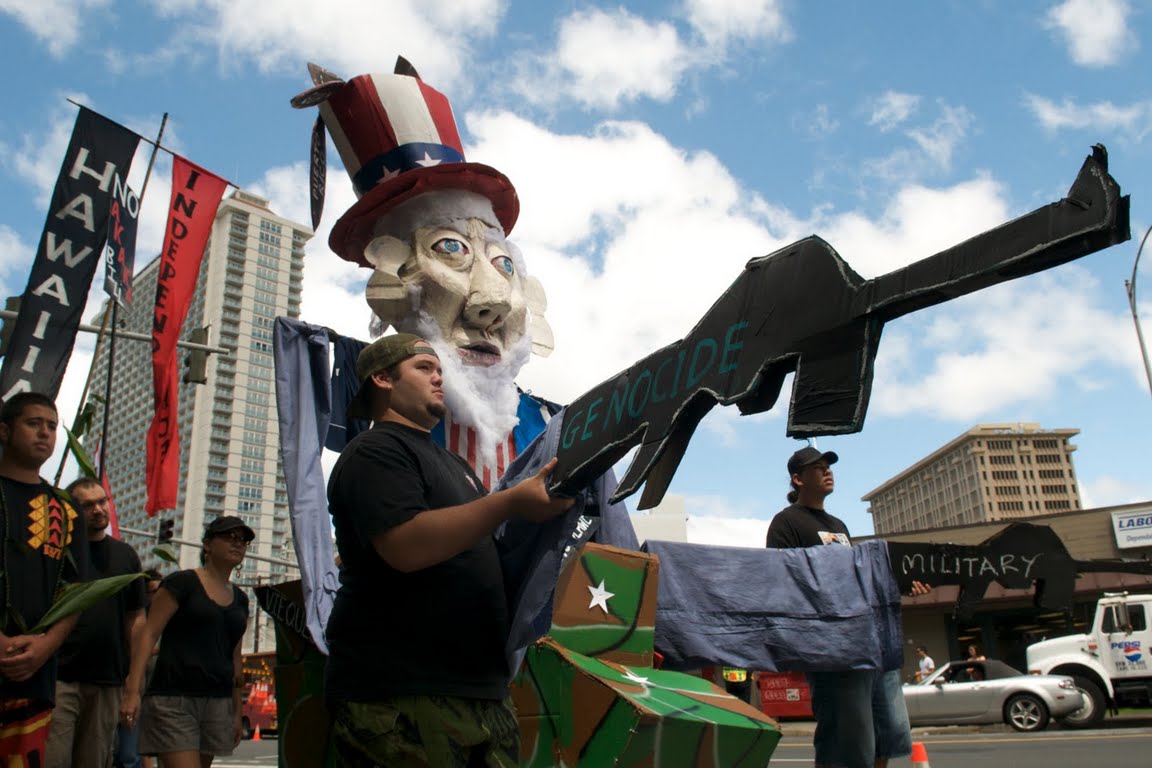
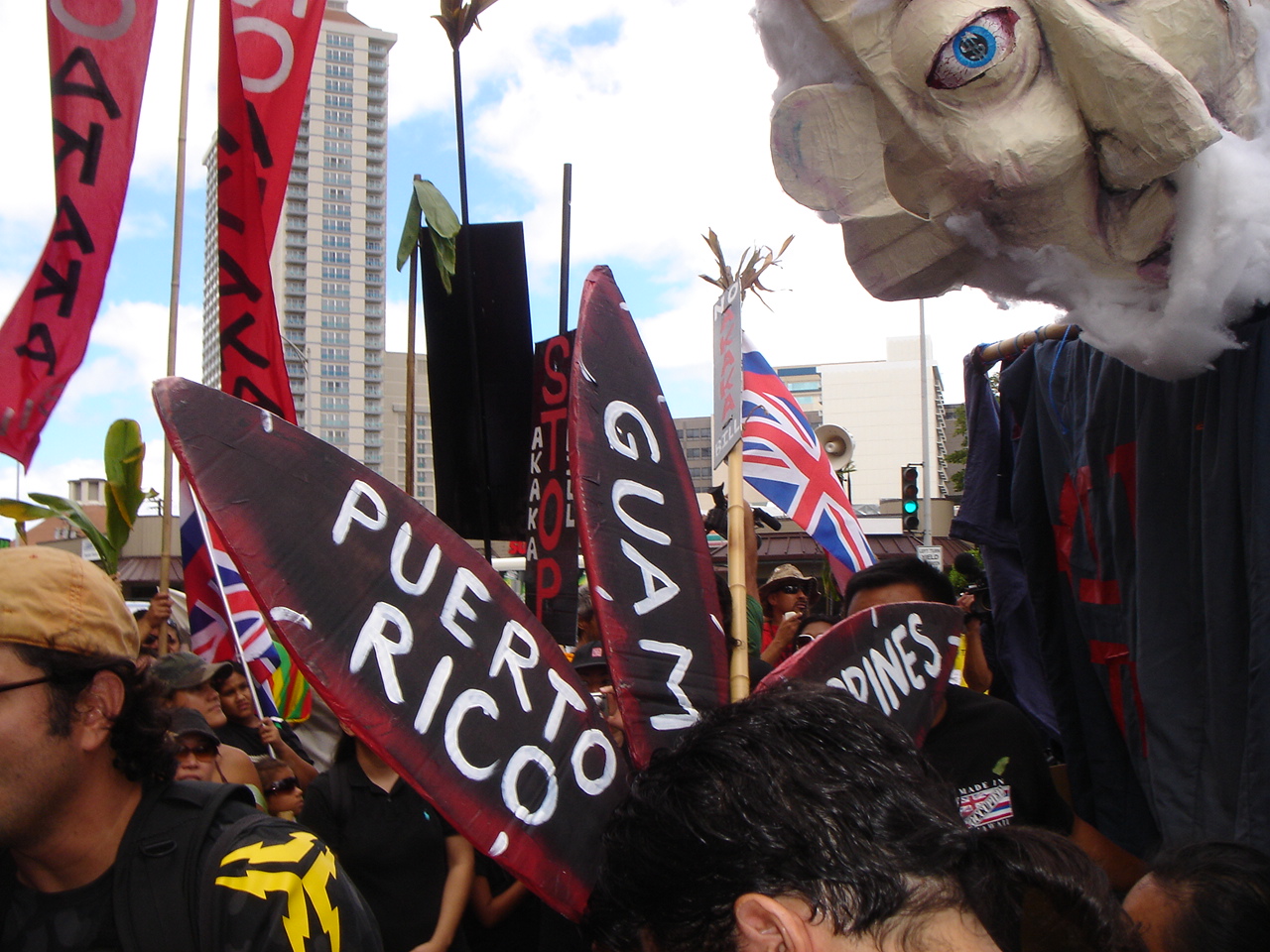
A centerpiece of the event was a towering puppet of Uncle Sam, riding on a camouflaged Stryker armored assault vehicle that was decorated with bombs bearing the names of places the U.S. military has bombed:  Kaho’olawe, Vieques, Bikini, Hiroshima and Nagasaki, Makua.   Walking behind the puppet, Andre Perez on the bullhorn delivered comic commentary:  “Why we going so slow?  Uncle Scam!  What’s holding  us back?  Uncle Scam!  Who’s blocking our way?  Uncle Scam!  Somebody, kick him in the ass!  Kanaka’s on the move!”

dsc034441

Photo: Kyle Kajihiro

puppet-guns

Uncle Sam carried M-16 assault rifles in each hand inscribed with “imperialist”, “genocide”, “military”. Photo: Jon Shishido

feathers-in-hat

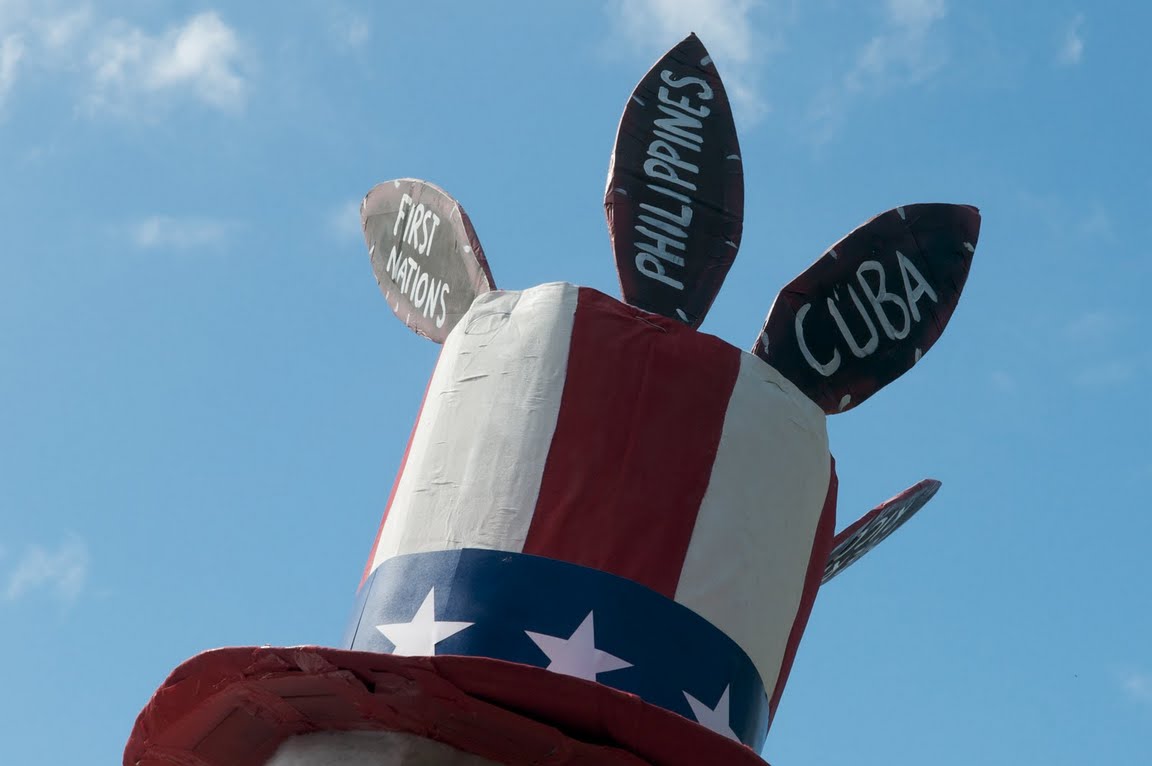
While the overriding message was independence for Hawai’i, the demonstration also addressed American imperialism as a a global threat. On his red-white-and-blue stovetop hat he had stuck “feathers” of his conquests: First Nations, Guam, Puerto Rico, Cuba, and the Philippines. Photo: Jon Shishido

dsc03459

At the end of the march, Uncle Sam’s hat was knocked off…

liberated-feathers

…and the feather trophies representing the colonized nations were “liberated” from the hat. Photos: Kyle Kajihiro and Jon Shishido

nation-live

Photo: Jon Shishido

dsc_6780 Photo: Jon Shishido

hi-independent-statehood6 Photo: Hawaii Independent

An American flag was taken out of the fallen hat and the 5oth star was cut out and burned.  An exorcism to break the spell.

kauai-pic

On Kaua’i, there were demonstrators at the entrance to the airport.

082109fakestatedemonstration-022

Kaua’i photos: Cairene

Former U.S. envoy backs Guam sentiments on buildup

Former U.S. envoy backs Guam sentiments on buildup

Friday, 21 August 2009 00:25

by Mar-Vic Cagurangan

Variety News Staff

TAKING up the cudgels for local activists, former U.S. ambassador and retired Army colonel Ann Wright assailed the federal government for shutting out the local population in the planning process for the U.S. Marines’ relocation from Okinawa to Guam.

“The U.S. federal government seldom takes into account local feelings about their projects, particularly military projects in a region far removed from the Washington power center,” Wright writes in an article titled “Guam resists military colonization” posted on CommonDreams.org.

“Guam activists want their voices heard and respected and not to be treated as merely residents of a colony of the United States,” said Wright, who accompanied members of the Japanese peace activist group Code Pink-Osaka during a fact-finding mission on Guam last month.

Wright said her visit to Guam has given her new perspectives about the Department of Defense’s plan for the relocation of 8,000 U.S. Marines to Guam.

“Three Guam legislators told us that the Guam government has not been properly consulted in the discussions between the U.S. and Japanese governments on the relocation of the large US Marine force,” Wright said. “Guam officials have been given little firm information about the military expansion plans.”

Anti-war

Wright is an outspoken critic of the Iraq war. Over the course of her diplomatic career that began in 1987, Wright served as deputy chief of mission at the U.S. embassies in Afghanistan.

On the eve of the U.S. invasion of Iraq on March 19, 2003, Wright sent her resignation letter to then State Secretary Collin Powell, saying she could no longer work for the U.S. government under the Bush administration. Wright quit her job in protest over the U.S. invasion of Iraq without sanction from the U.S. Security Council.

Now taking up the Guam military buildup case, Wright lashed at the U.S. for its plan to deploy thousands of troops to Guam “with virtually no consultation with the local government and citizens.”

Guam concerns

“Professors and students at the University of Guam expressed concern that there will be a sharp increase in sexual assault and rape on the island due to the relocation of US Marines,” she wrote. “They believe one of the reasons the Japanese government finally was able to get the U.S. government to move some military forces out of Okinawa was because of major citizen mobilizations that occurred in response to rapes by U.S. military personnel.”

The $10 billion relocation cost will be subsidized by the Japanese government, which has pledged to shoulder $6 billion, a commitment that was cemented in the Guam International Agreement signed in February.

“The Japanese people, too, are in the dark about the details of the billions of dollars they will pay the U.S. government to have US forces leave Japan,” Wright said.

Source: http://guam.mvarietynews.com/index.php?option=com_content&view=article&id=8140:former-us-envoy-backs-guam-sentiments-on-buildup&catid=1:guam-local-news&Itemid=2

New Informational Website on U.S. Military Violence Against Women

Announcing A New Informational Website on U.S. Military Violence Against Women

http://www.usmvaw.com

Providing information, analysis, and news about the history of U.S. military violence against girls and women in Okinawa and Japan, and in numerous other locations around the world. Other related concerns include:

* Sexual assault and violence against women within the U.S. armed forces; and

* Militarization and violence against women as an expression of colonialism, imperialism, and war.

The website is a collaborative project designed to deepen and broaden understandings of the relationships between U.S. militarism and foreign policy, imperialism, racism, and violence against girls and women. Organized by a team of faculty and students at California State University San Marcos, in collaboration with Colonel Ann Wright (retired), the project brings together information about United States military culture, historical narratives, stories of victimization, and analysis of the strategies used by Japanese activists to raise public awareness and prevent further crimes against girls and women.

These activists and organizers, particularly Okinawan Women Act Against Military Violence (OWAAMV), who view the U.S. military presence as a threat to local and regional security and happiness, are now making common cause with organizers in the Philippines and Korea who harbor similar concerns, and with activists in the United States and other parts of the world who have long worked for justice and accountability.

We invite you to visit the website and share it with others: http://www.usmvaw.com.

Please help get the word out about this continuing injustice.

We look forward to collaborating with activists, organizers, and scholars with an interest in these issues. Please contact us if we can share information or find ways to work together.

For information about the project, contact Project Director: Professor Linda Pershing, lpershing@usmvaw.com

For questions about the website or to share information, contact: Lezlie Lee-French, LLF@usmvaw.com

“They survived the combat, came back and – within two months – died on a motorcycle”

The Army is training soldiers in motorcycle safety to curb the high number of cycle fatalities that have occurred since 2005.  An Army spokesperson said that “motorcycles are a great tool to release adrenaline” and that one possible reason for the fatalities is the “aggressive soldier mind-set”.    First of all, motor vehicles shouldn’t be tools to “release adrenaline”.  Second, it seems that the “aggressive soldier mind-set” point to a deeper pathology within military culture and are symptomatic of the human costs of war.   The Army should look into the death that occurs inside soldiers who experience combat. This may be the real cause of many of the motorcycle fatalities.

>><<

Soldiers learn cycling safety

By Darin Moriki

POSTED: 01:30 a.m. HST, Aug 20, 2009

About 250 soldiers are participating in a supplemental motorcycle training program instituted because there have been 16 Army cycle fatalities since 2005.

“Many of them were killed soon after returning from combat,” said Bill Maxwell, U.S. Army Garrison-Hawaii transportation safety manager. “They survived the combat, came back, and – within two months – died on a motorcycle. We want to reverse that trend by providing them every bit of education that we possibly can.”

Maxwell said the Army pilot program was adopted from the Marines after it was found that “they have been having some positive results.” He explained that the free program is essential for motorcycle riders in light of the high number of Army motorcycle deaths.

One possible reason for the fatalities is the “aggressive soldier mind-set” that some may have, Maxwell said.

“We prepare them for combat, they go into a very high-stress situation, and they come back here,” Maxwell explained. “Motorcycles are a great tool to release adrenaline. Unfortunately, we have quite a bad history with motorcycles.”

The Honolulu Police Department reported that 12 of the 38 traffic fatalities this year involved motorcycles. Riders were wearing helmets in only six cases.

For a soldier to operate a bike on military installations, he or she must go through a basic and experienced rider course offered through the Motorcycle Safety Foundation. However, Maxwell said that these courses “provide the basic skills” and are “limited in size.”

“What we wanted to do here is expand the area and bring the speed up to get them a little bit closer to the operational speeds that they encounter out there on the road,” Maxwell said.

The training program, which began Monday at Wheeler Army Airfield, covers eight half-day courses that allow smaller groups of about 25 people.

The Los Angeles-based California Superbike School said the course is meant to boost a rider’s confidence with conditions that they may experience on the road.

“If the rider is unsure of himself, he’s going to panic,” said California Superbike School instructor and project manager Dylan Code. “What we want to make is a confident rider at this point.”

Each course included 30 minutes of classroom instruction before riders were taken out on an obstacle course. It was on the obstacle course that the real instruction began, where instructors – stationed at three checkpoints on various corners of the course – corrected mistakes that a rider made.

Many of the soldiers who attended the motorcycle training course left believing that they were more informed.

“The fundamentals that I learn here can be something that I can use out there on the streets,” said Cpl. Tyler Bridgeman, who has been riding about seven years. “This is one of the best courses that I have been to.”

“I left with a little bit more knowledge, but the knowledge that I left with was extremely important,” said Lt. Col. Rob Howe, who has been riding for 28 years. “I don’t know what I don’t know, but they told me what I needed to know.”

Source: http://www.starbulletin.com/news/20090820_Soldiers_learn_cycling_safety.html

Guam Resists Military Colonization

Published on Monday, August 17, 2009 by CommonDreams.org

http://www.commondreams.org/view/2009/08/17-6

Guam Resists Military Colonization

Having No Say When Washington Tries to Increase your Population by 25%

by Ann Wright

The United States and the Chinese governments have some remarkable similarities when it comes to colonization. The Chinese government has sent a huge Han population to inhabit Tibet and overwhelm the Tibetan population, even building the world’s highest railway to get people and materials there.

The United States government, with virtually no consultation with the local government and citizens, is increasing the population of its non-voting territory, Guam, by 25%. 8,000 U.S. Marines, their dependents and associated logistics units and personnel-a total of 42,000 new residents-will be moved to the small Pacific island (barely three times the size of Washington, DC) that has a current population of 175,000. The move will have a tremendous impact on the cultural and social identity of the island.

These military forces are being relocated to Guam, in great measure, because of the “Close US Military Bases” campaign organized by citizen activists in Okinawa, Japan. The United States has had a huge military presence there since the end of World War II.

I thought I was reasonably well-informed about America’s interests in the Pacific. I had worked as a US diplomat in Micronesia for two years and travelled many times through Guam, a US territory, located an 8 hour flight west of Honolulu.

But earlier this month, in Guam on a study tour sponsored by a coalition of Japanese peace activists spearheaded by CODEPINK-Osaka, Japan, which included a former member of the Japanese Diet (Parliament), I learned new aspects of the decision to relocate this large number of U.S. military to Guam.

Guam was first colonized by the Spanish in the 1500s, became a US colony in 1898, a war-trophy from the Spanish-American war and served as a stopover for ships travelling to the Philippines. During World War II, Guam was attacked and occupied by Japan on December 8, 1941, the day after the Japanese attacked Pearl Harbor. American citizens living on the island had been evacuated by the United States government before the attack, but the indigenous Chamorro population was left behind. During the 31 months of Japanese occupation, the Chamorros endured forced labor, concentration camps, forced prostitution, rape and execution by the Japanese military. The United States military returned three and one-half years later on July 21, 1944 to retake Guam.

In 1950, Guam was made an “unincorporated territory” of the United States by a US Congressional act and residents were given US as one of 16 “non-self governing territories” left in the world.

Lands were taken after World War II from the native Chamorro population without compensation by the US military to construct major air and naval bases which the US military still uses. Currently, there are 3,000 US Air Force and 2,000 US Navy personnel and 1,000 employees of other federal security agencies assigned to Guam.

Three Guam legislators told us that the Guam government has not been properly consulted in the discussions between the US and Japanese governments on the relocation of the large US Marine force. Guam officials have been given little firm information about the military expansion plans. They are very concerned about the impact of further militarization of their island as its major income is provided by hundreds of thousands of Japanese tourists who visit the tropical island annually.

They are disturbed by rumors of proposed forced condemnation of another 950 acres of land owned by members of the native Chamorro population for a live fire range for the incoming Marines. Residues of Agent Orange left from the Vietnam War and other toxic wastes from the military bases, plus the possibility that artillery shells and other munitions made from depleted uranium will be used on their island, are all sources of concern for the people of Guam.

In order to get the 8,000 US Marines out of Okinawa, the Japanese government is paying $6 billion to the US government for their relocation. Guam officials are concerned that not enough of the relocation funds will be made available for the large infrastructure improvements that will be needed for the island’s roads, water, sewage and electrical systems as it tries to support a 25% increase in population. They feel the military will take care of its bases but may leave the local population struggling with the new infrastructure problems created by the large number of military personnel.

The Japanese people, too, are in the dark about the details of the billions of dollars they will pay the US government to have US forces leave Japan. Japanese members of our delegation were shocked when they learned from local Guam activists that the relocation budget calls for the Japanese government to pay $650,000 for the construction of each new house on the base, while Guam activists told us the cost of a middle class home on Guam is around $250,000. The Japanese delegation was greatly concerned that their government is funding such inflated projects and is going to raise the budget with Japanese Diet members when they return to Japan.

Of concern to the Guam business community is consideration by US House of Representatives law makers to give Japanese contractors the same access as American firms to bidding on contracts worth more than $2.5 billion in upcoming US military construction projects on Guam. Apparently, the Japanese government, like the US government, likes to have its commercial firms benefit from government aid projects it is funding “overseas.” With Japan’s $6 billion contribution to the $10 billion cost of relocating the Marines, Japan wants some of that money returned to Japan through construction contracts on the Guam infrastructure projects.

Many Guam officials and a large number of Guam citizens are deeply concerned about the cultural, economic and security impact of the dramatic increase in population and militarization of their island the relocation would present. The current cultural divide of those living in relative luxury inside the bases with better housing, schools and services has been a source of friction between the US military and the local population over the years.

Guam officials said that they too have been perturbed about the extraordinarily high expenditures on US military base facilities, when the Government of Guam is strapped financially. The officials said they were amazed and horrified when they learned that the Air Force recently built an on-base animal kennel for $27 million, with each animal space costing $100,000, when locally, the government is unable to provide sufficient infrastructure for its citizens, much less animals.

Professors and students at the University of Guam expressed concern that there will be a sharp increase in sexual assault and rape on the island due to the relocation of US Marines. They believe one of the reasons the Japanese government finally was able to get the US government to move some military forces out of Okinawa was because of major citizen mobilizations that occurred in response to rapes by US military personnel.

In 2008, the US Ambassador to Japan had to fly to Okinawa to give his apologies for the rape of a 14 year old girl by a US Marine. The US military forces on Okinawa had a 3 day stand-down for “reflection” and Secretary of State Condoleezza Rice had to express her “regrets” to the Japanese Prime Minister “for the terrible incident that happened in Okinawa… we are concerned for the well-being of the young girl and her family.”

In April, 2008, U.S. Marine Staff Sergeant Tyrone Hadnott, 38, who had been in the Marines 18 years, was charged with the February 10, 2008, rape of 14 year old girl, abusive sexual contact with a child, making a false official statement, adultery and kidnapping.

On May 17, 2008, Hadnott was found guilty of abusive sexual conduct and the four other charges were dropped. Hadnott was sentenced to four years in prison, but will only serve a maximum of three years in prison due to a pretrial agreement that suspended the fourth year of the sentence. He was reduced to private and given a dishonorable discharge from the US Marines.

The rape accusation against Hadnott stirred memories of a brutal rape more than a decade ago and triggered outrage across Japan. Japanese Prime Minister Yasuo Fukuda said that Hadnott’s actions were “unforgivable.”

There are US Congressional stirrings of concern about the relocation of the Marines to Guam. House of Representatives Armed Services Committee chair Ike Skelton has raised concerns about the size, scope and cost of the move to Guam. “At over $10 billion (two and one-half times the initial cost estimate of $4 billion), it is an enormous project, and I am concerned that the thinking behind it is not yet sufficiently mature,” Skelton said at a recent Congressional hearing. “We need to do this, but it needs to be done right.”

In a challenge to US military “forward deployment” strategy in Asia and the Pacific, Guam activists strongly feel the US military should relocate large forces to the mainland of the US where there presence can be better absorbed by the greater populations and existing large military bases, rather than to their small Pacific island.

However, the US federal government seldom takes into account local feelings about their projects, particularly military projects in a region far removed from the Washington power center.

Guam activists want their voices heard and respected and not to be treated as merely residents of a colony of the United States.

Ann Wright is a 29 year US Army/Army Reserves veteran who retired as a Colonel and a former US diplomat who resigned in March, 2003 in opposition to the war on Iraq. She served in Nicaragua, Grenada, Somalia, Uzbekistan, Kyrgyzstan, Sierra Leone, Micronesia and Mongolia. In December, 2001 she was on the small team that reopened the US Embassy in Kabul, Afghanistan. She is the co-author of the book “Dissent: Voices of Conscience.” (www.voicesofconscience.com)

Aid sought for ‘Atomic Vets’

Source: http://www.honoluluadvertiser.com/article/20090817/NEWS01/908170340/0/NEWS01/Aid-sought-for–Atomic-Vets-

Posted on: Monday, August 17, 2009

Aid sought for ‘Atomic Vets’

Bill would facilitate care for U.S. veterans exposed to radiation

By John Yaukey
Advertiser Washington Bureau

WASHINGTON – Charles Clark knew something was wrong when he started losing his teeth at age 37.

“They just fell out – no blood,” the Hawai’i resident said.

He is virtually certain it had something to do with his Navy service in the Pacific during World War II, when he was exposed to atomic bomb radiation.

On Sept. 23, 1945, the 17-year-old sailor entered Nagasaki, Japan, where six weeks earlier the world’s second nuclear weapons attack had killed 80,000 people. Some died due to massive doses of radiation.

Clark remained in Nagasaki for five days, setting up ship-to-shore communications. It would forever change his life.

Since then, “I’ve had more than 180 skin cancers removed from my face,” he said in a recent interview. “Even today, the cancer keeps recurring. It never stops.”

Clark is among a group called the “Atomic Vets” – American military veterans exposed to radiation from nuclear weapons.

Between 1945 and 1962, half a million U.S. troops participated in more than 250 atmospheric and underwater atomic bomb tests, most in the Pacific and Nevada. Many of these veterans have since suffered a panoply of illnesses commonly associated with radiation exposure, but many have had trouble getting the care they need.

Rep. Neil Abercrombie, D-Hawai’i, has introduced legislation that would streamline the process and add transparency.

“These veterans are dying every day from diseases caused, at least in part, by their service in atomic tests and other nuclear weapon-related activities,” the 11-term congressman said.

The treatment process is run through the Department of Veterans Affairs using data from the Defense Threat Reduction Agency.

Typically, the process entails a veteran approaching the VA with a claim. At that point, the agency sends the information to the DTRA, which decides whether the veteran’s service record indicates past exposure to high doses of radiation.

This process, known as “dose reconstruction,” can take months and occurs behind closed doors, critics say.

It can be cumbersome and mysterious, especially for someone already dealing with a life-threatening illness.

The DTRA and the VA recognize 22 types of cancer that qualify as caused by radiation exposure. Some cancers must occur within a particular time frame, such as 20 years from exposure, to qualify.

More than 90 percent of the veterans who apply for benefits outside the set parameters are denied, according to research Abercrombie’s staff has done.

Abercrombie’s legislation, the Atomic Veterans Relief Act, would add transparency by opening up DTRA’s analysis methods.

There is no companion bill yet in the Senate. Abercrombie introduced his legislation around Memorial Day. He hopes it will pick up momentum as stories like Clark’s circulate, and as lawmakers gain appreciation for the sacrifices of war through the prism of two ongoing conflicts.

“We’re trying to get some certainty in the process,” said Abercrombie, who is running for governor in a state with a large retired military population.

DTRA spokeswoman Kate Hooten said the agency has well-established protocols for determining radiation exposure, and she noted that over the decades, many veterans have scattered across the globe and are out of touch with government health care networks.

“This is an important issue,” she said. “We’re always interested in finding out how we can reach out to the public.”

Vets remember

To make the case for his reform legislation, Abercrombie has collected the narratives of some veterans who worked around nuclear tests and are suffering multiple cancers and other ailments.

Edward Blas, who lives on Guam, was stationed in the Marshall Islands during the cleanup on Eniwetok Atoll after 43 nuclear tests there.

“The evidence was overwhelming that we were exposed to high levels of ionizing radiation while we lived on ground zero,” he wrote.

Despite the fact that he has never smoked, Blas is anemic and diabetic and weighs half the 220 pounds he did in the service. But his medical claim was denied on the grounds that veterans who served there after the nuclear tests were not considered “atomic vets.”

But those were different times. Not much was known about radiation exposure.

In the early days of the nation’s nuclear program, Cold War imperatives overrode most other concerns.

“I’ve talked to people who were pretty casual about radiation in the early going,” said Richard Rhodes, author of the 900-page Pulitzer Prize-winning book “The Making of the Atomic Bomb.”

“We were at war and we had to take some risks,” Rhodes said in an interview this week.

For Clark, the risks went further than his own body.

His daughter lost both breasts, while his granddaughter suffers from skin ailments, all of which he is convinced can be traced back to Nagasaki.

“We just never understood what we were getting into back then,” Clark said. “We were young kids.”

Army on track to surpass 2008 suicide numbers

Army on track to surpass 2008 suicide numbers

By Michelle Tan – Staff writer

Posted : Friday Aug 14, 2009 18:40:55 EDT

As many as 12 soldiers killed themselves in July, the Army announced today, and the service remains on course to setting a record for suicides in a single year.

Of the 12 deaths, eight were active-duty soldiers and four were National Guard or Army Reserve soldiers who were not on active duty at the time of their deaths.

All 12 deaths are possible suicides and remain under investigation.

Typically, about 90 percent of these investigations are ruled suicides, Army officials have said.

In June, there were 13 confirmed or possible suicides; nine were active-duty soldiers and four were soldiers who were not on active duty. As of Aug. 13, four of those 13 deaths had been confirmed as suicides.

Between Jan. 1 and July 31, there have been 96 reported active-duty suicides. Of those, 62 have been confirmed as suicides and 34 are still under investigation.

There were 79 suicides among active-duty soldiers for the same period in 2008.

Among soldiers who were not on active duty, there have been 17 confirmed and 28 possible suicides so far this year. During the same period last year, there were 32 suicides among reserve component soldiers who were not on active duty.

The Army reported 140 suicides in 2008 and is on track to surpass that number this year.

To reverse the increase in soldier suicides, the Army has implemented a number of programs and put Vice Chief of Staff Gen. Peter Chiarelli in charge of the service’s suicide prevention efforts.

Among those efforts, which included a service-wide stand down and a series of chain-teaching sessions, is a $50 million, five-year study on suicide conducted in conjunction with the National Institute of Mental Health.

In addition, the Army’s Suicide Prevention Task Force has put in place a number of improvements to the army’s health promotion, risk reduction and suicide prevention programs. They include major revisions to the Army’s health promotion policy and augmenting behavioral health staff at many installations to enhance access to counseling services for soldiers and families.

Source: http://www.armytimes.com/news/2009/08/army_suicides_081309w/