Dahr Jamail: Colonizing Culture

As an independent journalist, Dahr Jamail has brought the world vivid and horrifying accounts of the U.S. occupation of Iraq.  When he visited Hawai’i a few years ago, Hawaiian Independence activists introduced him to the history and current state of the U.S. occupation of Hawai’i and of the sovereignty movement.  He immediately got it.  In this article he describes the “soft” colonization of Iraq by massive, forced cultural change brought on by foreign occupation.  Of course, Hawai’i was one of the places where techniques of “soft” colonization were perfected.

http://www.truthout.org/052709R

Colonizing Culture

Wednesday 27 May 2009

by: Dahr Jamail, t r u t h o u t | Perspective

Transgress

The geo-strategic expansion of the American empire is an accepted fact of contemporary history. I have been writing in these columns about the impact of the US occupation on the people of Iraq in the wake of the “hard” colonization via F-16s, tanks, 2,000-pound bombs, white phosphorous and cluster bombs.

Here I offer a brief glimpse into the less obvious but far more insidious phenomenon of “soft” colonization. That scholars and political thinkers have talked at length of such processes only establishes the uncomfortable reality that history is bound to repeat itself in all its ugliness, unless the human civilization makes a concerted effort to eliminate the use of brute force from human affairs.

Gandhi, the apostle of non-violent resistance said:

“I do not want my house to be walled in on all sides and my windows to be stuffed. I want the cultures of all the lands to be blown about my house as freely as possible. But I refuse to be blown off my feet by any. I refuse to live in other people’s houses as an interloper, a beggar or a slave.”

This is an idea rendered irrelevant in the current scenario, where the mightier among the world’s nations have secured the mandate to invade, with impunity, any society and any state that can be exploited for resources. Unlike earlier times, modern-day invasions are invariably camouflaged by a façade of elaborate deceit that claims altruistic intent as the motive of assault. In this new scheme of things, resistance is deemed as insurgency and dissent is unpatriotic. Those that are invaded do not have the luxury to decide between being beggar and slave. Culture would be the last thing on their minds as they struggle to stay alive. Yet it is the loss of their culture that ultimately causes the disintegration of these societies to the absolute advantage of their victors.

It is said that history is written by the victor. What is not said is that destroying the enemy is only half the purpose of a victor. The other half is the subjugation and drastic alteration of the self-perception of the enemy, so as to gain unquestioned control over every aspect of the subjugated state, its populace and its resources, so that having won victory it can get on with the “much bigger business of plunder,” according to Franz Fanon, philosopher, psychiatrist, author and a pre-eminent thinker of the twentieth century.

At one level we have the Human Terrain System (HTS) I have written about previously wherein social scientists are embedded with combat units, ostensibly to help the occupiers better understand the cultures they are occupying. The veiled intent is to exploit existing schisms and fault-lines in these societies to the occupier’s own advantage through the policy of divide and conquer.

As Edward Said stated in “Orientalism”:

“… there is a difference between knowledge of other peoples and other times that is the result of understanding, compassion, careful study and analysis for their own sakes, and on the other hand knowledge – if that is what it is – that is part of an overall campaign of self-affirmation, belligerency, and outright war. There is, after all, a profound difference between the will to understand for purposes of coexistence and humanistic enlargement of horizons, and the will to dominate for the purposes of control and external enlargement of horizons, and the will to dominate for the purposes of control and external dominion.”

It is extremely obvious that the HTS belongs to this second category.

At another unquestioned level, the “democratization” and “modernization” of a “barbaric” society goes on. The embedded scholars of HTS evidently find no evidence of these cultures having withstood decades of international isolation and assault, yet sustained their sovereignty by the sheer dint of their education, culture and a well-integrated diverse social fabric. So the US sets up a range of state-funded programs, ostensibly to empower the women and youth of the target society, in the ways of democracy and modern civilization. Whether or not that suspect goal is accomplished, the badgered collective consciousness of the invaded people, traumatized by loss and conflict, does begin to submit to the “norms” of behavior prescribed by the victor, even when they are in violation of actual norms of society that may have prevailed prior to invasion.

Transform

Fanon said:

“A national culture under colonial domination is a contested culture whose destruction is sought in systematic fashion.”

Describing the psychopathology of colonization he said, “Every effort is made to bring the colonized person to admit the inferiority of his culture which has been transformed into instinctive patterns of behavior, to recognize the unreality of his ‘nation’, and, in the last extreme, the confused and imperfect character of his own biological structure.”

Fanon’s speech to the Congress of Black African Writers in 1959 is an uncanny description of Iraq’s tragedy today:

“Colonial domination, because it is total and tends to over-simplify, very soon manages to disrupt in spectacular fashion the cultural life of a conquered people. This cultural obliteration is made possible by the negation of national reality, by new legal relations introduced by the occupying power, by the banishment of the natives and their customs to outlying districts by colonial society, by expropriation, and by the systematic enslaving of men and women …

“For culture is first the expression of a nation, the expression of its preferences, of its taboos and of its patterns. It is at every stage of the whole of society that other taboos, values and patterns are formed. A national culture is the sum total of all these appraisals; it is the result of internal and external extensions exerted over society as a whole and also at every level of that society. In the colonial situation, culture, which is doubly deprived of the support of the nation and of the state, falls away and dies.”

At times we may witness blatant violations as in the distribution of backpacks with US flags to Iraqi children.

A more repulsive example is the Skin White Serum. One of many companies engaged in selling skin-bleaching cream is Skin White Research Labs. They proudly sell Skin White Serum in “over 30 countries.” There are countless other companies involved in this market, selling similar products, like Skin White Bleaching Cream and Xtreme White.

The hidden message here is that, politically, those in the culture being colonized should seek to cover their brown skin, which is in fact part of their ethnic identity, and aspire to the culture, power and influence of the dominant culture at the expense of their own.

Somewhat less subtle is the corporate colonization of Iraq’s culture. An example of this is Iraqi girls carrying Barbie backpacks in the Sadr City area of Baghdad.

In Iraq and Afghanistan, the dominant culture for a while now has been the US military. Since it has all the firepower and the brute force, it sets the norms and the standard. This is done by repeated suggestions through propaganda, and advertisements suggesting that the local population is of lesser worth than the occupiers of their country in their appearance, their beliefs, their customs and their way of life.

The material practices of society sustain its culture, which is the lifeline of identity, and affirmation that the progress of a nation depends on. Social custom, production systems, education, art and architecture are a few of the visible pillars of culture.

Community and custom become the first casualties when an entire people, unequal in the face of military might, struggle to survive under perpetual fear of loss and death. In a state of vacuum, the threatened society will grasp whatever is offered by the occupier as a “better” way of living. In the process it is bound to lose its own tried and tested self-sustaining modes of living.

With the destruction of infrastructure, education, health and livelihood sources are destroyed. When rehabilitation and restoration come packaged in alien systems of knowledge (read-USAID), that, too, is accepted in the absence of what existed earlier.

Literature, art and architecture meet with more systemic demolition.

My artist friends in Baghdad have reported,

“The occupation forces encouraged the rebels to loot museum and libraries. Five thousand years of history and art were irretrievably lost in hours. It is a loss for the world, not Iraq alone. Buildings can be fixed, so can electricity, but where can I find another Khalid al-Rahal to make me a new statue for Abu Fafar al-Mansoor? How will I replace the artifacts dating back to thousands of years? Iraq is altered forever.”

I have heard from ordinary men and women in Iraq, “We need our art, because it connects us with what has brought us here, and reminds us of where we are headed.” Dr. Saad Eskander has been director general of whatever remains of Iraq’s National Archive and Library and he says, “This building was burned twice, and looted. We have lost sixty percent of our archival collections like maps, historical records and photographs. Twenty-five percent of our books were lost … It has crippled our culture, and culture reaches to the bottom of peoples’ hearts, whereas politics do not.”

It is not difficult to see that the extent of devastation caused by the invasion and occupation of Iraq goes beyond loss of life, livelihood and property. The historical and cultural roots of the nation have been destroyed.

Dahr Jamail, an independent journalist, is the author of “Beyond the Green Zone: Dispatches From an Unembedded Journalist in Occupied Iraq,” (Haymarket Books, 2007). Jamail reported from occupied Iraq for eight months as well as from Lebanon, Syria, Jordan and Turkey over the last four years.

Another Case Confirms Agent Orange on Guam

Another case confirms AO on Guam

http://guam.mvarietynews.com/index.php?option=com_content&view=article&id=6726:another-case-confirms-ao-on-guam&catid=1:guam-local-news&Itemid=2

Tuesday, 26 May 2009 00:14 by Mar-Vic Cagurangan |Variety News Staff

ANOTHER veteran who was stationed at Andersen Air Force Base from 1962 to 1965 won his claim for disability benefits based on medical findings which showed that his illness was the result of his exposure to Agent Orange.

The decision issued by the Department of Veterans on April 16 was the fourth case won by veterans who were deployed to Guam in the 1960s. All four cases confirmed dioxin contamination at AAFB.

The Air Force veteran, who requested anonymity, has been suffering from diabetes mellitus type 2, which the Department of Veterans Affairs confirmed to be service-related.

“Service connection for diabetes mellitus type 2 is granted because the evidence shows a medical opinion that this current condition is related to in-service events or circumstances with residuals evident as shown in treatment records,” states the DVA decision.

“The statement of case issued on this matter found that the veteran was exposed to dioxin while stationed t Anderson Air Force base,” it added.

The decision was based on the medical opinion submitted by a doctor who stated that “the exposure to Agent Orange is etiologically related to the veteran’s current diabetes.”

During the Vietnam war era, Guam was used as storage facility for agent orange, a kind of chemical herbicide used to thin jungles in Vietnam in 1968 and 1969. A CBS News report on June 12, 2005, said Agent Orange was sprayed on Guam from 1955 to 1960s, and in the Panama Canal Zone from 1960s to 1970s.

The first confirmation of Agent Orange presence on Guam was found in U.S. Court of Appeals for Veterans’ ruling in 2005, which concluded that a veteran contracted a disease as a result of his exposure to Agent Orange while stationed on Guam in the late 1960s.

Pentagon Plans Latin America-Wide Intervention Ability for New Military Base in Colombia

Pentagon Plans Latin America-Wide Intervention Ability for New Military Base in Colombia

May 18, 2009, Oakland, CA: The United States is planning to establish a new military facility in Colombia that will give the U.S. increased capacity for military intervention throughout most of Latin America. Given the tense relations of Washington with Venezuela, Bolivia, and Ecuador, as well as the Colombian military’s atrocious human rights record, the Fellowship of Reconciliation (FOR) believes the plan should be subjected to vigorous debate.

“This base would feed a failed drug policy, support an abusive army, and reinforce a tragic history of U.S. military intervention in the region,” said John Lindsay-Poland, Latin America Program Co-director for FOR. “It’s wrong and wasteful, and Congress should scrap it.”

The new facility in Palanquero, Colombia would not be limited to counter-narcotics operations, nor even to operations in the Andean region, according to an Airlift Military Command (AMC) planning document <http://www.au.af.mil/awc/africom/documents/GlobalEnRouteStrategy.pdf>. The U.S. Southern Command aims to establish a base with “air mobility reach on the South American continent” in addition to a capacity for counter-narcotics operations, through the year 2025.

With help from the Transportation Command and AMC, the Southern Command identified Palanquero, from which “nearly half of the continent can be covered by a C-17 without refueling.” If fuel is available at its destination, “a C-17 could cover the entire continent, with the exception of the Cape Horn region,” the AMC planners wrote.

President Obama’s Pentagon budget <http://www.defenselink.mil/comptroller/defbudget/fy2010/fy2010_SSJ_Special_Topics.pdf> , submitted May 7, includes $46 million for development of the Palanquero base, and says the Defense Department seeks “an array of access arrangements for contingency operations, logistics, and training in Central/South America.” A U.S. Embassy spokesperson in Bogota told FOR that negotiations were not yet concluded for the base.

The Southern Command is also pursuing access to a site in French Guiana that would permit military aircraft to reach sites in Africa <http://www.au.af.mil/awc/africom/documents/GlobalEnRouteStrategy.pdf> , via the Ascension Islands, according to AMC. SouthCom apparently sought use of facilities in Recife, Brazil for the same purpose, but “the political relationship with Brazil is not conducive to the necessary agreements,” AMC wrote.

The lease for the U.S. “Forward Operating Location” in Manta, Ecuador expires in November 2009, and Ecuador notified Washington last year that it would not renew the lease. The facility in Manta was authorized to conduct only counter-drug operations, but drug traffic in the Pacific, where aircraft from Manta patrolled, has increased in recent years <http://articles.latimes.com/2007/oct/05/world/fg-ecuadrugs5> , according to military spokesmen. U.S. forces in Manta also carried out operations to arrest undocumented Ecuadorans on boats in Ecuadoran waters. But public documentation of U.S. operations conducted from Manta does not indicate use of C-17 cargo aircraft, so their use in Palanquero apparently would represent an expanded U.S. military capacity in the region.

The “mission creep” in the proposal for continent-wide operations from Colombia is also evident in President Obama’s foreign aid request <http://www.state.gov/f/releases/iab/fy2010/index.htm> for Colombia. While the budget request for $508 million tacitly recognizes the failure of Plan Colombia drug policy by cutting funds for fumigation of coca crops, the White House is asking for an increase in counterinsurgency equipment and training to the Colombian Army.

Colombian and U.S. human rights and political leaders have objected to continued funding <http://www.forcolombia.org/monthlyupdate/march2009#president> of the Colombian army, especially after revelations <http://www.globalpost.com/print/1280781> that the army reportedly murdered more than 1,000 civilians and alleged they were guerrillas killed in combat, in order to increase their body count. The Palanquero base itself, which houses a Colombian Air Force unit, was banned from receiving U.S. aid for five years because of its role in a 1998 attack that killed 17 civilians <http://justiciaypazcolombia.com/Masacre-en-Santo-Domingo-Arauca> , including six children, from the effects of U.S.-made cluster bombs. The United States resumed aid to the unit last year.

Colombian Defense Ministry sources said <http://www.eltiempo.com/colombia/justicia/con-traslado-de-base-de-manta-eu-tiene-en-la-mira-varias-pistas-del-suroccidente-del-pais_4877714-1> that Colombia was attempting to obtain increases in U.S. military aid as part of the base negotiations. Palanquero offers the U.S. military a sophisticated infrastructure <http://www.cambio.com.co/portadacambio/779/4234729-pag-2_3.html> – a 10,000-foot runway, hangars that hold more than 100 aircraft, housing for more than 2,000 men, restaurants, casinos, supermarkets, and a radar system installed by the United States itself in the 1990s.

U.S. law caps the number of uniformed U.S. soldiers operating in Colombia at 800, and the number of contractors at 600. Until last year, a significant number of them were intelligence personnel assigned to the effort to rescue three U.S. military contractors kidnapped by the leftist FARC guerrillas. With the rescue last year of the three contractors, many U.S. intelligence staff left Colombia, leaving space for soldiers to run operations in the prospective new U.S. base or bases.

“That the Colombian government asks for a U.S. base now would be a serious error,” says former defense minister and presidential candidate Rafael Pardo <http://www.cambio.com.co/portadacambio/779/4234729-pag-3_3.html> .

FOR believes replacing one military base that was set up for the failed drug war with another base to intervene in South America and to support the abusive Colombian army would be a serious error for the United States as well.

Contact: John Lindsay-Poland, Fellowship of Reconciliation, johnlp@igc.org, 510-282-8983 (cell)

Declaration of the Seven Puerto Rican Independentistas arrested in Congress

STATEMENT OF THE SEVEN

May 14-20, 2009
http://claridadpuertorico.com/content/view/403978/32/

Editors’ Note:
We are reproducing the Statement of the Seven, the words that the seven Puerto Rican patriots pronounced upon their release last Wednesday, May 6, and the entire text of the Letter they wrote to the President of the United States, Barack Obama, where they set forth the reasons for their act of civil disobedience.

The peaceful protest of civil disobedience we performed on May 6 in the Congress of the United States of America in Washington, D.C., is correlated with the uneasiness of the Puerto Rican people before the intolerable reality of colonialism we live; a reality that affects us all equally, independent of religious or ideological positions. For 111 years, the country, our country, has suffered occupation, first by the military and then by the metropolis’ usurpation of our political and economic powers. This situation does not allow us to adequately resolve our most immediate problems nor our long term issues.

The representatives “elected by the people” to deal with those problems, far from resolving them, increase and perpetuate them. The elections held every four years in Puerto Rico have become a process that betrays the concept of democracy, and is mediatized and influenced by the metropolis to maintain its domination and the predominance of its interests. The clamor of all the most progressive sectors of our nation is to end colonialism once and for all. If there is consensus about something in our country, it is that we constitute the oldest colony in the world. The plebiscites, consultations and referenda that have been conducted throughout those 111 years of colonialism have not at all guaranteed the solution for this ignominious system.

We urge the government of the U.S. to respect the multiple resolutions on the colonial case of Puerto Rico and initiate a process in conformity with International Law (just as they would demand of any other country in the world) for decolonization once and for all for our Puerto Rican island.

This act of civil disobedience, rooted in the most sincere and honest sense of love for our Homeland and our people, is also an expression of affirmation of what we are: A decent working people who deserve not one more second of the indignity of colonialism!

María L. (Chabela) Rodríguez
Eugenia V. Pérez-Montijo
Luis Enrique Romero
José (Tony Mapeyé) Rivera
Ramón Díaz
Luis Suárez
Carlos Esteban Fonseca
May 6, 2009
Wáshington, D.C., United States
English Translation: Jan Susler

original:
DECLARACION DE LOS SIETE
14 al 20 mayo 2009
http://claridadpuertorico.com/content/view/403978/32/

Nota de la Redacción:
A continuación reproducimos la Declaración de los Siete, las palabras que los siete patriotas puertorriqueños pronunciaron al ser dejados en libertad el pasado miércoles 6 de mayo y el texto íntegro de la Carta que le cursaron al Presidente de Estados Unidos, Barack Obama, donde exponen las razones para su acto de desobediencia civil.

La protesta pacífica de desobediencia civil que escenificamos el pasado 6 de mayo en el Congreso de los Estados Unidos de América en Wáshington, DC, es correlato del malestar del pueblo puertorriqueño ante la intolerable realidad de coloniaje que vivimos. Realidad que nos afecta a todos por igual independientemente de las posturas religiosas o ideológicas. Por 111 años, el país, nuestro país, ha sufrido una ocupación, primero militar y luego mediante la usurpación por parte de la metrópoli, de nuestros poderes políticos y económicos. Situación que no nos permite dar respuestas adecuadas a nuestros problemas más inmediatos y por consiguiente a los mediatos.

Los representantes “electos por el pueblo” para lidiar con esos problemas, lejos de resolverlos, los aumentan y perpetúan. Las elecciones que cada cuatro años se celebran en Puerto Rico se han convertido en un proceso que traiciona el concepto de la democracia y es uno mediatizado e influenciado por la metrópoli para mantener la dominación y el predominio de sus intereses. El clamor de todos los sectores más progresistas de nuestra nación es acabar de una vez por todas con el coloniaje. Si en algo hay consenso en nuestro país es que constituimos la colonia más antigua del mundo. Los plebiscitos, consultas y referéndum que se han llevado a cabo a lo largo de estos 111 años de coloniaje no han abonado un ápice a la solución de este ignominioso sistema.

Instamos al gobierno de los E.U.A. a acatar las múltiples resoluciones sobre el caso colonial de Puerto Rico e iniciar un proceso, conforme a la Ley Internacional (tal como ellos lo exigen a cualquier otro país en el mundo), para descolonizar de una vez y por todas nuestra isla borinqueña.

Este acto de desobediencia civil enraizado en el más sincero y honesto sentimiento de amor a nuestra Patria y a nuestro pueblo, es también expresión de afirmación de lo que somos: ¡Un pueblo trabajador y digno que no merece ni un segundo más la indignidad del coloniaje!

María L. (Chabela) Rodríguez
Eugenia V. Pérez-Montijo
Luis Enrique Romero
José (Tony Mapeyé) Rivera
Ramón Díaz
Luis Suárez
Carlos Esteban Fonseca
6 de mayo de 2009
Wáshington, DC, Estados Unidos

Resistance to Militarism: Guam, Puerto Rico, Diego Garcia

Resistance to Militarism: Guam, Puerto Rico, Diego Garcia

Tues, May 19, 6:30-9:00pm

PANA Institute, 2357 Le Conte Ave, Berkeley, CA

PANA and Women for Genuine Security invite you to:
• Hear updates on Island Peoples’ resistance to U.S. military bases & their struggle for life and land.
• Including book launch of: Island of Shame: The Secret history of the US Military Base on Diego Garcia
• Share food and community
6:30pm dinner. Program starts at 7:00pm. RSVP for dinner to Gwyn Kirk (gwyn@igc.org; 510 652-7511)

Speakers:

DEBÓRAH BERMAN SANTANA
Ethnic Studies professor, Mills College;
Advisor, Committee for the Rescue and Development of Vieques, and Collaborator, Ceiba Alliance for Development (PR community organizations that address the issue of military and ex-military lands);
Author of Kicking Off the Bootstrap: Environment, evelopment and Community Power in Puerto Rico (University of Arizona Press) + many articles on Puerto Rico, resistance to militarism, and environmental justice.

DAVID VINE
Anthropology professor. American University, Washington, DC, and author of Island of Shame: The Secret history of the US Military Base on Diego Garcia.

This explosive new book exposes the other Guantánamo in the heart of the Indian Ocean. Although most don’t know it exists, the U.S. military base on the island of Diego Garcia is one of the most strategically important and secretive U.S. military installations in the world, serving as a launch pad for the wars in Iraq and Afghanistan, a top-secret CIA prison, and a centerpiece for U.S. domination of Middle East oil supplies. Island of Shame also reveals the shocking truth of how the United States conspired with Britain to forcibly expel Diego Garcia’s indigenous people-the Chagossians-and dump them in impoverished exile. (All the author’s proceeds will be donated to the Chagossians).

FAMOKSAIYAN
Organizing for self-determination for Chamorro people of Guåhan/Guam.

DIRECTIONS:
Downtown Berkeley BART. Take University to Oxford. Left on Oxford, right on Hearst, left on Le Conte. Call 415 312 5583 if you need a ride from BART. Parking space in the driveway or on the street.

SPONSORS:
Women for Genuine Security & PANA Institute (Pacific School of Religion) For more information: Deborah Lee (dlee@psr.edu) • www.panainstitute.org
Gwyn Kirk (gwyn@igc.org);, 510 652- 7511 • www.genuinesecurity.org

Related event:
Author David Vine will also speak at Modern Times Bookstore in San Francisco on Wednesday, May 20, 7:00pm.

Another US Marine accused of raping Filipina Victim shows clear sign of sexual assault-lawyer

http://newsinfo.inquirer.net/breakingnews/nation/view/20090514-204984/Another-US-Marine-accused-of-raping-Filipina

Another US Marine accused of raping Filipina

Victim shows clear sign of sexual assault-lawyer
By Lira Dalangin-Fernandez, Nikko Dizon
Reporter

INQUIRER.net Philippine Daily Inquirer

Posted date: May 14, 2009

MANILA, Philippines-(UPDATE 5) Another United States Marine has been accused of raping another Filipino woman, this time a 22-year-old-university student, whose lawyer described her as having showed “clear signs” having been sexually assaulted.

The woman, identified to the media only as “Vanessa” to protect her real identity, broke down as she read a prepared statement narrating her ordeal with the American soldier.

She said the alleged rape happened last April 19 inside a hotel in Makati City.

Lawyer Evalyn Ursua said there were “clear signs” Vanessa was raped.

“It was very clear she was raped. It was very violent. She had marks on her neck after the incident,” Ursua said.

However, the lawyer said that while Vanessa did not intend to pursue the case for now, they were prepared with documents to support a possible case such as medico-legal report.

“She just wants to bring out her pain and hurt. In a way, it’s a form of justice,” said Ursua.

The victim said she first met the soldier, alias John Jones, on April 10 when he approached her in a club at The Fort in Taguig, where she was going out with several friends.

“Jones” introduced himself as a US Marine and got her cellular phone number.

That night, upon Jones’s invitation, Vanessa together with her friends went to his hotel and had conversations with him. They went home the next day.

On April 18, she said she got a text message from Jones inviting her to go out. That same night, Vanessa was invited by a cousin and a male friend to go out. But after finding out that the place they entered was a “girly bar,” she asked her cousin and her friend to transfer to a wholesome bar.

They got to the bar at 3:15 a.m. of April 19. Few minutes after, she received a text message from Jones asking her whereabouts. Jones followed her there at about 3:30 a.m. accompanied by three women.

Jones asked her to go to the five-star hotel where he and his friends were billeted. He also told her that his girlfriend and other friends were in his room.

When they got to the hotel room, Vanessa found out there was no one else there. Jones told her that his friends were coming in five minutes.

They sat for a few minutes and chatted. After a while, Vanessa told Jones that she wanted to go home because Jones’s girlfriend might not like it seeing another woman in his room.

Jones suddenly stood up and slapped her, shouting at her, “Why do you do that?”

Vanessa told Jones anew that she wanted to leave and went towards the door but Jones lifted her and hurled her unto the bed. Jones repeatedly slapped her using his left hand while his other hand was pressing on her neck.

Vanessa resisted and pushed Jones, while cursing him. But Jones was already on top of her, kissing her lips, and breasts.

“Nagawa ni Jones na ipasok ang kanyang ari sa akin. Patuloy ko syang pinapalo pero sinasangga niya ito. Maya-maya, napagod na si Jones, tumayo at kinuha ang kanyang cellphone. Dali dali akong tumayo [Jones was able to have sexual intercourse with me. I continued hitting him but he was parrying my blows. After a while, Jones got tired, stood up, and took his cellphone. I immediately stood up],” according to the fact sheet she read during the press conference.

She broke down after reading this.

Vanessa said she then immediately collected her clothes and got dressed inside the bathroom. Jones tried to prevent her again from leaving the room, but Vanessa insisted.

When she got out of the room and was near the elevator, Jones followed her and she overheard him talking on the phone and asking for security personnel “to attend to a lost girl.”

Vanessa immediately sought help from hotel personnel when she got to the lobby. A female personnel, who introduced herself as head of the security, assisted her. She told the personnel that she was raped.

Vanessa called up her sister and narrated the incident. Soon after, they came to pick her up and went straight to the police station to report the incident.

At about 10 a.m. of April 19, she went to a hospital for a medico-legal examination. The next day, she went to Gabriela to seek their help.

The militant group said in statement that they were able to confirm that the man was a US soldier listed in hotel records as “from Joint US Military Assistance Group (Jusmag)/Balikatan.”

In 2005, a Filipina identified only as “Nicole” also accused a US Marine, Lance Corporal Daniel Smith, of raping her in Subic.

In 2006, Smith was convicted and sentenced to up to 40 years by a local court, which he appealed before the Court of Appeals.

Earlier this year, “Nicole” recanted her allegation.

Smith was acquitted by the appellate court last month.

Chalmers Johnson on the Cost of Empire

Chalmers Johnson on the Cost of Empire

http://www.truthdig.com/arts_culture/item/20090514_chalmers_johnson_on_the_cost_of_empire/

Posted on May 15, 2009

By Chalmers Johnson

In her foreword to “The Bases of Empire: The Global Struggle Against U.S. Military Posts,” an important collection of articles on United States militarism and imperialism, edited by Catherine Lutz, the prominent feminist writer Cynthia Enloe notes one of our most abject failures as a government and a democracy: “There is virtually no news coverage-no journalists’ or editors’ curiosity-about the pressures or lures at work when the U.S. government seeks to persuade officials of Romania, Aruba or Ecuador that providing U.S. military-basing access would be good for their countries.” The American public, if not the residents of the territories in question, is almost totally innocent of the huge costs involved, the crimes committed by our soldiers against women and children in the occupied territories, the environmental pollution, and the deep and abiding suspicions generated among people forced to live close to thousands of heavily armed, culturally myopic and dangerously indoctrinated American soldiers. This book is an antidote to such parochialism.

Catherine Lutz is an anthropologist at Brown University and the author of an ethnography of an American city that is indubitably part of the American military complex: Fayetteville, N.C., adjacent to Fort Bragg, home of the John F. Kennedy Special Warfare School (see “Homefront, A Military City and the American Twentieth Century,” Beacon Press, 2002). On the opening page of her introduction to the current volume, Lutz makes a real contribution to the study of the American empire of bases. She writes, “Officially, over 190,000 troops and 115,000 civilian employees are massed in 909 military facilities in 46 countries and territories.” She cites as her source the Department of Defense’s Base Structure Report for fiscal year 2007. This is the Defense Department’s annual inventory of real estate that it owns or leases in the United States and in foreign countries. Oddly, however, the total of 909 foreign bases does not appear in the 2007 BSR. Instead, it gives the numbers of 823 bases located in other people’s countries and 86 sites located in U.S. territories. So Lutz has combined the foreign and territorial bases-which include American Samoa, the District of Columbia, Guam, Johnston Atoll, the Northern Marianas Islands, Puerto Rico, the Virgin Islands, and Wake Island. Guam is host to at least 30 military sites and Puerto Rico to 41 bases.

Combining the two numbers is a good idea. Some of the most deplorable conditions in the American military empire exist in U.S. territories, notably in Puerto Rico, where the citizens fought a long battle to stop the naval bombardment of Vieques Island, and in Guam, where the government plans to relocate more than 8,000 Marines from Okinawa together with a $13 billion expansion of Air Force and Navy facilities. The result will be an almost 15 percent increase in Guam’s population, which will significantly exceed the capacity of the island’s water and solid-waste systems. (See “U.S. Military Guam Buildup Spurs Worry over Services,” San Diego Union-Tribune, April 12, 2009.) In the book under review here, Lutz also includes an essay on the state of Hawaii, with its 161 military installations (in 2004) covering 6 percent of the state’s land area (22 percent of the state’s most densely populated island, Oahu). The military is easily Hawaii’s largest polluter, including the secret use of depleted uranium ammunition at the Shofield range, evidence of which was uncovered in 2006.

It should be noted that the BSR for fiscal 2008 has been available since the summer of last year and it somewhat alters Lutz’s figures. It gives details on 761 bases in other people’s countries and 104 U.S. territories, which produces a Lutz total of 865. Such small variations from year to year have been typical of the American empire throughout the Cold War. Some 865 bases located in all the continents except Antarctica is not only a staggeringly large number compared even with the great empires of the past, but one the U.S. clearly cannot afford given its severely weakened economic condition.

Nonetheless, there has been no public discussion by the Obama administration over starting to liquidate our overseas bases or beginning to scale back our imperialist presence in the rest of the world. One must also remember that the BSR is an official source that often conflicts with other reports on the numbers of American military personnel located all over the world. It omits many bases that the Department of Defense wants to conceal or play down, notably those in Iraq, Afghanistan and Israel. For example, just one of the many unlisted bases in Iraq, Ballad Air Base, houses 30,000 troops and 10,000 contractors, and extends across 16 square miles with an additional 12-square-mile “security perimeter.”

One other subject that Lutz touches on in her introduction and that cries out for a book-length study is the political machinations that every American embassy and military base on earth engages in to undermine and change local laws that stand in the way of U.S. military plans. For years the United States has interfered in the domestic affairs of nations to bring about “regime change,” rig elections, free American servicemen who have been charged with extremely serious felonies against local civilians, indoctrinate the local officer corps in American militarist values (as at the Western Hemisphere Institute for Security Cooperation at Fort Benning, Ga.), and preserve and protect the so-called Status of Forces Agreements that the United States imposes on all nations with U.S. bases. These SOFAs give our troops extraterritorial privileges such as freedom from local laws and from passport and travel regulations, and they absolve the U.S. from a country’s anti-pollution requirements, noise restrictions and environmental laws.

Mapping U.S. Power

The first essay in Lutz’s collection is by one of the few genuine veterans of military base studies, Joseph Gerson, the New England director of programs for the American Friends Service Committee. He is the editor (along with Bruce Birchard) of “The Sun Never Sets: Confronting the Network of U.S. Military Bases” (Boston: South End Press, 1991). His essay on “U.S. Foreign Military Bases and Military Colonialism: Personal and Analytical Perspectives” is particularly good on the hypocrisy and opportunism that imperialism imposes on our foreign policy, regardless of our intentions. For example, he notes, in the words of the American Declaration of Independence, the “abuses and usurpations” that King George III of England imposed on us though his “standing armies kept among us, in times of peace.”

Today the “abuses and usurpations” of American standing armies “include more than rape, murder, sexual harassment, robbery, other common crimes, seizure of people’s lands, destruction of property, and the cultural imperialism that have accompanied foreign armies since time immemorial. They now include terrorizing jet blasts of frequent low-altitude and night-landing exercises, helicopters and warplanes crashing into homes and schools and the poisoning of environments and communities with military toxins; and they transform ‘host’ communities into targets for genocidal nuclear as well as ‘conventional’ attacks.” When it comes to opportunism, Gerson notes that the Navy’s Indian Ocean tsunami relief operations of 2005 helped open the way for U.S. forces to return to Thailand and for greater cooperation with the Indonesian military.

John Lindsay-Poland’s essay “U.S. Military Bases in Latin America and the Caribbean” is informed by his extensive background in organizing and supporting struggles for the closure and environmental cleanup of U.S. military bases in Panama and Puerto Rico. His essay is comprehensive and historically detailed, although it appears to have been completed in late 2007 or early 2008 and some of the information has been overtaken by recent events. Ecuadorian President Rafael Correa has refused to renew our lease on Manta Air Base when it expires in November 2009; and the U.S. Army’s 2005 attempt to woo Paraguay flopped. After the Americans are expelled from the Manta base in November the only physical facilities of the U.S. military in South America will be in Colombia.

In 2005 and 2006, the United States tried to seduce Paraguay into giving the U.S. a permanent base by sending several hundred soldiers to provide medical assistance and dig wells. As it turned out, these ancient ploys did not work. Suspicions of the American military’s motives were aroused throughout the cone of South America, and the local population pronounced itself fully capable of digging wells unassisted by foreign troops. Lindsay-Poland notes that the “medical attention [in Paraguay] was one-time only, and … U.S. personnel handed out unlabeled medicines indiscriminately, regardless of the differences in medical conditions.”

David Heller and Hans Lammerant have contributed one of the most useful essays in the volume on “U.S. Nuclear Weapons Bases in Europe.” Information on this subject is scarce and the U.S. press is frightened of reporting what little is available for fear of raising a taboo topic. Heller has been actively involved with anti-nuclear and anti-militarist campaigns in Britain, Belgium and other European countries since the early 1990s. Lammerant has long supported the Belgian branch of War Resisters International.

They reveal that there are today still an estimated 350 to 480 free-fall B-61-type tactical nuclear weapons in the territories of the NATO allies, compared with a maximum of 7,300 land, air, and sea-based nuclear weapons based in Europe in 1971. The bombs are housed at eight air bases in six NATO countries, all of which enjoy Bechtel-installed Weapons Storage and Security Systems, type WS-3. These devices are vaults installed in the floors within a “protective aircraft shelter” and allow for the arming of bombs and aircraft inside hangars, offering high degrees of secrecy and (supposedly) security. Heller and Lammerant note that the weapons based in Europe are “secret, deadly, illegal, costly, militarily useless, politically motivated, and deeply, deeply unpopular.” Before they were all withdrawn, ground-launched nuclear missiles were based at Greenham Common and Molesworth in Britain, Comiso in Italy, Florennes in Belgium, and Wuescheim in the former West Germany. Pershing II missiles were based at Schwaebisch-Gmuend, Neu Ulm, and Waldheide-Neckarsulm in West Germany.

One of the themes stressed by Catherine Lutz as editor of this book is the prominent role played by women and women’s organizations in resisting American military imperialism over the years. All of the chapters offer details on the contributions of women to anti-base resistance activities, particularly in the case of the nuclear bases in Europe. Following the U.S. decision to station nuclear weapons at Greenham Common in the south of England, local women created “Women for Life on Earth” and maintained a constant presence in front of the base from 1981 to 2000 (even though the nuclear weapons were secretly removed in 1991).

Heller and Lammerant conclude their essay with details on the early-warning radars, anti-missile bases, military hubs to support operations in Africa, and facilities extant or being constructed at Thule in Greenland, Vardo in Denmark, the Czech Republic, Poland, and Vicenza in northern Italy. On March 17, 2009, the Czech government rejected a proposal by the Pentagon to install a U.S. military radar base in the Czech Republic because the lower house of the Czech parliament seemed certain to vote against it.

Tom Engelhardt’s contribution, “Iraq as a Pentagon Construction Site,” is a cobbled-together version of two essays first published on TomDispatch, of which Engelhardt is editor. All source citations have been removed from the Lutz version, but readers can consult the original essays-“A Basis for Enduring Relationships in Iraq,” Dec. 2, 2007, and “Baseless Considerations,” Nov. 4, 2007.

The essays are tours de force on the construction of probably permanent American military bases in occupied Iraq and of the massive fortress– as large as the Vatican-in the Green Zone of Baghdad that is the “American Embassy.” Engelhardt’s work is a model of how to glean information from the public press on subjects that the American military is trying to keep secret. This is the best research we have to date on the bases in Iraq and the billions of dollars that flowed into the coffers of Halliburton Corp. to build them. (Truth in reporting: Engelhardt is the editor of all three of my books in the Blowback Trilogy.)

Global Resistance

Roland G. Simbulan’s “People’s Movement Responses to Evolving U.S. Military Activities in the Philippines” is a detailed analysis of how the United States has tried to get back into its former colony after the Philippine Senate voted on Sept. 16, 1991, to close all American military facilities and ordered U.S. troops to withdraw. Simbulan is a professor at the University of the Philippines and he played an active role in the “people’s power” movement that overthrew the dictatorship of Ferdinand Marcos and led to the 1991 rejection of the bases treaty.

Simbulan is justified in calling his country’s active protests against the Americans and their domestic lackeys “the most vibrant social movement in Southeast Asia,” but he is at pains to stress that the Americans are unreconciled to their colonial defeat. They continue with unabated creativity to invent “visiting forces agreements” aimed at restoring the U.S. troops’ old extraterritorial privileges and “joint military exercises” against domestic criminal gangs such as the Abu Sayyaf bandits in Mindanao and other Islamic provinces of the southern Philippines.

After the attacks of Sept. 11, 2001, the U.S. has also tried to overstate the threat of Islamic radicalism in the Philippines, even though there has been a slow-burning insurgency by indigenous Muslims for over 20 years, and it has pressured the Philippine government to abandon the anti-nuclear weapons provisions of its 1987 constitution. Americans may also be implicated in a clandestine campaign of selective killings of political activists, peasant and trade union leaders, human rights workers, lawyers and church people “in a pattern that was strikingly similar to that of Operation Phoenix”-the terrorist exercise run by the CIA in Vietnam that took the lives of some 30,000 suspected members of the National Liberation Front. Simbulan has written an important analysis of why the Philippines seems unable to get out from under the shadow of the United States despite the victories of “people power” almost 20 years ago.

David Vine’s and Laura Jeffrey’s article entitled “Give Us Back Diego Garcia: Unity and Division Among Activists in the Indian Ocean,” is a lively treatment of the seemingly hopeless efforts of the indigenous people of the island of Diego Garcia to obtain some measure of justice. In 1964, they were expropriated and forcibly expelled by the British government at the insistence of the U.S. Navy so that it could turn the entire island into an American military base.

This essay builds on Vine’s important monograph “Island of Shame: The Secret History of the U.S. Military Base on Diego Garcia,” Princeton University Press, 2009. Vine is a professor of anthropology at American University in Washington, D.C. Jeffrey holds a postdoctoral fellowship in anthropology at the University of Edinburgh. She has carried out ethnographic fieldwork among the Chagossians, the exiled people of Diego Garcia, now living in Mauritius and the United Kingdom.

In 1960, U.S. government officials secretly approached their British counterparts about acquiring the tiny island of Diego Garcia in the middle of the Indian Ocean as a site for a military base. By 1964, the United Kingdom agreed to detach Diego Garcia and the rest of the surrounding Chagos archipelago from its colony Mauritius and several island groups from colonial Seychelles to create a strategic military colony, the British Indian Ocean Territory. In a flagrant violation of human rights, Britain then removed the native inhabitants of Diego Garcia and Chagos, dumping them in Mauritius and Seychelles, 1,300 miles away, where they live today in abject poverty.

By 1973, the United States had completed the nucleus of a super-secret base that would grow faster than any other U.S. base since the Vietnam War. After the attacks of 9/11, the United States used Diego Garcia’s twin parallel runways, each over two miles in length, to launch its fleet of B-1, B-2, and B-52 bombers in its assault on Afghanistan, and its 2003 “shock and awe” campaign against Iraq. Diego Garcia also became the site of a secret CIA detention and torture facility for suspected terrorists.

According to John Pike, who runs the military analysis Web site GlobalSecurity.org, Diego Garcia lies at the center of American imperialist plans in case the nations of East Asia should decide that they have had enough of American military forces based on their territories. According to Pike, “[Diego Garcia] is the single most important military facility we’ve got.” The military’s goal, Pike says, is that “we’ll be able to run the planet from Guam and Diego Garcia by 2015, even if the entire Eastern Hemisphere has drop-kicked us from bases on their territory.” With characteristic hypocrisy, the Pentagon has named the Diego Garcia base “Camp Justice.”

Environmental Issues

Environmental and health issues have become the most important new focus in the long-standing conflicts between the U.S. military and civilian communities. Chief evidence is the victory of popular mobilization and civil disobedience against the Navy’s 60-year-long bombing of Vieques, a 51-square-mile island municipality six miles off the southeast coast of the U.S. territory of Puerto Rico. Katherine T. McCaffrey’s expert treatment of the four-year-long movement to force an end to the bombing of Vieques is one the most important pieces in Lutz’s anthology. The bombing of a Caribbean island inhabited by 10,000 American civilians also exposed Puerto Rico’s lack of sovereignty and the second-class status of its residents within the U.S. polity. Emphasis on environmental issues overcame the Puerto Ricans’ traditional reluctance to politicize their plight and created a broad popular movement that mobilized women and caused the Catholic and Protestant churches to join hands.

On April 19, 1999, the Vieques movement was further strengthened and united when it acquired a martyr. Two U.S. Navy F-18 jet aircraft traveling at supersonic speeds accidentally dropped two 500-pound bombs on the compound that the Navy used to survey the shelling. A civilian security guard, David Sanes, who was patrolling the area, was knocked unconscious and subsequently bled to death. The result was that civilians occupied the site for more than a year, causing the Navy to move its bombing range to North Carolina. Given their access to the site, the occupiers also discovered that the Navy was using depleted uranium ammunition on Vieques. In May 2003, the Navy was finally forced off the island. McCaffrey concludes, “After decades of secrecy surrounding its activities, the military is emerging as the single largest polluter in the United States, single-handedly producing 27,000 toxic-waste sites in this country.”

From Vieques, mobilization based on environmental and health concerns spread to the Navy-controlled island of Kahoolawe in Hawaii, where it was equally successful in forcing the Navy to pull out. Kahoolawe had been occupied and bombed by the U.S. Navy since the outbreak of World War II. Kyle Kajihiro’s essay “Resisting Militarization in Hawaii,” touches on this and other military issues in Hawaii. Kajihiro is the American Friends Service Committee’s program director in Hawaii, who since 1996 has been active in the Hawaiian sovereignty movement. His article is less a scholarly analysis of the popular protests against the huge military presence in Hawaii than a well-informed, impassioned brief for the rights of the Kanaka Maoli (native Hawaiians). Kajihiro also points out that for the first time since World War II, tourism is now a bigger part of the Hawaiian economy than the military installations. His essay is a valuable contribution to the comparatively small literature on the problems of militarism within the United States.

The essay by Ayse Gul Altinay and Amy Holmes, “Opposition to the U.S. Military Presence in Turkey in the Context of the Iraq War,” is important for three reasons. First, there is very little published on the bases in Turkey; second, Incirlik Air Base on the outskirts of Adana, Turkey, is the largest U.S. military facility in a strategically vital NATO ally; and third, the decision on March 1, 2003, of the Turkish National Assembly not to deploy Turkish forces in Iraq nor to allow the United States to use Turkey as an invasion route into Iraq was one of the Bush administration’s greatest setbacks. Public opinion polls in January 2003 revealed that 90 percent of Turks opposed U.S. imperialism against Iraq and 83 percent opposed Turkey’s cooperating with the United States. Nonetheless, major U.S. newspapers either ignored or trivialized Turkey’s opposition to U.S. war plans.

Altinay is a professor of anthropology at Sabanci University, Turkey, and the author of “The Myth of the Military Nation: Militarism, Gender, and Education in Turkey” (Palgrave Macmillan, 2004). Holmes is a doctoral candidate in sociology at the Johns Hopkins University and has written extensively on American bases in Germany and Turkey.

Turkey is not an easy place to do research on American bases. Some 41 percent of bilateral agreements between the U.S. and Turkey between 1947 and 1965 were secret. It was not known that the U.S. had stationed missiles on Turkish territory until the U.S. promised to remove them in return for the USSR’s withdrawing its missiles from Cuba. Incirlik became even more central to U.S. strategy after 1974. In that year, Turkey invaded Cyprus and the United States imposed an arms embargo on its ally. As a result, Turkey closed all 27 U.S. bases in the country except for one, Incirlik. As Altinay and Holmes write, “It is difficult to overemphasize the importance of the Incirlik Air Base for U.S. power projection in the Middle East, particularly since the early 1990s; for more than a decade, the entire Iraq policy of the United States hinged on Incirlik.”

My choice of the best article in the Lutz volume is Kozue Akibayashi’s and Suzuyo Takazato‘s “Okinawa: Women’s Struggle for Demilitarization.” The persecution of the native population of the island of Okinawa, Japan’s most southerly and poorest prefecture, by the American occupiers and the Japanese government since at least the Battle of Okinawa in 1945 has been told often and is reasonably well known in mainland Japan and among the U.S. armed forces. Akibayashi and Takazato expertly retell the essence of the story here, but what makes the article a standout is their emphasis on the mistreatment of Okinawan women and girls and their theoretically sophisticated conclusions.

Akibayashi is a researcher at the Institute for Gender Studies of Ochanomizu University in Tokyo. Takazato is one of the best-known activists in the struggle of Okinawan women to escape the threat of sexual violence by American military personnel. She is an elected member of the City Council in Naha, the capital of Okinawa, and one of the founders of Okinawa Women Act Against Military Violence, which was created in the wake of the gang rape on Sept. 4, 1995 of a 12-year-old Okinawa schoolgirl by two U.S. Marines and a sailor. The purpose of Takazato’s organization was to prevent a recurrence of attacks by the U.S. military on Okinawan women and to protect the young victim of Sept. 4 from unwanted publicity. The organization subsequently created the Rape Emergency Intervention Counseling Center in Okinawa, and has worked to end the U.S. military occupation of the island chain. Unfortunately, despite heroic efforts to get American military commanders to enforce discipline among their troops and strong representations to the Japanese government to take an interest in the plight of the Okinawans, little has changed. This has led Akibayashi and Takazato to two significant conclusions.

(1) “Integral elements of misogyny infect military training. …The military is a violence-producing institution to which sexual and gender violence are intrinsic. … The essence of military forces is their pervasive, deep-rooted contempt for women, which can be seen in military training that completely denies femininity and praises hegemonic masculinity.”

(2) “The OWAAMV [Okinawa Women Act Against Military Violence] movement illustrates from a gender perspective that ‘the protected,’ who are structurally deprived of political power, are in fact not protected by the militarized security policies; rather their livelihoods are made insecure by these very policies. The movement has also illuminated the fact that ‘gated’ bases do not confine military violence to within the bases. Those hundred-of-miles-long fences around the bases are there only to assure the readiness of the military and military operations by excluding and even oppressing the people living outside the gated bases.”

These two propositions-misogyny in the official education of American troops and hypocrisy in describing the benefits to locals of foreign military bases-are significant. I believe that they should inform future research on the American empire around the world to see if they can be verified in many different contexts and to further develop their various implications. Meanwhile, these erudite essays should cause Americans to reflect on the nature of U.S. imperialism just at the point where it is most probably starting to decline due to economic constraints and popular exhaustion with the wars and deaths it has caused.

JULY 4th: VICENZA INDEPENDENCE DAY

JULY 4th: VICENZA INDEPENDENCE DAY

Appeal: on the eve of G8 everybody come to Vicenza

On the eve of G8 and the arrival of Obama in Italy the “No Dal Molin” invite everyone to Vicenza to free Dal Molin from the new war base.

“When in the course of human events, it becomes necessary for one people to dissolve the political bonds which have connected them with another, […] a decent respect to the opinions of mankind requires that they should declare the cause which impel them to the separation.”
[Incipit to the Declaration of Independence of the United States of America]

We want to be independant in building the future of our territory; we want the latter to be sensitive to the opinions of the great part of mankind who refuses and, too often suffers war as instrument of control and oppression.

We want to build the Other-commune as practice of the citizens’ self-administration and autonomy, founding it on the disobedience to impositions and on the shared activities; we want to regain our land as place of common well-living and not as object of trade between governments.

From July 8-10 in La Maddalena, the G8 summit will be held; on an island intentionally chosen because inaccessible to every voice of dissent, heads of state and government will meet to decide the destiny of our future, without us. Among them, will be U.S. President Obama: how can his promises to end U.S. military arrogance be justified when in Vicenza the war sets base at Dal Molin.

Vicenza case represents, from this point of view, one of the many contradictions in the U.S. foreign policy that promises legality, respect and transparence, but practices illegality, abuse of power and imposition.

As announced by important representatives of the U.S. administration Dal Molin will be subject of discussion at the G8 summit, not to give back the democracy to whom it was denied, but rather as object of secret agreements and barter between governments for the re-settling of the U.S. military presence in Italy, starting from Africom.

Vicenza, Unesco heritage, is subjected to military servitudes; the city which expressed its clear opposition and received solidarity from every angle of Italy, has seen the gag tightened over its mouth: evident illegal plannings have accompanied the attempt to “uproot the local dissent” firstly obstructing the city from expression, and then persecuting hundreds of citizens with fines and criminal proceedings.

Vicenza is also one of many construction sites of that world not accepting the diktat of whom, meeting for a few days in the imperial palaces, would write our theoretical story.

The Vicenza movement isn’t a romantic and sad novel; the women and men of this city want to re-write the true story, tearing out the pages on which politicians and militaries have already designed its future of servitude and silent acceptance.

July 4th, day of celebration in U.S.A. for independence from the British empire, we want to declare our independence from the U.S. military, freeing the land from the presence of a new war base.

In the past 3 years of mobilization we have learned that in only one day we cannot change the destiny of our city; but we know that the road ahead will lead us to new challenges: for this, at the vigil of the G8 summit and the arrival of Obama in Italy, we are asking the women and men opposed to militarization and war to return to the streets of Vicenza and to initiate the construction, together from the grassroots, the independence of the Other-commune, or in other words a territory free and unwelcome to military presence because experienced and realized by a rainbow of diversities that, building a peaceful world, are freeing the land from military servitudes and from environmental devastation.

July 4th 2009 in Vicenza, we are returning Dal Molin to its citizens independence, dignity, participation: the land is rebelling against war bases.

For information and adhesion:
comunicazione@nodalmolin.it

www.nodalmolin.it

P.S. right while sending out this appeal the news of a possible transfer of the G8 summit to L’Aquila has been broadcasted.

‘Reclaim Guåhan’ rally gathers strength

‘Reclaim Guåhan’ rally gathers strength

Monday, 11 May 2009

by Jude Lizama | Variety News Staff

THE Guåhan Youth, an umbrella group for the island’s youth and grassroots organizations, will hold a rally that will amplify their collective voice that has been muffled amid rapid changes resulting from the ongoing military buildup and what some people consider “federal interference.” The rally, billed “Reclaim Guåhan: Chule’ Tatte Guåhan,” will be a venue for education, expression and empowerment, featuring honored speakers, poetry, art, film showings and local music among others.

p820reclaim20jackson

Danny Jackson

The overall goal to teach those in attendance about the island’s critical issues and the ability to express various opinions will be highlighted throughout.

The rally is scheduled to be held from 2 to 8 p.m. on May 23 at Skinner’s Plaza in Hagåtña.

“It stems from the $1 million a week put forth by Judge [Frances] Tydingco-Gatewood, which we saw as federal interference on local governance,” stated primary event coordinator Victoria-Lola Leon Guerrero.

She cited such factors as the military buildup, land grabbing and lack of self determination as central reasons that prompted the Guåhan Youth to initiate a rally that centralizes on indigenous people’s self determination and other fundamental freedoms.

“It’s amazing that a lot of it is coming from the youth. People shouldn’t have to resign to hopelessness. The rally is intended to empower future generations to take leadership,” said Leon Guerrero, adding that the Guåhan Youth will show what they are “capable of as a community.”

“It’s frustrating to know that no one has spoken out,” said Leon Guerrero. “We need to focus on our language and culture in order to help stop all of this, and keep it as the land of the Chamorros. We don’t have power as a nation, but it is something that we are entitled to.”

I Nasion Chamoru’s Maga’ Håga, Debbie Quinata, said I Nasion Chamoru is a supporter and that in no way should I Nasion Chamoru take any credit for the upcoming Chule’ Tatte Guåhan rally, which has been materialized and bolstered by the island’s youth movement.

“It’s important for young people to take responsibility for what will be their future. I will not take credit for this ingenious movement,” Quinata said. “It’s a great way to get information out to the community.”

p820reclaim20hemsing

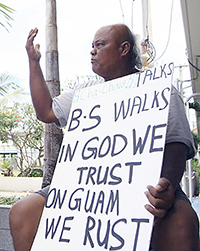
Howard Hemsing and (top) Danny Jackson, two of the most vocal activists on Guam, hold placards during a protest rally at the legislature in this Jan. 3, 2008 file photo. The island’s young people will take over the scene of activism during an upcoming rally in Hagatna. Photos by Paul Blas

She added that “It’s very important to have our young generation take firm grip of the reality of what’s happening on our island. They’re being responsible and forthright.”

Soldier kills five comrades at Baghdad base

washingtonpost.com

Five U.S. Soldiers’ Deaths Came at Hands of Comrade, Military Says

Gunman Opened Fire at Baghdad Base, Wounded Three Others

By Ernesto Londoño
Washington Post Foreign Service
Monday, May 11, 2009 1:30 PM

BAGHDAD, May 11 — An American soldier opened fire on comrades Monday on a large military base in Baghdad, killing five and wounding three, the U.S. military said.

The shooting at Camp Liberty, one of the largest bases in Baghdad, occurred about 2 p.m.

Lt. Col. Brian Tribus, a U.S. military spokesman, said the gunman was taken into custody.

A U.S. military officer in Baghdad said the shooting occurred at the base’s combat stress clinic.

The official, speaking on condition of anonymity, said the incident shook up soldiers, many of whom are in their third and even fourth tours. Some broke down in tears, he said.

“A lot of soldiers are wondering why,” the official said. “We will be asking as leaders: What could we have done? How could have we protected the soldiers?”

Most military facilities in Iraq have combat stress clinics, where soldiers seek counseling and are at times prescribed medicine for anxiety and depression.

The Army is grappling with a growing incidence of suicide cases, which military leaders attribute to the stress inflicted by multiple deployments to Iraq and Afghanistan.

A Defense Department official in Washington said three people were wounded, but he did not know if they were military or civilians.

“It’s some form of isolated incident, an unfortunate one at that,” he said.

The military did not immediately say what the motive might have been.

“Anytime we lose one of our own, it affects all of us,” said U.S. military spokesman Col. John Robinson. “Our hearts go out to the families and friends of all the service members involved in this terrible tragedy.”

The incident was among the deadliest attacks for U.S. troops in recent months. It appears to be the deadliest incident in which U.S. deaths were caused by a fellow U.S. soldier since the 2003 U.S. invasion of Iraq.

The shooting was particularly chilling for soldiers based at Victory Base Compound, which includes Liberty, because it is regarded as one of the safest installations for U.S. troops in Iraq.

Control to the compound is tightly restricted, but American soldiers carry weapons on base.

Also on Monday, the military said an American soldier was killed by a roadside bomb in southern Iraq. The attack occurred Sunday at 2 p.m. in Basra province. U.S. soldiers recently deployed additional troops to the province to replace British troops, who formally ended their mission there last month.

Liberty is one of three U.S. military bases adjacent to Baghdad International Airport.

Staff writer Ann Scott Tyson contributed to this article.

Source: http://www.washingtonpost.com/wp-dyn/content/article/2009/05/11/AR2009051100265_pf.html