Chamoru Protest at Governor’s Mansion Against Military Expansion

FOR IMMEDIATE RELEASE

PEACEFUL DEMONSTRATION OUTSIDE THE GOVERNOR’S MANSION

Hagatna, Guam

February 19, 2009
Members of Nasion Chamoru gathered outside the Government House in Tutuhan, also known as Agana Heights to demonstrate the right of assembly and the freedom of speech, greeting members of the Congressional Delegation (CODEL) on Monday, February 16, 2009 from 5:00pm to 9:00pm. The peaceful demonstration and protest was necessary because of the agenda to relocate 8,000 U.S. Marines and their dependents as well as the additional 40,000 service members in all other branches of the U.S. Military. While Secretary of State, Madame Hillary Clinton signed the Guam International Treaty, members of Congress gathered at the Governor’s House for a reception paid for by Guam Tax payer dollars. Large member’s of Guam’s elite were invited for attendance, including members of the Guam Chamber of Commerce and other off island corporate executives who never file taxes on Guam.

Members of the CODEL team purposely evaded elected officials, including members of the Guam Legislature. Instead, members of CODEL chose to meet with the Guam Chamber of Commerce and other off island corporate executives. The lack of respect given to the people of Guam and their elected officials causes worry amongst grassroots organizations such as Nasion.

After leaving Guam, Wednesday February 18, 2009, members of the CODEL team emphasized how important their “field trip” to Guam was and how this military expansion will happen whether we like it or not. In order to address the long standing racist policy against Oceanic peoples, namely the Chamoru people, and the People of Guam, social action, such as peaceful demonstrations, must take place to obtain attention to Guam’s plight. Peaceful Demonstrations are a fabric to American Democracy.

Members of Nasion protested with signs and with cultural music, but most of all, Nasion protested based on love, devotion and respect for our island, for elected officials, and with a sense of clarity of purpose that we are a political force that must be reckoned with on our island homeland. Although some proponents against Nasion Chamoru might say that the military build up is a good thing because of economics, it also means the annihilation to the inalieanable right to self-determination for the Chamoru people who have lived on these islands for more than 4,000 years. History tells of a people who have been decimated due to the influx of Westernization since the 16th century. People who have made Guam their home are also invited to join Nasion because Chamorus have always been forced to welcome our guests and we are a welcoming people. However, it is time that everyone on Guam stand with the Chamoru people to do what is right once and for all.

In the coming months, Nasion Chamoru plans to continue its freedom to demonstrate on our island community until the wrongs of the past are corrected, teaching once again the next generation to never be afraid to stand up for your beliefs. Fanoghe Chamoru!


si Debbie Quinata
I Nasion Chamoru
P.O. Box 6132
Merizo, Guam 96916
(671) 828-2957

Guam Landowners oppose US troop build up

Guam Landowners oppose US troop build up

By Online Editor

10:59 am GMT+12, 19/02/2009, Guam

Guam Landowners Association says it is opposed to United States plans for a military buildup in the territory, reports Radio New Zealand International.

The U.S. Secretary of State Hillary Clinton and Japan’s Foreign Minister Hirofumi Nakasone signed a deal in Tokyo this week to transfer 8000 U.S. Marines and their families from Okinawa to Guam by 2014.

Association’s representatives Antony Sablan said the people of Guam haven’t been asked if they support an influx of soldiers into the territory, which would boost the island’s population by about 10 percent.

Mr Sablan believes Guam would not only lose land but part of its identity.

“We are a foster child of a foster parent, where our resources are getting raped by our foster parent. Somebody has to step up to the plate and take the step to say ‘ hey, you can’t take advantage of this small group of innocent people’.”

Mr Sablan said the international community should step in and protect the people of Guam.

Meanwhile, Guam’s Chamber of Commerce is looking forward to what a planned military buildup will mean for the US territory’s economy.

“The United States and Japan signed a deal Tuesday to relocate 8000 U.S. Marines from Okinawa in Japan to Guam.”

The bulk of the relocation costs are to be covered by the US and Japan, but Guam will have to meet some of expenses arising from an infrastructure upgrade.

Guam’s Chamber’s chairman Frank Campillo said the relocation would bring many economic opportunities.

“We’ll see a huge amount of construction activity: we need to improve our island infrastructure, the streets, the waterways, the distribution of electricity, we need to build new housing. We understand there’ll be between 8 and 10 billion dollars of construction activity.”

Mr Campillo said there would also be long term benefits for the people, such as better health and education services and improved infrastructure
SOURCE: RNZI/PACNEWS

Littoral Combat Ship and Joint High Speed Vessel

Brad Parson’s sent out a post with lots of information about the Joint High Speed Vessel (Navy transport vessel research and development program, for which the Hawai’i Superferry was a prototype) and the Littoral Combat Ship (a futuristic shallow water combat ship that was supposed to revolutionize the Navy’s capabilities).

***

Sunday, February 8, 2009

Excellent links on LCS and JHSV in Australian Professor’s post today

Australian National University Lecturer Tom Worthington had another good post today comparing JHSV to LCS. There seem to be a number of articles doing that recently. Worthington previously posted back in 2005 some of the first entries on the Internet regarding the Australian designed Chinese Navy’s Type 022 Houbei Class offensive catamaran, what I call the Houbei Class “Hellcat.”

In particular Worthington cites two nice new links. One is an article from the January issue of the U.S. Naval Institute’s Proceedings, see: “Checkered Past, Uncertain Future” by Commander Otto Kreisher, U.S. Navy Reserve (Retired) in Proceedings U.S. NAVAL INSTITUTE, January 2009. The article by Otto Kreisher is excellent, one of a kind reporting on the LCS, therefore I will not be reposting it. Anybody wanting to understand LCS, JHSV, and the troubled concept of developing military vessels from commercial aluminium vessels should click over to there and read that article.

I will point out, though, just one mistake that I noticed Mr. Kreisher made in the above Proceedings article. Kreisher wrote, “General Dynamics’ LCS-2, called the Independence, is based on the ferry design seen in the High-Speed Vessel Swift (HSV-2) that the U.S. military has been leasing.” This is incorrect. LCS-2 is based on the commercial design of Benchijigua Express (An Auto Express 127 high speed vehicle-passenger trimaran ferry Video Available), a fast ferry that has been slicing through Canary Island waters with unique size, speed, and momentum.

The other good link that Worthington provides are some newly available graphics on the JHSV-1 design. Those are here and here. They are still leaving out disclosure of any significant changes to the hull design that may be contemplated regarding seakeeping deficiencies.

Re: http://www.tomw.net.au/blog/2009/02/australian-design-selected-for-us.html

Sunday, February 8, 2009
“Australian design selected for U.S. Military Transport Ships”
The design from West Australian based Austal has been selected by the US Department of Defence for the Joint High Speed Vessel (JHSV), worth around US$1.6 billion, if all ten ships are built. The aluminium 103-metre ship design is derived from that of Austal’s car ferries, one of which, the “WestPac Express” was leased to the US Marines. Austral’s main rival is also Australian: Incat of Hobart, who have also leased ships to the US military. One reason for Australia’s success in building such ships is expertise in welding aluminium.

The JHSV ships will be built in Mobile, Alabama, USA, not in Australia. These vessels are likely to be less controversial than the Littoral Combat Ship, USS Independence (LCS 2), being completed by Austal. The Independence was due for sea trials in early 2009. But both it and the competing design from Lockeed Martin (USS Freedom LCS1) have had problems with delays and cost overruns. See: “Checkered Past, Uncertain Future” By Commander Otto Kreisher, U.S. Navy Reserve (Retired) in Proceedings U.S. NAVAL INSTITUTE, January 2009.
Unlike the complex weapons and sensors used in the LCS ships, the JHSVs are more basic conversions of civilian transport ship design. Also the role of the transport ships is less controversial. This raises the interesting possibility of using the JHSVs for some of the roles envisaged for the LCSs… posted by Tom Worthington

Aloha, Brad

Korean Villagers threatened with Eviction for U.S. Base Expansion

Friday, February 6, 2009

The Struggle of Ohyunri, South Korea

1, 2, The people of Ohyun-ri, 1st Pan Korean rally against the expansion of Mugeon-ri military training field, Oct. 11, 2008, Seoul, Korea
Link

3. Korea DMZ area(mark added)


4. Kaeseong-Munsan-Paju map (English title added)


5. source from the Committee from P. 15, “Defense Reform 2020 by the SK Ministry of the National defense/ English title added


6. An Alliance For The 21 st Century And Beyond: United States Forces Strategic Digest, October, 2008

“On the basis of an agreement between the ROK and the US, the land was offered to the US military as a training area. It has become an international training ground, used not only by the USFK, but also troops based on Guam, Okinawa, and even the US mainland. This means that this training area was prepared for the purpose of permitting the US to carry out its new military strategy, based on “strategic flexibility”, which allows the USFK to conduct offensive operations outside the boundaries of the ROK.”

Written by Pan-Korean Committee against the Expansion of the Mugun-ri Military Training Fields, http://www.peaceoh.net/

Translation by Agatha Haun http://www.tlaxcala.es/

The Progressive Expansion of the Mugeonri Training Area

1980: In the vicinity of Mugeonri, a village in the Paju township, Kyeonggi Province, 3,500,000 pyeong of land (more than 10.5 million square meters) are cleared, followed by continuous expansion of the area after that.

1986: Up to this year the training area was expanded to 5,500,000 pyeong (more than 16.5 million square meters). All the residents who lived in Mugeonri at that time were evicted, and some of them moved to Ohyeonri. Now it is expected that the training ground will expand into that area.

1996: There are plans for enlarging the training area again, to 10,500,000 pyeong (more than 31.5 million square meters).

2008, September: A rushed announcement is made, afterward evaluation and assessment in Ohyeonri is moved forward.

2009: At present, the great majority of the residents do not accede to the National Defense Ministry’s plan to buy them out, and appeasement and threats are used to win them over.

In September last year, residents protested against the National Defense Ministry’s high-handed evaluation and assessment methods. Because of that, in connection with the illegal arrest of some residents, and the investigations that were set in motion, residents were summoned and compelled to make written apologies. This ran parallel with disgraceful coercion and pressure on residents.

The nature of the Mugeonri training area

As the only joint type of large-scale training area in the north part of Kyeonggi Province, it has been used for practicing the military strategy of an offensive against the North. It is expected that from now on it will seriously hinder the peace and reunification of the Korean peninsula.

On the basis of an agreement between the ROK and the US, the land was offered to the US military as a training area. It has become an international training ground, used not only by the USFK, but also troops based on Guam, Okinawa, and even the US mainland. This means that this training area was prepared for the purpose of permitting the US to carry out its new military strategy, based on “strategic flexibility”, which allows the USFK to conduct offensive operations outside the boundaries of the ROK.

Residents of Ohyeonri living in the area where the enlargement of the training area is planned

Currently there are more than 200 residents, living in more than 100 households. They live mainly by raising livestock and farming. It is a handsome village with beautiful scenery and many natural monuments. During the more than 30 years since the training area was first created, the residents have endured the suffering caused by the noise of tanks and so on during training exercises. In the meantime, the state, far from paying any compensation for the harm suffered by the residents, now is again trying to force their eviction. The majority of residents are outraged by this violence and oppose it.

The residents’ demands

Out of the entire area planned for the expansion of the training ground, more than 9,300,000 pyeong (over 28 million square meters), essentially 8,400,000 pyeong (more than 25.2 million square meters) is now secured by the Ministry of National Defense. In connection with this, on the occasion of the inspection of government offices, some National Assembly members asked the Minister of Defense why the military cannot conduct exercises in the training area in its present condition. Lee Sang Hee, the Minister of Defense explained that the training space had already been sufficiently enlarged, and that the residents were being made to remove simply for the sake of their own safety and security. However, in the middle of the training area where the village is situated, there is a national highway where every day several hundred thousand vehicles pass by. If one looks at it in light of the fact that there were already military units within the training area, this is merely an unconvincing, deceitful answer. The residents have already been living there for several decades already without any problem at all and training has gone on, and since the Minister of Defense himself said that the space needed for training had been enlarged enough, the residents demand that they be allowed to continue to live in their homes. Along with compensation for harm caused by living inside the training area, the residents are demanding the construction of sidewalks, in order to put an end to the danger caused by the careless driving of tanks. (In fact, this is the place where two middle school girls were run down and killed by a US armored vehicle in 2002.)

The need for international solidarity

As has been mentioned, this place is being used by the US as a training area for the purpose of implementing the aggressive, new military strategy that it intends to follow in Northeast Asia. Even so, although at present the US military has somewhat reduced its training exercises here, because of the residents’ struggle, it is expected that if the residents all are expelled and forced to leave, the US military forces’ training will proceed in earnest. (Due to an agreement between the ROK and the US, it was decided already that the US forces would use more than half the entire number of training days (91 days).) It is clear that this increases tension in Northeast Asia and has become a serious obstacle to reconciliation and cooperation between South and North Korea. Deepening military antagonism on the Korean peninsula and in Northeast Asia has become a major challenge to the peace of the entire world. Accordingly, the struggle to prevent the enlargement of the Mugeonri training area must become an significant concern and a matter of solidarity among the peace-loving people of the entire world.

We hope for your international solidarity and support for the Ohyeonri residents’ hard struggle!

* For more *

Candle light vigil
About Mugeonri training centerLink

http://en.wikipedia.org/wiki/Paju

http://activistphoto.net

* For more reference*

Realignment of U.S. Forces in Korea and Changes in US-ROK Military Alliance(Oct 2008)

http://usacrime.or..kr/ (Check English in the top right)

Posted by NO Base Stories of Korea at 6:20 AM
Labels: Mugun-ri/Ohyun-ri, United States Forces of korea(USFK), United States’ Strategic Change in Korea

No Bases Statement from participants at the World Social Forum

THE WORLD SOCIAL FORUM

THE INTERNATIONAL NO BASES NETWORK

Belem do Para, Brazil

February 1, 2009

The International Network for the Abolition of Foreign Military Bases, meeting at the WSF in Belem do Para, Brazil, from 27 January to 1 February 2009, recognized that:

The single biggest challenge in the militarization of Africa is the installation of the U.S. Africa Command, AFRICOM, in Stuttgart, German, from where the US provokes rebellion, civil unrest and fabricated terror attacks, in order to deal with this by using military means, as well as controlling the ongoing occupation of Iraq and Afghanistan;

The Latin American and Caribbean region’s sovereignty has been violated with the re-installation of the U.S. Fourth Fleet, the increased militarization through foreign military bases and other forms of military presence, the military occupation of Haiti and the probable transfer of the US Base in Manta, Ecuador to another country in the region;

The remodelling of NATO to go beyond the North Atlantic and act offensively in its military expansion, makes NATO an unacceptable threat to world peace and complicit with the United States in the war against terror. People all over the World will join forces in April to demand an end to NATO.

Asia and Pacific denounces the presence of the nuclear destroyer George Washington, which spreads nuclear radiation off the coast of Japan and the continued US military presence in Japan, the Philippines, Guam, Hawaii, Korea, among others.

North America has an important role, especially in the US, because of the awareness that needs to be raised in the country in relation to the imperial power represented in its 946 military bases abroad and more than 4000 in mainland US, 165 in Alaska, 121 in Hawaii and 17 in Washington D.C.

The No Bases Networks shares with all movements that work for global justice, human rights, demilitarization and global peace, its commitments:

We express our solidarity with the Palestinian people, especially the people in Gaza, for their struggle against occupation. We demand that Israel be taken to the International Court of Justice for crimes against humanity.

We support the US decision to close the torture center in Guantanamo, Cuba, but find it inadequate if the bay is not returned to its rightful owners, the people of Cuba.

We celebrate the withdrawal of US troops from the Manta Base in Ecuador, and urge social movements to be vigilant that it is not relocated in another country in the region.

We support the Anti-NATO campaign and activities to be carried out around the 60th Anniversary, where we will actively participate in Strasbourg on April 5th and all activities planned around the world. We express our solidarity with the people of Vicenza who have reclaimed their land which has been occupied by a US Base.

We denounce the 4th Fleet and will develop common strategies to fight its expansion and continued presence, during the meetings in Argentina in March, Trinidad and Tobago Presidents’ meetings in April, Brazil in June, Ecuador in October.

We support the people of Diego Garcia, displaced by the British government to install a US base, even after a favourable court ruling that gave them back their land, only to be dismissed by the House of Lords.

We condemn the establishment of AFRICOM and urge all African governments, social movements and others, to deny its presence in Africa. The global network should support African initiatives and a regional gathering to address this crisis.

We support the struggles against foreign military bases in Asia and Pacific and urge the global movement to join with the organizations and networks in the region to develop regional strategies and campaigns.

We invite all organizations to the Security Without Empire – National US Conference on Foreign Military Bases to be held on February 27 – March 2, 2009 in Washington D.C.

We condemn the hypocrisy of the US for endorsing the budget presented by George Bush, which includes the military budget, without any caveats, that presents an obstacle to our struggle.

We propose the development of a Treaty to Ban Foreign Military Bases, similar to the Ban Landmines Treaty.

We demand civilian oversight of US military activities in the world, with the involvement of multilateral organizations, such as the United Nations, among others.

We need to challenge and counter the “War on Terror” rhetoric, when analyzing in particular actions of resistance groups and Islamic political organizations.

WE COMMIT TO CONTINUE IN OUR STRUGGLE TO ABOLISH ALL FOREIGN MILITARY BASES, END ALL OCCUPATION AND SEND ALL TROOPS HOME.

For more information or to join the No Bases Network find us or contact us on:
www.no-bases.net or secretariat@no-bases.net or Wilbert@tni.org

Protests as US Warship Docks in Nagasaki

Published on Thursday, February 5, 2009
by Agence France Presse

Protests as US Warship Docks in Nagasaki

by Agence France Presse

TOKYO – A US warship docked Thursday in Nagasaki to the protests of residents and a boycott by local leaders who said the visit was in poor taste in a city obliterated by a US atomic bomb.

The USS Blue Ridge, which is stationed in Yokosuka near Tokyo, sailed to Nagasaki with a stated goal of promoting friendship between Japan and the United States.

Hundreds of residents including atomic bomb survivors chanted, “We are opposed to the port call!” as the 19,600-ton vessel arrived in the southwestern city.

“We don’t want to see the US flag flying at this port and this feeling will not change until the United States takes a policy towards the elimination of nuclear weapons,” Osamu Yoshitomi, an official at Nagasaki city, told AFP.

Nagasaki’s mayor and regional governor both refused to take part in the welcome ceremony after unsuccessfully asking Japanese and US authorities to cancel the visit.
The United States stations more than 40,000 troops in Japan under a post-World War II alliance. Under a 1960 agreement, local authorities do not have the right to refuse US warships’ port calls.

It was the seventh visit by a US military vessel to the city of Nagasaki. The US Navy also maintains a major base in the nearby city of Sasebo, part of Nagasaki prefecture.

Nagasaki Mayor Tomohisa Taue regretted the timing of the visit, saying that atomic bomb survivors had been optimistic that newly installed US President Barack Obama would move towards nuclear abolition.

“Nagasaki cannot accept a port call which rouses anxiety in a city hit by an atomic bomb,” Taue said in a statement.

Some 70,000 people died on August 9, 1945 when US forces dropped an atomic bomb on Nagasaki. Three days earlier, another atomic bomb killed more than 140,000 people in Hiroshima.

Japan surrendered on August 15, ending World War II.

Navy training expansion in Puget Sound meets resistance

2/4/2009

Navy training expansion draws criticism

By Justin Burnett
Examiner Staff Writer
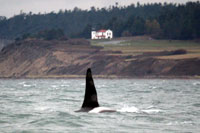
Photo: Howard Garrett
Ruffles, the oldest known male orca in the world, swims past Fort Casey Lighthouse in October 2008. The U.S. Navy recently released its plans to increase operations in its Northwest Training Range Complex and the news has many people wondering what the impact will be to marine wildlife and the environment.

Justin Burnett / The Whidbey Examiner
Clinton resident John Hurd speaks at a public hearing in Oak Harbor concerning the U.S. Navys plans to expand activities at the Northwest Training Range Complex.

Public comment
Mail comments about the plan by Feb. 11 to Naval Facilities Engineering Command Northwest, Attn: Kimberly Kler, 1101 Tautog Circle, Silverdale WA 98315-1101, or submit comments online at www.nwtrangecomplexeis.com.

As many as 150 orcas are known to inhabit the waters of Puget Sound and the coast of Washington at various times of the year.

Among them is Ruffles. He belongs to a small family group called J-pod. At 57, he is the oldest known male orca in the world, according to Howard Garrett, president of Orca Network, a Whidbey Island based nonprofit group dedicated to raising awareness about whales in the Northwest.

Ruffles’s exact age has been confirmed through photographic evidence. The characteristic ruffled back edge of his dorsal fin not only makes him easy to identify but also earned him his name.

He is usually spotted traveling on the outskirts of the pod. It may be that he is a loner or it may be that his position serves some special function within the group. It’s one of the many mysteries about orcas that scientists have yet to discover, Garrett said.

The U.S. Navy recently released its plan to expand its training operations in Puget Sound and off the coasts of Washington and Oregon. With everything from missile and sonar testing to dumping depleted uranium included in the proposal, some environmentalists are concerned that Ruffles and J-pod may have given up the last of their secrets.

Strategic defense

The Navy’s plan is to expand operations in its Northwest Training Range Complex, an area encompassing about 122,400 nautical miles of air, surface and subsurface space, which has been in operation since World War II.

The main purpose is to prepare for the wars of tomorrow, said Cmdr. Matt Miller, the executive officer at the Whidbey Island Naval Air Station, at a public hearing on the plan last week in Oak Harbor.

“Realistic training insures U.S. Navy personnel maintain the highest level of readiness in capability and is the single greatest asset the military has in preparing and protecting American service men and women to defend the nation,” he said.

The Navy has spent the past year preparing an environmental impact statement, or EIS, which is a requirement of the National Environment Policy Act. According to the document, which contains more than 1,000 pages, current training exercises in the complex include everything from anti-air, anti-surface, and anti-submarine warfare to explosive ordnance disposal.

Besides a no-action option, the EIS outlines two main alternatives. The first calls for an increase in current training activities as well as testing new equipment such as new aircraft, guided missile submarines and unmanned aerial systems.

Alternative 2, the Navy’s preferred option, includes all the changes outlined in alternative one but proposes increasing current training levels even more and enhancing the range by using new air and sea surface targets, and developing an underwater training minefield.

According to the EIS, Alternative 2 would allow the Navy to increase the number of missiles it fires by 470 percent, from 10 per year to 57 per year. The number of bombs dropped per year would increase 33 percent, from 108 to 144, and the number of shells fired would increase 106 percent, from 25,856 to 53,343.

That includes 20 mm cannon shells made from depleted uranium. Alternative 2 also would roughly double the number of sorties flown per year, from 2,499 to 4,998.

While most of these exercises would take place in coastal waters, some explosives testing is currently allowed within Puget Sound. Under Alternative 2, such activities would continue to be allowed.

Impact debated

Despite the Navy’s proposals, the EIS concludes there will be no significant effect on marine life from any of the offered alternatives.

The claim has drawn significant skepticism from a number of local residents. Of the 30 people who attended the public hearing in Oak Harbor, not a single person voiced support for the Navy’s plans. Instead, one attendee after another said the study’s conclusions are hard to swallow – literally.

“How much depleted uranium do you want to eat in your fish?” asked Zimmer Morris, a South Whidbey teacher.

While the study acknowledges that some species listed under the Endangered Species Act – certain salmonid species, leatherback turtles, migratory mammals and birds – could be affected, it would not be enough to have lasting effects.

The EIS is also proposing mitigation measures to help reduce potential impacts. With marine mammals, such as whales, the plan is to use passive sonar and keep at least three “well-trained” lookouts on duty 24 hours a day. When the animals are present, and they come within 200 yards, certain training exercises would be halted until the animals move out of the area.

But several people at the hearing expressed their doubt about the effectiveness of the mitigation measures. The Orca Network’s Garrett, for example, said he has been involved in observing and researching whales since 1981 and is aware of the difficulties of listening for “faint acoustic signals” that would indicate the presence of orcas.

“Recognition is highly problematic – even for experienced personnel,” Garrett said.

Another common concern among speakers was a feeling of being blindsided by the Navy’s plans. Although the EIS has been in the works for more than a year, Clinton resident Jerry Hurd said he didn’t learn about the proposal until January, shortly after the public comment period started Dec. 29. The comment period closes Feb. 11.

He also complained that he found it difficult to submit comments on the plan. The document was available at the Oak Harbor library, but not at any of the other Island libraries. And he said the Navy’s Web site, where the plan could be viewed online, wasn’t working for several days during the comment period.

“I think it would be appropriate there be an extension” of the public comment period, he said.

People from environmental organizations such as Whidbey Environmental Action Network, Whidbey Audubon Society and People for Puget Sound reported they also hadn’t learned about the plan until January.

“We just found out about this,” said Mike Sato, spokesman for People for Puget Sound.

Garrett said he also is hoping for an extension to the public comment period. Washington residents need more time to comment on the proposal, and a delay could improve the chance that the Navy’s plan will be noticed by Obama administration officials in Washington D.C., he said.

“The more time we can buy, the better,” he said.

Source: http://www.whidbeyexaminer.com/main.asp?SectionID=1&SubSectionID=1&ArticleID=2186&TM=66263.9

Kyrgyz government seeks to close U.S. military base

The U.S. may lose a key military base in Central Asia as the Obama Administration prepares to “surge” in Afghanistan.  According to a report by the AP, the government of Kyrgyzstan introduced legislation to close the U.S. military bas at Manas:

Kyrgyzstan’s government submitted a draft bill to parliament Wednesday that would close a U.S. base that is key to the American military campaign in Afghanistan.

Russia opposes the base at its doorstep.   The U.S. Embassy said that it did not receive formal notification of this closure.  The U.S. is seeking to maintain the base despite the Kyrgz government’s bid to close the base.

The report also cited opposition to the base as one of the reasons for the closure:

The Kyrgyz government also cited growing popular discontent with the U.S. military presence among its motivations for the closure. It also criticized U.S. obstruction of the investigation into the fatal shooting in December 2006 of a Kyrgyz truck driver by a U.S. serviceman during a security check at the entrance to the air base.

Protest and healing ceremony at Pohakuloa

Here’s a report from Jim Albertini, one of the organizers on Hawai’i island resisting further militarization.    They recently organized an action up at Pohakuloa.  You can also view a video covering both the Pro-Hawai’i/Pro-Peace protest and the Pro-war protest here.

POHAKULOA HEALING CEREMONY AND PROTEST

Aloha Kakou,

Approximately 50 Big Island residents gathered on Saturday, Jan. 3lst from l0AM till lPM at Mauna Kea Park, adjacent to the l33,000-acre military Pohakuloa Training Area (PTA). Troops were present at PTA but no live-fire was observed. The purpose of the gathering was twofold. First to conduct a healing ceremony for the ‘aina and second, to protest the ongoing military bombing, radiation contamination, desecration and occupation of the Hawai’i Kingdom. People brought ho’okupu (offerings) for the healing ceremony. Ali’i ai Moku, Paul Neves, of the Royal order of Kamehameha, brought his Halau who offered oli and hula as part of the ceremony. Kaliko Kanaele, a member of the Royal order and a long-time activist taught chants to those gathered about the importance of pulling together and bringing things to light. A number of people shared personal stories and thoughts on resistance. Protest signs at the gathering read: “Aloha ‘Aina –A Call to Action,” “Stop the Bombing,” “End U.S. Occupation,” “Make Peace–Work for Justice.” “The Kingdom Lives – Return Ceded Lands.” Throughout the gathering there was obvious military/police surveillance from vehicles in the park and adjacent military areas.

Throughout the ceremony and protest strong trade winds were blowing from Hilo so our gathering was fortunately upwind of the PTA base impact area. No above background readings were noted on several radiation monitors present unlike May 29, 2007 when winds were blowing directly off the PTA impact area toward Mauna Kea Park and citizen monitors recorded several spikes 4 times background levels.

People who came from Kona noted there was an American flag waving pro-war group of about 20 people at the PTA main gate area, located about l mile from Mauna Kea Park. Among those present was Andrew Walden, editor of the right wing now defunct Hawaii Free Press newspaper.

Following the healing ceremony, speakers, and a pani of shared food at Mauna Kea Park, several people carried the protest to the PTA main gate area. Protest signs were set up directly in front of the PTA main gate, across Saddle Road from the Pro-war demonstration. Ho’okupu from the healing ceremony were left on the triangle piece of land fronting the PTA main gate. Some exchange of thoughts took place across Saddle Rd, but all went peacefully.

The West Hawaii Today, Jan. 3lst newspaper ran an article saying that Army Col. Howard Killian will be giving a presentation to the Hawaii County Council Intergovernmental Relations Committee at l0:30AM on Tuesday, Feb. 3rd. on depleted uranium at the Pohakuloa Training Area. The article said, “the military recently completed tests to determine whether any of the material poses a threat to army personnel at PTA or residents. Although the tests won’t be made public until spring, military officials recently reported the tests determined no danger exists.”

This kind of statement about “no danger exists” is a military medical judgment. The military keeps repeating “no danger” with no data available for examination. We demand data on the radiation contamination, control data, etc. We want to know the extent of the radiation contamination and if DU penetrators have been used at PTA which we highly suspect. The military is trying to focus ONLY on DU Davy Crockett spotting rounds from the l960s. The military has a proven track record that it cannot be trusted to tell the truth.

JOIN IN A PROTEST AT THE COUNTY COUNCIL BUILDING 9:30 AM ON TUESDAY, FEBRUARY 3RD TO CHALLENGE COL. KILLIAN ON HIS STATEMENTS OF ‘NO DANGER.’

Jim Albertini

Malu ‘Aina Center for Non-violent Education & Action
P.O.Box AB
Kurtistown, Hawai’i 96760
phone: 808-966-7622
email: JA@interpac.net
Visit us on the web at: www.malu-aina.org

Activists in Vincenza, Italy occupy the site of a proposed U.S. military base

=================================
2009/1/31 Stephanie Westbrook <steph@webfabbrica.com>
Hi all,

This morning around 10am the movement opposing the new U.S. base in Vicenza entered and occupied the site. The police were caught completely off guard and the activists were able to cut the fence and gates and occupy the area. Once the police arrived, they were planning to forcibly remove the protesters. However, the protesters are occupying an area that was the airport Dal Molin, which is technically under control of the Italian civilian aviation authority, ENAC, who has said the protest is legitimate. So far the police have backed off. Tonight there will be a public assembly followed by a dinner and concert. Monday, Feb 2, had been announced by the movement as the start of a week of initiatives to protest the demolition work that is being carried out in preparation for the construction of the base, but it looks like the activists got off to an early start!

See below a “rough” translation of an article.

There is a short video on La 7: http://tinyurl.com/c7nqq6

You can also follow updates in Italian on the No Dal Molin and And Global Project sites:
http://www.nodalmolin.it/
http://www.globalproject.info/art-18748.html

For background, see the dossier in English:
http://www.peaceandjustice.it/vicenza

Stephanie

(Original in Italian – http://tinyurl.com/bfsdan)

Blitz in Vicenza: Site of the New US Base Occupied

About two hundred activists of the “No Dal Molin” movement entered the area of the Vicenza airport where a few days ago the construction of the new U.S. military base Camp Ederle 2 began.

The blitz was announced by the members of the movement themselves.

The police are on the site – including the Questore of Vicenza – and are
overseeing the peaceful occupation of the area.

To enter the area the protesters cut a piece of the fence. The Questore Sarlo is trying to start negotiations with the demonstrators. There are also members of the Disobbedienti who arrived from Padova and other cities of the Veneto region.

The situation for the moment is calm. The demonstrators displayed banners and posters against the U.S. military, and with the spray paint wrote “Vicenza City of Peace” and “You demolish, we build peace”. The protesters have not reached the area from the inside of Dal Molin, protected by a fence, which is being developed by the company in charge of demolishing the existing structures.

Some of the coop workers of CMC of Ravenna that were working on the site were taken away as a precaution. A fact that the ‘No Dal Molin’ have already declared as a victory.

Twenty demonstrators were on the roofs, while outside began assembling a tent. “This – said the Committee – is the response by those opposed to the project to the announcement of the imminent start of construction. On October 5, through the popular consultation, the participants decided in a vote by a large majority that the land must be devoted to civilian uses, therefore seeking to implement the project means trampling democracy.”

For the protesters, the project to double the U.S. base is “illegitimate and illegal, because the proponents have refused to accept that a detailed environmental impact assessment be made of the site, a useful tool in protecting the health and the area.” The occupation, the say, will continue indefinitely.