Okinawan defense chief compared military relocation to rape

The head of the Okinawan Defense Bureau compared the relocation of the Futenma military base to Henoko to an act of rape and may lose his job because of it.   It was probably a poor political choice of words given the politically charged atmosphere in Okinawa regarding U.S. military bases and the many crimes committed by U.S. troops there.   However, it is probably the most honest description of the attitude of the U.S. and Japan towards the bases in Okinawa.  Here’s an excerpt from the Asahi Shimbun:

The director-general of the Okinawa Defense Bureau may lose his job after he reportedly compared the delayed release of an environment assessment report on the planned relocation of a U.S. Marine Corps air base to warning someone about being raped.

“Would you say, ‘I will rape you,’ before you rape someone?” Satoshi Tanaka is reported to have said in an unofficial meeting with reporters on Nov. 28.

Tanaka allegedly made the comparison when asked why the government was waffling on the submission date of an assessment report on the environmental impact of the planned relocation of the U.S. Marine Corps Air Station Futenma to the Henoko district of Nago, Okinawa Prefecture.

Nye on U.S. ‘pivot’ to Asia Pacific

Joseph Nye, President Clinton’s first Assistant Secretary of Defense for International Security Affairs wrote an opinion article for the New York Times that applauds President Obama for his ‘pivot’ towards the Asia Pacific region and decision to increase U.S. military training in Australia.  This appears to be a concession that the move of Futenma air station within Okinawa is not feasible.  But one should read this article as the logic driving U.S. policy in the Asia Pacific.   As you can see, the concerns and wishes of peoples of the Pacific do not factor into his thinking.

He writes

There are three good reasons for President Obama’s decision to rotate regularly 2,500 Marines through an Australian base.

Obama is right to ‘pivot’ American foreign policy toward East Asia. It sends the right message to China, and avoids further friction with Japan.

Of the U.S. “message to China” he writes:

The Pentagon’s East Asia Strategy Review that has guided our policy since 1995 offered China integration into the international system through trade and exchanges, but we hedged our bet by simultaneously strengthening our alliance with Japan. Our military forces did not aspire to “contain” China in a cold war fashion, but they helped to shape the environment in which China makes its choices.

And of the Okinawa situation he concedes:

The U.S. and Japan have been working on the Futenma issue since I co-chaired a special action committee on Okinawa — in 1995! The current official plan to move the Marines inside Okinawa is unlikely to be acceptable to the Okinawa people. Moving Marines to Australia is a smart move because they will be able to train and exercise freely without inadvertently signaling a withdrawal from the region.


Navy wants the two Hawaii Superferries

When the community rallied to oppose the fast-track of the Hawaii Superferry back in 2007, we began to raise concerns about the military interests driving the venture.  Corporate and public officials dismissed the concerns as paranoid rantings.   But diligent research by Lance Holter and others surfaced many connections between the Hawaii Superferry prototype and the Joint High Speed Vessel that is now in production.  Now the Virginian Pilot reports that the Navy is bidding on the two Hawaii Superferry vessels that were repossessed by the Maritime Administration:

The Navy wants the two Hawaiian superferries docked at Lamberts Point in Norfolk.

The Navy “is working with the U.S. Maritime Administration to permit the transfer of the two high-speed vessels, formerly Hawaii superferries, into the naval service of the United States,” Lt. Cmdr. Alana Garas, a Navy spokeswoman, said Friday.

One of the ferries, the Huakai, was used in the military’s relief efforts after the Haiti earthquake in January 2010. The Navy first expressed interest in the ferries after the Maritime Administration took possession of them in 2009.

The Maritime Administration said Friday that a deal had yet to be reached.

“We continue to work with interested parties, including the U.S. Navy, in evaluating all options, with a goal of maximizing the government’s return from these vessels,” Kim Riddle, an administration spokeswoman, said in an email. “We anticipate announcing a winning bidder soon.”

Call for solidarity to save Takae forest in Okinawa!


The Okinawa Outreach blog posted news and an action alert about an escalating situation in Takae in Northern Okinawa.  The U.S. military uses the area as a jungle warfare training area and is attempting to expand the base, including construction of a new helipad.  The local residents have been blocking construction and holding vigil.  The article reports that construction equipment showed up on the scene but was blocked from the site by protesters.  They ask for solidarity:

We would like to call for your attention and action to support Takae people.
Here are what you can do:

・Check Takae blog (in Japanese) and Okinawa Outreach Facebook Group for update on Helipad construction in Takae.
・Spread update on Takae to make the issue known to the world.
・Express your objection to the construction of helipads in Takae by writing to the Okinawa Defense Bureau and the Japanese government.
– Japan Ministry of Defense     infomod@mod.go.jp
-Okinawa Defense Bureau  Fax: 81-(0)98-921-8168
・Send a message of solidarity to info@nohelipadtakae.org.  Your words will encourage Takae people to keep on with their struggle to protect Yanbaru forest and their life. You can leave your comment on their blog or send an email to info@nohelipadtakae.org

Here’s an excerpt from the article. There is more background information in the full article:

Save Takae ! Voice your opposition to the resumed US helipad construction !

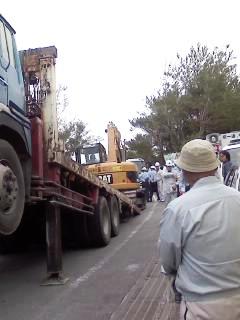
Photo:Takae People’s Blog, ”What is going on in Takae, Higashi village”
On November 15, the Okinawa Defense Bureau (ODB) returned to Takae in the Yanbaru forest to resume the construction of six new helipads for US military for the first time in 8 months.
According to Yamashiro Hiroji, a sit-in protester, about 70 people including 30 OBD staff members and 30 security guards showed up around 10:18 am in front of the Gate of N-4 Point with heavy machinery, demanding that the local residents and their supporters make way for them to resume the construction work.


Shortly after arrival of the ODB, about 40 people from various parts of Okinawa came to join the local residents and their supports to stage a larger sit-in protest against the ODB’s move.

The stand-off between the two sides became intensified as several construction crew members sneaked into the construction site.  With the machinery kept outside the construction site, however, the ODB was unable to do much work.

On November 16 and 17, ignoring the local residents and supporters’ protest and call for dialogue, the ODB again returned to Takae in attempts to resume the construction work with force.  They were however kept outside the construction site by the local residents and their supporters and were not able to conduct much work. (Okinawa local TV QAB’s report [in Japanese] on Nov.17 is here).


APEC “Hawaii’s biggest media event since Pearl Harbor”?

Calling APEC  “a game changer for Hawaii,” (11/19/2011) Honolulu City Council member Stanley Chang gushed that “This was Hawaii’s biggest media event since Pearl Harbor.”   And to him, “good press” included headlines like “Leaders’ close call with grass skirts and coconut bras.”  Or APEC agent Christopher Deedy fatally shooting local Kollin Elderts in a 3 AM altercation in a Waikīkī McDonalds.

Seriously?   You can’t make this stuff up.   Calling “Pearl Harbor” a “media event” trivializes the tragedy and horror of World War II..   But if APEC, and militarization in Hawai’i are only about the money, which is how these events are seen by many government and private sector leaders, then why not link APEC to Pearl Harbor?   After all, “Pearl Harbor” is a myth that sells.

However, digging deeper into the comparison between Pearl Harbor and APEC, more profound similarities emerge.  Both represent the policies of powerful countries vying for dominance in the world system.  During WWII, the U.S. and western powers prevented Japan, a rising power from effectively and peacefully integrating into the world economic system.   The rules of the game were also set by the ruling powers to reward countries that behaved in an imperialist manner, and Japan, ever the diligent student, was happy to oblige.  The Pacific War was the collision of American and Japanese imperialisms vying for dominance in the Pacific.

APEC was the backdrop for President Obama to announce his new ‘pivot’ to the Asia-Pacific region. He pushed hard for the Trans-Pacific Partnership Agreement (TPPA), which would create a U.S. dominated economic bloc without China.  Obama then announced that he was increasing the U.S. military troops and activities in Australia.  These more aggressive moves signal a shift to a more containment-oriented strategy towards China.  These moves will increase tensions with China, a rising power that the U.S. wants to contain.

In the prelude to World War II, Japan sought to ensure its economic growth by creating a Japanese-dominated economic bloc called the Greater East Asia Co-prosperity Sphere.  Today, the U.S. wants to ensure its economic recovery by creating a U.S.-dominated Asian economic bloc through the Trans Pacific Partnership.  As Michel Foucault observed, inverting the Clausewitzian maxim, policy and economics has become a form of war by other means.  But will it turn into guns and bombs?   In the Pacific, we know what the consequences would be of such a turn.  Quoting Philippines anti-bases scholar/activist Herbert Docena, Joseph Gerson noted at the Moana Nui Conference, “When elephants battle or make love, it is the ants who are crushed.”


Occupy APEC with Aloha

Christine Ahn wrote an brilliant article in FPIF on the Moana Nui conference and peoples’ resistance to the APEC neoliberal – militarization agenda.   I quote liberally from the article below.  You should read the full article here.

“The time has come for us to voice our rage,” the Hawaiian artist Makana sang as he gently strummed his slack-key guitar. “Against the ones who’ve trapped us in a cage, to steal from us the value of our wage.”

Makana wasn’t serenading the Occupy movement; rather his audience included over a dozen of the world’s most powerful leaders, including President Obama and China’s Premier Hu Jintao, at the world’s most secure, policed, and fortified event: the Asia Pacific Economic Cooperation (APEC) dinner in Hawaii.

[…]

Makana, however, wasn’t the only one voicing his outrage during the APEC summit. As government and corporate leaders from 21 Asia-Pacific economies plotted how to expand a global free trade agenda, civil society activists from throughout the Asia Pacific gathered across town at the Moana Nui (the Great Pacific Ocean) conference to discuss pressing issues facing people and the planet, such as climate change, income inequality, and militarization of the region.

Organized by Pua Mohala I Ka Po and the International Forum on Globalization (IFG), scholars, activists, policy analysts, lawyers, labor union leaders, practitioners, and artists traveled from Guam, Marshall Islands, Palau, Tonga, Fiji, Micronesia, New Zealand, Australia, Rapa Nui, Samoa, Japan, Siberia, Okinawa, Philippines, South Korea, Vanuatu, and the United States.

[…]

What’s significant is what preceded and then followed Obama’s China bashing. Ahead of the summit, both State Secretary Hillary Clinton and Defense Secretary Leon Panetta outlined the United States’ expanded role in the Asia-Pacific. In “America’s Pacific Century,” an article in Foreign Affairs, Secretary Clinton writes that the United States will “substantially increase investment—diplomatic, economic, strategic and otherwise—in the Asia-Pacific region.” Defense Secretary Leon Panetta also echoed Clinton on his last trip to Asia, where he promised greater U.S. military presence throughout the Asia-Pacific—that is, more than the 300-plus U.S. bases that have already been there for over half a century.

After APEC, President Obama visited Australia to announce the arrival of 250 U.S. marines to northern Australia next year, with the eventual buildup to reach 2,500. “The goal, though administration officials are loath to say it publicly,” writes Mark Landler of the New York Times, “is to assemble a coalition to counterbalance China’s growing power.” Although Washington is posing China as a military threat, the reality is that in 2010, the United States spent $720 billion on its military, compared with China’s $116 billion, and it’s the United States that has over 300 military bases in the Asia-Pacific, whereas China has none.

Moana Nui: The Alternative to APEC

Moana Nui brought together several social movements—the indigenous and native communities fighting for sovereignty with activists working to stop corporate globalization and militarism. It was significant to be gathering in Hawai’i, a once-sovereign nation whose Queen Lili’uokalani was overthrown by American gunboat “diplomacy” in 1893. Moana Nui opened with a daylong conversation among indigenous and native communities from throughout the Pacific. This was an important reminder of the United States’ long history of stealing indigenous peoples’ lands, without treaties, without democratic process. Moana Nui participants also reframed the Pacific in aquatic terms as the “liquid continent” instead of the continental approach used by hegemonic powers.

Their voices were soon joined by those who have been organizing and resisting against the onslaught of trade liberalization and militarization, the new and more subtle face of colonialism. Moana Nui participants shared how transnational corporations, empowered by free trade and structural adjustment policies, have destroyed local economies, cultural properties, natural resources, and ultimately the sovereignty and self-sufficiency of communities. Jane Kelsey, Professor of Law at the University of Auckland, warned that the TPP will further impact domestic policy and regulation and “give more ammunition to corporations to challenge governments,” by granting foreign investors stronger intellectual property rights and further facilitating corporate global supply chains.

The corporate-led free trade agenda, however, needs the military to secure its profits. Kyle Kajihiro of Hawaii Peace and Justice reminded the audience of Thomas Friedman’s classic quote, “The hidden hand of the market will never work without a hidden fist—McDonald’s cannot flourish without McDonnell Douglas, the designer of the F-15. And the hidden fist that keeps the world safe for Silicon Valley’s technologies is called the United States Army, Air Force, Navy and Marine Corps.” The military has gone hand-in-hand with free trade by forcing open new markets for investment and new natural resources for exploitation (let’s not forget Iraq). Although it may allow for the safe and secure transport of vital natural resources such as oil and natural gas, the military is there to project force, a lethal force that could intervene militarily if U.S. interests were compromised.

[…]What was clear during Moana Nui was that the peoples of the Asia-Pacific refuse to fall victim to the growing arms race between the United States and China. Echoing a proverb widely known in the Pacific, Gerson warned, “When the elephants are battling or making love, it’s the ants that get squashed.” Activists from Guam and Okinawa shared how the decades-long presence of U.S. military bases had destroyed their livelihoods, culture, and sovereignty, but also how their organizing has led to victories, such as delaying the transfer of 8,000 U.S. marines from Okinawa to Guam, and mass protests that brought nearly 100,000 Okinawans to the streets to protest the transfer of U.S. bases within Okinawa.

[…]

The final sessions of Moana Nui carried a clear message: the only way to address these challenges to sovereignty is to fundamentally roll back the conditions and laws imposed by FTAs, the WTO, and structural adjustment. As Walden Bello put it, “We need to de-globalize economies instead of being subordinated to free trade and global markets if we want to achieve food security, human livelihoods and ecological sustainability.”

[…]

The final declaration that emerged out of Moana Nui united the struggles of those who traveled across the great Pacific Ocean. “We invoke our rights to free, prior and informed consent. We choose cooperative trans-Pacific dialogue, action, advocacy, and solidarity between and amongst the peoples of the Pacific, rooted in traditional cultural practices and wisdom.”

The declaration also included a Native Hawaiian prophesy which echoes the principles of the Occupy movement: E iho ana o luna, E pi’i ana o lalo, E hui ana na moku, E ku ana ka paia. “That which is above shall be brought down, that which is below shall rise up, the islands shall unite, the walls of our foundation shall stand.” E mau ke ea o ka aina i ka pono. “Forever we will uphold the life and sovereignty of the land in righteousness.”

U.S. pivot to Asia makes China nervous

The Washington Postpublished an informative article on China’s reaction to President Obama’s “pivot” toward Asia:

With the Obama administration’s high-profile pivot toward Asia this week — pushing for a new free-trade agreement with at least eight other countries and securing military basing rights in Australia — China is feeling at once isolated, criticized, encircled and increasingly like a taret of U.S. moves.

The Trans-Pacific Partnership Agreement (TPP), which was the major policy issue at the APEC summit in Honolulu, will raise tensions between China and the U.S. and spill over from the realm of economics into the realm of security concerns:

Among the friction points between the United States and China, a particular source of tension is the U.S. push for a new free-trade pact, called the Trans-Pacific Partnership, or TPP, which pointedly does not include China. Beijing sees the development of the TPP as a political move, to create a U.S.-dominated counterweight to a rival trade bloc of Southeast Asian countries plus China, Japan and South Korea, known by the acronym ASEAN Plus Three.

[…]

“President Obama wants to intensely push on all fronts,” said Zhu Feng, a professor at Peking University’s School of International Studies. “It’s very, very depressing. Of course, it’s targeting China. It’s a new East Asian strategy.”

Zhu said he feared that the Chinese government would react to feeling isolated — particularly if the United States pursues the TPP free-trade agreement with Australia, Brunei, Chile, New Zealand, Peru, Malaysia, Singapore, Vietnam and, perhaps, Japan, without China being invited to join. And the one area where Beijing could react is the economic arena, where the United States and China had lately been acting more cooperatively, even as they continued to disagree on the issue of currency valuation.

“What worries me for the moment is, economically China’s backlash could be very serious,” Zhu said. “Economics has turned out to be common ground for both sides. Now I have to say security elements will complicate China’s view of economic engagement.”

[…]

But, analysts here said, China expects to be taken seriously as a player in the East Asian region. And the analysts feared that any U.S. moves seen as provocative might only push a nervous China to take defensive measures.

“If the U.S. tries to be provocative . . . and treat China as a rival, it will definitely trigger an arms race and put East Asia in a tight spot,” said Sun Zhe, an international relations professor at Tsinghua University. “This is what alarms me most.”

Obama on U.S. military expansion in Australia: “We are here to stay”

The New York Times carried another article about Obama’s decision to expand the U.S. military presence and activity in Australia as part of its containment of China.  U.S. imperial arrogance is on full display. Also, the article also touches on the the new types of military basing arrangements that we are more likely to see in the coming years.  With growing pressure to cut the federal budget, foreign military bases have come under increasing scrutiny in Congress.   Joint use base agreements are a way to ensure U.S. military access to bases without having to incur the cost and effort of maintaining the bases.  For example all South Korean military bases are available for U.S. military use, which is why the Jeju island military base is seen a U.S.-driven project.  Here’s a brief excerpt from the NYT article:

“But the second message I’m trying to send is that we are here to stay,” Mr. Obama said. “This is a region of huge strategic importance to us.” He added: “Even as we make a whole host of important fiscal decisions back home, this is right up there at the top of my priority list. And we’re going to make sure that we are able to fulfill our leadership role in the Asia-Pacific region.”

On his two-day visit to Australia, the president will fly north across the continent to Darwin, a frontier port and military outpost across the Timor Sea from Indonesia, which will be the center of operations for the coming deployment. The first 200 to 250 Marines will arrive next year, with forces rotating in and out and eventually building up to 2,500, the two leaders said.

The United States will not build new bases on the continent, but will use Australian facilities instead.

U.S. to expand its military presence in Australia

On his trip to Australia, U.S. President Barack Obama announced that the U.S. will expand its military footprint in Australia, but insists it is not intended to counter China in any way. Yeah, right.

President Barack Obama insisted Wednesday that the United States does not fear China, even as he announced a new security agreement with Australia that is widely viewed as a response to Beijing’s growing aggressiveness.

China responded swiftly, warning that an expanded U.S. military footprint in Australia may not be appropriate and deserved greater scrutiny.

The agreement, announced during a joint news conference with Australian Prime Minister Julia Gillard, will expand the U.S. military presence in Australia, positioning more U.S. personnel and equipment there, and increasing American access to bases. About 250 U.S. Marines will begin a rotation in northern Australia starting next year, with a full force of 2,500 military personnel staffing up over the next several years.

Obama called the deployment “significant,” and said it would build capacity and cooperation between the U.S. and Australia. U.S. officials were careful to emphasize that the pact was not an attempt to create a permanent American military presence in Australia.