Grieving for our Full Humanity

“He who fights with monsters should look to it that he himself does not become a monster. And when you gaze long into an abyss the abyss also gazes into you.”

– Friedrich Nietzsche, “Beyond Good and Evil”, Aphorism 146 (1886)

When the news broke  that U.S. special forces have killed Osama bin Laden, U.S. citizens celebrated in the streets as if they had just won a championship sports tournament, complete with cheerleaders and chants of “U.S.A! U.S.A! U.S.A!”

Pundits were on television hyping the momentous importance of the event.  “Cutting off the head of a snake,” said one tough sounding commentator. But what if the serpent was really a hydra of war and violence that grows back two heads each time one is cut off, feeding off the violence and hatred directed against it?

It felt strangely anti-climactic, like the crowds and commentators were trying very hard to convince themselves of the goodness and significance of the event to mask a lingering uneasiness, an emptiness they felt.   Why were the radical Islamist blogs silent?   The objective of the wars was met, so why does the war on terror  continue?  Even Stratfor predicts “In spite of the sense of justice and closure the killing of bin Laden brings, however, his death will likely have very little practical impact on the jihadist movement.”

Bin Laden’s first win was luring the U.S. into endless wars and occupations in Muslim countries.  Now even in death, he scores an ideological win becoming a martyr for his movement.

It reminded me of a movie where the ‘hero’ kills the ‘villain’ only to discover that this fulfilled the villain’s endgame to lure the hero into committing the murder, thereby becoming the evil that the hero hated most and releasing it on the world.  An empty robe, a wisp of smoke and distant laughter.  How do you fight ghosts?  The day bin Laden’s death was announced, military bases in the Pacific region were put on elevated threatcon Bravo.

Other, more muted voices have instead called for a time of reflection.  Kristen Breitweiser, a 9/11 widow writes that “today is not a day of celebration for me.”

The jubilation over the killing of bin Laden reminded me of the grisly trophy photos of lynchings with leering faces and tortured black bodies, much like the torture photos to emerge from Abu Ghraib prison or the so-called ‘Kill Team’ photos of Afghan civilians murdered by U.S. troops.

Jeffrey Acido of Nakem Youth and Hawai’i Peace and Justice posted the following reflection from a Christian perspective. He writes:

The God that Obama invokes is not the God of Christianity.  It is a God made in the image of Imperialism.  It hijacked the name Christian and reads the Bible from a perverted lens.  This imperial religion’s symbol is not the cross that liberates but the bomb that destroys. Their favorite hymn, the stars spangled banner, sing of bombs bursting in air—it is the only time they are allowed to cry. Its followers not only kill but are already dead.   This imperial religion is obsessed with security but never peace.

Thanks to Jeffrey for sharing his prophetic words.

>><<

Grieving for our Full Humanity

by Jeff Acido on Tuesday, May 3, 2011 at 12:42am

“Osama is Dead!” read the headlines all over the news outlets shortly after word got out.  “The war on terror is over,” remarked many political pundits.  Soon after, the United States president Barrack Hussein Obama addressed the American people and the world: “We will be true to the values that make us who we are. And on nights like this one, we can say to those families who have lost loved ones to Al Qaeda’s terror: Justice has been done”.  The atmosphere seemed to be a college frat party—blow up beach ball thrown around, a cheerleading squad performing a routine one would do in a football game, and shouts of “USA!, USA!” to celebrate the death of a person as a victory for a whole nation.    As many Americans continued to gather in front of the White House the president ended his speech with these peculiar remarks: “Let us remember that we can do these things not just because of wealth or power, but because of who we are: one nation, under God, indivisible, with liberty and justice for all”.

When is life grievable?  If we are not capable of grieving for a life lost, whether a victim or perpetrator, then I do not think we are capable of healing from the very act that caused the tragedy; neither can we prevent and bring to attention the roots and causes of the heinous act.   When we do not grieve life outside of ours we delude ourselves that we are the only ones who see the Truth.  And no other truths stand before us.  A thirsty soul looking for healing cannot be quenched from a well that only springs forth perverted versions of the truth—one does not heal but drowns and gets drunk in self-righteousness.

President Obama attributed the death of Osama as an American ‘value’ and that this act brought out ‘justice’.  These remarks give me reason on why Americans continue to live with racism, economic exploitation, and all the other ‘isms’ we see in the world as reality—something that ought to happen.  As long as Americans view justice as devoid of the ability to grieve and make this in turn a value, American transgressions will not only be tolerated but also glorified—these in turn gets translated into foreign and domestic policies.  American foreign policies only see others as foreign bodies or ‘just another’ body.  Domestic policies are increasingly being treated like foreign policies—if they are colored, queer, speak another language, poor, woman, indigenous, and do not look like the white-middle class-man they aspire to be then they too must be ‘foreign’—therefore treated like a ‘foreign body’—therefore a ‘nobody’—therefore has no right to live.

President Obama does not claim sole credit for this act of ‘justice’ he admits in the end that the act of killing is not his act alone but done under the empowerment of ‘one nation’ that holds (economic) wealth and (military) power, who believes in (American) liberty and guided by (Christian) God.

I want to say to all my brothers and sisters who are in the struggle against oppression at home and abroad that President Obama and those who are happily parading the streets of Osama’s death do not represent all Americans, nor certainly represent all Christians.

There is Kristen Breitweiser, an American widow, whose husband was killed in the morning of September 11, humbly says:  “Forgive me, but I don’t want to watch uncorked champagne spill onto hallowed ground where thousands were murdered in cold blood.”  No apology should be asked when speaking the truth.  Yet, Kristin asks for one, knowing that the truth might hurt—it is a symptom of someone grieving and aware of the fact that the truth is not always palatable—but always healing.

She does not agree with the President and the One Nation when she says, “I don’t want to see any ugly blood stained sheets as proof of death or justice…And it breaks my heart to witness young Americans cheer any death — even the death of a horrible, evil, murderous person — like it is some raucous tailgate party on a college campus”.  As her phone rings and the media calls her to echo the shouts of American jingoism she says: “I have to be honest, today is not a day of celebration for me.”

In the same manner as our sister Kristen Breitweiser, I too am sorry.  I do not readily identify myself as an “American” despite holding an American passport but I am always ready to say that I am a Christian.  But not the same as the Christianity that Obama and those happily waving the American flag in front of the White House embody.

The God that Obama invokes is not the God of Christianity.  It is a God made in the image of Imperialism.  It hijacked the name Christian and reads the Bible from a perverted lens.  This imperial religion’s symbol is not the cross that liberates but the bomb that destroys. Their favorite hymn, the stars spangled banner, sing of bombs bursting in air—it is the only time they are allowed to cry. Its followers not only kill but are already dead.   This imperial religion is obsessed with security but never peace.

This is Imperial Christianity and we have seen this God at its best (or worst).  It already dropped its bombs in Nagasaki, Hiroshima, and the Pacific Islands. It put Japanese/Americans in concentration camps; occupies Hawaii and the Philippines.  It lynched Blacks, Filipinos and other colored peoples in the US.  And now is slowly turning once loving communities against each other via its church—The military.

The Christianity that holds the cross as a symbol of liberation affirms life at all costs.  It lives on hope and practices peace.  Sister Soelle reminds us that it is ‘the religion of slaves’—a religion that summons a god that can always be seen in times of despair and desolation—a god that allows for a moment of grieving—for the other, the foreign, and ourselves.  It is a god that sees and hears only through our own eyes and ears.  In desperate and delicate times this god requires us to pray and pray with our feet.

We cannot be silent when our future ancestors, the children of today and tomorrow, ask us: “what did you do when people were suffering in the Philippines, Hawaii, and Middle East?” or “How did you treat the homeless at the park?”   To be silent in the face of war and people suffering is to imbibe our youth and propel into the future the testimony that it is acceptable to see a life or an object be treated with disrespect simply because they are powerless.

We must not let ourselves stray away from the genealogy of hope, love and struggle. We owe it to those terrorized into silence, petrified into permanent grieving, and the ancestors that have fought tirelessly to always affirm life.

Affirm Life.


Jeffrey Acido

Honolulu, Hawaii

5/3/11
New UH-military partnership symptomatic of the militarization of education

The AP reports that the University of Hawai’i and the Pacific Command are forming a partnership:

The University of Hawaii and the U.S. Pacific Command have agreed to work together in the areas of health care, alternative energy, water and waste management.

University President M.R.C. Greenwood and Pacific Command Commander Adm. Robert F. Willard are due to sign an agreement at a ceremony on Tuesday.

The Pacific Command says the deal is a result of a January conference on enhancing security throughout the Asia-Pacific.

The institutions plan to send nursing students on military humanitarian missions to countries in the Asia-Pacific region. They also plan to expand an internship program at Pacific Command headquarters that gives students first-hand experience working on strategic security initiatives.

The establishment of the Applied Research Laboratory, a Navy UARC (classified military research laboratory) at UH, in violation of the ban on classified research, was a precedent for further encroachment of the military into a public university.

How militarized are we?

The African ‘Star Wars’; Are We Still on an Imperial Planet?

Helpful analysis about events in Africa and the U.S. anxiety about China. First from Asia Times reporter Pepe Escobar writing an op ed for Al Jazeera. The second article “China as Number One?” by Tom Englehardt from Tom Dispatch.  It follows his earlier article “Sleepwalking into the Imperial Dark.” He is not as concerned about China’s rise and asks:

What if, in fact, the U.S. was indeed the last empire?  What if a world of rivalries, on a planet heading into resource scarcity, turned out to be less than imperial in nature?  Or what if — and think of me as a devil’s advocate here — this turned out not to be an imperial world of bitter rivalries at all, but in the face of unexpectedly tough times, a partnership planet?

Unlikely?  Sure, but who knows?  That’s the great charm of the future.  In any case, just to be safe, you might not want to start preparing for the Chinese century quite so fast or bet your bottom dollar on China as number one.  Not just yet anyway.

>><<

Source: http://english.aljazeera.net/indepth/opinion/2011/04/2011422131911465794.html

The African ‘Star Wars’

It is the Pentagon’s Africom versus China’s web of investments – the ultimate prize: Africa’s natural resources.

Pepe Escobar

Last Modified: 26 Apr 2011 13:54

From energy wars to water wars, the 21st century will be determined by a fierce battle for the world’s remaining natural resources. The chessboard is global. The stakes are tremendous. Most battles will be invisible. All will be crucial.

In resource-rich Africa, a complex subplot of the New Great Game in Eurasia is already in effect. It’s all about three major intertwined developments:

1) The coming of age of the African Union (AU) in the early 2000s.

2) China’s investment offencive in Africa throughout the 2000s.

3) The onset of the Pentagon’s African Command (Africom) in 2007.

Beijing clearly sees that the Anglo-French-American bombing of Libya – apart from its myriad geopolitical implications – has risked billions of dollars in Chinese investments, not to mention forcing the (smooth) evacuation of more than 35,000 Chinese working across the country.

And crucially, depending on the outcome – as in renegotiated energy contracts by a pliable, pro-Western government – it may also seriously jeopardise Chinese oil imports (3 per cent of total Chinese imports in 2010).

No wonder the China Military, a People’s Liberation Army (PLA) newspaper, as well as sectors in academia, are now openly arguing that China needs to drop Deng Xiaoping’s “low-profile” policy and bet on a sprawling armed forces to defend its strategic interests worldwide (these assets already total over $1.2 trillion).

Now compare it with a close examination of Africom’s strategy, which reveals as the proverbial hidden agenda the energy angle and a determined push to isolate China from northern Africa.

One report titled “China’s New Security Strategy in Africa” actually betrays the Pentagon’s fear of the PLA eventually sending troops to Africa to protect Chinese interests.

It won’t happen in Libya. It’s not about to happen in Sudan. But further on down the road, all bets are off.

Meddle is our middle name

The Pentagon has in fact been meddling in Africa’s affairs for more than half a century. According to a 2010 US Congressional Research Service study, this happened no less than 46 times before the current Libya civil war.

Among other exploits, the Pentagon invested in a botched large-scale invasion of Somalia and backed the infamous, genocide-related Rwanda regime.

The Bill Clinton administration raised hell in Liberia, Gabon, Congo and Sierra Leone, bombed Sudan, and sent “advisers” to Ethiopia to back dodgy clients grabbing a piece of Somalia (by the way, Somalia has been at war for 20 years).

The September 2002 National Security Strategy (NSS), conceived by the Bush administration, is explicit; Africa is a “strategic priority in fighting terrorism”.

Yet, the never-say-die “war on terror” is a sideshow in the Pentagon’s vast militarisation agenda, which favours client regimes, setting up military bases, and training of mercenaries – “cooperative partnerships” in Pentagon newspeak.

Africom has some sort of military “partnership” – bilateral agreements – with most of Africa’s 53 countries, not to mention fuzzy multilateral schemes such as West African Standby Force and Africa Partnership Station.

American warships have dropped by virtually every African nation except for those bordering the Mediterranean.

The exceptions: Ivory Coast, Sudan, Eritrea and Libya. Ivory Coast is now in the bag. So is South Sudan. Libya may be next. The only ones left to be incorporated to Africom will be Eritrea and Zimbabwe.

Africom’s reputation has not been exactly sterling – as the Tunisian and Egyptian chapters of the great 2011 Arab Revolt caught it totally by surprise. These “partners”, after all, were essential for surveillance of the southern Mediterranean and the Red Sea.

Libya for its part presented juicy possibilities: an easily demonised dictator; a pliable post-Gaddafi puppet regime; a crucial military base for Africom; loads of excellent cheap oil; and the possibility of throwing China out of Libya.

Under the Obama administration, Africom thus started its first African war. In the words of its commander, General Carter Ham, “we completed a complex, short-notice, operational mission in Libya and… transferred that mission to NATO.”

And that leads us to the next step. Africom will share all its African “assets” with NATO. Africom and NATO are in fact one – the Pentagon is a many-headed hydra after all.

Beijing for its part sees right through it; the Mediterranean as a NATO lake (neocolonialism is back especially, via France and Britain); Africa militarised by Africom; and Chinese interests at high risk.

READ THE FULL ARTICLE

+++

http://www.tomdispatch.com/post/175386/tomgram%3A_engelhardt%2C_are_we_still_on_an_imperial_planet/#more

Tomgram: Engelhardt, Are We Still on an Imperial Planet?

Posted by Tom Engelhardt at 5:20pm, May 1, 2011.

[Note for TomDispatch Readers: A final thanks to all of you who, in response to recent TD pleas, urged others to sign up for the email notice that goes out every time this site posts a piece. If you meant to do so, but haven’t yet, now’s still the perfect time! Just tell friends, acquaintances, colleagues, relatives to go to the “subscribe” window at the upper right of TomDispatch’s main screen, put in their email addresses, hit “submit,” answer the “opt-in” email that instantly arrives in your inbox (or, unfortunately, spam folder), and receive notices whenever a new post goes up. It’s been a specular little drive for new subscribers and so for all of you who lent a hand: our appreciation.

A couple of weeks ago, I wrote a piece on what it felt like to be inside an imperial power in decline, “Sleepwalking into the Imperial Dark.”  Consider today’s post a stand-alone follow-up to that.  Finally, special thanks go to TD copyeditor Christopher Holmes, who is always “number one,” and to Erica Hellerstein, TD’s intern, for a job consistently well done.  Tom.]

China as Number One?

Don’t Bet Your Bottom Dollar
By Tom Engelhardt

Tired of Afghanistan and all those messy, oil-ish wars in the Greater Middle East that just don’t seem to pan out?  Count on one thing: part of the U.S. military feels just the way you do, especially a largely sidelined Navy — and that’s undoubtedly one of the reasons why, a few months back, the specter of China as this country’s future enemy once again reared its ugly head.

Back before 9/11, China was, of course, the favored future uber-enemy of Secretary of Defense Donald Rumsfeld and all those neocons who signed onto the Project for the New American Century and later staffed George W. Bush’s administration.  After all, if you wanted to build a military beyond compare to enforce a long-term Pax Americana on the planet, you needed a nightmare enemy large enough to justify all the advanced weapons systems in which you planned to invest.

As late as June 2005, neocon journalist Robert Kaplan was still writing in the Atlantic about “How We Would Fight China,” an article with this provocative subhead: “The Middle East is just a blip. The American military contest with China in the Pacific will define the twenty-first century. And China will be a more formidable adversary than Russia ever was.”  As everyone knows, however, that “blip” proved far too much for the Bush administration.

Finding itself hopelessly bogged down in two ground wars with rag-tag insurgency movements on either end of the Greater Middle Eastern “mainland,” it let China-as-Monster-Enemy slip beneath the waves.  In the process, the Navy and, to some extent, the Air Force became adjunct services to the Army (and the Marines).  In Iraq and Afghanistan, for instance, U.S. Navy personnel far from any body of water found themselves driving trucks and staffing prisons.

It was the worst of times for the admirals, and probably not so great for the flyboys either, particularly after Secretary of Defense Robert Gates began pushing pilotless drones as the true force of the future.  Naturally, a no-dogfight world in which the U.S. military eternally engages enemies without significant air forces is a problematic basis for proposing future Air Force budgets.

There’s no reason to be surprised then that, as the war in Iraq began to wind down in 2009-2010, the “Chinese naval threat” began to quietly reemerge.  China was, after all, immensely economically successful and beginning to flex its muscles in local territorial waters.  The alarms sounded by military types or pundits associated with them grew stronger in the early months of 2011 (as did news of weapons systems being developed to deal with future Chinese air and sea power).  “Beware America, time is running out!” warned retired Air Force lieutenant general and Fox News contributor Thomas G. McInerney while describing China’s first experimental stealth jet fighter.

Others focused on China’s “string of pearls”: a potential set of military bases in the Indian Ocean that might someday (particularly if you have a vivid imagination) give that country control of the oil lanes.  Meanwhile, Kaplan, whose book about rivalries in that ocean came out in 2010, was back in the saddle, warning: “Now the United States faces a new challenge and potential threat from a rising China which seeks eventually to push the U.S. military’s area of operations back to Hawaii and exercise hegemony over the world’s most rapidly growing economies.”  (Head of the U.S. Pacific Command Admiral Robert Willard claimed that China had actually taken things down a notch at sea in the early months of 2011 — but only thanks to American strength.)

Behind the overheated warnings lay a deeper (if often unstated) calculation, shared by far more than budget-anxious military types and those who wrote about them: that the U.S. was heading toward the status of late, great superpower and that, one of these years not so far down the line, China would challenge us for the number one spot on the seas — and on the planet.

READ THE FULL ARTICLE

Two updates on Jeju island resistance to military base expansion

MacGregor Eddy writes on Facebook group Save Prof Yang and Sung Hee-Choi of Jeju Island that Professor Yang has been released on June 1 on probation. He had been on a hunger strike for more than 50 days but is now taking food. The South Korea (ROK) is building a Naval base destroying the lovely coral reefs at Gangjeong village. There is US pressure and US money. Sung-Hee Choi is still in jail. But she is taking food.

Bruce Gagnon coordinator of the Global Network Against Weapons & Nuclear Power in Space wrote two excellent posts on the situation in Jeju island, where the Gangjeong villagers are resisting the construction of a naval base that would obliterate their pristine environment:

http://space4peace.blogspot.com/2011/05/blindness-of-militarism.html

Tuesday, May 31, 2011

THE BLINDNESS OF MILITARISM


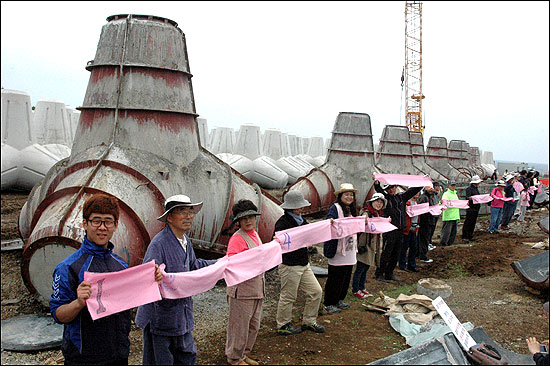
http://3.bp.blogspot.com/-EJzrt9bZpgA/TeTb9VG7KOI/AAAAAAAAEBI/vIOTrK1-KQM/s1600/jejupods.jpg


Over the past weekend hundreds rallied in Gangjeong village in South Korea to protect the rocks and the plant and animal life that will be destroyed once the thousands of huge “tetra pods” are all placed in the water and cement gets poured over everything to build the piers in order to dock the visiting U.S. warships.

The military (who says they are out to bring security) does not care about the life forms that are killed. Their brazen quest for power and control separates them from the living world around them. Power is like a drug and they always need more as the addiction numbs them to life. The plants, the rocks, the coral, the fish, the clean water do not exist in their minds. It is a spiritual disconnection.

[…]

Today begins my 9th day of fasting in solidarity with all life forms in and around Gangjeong village on Jeju Island. My heart is with Yang Yoon-Mo who is now on his 58th day of hunger striking and Sung-Hee Choi on her 14th day.

I am grateful to those who have been writing me and sending messages to the South Korean embassy in their country. In recent days I’ve heard from people in Germany, Denmark, Sweden, Scotland, Wales, England, China, Philippines, Japan, Hawaii, and all over the U.S. who are taking steps to show support. Many of these same people are fasting for a day or more. Thanks to all of you. Please keep spreading the word. I will return to Bath Iron Works again today.

And here is the earlier post with a message from Sung Hee Choi a Korean activist who was in jail and on the 7th day of her hunger strike against the naval base.

http://space4peace.blogspot.com/2011/05/words-from-sung-hee-choi.html

Sunday, May 29, 2011

WORDS FROM SUNG-HEE CHOI

JungJoo Park from South Korea has provided us with the latest communication from Sung-Hee Choi who is now on her 11th day of hunger striking on Jeju Island, South Korea. It is Sung-Hee laying under the construction vehicle and in the middle of the photo above.

JungJoo writes, “What Sung-hee in a prison said to people who support her a few days ago.”

The revolution comes in time we do not know.
It comes suddenly when we are in desperate, so close to give up.
I believe in that long water flow which are made by tiny water drops gathering rather than someone’s big power at certain time.
I especially believe the power of culture, power of arts, no, I believe the power of cultured people and artists.
And I believe the truth will be spread out to this whole world as our young generation begin to stand up.
But our fight has to be fun.
And again, our youth should be a source of strength for our fight.
You do not know how much I miss you, Gangjeong village, Gureombi…
I miss them so much, appreciate them so much, and I’d love to see them all.
Brother, Taewhan, will you sing again?
And everyone, will you sing together?
We get together again and do a dance on Gureombi?
But on the other hand, I am glad to come trapped.
More and more people coming to Gureombi, more things are doing!!
Here, I read books that I missed so far, and think a lot of ideas I missed.
There is a passage, especially coming so often these days.
“The absolute, must open one side of the door if the other side is closed.”
Let’s walk together toward the open door!
(And the tears flow quietly)
I’ve never ever cried while visiting.
But so many young people have come, my tears of happy flowing.
Please call more young people of 20’s. Let my tears flowing more.
For a while I was totally numb.
I got here so unjustly.
If your transparent and clear forces get together, It will change everything at the moment nobody can expected.
At the moment we think of defeat, we are really missing out on everything.
But we do not fail as long as we do have beliefs.
I believe history.
Take courage and anger at the same time.
Lying down under a dump truck and crane must be finished by our generation.
You do your things in your way.
More enjoyable, more fun!
Not short time later, a lightning flash occurs and the naval base will be destroyed.
At that moment we must able to say openly.
‘I am that thunder and lightning.’
I believe history and you.
Your infinite power available is up to you!


– Sung-Hee Choi
Jeju Island, South Korea


Sung Hee is the original blogger for http://nobasestorieskorea.blogspot.com/. It is one of the best sources of information about the Jeju struggle and other anti-bases movements in Korea.  We hope she is alright and freed from jail soon.

Support the people of Jeju in their struggle against the naval base, which will be used as part of the U.S. missile defense network to encircle China.  You can write to the Korean Embassy urging them to free Sung Hee and stop the construction of the naval base in Jeju on their website: http://www.dynamic-korea.com/embassy/meet.php

(Ironically, when you go to the website, the banner reads “Help us make Jeju Island one of the “New 7 Wonders of Nature”” even as the Korean government is preparing to destroy the rich marine environment at Gangjeong village, one home of the famous women divers of Jeju.)

Is U.S. military relief effort Operation Tomodachi really about friendship?

A post on the Japan Today blog asks:

“Tomodachi?” Friends? To many Japanese living near U.S. military bases, the bilateral “friendship” has seemed more like a prolonged occupation. Will Operation Tomodachi make friends of them, and turn their sullen resistance into gratitude?

It’s the biggest ever U.S. humanitarian mission in Japan – 20,000 troops, 113 aircraft and 12 ships thrown into the battle against chaos in the wake of Japan’s greatest postwar crisis, the earthquake-tsunami-radiation nightmare.

The blogger cites the Shukan Post’s claims that the entire military operation is for publicity:

The whole vast operation is purely for show, it says – and who will be paying the bill, it demands, when the hearts and minds have been won? You guessed it – Japan.

One example cited of the shibai (deception) was story of 78 bodies found along the Iwate Prefecture coast, supposedly by Japanese and American rescuers working cooperatively. However, a Japan Maritime Self Defense Force member was quoted as saying: “All the U.S. side did was send planes and helicopters into the air. The searching was done by Maritime SDF, Japan Coast Guard and Japanese police divers.”

The cost to Japan for U.S. “friendship”?:

Friendship doesn’t come cheap, Shukan Post notes. Operation Tomodachi, it says, is an $80 million undertaking, the cost to be covered through supplements to Japan’s financial commitment to support American troops stationed in Japan.

Tomgram: Rebecca Solnit, “The Butterfly and the Boiling Point – Charting the Wild Winds of Change in 2011”

Rebecca Solnit a San Francisco Bay Area activist, artist, geographer and contributor to TomDispatch wrote a beautiful and hopeful article analyzing the wave of uprisings and revolutionary unrest sweeping the Arab world and theorizing about the “unexpected” and “chaotic” nature of revolutionary phenomena, like butterfly wings fluttering in Brazil, changing the weather in Texas…

The Butterfly and the Boiling Point

Charting the Wild Winds of Change in 2011

By Rebecca Solnit

Revolution is as unpredictable as an earthquake and as beautiful as spring. Its coming is always a surprise, but its nature should not be.

Revolution is a phase, a mood, like spring, and just as spring has its buds and showers, so revolution has its ebullience, its bravery, its hope, and its solidarity. Some of these things pass. The women of Cairo do not move as freely in public as they did during those few precious weeks when the old rules were suspended and everything was different. But the old Egypt is gone and Egyptians’ sense of themselves — and our sense of them — is forever changed.

She offers some choice, poetic insights about the alchemical phase shift that transforms fear into hope:

Those who are not afraid are ungovernable, at least by fear, that favorite tool of the bygone era of George W. Bush. Jonathan Schell, with his usual beautiful insight, saw this when he wrote of the uprising in Tahrir Square:

“The murder of the 300 people, it may be, was the event that sealed Mubarak’s doom. When people are afraid, murders make them take flight. But when they have thrown off fear, murders have the opposite effect and make them bold. Instead of fear, they feel solidarity. Then they ‘stay’ — and advance. And there is no solidarity like solidarity with the dead. That is the stuff of which revolution is made.”

When a revolution is made, people suddenly find themselves in a changed state — of mind and of nation. The ordinary rules are suspended, and people become engaged with each other in new ways, and develop a new sense of power and possibility. People behave with generosity and altruism; they find they can govern themselves; and, in many ways, the government simply ceases to exist.

And she offers hopeful advise:

Hard times are in store for most people on Earth, and those may be times of boldness. Or not. The butterflies are out there, but when their flight stirs the winds of insurrection no one knows beforehand.

So remember to expect the unexpected, but not just to wait for it. Sometimes you have to become the unexpected, as the young heroes and heroines of 2011 have. I am sure they themselves are as surprised as anyone. Since she very nearly had the first word, let Asmaa Mahfouz have the last word: “As long as you say there is no hope, then there will be no hope, but if you go down and take a stance, then there will be hope.”

READ THE FULL ARTICLE

Sleepwalking into the Imperial Dark / Will the US extend the occupations of Iraq and Afghanistan

In August 2010, when President Obama announced to much fanfare:  “Consistent with our agreement with the Iraqi government, all of our troops will be out of Iraq by the end of next year,” did anyone really believe him?

Earlier this month, Secretary of Defense Robert Gates visited Iraq and raised the possibility of U.S. troops staying in Iraq beyond the agreed withdrawal date of 31 December, 2011.

Now, there has been talk of extending the U.S. military presense in Afghanistan beyond the pullout deadline.  Here’s an excerpt of a New York Times article:

Talks on U.S. Presence in Afghanistan After Pullout Unnerve Region

First, American officials were talking about July 2011 as the date to begin the withdrawal from Afghanistan. Then, the Americans and their NATO allies began to talk about transition, gradually handing over control of the war to the Afghans until finally pulling out in 2014. Now, however, the talk is all about what happens after 2014.

Afghanistan and the United States are in the midst of negotiating what they are calling a Strategic Partnership Declaration for beyond 2014.

Critics, including many of Afghanistan’s neighbors, call it the Permanent Bases Agreement — or, in a more cynical vein, Great Game 3.0, drawing a comparison with the ill-fated British and Russian rivalry in the region during the 19th and 20th centuries.

READ FULL ARTICLE

As Ann Wright reported after her last trip to Afghanistan on a peace delegation, the rapid and widespread construction of military bases in Afghanistan did not indicate a plan to withdraw, but rather a plan for a long term military occupation via a type of permanent bases agreement.

As Tom Engelhardt writes in Tom Dispatch “Sleepwalking into the Imperial Dark
What It Feels Like When a Superpower Runs Off the Tracks”
these developments are symptomatic of America’s deep denial of its empire.  He wonders what it must have felt like to be a citizen of an empire in decline:

at some point it must have seemed at least a little like this — truly strange, like watching a machine losing its parts.  It must have seemed as odd and unnerving as it does now to see a formerly mighty power enter a state of semi-paralysis at home even as it staggers on blindly with its war-making abroad.

He concludes:

A post-imperial U.S. could, of course, be open to all sorts of possibilities for change that might be exciting indeed.

Right now, though, it doesn’t feel that way, does it?  It makes me wonder: Could this be how it’s always felt inside a great imperial power on the downhill slide?  Could this be what it’s like to watch, paralyzed, as a country on autopilot begins to come apart at the seams while still proclaiming itself “the greatest nation on Earth”?

I don’t know.  But I do know one thing: this can’t end well.

Libya Conflict Highlights NATO’s Imperialist Mission

SOURCE: http://www.truth-out.org/libya-conflict-highlights-natos-imperialist-mission68753

Libya Conflict Highlights NATO’s Imperialist Mission

Saturday 26 March 2011


by: Joseph Gerson, t r u t h o u t | News Analysis

Having launched its Libyan regime change war to oust the Qaddafi dictatorship from the United States’ German-based Africa Command, the Obama administration this week arranged to continue its air war under cover of the North Atlantic Treaty Organization (NATO) alliance. Long understood to be a relatively benign and defensive alliance focused on European security needs, people across Europe and, increasingly, in the United States, are questioning how and why NATO is now focused on waging non-defensive wars beyond Europe.

From the beginning, 1948, NATO was about more than containing the Soviet Union, which in the immediate aftermath of World War II was a devastated nation whose occupation of Eastern Europe was as, George Kennan wrote, primarily designed to ensure a buffer against future invasions from the West. Think in terms of the devastation wrought by Napoleon, the Kaiser and Hitler.

Like the unequal treaties that defined 19th- and early 21st-century European colonialism in Asia, NATO has served as a fig leaf, providing a degree of legitimacy for the continuing US military occupation and related US political influence across Western Eurasia. Recall that Zbigniew Brzezinski, President Carter’s national security adviser, wrote that US global dominance requires US hegemony of Eurasia, which in turn necessitates that the United States maintain toeholds (or more) on its western, southern, and eastern peripheries.

Twenty-first century NATO isn’t the cold war alliance that many of us grew up with. The collapse of the Soviet Union eliminated NATO’s cold war raison d’etre, thereby undermining the rationales for the foreign deployment of hundreds of thousands of US warriors on hundreds of US and “NATO” bases across Europe. The Clinton, George W. Bush and Obama administrations responded by transforming NATO into a global alliance to reinforce US imperial ambitions and the privileges of sectors of the European elite. Violating President George H.W. Bush’s pledge not to expand NATO a centimeter nearer to Moscow, in exchange for Gorbachev’s blessing of German reunification on Western terms Clinton began the process of expanding NATO to Russia’s borders, along the way creating the foundation for Donald Rumsfeld and company to renew the game of divide and conquer by playing “New Europe” against “Old Europe.” The US now has bases across Eastern Europe, and there will be more to come with “missile defense” deployments. In violation of the UN Charter, the Clinton administration used NATO to fight its war against Serbia, making possible the creation of Kosovo and the rise of its corrupt client political leadership there.

As the cold war wound down, NATO adopted doctrines permitting “out of area operations,” i.e. military interventions in Africa, the Middle East and beyond. With NATO’s role in the Afghan war, “out of area operations” became the alliance’s primary mission. Today, with 22 additional partnerships still more being planned for Japan, Korea and Southeast Asian nations, NATO is also being used to ensure access to the mineral resources of the Global South and to reinforce the encirclement of China, as well as Russia. Thus, we can identify a major reason that NATO is today fighting in support of a ragtag collection of Libyan rebels in that oil-rich nation. And, as a recent edition of Foreign Affairs put it, China’s rise does not inevitably mean it will become the world’s dominant nation. If NATO can be merged with the European Union, the West, it argued, will remain dominant through the 21st century.
During its recent summits in Strasbourg – enforced by massive and brutal police state repression against nonviolent protesters – and Lisbon, and under pressure from the United States, NATO has resolved to remain at war in Afghanistan at least until 2014. It has adopted a new “strategic concept” consolidating and pointing toward the expansion of the global alliance that can serve as a military enforcer for the United Nations or act in violation of the UN Charter. And NATO has been reaffirmed as a nuclear alliance, while its members have been urged to further increase their military spending.

The 2012 summit to be held in the United States, likely in or near Washington, DC, will be used to plan and build support for the continuing Central Asian and Long wars, to continue the “containment” and encirclement of China and Russia, to bolster the Pentagon and its obscene budget and to reinforce President Obama’s re-election campaign.

Western European peace activists and progressives have long opposed NATO. This opposition grew with the 2001 invasion of Afghanistan, and it is worth noting that there is anything but unity about NATO’s Libyan war in elite European circles. Even Germany has turned its back on the war, leaving the goal of a united European foreign policy a short-lived dream, while Norway has reversed course, no longer contributing its air force to the war.

At the popular level, growing out of the 2008 International Conference on Afghanistan held in Hanover, Germany, a “No to NATO/No to War” network of leading European and US peace organizations has come into being. It organized counter-summit conferences and protests in both Strasbourg and Lisbon. Its members are rallying to oppose NATO’s Libya war and are planning a major demonstration in Bonn this November, when the tenth anniversary of the creation of the Karzai government there will be celebrated. And, with the next NATO summit to be held in the US in 2012, plans on both sides of the Atlantic pond are gearing up to oppose NATO’s wars, related military spending that is robbing our communities of essential social services and the alliance itself.

“Unfamiliar Fishes”

Scott Crawford sent the following email that I wanted to pass along. Sarah Vowell just published a novel entitled “Unfamiliar Fishes”, which is set in Hawai’i. In her dry witty way she exposes America’s “orgy of imperialism” in 1898:

You gotta watch this…

http://www.thedailyshow.com/watch/mon-march-21-2011/exclusive—sarah-vowell-extended-interview-pt–1

We’ve seen Sarah Vowell on The Daily Show before, and enjoy how she shares history with her dry wit and puts things in ways you can easily relate to.  As Jon says, “I laugh, but I learn.”

Well, now she’s written a book on Hawai’i, “Unfamiliar Fishes”. She describes the “orgy of imperialism” of the summer of 1898. And she nails it. Kekula said when it was over, “that was one
of the most comprehensive statements on Hawaii ever presented in such a broad media.” A whole lot of very well-informed, engaged people watch Jon Stewart. And the way she explained it was a
truth that many people probably heard for the first time. A lot of people will read her book.

She explains the context of the Spanish-American War, the role for Hawaii as “a naval base for our forthcoming invasions,” the missionary family children who “overthrew the Hawaiian queen so as to hand the Hawaiian Islands over to the United States,” mentions the anti-annexation petitions, and compares the joint resolution as “the sort of law New Jersey would use to declare a day Jon Bon Jovi Day.”

Her video excerpt from the book: http://www.youtube.com/watch?v=Qlj2sdEelak

http://www.indiebound.org/book/9781594487873

Unfamiliar Fishes

By Sarah Vowell
(Riverhead Hardcover, Hardcover, 9781594487873, 256pp.)
Publication Date: March 22, 2011

Description

From the bestselling author of The Wordy Shipmates, an examination of Hawaii, the place where Manifest Destiny got a sunburn.

Many think of 1776 as the defining year of American history, when we became a nation devoted to the pursuit of happiness through self-government. In Unfamiliar Fishes, Sarah Vowell  argues that 1898 might be a year just as defining, when, in an orgy of imperialism, the United States annexed Hawaii, Puerto Rico, and Guam, and invaded first Cuba, then the Philippines, becoming an international superpower practically overnight.

Among the developments in these outposts of 1898, Vowell considers the Americanization of Hawaii the most intriguing. From the arrival of New England missionaries in 1820, their goal to  Christianize the local heathen, to the coup d’état of the missionaries’ sons in 1893, which overthrew the Hawaiian queen, the events leading up to American annexation feature a cast of
beguiling, and often appealing or tragic, characters: whalers who fired cannons at the Bible-thumpers denying them their God-given right to whores, an incestuous princess pulled between
her new god and her brother-husband, sugar barons, lepers, con men, Theodore Roosevelt, and the last Hawaiian queen, a songwriter whose sentimental ode “Aloha ‘Oe” serenaded the first
Hawaiian president of the United States during his 2009 inaugural parade.

With her trademark smart-alecky insights and reporting, Vowell lights out to discover the off, emblematic, and exceptional history of the fiftieth state, and in so doing finds America, warts and all.

Libya, the West and the Narrative of Democracy

Interesting analysis from Stratfor of the U.S.-led war in Libya and the Westʻs conflicting imperatives: welcoming popular democratic uprisings while preventing repressive governments from crushing them:

Nevertheless, a narrative on what has happened in the Arab world has emerged and has become the framework for thinking about the region. The narrative says that the region is being swept by democratic revolutions (in the Western sense) rising up against oppressive regimes. The West must support these uprisings gently. That means that they must not sponsor them but at the same time act to prevent the repressive regimes from crushing them.

This is a complex maneuver. The West supporting the rebels will turn it into another phase of Western imperialism, under this theory. But the failure to support the rising will be a betrayal of fundamental moral principles.

The problem with Libya is that the government enjoys significant popular support from certain tribal factions, while the opposition forces are a loose coalition of tribes that oppose the Gadhafi regime, not a popular uprising.

>><<

Libya, the West and the Narrative of Democracy

By George Friedman

Forces from the United States and some European countries have intervened in Libya. Under U.N. authorization, they have imposed a no-fly zone in Libya, meaning they will shoot down any Libyan aircraft that attempts to fly within Libya. In addition, they have conducted attacks against aircraft on the ground, airfields, air defenses and the command, control and communication systems of the Libyan government, and French and U.S. aircraft have struck against Libyan armor and ground forces. There also are reports of European and Egyptian special operations forces deploying in eastern Libya, where the opposition to the government is centered, particularly around the city of Benghazi. In effect, the intervention of this alliance has been against the government of Moammar Gadhafi, and by extension, in favor of his opponents in the east.

The alliance’s full intention is not clear, nor is it clear that the allies are of one mind. The U.N. Security Council resolution clearly authorizes the imposition of a no-fly zone. By extension, this logically authorizes strikes against airfields and related targets. Very broadly, it also defines the mission of the intervention as protecting civilian lives. As such, it does not specifically prohibit the presence of ground forces, though it does clearly state that no “foreign occupation force” shall be permitted on Libyan soil. It can be assumed they intended that forces could intervene in Libya but could not remain in Libya after the intervention. What this means in practice is less than clear.

There is no question that the intervention is designed to protect Gadhafi’s enemies from his forces. Gadhafi had threatened to attack “without mercy” and had mounted a sustained eastward assault that the rebels proved incapable of slowing. Before the intervention, the vanguard of his forces was on the doorstep of Benghazi. The protection of the eastern rebels from Gadhafi’s vengeance coupled with attacks on facilities under Gadhafi’s control logically leads to the conclusion that the alliance wants regime change, that it wants to replace the Gadhafi government with one led by the rebels.

But that would be too much like the invasion of Iraq against Saddam Hussein, and the United Nations and the alliance haven’t gone that far in their rhetoric, regardless of the logic of their actions. Rather, the goal of the intervention is explicitly to stop Gadhafi’s threat to slaughter his enemies, support his enemies but leave the responsibility for the outcome in the hands of the eastern coalition. In other words — and this requires a lot of words to explain — they want to intervene to protect Gadhafi’s enemies, they are prepared to support those enemies (though it is not clear how far they are willing to go in providing that support), but they will not be responsible for the outcome of the civil war.

The Regional Context

To understand this logic, it is essential to begin by considering recent events in North Africa and the Arab world and the manner in which Western governments interpreted them. Beginning with Tunisia, spreading to Egypt and then to the Arabian Peninsula, the last two months have seen widespread unrest in the Arab world. Three assumptions have been made about this unrest. The first was that it represented broad-based popular opposition to existing governments, rather than representing the discontent of fragmented minorities — in other words, that they were popular revolutions. Second, it assumed that these revolutions had as a common goal the creation of a democratic society. Third, it assumed that the kind of democratic society they wanted was similar to European-American democracy, in other words, a constitutional system supporting Western democratic values.

Each of the countries experiencing unrest was very different. For example, in Egypt, while the cameras focused on demonstrators, they spent little time filming the vast majority of the country that did not rise up. Unlike 1979 in Iran, the shopkeepers and workers did not protest en masse. Whether they supported the demonstrators in Tahrir Square is a matter of conjecture. They might have, but the demonstrators were a tiny fraction of Egyptian society, and while they clearly wanted a democracy, it is less than clear that they wanted a liberal democracy. Recall that the Iranian Revolution created an Islamic Republic more democratic than its critics would like to admit, but radically illiberal and oppressive. In Egypt, it is clear that Mubarak was generally loathed but not clear that the regime in general was being rejected. It is not clear from the outcome what will happen now. Egypt may stay as it is, it may become an illiberal democracy or it may become a liberal democracy.

Consider also Bahrain. Clearly, the majority of the population is Shiite, and resentment toward the Sunni government is apparent. It should be assumed that the protesters want to dramatically increase Shiite power, and elections should do the trick. Whether they want to create a liberal democracy fully aligned with the U.N. doctrines on human rights is somewhat more problematic.

Egypt is a complicated country, and any simple statement about what is going on is going to be wrong. Bahrain is somewhat less complex, but the same holds there. The idea that opposition to the government means support for liberal democracy is a tremendous stretch in all cases — and the idea that what the demonstrators say they want on camera is what they actually want is problematic. Even more problematic in many cases is the idea that the demonstrators in the streets simply represent a universal popular will.

Nevertheless, a narrative on what has happened in the Arab world has emerged and has become the framework for thinking about the region. The narrative says that the region is being swept by democratic revolutions (in the Western sense) rising up against oppressive regimes. The West must support these uprisings gently. That means that they must not sponsor them but at the same time act to prevent the repressive regimes from crushing them.

This is a complex maneuver. The West supporting the rebels will turn it into another phase of Western imperialism, under this theory. But the failure to support the rising will be a betrayal of fundamental moral principles. Leaving aside whether the narrative is accurate, reconciling these two principles is not easy — but it particularly appeals to Europeans with their ideological preference for “soft power.”

The West has been walking a tightrope of these contradictory principles; Libya became the place where they fell off. According to the narrative, what happened in Libya was another in a series of democratic uprisings, but in this case suppressed with a brutality outside the bounds of what could be tolerated. Bahrain apparently was inside the bounds, and Egypt was a success, but Libya was a case in which the world could not stand aside while Gadhafi destroyed a democratic uprising. Now, the fact that the world had stood aside for more than 40 years while Gadhafi brutalized his own and other people was not the issue. In the narrative being told, Libya was no longer an isolated tyranny but part of a widespread rising — and the one in which the West’s moral integrity was being tested in the extreme. Now was different from before.

Of course, as with other countries, there was a massive divergence between the narrative and what actually happened. Certainly, that there was unrest in Tunisia and Egypt caused opponents of Gadhafi to think about opportunities, and the apparent ease of the Tunisian and Egyptian uprisings gave them some degree of confidence. But it would be an enormous mistake to see what has happened in Libya as a mass, liberal democratic uprising. The narrative has to be strained to work in most countries, but in Libya, it breaks down completely.

The Libyan Uprising

As we have pointed out, the Libyan uprising consisted of a cluster of tribes and personalities, some within the Libyan government, some within the army and many others longtime opponents of the regime, all of whom saw an opportunity at this particular moment. Though many in western portions of Libya, notably in the cities of Zawiya and Misurata, identify themselves with the opposition, they do not represent the heart of the historic opposition to Tripoli found in the east. It is this region, known in the pre-independence era as Cyrenaica, that is the core of the opposition movement. United perhaps only by their opposition to Gadhafi, these people hold no common ideology and certainly do not all advocate Western-style democracy. Rather, they saw an opportunity to take greater power, and they tried to seize it.

According to the narrative, Gadhafi should quickly have been overwhelmed — but he wasn’t. He actually had substantial support among some tribes and within the army. All of these supporters had a great deal to lose if he was overthrown. Therefore, they proved far stronger collectively than the opposition, even if they were taken aback by the initial opposition successes. To everyone’s surprise, Gadhafi not only didn’t flee, he counterattacked and repulsed his enemies.

This should not have surprised the world as much as it did. Gadhafi did not run Libya for the past 42 years because he was a fool, nor because he didn’t have support. He was very careful to reward his friends and hurt and weaken his enemies, and his supporters were substantial and motivated. One of the parts of the narrative is that the tyrant is surviving only by force and that the democratic rising readily routs him. The fact is that the tyrant had a lot of support in this case, the opposition wasn’t particularly democratic, much less organized or cohesive, and it was Gadhafi who routed them.

As Gadhafi closed in on Benghazi, the narrative shifted from the triumph of the democratic masses to the need to protect them from Gadhafi — hence the urgent calls for airstrikes. But this was tempered by reluctance to act decisively by landing troops, engaging the Libyan army and handing power to the rebels: Imperialism had to be avoided by doing the least possible to protect the rebels while arming them to defeat Gadhafi. Armed and trained by the West, provided with command of the air by the foreign air forces — this was the arbitrary line over which the new government keeps from being a Western puppet. It still seems a bit over the line, but that’s how the story goes.

In fact, the West is now supporting a very diverse and sometimes mutually hostile group of tribes and individuals, bound together by hostility to Gadhafi and not much else. It is possible that over time they could coalesce into a fighting force, but it is far more difficult imagining them defeating Gadhafi’s forces anytime soon, much less governing Libya together. There are simply too many issues between them. It is, in part, these divisions that allowed Gadhafi to stay in power as long as he did. The West’s ability to impose order on them without governing them, particularly in a short amount of time, is difficult to imagine. They remind me of Hamid Karzai in Afghanistan, anointed by the Americans, distrusted by much of the country and supported by a fractious coalition.

Other Factors

There are other factors involved, of course. Italy has an interest in Libyan oil, and the United Kingdom was looking for access to the same. But just as Gadhafi was happy to sell the oil, so would any successor regime be; this war was not necessary to guarantee access to oil. NATO politics also played a role. The Germans refused to go with this operation, and that drove the French closer to the Americans and British. There is the Arab League, which supported a no-fly zone (though it did an about-face when it found out that a no-fly zone included bombing things) and offered the opportunity to work with the Arab world.

But it would be a mistake to assume that these passing interests took precedence over the ideological narrative, the genuine belief that it was possible to thread the needle between humanitarianism and imperialism — that it was possible to intervene in Libya on humanitarian grounds without thereby interfering in the internal affairs of the country. The belief that one can take recourse to war to save the lives of the innocent without, in the course of that war, taking even more lives of innocents, also was in play.

The comparison to Iraq is obvious. Both countries had a monstrous dictator. Both were subjected to no-fly zones. The no-fly zones don’t deter the dictator. In due course, this evolves into a massive intervention in which the government is overthrown and the opposition goes into an internal civil war while simultaneously attacking the invaders. Of course, alternatively, this might play out like the Kosovo war, where a few months of bombing saw the government surrender the province. But in that case, only a province was in play. In this case, although focused ostensibly on the east, Gadhafi in effect is being asked to give up everything, and the same with his supporters — a harder business.

In my view, waging war to pursue the national interest is on rare occasion necessary. Waging war for ideological reasons requires a clear understanding of the ideology and an even clearer understanding of the reality on the ground. In this intervention, the ideology is not crystal clear, torn as it is between the concept of self-determination and the obligation to intervene to protect the favored faction. The reality on the ground is even less clear. The reality of democratic uprisings in the Arab world is much more complicated than the narrative makes it out to be, and the application of the narrative to Libya simply breaks down. There is unrest, but unrest comes in many sizes, democratic being only one.

Whenever you intervene in a country, whatever your intentions, you are intervening on someone’s side. In this case, the United States, France and Britain are intervening in favor of a poorly defined group of mutually hostile and suspicious tribes and factions that have failed to coalesce, at least so far, into a meaningful military force. The intervention may well succeed. The question is whether the outcome will create a morally superior nation. It is said that there can’t be anything worse than Gadhafi. But Gadhafi did not rule for 42 years because he was simply a dictator using force against innocents, but rather because he speaks to a real and powerful dimension of Libya.

Libya, the West and the Narrative of Democracy is republished with permission of STRATFOR.