How much does the military economy cost Hawai’i?


With much media hype, the Chamber of Commerce of Hawaii and the Hawaii Institute of Public Affairs (HIPA) coordinated the public release of a study of the military’s economic impact in Hawai’i by the RAND corporation, but the report said nothing really new or remarkable.   The Honolulu Star Advertiser reported:

The U.S. military pumped up to $12.2 billion into Hawaii in 2009 — or more than 18 percent of total spending in the islands, according to the first study of its kind in nearly 50 years, scheduled for release today.

The full-time equivalent of 91,000 to 101,000 employees worked for the military here between 2007 and 2009, representing 16 percent of the work force in the state, said the RAND National Defense Research Institute’s report, “How Much Does Military Spending Add to Hawaii’s Economy?”

The COCH represents Hawai’i’s business sector and had a hand in engineering the cession of Ke Awalau o Pu’uloa (Pearl Harbor) to the U.S. through the Treaty of Reciprocity with the Hawaiian Kingdom. It regularly hypes the military appropriations earmarked for Hawai’i and lobbies for continuous military expansion in Hawai’i.   HIPA, a purportedly non-partisan and independent local think-tank, has close ties to the Democratic party insiders.

Several years ago I suggested that HIPA do a study to document the true costs and impacts of the military in Hawai’i and help the public envision what different economic alternatives might look like.  But I guess that was too much to ask.  So instead we got another report reinforcing the military-corporate-political complex.

What is new about this study is that it was produced by the prestigious RAND corporation, a military sponsored research think tank.   While the RAND study compiled the most complete data available on various aspects of the military economy in Hawai’i, which is useful in and of itself, the report does not analyze the social, cultural and environmental costs of the military driven economic and social changes in Hawai’i.  Although the report does show which industries profit most from the military spending, it fails to analyze which communities pay the highest price in the form of lost land, cultural disintegration, violations of human rights to self-determination, environmental damage and other social impacts. In this regard, the RAND study fails in the same way all other economic reports on the military impact in Hawai’i fail to consider the high cost of so much military prosperity.   The RAND study does not ask whether so much military spending has had unintended and unacceptable negative impacts that may be harmful to a more sustainable and just economic future for Hawai’i.   That will have to be left to other more creative thinkers.

The most remarkable thing about this study is the very fact that the RAND corporation produced the report for the Office of the Secretary of Defense and in partnership with the COCH and HIPA.  Why is the public paying for a study to assist and bolster the corporations that benefit most from military spending in Hawai’i?  The Project On Government Oversight (POGO) thought this was unusual and wrote a critical piece on their website “Aloha! Pentagon Think Tank Uses Taxpayer Funds to Help Hawaii Chamber of Commerce”:

The report was produced by RAND’s National Defense Research Institute, a Federally Funded Research and Development Center (FFRDC), in cooperation with the Hawaii Institute of Public Affairs and the Chamber of Commerce of Hawaii, and was sponsored by the Office of the Secretary of Defense at the Pentagon–which is to say, taxpayers foot the bill.

[…]

The Chamber of Commerce of Hawaii Military Affairs Council and The Hawaii Institute For Public Affairs hosted a $35-a-ticket-event for the report co-sponsored by defense contractor BAE Systems yesterday. The question is, should taxpayers around the country be paying for research for the Hawaii Chamber of Commerce?

POGO investigator Mandy Smithberger also delved into recent problems with FFRDC’s:

FFRDCs like RAND typically produce research on larger strategic questions and issues, with the idea of producing high quality, unbiased analysis for Pentagon decision-makers. There have been conflict of interest problems in the past (some quite notable), but generally speaking, the Pentagon loves them, and the Pentagon’s head of Acquisition has encouraged using them more to increase efficiencies. RAND specifically has produced numerous reports on military budgets and defense spending, including a report on the impacts of defense spending on the civilian economy. But it appears that a report that is specific to the economy of one state is rare, if not unprecedented.

[…]

As the Pentagon and Congress continue to consider cost-cutting measures, it may be worth further scrutiny of how FFRDCs use taxpayer resources. The House’s version of the Defense Appropriations bill reduced FFRDC spending by $125 million and has prohibited creating new defense FFRDCs.

The issue of FFRDCs recalls the disastrous attempt to establish a similar type of federal research center at the University of Hawai’i (UH)Project Kai e’e, the code name of an initiative by military and UH officials to channel missile defense research monies through UH to establish a “Pacific Research Laboratory” were fraught with abuses and corruption and led to a naval criminal investigation of key players.  This did not stop the attempts to funnel non-competed military monies to businesses and researchers in Hawai’i via a University Affiliated Research Center (UARC), a type of classified Navy research center and another project called Hawaii Technology Development Venture (HTDV), a scheme to funnel public funds into venture capital for local firms to conduct research and development for the military.  DMZ-Hawai’i /Aloha ‘Aina and the Save UH/Stop UARC coalition waged a campaign over several years to stop this encroachment of military secrecy into a public university.  In the end, despite significant wins along the way by the Coalition, the UARC project was rammed through by the political powers, although only in a highly diminished form.

This brings us back to the question of why RAND is doing a study of the military economic impact in Hawai’i and why the Office of the Secretary of Defense commissioned it.   As Smithberger writes:

But did it take a RAND study to figure out that defense spending played a significant role in the state’s economy? The study confirms what many economists already suspected. Hawaii received $195.8 million in earmarks in the FY2010 Defense bill, according to Taxpayers for Common Sense’s earmark database–and wins more earmark dollars per capita than any other state (no doubt due in part to Hawaii Senator Daniel Inouye sitting on the Senate Appropriations Committee). Moreover, it’s not clear how this report serves national security interests, or why it had to be performed by RAND.

The report is an attempt by Hawai’i’s military, corporate and political players to shore up support for military spending at a time of shrinking budgets, growing opposition to the negative impacts of military activities and war fatigue.  In contrast to the rosy picture of the military painted by the COCH, the reality of Hawai’i’s military economy is more appropriately captured by the Honolulu Star Advertiser graphic of a toy soldier raising his bayonet to stab the Hawaiian islands – a form of assault.


Crosshairs on Kaneohe

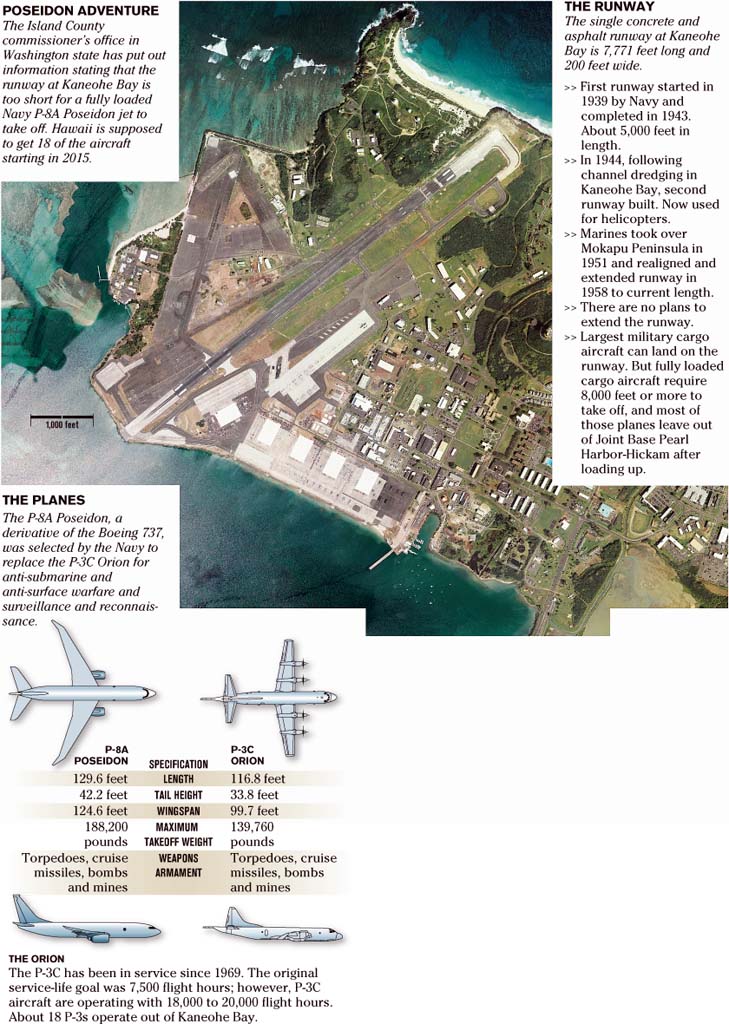
As reported previously on this site, there is a campaign by elected officials and residents of Whidbey Island, Washington to keep the Navy’s new P-8A Poseidon aircraft in Puget Sound rather than relocate them to the Marine Corps Base in Kane’ohe.  Below are excerpts from “Crosshairs on Kaneohe” an article in the Honolulu Star Advertiser about the competition between Whidbey and Kaneohe for the Poseidons.   There are already too many negative impacts and conflicts with the local community and Native Hawaiians due to expanded Marine Corps activities in Hawai’i.  We don’t want the Poseidons.


Source: http://www.staradvertiser.com/news/20110511_cross_hairs_on_kaneohe.html

William Cole writes:

A county commissioner from Washington state has mounted a campaign to secure Navy P-8A Poseidon sub-hunting aircraft for her state by claiming that Kaneohe Bay — where 18 of the jets are planned to be based — has a runway that’s too short for fully fueled and loaded Poseidons to take off.

“What can you do to help? Write a letter to your congressmen and women, state legislators and Navy brass,” Island County Commissioner Angie Homola says in her “talking points in support of the P-8A” on the Island County website.

A 2008 environmental impact statement also raises questions about the runway.

The 7,771-foot runway at Kaneohe Bay is “shorter than the suggested 8,000-foot runway for extreme operational conditions,” the Navy EIS states. “However, aircraft loads can be managed to decrease the required runway length for take off.”

The competition between Kane’ohe and Whidbey island came about when the Pentagon made cuts to its original  basing plans for the Poseidons:

Hawaii, Whidbey Island in Washington state and Jacksonville, Fla., were selected as home bases for the Poseidons, a military version of the Boeing 737 that will replace aging, propeller-driven P-3C Orions.

Kaneohe Bay was picked for three squadrons and 18 aircraft that are expected to begin arriving in 2015.

But with the Pentagon seeking to cut costs, the Navy said in February it was considering operating from two bases instead of three, with Whidbey potentially being left out.

Island County said Naval Air Station Whidbey is the largest employer in the region, with a $500 million annual impact on the economy.

As part of the campaign to change the Navy’s mind, Homola said in a news release sent to newspapers that Kaneohe Bay’s “short” runway and higher costs of living “make Hawaii a costly pick,” while Whidbey offers the “optimal strategic location.”

A key tenet of Homola’s argument against Kaneohe Bay is that its runway is too short for a fully loaded P-8A, which has the fuselage of a 737-800 and wings of a 737-900.

Given the recent crash of the Sea Stallion helicopter in Kane’ohe Bay and the concern of residents when aircraft overfly the communities fringing the bay, the issue of safety piqued my interest:

The EIS said Hickam was looked at but eliminated as a possible base for Poseidons in part because ordnance handling would exceed Defense Department safety requirements.

If the ordnance handling would exceed DoD safety requirements for Hickam, why is it okay to have these aircraft in Kane’ohe?   Right now the P-3C Orions operating out of Kane’ohe are being phased out due to structural problems:

All but three of the Navy’s 27 P-3C Orions at Kaneohe Bay would be replaced by Poseidons, the service said in late 2008. The number remaining at Kaneohe Bay has shrunk to about 18 with groundings due to metal fatigue and some planes out for depot maintenance, officials said.

In 2007 many of the Cold War-era sub hunters Navy-wide were grounded after studies of a test airframe and computer modeling showed there could be “significant” issues with fatigue on the rear portion of the wing.

The environmental review for the 18 Poseidons said the basing would bring an investment of $147.5 million to Kaneohe Bay for infrastructure upgrades.

These “upgrades” constitute a major expansion that would have significant impacts on cultural sites in Mokapu.   There is already a decades’ old conflict over the removal of more than 2000 iwi kupuna (human remains) to make way for the runway.   Native Hawaiians have been fighting the Marine Corps to have the iwi repatriated.  Other construction on the base have desecrated additional burials.   Despite the anticipated major impacts to cultural sites due the proposed construction, the Marine Corps has tried to restrict the required consultations under the National Historic Preservation Act (NHPA) Section 106 to only those Native Hawaiian families already involved as claimants to the burials under the Native American Graves Protection and Repatriation Act (NAGPRA), a separate statute with different criteria for having standing.

With the military base realignment plans in Okinawa, Korea and Guam meeting greater resistance both within the affected communities as well as budget-conscious officials in Washington, will Hawai’i be hit with more military expansion in the Pacific?   Often these decisions follow the path of least resistance. If residents of Ko’olaupoko don’t mobilize to oppose the military expansion, there is a good chance that they will get hit with the backwash of the militarization wave in Asia.

‘Raptors’ grounded over defects

The Honolulu Star Advertiser reports that:

The Air Force has grounded its entire fleet of F-22 Raptors, including those in Hawaii, because of concerns about the system that delivers oxygen to pilots aboard the fighter jets, a military spokeswoman said yesterday.

[…]

The Hawaii Air National Guard began flying F-22 Raptors last summer in partnership with the Air Force and has nine of the stealth fighters at Joint Base Pearl Harbor-Hickam.

[…]

The fleet of 158 fighter jets nationwide is on stand-down because of “hypoxia-like” events reported by some pilots, Anderson said. Hypoxia is when the body receives too little oxygen.

Last November an F-22 pilot was killed in Alaska when he lost control of his jet during a training exercise. Since January the Raptor fleet has been restricted from flying above 25,000 feet because of concerns with the plane’s oxygen supply system.

Capt. Jeffrey Haney was killed when his F-22 crashed 100 miles north of Anchorage. Haney was on a training run with another F-22 to practice “intercepts” when his plane disappeared from ground radar tracking and from communications with the other stealth fighter. The married father of two from Clarklake, Mich., did not eject from the plane.

Public may observe NRC conference re: Army possession of depleted uranium w/o license

Mahalo to Cory Harden of the Sierra Club Moku Loa Chapter for this information about a Nuclear Regulatory Commission predecisional enforcement conference regarding the apparent Army possession of depleted uranium without a license.  Download Meeting Notice here. The public can observe via toll free number and the internet:

Interested members of the public can participate in this meeting via a toll-free teleconference and view presentations via a website. For details, please contact the individuals listed in the attached Meeting Notice.  The Meeting Notice is also available at the NRC’s website at: http://www.nrc.gov/public-involve/public-meetings/index.cfm

>><<

From: prvs=0909e5355=Dominick.Orlando@nrc.gov [mailto:prvs=0909e5355=Dominick.Orlando@nrc.gov] On Behalf Of Orlando, Dominick
Sent: Tuesday, April 26, 2011 7:46 AM
To: mh@interpac.net; panghi@hawaii.rr.com; Geomike5@att.net; imua-hawaii@hawaii.rr.com; ja@interpac.net; lanny.sinkin@gmail.com; Honerlah, Hans B NAB02; russell.takata@doh.hawaii.gov
Cc: Michalak, Paul; Burgess, Michele; McConnell, Keith; Summers, Robert; McIntyre, David; Klukan, Brett; Sexton, Kimberly; Joustra, Judith; Roberts, Mark; Lipa, Christine; LaFranzo, Michael; Rodriguez, Lionel; Spitzberg, Blair; Evans, Robert; Schlapper, Gerald; robert.cherry@us.army.mil
Subject: Predecisional Enforcement Conference with US Army IMCOM

Good Morning

The NRC will be holding a Predecisional Enforcement Conference with the US Army Installation Management Command on Tuesday May 10, 2011 at 2:00 pm CST in the NRC’s Regional office in Arlington, Texas. The purpose of the Predecisional Enforcement Conference is to discuss apparent violations of NRC requirements involving possession of source material (depleted uranium from Davy Crockett spotting rounds) without a license.

The public is invited to observe this meeting and will have one or more opportunities to communicate with the NRC after the business portion, but before the meeting is adjourned.

Interested members of the public can participate in this meeting via a toll-free teleconference and view presentations via a website. For details, please contact the individuals listed in the attached Meeting Notice.  The Meeting Notice is also available at the NRC’s website at: http://www.nrc.gov/public-involve/public-meetings/index.cfm

Thank you

Dominick Orlando, Senior Project Manager

Special Projects Branch

Decommissioning and Uranium Recovery Licensing Directorate

Division of Waste Management and Environmental Protection

Download Meeting Notice

A Win for Environmental Justice! People of Wai’anae Save Farmland

The people of Wai’anae won a big victory for environmental justice. KAHEA reports, “Tropic Land’s petition for a boundary amendment to allow an industrial park on fertile farmland was DENIED today, April 21, 2011.”  The post continues:

The Petitioner recognized that Commissioners had concerns about the proposed industrial park, especially whether they had access to use the Navy-owned road to leads to the property site.  So in a last minute hail-mary, the Petitioner told the Commission that the Navy was now considering dedicating the land to the City.  Interestingly, the City’s attorney did not know about the proposed dedication.

The Elders reminded the Commission that for six years the Navy and the City negotiated over dedicating the Lualualei Naval Access Road, which did not result in any change in the ownership or use of the road.  The question of proper access to the property is something Tropic Land should have figured out long before proposing a permanent change in the land use designation of their property.

This is a campaign that began back in 2009 when the Wai’anae Environmental Justice Working Group was formed.    Ka Makani Kaiaulu o Wai’anae youth participated in documenting and raising awareness about the issues related to the encroachment of industrial and military activity into farm land, protection of cultural sites, including the important sites pertaining to Maui the demigod, and health effects of environmental contamination.

Congratulations and thanks go out to the Concerned Elders of Wai’anae, the Wai’anae Environmental Justice Working Group, KAHEA, MA’O Farms and the many groups and individuals who worked on this campaign. For now the agricultural land in Lualualei will be spared an industrial onslaught.   However, the threat is still looming, and struggle continues on another front.  The City and County of Honolulu Planning Commission is in the process of reviewing and receiving public comments on the Wai’anae Sustainable Communities Plan (WSCP). The community has long fought to preserve the natural, cultural and human waiwai (wealth) of Wai’anae, but this latest version of the plan includes an invasive ‘spot’ of industrial use where the Tropic Land LLC industrial park is proposed in the middle of agricultural land.    Yesterday, I testified in the second of two long days of hearings on the WSCP.  The Planning Commission will make a decision on the plan in May.

Demilitarization as Rehumanization

In an article in Left Turn magazine, Clare Bayard has beautifully reframed the issues for the peace / anti-war movement.  Demilitarization is about challenging the infrastructure and ideology that make wars more likely to occur.

Demilitarization as Rehumanization

By: Clare Bayard
March 11, 2011

The antiwar movement never died. The movement has shifted to the work of long-term, community-based organizing to mount a comprehensive challenge to US militarism. This work is growing inside grassroots movements led by veterans, immigrants, queers, and low-income communities of color. Everywhere domestic militarization burns to the bone, people are fighting for a different future. The mass street marches of 2003 sought to preemptively raise the political cost of the Iraq war. We always knew that beyond those marches we would have to confront the real human cost if the wars moved ahead.

For those who have retreated into depression or distraction, her message is as hopeful as it is challenging:

People are organizing on every level, from federal legislation and military policy to survival programs that start with individuals and generate networks of grassroots resources and programs. Current work with the potential to drastically impact US militarism includes war economy and economic conversion campaigns, migrant justice, and GI resistance organizing.

There are many crucial questions about alternatives to military intervention, or the roles of armed struggle in peoples’ movements for self-determination. We take inspiration from people around the world confronting US militarism on their own territory, particularly in the anti-occupation and anti military base movements, currently finding their strongest expressions in North Africa, West Asia, Latin America and the Pacific.

GI resistance, counter recruitment, women in the military resisting sexual violence are some examples she discusses.  She also highlights the need for healing the wounds of war, violence and militarism.  A unique example of the cross-constituency, cross issue organizing involved in demilitarization work took place in the San Francisco bay area between the Ohlone Nation and Veterans for Peace:

Members of the Ohlone Nation—the Bay Area’s original inhabitants, displaced to Southern California—journeyed to San Francisco to hold a joint healing ceremony with the local Veterans For Peace Chapter on Veterans’ Day. The ceremony recognized a young person lost to suicide after returning from combat, and honored these two communities, beginning an explicit long-term partnership on healing the wounds of war.

She concludes that demilitarization must also involve healing and decolonizing ourselves from the violent and oppressive influence of militarism:

Demilitarization means untangling layers, from which institutions shape our society and address our needs, and decolonizing our minds, bodies, and organizing practices. Demilitarization practices are healing and wholeness strategies for our communities and cultures. Affirming everyone’s humanity and centering the importance of healing capsizes the logic of militarism. While we campaign to withdraw troops, defund the military, involve the public  in reparations, and make racist fear and warmongering unacceptable, we must also be practicing individual and community behaviors that support the values we seek to implement as a society.

“Healing justice is being used as a framework that seeks to lift up resiliency and wellness practices as a transformative response to generational violence and trauma in our communities.” This footnote to principles developed at last summer’s US Social Forum, by Cara Page of Kindred Southern Healing Justice Collective, explains the power of aligning different antimilitarist threads. We have no choice but to address the violence and trauma carried in so many of our bodies. We must reclaim traditions of wellness that use not the individual but relationships as the fundamental unit. This aligns us with values of community, right relation to the environment, and organizing as a process of building relationships that we set in motion to effect change. Demilitarization means hope for the future.

READ THE FULL ARTICLE

Possible Native Hawaiian burial site found on shores of Ke Awalau o Pu’uloa/Pearl Harbor

From the Honolulu Star Advertiser http://www.staradvertiser.com/news/breaking/118053369.html:

Human remains found near Blaisdell Park may be from burial site

By Rob Shikina

POSTED: 03:16 p.m. HST, Mar 15, 2011

Human remains believed to be part of an ancient Hawaiian burial site were found along the shoreline of Neal S. Blaisdell Park in Aiea today.

A fisherman reporting finding the remains about 10:30 a.m. The remains were roughly 10 to 14 feet from the shoreline in three to four inches of mud, according to the Navy Region Hawaii.

Three skulls and other bones were found, the Navy said.

“It’s crazy. It’s unexpected,” said Ernie Medeiros, who was watching his friends belongings at the park today and saw police investigating the remains.

Medeiros often fishes off the shoreline where two posts for fishing poles were stuck into the ground less than five feet from the apparent burial site. The bones were below the Pearl Harbor bike path, fronting terraces at the park.

“It’s kind of hard to notice anything because the water is kind of murky at night,” he said. He said a friend saw the bones and told him it appeared a person was lying supine, feet toward the ocean.

The Naval Criminal Investigative Services determined there was no indication of criminal activity and closed their case, said Agnes Tauyan, Navy Region Hawaii spokeswoman.

Archeologists with the Naval Facilities Engineering Command took over and determined the site is likely a historic era or traditional Hawaiian burial site, she said.

Officials placed sandbags on the site, apparently to preserve it and prevent meddlers from touching the remains. Tauyan said archaeologists will return at low tide, possibly today, to excavate the site and recover the remaining bones. Federal officials also contacted the state Historic Preservation Division.

Police said federal officials are handling the case because the remains are on federal property.

Colorado chopper crash cost $25.8 million

As helicopters roar overhead en route from Pohakuloa to Wheeler, I received this article about a helicopter crash in Colorado  from Shannon Rudolph in Kona.   The Army is proposing to do High Altitude Mountainous Environment Terrain Training (HAMET) helicopter training on the slopes of Mauna Kea, which is a bad idea all around.  Mauna Kea is a sacred site to Native Hawaiians, an ecologically sensitive and protected area, and a poor location for the Army to meet its own training objectives.

The article cites an investigation of the crash that says “The investigation was also critical of the training program, designed to prepare Army pilots for Afghanistan… the program “focuses almost exclusively” on landing at high elevations even though helicopters have little need to do that in Afghanistan.”

>><<

http://www.huffingtonpost.com/2011/03/09/colorado-helicopter-crash_n_833482.html

Colorado Helicopter Crash Cost U.S. Army $25.8 Million

By Dan Elliott, AP

DENVER — An Army helicopter that crash-landed during a high-altitude training mission in Colorado last year suffered $25.8 million in damage, officials revealed this week.

The replacement price for the AH-64D Longbow helicopter from the 10th Mountain Division at Fort Drum, N.Y., is between $25 million and $30 million, the Army said. It wasn’t immediately known whether the Army would try to repair the aircraft.

The helicopter was attempting to land at about 12,200 feet above sea level June 30 when it crashed.

Two pilots were aboard. One suffered two broken legs, a broken nose and internal injuries. The other was treated and released.

READ THE FULL ARTICLE

Uranium travels nerves from nose to brain

Two articles in Environmental Health News review technical reports on new discoveries about the effects of depleted uranium on the body.  In “Uranium travels nerves from nose to brain”, the author writes:

Radioactive uranium that is inhaled by soldiers on the battlefield and by workers in factories may bypass the brain’s protective barrier by following nerves from the nose directly to the brain.

Nerves can act as a unique conduit, carrying inhaled uranium from the nose directly to the brain, finds a study with rats. Once in the brain, the uranium may affect task and decision-related types of thinking.

This study provides yet another example of how some substances can use the olfactory system – bypassing the brain’s protective blood barrier – to go directly to the brain. Titanium nanoparticles and the metals manganese, nickel, and thallium have been shown to reach the brain using the same route.

In another article, “Depleted and enriched uranium affect DNA in different ways,” the author writes:

Meticulous research identifies for the first time how two main types of uranium – enriched and depleted – damage a cell’s DNA by different methods. The manner – either by radiation or by its chemical properties as a metal – depends upon whether the uranium is processed or depleted.

This study shows that both types of uranium may carry a health risk because they both affect DNA in ways that can lead to cancer.

Why does it matter? Regulatory agencies determine safe uranium exposure based on the metal’s radioactive effects. Currently, safe exposure levels for workers and military personnel are based on enriched uranium – which is the more radioactive form and is considered to have a higher cancer risk than depleted uranium. Uranium exposure has been shown to affect bone, kidney, liver, brain, lung, intestine and the reproductive system.

Yet, many people are exposed at work or through military activities to the less radioactive, depleted form. They may not be adequately protected based on current methods that evaluate uranium’s health risks.

The study found that depleted uranium could cause genetic damage by its toxicity rather than its radiological effect:

However, the depleted uranium had a different type of effect. It altered the number of chromosomes in the cell. These effects are due to improper migration of chromosomes when cells divide. This type of damage – called aneugenic damage – was not related to the amount of radiation the cells received and was likely caused by the metal properties of uranium.

The methods used in this study clearly provide a new way to assess the different types of genetic harm caused by uranium. The findings will help ferret out whether the genetic damage caused by the depleted uranium also carries a high risk of causing cancer, which is something those who work with or are around the metal want to know. Further study is warranted to truly assess human health risks.

Please don’t build your telescope on Mauna Kea, Mr. Moore

The following letter is from Kealoha Pisciotta to Gordon Moore, one of the founders of Intel Corporation and a major backer of the TMT project (Stadium-sized telescope planned for Mauna Kea).

Please don’t build your telescope on Mauna Kea, Mr. Moore

An Open Letter to Intel’s Gordon Moore

Aloha Mr. Moore.

I first wish to acknowledge your great contributions as co-founder of Intel Corporation, trustee of the California Institute of Technology, and philanthropic supporter of science, as well as natural resource protection elsewhere in the world. You have given much to society, and for this, I thank you. I write today, however, regarding your financial backing of an aggressive campaign to build the world’s largest telescope—the Thirty Meter Telescope—atop Mauna Kea.

The summit of Mauna Kea is protected by state and federal laws that support conservation over development because Mauna Kea is home to rare plant and animal species found nowhere else on planet Earth, some on the brink of extinction. Astronomy, including the search for life on other planets, is a noble endeavor, but it loses its nobility if life on Earth is imperiled by those efforts.

Extinction begins the process of unraveling creation; it is forever, and it is unacceptable, especially in this day and age.

Mauna Kea is one of the most sacred places in the archipelago. Islanders use the mountain as a place of spiritual contemplation, healing and recreation. For Native Hawaiians, Mauna Kea is a temple dedicated to Aloha and peace. It is where our supreme being gave birth to all living things great and small. It was the meeting place of  Papa (Earth Mother) and Wakea (Sky Father), the progenitors of the Hawaiian people, and is the burial ground of our most revered ancestors.

We use Mauna Kea’s high elevation landscape for ceremonies that contain star and other knowledge essential to modern Hawaiian voyaging. Our ancestors used this knowledge since before the time of Christ and millennia before modern astronomy, to voyage to hundreds of tiny islands spread over ten million square miles of the Pacific.  More than ninety-three astronomical sites are available in the world for doing astronomy,  but Mauna Kea is the only place on Earth for conducting these ceremonies.

The controversy over the TMT does not end with moral and ethical questions about culture and the environment. There are also legal issues. Caltech and the University of California have repeatedly built telescopes on Mauna Kea without complying with state or federal environmental laws, escalating the decades-long conflict between the astronomers and islanders.  In the 1990’s, despite public outcry about building more telescopes, Caltech and  UC (and their NASA partner) campaigned to build as many as six more “outrigger” telescopes for the Keck observatory, and the people had to turn to the courts for justice.

My organization was one of the plaintiffs, and the courts found in our favor in both lawsuits. In 2003, a federal judge ordered the Keck project to comply with the National Environmental Policy Act, and in 2007 a state judge voided the Keck permit for Mauna Kea because it violated state law.

Sadly, the TMT Project perpetuates this legacy of lawlessness. As just two examples, TMT officials refuse to do a federal EIS, claiming in their state EIS that the project received no federal funds—a trigger for NEPA—despite millions in National Science Foundation funding. They’ve also ignored Hawai‘i limits on the number of telescopes allowed. Repeating the same errors the courts previously found unlawful is outrageous. Is this the legacy you wish to continue, Mr. Moore?

Aloha is not just a catchy phrase, like “it’s all good.” It’s about truth which is  meant to heal. Over and over, islanders have peacefully expressed—with aloha—our  concerns, yet you and your colleagues continue to push this project without following the law. Community fear and frustration are escalating, and the people now see no choice but to again challenge this lawlessness in court.  Mr. Moore, you have a chance to hold the California observatories to a higher standard of Aloha. You can influence the TMT Board of Directors before they meet this month to decide the location of your telescope.

It is time to Aloha Mauna Kea, Mr. Moore.

Kealoha Pisciotta is a Native Hawaiian cultural practitioner and a former Telescope

Systems Specialist for the James Clerk Maxwell Telescope on Mauna Kea. She is President of Mauna Kea Anaina Hou, one of the plaintiffs in the 2007 landmark case that stopped the Keck outriggers from being built on Mauna Kea.

Please get your testimony in TODAY!!! We need it for the 2/25 hearing — mahalo!!! http://salsa.democracyinaction.org/o/2699/p/dia/action/public/?action_KEY=5861