Environmental Racism in Wai’anae – “disposable humanity” in the “dumping ground of O’ahu”

On July 19th, the City and Count of Honolulu executed its sweep of more than 350 residents from the strip of land at Maili point known as “Guardrails”.   The majority of the persons evicted were Kanaka Maoli (Native Hawaiian). Among the evicted were many women and children.

Much of the news coverage has been biased against the houseless residents, framing them as a nuisance to be disposed of.   Bizarrely, KHON and KITV went so far as to give more time to the plight of evicted animals than to the stories of the people being evicted.  The Honolulu Star Advertiser, arriving late on the scene, emphasized the “fiery protest”, but not the distress and desperation.

The Hawaii Independent published an excellent series that captured the human tragedy of the eviction. It was the only news source that reported on the man who committed suicide the night before the sweeps due to the distress of enduring five evictions.  Residents reported that there were two other attempted suicides: another man tried to hang himself; and a woman went into the oncoming traffic on the highway.

The video posted by Darlene Rodrigues and Ikaika Hussey is an indictment of a society that treats people as disposable:

Some of the youth from Ka Makani Kaiaulu ‘O Wai’anae came down to “Guardrails” to document the eviction and gather stories from the residents.  Kuaika Kaeo wrote about what he witnessed, as did Kahaku Pinero here and here.

Meanwhile, as human beings are swept off the land, developers and officials eye Wai’anae for another landfill.   In an op ed piece, Bill Lyon argues against a regional park at a parcel in Lualualei and that the”highest and best use” of the land is another landfill. The site is near the existing construction and demolition landfill (PVT).  According to Mr. Lyon: “Leeward Land LLC, a sister company of PVT Land Co. Ltd., owns the land. Adjacent to the PVT construction and demolition (C&D) landfill, the land has been held in reserve for future expansion of the PVT landfill and has been on the city’s short list of potential landfill sites for 40 years.”

PVT literally sits in the backyard of several hundred families where high cancer and asthma rates have been reported by residents.  In Wai’anae, trash and toxic waste are a better use of land than people living or playing.

Meanwhile a man convicted of illegally dumping toxic tetracholoroethylene in Wai’anae was sentenced to prison. The link to the Honolulu Star Advertiser article seems to be broken.

Giant sea-based radar undergoes $7M repair

The giant sea-based X-band radar has reappeared in Pearl Harbor again for repairs. This expensive piece of hardware has been plagued by problems from the start, when it began to take on water and had to return to Pearl Harbor for repairs. As William Cole reports, the radar will get $7 million in repairs in Hawai’i and later on the west coast.  According to Cole: “Adak, Alaska, was the radar’s intended home port, but the SBX has spent scant time there. It has never pulled into port in Adak, officials said.”

The radar represents one of the looming “eyes of the he’e”.  Kaleikoa Kaeo coined the metaphor of a giant he’e or octopus to describe the U.S. military in Hawai’i and the Pacific.   The radars, optical tracking devices and antenna are the “eyes” of this he’e whose tentacles stretch from the west coast of North America to the east coast of Africa, from Alaska to Antarctica.

The X-band radar is an important component of the missile defense system which is considered to be an escalation of the nuclear arms race with China and Russia.  Or perhaps, as one former missile defense engineer explained to me in disgust, the whole missile defense program is a scam designed to require constant improvements as a way of insuring a steady flow of contracts and work for military tech firms.

>><<

http://www.staradvertiser.com/news/hawaiinews/20100803_Giant_sea-based_radar_undergoes_7M_repair.html

Giant sea-based radar undergoes $7M repair

By William Cole

POSTED: 01:30 a.m. HST, Aug 03, 2010

The Missile Defense Agency’s giant floating radar is in for some expensive repairs at Pearl Harbor and later on the West Coast.

The $1 billion ballistic missile tracker, known as the Sea-Based X-Band Radar, or SBX, arrived back at Pearl Harbor on July 13.

The Missile Defense Agency said the 280-foot-tall former oil rig will undergo about $7 million in repairs here.

READ MORE

OHA ‘drops the ball’ in protecting cultural sites from Stryker brigade

The Hawaii Independent has published an exclusive article about a formerly secret archaeological and cultural report contracted jointly by the Army and the Office of Hawaiian Affairs (OHA) for areas affected by the Army’s Stryker Brigade expansion. The article states:

The report, written by independently contracted archaeologist Christopher Monahan, comments on the Army’s numerous shortcomings in its attempts at documenting cultural sites, which, if included on the National Register of Historic Places, offers them various protections from being disturbed.

The report was the end result of a lawsuit OHA filed against the Army in November 2006 alleging violations against the NHPA and the Native American Graves Protection and Repatriation Act (NAGPRA). Cultural monitors claimed that numerous sites were being mistreated or were endangered, including Haleauau heiau near Schofield Barracks, whose protective buffers were razed by bulldozers in July of that year.

In October 2008, a settlement was reached where OHA would drop its lawsuit based on its then knowledge of the existing surveys and reports. In return, the Army allowed the independently contracted archaeologist, Monahan, as well as OHA staff, access to Stryker Brigade sites for a total of 50 days in order to draw up an objective second opinion. OHA had the option then to proceed with mediation or litigation based on the new findings.

The article describes some of the findings and conclusions in the archaeologist’s report:

Monahan is critical of the methods used in the previous surveys conducted by the military and its hired firms, recognizing there are issues with the competency of the field personnel involved. It also notes a general lack of subsurface testing, or excavating, to locate such sites. Instead, there are “mere guesses … and based on relatively little scientific data.”

At some locations, Monahan’s findings more than doubled the number of known features the Army had previously reported.

There is also concern regarding numerous earlier reports—ones that evaluated surveys taken of impacted areas—that were not made available to him because they were in draft form. Most problematic was a major report on the Kahuku Training Area, which was completed six years ago but is still not available.

The Army is systematically erasing the history and sacred places in Lihu’e, Kahuku, Pohakuloa and the other areas impacted by its Stryker Brigade expansion. The report by an independent archaeologist blasts the Army for numerous violations and failings and calls for protection of the vast and important cultural site complex in Lihu’e, O’ahu, once the ancient seat of government for O’ahu chiefs. Meanwhile OHA sat on this urgent information.

READ THE FULL ARTICLE HERE

DOWNLOAD THE MONAHAN REPORT HERE

Researchers report that chemical weapons dumped at sea are corroding but have not yet released toxic contents

University of Hawai’i researchers have concluded a three year research project to determine whether chemical munitions dumped at sea off O’ahu pose a threat to the health of humans or the environment.

Documents disclosed by the Army in 2007 reported that approximately 16,000 munitions containing 2,558 tons of chemical agents were dumped at three deep-water sites off Oahu.   The chemical agent included lewisite, mustard, cyanogen chloride and cyanide.

According to the Honolulu Star Advertiser article:

The School of Ocean Earth Science and Technology research for the U.S. Army reported that even the best-preserved munitions casings are deteriorating, but the observations and data collected “do not indicate any adverse impacts on ecological health” in the study area, known as HI-05, the university said.

Furthermore, the article reports:

The Pentagon does not plan to remove any of the chemical weapons because it said there is no data to indicate any of the dumped munitions pose a threat to human health or the environment.

The conclusion that there is no adverse impact on ecological health is misleading.   Most of the 2000 munitions identified by UH researchers were badly corroded but had not yet broken open to release their toxic contents.

The story on KHNL television was more qualified in reporting the safety of the munitions:

Findings show the World War II munitions buried at sea are still intact, but they are corroding, which means one day, they could leak chemicals into the ocean.

The Hawaii Independent provides more in-depth reporting on the study’s findings.

But the news media failed to mention the hidden story related to the funding for the research.   In 2007, politicians were quick to jump on the issue of the chemical munitions dumping because it was politically safe to criticize such an egregious example of the military’s poor environmental conduct while steering federal funding to Hawai’i to “study” the impacts.  Funding was funneled through the Indefinite Deliverable / Indefinite Quantity (IDIQ) Applied Research Laboratory contract, otherwise known as the controversial Navy University Affiliated Research Center (UARC).  In 2005, a coalition of students, faculty and community staged a campaign to stop the establishment of the classified Navy research center at the University of Hawai’i, which culminated in a week-long occupation of UH President David McClain’s office.   Despite overwhelming opposition, the UH Board of Regents approved the UARC, but the program had been severely diminished.

The Applied Research Laboratory has set up a contract vehicle, a pipeline for non-competed military contracts to be directed to UH research projects.    The UH researchers are now set up to seek future funding to study, but not necessarily clean up the toxic mess.

RIMPAC’ed

RIMPAC exercises have been assaulting Hawai’i for the past two months.   The armed forces of fourteen other nations descended on Hawai’i to partake in what has been touted as the largest multinational military exercises in the world.

What has RIMPAC brought Hawai’i?

The world’s largest floating cocktail party?  According to a former Marine Corps public relations contractor:

SNOOZEPAC is 38 days of too many visitors gorging themselves on foreign and U.S. naval delicacies. Air assets become personal taxis transporting their fares from vessel to vessel. (Maybe that’s how it got its rep as the world’s largest floating cocktail party.)

A bunch of guys to having a good ole time shooting up and sinking a ship off Kaua’i:

The big helicopter carrier New Orleans held out for hours as it was pummeled by at least seven Harpoon anti-ship missiles, and then was finished by deck guns from a firing squad of ships from the U.S., Japan, Australia, Canada and France.

In between, an Air Force B-52 bomber dropped a laser-guided 500-pound bomb onto the 603-foot amphibious ship.

The aircraft carrier like New Orleans rolled on its side and went down at about 6:15 p.m. Saturday about 70 miles northwest of Kauai.

The “sinkex” (sink exercise) of the decommissioned flattop during Rim of the Pacific naval exercises was as big as the ship itself, for a variety of reasons.

It’s not often that anyone in the Navy gets to fire Harpoons, which cost $1.2 million for newer versions.

Illegal off-road driving by a Marine convoy near Kahe point that got stuck in the sand.  Then they lied about the reason for taking the detour.

Having the joy of being awakened by  jet and helicopter noise at 2 am.

And hundreds of residents couldn’t get their garage door openers to work because of the Navy’s electromagnetic pollution.
20100712ran8247532_036.jpg

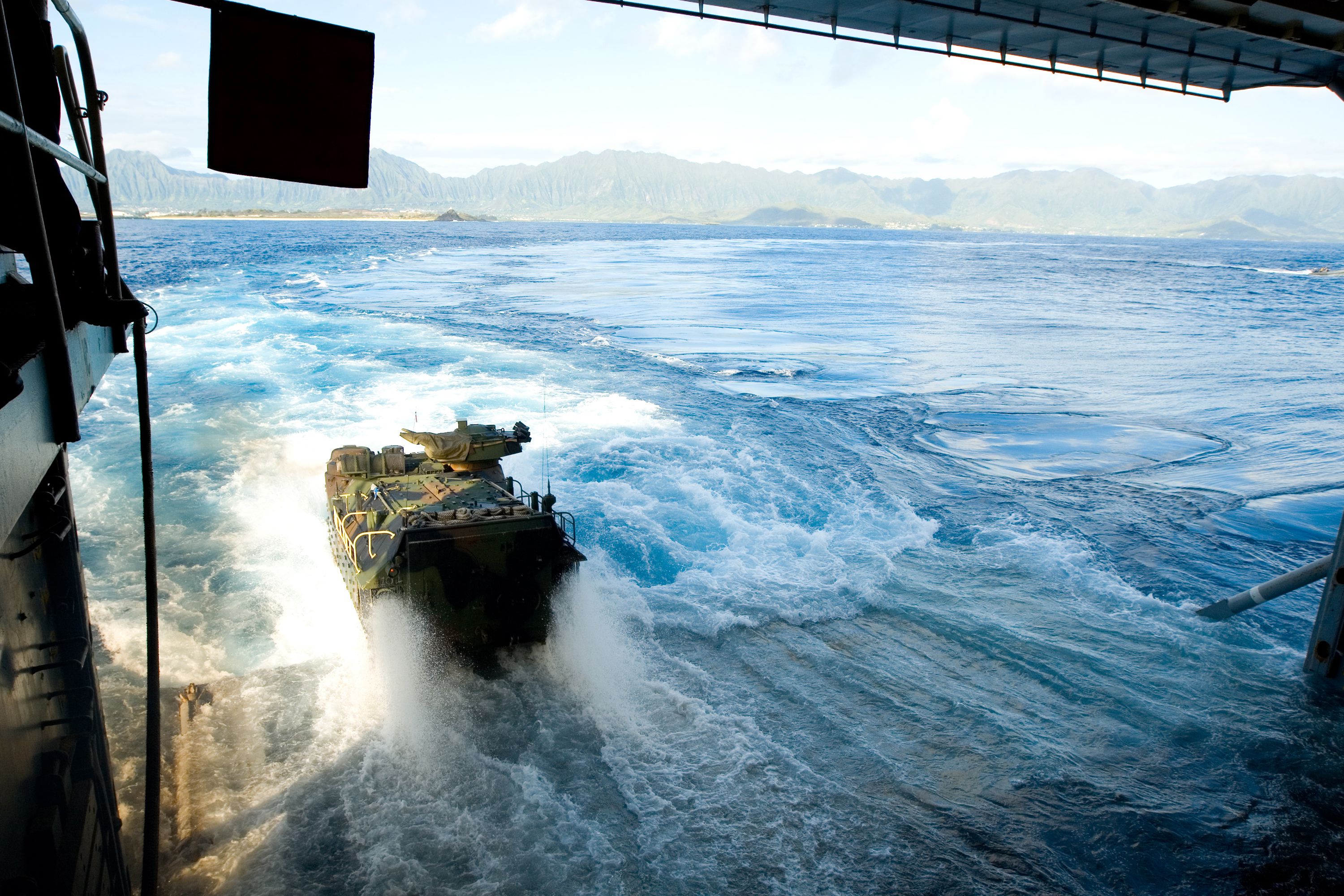
Amphibious invasion of Waimanalo.   Two years ago, the Marine amphibious landing craft got stuck on the reef for several hours.  These amphibious exercises have severely damaged the reef outside of Waimanalo.

>><<

http://www.staradvertiser.com/news/breaking/98977039.html

Kaneohe residents will hear more jet noise for the next three nights

By WILLIAM COLE

POSTED: 02:42 p.m. HST, Jul 21, 2010

Kaneohe residents will hear more jet noise tonight, tomorrow night and Friday night at the Marine Corps base as Rim of the Pacific naval exercises continue, officials said.

F/A-18 Hornet fighter and attack aircraft from Marine Corps Air Station Beaufort, S.C., are supporting ground-unit training at Pohakuloa Training Area on the Big Island, the Marines said.

The flights are expected to be finished between 11 p.m. and midnight over the next three nights, according to the Marines.

Janine Tully, a Kaneohe resident for 35 years, said she called the Marine Corps base to complain after jets roared by at 1 a.m. and 2:15 a.m. on Sunday and Monday.

“It’s pretty bad. The house rattles,” she said.

When she called to complain, the Marines apologized and said flights in and out of the Kaneohe Bay base are supposed to end by midnight, she said.

The noise affects residents all along the Kaneohe Bay shoreline, she said. Tully added that she understands the importance of RIMPAC for training. She also thinks the Marines could make more of an effort to inform residents and stop flying by midnight.

“It’s a given that the (RIMPAC) exercise is going to happen, but I think it would be nice for the base to make a little more effort to stick to the schedule,” Tully said.

RIMPAC is the world’s largest international maritime exercise and includes 14 nations, 32 ships, five submarines, more than 100 aircraft and 20,000 personnel.

For questions or concerns, contact the Marine Corps public affairs office at 257-8840.

Kaneohe residents will hear more jet noise tonight, tomorrow night and Friday night at the Marine Corps base as Rim of the Pacific naval exercises continue, officials said.

F/A-18 Hornet fighter and attack aircraft from Marine Corps Air Station Beaufort, S.C., are supporting ground-unit training at Pohakuloa Training Area on the Big Island, the Marines said.

The flights are expected to be finished between 11 p.m. and midnight over the next three nights, according to the Marines.

Janine Tully, a Kaneohe resident for 35 years, said she called the Marine Corps base to complain after jets roared by at 1 a.m. and 2:15 a.m. on Sunday and Monday.

“It’s pretty bad. The house rattles,” she said.

When she called to complain, the Marines apologized and said flights in and out of the Kaneohe Bay base are supposed to end by midnight, she said.

The noise affects residents all along the Kaneohe Bay shoreline, she said. Tully added that she understands the importance of RIMPAC for training. She also thinks the Marines could make more of an effort to inform residents and stop flying by midnight.

“It’s a given that the (RIMPAC) exercise is going to happen, but I think it would be nice for the base to make a little more effort to stick to the schedule,” Tully said.

RIMPAC is the world’s largest international maritime exercise and includes 14 nations, 32 ships, five submarines, more than 100 aircraft and 20,000 personnel.

For questions or concerns, contact the Marine Corps public affairs office at 257-8840.
Wai’anae Environmental Jusice Bus Tour

10.7.24 EJ bus tour flyer july 24

10.7.24 EJ bus tour flyer july 24

The Concerned Elders of Wai‘anae hope you will join us on July 24th for the fourth Huaka‘i Aloha ‘Aina o Wai‘anae, an environmental justice bus tour. This is a unique opportunity to visit the moku of Wai‘anae and experience the rich history of this vibrant community and fertile land. This is also a great opportunity to connect with the many Wai‘anae residents working to protect one of O‘ahu’s remaining breadbaskets.  Together, we can work to bring local, sustainable food production back to Hawai‘i, defend Hawai‘i’s rural communities and open spaces from inappropriate development, and protect the public’s health from contamination of our land and ocean.

We will be meeting at 8 AM at the Waianae Campus of the Leeward Community College.  We will visit successful farms in Wai‘anae, see farmland currently in jeopardy of industrialization, and meet with real Wai‘anae farmers.  We will pick up lunch at Wai‘anae’s own Farmers’ Market.

Seating on the tour bus is limited, so please RSVP to Marti at 524-8220 or marti@kahea.org.  See attached flyer for more details.

Mahalo!
Marti.

Directions:
The LCC-Wai‘anae Campus is located at 86-088 Farrington Highway.
Please proceed along Farrington Highway, past Leihoku Street and Longs Drugstore.  LCC-Wai‘anae is on the mauka-side of the road, on the top of the 2-story building behind the Cathay Chinese Restaurant and the Tesoro Gas Station. If you have trouble finding us, please call:

LCC-W front desk: 696-6378
Miwa: 228-7219
Marti: 372-1314

Raptors “reach out and touch” the enemy

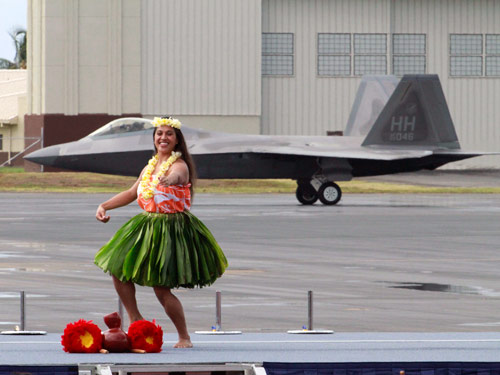
The Honolulu Star Advertiser reported that the first new F-22 Raptor jet arrived in Honolulu and became an obscene spectacle of militarism. Check out the photo by Craig Kojima depicting  a hula dancer “welcoming” the the phallic Raptor in the background.

10.7.12 photo f22 hula

Speakers alluded to dangers in the Asia Pacific:

Inouye said the Pacific “is now an area of major concern to our nation — it is an area that may have a potential for explosions.”

“We know that the Pacific is a region at peace, but we have seen recent regional events where peace can be threatened by individual actions,” said Gen. Gary L. North, commander of Pacific Air Forces headquartered at Hickam.

Although North did not specify those events, one example of recent instability was the March 26 sinking of the South Korean ship Cheonan, in which 46 South Korean sailors died, reportedly as a result of a North Korean torpedo strike.

I think the U.S. is the source of most of the explosions in the region.

NPR story on America’s H-bomb explosion in space

Check out this scary story from NPR about the atmospheric nuclear tests conducted by the U.S. from Kalama (Johnston Atoll) approximately 800 miles from O’ahu.   I have heard stories of people watching the “light show”.   I wonder what the fallout may have been and if it had health affects.

There were several nuclear test shots from Kalama that were aborted on launch.  One, I think it was Sunfish Prime, exploded on the launch pad and scattered highly toxic and radioactive plutonium across the island and into the lagoon.  The military scraped up all the contaminated coral and created a landfill.  As its “permanent” disposal solution, the military buried the plutonium contaminated wasted in an unlined pit and covered it with crushed coral.  Plutonium has a half-life of 24,100 years, which means it remains “hot” for a very long time.     Since most of Kalama was built with fill to accommodate the military activities, it is very prone to erosion.  The military estimated the sea will breach the landfill  in 50 – 100 years, scattering plutonium into the sea.

Go to the NPR website and watch the video clip of the nuclear “light show”.   Eerie and frightening.

>><<

http://www.npr.org/templates/story/story.php?storyId=128170775

A Very Scary Light Show: Exploding H-Bombs In Space

by Robert Krulwich

July 1, 2010

Since we’re coming up on the Fourth of July, and towns everywhere are preparing their better-than-ever fireworks spectaculars, we would like to offer this humbling bit of history. Back in the summer of 1962, the U.S. blew up a hydrogen bomb in outer space, some 250 miles above the Pacific Ocean. It was a weapons test, but one that created a man-made light show that has never been equaled — and hopefully never will. Here it is:

http://www.npr.org/templates/story/story.php?storyId=128170775

Source: NPR

Credit: Reporter: Robert Krulwich, Producers: Jessica Goldstein, Maggie Starbard Supervising producers: Vikki Valentine, Alison Richards Production Assistant: Ellen Webber Researcher: Meagen Voss

(Some of the images in this video were until recently top secret. Peter Kuran of Visual Concept Entertainment collected them for his documentary Nukes In Space.)

If you are wondering why anybody would deliberately detonate an H-bomb in space, the answer comes from a conversation we had with science historian James Fleming of Colby College:

“Well, I think a good entry point to the story is May 1, 1958, when James Van Allen, the space scientist, stands in front of the National Academy in Washington, D.C., and announces that they’ve just discovered something new about the planet,” he told us.

Van Allen described how the Earth is surrounded by belts of high-energy particles — mainly protons and electrons — that are held in place by the magnetic fields.

Today these radiation belts are called Van Allen belts. Now comes the surprise: While looking through the Van Allen papers at the University of Iowa to prepare a Van Allen biography, Fleming discovered “that [the] very same day after the press conference, [Van Allen] agreed with the military to get involved with a project to set off atomic bombs in the magnetosphere to see if they could disrupt it.”

Discover It, Then Blow It Up

The plan was to send rockets hundreds of miles up, higher than the Earth’s atmosphere, and then detonate nuclear weapons to see: a) If a bomb’s radiation would make it harder to see what was up there (like incoming Russian missiles!); b) If an explosion would do any damage to objects nearby; c) If the Van Allen belts would move a blast down the bands to an earthly target (Moscow! for example); and — most peculiar — d) if a man-made explosion might “alter” the natural shape of the belts.

The scientific basis for these proposals is not clear. Fleming is trying to figure out if Van Allen had any theoretical reason to suppose the military could use the Van Allen belts to attack a hostile nation. He supposes that at the height of the Cold War, the most pressing argument for a military experiment was, “if we don’t do it, the Russians will.” And, indeed, the Russians did test atomic bombs and hydrogen bombs in space.

In any case, says the science history professor, “this is the first occasion I’ve ever discovered where someone discovered something and immediately decided to blow it up.”

Code Name: Starfish Prime

The Americans launched their first atomic nuclear tests above the Earth’s atmosphere in 1958. Atom bombs had little effect on the magnetosphere, but the hydrogen bomb of July 9, 1962, did. Code-named “Starfish Prime” by the military, it literally created an artificial extension of the Van Allen belts that could be seen across the Pacific Ocean, from Hawaii to New Zealand.

In Honolulu, the explosions were front page news. “N-Blast Tonight May Be Dazzling: Good View Likely,” said the Honolulu Advertiser. Hotels held what they called “Rainbow Bomb Parties” on rooftops and verandas. When the bomb burst, people told of blackouts and strange electrical malfunctions, like garage doors opening and closing on their own. But the big show was in the sky.

To hear eyewitness accounts of what it looked like, listen to our broadcast on All Things Considered by clicking the Listen button on the top of this page.

Why Starfish Prime Created Rainbow Skies

To understand where the colors come from in Starfish Prime, you first have to know a little bit about Earth’s atmosphere. Nitrogen and oxygen are the two most abundant gases in our air. The concentration of each gas is different depending on the altitude.

When Starfish Prime detonated, charged particles — electrons — were released from the explosion. According to NASA astrophysicist David Sibeck, those particles came streaming down through the Earth’s atmosphere, energizing oxygen and nitrogen atoms, causing them to glow in different colors.

But why?

As electrons collide with the atoms, energy is transferred to the atoms. After holding onto it for a moment, the excess energy is released as light. When many excited atoms release energy together, the light is visible to the naked eye. Depending on the type of atom and the number of atoms, you get different colors.

It’s similar to what causes the aurora borealis, although those electrons are coming from the solar wind pounding into Earth. The electrons first encounter a high concentration of oxygen at the upper reaches of Earth’s atmosphere, causing the atoms to release a red light. Then green appears as the electrons travel to lower altitudes where there are fewer oxygen atoms. Even lower, where more nitrogen atoms are present, the collisions throw off a blue light.

But in the Starfish Prime explosion, charged particles went in every direction. That’s why you see the sky filled with a rainbow of colors nearly all at once in the footage. — Meagen Voss

Military lied about convoy stranding

As I pointed out in a previous post, it appears that the military made up the story about there being an auto accident on Farrington Highway and about being directed by Honolulu Police Department to make a U-turn that took them onto the beach.   This was nothing more than a joyride by armored vehicles where they should not be.  Someone needs to be held accountable for this.

>><<

http://www.staradvertiser.com/news/20100703_military_mistaken_in_mishap_hpd_says.html

Military mistaken in mishap, HPD says

Police officers in the vicinity deny directing a Marine Corps convoy off the road

By William Cole

POSTED: 01:30 a.m. HST, Jul 03, 2010

Honolulu police said there was no accident and that no officers directed a Marine Corps convoy off Farrington Highway on Thursday — as the Corps had maintained — after two of its armored vehicles became stuck on a beach on the Waianae Coast.

There were two officers assigned to “special duty” for construction activity about a half-mile west of the spot where the two Marine M-ATVs got stuck in the sand, said Maj. Michael Moses, HPD commander for District 8, which includes Ewa, Kapolei and Waianae.

“They said they didn’t direct any military vehicles to do a turnaround,” Moses said yesterday of his officers. “They didn’t even see any military vehicles pass their location during their shift.”

There were no accidents anywhere near the location at about 2 p.m. when the vehicles were noticed on the beach, Moses said.

The Marines had said the three M-ATV vehicles were conducting convoy training when they reached an accident in the road, HPD directed the vehicles to make a U-turn and in the process of reversing direction, two of the 25,000-pound vehicles became mired on the beach.

Maj. Alan Crouch, a Marine Corps spokesman, said yesterday that upon further analysis it was unclear whether it was HPD who directed the convoy to turn off the road.

“I’m not able to say who it was, and they (the troops involved) are not able to say 100 percent it was HPD,” Crouch said.

At or near Tracks Beach, “they were directed by a competent authority to turn left into a parking area in order to reverse their direction about a (half) mile prior to what they called an ‘accident’ but what could have been ‘construction,'” Crouch said.

Three Marine instructors, with six Army soldiers along, were conducting convoy training and were heading to Lualualei naval reservation when they said they were directed off the road, Crouch said.

Waianae Coast activist William Aila Jr. said the stuck vehicles were a good 50 yards off Farrington Highway, had driven another 50 yards on a dirt road and traveled 75 yards more on the sand before getting stuck about 30 feet from the surf.

Moses, the HPD commander, said it is illegal to drive on the beach.

“If they (the Marines) have any more facts, or a name or identity of the (police) officer or officers directing them that way, I would sure appreciate them giving me a call,” he said.

RIMPAC electromagnetic interference jams remote garage door openers, but Navy feigns ignorance

The invasion of Ke Awalau o Pu’uloa (Pearl Harbor) by ships, aircraft and personnel for RIMPAC exercises, the largest multinational war exercises in the world, may be causing a mysterious epidemic of dysfunctional remote garage door openers in Honolulu.  The Honolulu Star Advertiser writes:

Mary Abe came home from a workout and shopping, pushed the button on her garage door remote and … nothing.

She then checked the remote on a second car, and still nothing. Neither remote control would operate the garage door at her Aiea home in Royal Summit, she said.

“That’s why we called the repair people, and the repairman said, ‘I’ve had so many calls,'” Abe said. “He said that there’s nothing they could do because there was some type of interference. He thought it might be (Rim of the Pacific war games), because he started getting calls on Saturday.”

This is a recurring problem whenever significant numbers of military ships are in port. Apparently, the Navy uses 315 megahertz, the same frequency as many garage door openers.  The spike in military communications and radar activity during exercises seems to be jamming the remote devices.

But the Navy spokesperson denies responsibility:

“I don’t think we can pinpoint what’s causing what’s going on with the garage door openers, because there’s a lot of electromagnetic activity. It’s not just by the Navy,” said Agnes Tauyan, a spokeswoman for Navy Region Hawaii.

Being subjected to electromagnetic contamination without your knowledge or consent, one of the many joys of being under military occupation.