Guam: Japan Group Shares Experience With Military Presence

These people-to-people exchanges and solidarity efforts are very encouraging.   The peoples of our region can make peace despite the oppressive and militarized policies of our governments.

>><<

http://mvguam.com/index.php?option=com_content&view=article&id=11288:japan-group-shares-experience-with-military-presence&catid=1:guam-local-news&Itemid=2

Marianas Variety

Japan Group Shares Experience With Military Presence

Tuesday, 09 March 2010 04:54

by Therese Hart | Variety News Staff

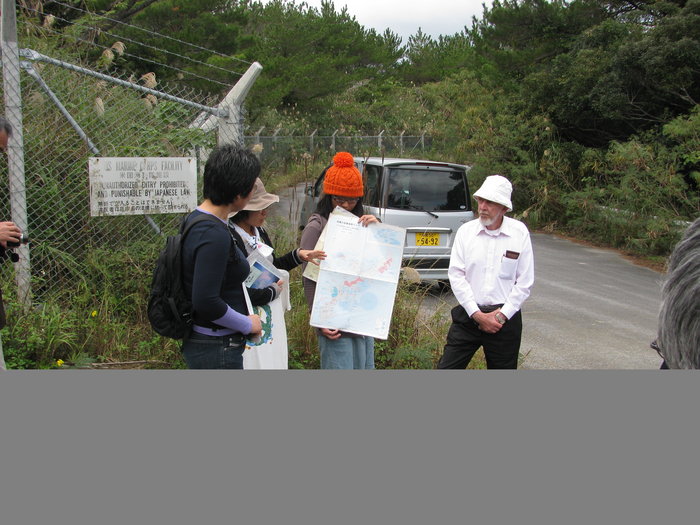
Tsuru Masaaki, leader of the 21-member delegation known as the Kyushu block Japan Congress against Atomic and Hydrogen Bombs said yesterday that the delegation’s mission was to share with Guam residents and leaders, the hardships their people have gone through with the military presence in Japan and to learn from local residents and leaders the issues facing Guam and the impending military buildup and its presence here.

When asked by Variety if the group planned to have an alliance with Guam, Masaaki said that they had no particular plan to draft any joint resolution or take any kind of action, but because they met with Guam residents and exchanged experiences, “we promised to continue to help and to have an exchange so in the future, we’re going to do something.”

“We came here to know the situation of Guam because we heard that in Guam people have the same kind of problems as the people in Japan. We came here to see the situation, only, not really have a special purpose of implementation.

Masaaki is from the Fukuoka Prefecture and is an attorney, as well as the executive chairman of Fukuoka local Japan Congress against Atomic and Hydrogen Bombs Saga Prefecture.

Uezu Yoshinao from Okinawa shared his views of the military presence in Okinawa, saying that Futenma Airbase is the most dangerous air base in the world.

Yoshinao backed up his statement saying that Futenma airbase is located near residential homes and public buildings. In August, 2004, a U.S. helicopter crashed and parts of the copter flew towards the residential area.

“Years ago, a U.S. helicopter crashed and part of the copter flew towards the residential area and people were really scared. Fortunately, there was nobody who was injured by that accident, but people are always facing that kind of fear,” said Yoshinao.

Yoshinao said that this situation would never have existed in the United States.

“In the U.S. this location cannot exist. Futenma airbase is near a residential area and public buildings. If this were in the U.S. you couldn’t build an airport in that area that is close to a residential area. So why in Japan, can you be allowed to do that and not in the U.S.? So as soon as possible, the airbase should be removed from there,” said Yoshinao.

Yoshinao said that incidents that will never be forgotten is one such as the rape of young Okinawan girls by U.S. military personnel.

The raping of young girls in Okinawa … this is just one example…The people of Okinawa has been suffering so that is why we want the U.S. bases out of Okinawa,” he said.

Yoshinao said he believes that the U.S. bases or military presence in Okinawa is representative of the United States itself. Therefore, the U.S. government must take responsibility for the base.

Senator Tina Muna Barnes said that it was clear from the beginning of the dialogue that local prefectures from Japan have the same concerns as Guam.

“They are on a fact-finding mission. There are concerns and parallels with issues such as ours regarding their land, their marine life, the aspect of how air space is being utilized, and self determination. I think all those things — we share all those concerns as common ground — so when is the United States going to step up to the plate to make sure there’s collaboration and there’s a fair playing field for everyone,” opined the lawmaker.

The Travails of a Client State: An Okinawan Angle on the 50th Anniversary of the US-Japan Security Treaty

Gavan McCormack provides an excellent analysis of Japan’s ‘client state’ position, the anti-bases movement in Okinawa and the crisis it represents for the US-Japan Security Treaty.

He links the bases issue to “poison” of war and occupation of other countries:

While official 50th anniversary commemorations celebrate the US military as the source of the “oxygen” that guaranteed peace and security to Japan, it is surely time for Japanese civil society to point out that the same oxygen is elsewhere a poison, responsible for visiting catastrophe in country after country in East Asia and beyond, notably Korea (1950s and since), Iran (1953), Guatemala (1954), Vietnam (1960s to 70s), Chile (1973), the Persian Gulf (1991), Afghanistan (2001-), and Iraq (2003-), and that now threatens Pakistan, Somalia, Yemen, and (again) Iran. Millions die or are driven into exile, and countries are devastated as the US military spreads its “oxygen” by unjust, illegal and ruthless interventions and permanent occupations. The degree to which allied countries share criminal responsibility has been the subject of major public review in Holland (which found that the Iraq War was indeed illegal and aggressive) and in the UK (where the Chilcot Inquiry continues). It is time for similar questions to be asked in Japan of the Iraq and Afghan wars, and Japan’s direct and indirect involvement in them.

His description of Okinawa as Japan’s ‘war state’ could also apply to the role of Guam and Hawai’i in American policy.   Unfortunately, his critique of U.S. military interventions and wars does not include Guam, Hawai’i or the other American colonies, some of the earliest casualties of the American Empire.

>><<

http://japanfocus.org/-Gavan-McCormack/3317

The Travails of a Client State: An Okinawan Angle on the 50th Anniversary of the US-Japan Security Treaty

Gavan McCormack

“It is incredible how as soon as a people become subject, it promptly falls into such complete forgetfulness of its freedom that it can hardly be roused to the point of regaining it, obeying so easily and so willingly that one is led to say that this people has not so much lost its liberty as won its enslavement.”

Etienne de la Boétie (1530-1563). Discours de la servitude volontaire ou le Contr’un (Discourse on Voluntary Servitude, or the Anti-Dictator).[1]

For a country in which ultra-nationalism was for so long a problem, the weakness of nationalism in contemporary Japan is puzzling. Six and a half decades after the war ended, Japan still clings to the apron of its former conqueror. Government and opinion leaders want Japan to remain occupied, and are determined at all costs to avoid offence to the occupiers. US forces still occupy lands they then took by force, especially in Okinawa, while the Government of Japan insists they stay and pays them generously to do so. Furthermore, despite successive revelations of the deception and lies (the secret agreements) that have characterized the Ampo relationship, one does not hear any public voice calling for a public inquiry into it. [2] Instead, on all sides one hears only talk of “deepening” it. In particular, the US insists the Futenma Marine Air Station on Okinawa must be replaced by a new military complex at Henoko, and with few exceptions politicians and pundits throughout the country nod their heads.

Okinawa in the East China Sea. Why the Ryukyus are the “Keystone of the Pacific” for US strategic planners

Chosen dependence is what I describe as Client State-ism (Zokkoku-shugi). [3] It is not a phenomenon unique to Japan, nor is it necessarily irrational. To gain and keep the favor of the powerful, dependence can often seem to offer the best assurance of security for the less powerful. Dependence and subordination during the Cold War brought considerable benefits, especially economic, and the relationship was at that time subject to certain limits, mainly stemming from the peculiarities of the American-imposed constitution (notably the Article 9 expression of commitment to state pacifism).

But that era ended, and instead of gradually reducing the US military footprint in Japan and Okinawa as the “enemy” vanished, the US decided to ramp it up. It pressed Japan’s Self Defence Forces to cease being “boy scouts” (as Donald Rumsfeld once contemptuously called them) and to become a “normal” army, able to fight alongside and if necessary instead of, US forces and at US direction, in the “war on terror,” specifically in support of US wars in Iraq, Afghanistan and Pakistan. It wanted Japanese forces to be integrated under US command, and it wanted greater access to Japan’s capital, markets and technology. “Client State” status required heavier burdens and much increased costs than during the Cold War, but it offered greatly reduced benefits.

Ever since the Hatoyama team first showed signs of being likely to assume government, and talked of “equality” and of renegotiating the relationship, Washington has maintained a ceaseless flow of advice, demand and intimidation to push it into the kind of subservience that had become the norm. The same “Japan experts” and “Japan-handlers” that in LDP times offered a steady stream of advice to “show the flag,” “put boots on the ground” in Iraq, and send the MSDF to the Indian Ocean, now send a steady drumbeat of: Obey! Obey! Obey! Implement the Guam Treaty! Build the new base at Henoko!

Yet, with the important exception of Okinawa, there is little sign of outrage in Japan. Instead, US demands are echoed by a chorus of Japanese voices agreeing that Hatoyama and his government be “realistic.” One well-placed Japanese observer recently wrote of the “foul odor” he felt in the air around Washington and Tokyo given off by the activities of the “Japan-expert” and the “pro-Japan” Americans on one side and “slavish” “US-expert” and “pro-American” Japanese on the other, both “living off” the unequal relationship which they had helped construct and support.[4]

Another recent Japanese critic, quoting the passage from de la Boétie that prefaces this article, writes:

“Struggling to be ‘best’ under the American umbrella, and taking it as matter for pride when cared for by the US, has become a structure in which ‘servitude’ is no longer just a necessary means but is happily embraced and borne. ‘Spontaneous freedom’ becomes indistinguishable from ‘spontaneous servitude’.” [5]

As the security treaty in its current form marks its 50th anniversary in 2010, it should be possible to reflect on the relationship, to continue it unchanged, straighten it out and revise it if necessary, or even to end it, but such reflection is blocked by a combination of cover-up of the past record, one-sided pressure to revise in a certain way, and political hype and rhetoric. As a result, in the year of the “golden Jubilee” anniversary, a more unequal, misrepresented and misunderstood bilateral relationship between two modern states would be difficult to imagine.

Although Hatoyama called for an “equal” relationship, the truth is that the US state does not admit the possibility of equality in its relations with any other state. The “closeness” and “reliability” of an ally is simply a measure of its servility. According to one senior member of the cabinet of Britain’s Tony Blair, looking back on her Government’s role in the war on Iraq, despite being the US’s supposedly closest of allies, “We ended up humiliating ourselves [with] unconditional, poodle-like adoration” because the “special relationship” meant “we just abjectly go wherever America goes.”[6] Her words deserve to be taken seriously by all America’s allies.

Only twice have Japanese governments made an effort to think of an alternative to the dependence rooted in the treaties of 1951 (San Francisco) and 1960 (Ampo) that have formed the legal frame for the post-Occupation relationship. In 1994 the Higuchi Commission recommended to Prime Minister Murayama Tomiichi that Japan revise its exclusively US-oriented, dependent diplomacy to become more multilateral, autonomous, and UN-oriented. [7] However, a US government commission headed by Joseph Nye then advised President Clinton almost precisely the opposite: since the peace and security of East Asia was in large part due to the “oxygen” of security provided by US forces based in the region, the existing defence and security arrangements should be maintained, the US military presence in East Asia (Japan and Korea) held at the level of 100,000 troops rather than wound down, and allies pressed to contribute more to maintaining them. Higuchi was forgotten and the Nye prescription applied. Not until 2009 was there any serious questioning of the wisdom of the Nye formula.

It was Nye and his associates (notably Richard Armitage) who from 1995 drew up the detailed sets of post-Cold War policy prescriptions for Japan. Paradoxically, but also reflecting the “Client State” phenomenon, they came to be respected, even revered, as “pro-Japanese” or “friends of Japan.” They and their colleagues drew the 2000 goal (in the “Armitage-Nye Report”) of turning the relationship into a “mature” alliance by reinforcing Japanese military subordination and integration under US command, removing barriers to the active service of Japan’s Self-Defense Forces on “collective security” missions, and taking the necessary steps towards revising the constitution, and in 2007 the further agenda of strengthening the Japanese state, revising the (still unrevised) constitution, passing a permanent law to authorize regular overseas dispatch of Japanese forces, and stepping up military spending.[8] The agreements on relocating US Forces in Japan (Beigun saihen, 2005-6) and Guam Treaty (2009) were the detailed policy instruments towards those goals. The “Futenma Replacement” (Henoko) project formed a central plank.

As Hatoyama’s team began to talk of equality and of an Asia-Pacific Community, it was Joseph Nye who issued a series of warnings, first spelling out (in December 2008) the acts that Congress would be inclined to see as “anti-American,” prominent among them being any attempt to revise the Beigun Saihen agreements (including the Futenma transfer).

The Treaty system whose anniversary is celebrated in 2010 has been unequal throughout its 50 years and is encrusted with deception and lies. The 1960 Treaty, rammed through the Diet in the pre-dawn hours and in the absence of the opposition, reconfirmed the (1951) division of the country into a demilitarized mainland “peace state” Japan and a directly American-controlled Okinawan “war state.” That division was maintained even when, in 1972, Okinawa was restored to nominal Japanese administration, in a deal that was also a model of deception. Firstly, the Okinawa “return” was in fact not a “giving back” but a “purchase,” Japan paying the US even more (for “return” of assets that in fact the US military retained) than it had paid seven years earlier to South Korea in compensation for forty years of colonial rule. And secondly, although the deal was declared to be one of reduction of Okinawan bases to mainland levels and without nuclear weapons, “kaku-nuki hondo-nami,” it was neither. The “war state” function remained central, bases remained intact and the US was assured (in the secret agreement, or mitsuyaku) that its nuclear privilege would remain intact. Despite the nominal inclusion of Okinawa under the Japanese constitution, then and since it has continued in fact to be subject to the over-riding principle of priority to the military, that is, the US military, and in that sense, ironically, matching North Korea as a “Songun” state.

Both governments prefer secret diplomacy to public scrutiny. By simple bureaucratic decision, Japan instituted a system of subsidy for US wars known as the “omoiyari” (sympathy) payments and expanded the scope of the security treaty from Japan and the “Far East” (according to Article 6) into a global agreement for the combat against terror. “Client State” Japan pays the US generously to continue, and not to reduce, its occupation.[9]

In mainland Japan, political and intellectual resistance to the Nye Client State agenda for Japan quickly crumbled nationally from 1995 with the return to power in Tokyo of the LDP, and the qualities of nationalism, democracy and constitutionalism were gradually relegated to second place to the “higher” cause of the alliance. In Okinawa, however, forced to bear the brunt of US military rule, civil democracy in the form of anti-base resistance grew steadily and the Client State agenda was never able to attain legitimacy. Consequently, for 14 years, through the terms of 8 Prime Ministers and 16 Defense Ministers, the 1996 bilateral agreement to substitute a Henoko base for the Futenma one made no progress. It was blocked by the fierce, uncompromising, popularly-supported Okinawan resistance.

In 2005 Okinawan civil society won an astonishing, against all odds, victory over the Koizumi government and its US backers, forcing the Government of Japan to abandon the “offshore” (on-reef, floating, pontoon structure) Henoko base project. It was a historic event in the history of democratic and non-violent civic activism. The government returned to the offensive in 2006, however, with its design for an enlarged, “on-shore” Henoko base to be built on reclaimed land that would jut out into Oura bay from within the existing Camp Schwab marine base. This dual runway, hi-tech, air, land and sea base able to project force throughout Asia and the Pacific was far grander and more multifunctional than either the obsolescent, inconvenient and dangerous Futenma or the earlier offshore, pontoon-based “heliport.”

Oura Bay

Though widely reported (with the subterfuge that is characteristic of the “Alliance”) as a US “withdrawal” designed to reduce the burden of post-World War II American military presence in Okinawa, the 2006 agreement would actually further the agenda of integration of Japanese with US forces and subjection to Pentagon priorities and increase the Japanese financial contribution to the alliance (with Japan paying $6.1 billion for US marine facilities on Guam and up to $10 billion for a new Marine Base at Henoko). “Consolidation” and “reinforcement” were the appropriate terms.

When Obama took office in early 2009, his Japan expert advisers seem to have advised him to move quickly to pre-empt any possible policy shift under a future DPJ government. They therefore exploited the interval when the LDP still enjoyed the two-thirds Lower House majority delivered by Koizumi’s “postal privatization” triumph of 2005 to press the 2006 agreement into a formal treaty and had Prime Minister Aso ram it through the Diet (in May 2009), so as to tie the hands of the Democratic Party forces about to be elected to government.

The Guam Treaty of 2009 was a defining moment in the US-Japan relationship, when both parties went too far, the US in demanding (hastily, well aware that time was running out to cut a deal with the LDP) and Japan in submitting to something not only unequal (imposing obligations on Japan but not on the US), but also unconstitutional, illegal, colonial and deceitful. [10] Yet few Japanese seemed able to detect the “foul odor” that arose from the deal.

In Okinawa, however, the Hatoyama DPJ election victory of August 2009, marked not only by the national party’s electoral pledge to relocate the Futenma base outside the prefecture but by the clean sweep within the prefecture of committed anti-base figures, was taken as signalling that a new and favourable tide to Okinawa was rising. Opposition to any “within Okinawa” Futenma relocation became almost total across the political spectrum. When a committed anti-base candidate was elected mayor of Nago City on 24 January 2010, the threat to Oura Bay (and its dugong, coral and turtles) seemed drastically diminished. Having witnessed the lies and deceptions by which over 13 years the temporary, pontoon-supported “heliport” gradually evolved into the giant, reclamation, dual-runway and military port project of 2006, and having experienced the emptiness of the promise of economic growth in return for base submission, Okinawans were in no mood to be tricked again.

Author being briefed at the site of the Helipad Sit-In, Higashi village, Yambaru, Okinawa, 6 December 2009.

If the two elections gave great heart to Okinawans, however, they also shook the “alliance” relationship. Washington insisted on fulfilment of the Guam Treaty but the Henoko base could only now be built if Hatoyama was prepared to adopt anti-democratic measures of something akin to martial law to defy the will of Okinawan voters and protesters. That would be a peculiar way to celebrate the 50th anniversary of the “Alliance.”

At Honolulu in January 2010, Hillary Clinton insisted that the Ampo base system was indispensable for East Asian, especially Japan’s, security and prosperity. It was essentially Joseph Nye’s 1995 point. But is it true? The idea that the peace and security of East Asia depends on the presence of the Marines in Okinawa (the “deterrence” function) is tendentious. There is today almost zero possibility of an attack on Japan by some armed force such as was imagined during the Cold War, and in any case the Marines are an expeditionary “attack” force, held in readiness to be launched as a ground force into enemy territory, not a force for the defense of Okinawa or Japan as stipulated under Article 4 of the Treaty of Mutual Cooperation and Security. Since 1990, they have flown repeatedly from bases in Japan for participation in the Gulf, Afghanistan, and Iraq Wars.

Furthermore, the hullabaloo in Japan surrounding the Henoko project rests on a serious misunderstanding. As Ginowan City mayor, Iha Yoichi, has repeatedly shown from his analysis of US military planning documents, the Pentagon from 2006 has been committed to transfer main force Futenma marine units to Guam, upgrading it into the military fortress and strategic staging post covering the whole of East Asia and the Western Pacific (and thus undercutting the strategic importance of any new Okinawan base). [11] Iha’s analysis was at least partially confirmed by a senior official of Japan’s defense bureaucracy who described the 3rd Marine Division as a “force for deployment at any time to particular regions beyond Japan …. not for the defense of particular regions.” [12] In short, the Guam Treaty is concerned not with a Futenma substitute, or even with the defense of Japan, but with construction of a new, upgraded, multi-service facility that U.S. Marines will receive for free and will use as a forward base capable of attacking foreign territories.

US military footprint on Guam

Virtually without exception, American officials, pundits and commentators support the Guam treaty formula and show neither sympathy nor understanding for Japanese democracy or Okinawan civil society, and by and large the Japanese pundits and commentators respond to this in “slave-faced” manner (do-gan in Terashima’s term). The Okinawa Times (19 January 2010) notes that the 50th anniversary offered a “chance to reconsider the Japan-US Security treaty that from Okinawa can only be seen as a relationship of dependence.” To seriously “re-consider” would require wiping the “slave faces” off Japan’s politicians and bureaucrats.

Hatoyama’s government has enunciated idealistic sentiments – including statements such as from Party Secretary-General Ozawa Ichiro saying that “Okinawa beautiful blue seas must not be despoiled” [13], and the postponing of a decision on the Futenma issue to May opened the issue to a measure of public scrutiny and discussion. However, neither the Prime Minister nor any of his senior ministers offered leadership or did anything to encourage discussion on the nature of the alliance or Okinawa’s burdens. Instead, the Hatoyama government backed itself into a corner by assuming the legitimacy of the Guam Treaty, from which it followed that Futenma could not be returned unless or until it was replaced. Furthermore, prominent ministers, in “Client State” spirit, publicly identified with the position of the US government. Thus Foreign Minister Okada in Nago on 5 December 2009 pleaded with Okinawans to understand the “crisis of the alliance” and the “difficulty” of the negotiations. He suggested that Okinawans should have sympathy for President Obama “who might not be able to escape criticism for weakness in his dealings with Japan at a time of falling popularity” if the Guam Treaty deal was not implemented. [14]

When Hatoyama announced the postponement of decision till May 2010, a Pentagon Press Secretary declared that the US “did not accept” the Japanese decision, [15] and Joseph Nye referred to the DPJ as “inexperienced, divided and still in the thrall of campaign promises,” plainly meaning that attempts to renegotiate the Guam Agreement would not be tolerated. [16]

Yet, the mood in Okinawa unquestionably strengthened following the Hatoyama victory and the sweeping aside of the representatives of the “old regime” in Okinawa in August 2009. Opinion polls had long shown levels of around 70 per cent against the Guam formula (for Henoko construction), [17] but that figure rose steadily, so that one May 2009 survey found a paltry 18 per cent in favour of the Henoko option on which Washington was adamant, and by November that figure had fallen to 5 per cent; hardly anyone. [18] Both Okinawan newspapers, and the most prominent figures in Okinawan civil society, were strongly opposed. [19] The signals of anger and discontent rose to their peak in February 2010 with the adoption by the Okinawan parliament (the Prefectural Assembly) of an extraordinary resolution, unanimously demanding that Futenma be closed (moved “overseas or elsewhere in Japan”), [20] and Okinawa’s 41 local district mayors also unanimously declared themselves of the same view. [21]

It meant that, while Tokyo struggled desperately to find a way to implement the Guam Treaty, Okinawa unanimously rejected it. There is no longer a “progressive-conservative” divide in Okinawan politics on this question. The Mayor of Okinawa’s capital, Naha, who in the past served as President of the Liberal Democratic Party of Okinawa, recently made clear that, as a prominent Okinawan conservative, he was disappointed by the Hatoyama government’s reluctance to redeem its electoral pledge on Futenma and hoped the Okinawan people would remain united “like a rugby scrum” to accomplish its closure and return (i.e., not replacement). [22] No local government or Japanese prefecture in modern history had ever been at such odds with the national government.

Early in March, Defense Vice-Minister Nagishima Akihisa bluntly declared that the US demands would be met, even if it meant alienating Okinawans (who would be offered “compensation.”) [23] With Hatoyama likewise insisting that he would honour alliance obligations, and the likelihood high that other formulas would prove unworkable or impossible to clear in such a tight timetable, Okinawans braced themselves. By May, 2010 Hatoyama would have to either reject the US demands, risking a major diplomatic crisis, or submit to them, announcing with regret that there is no “realistic alternative” to the “V-shaped” base at Henoko, thus provoking a domestic political crisis.

While official 50th anniversary commemorations celebrate the US military as the source of the “oxygen” that guaranteed peace and security to Japan, it is surely time for Japanese civil society to point out that the same oxygen is elsewhere a poison, responsible for visiting catastrophe in country after country in East Asia and beyond, notably Korea (1950s and since), Iran (1953), Guatemala (1954), Vietnam (1960s to 70s), Chile (1973), the Persian Gulf (1991), Afghanistan (2001-), and Iraq (2003-), and that now threatens Pakistan, Somalia, Yemen, and (again) Iran. Millions die or are driven into exile, and countries are devastated as the US military spreads its “oxygen” by unjust, illegal and ruthless interventions and permanent occupations. The degree to which allied countries share criminal responsibility has been the subject of major public review in Holland (which found that the Iraq War was indeed illegal and aggressive) and in the UK (where the Chilcot Inquiry continues). It is time for similar questions to be asked in Japan of the Iraq and Afghan wars, and Japan’s direct and indirect involvement in them.

The 50th anniversary should be a time for the Japan whose constitution outlaws “the threat or use of force in international affairs” to reflect on how it has come to rest its destiny on alliance with the country above all others for whom war and the threat of war are key instruments of policy, and whether it should continue to offer unqualified support and generous subsidy, and whether it should continue to “honour” the Guam treaty, at all costs maintaining the marine presence in Okinawa. As a first step, it is time to debate openly the unequal treaties, secret diplomacy, lies, deception and manipulation of the last 50 years and time to reflect upon, apologize, and offer redress for the wrongs that have for so long been visited upon the people of Okinawa as a result.

Gavan McCormack is a coordinator of The Asia-Pacific Journal – Japan Focus, and author of many previous texts on Okinawa-related matters. His Client State: Japan in the American Embrace was published in English (New York: Verso) in 2007 and in expanded and revised Japanese, Korean, and Chinese versions in 2008. He is an emeritus professor of Australian National University. The present paper is an expanded version of his article published in Japanese in Shukan kinyobi on 5 March 2010.

Recommended citation: Gavan McCormack, “The Travails of a Client State: An Okinawan Angle on the 50th Anniversary of the US-Japan Security Treaty,” The Asia-Pacific Journal, 10-3-10, March 8, 2010.

Notes

[1] In English as The Politics of Obedience: The Discourse of Voluntary Servitude, translated by Harry Kurz and with an introduction by Murray Rothbard, Montrèal/New York/London: Black Rose Books, 1997. Web version here. I am indebted to Nishitani Osamu (see note 5) for drawing my attention to de la Boétie.

[2] Foreign Minister Okada Katsuya did set up an “Experts” committee to investigate the so-called “Secret Agreements” between US and Japanese governments on nuclear and other matters and report back during 2010, but it was of limited focus, precipitated by the common knowledge that such documents existed in the US archives and a series of public statements by former senior officials testifying to their existence. Early reports from Tokyo suggest that no such documents had been found, which raised the possibility they had been deliberately destroyed.

[3] Client State: Japan in the American Embrace, New York, Verso, 2007. Expanded Japanese edition as Zokkoku – Amerika no hoyo to Ajia de no koritsu, Tokyo, Gaifusha, 2008.

[4] Terashima Jitsuro, “Zuno no ressun, Tokubetsu hen, (94), Joshiki ni kaeru ishi to koso – Nichibei domei no saikochiku ni mukete,” Sekai, February 2010, 118-125. Terashima refers to Japanese intellectuals by the term, “do-gan” (literally “slave face”, a term he invents based on his reading of a savagely satirical early 20th century Chinese story by Lu Hsun).

[5]. Nishitani Osamu, “’Jihatsuteki reiju’ o koeyo – jiritsuteki seiji e no ippo,” Sekai, February 2010: pp. 134-140, at p. 136.

[6] Clare Short, formerly International Development Secretary, “Clare Short: Blair misled us and took UK into an illegal war,” The Guardian, 2 February 2010.

[7] Boei mondai kondankai, “Nihon no anzen hosho to boeiryoku no arikata – 21 seiki e mukete no tenbo,” (commonly known as the “Higuchi Report” after its chair, Higuchi Kotaro), presented to Prime Minister Murayama in August 1994.

[8] Richard L. Armitage and Joseph S. Nye, “The U.S.-Japan Alliance: Getting Asia right through 2020,” Washington, CSIS, February 2007.

[9] For details, see my Client State, passim.

[10] “The Battle of Okinawa 2009: Obama vs Hatoyama,” The Asia-Pacific Journal, 16 November 2009.

[11] “Why Build a New Base on Okinawa When the Marines are Relocating to Guam?: Okinawa Mayor Challenges Japan and the US.” See also Iha Yoichi, interviewed in “Futenma isetsu to Henoko shin kichi wa kankei nai,” Shukan kinyobi, 15 January 2010, pp. 28-9.

[12] Yanagisawa Kyoji (special researcher and former Director of National Institute for Defense Studies), “Futenma no kakushin –kaiheitai no yokushiryoku o kensho seyo,” Asahi shimbun, 28 January 2010.

[13] “Santo raigetsu isetsusaki oteishi,” Okinawa Times, 29 December 2009.

[14] Quoted in “Kiki aoru dake de wa nasakenai,” editorial, Ryukyu shimpo, 7 December 2009. For a fascinating transcript of the meeting, see Medoruma Shun’s blog, “Uminari no hitobito,” “Okada gaisho to ‘shimin to no daiwa shukai’, zenmen kokai,” in 7 parts, beginning here.

[15] “Pentagon prods Japan on Futenma deadline,” Japan Times, 8 January 2010.

[16] Joseph S. Nye Jr, “An Alliance larger than One Issue,” New York Times, 6 January 2010.

[17] “Futenma hikojo daitai, kennai isetsu hantai 68%,” Okinawa Times, 14 May 2009. In the Northern Districts (including Nago Ciy) opposition was even higher, at 76 per cent.

[18]“Futenma iten: Genko keikaku ni ‘hantai” 67%, Okinawa yoron chosa,” Mainichi shimbun, 2 November 2009; for a partial English account, “Poll: 70 percent of Okinawans want Futenma moved out of prefecture, Japan,” Mainichi Daily News, 3 November 2009.

[19] Open Letter to Secretary of State Clinton, by Miyazato Seigen and 13 other representative figures of Okinawa’s civil society, 14 February 2009, (Japanese) text at “Nagonago zakki,” Miyagi Yasuhiro blog, 22 March 2009; English text courtesy Sato Manabu. They demanded cancellation of the Henoko plan, immediate and unconditional return of Futenma, and further reductions in the US military presence.

[20] “Kengikai, Futenma ‘kokugai kengai isetsu motomeru’ ikensho kaketsu,” Okinawa Times, 24 February 2010. A resolution to the same effect had been passed by a majority in July 2008.

[21] “Zen shucho kennai kyohi, Futenma kengai tekkyo no shiodoki,” editorial, Ryukyu shimpo, 1 March 2010. The rising tide of Okinawan sentiment on this issue is plain from the fact that the figure had been 80 per cent, or 31 out of the 41 mayors, in October “Futenma ‘kengai’ ‘kokugai’ 34 nin,” Okinawa Times, 30 October 2009).

[22] Onaga Takeshi, “Okinawa wa ‘yuai’ no soto na no ka,” Sekai, February 2010, pp. 149-154.

[23] John Brinsley and Sachiko Sakamaki, “US base to stay on Okinawa, Japanese official says,” Bloomberg, 2 March 2010.

Militarization would desecrate Pagat, Chamorro sacred site

From the Marianas Variety

Sacrilege in Pagat

Friday, 26 February 2010 01:58

Letter to the Editor

WHAT is Pagat? For the people who wrote the draft environmental impact statement, it is nothing more than a place to shoot off high-powered guns. For some people, it is worthless jungle, just as lattes and lusongs are worthless rocks. But many of us recognize it for what it is in its own right – a truly sacred place that, amazingly to this day, remains untouched by modern life.

Pagat’s caves and ancient Chamorro villages are places where we can touch and honor what was part of the daily lives of our ancestors who settled in the jungles for over 3,500 years. Amazing! Today, a walk through Pagat is a cherished visit with the ancestors, to the very roots of the island’s culture. It is the purest essence of Chamorro spirituality. It is our Sistine Chapel.

As an example of the deep reverence the Chamorros have for Pagat, we pray before entering the trail, speak in hushed voices, and respect the plants and animals encountered along the way. All the while we are filled with the sense that this experience is precious and its beauty humbles us. The idea of artillery echoing through this hallowed valley and destroying the lattes and lusongs is nothing short of sacrilegious. A firing range in Pagat would be no less an outrage than when the Taliban blew up the treasured, ancient Buddhas carved into the cliffs of Afghanistan.

The people of Guahan will never allow Pagat to be taken away, damaged, or restricted from future generations. Our people have protected the site for thousands of years, and will continue to do so, no matter how many powerful, ill-informed outsiders try to destroy what we have.

Christina Illarmo
Mangilao

Japanese groups conduct fact-finding visit to Guam

http://mvguam.com/index.php?option=com_content&view=article&id=11256:fact-finding-mission&catid=1:guam-local-news&Itemid=2

Fact-finding mission

Friday, 05 March 2010 01:20

by Mar-Vic Cagurangan | Variety News Staff

Japanese lobby groups coming to Guam

A 20-MEMBER delegation consisting of representatives from an influential coalition of Japanese lobby groups, is arriving on Guam tomorrow on a four-day fact-finding mission to assess the island’s capacity to accommodate the troops that will be relocated from Okinawa.

“They will meet our officials and members of the community and go back to Japan to share the outcome of their trip with their elected leaders,” said Debbie Quinata, maga’haga of Chamorro Nation, who is hosting the delegation from the left-leaning Japan Congress Against A and H Bombs.

The visiting coalition, led by Tsuru Masaaki, is represented by leaders of human rights groups, peace movement and labor unions from 10 prefectures.

“They are not here to play. After their trip, they will write a report that will be submitted to the Japanese Diet,” Quinata said.

She said the delegation is specifically interested in the financial aspect of the military buildup as it relates to the Japanese government’s $6 billion contribution to the Marines relocation cost, which is greeted with protests from Japanese taxpayers.

“This group is particularly opposed to the Japanese government’s intention to use the people’s taxes to subsidize the troop relocation expenses and to participate in infringing on the rights of the people of Guam,” Quinata said.

The delegates will arrive on Saturday night and visit the proposed firing range site for the Marines on Route 15 the next day. The tour also includes a visit to Pagat, an ancient site, which will also be affected by the firing range project.

They will meet with Lt. Gov. Mike Cruz in Adelup on Monday morning. A separate meeting with speaker Judi Won Pat, vice speaker BJ Cruz, and Sens.Judy Guthertz, and Senator Ben Pangelinan follows next on the same day.

Participating groups include the Nagasaki Prefecture Movement for Peace, Miyazaki Federation of Social Democrats and Kagoshima Prefecture Teachers Union, among others.

+++

http://mvguam.com/index.php?option=com_content&view=article&id=11274:japan-group-tours-guam&catid=1:guam-local-news&Itemid=2

Japan group tours Guam

Monday, 08 March 2010 05:32

by Therese Hart | Variety News Staff

A 21-member delegation from various organizations in Japan arrived on Guam Saturday evening for a study-tour related to the military buildup.

Yesterday, the group toured the Nelson family property in Pagat, Mangilao, to view the proposed live fire range. During the public comment period for the draft environmental impact statement, members of the Nelson family testified at many of the meetings in strong opposition to using their family land for the firing range.

Family members reiterated their opposition regarding the use of their land for military operations. And although Congresswoman Madeleine Z. Bordallo has stated for the record that she will oppose any land taking, family members remain concerned that Bordallo’s opposition in Washington D.C. might not be enough if the federal government decides to invoke its eminent domain authority on lands for military use.

“If they want it; there’s not much anyone can do once the decision has been made. I hope that Madeleine will lobby hard against any land taking. In the first place, the federal government should deal directly with private property owners,” said landowner Ted Nelson.

The group listened carefully as members of the We Are Guahan group shared with them the concerns raised since the DEIS was released.

The delegation will pay a courtesy call on Lt. Gov. Mike Cruz today at 9 a.m. as well as members of the 30th Guam Legislature at 10 a.m.

Organizations represented in the delegation include the Social Democratic Party of Japan, the Japan Congress Against A- and H-Bombs, and several Japanese labor unions and peace organizations, according to Vice Speaker Benjamin J. F. Cruz.

The group is expected to share comments with Guam leaders regarding the U.S.-Japan alliance and the issues surrounding Guam’s concerns about the buildup.

U.K. proposes Chagos marine reserve that could block islanders’ return

Chagos is an Indian Ocean island possession of the UK, one of the colonies it held onto after decolonization. Britain evicted the native Chagossian population and leased the island to the U.S. military. Now Diego Garcia is one of the most important bases in America’s empire of bases. British courts except for the House of Lords have ruled in favor of the Chagossian’s right to return to their homeland, but the government has fought them every step of the way. Now the UK is proposing a marine reserve for Chagos. A nice environmentally friendly move, you might think. However, this designation could block the return of Chagossians and prohibit fishing in the reserve.

The Brits may have stolen this play right out of the U.S. play book: using marine environmental protection to dispossess the native people. The U.S. has created federal marine monuments in the Northwestern Hawaiian Islands and is proposing a similar monument in the Marianas. While the Papahanaumokuakea National Marine Monument has created unprecedented protections for the coral reef system in the northwestern Hawaiian islands, the Bush administration slipped in an exemption for the military to conduct its activities within the reserve. The proposed Marianas marine monument contains similar provisions. Native Hawaiians have generally supported the Papahanaumokuakea National Marine Monument and have helped to shape it to incorporate subsistence fishing and other cultural practices. Chamorros have been divided on the Marianas monument because any increased federal control means an erosion of the islands’ sovereignty and native rights. With the proposed U.S. military expansion in Guam and CNMI, the federalization of the marine ecosystem is viewed with warranted suspicion.

The U.S. military has realized that being environmentally friendly can have strategic value. Undeveloped nature reserves are less troublesome as neighbors of military bases and ranges than complaining suburban residents. So the Pentagon instituted a conservation buffer program to partner with environmental groups to preserve areas bordering bases as a way to prevent the “encroachment” of other users. Marine reserves that allow military activities to take place without competing users serves the same purpose.

>><<
The Times
March 6, 2010

Chagossians fight for a home in paradise

Catherine Philp, Diplomatic Correspondent

chagos

(John Parker/Corbis) Designating the Chagos Archipelago as a marine protection area will end all fishing

If ever there was an oceanic treasure worthy of conservation, the Chagos archipelago, with its crystal-clear waters and jewelled reefs, is it. Yet the British Government’s plans have split the gentle world of marine conservation, created a diplomatic row with Indian Ocean states and turned the spotlight on to the archipelago’s place in Britain’s darker colonial history.

The British Indian Ocean Territory, as it is officially known, is the ancestral home of the Chagossians, the 2,000 people and their descendents that Britain removed forcibly from the islands in the Seventies to make way for a US air and naval base on the main island, Diego Garcia. Despite Britain repeatedly overruling court judgments in their favour, the exiled Chagossians have continued their struggle. This summer their case will be heard at the European Court of Human Rights in Strasbourg. By then, however — if David Miliband, the Foreign Secretary, gets his way — the Chagos will have been designated a marine protected area (MPA), where activities such as fishing and construction are banned, denying them any legal means to sustain their lives.

It is, depending on your view, a sinister trick to prevent the Chagossians returning; an easy piece of environmental legacy building by a Government about to lose power; or an act of arrogant imperialism to rob the territory’s true owners of any say in its future.

Perhaps the most compelling case against the plan, however, is made by the swelling cadre of environmentalists opposing the project in the belief that — far from protecting this pristine paradise — it could hasten its destruction. “Even if I didn’t care about human rights, I would say this is a terrible mistake,” said Dr Mark Spalding, one of the world’s foremost experts on reef conservation.

“The world of conservation is littered with failures where the people involved were not consulted. If the Chagossians win the right to return, why should they want to co-operate with the conservation groups running roughshod over them?”

The Government’s proposal acknowledges that the entire plan may have to be scrapped if the Chagossians are allowed to return. “That would make it the shortest-lived protection area in the world,” Dr Spalding said. “So you have to ask: what’s the rush to get this done before [the Strasbourg ruling and] a general election?”

Mr Miliband will begin to examine the cases for and against the reserve next week, after public consultations ended yesterday. A decision is expected within weeks, but the Foreign Secretary already sounds convinced. “This is a remarkable opportunity for the UK to create one of the world’s largest marine protected areas, and double the global coverage of the world’s oceans benefiting from full protection,” he wrote.

Many of the world’s leading conservation groups have thrown their weight behind the proposal, which emphasises the advantage of the islands being “uninhabited”. They are not: the original islanders were removed from Diego Garcia to make way for a military base that houses 1,500 US service personnel, 1,700 civilian contractors and 50 British sailors. The island, which constitutes 90 per cent of the landmass of the Chagos, is, in effect, to be exempt from the protection order.

Peter Sand, a British environmental lawyer who has investigated the US base’s impact, has documented four jet fuel spills totalling 1.3 million gallons since it was built and has lobbied unsuccessfully for information on radiation leakage from nuclear-powered vessels there. “To say that a small group of Chagossians could have a greater impact than the base is just crazy,” Dr Spalding said.

The plan has also sparked a diplomatic row with Mauritius and the Seychelles, from whom the Chagos Islands were taken and to whom Britain has agreed to cede them when they are no longer needed by the US military. Britain faces further embarrassment over allegations that Diego Garcia was used to moor US prison ships where “ghost” prisoners were tortured.

The Prime Minister of Mauritius said last week that he was “appalled” by the decision to press ahead with plans for the reserve, “It is unacceptable that the British claim to protect marine fauna and flora when they insist on denying Chagos-born Mauritians the right to return to their islands all the while,” Navin Chandra Ramgoolam said at the inauguration of a building for Chagossian refugees in the Mauritian capital. “How can you say you will protect coral and fish when you continue to violate the rights of Chagos’s former inhabitants?”

Britain originally offered the US the Aldabra atoll for its base but backed down after uproar from environmentalists. Aldabra, now a World Heritage Site, was uninhabited by humans but home to hundreds of thousands of giant tortoises. “The British had refused to create a base on Aldabra in the Seychelles not to harm its tortoise population,” marvelled Olivier Bancoult, head of the Chagos Refugees Group. “Now they are trying to create a protected area to prevent Chagossians from returning to their native islands.”

Shifting sands

1960s The Chagos archipelago, originally part of Mauritius, is secretly leased to Britain. Together with the Aldabra archipelago, taken from the Seychelles, they become the British Indian Ocean Territory

1970 Britain and the US agree to set up a military base on Diego Garcia, and Britain begins deporting the 2,000 Chagossians to Seychelles and Mauritius

1983 £1m compensation is paid to the refugees on Mauritius

2000 British High Court rules in favour of Chagossians demanding the right to return

2004 Government issues a royal prerogative striking down the court’s decision

2006 The Court of Appeal dismisses the Government’s appeal, saying its methods are unlawful and “an abuse of power”; 102 Chagossians are permitted to visit Diego Garcia for a day to tend relatives’ graves

2008 Law lords vote 3-2 in favour of Government, overruling High Court

2009 Foreign Office launches public consultation on the creation of a protected marine area

2010 The European Court of Human Rights is set to hear the Chagossians’ petition to return this summer

Source: Times database

Related Links

Fight for Guahan delivers message to PACOM

On February 22, 2010, an international delegation representing Fight for Guahan, a group opposed to the military buildup on Guam, and DMZ-Hawai’i / Aloha ‘Aina delivered a message to Admiral Willard, Commander in Chief, Pacific Command. Joining the delegation was Colonel Ann Wright, Chamorro activist Hope Cristobal, Saipan activist and navigator Lino Olopai and filmmaker Vanessa Warheit, who had just screened the new film Insular Empire: America in the Marianas. Hawaiian independence activist Pono Kealoha videotaped and posted the following footage on YouTube.


Japan won’t follow Futenma plan

http://mvguam.com/index.php?option=com_content&view=article&id=11254:japan-wont-follow-futenma-plan&catid=1:guam-local-news&Itemid=2

Japan won’t follow Futenma plan

Friday, 05 March 2010 01:16 by Therese Hart | Variety News Staff

THE Japanese government has conveyed to the United States that Tokyo will not go through with an existing plan to relocate a U.S. Marine base in Okinawa.

Citing several Japanese-U.S. sources, Kyodo News reported yesterday that Japan has now begun considering in earnest an alternative plan to reclaim an area between the U.S. Navy facility on White Beach in Uruma and Tsuken Island off the main island of Okinawa.

According to the Kyodo report, Chief Cabinet Secretary Hirofumi Hirano conveyed Tokyo’s intention not go through with the existing plan to U.S. Ambassador John Roos at a Tokyo hotel.

Kyodo quotes Hirano as telling Roos that the current plan ”has become politically difficult to implement.”

But the U.S. Department of Defense said last week that the agreement reached previously remains “fundamentally the best route” to reducing American forces on the island while ensuring security for Japan.

Deputy Secretary of State James Steinberg, accompanied by National Security Council Asia affairs director Jeffrey Bader, is due to arrive in Tokyo tomorrow for meetings with Japanese officials, according to Bloomberg News.

Earlier, the Japanese government was reportedly considering moving the whole Futenma base off Okinawa altogether and transferring it to Guam.

With this new development, Sen. Judi Guthertz said some of the confusion has been cleared away and the plan to move 8,000 Marines and their 9,000 dependents appears to be still on track.

But Guthertz hopes that the U.S. will heed the warnings of Guam lawmakers, Gov. Felix Camacho, Congresswoman Madeleine Z. Bordallo and Sen. Jim Webb with regard to slowing down the move.

Guthertz said the numerous socio-cultural and economic issues that cropped up during the public comment period on the DEIS showed that Guam is still not prepared for the buildup.

Japan Prime Minister Yukio Hatoyama has publicly given a May deadline for settling the dispute between Okinawa lawmakers and Japan’s government regarding the Futenma issue.

Hatoyama’s Democratic Party of Japan ousted the ruling Liberal Democratic Party last August, promising to scrap the U.S.-Japan military realignment accord, which contains the provision to relocate 8,000 Marines to Guam.

But Guthertz doesn’t think that the federal government will allow anything to stop the Guam relocation plan and that the move will happen.

Hatoyama’s coalition partner, the Social Democratic Party, has threatened to quit the coalition unless the base is moved off Okinawa.

‘There is no plan B’ – White House talking point on bases in Okinawa?

President Obama will be traveling to Guam at the end of the month to discuss the proposed military expansion there, but at this point, he has no plans to talk with residents of Guam who will be most affected by the build up.   A group called We Are Guahan is organizing a petition calling on Obama to go outside the confines of the military base to meet and talk with the residents.

In the article below, East-West Center fellow Denny Roy was cited: “Moving Marines from Okinawa to Guam is Plan A — and there really is no Plan B — so Obama needs to make Plan A work, Roy said.”

Wait, does that sounds familiar?

In an Asahi Shimbun interview, Richard P. Lawless, former deputy undersecretary of the U.S. Department of Defense in charge of Asia-Pacific affairs said:  “So frankly, there is no plan B, because Henoko was the chosen solution.”

I guess the spin masters in the Obama administration have distributed talking points to media pundits and opinion makers.

Ask the people whether the military expansion should take place in Okinawa or Guam. They would choose “none of the above”.

>><<

http://www.guampdn.com/article/20100305/NEWS01/3050302/1002/NLETTER01/Obama-to-discuss-buildup–Guam-economy–environment-on-President-s-agenda?source=nletter-news

Obama to discuss buildup: Guam economy, environment on President’s agenda

By Brett Kelman • Pacific Daily News • March 5, 2010

President Barack Obama and Gov. Felix Camacho will discuss ways to “revitalize the economy while protecting the environment” during a meeting on Guam this month, according to a testimony transcript on the U.S. Department of State Web site.

This brief glimpse into Obama’s on-island agenda was given by Kurt Campbell, assistant secretary of the Bureau of East Asia and Pacific Affairs, during testimony to a House of Representatives committee on Wednesday.

Yesterday, East-West Center senior fellow Denny Roy, an expert on northeastern Asia security issues, said he believed Campbell meant Obama’s meeting with the governor was about the relocation of troops from Okinawa and the coming military buildup.

Roy said he didn’t think any other Guam issue would really warrant the president’s time, but the movement of troops out of Okinawa is creating conflicts between the United States and Japan.

“(The troop realignment) is an important enough issue for the president to make time to meet with the governor of Guam,” he said. “There may well be other issues, but I have to think this is the principle way that Guam is salient to the president of the United States — as the host for military bases.”

Roy said he didn’t think Obama would have the time to make a public address or answer questions from local residents. The White House has announced that Obama will visit Guam in late March, but no official arrival date has been confirmed, according to e-mails from the offices of the governor and Guam Delegate Madeleine Bordallo.

The East-West Center is a congressionally established think-tank in Hawaii designed to promote relations and understanding between Asia, the Pacific and the mainland.

Roy specializes in strategic issues in this region, and the troop realignment is one of the biggest as of now, he said. The transfer of troops out of Okinawa has grown to be about more than just service members and military bases, he said.

Concessions

To preserve a strained relationship with an important ally, the United States must make some concessions in Okinawa, he said. At the same time, the United States cannot forfeit influence in this strategically and economically important region, so the troops must go somewhere nearby, he said.

Moving Marines from Okinawa to Guam is Plan A — and there really is no Plan B — so Obama needs to make Plan A work, Roy said.

So any concerns that threatened to derail the buildup in Guam, such as those raised by the U.S. Environmental Protection Agency last month, could have an impact on relations with Japan, he said.

In a Feb. 17 letter to the Department of the Defense, the U.S. EPA said the plans for the buildup in the draft Environmental Impact Statement are “environmentally unsatisfactory” and provide “inadequate information.”

The letter stated that:

  • The influx of 79,000 people by 2014 could create a drinking water shortage or overwork the island’s aquifer.
  • The military should help plan and pay for the wastewater upgrades that will be needed to treat the increase in sewage.
  • And the military is underestimating how much coral must be dredged to make way for aircraft carriers in Apra Harbor.

If the concerns aren’t addressed, U.S. EPA will take the issue to a White House council that acts as a referee when federal agencies disagree on major matters.

The Council of Environmental Quality is led by Obama’s chief environmental adviser.

Roy wasn’t aware of these U.S. EPA concerns, but if they threatened to disrupt realignment plans, they are worth Obama’s personal attention, he said

“If there has been recent evidence that this going to have a serious negative impact on the quality of life in Guam, that would help explain why this would be a weighty enough matter that the president of the United States would meet with a local leader,” Roy said.

‘Get this right’

Roseann Jones, a University of Guam economist, said she was inspired that Campbell mentioned economics and environment in the same breath.

For too long economists considered environmental impacts an afterthought or a hurdle in the way of progress, but now they should be core to any major plan, she said.

So far, most debates about the Guam buildup have weighed a tradeoff of economics versus environment, but now the president himself wanted to talk about preserving both, she said.

This bodes well for a better buildup, she said.

“What a great opportunity for Guam to demonstrate to the world that you can have significant economic growth while protecting the environment,” Jones said. “If we could to that, it would be the ultimate ‘being put on the map.'”

“If we could get this right — if Guam could be both a leader in economic advances and at the same time balance and sustain its incredible environmental resources, that would have global intentions,” she said. “The president coming here to talk about it nails it front and center on the agenda.”

Camacho’s office didn’t comment because officials from the White House have not confirmed a meeting between the governor and the president, according to an e-mail from governor’s spokeswoman Charlene Calip.

“The governor will make every effort to meet with the president and encourage a visit with the people of Guåhan, … ” Calip wrote.

Public address

Obama will meet with the governor while he is on island, but it is still not clear if he will talk to the rest of Guam.

It is unknown if Obama will give a public address or discuss buildup issues with other members of the government or community.

In the past month, several local senators and community group We Are Guåhan have made efforts to entice Obama off military property. Sens. Judith Guthertz, Rory Respicio, Frank Blas Jr. and Frank Aguon Jr. have urged Obama in letters to meet with the civilian population.

Yesterday, Roy said he thought it would be unlikely Obama could spare the time.

If Obama were to speak on Guam, he would have to sink hours into studying up on the island so he would not look uninformed, Roy said.

A massive amount of research is needed before every public address or town hall meeting, and the president would better spend that time preparing for his visits to Indonesia and Australia — where he will face questions, Roy said.

Taking questions in Guam would be “risky,” Roy said. Obama couldn’t be certain that a town hall meeting wouldn’t backfire and result in “negative media moments,” he said.

“There is a huge opportunity cost in investing his time in every issue he decides to take on (personally,)” Roy said. “It’s not at all sensible for him, given the other things on his mind, to set aside some hours to devote himself to boning up on issues of concern to get to the extent where he would be comfortable giving that kind of public appearance.”

U.S. official: Japan could lose entire Marine presence if Henoko plan scrapped

In this article, heavily slanted in favor of the U.S.-Japan military base agreement, Richard P. Lawless, former deputy undersecretary of the U.S. Department of Defense in charge of Asia-Pacific affairs, essentially threatened that if Japan blocks the plan to move a marine air base to Henoko in Okinawa, the U.S. will pack up its toys, or in this case “the entire Marine presence and its deterrence value” and leave.   This would probably be cheered by many of the people burdened with the impacts of U.S. military bases in Japan. However, such a move could be very bad for Guam or Hawai’i, unless it entailed the overall reduction in forces and bases in the Pacific.  John Feffer’s article in Tom Dispatch lays out a good analysis of the flawed rationale for and interests behind the marines presence in Japan and Okinawa.

>><<

http://www.asahi.com/english/TKY201003040361.html

U.S. official: Japan could lose entire Marine presence if Henoko plan scrapped

By YOICHI KATO, Asahi Shimbun Senior Staff Writer

2010/03/05

If the Hatoyama administration fails to honor its agreement to relocate the Marine Corps Air Station Futenma in Okinawa to Nago’s Henoko district in the prefecture, Japan runs the risk of losing the entire Marine presence and its deterrence value, Richard P. Lawless, former deputy undersecretary of the U.S. Department of Defense in charge of Asia-Pacific affairs, said in an interview with The Asahi Shimbun.

Lawless said the Japanese government seems intent on playing domestic politics and doesn’t fully understand the magnitude of the issue.

Lawless, who was involved in the negotiations to reach the 2006 Henoko agreement, also rejected the idea of moving Futenma functions to Camp Schwab, also in Okinawa Prefecture.

He said there is no plan B to the Henoko agreement. And any unacceptable alternative would not only seriously affect the U.S. capability to defend Japan, but could change the security structure of Asia.

In a worst case scenario, Japan could find itself on its own with potentially unfriendly nations nearby, Lawless said.

The following are excerpts of the interview.

Question: First, can you tell me about Schwab-Hilly option–building a runway in the hilly part of northwestern Camp Schwab–for the Futenma relocation plan?

As of now, Schwab-Hilly seems to be the most likely conclusion the research committee will reach next week. We understand that Washington, including you who represented the U.S. government, refused that option back in 2005.

What do you think of the Schwab-Hilly option now? And why did the U.S. government reject that option in 2005?

Answer: Yes. I do want to talk about that. But first I would like to mention the deep disappointment that I think the U.S. government holds over this issue. I am not a U.S. government spokesman, but I do have a keen sense that this disappointment is deep and wide in our government.

The disappointment is that this entire discussion over Futenma’s new location seems to be driven, almost exclusively, by Japanese domestic politics. Our hope from the very beginning was that the framework for this important decision would be, should be, “What is best for the security of Japan?”

Not what is best just for the alliance, but, “What is best for the security of Japan and, therefore, the alliance?” That key consideration should inform and frame every aspect of this decision.

That has not happened. Rather, the discussion and the decision has been allowed by the DPJ leadership to spiral downward into a swamp that is a mixture of mindless revenge directed at the former LDP administration, mixed with internal Minshuto (DPJ) political maneuvering, a wandering dynamic between Minshuto and various Okinawa political groups, all overlaid by ruling coalition calculations keyed to the July Upper House election.

We understand that the concerns of the Okinawa people should be taken into consideration, and we tried to do this at the end of the day. (But) the overriding concern and consideration must be the national security of Japan, and this is not happening. This is the disappointment, and the element that causes the U.S. to lose confidence and trust in the relationship.

Regarding the so-called Schwab Hilly option, if such is indeed the the solution so proposed by Prime Minister Hatoyama, it will arrive as a great disappointment to the United States. Because such a decision on the Japan side would directly impact the ability of the United States to sustain the capabilities to the alliance which we have promised.

We examined the Schwab Hilly option in great detail in the 2002-2005 period. It was jointly agreed, by both sides, that this was not a practical solution and would not work from either an operational or practical standpoint. The suggested 500-meter helicopter pad was, therefore, a nonstarter from day one.

First, such a facility would not give us the capability we needed to have with the Futenma Replacement Facility (FRF). Futenma is not just a helicopter pad–it is an air facility capable of handling a variety of aircraft, supporting a number of missions, in peacetime and in wartime. This facility must provide for contingency air operations in time of war or in time of heightened tensions. A 500-meter helicopter pad does not do that.

So from a contingency or from a capability standpoint, it is completely inadequate.

Secondly, from the standpoint of local impact within Okinawa, the Japan Defense Agency at the time regarded this as a high-risk approach because they thought it would be completely unacceptable to the local people.

There were numerous issues related to air safety, related to operations, noise and other issues, to the degree that the Japan side thought that this would make for a problematic offer, or solution, even in the case that we accepted it, from a capabilities point of view–which we did not.

So due consideration was given to Schwab-Hilly. For many good reasons it was decided almost at the outset that this was a completely inadequate and probably unachievable solution.

Q: Has the situation changed since then?

A: Actually, not only has the situation not changed, it has become even worse, because we still need the same capabilities on Okinawa to provide the real capabilities we need to execute our mission. If Japan has decided, on its own, that the alliance does not need these capabilities, Japan needs to tell us this new reality and explain what it expects us to do, and how Japan expects us to deliver on our obligations to the alliance.

One of our obligations is to retain operational readiness, thereby maintaining the credibility of our real commitments. As you know, we must complete the re-equipping of our Marine airlift squadrons, replacing the current model, which have served for several decades, with the MV-22 Osprey. This has been planned for some time, was a consideration in the planning for the Henoko facility, and we must execute this replacement in the near future.

Our operational requirements–the capability that we need to have in place to deliver on our obligations to the alliance–are satisfied by the current solution, the so-called Henoko solution. And this same solution will provide for future requirements to keep the alliance strong, relevant and credible.

The same requirements will absolutely not be satisfied by the so-called Schwab-Hilly.

On the local relationship side, I think the Hatoyama government has made it extremely difficult to deal with the Okinawa population and the local situation. So we have seen, in recent weeks, the reaction of the people to suggestions to move Futenma into the middle of Camp Schwab, suggestions made by both, I believe, Mr. Okada, and I believe, by Chief Cabinet Secretary Hirano.

These suggestions or “ad balloons” have met with extremely negative reactions from the Okinawa people.

So we think it’s a nonstarter, I would say, from the standpoint of capabilities that we need to have for the alliance, and presents us all with an even more difficult scenario related to the local political situation.

Q: Is it possible to put a 1,500-meter runway in the Schwab-Hilly location? And if that’s possible, would it satisfy the operational requirements?

A: It is very difficult for me to answer that question because I don’t believe such a possibility was ever seriously considered and because it was regarded as being too difficult, too costly and too problematic politically.

Q: Do you think the Henoko option, the Roadmap Agreement, is still viable and feasible?

A: The dilemma that the United States government has is that we have a bilateral agreement between our two nations, an agreement that underlies and supports an alliance transformation, the basic capabilities of that alliance and a badly needed and long-overdue posture realignment.

Unless the Japanese government formally notifies us in May, as Prime Minister Hatoyama has promised, that they are unwilling and unable to fulfill that agreement, we continue to live with the letter and the spirit of the agreement, and reasonably expect Japan to execute on the commitments it has made.

So everything that we’re doing in Japan, all of our realignment, the movement to Guam, all of the commitments which we made to the people of Okinawa, including Futenma closure and expanded land return, is conditional upon the Henoko solution. Until and unless the government of Japan formally informs us that they are breaking the agreement and not honoring it, we have to assume we’re going forward.

So to answer your question, we have to assume that it is still executable. If the government in Tokyo desires to execute it, the Hatoyama government must take responsibility for doing so and get it done.

Q: Back in 2005, did the Japanese government tell you it was executable?

A: It is more than that. We said we will accept a solution that you commit to be executable. So the compromises that we made, in accepting the Henoko solution, were based on the assurances of the Japanese government that this was the executable plan.

Q: One argument of the Hatoyama administration and the ruling coalition as a whole is that the Lower House election was carried out with the DPJ’s pledge to review this agreement, and the DPJ won the election. All four Okinawa districts had candidates who ran on the platform to promise to review this agreement, and they all won. So the argument is that this is the people’s choice, and the Japanese government must act on it.

From your point of view, how do you think the Hatoyama administration, or Japan as a whole, should deal with this political development?

A: We appreciate that there is a new political reality, and that reality is that Prime Minister Hatoyama and Minshuto have made promises, or commitments, that have introduced incredible complications, digging a hole that only gets deeper with time and indecision.

In the first instance, this is not the problem of the United States, and we do not want the United States to be pulled into this political hole that the Hatoyama government has dug for itself with these promises.

And there has always been a fundamental problem in the defense of Japan, in that the central government consistently tries to put the United States between the central government and the people of Okinawa. This is not appropriate, and we should never be placed in such a situation.

We thought, with the agreement we reached, we had struck a fair agreement, and the responsibility for managing the Okinawa part of this had been properly taken on board by the central government.

What has now happened is the old dynamic of putting the United States in the middle, between the people of Okinawa and the Tokyo government, has now been recreated to our–to both the governments’–net deficit.

Q: Another argument is that even if the Hatoyama Cabinet decides on the Henoko option, it might not be executable because the political reality has changed and there are heightened expectations within Okinawa that the facility will be located outside of Okinawa Prefecture, if not out of the country.

The protest movement would be much more difficult for the Hatoyama administration to deal with.

What do you think of this argument?

A: I think that is a possible scenario. So I think what we need to do is honestly and openly discuss the consequences of such a scenario.

Because there is no plan B. That is, it is a relocation to Henoko, as we have agreed. Or failing to execute that agreement, we are forced to stay where we are.

Directly put, if we are forced to stay where we are, that is a recipe for both the Marine air group and the Marines being forced to make a decision to leave Okinawa, and in leaving Okinawa, leaving Japan.

Q: Why is there no plan B? Can you elaborate on that a bit more?

A: Because we have an agreement, and the agreement we have looked at plans B, C, D and E. Our years of close consultations looked at all the other options related to Okinawa. None of them worked. And that was by mutual agreement! That wasn’t a unilateral decision by the United States.

We also looked at other areas in Japan. We were very strongly discouraged from looking for anything in Japan outside of Okinawa.

Q: You were discouraged from looking outside Okinawa by the Japanese government?

A: Yes, by the Japanese government. But in absolute fairness, Futenma and the Futenma replacement facility needs to be where the Marines are. It is a capabilities issue, specifically an integrated capabilities issue, and integrated capabilities provide real deterrence.

So the idea that you could move just Futenma somewhere else and plunk it down, like a poker chip in the middle of Kyushu, is an irrational or half-baked idea.

So frankly, there is no plan B, because Henoko was the chosen solution. And from what we’ve seen, the Hatoyama government has failed to find a realistic and acceptable plan B.

Q: So if Hatoyama said it’s Henoko, but it will not work, and then decides on something other than Henoko, would the Marines have to withdraw from Okinawa?

A: No. I am saying that the net result of not solving this problem and going forward with Henoko will be to keep us where we are at Futenma, with both parties having recognized, 20 years ago, that we had to move from Futenma. The net result of this will be to eventually force us to leave Futenma because our continued presence there is not sustainable. We both agreed to this fact.

There are valid safety, encroachment, noise and other issues. And to put it bluntly, staying in Futenma for an undetermined period of time is absolutely not sustainable.

So we need to find a solution, or failing to find that solution, we need to confront the reality of having to leave.

Q: Why do you think it’s not sustainable?

A: Because the government of Japan, the central government, has promised the people of Okinawa that they will return Futenma to them. We have agreed to that.

There are safety issues there. There are encroachment issues. And the whole basis of our agreement to relocate 8,000 Marines and to return not just Futenma but all the other land that the Okinawa people wanted back, it’s all conditioned on leaving Futenma and relocating to a new facility.

So if everything stops, if the Futenma relocation stops, it means all elements of the greater Okinawa compromise stop.

We accept the fact that the people of Okinawa are not going to be happy with such a development. They’ve been promised a better solution, and they had that better solution in hand when the Hatoyama government came into power.

All that new government had to do was understand what compromises had been reached, the underlying logic of those arrangements, accept the value of the alliance and the requirements needed to sustain the credibility of the alliance, and then get on with the execution of that agreement.

So I think the reality is if we are confronted with just staying as we are, our current posture is not sustainable. And the politicians and Japanese government officials who should know this, do know this. They simply will not discuss this reality. It is the truth that dares not speak its name. And the next reality is, if the Marine Air Wing has to leave, the air facility has to leave.

Q: Are you referring to the helicopters?

A: It’s not just the helicopters. Again, it is the capability that the air facility gives us for normal operations and, very importantly, for contingency operations in the case of a defense-of-Japan conflict or a contingency related to Japan.

If we have to leave, if we’re not able to operate at Futenma, and this is the reality that is coming forward to meet us head-on, if we’re not able to operate from that facility, the entire capability of the overall Marine presence in Okinawa–and therefore in Japan–is compromised.

So it is not really just a question of the air component that would be forced to leave; it would be the entire Marine presence. If that is the decision that the Hatoyama government forces upon us, then I think the Hatoyama government must, up front and directly, face the consequences of that decision, acknowledge the strategic consequences for Japan of such an action.

This is not about a Marine air base; it’s about the United States’ ability to sustain a critical military presence in Japan.

These same Japanese leaders need to be able to openly discuss the reality that if that critical air capability presence, the Marine ground component and the headquarters units and the other elements that provide that deterrence are compelled to leave Japan, to where will these same capabilities relocate?

And with that relocation, what will be the net impact on the United States’ ability to honor our military capabilities and our defense relationship with Japan?

Q: Would those amphibious units in Sasebo and the air wing in Iwakuni also go?

A: I think that would necessarily be part of any reconsideration of the amphibious ships that are there to support the Marines that are here. Those related capabilities, (the aircraft and the ships) are based where they’re based . . . to support the Marine presence in Japan.

The amphibious ships are based there, and the Marine air wing is based at Iwakuni to provide the maximum capability to the Marines. So it is an air-ground-sea task element that has been created here, very carefully balanced, as a political and a military commitment.

So if the Marines are compelled to relocate in order to sustain that balanced capability, of course there’s no purpose for the amphibious ships to be here, and there may not be a purpose for the Iwakuni air wing to be here.

Q: So the entire Marine presence in Japan, not just the presence in Okinawa and also Sasebo, could go?

A: That is the real magnitude of what is at risk here, with this pending decision of whether or not Japan should honor an agreement it has made as a national security issue.

Any relocation out of Japan of all or even a major part of our combined Marine presence in Japan would represent a fundamental relocation of a critical capability for the defense of Japan. Therefore, making a decision about Henoko has a potential to force the United States, probably sooner rather than later, to make a negative decision to base itself elsewhere.

We must be located where we can properly exercise that capability. It really means that we would have to rethink our entire deployment strategy. These are heavy decisions that have long-lasting consequences.

Q: Where would they go?

A: That’s the $64,000 question. I cannot say where they would go, but this would be a strategic decision that would have to be made. But certainly, they would be going away from Japan, and this displacement, we must assume, will reduce substantially the defense posture of Japan. This would also result in a reduced credibility of the United States’ presence in Japan, our forward-basing in Japan.

Q: Would they go to Guam?

A: Perhaps some could go to Guam. Perhaps some would go to Hawaii. Perhaps back to the United States West Coast or elsewhere.

There is an additional danger here. That is, once this issue causes a process of fundamental repositioning to begin to occur, understand that many forces will be at work, including U.S. congressional forces. It will be very difficult to manage the sequence of events that play out. And this is not something we want to see happen.

But our biggest concern is that it seems the people in Japan that are making these decisions, the Hatoyama government and its political overlords, do not have any sense of the magnitude of the issue with which they are playing.

In the greater scheme of things (for) the security of Japan, it almost seems we have a group of boys and girls playing with a box of matches as they sit in a room of dynamite.

Long after they have endangered themselves, the real damage will be done to the house of Japan. And the American firemen will not be around once the decision is made to burn down the house.

You know what I’m saying. It is, “Do the people that are making these decisions understand the second and third order consequences of forcing the United States to make a very difficult decision?” That’s the issue.

Q: Tell me about what’s happening in Congress. We know that Daniel Inouye and Jim Webb recently visited Okinawa. What’s the atmosphere in Congress regarding this issue?

A: I think the atmosphere in Congress is one of disappointment. They believed that there was a realignment agreement that would protect and preserve the bilateral security relationship for the next 50 to 100 years. We told them that. We assured them that this was the outcome of the realignment and rebalancing we had agreed to with Japan when the agreement was reached.

Our Congress was intensely involved, Senator Inouye among other leaders, in the agreement. And these congressmen understood the details.

And now these congressional leaders see an agreement–and I here would not presume to speak for Senator Inouye–that is unraveling. And they’re very disappointed.

I think this development causes them to question the entire posture, our ability to retain a forward-based posture in the Pacific. The reasonable question they’re asking is, “If you fail to follow through with this realignment, how will this affect our U.S. capabilities to execute on our national commitments to the people of Japan?” And that’s the question that’s being asked.

As the Henoko agreement spirals down, you can bet this question will be pressed more aggressively in our Congress, as it should be.

Q: Tell me about the potential impact on deterrence if the Marines in Okinawa, or even Sasebo and Iwakuni, withdraw from Japan. What kind of a change would occur in the deterrence factor?

A: I think it would be hugely damaging to the credibility of our deterrence posture. Beyond deterrence, it substantially damages our ability to execute on the planning we have in place and the commitments we’ve made to Japan. So you have a loss of deterrence value, which is very important.

But the second half of this is if you lose the deterrence value, you also lose the ability to execute. So you have to ask yourself, “What is the net impact on the alliance?”

We have obligations under the alliance. Japan has obligations. This is Article 5 and Article 6, respectively.

If Japan is unable or unwilling to fulfill its obligations under the alliance . . .

Q: Under Article 6 of the Japan-U.S. Security Treaty?

A: Yes. We have to re-evaluate our ability to deliver, under Article 5. It is that simple! This is not rocket science.

Q: Are you saying that the United States would not defend Japan?

A: No. What I am saying is the Hatoyama government must consider the real extended impact, having put us in the position of having a reduced capability to defend Japan. If the Hatoyama government puts us in that position, we have to be honest about what that action will have then done to the alliance.

There doesn’t seem to be any–any–consideration of the strategic impact of this issue on our ability to deliver what we have promised to deliver to the alliance. No consideration of the impact on our ability to deter and our ability to execute. Never has that issue, to my knowledge, been raised.

Q: But can the United States really afford to reduce its deterrence value in Japan? Won’t that damage the U.S. presence in this region in light of other major powers in this region, including China?

A: We cannot afford to do that. We cannot, from the standpoint of the United States.

Q: So you would stay anyway.

A: As best we can, but only as we can. But the first country that cannot afford the departure of these defense-of-Japan capabilities is Japan. The first endangered body is not the United States; it is Japan!

So why should this responsibility for such a fundamental adjustment be put on the shoulders of the United States rather than on the shoulders of the nation that is most directly affected?

We cannot afford to withdraw. But if we have to, we will. If we are given no choice, one has to leave.

The party that is most affected, Japan, doesn’t seem to grasp that elemental fact, nor does it understand that it is very close to putting us in an almost impossible position, pressing us to make a difficult decision.

Q: Tell me the realities we may face if we really go down the road of having the Marines forced to leave Okinawa and Japan. What’s would happen? Would China, for example, take over the disputed Senkakus?

A: I have no idea how this would play out. But think about this. What is happening–what might happen, what could happen, will happen, and very probably would happen–is that the responsibility for making the decision to stay in Japan will be put exclusively on the back of the United States.

At some point we’ll have to make that decision.

This will be an unmistakable signal to the other powers in the region, both our friends, our potential enemies, and other third-level powers who have ambitions to be disruptive or troublemakers. I certainly would put North Korea in that latter category, as its grinds out its nuclear weapons.

Think of the message that is being communicated today to China, to the Korean Peninsula, to our allies in the region, be it Australia, Singapore, to India. The message is that Japan and the United States cannot properly manage their security relationship, a Japan that is unwilling and unable to execute agreements it has entered into with its alliance partner.

The assorted nations of Greater Asia are watching a situation evolve in which the United States may have to, may be forced to, reposture itself in the Western Pacific. For all them–friend, foe, fence-sitters and assorted trouble-makers–this is a huge issue. If the body politic of Japan is too busy with domestic politics to watch this play out, other parties will do so for them and draw the appropriate conclusions.

In fact, it seems to us that this is almost more important to other countries in the region, like Australia, Singapore, India and certainly South Korea, than it is to Japan. Which is incredible!

Q: If the Marines leave, could Japan fill the vacuum by enhancing its own defense capabilities?

A: I think that will be a decision that will have to be made by the Japanese government and the Japanese people. But remember, what you’re losing is not just a given capability. You’re losing an alliance capability and the strategic connection, which eventually leads to strategic deterrence, that the Marine Corps’ presence provides.

This is assured, in the final instance, by the U.S. Marine Corps’ physical presence in the territory of Japan, which is Okinawa.

When you start disturbing that fundamental relationship, it leads to a range of other questions about the sustainability of the alliance. And I would suggest that the departure of the Marines would call into question the basic sustainability of this alliance as it is.

It would probably trigger a fundamental readjustment, necessarily, of this alliance. It would probably trigger major questions in our Congress about what our commitments are to Japan and why we have to have those commitments. I also think it would probably trigger a major reorientation of the regional security posture.

Japan will be the triple loser in any such event. But if Japan does not care, if its leaders are so distracted or have another plan, so be it.

Q: Hatoyama set May as the deadline for a decision. But that’s not a deadline set by the United States.

A: No.

Q: What would the U.S. reaction be if Hatoyama continued to drag on this issue?

A: I think we’ve been extremely patient up to this point. We believed him when he said he would have this issue resolved by December. We’ve now believe him when he said he would have it resolved by May.

There are hints that Hatoyama may attempt to delay this decision until after the July election. We see no value whatsoever in delaying this decision. It is only getting worse with time. It is not getting better.

When you have dug yourself a great big hole, it is usually wise to stop digging, or somebody has to take away the shovel.

What I want to capture is that there does not seem to be an appreciation that the Henoko issue will set in motion a necessarily complete reassessment of our entire posture. You know what I mean.

What this would do is highlight the fact that Japan is not a dependable ally, and it is, therefore, not an ally on whom, with whom, we can construct our deterrence strategy.

A forced departure, or a decision that forces us to consider departing our forces from Okinawa, would impact the overall political relationship long before any forces depart Japan. Just the fact that we would have to examine this possibility seriously will, in itself, set in motion a whole chain of considerations and reassessments.

So it is not the physical departure that triggers this; it’s the fact that we have to consider, almost immediately, when, how, what our options are. That, in turn, is going to get our Congress involved, and it will compel our military planners involved. This situation will quickly get out of control, and once the momentum and goodwill move away from Japan, it will be very difficult for Japan to put this problem back in the box.

The “knock-on” effect of a forced Marine departure, on the alliance itself but on all of our security relationships in Asia, shouldn’t be underestimated. A fundamental re-examination would lead us to make decisions that are lasting.

And if Japan is willing to accept that as the consequence of what they’re doing now, that’s fine. But a leader, Mr. Hatoyama as the leader in his party, must accept the consequences of what he and his party leadership has set in motion.

Q: One argument is that if Japan sets up a new multilateral “talk shop” in the region, like an East Asia summit, and then gains the confidence among those regional states, including China, then Japan wouldn’t have to depend on the U.S. presence as much as in the past. What do you say to this kind of argument?

A: Well, this is a decision that this government has to make. It was elected. It still has four more years to serve, I guess. And if its national strategy is to “jaw-jaw,” as Churchill would say, and create an East Asia Community with attendant security components, and that is how this government plans to provide for and enhance the security of Japan, then I think the Hatoyama government has to explain that to us. And then we have to talk very seriously about what that means for the alliance.

Here’s the question. And, this comes back to Henoko. Is there any evidence that the reduction of our capabilities in Japan and the weakening of the alliance, which will happen, in any way increases security for Japan?

The actual result will be different. It will embolden China. And it will embolden any country, such as North Korea, that wants to pick a fight or do something negative related to Japan.

So if you’re going to begin the process of dismantling, which is what we’re talking about, the quality of the alliance and, therefore, the quality of the deterrence that this alliance provides. If you’re going to do that, then one had best figure out what one is going to replace it with.

And we haven’t heard any ideas on how this new government would plan to replace the existing capability and the existing deterrence with a substitute mechanism.

Q: DPJ Secretary-General Ichiro Ozawa said, as you know, the Seventh Fleet is enough. So there is a school of thought within this administration and among its supporters that the current arrangement is more than enough for the defense of Japan.

What do you think of the argument that the Marines would not be necessary if the Seventh Fleet stays? For that matter, would the Fifth Air Force be enough?

A: First of all, I think that this particular Mr. Ozawa statement, I hope, was taken out of context. But if it wasn’t, it reveals an incredible naivete, simplicity and lack of judgment.

He can’t have meant what he said and be a logically, reasonably informed individual. And Mr. Ozawa is smarter than this.

So I think we take it that this statement was made for political merit and political impact, not as a serious statement by a man who, previously, was very well attuned to national security interests.

But if we were to take the statement at face value–the idea that Japan would have the level of deterrence simply by the Seventh Fleet remaining as currently based–(it) contains the assumption that our Congress would accept the continued basing of a nuclear carrier battle group in Japan after Japan has basically run the Marines out of town.

The nuclear carrier battle group is a United States’ national strategic capability. The idea that we would leave a national strategic capability in a country that had declared other military capabilities we deemed essential to the defense of Japan to be now unnecessary is delusional.

Q: Are you saying that if the Marines are forced to leave, the USS George Washington carrier group, the battle group, will also leave?

A: No. What I am suggesting is that when you start changing the basic equation, you start messing with basic assumptions. One cannot, Japan cannot, presume that it will be able to keep the perceived jewel in the crown–the nuclear carrier battle group–while picking apart the other elements in the security equation that we, the partner, deem to be essential.

The idea that you can keep some things and discard others is fantasy. So perhaps there was a little bit of fantasy mixed in with strategic, geostrategic and real domestic politics going on with Mr. Ozawa at the time he made his comments. I think he knows better. I think Ozawa knows much better and he understands what is at risk here as the politics of Henoko play out.

Q: Aren’t your views on the FRF agreement and the potential consequence of its failure more hard-line than that of Obama administration? Isn’t the Obama administration more flexible? To what extent do your statements reflect the views and positions of the Obama administration?

A: My views are my own, but they are informed by eight years of determined work trying to make the alliance better and sustainable. My comments are further informed by active dialogue with senior serving U.S. officials, all of whom believed that they had transitioned into a bilateral relationship that was positively focused on executing agreements reached between two alliance partners.

Frustration with Japan is broad and deep. Any suggestions from the members of the so-called Japan Club, some of whom may be a bit too eager to find any solution that buries this issue, that Henoko is a minor misunderstanding or just another airbase, completely miss the dimensions and the import of this issue.

On the flexibility of the Obama administration, the suggestion here seems to be that the U.S. must now find a way to compromise on this issue to accommodate Japanese domestic politics, and that once flexible, we will be on our way to a better alliance relationship.

As we say back in Illinois, “That dog does not hunt.”

The Obama administration may at some point be willing to compromise, in some fashion, but this is far from certain. In any case, one has to ask what will be the net result of a U.S. compromise that leaves the alliance less capable and core issues still unresolved.

As I noted, there are consequences here far beyond Japan and the self-marginalization that Japan as a nation, and as a security partner, appears to have embarked upon.

Tinian may be alternative for Marines on Okinawa

http://www.stripes.com/article.asp?section=104&article=67975

Pacific Island Tinian May Be Alternative for Marines on Okinawa

By Teri Weaver, Stars and Stripes

Pacific edition, Saturday, February 13, 2010

RELATED STORY: Japanese panel likes Tinian option

TOKYO — Attention, Marines: If you need a new home for those helicopters on Okinawa, give Tinian a call. The tiny mid-Pacific island is waiting to hear from you.

That’s the message from leaders on the Commonwealth of the Northern Marianas Islands, according to a spokesman for Gov. Benigno R. Fitial.

“We would be willing to consider any relocation the government would present to us,” said spokesman Tom Linden, who serves as coordinator of the commonwealth’s Military Integration Management Committee.

When asked Thursday if that could include permanently playing host to as many as 4,000 Marines and helicopters comprising air operations at Marine Corps Air Station Futenma — the focus of a U.S.-Japan stalemate involving relocation of the base on Okinawa — Linden said it depends on what Pentagon leaders ultimately want.

“If they wish, I guess it would,” he said during a phone interview.

It was not known what the military thought of the idea. A phone call to the Joint Guam Program Office, the military office on Guam charged with coordinating the buildup, was not returned Thursday.

Japanese officials on a committee to look at alternatives to hosting Marine air operations on Okinawa met this week with Guam officials and Fitial to discussed options there and on Tinian and other islands in the commonwealth. Under a 2006 U.S.-Japan military realignment pact, Japan is to pay nearly 60 percent of the projected $10.6 billion cost of relocating Marines from Okinawa to Guam.

Tinian’s interest in hosting U.S. military troops is a far cry from growing concerns on Okinawa and Guam, where the issues include, respectively, the continued presence and the impending arrival of thousands of Marines.

“We would like to see some military buildup in the area,” Linden said this week. “Tinian has been waiting for 30 years. They have been expecting to have a military buildup for quite some time.”

The Manhattan-size island, a major launching point for B-29 bombing missions of Japan during World War II, lies about 80 miles north of Guam.

So far, the military wants to use Tinian as a training area for the 8,600 troops from III Marine Expeditionary Force who are expected to move from Okinawa to Guam by 2014.

That training would require four small-arms ranges and a 1,000-square-meter area to allow platoons to conduct maneuvering exercises, according to John Jackson, a retired Marine Corps colonel who is director for the Guam program office. As many as 300 Marines would come monthly for week-long training. They would bring their own supplies, set up their own tents and stay on their own land.

Some in the commonwealth, which consists of 15 islands including Saipan and Rota, say current military plans for Tinian aren’t mutually beneficial. Specifically, they say the Marines’ training proposal may not mitigate for what the local economy could lose — access to chili pepper crops, grazing lands and tourist attractions like the runway the B-29 “Enola Gay” used as it took off to drop an atomic bomb on Hiroshima, according to Phillip Mendiola-Long, the current president of Tinian’s chamber of commerce.

“The chamber supports the buildup,” Mendiola-Long said during a phone call earlier this week. “But we have to have an equal partner. We’re going to start to slide.”

Yet it’s unclear, at this point, whether the Marines would be allowed any liberty time to spend money on the island. That’s what has some worried and looking for more military investment.

For more than three decades the military has leased nearly 28 square miles on Tinian, an area that covers two-thirds of an island that has fewer than 3,000 residents and no stop light. Past military training there was infrequent but significant, local and military officials said. Every two to three years, a few hundred troops would drop in for two to three weeks to train and spend money.

“The local hotels would fill,” Mendiola-Long said. “We’d run out of money in the ATMs.”

Vendors would sell food, and troops on liberty would gamble in the island’s sole casino, he added.

Between training sessions, the military land remained open to the public.

When the military announced nearly four years ago it would use Tinian for more frequent training, commonwealth leaders grew interested, Mendiola-Long said. But they found out late last year that the military plans for Tinian involve only expeditionary training.

The Marines “must be able to defend, deter, meet treaty obligations or any other contingency,” said Col. Robert Loynd, one of two Marines on Guam who currently make up Marine Forces Pacific (Forward) Guam, the unit proposed to grow to 8,600 Marines.

That could mean tourist areas could be closed for portions of the training, according to Jackson. It would periodically cut access to the island’s main north-south road, he added.

And, while military construction might add a couple hundred temporary jobs to the island, overall the military estimates it will need 12 to 15 full-time jobs to work security, clean out temporary toilets and cut back brush.

“We’re going to cut the grass and clean up the poo-poo?” said Mendiola-Long, with a hint of indignation.

Linden says Fitial is working with Guam leaders to find ways the proposed buildup could benefit Tinian more. The Futenma offer is part of those plans.

“The feeling is that Guam is getting all the money with very little lost,” Linden said. “On Tinian, the military is going to use more land, with next to no economic impact.”

+++

http://www.stripes.com/article.asp?section=104&article=67976

Japanese panel likes Tinian option

By Chiyomi Sumida, Stars and Stripes

Pacific edition, Saturday, February 13, 2010

GINOWAN, Okinawa — A Japanese committee sent to Guam to review possible sites for relocating a Marine Corps air station from Okinawa, wrapped up their two-day visit Thursday with a clear sense that Guam already has too much on its plate.

But they left encouraged with the island of Tinian, 80 miles to the north, as a possible site to move some military training, according to Diet member Mikio Shimoji, a representative from Okinawa and part of the 23-member delegation that toured Guam bases and spoke with island officials.

Shimoji said the governor of the Commonwealth of the Northern Marianas Islands, Benigno Fitial, told him that he would like to make four of the 15 islands in the commonwealth available for U.S. military training. Shimoji said he was unable to visit Tinian, but did spend two hours Wednesday with Fitial and other officials on Saipan.

“It was very encouraging,” Shimoji said in a telephone interview upon his return to Tokyo on Thursday evening. “While Okinawa will continue to host military bases, risk-sharing is important.”

He said the panel also was handed a resolution passed by the Guam legislature that states the current plan for the massive military buildup on Guam needs to be restudied because of the islanders’ concerns for the environment and impact on the local population

The plan is part of a military realignment pact the U.S. and Japan struck in 2006. Under the agreement, Japan would pay $6.1 billion of the projected $10.6 billion cost to relocate Marines to Guam from Okinawa

Shimoji said the panel will relay the resolution to Prime Minister Yukio Hatoyama, along with Guam Gov. Felix Camacho’s statement that Guam could not handle any more than the 8,000 Marines already scheduled to transfer to the island.

Shimoji said he pledged to be a voice for Guam in the Japanese Diet.

“Besides the Marines and their families from Okinawa, Guam is expected to accept thousands more,” he said, indicating the island’s population will bulge with construction workers and other personnel to support the buildup. “Under those circumstances, it is not appropriate to add further troops to Guam.”