The ‘Kill Team’ images

SPIEGEL magazine has published photos of U.S. troops posing with the corpse of an innocent Afghan civilian allegedly killed for sport by this so-called Stryker brigade “Kill Team”.  The release of the photos has the U.S. and NATO concerned about a backlash.  The U.S. Army issued an apology for the suffering the photos may cause.

SPIEGEL wrote:

The victim in the image is Gul Mudin, an Afghan man killed on Jan. 15, 2010 in the village of La Mohammed Kalay. In total, SPIEGEL and SPIEGEL TV has obtained a significant number of photos and videos.

The suspects are accused of having killed civilians for no reason and then of trying to make it look as though the killings had been acts of self-defense. Some of the accused have said the acts had been tightly scripted.

In one incident, which has been reconstructed based on documents from the investigation, the soldiers themselves detonate a hand grenade in order to make it look like they were the subjects of an attack before killing a man. One of those who allegedly participated, Adam Winfield, 21, described the incident to his father in a chat on the social networking site Facebook. “They made it look like the guy threw a grenade at them and mowed him down,” SPIEGEL quotes Winfield as having written in the chat.

In a second incident on Feb. 22, 2010, one of the members of the “kill team” who had been carrying an old Russian Kalashnikov, fired it before pulling out another gun and shooting 22-year-old Afghan Marach Agha. In a third incident on May 2, 2010, it appears that a hand grenade attack was again staged before the shooting and killing of Mullah Allah Dad.

Libya, the West and the Narrative of Democracy

Interesting analysis from Stratfor of the U.S.-led war in Libya and the Westʻs conflicting imperatives: welcoming popular democratic uprisings while preventing repressive governments from crushing them:

Nevertheless, a narrative on what has happened in the Arab world has emerged and has become the framework for thinking about the region. The narrative says that the region is being swept by democratic revolutions (in the Western sense) rising up against oppressive regimes. The West must support these uprisings gently. That means that they must not sponsor them but at the same time act to prevent the repressive regimes from crushing them.

This is a complex maneuver. The West supporting the rebels will turn it into another phase of Western imperialism, under this theory. But the failure to support the rising will be a betrayal of fundamental moral principles.

The problem with Libya is that the government enjoys significant popular support from certain tribal factions, while the opposition forces are a loose coalition of tribes that oppose the Gadhafi regime, not a popular uprising.

>><<

Libya, the West and the Narrative of Democracy

By George Friedman

Forces from the United States and some European countries have intervened in Libya. Under U.N. authorization, they have imposed a no-fly zone in Libya, meaning they will shoot down any Libyan aircraft that attempts to fly within Libya. In addition, they have conducted attacks against aircraft on the ground, airfields, air defenses and the command, control and communication systems of the Libyan government, and French and U.S. aircraft have struck against Libyan armor and ground forces. There also are reports of European and Egyptian special operations forces deploying in eastern Libya, where the opposition to the government is centered, particularly around the city of Benghazi. In effect, the intervention of this alliance has been against the government of Moammar Gadhafi, and by extension, in favor of his opponents in the east.

The alliance’s full intention is not clear, nor is it clear that the allies are of one mind. The U.N. Security Council resolution clearly authorizes the imposition of a no-fly zone. By extension, this logically authorizes strikes against airfields and related targets. Very broadly, it also defines the mission of the intervention as protecting civilian lives. As such, it does not specifically prohibit the presence of ground forces, though it does clearly state that no “foreign occupation force” shall be permitted on Libyan soil. It can be assumed they intended that forces could intervene in Libya but could not remain in Libya after the intervention. What this means in practice is less than clear.

There is no question that the intervention is designed to protect Gadhafi’s enemies from his forces. Gadhafi had threatened to attack “without mercy” and had mounted a sustained eastward assault that the rebels proved incapable of slowing. Before the intervention, the vanguard of his forces was on the doorstep of Benghazi. The protection of the eastern rebels from Gadhafi’s vengeance coupled with attacks on facilities under Gadhafi’s control logically leads to the conclusion that the alliance wants regime change, that it wants to replace the Gadhafi government with one led by the rebels.

But that would be too much like the invasion of Iraq against Saddam Hussein, and the United Nations and the alliance haven’t gone that far in their rhetoric, regardless of the logic of their actions. Rather, the goal of the intervention is explicitly to stop Gadhafi’s threat to slaughter his enemies, support his enemies but leave the responsibility for the outcome in the hands of the eastern coalition. In other words — and this requires a lot of words to explain — they want to intervene to protect Gadhafi’s enemies, they are prepared to support those enemies (though it is not clear how far they are willing to go in providing that support), but they will not be responsible for the outcome of the civil war.

The Regional Context

To understand this logic, it is essential to begin by considering recent events in North Africa and the Arab world and the manner in which Western governments interpreted them. Beginning with Tunisia, spreading to Egypt and then to the Arabian Peninsula, the last two months have seen widespread unrest in the Arab world. Three assumptions have been made about this unrest. The first was that it represented broad-based popular opposition to existing governments, rather than representing the discontent of fragmented minorities — in other words, that they were popular revolutions. Second, it assumed that these revolutions had as a common goal the creation of a democratic society. Third, it assumed that the kind of democratic society they wanted was similar to European-American democracy, in other words, a constitutional system supporting Western democratic values.

Each of the countries experiencing unrest was very different. For example, in Egypt, while the cameras focused on demonstrators, they spent little time filming the vast majority of the country that did not rise up. Unlike 1979 in Iran, the shopkeepers and workers did not protest en masse. Whether they supported the demonstrators in Tahrir Square is a matter of conjecture. They might have, but the demonstrators were a tiny fraction of Egyptian society, and while they clearly wanted a democracy, it is less than clear that they wanted a liberal democracy. Recall that the Iranian Revolution created an Islamic Republic more democratic than its critics would like to admit, but radically illiberal and oppressive. In Egypt, it is clear that Mubarak was generally loathed but not clear that the regime in general was being rejected. It is not clear from the outcome what will happen now. Egypt may stay as it is, it may become an illiberal democracy or it may become a liberal democracy.

Consider also Bahrain. Clearly, the majority of the population is Shiite, and resentment toward the Sunni government is apparent. It should be assumed that the protesters want to dramatically increase Shiite power, and elections should do the trick. Whether they want to create a liberal democracy fully aligned with the U.N. doctrines on human rights is somewhat more problematic.

Egypt is a complicated country, and any simple statement about what is going on is going to be wrong. Bahrain is somewhat less complex, but the same holds there. The idea that opposition to the government means support for liberal democracy is a tremendous stretch in all cases — and the idea that what the demonstrators say they want on camera is what they actually want is problematic. Even more problematic in many cases is the idea that the demonstrators in the streets simply represent a universal popular will.

Nevertheless, a narrative on what has happened in the Arab world has emerged and has become the framework for thinking about the region. The narrative says that the region is being swept by democratic revolutions (in the Western sense) rising up against oppressive regimes. The West must support these uprisings gently. That means that they must not sponsor them but at the same time act to prevent the repressive regimes from crushing them.

This is a complex maneuver. The West supporting the rebels will turn it into another phase of Western imperialism, under this theory. But the failure to support the rising will be a betrayal of fundamental moral principles. Leaving aside whether the narrative is accurate, reconciling these two principles is not easy — but it particularly appeals to Europeans with their ideological preference for “soft power.”

The West has been walking a tightrope of these contradictory principles; Libya became the place where they fell off. According to the narrative, what happened in Libya was another in a series of democratic uprisings, but in this case suppressed with a brutality outside the bounds of what could be tolerated. Bahrain apparently was inside the bounds, and Egypt was a success, but Libya was a case in which the world could not stand aside while Gadhafi destroyed a democratic uprising. Now, the fact that the world had stood aside for more than 40 years while Gadhafi brutalized his own and other people was not the issue. In the narrative being told, Libya was no longer an isolated tyranny but part of a widespread rising — and the one in which the West’s moral integrity was being tested in the extreme. Now was different from before.

Of course, as with other countries, there was a massive divergence between the narrative and what actually happened. Certainly, that there was unrest in Tunisia and Egypt caused opponents of Gadhafi to think about opportunities, and the apparent ease of the Tunisian and Egyptian uprisings gave them some degree of confidence. But it would be an enormous mistake to see what has happened in Libya as a mass, liberal democratic uprising. The narrative has to be strained to work in most countries, but in Libya, it breaks down completely.

The Libyan Uprising

As we have pointed out, the Libyan uprising consisted of a cluster of tribes and personalities, some within the Libyan government, some within the army and many others longtime opponents of the regime, all of whom saw an opportunity at this particular moment. Though many in western portions of Libya, notably in the cities of Zawiya and Misurata, identify themselves with the opposition, they do not represent the heart of the historic opposition to Tripoli found in the east. It is this region, known in the pre-independence era as Cyrenaica, that is the core of the opposition movement. United perhaps only by their opposition to Gadhafi, these people hold no common ideology and certainly do not all advocate Western-style democracy. Rather, they saw an opportunity to take greater power, and they tried to seize it.

According to the narrative, Gadhafi should quickly have been overwhelmed — but he wasn’t. He actually had substantial support among some tribes and within the army. All of these supporters had a great deal to lose if he was overthrown. Therefore, they proved far stronger collectively than the opposition, even if they were taken aback by the initial opposition successes. To everyone’s surprise, Gadhafi not only didn’t flee, he counterattacked and repulsed his enemies.

This should not have surprised the world as much as it did. Gadhafi did not run Libya for the past 42 years because he was a fool, nor because he didn’t have support. He was very careful to reward his friends and hurt and weaken his enemies, and his supporters were substantial and motivated. One of the parts of the narrative is that the tyrant is surviving only by force and that the democratic rising readily routs him. The fact is that the tyrant had a lot of support in this case, the opposition wasn’t particularly democratic, much less organized or cohesive, and it was Gadhafi who routed them.

As Gadhafi closed in on Benghazi, the narrative shifted from the triumph of the democratic masses to the need to protect them from Gadhafi — hence the urgent calls for airstrikes. But this was tempered by reluctance to act decisively by landing troops, engaging the Libyan army and handing power to the rebels: Imperialism had to be avoided by doing the least possible to protect the rebels while arming them to defeat Gadhafi. Armed and trained by the West, provided with command of the air by the foreign air forces — this was the arbitrary line over which the new government keeps from being a Western puppet. It still seems a bit over the line, but that’s how the story goes.

In fact, the West is now supporting a very diverse and sometimes mutually hostile group of tribes and individuals, bound together by hostility to Gadhafi and not much else. It is possible that over time they could coalesce into a fighting force, but it is far more difficult imagining them defeating Gadhafi’s forces anytime soon, much less governing Libya together. There are simply too many issues between them. It is, in part, these divisions that allowed Gadhafi to stay in power as long as he did. The West’s ability to impose order on them without governing them, particularly in a short amount of time, is difficult to imagine. They remind me of Hamid Karzai in Afghanistan, anointed by the Americans, distrusted by much of the country and supported by a fractious coalition.

Other Factors

There are other factors involved, of course. Italy has an interest in Libyan oil, and the United Kingdom was looking for access to the same. But just as Gadhafi was happy to sell the oil, so would any successor regime be; this war was not necessary to guarantee access to oil. NATO politics also played a role. The Germans refused to go with this operation, and that drove the French closer to the Americans and British. There is the Arab League, which supported a no-fly zone (though it did an about-face when it found out that a no-fly zone included bombing things) and offered the opportunity to work with the Arab world.

But it would be a mistake to assume that these passing interests took precedence over the ideological narrative, the genuine belief that it was possible to thread the needle between humanitarianism and imperialism — that it was possible to intervene in Libya on humanitarian grounds without thereby interfering in the internal affairs of the country. The belief that one can take recourse to war to save the lives of the innocent without, in the course of that war, taking even more lives of innocents, also was in play.

The comparison to Iraq is obvious. Both countries had a monstrous dictator. Both were subjected to no-fly zones. The no-fly zones don’t deter the dictator. In due course, this evolves into a massive intervention in which the government is overthrown and the opposition goes into an internal civil war while simultaneously attacking the invaders. Of course, alternatively, this might play out like the Kosovo war, where a few months of bombing saw the government surrender the province. But in that case, only a province was in play. In this case, although focused ostensibly on the east, Gadhafi in effect is being asked to give up everything, and the same with his supporters — a harder business.

In my view, waging war to pursue the national interest is on rare occasion necessary. Waging war for ideological reasons requires a clear understanding of the ideology and an even clearer understanding of the reality on the ground. In this intervention, the ideology is not crystal clear, torn as it is between the concept of self-determination and the obligation to intervene to protect the favored faction. The reality on the ground is even less clear. The reality of democratic uprisings in the Arab world is much more complicated than the narrative makes it out to be, and the application of the narrative to Libya simply breaks down. There is unrest, but unrest comes in many sizes, democratic being only one.

Whenever you intervene in a country, whatever your intentions, you are intervening on someone’s side. In this case, the United States, France and Britain are intervening in favor of a poorly defined group of mutually hostile and suspicious tribes and factions that have failed to coalesce, at least so far, into a meaningful military force. The intervention may well succeed. The question is whether the outcome will create a morally superior nation. It is said that there can’t be anything worse than Gadhafi. But Gadhafi did not rule for 42 years because he was simply a dictator using force against innocents, but rather because he speaks to a real and powerful dimension of Libya.

Libya, the West and the Narrative of Democracy is republished with permission of STRATFOR.

The Libyan War of 2011 and Crisis in Yemen

After obtaining a United Nations Security Council resolution establishing a “no fly zone” and authorizing “all necessary measures” to stop Libyaʻs military assault on rebel forces, the U.S. and European began their attack on Libya.  The AP wrote:

The U.S. claimed initial success two days into an assault on Libya that included some of the heaviest firepower in the American arsenal — long-range bombers designed for the Cold War — but American officials on Sunday said it was too early to define the international military campaign’s end game.

The New York Times reported:

American and European forces began a broad campaign of strikes against the government of Col. Muammar el-Qaddafi on Saturday, unleashing warplanes and missiles in a military intervention on a scale not seen in the Arab world since the Iraq war.

The mission to impose a United Nations-sanctioned no-fly zone and keep Colonel Qaddafi from using air power against beleaguered rebel forces was portrayed by Pentagon and NATO officials as under French and British leadership.

But the Pentagon said that American forces were mounting an initial campaign to knock out Libya’s air defense systems, firing volley after volley of Tomahawk missiles from nearby ships against missile, radar and communications centers around Tripoli, the capital, and the western cities of Misurata and Surt.

And while the Pentagon is reporting that the initial missile and bombardment campaign was successful, the U.S. strategy is unclear.  Another AP article reports that the western campaign in Libya could last “a while”:

The U.S. military, for now at the lead of the international campaign, is trying to walk a fine line over the end game of the assault. It is avoiding for now any appearance that it aims to take out Gadhafi or help the rebels oust him, instead limiting its stated goals to protecting civilians.

Britain also is treading carefully. Foreign Secretary William Hague refused Monday to say if Gadhafi would or could be assassinated, insisting he would not “get drawn into details about what or whom may be targeted.”

“I’m not going to speculate on the targets,” Hague said in a heated interview with BBC radio. “That depends on the circumstances at the time.”

So, the legal and moral justification for the military intervention is “humanitarian”, to protect civilians. But the real objective is regime change.   As Global Research reports, the Security Council resolution was not unanimous; Russia, China, Germany, Brazil and India abstained from the vote.   A Russian commentator also remarked that the “humanitarian” bombing of Yugoslavia was the precedent for the latest U.S. attack on Libya and that Libya was the fourth country in twelve years to be directly attacked by the west. Russian Prime Minister Vladimir Putin criticized the UN Security Council resolution authorizing military attacks against Libya:

“The Security Council resolution is deficient and flawed; it allows everything and is reminiscent of a medieval call for a crusade,” Putin told workers at a ballistic missile factory in the Urals region. “It effectively allows intervention in a sovereign state.”

Analysis from Stratfor suggests that while the immediate objective is regime change, the long term strategy in Libya is unclear:

The Libyan war has now begun. It pits a coalition of European powers plus the United States, a handful of Arab states and rebels in Libya against the Libyan government. The long-term goal, unspoken but well understood, is regime change — displacing the government of Libyan leader Moammar Gadhafi and replacing it with a new regime built around the rebels.

The mission is clearer than the strategy, and that strategy can’t be figured out from the first moves. The strategy might be the imposition of a no-fly zone, the imposition of a no-fly zone and attacks against Libya’s command-and-control centers, or these two plus direct ground attacks on Gadhafi’s forces. These could also be combined with an invasion and occupation of Libya.

The question, therefore, is not the mission but the strategy to be pursued. How far is the coalition, or at least some of its members, prepared to go to effect regime change and manage the consequences following regime change? How many resources are they prepared to provide and how long are they prepared to fight? It should be remembered that in Iraq and Afghanistan the occupation became the heart of the war, and regime change was merely the opening act. It is possible that the coalition partners haven’t decided on the strategy yet, or may not be in agreement. Let’s therefore consider the first phases of the war, regardless of how far they are prepared to go in pursuit of the mission.


Rick Rozoff points out in Global Research that the war on Libya is NATOʻs first direct African conflict as well as the first war for the newly created  U.S. African Command (AFRICOM).   He also points out that the humanitarian war justification for the attack on Libya has not been applied consistently the current wave of protest in the Arab world:

The slaying of unarmed civilian protesters in Yemen and Bahrain has not evoked a comparable outcry and has not produced analogous military actions from Western military powers.
Meanwhile the crisis in Yemen is heating up with government troops firing on and killing 46 protesters and a top military commander defecting to the side of the protesters.  Stratfor writes:

A crisis in Yemen is rapidly escalating. A standoff centered on the presidential palace is taking place between security forces in the capital city of Sanaa while embattled President Ali Abdullah Saleh continues to resist stepping down, claiming that the “majority of Yemeni people” support him. While a Western-led military intervention in Libya is dominating the headlines, the crisis in Yemen and its implications for Persian Gulf stability is of greater strategic consequence. Saudi Arabia is already facing the threat of an Iranian destabilization campaign in eastern Arabia and has deployed forces to Bahrain in an effort to prevent Shiite unrest from spreading. With a second front now threatening the Saudi underbelly, the situation in Yemen is becoming one that the Saudis can no longer leave on the backburner.

The turning point in Yemen occurred March 18 after Friday prayers, when tens of thousands of protesters in the streets calling for Saleh’s ouster came under a heavy crackdown that reportedly left some 46 people dead and hundreds wounded. It is unclear whether the shootings were ordered by Saleh himself, orchestrated by a member of the Yemeni defense establishment to facilitate Saleh’s political exit or simply provoked by tensions in the streets, but it does not really matter. Scores of defections from the ruling party, the prominent Hashid tribe in the north and military old guard followed the March 18 events, both putting Saleh at risk of being removed in a coup and putting the already deeply fractious country at risk of a civil war.

Read more: Yemen in Crisis: A Special Report | STRATFOR

The U.S. has conducted secret military operations in Yemen to hunt Al-Qaeda in Yemen.    Last year it was reported Yemenʻs President Saleh and General David Petraeus, Commander of the US Central Command held closed door meetings during which arrangements were made for the U.S. to establish a military base on the Yemeni island of Socotra.


Female soldiers’ suicide rate triples when at war

The March 4, 2011 suicide by Schofield Barracks soldier Pvt. Galina M. Klippelunderscores the high human cost of militarization and war on our families and communities.  The rate of suicide by female soldiers is three times higher when they go to war.   As Col. Ann Wright says “Reasons for never starting these wars!!!”

>><<

http://www.usatoday.com/news/military/2011-03-18-1Asuicides18_ST_N.htm?sms_ss=facebook&at_xt=4d8375dbf1546b32%2C0

Female soldiers’ suicide rate triples when at war

By Gregg Zoroya, USA TODAY

The suicide rate for female soldiers triples when they go to war, according to the first round of preliminary data from an Army study.

The findings, released to USA TODAY this week, show that the suicide rate rises from five per 100,000 to 15 per 100,000 among female soldiers at war. Scientists are not sure why but say they will look into whether women feel isolated in a male-dominated war zone or suffer greater anxieties about leaving behind children and other loved ones.

Even so, the suicide risk for female soldiers in Iraq or Afghanistan is still lower than for men serving next to them, the $50 million study says.

Findings also show that marriage somehow helps inoculate male and female soldiers from killing themselves while they are overseas. Although these death rates among GI’s who are single or divorced double when they go to war, the rate among married soldiers does not increase, according to the study.

READ THE FULL ARTICLE

What the U.S. Can Do to Help Japan Recover – Stop Demanding Billions From Japan for U.S. Bases

The following appeal was sent by the New Japan Womenʻs Association calling for an end to the billions of dollars Japan pays to the U.S. to cover the cost of foreign military bases.

>><<

Dear our friends in the U.S. peace community,

This is Emiko HIRANO, international section head of the New Japan Women’s Association (Shinfujin).

Thank you very much for solidarity, compassion and support you have been extending to us, in this most difficult time in our postwar history. You keep reminding us that we are not alone in enduring and recovering from the unprecedented tragedy.

President Barack Obama said in his statement on Thursday, “We will stand with the people of Japan as they contain this crisis, recover from this hardship, and rebuild their great nation.” We are grateful that the president of our ally is ready to do whatever it can to help us out of this tragedy.

The New Japan Women’s Association calls on our sisters and brothers, friends of the U.S. peace and just movement to ask your president to return the money he receives from the Japanese government, that is our taxpayers’ money, to cover the 75 percent of the cost of the U.S. military stationing in Japan. We have over 130 U.S. military bases and facilities with about 40,000 personnel. The expenses for the maintaining the U.S. military in our country is called “sympathy budget,” (host nation support in your media) because it covers far beyond the Japan’s obligation under the Security Treaty; it includes the salaries of the Japanese employees working in the bases, as well as heating, electricity and water, and even dry-cleaning charges of military families. In 2010, the expenses totaled nearly 190 billion yen (about $1.6 billion), and Japan covers 50 percent of all the cost of U.S. military stationed around the world.

With the unprecedented scale of damage in Tohoku region, well-known for its fishery and agricultural products, and the possible radiation contamination, we need money for the rescue work and for assisting the people who barely survived to recover. In the long run, Japan will need more and more money not only for the reconstruction of the disaster-stricken areas but also for recovering from the economic and human losses we are facing as a whole nation. We cannot afford sustaining U.S. military bases and daily life of the military families any more while we need money to help our fellow people living in sorrow, grief and fear to get back to their normal life as soon as possible, although life will not be the same as it used to be.

Please tell your president to show his support by saying that he kindly declines to receive the “sympathy budget.” Please tell your congresswomen, congressmen and senators to present a resolution to this end.

Here in Japan, the New Japan Women’s Association, urges the Japanese government to stop spending the Japanese people money for maintaining the U.S. military and to reallocate the budget for human need, with immediate focus on the assistance to the Tohoku population. We believe this will lead to the drastic cut in military spending to make our world safer for all and more sustainable.

HIRANO Emiko

****************************************

International Section Head

New Japan Women’s Association

5-10-20, Koishikawa, Bunkyo-ku, Tokyo 112-0002 JAPAN

Phone: +81-3-3814-9141

Fax: +81-3-3814-9441

E-mail: s-intl@shinfujin.gr.jp / hiraemi@concerto.plala.or.jp

URL: http://www.shinfujin.gr.jp

Pentagon Takes Aim at Asia-Pacific, and deploys mercenary social scientists

Recently, versions of the same op ed piece appeared in both Guam and Hawai’i newspapers by James A. Kent and and Eric Casino.  Kent describes himself as “an analyst of geographic-focused social and economic development in Pacific Rim countries; he is president of the JKA Group (www.jkagroup.com).”  Eric Casino is “a social anthropologist and freelance consultant on international business and development in Southeast Asia and the Pacific.”

The authors argue that Guam and Hawai’i should capitalize on the U.S. militarization of the Pacific and remake our island societies into “convergence zones” to counter China’s growing power and influence in the region.   They write:

Because of their critically important geographic positions at the heart of the Pacific, Hawaii and Guam are historically poised to become beneficial centers to the nations of the Western Pacific, the way Singapore serves countries around the South China Sea. In the 19th century, Hawaii was the “gas and go” center for whalers. In the 20th century it was the mobilization center for the war in the Pacific.

The writers even invoke the uprisings in the Arab world to encourage Guam and Hawai’i citizens to step up and take the reins of history:

Citizen action has shown itself as a critical component in the amazing political transformation sweeping the Middle East. It is time to change the old world of dominance and control by the few — to the participation and freedom for the many. The people of Hawaii and Guam will need to navigate these historic shifts with bold and creative rethinking.

“Change the old world dominance and control by the few – to the participation and freedom for the many”?   You would think that they were preaching revolution.  But its quite the opposite.   In the Guam version of the article, they attempt to repackage the subjugation of the peoples of Guam and Hawai’i as liberation, part of the neoliberal agenda of the upcoming APEC summit:

The opportunity to capitalize on these trends is aligned with the choice of Hawaii as the host of the Asian-Pacific Economic Cooperation summit in November.

Furthermore they encourage the people of Guam and Hawai’i to partake in and feed off of the militarization of our island nations while denigrating grassroots resistance:

The planned move of a part of the Marine Corps base must take place in a manner that builds Guam into a full social and economic participant in the power realignments and not just a military outpost for repositioning of American forces. Citizen unrest in Guam would sap U.S. energy to remain strategic and undermine its forward defense security.

So, while they exhort the people of Hawai’i and Guam “to navigate these historic shifts with bold and creative rethinking,” in the end, they are just selling the same old imperial and neoliberal arrangements imposed by foreign powers that the people of Hawai’i and Guam have had to contend with for centuries.

So what is the point of the op ed?  It makes more sense when you understand the history and context of the authors.  Both Kent and Casino are part of James Kent Associates, a consulting firm that has worked extensively with the Bureau of Land Management to manage the community concerns regarding development of natural resources in a number of western states.  In 1997, the Marine Corps hired JKA Group to help counter resistance from the Wai’anae community to proposed amphibious assault training at Makua Beach, or as they put it to help “sustain its training options at Makua Beach in a cooperative manner with the community, and to be sure that community impacts and environmental justice issues were adequately addressed. JKA engaged in informal community contact and description by entering the routines of the local communities.”

They were essentially ‘hired gun’ social scientists helping the military manipulate the community through anthropological techniques:

Prior to JKA’s involvement, the NEPA process was being “captured” by organized militants from the urban zones of Hawaii. The strategy of the militants was to disrupt NEPA by advocating for the importance of Makua as a sacred beach. As community workers identified elders in the local communities, the elders did not support the notion of a sacred beach-“What, you think we didn’t walk on our beaches?” They pointed to specific sites on the beach that were culturally important and could not be disturbed by any civilian or military activity. As this level of detail was injected into the EA process, the militants were less able to dominate the process and to bring forward their ideological agenda. They had to be more responsible or lose standing in the informal community because the latter understood: “how the training activity, through enhancements to the culture, can directly benefit community members. Therefore, the training becomes a mutual benefit, with the community networks standing between the military and the activists.”

So community members active in the Native Hawaiian, environmental and peace movements are “organized militants from urban zones of Hawaii”?   The military uses similar language to describe the resistance fighters in Iraq and Afghanistan.   In a way, their methods anticipated the use of anthropologists in the battlefield in the “Human Terrain System” program.

What they don’t report on their website is that they failed to win over the community. Opposition to the Marine amphibious exercises was so strong that PACOM hosted an unprecedented meeting between Wai’anae community leaders on the one hand and CINCPAC, the Governor, and other public officials on the other.  As preparations were made for nonviolent civil resistance, CINCPAC canceled the exercise in Makua and moved the amphibious landing to Waimanalo, where the community also protested.

It seems as though JKA Group has been contracted by the Marines once again to help manage the community resistance to the military invasion planned for Guam and Hawai’i.  So the people of Hawai’i and Guam will have to resist this assault “with bold and creative rethinking.”  One such initiative is the Moana Nui conference planned to coincide with APEC in Hawai’i in which the peoples of the Asia Pacific region can chart our own course for development, environmental protection, peace and security in a ways that “change the old world dominance and control by the few – to the participation and freedom for the many.”

On the topic of the militarization of the Asia-Pacific region, I recently spoke with Korean solidarity and human rights activist Hyun Lee and community organizer Irene Tung on their radio program Asia Pacific Forum on WBAI in New York City.

http://www.asiapacificforum.org/show-detail.php?show_id=221#610

Pentagon Takes Aim at Asia-Pacific

Last month, the Pentagon unveiled the first revision of the National Military Strategy since 2004, declaring, “the Nation’s strategic priorities and interests will increasingly emanate from the Asia-Pacific region.” Join APF as we discuss the implications of the new document.

Guests

  • KYLE KAJIHIRO is Director of DMZ Hawaii and Program Director of the American Friends Service Committee in Hawaii.

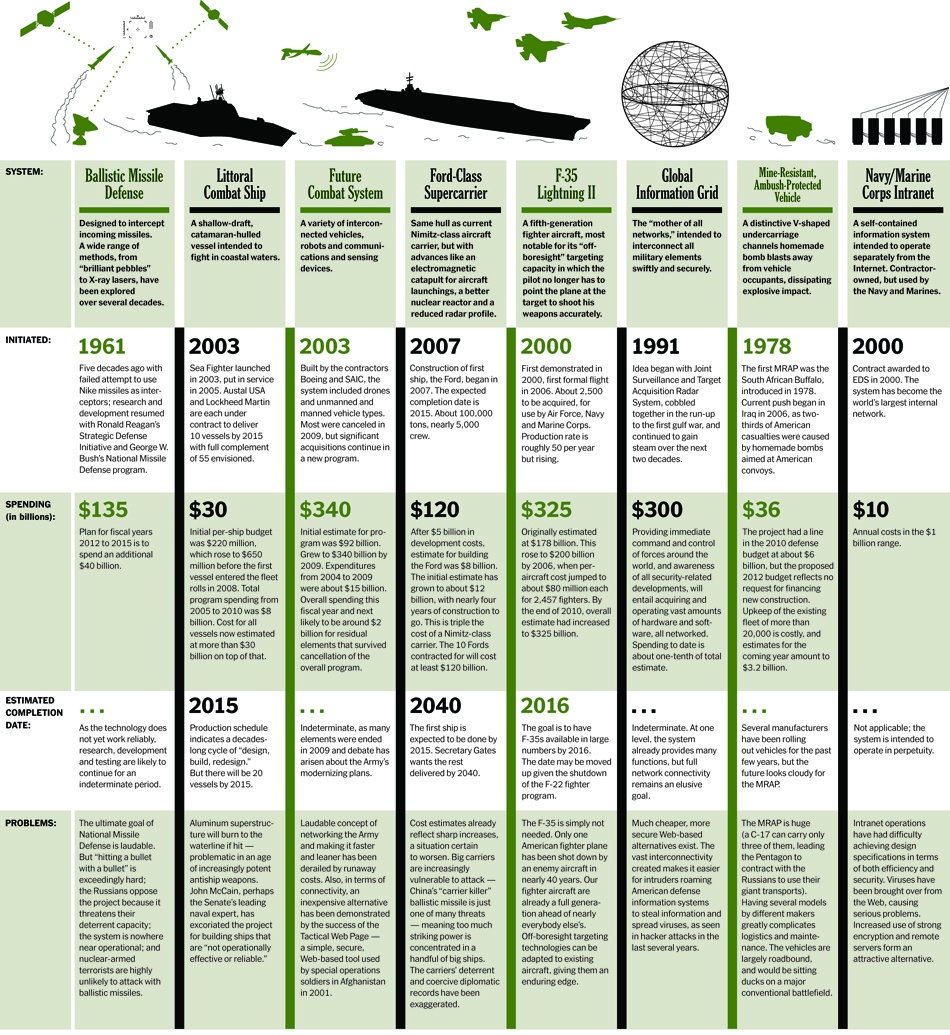
The Pentagon’s Biggest Boondoggles

The New York Times published this excellent Op-Chart graphic of the most wasteful military spending programs. Note that several of the programs listed are military earmarks backed by Senator Inouye or programs that related to Hawai’i in some way.

Missile Defense and Global Information Grid involves many of the wasteful programs associated with the Pacific Missile Range Facility on Kaua’i, computer and space warfare programs on Maui and a host of projects related to the ill-fated Project Kai e’e and Navy UARC at the University of Hawai’i. “Net-Centric Warfare” was one buzzword for these “revolutionary” technologies.

Along similar lines, Future Combat Systems was part of the transformation of the Army into modular, mobile, electronically networked and omniscient elements in the battlefield. The Stryker was one of the first elements to be deployed as a part of this transformation.

The Littoral Combat Ship is an enormously expensive program that was awarded to both Lockheed Martin and Austal USA. Austal USA was the manufacturer of the controversial Hawai’i Superferry, which was a prototype for the military’s Joint High Speed Vessel.   The Hawai’i Superferry contract helped Austal to establish its shipyard in the U.S., which enabled it to compete for the military contracts.

The F-35 Fighter is one of the troubled and expensive programs that President Obama vowed to veto. Senator Inouye went up against Obama to push for the F-35.

>><<

Source: http://www.nytimes.com/2011/03/13/opinion/13arquilla.html?partner=rssnyt&emc=rss

Published: March 12, 2011

Op-Chart

The Pentagon’s Biggest Boondoggles

JOHN ARQUILLA and FOGELSON-LUBLINER

As our government teeters on the brink of a shutdown, and Congress and the president haggle over spending cuts, the Pentagon budget should be scoured for places where significant reductions may be made. Not the handful of trims alluded to by Defense Secretary Robert Gates — $78 billion over the next five years, with these savings simply used to shore up spending on other acquisitions — but major cuts to systems that don’t work very well or that are not really going to be needed for decades to come.

Unworkable or unnecessary systems tend to have something in common: their costs are often uncontrollable. A 2009 Government Accountability Office study of 96 major defense acquisition programs found that almost two-thirds of them suffered major cost overruns — 40 percent above contract prices, over all — with average delays of nearly two years. Those overruns totaled close to $300 billion, about the amount of President Bill Clinton’s last full defense budget request a decade ago.

Listed below is just a sampling of what systems could be ended without endangering America; indeed, abandoning some of them might actually enhance national security. These cuts would generate only small savings initially — perhaps just several billion this fiscal year, as contracts would have to be wound down. But savings would swiftly rise to more than $50 billion annually thereafter.

And there’s plenty more where these came from.

John Arquilla is a professor of defense analysis at the Naval Postgraduate School and author of “Worst Enemy: The Reluctant Transformation of the American Military.” Fogelson-Lubliner is a design firm.

The Mauritius Miracle

Columbia professor and Nobel Prize laureate in economics, Joseph Stiglitz wrote a very interesting article about the economic “miracle” of Mauritius, a small island nation and former colony in the Indian Ocean. Mauritius has a population of 1.3 million, almost the same as Hawai’i. He writes:

Suppose someone were to describe a small country that provided free education through university for all of its citizens, transportation for school children, and free health care – including heart surgery – for all. You might suspect that such a country is either phenomenally rich or on the fast track to fiscal crisis.

After all, rich countries in Europe have increasingly found that they cannot pay for university education, and are asking young people and their families to bear the costs. For its part, the United States has never attempted to give free college for all, and it took a bitter battle just to ensure that America’s poor get access to health care – a guarantee that the Republican Party is now working hard to repeal, claiming that the country cannot afford it.

But Mauritius, a small island nation off the east coast of Africa, is neither particularly rich nor on its way to budgetary ruin. Nonetheless, it has spent the last decades successfully building a diverse economy, a democratic political system, and a strong social safety net. Many countries, not least the US, could learn from its experience.

In a recent visit to this tropical archipelago of 1.3 million people, I had a chance to see some of the leaps Mauritius has taken – accomplishments that can seem bewildering in light of the debate in the US and elsewhere. Consider home ownership: while American conservatives say that the government’s attempt to extend home ownership to 70% of the US population was responsible for the financial meltdown, 87% of Mauritians own their own homes – without fueling a housing bubble.

Now comes the painful number: Mauritius’s GDP has grown faster than 5% annually for almost 30 years. Surely, this must be some “trick.” Mauritius must be rich in diamonds, oil, or some other valuable commodity. But Mauritius has no exploitable natural resources. Indeed, so dismal were its prospects as it approached independence from Britain, which came in 1968, that the Nobel Prize-winning economist James Meade wrote in 1961: “It is going to be a great achievement if [the country] can find productive employment for its population without a serious reduction in the existing standard of living….[T]he outlook for peaceful development is weak.”

As if to prove Meade wrong, the Mauritians have increased per capita income from less than $400 around the time of independence to more than $6,700 today. The country has progressed from the sugar-based monoculture of 50 years ago to a diversified economy that includes tourism, finance, textiles, and, if current plans bear fruit, advanced technology.

Stiglitz identified several factors for their economic success are

First, the question is not whether we can afford to provide health care or education for all, or ensure widespread homeownership. If Mauritius can afford these things, America and Europe – which are several orders of magnitude richer – can, too. The question, rather, is how to organize society. Mauritians have chosen a path that leads to higher levels of social cohesion, welfare, and economic growth – and to a lower level of inequality.

Second, unlike many other small countries, Mauritius has decided that most military spending is a waste. The US need not go as far: just a fraction of the money that America spends on weapons that don’t work against enemies that don’t exist would go a long way toward creating a more humane society, including provision of health care and education to those who cannot afford them.

Third, Mauritius recognized that without natural resources, its people were its only asset. Maybe that appreciation for its human resources is also what led Mauritius to realize that, particularly given the country’s potential religious, ethnic, and political differences – which some tried to exploit in order to induce it to remain a British colony – education for all was crucial to social unity. So was a strong commitment to democratic institutions and cooperation between workers, government, and employers – precisely the opposite of the kind of dissension and division being engendered by conservatives in the US today.

Imagine that, cutting military spending and investing in its people as its greatest resource.

He notes that Mauritius was able to chart its own course only after gaining independence. But militarism and colonialism continue to haunt Mauritius. The Chagos islands, which were formerly part of Mauritius, remains a British colony. Within the Chagos group, the atoll of Diego Garcia is occupied by one of the United States’ most strategic military bases. The Diego Garcia residents who were forcibly relocated to Mauritius and other places continue to fight for the right to return to their home island. Stiglitz writes:

The Mauritius Miracle dates to independence. But the country still struggles with some of its colonial legacies: inequality in land and wealth, as well as vulnerability to high-stakes global politics. The US occupies one of Mauritius’s offshore islands, Diego Garcia, as a naval base without compensation, officially leasing it from the United Kingdom, which not only retained the Chagos Islands in violation of the UN and international law, but expelled its citizens and refuses to allow them to return.

The US should now do right by this peaceful and democratic country: recognize Mauritius’ rightful ownership of Diego Garcia, renegotiate the lease, and redeem past sins by paying a fair amount for land that it has illegally occupied for decades.

READ THE FULL ARTICLE “THE MAURITIUS MIRACLE”

Soldier suicide at Schofield Barracks a casualty of war and sexism

The following information about the suicide of Pvt. Galina Klippel has not been verified.   A commenter named Bearcat357 wrote on a forum at officer.com:

Media article sucks……and was just told I could post this…..

Female Solider going through divorce was hopped up on pills/booze…..barricades herself in vehicle…. MPs/DOA Police arrive and shut the area down. CID shows up and talks her down and she gets out of the vehicle….. Once she gets out, change of heart….. .45 to the head…. one shot/one self-inflicted KIA…. End of story……

Pvt. Klippel, who was deployed to Afghanistan in 2009 and 2010, was a casualty of the wars that have destroyed so many individual lives and families.  In January, the Congressional Quarterly reported:

Figures released by the armed services last week showed an alarming increase in suicides in 2010, but those figures leave out some categories.

Overall, the services reported 434 suicides by personnel on active duty, significantly more than the 381 suicides by active-duty personnel reported in 2009. The 2010 total is below the 462 deaths in combat, excluding accidents and illness. In 2009, active-duty suicides exceeded deaths in battle.

In 2009, the Pentagon reported that along with a jump in suicides among troops, “An increasing number are female Soldiers, who rarely committed suicide before but now are killing themselves at a much higher rate.”

Two days ago, the AP published an article that reported that female soldiers have much higher rates of divorce than their male military counterparts or civilian counterparts:

For women in the military, there’s a cold, hard reality: Their marriages are more than twice as likely to end in divorce as those of their male comrades — and up to three times as likely for enlisted women. And military women get divorced at higher rates than their peers outside the military, while military men divorce at lower rates than their civilian peers.

About 220,000 women have served in Afghanistan and Iraq in roles ranging from helicopter pilots to police officers. Last year, 7.8 percent of women in the military got a divorce, compared with 3 percent of military men, according to Pentagon statistics. Among the military’s enlisted corps, nearly 9 percent of women saw their marriages end, compared with a little more than 3 percent of the men.

Like all divorces, the results can be a sense of loss and a financial blow. But for military women, a divorce can be a breaking point — even putting them at greater risk for homelessness down the road.

It has an effect, too, on military kids. The military has more single moms than dads, and an estimated 30,000 of them have deployed in support of the wars in Iraq and Afghanistan.

Why military women are more burdened by divorce is unclear, although societal pressure is likely a factor.

“Societal pressure”?  More accurately, sexism and unequal power place greater distress on women soldiers.

Poster Girl, a new film about a female war veteran-turned anti-war activist tells a tragic, yet hopeful story.  It will air on HBO in 2011.   The website describes the film as:

The story of Robynn Murray, an all-American high-school cheerleader turned “poster girl” for women in combat, distinguished by Army Magazine’s cover shot. Now home from Iraq, her tough-as-nails exterior begins to crack, leaving Robynn struggling with the debilitating effects of post-traumatic stress disorder (PTSD).


U.S. sacks Kevin Maher over his derogatory remarks about Okinawans

Two articles reporting that the U.S. has sacked state department official Kevin Maher over his racist remarks about Okinawans.

>><<

http://news.xinhuanet.com/english2010/world/2011-03/10/c_13770455.htm

U.S. sacks state department official over racist slurs, apologizes to Japan

English.news.cn 2011-03-10 11:05:01

TOKYO, March 10 (Xinhua) — The U.S. Embassy in Tokyo announced Thursday that the U.S. government has sacked Kevin Maher as head of the Japan affairs office of the State Department following derogatory remarks he made about the people of Okinawa.

A former deputy chief of mission at the embassy, Rust Deming, will replace the abashed Maher, immediately in a bid to rebuild strained ties between the two countries, officials said.

Following the uproar caused by Maher, leading to prefectural and city assemblies in Okinawa calling for Maher to step down, apologize and officially retract his comments, U.S. assistant secretary of state Kurt Campbell was dispatched to Tokyo.

Campbell on Thursday offered a personal apology to the people of Okinawa and Japan and conveyed deep regret on Maher’s behalf, stating that Maher’s views in no way represent those of the U.S. government.

In a meeting held with Japan’s new Foreign Minister Takeaki Matsumoto on Thursday, Campbell said that U.S. Ambassador to Japan John Roos plans to visit Okinawa to offer an official apology to the people there in person.

Local media reported that the people of Okinawa, Japan’s southernmost prefecture, felt shocked, horrified and utterly ridiculed by Maher’s remarks.

The issue arose during a State Department lecture in the U.S. aimed at college students, during which Maher referred to the people of Okinawa as being “masters of manipulation and extortion. ”

He also referred to the people of Okinawa as “lazy and deceptive,” drawing the ire of Japan’s senior ministers and the Japanese population at large.

The Okinawa prefectural assembly said that Maher’s comments trampled on the feelings of the Okinawan people, ridiculing and insulting them and that the disparaging remarks were absolutely unforgivable.

The assembly also said that Maher repeatedly made discriminatory remarks and acted discriminatorily during his time as consul general.

Added to this, one of the students attending Maher’s State Department lecture felt there were definitely racist undertones to the former U.S. consul general’s remarks.

During the lecture, Maher was quoted as saying: “Consensus building is important in Japanese culture. While the Japanese would call this ‘consensus,’ they mean’extortion’ and use this culture of consensus as a means of extortion.”

“By pretending to seek consensus, people try to get as much money as possible,” he said.

He was also quoted as saying that Okinawan people are, “too lazy to grow goya” a traditional summer vegetable in the southern prefecture, according to official accounts.

Maher, 56, served as the consul general in Okinawa from 2006 to 2009 after joining the State Department in 1981. His comments have riled the people of Okinawa who have suffered under the heavy burden of hosting U.S. military bases for 65-years after the war.


+++

http://english.kyodonews.jp/news/2011/03/76139.html

U.S. moves to calm Okinawa’s anger by sacking Maher over remarks

TOKYO, March 10, Kyodo

The United States moved Thursday to calm anger in Okinawa ignited by alleged disparaging remarks about local people made by a senior U.S. official, sacking him and offering an apology to Japan over the incident.

The U.S. government replaced Kevin Maher as head of the Office of Japanese Affairs at the State Department with Rust Deming, a former deputy chief of mission at the U.S. Embassy in Tokyo.

Visiting U.S. Assistant Secretary of State for East Asian and Pacific Affairs Kurt Campbell offered his personal and the U.S. government’s ”deepest regret for the current controversy” concerning Maher’s alleged remarks when he met with Japan’s new Foreign Minister Takeaki Matsumoto.