Guam Lawmakers Cry Foul On Military Report

GUAM LAWMAKERS CRY FOUL ON MILITARY REPORT

Plagiarism, inaccurate information mar EIS

By Jennifer Naylor Gesick

HAGÅTÑA, Guam (Marianas Variety, April 29, 2010) – Guam senators are demanding that the Department of Defense draft a new environmental impact statement, irked that the draft impact study presented to the local community contained a string of inaccurate, inadequate information and plagiarized materials. They are also asking the defense department to conduct a new impact study for important projects such as Apra Harbor and the firing range proposed on Route 15.

Speaker Judi Won Pat responded with utter disgust to the discovery that portions of the draft impact study were plagiarized. “If they are going to plagiarize something that has nothing to do with Guam, then that makes me question all the contractors and experts they consulted,” she said.

“This makes me wonder how much of the entire DEIS [draft environmental impact statement] is flawed. The military needs to do some inquiries here,” Won Pat added.

She questioned why the contractor TEC, Inc., which wrote the report for the military, would cut and paste scientific information from a source that did not study Apra Harbor.

Won Pat added that it is the plagiarism along with several other discoveries of inadequate and wrong information that prompted the legislature to pass Resolution 275, which says the senators feel that whole sections of the DEIS should be dealt with separately.

Won Pat said, “It is very timely,” because Guam is going to be visited by high-level officials in the next few weeks.

Guam is expecting a visit this week from Assistant Secretary of Defense for Asian and Pacific Security Affairs Wallace C. Gregson. The senators plan to meet with him, and he is scheduled to give a lecture at the University of Guam entitled “Where America’s Day Begins: Guam and U.S. Engagement in the Asia Pacific.”

Senator Rory Respicio was also upset at the recent developments. “I’m shocked,” he said. “When anything like this is discovered, it makes the entire document suspect.”

“We have already found many problems ourselves and we know that EPA finds it insufficient,” added Respicio. “I wonder how many other items like this are scattered throughout the voluminous report? Could it be that EPA was also aware of this, and perhaps other instances where DEIS findings were taken from other sources without acknowledgment?”

He suggested, as others have, that Guam should take more time for the military buildup process. “This is just one more reason that we need to slow down this process and work together, both the federal and local governments, to do it right,” said Respicio.Senator Judi Guthertz, chairwoman of the military buildup committee, said, “Dr. Jason Biggs revealed what many suspected all along. The company contracted by the Department of Navy to draft the impact statement for the Guam military buildup did not do a good job.”

“In many ways, the multi-thousand page report is misleading, inaccurate, condescending to the people of Guam, and now — thanks to Dr. Biggs’ discovery – we know it is, at least in part, a dishonest document,” said Guthertz.

“The company contracted to do the draft study knows little about Guam and obviously scrambled to find information it could claim to help justify the military buildup preferred option plans for Guam,” Guthertz said.

Okinawa Base Issue: Full-Page Ad in Washington Post

http://www.huffingtonpost.com/john-feffer/okinawa-base-issue-full-p_b_555666.htmlPosted: April 28, 2010 03:14 PM

Okinawa Base Issue: Full-Page Ad in Washington Post

John Feffer

Co-director of Foreign Policy In Focus

It is a rarity that the anti-base movement gets much mention in the mainstream media. So, thanks to the generous contributions of Japanese and American citizens, the Network for Okinawa and the Japan-U.S. Citizens for Okinawa Network took out a full-page ad in The Washington Post today.

“Would You Want 30 Military Bases in Your Backyard?” reads the headline of the ad. “The new base would damage the health and safety of people and threaten a unique ecosystem that contains many rare species. This includes the Okinawan dugong, an endangered cousin of the manatee.”

The sponsors of the ad want to send a message to the Obama administration that a significant number of Americans support Okinawan concerns about the environmental and social consequences of U.S. military bases on the island. The ad challenges the prevailing consensus in Washington that the Futenma base is essential to U.S. national security.

The full-page ad coincides with a letter sent to President Obama and Prime Minister Hatoyama, signed by more than 500 organizations, that demands the immediate closure of Futenma and the cancellation of plans to relocate it to Henoko Bay.

To sign the individual petition and send a letter to your elected representatives, visit the Close the Base website. And follow the Network for Okinawa on its Facebook page.

Follow John Feffer on Twitter here.

Follow John Feffer on Twitter: www.twitter.com/http://twitter/

Palau’s senate offers land for U.S. Pacific base

In the 1980s, the people of Palau fought very hard to institute a nuclear free constitution. But the U.S. refused to accept the nuclear prohibition and made Palauans revise their constitution.   In the end, after a campaign of political terror, a constitution was ratified that did not contain the nuclear free clause.  It is a tragic irony that the present leaders in Palau are actively courting the same military power that once derailed their self-determination efforts.

>><<

http://australianetworknews.com/stories/201004/2884918.htm?desktop

Palau’s senate offers land for US Pacific base

Last Updated: Wed, 28 Apr 2010 15:54:00 +1000

Palau’s Senate has asked President President Johnson Toribiong to offer the state of Angaur as an alternative location for the US Futenma air base in Okinawa, Japan.

The Marianas Variety reports that under the Compact of Free Association, the US military has the option to use lands in Palau.

The senators also noted that two Japanese politicians recently visited the CNMI to look at a site being considered by Japan as a likely relocation site for Futenma.

Okinawa residents are protesting at Japan’s 2006 agreement to relocate the US base to a coastal part of the island.

Prime Minister Yukio Hatoyama vowed to review the agreement but has struggled to find an alternative location.

Ryukyu Shimpo article on demonstrations in Washington, D.C. and Honolulu (Japanese language)

The article reports on the action in front of the Japanese Embassy in Washington, D.C. and the vigil in Honolulu in front of the Consulate General of Japan.   The article mentions that in Hawai’i, participants wore a yellow ribbons and held signs saying “Bases Out of Guam, Okinawa, Hawaii”. After igniting candles, participants gathered in front of the consulate.

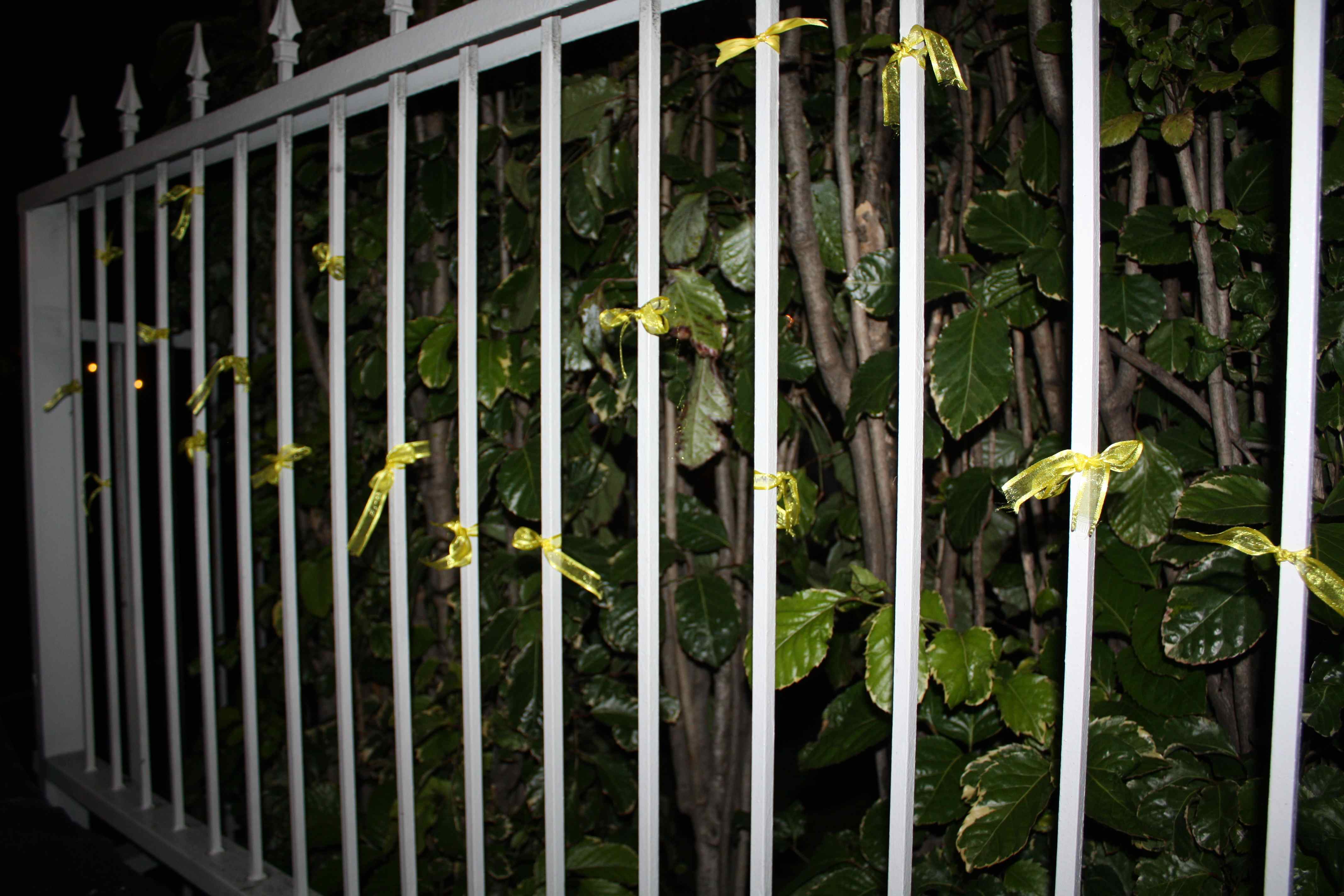
The article also reported that Mr. Kyle Kajihiro said “Hawaii, Okinawa and Guam, even from a small area, by the will of the people gathering, you can exert power. Chibariyo to the people of Okinawa.” A Japanese Brazilian first time protester,  Mr. Marvin Uehara said the “opinions of the Okinawan people should be respected.” The participants shared their feelings, sang “Teinsagunu flower” and “Hana” in chorus. The participants tied yellow ribbons to the wall of the consulate.

>><<

http://ryukyushimpo.jp/news/storyid-161368-storytopic-1.html

基地動かす力に ワシントン、ハワイでも連帯2010年4月27 日

県 内移設反対を訴えるメンバーら=25日午後、ワシントンDCの日本大使館前

「沖 縄の人にチバリヨーと言いたい」と語るカイルさん=ホノルル市の日本国総領事館前

◆「ジュゴン守 れ」/連帯組織「NO」 日本大使館前でデモ
【米ワシントン25日=与那嶺路代本紙特派員】米軍普天間飛行場の撤去を求め、北米を拠点に活動す る連帯組織「ネットワークフォア沖縄(NO)」(ジョン・フェファー代表)は25日午後、読谷村で開かれた4・25県民大会に合せ、米ワシントンDCの日 本大使館前で抗議デモを行った。
約30人の参加者らは「基地を閉鎖せよ」「ジュゴンを守れ」などと書かれたプラカードを掲げ、「沖縄に基地は要 らない」と声を張り上げた。
フェファー代表は「(現行案は)沖縄の負担軽減にならない。米軍基地による汚染、騒音、暴力などの問題を宜野湾から辺野古へ移すだけだ。基地の県内移設 ではなく、沖縄から取り除きたいという県民のメッセージを支持する」との連帯声明文を読み上げた。
NOは生物多様性センターや米保守党防衛同盟など16団体で構成。沖縄での新基地建設や、鹿児島県徳之島への移設に反対し、ジュゴンなど希少生物の保護 を訴えている。
NOは週内にもワシントンポスト紙に沖縄の基地撤去を訴える広告を出す予定。

◆県民大会に歓声/日系人ら“普天間”解決訴え
ハワイ在住の日系人らが沖縄について考える「ハワイ沖縄アライエンス」(HOA)のメンバーや沖縄県系人の三世、四世のグループが25日午後、在ホノル ル日本国総領事館前で、4・25県民大会に連帯する集会を開いた。黄色いリボンを着けた参加者は「グアム、沖縄、ハワイの基地を撤退せよ」などのプラカー ドを掲げ、普天間飛行場問題の解決をアピールした。
領事館前に集まった参加者がろうそくの火をともす中、HOAメンバーの島崎ピートさんがメディアで報じられている県民大会の様子を報告。参加者の間から 大きな歓声が上がった。
参加者の一人、カジヒロ・カイルさんは「ハワイ、沖縄、グアムという小さい地域からでも、人々の意思を集結することで、力を発揮できる。沖縄の人にチバ リヨーと言いたい」と語った。このような集会に初めて参加するというブラジル出身のハワイ大学院生、上原マルビン氏は「沖縄県民の意見が尊重されるべき だ」と述べた。参加者はそれぞれの想いを語った後、全員で「てぃんさぐぬ花」「花」を合唱。身に着けた黄色いリボンを領事館の壁に結び付けた。
(名護千賀子ハワイ通信員)

U.S. Military creating an Environmental Disaster in Afghanistan

http://globalresearch.ca/index.php?context=va&aid=18883

The American Military is Creating an Environmental Disaster in Afghanistan

By Matthew Nasuti
Global Research, April 27, 2010
Kabul Press – 2010-04-25

The American military presence in Afghanistan consists of fleets of aircraft, helicopters, armored vehicles, weapons, equipment, troops and facilities. Since 2001, they have generated millions of kilograms of hazardous, toxic and radioactive wastes. The Kabul Press asks the simple question:

“What have the Americans done with all that waste?”

The answer is chilling in that virtually all of it appears to have been buried, burned or secretly disposed of into the air, soil, groundwater and surface waters of Afghanistan. While the Americans may begin to withdraw next year, the toxic chemicals they leave behind will continue to pollute for centuries. Any abandoned radioactive waste may stain the Afghan countryside for thousands of years. Afghanistan has been described in the past as the graveyard of foreign armies. Today, Afghanistan has a different title:

“Afghanistan is the toxic dumping ground for foreign armies.”

The (U.S.) Air Force Times ran an editorial on March 1, 2010, that read: “Stamp Out Burn Pits” We reprint here the first half of that editorial:

“A growing number of military medical professionals believe burn pits are causing a wave of respiratory and other illnesses among troops returning from Iraq and Afghanistan. Found on almost all U.S. bases in the war zones, these open-air trash sites operate 24 hours a day, incinerating trash of all forms — including plastic bottles, paint, petroleum products, unexploded ordinance, hazardous materials, even amputated limbs and medical waste. Their smoke plumes belch dioxin, carbon monoxide and other toxins skyward, producing a toxic fog that hangs over living and working areas. Yet while the Air Force fact sheet flatly states that burn pits “can be harmful to human health and environment and should only be used until more suitable disposal capabilities are established,” the Pentagon line is that burn pits have “no known long-term health effects.”

On April 12, 2010, the Richmond Times-Dispatch carried an article by David Zucchino who investigated the American burn pits in Iraq. He interviewed Army Sgt. 1st Class Francis Jaeger who hauled military waste to the Balad burn pit which was being operated by a civilian contractor for the Pentagon. Jaeger told Zucchino:

“We were told to burn everything – electronics, bloody gauze, the medics’ biohazard bags, surgical gloves, cardboard. It all went up in smoke.”

The Pentagon now admits to operating 84 “official” burn pits in Iraq and Afghanistan. The number of unofficial burn pits is not known. The Pentagon claims that it is phasing out its burn pits in favor of incinerators and that 27 incinerators are currently operating in Iraq and Afghanistan with 82 more to be added in the near future.

According to a website called the “Burn Pits Action Center,” hundreds of American veterans who came in contact with burn pit smoke have been diagnosed with cancer, neurological diseases, cardiovascular disease, breathing and sleeping problems and various skin rashes. In 2009, they filed more than 30 lawsuits in Federal courts across the United States, naming Kellogg Brown and Root (KBR), and its former parent company Halliburton. These companies were named because of their involvement in the LOGCAP (Logistics Civil Augmentation Program) contracts for Iraq and Afghanistan. Several KBR entities either managed or assisted in the management of the American military’s waste in both countries and allegedly operated some or all of the burn pits. Additional lawsuits were filed in 2010, including one in Federal District Court in New Jersey.

The lawsuits reveal that the Pentagon has ignored American and international environmental laws and the results appear to be the widespread release of hazardous pollutants into the air, soil, surface water and groundwater across Afghanistan. This is a persistent problem that continues today. Unlike Saudi Arabia which insisted that American forces cleanup their pollution after the war to oust Iraq from Kuwait in 1991, or the Government of Canada which likewise insisted on a strict cleanup of American bases on its soil, the Government of Afghanistan has been unable to force the Americans and their allies to repair all the environmental damage that they have caused and continue to cause. Afghanistan does not want to wind up like Vietnam. While American ground combat units withdrew from South Vietnam in 1972, neither Vietnam nor its people have recovered from the long term environmental damage and mutagenic effects that American military operations and their exotic chemicals caused.

This article summarizes the problem of America’s military wastes and examines the types of hazardous wastes that are likely to have been released into Afghanistan.

Part 2 of this series will address the contradictory responses by the Pentagon to this problem and it will explore one of the remedies that the Pentagon is currently implementing, which is to phase out the burn pits, replacing them with incinerators. The article examines the flaws in that strategy and why Afghanistan should carefully consider whether to permit the continued use of military incinerators.

Part 3 of this series will set out the recommendations of the author to the Government of Afghanistan on how to investigate and clean up the pollution of Afghanistan’s countryside caused by the burn pits, landfills and other disposal facilities used by American forces.

The Sources or Means by Which the Various Wastes Are Being Released

The American military hazardous wastes that are believed to have entered the air, soil, groundwater and surface water of Afghanistan did so through the following methods (this list is partial only):

Burn pits
Incinerators
Burying/landfilling of the waste and ash
Intentional dumping
Accidental spills
Surface runoff
Leaking storage tanks, sumps and basins
Latrines

Categories of Amercian Military Waste

The American military’s waste, at this time, cannot be completely characterized. The volume and variety of waste (i.e., thousands of different chemicals) are not known and there are certain to be classified items and materials which have been brought into Afghanistan for which there may be no documentation. Regardless of that, much is known about the materials and chemicals that the military routinely uses and about the waste that it routinely generates. Most American military wastes will falls into one of the following twelve (12) categories:

The Dirty Dozen:

1. Fuel leaks and spills. These include releases of aviation fuel, gasoline and diesel fuel. These releases would range from large releases at American airbases of hundreds or even thousands of liters, to minor spills at Forward Operating Bases and combat outposts as soldiers seek to refill diesel generators. Petroleum residues have the ability to leach rapidly into underground drinking water aquifers and create plumes that will permanently contaminate local wells. There is no known way to completely remediate a groundwater source after it has been contaminated with hydrocarbons.

2. Paints, asbestos, solvents, grease, cleaning solutions (such as perchloethylene) and building materials that contain formaldehyde, copper, arsenic and hydrogen cyanide.

3. Hydraulic fluids, aircraft de-icing fluids, antifreeze and used oil. Used oil is carcinogenic, anti-freeze is poisonous, de-icing fluids can contain hazardous ethylene and propylene glycol, along with toxic additives such as benzotriazoce (which is a corrosion and flame inhibitor). Hydraulic fluids can contain TPP (triphenyl phosphate).

4. Pesticide/poison leaks and spills: Afghanistan apparently has no list of the pesticides, fungicides, termiticides and other poisons that the Americans brought into Afghanistan and used, spilled and released into the countryside in order to control flies, mosquitos, ants, fleas and rodents. The military refers to such practices as “vector control.” It is expected that the list of such neuro-toxins and the quantity sprayed or spilled throughout Afghanistan is staggering.

5. Lead, nickel, zinc and cadmium battery waste and acids (which are toxic and/or corrosive).

6. Electronic waste (or E-waste). This includes computers, printers, faxes, screens, televisions, radios, refrigerators, communications gear, test equipment. They contain cancer-causing chemicals such as the flame retardant PBDE (polybrominated diphenyl ethers), PCDD (polychlorinated dioxins), barium, copper, lead, zinc, cadmium oxides and cadmium sulphides and trivalent antimony, which is eco-toxic.

7. Light bulbs. This may not seem important but many military light bulbs are fluorescent and therefore contain toxic levels of mercury. Disposal of these light bulbs in ordinary landfills is prohibited in the United States.

8. Plastics. The U.S. military uses thousands of different types and formulations of plastic. While most are harmless in their present state, such as plastic water bottles and Polyvinyl Chloride (PVC) piping, the military has been burning its plastic waste in Afghanistan. When burned, many plastics release a deadly mix of chemicals including dioxins, furans, benzene, di 2-ethylhexyl phthalates (DEHP), hydrochloric acid, benzo(a)pyrene (BAP) and various acids and chlorine gas (which is a neurotoxin). Breathing a few seconds of this mixture in a concentrated form would likely be fatal.

9. Medical Waste. Infectious disease waste and biohazard materials, including used syringes, bloody bandages, sheets, gloves, expired drugs, amputated limbs and animal carcasses.

10. Ammunition waste. Lead, brass and other metals from ammunition along with all the constituents of the propellants, including trininitrotoluene, picric acid, diphenylamine, nitrocellulose, nitroglycerin, potassium nitrate, barium nitrate, tetracene, diazodintrophenol, phosphorus, peroxides, thiocarbamate, potassium chlorate, vinyl fluoride, vinyl chloride, sodium fluoride and sodium sulfate.

11. Radioactive waste. When one thinks of radioactive waste, usually one thinks only of atomic weapons, but that is not the case. The American military routinely uses a variety of devices and equipment that contain radioactive elements or radioluminescent elements. These materials are referred to as “Radioactive Commodities” by the American military. The primary radioactive materials are: Uranium, Tritium, Radium 226, Americium 241, Thorium, Cesium 137 and Plutonium 239.

Some of the equipment containing radioactive elements:

Night Vision Devices
M-16 Front Sight Post Assemblies
M72 Light Antitank Weapons
T-55 Aircraft Engine components
M58 and M59 Light Aiming Posts
M4 Front Sight Post Assemblies
RADIAC Calibrator Sets and Check Sources
Radium Compasses
L4A1 Quadrant Fire Control Devices
Fire Control Azimuths
Level Gauges
M-1 Collimators
M-1 Muzzle Reference Sensors
Soil Moisture Density Testers
TACOM Vehicle Dials and Gauges
Radios, including VRC-46/GRC-106/GRC-19
Chemical Agent Monitors
Testing Instruments
Vehicle Depleted Uranium Plates
Depleted Uranium Ammunition, including 20 millimeter ammunition
Electron Tubes for Communications Equipment
Various types of Laboratory and Hospital Analysis and Testing Machines.

Note: The American military will likely insist that it strictly controls the disposal of radioactive waste, but such assertions are not credible. While there are strict regulations, the time and cost of complying with them in a war zone are such that base commanders in Afghanistan most likely ignored them, opting instead for throwing the waste into burn pits. The evidence for this is contained in Part 3 of this Report, which cites to a Pentagon-funded study of what American field commanders think of the Pentagon’s environmental regulations.

If the American military continues to insist that it did not release radioactive materials in Afghanistan it should document such assertions by releasing its records. The Pentagon should publicly release all data on every radioactive commodity brought into Afghanistan. They should all be listed in HMIRS (the Hazardous Materials Information System). The Pentagon should then detail where each commodity is today.

12. Grey and Black Water. The American military and its contractors in Afghanistan operate human waste facilities. The military refers to these as LSS (Latrine, Shower and Shave) facilities. They generate what is known as grey and black waste-water. Grey water from sinks and showers has as its primary pollutant soap residue (i.e., phosphates and other chemicals that generate what is known as BOD – biological oxygen demand, which means they can absorb all the available oxygen in streams and rivers so fish cannot breathe). Some American soaps contain additives such as MIT (methylisothiazolinone), which is under investigation as a toxin.

Latrines generate black water pollution. While the American military has to adhere to strict rules regarding the discharge of such waste in the United States, it faces no restrictions in Afghanistan. Latrines can be dug near ground water and even upgradient from surface water (so that discharges can flow into them). There are no known maps of all the American latrines. After a latrine pit is filled, it is apparently covered over with dirt and forgotten.

While environmental releases involving categories 1 and 12 above are a certainty, it is feared that millions of kilograms and millions of liters of wastes set out in categories 2 through 11 were all thrown into the hundreds of American burn pits in Afghanistan or dumped into secret landfills. If true, the American legacy to Afghanistan is not freedom, but pollution.

In February 2010, the U.S. Department of Veterans Affairs began an 18-month study of the burn pits in Afghanistan and their effect on human health. Afghanistan cannot wait eighteen months for the results of this study, it has to act now.

The author is a former U.S. Air Force Captain. He advised on environmental cleanups at Logistics Command regarding the Air Force’s most contaminated bases and depots. He then worked for Bechtel Environmental and was involved in Superfund cleanups across the United States and radiological cleanups at U.S. Department of Energy sites. He later served as a consultant to a group of environmental remediation companies, smelters and waste recyclers.

Sources for Further Reading:

Houston Chronicle – February 7, 2010 – “GIs tell of horror from burn pits”
Los Angeles Times – February 18, 2010 – “Veterans speak out against burn pits”
The New York Times – February 25, 2010 – “Health Panel Begins Probing Impacts of Burn Pits”
Salem-News – March 29, 2010 – “Sick Veterans Sue KBR Over Iraq and Afghanistan Burn Pits”
AFP – November 10, 2009 – “Troops sue KBR over toxic waste in Iraq, Afghanistan”
U.S. Department of the Army Pamphlet 700-48

Okinawa Statement for the Withdrawal of the U.S. Marines

This statement was issued by prominent scholars and professionals in Japan and Okinawa. If you agree with the statement please consider signing on by going to the link below.

>><<

http://form1.fc2.com/form/?id=539738

For the Withdrawal of the US Marines

(Second) Statement on the Futenma Replacement Problem

The US Marine Air Base at Futenma, set in the middle of a residential district, is the most dangerous base in the world and it should be immediately closed and dismantled. The former LDP government “agreed” with the US on construction of a Futenma replacement base at Henoko in Northern Okinawa (on-shore at camp Schwab), but this amounted to the construction of a large, new base in Okinawa, and so the Okinawan people have taken every opportunity to express their opposition to it.

The Autumn 2009 change of government, and the electoral pledge of the DPJ for [Futenma transfer] “out of Japan or at least out of Okinawa” transformed the situation and gave hope to the Okinawan people. In the January 2010 Nago mayoral election, Inamine Susumu, the candidate opposed to any Futenma relocation, was victorious. In February, the Okinawan Prefectural assembly passed unanimously a resolution calling for “Futenma base to be moved out of Okinawa.” It was supported even by the LDP and Komeito, both of which had hitherto accepted transfer within the prefecture. Also, all 41 Okinawan town and village mayors have called for the base to be shifted out of Okinawa and the conservative-backed Governor, Nakaima Hirokazu, has begun to speak of the outlook for [relocation] within Okinawa as “harsh.” Okinawa has adopted an “all-Okinawa” stance of outright opposition to relocation within the prefecture.

However, the Hatoyama government, having postponed any “decision” till May 2010, has begun to move in the direction of a resolution of the matter on a “within Okinawa” basis, with plans for a Camp Schwab land-based structure and for reclamation off the Katsuren peninsula.

Deeply concerned over the moves by the Government, we issue the following Statement.

(The first group of 18 signatories listed below are those over whose names the January 2010 statement by scholars and intellectuals was issued. The second group comprises 20 scholars and intellectuals from Okinawa. Since they have also issued previous statements in Okinawa demanding withdrawal of the Marines, this Joint Statement may be considered a “Second Statement” for both.)

1. We oppose not just the Henoko land-based Camp Schwab plan and the Katsuren peninsula offshore plan, but all plans for Futenma base transfer within Okinawa. Okinawa’s burden must not be made heavier. Okinawa’s feelings must not be ignored. Okinawa’s environment must not be destroyed.

2. At the House of Representatives election in 2009, the Democratic Party of Japan’s position was for Futenma transfer “outside Japan, or at least outside Okinawa.” In the Nago City mayoral election, it supported the candidate, Inamine Susumu, who opposed any move to Henoko, and he was victorious. If the DPJ was to decide now on a transfer within Okinawa it would be a clear breach of promise and a betrayal of the people of Japan and the people of Okinawa. Even taking for granted the current US-Japan security treaty system, the Hatoyama government must make the utmost effort to explore the possibilities of relocation beyond Okinawa.

3. One proposal is that, in the event of there being no place, either elsewhere in Japan or in Okinawa, that will accept a Futenma transfer, Futenma air base should continue being used as it is now. This must not be allowed. This dangerous base that threatens the lives and livelihoods of the people living in its vicinity must be promptly closed.

4. Should it be the case that, after searching for a relocation site elsewhere in Japan, there is no place ready to accept the base, that would mean that the people of Japan have no desire to have any Marine base and in that case there would be no alternative but for the US Marines to quit Japan completely. It would mean that the people of Japan had the will to play a positive role in building peace and security in East Asia without the US marines. The US would have to respect the will of the Japanese people.

5. What the Hatoyama government has been intent on, and what the media attention has concentrated on, is the search for a (new) “base site.” Is it really this that we should be concentrating on at this time? Is it not rather necessary for us to cast doubt on the notions of “deterrence,” “enemy,” “alliance” as they exist in Cold War logic, and to cast off their spell? Notions of “common security” and “human security” now emerge in international society and become a major force pushing for dissolution of Cold War hostilities. What we should be questioning is not how to shuffle US bases around by finding new sites but the very structure under which US bases are kept in Okinawa and on the mainland and the US military is allowed to use them as it wishes. The US-Japan Security Treaty is a relic of the Cold War era. There has never been a better time than now to undertake a fundamental reconsideration of the Japan-US Security Treaty system, including the Status of Forces Agreement and the Guidelines (Japan-US Defence Cooperation Guidelines). We call on the government and people of Japan to begin this task.

Issued by:

Chiba Shin , Professor of Political Thought, International Christian University

Endo Seiji , Professor of Politics, Seikei University

Harashina Sachihiko , Professor of Environmental Planning ,Tokyo Institute of Technology

Kamo Toshio , Professor of Politics ,Ritsumeikan University

Kawase Mitsuyoshi , Professor of Ecomomics, Kyoto Prefectural University

Koseki Shoichi , Professor of Law ,Dokkyo University

Kobayashi Masaya , Professor of Politics, Chiba University

Komori Yoichi , Professor of Japanese Literature, Tokyo University

Miyamoto Kenichi , Professor Emeritus of Osaka City University,

Former President of Shiga University

Mizusima Asaho , Professor of Law, Waseda University

Maeda Tetsuo , Critic

Nishikawa Jun , Professor Emeritus of Waseda University

Nishitani Osamu , Professor of Philosophy, Tokyo University of Foreign Studies

Okamoto Atsushi , Editor in chief of Magazine SEKAI

Teranishi Shunichi , Professor of Economics, Hitotsubashi University

Uzawa Hirofumi , Professor Emeritus of Tokyo University

Yamaguchi Jiro , Professor of Politics, Hokkaido University

Wada Haruki , Professor Emeritus of Tokyo University

Arasaki Moriteru , Professor Emeritus of Okinawa University

Gabe Masaaki , Professor of International Relations, University of the Ryukyus

Hiyane Teruo , Professor Emeritus of University of Ryukyus

Miki Ken , Journalist

Miyazato Seigen , Representative, Okinawa External Study Group

Miyazato Akiya , Journalist

Nakachi Hiroshi , Professor of Administrative law ,Okinawa University

Nakazato Isao , Journalist

Ohshiro Tatsuhiro , Writer

Ohta Masahide , Former Governor of Okinawa Prefecture

Sakurai Kunitoshi , Professor of Environmental Planning ,Okinawa University

Shimabukuro Jun , Professor of Political Science, University of Ryukyus

Shinjo Ikuo , Professor of Japanese Literature , University of Ryukyus

Takasato Suzuyo , Former Vice Chairperson, Naha City Assembly

Takara Ben , Poet, Critic

Takara Tetsumi , Professor of Constitutional Law, University of Ryukyus

Teruya Hiroyuki , Professor of Public Administration ,Okinawa International University

Tomikawa Moritake , Professor of Economics, Okinawa International University

Yamashiro Noriko , Journalist

Yui Akiko , Journalist

If you agree with this statement, please sign on to the statement by May 20th,2010.

Pasifik rising! Famokaiyan and Women for Genuine Security action in San Francisco

On Earth Day, April 22, Famoksaiyan and Women for Genuine Security held a press conference and action at the U.S. Environmental Protection Agency’s Earth Day commemoration in protest of the military expansion in Guahan/Guam and the Mariana Islands. The action was also in solidarity with the massive demonstrations in Okinawa protesting U.S. military bases.

Check out the report on their action at the website for the West Coast chapter of Famoksaiyan.   There’s a great slide show at the end of the article.

I feel the Pasifik rising…

>><<

http://famoksaiyanwc.wordpress.com/2010/04/25/earth-day-press-conference-4-22-2010/

April 25, 2010…2:23 pm

Clean up not build up!: Earth Day Press Conference 4.22.2010

Contributed by Erica Benton

On April 22, Earth Day, several groups gathered outside St. Patrick’s Church in San Francisco demanding a halt to US military expansion on the Pacific island of Guam. Their voices join recent EPA concerns that the Department of Defense’s plan will have devastating impacts on 71 acres of coral reef and fails to come into compliance with the Clean Water Act and Endangered Species Act. The plan will threaten the habitat of thousands of species of marine life, including endangered species such as green sea turtle, hawksbill sea turtle and spinner dolphin. At a time of economic recession and mounting national debt, the US base expansion on Guam will be one of the largest buildups in recent history, costing US taxpayers an estimated $9 Billion. On Earth Day, San Franciscans witnessed the release of a letter signed by 100 environmentalists, scholars, community and religious leaders who are calling on the White House and the Council on Environmental Quality to halt the build-up.

The Environmental Protection Agency, in its evaluation of the Draft Environmental Impact Statement (DEIS), gave the plan the worst possible rating, calling it “inadequate” and “insufficient,” and stating that the impacts of dredging on the high quality coral reefs of Apra Harbor “are of sufficient magnitude that EPA believes the action should not proceed as proposed.” The proposed build up, would bring 79,000 more people to Guam, increasing the population of 173,456 by 47%. According to the EPA, the plan fails to adequately address the impact of this population increase on the water supply and wastewater treatment on Guam, creating adverse public health impacts.

Environmental research organizations, such as the Center for Biological Diversity stated in their public comment: “The Navy has failed to meet the statutory requirements of the National Environmental Policy Act (NEPA) and regulations of the Council on Environmental Quality…. because it improperly limited the scope of the DEIS and failed to include sufficient information on alternatives, impacts to cultural resources and social justice issues, and Greenhouse Gas Emissions.”

“Our communities in Guam are counting on us to be a voice for them in Washington,” says Erica Benton, a local bay area resident with family ties to Guam and a member of

Famoksaiyan, a group which voices concerns for Guam and Chamorros in the diaspora. “The island is an unincorporated territory of the US, which basically means they cannot vote for US presidents and only have a non-voting delegate in Congress. We hope our leaders here in California take a stand with us, and for the environment.”

“This Earth Day, we have to address that the military is one of the biggest polluters on the planet, and the largest contributor to greenhouse gases. The massive build up on Guam directly contradicts efforts to protect our environment from global warming,” says Reverend Deborah Lee, a member of Women for Genuine Security, the local chapter of a global women’s network that works to protect the health and safety of communities around US military bases. “The US military has an enormous carbon footprint which must be addressed for the health of local communities and the security of our entire planet.”

As the largest Chamorro population outside of Guam resides in California, groups are calling on California Congressional Representatives and President Obama to:

1) Halt the current plans for the build up;

2) Before the DOD goes forward, require a rewrite of the Draft Environmental Impact Statement, with an appropriate public comment period of at least 6 months. The new DEIS should address socioeconomic and cultural impacts on local communities, clearly outlined mitigation of environmental impacts and greenhouse gases, and impacts to self-determination. The process of writing the DEIS should be transparent and include participation of community and environmental watchdog groups.

3) Require the DOD to clean up existing contamination and toxic sites, on and off-base, caused by military operations on Guam, before any base expansion projects are considered;

The San Francisco Earth Day action took place across the street from the EPA’s Earth Day Festival at Yerba Buena Garden. The action was also in solidarity with rallies that will be held in Washington DC and Okinawa, Japan on Sunday, April 25th in protest of a new US base in Okinawa which already holds 30 bases. 100,000 people are expected to rally in Okinawa this Sunday. The Guam build-up plan includes the proposed transfer of 8,000 Marines from Futenma Air Station in Okinawa after decades of local protests.

Hawai’i vigil in solidarity with Okinawa

P4250185

P4250189

Photos: Jamie Oshiro, Hawai’i Okinawa Alliance

Yesterday, in solidarity with the 90,000+ Okinawans who rallied against U.S. military bases in Okinawa, the Hawai’i-Okinawa Alliance (HOA), the American Friends Service Committee – Hawai’i and DMZ-Hawai’i / Aloha ‘Aina organized a vigil in front of the Japanese Consulate in Honolulu.

Approximately 40 people held signs and candles in front of the Japanese Consulate. Ukwanshin Kabudan, Nakem Youth, Fight for Guahan, Veterans for Peace and Urban Babaylan were some of the groups represented.

10.4 oki dugong 10.4 oki k&y 10.4 oki jo my bk ng jaPhotos: Darlene Rodrigues

People spoke about the impacts of U.S. military bases in Hawai’i, Guam, Korea, and the Philippines and the need for our peoples to be in solidarity for the removal of these bases of war. Wearing a “Deji-wajiwaji!” HOA tee-shirt, World War II Veteran Don Matsuda called for the bases to get out of Okinawa. Kisha Borja-Kicho’cho’ with a contingent from Fight for Guahan expressed solidarity from the Chamoru community in their struggle to resist the U.S. military base expansion on her home island. Many speakers expressed a desire to remove the oppressive military bases and make the Pacific a zone of peace. Several people came after seeing coverage of the event on the television. For some it was their first demonstration.

10.4 oki norman Photo: Jeffrey Acido

Norman Kaneshiro sensei and several young Okinawan musicians sang traditional Okinawan songs. We closed the circle with singing “Hana” (Kina Shoukichi’s famous peace anthem).

10.4 oki ribbons 10.4 oki candle Photos: Darlene Rodrigues

Then we tied yellow ribbons with messages of peace written on them on the consulate fence.

The event was covered on KITV and KHNL television stations, and there reporters for the Okinawa Times and Ryukyu Shimpo covered the event.

Insular Empire “Red Pill Tour”

Vanessa Warheit, director of the film Insular Empire: America in the Mariana Islands just posted a new entry about her visit to Hawai’i and what she has dubbed the “Red Pill Tour”, a reference to the scene in The Matrix when Neo takes the red pill that awakens him to the violent and oppressive reality of his existence as he joins the resistance.

It was surreal standing over the map of the Pacific ocean in the Arizona Memorial visitor’s center, talking with Dr. Hope Cristobal a Chamorro leader from Guam, Lino Olopai, a Refaluwasch (Carolinian) master canoe navigator from Saipan, Terri Keko’olani and Vanessa about the “American Lake”, how the Pacific is depicted in the U.S. imperial imagination.  Then Lino struck up a conversation with “cousins” from Kiribati, who happened to be visiting the memorial. In beautiful contrast, it illustrated how peoples of the Pacific see Ka Moana Nui as the medium that unites peoples.

NY Times coverage of Okinawa anti-base protest

http://www.nytimes.com/2010/04/26/world/asia/26okinawa.html?hp

90,000 Protest U.S. Base on Okinawa

26japan_337-span-articleLarge

Kyodo News, via Associated Press

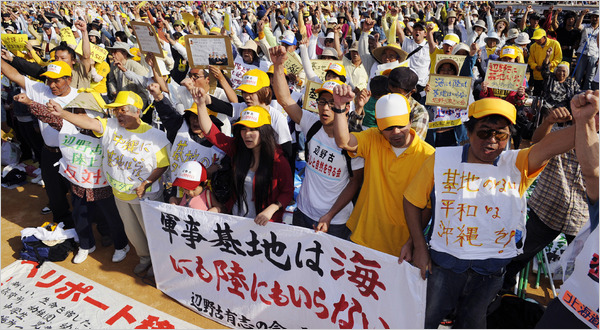
Protesters packed an athletic field in the town of Yomitanson in Okinawa, Japan, to demand that a U.S. Marine base be moved.

By MARTIN FACKLER

Published: April 25, 2010

TOKYO — More than 90,000 Okinawans rallied Sunday to oppose the relocation of an American air base on their island, adding to the pressure on Prime Minister Yukio Hatoyama to resolve an issue that has divided Tokyo and Washington.

The demonstrators, in one of the largest protests on the southern Japanese island in years, demanded that Mr. Hatoyama scrap a 2006 agreement with the United States to move the Futenma United States Marine air station to a different site on Okinawa. Many of the protesters wore yellow to signal they were giving Mr. Hatoyama a yellow card, or warning, for appearing to waver on election promises to move the busy base off Okinawa altogether.

Since his party’s landmark election victory last summer, Mr. Hatoyama has promised to come up with an alternative plan that would reduce the heavy American presence on the island, home to nearly half of the 50,000 United States military personnel in Japan. He has given himself until the end of May to put together such a plan that would also be acceptable to Washington.

So far, his efforts to find a new location for the base have not appeased Washington, which initially demanded that Tokyo adhere to the original 2006 deal, though it has recently signaled greater flexibility. The United States wants to move the base from its current location in the center of the city of Ginowan, to Camp Schwab, an existing Marine base in less-populated northern Okinawa.

The perception that Mr. Hatoyama has mishandled the relationship with the United States, Japan’s longtime protector, has contributed to his falling approval ratings, which have dropped below 30 percent. Opposition leaders and media commentators have begun calling on him to resign if he fails to find a compromise by the end of May.

While Mr. Hatoyama has remained tight-lipped about what his plan may look like, officials from his government have made repeated visits to Okinawa to sound out local leaders. Okinawan politicians and local media have described the emerging plan as a modified version of the 2006 agreement.

They said the government is considering building a small runway at Camp Schwab and moving at least part of Futenma’s functions — most likely some its training operations, and perhaps some of its helicopters — to Tokunoshima, a smaller island about 120 miles north of Okinawa. Japanese news media have interpreted this proposal as a token gesture to appease Okinawans by moving at least some of the Marines off of the island.

Okinawan leaders and local media reports have also said the government is considering building a new air base on an artificial island to be built off the Okinawan city of Uruma. Japanese media reports have said the island could take decades to build and would serve as a longer-term home for the Marines.

However, on Sunday, local leaders told the demonstrators that they rejected any plan that kept the air base on Okinawa. Toshio Shimobukuro, the mayor of Uruma, said he opposed the construction of the island, which would turn his city in “a major military site,” according to Japan’s Kyodo News.

The governor of Okinawa, Hirokazu Nakaima, who dropped his earlier support for the 2006 plan to join a rising backlash against the base, called on the rest of Japan to share more of the burden of the American military presence.

“This is not a problem that concerns only Okinawans,” he said, according to Kyodo.