Hawaii fights release of details on drone contracts

Jim Dooley wrote an interesting article on watchdog.org about the proposed use of aerial drones to monitor harbors in Hawai’i as part of no-bid contracts awarded to Hawaiya Technologies.  Hawaiya is a military technology company owned by Paul Schultz. Schultz, formerly a Rear Admiral and commander of a fleet stationed in Okinawa, was demoted to captain when he retired from the Navy. He had come under investigation for allegations of adultery and fraud tied to a Navy research contracts scandal at the University of Hawai’i and the Pacific Missile Range Facility.

While in the Navy, the married Schultz allegedly had an affair with an Office of Naval Research program manager Mun Won Chang Fenton who helped to steer research funds and technology to Schultz’s ships outside of normal procurement channels.  Fenton later awarded several grants to University of Hawai’i professors for research related to missile defense systems.  She directed the UH researchers to hire technical personnel under the grant. These “directed hires” took their orders from Chang Fenton. Chang Fenton directed these personnel to write a large net-centric warfare technology contract proposal under the auspices of the Research Corporation of the University of Hawai’i (RCUH) and submit the proposal to Navy research programs that Chang Fenton helped to manage.  The Navy awarded RCUH a contract for its proposal named “Project Kai e’e”, to establish a military Pacific Research Center to serve as a conduit for federal military high technology funding.

Naval Criminal Investigation Service (NCIS) documents and other sources allege that the Schultz and Chang Fenton tried to use government funds to create jobs for themselves in the new Pacific Research Center.   The job announcement for Executive Director of the Pacific Research Center was posted on the bulletin board in the RCUH office for a few minutes.  After Schultz submitted his application the job announcement was taken down.  RCUH staff were directed by Chang Fenton to rate the applicant favorably.  Schultz was offered the job, but he never formally accepted it.  RCUH Executive Director Harold Masumoto suddenly sent a letter to the Office of Naval Research canceling the contract award.

Naval investigators were closing in. My theory is that someone may have tipped off Schultz and his co-conspirators, sending them scurrying for cover.

The Project Kai e’e scandal morphed into the proposed University Affiliated Research Center (UARC), a military classified research lab that met fierce protest by students, faculty and community groups in 2004 – 2006.  The really interesting part of the this sordid tale is that the various projects were earmarks from Senator Inouye.  Sources familiar with the scandal told me that the investigation went nowhere because it could have implicated four admirals and a senator.

As Dooley’s article suggests, Schultz seems to have found a new niche in the homeland security gold-rush.  But the proposed use of unmanned aerial drones to monitor harbors raises many issues of civil liberties, safety and propriety.   The contracts were awarded without any bidding.  The plans for aerial drones are proceeding without approval from the Federal Aviation Administration.  And details about the project are being kept from the public.

Could the no-bid contract have been awarded via Aina Kai, a Native Hawaiian Organization (NHO) established by Schultz and Chang Fenton (who are now married) in partnership with former Hawai’i governor John Waihe’e?  NHOs are given special preferences for federal contracting to receive contract awards without competition and without a limit on the size of the award.

High stakes government funding, exotic and dangerous military technologies and secrecy are a recipe for corruption.   The tsunami of military spending that was unleashed in the wake of the 9/11 attacks have brought with it a flood of corruption. Such is life in the military-industrial-political complex.

>><<

http://watchdog.org/8124/hawaii-fights-release-of-details-on-drone-contracts/

Hawaii fights release of details on drone contracts

Posted on January 28, 2011

BY JIM DOOLEY — The state and a private contractor are installing extensive new security and surveillance measures at harbors and shorelines that include planned use of unmanned aerial drones, according to public records.

Neither the contractor nor state officials have applied to the Federal Aviation Administration for necessary permission to deploy the unmanned aerial vehicles in civilian air space here.

Repeated requests for details about the plans and their status made to the state and its contractor have not been answered for more than a month.

Paul Schultz, chief executive of Hawaiya Technologies, the company installing the new security measures, refused to discuss his company’s shoreline security plans in general or the use of UAV’s in particular.

“You can go find out your story on your own,” Schultz said.

“This is not a friendly story,” Schultz continued. ”You’re coming after me. You can come after me by yourself. But don’t call me looking for information.”

State Department of Transportation and harbors division personnel did not respond to repeated requests for comment submitted by email, telephone and in-person since late last year.

Glenn Okimoto, nominated by Gov. Neil Abercrombie as director of the Transportation Department, and his harbors division deputy director, Randy Grune, have said a department response was being prepared.

Okimoto was head of the harbors division in 2007 and personally recommended award of the original $1.46 million non-bid Honolulu harbor security contract to Hawaiya Technologies, according to state purchasing records.

Some $1 million of the contract is paid with federal grant money and the remainder comes from the state.

Grune said three weeks ago the department was still researching “technical issues” about non-bid security contracts awarded to Hawaiya.

The UAV’s are described as an anti-terrorism tool in documents describing new security measures at Honolulu and Kalaeloa Harbors on Oahu under a 2009 contract awarded to Hawaiya Technologies.

Another non-bid contract award worth nearly $1 million to Hawaiya is planned for Kahului harbor on Maui and the contractor has proposed installing the same system on Kauai and the Big Island.

The jobs would include use of UAV’s to conduct surveillance flights in the congested skies above state harbors, which abut two international airports, a general aviation airfield and Hickam Air Force Base.

The drones can’t fly without an FAA “certificate of authorization” and the state has not applied for one, said Ian Gregor, FAA spokesman.

The drones cost $75,000 each, according to purchasing records posted at the state procurement office website.

The type of drones – there are many different designs being marketed now – and the number to be purchased are details that the state has redacted from contracting files.

Only two civilian government agencies in the country – one in Texas and one in Kansas – have applied for and received necessary certifications for use of the drones, which must be operated by licensed pilots from ground control stations, said Gregor.

The Texas aircraft would be used to patrol remote sections of the Mexican border and the Kansas drones would be flown at a UAV testing and training facility 30 miles outside of Wichita.

The FAA requires that civilian-operated airborne drones must also be tracked by either a ground spotter vehicle or a manned chase plane.

The American Civil Liberties Union has expressed concern about invasion of privacy issues raised by use of surveillance drones in other states and is monitoring the Hawaii plans.

“Use of ‘Unmanned Aerial Vehicles’ or ‘drones’ by law enforcement has a vast potential for abuse,” sad Daniel Gluck, senior staff attorney for ACLU Hawaii.

READ FULL ARTICLE

Coming Soon? V-22 Osprey “extremely noisy with a horrific racket”

Coming soon to Mokapu and Pohakuloa?

Thanks to Satoko Norimatsu of the Peace Philosophy Centre for sharing these articles.

>><<

V-22 Osprey “extremely noisy with a horrific racket”

Link:
http://peacephilosophy.blogspot.com/2011/01/v-22-osprey-extremely-noisy-with.html

Okinawan newspapers on January 27 reported that the residents of Brewton, Alabama complained about the noise caused by the V-22 Osprey used in the US Air Force training mission at their municipal airport, and the Air Force offered apology and told the local airport authority that the squadron will not come back. “Those aircraft are extremely noisy with an horrific racket,” the airport director is quoted in the local news (see below).

It is disturbing news for Okinawa, as USMC is planning to deploy Ospreys in Henoko and Takae, two places in Northern Okinawa where military expansion is planned despite the opposition from local residents. Okinawans are worried, not just about their noise, but about the reported risk of accidents by Ospreys. A recent Pentagon report (below) also indicated the continuing unreliability of the aircraft due to “cracking or prematurely failing hinges and access doors, engine and drive components within the nacelle structure, flight control system failures, wiring and swashplate actuators.” The aircraft killed thirty people during the course of development, and killed four in a crash in Afghanistan in April 2010.

In late December, a US helicopter hovered over and damaged the protesters’ tent in Takae, where US/Japan are planning to build six new helipads (Osprey-capable) surrounding a residential area, but the authorities have not even confirmed that it was a US Marine helicopter
that did it. It is unacceptable that a plan to use noisy and dangerous aircraft like V-22 Osprey is not properly disclosed to local residents and there has been no assessment of risks associated with Ospreys in the environmental assessments on both places.

Satoko Norimatsu
Peace Philosophy Centre, Vancouver http://peacephilosophy.com
Asia-Pacific Journal: Japan Focus http://japanfocus.org
UBC Education/Centre for the Study of Historical Consciousness http://www.cshc.ubc.ca/


+++

http://www.businessweek.com/news/2011-01-12/textron-boeing-v-22-still-dogged-by-bad-parts-tester-says.html

Textron-Boeing V-22 Still Dogged By Bad Parts, Tester Says

January 12, 2011, 3:53 PM EST By Tony Capaccio

Jan. 12 (Bloomberg) — The V-22 tilt-rotor Osprey, five years after it was cleared for full-production, remains dogged by unreliable parts that reduce its availability for missions, according to the Pentagon’s top tester.

The Textron Inc. and Boeing Co. V-22, in its most recent testing to evaluate upgrades, was available only 57 percent of the time it was required to fly, rather than the specification of 82 percent, according to a new report by Michael Gilmore, the Pentagon’s director of operational test and evaluation. The testing took place between May and July 2009.
“Major contributors to this low mission capable rate included cracking or prematurely failing hinges and access doors, engine and drive components within the nacelle structure, flight control system failures, wiring and swashplate actuators,” which help the main rotors turn, the report said.
“Mission-capable rate” is a standard standard metric for aircraft combat reliability.
Gilmore assessed that when the aircraft was flying it “met or exceeded” all but one reliability and maintenance requirement.
The aircraft “demonstrated effectiveness in a wide range of approved high-altitude scenarios reflecting current Marines Corps operations,” wrote Gilmore, in a section on the V-22 in the annual report from the testing unit issued today.
The Pentagon test office and U.S. Government Accountability Office have consistently highlighted problems with V-22 parts since 2000. The V-22 is a fixed-wing plane with rotors that tilt so it can take off and land like a helicopter.
Bell Helicopter Textron spokesman William Schroeder and Naval Air Systems Command spokesman Victor Chen had no immediate comment on the test report because they had not seen it.
Improvements
Gilmore recommended that the Marines and Air Force, which is buying a version for to fly U.S. commandos, “aggressively continue integrated development and testing” to improve the aircraft’s braking system, engine and drive-train reliability.
The V-22 has been deployed to Iraq and is in Afghanistan, where it transported Defense Secretary Robert Gates during a March 2010 trip.
Congress through fiscal 2010 has approved spending $32 billion on the $52.8 billion program. The Navy plans to spend $20 billion more on upgrades and the purchase of the remaining planes in the 458-aircraft program for the Marine Corps and Air Force Special Operations Command.
The program was approved for full-production in September 2005 after four years of additional development to demonstrate it overcame a host of deficiencies, including problems with its design, safety and reliability uncovered after two crashes in 2000 killed 23 Marines.
Maintenance Problems
The GAO in a June 2009 report that evaluated the V-22’s initial Iraq deployment concluded that, while the aircraft flew its assigned missions successfully, maintenance problems left the planes available for flight at rates “significantly below minimum required levels.”
During three periods studied during the V-22’s deployment from October 2007 through April 2009, the planes were available for combat operations on average 68 percent, 57 percent and 61 percent of the time, “while the minimum requirement” is 82 percent, said the GAO.
These low rates “were not unique to the Iraq deployment” and were on par with other V-22 squadrons in the U.S., the GAO said.

–Editor: Terry Atlas, Steven Komarow

To contact the reporter on this story: Tony Capaccio at acapaccio@bloomberg.net

To contact the editor responsible for this story: Mark Silva at msilva34@bloomberg.net

+++

http://www.brewtonstandard.com/2011/01/22/military-plane-made-noise-over-brewton/

Military plane made noise over Brewton

Published 11:30am Saturday, January 22, 2011

The crew from “Unsolved Mysteries” won’t be coming to Brewton to investigate strange rumblings heard across the area Wednesday night.

Brewton Municipal Airport Director Earl Lambert said the noises heard throughout the area can be attributed to the massive V22 Osprey — a twin rotor helicopter/airplane owned by the military.

“After hearing the machinery, we began to investigate the source,” Lambert said. “Our investigation lead us to the special ops unit from Hurlburt Field.”

Hurlburt Field, located near Fort  Walton Beach, Fla., is home to the Airforce Special Operations Command.

“I spoke to the commander of the squadron and explained their training would not be good since we have so many citizens that live in the area around the airport,” Lambert said. “Those aircraft are extremely noisy with an horrific racket.”

The Brewton Municipal Airport serves as a training area for units from Whiting Field near Milton, Fla., during the day.

“We have a 50-year agreement with the Navy, and you just can’t mix the two,” Lambert said. “It would be prohibitive for them to use the area during the day when it’s being used by the Navy, and it’s just too noisy at night.”

Lambert said a gentlemen’s agreement was reached between himself and the commander Friday that would bring the training missions to a halt.

“The commander offered an apology for any inconvenience their training may have caused in the community,” Lambert said. “He assured me the squadron would not be back in the area to train.”

The Brewton Municipal Airport is a non-controlled facility, meaning there is no air traffic control tower and no after-hours communications system.

Target: Pohakuloa

The graphic in the Honolulu Star Advertiser article “Upgrade in Sight” is fitting: Pohakuloa in the crosshairs of a sniper’s scope.
STAR-ADVERTISER / October 2009

Pohakuloa has become the target of massive military expansion since 2001. First the Stryker brigade expansion led to a 23,000 acre land grab by the Army:

In 2006 the Army bought 23,000 acres from Parker Ranch for military maneuver training for $31.5 million, and it has spent $33.6 million for a Stryker armored vehicle “battle area complex” expected to open in 2012 at a separate spot at Pohakuloa. But that facility is mainly for Stryker gunnery, officials said.

Then the Air Force expanded its aerial bombardment training to use 2000 lb dummy bombs dropped from stealth B-2 bombers. Then the Marine Corps expansion. Now the Army “upgrade”of the range and proposed high altitude helicopter training on the slopes of Mauna Kea.  The recent announcement that the Army is abandoning live-fire training in Makua on O’ahu after more than 60 years is hardly cause for celebration in light of the shift of major military training activity to Lihu’e (Schofield range on O’ahu) and Pohakuloa on Hawai’i island.
Pohakuloa has been subjected to intense military activity:

Pohakuloa has 153 ranges, including the 566-acre housing and base operations area, and numerous firing ranges directed at a central 51,000-acre ordnance impact area.

Army soldiers, Hawaii-based and transiting Marines, and the Hawaii National Guard are among the ground forces that regularly train at Pohakuloa, officials said.

Artillery, mortars, rockets and missiles are fired at Pohakuloa, and Air Force bombers drop dummy bombs on the range.

Army expansion plans include helicopter training on Mauna Kea, outside the military base:

The high-altitude helicopter training plan seeks to standardize and make an annual requirement of similar exercises that were held at Pohakuloa in 2003, 2004 and 2006, a change that reflects new Army doctrine, according to documents.

The 25th Combat Aviation Brigade at Schofield would use the Mauna Kea and Mauna Loa training as it too prepares for deployment to Afghanistan, where operations routinely exceed 10,000 feet.

Six existing landing zones would be used for approach, landings and takeoff at elevations above 8,000 feet under high winds, extreme temperatures and during night operations.

The training was examined in an environmental assessment separate from the infantry plans. A draft finding of “no significant impact” was released in December.

Helicopter training hours at Pohakuloa would be increased by 30 percent to 6,000 total hours based on 300 to 400 aviators receiving the training, the Army said.

People will resist:

The Army faces opposition to the Pohakuloa plan from some Big Island residents, including peace activist Jim Albertini.

Albertini said in a statement following a public meeting held by the Army on the modernization plan that he is concerned about depleted uranium left over from a 1960s weapon system used at Pohakuloa.

“There has been plenty of money over the years for military buildup but very little funding for military cleanup. It’s time to change those priorities,” Albertini said. “The bottom line is this: Hawaii residents don’t want the U.S. military training to do to others what the U.S. has already done to Hawaii — overthrow and occupy its government and nation and contaminate its air, land, water, people, plants and animals with military toxins.”

The destruction of Pohakuloa, Makua, Kaho’olawe is not simply a result of “training”. What is happening to Pohakuloa is symptomatic of the wars that have become permanent fixtures of these islands. It exposes the Big Lie of Empire: “Pax Americana” – the American Peace. From the mountains of Afghanistan to the slopes of Mauna Kea, Empire is endless war.

As Ann Wright recently shared about her trip to Afghanistan, Afghan Youth Peace Volunteers have engaged in several global call-in days. People from around the world having conversations with youth from a remote part of Afghanistan. For those who still justify the war in Afghanistan and the military training in Hawai’i in preparation for that war, listen to these youth: http://ourjourneytosmile.com/blog/

>><<

Upgrade in sight

By William Cole

POSTED: 01:30 a.m. HST, Jan 22, 2011

Schofield Barracks soldiers of the 2nd Stryker Brigade Combat Team’s 1st Battalion, 21st Infantry spent two weeks at the Big Island’s Pohakuloa Training Area preparing for a deployment to Iraq. Army soldiers, Hawaii-based and transiting Marines, and the Hawaii National Guard are among the ground forces that regularly train there.

The Army wants to modernize its vast Pohakuloa Training Area on the Big Island for the 10,000 to 20,000 U.S. troops who use it each year, and increase high-altitude helicopter training on Mauna Kea and Mauna Loa to meet a shift in emphasis to Afghanistan.

An Infantry Platoon Battle Area at 133,000-acre Pohakuloa that also could be used for companies of about 150 soldiers — and replace past live-fire training at Makua Valley — is a priority for the Army, with the service hoping it can begin construction in 2013.

READ FULL ARTICLE

Hawaiian Leader Frenchy Desoto, 81, Dies

Aunty Frenchy DeSoto, a kupuna of the Native Hawaiian movement, a Wai’anae community leader and a staunch advocate for the clean up and return of Makua valley has died at the age of 81.  As KITV reports:

Longtime Hawaiian activist Adelaide Keanuenueokalaninuiamamao “Frenchy” De Soto died Friday night at her Makaha apartment, according to family members. She was 81 years old.The eldest of her six children, former city councilman John DeSoto, said she had been hospitalized for four days, suffering from pneumonia and congestive heart failure.

She was also a leader of Hui Malama O Makua, a coalition of organizations that fought to end the U.S. Army’s live-fire exercises in Makua Valley on Oahu’s Waianae Coast.

In the 1970s, Aunty Frenchy was also a leader in the Protect Kaho’olawe ‘Ohana.  Only weeks after the first protesters landed on Kaho’olawe in 1976 there was a rally at Makua valley in solidarity with the activists on Kaho’olawe.   The fire of protest was spreading.

Movement leaders gathered at her encampment at Makua beach to discuss strategy.   At the time a strategic decision was made to focus on stopping the bombing of Kaho’olawe first.  Decades later in meetings of the Makua activists, she frequently reminded us that Kaho’olawe leaders promised to help Makua after Kaho’lawe was liberated and would wonder aloud where they were.  At least she lived to see the end of live-fire training in Makua.

Aloha e Aunty Frenchy.  Wai’anae has lost a fiery voice for justice, but her legacy lives on the movement for Makua.

In the wake of the Army’s Makua decision

The Honolulu Star Advertiser did a feature article on David Henkin, an attorney for EarthJustice who represents Malama Makua in its fight with the U.S. Army.  David is a friend and Makahiki brother who has done a great job as the attorney for Malama Makua.   However, I disagree with his suggestion that live fire or other training is more acceptable at Schofield (Lihu’e) or Pohakuloa.  The principles of aloha ‘aina and solidarity that bring thousands of people from around the world to stand with Makua must be reciprocated.  The ‘not-in-my-backyard’ argument leaves unchallenged the very premise that the training is necessary and for some legitimate purpose, which, as the death toll and costs rise in Iraq and Afghanistan, we know to be a lie.  As Jim Albertini writes in his January 12, 2011 leaflet: “The bottom line is this: Hawaii residents don’t want the U.S. military training to do to others what the U.S. has already done to Hawaii: overthrow and occupy its government and nation, and contaminate it’s air, land, water, people, plants, and animals with military toxins.”

Below is the leaflet issued by Malu ‘Aina followed by the interview with David Henkin:

Pohakuloa Military Expansion Opposed Unanimously!

Below is a brief report on the public hearing held Jan. 11th at Hilo Intermediate School cafeteria on plans for military expansion at Pohakuloa. The plans call for new live-fire ranges and training, and construction activities, at Pohakuloa, as well as high altitude helicopter flights and landings on Mauna Kea and Mauna Loa in training for Afghanistan/Pakistan high altitude mountainous warfare.

The first hour and a half was taken up with “open house” science fair type displays by military people who knew very little about the history of militarism in Hawaii and couldn’t answer many questions asked. But the public testimony portion on Pohakuloa was powerful.

The public hearing portion started with Kumu Paul Neves and his Ohana/halau doing chants and then Paul led a Pule.  Lots of young Hawaiians testified both in their native tongue and English.  They spoke eloquently against the military desecration of the sacred mountains and aina.  Other Hawaiians and people of all ages,  testified as well.  The testimony went for 2 hours.  Not one person spoke in support of the military expansion plans. The PTA new commander and the Army Garrison commander from Oahu sat stoned-faced throughout the 2 hours of public testimony

Many citizens noted that no further military activity at the Pohakuloa Training Area (PTA) should go forward.  On July 2, 2008 the Hawaii County Council passed a resolution by a vote of 8-1 calling for a complete halt to all live-fire at PTA and any activities that create dust until there is a comprehensive independent assessment of the depleted uranium (DU) at PTA and a clean up of the DU present.  The council’s resolution also called for 7 additional actions, none of which have been implemented.

Several people emphasized that stopping the bombing and all live-fire, construction, and other activities that create dust at PTA is key.  Du particles are particularly hazardous when inhaled.  People testified that the federal government should pay for the comprehensive independent assessment, testing and monitoring for radiation contamination and that federal funds should be sought through Hawaii’s congressional delegation –senators Inouye and Akaka, and representatives Hirono and Hanabusa.  There has been plenty of money over the years for military build up but very little funding for military clean up.  It’s time to change those priorities.

The bottom line is this: Hawaii residents don’t want the U.S. military training to do to others what the U.S. has already done to Hawaii: overthrow and occupy its government and nation, and contaminate it’s air, land, water, people, plants, and animals with military toxins.

Stop the Bombing!  Stop All the Wars!
Military Clean Up NOT Build Up Now!
End all Occupations! Restore the Hawaii Nation!

1. Mourn all victims of violence. 2. Reject war as a solution. 3. Defend civil liberties. 4. Oppose all discrimination, anti-Islamic, anti-Semitic, etc. 5. Seek peace through justice in Hawai`i and around the world.
Contact: Malu `Aina Center for Non-violent Education & Action P.O. Box AB Kurtistown, Hawai`i 96760.
Phone (808) 966-7622.  Email ja@interpac.net   http://www.malu-aina.org
Hilo Peace Vigil leaflet (Jan. 14, 2011 – 487th week) – Friday 3:30-5PM downtown Post Office

Jim Albertini

Malu ‘Aina Center for Non-violent Education & Action

P.O.Box AB

Kurtistown, Hawai’i 96760

phone: 808-966-7622

email: JA@interpac.net

Visit us on the web at: www.malu-aina.org

+++

http://www.staradvertiser.com/columnists/20110121_David_Henkin.html

David Henkin

The lawyer for Earthjustice won a long campaign to stop the Army’s live-fire training in Makua Valley

By Dave Koga

POSTED: 01:30 a.m. HST, Jan 21, 2011

David Henkin knew early in life that he wanted to protect the environment. As a child in Los Angeles, he would pick up pieces of trash during walks with his mother and wonder aloud how people could be so thoughtless.

“The interest got more sophisticated after that,” he says, “but I think for a lot of people it starts with just looking around and seeing how beautiful the world is and what a gift we’ve been given … and understanding that we all have an obligation to stewardship.”

At Yale Law School, Henkin naturally gravitated toward environmental law, which would give him “the chance to stand up for the Earth.”

“What drew me in was not just the work — the opportunity to make the world cleaner, better, safer — but that the clients are never in it for money or personal gain,” he says. “They’re in it because they have a passion for protecting resources and places for future generations. And so that’s something I’ve always been able to get up in the morning for … to keep my energy up and keep doing it year in and year out.”

Since arriving in Hawaii in 1995 to work for Earthjustice, Henkin has filed numerous cases on issues ranging from protection of the endangered Hawaiian crow to the upgrading of Honolulu’s wastewater treatment facilities.

He is best known for representing the community group Malama Makua, which has pressed the U.S. Army since 1998 to prepare environmental impact statements on its training in Makua Valley, home to more than 100 archaeological sites and 50 endangered plant and animal species.

Two weeks ago, the Army’s commander in the Pacific, Lt. Gen. Benjamin Mixon, announced that “in an effort to balance our relations with the community and the requirements that we have for training,” the Army had abandoned plans to resume live-fire training in Makua Valley and would conduct future exercises at Schofield Barracks and the Pohakuloa Training Area on the Big Island.

Henkin is pleased with the Army’s decision, which he says was too long in coming. But he says the ultimate goal remains the return of the valley to the state — and it may be a while before that issue is resolved.

QUESTION: Now that the Army is saying there will be no more live-fire training in Makua, what’s your sense of what’s going to happen next?

ANSWER: What’s important to understand is that the Army hasn’t done any live-fire training in Makua since 1998 (when Malama Makua filed suit after a series of munitions-sparked brushfires). In the last 12 years, they’ve fired rounds in only 26 exercises during a three-year period. So actually, out of the last 12 years, there have been nine years without a single shot fired. And as you know, during that period of time, particularly from 2001 onward, the Army has been deploying constantly to combat theaters and they’ve been training their soldiers elsewhere. So what Gen. Mixon said is really just an acknowledgment of reality — which is that not only can the Army get by without live-fire training at Makua, it has.

And so the Army and the people of Hawaii have to ask themselves: Is it worth sacrificing the cultural sites and the endangered species? Is it worth training within three miles of heavily populated areas? Is it worth training across the street from areas where people play with their children and gather food from the ocean when there are other options?

The first lawsuit was filed in 1998 … and in 2000 and then again in 2001, the Army came out with a very short document called an environmental assessment where they said there was no potential for training at Makua to cause any significant harm to the environment. This, against a history in which cultural sites have been destroyed and endangered species have been burned, just didn’t pass the smile test. And the judge agreed with us that they needed to do the full-blown environmental impact statement …

To me, this case is a perfect illustration of what Congress intended when it made … the environmental review law. It is, “Let’s get the facts on the table; let’s not do it based on rhetoric and supposition. Let’s get the facts on the table and make a good decision.” And we believe the decision Gen. Mixon announced last week is not only good for us, but good for the Army and good for the people of the state of Hawaii, because for so long the dialogue has been readiness versus the environment. And now we realize that you can have both. You can protect sacred places, special places, and you can also do the training.

Q: What do you think was driving the Army’s reluctance to do any kind of complete study all these years?

A: We’ve heard that the Army had a fear — almost like the old domino theory — that if the Army gave in at Makua, then the activists would be at the gates and they would try to push them out of Schofield and out of Pohakuloa. For Earthjustice and Malama Makua, the issue has always been Makua and whether this is an appropriate place to train. I think there were some concerns about (the Army) saving face. Maybe along the way some of the generals (who commanded Pacific forces) believed their rhetoric.

Q: What are Malama Makua’s thoughts on the Army’s plan to now turn Makua into a roadside-bomb training site?

A: Our clients’ belief, and my personal belief, is that Makua is a very sacred, special place that just is not appropriate for training. I don’t think any rational military trainer in the 21st century would look around the state of Hawaii and say, “I’m going to train at Makua” if they hadn’t been there since World War II. I think it’s a legacy of past decisions made in a different age, with different knowledge and different sensibilities.

So I guess the short answer is there are other places where they can do this kind of training. To do the convoy exercise you basically need a road. There are plenty of roads on Army land at Schofield and Pohakuloa.

Now, the specifics of what’s being proposed are pretty much unknown at this point. My guess is that it is substantially less of an impact on the cultural sites and the endangered species than what they had been doing before, but to get back to my theme, information is vital and there hasn’t really been disclosure. I can just say, based on what I do know, that there are other places they can do it and Makua really ought to be returned to the people of the state of Hawaii for appropriate cultural and civilian use.

Q: Are you confident of that happening?

A: Before (the government’s 65-year lease for Makua expires in) 2029? My approach to the type of work that I do is that you have to be optimistic and idealistic, because that’s what keeps you going. But at the same time, you have to be realistic and keep your expectations low because that’s what keeps you from becoming discouraged. When you’re doing public interest environmental work, it’s always a long-term battle, it’s always an uphill battle, it’s never really over. So I do envision a return of Makua to the people of Hawaii as soon as possible. But I don’t expect it. I hope to be pleasantly surprised.

You have to remember that when Makua was originally taken for training in 1941, the families who lived there, the families who were evicted, were told that their land would be returned six months after the end of hostilities. They’re still waiting. So really, Makua has a history of very profound broken promises to the individual families and in a larger context to the people of Hawaii.

Q: Does Earthjustice have any problem with live-fire training at Pohakuloa?

A: My understanding is that the Army has started an environmental review process, where from the beginning they’ve admitted the need for an environmental impact statement — so there’s been progress over the years — and that they’re doing a review of locations of alternate training facilities to Pohakuloa. It is hard to find a place in the state of Hawaii to do live-fire military training that is not going to cause damage. It is by its very nature a destructive activity. You’re practicing war.

Am I OK with them training at Pohakuloa? That’s not really the lens that I look at it through. I look at it through this lens: If the Army is going to do a certain type of training, where can they do it with the least impact?

Q: As far as returning Makua to Hawaii and having it open to civilians again, do you have a sense of how much unexploded ordnance might still be there and how much clean-up it would take?

A: Well, one of the things we were able to secure through a settlement agreement in 2001, is an obligation for the Army now to be clearing unexploded ordnance from the valley. Normally, the Army has a policy that live training ranges don’t get cleaned up until they’re actually closed. But as part of our settlement we said, “We don’t want you to wait until you’re ready to leave, we want you to start cleaning up now.” So there have been 1,000-pound bombs, 250-pound bombs, a lot of heavy ordnance that has already been pulled out of there. Now they tend to find a mortar round here, a mortar round there.

Compared to Kahoolawe, the entire military reservation’s about 4,100 acres. The flat lands where people would want to carry out cultural activities, maybe start farming again, is a much, much smaller area. So I think it would be manageable.

Testifiers oppose Pohakuloa training plans

Source: http://www.bigislandweekly.com/articles/2011/01/19/read/news/news01.txt

Residents to Army: NO

Testifiers oppose Pohakuloa training plans
By Alan D. Mcnarie
Wednesday, January 19, 2011 8:21 AM HST

An army has to train if it wants to avoid unnecessary casualties. And American troops stationed in Hawai’i face a narrowing set of options for training. Kaho’olawe has been returned, much the worse for wear, to the native Hawaiians. And last week, the Army bowed to public pressure and announced that it would no longer pursue live-fire training in O’ahu’s Makua Valley.

That leaves Hawai’i Island’s 133,000-acre Pohakuloa Training Area to absorb much of the burden. Last year, the Army announced that it would shift its artillery heavy weapons practice from Makua to Pohakuloa. And last week, island residents got a glimpse of some of the specifics of that plan, as the Army held two “scoping sessions” for its “Programmatic Environmental Impact Statement” on the Army’s proposal to modernize PTA’s aged buildings and firing range. But at the two sessions, it appeared that the Army had no more support for training here than it did at Makua Valley.

Compared to some of its recent projects, such as the purchase of several thousand acres of range land for a Stryker vehicle maneuver area, the plans covered by the Programmatic EIS are relatively modest. All of the improvements would fall “within the current footprint. We’re not buying land to expand,” army spokesperson Mike Egami told BIW.

“The cantonment area and the ranges are so old that they’re not up to modern Army standards. The ranges are really fundamental; we have them (troops) training on these Korea-World War II types of facilities,” Egami said.

Plans include a new “shoot house” — an indoor firing range with walls that bullets can’t penetrate — an Infantry Battle Complex for training company-sized groups of foot soldiers, and a Military Operations Urban Terrain (MOUT) site where soldiers can practice dismounted urban warfare, all to be built within the confines of the current firing range.

At this stage, there still appear to be major holes in the Army’s assessment of the new facilities’ impact. Egami couldn’t say, for instance, how much the use of the new facilities would increase the amount of ammunition fired at the base, and when, where and how the unexploded ordnance would be cleaned up. He did tell BIW that all the ammunition used at the new facilities would be from small arms.

At the Tuesday Hilo scoping session, not a single resident spoke in favor of the Army’s plans. The Army got a similar verbal shellacking the next night in Waimea. Most of those who spoke wanted Pohakuloa closed down, not expanded. Several residents suggested that the Army should spend its money on rehabilitating the physical and mental casualties of the Iraq and Afghanistan wars, instead of on expanding training facilities.

“I can say that I’m a part of a military family, like it or not,” said veteran Hawaiian activist Moanikeala Akaka, after reciting a long list of relatives who’d served in the military or worked on military bases. “But I can say there are some of us who are sick and tired of the military expansion on the island.”

Relatively few of the speakers, in fact, actually addressed the specifics of the Army proposals contained in the PEIS, though one speaker did suggest that new training sites be moved to a different part of the impact area to get them further away from areas of native vegetation. Several residents wanted to talk about still another army training proposal that was not contained within the PEIS: The Army wants to use existing DLNR helicopter landing sites on Mauna Loa and Mauna Kea to hold high altitude training for the choppers of its 25th Combat Aviation Brigade, which is due to employ to Afghanistan in late spring of this year. The High Altitude Mountainous Environment Terrain Training (HAMET) is being handled in a separate Environmental Assessment; EAs do not require public hearings, though residents can give written input. A Draft Finding of No Significant Impact (FONSI) was published last month, and the Army is now accepting public comment on it. The draft is available at larger public libraries and online (Search Army + Hawaii + HAMET).

The Army has, in fact, been using those landing sites for years, and not without incident. According to the Draft Finding of No Significant Impact, a helicopter involved in a HAMET exercise in 2003 missed its landing zone and accidentally landed in the Mauna Kea Ice Age Natural Area Reserve. In 2006, another HAMET “incident” occurred when “an aircraft hovered too low over critical habitat.” The “critical habitat” mentioned is home to the palila, an endangered Hawaiian bird found only in the Big Island’s upper-altitude mamane forests, some of which have already been lost to the realignment of the Saddle Road.

Other threatened or endangered species may also be affected by the flights: the ‘io (Hawaiian Hawk); the ope’ape’a (Hawaiian hoary bat); and the nene. One of the helicopter landing sites on Mauna Loa, in fact, lies right on the edge of the Kipuka Ainahou Nene Sanctuary, though a map included in the Draft FONSI shows the border of the actual nene range well to the east of the sanctuary border. The Army plans to mitigate by flying at least 2000 feet over possible habitats, and the FONSI claims that the endangered species are “unlikely to be present at the elevation of any of the LZs [landing zones].”

Paul Neves of the Royal Order of Kamehameha I called the HAMET EA “completely inadequate.” He noted, for instance, that it had “no analysis of people using traditional trails near the landing zones,” and didn’t mention the usage of Mauna Loa Observatory Road by observatory workers, hunters and hikers, even though the military wanted to use landing zones on both sides of that road.

“The helicopters have been landing for seven years now with almost zero public oversight…,” testified the Sierra Club’s Cory Harden. “Helicopters may fly up to 18 hours a day during training, day and night, to within 2,000 vertical feet of the summit. The EA says noise and visual impacts on cultural practices and recreation will not be significant. That’s like saying impacts would not be significant from helicopters at Machu Pichu…. The EA has a cultural overview without one word about the illegal takeover of Hawai’i. That’s like writing a cultural overview of the United States and leaving out the Civil War.”

Harden also brought up another controversy: the furor over depleted uranium ordnance at Pohakuloa and the army’s refusal, so far, to completely remove it, or even to hunt very hard for it. She cited instance after instance of the army documents and spokespeople claiming it was too dangerous to look for DU in Pohakuloa’s impact zone. Yet all of the new battle areas, she noted, were “either in or directly adjacent to the existing impact areas of PTA.”

“Why is it too dangerous to enter the impact area to hunt for DU, but safe to go in and build more military facilities?” she asked.

Egami told BIW that the new live fire training facilities were not in the impact area, but adjacent to it. But one of the displays the army had put up at the scoping session said that the Infantry Platoon Battle Area would be “located at one of three (3) potential locations within the existing impact area”; an adjacent map showed not only the Infantry Platoon Battle area, but the shoot house and MOUT facility all within the impact zone. Army munitions expert Vic Garo explained that there were actually two zones of risk within the impact area. Within the impact area was the Improved Munitions Area, which held unexploded heavy ordnance including Vietnam-era bomblets. The outer zone, where the new facilities would be located, may contain mostly unexploded small arms munitions.

“We had to send our explosive ordnance disposal people in to clear that area [where the new facilities would be]” he said; cultural and natural survey teams could enter the outer zone if accompanied by explosives ordnance demolition teams.

“When projects come up, we go within the impact zone,” confirmed PTA archeologist Julie Toombs. “I keep telling people we haven’t blown any archeologists up yet.”

Toombs said that there had, indeed, been archeological sites found within the Impact Area: “There are platforms, lava tube systems, excavated pits….” Toombs said no one knew for certain what the pits were for, but they may have been carved into the lava to attract nesting sea birds: “Nineteenth Century accounts speak of huge flocks of sea birds in that area.”

Many native Hawaiians, from veteran activists such as Neves to several students who testified in Hawaiian, saw the Army’s plans as a strengthening of an illegal military occupation.

“Pretty soon the Big Island will no longer be the Big Island, because it will be called the United States Military,” predicted Neves.

Others dwelt on the sacredness of the mountain.

“I don’t know how many of you have seen Avatar, but Mauna Kea is like our home tree,” said another. “Your training of our youth is appreciated, but not here on Mauna Kea, not at Pohakuloa.”

Army’s Makua move welcome

The editorial from the Honolulu Star Advertiser about the Army’s decision to end live-fire training in Makua is surprisingly favorable to the community groups.    It ends with an acknowledgment that the move of major training activities to Pohakuloa will incite other resistance:  “The decision to move live-fire training from Oahu to the Big Island will not quickly dissolve reasonable resistance and scrutiny — nor should it.”

>><<

Source: http://www.staradvertiser.com/news/20110113_Army_ends_live-fire_training_at_Makua.html

Army’s Makua move welcome

POSTED: 01:30 a.m. HST, Jan 14, 2011

After some two decades battling environmental and cultural advocates, the Army has agreed to remove heavy firepower exercises from Makua Valley. The decision is not the full surrender that some had wanted and the Army needs to provide an analysis of the environmental effects created by the decision to alter its training grounds — but the move is a step in the right direction.

The decision comes five years after a federal judge ruled that the Army had failed to show that 25th Infantry Division soldiers would be “inadequately trained” if denied use of live ammunition in field exercises in the leeward valley, an Army training area since the attack on Pearl Harbor.

Four years have passed since the Army reported to Congress that the training in Makua was “absolutely necessary,” although no live-fire training has been permitted there since 2004.

Just over the Waianae ridge from Schofield Barracks, the 25th Infantry’s headquarters, the valley is regarded by some as a sacred place and is home to a multitude of endangered species.

Little more than two months ago, U.S. District Judge Susan Oki Mollway found that the Army had failed to adequately show how the live-fire training would affect cultural sites in the valley and Makua Beach limu, a seaweed consumed by families that fish in the area.

A trial on unresolved issues had been scheduled to begin next month.

The Malama Makua community group, which challenged the Army in court in 1998, and David Henkin, its Earthjustice attorney, welcomed the Army’s new stance. Waianae physician Fred Dodge, a Malama Makua board member, is understandably cautious about what the Army intends to do with the valley, remarking that he “would like to know more” about the Army’s plans.

Lt. Gen. Benjamin R. “Randy” Mixon, former commander of the 25th Infantry and now head of the U.S. Army in the Pacific, says the artillery and other heavy weapons training will move from the 4,190-acre Makua Valley to the 133,000-acre Big Island Pohakuloa Training Area, Schofield and mainland sites.

The Army is now eyeing Makua for a roadside-bomb and counterinsurgency training center, with conditions replicating those in Afghanistan. The potential effects of that new plan should be cautiously vetted.

The Army already faces opposition at Pohakuloa over depleted uranium contamination, but asserts that the radiological doses are “well within limits” considered safe.

Pohakuloa now is being used as an Army training area for 19-ton Stryker tracked vehicles.

The live-fire training move to Pohakuloa will provide ammunition for the opposition Malu Aina Center for Nonviolent Education & Action, headed by longtime peace activist Jim Albertini.

Mixon says the plan for Pohakuloa will be described in a Programmatic Environmental Impact Statement now being prepared.

The decision to move live-fire training from Oahu to the Big Island will not quickly dissolve reasonable resistance and scrutiny — nor should it.

A partial win for Makua, but struggle far from over

Yesterday, the Army announced that it will end live fire training in Makua valley. This is a win for those who have struggled for many years to save Makua from the destructive and contaminating activities of the U.S. military. The Honolulu Star Advertiser ran a story and so did the Associated Press.

However, it is only a partial victory.

The Army continues to hold Makua hostage and plans to use the valley for other kinds of training. Furthermore, the Army is shifting the bulk of its training to Schofield in Lihu’e, O’ahu and Pohakuloa on Hawai’i island. This is consistent with the recent announcement of a Programmatic Environmental Impact Statement for expanding or renovating training facilities at Pohakuloa.

This was never a “Not-In-My-Back-Yard” movement. Trading one ‘aina for another is not acceptable. Furthermore, it leaves unchallenged the very premise that the training is needed. Training for what purpose? To invade and occupy other countries? Inflict death and destruction in the name of Pax Americana?

The movement to protect Makua moves into a challenging phase as we now push for the cleanup and return of the land. The Army is hoping that non-live fire training will be less likely to inflame community anger. By removing a major flashpoint, the Army hopes to deflate the momentum of the movement. It is more difficult to sustain high levels of energy around the technical and tedious clean up and restoration of a site. So we must be inspired by our vision of the alternative we hope to grow in Makua.

Every gain we make in Makua owes to the thousands in Hawai’i and around the world who have come forward to malama ‘aina, speak out, protest, pray and grow the peaceful and blessed community we wish to see in the world.  The Makua movement must not forget its kuleana to the many people who have stood in solidarity with us, as we continue to stand and speak out in solidarity with others.

>><<

http://www.staradvertiser.com/news/20110113_Army_ends_live-fire_training_at_Makua.html

Army ends live-fire training at Makua

After decades of opposition to bombing the valley, real ordnance will be used only at Schofield and Pohakuloa

By William Cole

POSTED: 01:30 a.m. HST, Jan 13, 2011

The last company of soldiers may have stormed the hills of Makua Valley with M-4 rifles blazing, artillery whistling overhead, mortars pounding mock enemy positions and helicopters firing from above.

After battling environmentalists and Hawaiian cultural practitioners since at least the late 1980s, the Army said this week it is acceding to community concerns and no longer will use the heavy firepower in Makua that started multiple fires in the 4,190-acre Waianae Coast valley and fueled a number of lawsuits.

In place of the company Combined Arms Live-Fire Exercises, known as CALFEXes, the Army said it is moving ahead with a plan to turn Makua into a “world class” roadside-bomb and counterinsurgency training center with convoys along hillside roads, simulated explosions and multiple “villages” to replicate Afghanistan.

READ THE FULL ARTICLE

Hawaii key in U.S. plans for Pacific region

As the Honolulu Star Advertiser reports, despite the Pentagon’s announced budget cuts of $78 billion, the message from the 10th annual Hawaii military partnership conference is that “Hawaii is of extreme strategic importance” to the United States because of our location in the critically important Asia Pacific region and because of the rising economic and military power of China, which the U.S. hopes to contain.

The military-business love fest was sponsored by the Chamber of Commerce of Hawaii, the same organization that conspired with U.S. elites in the 19th century to obtain a Treaty of Reciprocity, which allowed the U.S. to use Ke Awalau o Pu’uloa (aka Pearl Harbor) in exchange for dropping tariffs on Hawaiian sugar imports to the U.S.  The Treaty of Reciprocity was opposed by many Hawaiian citizens because it was rightfully seen as an erosion of Hawaiian sovereignty and a threat to one of the richest food resources for the island of O’ahu.   This treaty, which could be considered a precursor to modern neoliberal trade agreements, was a key  event in the U.S. takeover of Hawai’i.   Today, Hawai’i is still hostage to the economic and military interests that engineered the overthrow of the Hawaiian Kingdom and the U.S. occupation of the islands.  The Hawai’i military partnership conference and upcoming APEC summit in Honolulu only confirms this fact.

According to the Star Advertiser article, the U.S. military population in Hawai’i is approximately 110,000 (50,000 active-duty military members and 60,000 dependents), which is around 8.5 percent of the total population of Hawai’i. Large scale military-driven population transfer of Americans to Hawai’i have had major negative social and cultural impacts on Kanaka Maoli, not the least of which is the loss of self-determination.  The international community understands that the influx of settlers to an occupied territory, such as Palestine, Tibet and East Timor, constitute serious human rights problems. However the influx of American settlers in Hawai’i or Guam have not gotten the same attention.

Chief of Naval Operations Adm. Gary said “There’s no question in my mind that the importance of this region, the Asia-Pacific region and in particular Hawaii, and the vital role it will play in the future is not going to diminish.”  This means that the threat of militarization will continue or worsen for places like Korea, Okinawa, Guam and Hawai’i.  Peace and justice movements in this region will have to grow our movements and strengthen our networks within the region and with allies in the U.S.   We need to call on peace and justice movements within the U.S. to understand developments in the Asia Pacific region, and especially the importance small island bases in the expansion and maintenance of U.S. empire, and to step up their own efforts to dismantle the oppressive “empire of bases” (to borrow a phrase from the late Chalmers Johnson). Now that fiscal realities are finally forcing some in Washington to consider the taboo subject of cutting the military budget, the U.S. peace and justice movements have an opportunity to advocate for the reduction of the military troops and bases around the world.

The article also reports:

Lt. Gen. Benjamin “Randy” Mixon, head of the U.S. Army in the Pacific and headquartered at Fort Shafter, said the Army is looking at shifting Makua Valley away from its past use as an intensive live-fire training facility and bringing in “more relevant” training focused on roadside bomb detection.

Due to a lawsuit, there has been no live-fire training in Makua Valley since 2004.

Another focus would be unmanned aerial vehicle training using Makua, which has unrestricted airspace, Mixon said. In conjunction with those changes, the Army is planning to move some live-fire training to new facilities it would build at Pohakuloa Training Area on the Big Island.

So the Programmatic Environmental Impact Statement being prepared for construction at Pohakuloa is related to the shifting of training activities from Makua to Pohakuloa.

The language coming out of these kinds of conferences also reveals a lot about how the military and businesses view Hawai’i.   Hawai’i is used to serve certain interests.  Our lands, seas and skies are used.  Our people are used.  The entire Pacific ocean is used.  It reveals the arrogance of empire.  Empire never asks permission of the people in its far flung possessions.  It imposes, announces, decides.

Adm. Robert F. Willard, commander in chief of the Pacific Command said that the Pentagon is focusing its attention on the Asia Pacific Region.  Willard said. “We’ll be discussing Pacific Command’s vision for a future posture that is an improved posture in the region — not a lessening posture by any means, but rather a reorienting of some of our forces.”   “Improved posture”?   As in stop slouching?  Interesting language.  It sounds like a bit of spin on possible budget cuts.  We’ll see.

READ THE FULL ARTICLE HERE

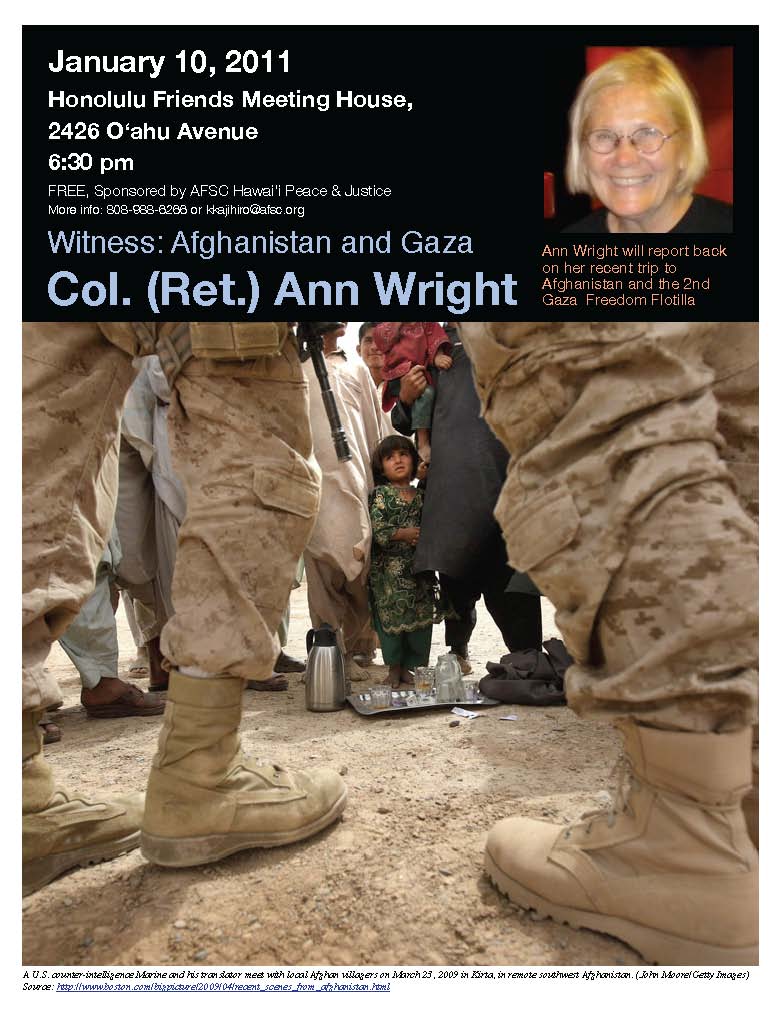
Colonel Ann Wright to speak about recent peace delegations to Afghanistan and Gaza

Download flyer here

Witness: Afghanistan and Gaza

Col. (Ret.) Ann Wright

Ann Wright will report back on her recent trip to Afghanistan and the 2nd Gaza Freedom Flotilla.

Just back from Kabul to Honolulu on December 31st, 2010, Ann will describe the conditions in Afghanistan and the exciting peace activism.  Ann worked with Afghan Youth Peace Volunteers who organized ‘Dear Afghanistan’ a world-wide call-in conversation with Afghan youth. Veterans For Peace President Mike Ferner wrote an article on Common Dreams:

The effort consisted of an entire day of Skyped-in phone calls, emails, Facebook and Twitter posts, with the goals of providing an opportunity for world citizens to learn about Afghanistan first-hand from experts – people trying to live their lives in a war zone; provide moral support for the members of Afghan Youth Peace Volunteers (AYPV); and begin linking conversations among a global, below-the-radar network of veteran peace activists, determined that the war in this country can and must be ended absent military force.

Ann will also speak about the second Gaza Freedom Flotilla.  Last year, Ann was aboard one of the ships in the Gaza Freedom Flotilla that was attacked by Israeli commandos, killing nine people.

January 10, 2011

Honolulu Friends Meeting House,
2426 O‘ahu Avenue

6:30 pm

FREE, Sponsored by AFSC Hawai‘i Peace & Justice
More info: 808-988-6266 or kkajihiro@afsc.org