Soldier suspected of attempted murder of 5 month old girl

From: Honoluluadvertiser.com

Posted on: Thursday, December 18, 2008

Military man, 20, held in attempted-murder probe

Advertiser Staff

A 20-year-old Army man identified yesterday as a suspect in a Honolulu police attempted-murder investigation is being held by the Schofield Barracks provost marshal following his arrest.

The investigation involves critical injuries suffered by a 5-month-old girl on Dec. 8.

The infant’s mother took her to Wahiawa General Hospital, which called police to report “suspicious injuries.”

The child was later transferred to Tripler Army Medical Center.

Federal guard, Army medic die in accident

Federal guard, medic die in Nimitz double fatality

By Leila Fujimori

POSTED: 01:30 a.m. HST, Dec 18, 2008

When Gregg Gurtiza of Salt Lake failed to arrive home late Tuesday night, his parents were not concerned.

Merlin and Karen Gurtiza of Salt Lake thought their youngest of four children had worked a double shift as a guard at the Federal Detention Center, adjacent to the airport.

Karen Gurtiza said she watched the morning news, which carried a report of a horrific accident on Nimitz Highway under the H-1 airport viaduct, where a motorcycle slammed into a car turning left.

She never thought the victim could be Gregg, 35.

But they received a grim call later yesterday morning from the city Medical Examiner’s Office.

The medical examiner said yesterday that Gurtiza died of multiple trauma blunt force injuries in the 12:45 a.m. crash.

Gurtiza, who was driving home after work, was turning left from Nimitz Highway onto Camp Catlin Road when he was hit by a motorcyclist who was traveling west, police said.

Police said the motorcycle came at such speed that it penetrated the passenger side of the black 2008 four-door Nissan sedan, causing it to roll over onto its roof.

The motorcyclist and his 2007 maroon Kawasaki were lodged inside the car, police said. He was also pronounced dead at the scene. They were the 43rd and 44th traffic fatalities for Oahu this year.

The motorcyclist was identified as a medic at Tripler Army Medical Center.

“You would think a guy in that profession — taking care of human life — would value that more than anything else,” said Gurtiza’s father.

He said military members are often involved in traffic accidents in the Nimitz area.

“They’re young, they like to have a good time, but it seems they cause a lot of the accidents and fatalities around here,” said Merlin Gurtiza. “At one time I was young and in the military. You got to weigh the good times and the value of people’s lives.”

Merlin Gurtiza said he could not grasp how a man in a car could be killed by a motorcycle. But he compared it to a bullet traveling at high speed.

Gregg Gurtiza graduated from a high school at Camp Zama on the outskirts of Tokyo and attended Honolulu Community College, where he studied criminal justice. He has been employed at the Federal Detention Center for about six years.

He is also survived by siblings Grant, Guy and Gay Tanap, all of Oahu.

Source: http://www.starbulletin.com/news/hawaiinews/20081218_federal_guard_medic_die_in_nimitz_double_fatality.html

Military backed convicted domestic violence felon

Source:http://www.honoluluadvertiser.com/article/20081218/SPECIALS/812180371/-1/SPECIALS&template=domesticviolence_story

Posted on: Thursday, December 18, 2008

Army backed domestic-violence felon

By Rob Perez
Advertiser Staff Writer

In the Hawai’i Army National Guard, a felony conviction usually is enough to get a citizen soldier kicked out of the military.

But when Guard member Ernie Gomez was convicted of a felony in 2005 for terrorizing his wife with a semiautomatic weapon, his military career was far from derailed.

Free on bail, the convicted domestic-violence felon was able to transfer from the Guard to the Army Reserve, get mobilized to active duty status in New Jersey and start an Army job that required a “secret” security clearance to train war-bound troops.

Gomez even was able to enroll in and complete a military police training course while a felon.

And as the soldier pursued an appeal and pardon of his domestic violence conviction, some of his former and then-current military colleagues, including a lieutenant colonel and captain, urged the Hawai’i courts and Gov. Linda Lingle to keep him out of prison and on the job. They cited his exemplary record of serving his country, his dedication to his family and his lack of a criminal record – except for the domestic violence felony.

“I don’t think I’ve ever seen a command weigh in on behalf of a soldier like this,” said Circuit Judge Michael Town at one court hearing.

Town presided over Gomez’s trial and granted his motions to remain free on bail while he pursued the appeal and pardon.

After the appeal was rejected in December 2007 and Lingle denied the pardon request in August, Town ordered the soldier to begin serving his five-year mandatory minimum prison sentence. Until then, Gomez had been free for more than three years following his conviction. For much of that time, he was working for the Army.

Critics say the Gomez case illustrates the military’s tendency to protect domestic abusers who hold jobs considered important by their supervisors.

“This certainly cements our concerns,” said Annelle Amaral, an advocate for battered women. “It’s extremely disturbing to think the military would defend someone convicted of violent, criminal behavior.”

Gomez could not be reached for comment, and the public defender who handled his appeal did not return calls from the newspaper.

But a Georgia-based Reserve spokeswoman said Gomez should not have been able to join the Reserve with a felony conviction and an investigation is under way to find out how the system allowed that to happen.

“Right now, we’re trying to investigate where it broke down,” said Maj. Claudia Jefferson.

If Gomez had been dishonorably discharged from the Guard because of his conviction, the action would have been flagged in a records check when he signed up for the Reserve and would have prevented him from joining, Jefferson said.

But nothing in his record at the time raised a red flag, she added, and no security background check was done because the one he had from the Guard still was current.

A Guard spokesman confirmed that Gomez transferred from the Guard to the Army Reserve in January 2006. But he said he couldn’t disclose details of Gomez’s case, citing privacy regulations.

A jury in February 2005 found Gomez guilty of using a semiautomatic handgun eight months earlier to terrorize his then-wife at their ‘Ewa Beach home. At the time, their 2-year-old daughter was nearby, screaming and crying. Gomez also was convicted of abuse for striking his wife.

Hawai’i law requires that anyone who uses a semiautomatic during the commission of a felony receive the mandatory five-year minimum term.

The crime happened just days before Gomez was to graduate from his Honolulu Police Department recruit class. He later quit the program.

At the time, Gomez also was a member of the Hawai’i Army National Guard, according to the employment history he provided with his pardon application. On Dec. 8, 2005, the soldier received his mandatory sentence.

More than a month later and almost a year after he was found guilty of terroristic threatening and abuse, Gomez transferred to the Reserve. He was ordered to active duty about a year later, assigned to Fort Dix, N.J., court records show.

Despite his felony record, Gomez was allowed to enroll in a “military police reclassification course” at Fort Polk, La., and in July 2007 he received his diploma, graduating in the top 20 percent of his class.

He also obtained a “secret” clearance required for his job at Fort Dix, Gomez said in a letter to Town. It was not clear from the letter when the clearance was obtained and whether it allowed him to handle sensitive military information.

But Jefferson said Gomez already had the “secret” clearance when he joined the Reserve, having obtained it while he was in the Guard.

As Gomez, then a sergeant first class, pursued his appeal and pardon, friends and colleagues wrote to Town and Lingle on the soldier’s behalf.

“SFC Gomez has been with our organization for the last several months and has been a major part of the success we are having in preparing soldiers for combat,” Lt. Col. William Wall, Reserve commander of Gomez’s New Jersey battalion, wrote in an undated letter to Town. “It would be a tremendous loss to our unit if he had to leave now.”

Wall also was a New Jersey detective and said he understood the seriousness of the domestic abuse charges. “Domestic violence will not be tolerated within my battalion and SFC Gomez will pay his debt to society,” Wall wrote.

The Reserve officer told the court he was willing to have “the entire chain of command” support efforts to keep Gomez on the job “only because SFC Gomez is a fine and outstanding NCO who has been proving his experience to soldiers as they prepare to deploy to theatre.”

Wall did not return phone calls seeking comment.

But even though the letter appears to have been written well after Gomez’s conviction, Wall did not know he had been convicted, Jefferson said.

His supervisor at Fort Dix, however, was well aware of Gomez’s conviction and still urged Lingle to pardon him.

“I can honestly affirm that SFC Gomez is one of the best soldiers and noncommission officers I have ever served with or have commanded,” wrote Capt. Javier Cortez-Perez in an October 2007 letter accompanying Gomez’s pardon application.

Cortez-Perez said he had been Gomez’s supervisor for the past 10 months and “his character and personal commitment to accomplishment of the mission and to the nation (are) unparalleled.”

Also in the pardon packet was a letter from John R. Penebacker, a retired Guard colonel who was Gomez’s commanding officer for about three years. He urged Lingle to grant the pardon.

“I know that for Mr. Gomez, time has provided opportunity for soul-searching, self-reflection and remorse,” Penebacker wrote in October 2007.

In felony cases, military law gives a convict’s commander the discretion on when to start the discharge process, according to Donald G. Rehkopf Jr., a New York attorney and former Air Force lawyer who has specialized in military law for 32 years. If an appeal or pardon were pending, the commander likely held off on starting that process, he said.

Gomez and his wife, Sherly Gomez, eventually divorced, and he has since remarried. Sherly Gomez and his current wife supported his pardon request, according to court documents.

The Gomez case has raised questions similar to those posed by other former spouses of military men who were found to have been abusive.

The system tends to favor the military member, not the victim, and minimizes the violence or threats of harm, several former spouses and their relatives told The Advertiser.

“Do you know how hard it is to get someone kicked out of the military for domestic violence?” asked Joy Lacanienta, who was abused by her Army husband in the late 1990s and early 2000s. “It’s close to impossible.”

Lacanienta said her now ex-husband eventually was discharged after the Army confirmed the abuse, but it took tremendous effort just to get his commanders to take the matter seriously.

Donna LaDuke, whose stepdaughter, Felicia LaDuke, was killed by a Schofield Barracks soldier in 2005, said multiple warning signs were ignored before Felicia’s death. According to testimony at Jeffery White’s murder trial, 24 military members or their spouses had heard him threaten Felicia in the 18 months before she was killed. But no one took White’s threats seriously or reported them to his superiors or the police, LaDuke said.

White eventually was court-martialed for LaDuke’s murder and is serving a life prison term with no possibility of parole.

The Army said it thoroughly investigates all allegations of domestic abuse, noting that such offenses undermine the mission readiness and well-being of soldiers and family members.

“In every instance, substantiated cases of domestic violence are taken seriously and aggressively pursued by the Army, ensuring proper protection and justice for victim and accountability for offender,” spokesman Loran Doane said in an e-mail.

Reach Rob Perez at rperez@honoluluadvertiser.com.

Military Domestic Violence a ‘big-time problem’

http://www.honoluluadvertiser.com/article/20081218/SPECIALS/812180372/-1/SPECIALS&template=domesticviolence_story

Posted on: Thursday, December 18, 2008

Domestic violence in military might be bigger problem than Hawaii statistics suggest
Many see violence against military wives as a ‘big-time problem,’ but official statistics tell different story

By Rob Perez
Advertiser Staff Writer

Sitting at a Windward O’ahu spouse abuse shelter, thousands of miles from her alleged batterer, Kaliegh Cuervo lifted her blouse to reveal a small scar from a bullet wound on her left side.
Advertisement

It serves as a permanent reminder of the brutal attacks she said she suffered on the Mainland after her then-Marine husband returned from a second deployment to Iraq.

The attacks left other lasting effects. Her right eye is permanently damaged. She has false teeth. Doctors told her she no longer can bear children.

After the second Iraq tour, Cuervo said, her husband came back a different person. He had trouble sleeping, was more withdrawn, more prone to violent outbursts. The first evening back, she said, he got night sweats so bad the mattress was soaked to the box-springs and had to be replaced.

“It was pretty scary,” said Cuervo, 36, who changed her name and fled to Hawai’i to get away from her ex-husband. “He wasn’t the man I married.”

Cuervo’s description of how the stresses of war transformed her former spouse sounded remarkably similar to what many other military wives and girlfriends have told Hawai’i court personnel, domestic-violence counselors, victim advocates and others to explain their partners’ violent or emotionally abusive tendencies.

Advocates believe such behavior helps explain why some civilian agencies that deal with returning troops or their spouses have seen a spike in domestic-abuse cases involving veterans of combat in Iraq and Afghanistan.

“It’s a big-time problem,” said William “Clay” Park, a former case manager and veterans specialist with Helping Hands Hawai’i.

Maj. Carlton Nishimura, head of Honolulu Police Department’s criminal investigation division, said his unit saw few military domestic-violence cases before the Iraq and Afghanistan wars.

Now, he and others said, police are seeing them more frequently.

Glenn Komiyama, the Judiciary’s adult client services branch supervisor, likewise said temporary-restraining-order filings involving military members seem to have increased since troops began returning from deployments.

If the rate of military abuse has risen in Hawai’i in recent years, the official statistics hardly reflect that.

The Army and Marines, the two branches that have shouldered the lion’s share of deployments from the Islands, have reported seeing little change in the number of substantiated domestic-abuse cases locally.

The Army total actually dropped from 160 cases in fiscal 2003 to 119 last fiscal year. The Marines recorded 57 administrative cases in fiscal 2006, unchanged from five years earlier.

The Hawai’i Army National Guard, which sent roughly half its 5,500 members to the war zones in 2004 and 2005, reported a similar experience. Before the deployment, the Guard averaged about one domestic-abuse case in the court system per year, according to spokesman Chuck Anthony. After the deployment, he added, the average has remained basically the same. The data include restraining-order cases.

Army spokesman Loran Doane said the decline in substantiated Army cases and the increase in personnel devoted to combating domestic violence and supporting families in Hawai’i indicate the programs are working.

“We’ve succeeded in what we wanted to accomplish,” he said, stressing that the programs will continue adapting to the changing needs of soldiers and their families.

Some outside the military say the numbers fail to capture the true extent of the domestic abuse problem within the services, tending to minimize it.

“I really do think it’s a much bigger problem than what’s being publicly acknowledged,” said Kata Issari, program director for the Family Peace Center, which provides services for Hawai’i offenders and victims.

Nationally, the picture is mixed. One study suggested that the Army’s domestic violence rates overall are no worse than for civilian families. Another noted that one in five veterans of Iraq and Afghanistan reported symptoms of combat stress or major depression, which can contribute to domestic violence. Still other studies have shown increased substance abuse problems – another contributor to domestic violence – among recent combat veterans.

The Miles Foundation, which provides help to battered military wives nationwide and at foreign bases, has seen its caseload skyrocket since the wars started. Before October 2001, it had roughly 50 new cases a month, according to Margaret Bowen, the foundation’s director of research and resources. As of June of this year, it was averaging nearly 170 cases per week.

“We’re seeing a big correlation between deployment and an increase in the number of cases and the severity of violence,” Bowen said.

Part of the problem is that the behaviors that underlie domestic violence – power and control – are closely aligned to the command mindset in the military. Additionally, the combat ethos – warriors take charge and show no emotion – can spell disaster in an intimate relationship if the soldier has trouble readjusting and bottles up his feelings.

“It’s like jamming a cannon,” said Joe Bloom, program director for Catholic Charities Hawai’i’s therapeutic services. “Eventually, it’s going to blow up.”

Most troops typically have no major problems adjusting. But as more members return to Hawai’i from their second, third and fourth deployments, the chances of domestic strain tend to rise, the experts say. Because of that, some agencies are bracing for even more abuse cases.

“I fully expect we’ll see quite a huge jump,” Bloom said.

One area in which military abuse cases tend to frequently surface in the civilian community is in the civil courts, where temporary restraining orders are issued.

Ed Flores, executive director of Ala Kuola, a nonprofit that helps people file TRO petitions, said the vast majority of military cases it handles involve troops recently returned from deployments.

“A lot of these wives will say, ‘He’s not the same person,’ ” Flores said.

Family Court Judge Michael Broderick, who decides restraining order cases three mornings a week, hears that line all the time. Broderick estimated that roughly 20 percent of his TRO cases involve military members.

“What I frequently hear (from the wives and girlfriends) is that he’s different, he’s like a stranger, he acts in ways he never did before,” Broderick said. “The truth is, I hurt for these guys. But I still grant the restraining orders” if the woman’s safety is at risk.

Broderick recalled a recent case in which a soldier acknowledged that he repeatedly hit and threatened to kill his girlfriend. Dressed in his military fatigues, the soldier came to court agitated, pacing in the tiny room.

He told the judge he had been wounded in Iraq and had killed people. Although he admitted abusing his girlfriend, he implored Broderick not to issue the protective order she sought.

“I’m begging you, don’t do this,” the soldier pleaded as his girlfriend cried only a few feet away. “Don’t take away from me the one person I love and the only person who can help me through this crisis.”

In considering whether to issue the order, Broderick said he had to separate the soldier’s pain and war experiences from the woman’s safety. Because the judge believed she clearly was in danger, he issued the protective order. “It was really, really hard,” he said.

In another case, a woman told the court that her military husband threw her to the ground and started choking her. She was able to get away and ran outside, where her husband grabbed her by the hair and started dragging her into the street, according to her restraining order petition. He finally let go and walked to her garage, where he punched holes in the wall.

Those types of cases are not uncommon in the daily stream of restraining-order requests to come before the courts.

Broderick said he has noticed other common themes in military cases, especially among the men returning from Iraq. Jealousy seems to be a frequent factor, with the soldiers telling the judge about suspicious e-mails their partners received or concerns because the partners were going out at night with friends. “In almost none of the cases is there a basis for the suspicion at all,” the judge said.

Broderick said he also is seeing more military men who seem genuinely confused that the judge doesn’t understand why they ended up abusing their partners. “It seems a disproportionate number have recently returned from Iraq.”

The public’s glimpse of the domestic violence problem in the military has come mostly from horrific criminal cases that have generated widespread media coverage.

The case of Hawai’i Army National Guard soldier Tyrone Vesperas, for instance, received national attention last year when he was charged with various murder-related crimes after he allegedly stabbed his 14-year-old son to death. The teen was protecting his pregnant mother during a domestic dispute on the Big Island.

Vesperas and his wife, Cheryl-Lyn Vesperas, had separated shortly after he returned from a tour in Iraq. During the argument, the wife also was stabbed repeatedly in the abdomen, police said. The unborn child did not survive.

Cuervo said her case got local media coverage partly because of the severity of the abuse. Her ex-husband is facing prosecution on a variety of charges, including domestic battery and kidnapping, she said.

Cuervo told her story from the Windward shelter in October on the condition that her former husband not be named. Because she has changed her identity, including her Social Security number, with the help of the federal government, she did not want her new name linked to her old one. She has since left the shelter.

Cuervo, who often broke into tears as she recounted what happened, said her husband was diagnosed with post-traumatic stress disorder after his second tour in Iraq. After he became particularly violent one night, Cuervo said she went to an emergency shelter, and four other women whose husbands were in the same Marine unit already were there, seeking refuge from their abusers.

Cuervo said she was hospitalized for several months after one beating, has had eight surgeries since then and considers herself lucky to be alive. “Every day of my life is a blessing,” she said. “When I look in the mirror now, I see hope.”

To counter the domestic violence problem, the military provides extensive training to its troops before, during and after deployments. Families also are offered classes to help them understand and cope with the lengthy deployments.

Once home, the soldiers go through more extensive sessions covering a range of topics, from substance abuse to suicide awareness. And because readjustment difficulties may not surface immediately, similar sessions are provided at several subsequent intervals, such as 90 and 180 days later for the Marines.

“These symptoms don’t manifest themselves immediately upon return,” said Marine Capt. Seth Gibson.

Since the deployments started, the Army in Hawai’i has added to its community service staff to offer expanded programs to soldiers and their dependents.

Workers, for instance, conduct life-skill classes and other family-friendly services. New parents can get home visits from family consultants and can join group sessions for specialized help.

Consultants provide problem-solving counseling and other assistance to help families cope with deployment stresses.

“Without a doubt, the Army definitely has stepped up to the plate to increase service delivery and support for soldiers and family members across the board,” said Cole Weeks, Family Advocacy Program manager for Army Community Service at Schofield Barracks.

The military also provides two options for victims to report abuse. One enables the victim to get medical, counseling and other treatment while law enforcement authorities pursue an investigation. That option could result in prosecution of the alleged abuser, with potential ramifications on his military career. The other option allows the victim to get treatment without requiring notification of the alleged abuser’s command and law enforcement.

“We do treat this issue very seriously and have a plethora of programs,” said Marine spokesman Maj. Alan Crouch.

With the Hawai’i Guard expecting more marital problems and divorces in the wake of a current deployment, the second for the group, it is planning to hire more workers to track cases and provide additional support services.

Among the services will be a mobile team with family specialists who can go to people’s homes.

Park, the former Helping Hands veterans specialist, said the military is trying to cope with the domestic violence problem, but not nearly enough is being done. Tracking of the problem is insufficient and more counseling and other intervention programs are needed, Park said.

He said he has spoken to many combat veterans who are struggling to cope with the after-effects of the war and whose marriages have ended or are under tremendous stress.

“The system is failing the guys and their spouses,” Park said.

Reach Rob Perez at rperez@honoluluadvertiser.com.

DNA links soldier to unsolved sex assault

Schofield soldier Mark Heath was arrested in 2007 for allegedly breaking into a UH dorm and stealing an iPod and panties from a female student.   Investigators suspected him of committing an earlier rape.  See the Star Bulletin story from 2007: http://starbulletin.com/2007/11/28/news/story05.html Now the DNA confirms he was the rapist.  Here’s the story from the Honolulu Star Bulletin:

Find this article at:
http://www.starbulletin.com/news/hawaiinews/20081218_case_grows_against_sex_assailant.html

Case grows against sex assailant

DNA links Mark Heath to an unsolved crime that occurred in 2007

By Gene Park

POSTED: 01:30 a.m. HST, Dec 18, 2008

A man who has already pleaded guilty to burglary and sexual assault at the University of Hawaii at Manoa pleaded no contest yesterday to another sexual assault case.

After Mark Heath, 21, pleaded guilty on April 30 to breaking into University of Hawaii dormitories and taking underwear and other objects, his DNA sample was taken.

That DNA was linked to an unsolved 2007 sexual assault case. Heath has been in custody on a $1 million bail.

Deputy Prosecutor Thalia Murphy said she hopes to get a maximum of 60 years total for Heath’s crimes, including the university incidents.

“He’s a predator and he’s indiscriminate,” Murphy said. “This defendant knows no bounds. And yet if you were to look at him, he looks like someone you’d want your daughter to marry.”

In April 2007, Heath followed a woman unknown to him to her Ala Wai Boulevard apartment. The woman shut the door on him and went to sleep.

She awoke to find Heath raping her, chased him out but could not catch up to him.

Heath’s DNA was linked to that case. Yesterday he pleaded no contest to first-degree burglary and second-degree sexual assault.

On Aug. 19, 2007, Heath tried to cut off the panties of a female student at the Hale Mokihana dormitory on the Manoa campus. He also was accused of stealing women’s underwear and an iPod in November 2007.

Heath’s sentencing is scheduled for March 4.

Case grows against sex assailant

Case grows against sex assailant

DNA links Mark Heath to an unsolved crime that occurred in 2007

By Gene Park

POSTED: 01:30 a.m. HST, Dec 18, 2008

A man who has already pleaded guilty to burglary and sexual assault at the University of Hawaii at Manoa pleaded no contest yesterday to another sexual assault case.

After Mark Heath, 21, pleaded guilty on April 30 to breaking into University of Hawaii dormitories and taking underwear and other objects, his DNA sample was taken.

That DNA was linked to an unsolved 2007 sexual assault case. Heath has been in custody on a $1 million bail.

Deputy Prosecutor Thalia Murphy said she hopes to get a maximum of 60 years total for Heath’s crimes, including the university incidents.

“He’s a predator and he’s indiscriminate,” Murphy said. “This defendant knows no bounds. And yet if you were to look at him, he looks like someone you’d want your daughter to marry.”

In April 2007, Heath followed a woman unknown to him to her Ala Wai Boulevard apartment. The woman shut the door on him and went to sleep.

She awoke to find Heath raping her, chased him out but could not catch up to him.

Heath’s DNA was linked to that case. Yesterday he pleaded no contest to first-degree burglary and second-degree sexual assault.

On Aug. 19, 2007, Heath tried to cut off the panties of a female student at the Hale Mokihana dormitory on the Manoa campus. He also was accused of stealing women’s underwear and an iPod in November 2007.

Heath’s sentencing is scheduled for March 4.

A man who has already pleaded guilty to burglary and sexual assault at the University of Hawaii at Manoa pleaded no contest yesterday to another sexual assault case.
Click Here For More Info!

After Mark Heath, 21, pleaded guilty on April 30 to breaking into University of Hawaii dormitories and taking underwear and other objects, his DNA sample was taken.

That DNA was linked to an unsolved 2007 sexual assault case. Heath has been in custody on a $1 million bail.

Deputy Prosecutor Thalia Murphy said she hopes to get a maximum of 60 years total for Heath’s crimes, including the university incidents.

“He’s a predator and he’s indiscriminate,” Murphy said. “This defendant knows no bounds. And yet if you were to look at him, he looks like someone you’d want your daughter to marry.”

In April 2007, Heath followed a woman unknown to him to her Ala Wai Boulevard apartment. The woman shut the door on him and went to sleep.

She awoke to find Heath raping her, chased him out but could not catch up to him.

Heath’s DNA was linked to that case. Yesterday he pleaded no contest to first-degree burglary and second-degree sexual assault.

On Aug. 19, 2007, Heath tried to cut off the panties of a female student at the Hale Mokihana dormitory on the Manoa campus. He also was accused of stealing women’s underwear and an iPod in November 2007.

Heath’s sentencing is scheduled for March 4.

Source: http://www.starbulletin.com/news/hawaiinews/20081218_case_grows_against_sex_assailant.html

Two killed in collision near airport

Honoluluadvertiser.com

December 17, 2008

Two killed in collision near Honolulu Airport

Advertiser Staff

Two men were killed early today when a speeding motorcycle broadsided a car near Honolulu International Airport, according to police vehicular homicide investigators.

The horrific impact of the 12:45 a.m. collision at the intersection of Kamehameha Highway and Camp Catlin Road left a 2007 Kawasaki motorcycle so deeply embedded in a 2008 Nissan Altima that only the cycle’s rear wheel was visible.

The Honolulu Medical Examiner’s office identified one of the victims as Gregg Gurtiza, 35, the car’s driver.

The name of the motorcycle operator, a 24-year-old man, was not released pending notification of family. Both men were pronounced dead at the scene at 1:19 a.m., according to Bryan Cheplic of the Honolulu Emergency Services Department.

Police said the motorcycle was speeding westbound on Kamehameha Highway when it struck the car, which had made a left turn headed toward Camp Catlin Road from Nimitz Highway. The impact caused the car to overturn, police said.

Today’s deaths are O‘ahu’s 43rd and 44th traffic fatalities of 2008 compared to 64 by this day last year.

Additional Facts

statewide fatality breakdown
As of today, 104 people have died in traffic accidents this year in Hawai‘i as compared to 127 by this date in 2007.

The updated 2008 island-by-island breakdown as compiled by The Advertiser:

O‘AHU (44) – Vehicle (20 deaths/19 collisions), pedestrian (13), motorcycle (6), moped (3), bicycle (2). Last fatal: Dec17. This month: 2. Last month: 1.
BIG ISLAND (27) – Vehicle (16), motorcycle (8), pedestrian (3). Last fatal: Dec. 13. This month: 2. Last month: 3.
MAUI (22) – Vehicle (13 deaths/12 collisions, includes two on Moloka‘i), motorcycle (7), pedestrian (2). Last fatal: Dec. 10. This month: 1. Last month: 4.
KAUA‘I (11) – Vehicle (10 deaths/8 collisions), pedestrian (1). Last fatal: Oct. 29. This month: 0. Last month: 0.

Soldier on motorcycle crashes into car, 2 dead

Motorcycle and Car Flip, 2 Killed

Written by Tim Sakahara – tsakahara@kgmb9.com

December 17, 2008 05:06 PM

The crash happened at 12:45 Wednesday morning.

One man involved lived in Salt Lake. The other is a soldier from Florida.

It’s one of the worst crashes police have seen in a while. The Nissan Altima was town bound on Nimitz Highway turning left onto Camp Catlin Road. The motorcycle was Ewa bound on Nimitz. That’s when the vehicles met.

Officers say the motorcycle was going so fast and the impact was so hard that the motorcycle went into the Nissan causing it to flip over.

“It indicates an incredibly excessive amount of speed,” said Lt. Darren Izumo, Honolulu Police Department.

Gregg Gurtiza was driving the Nissan. He worked at the Federal Detention Center near the Honolulu International Airport. His brother said he usually got off work at 10 p.m. but may have had to work later. He believes he was on his way home. The 35 year old was the youngest of four kids.

“He’s the baby brother, just your typical local boy growing up here, into the same type of thing any other kid or adult is into, cars, ultimate fighting that kind of stuff. He’s going to be very missed. It’s the holidays, I’m going to have to return my Christmas present to him so it’s just going to hit us,” said Grant Gurtiza, victim’s brother.

Hours after the crash an army buddy of the man on the motorcycle planted some flowers at the crash scene. He says he was an army medic and had served in Afghanistan. He was single and from Florida. His name is being withheld until his family is notified.

Police are not sure if drugs or alcohol played a factor.

Last Updated ( December 17, 2008 08:13 PM )

Remembering the Massie Case

Someone posted this op ed about the Massie incident from a few years ago on a listserve.  It’s a sobering reminder of the oppressive conditions Hawai’i endured under US occupation.

>><<

Posted on: Sunday, October 14, 2001

Focus

The Massie case: Injustice and courage

By David Stannard

Seventy years ago last month, in the pre-dawn hours of a Sunday morning, two Honolulu police officers awakened a young man named Horace Ida at his home in Kalihi-Palama. Ida dressed hurriedly and went with the detectives, thinking he knew what they were after.
op03a12

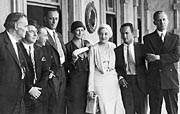
The four defendants and their supporters were at ‘Iolani Palace shortly after being found guilty of manslaughter and sentenced to serve a one-hour “prison term” in 1932. From left: Clarence Darrow, chief defense counsel; defendants E.J. Lord and A.O. Jones; Maj. Gordon Ross, high sheriff; Grace Fortescue, mother of Thalia Massie and niece of inventor Alexander Graham Bell; Thalia and Lt. Thomas Massie; and George Leisure, defense counsel.  Advertiser library photo • May 4, 1932

Two hours earlier, while driving his sister’s car, Ida had a near collision with another auto at the corner of King and Liliha streets. An argument broke out and one of the men riding with Ida got in a brief scuffle with a woman in the other car. Ida assumed the woman remembered his license plate number and decided to file charges.

But soon after arriving at police headquarters Henry Ida found himself under arrest for a far more serious crime. The 20- year-old wife of a Pearl Harbor Navy officer identified him as one of five local men who allegedly had kidnapped, beaten, and repeatedly raped her earlier that evening after she had left a Waikiki nightclub alone.

The woman’s name was Thalia Massie, the daughter of a wealthy and politically powerful Washington, D.C., couple. And for the better part of the next year Honolulu was swept up in an unprecedented frenzy of accusations, threats, and violence.

“The Massie case” remains the most notorious criminal incident in the modern history of Hawai’i. Associated Press editors in 1932 voted it, along with the Lindbergh baby kidnapping, the biggest criminal case in the country. Books and articles have been written about it, and at least one Hollywood film was based – very loosely – on it. But by now many people have forgotten what actually happened, and many more have never heard of the case.

The story deserves retelling because it remains powerfully relevant today. Not only because of the tragedy and racial injustice associated with the case but also because of its less-heralded lessons in straightforward moral courage.

Controlling the story

All the men accused of raping Thalia Massie were from impoverished or working class backgrounds. Two were Hawaiian, two were Japanese, and one was Chinese-Hawaiian. From the start, based on little or no evidence, local newspapers assumed the men were guilty and referred to them in print as “thugs,” “degenerates,” and “fiends.” Their alleged victim was described as “a white woman of refinement and culture.”

Although the Honolulu press would be filled for months with racially inflammatory articles and editorials on the case, few in the business, political, or military communities wanted the story to spread beyond the Islands. During the preceding decade tourism had begun to take off, Hawai’i’s semi-autonomous political status remained precarious, and the Navy commandant at Pearl Harbor was not eager for Washington to question his ability to maintain order. A blanket was thrown over news of the events, and at first the story was confined almost entirely to local newspaper accounts.

At the same time, authorities pressed for an aggressive prosecution to placate an enraged Navy and local haole community. Few expected anything but a quick conviction and lengthy prison sentences for the five men.
ahakuelo1

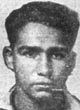
Benny Ahakuelo was accused of taking part in a gang rape.
chang1

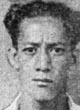
Henry Chang was defamed as part of a gang of young bucks.
ida1

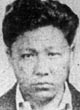
Horace Ida was beaten over a crime he didn’t commit.
kahahawai1

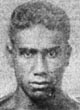
Joe Kahahawai was killed after a rape trial ended in hung jury.
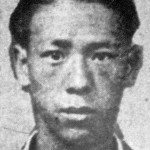
takai2

David Takai, like others accused, stuck to his word.

Advertiser library photo

Vicious, racist violence

But after a three-week trial and the longest jury deliberation ever in Hawai’i, the jurors declared themselves deadlocked. A mistrial was declared. Before a decision could be made about retrying the five men, however, Thalia Massie’s supporters and family took matters into their own hands.

First, Horace Ida was seized on a Honolulu street by a carload of sailors and was beaten, clubbed, and whipped with leather belts. Then, with the aid of two Navy enlisted men, Thalia’s husband and mother kidnapped and murdered one of the other defendants, Joseph Kahahawai. Police captured the killers with Kahahawai’s naked corpse, wrapped in a bloody sheet, lying on the back seat of their car as they were driving toward Koko Head to dispose of it.

At this point the story could be contained no longer. As the story erupted in the United States, the president called a special Cabinet meeting at the White House. Congress held emergency weekend hearings. The Justice Department and the FBI sent a team of investigators to Hawai’i. Every major American newspaper ran front-page stories on the case.

Sympathy for white woman

Almost without exception, the expressed sympathy of America’s politicians and journalists was not for the murdered young man, but for his killers. From coast to coast newspapers, magazines, and radio commentators described Hawai’i as – in the words of a syndicated Hearst editorial – a place where “the roads go through jungles, and in those remote places bands of degenerate natives lie in wait for white women driving by.”

Not to be outdone, Time magazine blamed the killing of Joseph Kahahawai on the victim and his friends, describing them as “five brown-skinned young bucks” who demonstrated the well-known “lust of mixed breeds for white women” when they raped Thalia Massie in the first place. The fact that the men had not been convicted of the alleged crime by a local jury only proved to the American press that Hawai’i itself was a “cesspool” of anti-white racial hatred that did not deserve territorial status.

Accordingly, the New York Post called for a battleship to sail into Honolulu harbor and rescue the killers from the civil authorities who had them under arrest. And everywhere the cry went up for the United States to impose martial law in the Islands.

Darrow defends killers

Into this furor, then, stepped Clarence Darrow, the most famous criminal lawyer in American history. Much of Darrow’s celebrity was based on his spectacular courtroom defenses of the oppressed and downtrodden.

But now, at age 74, he was broke, financially ruined by the Depression. So, for the equivalent of about $400,000 today, he agreed to defend four white people charged with killing a young Hawaiian man – a murder that even Darrow later admitted they were guilty of committing.

To a large extent Darrow’s strategy was the same one used by defenders of lynching in the South. Asserting flatly that Kahahawai had indeed participated in a gang rape of Thalia Massie – something that Honolulu prosecutors had been unable to prove – Darrow took the position that the murder was a justified “honor killing.” As such, he contended, customary “unwritten law” demanded that the accused should go free.

Facing Darrow across the courtroom was Honolulu’s newly appointed prosecutor, John Kelley. From the first day of jury selection until their final summations Darrow and Kelley went to war with one another.

Years later the New York Times, which ran nearly 200 stories on the case while it was in progress, would recall it as one of Darrow’s three most compelling trials ever. The others were the Scopes “Monkey Trial” over the teaching of evolution in Tennessee and the Leopold and Loeb murder trial in Chicago. But neither of the other two, the Times said, contained a moment of high drama to compare with Thalia Massie – under cross-examination by prosecutor Kelley – tearing a piece of evidence to shreds on the witness stand and rushing across the courtroom in tears to the waiting arms of her husband and the applause of a standing-room-only crowd of spectators.

Getting away with a lie

A packed courtroom
courtroom1

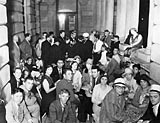
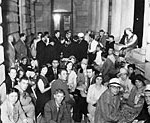
Hundreds of Hawai’i residents and others tried to gain access to the courtroom during the Massie trial but were turned away. Advertiser library photo • 1932

Reporters from throughout the world were in Honolulu for the trial, and a special radio hookup was installed so that Darrow’s closing argument could be carried live on the American continent.

Few juries have ever been under as much pressure as this one. On the one hand, there was no doubt that the four accused defendants had killed Joseph Kahahawai. On the other hand, there was equally little doubt that a conviction would bring, at the very least, what was called a “commission” form of government to Hawai’i, an arrangement only one step short of martial law. Congress and the American press had openly warned of such a consequence, and even prosecutor Kelley – while appealing to the jury for a verdict of guilty – admitted that a fair and honorable decision by them could mean the end of civilian rule in the Islands.

In addition, many of the jurors were employed by companies controlled by the corporate oligarchy that then dominated business in Hawai’i or they worked for firms with close connections to the Navy. Thus, their livelihoods and the economic well being of their families were at stake, in addition to the threatened political status of the place that was their home.

Surprising many who expected another hung jury, the panel reached a verdict. The defendants were found guilty of manslaughter. It wasn’t murder, but it was a conviction carrying a mandatory sentence of 10 years imprisonment.

Predictably, the national uproar grew louder. The thought that three white U.S. Navy men and a middle-aged Washington socialite might spend time in the Territorial prison – even if they had kidnapped and murdered a young Hawaiian man – seemed unthinkable.

And, as things turned out, it was. Despite the verdict, the killers would never spend a day in prison. After a flurry of diplomatic maneuvering between Washington and Honolulu, Territorial Governor Lawrence Judd commuted the sentences of the convicted killers to one hour, to be served in his office. In return, Hawai’i was spared martial law until the outbreak of World War II.

Within days of the commutation the Massies, Thalia’s mother, the convicted Navy men, and Clarence Darrow boarded a ship and left Hawai’i forever. Months later, an independent investigation by Mainland detectives, funded by the Territory, demonstrated beyond doubt that the accused men could not possibly have committed the alleged rape. Indeed, compelling evidence suggested that the supposed crime had never even occurred.

Cult of the killers

A multi-ethnic jury
jury1

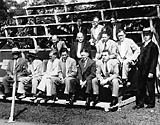
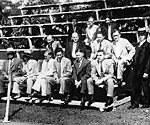
Jury members in Joseph Kahahawai’s murder trial broke from deliberations at one point to attend a baseball game. The jury refused to accept the racism embedded in the arguments presented by the defense. Advertiser library photo • 1932

The first historical assessments of the Massie case were not written until the mid-1960s.

Although not without sympathy for the accused, most accounts then and since have focused with tabloid-like fascination on those characters in the drama who behaved most contemptibly.

They include Thalia Massie, who falsely charged the five men in the first place; Thalia’s husband and mother, and the Navy enlisted men who helped the other two murder an innocent man; Navy Adm. Yates Stirling, who fabricated lies about conditions in Hawai’i in an effort to advance his own career; and Clarence Darrow, who borrowed a tactic from the Ku Klux Klan to defend his clients.

Heroism left out of story

In contrast, little attention has been paid to those who behaved well under extraordinarily difficult circumstances. And yet it is with them – a true racial and ethnic cross-section of Hawai’i then and now – that the valuable lessons of the Massie case reside.

First there are the accused men themselves. Horace Ida, Joseph Kahahawai, Henry Chang, David Takai, and Benjamin Ahakuelo. One of them was nearly beaten to death. Another was kidnapped, then shot and killed with a single bullet to his heart. All of them endured months of vicious defamation in the press and the threat of lengthy imprisonment for a crime they did not commit. And police and prosecutors tried all the usual tactics – including individual offers of immunity if one would inform on the others – and some that were not so usual, such as pitting the men against one another racially. Despite the threats and enticements, none of them ever budged from their insistence that they had done nothing wrong.

Then there were the lawyers who stepped forward in the first trial to defend the accused men without compensation. William Heen, of Chinese-Hawaiian ancestry, perhaps the best attorney in the Islands and the first non-haole Circuit Court judge in the Territory. A young local Japanese lawyer, Robert Murakami, recently graduated from the University of Chicago Law School. And a prominent haole originally from Mississippi, William Pittman.

Not only did they put their careers on the line, defending five almost penniless young men amid racial and political near-hysteria, but they did so by publicly exposing that turmoil for what it was. And none did so more effectively than Pittman, in a Southern drawl, summing up his defense by accusing the prosecution of bending to the will of “a conspiracy of white people – the small group of hypocritical haoles more anxious to satisfy the Navy than to seek justice.”

After the murder of Joseph Kahahawai the grand jury at first refused to indict the killers, despite the fact that they had been caught with the dead man’s body in the back seat of their car. Of the grand jury’s 21 members 19 were white. And, as one of them openly said, they were fearful of what would happen to their “standing in the community” if they voted to indict four well-connected white people for the murder of a poor Hawaiian. But the judge, Albert Cristy, who also was white, risked disqualification from the case and possibly his entire judicial future by repeatedly demanding an indictment from the grand jurors – and finally getting it.

Methods of murder
evidence1
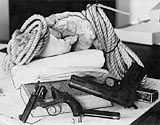
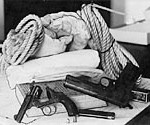
Evidence presented by authorities showed that Joseph Kahahawai had been kidnapped, shot to death, and wrapped in a bloody sheet. Advertiser library photo • 1932
Then there was Jack Kelley. Originally from Montana and a former law partner of William Heen, Kelley was trying his first case as a prosecutor when he went up against Clarence Darrow. Not intimidated by the immense political pressure he was under or by the legendary reputation of his opposing counsel, he matched Darrow point for point. Describing Darrow’s defense as advocacy of the “serpent of lynch law,” he warned the jury that nothing could be worse than allowing that to become the law of the land.

The jury was made up of three haole-Hawaiians, two local Chinese, one Portuguese, and six whites. After two days of deliberation – and fully aware of the ominous larger consequences – they brought in their unanimous verdict of guilty.

Darrow was outraged. Of the non-white jurors, he complained that during the trial “it was not easy to guess what they were thinking about, if anything at all.” Adding that “obviously they do not think as we do,” he concluded that “a jury of white men would have acquitted.” With this last comment Darrow conveniently forgot that a single negative vote from among the jury’s half-dozen haole members would have blocked the convictions.

Together with the first jury that had deadlocked in the rape trial, 24 jurors had heard both cases in an intensely politicized and menacing environment. Among them were seven whites, nine haole-Hawaiians, four Chinese, two Portuguese, and two Japanese. None had anything personal to gain – and a great deal to lose – by facing down the local and national white power structure and voting their consciences. They did it anyway.

There were others. Princess Abigail Kawananakoa, Hawai’i’s conservative Republican National committeewoman and a wealthy heiress to the Hawaiian monarchy, received a telephone call one night at her elegant home. It was from someone she had never met, a poor Hawaiian woman whose son had been arrested for a crime she said he didn’t commit. After speaking to Joseph Kahahawai’s mother for a while, the Princess hung up and called William Heen, urging him to take the case. She followed the subsequent events closely, speaking out publicly against what she called the “travesty” of a two-tiered justice system in the Islands, “one for the favored few and another for the people in general.”

At a very different place on the Islands’ social scale, George Wright was the haole editor of the English-language section of the Japanese newspaper Hawaii Hochi. Wright had been a civilian machinist at Pearl Harbor before being fired for union activities. Along with his boss, Hochi publisher and editor Frederick Makino, of haole and Japanese parentage, Wright maintained a lonely editorial drumbeat of criticism throughout the entire Massie affair – pointing out crippling flaws in the charges against the five men from the very beginning and never wavering from a demand for justice in the face of an avalanche of racial prejudice.

Need to remember

Just as it is essential that we continue to remember those who stood up to the likes of Joseph McCarthy in the 1950s, so it is important that we honor those who publicly opposed the forces of racism and oppression during the Massie case.

It took character and courage to speak out against the racial and political injustices that permeated life in Hawai’i at that time, at a time when a former Advertiser assistant editor recalled how American naval officers commonly referred to Hawaiians as “niggers.”

The example should cause all of us to consider what we would have done under those circumstances – and to reflect on what we are doing now, as more subtle forms of oppression tear at Hawai’i’s social fabric. What will people think, 70 years from now, as they look back on how we treat the poorest and the weakest and most damaged among us? How we behave now will be our most enduring legacy.

David Stannard is a professor of American Studies at the University of Hawai’i. He is writing a book on the Massie case that focuses on the involvement of local people in that struggle for justice. He would like to hear from anyone with personal memories or family stories or photographs about the events of that time. You can call him at 235-4924, e-mail him at stannard@hawaii.rr.com, or write to him at the Department of American Studiesm, University of Hawai’i, Honolulu, HI 96822.

Unexploded Ordnance removed from Kaua’i yard

Ordnance is removed from yard

HANAMAULU, Kauai » An old, unexploded piece of ordnance sat in a front yard for decades before an elderly woman turned it over to police last week, Kauai officials said.

On Dec. 8, Kauai police received a call for assistance Monday from a woman who wanted to remove a large artillery shell from her home, police said yesterday.

According to the woman, the shell, with its primer and warhead still intact, was found by a family member 20 or 25 years ago at the Marine Camp in Nukolii and had been sitting in her front yard since then, officials said.

The M-79 armor piercing round, almost 3 feet high, was removed by police and kept securely until yesterday, when the Army 706 Explosive Unit detonated the shell at the KPD Firing Range, county officials added.

Source: http://www.starbulletin.com/news/20081213_Police__Fire.html