APEC Conference will intensify militarization of Honolulu

Public officials are already hyping the APEC conference and potential protests to justify the intensification of security measures in Honolulu.  When the Asian Development Bank held its meeting in Honolulu, the city police were militarized with new equipment and training.   There were approximately 1000 protesters including international delegations.

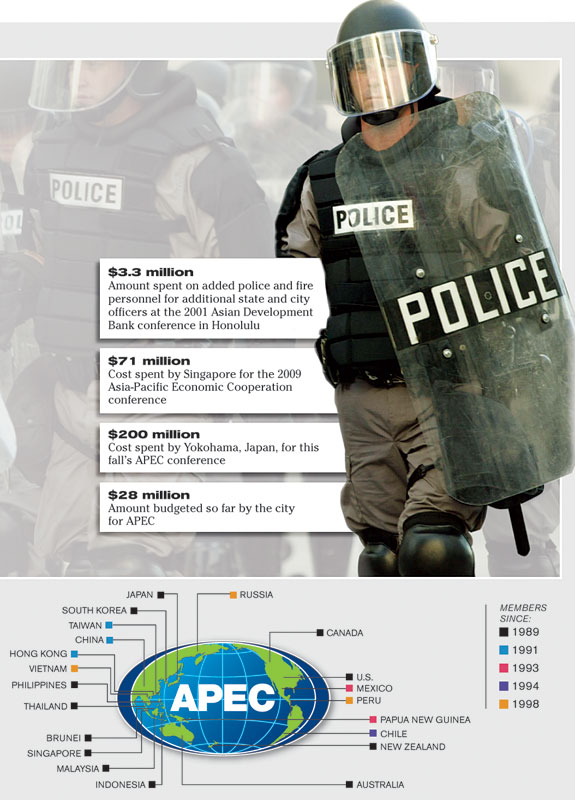
APEC is a more high profile event with heads of state including President Obama.  This will mean crazy militarization of the streets in Honolulu, and a big price tag.

The Honolulu Star Advertiser reports:

Janet Napolitano, secretary of homeland security, is expected soon to designate the 2011 APEC conference a National Special Security Event, or NSSE, making Hawaii eligible to tap federal resources, including cash and law enforcement personnel.

The designation is typically given to U.S. events attended by a large number of dignitaries and which hold “national significance,” thus requiring larger-scale security coordination. Previous NSSEs have included national political conventions, Super Bowls and the Academy Awards.

apec graphic

Graphic from the Honolulu Star Advertiser

Strykers: Following public outcry, OHA calls on Army to honor 2008 agreement

The Hawaii Independent published another piece on the Army’s failure to conduct cultural surveys for the areas affected by its Stryker brigade expansion and the follow up action by the Office of Hawaiian Affairs calling on the Army to honor terms of a 2008 settlement agreement. The Hawaii Independent reports: “According to the settlement, OHA does have the option, if the two parties cannot come to a consensus on the identification of historic properties eligible for the Register, of seeking an injunction to halt construction should attempts at mediation prove unsuccessful.”

>><<

http://thehawaiiindependent.com/story/stryker-update/

Strykers: Following public outcry, OHA calls on Army to honor 2008 agreement

Aug 08, 2010 – 02:06 PM | by Samson Kaala Reiny

HONOLULU—Amid public outcry, the Office of Hawaiian Affairs (OHA) has requested that the U.S. Army honors a 2008 agreement that helps identify and protect cultural sites.

A week after OHA officials met face-to-face with concerned members of the Hawaiian community over a damning archaeological report the organization sat on for almost a year, a letter was sent to the Army on Friday, August 6, requesting that the military “promptly evaluate the historic properties” discovered.

READ MORE

Download OHA’s letter to Army Garrison_8-6-10

Download the 2008 settlement agreement between OHA and the Army.

Christopher Monahan’s full report on the Stryker vehicles and cultural sites can be viewed at http://www.scribd.com/doc/48829377/09-Monahan-Report.

Ann Wright to speak about the Gaza Freedom Flotilla and Israel’s murder of activists

Sunday, August 15 at 3pm

Talk by Ann Wright

On the Gaza Freedom Flotilla

and Israel’s Murder of Activists Aboard the Mavi Marmara

On May 31st Israeli military forces stormed the Mavi Marmara, one of six ships carrying humanitarian relief to Gaza. At least nine activists were murdered and many others were seriously injured. Ann had been on the Mavi Marmara, and was on the ship next to the Mavi Marmara when it was attacked. The ship she was on was also boarded and Ann, along with all of the other activists were kidnapped, taken to Israel, and imprisoned for several days before being deported. The humanitarian supplies aboard the ship were taken to Israel, and personal possessions (including cameras and computers) were confiscated. They were subsequently deported.

While the attack on the Gaza Freedom Flotilla and the massacre on board the Mavi Marmara was covered extensively in the media when it happened, much of the “news” was actually disinformation disseminated by Israel (and then mainstream newspapers in the US and around the world). However, the attack further isolated Israel and the U.S. is representing that Israel’s blockade of Gaza has fundamentally changed.

We know everyone has a lot of questions about the flotilla, what actually happened onboard the Mavi Marmara, and subsequent events. This is your chance to get a first-hand account, raise your questions, and get into discussion.

Those of you who have heard Ann before know that she’ll tell the story straight and will welcome your questions.

Ann’s talk will be followed by a substantial time for questions and discussion, and then an informal time for socializing and refreshments.

Revolution Books

2626 South King Street

Tel: 944-3106

www.revolutionbookshonolulu.org

Free parking in front of the store.

Another rape in Okinawa: U.S. Marine arrested

http://www.bloomberg.com/news/2010-08-04/japan-police-arrest-u-s-marine-for-sexual-assault-in-okinawa-kyodo-says.html

August 4, 2010

Japanese Police Arrest U.S. Marine Suspected Of Sexual Assault In Okinawa

By Yumi Otagaki, Bloomberg News

Japanese police arrested a U.S. Marine for the alleged sexual assault of a woman on the island of Okinawa, where similar incidents in the past have led to protests against the American military presence.

Marine Sergeant Phillip Edward Sawyerr, 28, was taken into custody in the capital of Naha early this morning on suspicion of breaking into the house of a woman in her 20s and sexually assaulting her, police spokesman Motoki Haneji said by phone. The U.S. serviceman has denied the charges, Haneji said, adding that American authorities in Japan had been notified.

READ MORE

Targeting Children: U.S. uses comics to promote U.S.-Japan military alliance

The U.S. is using manga, a Japanese comic book form to promote its tattered military alliance with Japan.  Psyops targeting children?

And the racial and sexual politics of the characters are just a little creepy.  The blond blue-eyed boy “Usa-kun” protects the house of the girl “Arai Anzu”. When asked why he says “Because we have an alliance…We are ‘Important Friends’.”

Meanwhile, a U.S. marine was arrested as the suspect in another rape of a woman in Okinawa.   I guess ‘Important Friends’ expect special privileges from the ones they protect.

>><<

3 August 2010 Last updated at 05:36 ET

Manga to promote US-Japan military alliance

Front cover of the first of the four manga comics
The manga is the first of four explaining the half-century alliance

The US military is to use manga-style comics to teach Japanese children about the two countries’ security alliance.

Four comics featuring a Japanese girl and a visiting US boy will be posted online, each exploring how US and Japanese troops work together.

In it the young girl, Arai Anzu – which sounds like alliance when pronounced by a Japanese person – asks the boy, Usa-kun – a play on USA – why he is protecting her house.

“Because we have an alliance,” he says. “We are ‘Important Friends’.”

“It’s good to have a friend you can rely on to go with you,” the little girl concludes.

READ THE FULL ARTICLE

OHA ‘drops the ball’ in protecting cultural sites from Stryker brigade

The Hawaii Independent has published an exclusive article about a formerly secret archaeological and cultural report contracted jointly by the Army and the Office of Hawaiian Affairs (OHA) for areas affected by the Army’s Stryker Brigade expansion. The article states:

The report, written by independently contracted archaeologist Christopher Monahan, comments on the Army’s numerous shortcomings in its attempts at documenting cultural sites, which, if included on the National Register of Historic Places, offers them various protections from being disturbed.

The report was the end result of a lawsuit OHA filed against the Army in November 2006 alleging violations against the NHPA and the Native American Graves Protection and Repatriation Act (NAGPRA). Cultural monitors claimed that numerous sites were being mistreated or were endangered, including Haleauau heiau near Schofield Barracks, whose protective buffers were razed by bulldozers in July of that year.

In October 2008, a settlement was reached where OHA would drop its lawsuit based on its then knowledge of the existing surveys and reports. In return, the Army allowed the independently contracted archaeologist, Monahan, as well as OHA staff, access to Stryker Brigade sites for a total of 50 days in order to draw up an objective second opinion. OHA had the option then to proceed with mediation or litigation based on the new findings.

The article describes some of the findings and conclusions in the archaeologist’s report:

Monahan is critical of the methods used in the previous surveys conducted by the military and its hired firms, recognizing there are issues with the competency of the field personnel involved. It also notes a general lack of subsurface testing, or excavating, to locate such sites. Instead, there are “mere guesses … and based on relatively little scientific data.”

At some locations, Monahan’s findings more than doubled the number of known features the Army had previously reported.

There is also concern regarding numerous earlier reports—ones that evaluated surveys taken of impacted areas—that were not made available to him because they were in draft form. Most problematic was a major report on the Kahuku Training Area, which was completed six years ago but is still not available.

The Army is systematically erasing the history and sacred places in Lihu’e, Kahuku, Pohakuloa and the other areas impacted by its Stryker Brigade expansion. The report by an independent archaeologist blasts the Army for numerous violations and failings and calls for protection of the vast and important cultural site complex in Lihu’e, O’ahu, once the ancient seat of government for O’ahu chiefs. Meanwhile OHA sat on this urgent information.

READ THE FULL ARTICLE HERE

DOWNLOAD THE MONAHAN REPORT HERE

Okinawa problem could boil over

According to Asia analyst Peter Ennis, the August and November deadlines for finalizing plans for the realignment of U.S. bases in Okinawa and Guam will not be met.  In a Pan Orient Op Ed piece, Peter Ennis wrote:

Indeed, the political underpinnings of the 2006 bilateral “Roadmap” for realignment of US forces in Japan, of which the relocation of some 8,500 US Marines from Okinawa to Guam and the construction of a Futenma replacement facility are cornerstones, are coming undone in both countries.

It has been reported that the Japanese government will “defer decisions until after the Okinawa gubernatorial election, scheduled for late November.”  According to Ennis:

The Okinawa election is likely to institutionalize widespread opposition to construction of the Futenma replacement facility. Prime Minister Kan has already said he will not forcibly begin construction. To do so could easily spark broader opposition to US bases in Japan, which neither Washington nor Tokyo wants to see happen. So the stage is increasingly set for Tokyo, while ceaselessly voicing support for the replacement facility, to shrug its post-election shoulders and say it needs more (undefined) time to bring Okinawan opinion along.

Ennis poses the crucial question for the U.S.:

The big question now is how the Obama administration will respond to a situation over which it is rapidly losing even the pretense of control.

READ MORE

Hawaii Superferry failed to pay the state monthly fees

The Associated Press reported that the troubled Hawaii Superferry, a military prototype fast transport ship, had failed to pay the state its monthly fees nine months before the Hawaii Supreme Court ruling that overturned a state law retroactively exempting the Hawaii Superferry from state environmental review laws.  AP reporter Mark Niesse reported:

The Hawaii Superferry was sailing under a facade of success in the summer of 2008 — boasting of record ridership — but it had already begun to shortchange the state on its monthly fees, according to an Associated Press review of Department of Transportation records.

The article went further to report:

During the first month the Superferry shorted the state, company President Tom Fargo went so far as to proclaim “business is good,” with July showing a 40 percent increase in passenger traffic on the vessel compared to the previous month.

Russia’s Cheonan investigation suspects that the sinking Cheonan ship was caused by a mine in water

A Russian investigation into the sinking of the Cheonan concludes that the accident was caused by “non-contact external underwater explosion” most likely from a mine.  There are some good photos on the Hankyoreh website.  Thanks to Sung-hee Choi for sharing summaries and links to the four-part series.

>><<

Hankyoreh special (Four articles) on the Russian investigation on Cheonan Ship on July 27, 2010

_______
http://english.hani.co.kr/arti/english_edition/e_northkorea/432232.html

Russia’s Cheonan investigation suspects that the sinking Cheonan ship was caused by a mine in water
: Russia’s Cheonan investigation findings contrast with S.Korea’s report
S.Korea’s joint civilian-military investigation team concluded the sinking was caused by a torpedo attack
by N.Korea

Excerpt

A document shows that the Russian investigation team that came to Korea from May 31 to June 7 to conduct its own investigation into the sinking of the Cheonan concluded that the sinking resulted from an “indirect outside underwater explosion,” but that the blast was more likely from a mine than a torpedo.

On Monday, the Hankyoreh acquired a document titled “Data from the Russian Naval Expert Group’s Investigation into the Cause of the South Korean Naval Vessel Cheonan’s Sinking,” in which the Russian team stated, “The explosion time officially stated by South Korea [9:21:58 p.m.] does not coincide with the time of the last video footage taken on the day in question when the power current was cut off within the vessel [9:17:03 p.m.].” This statement hints that an uncontrollable situation may have arisen at least four to five minutes before the time announced by the South Korean team.

The Russian team also said that a sailor on board the Cheonan made a cell phone call at 9:12:03 p.m. notifying a Naval signalman that crew members were injured. “The record of this first communication does not accord with what was official stated by South Korea,” the team said. This coincides with a July 8 Hankyoreh report stating that the Russian team had “detected the transmission of a distress signal at a time earlier than the time of the Cheonan explosion.”

The Russian team also raised questions about the so-called “No. 1 torpedo” fragment presented by the South Korean team as “conclusive evidence” of North Korean responsibility for the sinking. “While the torpedo fragment may have been made in North Korea, the characters written in ink do not conform to general standards” in terms of location and lettering, the Russian team said. The Russian team went to say, “Based on a naked-eye analysis of the torpedo fragment presented, one could believe that the fragment had been underwater for six months or more.” Previously, the South Korean team announced that a naked-eye analysis of the degree of corrosion indicated that the torpedo debris had been underwater for around one to two months.

Regarding damage to the Cheonan’s propeller screws, the Russian team wrote, “Since before the time of the disaster in question, all five of the right-side screw wings and two of the screw wings on the left had been damaged due to contact with the ocean floor.” In short, the Russian team held that the screws became broken or bent due to contact with the ocean floor, which varies considerably from the official announcement by the South Korean team.

___________________________________________________

http://english.hani.co.kr/arti/english_edition/e_northkorea/432230.html
Russian Navy Expert Team’s analysis on the Cheonan incident
:The following are the conclusions reached based on the analysis of and experiments on the materials given to the team of Russian experts.

Excerpt

The following was concluded from our examination: Before the sinking, the bottom of the Cheonan ship touched the shallow ocean floor, and all wing blades of its right screw (propeller) and two wing blades of its left screw (propeller) were damaged, and the damaged propellers were scratched so baddly that they became shiny and wide areas of the screws were scratched by friction.

Remnant fishing nets were found entangled around the right screw axle of the damaged ship. This contradicts the ROK’s claim that there were no fishing zones in the area of the ship’s voyage.

The Russian experts’ conclusions are the following.

1. It is confirmed that the cause of the sinking of the Cheonan is due to an explosion outside the ship and in the water. (* The Hankyoreh Korean version specifically names the probable cause of explosion due to the ‘underwater mines’ that have probably been installed by the ROK and U.S. as a part of deterrence practice against NK  for decades in the past)

2. Before the sinking, the Cheonan ship touched the ocean floor on the right, a fishing net was entangled in the right propeller and the right line of the axle, which damaged the propeller wings.

3. The torpedo part that ROK presented seems to be an electronic torpedo with a radius of 533mm. However, we do not conclude that this particular torpedo was launched to and impacted on the Cheonan ship.

___________________________________________________

http://english.hani.co.kr/arti/english_edition/e_northkorea/432233.html

“Complex combination of factors” responsible for Cheonan sinking, Russian investigation concludes

: The Russian investigation team has proposed that the primary problem was damage to the ship’s propeller prior to the explosion

Excerpt:

The Russian team that investigated the cause of the Cheonan’s sinking concluded that a “complex combination of factors” were responsible. The report on its investigation findings essentially states that the primary problem arose while the Cheonan was sailing through deep waters, and that the underwater explosion was a secondary factor resulting from a mine.

The Russian team agreed with the South Korean joint civilian-military investigation team’s conclusion that the sinking resulting from a non-contact underwater explosion. However, in light of the state of damage to propeller screws on the Cheonan, the Russian team surmised that they had likely come into contact with the ocean floor before the explosion took place.

“Prior to the sinking, the Cheonan came into contact with the ocean floor on the right side, and there is a very strong likelihood that the propeller wings were damaged as a net became entangled with the right propeller and shaft,” the team stated.

___________________________________________________

http://english.hani.co.kr/arti/english_edition/e_editorial/432234.htm
[Editorial] A thorough reinvestigation into the sinking of the Cheonan

Excerpt:

The Foreign Ministry has been ignoring even the existence of opinions differing from the result of the joint investigation team, saying Russia had not informed it of the results of their consideration. However, the government has now received the results of the Russian investigation, via another country involved. They must make public the entire contents of the Russian investigation and have them verified by experts in South Korea and abroad.

Since the sinking of the Cheonan, anachronistic division and conflict between two camps has been taking place on the Korean Peninsula and in Northeast Asia. A thorough reinvestigation will be very helpful in bringing this futile phase of conflict to an end.

TONIGHT: OHA to hold informational meeting on cultural study of Kūkaniloko

FOR IMMEDIATE RELEASE
July 19, 2010

COMMUNITY INVITED TO PARTICIPATE IN UPCOMING OHA MEETING ON KŪKANILOKO

OHA to hold informational meeting on cultural study of Kūkaniloko

WAHIAWĀ – The Office of Hawaiian Affairs (OHA) is conducting a study of Kūkaniloko, and is encouraging and welcoming the surrounding communities of Wahiawā and central O‘ahu to attend an informational meeting and provide ideas about the site’s importance and management needs. The meeting is free and open to the public on Thursday, July 22, 2010 at Wahiawā District Park in the Hale Ho‘okipa Room from 6 to 8:30 p.m.

OHA beneficiaries, community members and organizations urged OHA to conduct a Traditional Cultural Property Study (TCP study) of Kūkaniloko. A TCP study is a more holistic approach to studying, protecting and perpetuating wahi kapu and wahi pana (sacred and celebrated places) while focusing on why a community values the area. OHA has contracted Hui ‘Imi ‘Ike to perform the study and plans to start documenting collective knowledge of Kūkaniloko through meeting with people in the surrounding communities to gain a sense of Kūkaniloko’s role in Wahiawa, O‘ahu and all of Hawai‘i.

An extremely important cultural site, Kūkaniloko, still survives near the Wahiawā area of O‘ahu. When O‘ahu was a famous and powerful kingdom in these islands from the 1400s until the late 1700s, the area today referred to as the Wahiawā-Schofield–Wheeler area was one of its royal centers, where the ruler and high chiefs often resided. A vital part of this royal center was Kūkaniloko, which had birthing stones where the nobility frequently came to have their children born. This cultural site was one of the most sacred on the island of O‘ahu, famed into the time of Kamehameha and through the 1800s. Today it is little known, and needs better protection.

“Our beneficiaries’ request to do the TCP study was timely and fit into OHA’s vision to develop ways to understand the sacredness and breath of a landscape and its role in informing our collective sense of place. This is especially so in regard to the use of land as a foundation and empowering tool for the heritage of Hawaiian people,” said Kevin Chang, Land Manager of OHA’s Land and Property Management Program, we believe this study will be of great interest to our beneficiaries, cultural practitioners, hula hālau, long term residents, scholars, historians and the greater community alike.”

Contact:
Lloyd Yonenaka
Media Relations and Messaging Manager
Office: 808-594-1982
Cell: 808-754-0078
Email: lloydy@oha.org